Iran captures ‘lost’ U.S. spy drone — the first remote hijacking?
By Paul Woodward | War In Context | December 4, 2011

Lockheed Martin RQ-170 Sentinel spy drone
The Los Angeles Times reports:
A drone that Iranian officials claimed to have shot down may be an unarmed U.S. reconnaissance aircraft that went missing over western Afghanistan late last week, according to U.S.-led forces in that country.
“The operators of the UAV [unmanned aerial vehicle] lost control of the aircraft and had been working to determine its status,” NATO’s International Security Assistance Force in Afghanistan said in a statement.
Iranian media reported Sunday that the country’s armed forces had shot down a U.S. drone that they said violated Iranian airspace along the eastern border. Iran borders Afghanistan and Pakistan in the east.
An Iranian military official quoted by the official Islamic Republic News Agency said the aircraft suffered minor damage and was in the possession of the armed forces. He identified the aircraft as an “RQ170″ type drone and said Iranian forces were “fully ready to counter any aggression.”
When the existence of the RQ-170 first entered the public domain after it was photographed in Afghanistan, it quickly got dubbed the “Beast of Kandahar.”
As a highly classified stealth aircraft the question was: why would the US be flying a drone designed to evade radar when the Taliban have no radar? Speculation suggested that its areas of operation were more likely over Pakistan and perhaps spying on nuclear facilities in Iran.
In May this year the Washington Post reported that this aircraft had indeed been used to “fly dozens of secret missions deep into Pakistani airspace and monitor the compound where Osama bin Laden was killed.”
So how did the operators manage to lose such valuable piece of equipment last week? Someone fell asleep at the wheel? Very unlikely during such a critical intelligence operation. A technical malfunction? Maybe, but in such an event it would seem more likely that the aircraft would have crashed and been destroyed.
Another possibility is that “lost control” is another way of saying hijacked. In other words, U.S. remote pilots lost control as Iranians took control.
There may be a connection with another drone story — this one about a drone that Israel lost.
Late last month, Richard Silverstein “revealed” that an Israeli drone brought down over Southern Lebanon by Hezbollah had been booby-trapped and later unwittingly taken to a weapons depot where it was remotely detonated. It was a story so implausible that it seemed like Israeli intelligence could only feed it to a scoop-hungry blogger since most journalists simply wouldn’t take it seriously.
If the story was indeed an Israeli fabrication then it was probably concocted in order to cover up a much more important story: that Hezbollah has managed to refine its tools of electronic warfare to a point that puts in jeopardy all of Israel’s drone missions over Lebanon.
If that was the case this would have serious consequences since it is widely assumed that in the event of an Israeli attack on Iran’s nuclear facilities, reprisal attacks on Israel from Lebanon would swiftly follow. In such a situation, Israel could not afford to have lost one of its most valuable intelligence gathering tools — the means on which it might depend to prevent missile strikes on Tel Aviv.
In other words, if Israel’s ability to defend itself from attacks from Lebanon has been significantly degraded, it might need to be a bit more cautious about threatening to attack Iran.
Israel is flying less sophisticated drones than the RQ-170, but even so, whatever skills Hezbollah has been acquiring in its counter-drone operations it has very likely been sharing with Iran’s Revolutionary Guard.
Might this provide part of the explanation about how the U.S. lost and Iran found a drone that supposedly went “missing”?
‘The bullets made the water splash up in my face’
PCHR | 01 December 2011
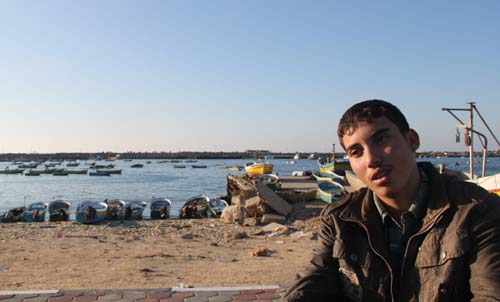
“The bullets made the water splash up in my face. The soldiers shouted at us to take off our shirts and trousers. We had to jump into the water and swim towards them one by one” says 17-year old Mohammed Bakr, as he recounts how Israeli naval forces detained him from his family’s fishing boat, together with his cousin and uncle.
Mohammed Wisam Lutfi Bakr is the oldest of 9 children. He is from a fisherman’s family living in Gaza City’s Remal neighbourhood. He has been helping out on his father’s fishing boat since he was 7 years old. As he explains what happened to him, his cousin, and their uncle on the early morning of 10 November he relives the fear he felt during the initial attack, arrest and subsequent detention.
Like every morning when the weather allows, Mohammed, his cousin Abdul Kader Wael Bakr (17), and their uncle Arafat Lutfi Bakr (28) went out fishing off the shore of Gaza City, leaving at approximately 03.00. At around 03.30, when they were approximately 2 nautical miles off Gaza City’s shore, they were suddenly approached by a large Israeli gunboat. Without warning soldiers started firing shots in the water around them, very close to the boat. “The bullets made the water splash up in my face. The soldiers shouted at us to take off our shirts and trousers. We had to jump into the water and swim towards them one by one” Mohammed recalls. His uncle Arafat went first. Mohammed watched how his uncle was pulled on board of the gunboat by the soldiers. Then his cousin Abdul Kader followed. “I went last” says Mohammed, “they handcuffed us with plastic straps and blindfolded Arafat. There were at least 5 soldiers. They kicked and beat me on my arms and legs. They did the same to my cousin. I’m almost sure they gave our uncle even worse treatment, but I could not see him because they took him out of our sight”. All three of them were taken to a detention facility in Ashdod and held there blindfolded. “It was very dirty. At some point I said I needed to go to the toilet. Then they put me in an open area where everyone could see me. There was not even a toilet.”
Around 12.00h Mohammed and Abdul Kader were transferred to Erez checkpoint, between Israel and the Gaza Strip. There the two cousins were held and questioned until 22.30h. Then the soldiers at the Erez called Mohammed’s father and grandfather to tell them that they released the two cousins. The two men had been waiting for news about the boys since noon, when a fisherman told them they had been taken by soldiers. The father and grandfather had heard shots being fired while they were in the mosque for morning prayers. Later they realized they had heard the attack on Mohammed, Abdul Kader and Arafat.
Mohammed cannot stop thinking about his uncle, who is still being held in Israeli detention; “Arafat and I would go everywhere together and do all the fishing together. I am very worried about him. The soldiers even said; ‘you always go fishing with Arafat’. I am very afraid for how they are treating him.” Arafat is a member of the Palestinian Naval Police.
On the day of the arrest, the family’s fishing boat, including the motor and net, were confiscated. The boat was passed from Mohammed’s grandfather to his father and has been the livelihood of the extended family for as long as Mohammed can remember: “we have no money for a new boat, motor, and net. Altogether it would cost us around 46,000 NIS.” With the confiscation Mohammed and many of his relatives lost their only source of income.
Mohammed is in his last year of high school and is preparing for the final tawjihi exams; “all my classmates take extra classes for the tawjihi but it costs a lot of money, which my family doesn’t have.” Mohammed would like to take the extra classes too but with the loss of the family income, that has become an impossible challenge.
The Israeli army violence against the fishermen has a major impact on Mohammed and his family: “last year my twenty year old cousin, Mohammed Mansour Bakr, was attacked by the Israeli army while fishing. The soldiers shot him and he died. The army is merciless. We stopped fishing for a little while but eventually we had no choice but to get back to our work. We are attacked a lot by the soldiers. They harass us. During this year’s Ramadan they chased and harassed us seven times. It feels like they want to disturb us more during our holy month. At sea the thoughts of risks are constantly in my head. Everyone can feel the same fear at sea. It feels like watching a frightening movie”. However, there is no other option for Mohammed and his family but to continue fishing; “There is no other work for us. Where can we possibly get other work from in Gaza? Even though our work is very dangerous, there is no other choice but to go back to the see because we need the money. If and when we get another boat, I will go again.”
For the past two decades the fishing waters of the Gaza Strip have gradually shrunk by access restrictions imposed as a result of the Oslo agreement and more recently by illegal unilateral restrictions imposed by Israel. Even within the currently enforced 3 nautical mile limit, the Israeli navy regularly attacks, arrests, and sometimes even kills fishermen. This year at least 32 fishermen were arrested, 17 in the month of November. Another 5 fishermen were injured and at least 20 boats were confiscated. In conjunction with the restriction on fishing waters, the income of Gaza’s fishing community (8,200 fishermen and workers in the fishing sector) has steadily decreased. By 2010 the fishing catch had decreased by 37% compared to 2008 and this amounted to only half of the 1999 fishing catch. The sardine catch, which makes up 70% of Gaza’s total fishing catch, now only reaches 20% of the sardine catch that existed before the restrictions, representing a loss of $10 million. Finally, according to the Fisherman’s Syndicate, around 60% of the small fishing boats and 22% of trawler boats in the Gaza Strip are not used because of the high risks involved and the limited catch.
Hebron: Occupation and Sterilization

The divisions have been institutionalized. (Markus Balázs Göransson)
By Markus Balázs Göransson | Palestine Chronicle | December 2, 2011
The center of Hebron is surreal and terrifying. It is strange and overwhelming to see this schizophrenic place with my own eyes. As I walk along the streets, my senses are heightened yet I cannot fully process what I see. It feels like I am walking in a dream or on an empty movie set. The legacy of violence is stark and in your face and I am reminded of the ruins and craters that I saw when visiting Srebrenica in Bosnia several years ago. Yet, unlike Srebrenica, there has been no attempt to move past the divisions in Hebron. Instead, the divisions have been frozen and institutionalized and today Hebron is relatively quiet only because people are kept physically apart.
A handful of Jewish settlers – 800, in a city of 170 000 – have moved into the heart of the city and to protect them the Israeli army has created “sterilized zones” where the movement, residence and business of Palestinians are sharply restricted. On parts of some streets Palestinians are allowed to pass but when they do so they walk swiftly with their heads down to escape notice by Israeli settlers and soldiers. Other streets are closed to Palestinians, who cannot work or walk there. Technically, they are allowed to live in some buildings but the front doors of these buildings have been bolted shut and the residents are able to enter and leave them only through back windows or over rooftops.
Some Jewish settlers living nearby harass the Palestinians regularly with impunity. The Israeli army division stationed in Hebron is there to protect Jewish settlers and is not authorized to defend Palestinians against settler violence which is frequent and vicious. Five hundred Israeli soldiers are deployed to protect eight hundred Jewish settlers. And since the Palestinian police are not allowed to enter the sterilized zones there is little or no safeguarding of Palestinian rights. Most Palestinians who could escape the zones have escaped. Only the poorest families – and the criminals seeking a refuge – remain.
In one courtyard, where a thick stench of trash and rotting food hangs in the air fifty Palestinian families used to live. Today only two remain. They live in a building scarred by violence, where the front door is blocked and the windows covered with iron bars and metal nets. They enter and exit through a back window leading to the Arab part of the city. The courtyard in front of their apartment used to be full of life but is now covered in trash. Alleyways leading from the courtyard are blocked with slabs of concrete and giant rolls of barbed wire. An Israeli soldier is standing nearby, eyeing us uneasily as we move around listening to our guide explaining the history and nature of the conflict in Hebron.
My visit to Hebron was arranged by the Israeli NGO Breaking the Silence, a veterans organisation which collects and publishes testimonies of Israeli soldiers about the abuses they have committed in the occupied Palestinian territories. The founder of this organization, Yehuda Shaul – a bearded Jewish man who wore a kippa and described himself as Orthodox – guided us around the deserted streets of the now Jewish parts of Hebron, showing us destroyed architecture, boarded-up Palestinian homes and the ubiquitous presence of the Israeli army. He had himself taken part in the occupation, serving as a grenade launcher operator with the IDF in Hebron during the Second Intifada (2000-4).
Explaining the military logic of the occupation, Shaul stressed two messages. First, he insisted that there is no such thing as a “good occupation” and that the Israeli public is simply soothing its conscience with the myth that the Israeli Defense Force is enforcing a moral occupation. On the contrary, he argued, an occupation cannot be effective without involving serious abuses of the rights of the local people. This is irrespective of the virtues and morality of the individual soldier. The logic and pressures of the situation will lead soldiers to treat certain categories as security threats and hence deprived of certain rights. Add to this, he noted, the psychological stress that many soldiers suffer on account of being stationed in hostile territory and the widespread atmosphere of impunity around them and you have a combustible mix.
Shaul went on to say that many of the abuses committed by the Israeli army have a clear military purpose. They are not the result of indiscipline or frustration but part and parcel of the very strategy of the occupation. He gave as an example that Israeli forces systematically disrupt the daily life of local Palestinians in order to keep them on their toes and thereby discourage them from engaging in organized violence. He also recalled from his own military service in Hebron that Israeli soldiers would repeatedly break into Palestinian homes to snatch with them young boys that they would force to walk in front of their vehicles during patrols. This was not an act of cruelty but an effective tactic to prevent other Palestinians from throwing stones at them.
Shaul’s central message was that the occupation, despite the lofty rhetoric surrounding it, carries a dark underside, and it is this underside that Breaking the Silence wants to expose and bring to the attention of the Israeli public. He emphasized that Israelis must take responsibility for the crimes committed in their name. There is a large moral price tag to the occupation, Shaul insisted, and the Israeli people must face up to this.
Unsurprisingly, our tour group was not greeted warmly by many Hebron settlers. Many shouted abuse at us, and at one point a group of children, aged 7-8 years, took a hose and sprayed us with water as we passed a settlement. Two of them ran after us and punched, kicked and jumped on Shaul, calling him names. I was disgusted, not because of their obvious hatred, but because they were so steeped in a sense of self-righteousness and impunity that they felt safe and entitled to attack a group of adult visitors.
It is difficult not to be outraged by the situation in Hebron. The visit brought home some of the injustice and intractability of the Israel-Palestine conflict, and the structural logic and powerful interests that sustain it.
– Markus Balázs Göransson is currently studying for a PhD in International Politics at Aberystwyth University. He has previously worked as a conflict researcher and written on conflicts in the Philippines, the Balkans and the Middle East.
Anonymously Explaining Pakistan Deaths
By Peter Hart – FAIR – 11/29/2011
A New York Times piece today about the U.S. airstrikes that apparently killed 24 Pakistani soldiers opens with Pakistani Prime Minister Yousaf Raza Gilani speaking publicly about the incident, as does Pakistani military spokesperson Maj. Gen. Athar Abbas.
Readers are then treated to a lesson in how U.S. officials speak to important news outlets about an emerging, controversial story. They don’t use their names. Instead, we hear from:
- “A United States official” who comments on the “growing frustration in Washington about the increasingly harsh language coming out of Islamabad.” He “spoke on the condition of anonymity, citing the need not to personally alienate Pakistani officials.”That same official then is allowed to mischaracterize the Pakistani complaint: “You hear what they’re saying, and they’re making it sound like we’re just bombing Pakistani military positions for the hell of it.”
- “Another American official,” who “disputed the Pakistani assertions that the border posts were in areas that had been largely cleared of insurgents.”
- “Yet another American official… who asked not to be identified in discussing a case that is under investigation.”
- And, finally, a “third American official briefed on the raid.”
Elsewhere in the paper, a Times editorial explained its regrets over this incident and others:
It’s not clear what led to NATO strikes on two Pakistani border posts this weekend, but there can be no dispute that the loss of lives is tragic. At least 24 Pakistani troops were killed. We regret those deaths, as we do those of all American, NATO and Afghan troops and Pakistani and Afghan civilians killed by extremists.
So any deaths in the wars in Afghanistan or Pakistan are regrettable–except for civilians killed by U.S./NATO forces.
NYT Befuddled on Cluster Bomb Ban?
Which Side Are We On? NYT, U.S and Cluster Bombs
By Peter Hart – FAIR – 11/28/2011
International efforts to ban cluster bombs fell apart late last week. If you were reading about this in the New York Times, you might have been led to believe that the United States was pushing to get rid of the weapons–instead of the opposite.
Here’s the lead sentence from a story in Saturday’s paper (11/26/11):
GENEVA — Despite last-minute attempts to broker a compromise, American-led efforts to conclude an international treaty restricting use of cluster munitions collapsed on Friday in the face of opposition from countries that said it did not address their humanitarian concerns and would undermine existing international law.
This “American-led effort,” readers were told, “reflected the increasing stigmatization of a weapon recognized as causing unacceptable harm to civilians and seen as having lasting effects on development for decades after conflicts have ended.”
Well, who opposes such efforts? It takes a little while to understand that the other side is taking a much tougher stance to eliminate cluster bombs, as outlined at an Oslo conference in 2008:
But countries and disarmament groups opposing the draft treaty said the humanitarian impact of the proposed protocol would be minimal and would legitimize continued use of other cluster munitions that are recognized to cause unacceptable harm.
These countries, together with the International Committee of the Red Cross and United Nations agencies dealing with development and human rights, also argued that the adoption of a legal instrument that was weaker than the Oslo agreement would set a dangerous precedent.
The Times’ confused account is in stark contrast to other reporting. This Reuters piece, for example, does a much better job of explaining things in its lead:
GENEVA (Reuters) — A U.S.-led push to regulate, rather than ban, cluster munitions failed Friday after 50 countries objected, following humanitarian campaigners’ claims that anything less than a outright ban would be an unprecedented reversal of human rights law.
Something tells me the Times story would look a little differently if the United States weren’t on the pro-cluster bomb side of this argument.
Israel threatens to cut Gaza water, power
Press TV – November 26, 2011
Israel has threatened to cut the supply of water and electricity to the Gaza Strip if rival Palestinian movements, Fatah and Hamas, establish a unity government.
“The foreign ministry is examining the possibility of Israel pulling out of the Gaza Strip in terms of infrastructure,” AFP quoted Deputy Israeli Foreign Minister Danny Ayalon as telling the daily Yediot Aharonot’s website on Saturday.
Ayalon, a Knesset (Israeli parliament) deputy for the leftist Yisrael Beitenu party, said a Palestinian unity government “would put an end to any hope for a peace agreement” with Tel Aviv.
On Thursday, acting Palestinian Authority (PA) Chief Mahmoud Abbas (leader of Fatah party) held talks with Hamas Political Bureau Chief , Khaled Meshaal, in the Egyptian capital Cairo, where they announced a new era of partnership between the rival Palestinian factions.
The talks seriously irked Israeli leaders who decided to maintain a freeze on the transfer of tens of millions of dollars in tax monies to the PA, to further increase the strain on Ramallah-based authority.
The transfer of funds, which make up a large percentage of the PA’s monthly budget, was frozen in November by Tel Aviv, after the Palestine won full membership of the UN cultural organization, UNESCO.
Israeli Prime Minister Benjamin Netanyahu had in January threatened to cut off water and power to the long-blockaded Gaza Strip.
Israel continues to control the supply of water to Gaza and 70 percent of the territory’s electrical power. The rest of Gaza’s electricity needs are supplied by neighboring Egypt and local power plants, which rarely receive enough fuel to operate under Israel’s blockade.
Israel has tightened its crippling closure on the Gaza Strip since 2007, defying international calls to lift the blockade.
Pakistan PM condemns NATO airstrike
Press TV – November 26, 2011
Pakistani Prime Minister Yousuf Raza Gilani has strongly condemned a NATO airstrike on a border post, which killed at least 28 Pakistani soldiers, Press TV reports.
Pakistan’s Foreign Ministry announced on Saturday that it also lodged a complaint in the strongest terms with NATO and the US over the attack, a Press TV correspondent reported.
“On his [Gilani] directions, the matter is being taken up by the foreign ministry, in the strongest terms, with NATO and the US,” the ministry said.
The incident occurred when a NATO helicopter targeted a security forces checkpoint known as Salala on the Mohmand Agency in northwestern Pakistan near the Afghan border early on Saturday. The strike also left 15 Pakistani soldiers injured.
The Western alliance said it was aware that an incident took place and it is still in the process of gathering information to investigate the attack.
In retaliation, Islamabad has blocked NATO supplies to Afghanistan.
Dozens of trucks carrying goods and petroleum supplies for NATO forces were stopped in the Torkham border area of the Khyber tribal region in northwestern Pakistan.
Pakistan has repeatedly condemned airstrikes against its troops near the border with Afghanistan. While the strikes supposedly target militants, they usually claim the lives of civilians and Pakistani soldiers.
Executed Britons
By Craig Murray on November 19, 2011
The two British men executed by US drone attacks in Pakistan were not killed in combat. They were assassinated while going about normal life. This is a most barbarous practice, which amounts not just to execution without trial, but to inaccurate execution killing many who were never accused in the first place.
Being British does not make these particular victims more important than the thousands of others – including numerous women and children – that the US has assassinated in this way. But it does give the British government a standing to protest. Sadly there is no chance that the neo-cons in power will do anything about it. If there was one area where you might have expected the Lib-Dem presence in government to give it a slightly more liberal tinge, it was foreign affairs. In fact, there has been no evidence of that whatsoever.
Featured Video

Genocide-linked firm handles Britons’ NHS data
or go to
Aletho News Archives – Video-Images
Book Review
How the U.S. Navy Sold the Vietnam War
By Gareth Porter | TruthDig | March 27, 2019
Dr. Tom Dooley, whose best-selling book “Deliver Us From Evil” helped create a favorable climate of opinion for U.S. intervention in South Vietnam, has long been linked to legendary CIA officer Edward G. Lansdale and his black operations in Vietnam between 1954 and 1955. But the real story about Dooley’s influential book, which has finally emerged from more recent scholarly research, is that it was engineered by an official of the U.S. Navy’s Pacific Command, Capt. William Lederer.
Lederer is best known as the co-author, with Eugene Burdick, of the 1958 novel “The Ugly American,” which was turned into a 1963 movie starring Marlon Brando. Far more important, however, is the fact that from 1951 through 1957 Capt. Lederer was on the staff of the commander in chief of the U.S. Pacific Fleet (CINCPAC), Adm. Felix Stump. … continue
Blog Roll
 Aletho News
- The 10 Disease Renamings That Rescued the Vaccine
- NATO cancels 2027 leaders’ summit
- IAEA’s politicized use of safeguards undermines its impartiality: Russian envoy
- UK must be ready to strike Russian Arctic – ex-PM
- Fico’s Two Red Lines: Russian Energy and the Next Ukraine Loan
- Thousands rally for banned NATO-skeptic presidential candidate
- Ukraine Settlement and New European Security Architecture Must Go Hand in Hand – Kremlin
- Book review: Boiling Point, How America Brought War to Ukraine
- Israel Revives The ‘Iranian Assassination Threat Against Trump’ Deception In A Desperate Bid To Restart The War
- US rewrites history to dodge blame for illegal war on Iran: Foreign Ministry spokesperson
- If Americans Knew
- No, Christians did not invent Zionism
- Hakeem Jeffries & Chuck Schumer: Conduits for Israel Lobby Dark Money
- DAILY UPDATE: Latest essential news on Palestine, Israel, & region
- Aid organizations in Gaza are pulling back, leaving hundreds of thousands of Palestinians without food
- 1.4 Million People in Gaza Live in Tents. Winter Storms Can Be a Death Sentence.
- Israel Used a U.S.-Made Missile to Kill Six at Gaza’s Nasser Hospital
- Congress Might Sneakily Use Lame Duck to Deeply Intertwine the U.S. and Israeli Militaries
- DAILY UPDATE: Latest essential news on Palestine, Israel, & region
- 9-month-old baby dies from severe cold in Gaza, 1st cold-related death this winter: Health Ministry
- Israel Kills over 12, Injures Many Across Gaza
- No Tricks Zone
- New Study: Barents Sea Temperatures Were Warmer And Sea Ice Less Extensive In The 1700s Than Today
- German Authorities Start Initiative To Evaluate Public Register For Climate “Disinformation” Spreaders!
- Zonal Asymmetry of Temperature Change in the Antarctic Circumpolar Current
- New Study: The Net Fossil Fuel Contribution To Rising Atmospheric CO2 Has Been Zero For 500 Years
- Germany’s Green Energy Transition Becoming Increasingly Expensive…Another 6 Trillion Euros!
- Sudden Stratospheric Warming, Powerful El Niño Combination May Lead To Extreme Europe Cold, Energy Crisis!
- Two New Studies Find Thwaites Glacier Melt Cannot Be Driven By Human Activity Or A Warming Ocean
- E-Cars Reduce CO2 Emissions By Only 41% Compared To Internal Combustion Engine Vehicles
- Predictions Made By Renowned Climate Professor Over Past Decades Have Been Proven To Be Poor
- New Study Suggests Large Regions Of The Pacific Ocean Have Been Cooling For The Last 80 Years

