Necessity and Defiance
By Eva Bartlett | April 16, 2010

Mohammed Abu Jerrad, 12, works with his older brother and 4 others to gather their wheat. Although it is still somewhat early for harvesting, the family hopes to harvest their 5 dunams quickly, preferring the early harvest over the possibility that Israeli soldiers will demolish or light their crops afire, as they have routinely done in the past. [One such incident occured in Johr Ad Dik last May, when Israeli soldiers shot incendiary devices into ripe wheat and barley fields, setting nearly 3 km, 200 dunams, of crops and fruit trees afire.]

Abu Jerrad’s 5 dunams lie roughly just over 300 metres from the border, along which Israeli military tower and remote controlled machine gun towers loom. From these towers, Israeli soldiers regularly shoot on farmers, workers gathering rubble and scrap metal for construction uses, and civilians on the land.
This plot of wheat is on rented land.
“We grow it to feed our sheep and goats,” Abu Jerrad says of his 150 animals.
“This morning when we came here to work the Israelis began shooting, so we left,” he says.
“Yes, Mohammed was with us,” he answers of the 12 year old helping him.
“Sometimes they even shoot at the sheep,” he adds. “Are they afraid of the sheep?” he jokes.
The 6 farmers can do two trips of 3 loaded donkey carts per day, if all goes well. It will take many more days before their crops are harvested.
In a Strip under years of siege and an area where Israeli shooting, shelling and kidnapping is the norm, every incident of farming is an act of necessity and an act of defiance: Palestinian farmers will not be driven off their land.


*Sheep, most often seen scouring Gaza’s vacant lots and garbage dumps, find good grazing land for a change. Much of Gaza’s prime grazing land has been destroyed or is inaccessible due to the Israeli-imposed “buffer zone”.
Afghans ‘abused at secret prison’ at Bagram airbase
By Hilary Andersson | BBC News | April 15, 2010
Bagram – Afghan prisoners are being abused in a “secret jail” at Bagram airbase, according to nine witnesses whose stories the BBC has documented. The abuses are all said to have taken place since US President Barack Obama was elected, promising to end torture.
The US military has denied the existence of a secret detention site and promised to look into allegations.
Bagram was the site of a controversial jail holding hundreds of inmates, who have now been moved to another complex.
The old prison was notorious for allegations of prisoner torture and abuse. But witnesses told the BBC in interviews or written testimony that abuses continue in a hidden facility.
Sleep deprivation
“They call it the Black Hole,” said Sher Agha who spent six days in the facility last autumn.
“When they released us they told us we should not tell our stories to outsiders because that will harm us.”
Sher Agha and others we interviewed complained their cells were very cold.
“When I wanted to sleep and started shivering with cold I started reciting the holy Koran,” he said. But sleep, according to the prisoners interviewed, is deliberately prevented in this detention site.
“I could not sleep, nobody could sleep because there was a machine that was making noise,” said Mirwais, who said he was held in the secret jail for 24 days.
“There was a small camera in my cell, and if you were sleeping they’d come in and disturb you,” he added.
The prisoners, who were interviewed separately, all told very similar stories. Most of them said they had been beaten by American soldiers at the point of arrest before being taken to the prison.
Mirwais had half a row of teeth missing, which he said was from being struck with the butt of a gun by an American soldier.
No-one said they were visited by the International Committee of the Red Cross during their detention at the site, and they all said that their families did not know where they were.
In the small concrete cells, the prisoners said, a light was on all the time. They said they could not tell if it was night or day and described this as very disturbing.
Mirwais said he was made to dance to music by American soldiers every time he wanted to use the toilet.
The ex-prisoners said they were imprisoned at the secret jail before being taken to the main detention centre at the Bagram airbase, a new complex called The Detention Facility in Parwan. Bagram’s prisoners were moved to the Parwan complex from the old notorious Bagram prison site on the airbase earlier this year… Full article
Did Banned Media Report Foretell of Gaza War Crimes?
By Jonathan Cook – Nazareth – April 15, 2010
An Arab member of the Israeli parliament is demanding that a newspaper be allowed to publish an investigative report that was suppressed days before Israel attacked Gaza in winter 2008.
The investigation by Uri Blau, who has been in hiding since December to avoid arrest, concerned Israeli preparations for the impending assault on Gaza, known as Operation Cast Lead.
In a highly unusual move, according to reports in the Israeli media, the army ordered the Haaretz newspaper to destroy all copies of an edition that included Mr Blau’s investigation after it had already gone to press and been passed by the military censor. The article was never republished.
Mr Blau has gone underground in London after the Shin Bet, Israel’s secret police, demanded he return to Israel to hand back hundreds of classified documents they claim are in his possession and to reveal his sources.
He published several additional reports for Haaretz in 2008 and 2009 that severely embarrassed senior military commanders by showing they had issued orders that intentionally violated court rulings, including to execute Palestinians who could be safely apprehended.
Haneen Zoubi, an MP who previously headed an Israeli media-monitoring organisation, said it was “outrageous” that the suppressed report was still secret so long after the Gaza attack. She is to table a parliamentary question to Ehud Barak, the defence minister, today demanding to know why the army suppressed the article and what is preventing its publication now. Mr Barak must respond within 21 days.
She said publication of the article was important both because Israel had been widely criticised for killing many hundreds of civilians in its three-week assault on Gaza, and because subsequent reports suggested that Israeli commanders sought legal advice months before the operation to manipulate the accepted definitions of international law to make it easier to target civilians.
“There must be at least a strong suspicion that Mr Blau’s article contains vital information, based on military documentation, warning of Israeli army intentions to commit war crimes,” she said in an interview.
“If so, then there is a public duty on Haaretz to publish the article. If not, then there is no reason for the minister to prevent publication after all this time.”
Ms Zoubi’s call yesterday followed mounting public criticism of Haaretz for supporting Mr Blau by advising him to stay in hiding and continuing to pay his salary. In chat forums and talkback columns, the reporter has been widely denounced as a traitor. Several MPs have called for Haaretz to be closed down or boycotted.
A Haaretz spokeswoman refused to comment, but a journalist there said a “fortress mentality” had developed at the newspaper. “We’ve all been told not to talk to anyone about the case,” he said. “There’s absolute paranoia that the paper is going to be made to suffer because of the Blau case.”
Amal Jamal, a professor at Tel Aviv University who teaches a media course, said he was concerned with the timing of the Shin Bet’s campaign against Mr Blau. He observed that they began interviewing the reporter about his sources and documents last summer as publication neared of the Goldstone report, commissioned by the United Nations and which embarrassed Israel by alleging it had perpetrated war crimes in Gaza.
“The goal in this case appears to be not only to intimidate journalists but also to delegitimise certain kinds of investigations concerning security issues, given the new climate of sensitivity in Israel following the Goldstone report.”
He added that Mr Blau, who had quickly acquired a reputation as Israel’s best investigative reporter, was “probably finished” as a journalist in Israel.
Shraga Elam, an award-winning Israeli reporter, said Mr Blau’s suppressed article might also have revealed the aims of a widely mentioned but unspecified “third phase” of the Gaza attack, following the initial air strikes and a limited ground invasion, that was not implemented.
He suspected the plans involved pushing some of Gaza’s population into Egypt under cover of a more extensive ground invasion. The plan had been foiled, he believed, because Hamas offered little resistance and Egypt refused to open the border.
On Monday, an MP with the centrist Kadima Party, Yulia Shamal-Berkovich, called for Haaretz to be closed down, backing a similar demand from fellow MP Michael Ben-Ari, of the right-wing National Union.
She accused Haaretz management of having “chosen to hide” over the case and blamed it for advising Mr Blau to remain abroad. She said the newspaper “must make sure the materials that are in his possession are returned. If Haaretz fails to do so, its newspaper licence should be revoked without delay.”
Another Kadima MP, Yisrael Hasson, a former deputy head of the Shin Bet, this week urged Haaretz readers to boycott the newspaper until Mr Blau was fired.
A petition calling on the Shin Bet to end its threat to charge Mr Blau with espionage has attracted the signatures of several prominent journalists in Israel.
“We believe the Blau case is unique and are concerned this unique case will create a dangerous precedent,” their letter states. “Until now, prosecution authorities have not sought to try reporters for the offence of holding classified information, an offence most of us are guilty of in one way or another.”
A group of Israeli human rights organisations is due to submit a letter this week to the government demanding that the investigation concentrate on lawbreaking by the army rather the “character assassination” of Mr Blau and his sources.
Yesterday, the supreme court tightened restrictions on Anat Kamm, one of Mr Blau’s main informants, who has been under house arrest since December for copying up to 2,000 military documents while she was a soldier. She is accused of espionage with intent to harm the state, a charge that carries a tariff of 25 years in jail.
The papers copied by Ms Kamm, 23, included military orders that violated court rulings and justified law-breaking by soldiers.
Judge Ayala Procaccia said: “The acts attributed to the respondent point to a deep internal distorted perception of a soldier’s duties to the military system he or she is required to serve, and a serious perversion from the basic responsibility that a citizen owes the state to which he or she belongs.”
Ms Kamm, the court decided, must not leave her apartment and must be watched by a close relative at all times.
Media coverage of the case in Israel has been largely hostile to both Ms Kamm and Mr Blau. Gideon Levy observed in Haaretz today: “The real betrayal has been that of the journalists, who have betrayed their profession — journalists who take sides with the security apparatus against colleagues who are doing their job bringing light to the dark.”
Calling Israel “a Shin Bet state”, Mr Levy added: “If it depended on public opinion, Kamm and Blau would be executed and Haaretz would be shut down on the spot.”
Israel’s ‘crisis of legitimacy’
Jared Malsin – 13/04/2010
I know something about how Israel’s security forces treat journalists they view as hostile. In January, I was held for over a week in a dingy detention center at Israel’s Ben Gurion International Airport before being deported.
Before I was detained, I was interrogated in a spare, windowless office in the airport about news articles I had authored in my two and a half years working in the occupied West Bank for the Palestinian news agency Ma’an.
At one point, the security officer, a woman with piercing blue eyes who never identified herself, paged through the contacts in my cell phones, demanding that I provide information about sources, colleagues, and friends whose numbers I had stored. I refused.
She set the phones down on her desk and I, without thinking, reached for them. She stopped me. “In this office, you have no rights,” the interrogator explained. I didn’t see the phones, like the rest of my possessions, until I was expelled to New York eight days later.
So it’s natural that I’ve been following and investigating for weeks the case of Anat Kamm, the Israeli journalist and former soldier who has been under secret house arrest for months over allegations she leaked military documents, and Uri Blau, the reporter who reportedly used those papers to expose a West Bank assassinations program that violates even Israel’s own laws.
Like me, Blau, a reporter for the Israeli newspaper Haaretz, also finds himself unable to return to Israel.
I’m not Israeli, and Blau’s situation is different and, in important ways, much more severe than mine. But I believe I can empathize, on some basic level, with the Kafkaesque turn his life has taken.
Blau is in hiding in London, fearing arrest if he returns to his home country. He exposed documents that proved the military was violating a High Court of Justice order by authorizing the killing of Islamic Jihad leaders, even when innocents were also killed.
Blau wrote an article in Friday’s newspaper explaining how he went on vacation in December not knowing the extent to which he was under surveillance: “When I left Israel I had no reason to believe our planned trip would suddenly turn into a spy movie whose end is not clear.”
“I certainly didn’t think I’d have to stay in London and wouldn’t be able to return to Tel Aviv as a journalist and a free man, only because I published reports that were not convenient to the establishment,” he wrote.
Israel’s General Security Service (GSS, known casually as the Shin Bet) suspects Blau received the documents from Kamm, a writer for the popular Israeli news and entertainment site Walla!, who obtained the papers during her mandatory military service years earlier.
For months, Israeli authorities banned publication of any information on the case, or even mentioning the gag order.
After weeks of news of the case leaking out in blogs and Palestinian and international media (including a Ma’an investigation that I assisted), the government caved in and lifted the gag order on Thursday. The floodgates were opened.
Now that Blau and his editors at Haaretz can freely report their side of the story, much of what I learned from sources close to the case in recent weeks has been confirmed.
We now know, for example, that security agents raided Blau’s apartment, and that they seized and destroyed his computer.
We also know that Blau was the original focus of the Shin Bet’s investigation, and that his reports were at the heart of the case.
I spoke with Israeli historian Avner Cohen, an expert on Israeli state secrecy and the author of Israel and the Bomb, a book on the history of the Israeli nuclear program, about the matter.
Cohen said the Israeli state’s motivation in investigating Blau was varied, above all a “breach of field security,” but also a sense of political embarrassment over Blau’s reports. Blau, he said, “was able to put his hands on lots of stuff that was offensive and biting to many people.”
“It is evident that the GSS were performing all sorts of close surveillance on Uri Blau and it appears it led them to find Anat Kamm,” he added.
Over the years, Blau has made a career of exposing wrongdoing by his country’s armed forces. His associates say that, at the age of 19, he began spending his days getting military sources to confirm reports of abuses gathered by senior Haaretz reporters.
I was told that Blau would drive around the West Bank, near the scene of military action, offering rides to soldiers who would then corroborate reports of wrongdoing. Today, he is known to have a deep network of military sources.
Last year, Blau wrote a disturbing exposé about army-endorsed T-shirts, worn by Israeli soldiers, depicting pregnant Palestinian women in a sniper’s crosshairs, among other grotesque images.
He also revealed a secret military database that exposed the true nature and extent of Israel’s illegal West Bank settlements. Seventy-five percent of the settlements were illegal under Israel’s own domestic law, the data showed.
The report that triggered the current controversy was published in November 2008. It cited confidential army documents showing that the military violated a High Court ruling by ordering the 2007 assassination of an Islamic Jihad leader in Jenin, even when arrest was possible, and even when civilians were endangered. The article cited a March 2007 document in which Major-General Yair Naveh authorized forces to shoot three Jihad officials on sight.
In an editorial in Friday’s paper, Haaretz confirmed that Blau was summoned by Shin Bet in September 2009 and told to return documents that he used in preparing several articles.
Haaretz said it signed an agreement with the security agency under which Blau would hand over some documents but would not face further questioning, that his sources would be protected, and that the papers would not be used in any potential prosecution.
The newspaper also noted that the Shin Bet broke this agreement by detaining Kamm on the suspicion that she was Blau’s source, and by announcing in January 2009 that Blau was “wanted for questioning.”
In its editorial, Haaretz underlined the central moral irony of the case: the controversy over Blau’s reporting on so-called “sensitive” security matters hides the real issue: Israel’s military circumvented the High Court by authorizing targeted assassinations outside of the rules of engagement.
“In reality, however, the crime in question is far more severe – the one committed by the security apparatus (GOC Central Command in particular) in ignoring a High Court order and approving the targeted assassination of wanted men who could otherwise have been detained, in strikes that claimed the lives of innocent civilians,” Haaretz’s editorial board wrote.
Regardless, many unanswered questions remain. What information was contained in the other documents that Blau was forced to hand over? What other, even more unsettling secrets might still be submerged in the recesses of Israeli bureaucracy?
Beyond this, what motivated the Shin Bet to commit the blunder of seeking a court-ordered gag order that embarrassingly collapsed under inevitable media pressure?
Avner Cohen told me he thought one aspect of the motivation was related to “Israeli sensitivity about the Goldstone report,” referring to the UN fact-finding mission that accused Israel of war crimes and possible crimes against humanity during its offensive on Gaza last year.
Cohen said the underlying context in the Kamm-Blau case is concern within the Israeli government about a “crisis of legitimacy” sparked by the allegations in the Goldstone report.
“There is a nervousness in Israel,” he said. “There is a sense that what has been tolerated by the world for decades, the occupation, the checkpoints and so on, that there is less and less tolerance for Israel as occupier.”
Katyn and ‘The Good War’
By Patrick J. Buchanan | April 13, 2010
The decapitation of the Polish government last weekend, including President Lech Kaczynski and the military leadership, on that flight to Smolensk to commemorate the Katyn Massacre, brings to mind the terrible and tragic days and deeds of what many yet call the Good War.
From Russian reports, the Polish pilot waved off four commands from air traffic control to divert to Moscow or Minsk. The airfield at Smolensk was fogged in. There is speculation that Kaczynski, fiercely nationalistic and distrustful of Russians, may have defiantly ordered his pilot to land, rather than delay the 70th anniversary of Katyn. The symbolism is inescapable.
For it was Polish defiance of Adolf Hitler’s demand to negotiate the return of Danzig, a German town put under Polish control after World War I, that gave birth to the Hitler-Stalin Pact, which led to Katyn.
After the German invasion on Sept. 1, 1939, ignited the war, Joseph Stalin attacked Poland from the east on Sept. 17, capturing much of the Polish officer corps.
In April 1940, on Stalin’s order, the Soviet Secret Police, the NKVD, murdered virtually the entire leadership of the nation, including 8,000 officers and near twice that number of intellectuals and civilian leaders. Some 4,000 were shot with their hands tied behind their backs in Katyn Forest.
The Germans unearthed the bodies in 1943 and invited the Red Cross in to examine the site. Through newspapers found on the corpses, the date of the atrocity was fixed as more than a year before the German army invaded the Soviet Union.
When Polish patriots, whose sons had flown with the Royal Air Force in the Battle of Britain, went to Winston Churchill to demand that he get answers from Stalin about the atrocity, he brushed them off.
“There is no sense prowling around the three-year-old graves of Smolensk,” said the Great Man.
At Stalin’s request, Churchill bullied the Poles into acceding to Soviet annexation of all the Polish land Stalin had been awarded for signing his pact with Hitler.
At the Nuremberg trials, the Russian delegation, led by Andrei Vishinsky, the prosecutor who did Stalin’s dirty work in the purge trials, charged the Germans with the massacre.
This presented a problem for the Americans and British who knew the truth. They finessed the issue by leaving the charge unresolved.
Before, during, and after the Nuremberg trials that would convict the Nazis of “crimes against humanity,” one of the greatest crimes against humanity in history was being committed. Fifteen million Germans – old men, women, children – were driven like cattle out of ancestral homes in Prussia, Pomerania, Brandenburg, Silesia, and the Sudetenland.
As human rights champion Alfred de Zayas wrote in his courageous Nemesis at Potsdam: The Anglo-Americans and the Expulsion of the Germans, perhaps 2 million died in the exodus. Few German women in Eastern Europe escaped rape.
The Allies turned a blind eye to the monstrous atrocity, as ancient names vanished. Memel became Klaipeda. Prussia disappeared. Koenigsberg, the city of Immanuel Kant, became Kaliningrad. Danzig became Gdansk. Breslau became Wroclaw.
“The Germans deserved it, for what they did,” comes the retort.
Undeniably, the Nazi atrocities were numerous and horrible – against Poles, Ukrainians, Russians, Jews.
Yet, it was innocent Germans who paid for the crimes of the guilty Germans.
What happened in Eastern and Central Europe from 1939 to 1948 provided proof, if any more were really needed, of the truth of W.H. Auden’s insight in his poem “September 1, 1939″: “Those to whom evil is done do evil in return.”
At war’s end, Churchill and Harry Truman agreed to repatriate 2 million Soviet prisoners of war to Stalin, none of whom wished to go back. For return to Russia meant death at the railhead or a short, brutal life at slave labor in the Gulag Archipelago.
Operation Keelhaul was the name given the Allied collusion with the Red Army in transferring these terrified POWs back to their deaths at the hands of the same Soviet butchers who had done the murdering at Katyn.
On Sept. 3, 1939, Britain and France declared war on Germany to restore the integrity and independence of Poland. For this great goal they converted a German-Polish clash that lasted three weeks into a world war lasting six years.
And was Poland saved? No. Poland was crucified.
As a consequence of the war begun on her behalf, millions of Poles – Jews and Catholics alike – perished, the Katyn massacre was carried out, the Home Army was annihilated, the nation suffered five years of Nazi rule and almost half a century of communist persecution.
The tragedy of today is that it was men of the postwar generation, like Lech Kaczynski, who kept the faith of their fathers and led Poland out of that darkness into the sunlight of freedom, who died seeking to pay homage to their fathers who suffered one of the greatest crimes of that bloodiest of centuries.
COPYRIGHT 2010 CREATORS.COM
At Least 21 Civilians Killed in Mogadishu Violence
Most Die as AU Troops Shell Residential Area
By Jason Ditz | April 12, 2010
Violence in the Somali capital of Mogadishu today killed at least 21 civilians and two government soldiers, and left scores injured. The bulk of the civilian toll came, as it so often does in Mogadishu, with AU shelling against a densely populated residential area.
The first attack involved a bombing attack against a government convoy, which left two government soldiers and four civilians dead. Another civilian was reported to have died of injuries related to a mortar attack on the airport.
The African Union forces responded by shelling a residential neighborhood near the city’s main marketplace, killing at least 16 and wounding 55 others. The head of the city’s ambulance service was highly critical of the AU attack.
“It was indiscriminate shelling,” he noted, adding it was the worst such incident in months. The Somali government confirmed the shelling but declined to offer any details about why the neighborhood was targeted.
But AU troops have regularly shelled the area around the Bakara market, one of the most populated in the city, in “retaliation” after insurgent attacks. The AU has in the past claimed that any areas outside government control are fair game for shelling, but as the self-proclaimed Somali government controls only a few city blocks near the presidential palace this has placed the vast majority of the Somali populace directly in the crosshairs.
The ‘Obama doctrine’: kill, don’t detain
Asim Qureshi | guardian.co.uk | 11 April 2010
In 2001, Charles Krauthammer first coined the phrase “Bush Doctrine”, which would later become associated most significantly with the legal anomaly known as pre-emptive strike. Understanding the doctrine with hindsight could lead to a further understanding of the legacy that the former administration left – the choice to place concerns of national security over even the most entrenched norms of due process and the rule of law. It is, indeed, this doctrine that united people across the world in their condemnation of Guantánamo Bay.
The ambitious desire to close Guantánamo hailed the coming of a new era, a feeling implicitly recognised by the Nobel peace prize that President Obama received. Unfortunately, what we witnessed was a false dawn. The lawyers for the Guantánamo detainees with whom I am in touch in the US speak of their dismay as they prepare for Obama to do the one thing they never expected – to send the detainees back to the military commissions – a decision that will lose Obama all support he once had within the human rights community.
Worse still, a completely new trend has emerged that, in many ways, is more dangerous than the trends under Bush. Extrajudicial killings and targeted assassinations will soon become the main point of contention that Obama’s administration will need to justify. Although Bush was known for his support for such policies, the extensive use of drones under Obama have taken the death count well beyond anything that has been seen before.
Harold Koh, the legal adviser to the US state department, explained the justifications behind unmanned aerial vehicles (UAVs) when addressing the American Society of International Law’s annual meeting on 25 March 2010:
“[I]t is the considered view of this administration … that targeting practices, including lethal operations conducted with the use of unmanned aerial vehicles (UAVs), comply with all applicable law, including the laws of war … As recent events have shown, al-Qaida has not abandoned its intent to attack the United States, and indeed continues to attack us. Thus, in this ongoing armed conflict, the United States has the authority under international law, and the responsibility to its citizens, to use force, including lethal force, to defend itself, including by targeting persons such as high-level al Qaeda leaders who are planning attacks … [T]his administration has carefully reviewed the rules governing targeting operations to ensure that these operations are conducted consistently with law of war principles …
“[S]ome have argued that the use of lethal force against specific individuals fails to provide adequate process and thus constitutes unlawful extrajudicial killing. But a state that is engaged in armed conflict or in legitimate self-defense is not required to provide targets with legal process before the state may use lethal force. Our procedures and practices for identifying lawful targets are extremely robust, and advanced technologies have helped to make our targeting even more precise. In my experience, the principles of distinction and proportionality that the United States applies are not just recited at meeting. They are implemented rigorously throughout the planning and execution of lethal operations to ensure that such operations are conducted in accordance with all applicable law.”
The legal justifications put forward by Koh are reminiscent of the arguments that were used by John Yoo and others in their bid to lend legitimacy to unlawful practices such as rendition, arbitrary detention and torture. The main cause for concern from Koh’s statements is the implication that protective jurisdiction to which the US feels it is entitled in order to carry out operations anywhere in the world still continues under Obama. The laws of war do not allow for the targeting of individuals outside of the conflict zone, and yet we now find that extrajudicial killings are taking place in countries as far apart as Yemen, the Horn of Africa and Pakistan. From a legal and moral perspective, the rationale provided by the State Department is bankrupt and only reinforces the stereotype that the US has very little concern for its own principles.
Despite the legalities of what is being conducted, the actuality of extrajudicial killings, especially through UAVs is frightening. The recent revelations by WikiLeaks on the killing of civilians by US Apache helicopters in Iraq has strongly highlighted the opportunities for misuse surrounding targeting from the air. In the Iraq case, there were soldiers who were supposed to be using the equipment to identify so-called combatants, and yet they still managed to catastrophically target the wrong people. This situation is made even worse in the case of UAVs, where the operators are far removed from the reality of the conflict and rely on digital images to see what is taking place on the ground.
Conservative estimates from thinktanks such as the New American Foundation claim that civilian causalities from drone attacks are around one in three, although this figure is disputed by the Pakistani authorities. According to Pakistani official statistics, every month an average of 58 civilians were killed during 2009. Of the 44 Predator drone attacks that year, only five targets were correctly identified; the result was over 700 civilian casualties.
Regardless of the figures used, the case that extrajudicial killings are justified is extremely weak, and the number of civilian casualties is far too high to justify their continued use.
A further twist to the Obama Doctrine is the breaking of a taboo that the Bush administration balked at – the concept of treating US citizens outside of the US constitutional process. During the Bush era, the treatment of detainees such as John Walker Lindh, Yasser Hamdi and Jose Padilla showed reluctance by officials to treat their own nationals in the way it had all those of other nationalities (by, for instance, sending them to Guantánamo Bay and other secret prisons). The policy of discrimination reserved for US citizens showed that there was a line the US was not willing to cross.
At least, today, we can strike discrimination off the list of grievances against the current president. The National Security Council of the US has now given specific permission to the CIA to target certain US citizens as part of counter-terrorism operations. Specifically, Anwar al-Awlaki has been singled out for such treatment, as it has been claimed that he was directly involved in the planning of the Major Hasan Nidal killings and the Christmas Day bomber attacks. Indeed, it is claims such as this that bring the entire concept of targeted assassinations into question. The US would like us to believe that we should simply trust that they have the relevant evidence and information to justify such a killing, without bringing the individual to account before a court.
The assumption that trust should be extended to a government that has involved itself in innumerable unlawful and unconscionable practices since the start of the war on terror is too much to ask. Whatever goodwill the US government had after 9/11 was destroyed by the way in which it prosecuted its wars. Further, the hope that came with the election of Barack Obama has faded as his policies have indicated nothing more than a reconfiguration of the basic tenet of the Bush Doctrine – that the US’s national security interests supersede any consideration of due process or the rule of law. The only difference – witness the rising civilian body count from drone attacks – being that Obama’s doctrine is even more deadly.
Affecting and Affected
Eva Bartlett | In Gaza | April 11, 2010
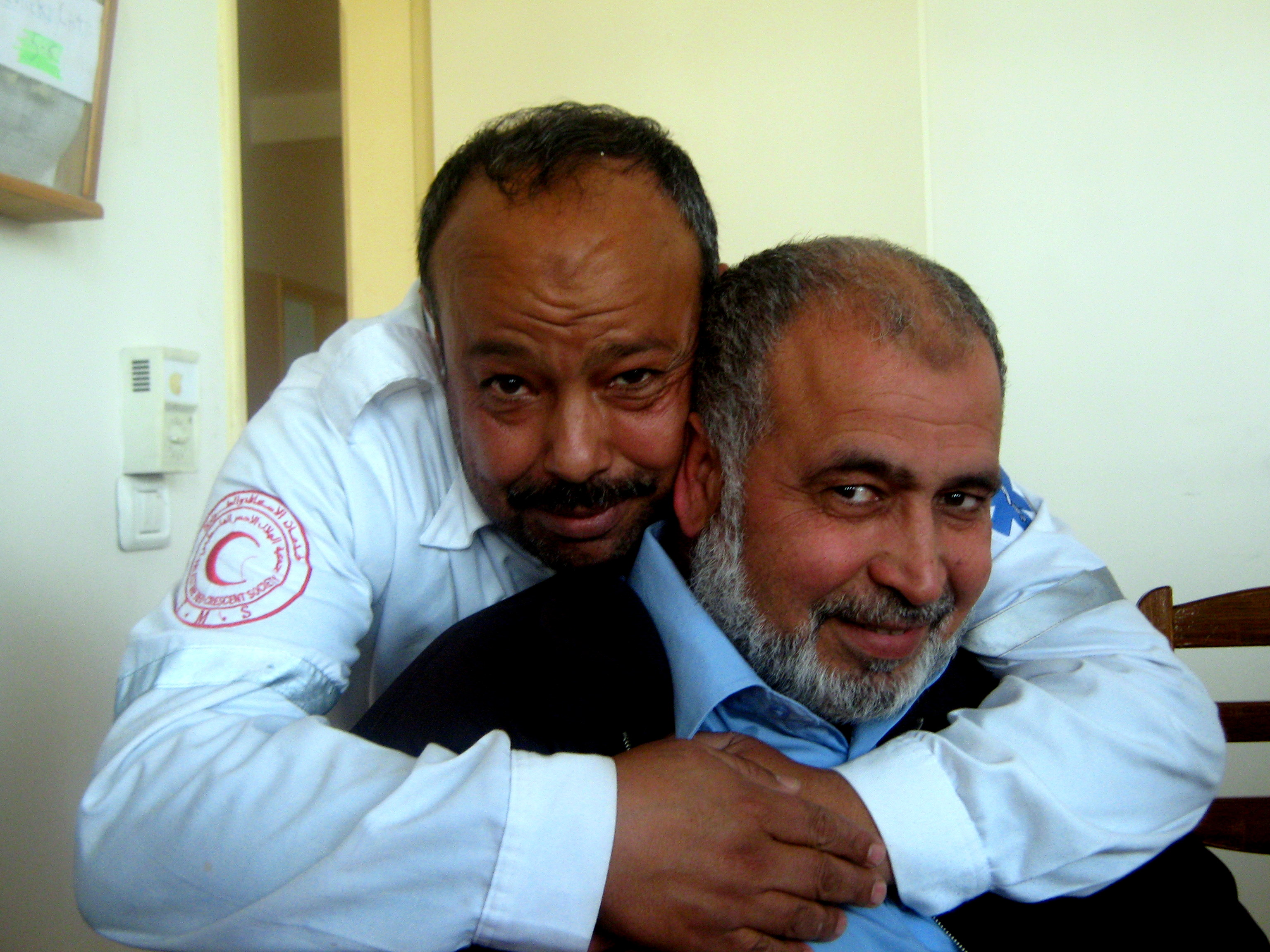
Abu Basel (right) is one of the long-termers, having served over 20 years as a medic in Gaza.
“Who will take care of people if not us? Someone has to do this work. Without medics, who will care for the injured? Everyone has something to contribute,” he replied to the question: why do you do such dangerous work.
Dangerous work. Being a medic hardly seems dangerous…anywhere else. But in a place like Palestine, medics have to contend with more than tending to the injured or bringing in the dead. They have to be aware of Israeli soldiers’ shooting, shelling from Apaches, F-16s, tanks, the sea…
Having spoken with Abu Basel many times during and after the Israeli massacre of Gaza last year, I thought I’d heard most of his horror stories.
He is a calm man, when not driving the ambulance, and relates all his stories in the same laid-back tone, whether joyful or atrocious.
Upon request, he begins to recall some of the many dangers he was exposed to during the last Israeli attacks, not to mention the nearly 2 decades before that.
He recalls being with medics and 4 ambulances, 2 metres from the Al Kurdi house in the Jabaliya region when an F-16 bombed it.
“How in the world are you alive?” I ask.
“It’s in God’s hands,” he replies.
He remembers a night in Beit Lahiya when they rushed to the site of a drone missile bombing.
“It was 1 am. We found the injured and brought the stretcher. A drone dropped another missile. Because it was night and there were not as many noises as during the day, I heard the sssss of the missile and we ran. The missile landed 1 metre from ambulance and 1.5 metres from the injured.
We ran back and grabbed the injured and drove. Two minutes later an F-16 bombed the house where we’d taken the injured from.”
He relates another incident in Sheyjayee where, similarly, a drone attacked his ambulance, dropping a missile metres from his ambulance.
“We’d gone to retrieve 5 injured but were only able to take four before the missile struck. A man nearby who had come to help us load the injured was killed by the missile. The ambulance windows shattered and my colleagues were injured.”
He then recalls 2 incidents when he says his ambulance had coordination via the International Committee of the Red Cross (ICRC) to reach an area the Israeli soldiers were occupying or preventing ambulances from accessing.
We went to Attatra with 3 Red Crescent ambulances and an ICRC jeep to bring out injured. When we reached the area, Israeli tanks started firing on us with machine gun fire. An ICRC employee started speaking with the Israelis via phone. ‘You’re firing on us,’ he said and the Israelis denied it. But the tanks kept firing and we had to leave quickly because of the danger.
Another time, in Esserah area, Beit Lahiya, we again went with coordination. We went there along the sea route and when near the area got on the microphone. ‘If there’s anyone injured or anyone needs to leave or has an ill person or needs help, we’re ICRC and RC, we’re here to help,’ we told them.
There was a guy sitting outside his destroyed house. He told us 13 people from his family were inside the house (children, elderly, women). We began helping them, loading them into our ambulances. When the Israeli soldiers saw us helping the people, they began firing on us from their tanks. We hurried, took the 13 people into our ambulance. Two tires were blown out on one ambulance, but there wasn’t time to transfer the people or wait for other ambulances. They’d been in there, the 14 of them, since their house was destroyed a week earlier. They’d been without food for the week, just had water.”

Iyad has been a medic for 16 years and equally has too many close calls to remember.
He shares some of his near-death escapes.
“I was working in the Red Crescent centre near Al Quds hospital, in the Tel el Howa area of Gaza City. After the Samounis were bombed, I went one afternoon to bring some of the martyrs. A drone and tanks fired missiles on the road we were driving on. Six missiles, the closest was just 8 metres away. We had gone without coordination, because there were many martyrs and the area where we headed was somewhat far from the Israelis, maybe 500 metres away. I saw them and they saw me. We managed to take a marytr and leave.”
Living in central Gaza, Iyad was among the medics completely cut off from his family during the massacre.
“For about a week I didn’t know anything on my family, the phone reception was so bad we couldn’t call each other. I live in Nussierat, and the road was severed by the Israelis, so I couldn’t get to them or communicate with them.”
“There are so many incidents,” Abu Basel says, “but I can’t remember them all, so many.”
He repeats what most medics have said.
“We weren’t afraid, despite the danger. But it was hard. We weren’t sleeping, not eating well –there was no time to eat or sleep. Most didn’t see our families during the war, just a minute or two here or there.”
While you’d think the most difficult time was the Israeli war on Gaza itself, because the medics were kept busy, most didn’t have time to think about the horrors of what they were seeing and experiencing.
“The hardest hardest was after the war,” says Abu Basel. “During the war, I knew there was death. I’d see a body, then a different body. I wouldn’t dwell on what I had seen, would just think about what I had to do next.
But after the war, I began to have terrible dreams, I’d remember everything. For 2 months I dreamed horrible dreams, warplanes, the bodies, everything I saw in the war I re-lived in my dreams.
That was much harder than the war.”
I remember Abu Basel telling me about finding Shahed Abu Halima, the infant girl killed by white phosphorous shelling, her corpse left for days as medics and family were unable to bring it out. Abu Basel was among the medics who uncovered the Abu Halima massacre, the charred remains of those family members killed in the shelling, and the gnawed body of Shahed, partially eaten by dogs.
“For the rest of my life I’ll remember that day. I’ll never get over it,” he said.
Do they feel scarred by their work and experiences?
“After 20 years of this, this kind of stress and work is normal. But still, after this last war, the worst so far, people were extremely nervous and agitated. Some developed diabetes. Many found that after the war they got angry easily and were not sociable, didn’t want to speak to people… but now most are better.
Many medics can’t have babies. I know one who after 7 years still hasn’t had children.
Many take medications to have kids. It’s because they are very stressed, they see a lot of terrible things and begin to have problems with psychology.”
After the massacre, a psychologist came to the Red Crescent to do workshops with the medics, says Abu Basel.
“For a month and a half, two days per week, we had sessions. He spoke with us, showed us exercises for relaxation, took us to the sea…
He gave us the will and spirit to work and live well.
The problem for us isn’t our psychology. We only need a break, to go somewhere else for a vacation and see something different. Go to Europe or somewhere, see a different life and try to forget what we saw.
For Iyad, there is no relaxation.
I sleep. Only. There’s nothing else to do. When I use the internet, there’s news. I watch TV or listen to the radio, and I hear news. I walk on the street, and all I hear is politics. There is no escape from this stress, no way to relax but to sleep.”


Ahmed Abu Foul’s daughter Hola is 6 months old now. Married just one week before the Israeli massacre of Gaza erupted, Ahmed’s honeymoon was 23 days of hell in his dual positions of medic with the Red Crescent and with the Civil Defense, along with the hell of being separated from family.
Although only 27, Ahmed’s stories are too many to recount.
He re-visits some of them, which I marveled over before:
-The time he went to retrieve a martyr near a cemetery in Beit Lahiya. Israeli machine gun fire erupts at him and Ahmed is trapped, lying on the road, breaking for it and zig-zagging his way back to the ambulance.
-When they went to the site of a bombing in Sheik Radwan, north of Gaza City.
“There had been a drone strike on a house, they said there were injured.
I was looking to see if anyone [was] injured. I was next to a 5 story house, in the alley, when an F-16 hit the house next to me. It fell in the other direction, but rubble fell on me.
I wasn’t badly injured, somehow, but my hair stood on end and I lost my hearing for 4 or 5 days,” Ahmed tells with a grin.
But his most troubling recent injury is that inflicted as he attempted to evacuate a martyr from a Jabaliya apartment.
“The Israelis had fired numerous missiles on Hamouda tower, a 5 story building in Jabaliya district. When we got there, we were told there was a martyr on 5th floor. I was the first to enter, everyone else was afraid. I found the body and Dr Issa Salah came up to help.
We were carrying the corpse down the stairs when the Israelis fired on us. The bomb blast decapitated Dr. Issa. His head hit me in the back of my head . I thought I’d been hit by shrapnel or something. Now I’ve got shrapnel in my head, but its bone shrapnel, from the dr. Issa. And shrapnel in leg from the bomb blast.
In a society where nearly everyone suffers from the continuous Israeli attacks, invasions, and wars, venting is not easy, and going to a psychologist is not the norm.
“After the war, I became extremely, extremely nervous. I was agitated and got angry easily. Sometimes if someone was making noise or annoying me I’d want to hit them,” he says, still smiling his open smile.
“I was never rested. When I’d wake, I’d still feel like I hadn’t slept.
Until today, I still have nightmares from the war.
I went to a doctor. Every 2 days I saw her. If I hadn’t gone I would have been completely destroyed long ago.
We talked about my feelings. I just talked and talked, no medicine, just talking. By the end she said I was fine.
Some people are afraid to go to a therapist. Others might say they are crazy. But I know I wasn’t crazy, I just needed to talk, needed to fix my psychological state.”
And like the others, Ahmed longs for a reprieve, even for a week.
“If I could just leave Gaza for one week, breathe a different air, all my psychological problems and stress would go. Even if I just went to Cairo.”
Israel’s Pentagon Papers
By Bernard Avishai | TPM | April 9, 2010
Common sense tells you that the Israeli military, charged with keeping Israeli citizens as safe as possible, should have the right to keep operational plans secret; and that the government–acting within bounds set by the judiciary–should have the right to censor any stories about such plans and prosecute the people who leak them. But what if the military, acting as an occupation force, is itself violating bounds set by the judiciary, and its actions are arguably making citizens less safe? What if a whistle-blower leaks documents to a journalist, who then uses them to write a story questioning the legality or efficacy of the military’s actions? What if the story is itself passed by the censor, but the government opens an investigation into the journalist’s sources?
What, then, if the journalist, cooperating with the investigation, hands over documents in an agreement that stipulates that they could not be used to prosecute the source, if found? And what, nevertheless, if the government finds the whistle-blower and charges her under laws written, not to deal with the press, but to prevent espionage for a hostile foreign government? What if the government refuses to renounce the option of arresting the journalist for holding prohibited documents–so he remains in London, refusing to return to the country?
THIS, IN A nutshell, is the troubling case of a young woman, Anat Kam, who allegedly (well, apparently) leaked documents from the office of the Central Command to Haaretz journalist Uri Blau, showing that the IDF systematically issued operational guidelines to its soldiers quite different from regulations the courts have required. The latter decreed that the military may not simply engage in targeted assassination in the occupied territories; that, rather, soldiers must at least try to take Palestinian suspects alive, and not unreasonably endanger innocent bystanders during search operations. Blau’s original piece exposed how the IDF ignored these bounds. He explored cases where Palestinians who might have been arrested were killed, as were bystanders.
Haaretz–which, as if more proof were needed, is emerging as a great world newspaper–is defending its journalist with all of its force. I won’t attempt to compete with its morning edition, that gives any patient reader the full picture, including this editorial, arguing how military intelligence broke the deal it made with the paper, and this follow-up by Blau.
I will, however, make one point the paper does not make, about the efficacy of targeted assassinations themselves. Presumably, these are justified, and the regulations issued to facilitate them justified, because occupation forces preempt attacks on Israeli civilians by getting the bad guys before they get us. I have no doubt that, in some cases, this preemption has saved lives. But what if, on the whole, the opposite is true, that shooting preemptively and recklessly raises the likelihood of violence against Israelis.
ANYONE WHO GIVES this a moment’s thought must see this is at least possible. An old friend of mine, the University of Toronto sociologist Robert Brym, carefully studied all 138 suicide bombings between September 2000 and mid-July 2005. He concluded that, in the vast majority of cases, the suicide bombers themselves–whatever their “ideological” predispositions, or the groups that claimed responsibility–had lost a friend or close relative to Israeli fire. They acted, he wrote, “out of revenge.”
Which is precisely why the newspaper was as justified in exposing these secret documents as the Times and the Post were justified in publishing the Pentagon Papers. Haaretz’s Akiva Eldar connected the dots this morning when he wrote that he expects the real story of how the Al-Aqsa Intifada got started is buried somewhere in similar documents–the ones we have not yet seen–documents pointed to by Kam’s leaked ones, testifying to the IDF’s vendetta culture:
Right now, hundreds of clerks and officers are sitting in the Defense Ministry, the Foreign Ministry and the army lacking the courage to contact a journalist and divulge that the ministers or commanders in charge are endangering their children’s future.
Some are keeping to themselves the real story behind the big lie peddled by Ehud Barak, Shaul Mofaz and Moshe Ya’alon – the falsehood that “Yasser Arafat planned the intifada,” which gave rise to the disastrous “there is no partner” ideology. The real story, of course, is contained in documents stamped with the words “Top Secret.”
I expect we will soon hear stories about Kam’s youth, or ingenuousness, or flakiness, which all may be as true as Daniel Ellsberg’s depressions. None of this changes the importance to Israeli democracy of airing the question of whether targeted assassinations as practiced and sanctioned by the IDF command are either morally acceptable in a country of law or will make any of us sleep more safely, even if not more soundly.
A presidential death warrant
By Paul Woodward on April 8, 2010

American soldiers have to be trained how to kill, but for American presidents killing comes naturally.
Anyone who aspires to become president must surely ask themselves: am I willing to end someone else’s life, be that an individual or perhaps tens or hundreds of thousands or even millions of people? After all, even though it’s not spelled out in the Constitution, it’s clear that a pacifist could never hold this office. Killing comes with the territory.
Even so, I can’t help wondering when it was the Barack Obama posed this question and decided, “yes I can.”
With candidate George W Bush we didn’t need to ask the question. He had a track record — as the Governor of Texas he presided over 152 executions. But with Obama, we may never know when he came to regard killing as a tolerable part of his job.
It’s hard to imagine that as a community organizer he ever entertained the idea that wiping people out could become a dimension of working towards the greater good, yet at some point he must have seen this coming and — from all the evidence we now see — not flinched.
But to contrast Obama and Bush as killers, here’s what’s scary and yet passes without comment: Obama’s approach is dispassionate, with no explicit moral calculation. Whereas Bush felt driven to assume an air of righteousness and moral superiority, casting his actions within a drama of good and evil, Obama presents the image of an administrative process through which, after careful analysis and legal and political deliberation, lives are terminated.
Under the morally insidious rubric of “procedures” — a notion that peels away personal responsibility by replacing it with impersonal rules-based behavior — the president, the CIA, the military, the administration, the media, and the American public are all being offered an excuse to look the other way. An unnamed official assured a Washington Post reporter: “[there are] careful procedures our government follows in these kinds of cases.”
 When Anwar al-Awlaki, an American born in New Mexico is shredded and incinerated — his likely fate at the receiving end of a Hellfire missile — there will be no account of the last moments of his life. No record of who happened to be in the vicinity. Most likely nothing more than a cursory wire report quoting unnamed American officials announcing that the United States no longer faces a threat from a so-called high value target.
Representative Jane Harman, Democrat of California and chairwoman of a House subcommittee on homeland security, was out prepping the media and the public on Tuesday when she called Awlaki “probably the person, the terrorist, who would be terrorist No 1 in terms of threat against us.”
Although it was only this week that a US official announced that Awlaki is now on the CIA’s assassination list, US special forces were already authorized and had made at least one attempt to kill the Muslim cleric who now resides in Yemen.
While both the military and the CIA make use of drones for the purpose of remotely controlled assassination, the fact that Awlaki is now considered a legitimate target for “lethal CIA operations” raises questions about the methods the agency might use.
Last summer CIA Director Leon Panetta shut down a secret CIA program which would have operated assassination teams for hunting down al Qaeda leaders. The news was presented as though the new administration was again distancing itself from the questionable practices of the Bush administration, yet at the time, Director of National Intelligence Dennis C Blair told Congress that the termination of that particular program did not rule out the future use of insertion teams that could kill or capture terrorist leaders.
One of the many ironies here is that the Obama administration appears to have abandoned one of the Bush era rationales for torture in favor of its own rationale for murder.
The most frequently used justification for torturing terrorist suspects has been the claim that in the scenario of a so-called ticking time bomb, vital information might be forced out of a suspect enabling an imminent act of terrorism to be thwarted.
Anwar al-Awlaki is supposedly just such a suspect. “He’s working actively to kill Americans,” an American official told the Washington Post. But whatever vital intelligence he might be able to provide, we’ll probably never know. Once dead he won’t hatch any new plots, but as for the ones already set in motion, well, we’ll just have to wait and see what sort of surprises may yet appear.
Needless to say, I am not suggesting that torturing terrorist suspects is any more acceptable than murdering them.
Ken Gude, a human rights expert from the Center for American Progress, argues that Awlaki is a legitimate target for assassination because of his claimed role in assisting the 9/11 attackers. On that basis, his killing would appear to be an act of extra-judicial punishment rather than the removal of a potential threat. But even if the administration sticks assiduously to its focus on future threats, it should not claim a God-like power to predict the future. Nor should it assume that the threat someone poses is necessarily diminished once they are dead.
 In weighing the fate of Anwar al-Awlaki, this administration would do well to remember the case of Mohammed El Fazazi, a Moroccan cleric who from a Hamburg mosque preached to Mohammed Atta, Ramzi Binalshibh and Marwan al-Shehhi, three of the men who participated in the 9/11 attacks, that it was the duty of a devout Muslim to “slit the throats of non-believers.”
Eight years later, Fazazi had a new message as he appealed to Muslims to air their grievances through peaceful demonstrations. He is helping turn young men away from violent jihad. But what would stir the hearts of such men now if rather than hearing Fazazi’s moderated message, instead they held the memory of a day he became a martyr when struck by an American Hellfire missile?
US military aid to Israel violates domestic, international law
Nahida H Gordon, The Electronic Intifada, 7 April 2010
 |
Should the US government, based on international and domestic law, cut military aid and cease the transfer of weapons to Israel? (Luay Sababa/MaanImages) |
The Middle East Study Committee of the Presbyterian Church (USA) has published “Breaking Down the Walls“, a report to be submitted to the church’s 219th General Assembly this July.
Some of the report’s 39 recommendations have drawn harsh criticism. The Simon Wiesenthal Center declared in a 22 February action alert that “adoption of this poisonous document by the Presbyterian Church will be nothing short of a declaration of war on Israel and her supporters” (“Presbyterian Church USA Ready to Declare War Against Israel: Take Action Now“).
Such attacks make exaggerated claims and misrepresent the recommendations. The Committee’s intent is not to make war but rather peace.
One factually misleading claim is the Simon Wiesenthal Center’s assertion that “the report calls for the US to withhold financial and military aid to Israel.” In fact, the report “calls on the US government to exercise strategically its international influence, including the possible withholding of military aid as a means of bringing Israel to compliance with international law and peacemaking efforts” (p.53).
As one can easily see, the Committee’s recommendation is nuanced and calls on withholding military aid as a last resort.
Within this context it is appropriate to consider whether the US government, based on international and domestic law, should cut military aid and cease the transfer of weapons to Israel.
According to the International Law Commission (ILC), the official UN body that codifies customary international law, “A State which aids or assists another State in the commission of an internationally wrongful act by the latter is internationally responsible for doing so if: (a) that State does so with knowledge of the circumstances of the internationally wrongful act; and (b) the act would be internationally wrongful if committed by that State” (Article 16 of the International Law Commission, “Articles on Responsibility of States for Internationally Wrongful Acts,” (2001) which were commended by the General Assembly, A/RES/56/83).
In other words, if you knowingly help someone commit a crime, you are also liable for that crime. The ILC states that international law also “prohibits conduct that involves patterns of blatant abuse and complicity in such a pattern of blatant abuse.”
According to Amnesty International, since 2001, the US has been by far the major supplier of conventional arms to Israel. Also since 2001, Israel launched military invasions of Lebanon and Gaza, causing extensive loss of civilian human life and destruction of property, including homes (“Fueling conflict: foreign arms supplies to Israel/Gaza,” Amnesty International, February 2009, p.21).
Section 502B of the US Foreign Assistance Act stipulates that “no security assistance may be provided to any country the government of which engages in a consistent pattern of gross violations of internationally recognized human rights” and section 4 of the Arms Export Control Act authorizes the supply of US military equipment and training only for lawful purposes of internal security, “legitimate self-defense,” or participation in United Nations peacekeeping operations or other operations consistent with the UN Charter.
Since the US government gives no military assistance to any of the Palestinian resistance groups, the question with regard to US military aid and transfer of weapons applies only to Israel.
And with regard to Israel, the UN-commissioned Goldstone report found that the Israeli forces in Gaza committed grave breaches of the Fourth Geneva Convention which included willful killing, torture or inhuman treatment, willfully causing great suffering or serious injury to body or health, extensive destruction of property and use of human shields. Other findings were that the Israeli forces committed a series of acts that deprive Palestinians of their means of subsistence, employment, housing and water, that deny their freedom of movement and their right to leave and enter their own country, that limit their rights to access a court of law and an effective remedy and that these findings could lead a competent court to find that the crime against humanity were committed.
A particularly abhorrent use by Israel of weapons provided to it by the US government is the use of white phosphorous which when it comes into contact with skin burns deeply through muscle and bone, continuing to burn until deprived of oxygen. It can contaminate other parts of the victim’s body or even those treating the injuries, as documented by Amnesty International. Moreover its use in civilian areas is prohibited under international law.
Based on international and domestic US laws, and the Goldstone report’s finding that Israel committed grave breaches of the Fourth Geneva Convention, the US government, in providing military aid and the transfer of arms to Israel, has violated its responsibility not to participate in the internationally wrongful acts of another state.
With these observations in mind, I personally believe that the recommendation of the Presbyterian Church (USA) Middle East Study Committee to withhold military aid to Israel as a last resort — in attempting to enforce international law vis-a-vis the occupation of Palestinian territories and the human rights violations against the Palestinians — is a mild statement, indeed. Particularly so in light of Amnesty International’s “calling on the UN, notably the Security Council, to impose an immediate, comprehensive arms embargo on all parties to the conflict, and on all states to take action individually to impose national embargoes on any arms or weapons transfers to the parties to the conflict until there is no longer a substantial risk that such arms or weapons could be used to commit serious violations of international law.”
As the Middle East Study Committee states, “We deeply value our relationships with Jews and Muslims in the United States, Israel and the predominantly Muslim countries of the Middle East. Yet the bonds of friendship must neither prevent us from speaking nor limit our empathy for the suffering of others. Inaction and silence on our part enable actions we oppose and consequences we grieve.”
N H Gordon is a professor of statistics and member of the Presbyterian Church (USA) Middle East Study Committee. Professor Gordon, a life-long Presbyterian and currently a church Elder, is a Palestinian-American who experienced, first hand, the 1948 Palestinian Nakba as a child.
US-led raid kills 4 civilians in Afghanistan
Press TV – April 6, 2010

A US-led air strike has killed at least four civilians including two women and a child in an incident the US military described as an attack against suspected militants in southern Helmand province.
“Insurgents were using the compound as a firing position when combined forces, unaware of the possible presence of civilians, directed air assets against it,” the NATO-led International Security Assistance Force (ISAF) said in a
statement.
The statement went on to say that once the US-led forces were able to enter the compound, they found four dead civilians, two women, an elderly man and a child inside.
The Monday botched attack in the Nahr-e-Saraj district of the southern province of Helmand is the latest incident the alliance has described as a mistaken strike and threatens to further strain relations between the NATO powers and President Hamid Karzai’s administration.
Karzai has previously tearfully denounced The US for killing civilians and the issue has provoked deep resentment among Afghans.
Featured Video

or go to
Aletho News Archives – Video-Images
New Documentary
“Inside Gaza” wins best documentary at Montreal’s Cinemania film festival
Palestine Information Center – November 16, 2026
MONTREAL – The documentary “Inside Gaza,” which chronicles the experiences of Palestinian journalists working with Agence France-Presse (AFP) while covering the Israeli war on the Gaza Strip, won the Best Documentary Award at the 32nd Cinemania International Francophone Film Festival held in Montreal, Canada.
Directed by Helene Lam Trong, the 72-minute film follows the daily lives of four AFP journalists who bear witness to the difficulties of reporting in a war-torn territory largely closed off to international media.
The film is compiled from material produced by the team on the ground, as well as from interviews conducted after they left.
The film also won the People’s Choice Award at the festival on Saturday. … continue
Blog Roll
 Aletho News
- Iran accuses NYT report of paving way for attacks on dams
- Brand ‘rape’ case just doesn’t add up. Was he framed?
- How The Jensen Huang Chinese Spy Hoax Is Russiagate 2.0
- Austria seeks to strip former foreign minister of citizenship over Russia ties
- “Inside Gaza” wins best documentary at Montreal’s Cinemania film festival
- Activists block German munitions plant over arms exports to ‘Israel’
- The Nasser Hospital attack and Israel’s relentless lies
- Could it be satan? No, Huckabee, just the Americans you work for
- AIPAC and more: Network of pro-Israel influence in US Congress
- Putin aide reveals Moscow’s stance on Europe at peace talks
- If Americans Knew
- An error has occurred; the feed is probably down. Try again later.
- No Tricks Zone
- Argentina’s Perito Moreno Glacier Joins Antarctica and Arctic In Defying Doomsday Melt Claims
- New Study: Barents Sea Temperatures Were Warmer And Sea Ice Less Extensive In The 1700s Than Today
- German Authorities Start Initiative To Evaluate Public Register For Climate “Disinformation” Spreaders!
- Zonal Asymmetry of Temperature Change in the Antarctic Circumpolar Current
- New Study: The Net Fossil Fuel Contribution To Rising Atmospheric CO2 Has Been Zero For 500 Years
- Germany’s Green Energy Transition Becoming Increasingly Expensive…Another 6 Trillion Euros!
- Sudden Stratospheric Warming, Powerful El Niño Combination May Lead To Extreme Europe Cold, Energy Crisis!
- Two New Studies Find Thwaites Glacier Melt Cannot Be Driven By Human Activity Or A Warming Ocean
- E-Cars Reduce CO2 Emissions By Only 41% Compared To Internal Combustion Engine Vehicles
- Predictions Made By Renowned Climate Professor Over Past Decades Have Been Proven To Be Poor

