Israel destroys Gaza dairy for second time
Rami Almeghari writing from the occupied Gaza Strip, Live from Palestine, 5 April 2010
 |
Palestinians inspect the remains of the destroyed Dalloul dairy plant in southern Gaza City. (Rami Almeghari) |
It was not a chemical plant, nor a nuclear facility, nor a manufacturer of weapons of mass destruction. But almost all the rubble of the entirely destroyed factory was covered in white, with white chunks everywhere. These were pieces of cheese, butter and yoghurt — some of the products made by the Dalloul dairy factory in southern Gaza City.
Israeli warplanes bombed the factory shortly after midnight last Thursday through Friday night, 1-2 April, leaving the building, all its equipment and the distribution van completely destroyed.
“At 12:30am we heard a very loud explosion nearby,” said owner Mutassim Dalloul as he inspected the wreckage on Friday morning. “I got downstairs to find my factory completely destroyed. Everything inside, including the machines, the power generator and all our products, [was destroyed].”
This was not the first Israeli attack on the factory.
“During the January 2009 war on Gaza, Israeli warplanes hit my factory, inflicting an estimated loss of half a million dollars. However, my brothers and I decided to rebuild it, so we now have a newly-destroyed dairy,” Dalloul said. He estimated the losses from the latest attack to be at least $100,000.
The Dalloul dairy is located in southern Gaza City, far away from the Gaza-Israel boundary. The factory distributed its products all over the city.
“At least 60 family members used to be supported from the work at this diary. I myself have a family of nine, including myself and my wife. My two brothers along with a number of other workers used to work at this factory, trying to get by under these harsh circumstances,” Dalloul patiently explained, despite his loss.
The attack on the Dalloul factory was part of about a dozen air raids carried out across the Gaza Strip in what Israel said was a response to rockets fired from Gaza into nearby Israeli towns (Palestinian resistance factions for their part say their rocket fire is a response to constant Israeli attacks on Gaza). Israeli leaders have publicly threatened harsh attacks on the territory after Palestinian resistance fighters killed two Israeli soldiers when an Israeli patrol made an incursion into the Gaza Strip last week.
International officials have warned in recent days against an escalation in violence, and the Palestinian prime minister in Gaza, Ismail Haniyeh, called for international intervention to prevent further deterioration. Al-Quds al-Arabi newspaper reported on 5 April that representatives of all Palestinian factions in Gaza, except for Fatah which declined to attend, had met to discuss a moratorium on rocket fire into Israel, while reserving the right to self-defense.
“I cannot imagine what my factory has to do with the ongoing situation,” Dalloul said. “Can you see a homemade rocket? Can you see a single bullet? Can you see a gun? Why did they attack my dairy?”
Since June 2007 — when Israel tightened its blockade of Gaza — the economy has sunk into a deep depression as unemployment has hit as high as 70 percent. Poverty among the 1.5 million residents has reached unprecedented levels with more than 80 percent of the population dependent on food aid provided by UNRWA, the UN agency for Palestine refugees. The dire situation is the result of Israel’s closure, according to numerous international assessments. Although Israel erratically opens border crossings for the import of food and other basic necessities to Gaza, only a fraction of the people’s requirements get in.
Dalloul’s was one of the few dairies meeting Gaza’s needs. In one corner of the factory, Haroun Dalloul, who worked at the factory, was picking up pieces of cheese. “I didn’t imagine I would get up this sad morning to throw the cheese into trash cans, instead of helping distribute it,” he said.
Mustafa al-Qayed, a local resident, expressed resentment at the attack: “The destroyed factory used to provide our neighborhood with milk and cheese daily.” He noted that the prices of the locally-made products were much lower than the Israeli products that were occasionally imported into Gaza.
According to economic assessments in Gaza, approximately 95 percent of Gaza’s local industrial facilities have been forced to shut down because of the closure of Gaza’s commercial crossings. The closing of the these facilities has rendered more than 70,000 Gaza laborers jobless. Dalloul’s dairy, along with several metal workshops Israel also destroyed in the latest attacks, were vital to Gaza’s economy.
During its December 2008-January 2009 attack on Gaza, Israel destroyed a number of other facilities central to Gaza’s food supply, including the al-Badr flour mill — the only functioning one in in the territory — and the Sawafiry chicken farm which supplied the vast majority of the territory’s eggs. The UN-commissioned Goldstone report found that these attacks, as well as others on Gaza’s water, food and agricultural infrastructure, appeared to be part of a deliberate pattern and constituted violations of the right to food, as well as possible war crimes and crimes against humanity.
However, manufacturers like Dalloul are determined to get their businesses back up and running.
“The same way we rebuilt our factory that was bombarded during the war, we are determined to rebuild this one,” Mutassim Dalloul said. “We are determined with a great deal of hope to resume our production, to say to our enemy that whatever you do will never make us succumb.”
Meanwhile, Dalloul greeted well-wishers arriving to the factory offering sympathy and support.
Rami Almeghari is a journalist and university lecturer based in the Gaza Strip.
NATO Admits Killing Civilians in February Afghan Raid
By Jason Ditz | April 04, 2010
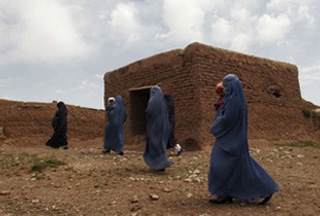
Nearly two months after the high profile night raid in Afghanistan’s Paktia Province and after several official denials, NATO has finally admitted to killing all five civilians, including two Afghan government employees.
NATO’s first official acknowledgement of the raid claimed they engaged in a “fire fight” with insurgents known to be hiding at the house and made a “gruesome” discovery of three slain women bound and gagged in an adjacent room of the house. Two of the women were later revealed to be pregnant at the time.
Though the family initially disputed the claims, the real holes in the official story began to develop a month later, when Rear Admiral Greg Smith admitted they had no evidence the “firefight” involved a single shot fired by anyone but the NATO forces, and all the arrested “insurgents” were released. NATO also attempted to pay them “compensation” for the slain civilians, but were rebuffed.
But all of this still leaves an enormous loose string to tie up. If there was no “gruesome discovery” as claimed, then the US special forces responsible for the raid not only killed those pregnant women, but bound and gagged their corpses to try to cover it up (which is what the family claimed the day after it happened, to the dismissal of everyone).
Incredibly, however, NATO is still insisting that they have no evidence that the soldiers acted “inappropriately” in the slaughter, and even though Afghan government officials confirmed that the troops were removing evidence from the scene for seven hours before letting the Afghan security forces in to inspect it they maintain that nothing resembling a cover-up has occurred.
Destruction of Gazan cheese factory continues pattern Goldstone found illegal
By Alex Kane on April 2, 2010

Israeli warplanes bombed areas across the Gaza Strip early Friday, injuring at least three children, according to news outlets. Although the Israeli military claims that the targets were weapons-manufacturing plants and arms caches, Ma’an, Al Jazeera, Haaretz, and YNet are reporting that the Israeli air force struck civilian sites, including a metal factory in a refugee camp and the Daloul cheese and dairy factory in Gaza City.
The targeting of the means of sustenance for the civilian population in Gaza is an area that Judge Richard Goldstone focused on in his United Nations report on the Israeli assault on Gaza. I assume the crude logic behind the targeting of a cheese and dairy factory in the heart of Gaza is part of putting “Palestinians on a diet, but not to make them die of hunger,” as Dov Weisglass, an adviser to former Israeli Prime Minister Ehud Olmert, said, in explaining the suffocating blockade that has been imposed on the Gaza Strip.
Goldstone reported on the destruction of the el-Bader flourmill and the Sawafeary chicken farms. The section where Goldstone deals with these attacks can be found on pages 199-206 of his report.
On the destruction of the flour mill, the report states, “that the destruction of the mill was carried out for the purpose of denying sustenance to the civilian population, which is a violation of customary international law as reflected in article 54 (2) of Additional Protocol I and may constitute a war crime.”
More broadly, the report found, “as a result of its actions to destroy food and water supplies and infrastructure, Israel has violated article 1 of the International Covenant on Civil and Political Rights, article 11 of the International Covenant on Economic, Social and Cultural Rights and article 12 (2) of the Convention on the Elimination of All Forms of Discrimination against Women.”
I wonder what the esteemed jurist would say about this attack on the cheese and dairy factory. We know what Israel will say: “Cheese and dairy factories are part of the Hamas terror infrastructure,” or “cheese and dairy can be used to make bombs,” or “rockets with cheese and dairy attached are particularly dangerous.”
The So Called ‘Only Democracy in the Middle East’
By Gilad Atzmon | April 3, 2010

In Israel, the so called ‘only democracy in the Middle East’, a journalist has been held under house arrest since December for leaking a story of Israeli barbarism. In the Jewish Democracy another prominent Journalist had to run for his life for telling the truth about Israel’s murderous policies and its chief war criminals.
The Guardian reported today that Anat Kam, 23, an Israeli journalist “has been under secret house arrest since December on charges that she leaked highly sensitive classified military documents that suggest the Israeli military breached a court order on assassinations in the occupied West Bank.”
Seemingly, in the ‘Jews only democracy’, people are put under house arrest even when they are trying to suggest a breach of the state’s High Court’s orders. (Even kosher citizens)
Anat Kam, 23, goes on trial in two weeks on treason and espionage charges and could face up to 14 years in jail. In the ‘democratic’ Jewish state, a court-imposed gagging order is preventing media coverage of the arrest and charges in Israel. I am left puzzled here as it seems Israelis can be prosecuted for reporting illegal activities.
A Haaretz leading journalist, Uri Blau, who has also been linked to the case, has had to escape Israel. He is now in London, apparently for fear he will be targeted for his reporting.
In November 2008, Blau reported in Haaretz that the IDF had been carrying out assassinations of Palestinian militants in the West Bank in contravention of an Israeli high court ruling, which said efforts should be made first to arrest suspected militants rather than assassinating them.
According to Blau the IDF chief General Gabi Ashkenazi allegedly approved the assassination operations. The Haaretz piece was accompanied by copies of military documents but it was approved by the military censor before publication.
I am here to suggest that if America still insists to ‘democratize the world’, it may have to start with its ‘best ally’. Time may also be ripe for Neocon British Foreign Secretary David Miliband who advocates ‘liberal interventionalism’, to face the fact that the Jewish state, the state that lists him as one of its Propaganda (Hasbara) authours, is no less than a Tyranny inspired by a deep Talmudic intolerance.
What War with Iran Means
By Patrick J. Buchanan | April 02, 2010
“Diplomacy has failed,” Sen. Chuck Schumer, D-N.Y., told AIPAC, “Iran is on the verge of becoming nuclear and we cannot afford that.”
“We have to contemplate the final option,” said Sen. Evan Bayh, D-Ind., “the use of force to prevent Iran from getting a nuclear weapon.”
War is a “terrible thing,” said Sen. Lindsay Graham, R-S.C., but “sometimes it is better to go to war than to allow the Holocaust to develop a second time.”
Graham then describes the war we Americans should fight:
“If military force is ever employed, it should be done in a decisive fashion. The Iran government’s ability to wage conventional war against its neighbors and our troops in the region should not exist. They should not have one plane that can fly or one ship that can float.”
Danielle Pletka of the American Enterprise Institute, Neocon Central, writes, “The only questions remaining, one Washington politico tells me, are who starts it, and how it ends.”
As to who starts it, we know the answer. Tehran has not started a war in memory and is not going to launch a suicide attack on a superpower with thousands of nuclear weapons. As with Iraq in 2003, the war will be launched by the United States against a nation that did not attack us — to strip it of weapons it does not have.
But to Graham’s point, if we are going to start this war, prudence dictates that we destroy Iran’s ability to fight back. At a minimum, we would have to use air strikes and cruise missiles to hit a range of targets.
First, Iran’s nuclear facilities such as the uranium enrichment plant at Natanz, the U.S.-built reactor that makes medical isotopes, the power plant at Bushehr, the centrifuge facility near Qom and the heavy-water plant at Arak.
Our problem here is that the last three are not even operational and all are subject to U.N. inspections. There are Russians at Bushehr. And there is no evidence that diversion to a weapons program has taken place.
If Iran has secret plants working on nuclear weapons, why have we not been told where, and demanded that U.N. inspectors be let in? Why did 16 U.S. intelligence agencies, three years ago, tell us they did not exist and Iran gave up its drive for a nuclear weapon in 2003?
If Iran is on the “verge” of a bomb, as Schumer claims, the entire U.S. intelligence community should be decapitated for incompetence.
This week, in a hyped headline, “CIA: Iran capable of producing nukes,” the Washington Times said that a new CIA report claims, “Iran continues to develop a range of capabilities that could be applied to producing nuclear weapons, if a decision is made to do so.”
Excuse me, but this is mush. We could say the same of a dozen countries that use nuclear power and study nuclear technology.
But let us continue with Graham’s blitzkrieg war.
To prevent a counterattack, the United States would have to take out Iran’s 14 airfields and all its warplanes on the ground. We would also have to sink every warship and submarine in Iran’s navy and destroy some 200 missile, patrol, and speedboats operated by the Revolutionary Guard, else they would be dropping mines and mauling our warships.
Also, it would be crucial on day one to hit Iran’s launch sites and missile plants for, like Saddam in 1991, Iran would probably attack Israel, to make it an American and Israeli war on an Islamic republic.
Among other critical targets would be the Silkworm anti-ship missile sites on Iran’s coastline that would menace U.S. warships and oil tankers transiting the Strait of Hormuz. Any Iranian attack on ships or seeding of mines would likely close the gulf and send world oil prices soaring.
Revolutionary Guard barracks, especially the Quds Force near Iraq, would have to be hit to slow troop movement to and across the border into Iraq to kill U.S. soldiers and civilians. The same might be necessary against Iranian troops near Afghanistan.
With Iran’s ally Hezbollah in south Beirut, all U.S. civilians should probably be pulled out of Lebanon before an attack lest they wind up dead or hostages. And how safe would Americans be in the Gulf region, especially Bahrain, home of the U.S. Fifth Fleet, a predominantly Shi’ite island?
And whose side would Shi’ite Iraq take?
Would we have to intern all Iranian nationals in the United States, as we did Germans and Italians in 1941? How many terror attacks on soft targets in the USA could we expect from Iranian and Hezbollah agents in reprisal for our killing thousands of civilians in hundreds of strikes on Iran?
Before the War Party stampedes us into yet another war, the Senate should find out if Tehran is really on the “verge” of getting a bomb, and why deterrence, which never failed us, cannot succeed with Iran.
COPYRIGHT 2010 CREATORS.COM
Liberals with guns: scarier than Tea Partiers
Charles Davis | False Dichotomy | March 25, 2010
I often begin my political science courses with a brief introduction to the idea of “the state.” The state is the entity that has a monopoly on the legitimate use of violence, force and coercion. If an individual travels to another country and kills its citizens, we call it terrorism. If the state does it, we call it war. If a man kills his neighbor it is murder; if the state does it is the death penalty. If an individual takes his neighbor’s money, it is theft; if the state does it, it is taxation.
Maria Harris-Lacewell is a professor at Princeton University, as so subtly alluded to in the above excerpt from her latest drivel for The Nation, and she’s concerned about the “legitimacy” of the state — a legitimacy she assumes but doesn’t explain — which she notes some backwards reactionaries have had the temerity to challenge in the age of Democratic government. Now, considering that U.S. government imprisons more of its own citizens than any other in the history, with 25 percent of the world’s prisoners; that it has more military bases in more countries than any previous empire in history, and has killed millions of people from Iraq to Vietnam; and that its current head, Barack Obama, is openly targeting for extrajudicial killing Americans and foreigners alike, one might ask: why is a liberal magazine so concerned about this state’s legitimacy?
Because of the Tea Party movement, you see, whose flashes of racism and disrespect toward politicians is of more concern to Ivy League academics than the “legitimate” state violence they applaud. Tea Partiers, by accusing the current administration of “various forms of totalitarianism . . . are arguing that this government has no right to levy taxes or make policy,” the professor writes, apparently under the mistaken belief that most taxes the state levies go to gumdrop bridges and fairy dust health clinics, rather than less wholesome things like aircraft carriers and daisy cutters. Rather than focusing on what the state actually does, though, Harris-Lacewell, like most liberals, would prefer we focus on their shining, abstract ideal of what it could be, while sanctimoniously dismissing those who see no distinction between state-sponsored and private sector murder, an approach befitting the wait-until-you’re-called merit-class liberal mentality that dominates the Democratic Party and the progressive press.
As The Nation’s house political scientist explains it, adopting an argument that one could never imagine being applied to the left, “When protesters spit on and scream at duly elected representatives of the United States government it is more than act of racism. It is an act of sedition.”
Put another way: offenses against the state are inherently more despicable than any offense one could commit against some poor schmuck civilian. An overstatement? Well, no, as Harris-Lacewell herself demonstrates in writing about Congressman John Lewis (D-GA), who “is no longer just a brave American fighting for the soul of his country- he is an elected official. He is an embodiment of the state.” Yeah, you know, before Lewis just marched in the streets against racism and state-enforced segregation as a (ho-hum) private citizen, but now he chairs a subcommittee — show him some respect!
Hooping and hollering at an elected official — sorry, “an embodiment of the state” — might give liberals at The Nation the vapors, and right-wing protesters who cheered on the Bush administration’s abuses of power may not be my cup of tea, but color me unimpressed with the argument that I have more to fear from the talk radio right than I do the incarcerating-and-assassinating state. Now while there’s little chance you’ll catch me marching against compact fluorescent light-bulbs or Obamacare anytime soon — though I promise nothing — I just don’t fear a rollback of the Reconstruction period “and the descent of a vicious new Jim Crow terrorism” as much as I fear and abhor the actual, happening-right-now terrorism carried out by my esteemed public officials with the tacit approval of the humanitarian progressives too busy lecturing the rabble on the need to pay taxes and pledge allegiance to their betters in Washington than to challenge their leader’s wars. In addition to the hundreds killed without so much as a show trial by hellfire missiles since the glorious advent of The Liberal Ascendancy, agents of the U.S. government have been implicated in several headline-grabbing atrocities, the latest of which involved the pre-dawn slaying of a pair of pregnant women and a teenage girl. That female civilians are being killed at a level on par with Afghan males is no doubt being hailed in the halls of Brookings as a feminist triumph, but it’s more troubling to me than the idea of some people questioning the legitimacy of the perpetrators’ employer.
Perhaps they shouldn’t just be ignored, but until Glenn Beck’s followers kill two dozen people in a remote village, I’m going to spend most of my time focusing on those with control over the tanks and nuclear weapons. And rather than seeking to bolster the state and reinforce the idea of some mythical, mystical social contract, I just might seek to undermine this government, so far as I can, for as long as it continues enriching a politically connected corporate elite while imprisoning and enlisting the rest of its population, no matter how “duly elected” our politicians might be as a result of the sham two-party electoral system. When political leaders are engaged in senseless war and widespread human rights abuses — and the occupation of Afghanistan and the U.S. prison system at home and abroad qualify — the person of conscience’s duty is not to the state but to justice, which usually means opposing the state and questioning its presumed legitimacy.
The proper attitude toward a criminal government is not deference and respect, however much some at The Nation might love a smooth-talking Democrat, but defiance and rebellion — of the non-violent variety.
At D.C. conference, Goldstone has a defender at the top of his game
By Chase Madar on March 31, 2010
The panel on the Goldstone Report was, as expected, one of the highlights of the 104th conference of the American Society of International Law held last week in the basement of the Ritz-Carlton in Washington DC.
(The other highlights? Harold Koh, the State Department’s top lawyer, unveiled the legal rationale for targeted killings via drone aircraft in Afghanistan and Pakistan; Professor Antony Anghie’s showcased lecture on the centrality of imperialism to the history of international law; Anne-Marie Slaughter, Director of Policy Planning at State, informed us that the age of power wielded over others is nearly gone; what the youngsters now talk about is wielding power with others. Callooh callay!)
But the Goldstone Report. It may be too much to call it the most controversial international legal document of the year, as the report went down quite smoothly in most of the world. But not in Israel or the United States, whose governments have condemned the inquiry as irredeemably biased against the Israeli Defense Forces. The ASIL panel would deal with this issue of alleged bias.
The panel was really a debate, ably moderated by Lucy F. Reed, president of ASIL. Defense of the report was mounted by Omar Dajani, a former legal advisor to Palestian peace talk team, corporate litigator at Sidley & Austin, and now a professor at McGeorge School of Law in Sacramento. The report was attacked by Abraham Bell, former clerk at the Supreme Court of Israel and a law and economics scholar University of San Diego. Dajani argued that the report is a very conservative document, upholding strictly construed norms and categories of international law, “toeing the line” against those who would rewrite the laws of war to the advantage of the IDF. Bell argued that the report is a “radical” document, bending international law past the breaking point.
Bell did the best he could, but I think Dajani carried the day. He was lucid, calm and argued with the appropriate degree of passion. Bell could really only nitpick, cast vague aspersions on the report’s “tone,” and talk about how tough it is to wage asymmetric war against a weaker, worse-armed enemy. (Dajani however evinced no such self-pity.) Bell denied, weirdly, that Gaza is under occupation.
Questioners were pretty evenly divided between supporters and critics of the report.
One questioner, a ponytailed gentleman from University of Tennessee, found it horribly unfair that Israel should be the target of so many General Assembly resolutions. Is there a double standard operating at the UN? Yes there certainly is, Dajani quickly responded, and this double standard is at the Security Council, where the US automatically vetoes any resolution against Israel. This leaves the General Assembly as the only forum for motions against Israeli violations of international norms. And these General Assembly motions are not much of a consolation prize, as the real power resides in the Security Council—a fact lost on most of the general public, and on many lawyers too.
Another questioner, Daniel Joyner of University of Alabama, asked Bell what Gaza’s status was, if it is indeed “unoccupied territory”—is it sovereign territory like Switzerland? Is it terra nullius like Antarctica? For it can only be one or the other. Bell’s response was curt and legalistically absurd: “Gaza’s status is… not occupied.”
“Right, except for its airspace and its borders and often its land,” Dajani quickly chimed in.
For his part, Dajani made no such auto-goals. It was nice to see that the Goldstone report had a defender on the top of his game.
Was this ASIL conference panel a new departure into real fairness and evenhandedness? Not really. Joyner, who has been to seven or eight of these ASIL confabs, told me that this crowd—highly educated, many of them non-American—has generally, but by no means unanimously, been open to international law arguments against Israel’s colonial domination of Palestine.
As for the related question of “lawfare,” it popped up throughout the conference. Not the neocon condemnations all legal challenges to Israel and America’s uses of force, but rather lawfare advocacy on the other side: folks eager to bend, rewrite and “update” the laws of war to the benefit of the American imperial project and its client states. There was Harold Koh justifying targeted killings via UAVs (drones) in Afghanistan and Pakistan. There was young Ganesh Sitaraman, of Harvard lamenting that international lawyers are not sufficiently “engaging” with this marvelous new technique of counterinsurgency warfare.
All to be expected, for the waging of lawfare is as old as international law itself; one could even argue that lawfare is the beating heart of international law. Let us not forget that the great Grotius, august 17th century father of international law, was also Huig de Groot, a picaresque shyster whose first legal treatise was a fast-talking apologia for Dutch privateers. The ASIL conference reaffirmed again and again the inherent two-facedness of international law. Yes it is quite true that international law has at times stood tall against overweening power. But at least as often international law lubes and legitimates the actions of the strong against the weak.
Chase Madar is a lawyer in New York.
Israeli Army Invades Khan Younis, Leaders Weigh Resumption Of Assassinations
By Saed Bannoura – IMEMC & Agencies – March 28, 2010
 Ma’an images

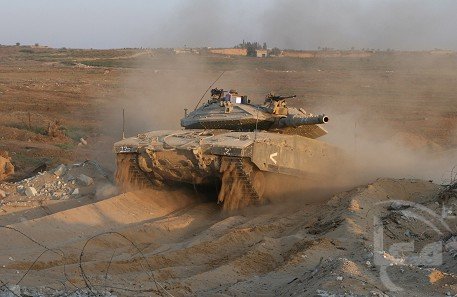
Several armored military vehicles carried out a limited invasion into Khan Youni, in the southern part of the Gaza Strip, on Sunday morning. The latest attack comes amidst talks of a likely resumption of assassinations in the coastal region. Israeli Finance Minister called for “reoccupying” Gaza and “eliminating Hamas”.
Eyewitnesses reported that several armored vehicles and military bulldozers advanced 500 meters into the area, and that military bulldozers started uprooting trees and farmlands while the army opened fire in different directions. Military bulldozers uprooted olive and almond trees in Um Al Mahed and Abu T’eima areas, in Khan Younis.
The invaded area is where Friday clashes took place; one resident was killed and thirteen others were wounded. Two Israeli soldiers were killed and three were wounded. The latest developments came as Israel’s military and political leaders are weighing the possibility of a massive attack against the Gaza Strip in addition to weighing the possibility of resuming Israel’s illegal assassinations policies.
Israeli paper, Maariv, reported Sunday that Israel’s military leadership believes that Palestinian resistance groups in Gaza benefited from the cease fire that followed “Operation Cast Lead” offensive against the Gaza Strip a year ago January. The paper added that this cease fire gave the resistance a chance to attack the Israeli army along the border with Gaza, such as the Friday attack that led to the death of three soldiers.
A number of military leaders said that the known policy of bombarding tunnels and “weapons storage facilities is not affective anymore and does not curb further attacks”.
Senior Israeli military leaders stated that the current situation requires the resumption of the assassination policy. They are calling for assassinations targeting certain political and military leaders of Palestinian factions in Gaza, especially prominent figures.
The Israeli army believes that after the Friday attack and the killing of the soldiers, several leaders in Gaza went underground fearing Israel’s retaliation.
The army estimates that those leaders would resume their activities in the future, therefore “the army must prepare plans to assassinate them”, and should also bombard certain areas believed to be used by the resistance. This includes tunnels, resistance training centers and areas believed to be weapons storage facilities, in addition to bombing the homes of political and military leaders of Hamas and other factions.
Israeli Finance Minister, Yuval Steinitz, called for “reoccupying Gaza” and to totally eliminate the authority of Hamas in the coastal region. He said that reoccupying Gaza and eliminating Hamas, the ruling “power” on Gaza, are among the main scenarios that Israel might elect should other options fade.
Steinitz slammed what he called “the U.S. pressure on Israel”, and claimed that Israel conducted acts of “good will” towards the Palestinians by “giving them the chance to improve their economy” and by “freezing settlement activities”.
US missiles kill four in NW Pakistan
Press TV – March 27, 2010
Four people have been killed in the latest US drone attack on local tribesmen in Pakistan’s northwestern area near the border with Afghanistan.
 A US drone fired two missiles into the compounds belonging to what Washington calls suspected militant hideouts in the suburbs of Mir Ali, a town in North Waziristan.
The missiles targeted “two compounds owned by local tribesmen,” AFP quoted a local security official who spoke on condition of anonymity as saying.
“We have confirmation of four people killed and more than five injured,” said another Pakistani security official. The identities of the victims were not immediately revealed.
The United States has been conducting drone attacks in tribal areas within the Pakistani borders despite protests from Islamabad. The strikes have significantly hiked since US President Barack Obama took office last year. Washington says the drone attacks target militant hideouts in Pakistan, but the soaring number of civilian causalities inflicted during the strikes has given raise to strong anti-US sentiments across Pakistan.
###
The inaccessibility of the regions makes it very difficult to get independent confirmation of the casualty figures provided by officials and the identity of those killed. Civilian casualties are rarely, if ever, mentioned in army accounts of the fighting.
Palestinian Political Prisoners
By Stephen Lendman | March 27, 2010
The numbers vary but range at any time from over 7,000 to 12,000 or more. In April 2008, the Adalah Legal Center for Arab Minority Rights in Israel cited 11,000, including 345 children and 98 women. Over 1,000 suffered from chronic or other diseases. Around 150 were seriously ill from heart disease, cancer, and other diseases, and 195 or more Palestinians died or were killed in prison since 1967.
As of January 2009, Adalah said about “22,500 individuals were imprisoned or detained in Israeli prisons; around 70% (or 15,750 are) Arabs.” Included are 9,735 Palestinians, nearly 80% classified as “security.” Of these, 570 were administrative detainees, uncharged by order of an administrative official, not a judge.
Another 20 were so-called “unlawful combatants” under Israel’s Unlawful Combatants Law (UCL), saying they’re not entitled to POW status under international law because they either took part in hostilities against Israel (directly or indirectly) or belong to a force carrying them out. No proof is needed, only “a reasonable basis for believing” the designation is accurate, and under UCL, detentions can be permanent, without trial or judicial fairness.
According to the Addameer Prisoners’ Support and Human Rights Association, since 1967, “over 650,000 have been detained by Israel,” about 20% of the total Occupied Territory (OPT) population and 40% of the male population. Most are held in Palestine, but many thousands in Israeli civil and military prisons, in violation of numerous Fourth Geneva provisions, including Article 49 stating:
“….forcible transfers, as well as deportations of protected persons (including prisoners) from occupied territory to the territory of the Occupying Power or to that of any other country, occupied or not, are prohibited, regardless of their motive.”
This applies to OPT prisoners, most of whom are political victims of militarized oppression, or in other words, guilty of being Palestinian. In addition, Fourth Geneva states protected persons shall be detained in the occupied territory and, if convicted, serve there sentences therein.
OPT arrests and detentions come under about 1,500 military regulations for the West Bank and over 1,400 for Gaza. The IDF commander issues orders, but new ones aren’t revealed until implemented because they’re issued any time for any reason, often arbitrarily and capriciously.
Israeli prisons and military detention facilities are mainly located within Israel’s 1948 borders. They include five interrogation centers, six detention/holding facilities, three military detention camps, and about 20 prisons where OPT Palestinians are held.
A secret Facility 1391 at an unknown location is notorious for using severe torture. Gilboa Prison, north of the West Bank, is also believed to administer extreme treatment.
“The location of prisons within Israel and the transfer of detainees to locations within the occupying power’s territory are illegal under international law and constitute a war crime.”
On June 7, 1967, Military proclamation No. 1 justified them “in the interests of security and public order,” weasel words meaning anything. Since then, over 2,900 orders were issued, gravely harming Palestinians’ welfare. “These orders serve as justification every time the Israeli authorities arrest a Palestinian….”
They can be held for extended periods, interrogations lasting up to six months, during which time torture, abuse and other degrading treatment is commonplace, against the great majority in custody.
After interrogation, Palestinians can be detained administratively without charge or tried in military courts where “military orders take precedence over Israeli and international law.”
Under Military Order 1530, months may elapse between being charged and trial. The entire process is structured to deny due process and judicial fairness, unlike for most Jews in civil courts.
Activists, protesters and human rights defenders are especially at risk. In July 2008, Israeli authorities, by military order, closed the Nafha Society for the Defense of Prisoners and Human Rights. It’s one of several organizations representing Palestinian detainees in Israeli courts and advocates for them in prisons and detention centers.
Currently, Israeli security forces, politicians and extremist groups are targeting human rights groups in response to their support for the Goldstone Commission report. Among those affected are:
— B’Tselem
— Adalah
— Breaking the Silence
— the Association for Civil Rights in Israel (ACRI)
— Yesh Din
— the Centre for the Defence of the Individual
— the Public Committee Against Torture in Israeli (PACTI)
— the Israel Religious Action Centre
— Physicians for Human Rights – Israel
— Rabbis for Human Rights, and
— the Palestinian Centre for Human Rights (PCHR) that condemned the practice in a February 8 press release stating:
PCHR “condemns the continued persecution of international human rights defenders in the West Bank….and the deportation of international activists from the country.”
On February 7, PCHR learned that Israeli security forces entered Ramallah and al-Bireh, storming an al-Bireh apartment building and arresting Spanish journalist Ariadna Jove Marti and Australian student Bridgette Chappell. They were taken to Ofer Prison pending their deportation, citing expired visas as pretext. The two women are International Solidarity Movement activists known, according to an IDF spokesman, “for being involved in illegal riots that obstruct Israeli security operations.”
Other activists were also arrested, Israel now issuing tourist visas only to 150 selected NGOs operating in the West Bank and East Jerusalem, including Oxfam, Save the Children, and Doctors Without Borders. However, they’ll be excluded from Area C under Israeli control, comprising 60% of the West Bank, thus hampering their work and imposing additional hardships on Palestinians.
PCHR condemned the action and recommends that international civil society and human rights organizations, bar associations, and international solidarity groups continue exposing suspected Israeli war criminals and pressuring their governments to prosecute them according to provisions of international law.
The extremist Netanyahu government won’t tolerate criticism or censure for its expansionist West Bank plans, including making all Jerusalem exclusively Jewish.
His cabinet introduced a Knesset bill prohibiting organizations from receiving funding from foreign political institutions unless registered with the Registrar of Political Parties.
They must then provide details about all “foreign political entity” donations, the source, amount, purpose, commitment made for its use, and more, as a way to harass and make the process more cumbersome.
The bill’s supposed purpose is to:
“increase the transparency and to correct lacunas (empty spaces or missing parts) in the law regarding the funding of political activity in Israel by foreign political entities (where such activity is defined as being) aimed at influencing public opinion in Israel or one of the branches of government in Israel regarding any element of Israel’s domestic or foreign policy.”
In fact, it’s to stifle free expression, dissent and activism, the way police states do it, how Israel always treats Palestinians, now increasingly toward outspoken Jews and international human rights organizations as well.
Conditions in Israeli Prisons
Israel willfully and systematically violates international humanitarian law, including Common Article 3 applying to the four Geneva Conventions, requiring:
“humane treatment for all persons in enemy hands, specifically prohibit(ing) murder, mutilation, torture, cruel, humiliating and degrading treatment (and) unfair trial(s).”
Fourth Geneva’s Article 4 calls “protected persons” those held by parties to a conflict or occupation “of which they are not nationals.” They must “be treated with humanity and, in case of trial, shall not be deprived of the rights of fair and regular trial prescribed by the present Convention.” They’re entitled to full Fourth Geneva rights. Prisoners of war under Third Geneva have the same rights and those under Common Article 3.
Israel willfully denies them. Under the 1971 Israeli Prison Ordinance, no provision defines prisoner rights. It only provides binding rules for the Interior Minister who can interpret them freely by administrative decree. For example, it’s legal to intern 20 inmates in a cell as small as five meters long, four meters wide and three meters high, including an open lavatory, and they can be confined there up to 23 hours daily.
An April 2009 PCHR press release said thousands of Palestinians “continue to suffer in Israeli jails” under horrific conditions, including:
— severe overcrowding;
— poor ventilation and sanitation;
— no change of clothes or adequate clothing;
— sleeping on wooden planks with thin mattresses, some infested with vermin; blankets are often torn, filthy and inadequate; hot water is rare and soap is rationed;
— at the Negev Ketziot military detention camp, threadbare tents are used, exposing detainees to extreme weather conditions; in summer, vermin, insects, scorpions, parasites, rats, and other reptiles are a major problem;
— Megiddo and Ofer also use tents; in addition, Ofer uses oil-soiled hangers;
— for some, isolation in tiny, poorly ventilated solitary confinement with no visitation rights or contact with counsel or other prisoners;
— no access to personal cleanliness and hygiene; toilet facilities are restricted, forcing prisoners to urinate in bottles in their cells;
— inadequate food in terms of quality, quantity, and dietary requirements;
— poor medical care, including lack of specialized personnel, mental health treatment, and denial of needed medicines and equipment; as a result, many suffer ill health; doctors are also pressured to deny proper treatment, some later admitting it;
— extreme psychological pressure to break detainees’ will;
— widespread use of torture, abuse, cruel and degrading treatment;
— women and children are treated the same as men;
— NGOs like Physicians for Human Rights – Israel and the ICRC are deterred from aiding detainees;
— denied or hindered access to family members and counsel;
— imposed conditions link visits:
“with the overall security situation, requiring that prisoners must not be security prisoners and that persons applying for visits must not have a security record, requiring that visitors be first-degree relatives and that brothers or sons applying for visits must be under the age of 18.”
Treatment of Gazans Arrested During and After Operation Cast Lead
On January 28, 2009, a complaint to Israel’s Military Judge Advocate General, Brigadier General Avichai Mandelblit, by seven Israeli human rights organizations, cited degrading and appalling conditions in which detainees, including minors, were held.
Before transfer to the Israel Prison Service, they were held for many hours or days in pits dug in the ground, handcuffed and blindfolded, under extreme weather conditions. No sanitation was provided and limited amounts of food. Some, in fact, were held in combat areas, in violation of international law prohibiting their exposure to danger.
After removal from pits, some were held overnight in a truck, handcuffed, with one blanket for two people in winter. Others were kept for extended periods in the rain with little food or water. Incidents of extreme violence and humiliation were also reported that continued after prison transfers.
Legal Department Director of the Public Committee Against Torture in Israel (PACTI), Bana Shoughry-Badarne, said:
“Israel’s indifference to its moral and legal obligations to detainees is particularly objectionable in view of the fact” that the IDF completely ignored “the basic rights of the detainees and captives” under international law, violations committed against every detainee held.
Since July 2007, Gazan families have been denied access to their relatives in Israeli prisons. Non-Israeli Palestinian lawyers can’t represent them in military courts. Travel restrictions impede all lawyers. Meetings with their clients aren’t confidential, and most prisoners have no access to an attorney.
In 2006, B’Tselem issued a report titled, “Barred from Contact: Violation of the Right to Visit Palestinians Held in Israeli Prisons,” citing obstacles families face to visit their relatives. They include difficulties obtaining required permits and “grueling journeys” of up to 24 hours, the result of long distances through numerous checkpoints plus delays.
This “arbitrary and disproportionate policy not only infringes the right to family visits, it also results in violation of other rights and principles of international humanitarian and human rights law, as well as domestic Israeli law.”
In January 2010, Adalah addressed the same issue stating:
On December 9, 2009, “Israel’s Supreme Court (HCJ) decided that the state has no obligation to allow family visits for Gazans detained in Israel.” Writer Grietje Baars, a UK lawyer, said the HCJ rejected petitions by detainees, their relatives and Palestinian and Israeli human rights organizations, claiming that “Israel’s rights as a sovereign state” lets it deny “foreigners” entry in violation of international law – a clear act of persecution.
Under Article 7(g) of the Rome Statute of the International Criminal Court (HCJ), crimes against humanity include:
“Persecution (meaning) the intentional and severe deprivation of fundamental rights contrary to international law by reason of the identity of the group or collectivity.”
In a previous decision, the HCJ held that:
“It is a firmly established precept that the human rights to which a person is entitled simply by being human remain even when he is detained or imprisoned, and the fact that he is incarcerated cannot serve to deprive him of any right.”
Denying them defies that ruling, and the fact that hundreds of Gazan detainees in Israel are held indefinitely without trial, are in virtual isolation, and can only send their families occasional messages through ICRC representatives.
Petitioners call banning visits “collective punishment” under Fourth Geneva’s Article 33 stating:
“No protected person may be punished for an offence he or she has not personally committed. Collective penalties….are prohibited.”
Doing so (along with torture and other forms of abuse) aims to break their spirit to get them to cooperate or confess to crimes they didn’t commit.
Baars concluded:
“Aside from the right to have their rights hououred and protected, and to live their lives in dignity and freedom, the Gazans and the Palestinians in general, have the right to an effective judicial remedy. Without domestic enforcement of international law, the onus is on the international community to fulfill these rights and uphold the rule of law, internationally, for the benefit of all.”
The international community’s failure to comply with international law lets Israel violate its provisions freely. Unless changed, Israel’s lawlessness will continue unchecked, a no longer to be tolerated grim prospect.
Stephen Lendman lives in Chicago and can be reached at lendmanstephen@sbcglobal.net. Also visit his blog site at sjlendman.blogspot.com
CIA may face prosecution for drone raids in Pakistan
Press TV – March 24, 2010
The US government’s refusal to offer legal grounds for CIA’s drones bombing raids in Pakistan may result in CIA officers facing prosecution for war crimes.
“Prominent voices in the international legal community” were increasingly impatient with Washington’s silence on the CIA’s bombing raids in Pakistan and elsewhere, Kenneth Anderson, a law professor at American University, told a congressional panel on Tuesday, AFP reported.
Lawyers at the US State Department and other government agencies were concerned the administration has “not settled on what the rationales are” for the drone strikes, he said.
“And I believe that at some point that ill serves an administration which is embracing this,” said Anderson.
The law professor said he believes the drone strikes are legal under international law, based on a country’s right to self-defense, and urged the US administration to argue its case publicly.
The drone attacks, which have so far taken the lives of many civilians, have sparked outrage among the Pakistani nation amid Washington’s claims that they are aimed at “Taliban militants.”
Featured Video

or go to
Aletho News Archives – Video-Images
New Documentary
“Inside Gaza” wins best documentary at Montreal’s Cinemania film festival
Palestine Information Center – November 16, 2026
MONTREAL – The documentary “Inside Gaza,” which chronicles the experiences of Palestinian journalists working with Agence France-Presse (AFP) while covering the Israeli war on the Gaza Strip, won the Best Documentary Award at the 32nd Cinemania International Francophone Film Festival held in Montreal, Canada.
Directed by Helene Lam Trong, the 72-minute film follows the daily lives of four AFP journalists who bear witness to the difficulties of reporting in a war-torn territory largely closed off to international media.
The film is compiled from material produced by the team on the ground, as well as from interviews conducted after they left.
The film also won the People’s Choice Award at the festival on Saturday. … continue
Blog Roll
 Aletho News
- Iran accuses NYT report of paving way for attacks on dams
- Brand ‘rape’ case just doesn’t add up. Was he framed?
- How The Jensen Huang Chinese Spy Hoax Is Russiagate 2.0
- Austria seeks to strip former foreign minister of citizenship over Russia ties
- “Inside Gaza” wins best documentary at Montreal’s Cinemania film festival
- Activists block German munitions plant over arms exports to ‘Israel’
- The Nasser Hospital attack and Israel’s relentless lies
- Could it be satan? No, Huckabee, just the Americans you work for
- AIPAC and more: Network of pro-Israel influence in US Congress
- Putin aide reveals Moscow’s stance on Europe at peace talks
- If Americans Knew
- An error has occurred; the feed is probably down. Try again later.
- No Tricks Zone
- Argentina’s Perito Moreno Glacier Joins Antarctica and Arctic In Defying Doomsday Melt Claims
- New Study: Barents Sea Temperatures Were Warmer And Sea Ice Less Extensive In The 1700s Than Today
- German Authorities Start Initiative To Evaluate Public Register For Climate “Disinformation” Spreaders!
- Zonal Asymmetry of Temperature Change in the Antarctic Circumpolar Current
- New Study: The Net Fossil Fuel Contribution To Rising Atmospheric CO2 Has Been Zero For 500 Years
- Germany’s Green Energy Transition Becoming Increasingly Expensive…Another 6 Trillion Euros!
- Sudden Stratospheric Warming, Powerful El Niño Combination May Lead To Extreme Europe Cold, Energy Crisis!
- Two New Studies Find Thwaites Glacier Melt Cannot Be Driven By Human Activity Or A Warming Ocean
- E-Cars Reduce CO2 Emissions By Only 41% Compared To Internal Combustion Engine Vehicles
- Predictions Made By Renowned Climate Professor Over Past Decades Have Been Proven To Be Poor

