Gaza’s thin red line one year later
Eva Bartlett, The Electronic Intifada, 22 January 2010
“The last Israeli attacks were the hardest, the most dangerous. It wasn’t a war, it was a massacre. They shot anyone walking, anyone outside of their home, in their home … it didn’t matter. And it didn’t matter if the victims were children or adults; there was no difference.”
Ali Khalil, 47, has served as a medic with the Palestine Red Crescent Society (PRCS) and private hospitals in Gaza for more than 20 years. He has seen some of the worst atrocities committed by the Israeli army. During Israel’s war on Gaza last winter, Khalil worked in Gaza’s northern region, venturing repeatedly into high-risk areas bombarded by Israeli tanks, helicopters and warplanes to rescue the injured and retrieve the dead.
During the 23-day invasion, the Israeli army warplanes, drones, warships, tanks and snipers rendered entire areas off-limits and impossible for ambulances and civil defense fire and rescue trucks to reach. In the north, Ezbet Abed Rabbo and Attatra, east and northwest of Jabaliya, respectively, were among the districts occupied by the Israeli army.
Through the International Committee of the Red Cross (ICRC), Palestinian rescuers were sometimes able to coordinate with the Israeli army to gain access to areas they controlled.
“We’d wait five hours, even over 30 hours, for coordination from the Israelis to enter the area to retrieve wounded or martyred,” says Khalil. “And much of the time, we wouldn’t get it.”
Even coordination, however, did not ensure access or safety.
“On 9 January, we went to retrieve wounded and martyred. There were three ambulances, and one ICRC jeep in front. We had coordination via the ICRC,” says Khalil.
Marwan Hammouda, 33, a PRCS medic for the last 10 years, was on the same call. “We were driving to the area, speaking with the Israelis on the phone. They’d tell us which way to drive, what road to take. When we got near the wounded, Israeli soldiers started firing. I told them, ‘We have coordination’ and they said to wait. Then they began firing at us again.”
Emergency workers under fire
According to the Palestinian Centre for Human Rights (PCHR), that same day, 9 January, Israeli soldiers fired on a convoy of 11 ambulances led by a clearly marked ICRC vehicle in central Gaza, injuring an ICRC staff member and damaging the vehicle.
This was not the only that occasion emergency medics came under fire. During the invasion, Israeli forces killed 16 medical rescuers, four in one day alone. Another 57 were injured. At least 16 ambulances were damaged with at least nine completely destroyed.
Although the Geneva Conventions explicitly state that “medical personnel searching, collecting, transporting or treating the wounded should be protected and respected in all circumstances,” throughout Israel’s invasion this was not the case. Indeed, as the injured and emergency workers testify, Israeli forces targeted and prevented medical workers from reaching the wounded.
“If we can’t even access areas with ICRC coordination, how are we supposed to help people?” asks Khalil.
Without coordination, many ambulances did not dare risk Israeli gunfire and shelling, meaning hundreds of calls went unanswered, according to PCHR. Denied medical care, many victims succumbed to their wounds.
It was days before ambulances could reach the bodies of at least five members of the Abu Halima family who were killed when Israeli shelling and white phosphorous struck their home. In addition, two young male cousins, Matar and Muhammad, were shot dead by Israeli soldiers as they tried to drive a tractor-pulled wagon carrying the injured and martyred.
Ambulances trying to answer the calls were fired upon by machine guns and further shelling. Ali Khalil is still traumatized by what he and other emergency workers finally found days later.
“I brought back baby Shahed’s burned, gnawed corpse.”
The infant body that Khalil carried out, burned by white phosphorous, left in the tractor wagon, had been partially eaten by stray dogs.
“For the rest of my life I’ll remember that day. I’ll never get over it.”
Khalil is among many veteran medics who feel all the emergency workers need counseling for the stresses and traumas endured in their work.
 |
| Ahmed Abu Foul in the destroyed Palestine Red Crescent Society station, Ezbet Abed Rabbo. |
 |
| A Palestine Red Crescent Society ambulance, destroyed by Israeli bombing at the al-Quds hospital and PRCS station, Tel al-Hawa, Gaza City. |
Ahmed Abu Foul, 26, works as a medic and coordinator of all the PRCS volunteers in northern Gaza. He also works as a medic and coordinator with the Civil Defense, Gaza’s fire and rescue services. He is newly a father of a baby girl.
Abu Foul has narrowly escaped death while working on many occasions, and his body bears the scars of Israeli-fired bullet, shrapnel and flechette (dart bomb) injuries. In the last invasion alone, Abu Foul was twice targeted by snipers, was at the Fakhoura school when it was hit by white phosphorous shells on 6 January, and was in a building that was being bombed while emergency workers tried to evacuate the victims. In the latter incident, Abu Foul’s colleague was killed and Abu Foul was lacerated with shrapnel to the leg and head.
Despite his many close calls, Abu Foul maintains a convincingly cheerful attitude, and continues to work full time for both the Civil Defense and the PRCS. However, he admits the psychological and physical pain have not abated since the last Israeli attacks.
“My left leg is useless. When I walk too much, the pain becomes unbearable and my leg won’t support me. There’s still shrapnel in it, and the nerves were badly damaged by the shrapnel.”
It’s the same leg that was shot in May 2008 while Abu Foul was on a mission for PRCS, he says. Just above the support bandage around his calf, a hollow in his leg above his kneecap shows where the bullet bored straight through.
“A doctor here said he could remove the shrapnel and repair the nerves, but wanted to open it up from my foot all the way to my thigh,” he says of his recent injury.
“I have pain in my head also, especially when it is sunny,” he adds. “There’s still shrapnel in it from the shelling, although doctors already removed three pieces.”
He endures both injuries, waiting for specialists and the means outside of Gaza to remove the shrapnel. “It’s too dangerous here; we don’t have the means nor the medical equipment to locate the shrapnel before removing it.”
Medical shortages under siege
Under siege since after Hamas’ election in early 2006, Gaza is still not receiving all the necessary medical supplies needed, nor the spare parts to repair aged machinery. Doctors, unable to leave Gaza, cannot obtain advanced and specialized training. The health care system, post-invasion and under siege, is in more dire condition than before the Israeli attacks one year ago. According to Gaza’s Ministry of Health, stocks of 141 types of medicines are depleted, as are 116 types of essential medical supplies.
Aside from Abu Foul’s very present physical pain, it is memories of the wounded, the martyred, and the loss of his colleagues that still troubles him.
“I was with Dr. Issa Saleh coming down the stairs from the sixth floor of an apartment building in Jabaliya, evacuating a martyr, when the Israelis again shelled the building. They knew there were medics inside. They could see our uniforms and the ambulances outside. Dr. Saleh was hit by the missile.”
Abu Foul describes in testimony to the al-Mezan Center for Human Rights how he believed he’d been mortally wounded.
“I put my hand on the back of my head and I found blood and brain. I then saw Dr. Issa had been decapitated and realized it must have been his head hitting my head and his brain on the back of my head.”
Just days earlier, Abu Foul and other medics came under heavy Israeli fire for several minutes as they attempted to reach the injured.
The extreme stress and loss have manifested in Abu Foul’s daily life. “I feel as though I don’t care about anything now. Now, when I get angry I find myself hitting and throwing things. I feel nervous and I shout a lot now,” he told al-Mezan.
Yet Abu Foul takes his role as an emergency rescuer seriously and is not daunted in his work, in spite of how it has affected his personal life. Abu Foul now continues to seek replacement equipment, requesting delegations visiting Gaza to bring any sort of emergency equipment.
“Ten out of sixteen fire engines are functional. We need fire hoses, spotlights for the trucks, handheld spotlights for searching in the dark, chemical extinguishing spray, electric saws for cutting through wreckage …” The list is long and seems impossible when the Israeli siege on Gaza is tighter than ever.
 |
| The ambulance which Arafa Abd al-Dayem was loading when he was fatally struck by an Israeli-fired dart bomb. |
Duty calls
“Each invasion becomes harder than the last,” says Marwan Hammouda. Like his colleagues, Hammouda has no fear of death, and like them he has a history of injuries in the line of work, the latest being a gunshot to his left foot when the ambulance he was driving came under Israeli fire in Jabaliya.
Since Israel’s invasion, Hammouda has developed a thyroid disorder, a condition doctors say is a result of post-traumatic stress.
“You saw the last war,” he says. “There was nowhere safe, not homes, not schools, not kindergartens, not media buildings.” And not ambulances.
“So do I want to die in my home, or in my work, at least helping people who have been injured?” Hammouda asks. “The Israelis don’t have any respect for international law. And I have absolutely no confidence that things will change because American politicians give sweet speeches.”
“My children got used to the idea that I could die at any moment in our work,” says the father of six. “During the Israeli attacks, I only saw them for five or ten minutes a day. Some days I didn’t see them at all because I was always with the ambulances.”
Hassan al-Attal, 35, a father of three, was shot by an Israeli sniper while carrying a body from Zimmo crossroads east of Jabaliya back towards the wailing, flashing ambulance.
Since the Israeli tanks rolled in with the land invasion after the first week of aerial bombardment, injured and trapped residents of Ezbet Abed Rabbo — one of the hardest-hit areas during the Israeli attacks — had been calling for ambulances to evacuate the wounded and the dead. In almost all cases, emergency rescuers were unable to reach these calls, hindered by Israeli army shooting and shelling.
A medic for ten years, Attal has on many occasions come under Israeli fire and aggression while working.
His gunshot injury during the 7 January mission at 1:30pm came during Israel’s self-declared “humanitarian cease-fire hours,” when civilians were told they could safely walk the streets to buy food supplies or otherwise leave their homes.
After carrying the corpse only a few meters, Israeli sniper fire broke out on Attal and Jamal Said, 21, the volunteer with him.
“We came under heavy fire, around 20 shots. I was shot in the left thigh,” says Attal.
Hazem Graith, 35, a father of four and a medic with the PRCS since 1999, worked in Gaza’s north during the Israeli attacks.
Like most medics, Graith came to the profession out of a sense of obligation to his community. “Because I love to help people,” he says.
Graith too has come under Israeli fire on many occasions. However, he is quick to emphasize that while the Israeli attacks on rescuers during last winter’s invasion were the most savage and numerous yet, they were not isolated incidents. Rather, they were part of a larger Israeli policy of denying access of emergency personnel to the wounded which dates back to the beginning of the second Palestinian intifada in September 2000.
Targeting hospitals and medical facilities
In addition to attacking rescuers, Israeli warplanes and tanks attacked medical facilities and clinics during the Israeli war on Gaza. An investigative report published by the Guardian in March 2009 found that 15 of Gaza’s 27 hospitals were bombed, and another 44 clinics were damaged — two destroyed completely — although the Israeli military knew the coordinates of all the facilities.
On 15 January, the al-Quds hospital complex in Tel al-Hawa was shelled repeatedly, including with white phosphorous, causing fires to break out, extensive damage and forced the evacuation of all patients from the hospital.
The al-Wafa rehabilitation hospital in eastern Gaza — the only one of its kind in the entire territory — was attacked on the night of 15 January by tank shelling, including with phosphorous, and machine gun fire. Hospital residents included the disabled and immobile patients, as well as the elderly. Fire broke out on the roof of the hospital, and most buildings in the complex sustained extensive damage.
When medics were forced to evacuate the Ezbet Abed Rabbo PRCS station on the second day of the land invasion, the small band of ambulances temporarily stationed outside of Hamid’s home in Jabaliya. Days later, they moved to Beit Lahia’s al-Awda hospital, where they were based for the rest of the Israeli attacks.
“It was the most dangerous invasion we faced. Everywhere was dangerous, there was no safe place. Especially after 4pm it was extremely dangerous to be on the streets. But if we didn’t go out, who would help the people?”
Dodging missiles and gunfire on the streets and at attack sites, medics were further hounded at their temporary station at al-Awda hospital.
“The Israelis launched missiles on al-Awda, a hospital. Fortunately no one was killed in that attack, but it’s a hospital, and our ambulance base,” says Hamid.
Lost colleagues
Khaled Abu Sada, 43, another long-term medic, will never forget the Israeli attack that savagely martyred his colleague Arafa Abd al-Dayem.
On 4 January, at around 10am, medics Sada, Abd al-Dayem and PRCS volunteer Ala Sarhan, 23, answered the call of civilians targeted by Israeli tank shelling in northern Gaza’s Beit Lahiya.
As they brought the injured and martyred to the ambulance, the medic team was struck by an Israeli tank-fired dart bomb. The flechettes, just two inches long and dart-shaped, are designed to bore through anything, to break apart upon impact, to ensure maximum damage. Arafa Abd al-Dayem, 35, a father of four and volunteer medic for eight years, was shredded by the darts.
Abu Sada testified to the Guardian: “I came round here and found Arafa kneeling down with his hands in the air and praying to God. They found his body full of these nails. The guy that had been brought to the ambulance was in pieces. He was now missing his head and both his legs.”
Arafa Abd al-Dayem went into shock and died an hour or so after the attack, while Ala Sarhan was paralyzed by the injuries sustained in the attack.
 |
| Arafa Abd al-Dayem, the night before he was killed by Israeli fire while on duty. |
 |
| The first night of Israel’s land invasion during last winter’s attacks; the Ezbet Abed Rabbo PRCS station had to be evacuated because of Israeli shelling. |
Powerless to help
Ashraf al-Khatib has been a medic for 11 years. During the Israeli attacks, he worked at Rafah’s PRCS station. “On 15 January we got a call from a man who said his brother was dead and he was injured by multiple Israeli gunshots. Ahmed and Ibrahim Thabet didn’t know the Israeli army were nearby when they rode their motorcycle through a district of eastern Rafah.”
Called at 11am, al-Khatib attempted to get Israeli coordination via the ICRC to reach the injured man.
“We tried for hours. Ibrahim kept calling us, crying, panicked. We explained we couldn’t reach the area because of the Israeli army. We told him how to stop his bleeding to his chest and leg until we arrived.”
Unable to wait any longer, al-Khatib and colleagues made the decision to risk going without Israeli coordination.
“I told them, we may die. But we agreed to go.”
Two ambulances reached the area and brought out the dead and injured men.
“We had snipers trained on us, lasers on our foreheads and chest,” he says.
Having reached the Thabet brothers, the medics saw more victims.
“It was a busy area. People didn’t know there were Israeli snipers nearby.”
But because of renewed Israeli firing, al-Khatib’s ambulances were forced to retreat, leaving the victims behind.
Al-Khatib recalls another well-known case in Gaza, that of the Shurrab family in Rafah.
“We got a call from Muhammad Shurrab saying he and his sons had been evicted from their home by Israeli soldiers, then shot. They were all living but injured,” he explained.
The family waited, trapped between an Israeli tank and their home, bleeding of their injuries, he says.
“We went, when we tried to reach them Israeli soldiers fired on us, so we retreated and tried to get coordination. Shurrab would call every so often; I’d tell him to be patient while we tried. It was winter, so in addition to their injuries, they were freezing.”
Al-Khatib relates the saga which went on through the night.
“Later, the father called to say one son had died. We called Al-Jazeera television and told them the Israelis were preventing us from reaching Shurrab. Al-Jazeera took his mobile number and interviewed him live on the air. By that time his second son had died. Twelve hours later the Israelis finally allowed us to reach him, but his sons were both dead.”
Al-Khatib says this was the worst challenge he has faced as a medic.
“I knew they were injured but there was no way to reach them, then the kids died. The Israeli army was playing with us,” he says.
Muhammad, who declined to give his last name, 30, a volunteer medic and ambulance driver at the Tel al-Hawa PRCS station, was among the team sent to retrieve injured from the Samouni neighborhood in Zaytoun, eastern Gaza, while the attacks were still raging.
“When we arrived, we saw two tanks and a bulldozer between the trees. The tanks aimed their machine guns at the ambulance and the Israelis told us to continue forward. We went about 500 meters. Suddenly 20 or 30 soldiers appeared on foot and surrounded the ambulance, pointing their guns at us. They told me to get out of the ambulance, slowly. I did. They told me to take off my clothes. I did, at the same time telling them we’d come to bring out injured.”
They ordered his colleague Rami, a volunteer medic, to get out and strip his clothes.
“They forced us to lie on the ground.”
For the next 30 minutes, Muhammad says, they lay on the cold ground in their underwear, soldiers sitting on their backs, guns trained on them.
“Finally, after maybe 30 minutes, they let us go. But they didn’t let us retrieve the injured or the children.”
“Why shoot at ambulances?”
Throughout Gaza, during and before Israel’s latest invasion there, stories of detention, attack, delay and bombardment of stations of both medic rescuers and the Civil Defense abound. Despite the scale of the aggression, the last Israeli war on Gaza was not a precedent for emergency workers, but the continuation of a deeply-entrenched Israeli policy violating international law.
In April 2009, journalist Amira Hass reported in the Israeli daily Haaretz finding a note in Gaza ordering soldiers to “open fire also upon rescue.” Written in Hebrew, Hass reports that the note was found in a home occupied by Israeli forces during the war on Gaza. A military spokesperson, she writes, denied the note represents official Israeli army policy. But the facts on the ground and bodies in the graveyard point to a different conclusion.
Although one year has passed since the Israeli invasion, throughout Gaza the psychological wounds are still wide open. For the emergency rescuers, the prospect of the next Israeli attack is all too real and all too routine.
“Nothing is forbidden here, there is no international law where Israel is concerned. Even though the Geneva Conventions say we have the right to reach the wounded, Israel does not pay attention to international law,” says medic Hazem Graith.
Like Hammouda, Graith speaks wryly of the Israeli explanation for such attacks.
“Why shoot at ambulances? Why destroy them? Why kill medics?” he asks. “The Israelis say we are militants or are carrying militants, that’s the reason they give for targeting medics. Lies, all lies. In our ambulances there are only ever wounded or martyred.”
While the destruction of ambulances is a major obstacle to medics’ work, Graith calls for more than mere aid.
“We don’t want new ambulances from the international community. We want you to see what Israel does and apply pressure to stop Israel from firing on ambulances.”
He emphasizes, “Go to the root of the problem.”
All images by Eva Bartlett.
Eva Bartlett is a Canadian human rights advocate and freelancer who arrived in Gaza in November 2008 on the third Free Gaza Movement boat. She has been volunteering with the International Solidarity Movement and documenting Israel’s ongoing attacks on Palestinians in Gaza. During Israel’s recent assault on Gaza, she and other ISM volunteers accompanied ambulances and documenting the Israeli attacks on the Gaza Strip.
Israeli Drones in Afghan Skies
A number of NATO countries are using Israeli drones in Afghanistan to hunt down Taliban fighters
IslamOnline.net | January 22, 2010
CAIRO – Despite having no ground troops in the Muslim country, Israel is taking part in the US-led war in Afghanistan by sending drones to the US allies in the country.
“While Israeli soldiers can’t fight in the war in Afghanistan, Israeli drones can,” commented The Jerusalem Post on Friday, January 22.
A number of NATO countries are using Israeli drones to hunt down Taliban fighters.
Germany, which has 4,500 troops in Afghanistan, will receive next week an undisclosed number of the Israeli-made drone Heron UAVs to operate in the Muslim country.
The Royal Australian Air Force has already announced using Heron systems against Taliban in South Afghanistan.
Three other NATO countries; Spain, France and Canada, also have Israeli drones operating in the Muslim country.
The Heron is a medium altitude long endurance UAV that can remain airborne for more than 30 hours with a cruising altitude of 30,000 feet.
The drone can carry a payload of 250 kg and has a wingspan of 16.6 meters and a takeoff weight of 1,200 kg.
It also has an operational range of several hundred kilometers.
The unmanned drone can carry a variety of sensors used for surveillance and target identification.
Though the UAVs are manufactured in Israel, there are no identifying marks on the aircraft to indicate the country of origin.
Last year, media reports revealed that the US army and allying western forces have been operating the Israeli drones over Iraq and Afghanistan since 2006.
The US-led troops have been struggling against a deadly guerrilla warfare launched by the Taliban since its ouster by the 2001 US invasion.
I Am Going Back to Gaza: Interview with Ewa Jasiewicz
 |
Ewa Jasiewicz: It’s an honour and a privilege to participate in this struggle. |
By Frank Barat
A year ago, Israel launched ‘Operation Cast lead’ in Gaza. It started on 27th of December 2008 and finished on 18th of January 2009. Those 22 days were the most brutal and violent the Palestinians had seen since 1967. More than 1400 Palestinians died including more than 400 children. More than 5000 Palestinians suffered serious injuries. 13 Israelis died. Ewa Jasiewicz was one of a handful “internationals” on the ground. A year later, she remembers and shares her reflections with me.
Frank Barat: You were in Gaza a year ago during “Operation Cast Lead”. Why and how did you and other activists get to the Gaza Strip?
Ewa Jasiewicz: Myself and several solidarity activists from Lebanon, Spain, Canada, Australia, Italy, UK, Ireland and Greece managed to get into Gaza aboard the Free Gaza Movement’s Dignity boat. FGM (1) has sailed five successful missions to Gaza between August-December 2008 bringing in human rights workers to build political solidarity activism, to break the isolation of ghettoized communities and directly confront Israel’s illegal and brutally collectively punishing siege.
FGM’s missions are political – we know Palestine is not a charity case, and that the solutions to 60-year policy of ethnic cleansing, apartheid and militarised ghettoization are not extra bags of flour, medicine, new tents and millions in aid, but, political will and direct action – currently un-forthcoming from governments around the world, so our actions are about directly applying international law from the grassroots up because it isn’t being respected and is being violated, daily, from the top-down – the siege of Gaza and occupation of Palestine is international, the states supporting it either with their silence or direct complicity in economically supporting Israel are co-occupiers and collaborators in war crimes against the Palestinian people along with Israel.
FB: You had already spent some time in the West Bank during various Israeli operations (more particularly in Jenin). What were the main differences between the 2 places and what did you expect to see in Gaza? Did you expect the attack?
EJ: I didn’t expect the attack – but people in Gaza and the Hamas authority did expect an attack because the ceasefire had expired and Israel was sabre-rattling, threatening to eliminate, as always but with greater intensity and focus, resistance leaders – military and political – and their supporters. There was an increase in UAVs (unmanned aerial vehicles – drones) flying 24-7. I had experience of smaller operations in the West Bank in Jenin and Nablus following Operation Defensive Shield in 2002. Operation Defensive Shield had been massive, hundreds of Palestinians were killed, the heart of Jenin refugee camp was bulldozed and dozens of civilians massacred in the process. By the time I came, all the ruins and trauma were still very fresh but the worst of the destruction and killing had subsided.
The smaller invasions were carried out under curfew, involving hundreds of troops, carrying out house to house searches, and mass arrests with every man aged between 15-50 rounded up, interrogated and beaten – a typical operation, with groups of children throwing anything they can at tanks and APCs in the street – and often getting shot at for doing it. There would be sporadic resistance at night from fighters, but many of the most experienced had been killed at that point. Troops would carry out collectively punishing home demolitions using bulldozers or explosives and civilians would be used as human shields. What was different at that time in the West Bank was that a lot of the PA’s infrastructure and military infrastructure of the resistance – fighters and leaders – had been destroyed during Defensive Shield by F16s. Israel was executing its cyclical strategy of having decimated the leaders of the armed and political resistance of major political factions, moving on to target the social infrastructure – community leaders, social activists, as continuing to arrest relatives of The Wanted and trying to bait out and kill the younger, more inexperienced fighters.
Because of the tunnels, fighters in Gaza have had access to more sophisticated and threatening weaponry than their West Bank counterparts, so Israeli aggression has been more intense in Gaza and heavily reliant on aerial bombardment. Since the withdrawal of the colonists and military bases, this has increased.
In the WB activists could be much more mobile and confront and dialogue with soldiers. In Gaza 2009 that was impossible. I only once saw soldiers – a special forces soldier trained his gun and apparently shot at our ambulance. In the West Bank we were often between tanks and APCs and following and observing soldiers close-up. If you got close to soldiers in Gaza they’d kill you – is what everyone kept telling us.
FB: What had you planned to do there? Did your plans changed once “Operation Cast Lead” started?
EJ: I’d planned, as had other activists, to work with Palestinian partners – civil society groups, unions, farmers and fisherman, local campaigns for the right to education and to end the siege. My role was going to be to co-ordinate and guide visiting delegations coming aboard Free Gaza’s boats along with Caoimhe Butterly. Once OCL (Operation Cast Lead) started, it became immediately clear that we needed to do as foreign activists was to fulfil our role of witnessing and reporting, mitigating the risk to those most likely to attacked – which during invasions are the medical services. The IOF (Israel Occupation Forces) killed 16 rescuers in 22 days and injured dozens more. By volunteering with medics we (a) attempted to deter attacks on them by informing the media and our embassies that we would be accompanying all services – 13 of the medics killed were from the Civil Defence services. We did no differentiate between ‘independent’ and ‘government’ services, all must be protected under international law. Also, we didn’t just sit in the ambulances, we physically carried the injured and dead and tried to assist where possible (b) we could remain mobile – ambulances were the only vehicles moving around 24-hours, we needed to be able to document and report on the attacks as fully as possible (c) in our mobility and proximity to the front line we could witness the effects of the bombardment on civilians in their homes, and take testimonies from families and Palestinian human rights workers inside hospitals.
FB: Could you describe a day in Gaza during “Operation Cast lead”.
EJ: The constant sneer of surveillance drones, repetitive bombing and crashing sounds, some close some further away, muted panic, empty streets, rubble everywhere, ambulance sirens wailing endlessly, screaming relatives coupled with the groans of the bloodied and dust-covered crushed and injured, medics praying, and smoking, heart-beating perpetual ratcheted-up adrenaline, a constant readiness for the next strike and yearning for it to all end, endless stream of bodies and blood-soaked stretchers, cyclical dread, pierced with fresh-surges of shock and horror, un-absorbed, and a deep fear of the night and whether we would make it through and whether each ambulance run might be the last. None of the fear paralysed us but nevertheless it was present. But we all early on accepted we could die, and took on the risks because it was worth it, the Palestinian people are worth it. We wanted to save lives and I know I let go of my attachment to mine, inspired and encouraged by the bravery of those around me, and their willingness to make the ultimate sacrifice for the sake of others.
FB: What was the feeling of the population on the ground? How were they surviving and responding?
EJ: Everybody was terrified but defiant. The feeling on the ground was that anything could happen, all red lines had been crossed, not just with this operation, we have to remember that Cast Lead was only an intensification and a drastic one at that, of an existing policy of massacre and deliberate targeting of civilians and civilian infrastructure, but in Jabalia, many of us were expecting another Sabra and Shatilla, with all witnesses banned from seeing the worst and with media being attacked, and tanks moving in closer and close, we felt that the atrocities already happening signified more could come and on a much wider scale.
FB: What was the most useful thing you think international volunteers were able to achieve and contribute? What did the Gazans think of your presence there?
EJ: The community was glad we were there and kept telling us, ‘please report what you see, we cant even believe this is happening to us, let the world know, its your duty to speak out about what your witness’ – and that’s what we did, through TV and Radio interviews, our own written reports, some of us wrote books too (Vittorio Arrigoni ‘Gaza, Stay Human’ (Italy) (2), Sharyn Lock ‘Gaza Beneath the Bombs’ (UK) (3), myself ‘Gaza: a ghetto unbroken’ (Poland) (4), and some of us made films, Fida Qeshta and Jenny Linnel – documentaries on the phosphoric bombardment of Khoza and Alberto Arce and Mohammad Rujailah (To Shoot an Elephant) (5). I think we contributed to the testimony of the Palestinian community – that white phosphorous was being used, that civilians were deliberately being targeted, that hospitals, schools, emergency services were being targeted. And that counter-acted Israel’s propaganda. Also, I know for a fact that we lifted the spirits of the medics we worked with, they felt they had a witness with them in case of their death, and a possible small bit of protection against Israeli attack. Everybody needs a witness when they’re going through hell – wherever and whatever that hell is – it’s a form of solidarity, of verification, that the unbelievable really is happening to you. Also, we were urging people on the outside to step up their protests and direct actions and advocacy for BDS (Boycott Divestment and Sanctions) (6) – getting that narrative out was important too, peoples eyes were opened by OCL and many people wanted to get involved and deepen their activism.
FB: Could you recount one event that truly shocked you during this period?
EJ: There were so so many. Probably the bombing of a house by F16 just a few feet away from four of our ambulances. I was in the passenger seat with my hand on the door, my friend and driver told me just wait, wait a little, and suddenly there was this enormous explosion – everything went bright fire orange and rubble and debris showered our ambulance. One of our drivers was injured and needed to be carried out on a stretcher. Our exit route was blocked by rubble, a family was screaming and gathering their belongings and getting out, we were stumbling with our casualty and surveillance drones were thundering above, and we feared a repeat strike, more casualties, and losing four ambulances when every single one was vital. We cheated death that night. The Israelis saw us and our solo-movement in the streets of Jabalia, and bombed a house less than 10 feet away from us – this is a criminal reckless use of force. Another was the bombing of the Beit Lahiya Elementary School with white phosphorous. We arrived in our ambulances after evacuating dozens of residents suffering from phosphoric inhalation and after the school had taken a direct hit. I was masked up but the stench and smoke was still penetrating, and when we got there a second round exploded above us, I was frozen to the spot and could see these burning blobs raining down next to me, I had to be screamed at to to move and shelter. The refugees in the school were screaming and crying under a flimsy metal shelter in the school yard. The third floor of the school was on fire. We brought Bilal Ashkar aged 7 – just this limp boy – into our ambulance. He’d been hit by the phosphorous shell and thrown down the stairs of the school by the force of the explosion. He was dead on arrival.
FB: A ceasefire was declared on 18th January. Did things change much after this? What did Gaza feel like and look like after the ceasefire?
EJ: The IOF flew F16s over people returning to pick up the pieces of their shattered lives in Ezbit Abid Rabo, drones continued to sneer above us every night. There was this hollow humiliation and un-digested horror, and loss, such a profound sense of dislocation and loss, of lives, of the loved, homes, whole communities, streets, mosques, shops, gone. People literally felt physically lost in their own neighbourhoods. It was like another Nakba (1948 Palestinian Catastrophe). People felt mocked by the international community, ‘Homme yidhak aleina’ was what we frequently heard, ‘they’re laughing at us, the whole world doesn’t care, they’re mocking us’. It felt like a tsunami had hit.
FB: Many reports coming from UN bodies, aid agencies and Human Rights organisations came out very quickly in months following “Operation Cast Lead”. Most of them agreed on the fact that War Crimes and possible Crimes against Humanity had been committed during the Israeli attack. You’re not an expert, but did you ever witness actions that for you were crimes of this magnitude?
EJ: Absolutely. The targeting of civilians and civilian areas, the reckless and wanton destruction of property, the disproportionate and indiscriminate use of force, seen with the bombing of the Beit Lahiya School, Samouni family massacre, the F16 bombardment of the Hamdan children in Beit Hanoun, the utter disregard for our ambulances, the blocking of access to the injured resulting in hundreds of deaths, the extra judicial killing of Sayed Al Seyam and Nazar Rayan and scores of their family members. We picked up some many shredded men (and some some women too) axed by heavy-duty bombs released by surveillance drones – these can carry a 150kg payload and are sophisticated enough to detect the colour of a person’s hair. According to Al Mezan, proportionally, most people in OCL were killed by UAV’s followed by F16s.
FB: A year later (27-12-09), people marched in hundreds of cities around the world to “commemorate” those horrific events. What do you think of those demonstrations, rallies…? What type of effect do they have on Gazans? Are they useful at all in your opinion?
EJ: The rallies are a focus point, we do need collective mourning, remembrance and action in our streets, but its also important to target companies violating international law and which are key in perpetuating Israeli apartheid which we must always remember is not limited to Gaza – the west bank is 15 times larger than Gaza and is full of mini Gaza’s – Bantustans surrounded by the apartheid wall. Companies like Veolia, Alstom, Caterpillar, Elbit Systems, CRT Holdings, Carmel-Agrexco could be charged with aiding and abetting war crimes of ethnic cleansing and illegal colony-building. The call for Boycott, Divestment and Sanctions from Palestinian civil society in 2005 needs to be responded to and supported – actively, daily. We are all complicit in the reproduction and reinforcement of the occupation – it is an international occupation, it is an international issue, and international solidarity for Palestinian human rights can create the conditions for a local solution.
FB: A few weeks ago, 16 aid agencies issued a report saying that the international community had “failed Gaza” (7). On the ground things not only have not changed at all for ordinary Gazans but have gotten worse. Keeping this in mind, what do you think is the role of popular resistance or citizen activism?
EJ: Yes, the international community facilitates and pays for Israel’s occupation, and pathologises and de-develops Palestine in the process. Ordinary citizens have a responsibility not to fund or politically support the bomb and build industry which hides a relentless project of ethnic cleansing and colonialism of Palestine, but to build a critical mass of political pressure by all means available – through BDS and direct action – to bring about sanctions against Israel and to enforce international law by targeting the companies that violate it with respect to Palestinian human rights, and to expose Israel in the same way South African Apartheid was exposed and eventually brought to an end.
FB: What, in your opinion, is most urgently needed in Gaza? What can people do to help and change the “Status quo”?
EJ: Palestinians in Gaza should answer that, but what many say, is that what Gaza needs is the rest of Palestine, people living in camps in Jordan, Lebanon, Syria and the West Bank want to be reunited with their families and homes. The inalienable and legal right of return for Gaza’s and all Palestinian refugees needs to be enacted. The Israeli tactic of divide and torture, of chopping up the Palestinian community, is a long-term tactic designed to break down the strongest weapon against ethnic cleansing that Palestinians possess – memory, community, family – as long as you have a people who remember their homes and lands, and know each other, refer to one another as cousin, uncle, sister and brother, and can ask, ‘Min dar mean’? From which home/family are you?’ then the struggle can never be alienated or abstracted. Palestinians in Gaza need to have the means to speak and act for themselves and not be spoken for, and to have access to the rest of the world – twinning relationships and projects between schools, mosques, universities, hospitals, youth groups, initiatives – these are all means to break the isolation inside and build a more intimate and motivated solidarity movement on the outside. Aid is not the answer. Solidarity is.
FB: Will you ever go back?
EJ: I am going back! I only meant to leave for a month, I deeply miss Gaza. It became like a home to me, I miss my friends and ‘family’ there. Like so many activists that go to Palestine, what we witness never leaves us. We learn from and are humbled by the people that we work with, and it’s an honour and a privilege to participate in this struggle.
[Ewa Jasiewicz is a human rights activist, union organiser and journalist. She has spent years working in occupied Palestine and Iraq with oil workers, refugees, paramedics and community groups. She is a co-ordinator for The Free Gaza Movement and part of the editorial collective of Le Monde Diplomatqiue Polish Edition. Her book ‘Gaza: Getto Nieujarzmione (Gaza – a Ghetto Unbroken) will be published in Poland by Ksiazka i Prasa in March. UK publisher T.B.C.]
– Frank Barat is a human right activist living in the UK. He contributed this article to PalestineChronicle.com.
Notes:
(1): See www.freegaza.org
(2): See Kubepublishing.org.
(3): www.plutobooks.com/display.asp?K=9780745330242
(4): Soon to be published
(5): www.toshootanelephant.com/
(6): www.bdsmovement.net/
(7): www.amnesty.org.uk/uploads/documents/doc_20012.pdf
Gaza flooded after Israel opens dam gates
Press TV – January 18, 2010 23:41:04 GMT
Israel has opened the floodgates of one of its dams in the eastern part of the Gaza Strip, flooding Palestinian houses and causing severe damage.
The Israeli authorities opened the dam’s floodgates without any prior warning or coordination with local authorities in Gaza, stunning the residents of the area, the Press TV correspondent in Gaza reported late on Monday.
There has been heavy rain in the region over the past 24 hours. It seems the Israeli authorities could not handle the huge amount of rainwater and decided to open the floodgates without prior warning.
Because Gaza is located in a low-lying area and the elevation decreases on the way to the Mediterranean Sea, water gushed into the area, flooding two Palestinian villages and displacing a hundred Gazan families.
The locals say Israel intentionally caused the floods, the Press TV correspondent said.
The waters from the dam, called the Valley of Gaza, flooded houses in Johr al-Deek village, which is southeast of Gaza City, and Nusirat in the eastern part of the territory, where the Al-Nusirat refugee camp is also located.
The Valley of Gaza is about 8 kilometers long. It starts on the eastern Gaza border with Israel and ends in the Mediterranean.
The houses of many Palestinians have been flooded and a number of people are trapped inside or on their roofs, while many have also gone missing, the Press TV correspondent said.
Rescue teams are using small boats to evacuate the trapped people.
Hamas has condemned the act as a war crime and has called on all concerned parties to intervene and offer assistance to the locals.
The flooding has made life more difficult for the Gazans, especially for those still living in tents because their homes were destroyed in the December 2008-January 2009 Israeli war on the Gaza Strip.
In the war, more than 1,400 people were killed, mostly women and children, and over 10,000 houses were destroyed or damaged, forcing at least 500 families to live in tents.
Very little progress is seen in reconstruction of the devastated areas in the Gaza Strip, mostly due to the Israeli blockade, which has prevented the delivery of building materials to the coastal enclave.
The Carlos Santana “Concert of Shame”
January 10, 2010
The Zionist daily newspaper Yedioth Ahronoth reported that Israeli producer Shuki Weiss has booked the world famous Mexican born rock musician and guitarist Carlos Santana to perform at the Blumfield Stadium in Jaffa, Israel this coming June.
Carlos Santana was born in Autlán de Navarro, Jalisco, Mexico but was raised in Tijuana, Baja California. Carlos Santana presently lives across the San Francisco Golden Gate Bridge in Marin County. He is considered one of the world’s greatest musicians and was named “The Greatest Guitarists of All Time” by Rolling Stone. He is also a Grammy Award-winning performer
 |
Palestinian child burried in the rubble after Israeli bombing strike |
Carlos Santana is in addition a very well known humanitarian and active advocate for children’s rights. He is the founder and principal supporter of the Milagro Foundation that benefits underserved and vulnerable children around the world by making grants to community based tax-exempt organizations that work with children in the areas of education, health and the arts. Milagro means “miracle” says its website at http://www.milagrofoundation.org/ . It adds, “The image of children as divine miracles of light and hope, even as gifts to our lives, is the meaning of the name.”
Apparently Carlos Santana is not aware that Zionist Israel massacred over 300 innocent Palestinian children in a brutal military attack on the Gaza Strip about a year ago and is now planning to murder more through starvation and bombs. We believe that if Carlos Santana knew the facts, he would not be entertaining these Zionist war criminals.
Latino human rights organizations are calling for Carlos Santana to cancel his “Concert of Shame” scheduled for June in Zionist Israel. His representative may be contacted through e-mail at:
fanmail@santana.com
or
tourinfo@santana.com
or through:
The Milagro Foundation
P.O. Box 9125
San Rafael, CA 94912-9125
Ph. 415-460-9939
Fx. 415-460-6802
info@milagrofoundation.org
or through Michael Jensen of Jensen Communications at:
info@jensencom.com
or through:
Creative Artists Agency
9830 Wilshire Boulevard
Beverly Hills, CA 90212 USA
Tel: 310-288-4545
Fax: 310-288-4795
Turkish President, Prime Minister, Refuse To Meet Barak
January 17, 2010 | By Saed Bannoura | IMEMC & Agencies
Turkish media sources reported on Saturday that the Turkish President, Abdullah Gül, and Prime Minister, Receb Tayyip Erdogan, will not hold a meeting with Israel’s Defense Minister, Ehud Barak, who will be visiting the country on Sunday.
Barak officially requested to convene with the Turkish President and Prime Minister but they denied his request due to the strained relations between the two countries.
So far, Barak is scheduled to meet his Turkish counterpart, Decdi Gonul, and the Turkish Foreign Minister, Ahmet Davutoglu. He will be accompanied by Udi Shani, the director-general of the Defense Ministry, and the Ministry’s Political desk head, Amos Gilad, Israeli daily, Haaretz, reported.
Gül claimed that he cannot meet Barak because he is busy with the preparations for the activities of Istanbul as the capital of European Culture. But Turkish sources reported that the real reason is Israel’s recent mistreatment of the Turkish ambassador.
Israel’s vice-Foreign Minister, Danni Ayalon, from the fundamentalist extreme right-wing party, Yisrael Beiteinu party, threatened to kick the Turkish ambassador out of the country due to a Turkish TV show accusing the Israeli army of committing war crimes against the Palestinian people.
In an Interview with Israel’s TV, Channel 2, Ayalon threatened to kick out the ambassador of any country that criticized Israel and shows its soldiers as war criminals.
Last week, Ayalon summoned the Turkish Ambassador and humiliated him and also had him sit in a seat lawyer than his to look down on him while “criticizing the Turkish TV show”.
Ayalon later on apologized to the ambassador and claimed that he believed what he did was foolish, yet he said that the causes of this crisis are valid.
Iran’s “WWII compensation commission” meets in Tehran
 Iranians are forced by occupying troops to load their own requisitioned trains during WWII

Press TV – January 17, 2010
A task force assigned by Iran’s president has begun their work in estimating the amount of damage inflicted on the Iranian nation during the Second World War.
The compensation commission, consisting of representatives from Iran’s main ministries and organizations, concluded their first meeting on the task in Tehran Saturday.
Earlier this month, President Ahmadinejad had called for the need to demand reparations from the West for the damages inflicted on Iran during the world war that raged between 1939 and 1945.
At the outbreak of the conflict, Iran, which had declared its neutrality, was simultaneously invaded by Britain and the Soviet Union on August 26, 1941.
Iran served as a source of oil and a transit route for American war materials to the Soviet Union — what the Allies came to call their “victory bridge” or the “Persian Corridor,” as it was known.
Britain, the Soviet Union, and the United States together managed to move over 5 million tons of munitions and other war materials across Iran to the Soviet Union.
The war had dire consequences for the ordinary citizens of Iran.
Thousands of Iranian civilians, from laborers and drivers to skilled mechanics, were forced to work the “little Detroit’s” truck assembly plants at Iran’s northern city of Andimeshk. In one year, 648,000 vehicles were built in Iran for shipment to the Soviet Union.
Severe inflation imposed great hardship on the lower and middle classes, while fortunes were made by individuals dealing in scarce items.
The country’s population also suffered food shortages, as the invading forces had bought up most of the grain intended for the Iranian marketplace.
US drone attack claims 20 lives in Pakistan
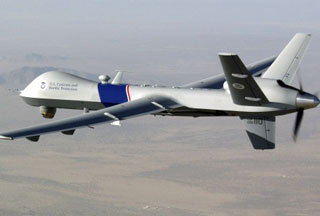 Press TV – January 17, 2010
At least 20 people have been killed in Pakistan in the latest US drone attacks that picked up pace after seven CIA agents were killed in late December.
The Sunday attack has reportedly targeted a militant compound in an area near Miranshah, the main town in the North Waziristan tribal region. However, the identity of those killed in the air raid has not been confirmed.
The number of CIA-operated drone strikes along the Pakistan-Afghanistan border has increased after a Jordanian double agent crossed into Afghanistan from the tribal lands and struck a US intelligence center in late 2009.
Over the weekend, eleven people were killed in two drone attacks in northwestern Pakistan.
The US has carried out dozens of missile strikes in northwestern Pakistan over the past twelve months. Washington claims it is targeting militants.
But reports say the attacks have repeatedly killed civilians. Last week, Pakistani officials warned US Special Envoy Richard Holbrooke that the US drone attacks could endanger ties.
There have been nationwide rallies in Pakistan against high civilian casualties inflicted by the US operations.
Pakistan Islami Jamiat-e Talaba staged an anti-American rally on Saturday to show strong resentment at US drone attacks in the country.
Demonstrators demanded that the government take a strong stand against the US presence in the country.
ACLU Requests Information On Predator Drone Program
Asks For Data On “Targeted Killings” Of Suspected Terrorists And Civilian Casualties
January 13, 2010
NEW YORK – In a Freedom of Information Act (FOIA) request filed today, the American Civil Liberties Union asked the government to disclose the legal basis for its use of predator drones to conduct “targeted killings” overseas. In particular, the ACLU seeks to find out when, where and against whom drone strikes can be authorized, and how the United States ensures compliance with international laws relating to extrajudicial killings.
“The American public has a right to know whether the drone program is consistent with international law, and that all efforts are made to minimize the loss of innocent lives,” said Jonathan Manes, a legal fellow with the ACLU National Security Project. “The Obama administration has reportedly expanded the drone program, but it has not explained publicly what the legal basis for the program is, what limitations it recognizes on the use of drones outside active theaters of war and what the civilian casualty toll has been thus far. We’re hopeful that the request we’ve filed today will encourage the Obama administration to disclose information about the basis, scope and implementation of the program.”
The administration has used unmanned drones to target and kill individuals not only in Afghanistan and Iraq but also in Pakistan and Yemen. The technology allows U.S. personnel to observe targeted individuals and launch missiles intended to kill them from control centers located thousands of miles away.
Today’s FOIA request was filed with the Department of Defense, the Department of Justice (including the Office of Legal Counsel), the Department of State and the CIA.
“The use of drones to conduct targeted killings raises complicated questions – not just legal questions but policy and moral questions as well,” said Jameel Jaffer, Director of the ACLU National Security Project. “These are not questions that should be decided behind closed doors. They are questions that should be debated openly, and the public should have access to information that would allow it to participate meaningfully in the debate.”
The ACLU’s request seeks, in addition to information about the legal basis for the drone program, data regarding the number of civilians and non-civilians killed in the strikes. Estimates of civilian casualties from the government and human rights organizations differ dramatically, from the dozens to the hundreds, giving an incomplete and inconsistent picture of the human cost of the program.
media@aclu.org
Japan Ends Refueling Ships in Support of War in Afghanistan
By Sachiko Sakamaki and Takashi Hirokawa
Jan. 15 (Bloomberg) — Prime Minister Yukio Hatoyama said Japan today will end its refueling of ships in the Indian Ocean to aid U.S.-led operations in Afghanistan.
Hatoyama thanks navy personnel who provided fuel and water to ships from Pakistan, the U.S. and other countries, and said Japan will continue to participate in the international efforts against terrorism, according to a statement. Japan in November said it will provide as much as $5 billion over five years to help in the reconstruction of war-torn Afghanistan.
“I think more direct, civilian assistance is important for Afghanistan to secure economic stability and peace,” Hatoyama told reporters today in Tokyo.
Japan’s navy had refueled warships in the Indian Ocean since 2001. Hatoyama’s Democratic Party of Japan ousted the Liberal Democratic Party from 50 years of almost unbroken rule and vowed to end the operations.
To contact the reporter on this story: Sachiko Sakamaki in Tokyo at ssakamaki1@bloomberg.netTakashi Hirokawa in Tokyo at thirokawa@bloomberg.net
Filmmaker Loach urges cultural boycott of Israel
Press TV – January 15, 2010
The acclaimed British director and winner of Palme d’Or at the Cannes Film Festival, Ken Loach, has called for the boycott of Israeli movies at the international film festivals and cultural events.
“The massacres and state terrorism in Gaza make the showcasing of Israeli films in various sections of international film festivals unacceptable,” Loach was quoted as saying at a ceremony commemorating Israeli offensive on the besieged Gaza Strip by IRNA.
“Tel Aviv sponsors various international film festivals with the intention to open the way for Israeli films.”
He added the call for a boycott of Israeli cultural products comes from many writers, artists, journalists, lawyers, academics, trades unionists and teachers. They see it as “a contribution to the struggle to end Israel’s occupation, colonization and system of apartheid.”
Last July, Loach withdrew his film ”Looking for Eric” from the Melbourne International Film Festival in protest against the Israel’s sponsorship of another filmmaker. Tel Aviv provided airfare for Tatia Rosenthal, whose film ”9.99” is an Israeli-Australian co-production.
In May 2009, Loach as director of the Edinburgh International film festival returned a £300 gift from the Israeli embassy as a sign of his cultural boycott of Israel and in protest of Tel Aviv’s policies towards the Palestinian people.
The Toronto international film festival (TIFF) came under fire in September for selecting Tel Aviv as the subject of its inaugural City-to-City Spotlight strand. Renowned movie makers including Loach, Jane Fonda and David Byrne were among those who signed a statement supporting Canadian film-maker John Greyson, who withdrew his short film “Covered” from TIFF after learning of the program.
In a letter to the festival, Greyson cited Israeli action in Gaza and the expansion of illegal settlements as reasons for his withdrawal.
A United Nations inquiry led by former South African Judge Richard Goldstone details what investigators call Israeli actions “amounting to war crimes, possibly crimes against humanity” during Israel’s offensive against Gaza.
Tel Aviv is worried that charges could be lodged against politicians and army officers for war crimes committed during Israel’s 22-day offensive against blockaded Gaza Strip. Top officials who would be in the judicial cross-hairs could include former Prime Minister Ehud Olmert, former Foreign Minister Tzipi Livni as well as current Defense Minister Ehud Barak.
More than 1,400 Palestinians were killed during three weeks of Israel’s land, sea and air assault in the impoverished coastal sliver. The offensive also inflicted $ 1.6 billion damage to Gaza economy.
Remembering earlier massacres in Gaza: “This is life”
Eva Bartlett writing from occupied Gaza Strip, Live from Palestine, 14 January 2010
It’s a sunny day in the border region east of Beit Hanoun. Aside from a glaring absence of the citrus and olive trees which for decades abounded on this fertile land, finally razed by Israeli military bulldozers, all seems idyllic.
“This is the first time I’ve returned here since my friends were killed,” Ahmad Hammad says. He stands at the edge of a vacant plot and gestures to its far end which lies over 1 km from the border separating Israel and the Gaza Strip. “They were over there, I was standing here,” he explains.
Hammad, 24, recalls the day two years ago when three of his friends, all in their early twenties, were torn apart by an Israeli-fired surface-to-surface missile.
The Palestinian Centre for Human Rights reported that an Israeli military spokesman claimed that the Israeli army “targeted Palestinian gunmen accused of launching home-made rockets at Israeli towns.”
But Hammad remembers differently.
“They were all sitting over there, beside a small concrete hut. We used to come here all the time, to relax, drink tea, talk of our hopes and dreams. I was late that day.”
The date — 23 February 2008 — is etched in Hammad’s memory. His is a story of seeking a sanctuary where politics, occupation, siege and Israeli attacks didn’t exist. Just friends, tea, tobacco water pipe and talk.
“I left home around 2pm when they called me. They were already here, preparing the tea, relaxing. When I arrived to this spot, Muhammad stood up and began dancing around, joking, waving me to come over.”
He relives the next painful minutes in slow motion:
Then — it was exactly 2:28pm — there was a huge explosion and much smoke. I couldn’t see the area where they’d been standing, the smoke was so thick. When I finally got through the smoke and reached where they’d been standing, I found only pieces of my friends. I couldn’t even identify them by their faces, they were so destroyed.
I couldn’t think straight, couldn’t talk. I cried and cried, for maybe half an hour. Then I tried to call an ambulance, but I was still crying so hard the dispatcher couldn’t understand me. I called a friend instead and told him to bring a car and come here. He asked why, and I just told him to come here, still crying.
We collected my friends in pieces and took them to the hospital.
Hammad walks now, venturing to the site where his best friends were martyred. He sits near a water pipe leading from the ground and explains the area. “That was the hut, it was just a single room. We’d prepare tea and heat coals [for the water pipe] here.”
Pointing beyond the flat space where the hut stood, he notes a pile of rubble. “The room was destroyed in the last Israeli attacks on Gaza.”
The land is parched and cracked from want of rain or irrigation. “All the water pumps and wells in this area have been destroyed,” Hammad says, diverting to the troubles which now plague the region. “My own father’s well, over there, just 700 meters from the border, was destroyed. It must have cost him at least $10,000 to build, and now he can’t water his citrus trees.”
The Hammad family is not alone in repeatedly losing trees, crops and wells to Israeli bulldozers. Throughout the border region, wells, cisterns, piping, houses, farm equipment, and crops have been destroyed over the last decade, the most thorough destruction being during Israel’s invasion of Gaza last winter.
This dry, flat plot of land once sprouted onions. “Some of our other friends rented the land. They wanted to earn some money, so they planted onions and worked the land together. But they always let us come here to relax, whenever we wanted. That’s why we came here that day.”
He points up, over the border region where a fat white blimp hangs in the sky, surveying the land below with great accuracy. “These blimps are along the border. They can see everything with great detail, including my clothes and face.”
What the blimp misses, the drone hovering above sees. During Israel’s invasion, drones clouded Gaza’s skies and accounted for 519 of the 1,419 Palestinian civilians murdered during the Israeli massacre, according to the al-Mezan Centre for Human Rights. Often, the first drone-fired missile would be pointedly followed minutes later by a second or third, striking those who came to rescue the injured.
Earlier this day, Israeli warplanes leafleted the border regions, again declaring the 300 meters from the border mortally off-limits to anyone on the Gaza side. The Israeli-imposed “buffer zone” goes back a decade. And although the current limit is 300 meters, in practice Israeli soldiers target Palestinians up to nearly 2km away.
“They were young, were still dreaming and planning their lives,” says Hammad.
Muhammad al-Zaniin was from Beit Hanoun. He was still in school, studying business and English at al-Azhar University.
“He was an over-achiever, always wanted to get the highest marks possible. His goal was to be first in his class throughout university, and to finish early. He was always studying. Just before he was killed, he had learned the results of some of his exams: 97 percent, 95 percent. But he was killed before he knew the rest. He wasn’t asking for much from life, just to do well in school, get a job, and marry a girl he loved.”
Ibrahim Abu Jarrad was also from Beit Hanoun.
“He was the quietest of us all. He was very thoughtful and a mediator, always solving problems between people. His hopes were very simple: to build a home and marry the girl he loved.”
Muhammad Hassanain was from Jabaliya. His father was dead and Muhammed had taken on the role of providing for the family.
“He dreamed of building a new home, large enough to house the family comfortably. He was such a responsible guy — as paying the university tuition of his younger brother. He just wanted to marry and take care of his family.”
It was the same week that the Israeli military killed another six civilians in Gaza and wounded 16. Among the martyred were an elderly shepherd and a farmer in his thirties, both nearly 3 km from the border when shelled by an Israeli surface-to-surface missile east of Gaza City. A 12-year-old and two 10-year-olds were killed later the same day west of Jabaliya, targeted by Israeli air strikes. An infant was killed by shrapnel to his head and chest after Israeli aircraft bombed a government building surrounded by houses in the center of Gaza City. A 31-year-old in the east Khan Younis region was killed by indiscriminate Israeli fire the day earlier.
“After I saw my friends torn to pieces, I kept thinking, ‘I wish I had been with them.’ I saw part of the missile that looked like it hadn’t exploded, and I wished that it would now explode with me,” Hammad says. “It was the end of the life I had, the end of my dreams.”
The killing of Hammad’s three friends wasn’t his first personal loss, but it hit him the hardest.
“I’d seen my cousins killed, in 2004. But that was nothing. This was the most difficult thing for me, it still haunts me.”
While Hammad no longer visits places that remind him of his martyred friends, he does still regularly visit their families.
“Of course, they are like my own families. But even though I know they love me, I always feel that they blame me, think I was the reason their sons were killed. I see it in their eyes.”
Like most Palestinians who’ve suffered the loss of their loved ones, or suffer from the grinding, nearly four-year-long siege on Gaza, Hammad hides his pain behind smiles and laughter.
“I told my friends that I’d never laugh again after my best friends were killed. But we go on. And my laughter is hollow.”
Fluent in English, Hebrew and his native Arabic, Hammad is educated and employed. But not happy.
“I also had many dreams. I used to dream of doing a Masters degree abroad. Now I just live day to day, continue because everyone tells me I must. This is life. It comes and takes everything you want.”
Eva Bartlett is a Canadian human rights advocate and freelancer who arrived in Gaza in November 2008 on the third Free Gaza Movement boat. She has been volunteering with the International Solidarity Movement and documenting Israel’s ongoing attacks on Palestinians in Gaza. During Israel’s recent assault on Gaza, she and other ISM volunteers accompanied ambulances and documenting the Israeli attacks on the Gaza Strip.
Featured Video

or go to
Aletho News Archives – Video-Images
New Documentary
“Inside Gaza” wins best documentary at Montreal’s Cinemania film festival
Palestine Information Center – November 16, 2026
MONTREAL – The documentary “Inside Gaza,” which chronicles the experiences of Palestinian journalists working with Agence France-Presse (AFP) while covering the Israeli war on the Gaza Strip, won the Best Documentary Award at the 32nd Cinemania International Francophone Film Festival held in Montreal, Canada.
Directed by Helene Lam Trong, the 72-minute film follows the daily lives of four AFP journalists who bear witness to the difficulties of reporting in a war-torn territory largely closed off to international media.
The film is compiled from material produced by the team on the ground, as well as from interviews conducted after they left.
The film also won the People’s Choice Award at the festival on Saturday. … continue
Blog Roll
 Aletho News
- Iran accuses NYT report of paving way for attacks on dams
- Brand ‘rape’ case just doesn’t add up. Was he framed?
- How The Jensen Huang Chinese Spy Hoax Is Russiagate 2.0
- Austria seeks to strip former foreign minister of citizenship over Russia ties
- “Inside Gaza” wins best documentary at Montreal’s Cinemania film festival
- Activists block German munitions plant over arms exports to ‘Israel’
- The Nasser Hospital attack and Israel’s relentless lies
- Could it be satan? No, Huckabee, just the Americans you work for
- AIPAC and more: Network of pro-Israel influence in US Congress
- Putin aide reveals Moscow’s stance on Europe at peace talks
- If Americans Knew
- An error has occurred; the feed is probably down. Try again later.
- No Tricks Zone
- Argentina’s Perito Moreno Glacier Joins Antarctica and Arctic In Defying Doomsday Melt Claims
- New Study: Barents Sea Temperatures Were Warmer And Sea Ice Less Extensive In The 1700s Than Today
- German Authorities Start Initiative To Evaluate Public Register For Climate “Disinformation” Spreaders!
- Zonal Asymmetry of Temperature Change in the Antarctic Circumpolar Current
- New Study: The Net Fossil Fuel Contribution To Rising Atmospheric CO2 Has Been Zero For 500 Years
- Germany’s Green Energy Transition Becoming Increasingly Expensive…Another 6 Trillion Euros!
- Sudden Stratospheric Warming, Powerful El Niño Combination May Lead To Extreme Europe Cold, Energy Crisis!
- Two New Studies Find Thwaites Glacier Melt Cannot Be Driven By Human Activity Or A Warming Ocean
- E-Cars Reduce CO2 Emissions By Only 41% Compared To Internal Combustion Engine Vehicles
- Predictions Made By Renowned Climate Professor Over Past Decades Have Been Proven To Be Poor

