Turkish organization: Arrest Barak for War Crimes When He Arrives Here
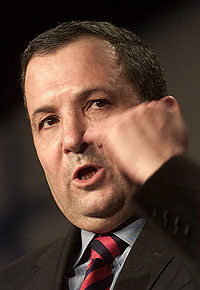 AL – MANAR TV 14/01/2010 – Despite the intensifying crisis between Israel and Turkey, Israeli Defense Minister Ehud Barak is insisting to follow through with his scheduled plans to visit Turkey next week. However, on Thursday it became clear that an arrest warrant may await him there.
One of the major human rights organizations in Turkey, Mazlumder, requested from the Turkish state prosecution to order that Barak be arrested upon landing in the country for what they call “his responsibility for war crimes during Operation Cast Lead.”
A statement published Wednesday night by the Istanbul branch of Mazlumder said that the request is rooted in the right of universal jurisdiction and Article CMK98 of Turkish law.
“Israel perpetrated genocide and crimes against humanity. Israeli army forces bombed the UN building, hospitals, and schools. As was proven by lab tests performed by Turkish universities, they also used phosphorous bombs, which are forbidden. It is known that Israel used an assortment of ammunitions that caused physiological and psychological diseases among the Gazan population.”
The organization’s statement also asserted that a request was made in the past to Turkish prosecution to arrest senior Israeli officials, but then Justice Minister Mehmet Ali Shahin rejected it. The organization hopes that this time around, given the crisis in the relations between the two countries and the precedent provided by efforts in Britain to issue an arrest warrant against former minister Tzipi Livni, the Turkish prosecutor will decide to act differently.
“We know that Barak will arrive in Turkey on the 17th of the month,” said the organization. “(We) need to put him trial and prevent every other Israeli who is responsible for war crimes from entering Turkey freely. We remind the Turkish prosecution of its role. We remind them that Britain has already decided to arrest Tzipi Livni when she was slated to arrive in the country. We remind them that Shimon Peres and Ehud Olmert must also be arrested according to Article CMK-98 of the Turkish law, which grants us the right to try them.”
Mazlumder is an independent organization that was founded in 1991 by a group of 54 lawyers, businessmen, and media correspondents. It has many branches throughout Turkey. The group defines itself as apolitical and promoting human rights regardless of race, religion, or gender and “without double standards for humanity.”
Chairman of the Istanbul branch Attorney Jihad Gokdimar is signed on the current request for an arrest warrant.
This is the not the first time an attempt has been made in Turkey to issue an arrest warrant against senior Israeli officials. In February 2009, a pro-Palestinian organization asked that then Israeli Prime Minister Ehud Olmert, his Foreign Minister Tzipi Livni, Defense Minister Ehud Barak, and President Shimon Peres be put on trial. The general prosecutor in Ankara rejected their request.
NATO forces kill protesters
By Zainullah Stanikzai | RAWA | January 12, 2010
LASHKARGAH: Ten people were killed and 25 others wounded as NATO-led soldiers opened fire on residents protesting civilian deaths and desecration of the Holy Quran in southern Helmand province on Tuesday.
Dwellers of the restive Garmser district said International Security Assistance Force (ISAF) soldiers raided the house of a tribal elder, killing three of his family members and torching copies of Quran in a local mosque.
To protest the overnight raid on the residence of tribal elder Haji Qayyum in the Darveshan village, residents staged a demonstration that came under fire from foreign troops, eyewitness Dost Muhammad told Pajhwok Afghan News.
Agha Muhammad, another resident who had come to the provincial capital of Lashkargah, said the people — chanting slogans against international troops — had informed the district chief of their protest. Even then they were fired on by Afghan and foreign soldiers, he claimed.
“Ten protestors were killed and 25 others wounded as a result of firing by the joint force,” he alleged, saying those slightly injured were rushed to the Garmser Civil Hospital. Eleven people with serious injuries were shifted to the provincial capital, he continued.
An employee of the Lashkargah Emergency Hospital confirmed receiving 10 wounded civilians. Two of them are said to be in a critical condition.
A security official, who did not want to be named, confirmed eight deaths and injuries to13 others. The angry demonstrators reportedly turned violent against intelligence operatives, who opened fire on them, he said.
“The protestors were signaled to stop but they ignored the orders. Subsequently, they came under fire,” the source said, disclosing one intelligence agent was also killed and another two injured. He alleged Taliban commander Mullah Naeem had provoked the protestors.
In Kabul, the ISAF Joint Command (IJC) said it was aware of the protests against the alleged desecration of the Holy Quran that took place in Garmser district.
“While denying these allegations, we take them very seriously and support a combined investigation with local Afghan authorities,” said Major Gen. Michael Regner, IJC deputy chief of staff for operations.
“ISAF is an international force that includes Muslim soldiers, and we deplore such an action under any circumstances.” The allegation comes in reference to an operation against the Taliban in the district.
On Sunday, the multinational force said, Afghan forces conducted the operation, supported by coalition troops. The joint force protected the dignity of all innocent civilians during the operation, it insisted
During the protest, an insurgent sniper shot an Afghan official, the statement added. ISAF service members identified the sniper and shot him dead. There were no other injuries or shots fired.
“As partners with the Afghan people, we will thoroughly investigate allegations to determine the facts,” Regner said. “IJC remains committed to our Afghan partners and we will continue our efforts in support of a free and prosperous Afghanistan.”
Protests continue to follow Ehud Olmert
By Adam Horowitz | January 12, 2010

Protest against Olmert speech in Chicago, October, 2009. (Photo:Tom Tian)

A few months ago we followed a series of protests that followed Ehud Olmert across the country as he tried to rehabilitate his image on a US speaking tour. He is still at it, and the protests continue to follow. This Thursday, Olmert will speak at Union College in Schenectady, NY and a coalition of local organizations are planning a protest.
In addition, Union faculty have opposed the decision to host Olmert and are circulating the following statement:
A Position Statement from Members of the Union College Community:
Whereas, Union’s Strategic Plan calls for graduating students who are “engaged, innovative, and ethical contributors to an increasingly diverse, global, and technologically complex society;” and
Whereas, former Prime Minister Ehud Olmert has been indicted on serious corruption charges in his own country, has been officially implicated by the United Nations in war crimes and crimes against humanity in Gaza, and has also been implicated in the suppression of dissent:
We, the undersigned, hold that the administration’s decision to allow the Speaker’s Forum to invite Mr. Olmert was mistaken and contradicts the values and ethics of Union College. We reject the argument that Mr. Olmert’s visit is simply that of a “controversial” individual. We reject the logic that validates such a position, and hold it to be irrational and inconsistent with the intellectual climate we hope to create. Mr. Olmert’s appearance at Union does not contribute to the free exchange of ideas. On the contrary, closed to the general public, under the pall of heavy security, and with questions vetted by moderators, this event seems to limit and stifle opposing viewpoints a set of conditions inconsistent with our tradition of academic freedom. Furthermore, we deplore the significant negative impact this event will have on Union’s academic reputation on the local, national, and international levels. We go on record strongly against this decision to invite Mr. Olmert to speak at Union College, and urge that the event be cancelled.
Anyone wishing to sign this statement is invited to contact any of us listed below to be added to the list of supporters. We are compelled by our consciences to circulate this position statement within the Union College community and beyond.
David Ogawa
Eshi Motahar
Tom Lobe
Mazin Tadros
Andy Feffer
Michelle Chilcoat
Valerie Barr
Blackwater/Xe mercs arrive in Somalia, Al-Shabab says
Press TV – January 12, 2010 01:34:41 GMT
At least 18 people have been killed in clashes between rival factions in southern and central Somalia, and there are reports that Blackwater/Xe mercenaries have entered the country.
A battle broke out between the pro-government Ahlu Sunnah militia and Hizbul Islam fighters in the town of Baladwayne on Sunday and went well into Monday, during which at least 13 people lost their lives, witnesses said.
In addition, five people were killed when Hizbul Islam fighters engaged Al-Shabab fighters in the town of Dhobley near the Kenyan border, Reuters reported.
There are also allegations of US-sponsored bomb plots in the capital.
The bombings will be carried out in order to create a pretext to launch a campaign against Al-Shabab, a spokesman of the group, Sheikh Ali Mohammed Rage, told Reuters.
“We have discovered that US agencies are going to launch suicide bombings in public places in Mogadishu,” he told reporters. “They have tried it in Algeria, Pakistan and Afghanistan… We warn of these disasters. They want to target Bakara Market and mosques, then use that to malign us.”
At a meeting with tribal elders in Mogadishu on Monday, the Al-Shabab spokesman said that mercenaries of the Xe private security firm — formerly known as Blackwater — have arrived in the Somali capital, the Press TV correspondent in Mogadishu reported on Monday.
Blackwater/Xe mercenaries plan to carry out bombings in Mogadishu in order to accuse Al-Shabab of being the culprits in the attacks, the Al-Shabab spokesman added.
He went on to say that the Blackwater/Xe mercenaries have already recruited many lackeys to help them carry out bombings targeting prominent individuals and innocent civilians.
The Al-Shabab spokesman also told the tribal elders that a system based on Islam should be established in Somalia.
The use of Palestinian civilians as human shields
Part 15 of a series recounting the findings of South African jurist Richard Goldstone’s UN Fact Finding Mission on the Gaza Conflict.
Bethlehem – Ma’an – At midnight on 10 January 2009, Israeli soldiers violently entered the home of Mahmoud Al-Ajrami, where he and his wife were sheltering underneath the stairs.
Soldiers threw a grenade and entered the house shooting. What Al-Ajrami says transpired over the next 48 hours left him with two fractured vertebrae as a result of beatings, and was one of four cases in which civilians were used as human shields that Richard Goldstone’s UN inquiry investigated.
These civilians were allegedly forced to enter houses at gunpoint in front of or, in one case, instead of soldiers. Two incidents took place east of Jabaliya.
The case of Mahmoud Al-Ajrami
Al-Ajrami, a former foreign minister, testified in Gaza City last June. He resigned when Hamas took over and has not worked since. He, his wife and 15-year-old daughter lived in a house west of Beit Lahiya. His home was directly hit for the first time on 2 or 3 January 2009, according to him by tank shells and by missiles fired by Apache helicopters, which seriously damaged external and internal walls.
“I don’t know why the Israeli army did what it did, especially since I was in a civilian house. There wasn’t one bullet fired from my house or from the neighboring houses,” he recounted. “And I asked this question to one of the officers later … this question still challenges me.”
Tanks that came into the area were initially positioned around 500 meters north of his house. As he told Goldstone, Al-Ajrami had decided not to leave because of his father’s experience of leaving his home in Israel and not being able to return. But he decided that this was proving too difficult for his daughter. He called a taxi and his daughter moved to the house of an uncle in a safer area.
“The soldiers came in while firing and guns shooting. … At one point we were facing them, so I started talking to them in a loud voice, telling them, ‘we are here, we are the owners of this house, we are civilians,’ and my wife was saying more or less the same. …”
An officer ordered Al-Ajrami to lift his robe (he was in nightclothes) and turn around. “I was there with my wife, wearing pajamas and bathrobes, because this was January and you know it’s very cold, and these are the coldest days of the year in Palestine,” he said.
“One of them – actually there were about 20 to 25 soldiers inside the house, and like I said, we were in the corner, although we tried to get closer to them – and one of them yelled at us in broken Arabic and I couldn’t understand him … So when I got closer to him, he pointed his gun at me with the laser beam, of course, pointing at me, so I moved my hands and said, ‘please, just stop, stop, don’t shoot. I don’t understand what you need, what you want.’ …
“His first question was ‘what are you doing here,’ and I said, ‘this is my house, this is my home and it’s quite natural to be at home, and I don’t know, frankly speaking, what are you doing here, because my presence here is natural, your presence is not natural.’ So he insulted me, using extremely crude words and he said, ‘you have to remove your shirt, turn around.’ I did, and he – maybe he expected me to be carrying a bomb … Then he asked me to move ahead. …
They were then taken to a neighboring house where soldiers took his ID card and checked it on a laptop.
“And then he said, ‘well, you’re going to stay with us’ and he started then asking the questions, ‘I’m gonna give you five minutes and then you will have to tell us in detail where is [captured Israeli soldier] Gilad Shalit. Where are the Hamas tunnels located and where are the Hamas militants, where are the rockets’ and so on.”
Al-Ajrami responded that he could not provide that information because he did not know, that he was previously a member of the Fatah administration. “So he said, ‘well, I’ll come back to you.’ … He told me, ‘if you don’t speak we will take you and we will kill you,’ and I remember exactly what he said, ‘if you don’t talk we will take you and shoot you,’ and he repeated the same sentence over and over again. So I said, ‘I don’t have any information. I don’t know what I can tell you.'”
According to Goldstone, the soldier responded: “You are Hamas; Hamas killed all Fatah and others in Gaza, so you must be Hamas.” Al-Ajrami insisted that he was a civilian. The officer told him again that he had five minutes in which to give him information or he would be shot. Five minutes later, Al-Ajrami again responded that he did not know anything about the questions asked.
“So he said, ‘what do you do.’ I said, ‘I work as the assistant of the minister.’ He said ‘which minister,’ I said ‘the foreign minister.’ So he said, ‘then you’re the assistant of Dr Mahmoud Al-Zahar, the [de facto government] foreign affairs minister.’ I said, ‘well, I worked with all of the ministers of foreign affairs.’ We stopped there and then he said ‘you’re a Hamas member’ and I said, ‘no, this is my job as a diplomat at the foreign affairs minister. I don’t belong to any party.’
“Then he said, well, ‘you don’t want to speak,’ and I said, ‘no,’ so he yelled at me and he was extremely angry. He started insulting me, he insulted my mother, using words, extremely offensive words that nobody can imagine. So I said, ‘look, you can take me wherever you want, I can’t do anything about it. You’re an army, you have your forces, your tanks are stationed here …’
Al-Ajlami was handcuffed and blindfolded. Two or three soldiers took him by the shoulders and forced him to walk in front of them. His wife tried to go with him but they pushed her back into the room. It was by now around 2am. “My wife had her hands tied, was hanging to my robe, and she said ‘please take me with him’ and she was screaming and she said, ‘I’m not going to leave him, take me with him.’ One of the soldiers pushed her back, so she fell on the ground and he said, ‘no, you are not to move.’ So I left.
‘I thought they were going to shoot me’
The soldiers took Al-Ajlami up to the second floor of the building and threw him off. He landed on rubble and fainted. When he came to, he had severe pain in his right side and had difficulty breathing. He found out later that he had broken four ribs and he had severe bruising down his right leg.
“I didn’t expect that I was going to be thrown off the second floor, and of course, it goes without saying, I couldn’t do anything about it. …
It was raining and still dark. Four soldiers forced him to stand. He was moaning with the pain but did not want them to hear. “I didn’t want to scream. I tried to hold myself, I tried to restrain myself. They put me up and I had to walk but I was in extreme pain. I realized that I could not walk; that the right side, there were a lot of bruises and I saw them later when I reached the hospital.”
The soldiers pushed him against a wall and walked away. He thought they were going to shoot him. He was still blindfolded. “I tried to look from underneath the blindfold, I saw the soldier’s feet, and I heard [from a witness] later on that when they brought him to join me, he saw them holding their guns and pointing their guns at me and he thought that they were going to shoot me and shoot him also.”
Early the next morning, the soldiers took him and another man (whom he subsequently found out to be his neighbor Abbas Halawa) and forced them to walk in front of them. Al-Ajrami was blindfolded and a gun was held to the back of his head. He thinks that there were around 25 soldiers behind him and the other Palestinian man. Having walked in this way for a while, both he and the other man were forced to enter several houses with the soldiers taking cover behind them. They did not find anyone in any of the houses.
“I had a lot of difficulty walking and it was rough road. It was difficult to walk on that road and my movements were extremely difficult and we were blindfolded, our hands were tied. This is in addition to the acute pain I was feeling. I spoke to one of the Israeli soldiers who was behind me, and of course, we could feel the guns on our heads, also on the broken ribs on my back, and I told him I’m in extreme pain and he insulted me and he said ‘just walk, go, go,’ he said.
“Now, there were both of us, Abbas Halawa and myself and we kept walking, and when we got closer to a house, and because we could still see that, they would just push us ahead, meaning that they were hiding behind us. And on more than six or seven occasions they started shooting. So whenever they heard a strange noise and it was windy, because it was wintertime, they would start shooting. And we went on like this until we reached a a military location where there were a lot of tanks, also machine guns, soldiers.”
After searching several houses, the soldiers, Al-Ajrami, and Halawa walked north toward Dogit, a former settlement. He could hear the movement of tanks and see tank positions. Both men were forced to sit on the ground. They were left there without food, water or blankets. “They threw us on the floor next to each other with Mr Abbas Halawa and we stayed like this until the morning.”
At around 10am, soldiers took Halawa for interrogation. “I kept just writhing and writhing because of the pain, it was extremely cold. I was trembling and shivering. … It was around 11:00am and the soldiers came and took me. I told them don’t touch my right arm because I’m in extreme pain and I could not stand up, so they carried me.”
During that and the following day, Al-Ajrami was interrogated, once by a senior officer. “I realized that I was face to face with an Israeli officer, blond guy, blue eyes, in his 50s. I think he’s a general, I didn’t pay attention to his rank. And I felt, somehow, questioning myself why I was put that way, as if I were a terrorist. … And he said ‘look me in the eyes, I’m an intelligence officer, and I can understand whether you lie or not because we study psychology.’ I said, ‘I also have a PhD in mental health,’ and he just nodded and I think he didn’t feel happy about it, because he replied in a very, very harsh manner.
“And he repeated the same questions, again, and when I gave him the same reply again, he said that Hamas killed everybody and I laughed and he asked me about the whereabouts of Gilad Shalit and the rockets and what have you. … I said, ‘why are you treating me that way.’ He asked me to approach. I said, ‘I can’t.’ He said, ‘why.’ I said, ‘because one of your soldiers [threw] me off the second floor.’ He asked the soldiers to drive me forward where there was a boulder of debris and all soldiers there and tanks were coming and going and rockets were falling from the aircraft and the atmosphere was quite tense.
“And he said, ‘this is your house’ and I looked at the sea, to see that my house was there because it was on a hill. ‘Yes,’ I told him … he said that it was a beautiful house. I said, ‘your soldiers destroyed it,’ and he said, ‘we explicitly did that so as to give you a lesson because you elected the number one enemy of Israel, and I said, what’s my fault, what’s my guilt.’ He said, ‘as long as you are alive, you should know that the IDF is there and it is coming.’
“Then there was another officer who intervened and said ‘take him away’ and they brought me back to the ground, and that interrogation was repeated four or five times through the day and night and I was just in the open without any food or water and without any medication, whatsoever. And the next day the interrogation was repeated with me.”
On the second day, Al-Ajlami was taken to the edge of the camp and told to walk back south into Gaza City. “I walked southward toward my house and it was about 1pm and about 100 meters from that point, one of the soldiers took scissors and he cut the plastic handcuffs and they took away the blindfold and they put it in his pocket and then he asked me to go south, not to my house, and to head toward Jabaliya. I said, well, and at that moment I [thought] I was breathing my last because of thirst. I asked for some water. One of the soldiers gave me a small bottle of water and it had a black thread around it, and he said ‘take it’ and I had some water.
Then I said, ‘where should I go, should I go alone.’ He said, yes, ‘but I’m among your soldiers and this is just like an execution process.’ The other insulted me at least ‘go to hell and get lost;’ this is the least I can say.”
Al-Ajlami was able to reach the outskirts of the city and was helped by a stranger to reach a relative’s home, from where he was taken to Ash-Shifa Hospital. On returning to his house, he found it ransacked and vandalized. Many items of value had been stolen, including jewelry and electronic equipment.
The case of Majdi Abd Rabbo
Majdi Abd Rabbo, a man aged 39 at the time of the incident, is married and the father of five children. He is PA intelligence officer.
Abd Rabbo recounted that, at around 9:30am on 5 January 2009, he heard loud banging on the outer door of the house. He asked who was at the door and someone responded in Arabic, ordering him to open the door. He opened the door and saw in front of him a handcuffed Palestinian man, who was intentionally not identified by name in Goldstone’s report.
A group of around 15 soldiers stood behind the Palestinian man. One of the soldiers was holding a weapon to the man’s head. The soldiers pushed the man to one side and four soldiers pointed their weapons at Abd Rabbo. They ordered him to undress down to his underwear. He was then told to dress again and they pushed him into the house.
The soldiers ordered him to call his children one by one. He started with his eldest son, aged 16, who was ordered by the soldiers to strip naked. The same process was followed with the two other sons, aged nine and eight. He then called his daughter, aged 14, who was told to press her clothes to her body and turn around. His wife, who was holding their baby daughter, was also told to press her clothes to her body, and then to take the baby’s trousers off.
Abd Rabbo stated that the soldiers then forced him to walk in front of them as they searched the house, room by room, holding a firearm to his head. They questioned him about the house behind his. He told them that the house was empty and the owner had been absent for four years working in the Sudan. There was a small gap between the two houses, but they were joined at the roof. The soldiers gave him a sledgehammer, the kind used to break stones, and told him to break a hole through the dividing wall. This took around 15 minutes.
From the roof, the soldiers entered the house, pushing Abd Rabbo ahead of them down the stairs while they watched over his shoulders. They had descended only a few steps, however, when the soldiers apparently detected some movement, started shouting, pulled Abd Rabbo back and rushed back into his house over the roof. He heard some gun shots.
The soldiers ran out into the street, forcing Abd Rabbo and the other man with them while they were shooting. Both were taken into an adjacent mosque, where there were a large number of soldiers with military equipment. They were forced to sit down and then handcuffed.
The soldiers used the raised area of the mosque, from where the imam leads prayers, to fire at Abd Rabbo’s house and the houses next to it. He shouted at the soldiers to stop, as his family was still in the house. A soldier told him to shut up or they would shoot him. The shooting continued for around 30 minutes. After a lull, the soldiers warned that there would be a huge explosion and, indeed, about three minutes later there was a huge explosion. The explosion was followed by intensive gunfire and artillery shells.
In the meantime, he had been forced to break a hole in the wall of the mosque and into the neighboring house. He had then been interrogated about his knowledge of Hamas and the location of tunnels. Subsequently, he was taken and detained together with neighbors, men and women, in another house.
When the shooting stopped, soldiers came to fetch him. He was taken to the road near his house. There were numerous soldiers standing next to it, including some officers. He saw a senior officer talking to the soldiers who raided his house, and the officer then came to speak to him, through an interpreter.
‘This is not my job, I don’t want to die’
The soldier said that they had killed the fighters in the house and told him to go inside and come back with their clothes and weapons. Abd Rabbo protested, saying that he just wanted to find out if his family was safe. The officer told him to obey their orders if he wanted to see his family again. He refused to go, and was kicked and beaten by soldiers with their weapons until he gave in.
He approached the house from the street. The entrance was destroyed and blocked by rubble. He went back to the officer and told him that he could not get in. The officer told him to go through the roof instead. He went into his own house, which he found empty, except for a soldier. This reinforced his anxiety about the fate of his family. At this point, there was no major damage to his house. He crossed the roof and went down the stairs into the other house. He was scared that the fighters would shoot at him and shouted, “I am a Palestinian, a neighbor. I am being forced to come into this house.”
In a room at the bottom of the stairs he found three armed young men wearing military camouflage and headbands of the Al-Qassam Brigades, the military wing of Hamas. They pointed their weapons at him. He told them that the soldiers thought they had been killed and had sent him to check. He said he was helpless as they had taken his wife and children. The men told him they had seen everything, and asked him to go back and tell the soldiers what he had seen.
He went back outside, again crossing over the roof of his house. As he approached the soldiers, they pointed their weapons at him and ordered him to stop, strip naked and turn around. After he dressed again, he told them what he had seen. Initially, the soldiers did not believe him. They asked how he knew that they were Hamas militants and he explained about their headbands. The soldiers asked about their weapons. He replied that they were carrying Kalashnikovs. The officer told him that, if he was lying, he would be shot dead.
He was handcuffed and taken back to the family house for detention. At around 3pm, he heard gunfire for around 30 minutes. The soldiers came back for him and took him to the same officer. This time he noticed different soldiers present with different military equipment. Through the translator, the officer told him that they had killed the militants, and told him to go in and bring back their bodies. Again he refused, saying “this is not my job, I don’t want to die.”
He lied to them, saying that the three militants had told him that if he came back, they would kill him. The officer told him that, as they had already killed the militants, he should not worry. He added that they had fired two missiles into the house, which must have killed the militants. When he still resisted, he was beaten and kicked again, until he went into the house via the roof again.
He found the house very badly damaged. The bottom part of the stairs was missing. He again went in shouting, to alert the militants if they were still alive. He found them in the same room as before. Two were unharmed. The third was badly injured, covered in blood, with wounds to his shoulder and abdomen. They asked him what was going on outside and he told them that the area was fully occupied and the soldiers had taken numerous hostages, including his family.
The wounded man gave him his name and asked him to tell his family what had happened. Abd Rabbo promised to do so if he survived and later did so. Another told him to tell the Israeli officer that, if he was a real man, he would come to them himself.
Abd Rabbo returned to the soldiers, who again forced him to strip naked before they approached him. He told the officer that two of the militants were unharmed. The officer swore at him and accused him of lying. Abd Rabbo then repeated the message from the militant, at which the officer and four other soldiers assaulted him with their weapons and insulted him.
The officer asked for his ID card. He replied that it was in his house but gave him the number. The officer checked it via an electronic device. Three minutes later the officer asked him if it was true that he worked with the head of the PA’s intelligence services, which he confirmed. The officer asked him if he was a supporter of Mahmoud Abbas and a Fatah affiliate. He said he was.
The soldiers brought Abd Rabbo a megaphone and told him to use it to call the fighters. He initially refused but did so under threat. As instructed, he told them to surrender, that the Red Cross was present and they could hand themselves over. There was no response.
By then, night had fallen. Abd Rabbo was again handcuffed and taken back to the house. Thirty to forty minutes later, he heard shooting and a huge explosion. Soldiers came to tell him that they had bombed the house and ordered him to go in again and check on the fighters.
Israeli forces had floodlit the area. Abd Rabbo found both his and the neighbor’s house very badly damaged. He could not use the roof of his house to enter the neighbor’s house, as it had collapsed. He went back to the soldiers, who again made him strip, this time to his underwear. He asked where his family was and said that he could not reach the fighters because of the damage to the houses. He accused the soldiers of destroying his house. The officer said that they had only hit the neighbor’s house. He was then handcuffed.
Until this time, Abd Rabbo had been given no food or water, and it was very cold. After a while, his handcuffs were removed, he was told to dress and taken back to the family house, to the room where he found that other people were being held. All the men and boys in this room were handcuffed and their ankles were tied. A soldier came with some drinking glasses and smashed them at the entrance to the room where they were being held. After smashing the glasses, the soldier left again.
Abd Rabbo had developed a severe headache. Another detainee, who spoke Hebrew, called a soldier to say that he was sick and needed medicine. The soldier told him to keep quiet or he would be shot. A woman tied a scarf around his head to ease the pain.
At around 7am, he was taken back to the soldiers outside. He was questioned about the number of fighters in the house. He confirmed that he had seen three.
Two young Palestinian men from the neighborhood were brought over. A soldier gave them a camera and told them to go into the house and take photos of the fighters. The two tried to refuse, and were beaten and kicked. About 10 minutes later, they came back with photos of the three fighters. Two appeared to be dead, under rubble. The third was also trapped by rubble but appeared to be alive and was still holding his firearm. A soldier showed Abd Rabbo the photos and asked if these were the same people. He confirmed they were.
A soldier took the megaphone and told the fighters that they had 15 minutes to surrender, that the neighborhood was under the control of Israeli forces and that, if they did not surrender, they would hit the house with an airstrike.
Fifteen minutes later, a soldier came with a dog, which had electronic gear attached to its body and what looked like a camera on its head. Another soldier had a small laptop. The handler sent the dog into the house. A few minutes later, shots were heard and the dog came running out. It had been shot and subsequently died.
At around 10:30am on 6 January 2009, a bulldozer arrived and started to level the house, demolishing everything in its way. Abd Rabbo watched it demolish his own house and the neighbor’s house. He and the two young men were told to go back to the family house. They heard shooting.
At around 3pm, Abd Rabbo was taken back close to the site of his and his neighbor’s house. He told the Goldstone mission that he saw the bodies of the three fighters lying on the ground in the rubble of the house.
The soldiers then forced him to enter other houses on the street as they searched them. All were empty. The soldiers forced him to go into a house alone initially and, when he came out, sent in a dog. During the house searches he managed to find some water to drink, the first drink he had had for two days. At midnight, the soldiers took him back to the family house.
On 7 January, all the men and boys were taken from the family house and transferred to the house of a cousin of Abd Rabbo’s in the same neighborhood. There were more than 100 men and boys, including members of his extended family, aged between 15 and 70. The women were being held elsewhere. Abd Rabbo’s immediate family members were not there, and he learnt that no one had seen them. He remained extremely anxious about their safety.
At around 11pm, the men and boys in that house were told that they were going to be released, and that they should all walk west toward Jabaliya, without turning left or right, on threat of being shot. They found Izbat Abd Rabbo Street severely damaged. Abd Rabbo went to his sister’s house in Jabaliya, where he was reunited with his wife and children.
Abd Rabbo told the Goldstone mission that he and his family were traumatized by what had happened to them and did not know what to do now, having lost their home and all their possessions. His children were all suffering psychologically and performing poorly at school. Five months later, Majdi Abd Rabbo was still having nightmares.
Flour mill targeted ‘for the purpose of denying sustenance’
Part 14 of a series recounting the findings of South African jurist Richard Goldstone’s UN Fact Finding Mission on the Gaza Conflict.
Bethlehem – Ma’an – When the Al-Bader flour mill was destroyed on 9 January 2009, the strike happened without prior warning, raising questions about the efficacy or seriousness of the warnings system used by Israeli forces during their devastating assault on Gaza last winter.
Odder still was that in two prior instances, Israel did warn mill owner Rashad Hamada that its jets intended to strike immanently, leading to two evacuations of the mill, neither of which ended in strikes.
On 30 December 2008, a recorded warning was left on the flour mill’s answering machine by Israeli forces, indicating that his building should be evacuated immediately. The approximately 45 workers in the mill at the time were evacuated.
“We received a recorded message by telephone on a landline asking us to evacuate the mill. This call came from Israel,” Hamada said, in testimony to Richard Goldstone’s UN inquiry.
“We evacuated the factory of all workers, a total evacuation and waited until the next day. The factory was not hit.”
Following the evacuation, Hamada called a business associate in Israel, explained what had happened and asked him for advice. The associate spoke with contacts in the Israeli military, and had been told that, although the mill had been on a list of proposed targets, they had decided not to proceed with the strike. Hamada did not receive any information as to why his mill might have been targeted.
Based on these conversations and the fact that there had been no strike, the mill’s employees returned to work the next day. Work continued for a number of days as flour ran out across the Strip, until a second recorded warning was received on or around 4 January 2009.
“We received another message,” Hamada said. “We were told to evacuate the factory. The factory was evacuated.”
Again, there was no attack. “They were put into a state of fear as a result of the false alarms,” Goldstone’s report states.
Hamada received a call later in the week from his business associate in Israel, who said Israeli forces told him the mill would not be hit. The employees returned to work in light of the information.
Then on 9 January, without warning, “we received a call from the guard telling us that the factory was targeted by air with a missile and that it had caught fire. After 15 minutes, he called us again and told us that there are tanks approaching the area and that the factory was targeted with tank fire. We immediately informed the [Red Cross] and the Civil Defense in order to put out the fire in the mill,” Hamada said.
The flour mill was hit by an airstrike, possibly by an F16. The missile struck the floor that housed one of the machines indispensable to the mill’s functioning, completely destroying it. In the next 60 to 90 minutes the mill was hit several times by missiles fired from an Apache helicopter. These missiles hit the upper floors of the factory, destroying more key machinery.
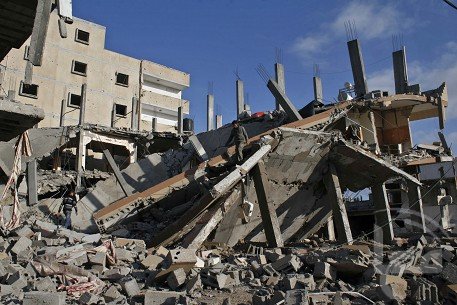
Hamada recounted: “What happened at the mill is a total destruction, a total destruction of the whole production line of the factory. Because this factory, in fact, is vertical, the equipment is set vertically. There are six floors. The production line was destroyed from the sixth floor to the ground floor. Three floors, the fifth, sixth and fourth, were destroyed including all the equipment, total destruction, therefore the building and the equipment. And the other three floors, the first, second and third floors, they were totally burned.”
Adjoining buildings, including the grain store, were not hit. The strikes entirely disabled the factory, which has remained in disrepair because of the siege on building supplies. Even amid subsequent food shortages, a large amount of grain remains at the site but cannot be processed.
“During the war, the mill was working 24 hours a day and we had also been working 24 hours a day one month prior to this date; we were working around the clock,” Hamada said. “As for the targeting, it is because a flour mill [was] working. There were four flour mills that were not producing and were not targeted.”
Israeli forces occupied the disabled building until around 13 January. Hundreds of shells were found on its roof after the soldiers left. They appeared to be 40-mm grenade machine-gun spent cartridges.
Attacks on the foundations of civilian life in Gaza
Goldstone’s team said Hamada and his brother provided information that was corroborated by other representatives of the Gaza business community with whom the investigators discussed the context and consequences of the strike on the flour mill.
The consequences of the strike on the flour mill were significant, his report states. Not only are all the employees out of work, the capacity of Gaza to produce milled flour, the most basic staple ingredient of the local diet, has been greatly diminished. As a result, the population of Gaza is now more dependent on the Israeli authorities’ granting permission for flour and bread to enter the Gaza Strip.
“From what we could see on the ground and from what we had in Gaza, this flour mill was the only flour mill for the past ten years providing for the needs of the Gaza Strip in wheat,” Hamada said. “It is well-known everywhere in Gaza. And in Israel, they know that Al-Bader Flour Mill [which is] the strategic reserve of flour for the strip, was there.”
“There is no flour mill that works except ours and it was shelled. I do not want to give conclusions. It is well-known, this is a flour mill that works and that provides for the needs of the country. It was targeted because we are in a state of war. There is no peace. What I know is that war is war. We hope that all of this will end and will be replaced by peace and that we will forget about these hearings.”
The Israelis have apparently not investigated the flour mill’s destruction, according to the report, nor made any suggestion that the site was targeted for military purposes.
Nevertheless, Hamada rejected any suggestion that the building was at any time used for any purpose by Palestinian armed groups. They pointed out that all of the buildings and factories were surrounded by a high wall and manned by at least one guard at night.
“There is no resistance there,” Hamada said. “After the end of the war, I went to have a look and I asked are there any combatants that died here, any Israelis that died? Not at all, nobody told me of any kind of resistance in the whole area.”
I do not know what they were targeting, I wasn’t there,” Hamada conceded. “However, I saw the results of the firing in the flour mill, … Testimony has to be real, it’s a word of truth, I cannot tell you what they targeted or who they targeted. What I did see are the empty bullets in the factory, on the factory roof, that’s what I saw.”
He added, however, that “All the factories in the eastern region were destroyed. Did they also have resistance? I don’t know, but what I do know is that vital factories were targeted. Why? Because war is war, I say it again, and we want peace, enough war.”
Addressing the UN mission directly, Hamada added: “We do not want words, we want acts. We want the United Nations to take action. We have been suffering for two full years under siege. We did not see the United Nations doing anything for us. We see that in Darfur there is a problem, the whole world goes running to Darfur, in Cambodia and Laos, everywhere in the world, but here, when we speak of the Palestinian people, everybody closes his ears, they do not want to hear about us or our problems.”
Starvation as a method of warfare is prohibited
No other buildings in the industrial compound belonging to the Hamadas were damaged at the time of the strikes. “It appears that the strikes on the flour mill were intentional and precise,” Goldstone’s final report states.
Hamada and his brothers are well-known businessmen. Israeli authorities did not appear to consider them either before or after the military operations to be a threat, given the unrestricted issuance of their Businessman Cards and their ability to travel to Israel afterwards.
“The issuance of a Businessman Card is no trifle, especially in the context of the ongoing restrictions on trade. It is not plausible that the Israeli authorities would issue such a document to any party it regarded with suspicion,” the report notes.
As for whether the flour mill could have been deemed a military objective, Goldstone notes that the building was one of the tallest in the area and would have offered extensive views to Israeli forces. The mission notes that taking control of the building might be deemed a legitimate objective in the circumstances.
“However, by 9 January the Israeli armed forces were fully aware that the flour mill could be evacuated at short notice by using the warning message system. If the reason for attacking the mill was to gain control of it for observation and control purposes, it made no sense to bomb the principal machinery and to destroy the upper floors.
There is also no suggestion that Israeli forces considered the building to be a source of enemy fire, the report states.
“The nature of the strikes on the mill and in particular the precise targeting of crucial machinery on one of the mid-level floors suggests that the intention was to disable its productive capacity,” Goldstone alleges. “There appears to be no plausible justification for the extensive damage to the flour mill if the sole objective was to take control of the building. It thus appears that the only purpose was to put an end to the production of flour in the Gaza Strip.”
According to the report, “there has been a violation of the grave breaches provisions of the Fourth Geneva Convention. Unlawful and wanton destruction which is not justified by military necessity would amount to a war crime.”
Having concluded that the strikes were without any military justification, and therefore wanton and unlawful, the mission found it useful to consider if there was any non-military purpose to the strikes. “The aim of the strike, if not military, could only have been to destroy the local capacity to produce flour.” Thus, according to Goldstone, the question is whether such deliberate destruction of the sole remaining flour-producing capacity in the Gaza Strip can be described as having been done for the purpose of denying sustenance to the civilian population.
International law, the report describes, prohibits acts whose specific purpose is the denial of sustenance for whatever reason, including starvation, forced displacement or anything else. “In short, the motive for denying sustenance need not be to starve the civilian population. Indeed, the motive is irrelevant.”
Due to the ongoing Israeli-led blockade, Gaza’s civilian population is increasingly dependent on external humanitarian assistance, whose arrival depends on permission from Israeli authorities. While it is not suggested that starvation is imminent, the health and welfare of the population at large have been profoundly affected by the blockade and the military operations.
“The only reason why starvation is not imminent however is precisely the provision of humanitarian assistance. Without such assistance Gaza’s civilian population would not be able to feed itself,” the report notes.
“States cannot escape their obligations not to deny the means of sustenance simply by presuming the international community will fill the gap they have created by deliberately destroying the existing capacity.
“From the facts ascertained by it, the Mission finds that the destruction of the mill was carried out for the purpose of denying sustenance to the civilian population, which is a violation of customary international law,” the report concludes, “and may constitute a war crime.”
‘Hospitals may in no circumstances be the object of attack’
Part 13 of a series recounting the findings of South African jurist Richard Goldstone’s UN Fact Finding Mission on the Gaza Conflict.
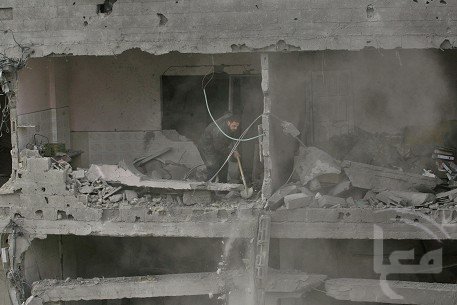 Bethlehem – Ma’an – On 8 January 2009, one year ago today, Israeli artillery shells struck the seventh-floor apartment of Dr Jaber Abu An-Naja, the former PLO ambassador to Senegal and a well-known Fatah politician.
The doctor’s wife and son-in-law were killed immediately as they sat on the balcony eating pastries. His wife was cut in half by the explosion and his son-in-law was thrown from the balcony on to the street below.
His daughter, Ihsan, was seriously injured and taken for treatment to Al-Quds Hospital, a medical center located near Abu An-Naja’s and a number of other civilian apartment buildings on Al-Abraj Street in Gaza’s Tal El Hawa district, which had come under attack for four days.
According to three senior doctors at the hospital and two residents from Al-Abraj Street, at some point between 3 and 6 January several tanks were stationed several hundred meters east of Al-Quds, visible from the hospital’s ambulance depot. Throughout the days of 5-8 January, there was significant artillery fire on apartment buildings nearby to where Abu An-Naja’s relatives were killed.
The shelling on 8 January was just one incident of dozens in and around the area that damaged portions of the hospital and destroyed other buildings in their entirety during Israel’s three-week assault on the Gaza Strip, which ended in late January 2009.
Continuous damage to medical buildings
When the air offensive began on 27 December, for instance, a government building opposite the hospital’s administrative building on Al-Abraj Street was almost totally destroyed. The building had previously served as a criminal detention center and is still referred to locally by that designation although it had recently been used for other purposes, including customs administration. The same building was reportedly struck on a number of other occasions after 27 December, after which the site was completely demolished.
Kitty-corner to the hospital, on Jami’at Ad-Duwal Al-Arabiya Street, was another building rented to the de facto government and used primarily as a public registry office. At the time of writing, only the ground floor of the building remained. Witnesses, speaking to the Goldstone commission, indicated that the upper floors had been destroyed, probably by artillery fire, on 6 and 7 January.
By 15 January, the area immediately to the south of Al-Quds Hospital (the customs building and the registry building) had been totally or very substantially destroyed. The area to the east on Al-Abraj Street had been significantly attacked by artillery fire.
By this time, several hundred civilians had also gathered in the hospital buildings seeking safety.
The Al-Quds Hospital belongs to the Palestinian Red Crescent Society (PRCS). It consists of three buildings facing west toward the sea on the corner of Jami’at Ad-Duwal Al-Arabiya Street and Al-Abraj Street in the area of Tel Al-Hawa.
The building nearest the corner was seven stories high. Its principal purposes were administrative and cultural rather than medical. It stored a huge quantity of PRCS archives. The middle building contained the accident and emergency treatment areas as well as other offices of medical and administrative staff. The building furthest from the corner was the main medical building with operating theaters in the basement. About 200 meters east on Al-Abraj Street was the PRCS ambulance depot.
The buildings all suffered significant damage in the course of an Israeli bombardment on 15 January 2009, which included the use of white phosphorous, endangering the lives of staff and more than 50 patients. There was no warning given for any of the attacks.
Direct Attack on the Hospital
During the night of 14 January, Israeli forces began an extended barrage of artillery fire over the area. It continued into the morning of 15 January. Between 8 and 9am doctors in the main building were in the principal meeting room when shells landed on either side of the building. They saw white phosphorous wedges burning near a container of diesel and efforts were successfully made to move those away.
The initial explosions blew out the office windows. The administrative building on the corner was also hit. Because the hospital building was largely constructed out of timber (rare in Gaza), staff were worried that the fire would spread. A witness described how hospital staff, including senior doctors, all sought to break, by hand, the wooden bridge linking the administrative building to the hospital building, in an attempt to prevent the fire from spreading.
Shortly after the initial explosions and fire were observed, a tank shell directly penetrated the rear of the middle hospital building. That part of the building was made of corrugated iron. The shell made a clearly defined home in the hospital wall, and the impact crater continues through the cement wall into the hospital’s pharmacy.The pharmacy was completely destroyed as a result.
An eyewitness said that through the resulting hole, he observed a tank on a road between two buildings about 400 meters east of the building. Although he could not say whether it was this tank that had struck the hospital directly, it was in a direct line in relation to the entry point of the shell.
No civil defense forces were available to fight the fire at the hospital, so medical staff worked on their own to save the building and ensure the safety of the patients.
It was not until 4pm that the International Committee of the Red Cross (ICRC) was able to respond and help evacuate patients. Officials at the ICRC made it clear upon arrival that it would be able to carry out this procedure only once. Those not evacuated at 4pm were relocated to the operating theaters of the damaged hospital.
At 8pm, another fire broke out in the hospital. As a result, a total evacuation of remaining patients and those who had sought refuge at the hospital was carried out. It was at this stage that one of the senior doctors took an eight-year-old girl who had been struck by a bullet in the jaw and was critically ill to Ash-Shifa Hospital, where she later died. One of the medical staff at the hospital told the Goldstone commission that there was very heavy fire in the area, and he felt sure there were direct hits by Israeli forces on the ambulance depot.
As the hospital was evacuated, the depot, 200 meters to the east in Al-Abraj Street, sustained damage, and one of its principal buildings was entirely destroyed. Remnants of three PRCS ambulances that had been parked at the entrance to the depot were seen were still visible by summer. Two had been crushed by tanks but not burned out. The other ambulance showed signs of having been struck directly in the front below the windscreen by a missile of some description and having been burned out.
The devastation caused to both the hospital buildings, including the loss of all archives in the administrative building, and the ambulance depot was immense, as was the risk to the safety of the patients.
The Israeli position
In the conclusions of their investigations on 22 April 2009, Israeli authorities did not specifically mention the incident at Al-Quds Hospital, although a portion of it addresses some allegations regarding the use of ambulances. In another report, released in July 2009, the Israeli government quotes part of an article from Newsweek magazine:
One of the most notorious incidents during the war was the Jan. 15 shelling of the Palestinian Red Crescent Society buildings in the downtown Tal-al Hawa part of Gaza City, followed by a shell hitting their Al Quds Hospital next door; the subsequent fire forced all 500 patients to be evacuated. Asked if there were any militants firing from the hospital or the Red Crescent buildings, hospital director general Dr. Khalid Judah chose his words carefully. “I am not able to say if anyone was using the PRCS buildings [the two Palestine Red Crescent Society buildings adjacent to the hospital], but I know for a fact that no one was using the hospital.”
In the Tal-al Hawa neighborhood nearby, however, Talal Safadi, an official in the leftist Palestinian People’s Party, said that resistance fighters were firing from positions all around the hospital. He shrugged that off, having a bigger beef with Hamas. “They failed to win the battle.” Or as his fellow PPP official, Walid al Awad, put it: “It was a mistake to give Israel the excuse to come in.” [para. 173].
While the Israeli government does not comment further on the specific attack, it would appear to invoke these comments to justify the strikes on the hospital and surrounding area.
The final report of Richard Goldstone’s UN inquiry understood that the Israeli government “may consider relying on journalists’ reporting as likely to be treated as more impartial than reliance on its own intelligence information,” but said its investigators were “nonetheless struck by the lack of any suggestion in Israel’s report of July 2009 that there were members of armed groups present in the hospital at the time.”
The report also said it addressed questions to Israel’s government regarding the use of white phosphorous munitions against the hospital and the direct military advantage pursued by their use under the circumstances, but received no reply.
Factual findings
The Goldstone report finds that on the morning of 15 January the hospital building and the administrative building were struck by a number of shells containing white phosphorous and by at least one high explosive shell. “The fires these caused led to panic and chaos among the sick and wounded, necessitated two evacuations in extremely perilous conditions, caused huge financial losses as a result of the damage and put the lives of several hundred civilians including medical staff at very great risk.”
In its conclusions, the mission also notes that as a result of the conditions the attack created, the hospital was unable to provide the necessary care for an eight-year-old girl. “Despite heroic attempts to save her, she died later in another hospital. The girl had been shot by an Israeli sniper. The Mission finds the Israeli armed forces responsible for her death.”
On the issue of armed groups being present in the hospital buildings, the team does not agree that anything in the extract cited from Newsweek magazine justifies the conclusion that the hospital premises were being used by armed groups.
The fact that Dr Judah spoke with certainty about matters within his knowledge “cannot be presumed to mean that he believed other parts of the hospital premises were being used by armed groups,” the Goldstone report notes, speculating that it could have been “journalistic gloss and is tantamount to putting words in the mouth of Dr. Judah.” The comments attributed to Safadi that “resistance fighters were firing from positions all around the hospital” can mean either that people were inside the hospital firing or were in positions outside but near to the hospital, Goldstone adds, “The journalist did not clarify precisely what was meant.”
The mission carried out over eight hours of interviews with senior and junior staff at the hospital, and having sought to verify the matter with others, including journalists who were in the area at that time, concluded that it was unlikely there was any armed presence in any of the hospital buildings at the time of the attack. It also notes that no warning was given at any point of an imminent strike and at no time has the Israeli government suggested such a warning was given, compared to other instances in which they insist they did.
Goldstone’s report states that in reviewing the scene at the time of the strikes, “it is important to bear in mind that a great deal of destruction had already occurred and that buildings with an apparent connection to the local government had been attacked and largely destroyed. As such, Israeli tanks had a relatively clear view of the area immediately to the south of the hospital.
“The Mission also notes that as a result of the attacks on al-Abraj Street by tanks for several days, the scope for resistance, if any, from that particular quarter had been significantly reduced.
The mission concedes that it was aware of reports that there was significant resistance from Palestinian groups in the area on the night of 14 January, in which Israeli troops entered buildings along the street and allegedly used human shields to check if there was any presence of enemy combatants of explosive devices and found none.
Legal findings
Article 18 of the Fourth Geneva Convention provides that civilian hospitals may in no circumstances be the object of attack but shall at all times be respected and protected by the parties to the conflict. Civilian hospitals’ protection shall cease “only after due warning has been given, naming, in all appropriate cases, a reasonable time limit and after such warning has remained unheeded,” article 19 states.
“Even in the unlikely event that there was any armed group present on hospital premises, there is no suggestion even by the Israeli authorities that a warning was given to the hospital of an intention to strike it,” the Goldstone report states. “As such the Mission finds on the information before it that Israeli armed forces violated articles 18 and 19 of the Fourth Geneva Convention.
“On considering the information before it, the Mission takes the view that there was intent to strike the hospital, as evidenced in particular by the high explosive artillery shell that penetrated the rear of the hospital and destroyed the pharmacy.
“Even if it is suggested that there was no intent to directly strike the hospital but that Palestinian armed groups had taken up positions near al-Quds hospital, the Israeli armed forces would still have been bound to ensure that risk of death, injury or damage to the people in the hospital or the hospital itself would not be excessive in relation to the military advantage anticipated in attacking the hospital.
“Taking into account the weapons used, and in particular the use of white phosphorous in and around a hospital that the Israeli armed forces knew was not only dealing with scores of injured and wounded but also giving shelter to several hundred civilians, the Mission finds, based on all the information available to it, that in directly striking the hospital and the ambulance depot the Israeli armed forces in these circumstances violated article 18 of the Fourth Geneva Convention and violated customary international law in relation to proportionality.”
Gaza, Day 12: The shooting of Amal, Souad, Samar and Hajja
Part 12 of a series recounting the findings of South African jurist Richard Goldstone’s UN Fact Finding Mission on the Gaza Conflict.
Bethlehem – Ma’an – In the late morning of 7 January 2009, one year ago today, Israeli tanks moved onto a small piece of agricultural land in front of the of the house of Khalid Abd Rabbo and his wife Kawthar, on the ground floor of a four-story building in the eastern part of Izbat Abd Rabbo, a neighborhood east of Jabaliya inhabited primarily by members of their extended family.
Speaking to Richard Goldstone’s UN inquiry, Khalid recounted: “On January 7 at 12:50pm the Israeli army bulldozed our garden and the Israeli tanks were positioned in front of our house. They started yelling at us through the speakers and asked us to leave the house.”
Moments earlier, at 12:30pm, megaphone messages telling all residents to leave were heard across the neighborhood. According to one witness’s recollection, a radio message was also broadcast by Israeli forces around 12:30pm announcing that there would be a temporary cessation of shooting between 1 and 4pm that day, during which time residents of the area were asked to walk to central Jabaliya.
“Of course this happened when Israel had declared [a] ceasefire for four hours, January 7 from 1:00-4:00pm, and that was a truce back then and that’s when wounded civilians could be rescued, and in spite of all of that, in spite of all of this declaration, the Israeli army was there right in front of our house not attempting to move,” Khalid said.
Responding to the messages, Khalid, his wife Kawthar, their three daughters, nine-year-old Souad, five-year-old Samar, and three-year-old Amal, and his mother Hajja Souad stepped out of the house, all of them carrying white flags. Less than 10 meters from the door was a tank, turned toward their house. Two soldiers were sitting on top of it having a snack. It was 12:50pm.
“So we stood by our entrance and holding flags, white flags. The tanks were seven meters away from our house.”
The family stood still, waiting for orders from the soldiers, but none was given. “[W]e were by the entrance holding white flags and waiting for them to tell us what we should do, whether to go back inside the house or move to somewhere else. They did not say anything to us. There were two soldiers sitting on top of the tank. One of them was eating chips. The other one was eating chocolate. We were looking at them like what are we supposed to do, where should we go, but no reaction from them whatsoever.”
Without warning, a third soldier emerged from inside the tank and started shooting at the three girls and then also at their grandmother. Several bullets hit Souad in the chest, Amal in the stomach and Samar in the back. Hajja Souad was hit in the lower back and in the left arm.
“They starting shooting at the children with no reason, no reason, with no explanation, no pretext,” Khalid said. “My daughter, three years old, [her] stomach was, hit and her intestines were coming out. So really I was amazed at how could a soldier be firing at my daughter? So I carried my daughter, three years old. She could hardly breathe. Like I said, her stomach was wounded.
“My other daughter was also wounded in her chest. So I took both of them, Samar and Amal, inside the house. My wife and my mother and my other daughter Suad were still outside. All of a sudden my wife joined me carrying Suad. She was wounded also. Her chest was wounded by many bullets. My mother, 60 years old, she was carrying the white flag and she was wounded on her forearm and also in her stomach.”
Khalid and Kawthar carried their three daughters and mother back inside the house. There, they and the family members who had stayed inside tried to call for help by mobile phone. They also shouted for help and a neighbor, Sameeh Al-Sheikh, an ambulance driver who had his ambulance parked next to his house.
Sameeh put on his ambulance uniform and asked his son to put on a fluorescent jacket. They got in the ambulance, had driven a few meters from their house, when Israeli soldiers ordered them to halt and get out of the vehicle. Sameeh protested, saying he had heard cries for help from the family and intended to bring the wounded to hospital. The soldiers ordered him and his son to undress and then redress. They then ordered them to abandon the ambulance and to walk toward Jabaliya.
“So we were all inside the house and we started calling the ICRC [International Committee of the Red Cross], the ambulances, anybody to come and rescue us but nobody came and all of a sudden we heard an ambulance but all of a sudden nothing, silence. But later, we saw that the Israeli soldiers asked the ambulance drivers to come out of the car, to undress, and they bulldozed the ambulance with the tank.”
Not like before , when civilians were safe
Khalid’s family decided to stay inside the house, all gathered on the ground floor, as they had done safely during previous Israeli incursions into the neighborhood.
According to Khalid: “Our house, or our area rather, was subjected to many incursions and each and every time the army would invade the area, would come into our houses, but no harm was done to civilians or to children. Last time, that is before the last war on Gaza, that was on January 3, 2008, the Israeli army came in our house and stayed three days and destroyed many things inside the house but left without harming the civilians or the children. Now during the last war that is on January 7, 2009, actually the ground war had already started and we heard that Israel had declared war on Hamas.
“We are civilians. We have nothing to do with Hamas and we were used to have the Israeli army come into our area,” Khalid recalled in his testimony to Richard Goldstone’s UN inquiry. “So I thought this time we could stay in our houses. We had nothing to do with Hamas. We did not pose any danger to Hamas. The war, the ground war, started on Gaza and as of the first half hour approximately on January 4, the Israeli army controlled the whole area. There was no resistance in the area. It’s an area nearby the Israeli border. Of course we were inside the houses. We were surprised because the war went on for four days while we were still inside our houses.”
On 7 January 2009, however, when Amal and Souad died of their wounds, the family decided that they had to make an attempt to walk to Jabaliya. They would take Samar, the dead bodies of Amal and Souad, and their grandmother to hospital.
“My mother, 60 years old, was also dying. I was helpless. I didn’t know what to do for my children. There was my daughter dying in front of me. So I carried her and left the house even if I had to die myself because I couldn’t take it anymore. So I carried my daughter and left the house again so that the soldier, he might as just well kill my daughter and kill myself because I couldn’t take it anymore. I couldn’t let my children die in front of me.”
Khalid explained: “From 12:50 until 2:50 we were stuck inside the house. Once again, like I said, I went out to the soldier. They were there, three of them, and there was a Merkava tank positioned in front of the house. I was carrying Samar, even if I had to die, and I was surprised because the third soldier looked at me and two minutes later he went inside the tank and then he came out and he moved his hand just, you know, telling me you can go ahead. So I immediately went back home inside the house and told them we’re going to die anyway. So we don’t want to die inside the house. Let’s die outside the house. Let’s move.
“Although inside the house there [were] more than 25 children, my brothers, my sisters, my dad, my mom. So we had to bring children’s mattress to put my mom on top of the mattress because she was very tired. I carried my daughter Suad, three years old. She was dead… While we were moving, every ten meters they were shooting, once above our heads and the other time by our feet. ”
Khaled and Kawthar, as well as other family members and neighbors, carried the girls on their shoulders. Hajja Souad was carried by family and neighbors on a bed. Samar was transferred to Ash-Shifa Hospital and then, through Egypt, to Belgium, where she was still is in hospital at the time of writing.
“So we were trying to move and every now and then we would fall down. We walked for almost a kilometer and a half until we reached the edge of Jabaliya downtown. Of course, we reached the Kamal Idwan Hospital and they confirmed that the three of them were martyred…surprisingly enough they told me that Samar, no, she had survived and she was moved to Ash-Shiffa Hospital. I took the bodies of my two daughters in order to bury them. We didn’t have any time. This was an outrageous war and the Israeli army was moving around. So we had to bury them, Amal and Suad, and wait until they would bring Samar because we thought and we knew that Samar was going to die. ”
According to her parents, Samar suffered a spinal injury and will remain paraplegic for the rest of her life. “Samar, of course, and with God’s will, Samar survived, survived so that she would be the witness before the world for the atrocities,” Khalid said. “Samar survived, paralyzed. She can move only her arms. She can speak but the rest is paralyzed. She can speak for herself and she can tell her tragedy.”
According to Khalid, “I haven’t seen [Samar] since the events. My tragedy is still going on. It’s not over. So what crime did I commit? I have always been a peace-loving person. I’m for peace. I’ve always supported peace and despite [all that] happened to me I’m asking the world please, please help us live in peace. The Israeli army knows that, that I’ve never been a terrorist.
“… why did it happen to me, why did they come to my house, kill my children without having committed any crime. What did I do?
“There was no war. It was cold-blooded murder of children. That was not just accidental. No, the soldier even chuckled, like I said. I know that Israel has a very sophisticated technology and that every operation it carries out is actually filmed and I’m asking Israel please broadcast the film of the killing of my children. Did you see my children carrying any rockets?”
No home to return to
When Khalid returned to his home on 18 January 2009, his house, as most houses in that part of Izbat Abd Rabbo, had been demolished. He drew the UN fact-finding mission’s attention to an anti-tank mine under the rubble of a neighbor’s house.
He added: “I call upon the international community and ask the international community why my children were cold-bloodedly killed? Why were they fired on? My mother, 60, she was hit in her chest; my daughter Suad, eight years, in her chest; Samar, four years, in the chest; Amal, three years, in the chest, and this is despite the fact that they are all different sizes, all the targeting was at the chest.
“This was execution. This was utter execution and I’m asking the world what crime did my children commit? What danger did they pose for the Israeli army? I myself was there. Why didn’t they fire at me? Why didn’t they kill me and not let me see my children die in front of my eyes. My children, until now, I cannot get myself to realize there I was looking at them while they were dying.”
Factual findings
Goldstone’s team found Khalid and Kawthar Abd Rabbo to be credible and reliable witnesses. “It has no reason to doubt the veracity of the main elements of their testimony.” The mission also reviewed several sworn statements they and other eyewitnesses gave to NGOs about the incident and found them to be consistent with the account it received, according to the report.
Goldstone’s report notes that, in general, Izbat Abd Rabbo and the nearby areas of Jabal Al-Kashef and Jabal Al-Rayes saw some of the most intense combat during the military operations.
No perceived danger
The testimony of Khalid and Kawthar Abd Rabbo, however, shows that Israeli forces were not engaged in combat or fearing an attack at the time of the incident, the report states. Two soldiers were sitting on the tank in front of the family house and having a snack. “They clearly did not perceive any danger from the house, its occupants or the surroundings.
“Moreover, when the family, consisting of a man, a young and an elderly woman, and three small girls, some of them waving white flags, stepped out of the house, they stood still for several minutes waiting for instructions from the soldiers.”
“The Israeli soldiers could, therefore, not reasonably have perceived any threat from the group. Indeed, the fact that the gunfire was directed at the three girls and, subsequently, at the elderly woman, and not at the young adult couple, can be seen as further corroborating the finding that there was no reasonable ground for the soldier shooting to assume that any of the members of the group were directly participating in the hostilities,” Goldstone’s report states, finding “that the soldier deliberately directed lethal fire at Souad, Samar and Amal Abd Rabbo and at their grandmother, Hajja Souad Abd Rabbo.”
Goldstone’s report further states, that by preventing Sameeh Al-Sheikh from taking the wounded to the nearest hospital in his ambulance, Israeli forces deliberately aggravated the consequences of the shooting.
“The Mission recalls that the soldiers had forced Sameeh Al-Sheikh and his son to get out of the ambulance, undress and then redress. They therefore knew that they did not constitute a threat. Instead of allowing them to take the gravely wounded Samar Abd Rabbo to hospital, the soldiers forced Sameeh al-Sheikh and his son to abandon the ambulance and to walk towards Jabaliya.
Instructions given to Israeli forces: Low threshold for lethal force
The team found in the above incidents that “Israeli forces repeatedly opened fire on civilians who were not taking part in the hostilities and who posed no threat to them.” From that finding, the report extrapolated that the “incidents indicate that the instructions given to the Israeli armed forces moving into Gaza provided for a low threshold for the use of lethal fire against the civilian population.”
Goldstone found strong corroboration of this trend in the testimonies of Israeli soldiers collected by the Israeli NGO Breaking the Silence, and in the Protocol of the Rabin Academy’s “Fighters’ Talk.” These testimonies suggest in particular that the instructions given to the soldiers conveyed two “policies.” Both are an expression of the aim to eliminate as far as possible any risk to the lives of Israeli soldiers.
The first policy could be summarized, in the words of one of the soldiers: “if we see something suspect and shoot, better hit an innocent than hesitate to target an enemy.”
Another soldier attributed the following instructions to his battalion commander: “If you are not sure – shoot. If there is doubt then there is no doubt.” The first soldier summarized the briefing from the battalion commander as follows “the enemy was hiding behind civilian population. […] if we suspect someone, we should not give him the benefit of the doubt. Eventually, this could be an enemy, even if it’s some old woman approaching the house. It could be an old woman carrying an explosive charge.”
A third soldier explained “you don’t only shoot when threatened. The assumption is that you constantly feel threatened, so anything there threatens you, and you shoot. No one actually said ‘shoot regardless’ or ‘shoot anything that moves.’ But we were not ordered
to open fire only if there was a real threat.”
The report notes that some soldiers stated that they agreed with the instructions to “shoot in case of doubt.” One of them explained his profound discomfort with the policy and of how he and his comrades had attempted to question their commander after a clearly harmless man was shot. While they disagreed about the legitimacy and morality of the policy, they had little doubt about the terms of the instructions: each soldier and commander on the ground had to exercise judgment, but the policy was to shoot in case of doubt.
The second policy clearly emerging from the soldiers’ testimonies is explained by one of the soldiers as follows: “One of the things in this procedure [the outpost procedure, which is being applied in areas held by the Israeli armed forces after the Gaza ground invasion] is setting red lines. It means that whoever crosses this limit is shot, no questions asked. […] Shoot to kill.”
A soldier recounted one incident of the red-line policy: A family is ordered to leave their house. For reasons that remain unclear, probably a misunderstanding, the mother and two children turn left instead of right after having walked between 100 and 200 meters from their house. They thereby cross a “red line” established by the Israeli unit (of whose existence the mother and children could have no knowledge). An Israeli marksman on the roof of the house they had just left opened fire on the woman and her two children, killing them. As the soldier speaking at the Rabin Academy’s “Fighters’ Talk” a month later observes, “from our perspective, he [the marksman] did his job according to the orders he was given.”
Investigators also read testimony from soldiers who recounted cases in which, although a civilian had come within a distance from them which would have required opening fire under the rules imparted to them, they decided not to shoot because they did not consider the civilian a threat to them.
Legal findings: Direct assaults on civilians
According to Goldstone, the fundamental principles applicable to these incidents – cornerstones of both treaty-based and customary international humanitarian law – are that “the parties to the conflict shall at all times distinguish between the civilian population and combatants”452 and that “the civilian population as such, as well as individual civilians, shall not be the object of attack.”
Israel refers to the principle of distinction as “the first core principle of the Law of Armed Conflict.” It further states that “the IDF’s [Israeli army’s] emphasis on compliance with the Law of Armed Conflict was also directly incorporated into the rules of engagement for the Gaza Operation.” The principle of distinction was reportedly incorporated in the following terms: “Strikes shall be directed against military objectives and combatants only. It is absolutely prohibited to intentionally strike civilians or civilian objects (in contrast to incidental proportional harm).”
In reviewing the above incidents the mission found in every case that the Israeli armed forces carried out direct intentional strikes against civilians. In none of the cases reviewed were there any grounds which could have reasonably induced the Israeli armed forces to assume that the civilians attacked were in fact taking a direct part in the hostilities.
The team therefore finds that Israeli forces violated the prohibition under customary international law and reflected in article 51 (2) of Additional Protocol, that the civilian population as such will not be the object of attacks. This finding applies to the attacks on Amal, Souad, Samar, and Hajja Souad Abd Rabbo.
Not only are civilians not to be the object of attacks, they are also “entitled in all circumstances, to respect for their persons … protected especially against all acts of violence or threats thereof” (Fourth Geneva Convention, art. 27). Fundamental guarantees set out in article 75 of Additional Protocol I include the absolute prohibition “at any time and in any place” of “violence to the life, health, or physical or mental well-being of persons”. According to the facts presented to the mission, these provisions have been violated.
“The State of Israel would be responsible under international law for these internationally wrongful actions carried out by its agents,” the report states. “From the facts ascertained, the Mission finds that the conduct of the Israeli armed forces in these cases would constitute grave breaches of the Fourth Geneva Convention in respect of willful killings and willfully causing great suffering to protected persons456 and as such give rise to individual criminal responsibility.
“The Mission also finds that the direct targeting and arbitrary killing of Palestinian civilians is a violation by the Israeli armed forces of the right to life as provided in article 6 of the International Covenant on Civil and Political Rights.
“In most of the cases examined above, the Mission finds that the Israeli armed forces denied the medical emergency services access to the wounded civilians. …
“The Mission recalls that article 10 (2) of Additional Protocol I provides that ‘In all circumstances [the wounded] shall be treated humanely and shall receive, to the fullest extent practicable and with the least possible delay, the medical care and attention required by their condition. …’ This provision enjoys customary international law status. The Mission is mindful that ‘the obligation to protect and care for the wounded … is an obligation of means.’
“It applies whenever circumstances permit. However, “each party to the conflict must use its best efforts to provide protection and care for the wounded, the report states, including permitting humanitarian organizations to provide for their protection and care.
“The facts ascertained by the Mission establish that in the incidents investigated the Israeli armed forces did not use their best efforts to provide humanitarian organizations access to the wounded. On the contrary, the facts indicate that, while the circumstances permitted giving access, the Israeli armed forces arbitrarily withheld it,” according to Goldstone’s final report.
“On this basis, the Mission finds a violation of the obligation under customary international law to treat the wounded humanely,” the report states. The conduct of the Israeli armed forces amounted to violations of the right to life where it resulted in death, and to a violation of the right to physical integrity, and to cruel and inhuman treatment in other cases, which constitutes a violation of articles 6 and 7 of the International Covenant on Civil and Political Rights.”
A year after losing a father and sons, a Gaza family copes
Rami Almeghari writing from the occupied Gaza Strip, Live from Palestine, 6 January 2010
 |
Khaled Abu Jbarah with baby Lina and Jihad, whose father was killed in an Israeli missile strike on their Gaza home. (Rami Almeghari) |
“Four months after the martyrdom of my husband and two of my sons, my granddaughter Lina was born — the daughter of my martyred son Basel,” said Fathiya Abu Jbarah. Fathiya is the widow of Jihad Abu Jbarah and mother of Basil, 30, and Usama, 21 who were killed on 4 January 2009 by an Israeli missile that struck their home in al-Bureij refugee camp in the central Gaza Strip. Their home was hit during Israel’s 22-day air and land attack that killed more than 1,400 persons and wounded thousands of others.
The Electronic Intifada visited the family a few days after the attack (see “Targeting a cup of tea in Gaza,” 12 January 2009) and came back one year later to see how they are coping.
Reflecting on the birth of Basel’s daughter Lina, Fathiya Abu Jbarah said, “My heart almost popped. What did this innocent baby do to be born without a father?”
“We Palestinian mothers like any other mothers, never want to see our children and grandchildren become orphans or for wives to become widows,” Fathiya who is in her mid-50s, said as she carried Lina in her arms. “We want to live in peace as any other nation in this world. Yet, the Israeli occupation never leaves us alone, they have continued to attack us regularly for decades now. Isn’t it time for us to live normally?”
In addition to the killings of Jihad and his two sons, a fourth family member, Khaled, 19, suffered severe shrapnel wounds to his abdomen and arms, and was transferred to a hospital in Saudi Arabia for treatment.
Khaled recalled the moment, just before 10:30pm on 4 January 2009, when the missiles struck the house. He had been sitting outside with his father and brothers. However, Khaled said, “The weather was cold, so I went in my room, while my brothers and father were keeping warm outside in front of a wood stove.”
Khaled then heard missiles striking near the home and rushed out of his room to see what happened. “I saw the three [Jihad, Basel and Usama] dismembered by the strike, but I did not know I was also hit.” Khaled recalled going out of the house to a nearby hospital.
The family’s rented home was badly damaged in the Israeli attack, but now they live in a newly-built three-room house. Khaled now lives there along with his brother Muhammad and other family members including a teenage brother, his mother, his sister-in-law, the widow of Basil and other nieces and nephews.
The Abu Jbarah home is one of the very few to be built in the past year, as thousands of homes damaged or destroyed in the Israeli attack remain unrepaired. Virtually no building supplies have come in due to the ongoing Israeli blockade, but the Abu Jbarahs built the house with the help of friends and family, and using building supplies smuggled in through tunnels from Egypt, and sold at inflated prices.
Muhammad Abu Jbarah, 24, explained that his late father had decided to build a family home in 2006, but due to the blockade he could never get the raw materials, which is why he rented the home that was attacked by Israel last year. After the attack, the family lived for months at the home of a relative, but with their needs, they decided to build the new house. It has been an enormous struggle.
“We have been building this new house for almost eight months, trying to get use of any raw building material available in local markets,” Muhammad explained. The cost has been enormous — about $70,000, much of which was borrowed from relatives or friends. “We owe about 70 percent of that amount,” said Muhammad,” and it will take us at least six or seven years to pay it off, but we have no choice.”
Despite the agony he has endured during the past year, Khaled Abu Jbarah sounded hopeful and looked forward to a better life in the new year. “I do look forward to a better situation, not only for me but also for these little children. We Palestinians want to live in peace and tranquility for generations to come, but unfortunately, every generation of us experiences the same suffering at the hands of this occupation, which never abides by ceasefire declarations, peace agreements, or any other international resolutions.”
Although the situation has been generally calm, Khaled pointed out that the “Israeli army continues to open fire from time to time [and] some people have been killed and wounded recently.”
The home provides some comfort now, but Fathiya Abu Jbarah said, “what you see can never compensate me for my loss. During Ramadan I cried a lot for my dear husband and children, while serving iftar [the fast-breaking meal] to the rest of my family.” As she spoke, the memory brought the tears back to her eyes.
Rami Almeghari is a journalist and university lecturer based in the Gaza Strip.
Iraq to pursue compensation for 1981 Israeli airstrike
DPA
January 5, 2010, 10:24 GMT
Baghdad – The Iraqi government continues to seek redress for an Israeli airstrike against a 1981 Israeli airstrike against an Iraqi nuclear reactor, an Iraqi lawmaker said in remarks published Tuesday.
‘Prime Minister Nuri al-Maliki and the Ministry of Foreign Affairs petitioned the United Nations and the UN Security Council to demand that Israel pay compensation … for the 1981 bombing an (Iraqi) nuclear reactor,’ Mohammed Naji Mohammed, a member of parliament with the United Iraqi Alliance coalition, told the al-Sabah newspaper.
Mohammed said the cabinet had on November 25 approved a plan to seek redress through diplomatic channels, and to form a ‘neutral’ committee to assess the value of the reparations it would seek.
The lawmaker is leading a campaign to seek billions of dollars in reparations for an Israeli airstrike on the Osiraq nuclear reactor, based, he said, on UN Security Council Resolution 487.
The resolution, passed in the wake of the attack, ‘strongly condemns’ Israel’s airstrike against Iraq’s Osiraq nuclear reactor in June 1981, and ‘considers that Iraq is entitled to appropriate redress for the destruction it has suffered, responsibility for which has been acknowledged by Israel.’
Israeli officials at the time said they were concerned that the reactor could eventually be used to produce nuclear weapons for the regime led at the time by Saddam Hussein.
The Security Council, however, noted at the time that the International Atomic Energy Agency (IAEA) had testified that its safeguards had been ‘satisfactorily applied’ in Iraq.
Rather, the Security Council said, the Osiraq attack constituted ‘a serious threat to the entire safeguards regime’ of the IAEA.
“I hope that I die on my land”
Jody McIntyre writing from Bilin, occupied West Bank, Live from Palestine, 4 January 2010
 |
Fatima Yassin watches looks on as Israeli occupation soldiers prepare to invade her home in Bilin. (Hamde Abu Rahme) |
Fatima Mohammed Yassin, 49, is a farmer from the Palestinian village of Bilin in the occupied West Bank. In spite of Israel’s occupation and construction of its wall in the West Bank, including on Bilin’s farm land, Yassin and her husband continue to work their land on a daily basis. Jody McIntyre spoke to her for The Electronic Intifada.
Jody McIntyre: Do you have land behind the wall?
Fatima Yassin: Yes, before Israel started construction of the wall in Bilin, my family had 45 dunams of land [1 dunam equals approximately 1,000 square meters], all of it filled with olive trees. My husband’s family had 50 dunams, which were a mixture of olive groves and vegetable patches, as well as another 50 dunams of land that was stolen after 1967 [Israel’s occupation of the West Bank began after the June 1967 war].
When the Israeli army was building the wall on our land, they stole land from many people, but only on my husband’s land did they steal his olive trees as well! We still go to our land every day to plant vegetables and look after the soil, because we will not allow the Israeli government or the settlers to claim that our land is unused. If we don’t go to our land, they will say it is unneeded and confiscate it so that they can expand the settlements, which are already built illegally on our land.
JM: Does the Israeli army create problems when you try to go to your land?
FY: Yes, sometimes they don’t allow us to enter, but my husband and I will wait at the gate for one hour or two hours; if they don’t let us through we will stay there from the morning until the evening. We won’t go home until they let us go to our land. The soldiers once told us that it was illegal for us to go to our land and that we should go back home, but I simply replied, “I don’t want to go home, I want to go to look after my land.” Sometimes when our sons come to help us on the land the soldiers beat them or try to arrest them. We’ve had these problems many, many times, but in spite of this, we will not stop resisting this occupation. We are not afraid.
JM: Do the settlers create problems when you are on your land?
FY: Yes, they came and set fire to a small room that the people from Bilin built behind the wall — [they did this] four times. One of the times, I had just gone to make coffee for my husband — they were watching me and when I left went they went in and set the fire. But every time they damaged the room, we went to fix it again.
JM: How did you feel when you first heard Israel wanted to build the wall in Bilin?
FY: Everyone was angry when they heard the news, and sad because we knew it was a ploy to steal our land, so we started to protest against the construction of the wall. The first time we heard that it was being built, all the people from the village went to our land and said that we would fight against its confiscation by the Israeli army. We could see the bulldozers uprooting our trees. For the last five years we have been fighting against the wall, and for justice, and we will always continue.
JM: Do you attend the weekly demonstrations against the wall in Bilin?
FY: Yes, of course! My entire family goes to the demonstrations, me and my husband, our five daughters and our five sons. These demonstrations are our way of nonviolently resisting against the wall, the settlements and the confiscation of our land. We are not going out there to kill people, we are going to return to work on our land — to take back what they have stolen from us.
JM: Have any of your family been injured at the demonstrations?
FY: Of course! All my sons have been injured. The first one to be injured was Helme. He was injured at the very first demonstration we had in Bilin. [The Israeli army] shot him with a tear gas canister in the neck. After a few weeks, he was injured in the leg with the same weapon. A couple of months later he was arrested, becoming the first person to be arrested for our village. But even while in jail they couldn’t crush the rebellious spirit in his heart. [The prisoners] started a protest against the terrible conditions in the prison, and the soldiers shot Helme in the leg with a rubber-coated steel bullet.
My son Hamde was shot next, in the leg also with a rubber-coated steel bullet, and then Mustafa was shot with a tear gas canister. My youngest son, Mohammed, was just 14 years old at the time, and he was injured three times by rubber-coated steel bullets, twice in the legs and once in buttocks.
The last one to be injured was Khamis, my eldest son. He was shot in the head with a high-velocity tear gas canister, a new weapon at the time, and was left in a coma. I was very sad when they shot Khamis.
So all my sons have been shot in the demonstrations, but we will not stop until we return to our land.
JM: Has your house even been invaded by the Israeli army?
FY: The first night raid was at our house, when they arrested Helme. Our house is very close to the wall, so if there are any problems at the wall the army immediately comes to our home. Once they came during the day when I out working on my land, broke down the doors to my house, beat my daughters and arrested my 10-year-old nephew. He wasn’t wanted for anything.
The next time they came was to arrest my eldest son Khamis. As always, it was because he dared to nonviolently resist against the confiscation of his family’s land. Sometimes they come and don’t arrest anyone, just to harass us, to wake us up in the middle of the night and to intimidate us.
My son Hamde photographs the night raids, to show the world what is happening here in Bilin. Of course I am proud of what he is doing, but it makes me worry about him and I cannot sleep. I’m afraid that a soldier will shoot him or arrest him. I know that he has been beaten many times while taking photographs. The soldiers are very violent during the night raids, so I worry about him.
Another time, when Hamde was away, they invaded [the village] at night and stayed in our home for three hours. When I saw all my sons lined up outside, and the soldiers trying to beat them and joking together about when they had shot Khamis in the head, laughing about how he had nearly died in the hospital. When I heard them say this I passed out. When I woke up, I was lying in the hospital myself. Because Hamde was abroad, I was scared that they were looking for him and would arrest him at a checkpoint on his way back into the country.
Once they invaded the house in the day, and the army commander came over to me and said, “One day, I am going to come here with a bulldozer and destroy your house.” They came two days later and started searching the house, but they didn’t find anything — because we don’t have anything!
It’s like we can’t sleep during the day or at night now, because of the invasions. All we can do is sit awake.
JM: After all the oppression the people of Bilin have suffered at the hands of the Israeli army, do you think your campaign of nonviolent resistance can continue?
FY: Yes, we will certainly continue. My husband and I will continue to go to our land every day. We will go until the last moment. I hope that I die on my land.
Jody McIntyre is a journalist from the United Kingdom, currently living in the occupied West Bank village of Bilin. Jody has cerebral palsy, and travels in a wheelchair. He writes a blog for Ctrl.Alt.Shift, entitled “Life on Wheels,” which can be found at www.ctrlaltshift.co.uk, where a version of this article was originally published. He can be reached at jody.mcintyre AT gmail DOT com.
American Jewish groups fight to protect Somali rights abuser from legal action
By Nathan Guttman | The Jewish Daily Forward | December 31, 2009
General Mohamed Ali Samatar, Former vice president and Prime minister of Somalia
Washington — American Jewish organizations that fought to establish the jurisdiction of U.S. courts for suits against terrorist groups are taking an opposite tack in suits involving human rights abuses.
Jewish groups have filed briefs siding with a former Somali official now living in Virginia who is alleged to bear responsibility for atrocities committed during his tenure.
The case’s outcome is expected to set a precedent on the vulnerability to human rights lawsuits of former and present officials of internationally recognized governments. But supporters of Israel fear the result could enable Palestinians who claim to be victims of Israel to pursue Israeli officials here.
The Supreme Court will hear oral arguments March 3 in the case of Yousuf v. Samantar, in which a group of Somalis is seeking financial damages from Mohamed Ali Samantar, Somalia’s former defense minister. He also served as prime minister from 1987 to 1990. Samantar was a top official in the regime of President Siad Barre, a socialist-leaning dictatorship that was denounced by international groups for its systematic use of torture and arbitrary arrests, and for the rape and murder of political rivals and dissidents.
Among the five Somalis suing Samantar are a student who was allegedly detained and raped 15 times by a military man, a former officer who alleges he survived a mass execution and a businessman who claims he was tortured for months by the regime Samantar helped lead. Two of the plaintiffs are now American citizens. The case was filed under the Torture Victim Protection Act.
The Supreme Court will rule on the plaintiffs’ right to pursue a civil lawsuit against Samantar. Pro-Israel activists, fearing a precedent that will allow others to pursue legal action against Israel for alleged war crimes — as has happened in Europe — have filed briefs opposing their suit.
“There will be a rash of lawsuits of this kind against Israel” if the court rules for the plaintiffs, warned Alyza Lewin, an attorney with the firm of Lewin & Lewin, which has filed a friend-of-the-court brief in favor of Samantar and against making foreign officials vulnerable to civil lawsuits. The brief was filed on behalf of four Jewish groups: the Zionist Organization of America, the Union of Orthodox Jewish Congregations of America, Agudath Israel of America, and the American Association of Jewish Lawyers and Jurists.
It is an unusual setting, one in which pro-Israel activists are siding with the Saudi government — which has also filed a brief on behalf of Samantar — while pitting themselves against international human-rights advocates. Furthermore, this battle also puts the Jewish community on the side of those seeking to limit international jurisdiction after years of fighting to broaden the ability to sue foreign entities in order to go after terror groups and their sponsoring states.
Samantar moved to dismiss the 2004 lawsuit on grounds of immunity provided under the Foreign Sovereign Immunities Act, which protects foreign governments in most cases from legal action in the United States. But in January 2009, the Fourth Circuit Court of Appeals reinstated the case, ruling that this immunity applies not to individuals but only to governments and their agencies. A Washington circuit court had previously reached the opposite conclusion. The Supreme Court’s ruling is expected to resolve the dueling decisions.
For Jewish communal officials, the Samantar case set off alarm bells. The Jewish groups that filed the brief cite more than 1,000 cases of lawsuits against Israeli officials around the world as part of an effort that Israeli leaders dub “lawfare” — a campaign to take Arab human-rights grievances against Israel to international courtrooms.
One of those recent cases was the December attempt to issue a criminal arrest warrant in Britain against Israeli opposition leader Tzipi Livni because of the role she played as foreign minister during last January’s Israeli military operation in Gaza.
In the United States, the law does not allow citizens to file similar criminal lawsuits against foreign officials. But in civil suits, it is an unsettled question whether the Foreign Sovereign Immunities Act, which protects governments, extends to individual government officials and former government officials who were acting in their authorized capacities at the time in question.
Lewin, of the law firm representing the four Jewish groups, says it should. “It would be tempting for us to say, wouldn’t it be nice to sue government officials in these cases, but the risks and the costs outweigh the benefits,” she said.
“You’d have the entire Middle East conflict here in the U.S.” if Samantar won, agreed Marc Stern, co-executive director of the American Jewish Congress. Stern, who also filed a brief on this issue, claimed that allowing civil suits would “require Israelis to recount in an American court years after the event why every rocket was fired and why each attack took place.”
A couple of Israeli officials already faced this threat in the United States.
In 2005, former chief of staff and current Cabinet minister Moshe Ya’alon was served with a civil suit while entering a Washington think tank he was attending as a visiting scholar, filed by families of victims from a 1996 Israeli shelling in Lebanon. A week earlier, Avi Dichter, former head of Israel’s General Security Service, had the same experience in New York. This lawsuit was on behalf of victims of an Israeli bombing in Gaza.
These lawsuits cannot lead to arrests, but they can cause significant financial liabilities to Israelis and eventually deter Israeli officials from visiting America, pro-Israel activists say.
Fighting to maintain immunity for foreign officials seems to place Jewish activists far from positions they have taken in the past. Supporters of Israel actively backed legislation that paved the way for relatives of terror victims to sue terror organizations and their sponsors in American courts. Over the years, these lawsuits have yielded several rulings against Hamas, Fatah and Iran for compensation reaching hundreds of millions of dollars.
Unlike the laws governing human-rights suits, the law empowering individuals to file civil suits against terror organizations and their state sponsors is specifically exempted from the Foreign Sovereign Immunities Act. But the terrorism law — also unlike the human-rights laws — clearly disallows suits against individuals.
The Anti-Defamation League, in a separate friend-of-the-court brief filed in the Samantar case, differed with the position taken by the AJCongress and the groups represented by Lewin. The ADL brief spoke of the need to strike a balance between the allowance of victims of severe human-rights violations overseas to seek remedy in American courts, and the need to “protect the ability of lower courts to dismiss meritless claims brought for political or other improper purposes.”
The Samantar case made some strange bedfellows in fighting to limit the scope of lawsuits against foreigners. Alongside the former Somali politician were not only the pro-Israel activists, but also the kingdom of Saudi Arabia. A brief filed by the Saudis reflects concerns similar to those of pro-Israel advocates — that this case could lead to an outpouring of lawsuits against former and current government officials. Citing numerous suits filed against Saudi Arabia after the 9/11 terror attacks, the brief states the kingdom’s “unique experience” and “strong interest” in the outcome of the case.
On the other side are human- rights groups, led by the Center for Justice & Accountability, representing the Somali citizens suing Samantar. “This case stands for the proposition that the U.S. cannot be a safe haven for human-rights abusers like Samantar,” said Pamela Merchant, the group’s executive director, “and we are confident that the Supreme Court will not allow U.S. law to be manipulated to undermine this principle.”
Both sides are waiting for the American government’s brief to be filed. While previous administrations have opposed expanding the ability to sue foreigners in the United States, senior Obama administration officials were supportive of this notion in their previous capacities.
Contact Nathan Guttman at guttman@forward.com
Featured Video

or go to
Aletho News Archives – Video-Images
New Documentary
“Inside Gaza” wins best documentary at Montreal’s Cinemania film festival
Palestine Information Center – November 16, 2026
MONTREAL – The documentary “Inside Gaza,” which chronicles the experiences of Palestinian journalists working with Agence France-Presse (AFP) while covering the Israeli war on the Gaza Strip, won the Best Documentary Award at the 32nd Cinemania International Francophone Film Festival held in Montreal, Canada.
Directed by Helene Lam Trong, the 72-minute film follows the daily lives of four AFP journalists who bear witness to the difficulties of reporting in a war-torn territory largely closed off to international media.
The film is compiled from material produced by the team on the ground, as well as from interviews conducted after they left.
The film also won the People’s Choice Award at the festival on Saturday. … continue
Blog Roll
 Aletho News
- Iran accuses NYT report of paving way for attacks on dams
- Brand ‘rape’ case just doesn’t add up. Was he framed?
- How The Jensen Huang Chinese Spy Hoax Is Russiagate 2.0
- Austria seeks to strip former foreign minister of citizenship over Russia ties
- “Inside Gaza” wins best documentary at Montreal’s Cinemania film festival
- Activists block German munitions plant over arms exports to ‘Israel’
- The Nasser Hospital attack and Israel’s relentless lies
- Could it be satan? No, Huckabee, just the Americans you work for
- AIPAC and more: Network of pro-Israel influence in US Congress
- Putin aide reveals Moscow’s stance on Europe at peace talks
- If Americans Knew
- An error has occurred; the feed is probably down. Try again later.
- No Tricks Zone
- Argentina’s Perito Moreno Glacier Joins Antarctica and Arctic In Defying Doomsday Melt Claims
- New Study: Barents Sea Temperatures Were Warmer And Sea Ice Less Extensive In The 1700s Than Today
- German Authorities Start Initiative To Evaluate Public Register For Climate “Disinformation” Spreaders!
- Zonal Asymmetry of Temperature Change in the Antarctic Circumpolar Current
- New Study: The Net Fossil Fuel Contribution To Rising Atmospheric CO2 Has Been Zero For 500 Years
- Germany’s Green Energy Transition Becoming Increasingly Expensive…Another 6 Trillion Euros!
- Sudden Stratospheric Warming, Powerful El Niño Combination May Lead To Extreme Europe Cold, Energy Crisis!
- Two New Studies Find Thwaites Glacier Melt Cannot Be Driven By Human Activity Or A Warming Ocean
- E-Cars Reduce CO2 Emissions By Only 41% Compared To Internal Combustion Engine Vehicles
- Predictions Made By Renowned Climate Professor Over Past Decades Have Been Proven To Be Poor

