Ceasefire without terms: Iran’s strategic deterrence in shadow of 9,379 kg
By Amro Allan | Al Mayadeen | June 27, 2025
12 days of war between Iran and the Israeli-US alliance have ended, not with an agreement, treaty, or even mutual understanding, but with silence. US President Donald Trump announced a unilateral ceasefire following an Israeli request, and after consultation with Prime Minister Benjamin Netanyahu’s cabinet. Qatar, acting as an intermediary, passed on the message to Tehran, which acknowledged the mediation without committing to any terms. No documents were signed, no concessions were made, and no conditions agreed. What has emerged is a calm devoid of consensus, a tactical pause, not an end to the war.
Yet for all its fragility, this ceasefire reveals something critical: Iran endured, Iran responded, and most significantly, Iran preserved what it considers the cornerstone of its strategic deterrence, its nuclear capability and its sovereignty in the face of overwhelming pressure. And for a nation that has lived through decades of sanctions, threats, and assassinations, survival on its own terms is not defeat, it is a form of victory.
Victory without capitulation
From Tel Aviv and Washington, the war was framed as a swift punitive campaign meant to decapitate Iran’s nuclear programme and reassert Israeli regional dominance. Netanyahu boasted of air superiority, missile interception, and the assassination of key Iranian generals and nuclear scientists. He claimed “Israel” had “dismantled” Iran’s missile programme and brought its nuclear efforts to a halt.
But such triumphalism proved premature, and ultimately misleading. The final missiles fired before the ceasefire originated from Iranian launchers, employing a strategic class of weaponry deployed for the first time in this conflict. Strikes on Tel Aviv, Haifa, and strategic military targets pierced “Israel’s” multi-layered air defence systems and killed seven. These were not symbolic responses; they were calibrated strikes executed under pressure, revealing Tehran’s ability to absorb an attack and immediately retaliate.
From Iran’s perspective, the war did not end in surrender, nor even in compromise. Iranian officials confirmed that while key facilities at Fordow, Natanz, and Esfahan were targeted, critical material, including an estimated 9,379 kilograms of enriched uranium, was relocated to fortified and undisclosed sites before the first missiles struck. Iran suffered damage, but not disarmament. Its ability to resume nuclear enrichment, or even accelerate it, remains fully intact.
The untouched core: 9,379 kilograms
The most recent IAEA report from May 2025 offers the most telling figures: Iran holds 9,379 kilograms of enriched uranium at various purities. Of these, 8,840 kilograms are enriched to 5% or less, usable for civilian reactors and medical isotopes. A further 130 kilograms of uranium exists in intermediate purity levels, mostly in scrap form.
The strategic concern, and Tehran’s most potent leverage, lies in the 408.6 kilograms enriched to 60%, a step away from weapons-grade 90% enrichment. According to nuclear experts, this stockpile could provide material for up to nine nuclear warheads if further refined. Iranian officials assert that none of this material was compromised during the bombing campaign and that their pre-emptive relocations prevented a nuclear or environmental catastrophe.
The IAEA has acknowledged that it detected no abnormal radiation levels post-strikes, suggesting no containment breach occurred. However, the Agency has not been granted access to the new locations, a move Tehran justifies as a response to what it sees as an illegitimate and unprovoked military assault on safeguarded civilian nuclear infrastructure.
In this light, Iran’s refusal to disclose further details is not simply about secrecy: it is an assertion of sovereignty. It underscores a consistent Iranian position that nuclear development, so long as it remains within NPT guidelines, is a right, not a bargaining chip.
Strategic deterrence and battlefield lessons
Iran’s response went beyond merely absorbing damage. It turned the battlefield into a proving ground for its missile, drone, and cyber capabilities. Iranian forces launched hypersonic missiles that bypassed Israeli defences entirely, signalling not just tactical innovation but strategic maturity. It demonstrated that its command-and-control structures remain functional under attack, and that its military doctrine has evolved to anticipate multi-domain warfare.
Equally important is the shift in psychological warfare. For the first time, Iran shattered the long-standing regional norm against directly striking Israeli territory with sustained, high-precision attacks. It was a message: the Islamic Republic is prepared to escalate if pushed, and escalation no longer means allies in Lebanon or Iraq—it means Tehran itself.
“Israel’s” sense of impunity has been challenged. Its air defense failures in intercepting Iranian salvos have exposed critical vulnerabilities, undermining Netanyahu’s claims of “total superiority.” What once was an asymmetric confrontation tilted in “Israel’s” favour has now grown more balanced. Iran may not match “Israel’s” military hardware or American support, but it has altered the rules of engagement and redefined the costs of war.
A Ceasefire or a Countdown?
Like most previous regional confrontations, this ceasefire was not a culmination, it was an intermission. There is no written document, no internationally recognised monitoring framework, and no agreed roadmap for de-escalation. From Tehran’s point of view, this suits “Israel” and the US, both of which sought a pause, not a solution.
US President Trump’s ceasefire announcement was timed more for electoral optics than for strategic clarity. It postponed a war that risked spiralling out of control, particularly if the United States was drawn deeper into an open-ended campaign. But in doing so, it handed Iran space: space to harden its facilities, mobilise internally, and potentially accelerate a shift from nuclear ambiguity to overt deterrence.
And while Washington may consider this a temporary win, in Tehran, it’s viewed as proof that Iran’s endurance forced a nuclear superpower to back down.
Tehran has since filed a complaint with the United Nations, accusing the US and “Israel” of violating international law by targeting nuclear facilities under IAEA safeguards. Article II of the UN Charter prohibits the use of force against the territorial integrity of sovereign states outside of self-defence or Security Council approval. Moreover, under the Convention on the Physical Protection of Nuclear Material, attacks on safeguarded nuclear sites are explicitly prohibited due to the danger of radiological release and nuclear proliferation.
By failing to condemn the assault, Iran argues, the IAEA and its Director General, Rafael Grossi, risk setting a precedent that undermines the entire non-proliferation regime. The silence from international bodies has also eroded confidence in future cooperation and inspections. Why, Iranian officials ask, should Tehran continue to allow oversight if that oversight brings no protection?
The Unravelling of the JCPOA framework
With the Joint Comprehensive Plan of Action (JCPOA) already hanging by a thread since the US withdrawal in 2018, this latest episode may have finally sealed its fate. While Europe and Russia have called for renewed diplomacy, the military strikes have made a return to the previous deal politically toxic in Iran.
For many in Tehran, the JCPOA is now seen as a trap, one that offered transparency in exchange for economic relief that never came, and which left Iran’s strategic sites vulnerable to airstrikes and sabotage. In this view, returning to negotiations without structural guarantees would be naïve.
Indeed, many voices in Iran’s political establishment are calling for full withdrawal from the Non-Proliferation Treaty (NPT) itself, a move that would legally unbind Iran from its current commitments and allow for open pursuit of a nuclear deterrent.
A shift toward strategic ambiguity
The consequences of the ceasefire extend far beyond Iran’s borders. In Arab capitals, there is quiet recognition that Iran has emerged more resilient and emboldened. In Tel Aviv, there is growing unease over the efficacy of existing defences. And in Washington, there is a dangerous temptation to view ambiguity as strategy.
But ambiguity, in this case, cuts both ways. Iran has preserved its right to develop nuclear technology while refusing to confirm its future intentions. Should it now cross the weaponisation threshold, it may do so without warning, rendering international diplomacy too slow to stop it. The 9,379 kilograms of enriched uranium now sit in the shadows, untouched, uninspected, and more symbolically potent than ever.
If the goal of the Israeli-American air campaign was to slow down Iran’s march toward nuclear capacity, it may have done the opposite. Tehran now has every justification to argue that deterrence, not diplomacy, is its only protection against existential threats.
The reality is stark: this ceasefire has changed nothing. It has only delayed the inevitable confrontation, whether on the battlefield or in the nuclear sphere. “Israel” will continue to press for economic isolation and sabotage operations. Iran will deepen its alliances, harden its defences, and invest in further nuclear and missile development.
In truth, both parties are positioning themselves for the next phase of confrontation.
The international community, meanwhile, remains largely paralysed. With diplomacy broken, legal frameworks ignored, and verification mechanisms sidelined, the world is flying blind. The stakes are no longer theoretical. A single miscalculation could trigger a chain reaction that extends far beyond the Middle East.
The rendezvous has only been postponed
What began as an undeclared war has concluded with an undeclared pause. Yet make no mistake, this is merely the beginning of a countdown.
Iran, having absorbed an extensive assault on its territory, has emerged defiant, intact, and strategically alert. “Israel”, despite its claims, has discovered its limits. And the US, though instrumental in halting the war, has revealed the fragility of its credibility as an honest broker.
The next act may begin with an enrichment announcement, a nuclear test, or another missile barrage. For now, Tehran waits in silence, but it waits on its own terms. The world, meanwhile, must decide whether to engage that silence diplomatically, or face its consequences militarily.
Either way, the rendezvous is coming.
Ian Proud: Was the Iran War a Strategic Blunder?
Glenn Diesen | June 25, 2025
Ian Proud was a member of His Majesty’s Diplomatic Service from 1999 to 2023. Ian was a senior officer at the British Embassy in Moscow from July 2014 to February 2019, at a time when UK-Russia relations were particularly tense. He performed a number of roles in Moscow, including as Head of Chancery, Economic Counsellor – in charge of advising UK Ministers on economic sanctions – Chair of the Crisis Committee, Director of the Diplomatic Academy for Eastern Europe and Central Asia and Vice Chair of the Board at the Anglo-American School.
Ian Proud’s Substack: https://thepeacemonger.substack.com/
Follow Prof. Glenn Diesen: Substack: https://glenndiesen.substack.com/
INSANE Israel-First Admission
Glenn Greenwald | June 24, 2025
This is a clip from our show SYSTEM UPDATE, now airing every weeknight at 7pm ET on Rumble.
You can watch the full episode for FREE here: https://rumble.com/v6v828x-system-upd…
Now available as a podcast!
Find full episodes here: https://linktr.ee/systemupdate_
Join us LIVE on Rumble, weeknights at 7pm ET: https://rumble.com/c/GGreenwald
Become part of our Locals community: https://greenwald.locals.com/
Follow Glenn: Twitter:  / ggreenwald
Instagram:  / glenn.11.greenwald
Who Destroyed Four World Trade Center Buildings?
Tales of the American Empire | June 19, 2025
On September 11 2001, FOUR World Trade center buildings in New York were suddenly destroyed. We are told that no one could imagine that terrorists could knock down the two World Trade Center towers, even though Israeli prime minister Benjamin Netanyahu predicted this in his 1995 book. He warned the U.S. Congress this may happened unless the United States joined a war to expand Israel by destroying what he called terror states. Even before the smoke cleared on 9-11, the plotters blamed Osama bin Laden to block investigations into their weak official story.
Note: YouTube demonetized this video claiming “violence throughout”, even though there is no graphic violence, just some collapsing buildings often shown on television.
_____________________________________________________
“Bin Laden says he wasn’t behind attacks”; CNN; September 17, 2001; https://edition.cnn.com/2001/US/09/16…
Related Tale: “The Empire’s Fake War on Terror”;  • The Empire’s Fake War on Terror
Related Tale: “Osama Bin Laden WAS NOT Responsible for 9/11”; • Osama Bin Laden WAS NOT Responsible for 9/11
“U.S. Military Knows Israel Did 9/11 – Dr. Alan Sabrosky”; Augustus Berg; Bitchute; June 30, 2023; https://www.bitchute.com/video/Vsf4v1…
“9/9 and 9/11, 20 Years Later”; Pepe Escobar; Unz.com; September 9, 2021; https://www.unz.com/pescobar/9-9-and-…
Related Tale: “The 1993 FBI Bombing in New York; • The 1993 FBI Bombing in New York
“9/11 Conspiracy Theory Explained in 5 Minutes”; James Corbett; 2022; • 9/11 Conspiracy Theory Explained in 5 Minutes
“”The 9/11 Commission Was A FRAUD” – Curt Weldon EXPOSES CIA Cover-Up, Able Danger & Deleted Evidence”; PBD Podcast; YouTube; May 14, 2025; • “The 9/11 Commission Was A FRAUD” – Curt W…
“Rep. Curt Weldon: It’s Time to Finally Tell the Truth About 9-11”; Tucker Carlson; YouTube; April 14, 2025; • Rep. Curt Weldon: It’s Time to Finally Tel…
The Iran war is Trump’s unconditional surrender to Israel
Sidelining US intelligence, Trump and top principals rely on Israeli fabrications to promote war on Iran.
By Aaron Maté | June 21, 2025
[Note: this article has been updated following the US bombing of Iran]
Since his election in 2016, Donald Trump’s political opponents have portrayed him as a dangerous, unstable fabulist doing the bidding of a malign, nuclear-armed foreign power.
Having returned to the White House this year, Trump is proving his detractors correct on all counts but one: the location on the map. The rogue state that he’s colluding with — at great peril to the planet — is not Russia, as his most vocal detractors alleged, but Israel.
Israel’s June 13th attack on Iran sabotaged the then-ongoing talks on a new nuclear deal with the United States, and Trump has gone to unprecedented lengths to support its aggression. Trump undercut his own Secretary of State’s claim that Israel had undertaken “unilateral action” by acknowledging that “we knew everything” in advance of what he called a “very successful attack.” Administration officials then disclosed that Trump had previously authorized giving Israel intelligence support for the bombing. Trump then called on Tehran’s 9.8 million residents to evacuate, mused about killing Iran’s supreme leader, Ayatollah Ali Khamenei, and declared that “we” – meaning Israel – “have complete and total control of the skies over Iran.”
After Iran rejected his demand for “unconditional surrender”, Trump imposed a new deadline of two weeks, only to break it three days later by ordering a US military attack on three Iranian nuclear energy sites, including the deeply buried mountain complex Fordo, which he quickly hailed as a “great success.” Just as with Trump’s diplomacy with Iran, his two-week deadline turns out to have been a ruse whose “goal was to create a situation when everyone wasn’t expecting it,” a senior administration official said.
To wage war on Iran, Trump and his allies have employed the traditional Iraq WMD playbook of ignoring or manipulating the available evidence to fear-monger about a foreign state marked for regime change. Unlike the Iraq war, where the fraudulent case for invading was mostly concocted in-house, Trump has outsourced the job to Israel, while not even pretending to care about public opinion or Congressional approval.
Back in March, the US intelligence community assessed that “Iran is not building a nuclear weapon” and “has not reauthorized the nuclear weapons program… suspended in 2003.” According to US officials who spoke to the New York Times, “[t]hat assessment has not changed.” Moreover, the US has found that “not only was Iran not actively pursuing a nuclear weapon, it was also up to three years away from being able to produce and deliver one,” CNN reports, citing four sources.
Whereas Dick Cheney and company went through the trouble of nudging subordinates to fabricate intelligence, including via torture, Trump does not care about seeking their imprimatur. “[M]y intelligence community is wrong,” Trump told reporters on Friday. White House Press Secretary Karoline Leavitt insisted that “Iran has all that it needs to achieve a nuclear weapon,” and, if authorized by Ayatollah Khamenei, “it would take a couple weeks to complete the production of that weapon.” In White House meetings, CIA chief John Ratcliffe has argued that Iran is close to a nuclear bomb and that claiming otherwise “would be similar to saying football players who have fought their way to the one-yard line don’t want to score a touchdown,” according to one US official who spoke to CBS News. (After the Iraq war, a “Slam dunk” basketball analogy is no longer available).
If Trump’s intelligence community is “wrong,” who does he think is right? As US officials told the New York Times, the claims from Trump and his circle “echoed material provided by Mossad,” Israel’s intelligence agency. And whereas some in the government, undoubtedly those close to Trump, “find the Israeli estimate credible”, others believe that “Israeli assessments have been colored by Prime Minister Benjamin Netanyahu’s desire to gain American support for his military campaign against Iran.” Moreover, according to multiple officials, “[n]one of the new assessments on the timeline to get a bomb are based on newly collected intelligence,” but instead on “new analysis of existing work.” In other words, Trump is sidelining his own intelligence community to trust a “new analysis” that is based on no new information, just the manipulation of a foreign government.
Trump’s disdain for his own agencies is a particular slight to intelligence chief Tulsi Gabbard. “I don’t care what she said,” Trump said this week, referring to Gabbard’s presentation of the US intelligence consensus on Iran in March. “I think they [Iran] were very close to having it.”
Rather than defend the agencies she oversees – and the record she earned challenging previous US-driven regime change deceptions — Gabbard has bent the knee to Trump, and Israel by extension. In a social media post, Gabbard chided “the dishonest media” for taking her March testimony “out of context.” The US, Gabbard now claimed, “has intelligence that Iran is at the point that it can produce a nuclear weapon within weeks to months, if they decide to finalize the assembly.” Gabbard also shared video of that March testimony, without addressing the contradictory fact that it does not include any mention of her newfound claim that Iran has the capability to produce a nuclear bomb “within weeks to months.”
Gabbard is engaging in disingenuous wordplay. If Israel tells America that Iran “can produce a nuclear weapon within weeks”, then yes, American intelligence now “has” that intelligence. That doesn’t mean it is true, or that American intelligence believes it, which it does not. A US official familiar with the available record on Iran tells me that there is no US intelligence assessment concluding that Iran is “weeks” away from building a nuclear weapon. Gabbard is only saying, therefore, that the US intelligence community has received “intelligence” from Israel, without mentioning that the IC does not actually endorse it.
Moreover, pretend for a moment that the Israeli claim is correct. Gabbard’s caveat of “if they decide to finalize” is an acknowledgment that Iran has not decided to build a nuclear weapon. That’s because Iran has said it does not want one, and is willing to commit to that in a binding agreement — the one they were negotiating with the US until Trump and Israel sabotaged it, and not for the first time. In fact, as US intelligence officials have also predicted, Trump’s bombing now increases the likelihood that Iran will pursue the nuclear bomb that it has long foresworn. Iran claims to have moved enriched uranium stockpiles prior to the US bombing, which preserves its capacity to weaponize.
Trump and Israel insisted, in the president’s words, on “unconditional surrender”: capitulation to maximalist US-Israeli demands that Iran end its uranium enrichment program, which it is entitled to have under the Non-Proliferation Treaty; and that it limit its arsenal of missiles. In other words, Trump and Netanyahu demanded that Iran agree to abandon its sovereignty and right to self-defense just as it is under attack from US-backed Israeli aggression; and all while US-backed Israeli mass murder in Gaza and annexation of the West Bank continues unimpeded.
Iranian officials did not surrender. Trump, by contrast, cannot say the same. By enabling its bombing campaign, parroting its deceptions, and now going to war against Iran on its behalf, Trump has already offered an unconditional surrender to Israel — a betrayal that grows more dangerous by the day.
Europe bears ‘share of the blame’ for Israel’s attack on Iran – Russia
RT | June 24, 2025
European leaders pressured the International Atomic Energy Agency (IAEA) to issue a negative assessment of Iran and “bear a share of the blame” for Israel’s attack on the Islamic Republic, Russian Foreign Minister Sergey Lavrov has said.
Israel attacked Iran shortly after the UN nuclear watchdog declared Tehran to be in breach of the Non-Proliferation Treaty (NPT), despite Iran’s claims its uranium enrichment program is peaceful. The US joined the Jewish state’s air campaign to strike Tehran’s nuclear sites shortly before Washington announced a ceasefire had been reached between Israel and Iran.
Speaking at the Primakov Forums meeting in Moscow on Tuesday, Lavrov accused European leaders of pressuring the IAEA’s director, General Rafael Grossi, into publishing an accusatory report on Iran.
“The Europeans have taken a purely neocolonial position… They were actively preparing Grossi so that he would put the most ambiguously negative formulations into his report,” the top diplomat said.
The UK, France, Germany, and later, the US ran with the IAEA assessment and pushed a resolution through the IAEA Board of Governors that condemned Iran for allegedly violating the NPT, he added.
“A few days later, Israel launched its attacks,” Lavrov said.
The Europeans bear a share of the blame for this happening and for the fact that such attacks were carried out.
This highlights that the West “exerts very serious influence on international organizations, and has even privatized them to an extent,” Lavrov said, adding that most such bodies are no longer “guided by the requirement of impartiality.”
Weeks before the escalation, Reuters cited anonymous diplomats as saying that Western powers were pressuring the IAEA to declare Tehran in breach of its NPT obligations, at the height of US-Iran nuclear talks.
Tehran has since accused Grossi of taking sides and turning a blind eye to Israel’s attacks on Iran’s nuclear energy facilities. Multiple IAEA resolutions state that any use of force against peaceful nuclear facilities is illegal under international law.
Moscow has condemned Israeli and US attacks against Iran as “illegitimate.” The recent ceasefire, announced by US President Donald Trump on Tuesday, “can and should be welcomed,” Kremlin spokesman Dmitry Peskov has said. Moscow hopes that it “proves to be sustainable,” he added.
In significant policy shift, Trump says China can keep buying oil from Iran
Press TV – June 24, 2025
US President Donald Trump said on Tuesday that China can keep buying oil from Iran, marking a significant shift from his so-called maximum pressure campaign.
His remarks came hours after the Israeli regime was forced to halt its aggression against the Islamic Republic as Trump showed reluctance in further American involvement in the war.
Trump claimed in a social media post that he had worked out a “ceasefire” between Iran and Israel 12 days after Israel launched an unprovoked war on Iran, prompting a powerful Iranian response that inflicted heavy blows on the regime and its military infrastructure.
“China can now continue to purchase Oil from Iran,” Trump said in a post on his social media platform, Truth Social.
“Hopefully, they will be purchasing plenty from the US, also. It was my Great Honor to make this happen!” he added.
The development came more than a month after Trump warned China that it would face harsh penalties if it continued to buy oil from Iran.
The US president had signed a presidential memorandum on February 4 ordering a campaign of maximum pressure on Iran.
The US Treasury has imposed several rounds of sanctions on Chinese companies and tankers that it says have been involved in the Iranian oil trade.
China accounts for a bulk of oil purchases from Iran as estimates suggest that private refiners in the country receive an average of more than 1.5 million barrels per day of oil from Iranian suppliers.
Beijing has repeatedly indicated that it does not recognize unilateral sanctions imposed by the US on other countries.
Trump’s latest announcement on Iranian oil also comes amid concerns that his sanctions on Chinese imports of oil from Iran could push up international oil prices and lead to consumer dissatisfaction inside the US.
Trump used the Israeli war against Iran to order airstrikes on Iranian nuclear facilities early on Sunday. Iran responded by firing missiles at a key US air base in Qatar late on Monday.
Attack on Iran damaged US credibility – China
RT | June 24, 2025
The US has damaged its own credibility by attacking Iran’s nuclear sites, Chinese UN Ambassador Fu Cong has said, denouncing the strikes as a violation of international norms and the United Nations charter.
Earlier this month, Israel launched a series of aerial attacks on Iranian territory, claiming Tehran was close to building a nuclear weapon. The US later joined the campaign, bombing multiple nuclear facilities. On Tuesday, both Iran and Israel confirmed they had agreed to a ceasefire after nearly two weeks of hostilities.
Speaking at a UN Security Council meeting on Sunday, Fu said the US attack had not only harmed Iran but also “damaged” Washington’s credibility, “both as a country and as a participant in any international negotiations.”
The Chinese Foreign Ministry added that the strikes violated international law. Spokesman Guo Jiakun said on Monday that attacking nuclear facilities that were under the supervision of the International Atomic Energy Agency (IAEA) constituted “a serious violation of the United Nations Charter.”
Guo told reporters that Beijing was prepared to strengthen communication and coordination with all parties in order to “play a constructive role in restoring peace in the Middle East.”
The Israeli-US strikes have drawn widespread condemnation. Russian President Vladimir Putin has said there is “no justification” for what he called “unprovoked aggression” against Iran. During a meeting with Iranian Foreign Minister Abbas Araghchi in Moscow on Monday, Putin described Israel’s actions as “illegitimate” and in violation of international law.
Former Russian President Dmitry Medvedev has also criticized the attacks. In a post on Sunday, he said that the “vast majority of countries” opposed the Israeli-US operation and accused President Donald Trump of pushing the US into another war. Medvedev added that Trump could “forget about the Nobel Peace Prize.”
Will Germany initiate compulsory military service?
Remix News | June 24, 2025
Bavarian Prime Minister Markus Söder has come out with an aggressive plan to prep Germany for war. Support for Ukraine, defense against Russia, and efforts to prevent terrorists from getting their hands on nuclear weapons are the priorities.
“Compulsory military and civilian service is the future,” said Bavarian Prime Minister Markus Söder, according to Magyar Nemzet. “It is not enough to simply send out questionnaires to young people asking if they would be willing to serve; more decisive steps are needed,” he added.
Germany suspended compulsory military service in 2011, but the service could be reactivated via a parliamentary ruling. The German government’s coalition agreement currently only allows for voluntary military service. However, Defense Minister Boris Pistorius has already indicated that a much more ambitious bill is in the works, which would allow for the introduction of compulsory military service if necessary.
In addition to the issue of conscription, Söder also urged the maximum deployment of the Bundeswehr —the German army — and again called for the development of a national missile defense system.
“This also requires technology – an Iron Dome system is absolutely necessary to protect not only Berlin, but all of Germany,” he said, emphasizing that urgent action, including more sanctions, is needed to deter Russia.
Söder also called for full support for Ukraine, including supplying the country with arms. Thorsten Frei, the head of the German Chancellery, warned on Monday that the threat to U.S. military bases in Germany had increased significantly after the U.S. air strikes on Iran.
“We stand with the United States and Israel,” Frei stated, adding that German security agencies are doing everything they can to protect American facilities.
Regarding the attacks on Iran, the politician highlighted: “The fact is that it was not only Israel that was in serious danger. If a terrorist regime were to obtain nuclear weapons, it would also pose a serious threat to world peace.”
Meet the Israeli fanatic running Ted Cruz’s office
By Wyatt Reed | The Grayzone | June 23, 2025
On June 18, former Fox host Tucker Carlson published a video which, though marketed as an interview, was more of a snuff film. Over the course of two hours, Carlson can be seen rhetorically disemboweling his debate opponent, US Senator Ted Cruz, on the politician’s determination to see the US attack Iran on Israel’s behalf.
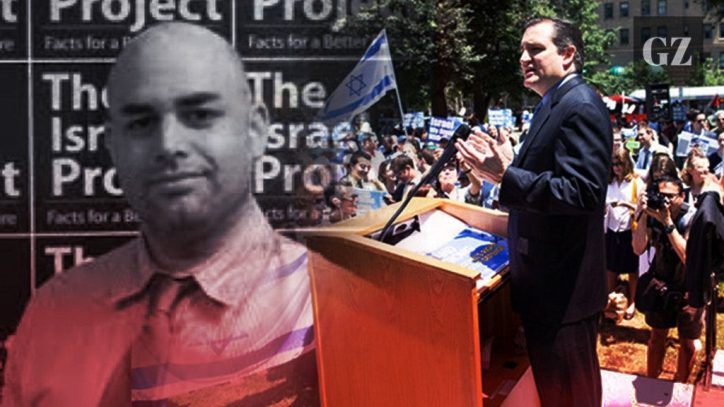
While Cruz presents himself as a Christian Zionist moved by his own zealotry to support Israel, the politician’s Tel Aviv-driven policy line can also be traced back to his Senior Advisor for Policy and Communications, an Israeli-born Zionist lobbyist named Omri Ceren.
Before overseeing Cruz’s public relations, Ceren managed his foreign policy docket as his national security advisor. Prior to joining the Senator’s staff, Ceren served as the press director for The Israel Project, a Zionist pressure group which was forced to close down after being exposed as a de facto Israeli government front by Al Jazeera’s groundbreaking undercover investigation, The Lobby. Before that, Ceren cut his teeth lobbying for Ivory Coast dictator Laurent Gbagbo, who relied on Ceren as a registered foreign agent lending his marketing expertise to the embattled regime.
Ceren has consistently opposed a nuclear deal with Iran since at least 2015, when he declared that any agreement would simply ensure Tehran was “able to cheat with impunity.” At a talk hosted by the neocon Hudson Institute think tank in 2018, he suggested Washington should continue preaching about “freedom” and encouraging Iranian protesters to pursue regime change while simultaneously maintaining Trump’s ban on Iranians entering the US.
Omri’s sister, Merav Ceren, previously worked under the supervision of the Israeli Defense Ministry, as well as another Israeli government cutout in Washington, the Foundation for Defense of Democracies. The pair were born in Haifa, Israel, with Merav embarking on her career of Israel lobbying as a college student.
Upon Merav Ceren’s appointment to head the Israel and Iran desks of Trump’s National Security Council in April 2025, one Israeli publication declared her “One of Our Own.” The authors went on to boast that Ceren’s “presence… in the discussion rooms gives significant space to voice Israeli interests.” Just a month later, however, she was fired as tensions between the Republican Party’s America First and Israel First wings came to a head.
While his sister looked for a new gig, Omri Ceren continued to represent his home country as the national security advisor to a senator who has pantomimed “America First” conservatism while zealously advancing Israel’s objectives. Cruz’s messaging since the US bombed Iran’s nuclear facilities on June 21 clearly bears his Israeli advisor’s imprimatur.
Since the attack, Cruz has posted 14 comments on Twitter/X. 12 of them consisted of breathless statements cheering the bombing or attacks on opponents of the war, whom he branded as “the death to America crowd.” The remaining two posts expressed affection for the senator’s hometown NBA team, the Houston Rockets.
The key nuclear allegation that started the war was coaxed from a Palantir counter-intelligence algorithm
By Alastair Crooke – Strategic Culture Foundation – June 23, 2025
The IAEA Board’s ‘Non-Compliance’ Resolution on 12 June 2025 was the planned precursor for Israel’s ‘bolt from the blue’ strike on Iran the next day. Israelis say the plan to go to war with Iran was grounded in ‘the opportunity’ to strike, and not the intelligence that Iran was speeding towards a bomb (that was the peg for war).
Alastair Crooke
The sudden claim of Iran being very close to a bomb (that seemingly jumped out of ‘nowhere’ to leave Americans puzzling how could it happen that – in the blink of eye, we are going to war – was subsequently refuted by IAEA Chief Grossi to CNN on 17 June (but only after the abrupt attack on Iran already had taken place):
“We did not have any evidence of a systematic effort [by Iran] to move to a nuclear weapon”, Grossi confirmed on CNN.
This statement drew the following riposte from Iran by its Foreign Ministry Spokesman, Esmaeil Baqaei on 19 June:
“This is too late, Mr. Grossi – you obscured this truth in your absolutely biased report that was instrumentalized by E3/U.S. to craft a resolution with baseless allegation of [Iranian] ‘non-compliance’; the same resolution was then utilized, as a final pretext, by a genocidal warmongering regime to wage a war of aggression on Iran and to launch an unlawful attack on our peaceful nuclear facilities. Do you know how many innocent Iranians have been killed/maimed as a result of this criminal war? You turned IAEA into a tool of convenience for non-NPT members to deprive NPT members of their basic right under Article 4. Any clear conscience?!”.
To which Dr Ali Larijani, Advisor to the Supreme Leader, added:
“When the war ends, we will hold the director of the IAEA, Rafael Grossi, accountable”.
What they are saying:
The Russian Foreign Ministry’s Statement, in relation to the escalation of the Iranian-Israeli conflict –
“It was precisely these “sympathisers” [EU3] who exerted pressure on the leadership of the [IAEA] Agency to prepare a controversial “comprehensive assessment” of Iran’s nuclear programme, the flaws of which were subsequently exploited to push through a biased anti-Iran resolution at the IAEA Board of Governors on 12 June [2025]. This resolution effectively provided a green light to actions by West Jerusalem, leading to tragedy” [i.e. to the sneak attack on the immediate day after, 13 June].
Behind the scenes:
The underpinnings to the 12 June 2025 IAEA Resolution – giving pretext for Israel to strike Iran (and crafted to sway President Trump to dismiss his own Director of National Intelligence’s warnings that there was no evidence of Iran moving towards weaponisation) – reportedly were drawn not from Mossad or other western intelligence services, but from IAEA software. As DD Geo-politics outlines, since 2015, the IAEA has relied on Palantir’s Mosaic platform, a $50-million AI system that sifts through millions of data points – satellite imagery, social media, personnel logs – to predict nuclear threats:
“Iran’s stockpile [of enriched uranium] had been growing steadily for months—yet the narrative of an imminent breakthrough surged only after the IAEA’s censure on June 6, 2025. That resolution, adopted 19–3, provided Israel the diplomatic cover it needed. Palantir’s Mosaic platform played a critical role in this pivot. Its data shaped the May 31 report, flagging anomalies at Fordow and Lavisan-Shian, and recycling prior allegations from Turquzabad—despite years-old Iranian denials and sabotage … Mosaic was conceived originally to identify insurgent activity in Iraq and Afghanistan”.
Its algorithm looks to identify and infer ‘hostile intent’ from indirect indicators – metadata, behavioral patterns, signal traffic – not from confirmed evidence. In other words, it postulates what suspects may be thinking, or planning. On 12 June, Iran leaked documents, which it claimed showed IAEA chief Rafael Grossi sharing Mosaic outputs with Israel. By 2018, Mosaic had processed more than 400 million discrete data objects and had helped impute suspicion to over 60 Iranian sites such as to justify unannounced IAEA inspections of those sites, under the JCPOA. These outputs, though dependent largely on the algorithmic equations, were incorporated into formal IAEA safeguard reports and were widely accepted by UN member states and non-proliferation regimes as credible, evidence-based assessments. Mosaic however is not a passive system. It is trained to infer from its algorithm hostile intent, but when repurposed for nuclear oversight, its equations risk translating simple correlation into malicious intent.
What leading Israeli commentators are saying:
Leading Israeli centre-right commentator, Ben Caspit (Ma’ariv):
“Was Iran’s ‘breakthrough’ to the nuclear weapon actually detected? Probably not. Was the [Supreme] Leader’s “order” to achieve a military nuclear weapon actually given? Probably not. So why did we go to war? Because there was no choice. They were promoting an Israeli annihilation plan and we had no choice… October 7: A cold shower woke up an entire country. All those involved need to understand that anyone who contemplates our destruction will be destroyed. Eyes on the ball and a bullet between the eyes … From now on, every move one of our enemies makes somewhere must be followed by action. Every snake’s head that rises must be beheaded … And there is something else: the rare and one-time historical window of opportunity that suddenly opened before us … All of this made the decision to go to this war the right one … Netanyahu is currently in euphoria”.
Israeli commentator, Nahum Barnea (Yedioth Ahoronot):
“The decision to start a war was all Netanyahu’s. And here he is, deciding and responsible: all the credit is his. Trump gave Israel the green light to start a war, provided that it does not present America as a partner and responsible. The Trump method does not distinguish between Zelensky’s Ukraine and Khamenei’s Iran: humiliation along the way is the guarantee of an agreement in the end”.
Israeli & NY Times commentator, Ronan Bergman (Yedioth Ahoronot):
“The need for the series of assassinations last week first emerged as a thought last September, among senior officials in Unit 8200, the research division in the Intelligence Directorate, the Mossad, and other parts of the system. The trigger was the defeat inflicted by the IDF on Hezbollah, followed by the successful attack on Iran and the destruction of its air defence system in October, followed in December by the collapse of the Assad regime in Damascus and the destruction of its air defence system by the IDF. The sequence of events led many senior Israeli officials to believe that an unprecedented opportunity had arisen, a window of a lifetime, to attack Iran… And so the beheading forum, which decided the fates of scientists thousands of miles away, sat down and decided who would be ranked at level A – the highest importance – and who at levels B, C or D – the lowest”.
Big Picture:
Seemingly, Trump had been convinced by Netanyahu, Ron Dermer and CENTOM’s General Kurilla (Politico reports that Kurilla was instrumental in persuading Trump that DNI Tulsi Gabbard was wrong in her assessment that Iran had ‘no bomb’). Trump sided with the Israelis, asserting that Iran was “very close” to having a bomb, and added that he ‘didn’t care what she [Gabbard] thinks’. Trump did speculate out loud – the day before the sneak 13 June – that an Israeli attack (on Iran) “could speed [up] a deal”. There is little doubt that Syria’s unexpectedly sudden ‘fall’ galvanized the neo-cons to imagine they might quickly repeat the exercise in Iran. This is why, too, so much emphasis is being laid on assassinating the Supreme Leader. When Iran did not collapse; when the Iranian system rebooted itself unexpectedly swiftly; and when Iran’s retaliatory strikes on Israel began, the pro-Israeli bloc panicked and exerted tremendous pressure on Trump for the U.S. to enter the war on Israel’s behalf.
This left Trump facing a terrible dilemma – having to choose between the sirens, Scylla and Charybdis – either to alienate his MAGA support base (who voted for him precisely to prevent the U.S. joining another forever war (thus likely causing a GOP loss at the next midterms)), or to alienate his ultra-rich Jewish donors (such as Miriam Adelson, whose money holds sway over Congress, and whose resources are harnessed by the Deep State to pursue mutual interests with the Israeli-Firsters), who would turn against him.
Shades of Iraq and the Colin Powell role…
Featured Video
Racist Seinfeld Dances for Joy as Bibi Unveils His New Map
or go to
Aletho News Archives – Video-Images
TV Drama Review
Japanese drama projects Japan’s wartime atrocities onto Chinese characters

Global Times | October 25, 2026
By portraying Chinese characters as perpetrators of ruthless violence while casting Japanese Self-Defense Forces (SDF) intelligence operatives as defenders, the season 2 of the Japanese drama Vivant has recently drawn criticism from Chinese netizens, who argue that its depiction turns historical reality on its head while ignoring Japan’s wartime atrocities.
The TBS drama series – a spy suspense story in which an alleged unofficial intelligence unit of the SDF operates across the globe — has attracted a passionate fanbase. Its currently airing season 2 opened with a household rating of 18.8 percent, the highest for a TV drama this year, according toa commentary article by Japanese media Toyo Keizai.
What draws attention is the portrayal of the enemies in the series, the article noted. Scenes in which the Chinese organization subjects kidnapped members of the SDF unit to brutal torture are repeated with unrelenting intensity.
It is rare for Japanese TV dramas to explicitly portray a real-life country as the enemy, the article noted.
Japanese Prime Minister Sanae Takaichi also made a reference to the drama, saying that she has been recording Vivant and hopes to binge-watch it over the year-end and New Year holidays, according to Japanese media outlets.
China’s CCTV News report on Sunday revealed that the drama features scenes in which Chinese personnel cut off the fingers of and stab Japanese intelligence operatives in the abdomen. Such acts bear striking similarities to the torture inflicted on Chinese nationals by invading Japanese troops during the World War II.
The drama distorts the truth by attributing these atrocities to modern Chinese characters. Beneath the surface, it subtly glorifies Japan’s cross-border overseas operations, blurs the functional boundaries of the SDF and implicitly promotes an expansionist narrative, per CCTV News. … continue
Blog Roll
 Aletho News
- EU facing trillion-euro debt hole while seeking more cash for Kiev
- How US, Europe, Persian Gulf states exhausted missile stockpiles, splurged billions to defend Israel
- Up in arms… Koreans reject U.S. empire’s plan to make South Korea the next Ukraine
- Iran, Turkey, Pakistan, Saudi Arabia could advance region-led security framework in Tehran: FM spox
- Netizens condemn Japanese drama for projecting Japan’s wartime atrocities onto Chinese characters
- Racist Seinfeld Dances for Joy as Bibi Unveils His New Map
- A West Bank War for Netanyahu’s Election Campaign, Could It Backfire?
- Yemen denounces European Parliament’s ‘hypocritical’ push to blacklist Ansarullah
- Qalibaf: UAE’s UN bid aims to ‘clear the runway’ for ‘Greater Israel’, whitewash genocide
- Pakistan reopens Iran border after boosting security: Report
- If Americans Knew
- An error has occurred; the feed is probably down. Try again later.
- No Tricks Zone
- Sudden Stratospheric Warming, Powerful El Niño Combination May Lead To Extreme Europe Cold, Energy Crisis!
- Two New Studies Find Thwaites Glacier Melt Cannot Be Driven By Human Activity Or A Warming Ocean
- E-Cars Reduce CO2 Emissions By Only 41% Compared To Internal Combustion Engine Vehicles
- Predictions Made By Renowned Climate Professor Over Past Decades Have Been Proven To Be Poor
- New Study Suggests Large Regions Of The Pacific Ocean Have Been Cooling For The Last 80 Years
- Germany’s Green Energy Debacle: High Energy Costs Force Kahla Porzellan to Close After 182 Years!
- New Study: 50 Years Of The Most Aggressive ‘Net Zero’ Policies Can Only Affect The Global Climate By 0.03°C
- US September “Heat” Was No Record…Many Records Set Decades Ago
- Latest European Green Energy Debacle; Portugal’s Largest Flagship Solar Park Insolvent!
- Green Energy Debacle: German Expert Professor Fritz Vahrenholt Warns Of Severe Economic And Social Consequences

