Would a Clinton Win Mean More Wars?
By Robert Parry | Consortium News | April 10, 2016
The Democratic Party establishment seems determined to drag Hillary Clinton’s listless campaign across the finish line of her race with Bernie Sanders and then count on Republican divisions to give her a path to the White House. But – if she gets there – the world should hold its breath.
If Clinton becomes President, she will be surrounded by a neocon-dominated American foreign policy establishment that will press her to resume its “regime change” strategies in the Middle East and escalate its new and dangerous Cold War against Russia.
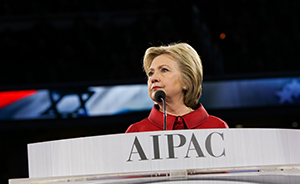
Hillary Clinton (Photo credit: AIPAC)
If Bashar al-Assad is still president of Syria, there will be demands that she finally go for the knock-out blow; there will pressure, too, for her to ratchet up sanctions on Iran pushing Tehran toward renouncing the nuclear agreement; there are already calls for deploying more U.S. troops on Russia’s border and integrating Ukraine into the NATO military structure.
President Clinton-45 would hear the clever talking points justifying these moves, the swaggering tough-guy/gal rhetoric, and the tear-jerking propaganda about evil enemies throwing babies off incubators, giving Viagra to soldiers to rape more women, and committing horrific crimes (some real but many imagined) against defenseless innocents.
Does anyone think that Hillary Clinton has the wisdom to resist these siren songs of confrontation and war, even if she were inclined to?
President Barack Obama, who – for all his faults – has a much deeper and subtler intellect than Hillary Clinton, found himself so battered by these pressures from the militaristic Washington “playbook” that he whined about his predicament to The Atlantic’s Jeffrey Goldberg, himself a neocon war hawk.
The Washington foreign policy establishment is now so profoundly in the hands of the neocons and their “liberal interventionist” sidekicks that the sitting President presumably couldn’t find anyone but a neocon to give those interviews to, even as he complained about how the U.S. capital is in the hands of warmongers.
Given this neocon domination of U.S. foreign policy – especially in the State Department bureaucracy, the major media and the big think tanks – Clinton will be buffeted by hawkish demands and plans both from outside of her administration and from within.
Already key neocons, such as the Brookings Institution’s Robert Kagan, are signaling that they expect to have substantial influence over Clinton’s foreign policy. Kagan, who has repackaged himself as a “liberal interventionist,” threw his support to Clinton, who put him on a State Department advisory board.
There is also talk in Washington that Kagan’s neocon wife, Assistant Secretary of State for European Affairs Victoria Nuland, another Clinton favorite and the architect of the “regime change” in Ukraine, would be in line for a top foreign policy job in a Clinton-45 administration.
Neocons Back in Charge
So, Clinton’s election could mean that some of the most dangerous people in American foreign policy would be whispering their schemes for war and more war directly into her ear – and her record shows that she is very susceptible to such guidance.
At every turn, as a U.S. senator and as Secretary of State, Clinton has opted for “regime change” solutions – from the Iraq invasion in 2003 to the Honduras coup in 2009 to the Libyan air war in 2011 to the Syria civil war since 2011 – or she has advocated for the escalation of conflicts, such as in Afghanistan and with Iran, rather than engaging in reasonable give-and-take negotiations.
Though her backers tout her experience as Secretary of State, the reality was that she repeatedly disdained genuine diplomacy and was constantly hectoring President Obama into adopting the most violent and confrontational options.
He sometimes did (the Afghan “surge,” the Libyan war, the Iran nuclear stand-off) but he sometimes didn’t (reversing the Afghan escalation, finally negotiating a nuclear deal with Iran after Clinton left, rejecting a direct U.S. military assault on the Syrian government, and working at times with the Russians on Iran and Syria).
In other words, Obama acted as a register or brake restraining Clinton’s hawkishness. With Clinton as the President, however, she would have no such restraints. One could expect her to endorse many if not all the harebrained neocon schemes, much as President George W. Bush did when his neocon advisers exploited his fear and fury over 9/11 to guide him into their “regime change” agenda for the Middle East.
The neocons have never given up their dreams of overthrowing Mideast governments that Israel has put on its enemies list. Iraq was only the first. To follow were Syria and Iran with the idea that by installing pro-Israeli leaders in those countries, Israel’s close-in enemies – Lebanon’s Hezbollah, Hamas and other Palestinian militant groups – could be isolated and crushed.
After Bush’s Iraq invasion in 2003, Washington’s neocons were joking about whether Iran or Syria should come next, with the punch line: “Real men go to Tehran!” But the Iraq War wasn’t the “cakewalk” that the neocons had predicted. Instead of throwing flowers at the U.S. troops, Iraqis planted IEDs.
As it turned out, a lot of “real men” and “real women” – as well as “real children” – died in Iraq, including nearly 4,500 American soldiers and hundreds of thousands of Iraqis.
So the neocon timetable took a hit but, in their view, only because of Bush’s incompetent follow-through on Iraq. If not for the botched occupation, the neocons felt they could have continued rolling up other troublesome regimes, one after another.
Professionally, the neocons also escaped the Iraq disaster largely unscathed, continuing to dominate Washington’s think tanks and the op-ed pages of major American news outlets such as The Washington Post and The New York Times. Barely missing a beat, they set about planning for the longer haul.
An Obama Mistake
Although they lost the White House in 2008, the neocons caught a break when President-elect Obama opted for a Lincoln-esque “team of rivals” on foreign policy. Instead of reaching out to Washington’s marginalized (and aging) foreign policy “realists,” Obama looked to the roster of the neocon-dominated establishment.
Obama recruited his hawkish Democratic rival, Sen. Hillary Clinton, to be Secretary of State and kept Bush’s Defense Secretary Robert Gates. Obama also left in place most of Bush’s military high command, including neocon favorite, General David Petraeus.
Obama’s naïve management strategy let the neocons and their “liberal interventionist” pals consolidate their bureaucratic control of Washington’s foreign policy bureaucracy, even though the President favored a more “realist” approach that would use America’s power more judiciously — and he was less enthralled to Israel’s right-wing government.
The behind-the-scenes neocon influence became especially pronounced at Clinton’s State Department where she tapped the likes of Nuland, a neocon ideologue and an adviser to Vice President Dick Cheney, to become the department’s spokesperson and put her on track to become Assistant Secretary of State for European Affairs (although the appointment wasn’t finalized until after Clinton left in 2013).
The neocon/liberal-hawk bias is now so strong inside the State Department that officials I know who have gone there reemerge as kind of “pod people” spouting arrogant talking points in support of U.S. intervention all over the world. By contrast, I find the CIA and the Pentagon to be places of relative realism and restraint.
Perhaps the best example of this “pod people” phenomenon was Sen. John Kerry, who replaced Clinton as Secretary of State and suddenly became the mouthpiece for the bureaucracy’s most extreme war-like rhetoric.
For instance, Kerry advocated a retaliatory bombing campaign against Syria’s military in August 2013, ignoring the intelligence community’s doubts about whether President Bashar al-Assad’s regime was responsible for a sarin-gas attack outside Damascus.
Instead of listening to the intelligence analysts, Kerry fell in line behind the neocon-driven “group think” pinning the blame on Assad, the perfect excuse for implementing the neocons’ long-delayed Syrian “regime change.” The neocons didn’t care what the facts were — and Kerry fell in line. [See Consortiumnews.com’s “What’s the Matter with John Kerry?”]
But Obama didn’t fall in line. He listened when Director of National Intelligence James Clapper told him that there was no “slam dunk” evidence implicating the Syrian military. (Ultimately, the evidence would point to a provocation carried out by Islamic extremists trying to trick the U.S. military into intervening in the war on their side.)
Obama also got help from Russian President Vladimir Putin who persuaded President Assad to surrender all his chemical weapons (while Assad still denied any role in the sarin-gas attack). Putin’s assistance infuriated the neocons who soon recognized that the Obama-Putin cooperation was a profound threat to their “regime change” enterprise.
Targeting Ukraine
Some of the smarter neocons quickly identified Ukraine as a potential wedge that could be driven between Obama and Putin. Carl Gershman, president of the National Endowment for Democracy, called Ukraine “the biggest prize” and a potential first step toward driving Putin from power in Russia.
It fell to Assistant Secretary of State Nuland to shepherd the Ukraine operation to fulfillment as she plotted with U.S. Ambassador to Ukraine Geoffrey Pyatt how to remove Ukraine’s pro-Russian President Viktor Yanukovych. Nuland and Pyatt were caught in an intercepted phone call discussing who should take over.
“Yats is the guy,” Nuland said referring to Arseniy Yatsenyuk who indeed would become the new prime minister. Nuland and Pyatt then exchanged ideas how to “glue this thing” and how to “midwife this thing.” This “thing” became the bloody Feb. 22, 2014 coup ousting elected President Yanukovych and touching off a civil war between Ukrainian “nationalists” from the west and Ukraine’s ethnic Russians in the east.
As the “nationalists,” some of them openly neo-Nazis, inflicted atrocities on ethnic Russians, Crimea voted by 96 percent to leave Ukraine and rejoin Russia. Resistance to the new Kiev regime also arose in the eastern Donbas region.
To the State Department – and the mainstream U.S. news media – this conflict was all explained as “Russian aggression” against Ukraine and a “Russian invasion” of Crimea (although Russian troops were already in Crimea as part of the Sevastopol naval base agreement). But All the Important People agreed that the Crimean referendum was a “sham” (although many polls have since confirmed the results).
When citizen Clinton weighed in on the Ukraine crisis, she compared Russian President Putin to Hitler.
So, today the neocon/liberal-hawk Washington “playbook” – as Obama would call it – calls for massing more and more U.S. troops and NATO weapons systems on Russia’s border to deter Putin’s “aggression.”
These tough guys and gals also vow to ignore Russia’s warnings against what it views as military threats to its existence. Apparently “real, real men” go to Moscow (perhaps riding a nuclear bomb like the famous seen from “Dr. Strangelove.”).
Ian Joseph Brzezinski, a State Department official under President George W. Bush and now a foreign policy expert for the Atlantic Council, a NATO think tank, has co-authored an article urging NATO to incorporate Ukrainian army units into its expansion of military operations along Russia’s border.
“High-level Ukrainian national security officials have urged the international community to be bolder in its response to Russia’s provocative military actions,” wrote Brzezinski (son of old Cold Warrior Zbigniew Brzezinski) and Ukrainian co-author Markian Bilynskyj.
“The deployment of a battle tested, Ukrainian infantry company or larger unit to reinforce the defense of NATO territory in Central Europe would be a positive contribution to the Alliance force posture in the region.”
Following the Playbook
This kind of tough-talking jargon is what the next President, whoever he or she is, can expect from Official Washington. From Obama’s interview in The Atlantic, it’s clear that he feels surrounded and embattled by these warmongering forces but takes some pride in resisting – from time to time – the Washington “playbook.”
But how would President Hillary Clinton respond? When she appeared before the American Israel Public Affairs Committee on March 21 – at a moment when it appeared she had all but nailed down the Democratic nomination – Clinton showed what you might call her true colors, fawning over how loyal she would be to Israel and promising to take the very cozy relationship between the U.S. and Israel “to the next level.”
By reviewing Clinton’s public record, one could reasonably conclude that she is herself a neocon, both in her devotion to Israel and her proclivity toward “regime change” solutions. She also follows the neocon lead in demonizing any foreign leader who gets in their way. But even if she isn’t a full-fledged neocon, she often bends to their demands.
The one possible deviation from this pattern is Clinton’s personal friendship with longtime adviser Sidney Blumenthal, who was an early critic of the neoconservatives as they emerged as a powerful force during the Reagan administration. Blumenthal and his son Max have also dared criticize Israel’s abusive treatment of the Palestinians.
However, the Israel Lobby appears to be taking no chances that Sidney Blumenthal’s voice might be heard during a Clinton-45 administration. Last month, a pro-Zionist group, The World Values Network, bought a full-page ad in The New York Times to attack Blumenthal and his son and declared that “Hillary Clinton must disavow her anti-Israel advisors.”
Though Clinton might not publicly disassociate herself from Sidney Blumenthal, the preemptive strike pushed him further toward the margins and helped clear the path for the Kagan/Nuland faction to rush to the center of Clinton’s foreign policy.
Indeed, Clinton’s primary focus if she gets elected is likely to be ensuring that she gets reelected. As a traditional politician, she would think that the way to achieve reelection is to stay on the good side of the Israeli leadership. Along those lines, she promised AIPAC that, as President, she would immediately invite Prime Minister Benjamin Netanyahu to the White House.
So, what would happen if Clinton takes the U.S.-Israeli relationship “to the next level”? Presumably that would mean taking a super-hard line against Iran over last year’s nuclear deal. Yet, already Iran is questioning whether its acceptance of extraordinary constraints on its nuclear program was worth it, given the U.S. unwillingness to grant meaningful relief on economic sanctions.
A belligerent Clinton approach – decrying Iran’s behavior and imposing new sanctions – would strengthen Iran’s hard-line faction internally and might well lead to Iran renouncing the agreement on the grounds of American bad faith. That, of course, would please the neocons and Netanyahu by putting the “bomb-bomb-bomb Iran” option back in play.
A Stunning Reversal
Clinton may have viewed her AIPAC speech as the beginning of her long-awaited “pivot to the center,” but afterwards she suffered a string of primary and caucus defeats at the hands of Sen. Bernie Sanders, most by landslide margins.
Besides those stunning defeats, Clinton’s campaign clearly has an “enthusiasm gap.” Sanders, the 74-year-old “democratic socialist” from Vermont, draws huge and excited crowds and wins younger voters by staggering percentages. Meanwhile, Clinton confronts polls showing high negatives and extraordinary public distrust.
If she gets the Democratic nomination, she may have little choice but to engage in a fiercely negative campaign since — faced with the lack of voter enthusiasm — her best chance of winning is to so demonize her Republican opponent that Democrats and independents will be driven to the polls out of fear of what the crazy GOP madman might do.
Right now, many Clinton supporters see her as the “safe” — not exciting — choice, a politician whose long résumé gives them comfort that she must know what’s she’s doing. African-American voters, who have been her most loyal constituency, apparently feel more comfortable with someone they’ve known (who has also served in the Obama administration) than Sanders who is unknown to many and is seen as someone whose ambitious programs appear less practical than Clinton’s small-bore ideas.
But a look behind Clinton’s résumé, especially her reliance on “regime change” and other interventionist schemes in the Middle East and Eastern Europe, might give all peace-loving voters pause. [See Consortiumnews.com’s “Is Hillary Clinton ‘Qualified’?”]
Savvy neocons, like Robert Kagan, have long understood that Clinton could be their Trojan Horse, pulled into the White House by Democratic voters. Kagan told The New York Times, “I feel comfortable with her on foreign policy. If she pursues a policy which we think she will pursue it’s something that might have been called neocon, but clearly her supporters are not going to call it that; they are going to call it something else.”
The same Times article noted that Clinton “remains the vessel into which many interventionists are pouring their hopes.” However, if she is that “vessel” carrying a neocon foreign policy back into the White House, this “safe” choice might prove dangerous to America and the world.
Investigative reporter Robert Parry broke many of the Iran-Contra stories for The Associated Press and Newsweek in the 1980s. You can buy his latest book, America’s Stolen Narrative, either in print here or as an e-book (from Amazon and barnesandnoble.com).
Lebanon is being forced to collapse
By Andre Vltchek | RT | April 8, 2016
Lebanon cannot stand on its feet anymore. It is overwhelmed, frightened and broke.
It stands at the frontline, facing Islamic State (IS, formerly known as ISIS/ISIL) in the east and north, hostile Israel in the south and the deep blue sea in the west. One and a half million (mostly Syrian) refugees are dispersed all over its tiny territory. Its economy is collapsing and the infrastructure crumbling. ISIS is right on the border with Syria, literally next door, or even with one foot inside Lebanon, periodically invading, and setting up countless “dormant cells” in all the Lebanese cities and all over the countryside. Hezbollah is fighting ISIS, but the West and Saudi Arabia apparently consider Hezbollah, not ISIS, to be the major menace to their geopolitical interests. The Lebanese army is relatively well trained but badly armed, and as the entire country, it is notoriously cash-strapped.
These days, on the streets of Beirut, one can often hear: “Just a little bit more; one more push, and the entire country will collapse, go up in smoke.”
Is this what the West and its regional allies really want?
One top foreign dignitary after another is now visiting Lebanon: the UN chief Ban Ki-moon, World Bank Group President Jim Yong Kim and the EU foreign policy chief Federica Mogherini. All the foreign visitors are predictably and abstractly expressing “deep concern” about the proximity of ISIS, and about the fate of the 1.5 million Syrian refugees now living in Lebanon. “The war in neighboring Syria is having a deep impact on tiny Lebanon”, they all admit.
Who triggered this war is never addressed.
And not much gets resolved. Only very few concrete promises are being made. And what is promised is not being delivered.
One of my sources who attended a closed-door meeting of Ban Ki-moon, Jim Yong Kim and the heads of the UN agencies in Beirut, commented: “almost nothing new, concrete or inspiring was discussed there.”
The so-called international community is showing very little desire to rescue Lebanon from its deep and ongoing crises. In fact, several countries and organizations are constantly at Lebanon’s throat, accusing it of “human rights violations” and of having weak and ineffective government. What seems to irritate them the most, though, is that Hezbollah (an organization that is placed by many Western countries and their allies in the Arab world on the “terrorist list”) is at least to some extent allowed to participate in running the country.
But Hezbollah appears to be the only military force capable of effectively fighting against ISIS – in the northeast of the country, on the border with Syria, and elsewhere. It is also the only organization providing a reliable social net to those hundreds of thousands of poor Lebanese citizens. In this nation deeply divided along sectarian lines, it extends its hand to the ‘others’, forging coalitions with both Muslim and Christian parties and movements.
Why so much fuss over Hezbollah?
It is because it is predominantly Shia, and Shia Muslims are being antagonized and targeted by almost all the West’s allies in the Arab world. Targeted and sometimes even directly liquidated.
Hezbollah is seen as the right hand of Iran, and Iran is Shia and it stands against Western imperialism determinately, alongside Russia, China and much of Latin America – countries that are demonized and provoked by the ‘Empire’ and its client states.
Hezbollah is closely allied with both Iran and Bashar al-Assad’s government in Syria. It combats Israel whenever Israel invades Lebanon, and it wins most of the battles that it is forced to fight. It is openly hostile towards the expansionist policies of the West, Israel and Saudi Arabia; its leaders are extremely outspoken.
“So what?” many people in the region would say, including those living in Lebanon.
Angie Tibbs is the owner and senior editor of Dissident Voice who has been closely watching events in the Middle East in recent years. She believes a brief comparison between events of 2005 and today is essential for understanding complexity of the situation:
“In a country where, since the end of civil wars in 1990, outward civility masks a still seething underbelly wherein old wounds, old wrongs, real and imagined, have not been forgotten or forgiven, the military and political success of Hezbollah has been the most stabilizing influence. Back in 2005, following the bomb explosion that killed former Premier Rafiq al Hariri and 20 others, the US and Israel proclaimed loudly that “Syria did it” without producing a shred of evidence. The Syrian army, in Lebanon at the request of the Lebanese government, was ordered out by the US, and UN Resolution 1559 stated in part that all Lebanese militias must be disarmed. The plan was clear. With Syrian forces gone, and an unarmed Hezbollah, we had two moves which would leave Lebanon’s southern border completely vulnerable, and then – well, what would prevent Israel from barging in and taking over?”
Ms Tibbs is also convinced the so-called international community is leaving Lebanon defenseless on purpose:
“A similar devious scenario is unfolding today. Hezbollah is busy fighting ISIS in Syria; the Lebanese army, though well trained, is poorly armed. Arms deals are being cancelled, the UN and IMF, and, in fact, the world community of nations are not providing any assistance, and little Lebanon is gasping under the weight of a million plus Syrian refugees. It’s a perfect opportunity for ISIS, the proxy army of Israel and the West, to move in and Lebanon’s sovereignty be damned.”
Indignant, several Lebanese leaders snapped back. The Foreign Minister Gebran Bassil refused to meet with Ban Ki-moon during his two-day visit of Beirut and the Bekaa Valley.
One of Lebanon’s major newspapers, the Daily Star, reported on March 26, 2016:
“Foreign Minister Gebran Bassil Saturday accused the international community of approaching the Syrian refugee crisis with a double standard; hours after UN chief Ban Ki-moon departed Beirut following a two-day visit. ‘They create war, and then call on others to host refugees in line with human rights treaties,’ he said in a televised news conference from his residence in Batroun.”
Lebanon is collapsing. Even its once lavish capital Beirut is experiencing constant blackouts, water shortages and garbage-collection dramas. Economically the country is in a sharp decline.
Dr. Salim Chahine, Professor of Finance, at the American University of Beirut, is usually at least moderately upbeat about the country. Recent developments have worn down his optimism.
“Although the Coincident Indicator issued by the Lebanese Central Bank, BDL, has recently suggested a slight enhancement in economic activity, several officials are sending clear warnings about further deterioration in the situation. The regional geopolitical tensions, the civil conflict in Syria, as well as their implications internally have impacted tourism, trade, and the real estate sectors. According to HSBC, deposits from Lebanon’s largest expatriate population – that usually provide the necessary liquidity for government borrowing – may grow at a slower rate in the near future given the worsening conditions in the Gulf. As the country enters into its sixth year of economic slump, HSBC remains skeptical about a short-term recovery. The public deficit is currently rising by around 20 percent per year, and the GDP growth rate is close to zero.”
Yayoi Segi, an educationalist and the Senior Program Specialist for UNESCO’s Arab Regional Office based in Beirut, works intensively in both Syria and Lebanon. The education sector is, according to her, struggling:
“The public education sector is very small in terms of its coverage in the country, reaching only about 35 percent of the school age population. The state allocation to education is less than 10 percent while the world average or benchmark is 18-20 percent. The situation is further compounded by the current ongoing crisis in the region whereby Lebanon has had to accommodate a large influx of refugees. The public provision of education has expanded and continues to expand. However, it is impacting on quality and contributes to an increasing number of vulnerable Lebanese students dropping out of school, while it can only reach 50 percent of Syrian refugee children.”
Nadine Georges Gholam (not her real name), working for one of the UN agencies, says that lately she feels phlegmatic, even hopeless:
“What has been happening to Lebanon particularly these past five years is really depressing. I used to actively take part in protests to voice my anger and frustration. But now I don’t know if they make any difference or change anything at all. There is no functioning government in sight. Three hundred thousand tons of unprocessed trash accumulated in just eight months. There is sectarian infighting. Regional conflicts… What else? Lebanon can’t withstand such pressure, anymore. All is going down the drain, collapsing…”
“But worse is yet to come. Recently, Saudi Arabia cancelled a $4 billion aid package for Lebanon. It was supposed to finance a massive purchase of modern weapons from France, something urgently needed and totally overdue. That is, if both the West and the KSA are serious about fighting ISIS.”
“The KSA “punished” Lebanon for having representatives of Hezbollah in the government, for refusing to support the West’s allies in the Arab League (who define Hezbollah as a terrorist group), and for still holding a Saudi prince in custody, after he attempted to smuggle two tons of narcotics from Rafic Hariri International Airport outside Beirut.”
These are of course the most dangerous times for this tiny but proud nation. Syrian forces, with great help of Russia, are liberating one Syrian city after another from ISIS and other terrorist groups supported by Turkey, KSA, Qatar and other of the West’s allies.
ISIS may try to move into Iraq, to join its cohorts there, but the Iraqi government is trying to get its act together, and is now ready to fight. It is also talking to Moscow, while studying the great success Russia is having in Syria.
For ISIS or al-Nusra, to move to weaken and almost bankrupt Lebanon would be the most logical step. And the West, Saudi Arabia and others are clearly aware of it.
In fact, ISIS is already there; it has infiltrated virtually all the cities and towns of Lebanon, as well the countryside. Whenever it feels like it, it carries out attacks against the Shia, military and other targets. Both ISIS and al-Nusra do. And the dream of ISIS is blatant: a caliphate with access to the sea, one that would cover at least the northern part of Lebanon.
If the West and its allies do nothing to prevent these plans, it is because they simply don’t want to.
Tiny Lebanon is finding itself in the middle of a whirlwind of a political and military storm that is consuming virtually the entire Middle East and the Gulf.
In recent decades, Lebanon has suffered immensely. This time, if the West and its allies do not change their minds, it may soon cease to exist altogether. It is becoming obvious that in order to survive, it would have to forge much closer ties with the Syrian government, as well as with Iran, Russia and China.
Would it dare to do it? There is no united front inside Lebanon’s leadership. Pro-Western and pro-Saudi fractions would oppose an alliance with those countries that are defying Western interests.
But time is running out. Just recently, the Syrian city of Palmyra was liberated from ISIS. Paradoxically, the great Lebanese historic cities of Baalbek and Byblos may fall soon.
Nagorno-Karabakh and the Passover Feast: Hollywood’s Glorification of the Arms Trade

David Packouz (L) and Efraim Diveroli
By Richard Edmondson | Fig Trees and Vineyards | April 7, 2016
From Ukraine to North Africa to the Middle East, and most recently in the Caucasus with the outbreak of hostilities between Azerbaijan and Armenia, death and destruction are on the prowl in multiple wars, while at the same time international laws governing armed conflict are rapidly being cast onto the rubbish heap.
Many of these wars have been instigated by powers outside the countries in which they are being fought, and the tide of violence threatening to engulf the world now is unprecedented in history. You would think that at such a time, Hollywood would have better taste than to make a movie glorifying the arms trade.
But of course, you would be wrong.
Scheduled for release in August, “War Dogs” is based on the real life story of Efraim Diveroli and David Packouz, two twenty-something Jews who got involved in the arms trade and ended up bidding on Pentagon contracts, in the process scoring deals to supply weapons, ammo, and other military equipment to forces the US was arming in both Iraq and Afghanistan.
Their story was told in a 2011 Rolling Stone article which detailed their passion for money-making, recreational drug use, and their predilection for shady business dealings. “Packouz and Diveroli met at Beth Israel Congregation, the largest Orthodox synagogue in Miami Beach,” the story informs us, and then goes on to describe how they landed some lucrative contracts, including one worth $300 million, all while operating a small company known as AEY, a shell company Diveroli’s father had set up. All of this was in the years 2005-2007.
For decades, weapons had been stockpiled in warehouses throughout the Balkans and Eastern Europe for the threat of war against the West, but now arms dealers were selling them off to the highest bidder. The Pentagon needed access to this new aftermarket to arm the militias it was creating in Iraq and Afghanistan. The trouble was, it couldn’t go into such a murky underworld on its own. It needed proxies to do its dirty work — companies like AEY. The result was a new era of lawlessness…
One evening, Diveroli picked Packouz up in his Mercedes, and the two headed to a party at a local rabbi’s house, lured by the promise of free booze and pretty girls. Diveroli was excited about a deal he had just completed, a $15 million contract to sell old Russian-manufactured rifles to the Pentagon to supply the Iraqi army. He regaled Packouz with the tale of how he had won the contract, how much money he was making and how much more there was to be made….
Diveroli, by the way, is the nephew of celebrity rabbi Shmuley Boteach, a staunch supporter of Israel and author of several books, including one entitled “Kosher Sex”–a book in which he “breaks down sexual taboos” while pioneering “a revolutionary approach to sex, marriage, and personal relationships, drawing on traditional Jewish wisdom.” Boteach has also run inflammatory ads in the New York Times defending Israel, and in 2012 was bankrolled by Las Vegas casino magnate Sheldon Adelson in an unsuccessful campaign for Congress.
So in other words, while Boteach was doing the TV talk show circuit advising Americans how to improve their sex lives, his nephew Diveroli was finding his niche in the “murkey underworld” of arms trafficking.
Above all, Diveroli cared about the bottom line. “Efraim was a Republican because they started more wars,” Packouz says. “When the United States invaded Iraq, he was thrilled. He said to me, ‘Do I think George Bush did the right thing for the country by invading Iraq? No. But am I happy about it? Absofuckinglutely.’ He hoped we would invade more countries because it was good for business.”
The big $300 million deal they landed found them purchasing stocks of Chinese-made ammunition in the Balkans and transporting them to Afghanistan, but a US embargo against Chinese weapons meant the whole thing had to be carried out clandestinely. The ammo was repackaged in cardboard boxes with no Chinese lettering. But some of the ammo was quite old, a number of the crates were infested with termites, and the two ended up being indicted for fraud and pleading guilty. And now we have a forthcoming Hollywood movie about their endogamic escapades.
It’s tempting to dismiss “War Dogs” as just another piece of Hollywood trash, but of course it comes as millions are coping with the destruction of homes and lives in the bogus war on terror and as whole nations are being torn apart. In Syria, the US has aligned itself with so-called “moderate” rebels, equipping them with vast stocks of weapons, many of which have ended up in the hands of ISIS, while in Yemen, we have assisted Saudi Arabia in an air campaign which, as of January 2016, had resulted in 2,795 killed and 5,324 wounded. At least 62 civilians were killed by coalition airstrikes in December alone, reports the UN, which was more than twice the number killed in the previous month. Many others have been left homeless.

A girl drinks from a leaking street pipe in Yemen, where millions now have no access to drinking water
But this hasn’t stopped the US from continuing to fuel the fire, so to speak. According to Defense News, the State Department has facilitated $33 billion worth of weapons sales to its Arab Gulf allies since May of 2015. The weapons–including anti-armor missiles, attack helicopters, and ballistic missile defense capabilities–have been sold to the six countries that make up the Gulf Cooperation Council, or GCC. These would of course be some of the same countries that have been supplying arms to ISIS while also carrying out war crimes in Yemen.
“In addition, the U.S. government and industry also delivered 4,500 precision-guided munitions to the GCC countries in 2015, including 1,500 taken directly from U.S. military stocks — a significant action given our military’s own needs,” said David McKeeby, a spokesman with the State Department’s Bureau of Political-Military Affairs.
How much of this ordnance may have ended up in the hands of not-so-moderate terrorists is unclear, but in December of 2015, Amnesty International published a report entitled “Taking Stock: The Arming of the Islamic State,” which found that the terrorist army “now deploys a substantial arsenal of arms and ammunition, designed or manufactured in more than 25 countries.”
A lot of this was looted or captured from poorly secured Iraqi military stocks, says the report, but illicit weapons transactions also seem to have played a considerable role in building up the ISIS arsenal–and some of the “chain of custody” evidence cited in the report, including a cache of weapons transferred from Croatia to the Free Syrian Army, sounds almost eerily similar to the sort of shady weapons trafficking operation run by Packouz and Diveroli.
Of course there is the old adage about art imitating life, and, on some level the fact that Hollywood would make a film about two Jews and then go on to entitle it “War Dogs” is perhaps not surprising. This, keep in mind, coming at a time when evidence of Israel’s support for terrorists in Syria is as clear as the hand in front of your face. And of course who could forget the lovable Victoria Nuland and her famous “f**k-the-EU” comment, mouthed off at a time when her State Department was busy engineering a coup in Ukraine?
In fact, efforts by Zionist Jews to create instability and instigate wars are getting to be about as common as fireflies on a summer night. They’re not always easy to spot, but you know they’re out there because they occasionally involuntarily light up, as when someone like Nuland gets caught in a taped phone conversation.
And now it looks like certain fireflies have moved into the Caucasus where they seem to be taking advantage of a long-simmering dispute between Azerbaijan and Armenia over the region of Nagorno-Karabakh. On April 2, intense fighting broke out followed by a series of charges, counter-charges, claims and counterclaims, made by both sides. According to the Armenians, it started with an offensive launched by Azerbaijani troops using tanks and artillery. Azerbaijan, on the other hand, insists it was responding to large-caliber weapons fire from inside the ethnic Armenian-controlled Nagorno-Karabakh area. So who is telling the truth? Or are both sides lying?
Hard to say for sure, but a couple of knowns are worth mentioning: A) Armenia is closely allied with Russia, and, B) Azerbaijan, too, has ties, including trade ties, with Russia, but it also is closely aligned with Turkey and maintains extensive trade relations with Israel. And the trade with Israel has been especially heavy in the area of military procurement.
Israeli drones, anti-aircraft and missile defense systems have been supplied to Azerbaijan in the wake of a $1.6 billion agreement struck between the two countries in 2012. Israeli companies are also active in the Azerbaijani telecommunications, agriculture, water supply medical technology, and energy sectors. That makes for a lot of sayanim on the ground inside a relatively small country.
Perhaps no surprise, then, that Armenian forces shot down an Israeli drone on April 2–the very day hostilities broke out.
The ThunderB drone is known for its light weight, 62 pounds, and its long flying time–25.5 hours–on a single tank of fuel. It is made by an Israeli company known as BlueBird, which reportedly may be about to be purchased by Elbit Systems.
And then on Tuesday came news of yet another Israeli drone spotted over Nagorno-Karabakh–this one believed to be a Harop drone, made by Israeli Aerospace Industries. The Harop is also known as a “suicide drone” in that rather than firing a missile at a target it simply becomes the missile itself, ramming the target and destroying it.
According to Gordon Duff, senior editor at Veterans Today, the key to understanding the Armenian-Azerbaijani conflict is to recognize “that Azerbaijan is a client state of Israel and the CIA.” He adds that Azerbaijan has as well become “the regional operating center for Google Idea Groups,” which he refers to as the “shadow CIA.”
Google Ideas was formed in 2010. At that time Google CEO Eric Schmidt tapped the State Department’s Jared Cohen to direct the new venture, dubbed as a “think/do tank.” In late 2015, Google was reorganized under a parent company called Alphabet, Inc., and in February of this year Google Ideas was rebranded as “Jigsaw”–although it is still run by Cohen and still affiliated with Google.
Cohen, by the way, is also an adjunct senior fellow at the Council on Foreign Relations, and during his years with the State Department (2006-2010) he worked closely with Condoleezza Rice and Hillary Clinton, and became a strategic advisor in US policy toward Iran. Jigsaw’s mission is to “use technology to tackle the toughest geopolitical challenges, from countering violent extremism to thwarting online censorship to mitigating the threats associated with digital attacks,” says Schmidt.
Sounds nice, but a purview of Jigsaw’s website–fittingly kind of creepy and dark-looking–suggests that virtually all of the “activists” it has provided support to seem to be from countries with governments the US seeks to overthrow. And indeed, in 2012 Wikileaks released a cache of emails concerning Cohen’s activities in the Middle East, including one, apparently written by Cohen himself, in which he discusses efforts to stir up trouble in Iran:
I wanted to follow-up and get a sense of your latest thinking on the proposed March trip to UAE, Azerbaijan, and Turkey. The purpose of this trip is to exclusively engage the Iranian community to better understand the challenges faced by Iranians as part of one of our Google Ideas groups on repressive societies. Here is what we are thinking: Drive to Azerbaijan/Iranian border and engage the Iranian communities closer to the border (this is important because we need the Azeri Iranian perspective).
So here, it seems, we have Cohen basically setting up shop on the Iran-Azerbaijan border. It should be noted that both Azerbaijan and Armenia border Iran, while Azerbaijan also shares a border with Russia. A conflict breaking out in this region could easily spill over into Russia or Iran–both of which have called for the two warring parties to adhere to a 1994 ceasefire agreement.
But of course, such a spillover would advance certain geopolitical interests. For one thing, it would pose a dilemma for Russia at a time when it is engaged in Syria. Sergei Zheleznyak, vice speaker of the Russian state Duma, has voiced the view that a “third force” is behind developments in Nagorno-Karabakh. According to the Russian News Agency Tass :
“It is clear that the force that continues to fan the flames of war in the Middle East, Central Asia and the Caucasus dissatisfied with the peacekeeping and counter-terror success of Russia and our allies in Syria is interested in the speedy exacerbation of the protracted conflict in the Nagorno-Karabakh region,” the parliamentarian wrote on his Facebook page on Saturday.
According to Zheleznyak, “neither Azerbaijan nor Armenia essentially need this exacerbation now.” He noted that “there is every likelihood that this provocation has been organized by a third force,” adding that “information on its presence is beginning to leak out.” In view of this, he drew attention to the fact that “at night in the mountains it is enough to have a few trained armed persons who know the opposing sides’ balance of forces to provoke them to open reciprocal ‘reprisal’ fire.”
Most people probably assumed Zheleznyak, in talking about a “third force,” was referring to Turkey–and certainly Turkey’s downing of a Russian jet in Syria factors into the equation. But another element that perhaps figures even more prominently is the “clash of civilizations” that hardcore Zionists have long salivated over the thought of.
We might theorize that ISIS was created with a two-fold objective: one was to break apart Syria and bring about the overthrow of Bashar Assad, while the other was to jockey into existence a clash of civilizations between Christians and Muslims. In both of these objectives it has failed. Assad is still standing, and while the rise of ISIS certainly inflamed anti-Muslim sentiments in the West, it has not resulted in the all-out war between Christianity and Islam that would have played so well into the hands of the Jewish state.
But where the ISIS plan failed, the conflict in the Caucasus could well succeed. Armenia is predominantly a Christian state, while Azerbaijan is mostly Muslim. A war between these two could galvanize public opinion in the region along religious lines. Regional political alignments and the history of the Armenian genocide are also to be considered. Turkey, though sharing a border with Armenia, has openly sided with Azerbaijan. Russia, on the other hand, has remained officially neutral. However, an RT report filed April 5 shows journalist Murad Gazdiev reporting from inside Armenian Karabakh trenches.

Armenian Genocide–young girls crucified on crosses
So where is Israel in all of this? Officially it doesn’t seem to be saying much about it, but in May of 2015, the Jewish Daily Forward published an article entitled, “Why Israel’s Alliance with Azerbaijan is so Shortsighted.” The writer, Christopher Atamian, takes the Jewish state to task over its refusal to recognize the Armenian genocide as well as for its lucrative arms contract with Azerbaijan, a country he refers to as an “authoritarian regime that is fueling regional conflict.”
“This is the same country that attempted to wipe out the entire Armenian population of Nagorno Karabakh in 1991 before losing a bloody war against the Armenians,” he adds.
What he leaves unspoken, of course, is that Israel’s refusal to recognize the Armenian genocide is tantamount to holocaust denial. More than 1.5 million Armenians were massacred from the years 1915 to 1922, and the Jewish state’s silence on the matter became a particularly hot-button issue last year on the genocide’s 100th anniversary.
Zheleznyak, the Duma vice speaker, seems for his own part to be offering sage advice to both parties in the current conflict, noting that Russia’s president as well as its government agencies “urge Armenia and Azerbaijan to cease fire and not to allow to draw them into someone else’s insidious game, as long as it is still possible.”
“As long as it’s still possible” is of course the key question. The more people die, the further recede the possibilities of the regional players not getting trapped or caught up in the “insidious game”–and the greater grow the chances of the conflict’s becoming the parabolic curve that ignites World War III.
Should that come to pass, maybe Diveroli and Packouz will vie for ringside seats–although it doesn’t appear they’ll especially want to sit next to each other. According to the article in Rolling Stone, the two had a major falling out.
“Listen, dude, if you f**k me, I’m going to f**k you,” one of them warned during an argument over money.
“Whatever,” replied the other.
One wonders why they didn’t name the movie “War Pigs” rather than “War Dogs.” Perhaps it wouldn’t have been kosher enough.
In the past year in Israel we’ve seen an arson attack on a Palestinian home which left a mother, father and their 18-month-old baby dead; we have seen a video of Jewish settlers dancing and celebrating the attack by stabbing a photo of the baby; we have observed continued expropriation of Palestinian land in the West Bank, including one of the biggest land grabs in recent years–579 acres near the Dead Sea; and more recently we have seen a second video showing an Israeli soldier executing a wounded Palestinian with a gunshot to the head.
The execution video showed Israeli soldier Elior Azaria pump a bullet into the head of 21-year-old Abdul Fattah Sharif, as he lay on the ground wounded and barely moving. The murder took place on Purim, the Jewish holiday which celebrates the massacre of thousands of Gentiles, as told of in the Book of Esther. The next holiday on the Jewish calendar is Passover, coming up on April 22-23. The significance of Passover is laid out in twelfth chapter of Exodus:
On that same night I will pass through Egypt and strike down every firstborn–both men and animals–and I will bring judgement on all the gods of Egypt. I am the Lord. The blood will be a sign for you on the houses where you are; and when I see the blood I will pass over you. No destructive plague will touch you when I strike Egypt.
This is a day you are to commemorate; for the generations to come you shall celebrate it as a festival to the Lord–a lasting ordinance… And when your children ask you, ‘What does this ceremony mean to you?’ then tell them, ‘It is the Passover sacrifice to the Lord, who passed over the houses of the Israelites in Egypt and spared our homes when he struck down the Egyptians.’
It seems that both Purim and Passover are in essence celebrations of the deaths of non-Jews. Suppose Gentiles observed holidays each year in which we celebrated Jewish deaths? What do you suppose would be said of it?
Whatever one’s views of Judaism may be (there are some admirable sentiments expressed in the Old Testament as well as some repellent ones), Zionism has morphed from the simple idea of a homeland for a specific group of people into a supremacist ideology that has had appalling consequences–not only for its victims but also even for its adherents, dehumanizing them to a degree never thought imaginable.
Zionism is the great Passover feast that has become a celebration of war.
Pro-Israel lobby tells Prince Charles not to visit Iran
RT | April 6, 2016
Israel lobby group We Believe in Israel (WBII) is calling on Prince Charles to reconsider an upcoming visit to Iran, which it accuses of anti-Semitism.
The grassroots pro-Israel group started an online petition in response to reports the Prince of Wales is planning to visit Iran in autumn. The trip would be the first official visit of a UK royal to the Islamic Republic in over 40 years.
The Foreign Office and Clarence House are discussing a tour with Tehran, the Sunday Times reported last month.
The visit follows an international deal struck in 2015 after years of talks, which saw Western sanctions against Iran lifted in exchange for it abandoning its nuclear ambitions.
Prince Charles’ visit would mark a significant thaw in relations, and could lead to new trade ties.
WBII however has unequivocally called on the Foreign Office and Clarence House to abandon the plans.
“We do not consider it appropriate for a member of the Royal Family to visit Iran and give credibility to the Iranian regime,” the WBII petition reads.
WBII Director Luke Akehurst said he is “disturbed” by the prospect of a royal visit to Iran, noting the regime’s alleged ties to terror groups, its senior figures’ denial of the Holocaust and calls for the destruction of Israel.
“We find the proposed visit particularly strange as there has never been an official Royal visit to Israel, the only democracy in the region,” said Akehurst, the Jewish Chronicle reports.
In 2004, Prince Charles made an unofficial visit to the city of Bam in southeastern Iran in his capacity as president of the British Red Cross after an earthquake killed 40,000 people in the region.
Queen Elizabeth II paid the last official royal visit to Iran in 1974, five years before the Islamic Revolution deposed Shah Reza Pahlavi and installed a theocratic government.
US to block sale of Russian Su-30 aircraft to Iran: State Dept.
Press TV – April 5, 2016
The United States would use its veto power in the United Nations Security Council to block the sale of Russian Ru-30 fighter jets to Iran, the State Department says.
Department of State Under Secretary for Political Affairs Thomas Shannon made the announcement on Tuesday during a congressional hearing on Iran. “We would block the approval of fighter aircraft.”
Shannon told the Senate Foreign Relations Committee hearing that any such sale of fighter jets would have to be approved by the UN Security Council.
Su-30 is a multirole advanced fighter aircraft for all-weather, air-to-air and air-to-surface deep interdiction missions.
“The sale of Su-30 fighter aircraft is prohibited under UNSCR 2231 without the approval of the UN Security Council and we would block the approval of any sale of fighter aircraft under the restrictions,” Shannon said.
Shannon was referring to the UN Security Council Resolution 2231, adopted by the Security Council on July 20, 2015, which endorsed the nuclear agreement between Iran and the P5+1 group – Russia, China, France, Britain, the US and Germany.
The UN resolution calls upon Iran not to undertake any activity related to ballistic missiles designed to be capable of delivering nuclear weapons, including launches using such ballistic missile technology.
But according to diplomats, resolution 2231 does not prohibit Iran from buying fight jets, and the language of 2231 is not legally binding and cannot be enforced with punitive measures.
Iran and the P5+1 finalized the Joint Comprehensive Plan of Action (JCPOA) in Vienna, Austria, on July 14, 2015. They started to implement the JCPOA on January 16, 2016.
Under the agreement, limits are put on Iran’s nuclear activities in exchange for, among other things, the removal of all nuclear-related economic sanctions against the Islamic Republic.
House speaker says US, Israel key partners in war on terror
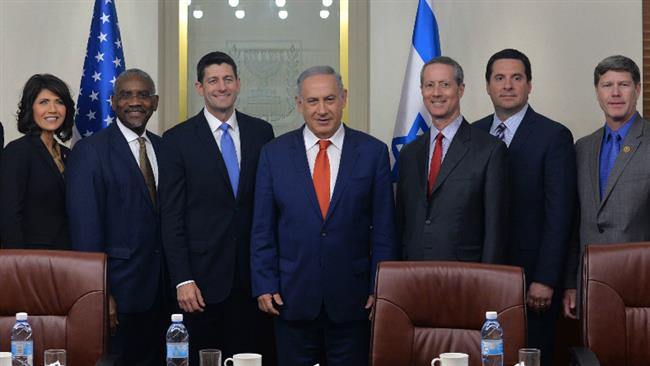
A bipartisan delegation of US lawmakers meets with Israeli Prime Minister Benjamin Netanyahu on April 4, 2016 at the premier’s office in Jerusalem al-Quds.
Press TV – April 5, 2016
Speaker of the US House of Representatives Paul Ryan led a bipartisan delegation of members of Congress to the Israeli Knesset, stressing that the alliance between Tel Aviv and Washington is “more important than ever.”
During his first official visit abroad as the House speaker, Ryan met with Knesset speaker Yuli Edelstein on Monday and said the United States will work “shoulder to shoulder” with Israel to counter their common threats.
“I wanted to come to Israel first to emphasize how important the US commitment to Israel and strong friendship with Israel is to us,” the Republican of Wisconsin said.
“Especially against the shared security threats of ISIS (Daesh) and Iran, this friendship is even more important than in the past,” he continued.
The speaker reassured his Israeli counterpart that the US Congress would rigorously push back against any boycott efforts against Israel.
Upon arriving in the occupied territories, Ryan tweeted that, “as long as I am speaker, I will not allow any legislation that divides Israel & America to come to the House floor.”
The American delegation also met with Prime Minister Benjamin Netanyahu and “expressed strong support for Israel,” the premier’s office said in a short statement on Monday.
In an interview with the Times of Israel on Sunday, Ryan said Palestinian “terrorism” directed against Israelis was no different than the terror wreaking havoc in Europe.
“They’re coming at Israel but they’re ultimately coming for us,” he said. “So we are partners in this war on terror.”
“Israel is an indispensable ally in that. Israel is on the frontline in so many ways with respects to it,” the speaker continued.
The visit comes as Ryan’s home state of Wisconsin is gearing up for its crucial presidential primary on Tuesday.
Strong congressional support for Israel has played a crucial role in Israel receiving benefits not available to any other ally.
Israel is the largest cumulative recipient of US foreign assistance since World War II.
US military aid to Israel has amounted to more than $124.3 billion since it began in 1962, according to a US congressional report, released late last year.
Sen. Cardin demands renewal of anti-Iran sanctions: Jewish Telegraphic Agency
Press TV – April 4, 2016
US Democratic Senator Ben Cardin has pledged to get Congress to renew sanctions against Iran before the end of the year.
The pro-Israeli lawmaker on the Senate Foreign Relations Committee has told Jewish media that there is a general agreement to extend sanctions against Iran before they expire in December 2016.
“There’s general agreement we have to extend the sanctions against Iran, and we need to do it before they expire at the end of this year,” Cardin told Jewish Telegraphic Agency in a recent interview.
Cardin said he could get Democrats behind a simple reauthorization of sanctions, adding they are needed to remain in effect.
“Speaking as the ranking Democrat on the committee, and on behalf of the Democrats, we could get it done quickly if we were to just do that part,” he said, meaning a simple reauthorization of the sanctions, aka Iran Sanctions Act, which were passed in 1996 and reauthorized in 2006. The sanctions must be renewed every 10 years.
Last month, Cardin toured Israel, Saudi Arabia and Qatar, where he met with authorities expressing ‘concern’ over Iran’s growing influence in the region.
At the beginning of this year, US President Barack Obama signed an executive order, lifting the US economic sanctions on Iran after Tehran proved it had fulfilled its commitments undertaken in the Joint Comprehensive Plan of Action (JCPOA) – Iran’s nuclear agreement with the permanent UN Security Council members plus Germany (P5+1) signed last July.
Last month, a group of US Republican senators also introduced legislation to impose new sanctions against Iran over what legislators have described as Tehran’s “support for terrorism and human rights violations.”
With the ‘Iran Sanctions Act’ expiring at the end of this year, GOP senators are making every effort to reauthorize and impose more sanctions on Tehran on the pretext of terrorism, human rights issues, and ballistic missile tests.
Several Republican senators including Marco Rubio and Ted Cruz have signed the new bill, dubbed the “Iran Terrorism and Human Rights Sanctions Act of 2016.”
How US-Backed War on Syria Helped ISIS
By Daniel Lazare | Consortium News | March 31, 2016
Why are Islamic militants wreaking havoc from Brussels to Lahore? The best way to answer this question is by taking a close look at how The New York Times covered this weekend’s liberation of Palmyra from Abu Bakr al-Baghdadi’s Islamic State.
The article, entitled “Syrian Troops Said to Recapture Historic Palmyra From ISIS,” began on a snide note. While the victory may have netted Bashar al-Assad “a strategic prize,” reporters Hwaida Saad and Kareem Fahim wrote that it also provided the Syrian president with “something more rare: a measure of international praise.”
The article noted that “Mr. Assad’s contention that his government is a bulwark against the transnational extremist group” has been bolstered, but added that “his foes and some allies argue that he must leave power as part of a political settlement to end the war in Syria” – without, of course, specifying who those allies might be.
Then it offered a bit of background: “Lost in the celebrations was a discussion of how Palmyra had fallen in the first place. When the Islamic State captured the city in May [2015], the militants faced little resistance from Syrian troops. At the time, residents said officers and militiamen had fled into orchards outside the city, leaving conscripted soldiers and residents to face the militants alone.”
Since the Times claims to have “several hundred” surreptitious contacts inside Syria, the charge that Assad’s troops fled without a fight may conceivably be correct. But it’s hard to square with reports that the Islamic State (also known as ISIS, ISIL and Daesh) had to battle for seven or eight days before entering the city and then had to deal with a counter-offensive on the city’s outskirts. But even if true, it’s only part of the story and a small one at that.
The real story began two months earlier when Syrian rebels launched a major offensive in Syria’s northern Idlib province with heavy backing from Turkey and Saudi Arabia. Led by Al Nusra, the local Al Qaeda affiliate, but with the full participation of U.S.-backed rebel forces, the assault proved highly successful because of the large numbers of U.S.-made optically guided TOW missiles supplied by the Saudis. [See Consortiumnews.com’s “Climbing into Bed with Al-Qaeda.”]
The missiles gave the rebels the edge they needed to destroy dozens of government tanks and other vehicles according to videos posted on social media websites. Indeed, one pro-U.S. commander told The Wall Street Journal that the TOWs completely “flipped the balance of power,” enabling the rebels to dislodge the Syrian army’s heavily dug-in forces and drive them out of town. Although the government soon counter-attacked, Al Nusra and its allies continued to advance to the point where they posed a direct threat to the Damascus regime’s stronghold in Latakia province 50 or 60 miles to the west.
Official Washington was jubilant. “The trend lines for Assad are bad and getting worse,” a senior official crowed a month after the offensive began. The Times happily observed that “[t]he Syrian Army has suffered a string of defeats from re-energized insurgents … [which] raise newly urgent questions about the durability of President Bashar al-Assad’s rule.”
Assad was on the ropes, or so everyone said. Indeed, ISIS thought so as well, according to the Associated Press, which is why it decided that the opportunity was ripe to launch an offensive of its own 200 miles or so to the southeast. Worn-out and depleted after four years of civil war, the Syrian Arab Army retreated before the onslaught.
But considering the billions of dollars that the U.S. and Saudis were pouring into the rebel forces, blaming Damascus for not putting up a stiffer fight is a little like beating up a 12-year-old girl and then blaming her for not having a better right hook.
So the U.S. and its allies helped Islamic State by tying down Assad’s forces in the north so that it could punch through in the center. But that’s not all the U.S. did. It also helped by suspending bombing as the Islamic State neared Palmyra.
As the Times put it at the time: “Any airstrikes against Islamic State militants in and around Palmyra would probably benefit the forces of President Bashar al-Assad. So far, United States-led airstrikes in Syria have largely focused on areas far outside government control, to avoid the perception of aiding a leader whose ouster President Obama has called for.”
The upshot was a clear message to ISIS to the effect that it had nothing to worry about from U.S. jet bombers as long as it engaged Assad’s troops in close combat. The U.S. thus incentivized ISIS to press forward with the assault. Although residents later wondered why the U.S. had not bombed ISIS forces “while they were traversing miles of open desert roads,” the answer, simply, is that Washington had other things on its mind. Rather than defeating ISIS, it preferred to use it to accomplish its primary goal, which was driving out Assad.
The Blowback
But what does this have to do with Brussels and Lahore? Simply that America’s fundamental ambivalence toward ISIS, Al Qaeda, and similar groups — its policy of battling them on one hand and seeking to make use of them on the other — is what allows Sunni terrorism to fester and grow.
The administration is shocked, SHOCKED, when Islamists kill innocent people in Belgium but not when they kill innocent people in Syria. This is why the White House long regarded ISIS as a lesser threat: because it thought its violence would remain safely contained.
“Where Al Qaeda’s principal ambition is to launch attacks against the West and U.S. homeland,” Deputy National Security Adviser Ben Rhodes explained in August 2014, “ISIL’s primary focus is consolidating territory in the Middle East region to establish their own Islamic State.”
Since the only people in harm’s way were Syrians, there was no cause for alarm. The rest of the world could relax.
Hence the confusion when ISIS did the unexpected by striking out at Western targets after all. As the Times observed in a major takeout this week on Islamic State’s Western operations, officials were slow to connect the dots because Euro-terrorism was not supposed to be ISIS’s thing: “Even as the group began aggressively recruiting foreigners, especially Europeans, policymakers in the United States and Europe continued to see it as a lower-profile branch of Al Qaeda that was mostly interested in gaining and governing territory.”
Turkish officials made essentially the same point last week in response to widespread complaints that they have done little to prevent Sunni terrorists from making their way to Syria. Not so, they countered. When they tried to return the jihadis from whence they came, they found that members of the European Union were none too eager to have them.
“We were suspicious that the reason they want these people to come is because they don’t want them in their own countries,” a senior Turkish security official told the London Guardian. Instead, they preferred to see them continue on their way. And why not? At home, they would only cause trouble, whereas in Syria they would advance Western interests by waging war against Assad’s Baathist government.
Thus, Brussels was unresponsive when Turkish officials informed it that they had detained a Belgian citizen named Ibrahim el-Bakraoui in the border town of Gaziantep on suspicion of traveling to Syria to join the jihad. The Turks deported him anyway, but the Belgians remained unconcerned until El-Bakraoui turned up among the suicide bombers at Zaventem airport.
The same thing happened when the Turks intercepted a Syria-bound French national named Omar Ismail Mostefai. Paris was also unresponsive until Mostefai wound up among the ISIS militants who stormed the Bataclan concert hall last November, at which point its attitude turned distinctly less blasé.
In June 2014, Turkish security officers in Istanbul intercepted a Norwegian citizen traveling to Syria with a camouflage outfit, a first-aid kit, knives, a gun magazine and parts of an AK-47, all of which E.U. customs officials had somehow overlooked.
Two months later, they intercepted a German citizen with a suitcase containing a bulletproof vest, military camouflage and binoculars that customs had also failed to notice. When they apprehended a Danish-Turkish dual citizen on his way to Syria, they sent him back to Copenhagen. But the Danes gave him another passport regardless so he could continue on his way. Everyone figured that what happens in Syria stays in Syria, so why worry?
Now, of course, everyone is worried big time. With the AP reporting that Islamic State has armed and trained 400 to 600 fighters for its European operations, talk of ISIS sleeper cells is ubiquitous. Referring to the Brussels district where the March 22 bombing plot was hatched, Patrick Kanner, the French social-democratic minister of youth, warned ominously: “There are today, as is well known, hundreds of neighborhoods in France that present potential similarities to what happened in Molenbeek.”
The implication was that the state of emergency should not only continue but deepen. As hundreds of neo-Nazis descended on Brussels chanting anti-immigrant slogans, paranoia took a giant leap forward as did its handmaidens racism and Islamophobia.
But as much everyone would like to blame it all on Donald Trump, Marine Le Pen and others of that ilk, none of this is really their fault. To the contrary, the West’s disastrous Syria policy is entirely the creation of nice-guy liberals like Barack Obama. Desperate to appease both Israel and the Sunni oil sheiks, all of whom for various reasons wanted Assad to go, he signed on to a massive Sunni jihad that has turned Syria into a charnel house.
With death estimates now running as high as 470,000, which is to say one person in nine, the idea that massive violence like this could remain confined to a single country was absurd to begin with. Yet Obama went along regardless.
Indeed, the administration is still unwilling to back down despite all that has happened since. When a reporter asked point-blank at a State Department press briefing, “Do you want to see the [Damascus] regime retake Palmyra or would you prefer that it stays in Daesh’s hands,” spokesman Mark Toner hemmed and hawed before finally admitting that a takeover was preferable because “we think Daesh is probably the greater evil in this case.” (Exchange starts at 1:05.)
But the next day he walked back even that mealy-mouthed statement. Refusing to endorse Palmyra’s fall at all, he declared: “I’m not going to laud it because it’s important to remember that one of the reasons Daesh is in Syria is because Assad’s brutal crackdown on his own people created the kind of vacuum, if you will, that has allowed a group like ISIL or Daesh to flourish. Just because he’s now, given the cessation of hostilities, willing and-or able to divert his forces to take on Daesh doesn’t exonerate him or his regime from the gross abuses that they’ve carried out against the Syrian people.”
Since Assad is the only one to blame, the U.S. doesn’t have to ponder its own contribution to the problem. Instead, it gives itself a clean bill of health and moves on. Rather, it would like to move on if only ISIS would let it.
But the more aid the U.S. and its allies funnel into the hands of Sunni terrorists, the more groups like ISIS and Al Qaeda will grow and the farther their reach will extend. The upshot will be more bombings and shootings in Paris, Brussels, and who knows where else. Racism and Islamophobia will continue to surge regardless of what bien-pensant liberals do to talk it down.
The liberal center is engineering its own demise.
Daniel Lazare is the author of several books including The Frozen Republic: How the Constitution Is Paralyzing Democracy (Harcourt Brace).
Featured Video

AIDS Inc. by Gary Null (2007)
or go to
Aletho News Archives – Video-Images
From the Archives
Clash of Civilization, Iran Part II
By Jamal Kanj – Intifada-Palestine.com – January 14, 2011
Israel’s survival kit is: perpetuate conflict, insecurity to rationalize collective hate and finally playing victim.
Devoid of conflict, Israel implodes internally; without hate, Zionism loses its justification; and playing eternal victim to continue blackmailing the West. Absence of this holy trinity, Israel ceases to exist.
From its inception, the house of Zion has mastered exploiting adversarial powers to advance Israel’s cause. For instance, their influence over the Democratic Party in the US began with President Truman’s bid for 2nd term election in 1948.
Responding to strong opposition from Secretary of State General George Marshall and Department experts urging against recognition of Israel, President Truman replied: “I’m sorry gentlemen but I have to answer to hundreds of thousands [Jewish voters] who are anxious for the success of Zionism. I do not have hundreds of thousands of [voting] Arabs among my constituents”
Zionists influence over liberal American politics was matched with the doctrinal school of Conservative theoreticians aligning the Republican Party’s platform with Israel’s objectives. The Neoconservative Zionists, coined Zioncons, invented the “Clash of Civilization” concept to fight Israel’s wars. … continue
Blog Roll
 Aletho News
- Mauritius denies landing permit to flight from Israel, forcing cancellation: Tour operator
- Israeli finance minister calls for genocidal war on West Bank, annexation of south Lebanon
- 12 Things Your Psychiatrist Was Trained Not to Tell You
- From Unipolar Universalism to Multipolar Civilizational Distinctiveness
- RSF military group defects, joins Sudanese army: State media
- Ireland goalkeeper refuses to play ‘Israel’ as squad weighs boycott
- China pushes back against US on Cuba, Iran
- Ukrainian Soldiers, Potential Mercenaries: Have Gun, Will Travel!
- Burnham’s UN debut… A masterclass in British disinformation
- Iran flights continue despite US aviation sanctions
- If Americans Knew
- Israel forces Gazans to live in constant peril – Daily Update
- Deconstructing Netanyahu’s pants-on-fire UN rant – Daily Update
- Trump betrayed voters with his campaign lies and prioritized a foreign country once he took office
- Netanyahu calls Israel’s war in Gaza ‘opposite of genocide’ in UN speech to near-empty hall
- Settler Kidnappings: Torture, Sexual Abuse and Terrorisation of Palestinian Abductees as Israel Deepens Annexation of West Bank
- Gaza winter nears as 162,000 tents become unusable, raising fears of humanitarian crisis
- Netanyahu says, “It’s the opposite of genocide”; UN says Gaza economy is world’s ‘most severe crisis on record’ – Daily Update
- Israel’s US-Backed Assault on Gaza Has Created the ‘World’s Most Severe Economic Crisis on Record’: UN
- ‘Protecting U.S. Citizens’… From Israel
- ‘This is where I live now, the back of a truck’: a day in the life of a grandmother in Gaza
- No Tricks Zone
- New Study: Earth And Venus Surface Warmth Largely Explained By Convection And Lapse Rate, Not CO2 Or Radiation
- 2025 Nature Paper Claiming Worsening Global Drought Gets RETRACTED …Heavily Flawed
- New Study: ‘Global Drought Shows No Detectable Recent Acceleration Under Climate Warming’
- Economic Masterminds: German Socialists Suggest Taxing Productivity Gains Stemming From Using AI
- The South China Sea Has Not Been Cooperating With The Climate Change Narrative
- Energy Crisis: Germany Enters Heating Season With Historically Low Gas Reserve Fill Levels
- New Study: The Antarctic Ice Sheet Gained Mass From 2020-2024 Due To Staggering Snow And Ice Accumulation
- Study: Ocean Heating Rates From Thousands Of Years Ago ‘Dwarf’ Modern Ocean Heating Rates
- Climate Extremists Target, Attack Large-Scale Power Grid Infrastructure In Germany!
- New Study: Antarctic Ice Melt Has Contributed Less Than 1 Centimeter To Sea Level Rise In The Last 30 Years

