US Republican lawmakers push Boeing to scrap any Iran deal
Press TV – May 4, 2016
Three US Republican lawmakers are pushing the American aerospace giant, Boeing, to refrain from getting into any deal with Iran.
In a letter to Boeing CEO Dennis Muilenburg, the Illinois Republican congressmen asked the company no to business with Tehran for any supply of planes and other services.
Congressmen Peter Roskam, Bob Dold and Randy Hultgren referred to a last July nuclear agreement between Iran and the permanent UN Security Council members plus Germany (P5+1) that removed anti-Iran sanctions in return for curbs on Tehran’s nuclear program, saying in their letter that any Iran deal with Boeing would be legal but “not right,” according to Fox News.
“This is not about doing what is legal – it is about doing what is right,” the letter said.
The Republican lawmakers reiterated US allegations of Iranian support for terror, telling Boeing that Iran’s Islamic Revolution Guards Corps (IRGC) can turn the planes into combat aircraft.
“We urge you not to be complicit in the likely conversion of Boeing aircraft to IRGC warplanes,” said the lawmakers.
Congressman Roskam, chairman of the US House Committee on Ways and Means Oversight, has been particularly vocal in his anti-Iran position, previously pushing for Europe’s multinational plane-maker Airbus to scuttle its $25 billion deal to sell 118 planes to Iran.
Roskam on Friday introduced an amendment to the National Defense Authorization Act, which would prohibit the US Department of Defense from awarding contracts to any entity that does business with Iran.
This is while Boeing is not alone in its interest in Iranian ventures. General Electric Co., among others, is also reportedly exploring business opportunities in Iran.
“Should any agreements be reached at some future point, they would be contingent on the approval of the US government,” Boeing said in a statement in April.
Last month, Iranian officials said Boeing had proposed to sell new models of its 737, 777 and 787 aircraft to Iran and promised after-sales support.
In late January, Iran’s Deputy Transport Minister Asghar Fakhrieh-Kashan said the country was planning to purchase over 100 planes from Boeing.
The official noted that Iran’s order list from the American company included 737s for domestic flights and two-aisle 777s for long-haul routes.
Iranian officials have already emphasized that the country will need to buy 500 commercial jets of various models for various short-, medium- and long-distance routes.
US presidential elections: A view from the Middle East
By Sharmine Narwani | RT | April 30, 2016
Although the era of US global hegemony is coming to a close, the Middle East – more than most regions – is still reeling from the nasty last jabs of that Empire in decline.
It is little wonder, then, that the US presidential election season is scrutinized carefully in all corners of the Mideast.
Over here, the debate over the likely victor is less about economic, political and social projects than it is about which candidate is least likely to launch wars against us.
Anecdotally, there seems to be a consensus that Hillary Clinton would be the worst for the region, though of course – like in the United States – that perception changes dramatically when the conversation is with regional elites and ‘liberals.’
And just like their American counterparts, Middle Easterners get bogged down in arguments about Donald Trump’s ‘racism,’ Bernie Sanders’ ‘viability’ and Clinton’s ‘hawkishness.’ Media, after all, has never been more uniform in its pronouncements – we all, universally, receive the same talking points.
But US Presidential Election 2016 means a lot more than US polls in decades past. From the Levant to the Persian Gulf to North Africa, borders have never been so frayed, terrorism so pervasive, security and resources so threatened.
The Middle East is a wretched mess. And at the heart of each and every one of these quagmires stands the United States, imposing itself, its military ‘expertise’ and its humanitarian ‘do-gooding’ into our suffering. Ironically, perhaps, there are few problems in the Mideast that have not been caused or exacerbated by the destructive hand of US foreign policy.
The last playground
The Middle East is the last global playground where the US can act with impunity. Part of the reason for this is that most of the two dozen states that make up the region are still headed by US-backed dictators and monarchs – American proxies that prioritize Washington’s interests over those of its citizenry. The US plays hard in this region because it wishes to maintain this remarkably favorable status quo, which it has lost virtually everywhere else.
Even as the Cold War was drawing to a close – vanquishing the old Soviet bloc proxy leaders in the Mideast and replacing them with US-friendly ones – the 1979 Iranian Revolution flipped the region once more, ushering in a new framework for independence from the ‘Anglo imperialist.’
In the aftermath of Iraq’s war with Iran, which had placed Iranian aspirations on hold for eight long, destructive years, Tehran began to forge regional relationships that formed the underpinnings of a new Axis of Resistance to US and Western hegemonic ambitions.
The US expanded its military role in the Middle East mainly to eradicate this ‘Shia’ thorn in its side – but it has not only failed to do so with each consecutive US administration, it has willfully unleashed the well-contained demons of sectarianism to achieve this goal.
Hello, Sunni Wahhabi fundamentalism. Hello, Al Qaeda. Hello, ISIS.
Why even get into this recent history? It’s important for one main reason. Even as the US now turns its guns on the Frankenstein monster it created from its invasions of Afghanistan, Iraq, Libya and now its intervention in Syria… Washington also has its guns aimed at Iran, Syria, Hezbollah and other entities that are fighting this very terrorism.
When Trump debuted his foreign policy vision earlier this week, he pointed out that current US policy was “reckless, rudderless and aimless” – “one that has blazed the path of destruction in its wake.”
It’s all we’ve heard in recent years – certainly since the start of the Arab ‘uprisings’ – with pundits and commentators alike scratching their heads in confusion over US goals in the region.
American policy is not confused – it is very deliberate. Get your head around this: Washington seeks to thwart the Iranian-led axis by unleashing sectarian, Wahhabi-influenced extremists into parts of the region viewed as Iran’s strategic depth, AND it seeks to counter the proliferation of these extremists by reaching out to Iran, tactically – hence the sudden P5+1 nuclear deal in the midst of all this conflict.
This is what I call America’s “strategic dissonance” – playing both sides to engineer protracted conflict in an effort to gradually drive the two sides into extinction.
Only problem is the unpredictability of it all – and the ensuing chaos, destruction and terrorism that has now poured over these borders into Europe and beyond.
Mr. America versus Ms. Beltway
It is clear that this strategic dissonance has once more led to an American “unintended consequence.” It is equally clear that it will take nothing less than a sledgehammer to alter the destructive bent of US foreign policy.
What’s interesting about this election year is that voters have put their backs behind unlikely candidates Bernie Sanders and Donald Trump, mostly, it seems, to buck the establishment.
The two long-shot candidates have delivered scathing reviews of Beltway politicos and the ‘interest groups’ that prop them up – foreign and domestic, both.
By contrast, Hillary Clinton – the ‘deserving’ establishment candidate who was a shoo-in until a few short months ago – has had to fight for every vote in her contests with Democratic Party newcomer Sanders.
And the easiest blows against Clinton have been in the foreign policy arena, where the Beltway hawk has a long record of backing the wrong plan – in Iraq, in Libya, in Syria.
In the Mideast, Clinton’s militaristic leanings scuttle any goodwill one would otherwise have for a Democratic Party candidate. Egyptians lobbed tomatoes, shoes and water bottles at her motorcade when the then-secretary of state made an appearance after the ousting of longtime US ally President Hosni Mubarak.
It was under her stewardship at the Department of State when “foreign hands” began to make their marks on the Arab uprisings – none to the benefit of the Arab masses.
Her support for the ill-conceived US invasion of Iraq, which led to the establishment of Al Qaeda in that country, is a constant refrain here in the Mideast – much as it is in the United States. And her refusal to acknowledge the disastrous consequences of US military intervention in Libya remain proof that she never learned from Iraq.
Like him or not, Clinton’s maniacal laughter over Libyan leader Muammar Gaddafi’s violent death as she sanguinely declared “We came, we saw, he died,” has been forever imprinted on our collective memories.
We have since learned that US President Barack Obama’s decision to militarily intervene in Libya came down to her vote. Libyan blood cannot be washed off those hands.
And now Clinton wants to escalate in Syria by carving out a “safe zone” – which is how her Libyan adventure started.
If Clinton suffers from a likeability problem in the US, she is downright reviled in the Mideast – except among the usual suspects which include dictators, monarchs and other super-wealthy elites who have either contributed to the Clinton Foundation or are desperate to maintain their cushy positions within a US-dominated region.
Then there’s Trump
The highly controversial billionaire businessman Donald Trump has been roundly bashed in this region for his prejudicial comments against Muslims, but there’s a quiet parade of thinkers in the Mideast – from Arab nationalists to progressives to intellectuals – who have been casting coy second glances his way.
“Trump can turn the system upside down,” says a leading Lebanon-based Arab nationalist. “He’s his own man, he will not be dragged into the trappings of the deep state,” says an influential writer.
“Who else is willing to put the brakes on NATO, disengage from lousy alliances, hook up with Putin and others to fight terrorism the right way, prioritize diplomacy over military options? Not Clinton, no way,” a college student rants.
There is that.
Unlike Clinton, there’s not much we know about Trump. He has no foreign policy record, except of course his non-stop reminder that he opposed the US invasion of Iraq and warned that it would be a “disaster.”
But if you’re going to take a chance on a candidate – if you’re going to try to read between the lines of campaign promises – I suggest taking the unconventional, risky declarations more seriously than predictable, voter-friendly platitudes like “I support the state of Israel unconditionally.”
And Trump has some doozies.
On key US ally Saudi Arabia, arguably ground zero for the militant extremism rampant in the region – and a country that former Defense Secretary Robert Gates says was prepared to “fight the Iranians to the last American” – Trump warns that he might halt purchases of Saudi oil unless Riyadh commits ground troops to the ISIS fight. His comments mirror those of Gates – as disclosed in a 2010 Wikileaks cable – who said of the Saudis that it “is time for them to get in the game.”
“If Saudi Arabia was without the cloak of American protection, I don’t think it would be around,” suggests Trump, quite correctly.
On Russia, Syria and US support of rebels: “Putin does not want ISIS. The rebel groups… we have no idea who these people are. We’re training people, we don’t know who they are… we’re giving them billions of dollars to fight Assad… If you look at Libya, look what we did there, it’s a mess. If you look at Saddam Hussein, with Iraq, look at what we did there, it’s a mess…”
In what seemed like a swipe at US support of questionable militants in Syria and elsewhere, Trump says: “We need to be clear sighted about the groups that will never be anything other than enemies. And believe me, we have groups that no matter what you do, they will be the enemy. We have to be smart enough to recognize who those groups are, who those people are, and not help them.”
Asked if the Mideast would be more secure if Saddam and Gaddafi were still around and Assad were stronger, Trump boldly declares: “It’s not even a contest… Of course it would be.”
And this: “I like that Putin is bombing the hell out of ISIS. Putin has to get rid of ISIS because Putin doesn’t want ISIS coming into Russia.”
In short…
Trump is an unknown quantity, but he is delivering some home truths to restive voters in an unconventional election year.
Clinton is the quintessential establishment candidate, the sure-thing that voters wish they could like, who is running for president at the wrong time for a beltway insider.
Trump has defied all the odds thus far, and there is no reason he can’t continue to do that all the way to the White House. Whether or not he can keep surprising once he is there is anyone’s guess. Will he become co-opted by the system? Will he strike down entrenched Washington dogmas with his trademark arrogance? Nobody knows.
If Trump runs against Clinton, his campaign mantra has to be “Clinton: tons of experience, no judgment.” It’s pretty much the only way he can compete with a seasoned politician who is sure to throw his inexperience back in his face at every opportunity.
For the Mideast, this is not the time to pick the ‘devil we know.’ We know how that story ends every single time: destabilization, chaos, terrorism.
Trump is definitely the lesser evil, whichever way one looks at it. He simply cannot be worse than her.
But there is one solitary upside to a Clinton presidency. If Hillary Clinton is the next president of the United States… we will see the world shift decisively into a new multi-polar order. The battle over Syria became a red line for the Russians, Chinese and Iranians, and they placed protective arms around key states, in turn forging closer relations with each other – some of these, military dimensions – and with a number of other ‘middle powers’ that threatened to up-end US hegemonic ambitions once and for all.
Imagine then, the reactions of Russia, China, Iran, Brazil, South Africa and other states irked by US-backed destabilizing campaigns, if a hawk like Clinton is ensconced in the White House.
We’ll slip into a new world order faster than you can say ‘Goldman Sachs.’
Follow Sharmine Narwani on Twitter at @snarwani
Read more:
‘Neocon Clinton courts regime change, isolationist Trump wants less US meddling abroad’
Trump’s Worldview: Old Wine in New Bottles
By Stephen Lendman | April 28, 2016
Believe nothing politicians say. They all lie. Trump sent mixed messages in delivering his first foreign policy address. His worldview is more nightmarish than visionary.
His America first agenda features uni-polarity, nativism and US military supremacy while claiming to “want to live peacefully with Russia and China.”
Absent was urging respect for and adherence to rule of law principles along with wanting mutual cooperation among all nations.
He failed to denounce America’s imperial agenda, its phony war on terrorism as a pretext for endless aggression against nonbelligerent states threatening no others.
On the one hand, he called “(o)ur foreign policy… a complete and total disaster.” On the other, his “administration will lead a free world (sic) that is properly armed and funded…”
He lied about the Iran nuclear deal, calling it “disastrous.” In earlier comments, he vowed to rescind it, ignoring the obligation of P5+1 countries to observe agreed on principles – Iran in full compliance.
Saying Tehran “ignor(ed) its terms even before the ink was dry” was willful deception. America alone continues violating terms it agreed to observe.
Stressing “Iran cannot be allowed to have a nuclear weapon” ignores its peaceful program with no military component or indication it seeks one – along with failing to denounce Israel as the region’s sole nuclear armed and dangerous regional state, threatening its peace and stability.
Trump shamelessly called the Jewish state “the one true democracy in the Middle East… a force for peace and justice” – ignoring its longstanding anti-Palestinian genocidal agenda, ongoing viciousness as he spoke.
His address was a litany of misinformation, distortions and Big Lies.
Obama “watches helplessly as North Korea increases its aggression,” he blustered.
“China… continue(s) its economic assault on American jobs and wealth…” It’s waging cyberwar “to steal government secrets…”
“If President Obama’s goal had been to weaken America, he could not have done a better job.”
“We’re a humanitarian nation… (T)he legacy of the Obama-Clinton interventions will be weakness, confusion and disarray, a mess… We left Christians subject to intense persecution and even genocide.”
All of the above twists reality demagogically. North Korea threatens no one. For decades, Washington spurned its efforts to normalize relations with the West.
China doesn’t steal US jobs. Corporate America offshores them to numerous low-wage countries, bipartisan US policy doing nothing to stop the transformation of industrial America into a third world nation.
Trump conveniently ignored post-9/11 Bush wars of aggression, bipartisan complicity supporting them.
Clinton’s 1990s Balkan wars preceded them, raping and dismembering the former Yugoslavia.
Obama’s imperial agenda is more of the same, exceeding the worst of George Bush – Hillary Clinton as secretary of state orchestrating naked aggression on Libya and Syria.
Muslims, not Christians and Jews, are at risk in today’s dangerous world. Post-9/11, US foreign policy left millions dead, endless carnage continuing, Congress permitting it with outsized military appropriations for permanent war on humanity.
Who knows what Trump means about everything changing if he becomes president. “America is going to be strong again,” he ranted.
Claiming he wants “radical Islam” halted ignores its US creation and support. Surely he knows, but won’t say, perpetuating the myth of war on terrorism – failing to explain ISIS and similar groups can’t exist without foreign support.
“(W)e have to rebuild our military and our economy,” he blustered. Annual defense authorizations should be greatly reduced at a time America has no enemies.
Billions saved should be invested domestically to create jobs for the one out of four working-age Americans without them – and better ones for the millions of underemployed.
Trump shamelessly calls increasing America’s military strength “the cheapest, single investment we can make…Our military dominance must be unquestioned, and I mean…by anybody and everybody.”
At the same time, he stresses not wasting “one single dollar.” Pentagon policy is a longstanding sinkhole of waste, fraud and abuse. Trump bluster won’t change things.
Putting America first sounds like demanding other nations operate by US rules or else. Saying “I will not hesitate to deploy military force when there is no alternative” is no different from current imperial policy.
Insisting he wants “peace and prosperity, not war and destruction” suggests a pledge to be breached straightaway in office, continuing dirty business as usual.
Trump differs from rival candidates largely in style. If elected to succeed Obama, expect deplorable continuity, not responsible change.
Stephen Lendman can be reached at lendmanstephen@sbcglobal.net.
His new book as editor and contributor is titled Flashpoint in Ukraine: US Drive for Hegemony Risks WW III.
Merkel’s Syria Safe Zone Partition Scheme
By Stephen Lendman | April 24, 2016
Longstanding US/Israeli plans call for redrawing the Middle East map – including partitioning Iraq and Syria, installing pro-Western/Zionist puppet regimes.
Turkey wants a Syria buffer zone to annex border areas between both countries. Weeks earlier, Russian Foreign Minister Sergey Lavrov blasted the idea, saying creating one would “violate every principle of international law and will lead to a substantial, qualitative escalation” of tensions.
In February, John Kerry told Senate Foreign Relations Committee members that establishing a buffer or safe zone in Syria would require up to 30,000 troops to enforce it, according to Pentagon estimates.
Last November, Trump endorsed the idea, saying “(b)uild a big, beautiful safe zone, and you have whatever it is so people can live, and they’ll be happier.”
Hillary Clinton earlier urged establishing a no-fly zone, the same scheme she used to wage US-led NATO aggression on Libya.
Merkel supported the idea. Now she seeks creating “safe zones” on the phony pretext of protecting internally displaced Syrians, saying:
Establish “zones where the ceasefire is particularly enforced and where a significant level of security can be guaranteed.”
Syria and Russia categorically reject the idea, a thinly veiled partition plan, flagrantly violating international law, also aiming to stem the refugee flow caused by Obama’s war – NATO and regional rogue states complicit in his high crime.
On Friday, Syrian chief peace talks negotiator Bashar al-Jaafari minced no words blasting Western and regional regimes for supporting “organized networks of international terrorism,” continuing to send them cross-border into Syria, “sabotaging the rules of international law,” while claiming to support diplomatic conflict resolution.
War without resolution continues. Peace prospects are unattainable as long as Washington demands regime change.
Stephen Lendman can be reached at lendmanstephen@sbcglobal.net.
His new book as editor and contributor is titled “Flashpoint in Ukraine: US Drive for Hegemony Risks WW III.”
Is Hillary Clinton ‘Honest’?
By Robert Parry | Consortium News | April 24, 2016
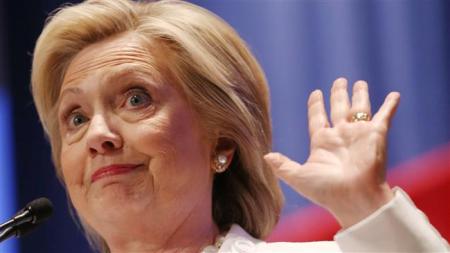
New York Times columnist Nicholas Kristof has offered a curious defense of Hillary Clinton’s “honesty,” refuting the public’s widespread view that she is a liar by narrowly defining what it means to be “honest” and arguing that she is less dishonest than she is a calculating and corner-cutting politician.
Kristof writes, “as we head toward the general election showdown, by all means denounce Hillary Clinton’s judgment and policy positions, but let’s focus on the real issues. She’s not a saint but a politician, and to me this notion that she’s fundamentally dishonest is a bogus narrative.”
Kristof cites, for instance, that half of her campaign statements, as evaluated by PolitiFact, were rated either true or mostly true, comparable to how the group assessed statements by Sen. Bernie Sanders and Sen. Ted Cruz and much better than Donald Trump’s 22 percent. Leaving aside the “conventional wisdom” bias of this mainstream media organization, Kristof does seem to have a point. In a narrow definition of “honesty,” former Secretary of State Clinton may be “truthful” or kind of truthful half the time.
But Kristof misses the larger point that the American people are making when 56 percent of them rate her negatively and many call “crooked” and “dishonest.” They seem to be commenting on her lack of authenticity and perhaps her resistance to sincerely acknowledging major errors in judgment. She only grudgingly apologized for her pro-Iraq War vote and still insists that her bloody “regime change” scheme for Libya was a good idea, even as the once-prosperous North African nation slides into anarchy and deprivation – with the chief beneficiary the head-choppers of the Islamic State.
A Nixonian Quality
Many Americans sense that there is a Nixonian quality to Hillary Clinton – her excessive secrecy, her defensiveness, her rigidity, her unwillingness to acknowledge or learn from mistakes. Even when she is forced into admitting a “mistake,” such as her violation of State Department rules when she maintained a private email server for official correspondence, she acts as if she’s just “apologizing” to close off further debate or examination. As with Richard Nixon, there’s a feeling that Clinton’s apologies and rationales are self-serving, not forthcoming.
Yet, while it’s true that Nixon was a deceitful character – his most famous lie being when he declared “I am not a crook” – I would argue that he had some clear advantages over Clinton as President. He was a much more strategic thinker than she is – and sometimes went against the grain of expectations as encapsulated in the phrase “Nixon goes to China,” meaning that Nixon could open up to communist China precisely because he was viewed as such a hardliner who would never do such a thing but who finally judged that the move was in America’s interests.
While it’s impossible to say whether Clinton would seize unexpected openings as President, she showed none of that creativity, subtlety and courage as Secretary of State. She marched down a straightforward neocon line, doing precisely what Israel’s Prime Minister Benjamin Netanyahu wanted in the Middle East.
Clinton tried to sabotage President Barack Obama’s diplomatic outreach to Iran and favored military solutions to Afghanistan, Libya and Syria. She also followed a rightist approach in backing the 2009 coup in Honduras that ousted an elected progressive president who had offended some of the Honduran oligarchs and outside corporate interests.
Lack of Self-Criticism
In addition, Clinton appears to have learned nothing from her support for the catastrophic Iraq War and has argued against “conflating” her Iraq decision with her Libya decision. But that suggests that she is incapable of learning a lesson from one mistake and applying it to a similar situation, an almost disqualifying characteristic for someone who hopes to become President.
Being a successful President requires extracting painful lessons from one mistake and making sure you don’t make the same mistake again. But Clinton’s personal arrogance or defensiveness (it’s hard to figure out which is dominant) prevents her from that sort of self-criticism.
Indeed, her ritualistic (and politically timed) apology for her Iraq War vote in 2006 came across less than an honest recognition that she had done something horribly wrong than that she had to say something to appease a furious Democratic electorate as she mounted her first run for President against anti-Iraq War candidate Obama.
After losing to Obama and becoming his Secretary of State, she privately hedged her Iraq War apology by saying privately that she thought that President George W. Bush’s “surge” in Iraq was successful and admitting that she had only opposed it in 2007 for political reasons, according to former Defense Secretary Robert Gates in his memoir, Duty.
On Oct. 26, 2009, as Gates — a holdover from the Bush administration — and Clinton joined forces to pressure Obama into approving a similar “surge” for Afghanistan, Gates recalled a meeting in which Clinton made what he regarded as a stunning admission, writing:
“The exchange that followed was remarkable. In strongly supporting the surge in Afghanistan, Hillary told the president that her opposition to the surge in Iraq had been political because she was facing him in the Iowa primary [in 2008]. She went on to say, ‘The Iraq surge worked.’
“The president conceded vaguely that opposition to the Iraq surge had been political. To hear the two of them making these admissions, and in front of me, was as surprising as it was dismaying.” (Obama’s aides disputed Gates’s suggestion that the President indicated that his opposition to the Iraq “surge” was political, noting that he had always opposed the Iraq War. The Clinton team has not challenged Gates’s account.)
But the exchange, as recounted by Gates, indicates that Clinton not only let her political needs dictate her position on an important national security issue, but that she accepts as true the superficial conventional wisdom about the “successful surge” in Iraq, which claimed the lives of about 1,000 American soldiers and a much larger number of Iraqis but failed its principal mission of buying time for the Iraqis to resolve their sectarian differences.
So, when one considers Hillary Clinton’s “honesty” more should be in play than simply whether she accurately describes her policy positions half the time. Honesty, as most people would perceive it, relates to a person’s fundamental integrity, strength of character, readiness to acknowledge mistakes and ability to learn from them. On that measure, the American people seem to have sized up Hillary Clinton pretty well.
[For more on this topic, see Consortiumnews.com’s “Yes, Hillary Clinton Is a Neocon.“]
Investigative reporter Robert Parry broke many of the Iran-Contra stories for The Associated Press and Newsweek in the 1980s. You can buy his latest book, America’s Stolen Narrative, either in print here or as an e-book (from Amazon and barnesandnoble.com).
US Supreme Court upholds ruling to seize Iranian assets
Press TV – April 20, 2016
The US Supreme Court has upheld Congress and President Barack Obama’s actions to hold Iran financially responsible for the 1983 bombing that killed 241 Marines at their barracks in the Lebanese capital city of Beirut.
The 6-2 ruling on Wednesday allowed the families of the Marines and victims of other attacks that courts have linked to Iran to seize some $2 billion in assets held in New York’s Citibank, belonging to Bank Markazi, the Central Bank of Iran (CBI), which has been blocked under US sanctions.
The Supreme Court determined that a law passed by Congress did not dictate to the courts how to handle the dispute despite appeals by the CBI.
In 2012, Congress passed a law that specifically directed the American bank to turn over the Iranian assets to victims’ families. Obama also entered the battle in an effort to force the payments on Iran.
Iran, however, argued that Obama and Congress were intruding into the business of federal courts, a practice banned by the US Constitution.
“The US judicial apparatus, with the support of the country’s administration and Congress, has been issuing and enacting rulings against the Islamic Republic of Iran for years, violating basic principles of international law with recourse to unsubstantiated and baseless allegations,” Iranian Foreign Ministry Spokesman Hossein Jaberi Ansari said in December last year.
Associate Justice of the US Supreme Court Ruth Bader Ginsburg rejected the view on Wednesday, saying the legislation “does not transgress restraints placed on Congress and the president by the Constitution.”
Chief Justice John Roberts and Justice Sonia Sotomayor dissented, with Roberts stating that “the authority of the political branches is sufficient; they have no need to seize ours.”
The case involves over 1,300 plaintiffs, who have demanded compensation over several attacks, namely the Beirut bombing, and the 1996 Khobar Towers bombing in Saudi Arabia.
What’s Israel’s Role in the Nagorno-Karabakh Conflict?
Sputnik – April 17, 2016
With the decades-long Azeri-Armenian conflict over the disputed Nagorno-Karabakh region burning out of control for four intense, blood-soaked days at the beginning of this month, questions have emerged over the secretive role played by Israel in the conflict.
Late last week, commenting on the recent escalation of the conflict between Armenia and Azerbaijan over the disputed region of Nagorno-Karabakh, former Israeli foreign minister Avigdor Lieberman blamed Armenia for provoking four days of clashes which left over a hundred dead and dozens wounded.
Azerbaijan, Lieberman said, had “no reasons for escalating the conflict,” despite extensive reports confirming that Azerbaijan was the party that launched offensive operations to regain control of territory in the Armenia-backed Nagorno-Karabakh Republic.
For its part, the Azeri Defense Ministry called the operation, which resulted in the taking of several strategic heights and settlements, a successful ‘counteroffensive’ launched in response to Armenian shelling.
Lieberman’s words would be echoed by retired Israel Defense Forces general Ephraim Sneh, who emphasized in a Friday op-ed for Al-Monitor that Azerbaijan is Israel’s “strategic ally,” and that at the moment, Baku “needs all the diplomatic help [Israel] can muster.”
Sneh slammed Tel Aviv for “staying silent” in Baku’s hour of need, explaining that Azerbaijan is one of Israel’s only friends in the Islamic world, and adding that Israel needs Azerbaijan to ensure its energy security, with Baku providing the Jewish State with some 40% of its oil.
Russia’s mediation of the conflict, Sneh suggested, has been disastrous for Baku, with the “status quo” that emerged in 1994 following the six-year war which began in the late 1980s “convenient for everyone, except for Azerbaijan.”
Blaming Armenia for violations of the ceasefire (and absolving the Azeris of their own violations), Sneh candidly admitted that Baku started the latest bloodshed, and suggested that Azerbaijan’s challenging of the status quo may actually work in its favor.
Saying that the current Moscow-brokered ceasefire, is “tenuous at best and not expected to last long,” the general says that he is hopeful that “now that Azerbaijan has proved its military superiority, there is a chance for real diplomatic negotiations that could lead to an agreement between the two countries,” i.e. for the ethnically Armenian Nagorno-Karabakh Republic to give its territory. In this sense, Sneh says, the Azeris could take a lesson from Tel Aviv and negotiate according to a formula of “land for peace,” which Israel used in the late 1970s in negotiations with Egypt to return the Sinai Peninsula.
This time, Sneh argues, the Azeris should do the same, but in reverse, promising Armenia peace in exchange for Nagorno-Karabakh. “Armenia’s weak economy could stand to benefit from such an agreement.” Moreover, “improved economic relations with Turkey are just one important economic benefit that Armenia can be assured of as soon as it withdraws from the occupied Azeri territories.””Meanwhile, Azerbaijan needs much more robust diplomatic support than it is receiving today.” Unfortunately, Sneh complains, Baku hasn’t been getting it from Israel.
But just how silent has Tel Aviv actually been?
To begin with, hints of the extensive military cooperation between the two countries emerged in the first days of the conflict, indicating that Israeli ‘suicide drones’ were being used by Azeri forces in the course of their offensive. The Harop unmanned aerial vehicle, which acts as a ‘kamikaze’ capable of destroying targets by ramming into them, is produced by Israeli Aerospace Industries (IAI).
According to French intelligence newsletter Intelligence Online, in addition to drones, Israel also provides Baku with advanced radar systems, control and command posts, and other intelligence-collection equipment, and has even entered a bid to provide Baku with a $150 million observation satellite.
Israel has refused to confirm or deny its sale of drones, or other weaponry, to Azerbaijan. However, Meretz party chairwoman Zehava Galon came out publicly warning that Israel intends to send more drones to Baku. In a letter addressed to Defense Minister Moshe Ya’alon, Galon urged that the Israeli government should stop weapons deliveries to the Azeris until it could be assured that Baku would halt the fighting in Nagorno-Karabakh.
At the same time, Israeli security and intelligence specialist Yossi Melman says that Israel has a massive, but highly secretive, defense footprint in Azerbaijan.
In his analysis for The Jerusalem Post, Melman explained that Israel and Azerbaijan enjoy annual trade which is “$5 billion larger than between Israel and France.” Moreover, he said, “most of the content remains confidential, and consists of Azeri oil sold to Israel and Israeli weapons and intelligence technologies purchased by Azerbaijan.”
From modest beginnings in the early 1990s, Azerbaijan has grown to become “the second-biggest market in Asia, after India, for Israeli weapons,” with Israeli defense companies enjoying literally billions of dollars in sales in the Caucasian state. At the same time, Melman indicates, “the best promoters of the military sales and ties are Israeli ministers and officials who visit the Caucasian nation.”
“This week,” the analyst recalls, “The Washington Post enabled the world to have a peeping window into the secret relations [between the two countries] when it published a photo of an Israeli-made ‘suicidal drone’ exploding itself on a bus leading Armenian combatants to the front lines. Seven people were killed, and the Armenian government protested to Israel.”
“A few days after the incident, military journalists visited Israeli Aerospace Industries facilities and were briefed on the various products, from drones to satellites, which the company has to offer. An IAI spokeswoman was asked if the company was behind the Washington Post revelation. She refused to answer but openly smiled when one reporter commented that such a photo is good for business and promotes sales of products that can be labeled ‘battle proven’.”
In addition to military ties, Melman notes that the two countries also have strong intelligence ties, with Mossad given permission to set up a large station in Azerbaijan, taking advantage of the region’s geography to run operations throughout the North Caucasus.
Both Russian and Iranian officials have previously accused Azerbaijan of allowing Mossad to use their territory for espionage activities, the latter indicating that the Israeli missions included everything from “recruiting and planting agents,” to “communication interception and aerial reconnaissance,” Melman explained. Moreover, he added, “more than a year ago Iran claimed to have shot down an Israeli-made drone,” claims which Israeli officials have refused to comment on.
Pointing to the secretive nature of political, defense and intelligence cooperation between the two countries, the analyst noted that “it was [Azeri President Ilham] Alieyev himself who was quoted in a WikiLeaks cable sent from the US Embassy in Baku [saying] that ‘bilateral relations between Azerbaijan and Israel are like an iceberg. Nine-tenths are below the surface.'”
Ultimately, Melmen notes, “seemingly, Israel and Azerbaijan are an odd couple, not meant to be with each other,” with the Caucasian nation not really serving as a model of Western democracy, being run by the same family since 1991, and facing issues including corruption and the suppression of free media. “On the other hand, Israel is not too selective in choosing friends when it comes to weapons sales and national interests. A quick look at the map,” showing that Azerbaijan borders Iran, Israel’s sworn enemy, “can explain Israeli priorities.”
Read more:
Nagorno-Karabakh Crisis Could Get Messy If New Arms Suppliers Emerge
Turkey Claims Azerbaijan ‘Patient’ Over Nagorno-Karabakh Conflict
Armenia Rejects Israeli Proposal on Arms Purchase – Defense Minister
Yes, Hillary Clinton Is a Neocon
By Robert Parry | Consortium News | April 16, 2016
If there were any doubts that Hillary Clinton favors a neoconservative foreign policy, her performance at Thursday’s debate should have laid them to rest. In every meaningful sense, she is a neocon and – if she becomes President – Americans should expect more global tensions and conflicts in pursuit of the neocons’ signature goal of “regime change” in countries that get in their way.
Beyond sharing this neocon “regime change” obsession, former Secretary of State Clinton also talks like a neocon. One of their trademark skills is to use propaganda or “perception management” to demonize their targets and to romanticize their allies, what is called “gluing white hats” on their side and “gluing black hats” on the other.
So, in defending her role in the Libyan “regime change,” Clinton called the slain Libyan leader Muammar Gaddafi “genocidal” though that is a gross exaggeration of Gaddafi’s efforts to beat back Islamic militants in 2011. But her approach fits with what the neocons do. They realize that almost no one will dare challenge such a characterization because to do so opens you to accusations of being a “Gaddafi apologist.”
Similarly, before the Iraq War, the neocons knew that they could level pretty much any charge against Saddam Hussein no matter how false or absurd, knowing that it would go uncontested in mainstream political and media circles. No one wanted to be a “Saddam apologist.”
Clinton, like the neocons, also shows selective humanitarian outrage. For instance, she laments the suffering of Israelis under crude (almost never lethal) rocket fire from Gaza but shows next to no sympathy for Palestinians being slaughtered by sophisticated (highly lethal) Israeli missiles and bombs.
She talks about the need for “safe zones” or “no-fly zones” for Syrians opposed to another demonized enemy, Syria’s President Bashar al-Assad, but not for the people of Gaza who face the wrath of Israeli Prime Minister Benjamin Netanyahu.
“Yes, I do still support a no-fly zone [in Syria] because I think we need to put in safe havens for those poor Syrians who are fleeing both Assad and ISIS and have some place that they can be safe,” Clinton said. But she showed no such empathy for Palestinians defenseless against Israel’s “mowing the grass” operations against men, women and children trapped in Gaza.
In Clinton’s (and the neocons’) worldview, the Israelis are the aggrieved victims and the Palestinians the heartless aggressors. Referring to the Gaza rocket fire, she said: “I can tell you right now I have been there with Israeli officials going back more than 25 years that they do not seek this kind of attacks. They do not invite the rockets raining down on their towns and villages. They do not believe that there should be a constant incitement by Hamas aided and abetted by Iran against Israel. …
“So, I don’t know how you run a country when you are under constant threat, terrorist attack, rockets coming at you. You have a right to defend yourself.”
Ignoring History
Clinton ignored the history of the Israeli-Palestinian conflict, which dates back to the 1940s when Israeli terrorist organizations engaged in massacres to drive Palestinians from their ancestral lands and murdered British officials who were responsible for governing the territory. Israeli encroachment on Palestinian lands has continued to the present day.
But Clinton framed the conflict entirely along the propaganda lines of the Israeli government: “Remember, Israel left Gaza. They took out all the Israelis. They turned the keys over to the Palestinian people. And what happened? Hamas took over Gaza. So instead of having a thriving economy with the kind of opportunities that the children of the Palestinians deserve, we have a terrorist haven that is getting more and more rockets shipped in from Iran and elsewhere.”
So, Clinton made clear – both at the debate and in her recent AIPAC speech – that she is fully in line with the neocon reverence for Israel and eager to take out any government or group that Israel puts on its enemies list. While waxing rhapsodic about the U.S.-Israeli relationship – promising to take it “to the next level” – Clinton vows to challenge Syria, Iran, Russia and other countries that have resisted or obstructed the neocon/Israeli “wish list” for “regime change.”
In response to Clinton’s Israel-pandering, Sen. Bernie Sanders, who once worked on an Israeli kibbutz as a young man, did the unthinkable in American politics. He called out Clinton for her double standards on Israel-Palestine and suggested that Netanyahu may not be the greatest man on earth.
“You gave a major speech to AIPAC,” Sanders said, “and you barely mentioned the Palestinians. … All that I am saying is we cannot continue to be one-sided. There are two sides to the issue. … There comes a time when if we pursue justice and peace, we are going to have to say that Netanyahu is not right all of the time.”
But in Hillary Clinton’s mind, the Israeli-Palestinian dispute is essentially one-sided. During her speech to the American Israel Public Affairs Committee last month, she depicted Israel as entirely an innocent victim in the Mideast conflicts.
“As we gather here, three evolving threats — Iran’s continued aggression, a rising tide of extremism across a wide arc of instability, and the growing effort to de-legitimize Israel on the world stage — are converging to make the U.S.-Israel alliance more indispensable than ever,” she declared.
“The United States and Israel must be closer than ever, stronger than ever and more determined than ever to prevail against our common adversaries and to advance our shared values. … This is especially true at a time when Israel faces brutal terrorist stabbings, shootings and vehicle attacks at home. Parents worry about letting their children walk down the street. Families live in fear.”
Yet, Clinton made no reference to Palestinian parents who worry about their children walking down the street or playing on a beach and facing the possibility of sudden death from an Israeli drone or warplane. Instead, she scolded Palestinian adults. “Palestinian leaders need to stop inciting violence, stop celebrating terrorists as martyrs and stop paying rewards to their families,” she said.
Then, Clinton promised to put her future administration at the service of the Israeli government. Clinton said, “One of the first things I’ll do in office is invite the Israeli prime minister to visit the White House. And I will send a delegation from the Pentagon and the Joint Chiefs to Israel for early consultations. Let’s also expand our collaboration beyond security.”
Pleasing Phrases
In selling her neocon policies to the American public, Clinton puts the military aspects in pleasing phrases, like “safe zones” and “no-fly zones.” Yet, what she means by that is that as President she will invade Syria and push “regime change,” following much the same course that she used to persuade a reluctant President Obama to invade Libya in 2011.
The Libyan operation was sold as a “humanitarian” mission to protect innocent civilians though Gaddafi was targeting Islamic militants much as he claimed at the time and was not engaging in any mass slaughter of civilians. Clinton also knew that the European allies, such as France, had less than noble motives in wanting to take out Gaddafi.
As Clinton confidant Sidney Blumenthal explained to her, the French were concerned that Gaddafi was working to develop a pan-African currency which would have given Francophone African countries greater freedom from their former colonial master and would undermine French economic dominance of those ex-colonies.
In an April 2, 2011 email, Blumenthal informed Clinton that sources close to one of Gaddafi sons reported that Gaddafi’s government had accumulated 143 tons of gold and a similar amount of silver that “was intended to be used to establish a pan-African currency” that would be an alternative to the French franc.
Blumenthal added that “this was one of the factors that influenced President Nicolas Sarkozy’s decision to commit France to the attack on Libya.” Sarkozy also wanted a greater share of Libya’s oil production and to increase French influence in North Africa, Blumenthal wrote.
But few Americans would rally to a war fought to keep North Africa under France’s thumb. So, the winning approach was to demonize Gaddafi with salacious rumors about him giving Viagra to his troops so they could rape more, a ludicrous allegation that was raised by then-U.S. Ambassador to the United Nations Susan Rice, who also claimed that Gaddafi’s snipers were intentionally shooting children.
With Americans fed a steady diet of such crude propaganda, there was little serious debate about the wisdom of Clinton’s Libyan “regime change.” Meanwhile, other emails show that Clinton’s advisers were contemplating how to exploit Gaddafi’s overthrow as the dramatic moment to declare a “Clinton Doctrine” built on using “smart power.”
On Oct. 20, 2011, when U.S.-backed rebels captured Gaddafi, sodomized him with a knife and then murdered him, Secretary of State Clinton couldn’t contain her glee. Paraphrasing a famous Julius Caesar quote, she declared about Gaddafi, “we came, we saw, he died.”
But this U.S.-organized “regime change” quickly turned sour as old tribal rivalries, which Gaddafi had contained, were unleashed. Plus, it turned out that Gaddafi’s warnings that many of the rebels were Islamic militants turned out to be true. On Sept. 11, 2012, one extremist militia overran the U.S. consulate in Benghazi killing U.S. Ambassador Christopher Stevens and three other Americans.
Soon, Libya slid into anarchy and Western nations abandoned their embassies in Tripoli. President Obama now terms the Libyan fiasco the biggest mistake of his presidency. But Clinton refuses to be chastened by the debacle, much as she appeared to learn nothing from her support for the Iraq invasion in 2003.
The Libyan Mirage
During Thursday’s debate – instead of joining Obama in recognition of the Libyan failure – Clinton acted as if she had overseen some glowing success: “Well, let me say I think we did a great deal to help the Libyan people after Gaddafi’s demise. … We helped them hold two successful elections, something that is not easy, which they did very well because they had a pent-up desire to try to chart their own future after 42 years of dictatorship. I was very proud of that. …
“We also worked to help them set up their government. We sent a lot of American experts there. We offered to help them secure their borders, to train a new military. They, at the end, when it came to security issues, … did not want troops from any other country, not just us, European or other countries, in Libya.
“And so we were caught in a very difficult position. They could not provide security on their own, which we could see and we told them that, but they didn’t want to have others helping to provide that security. And the result has been a clash between different parts of the country, terrorists taking up some locations in the country.”
But that is exactly the point. Like the earlier neocon-driven “regime change” in Iraq, the “regime change” obsession blinds the neocons from recognizing that not only are these operations violations of basic international law regarding sovereignty of other nations but the invasions unleash powerful internal rivalries that neocons, who know little about the inner workings of these countries, soon find they can’t control.
Yet, America’s neocons are so arrogant and so influential that they simply move from one catastrophe to the next like a swarm of locust spreading chaos and death around the globe. They also adapt readily to changes in the political climate.
That’s why some savvy neocons, such as the Brookings Institution’s Robert Kagan, have endorsed Clinton, who The New York Times reported has become “the vessel into which many interventionists are pouring their hopes.”
Kagan told the Times, “I feel comfortable with her on foreign policy. If she pursues a policy which we think she will pursue it’s something that might have been called neocon, but clearly her supporters are not going to call it that; they are going to call it something else.”
Now with Clinton’s election seemingly within reach, the neocons are even more excited about how they can get back to work achieving Syrian “regime change,” overturning Obama’s nuclear deal with Iran, and – what is becoming their ultimate goal – destabilizing nuclear-armed Russia and seeking “regime change” in Moscow.
After all, by helping Assad bring some stability to Syria and assisting Obama in securing the Iranian nuclear deal, Russian President Vladimir Putin has become what the neocons view as the linchpin of resistance to their “regime change” goals. Pull Putin down, the thinking goes, and the neocons can resume checking off their to-do list of Israel’s adversaries: Syria, Iran, Hezbollah, Hamas, etc.
And what could possibly go wrong by destabilizing nuclear-armed Russia and forcing some disruptive “regime change”?
By making Russia’s economy scream and instigating a Maidan-style revolt in Moscow’s Red Square, the neocons see their geopolitical path being cleared, but what they don’t take into account is that the likely successor to Putin would not be some malleable drunk like the late Russian President Boris Yeltsin but, far more likely, a hardline nationalist who might be a lot more careless with the nuclear codes than Putin.
But, hey, when has a neocon “regime change” scheme veered off into a dangerous and unanticipated direction?
A Neocon True-Believer
In Thursday’s debate, Hillary Clinton showed how much she has become a neocon true-believer. Despite the catastrophic “regime changes” in Iraq and Libya, she vowed to invade Syria, although she dresses up that reality in pretty phrases like “safe zones” and “no-fly zones.” She also revived the idea of increasing the flow of weapons to “moderate” rebels although they, in reality, mostly fight under the command umbrella of Al Qaeda’s Nusra Front.
Clinton also suggested that the Syria mess can be blamed on President Obama’s rejection of her recommendations in 2011 to authorize a more direct U.S. military intervention. “Nobody stood up to Assad and removed him,” Clinton said, “and we have had a far greater disaster in Syria than we are currently dealing with right now in Libya.”
In other words, Clinton still harbors the “regime change” goal in Syria. But the problem always was that the anti-Assad forces were penetrated by Al Qaeda and what is now called the Islamic State. The more likely result from Clinton’s goal of removing Assad would be the collapse of the Syrian security forces and a victory for Al Qaeda’s Nusra Front and/or the Islamic State.
If that were to happen, the horrific situation in Syria would become cataclysmic. Millions of Syrians – Alawites, Shiites, Christians, secularists and other “infidels” – would have to flee the beheading swords of these terror groups. That might well force a full-scale U.S. and European invasion of Syria with the bloody outcome probably similar to the disastrous Iraq War.
The only reasonable hope for Syria is for the Assad regime and the less radical Sunni oppositionists to work out some power-sharing agreement, stabilize most of the country, neutralize to some degree the jihadists, and then hold elections, letting the Syrian people decide whether “Assad must go!” – not the U.S. government. But that’s not what Clinton wants.
Perhaps even more dangerous, Clinton’s bellicose rhetoric suggests that she would eagerly move into a dangerous Cold War confrontation with Russia under the upside-down propaganda theme blaming tensions in Eastern Europe on “Russian aggression,” not NATO’s expansion up to Russia’s borders and the U.S.-backed coup in Ukraine in 2014 which ousted an elected president and touched off a civil war.
That coup, which followed neocon fury at Putin for his helping Obama avert U.S. bombing campaigns against Syria and Iran, was largely orchestrated by neocons associated with the U.S. government, including Assistant Secretary of State for European Affairs Victoria Nuland (Robert Kagan’s wife), Sen. John McCain and National Endowment for Democracy President Carl Gershman.
After the violent coup, when the people of Crimea voted by 96 percent to secede from Ukraine and rejoin Russia, the U.S. government and Western media deemed that a “Russian invasion” and when ethnic Russians in eastern Ukraine rose up in resistance to the new authorities in Kiev that became “Russian aggression.”
NATO on the Move
Though President Obama should know better – and I’m told that he does know better – he has succumbed this time to pressure to go along with what he calls the Washington “playbook” of saber-rattling and militarism. NATO is moving more and more combat troops up to the Russian border while Washington has organized punishing economic sanctions aimed at disrupting the Russian economy.
Hillary Clinton appears fully onboard with the neocon goal of grabbing the Big Enchilada, “regime change” in Moscow. Rather than seeing the world as it is, she continues to look through the wrong end of the telescope in line with all the anti-Russian propaganda and the demonization of Putin, whom Clinton has compared to Hitler.
Supporting NATO’s military buildup on Russia’s border, Clinton said, “With Russia being more aggressive, making all kinds of intimidating moves toward the Baltic countries, we’ve seen what they’ve done in eastern Ukraine, we know how they want to rewrite the map of Europe, it is not in our interests [to reduce U.S. support for NATO]. Think of how much it would cost if Russia’s aggression were not deterred because NATO was there on the front lines making it clear they could not move forward.”
Though Clinton’s anti-Russian delusions are shared by many powerful people in Official Washington, they are no more accurate than the other claims about Iraq’s WMD, Gaddafi passing out Viagra to his troops, the humanitarian need to invade Syria, the craziness about Iran being the principal source of terrorism (when it is the Saudis, the Qataris, the Turks and other Sunni powers that have bred Al Qaeda and the Islamic State), and the notion that the Palestinians are the ones picking on the Israelis, not the other way around.
However, Clinton’s buying into the neocon propaganda about Russia may be the most dangerous – arguably existential – threat that a Clinton presidency would present to the world. Yes, she may launch U.S. military strikes against the Syrian government (which could open the gates of Damascus to Al Qaeda and the Islamic State); yes, she might push Iran into renouncing the nuclear agreement (and putting the Israeli/neocon goal to bomb-bomb-bomb-Iran back on the table); yes, she might make Obama’s progressive critics long for his more temperate presidency.
But Clinton’s potential escalation of the new Cold War with Russia could be both the most costly and conceivably the most suicidal feature of a Clinton-45 presidency. Unlike her times as Secretary of State, when Obama could block her militaristic schemes, there will be no one to stop her if she is elected President, surrounded by likeminded neocon advisers.
Investigative reporter Robert Parry broke many of the Iran-Contra stories for The Associated Press and Newsweek in the 1980s. You can buy his latest book, America’s Stolen Narrative, either in print here or as an e-book (from Amazon and barnesandnoble.com).
Iran Accuses US of Violating Nuclear Deal
By Stephen Lendman | April 16, 2016
America’s history shows trustworthiness isn’t its long suit, treaties and other deals agreed to systematically violated – culpability ignored or counterparties wrongfully blamed for its breaches.
After last year’s nuclear deal was consummated, Obama lied, saying “(h)istory shows that America must lead not just with our might, but with our principles. It shows we are stronger not when we are alone, but when we bring the world together.”
According to a complaint filed last August with the IAEA, Iran said Washington breached nuclear deal principles straightaway – three days after the deal was reached.
At the time, White House press secretary Josh Earnest said “(t)he military option… remain(s) on the table…enhanced because we’ve been spending (past) years gathering significantly more (intelligence) about Iran’s nuclear program.”
Tehran said this threat to use military force preemptively without just cause constitutes a “material breach of the commitments just undertaken.”
The agreement was never meant to be a vehicle to facilitate US spying on the Islamic Republic.
Iran “(r)ecall(ed) past instances, in which highly confidential information provided by the Islamic Republic of Iran to the Agency inspectors had been leaked, posing a grave threat to the national security of Iran… it is absolutely essential and imperative for the Agency to take immediate and urgent action to reject such flagrant abuses,” a statement said.
Washington used the nuclear deal to justify expanding its regional military footprint, increase aid to Israel and sell billions of dollars more weapons to Saudi Arabia and other Gulf states.
On Friday, Iranian central bank head Valiollah Seif accused US-led Western countries of locking Tehran out of the international financial system, another flagrant deal breach with likely more coming.
According to Seif, Western nuclear deal counterparties have done “almost nothing” to live up to provisions agreed on.
“(W)e are not able to use our frozen funds abroad.” Unless resolved, the deal “breaks up on its own terms,” he said without further elaboration.
White House press secretary Josh Earnest lied, claiming “(t)he United States, along with the rest of the international community, is committed to living up to our end of the bargain” – at the same time saying Washington has no intention of giving Tehran access to America’s financial system.
State Department spokesman admiral John Kirby compounded the Big Lie, claiming Washington fulfilled its part of the deal.
“There is no need to do more when we have met all of our commitments,” he disingenuously claimed.
It’s well known Iran’s nuclear program is peaceful with no military component and no known intention to have one.
Washington’s concerns otherwise were and remain red herring cover for its real aim – regime change, replacing Iran’s sovereign independence with puppet governance it controls.
Longstanding US hostility persists. Normalization remains unattainable as long as neocons infesting Washington, Israel and AIPAC reject it.
Stephen Lendman can be reached at lendmanstephen@sbcglobal.net.
His new book as editor and contributor is titled Flashpoint in Ukraine: US Drive for Hegemony Risks WW III.
Featured Video

AIDS Inc. by Gary Null (2007)
or go to
Aletho News Archives – Video-Images
From the Archives
Clash of Civilization, Iran Part II
By Jamal Kanj – Intifada-Palestine.com – January 14, 2011
Israel’s survival kit is: perpetuate conflict, insecurity to rationalize collective hate and finally playing victim.
Devoid of conflict, Israel implodes internally; without hate, Zionism loses its justification; and playing eternal victim to continue blackmailing the West. Absence of this holy trinity, Israel ceases to exist.
From its inception, the house of Zion has mastered exploiting adversarial powers to advance Israel’s cause. For instance, their influence over the Democratic Party in the US began with President Truman’s bid for 2nd term election in 1948.
Responding to strong opposition from Secretary of State General George Marshall and Department experts urging against recognition of Israel, President Truman replied: “I’m sorry gentlemen but I have to answer to hundreds of thousands [Jewish voters] who are anxious for the success of Zionism. I do not have hundreds of thousands of [voting] Arabs among my constituents”
Zionists influence over liberal American politics was matched with the doctrinal school of Conservative theoreticians aligning the Republican Party’s platform with Israel’s objectives. The Neoconservative Zionists, coined Zioncons, invented the “Clash of Civilization” concept to fight Israel’s wars. … continue
Blog Roll
 Aletho News
- 12 Things Your Psychiatrist Was Trained Not to Tell You
- From Unipolar Universalism to Multipolar Civilizational Distinctiveness
- RSF military group defects, joins Sudanese army: State media
- Ireland goalkeeper refuses to play ‘Israel’ as squad weighs boycott
- China pushes back against US on Cuba, Iran
- Ukrainian Soldiers, Potential Mercenaries: Have Gun, Will Travel!
- Burnham’s UN debut… A masterclass in British disinformation
- Iran flights continue despite US aviation sanctions
- Global Tipping Points Lead the World Into a State of Entropy
- The day-after at the White House: USA and Xi Jinping
- If Americans Knew
- Israel forces Gazans to live in constant peril – Daily Update
- Deconstructing Netanyahu’s pants-on-fire UN rant – Daily Update
- Trump betrayed voters with his campaign lies and prioritized a foreign country once he took office
- Netanyahu calls Israel’s war in Gaza ‘opposite of genocide’ in UN speech to near-empty hall
- Settler Kidnappings: Torture, Sexual Abuse and Terrorisation of Palestinian Abductees as Israel Deepens Annexation of West Bank
- Gaza winter nears as 162,000 tents become unusable, raising fears of humanitarian crisis
- Netanyahu says, “It’s the opposite of genocide”; UN says Gaza economy is world’s ‘most severe crisis on record’ – Daily Update
- Israel’s US-Backed Assault on Gaza Has Created the ‘World’s Most Severe Economic Crisis on Record’: UN
- ‘Protecting U.S. Citizens’… From Israel
- ‘This is where I live now, the back of a truck’: a day in the life of a grandmother in Gaza
- No Tricks Zone
- New Study: Earth And Venus Surface Warmth Largely Explained By Convection And Lapse Rate, Not CO2 Or Radiation
- 2025 Nature Paper Claiming Worsening Global Drought Gets RETRACTED …Heavily Flawed
- New Study: ‘Global Drought Shows No Detectable Recent Acceleration Under Climate Warming’
- Economic Masterminds: German Socialists Suggest Taxing Productivity Gains Stemming From Using AI
- The South China Sea Has Not Been Cooperating With The Climate Change Narrative
- Energy Crisis: Germany Enters Heating Season With Historically Low Gas Reserve Fill Levels
- New Study: The Antarctic Ice Sheet Gained Mass From 2020-2024 Due To Staggering Snow And Ice Accumulation
- Study: Ocean Heating Rates From Thousands Of Years Ago ‘Dwarf’ Modern Ocean Heating Rates
- Climate Extremists Target, Attack Large-Scale Power Grid Infrastructure In Germany!
- New Study: Antarctic Ice Melt Has Contributed Less Than 1 Centimeter To Sea Level Rise In The Last 30 Years

