It’s clear that Israel’s strategy is to use the Syrian Civil War to deliberately provoke Hezbollah. The provocation is designed to goad Hezbollah into retaliation for over-flying Lebanon while on their way to apparently destroy weapons that the Israelis say are bound for Hezbollah.
The strategy has worked before. In 2006 the Israelis flew low level high speed jet sorties over Lebanon. Hezbollah responded by launching rockets into Israel. The situation then quickly escalated when the Israelis prepared reconnaissance patrols into south Lebanon. This resulted in an Israeli patrol unit being attacked close to the Lebanese border when three Israelis were killed and two others taken either dead or mortally wounded. The result was a war that the Israelis hoped would put an end to Hezbollah once and for all. However, Hezbollah turned out to be far more tenacious than the Israelis imagined and the war ended when the US under Bush and Condoleezza Rice were no longer able to support Israeli aggression due to international pressure to stop the war as hundreds of Lebanese civilians were being killed. 44 Israeli civilians were killed and 121 Israeli military personnel died. While many Lebanese civilians lost their lives and there was horrendous damage done to Lebanon’s infrastructure, Israel, considering its war aims were to destroy Hezbollah and occupy south Lebanon up to the Litani River, suffered a humiliating defeat. Now the Israelis are trying a different tack except this time their war aims are far grander and they hope to include the US.
The Israelis are clearly hoping that Hezbollah will retaliate in some way to Israeli provocation. So far, Hezbollah have resisted the temptation to launch any anti-aircraft missiles at Israeli aircraft overflying Lebanon and/or launch rockets against Israel in an attempt to deter Israel from further aggression.
As for Israel’s claims that their raids against weapons dumps in Syria are aimed at preventing weapons from reaching Hezbollah, this too is simply part of an overall strategy designed to demonise the Iran-Syria-Hezbollah alliance for propaganda purposes for when a wider regional war breaks out. It also provides a reasonable casus belli for when such a full on regional war does break out. The fact is, there would be no way that President al-Assad would want to provoke Israel by allowing any WMDs to be transferred to Hezbollah and Israel knows this. There is also no way that al-Assad would want to incur America’s wrath by using chemical weapons against anyone. Again, the Israelis know this. Yet it is the Israelis that are pushing this right to the very edge.
Israel is desperate to initiate a regional confrontation with all of their enemies that will allow them to pursue their territorial expansionist ambitions which will result in the long term in realising their dreams of a Greater Israel. There are a number of doors through which Israel can pass through in order to kick off their long sought after war. The civil war in Syria is just another door.
May 5, 2013
Posted by aletho |
Ethnic Cleansing, Racism, Zionism, Militarism, Timeless or most popular, Wars for Israel | Hezbollah, Israel, Lebanon, Syria, Syrian Civil War, United States, Zionism |
Leave a comment
A new poll has revealed that most Americans oppose US intervention in Syria amid growing efforts by the Obama administration and pro-Israeli members of Congress to directly engage US troops in yet another Muslim nation.
While 61 percent of those polled expressed opposition to US meddling in the internal Syrian crisis, triggered and sustained by a massive foreign-sponsored armed insurgency, merely 10 percent of participants in the online survey were supportive of the American intervention, according to the results of a Reuters/Ipsos opinion poll published on Wednesday.
The findings of the new survey confirm the results of an earlier poll conducted by US-based CBS News and The New York Times, which put the strength of American opposition to the potential US intervention in Syria at 62 percent.
Despite the obvious opposition of most Americans to yet another US military intervention in the Middle East, a number of fervently pro-Israel members of the US congress continue to press the Obama administration to expand its support of anti-Damascus militant gangs in Syria by supplying them with lethal weapons and even to deploy troops in a bid to “hasten” what many consider as a joint US-Israeli vision for the removal of Syrian President Bashar al-Assad.
The development comes just a day after US-based press reports cited senior Obama administration officials as saying that Washington is preparing to deploy troops to Syria and supplying lethal weapons to foreign-backed militants in the country in an intensifying effort to force the ouster of Syrian president.
According to these reports, the decision to vastly expand American intervention measures against Damascus was prompted by the growing realization in Washington that that the US-sponsored Syrian opposition is unable to gather popular support in the Arab nation.
“We’re clearly on an upward trajectory; we’ve moved over to assistance that has a direct military purpose,” a senior Obama administration official was quoted as saying in a Washington Post report.
Further highlighting Washington’s actual aim of removing President Assad from power in Syria at any cost, the administration’s National Security Council spokeswoman Caitlin Hayden said, “We continue to consider all other possible options that would accomplish our objective of hastening a political transition,” which refers to regime change.
This is while openly pro-Israeli Senators John McCain of Arizona and Lindsey Graham of South Carolina recently cited the widely discounted Israeli claims of chemical weapons use in Syria, pressing for swift Washington action to “secure” chemical arms arsenals in the country.
The two lawmakers, however, did not explain how American forces would accomplish such a task.
Moreover, Graham called on the US military to “bomb Syrian air bases with cruise missiles in a bid to “neutralize” the government’s air advantage over the foreign-backed militant gangs and turn the “tide of battle pretty quickly” in favor of the anti-Damascus insurgents.
Senator McCain, meanwhile, said the US should move into Syria as part of an “international force” to secure the country’s chemical weapons, but did not elaborate on how such international military force would be established and which countries would be involved.
Syria has been faced with a foreign-sponsored armed insurgency since 2011. Thousands of people in the country, including a large number of security forces, have been killed in the unrest with many foreign nationals infiltrating the key Arab state in a bid to destabilize the government of President Bashar al-Assad.
May 2, 2013
Posted by aletho |
Militarism, Wars for Israel | Israel, Syria, United States |
Leave a comment
The Syrian opposition is made up of young men with little education, brainwashed into fighting President Assad, journalist Anhar Kocheva told RT. Kocheva spoke about her time as a hostage, describing a ragtag group of men devoid of tangible ideals.
Anhar Kochneva, a Ukrainian citizen and Palestinian national, spent 153 days as a hostage in the custody of Syrian opposition guerilla fighters. She paints an altogether different picture of the rebel fighters to the one in Western media – young men in their twenties conned into fighting for the opposition by the farfetched stories of sheiks.
RT: Can you describe these rebel fighters? What kind of people are they?
Anhar Kochneva: The ones that held me captive were Syrians, Sunnis. There are no foreigners in that particular group. Most of them are former neighbors or relatives from a southern Homs district – Baba Amr. Their apartments and houses were destroyed a year ago, because they were fighting against the army there and, as they put it, they made a tactical decision to withdraw. The withdrawal basically meant crossing the Homs-Tartus highway, moving from its northern to its southern side. They moved into the empty houses in the village and paid some rent to the owners – $50-100. Rent is getting higher, because the demand for housing is growing, since there are more and more refugees. And it is impossible to live in summer houses. In some houses, there are over 30 refugees. Electricity is scarce; there is a schedule for when it comes on. Those who have a generator are considered very lucky. My kidnappers didn’t have a generator.
RT: What kind of guerilla activities are they involved in? Are they constantly attacked by the Army?
AK: The army didn’t really do anything to them. There were occasional shootings. These are just small groups in rural areas. So the army doesn’t really target their residences. They attacked the government forces and their checkpoints every once in a while, kidnapped people.
RT: What is the relationship between the guerilla fighters and the locals?
AK: They try to co-exist peacefully with the people who surround them and give them shelter.
They are mad at the Christian community of El Quseir though. Some time ago there were reports about kidnappings of Christians [in September 2012, almost 300 Catholics, half of them women and children, were kidnapped, when they were picking apples in Rehle, on the border with Lebanon – RT]. But it was not mentioned anywhere that by doing that the rebels tried to bring back four of their friends, who were captured by the Christian community – so it was the Christians who upset the peaceful co-existence.
According to many accounts, this is what happened. Four rebels were kidnapped by the Christians. I was told that these four people were kidnapped when they were not doing anything against this Christian community. They were just going about their business.
In order to set their people free, opposition fighters took almost 100 Christians hostage. The guerilla fighters returned all the hostages alive, whereas their people came back in body bags, cut into pieces.
They were offended by that, saying that these people didn’t harm the Christians in any way.
All this happened during my first days in captivity – and they kept talking about this. I overheard some things. They are mad, because their people were brutally killed, but nobody in the West is saying anything about it. They were ordered not to kill Christians, otherwise the West would stop helping them. These cases have to be brought to light and investigated. Maybe because these four people were killed, a chance to achieve a truce was missed… Now the residents of this Christian suburb don’t go anywhere, they don’t go to Sunni villages to buy groceries.
‘They believe most insane stories’
RT: Who are these people, these Syrian guerilla fighters?
AK: Most of them are in their early twenties. Some have served in the army. Twenty-seven-year-olds are considered very mature. Most of them are single. Some didn’t even graduate from high school. Their parents told them, “You know the alphabet, so go work now.”
They don’t have any clear ideology. They don’t really think about things, don’t discuss anything. At least, they didn’t have any such talks with me, they said right away – it’s impossible to argue with them.
Their logic really suffers – and you can see that in everyday life. They believe the most insane stories, if they hear them from some religious teachers.
My guard’s name was Ahmad, 27 years old, finished four grades in school. He told me that he had heard in a sermon that in 1990, Soviet scientists drilled a tunnel to the center of the Earth, saw fire there and recorded the screams of sinners in hell. He believes in that story, because it supports his worldview.
I tried to argue that in 1990 this was the last thing on Russia’s mind, that there is no recording device that can work in such temperature, that spirits don’t have voices – I couldn’t convince him. Most of them have never been outside the country, and didn’t travel around Syria much either. But they remember the blessed times of low prices, somebody even managed to go to the seashore, which is not far from there. But they cannot draw connections between the current situation and their actions.
They talk about how they used to go to restaurants, to cabaret.
RT: Does religion play any role in their life? Do they pray?
AK: They try, but not always succeed. They might fall asleep or fail to wake up. Some other excuses: “I am cold, I am hungry.” I did not see them pray together, they prayed individually. They don’t quote the Koran, don’t say Bismillah or Insha’Allah all the time. These are simple people, who were thrown into some new circumstances, but it didn’t change who they are.
RT: We read all the time that mercenaries are paid “huge money”. What can you say about that?
AK: They don’t consider themselves mercenaries. They are guerilla fighters, volunteers. They made a conscious decision to be part of the unit, to follow this commander, whom they respect. They are not paid salaries, they only get an allowance.
My captors got $100 per month – they spent 40-50 per cent of that on cigarettes.
Fighters in other units get twice as much, or even more. But those who held me didn’t mind staying on the allowance, as long as Ammar was their leader.
RT: Who is this commander? What sets him apart?
AK: He turned 40 recently. Before the war, he used to be a house painter in Homs. He’s single. His father was a well-known Sufi sheik who could talk to snakes. My guards knew and respected him.
‘Simple provincial folk’
RT: And how do these things go together – their respect for a Sufi sheik and brainwashing the public that this unrest is the Salafist doing?
AK: They are neither radical Muslims nor Salafists, they are simple provincial folk that have been told by sheiks about freedom and democracy.Ammar has been in the guerilla force for over a year.
RT: What made him join?
AK: He saw what he thought to be a major injustice taking place. Both the opposition and the army kept firing, and innocent people kept dying in the crossfire. In his circle, the perception was that it was army’s and the regime’s fault.
I asked him once, “What would you do if this civil war never happened and instead Israel attacked Syria?” He replied, “I would join the army and fight for Syria.”
But there’s no going back for him now.
RT: Any war ends in a truce.
AK: He’s gone way too far. He is the enemy of the state. He is a leader and head of the military council of the Farouq Brigades in Homs area. He supervises attacks on checkpoints, they have partly killed and expelled all the Shia, and all the Alawites. He led the resistance to the army taking over Homs from Bab-Amr. I believe this is the man it would be worth running negotiations with – that’s of course if he chose to resort to a dialogue. He is not beyond compassion and understanding. He can let people free. During my time there, he let two Sunni fighters, professors with Homs University free.
He is a very simple man, he doesn’t require much, and strives to deliver justice. He gave over his room and bed to me and slept on the floor. People often send him gifts of nice clothes and he gives them away to his fighters. He has no material ambition to get rich.
RT: Did he mention what goals the guerilla forces pursue?
AK: No. They thought it wouldn’t take long and hoped to get support from abroad. He believes they have been decoyed and used, as they didn’t receive the help they had been promised and now it’s obvious they are not going to receive it at all.
He is not a bigot or radical – he is a civilized person with that Syrian conception that everybody has the right to have its own idea of how to follow their religion. I was forced to put on a headscarf only for the time of filming [a video about the terms of release – RT].
People respect him as he is reasonable and has no material ambition to get rich.
The man who kidnapped me behaves differently and people notice such things. For instance, when they [people from the 1st detachment – RT] attacked the village of al Haidaria, not only did they steal people’s belongings from the abandoned houses, but they knocked down the walls, pulled out electrical boxes, removed windows and doors, plug sockets and switchers in order to sell them all.
Those who kept me hostage disapproved of that.
Many told me that if I had gotten in hands to some other field commander, I would have had a far harder time.
RT: The rebels’ hatred is focused on Bashar Assad – can you say why?
AK: They hold him responsible for everything. They even say the carrot crop failure is his fault. It’s a trend to hate him. And they get brainwashed to believe that the majority of people think the same. They don’t want to know that the majority actually does not support them.
The brainwashing techniques are quite primitive. For example, their fatigues have been manufactured in Turkey, with each set numbered, and the numbers they used exceed 11 million. But that’s nonsense. Syria doesn’t have that many men. Its entire population is 23 million people, and children account for more than a half of this number. This is the way they’re trying to support the myth that the FSA has the majority on its side. And you know what happens in those small areas they control? Many are forced to keep their real attitude secret.
RT: What about Hafez Assad? Did their parents hate him, too?
AK: They don’t talk about him. I never heard anything. They don’t even need that kind of logical argument.
RT: Do they hate Russia?
AK: They plan to celebrate their victory by blasts in Chechnya and Moscow – these are their exact words. My guards happily assured me this will happen. It’s possible they just said it to dispirit me, and use other words with other people.
RT: You said that the commander of the detachment would have joined the army if Israel had attacked Syria. What do rank-and-file guerrillas think about Israel?
AK: According to some rumors, the Qataris and Saudis became regular visitors to Israel, and their visits were quite friendly. That’s why the command of the opposition ordered to be kind to Israel. As for the Palestinian people, there is another directive – they should treat them with disdain. They say that the Palestinians were selling their own land, and the Jews, on the contrary, are good people. I heard several people saying such things, and it sounds like an echo of some programs, conversations and opinions someone had instilled in them. I repeat that there is no mindset there.
Speaking of the Palestinians, Kurds, coastal population and the population of the regions – they believe that they are all traitors, because they haven’t taken the side of the revolution.
Turkey is not respected either – they don’t get anything essential from them, although some useful small items come from Turkey from time to time. For example, there were book series dedicated to the “Blessed Syrian Revolution” published in Turkey, and they read them. These books include quotes from the Koran and say that God welcomes the events in Syria.
RT: Is hatred towards Alawites religious in character?
AK: No, there’s nothing about religion, although some statements about incorrect believing did take place. But this is not the key point. They have some way stronger emotions. For example, I heard them complaining that the houses of Alawite scum were the only ones that were heated. The thing is they were offered big multi-dwelling units with heating, but they refused saying they wanted to live in their private homes.
RT: And what do they think of the Christians?
AK: They are regarded as wayward, but they don’t dare mess with the Christians fearing Europe would turn away from them. Moreover, we shouldn’t forget there are a lot of Christians in Syria, as well as plenty of different communities and sects. They all live side-by-side with the Muslims and regard them as neighbors, without paying extra attention to what they believe in.
RT: How do they regard the Americans?
AK: They criticize them, claiming the Americans have decoyed them. The guerrillas are told that the Americans might be spies. There was an American man who had pretended to be a journalist and he had been caught before me. According to the guerrillas, he was leaking some information about locations, so he was caught and accused of espionage. I heard he was bartered – there was a grand operation.
‘They are hostile towards opposition groups abroad’
RT: Do they realize how the opposition can represent them abroad? Does anybody monitor and evaluate their activities?
AK: They don’t like the opposition members settled in Europe, Istanbul and Moscow, and have promised to slaughter them if they come back to Syria. Regular fighters say they have been shedding blood and those people just want to get everything for free. So they are quite hostile towards the opposition that settled down abroad.
RT: What arms do guerillas use?
AK: Russian hand grenades, Kalashnikov guns – both Russian and Chinese. As they said themselves, they have got lots of Belgian weapons.
RT: Did you see if they had money?
AK: Two bundles of $8,000. And they were speaking of such sums like pocket change. They were counting money before my own eyes. What’s more, after I had already been released, I ran into a video in which Ammar was counting a huge bundle of money. It is clear they don’t keep this money to themselves – they buy weapons with it.
RT: Did you see anybody get wounded?
AK: Lots of wounded people. I saw about nine people bandaged and loads of murdered. There is a field hospital, but I’d rather call it a regular clinic. The chief doctor is a pharmacist, who – according to my experience – doesn’t know what is what even in terms of pharmacy. There was some wounded man delivered from Homs – he begged to be handed over to the army, as he knew he wouldn’t get proper medical treatment and would die.
RT: What do the rebels think of volunteers from abroad?
AK: They are at odds with Jabhat al-Nusra. There is some killing list with the names of al-Faruk Brigades’ leaders on it, and about five people have already been killed – they try to eliminate the lead figures. Moreover, there are ongoing serious wrangles among the rebels themselves. There were no foreigners in the areas I have been to. To say the least, they are not welcomed and regarded as competitors.
‘People are exhausted’
RT: How do people feel over there?
AK: People are exhausted. Most of them have lost everything. Those who had wanted to take part in the revolution already joined – so human resources inside the country ran out. Still the Syrian people are not used to living in such conditions. They don’t leave their homes after 7pm: any noise and you may be shot.
They eat pigeons and sparrows that they shoot, pluck and roast, which is clearly caused by hunger and distress, but there are some unmotivated actions taking place, too. They can shoot a dog or a little puppy kids have been playing with. I have never seen the soldiers of the regular army turning their guns on living beings.
RT: Which mass media is popular?
AK: They watch Al Jazeera, Orient TV – all in all about eight opposition channels. They use the internet as well. There is an information center where correspondents of Al Jazeera Mohammad Arabi and Hale dabu Saleh worked.
May 2, 2013
Posted by aletho |
Deception, Ethnic Cleansing, Racism, Zionism, False Flag Terrorism, Mainstream Media, Warmongering, Timeless or most popular, Wars for Israel | RT, Syria |
Leave a comment
It is fitting that on the same day as this headline appeared, “Pro-Israeli US lawmakers urge bombing Syria air bases, arming militants, invasion” I delivered the following remarks to the United Nations International Meeting on the Question of Palestine:
From Cynthia McKinney: Remarks at the UN International Meeting on Palestine in Addis Ababa, Ethiopia
My name is Cynthia McKinney and I served as a Member of the U.S. Congress for 12 years. During my time in Congress, I strove to make respect for human rights a central feature in the formulation of U.S. foreign policy. Amid minor successes, I have to say that my efforts while, broadly appreciated by many, failed miserably. That failure stems in part from the peculiarities of U.S. politics that allow policy formulation to deviate from and in many cases become diametrically opposed to the values of the people of the U.S. Sadly, what we in the U.S. call “special interests” are able to buy public policy by way of campaign contributions and misleading media campaigns. These “special interests” are aided and abetted in the U.S. by a concentrated media that has no obligation according to U.S. court decisions to tell the public the truth. In other words, U.S. media have won in U.S. court the right to knowingly lie to the people they ostensibly serve. I will briefly delve into this unusual and anti-”democratic” state of affairs now controlling in the U.S. once again before I conclude my remarks.
After my tenure in Congress, I became involved in international human rights activism. During Israel’s Operation Cast Lead (which was its war against Hamas and others), I joined with a group of human rights activists who tried to deliver medical supplies to the people of Gaza; the Israeli Military stopped us. While in international waters, an Israeli Defense Forces warship rammed the pleasure boat that I was on with the other volunteers, and totally destroyed our boat. Neither the medical supplies nor us volunteers reached Gaza.
Approximately six months later, we, the volunteers from the first thwarted effort, reassembled in order to make another attempt to reach Gaza by sea, traveling through international waters, with the hopes of entering into Palestine by way of Gaza’s territorial waters. By this time, Operation Cast Lead had ended, President Barack Obama had been sworn in, and he had appealed publicly for an easing of the Israeli blockade of Gaza. Gazans had made an appeal for school supplies for the children still reeling from the trauma of three weeks of what the United Nations called “one of the most violent episodes in the recent history of the Palestinian territory.” So, some of us answered that call with school supplies for the children and building supplies for the adults so that Gaza could rebuild from the devastation after Operation Cast Lead. On this effort to answer a humanitarian call for help, I, along with 20 other volunteers, was kidnapped by the Israeli military while in international waters, our boat was seized, we were taken by an extremely circuitous route to Israel where we never intended to go, and I was incarcerated in an Israeli prison for 7 days. Sadly, what I witnessed while in Israeli prison pointed to Israel as an apartheid state and the gross mistreatment of, particularly, Ethiopian women who had been lured to the “Holy Land” for job opportunities that vaporized because they were not of the correct religion. In addition to that, my observation at the time was that Ethiopian Jews are used as an important pillar–even enforcer, ironically, of Israeli apartheid. I can expand on this aspect of my observations later if there are specific questions or requests for more information from this body or from individuals in attendance at this Conference.
Needless to say, for a second time, I was prevented from entering Gaza. Upon hearing of my ordeal, Member of Parliament George Galloway who was in Cairo leading “Viva Palestina USA,” contacted me and invited me to come to Cairo and enter Gaza by land, which I did. Upon entering Gaza, I was able to see the destruction inflicted on the people by Israel’s Operation Cast Lead. I scooped up a bit of the soil and put it in this container. Sadly, as noted in the Goldstone Report and admitted by the Israeli Defense Forces, this Gaza soil is probably contaminated with whatever remains of the chemicals that were used by the Israelis against the people of Gaza: chemicals ranging from white phosphorus to inert metals. And while I unsuccessfully tried to pass legislation in Congress to end the use of depleted uranium in U.S. munitions because of the health effects, the Goldstone Report mentions that allegations were made that Israel used depleted uranium during Operation Cast Lead, which also might be in this soil. The United Nations Division for Palestinian Rights is also aware that civilian targets were bombed and totally destroyed. I visited a few of those targets.
One stop on my private tour of the destruction in Gaza was the American International School and amid the rubble I spotted a bright yellow something that I couldn’t quite make out what it was. So, I climbed through the jutted shards of concrete and exposed rebar to retrieve the object. This is that object: an English language children’s art book stamped with the initials of the American International School in Gaza, “AISG.” I was standing in what was left of the School’s library.
Another stop on my tour of the effects of Israel’s Operation Cast Lead was a neighborhood school, not nearly as big and grand as the American School. There, I could see the path of one missile that blew a hole clear through several walls of the school. There were markings on the chalkboard, including the Star of David. I saw several cans of peanuts on the floor. This is one of them. It is written in Hebrew. The Israeli soldiers blew up the school and then sat down in its ruins and enjoyed peanuts and drew religious and political markings on the chalkboard.
Both boats that I was on were seized by the Israelis and destroyed by them. The humanitarian aid on the boats did not reach Gaza and only token aid was delivered by the land convoy to the Al Shifa Hospital in Gaza, the bulk of it stranded in Egypt, not allowed into Gaza by the Egyptians or the Israelis.
What is amazing is not only that this happens over and over again, but that Israeli leaders who commit war crimes and crimes against humanity, leave office, and are never held accountable for their policies, as was done by victims of Augusto Pinochet, and as is being done currently by the International Criminal Court. Another aspect of this impunity is that Israel continues to receive U.S. weapons and technology which it uses against civilians in contravention of U.S. law. As these weapons are used or become outdated, the U.S. replenishes Israel’s weapons stock every year.
One measure of this impunity is brought to bear by the pro-Israel Lobby that operates in the political sphere of the U.S. I am a former Member of Congress because pro-Israel sympathizers known as the “pro-Israel Lobby” ensured my ouster from Congress and that of many other Members of Congress who dared to try and draw attention to U.S. law, Israel’s human rights violations, Israel’s misuse of U.S. weapons, or any other inconvenient facts that were better buried and left unknown.
What many of you might not know, because these things just aren’t discussed as widely as they should be, is that many of those Members of Congress who were put out of office by the pro-Israel Lobby were the stolen children of Africa, descendants of Africans trafficked in the Trans-Atlantic Slave Trade. I will call the names of a few and tell you where you can find information about them as they tell their own stories:
· Gus Savage, Member of Congress from Chicago, Illinois was targeted for defeat by the pro-Israel Lobby because he dared to engage in foreign relations within the purview of a Member of Congress on the African Continent, in Egypt among other places. He recounted his ordeal on the Floor of the House of Representatives and revealed the secrets of the pro-Israel Lobby on the Congressional Record where students and others interested in this topic can find his words today.
· Earl Hilliard, Member of Congress from Birmingham, Alabama was the first Black Member of Congress to serve the people of Alabama since the U.S. Civil War’s Reconstruction Era. He was ejected from the Congress by the pro-Israel Lobby because he, like Gus Savage, traveled to Africa, and in particular to Libya. He also traveled to Lebanon and learned of new weapons for that time, that had been used there by Israel. For this transgression, Earl Hilliard had to go. He is interviewed in a Dutch documentary that is available on youtube where he describes the vicious campaign that was run against him by the pro-Israel Lobby.
· And then, there’s me. Just this month, I published a book entitled Ain’t Nothing Like Freedom, in which I describe just a few of the tactics that were used against me by the pro-Israel Lobby to destroy my career in Congress.
· These three political “take-downs” were very publicly done in order to send a message to others who might also be inclined to speak up out of moral conviction, as Savage, Hilliard, and I did.
· This weeding out also occurs on the local level with state and local elected officials like my father and others targeted for defeat because of the potential threat to the interests of the pro-Israel Lobby that they pose.
· In addition, on a public and private level, targeted individuals have to endure soft repression that makes life difficult. All of this needs to be put on the record if one is to fully understand the power of the pro-Israel Lobby and the pall that it casts on the political process in the U.S. and from what I have been told, also in Europe.
· Finally, the political landscape for Blacks in the U.S. is negatively affected by this weeding out process, because their strongest and most outspoken authentic leaders are vulnerable to the challenges from candidates that are well funded by outside “special interests.”
In light of this, I would like to put this thought to you: can you even imagine what U.S. policy would be like at the United Nations if the will of the people were carried out without the interference of the pro-Israel Lobby? The Durban World Conference Against Racism was a watershed that could be revisited time and time again with U.S. support and participation, except that powerful Lobbies want otherwise. I know, it’s hard to imagine things differently. But it is not hard for me and that is one vision that keeps me going: U.S. policy made in the image of the values of the people of the U.S. At a Conference whose theme is African solidarity with the Palestinian people, I thought it was important to mention not only how the pro-Israel Lobby skews politics in the U.S. against the Palestinians, but also against African-descendants inside the U.S.
I focus on this important aspect of policy-making by focusing on who gets to make the policy because I believe that this is one key reason why Palestinians are forced to suffer while, at best platitudes and delay, serve as the effective policies of the US and European countries.
The short version of this tragic story is that pro-Israel forces inside the U.S. are willing to use their money to buy political influence and protection for Israel across the political spectrum while the same cannot be said of pro-peace, pro-justice forces. I liken the situation to game day when one team shows up in beautiful new uniforms with all of the latest and best equipment, primed and ready to execute its strategy in the game of play, while the other team doesn’t even show up on the pitch. I believe that one remaining untested justice frontier is the political battleground in U.S. and European capitals. It is inside these essential capitals that pro-Israel Lobbies have become comfortable operating with very little opposition from the other side.
I am tired of losing when, I believe, we really do not have to lose. I fundamentally believe that the people of this world are good and want peace. I have spoken to Afghanis and Pakistanis, to Yemenis and to Somalis, Palestinians and Americans, and I find them to be peace-loving peoples.
So, how do we move from where we are to where we need to be? That is the fundamental question. I focus on the political because the political creates the legal. And the political creates impunity.
Just in my personal experiences, I have outlined breaches of international humanitarian law, international human rights law, international law, and U.S. law by the occupying power: Israel.
I served as a juror on the Bertrand Russell Tribunal on Palestine that recently concluded its Sessions with a finding that both the U.S. and Europe are guilty of contributing to the atmosphere of impunity with which apartheid Israel carries out its policies against Palestinians and anyone who stands in its way.
I also recently served as an Official Observer as the Kuala Lumpur War Crimes Commission received testimony from Palestinians on their treatment inside Israel as well as in the Occupied Territories.
Through my service with both of these organizations, I have met too many courageous Palestinians and Israelis who want to live peacefully with each other and who put their lives and their livelihoods on the line every day for peace and the rule of law. I do believe that much of the suffering could be alleviated if we would put sufficient energy and resources behind putting out in public view how the pro-Israel Lobby misdirects U.S. and European policies and prevents pro-peace and justice politicians from ever having the opportunity to put those values, along with our basic human dignity, permanently on the table for public debate.
Finally, I am not Palestinian. I am not Arab. I am not Muslim. But I am human. And that is enough for me to acknowledge the dignity of others who are oppressed and to epitomize what this Conference is all about: African Solidarity with the Palestinian People for the Achievement of its inalienable rights, including the sovereignty and independence of the State of Palestine.
Thank you.
April 30, 2013
Posted by aletho |
Corruption, Ethnic Cleansing, Racism, Zionism, Timeless or most popular, War Crimes, Wars for Israel | Congress, Cynthia McKinney, Gaza, Israel, Palestine, Zionism |
Leave a comment

US Senator Lindsey Graham (R) South Carolina (file photo)
Top US Republican lawmakers have again called for further American actions against Syria, including the bombing of its air bases, leading a multi-nation invasion of the country and sending lethal weapons to anti-Damascus militant gangs.
Fervently pro-Israeli Senators John McCain of Arizona and Lindsey Graham of South Carolina further cited widely challenged claims by the Israeli regime of chemical weapons use in Syria to urge swift Washington action to “secure” chemical arms arsenals in the Arab country in efforts to prevent al-Qaeda-linked militants from gaining access to such weapons, US press reports said on Sunday and Monday.
The two lawmakers, however, did not explain how American forces would secure the alleged cache of Syrian chemical weaponry.
Graham went as far as warning that if the US does not intervene in Syria the next terrorist bombing in American soil will include chemical agents.
“The chemical weapons (in Syria)… are going to be compromised and fall into wrong hands and the next bomb that goes off in America may not have nails and glasses in it,” said Graham during a televised interview with major US network CBS on Sunday.
The senior member of US Senate’s Armed Services Committee also expressed serious concerns about the potential fall of Jordan’s dictator King Abdullah II if Washington did not intervene quickly enough to stop the growing flow of Syrian refugees into his country.
Describing the Jordanian ruler as “a moderating influence and a good [US] ally,” Graham predicted that his regime will fall if the “flood” of Syrian refugees into Jordan continued.
He also predicted a US war with Iran if the Obama administration does not intervene in Syria on the grounds that Tehran would doubt Washington’s resolve in taking action against their nuclear energy program.
The American senator went on to urge the US military to “bomb Syrian air bases with cruise missiles in a bid to “neutralize” the government’s air advantage over the foreign-backed militant gangs and turn the “tide of battle pretty quickly” in favor of the anti-Damascus insurgents.
Moreover, Senator McCain said the US should move into Syria as part of an “international force” to secure the country’s chemical weapons, but did not elaborate on how such international military force would be established and which countries would be involved.
Syria has been faced with a foreign-sponsored armed insurgency since 2011. Thousands of people in the country, including a large number of security forces, have been killed in the unrest with many foreign nationals infiltrating the key Arab state in a bid to destabilize the government of President Bashar al-Assad.
April 29, 2013
Posted by aletho |
Deception, Mainstream Media, Warmongering, Wars for Israel | John McCain, Lindsey Graham, Syria, United States |
Leave a comment
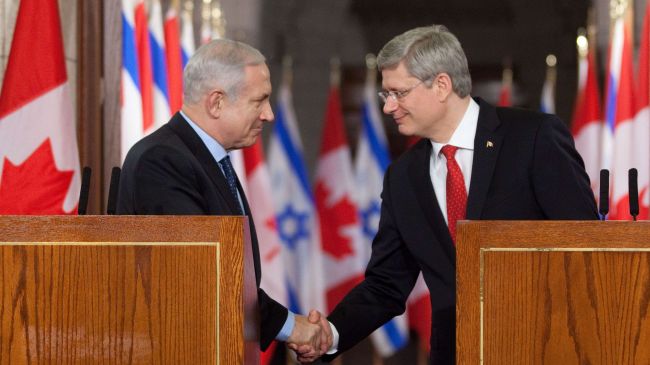
This picture shows Canada’s Prime Minister Stephen Harper (R) and Israeli Prime Minister Benjamin Netanyahu shaking hands after a joint press conference on Parliament Hill, Ottawa, March 2, 2012.
The world is taking note of the ruling Conservatives’ shameful betrayal of Canada’s once admirable reputation as a fair country, sincerely working on the world stage to improve the lot of the disadvantaged and suffering.
In the UN Human Rights Council’s Universal Periodic Review, Canada was criticized to such an extent that the Council decided to send the Special Rapporteur on the Rights of Indigenous Peoples, and representatives of the Committee on the Elimination of Discrimination Against Women and the Inter-American Commission on Human Rights, to investigate.
Minister of Foreign Affairs spokesman Joseph Lavoie dismissed complaints by
*China of “widespread racial discrimination”,
*Iran of “child sexual exploitation and trafficking, the right to food, discriminatory law and regulation against indigenous people and minority groups including Muslim, Arab and African communities”,
*Pakistan of “increased poverty and unemployment rate among immigrant communities”,
*Egypt of “racial profiling in law-enforcement action”, and
*Cuba of “racism and xenophobia” in Canada,
insisting that “Canada has a track record of being a human rights leader, at home and around the world.”
The visits come at an awkward moment for the Conservatives, as it makes a public display of victimizing Muslims as part of a campaign to ram through the “Combating Terrorism Act” (Bill S-7), which gives the state extraordinary powers to detain suspects without any charges and without any legal protections for up to a year.
This sorry state of Canadian political life is the fruit of the Conservatives’ slavish obedience to every US whim, and of its decision to abandon any pretense of an independent foreign policy, making all decisions in consultation with Israeli advisers under the public security cooperation “partnership” signed in 2008 by Canada and Israel to “protect their respective countries’ population, assets and interests from common threats”. Israel security agents now officially assist Canada’s security services, the RCMP and CSIS, in profiling Canadian citizens who are Muslims and monitoring individuals and/or organizations in Canada involved in supporting the rights of Palestinians and other such nefarious activities. Even the usually timid UN is appalled.
The past two weeks of public spectacle could be lifted from a perverse Alice-in-Wonderland scenario. The latest claim to have uncovered a dastardly scheme by Muslim furriners plotting to explode weapons of mass destruction came just a week after the now legendary Boston bombing. Both incidents were dramatically unfolded to a gullible public as classic ‘good vs evil’, though neither holds water.
Canadian authorities boasted Monday afternoon that, working in concert with the FBI and other US national security agencies, they had broken up a terrorist conspiracy involving an “Iranian-based al-Qaeda cell”. The announcement, made at an RCMP press conference, came out of the blue, just days after the Boston bombing, and a few days after the House of Commons agenda was changed to debate final reading of the draconian anti-terrorism legislation.
On cue, US Ambassador to Canada David Jacobson hailed the action as “the result of extensive cross-border cooperation” showing “that we face serious and real threats.” The men were arrested in a Hollywoodesque fashion–Chiheb Esseghaier while eating at McDonald’s in Montreal’s main train station; Raed Jason, by scores of police armed with rifles and accompanied by search-dogs at his workplace in the Toronto borough of North York. They were charged with conspiracy to bomb a New York-bound Via passenger train, though the RCMP conceded that there had never been an imminent threat of an attack or even a definite plan, that Esseghaier and Jaser have been under police radar since last August (based on a year-old tip from an imam), and that their alleged crimes date back to last year.
The reason for their delayed and then sudden arrest is beyond a doubt the notorious Bill S-7, a bill that was forced on Canada by Big Brother in post-911 2001, and which was not renewed in 2007 thanks to Liberal opposition (they originally passed it and then had enough sense to oppose it). The Conservative government suddenly changed the House of Commons agenda as US authorities placed Boston under martial law. The Canadian copycat arrests clearly are intended to add a Canadian pretext for proceeding with Bill S-7, while showing that “We are all Americans now.”
This episode calls to mind the terrorist scare in 2006, when the RCMP staged the dramatic arrest of 18 young Muslims, whom they accused of preparing extensive terrorist attacks, including blowing up the parliament buildings. During the trial, it emerged that the “Toronto 18” was riddled with police agents, one providing the arms instruction at a “terrorist training camp” while another providing harmless bomb-making ingredients. Nevertheless, eleven were convicted and most given lengthy prison terms.
When Esseghaier, a Tunisian-born Montreal PhD student in nanotechnology, told the judge, “These conclusions are being reached based on facts that are nothing but words and appearances,” he was told to shut up, and the hearing was shut down. Jaser’s lawyer John Norris said his client was “in a state of shock and disbelief” and “intends to defend himself vigorously”. Norris took exception to the police’s attempt to present his client as a non-Canadian, noting that the Palestinian refugee has lived with his family in Canada for the past twenty years.
Is it just possible that UN Human Rights Council members read the ‘news’, are appalled, and are genuinely concerned about what’s happening to human rights in Canada?
Canadians’ plight is bad enough, but this recent orchestration of Islamophobia has another angle, just as appalling. The RCMP assertion that these damn furriners acted under the “direction and guidance” of “al-Qaeda elements located in Iran” is a blatant falsehood, as Iran (like Iraq before the US invasion) is probably the most anti-al-Qaeda country in the world. The fundamentalist al-Qaeda delights in killing Shia, was (and is?) supported by the US and financed by Canada’s enlightened Saudi oil-millionaire allies. So it’s not just a question of stripping Canadians of their rights, but of adding toxic fuel to the US-Israeli fires intended to launch war against peaceful (pro-Palestinian) Iran.
The RCMP admitted that they had no evidence of Iranian government involvement, but still… (nudge, nudge, wink, wink). When Canada broke off diplomatic relations with Tehran last autumn, Foreign Minister John Baird labeled Iran “the most significant threat to global peace and security in the world today”. All Iranian Foreign Ministry spokesman Ramin Mehmanparast had to do was to point to the hypocrisy and cynicism of Canada’s government backing the campaign to overthrow the Syrian government -a campaign in which some of insurgents are openly aligned with al-Qaeda: “The same [al-Qaeda] current is killing people in Syria while enjoying Canada’s support.”
And what about the latest hit on the American 911 funny bone? Tamerlan Tsarnaev was under surveillance for four years by the FBI, who were asked by the Russian government to arrest him in 2010 (which they did not do). They do admit to interviewing him in 2011 and sifting through his computer files, but, remarkably for someone allegedly radicalized by the internet, they found nothing of concern. It’s not clear why Russia let him go to visit his parents in the center of terrorism (Dagestan) in Russia in 2012, where purportedly he received some form of terror training or further Islamist indoctrination. Nor how he managed to attend a workshop next door in hostile Georgia organized by the “Fund of the Caucasus” (which works with the US rightwing thinktank the Jamestown Foundation) focused on destabilizing the Caucasus region.
Were both the FBI and the Russian FSB asleep? Was Tamerlan an FBI operative? Was he set up to do the bombing, or did he go AWOL on the FBI? Is this Chechen connection intended to frighten Russia into acquiescing to US-Israeli plans for Syria? “This [official] scenario is simply impossible in the real world,” writes former UK Ambassador Craig Murray. In an interview with Russia Today, Tamerlan’s mother said, “‘They were set up, the FBI followed them for years.” Is this international intrigue-intended to scare both Russia and Iran into abandoning the beleaguered Syrian government -really what Canadian domestic human rights and foreign policy should be based on? Why should we trust Ambassador Jacobson’s blah-blah about “serious threats”?
Canadians are left with security forces eager to show they are doing something, a craven government intent on passing a draconian bill to take away freedoms, and a foreign policy based on a US-Israel obsession with finding some spark to ignite the latest war craze -attack Iran. The supposed pretext -Iran’s nuclear energy program- is after all wearing a tad thin. Peter Osborne in the Telegraph explained how the West has turned down one serious offer after another by Iran (two in 2005 alone), and argues that it is western rather than Iranian intransigence that prevents a deal being struck today. So if no one believes the cry of “Wolf!” on that boondoggle, then the next best thing is “al-Qaeda”. Hell, Bush got away with it against Iraq in 2003; maybe it will work again.
Iran poses only an ideological threat -telling the truth to the US-Israeli tyrant and inspiring Arab Springs.
As for being killed by a bona fide terrorist, the odds are 1 in 20 million, while every year, 4,600 Americans are killed in workplace-related accidents, and more than 30,000 are killed by gun violence. Every 28 hours a black person is killed by police, security guards or vigilantes. On Boston Marathon Day, six Pakistanis died in a drone strike, while scores were killed in car bombs in Iraq. I won’t even begin to recount the daily horrors inflicted by the US in Afghanistan.
Not that these latter crimes against humanity -committed by us- justify retributive violence in any religion, especially Islam. “You shall not be treacherous, you shall not deceive, you shall not mutilate, you shall not kill children.” But the fact that we in the West are unconcerned with preventing senseless deaths at home, and are unaware or don’t care about the murders committed daily in our name abroad, does not bode well for the future. Only when we stop perpetrating violence will violence against us end.
April 28, 2013
Posted by aletho |
Civil Liberties, Deception, False Flag Terrorism, Timeless or most popular, Wars for Israel | al-Qaeda, Canada, Iran, Israel, RCMP, Royal Canadian Mounted Police, Stephen Harper, United States, Zionism |
Leave a comment
Let us be clear. The United States can verify absolutely nothing about the use of chemical weapons (CWs) in Syria. Any suggestion to the contrary is entirely false.
Don’t take it from me – here is what US officials have to say about the subject:
A mere 24 hours after Washington heavyweights from the White House, Pentagon, and State Department brushed aside Israeli allegations of chemical weapons use in Syria, US Secretary of Defense Chuck Hagel and the White House changed their minds. They now believe “with varying degrees of confidence” that CWs have been used “on a small scale” inside Syria.
For the uninitiated, “varying degrees of confidence” can mean anything from “no confidence whatsoever” to “the Israelis told us” – which, translated, also means “no confidence whatsoever.”
Too cavalier? I don’t think so. The White House introduced another important caveat in its detailed briefing on Thursday:
“This assessment is based in part on physiological samples. Our standard of evidence must build on these intelligence assessments as we seek to establish credible and corroborated facts. For example the chain of custody is not clear so we cannot confirm how the exposure occurred and under what conditions.”
“The chain of custody is not clear.” That is the single most important phrase in this whole exercise. It is the only phrase that journalists need consider – everything else is conjecture of WMDs-in-Iraq proportions.
I asked a State Department spokesperson the following: “Does it mean you don’t know who has had access to the sample before it reached you? Or that the sample has not been contaminated along the way?”
He responded: “It could mean both.”
Chuck Hagel expands on that jaw-dropping admission: “We cannot confirm the origin of these weapons.” Although he goes on to conclude anyway: “but we do believe that any use of chemical weapons in Syria would very likely have originated with the Assad regime.”
Four-year-olds shouldn’t have confidence in the US intelligence community at this point. Yet we are supposed to believe that the Syrian government must be behind a chemical weapons attack because Hagel says so.
Let’s consider the facts. The Syrian government has clearly stated it would not use chemical weapons during the crisis “regardless of the developments” unless “Syria faces external aggression.”
The US and other western states have warned for more than a year now that as the government of Bashar al-Assad begins to “topple,” the likelihood of using CWs as a desperate last measure will increase.
The White House reiterated this point yesterday: “Given our concern that as the situation deteriorated and the regime became more desperate, they may use some of their significant stockpiles of chemical weapons.”
Assad’s government is clearly not on its last leg. If anything, the Syrian army has made tremendous gains in the past few weeks by thwarting rebel plans to storm Damascus, pushing them out of key surrounding suburbs, and cutting off their supply lines in different parts of the country.
This recent reversal of fortunes tends to validate the observations of those who have met with Assad and say the president remains confident that he can repel rebel forces whenever and wherever he chooses to do so.
Which frankly removes a major “motive” from any calculation by the Syrian government to use chemical weapons against civilians.
The constant reference to CWs in this conflict is suspect – there is no conceivable military advantage to be gained from the use of these munitions. Writing for Foreign Policy in December, Charles Blair says using CWs against rebels makes no tactical or strategic sense:
“The regime would risk losing Russian and Chinese support, legitimizing foreign military intervention, and, ultimately, hastening its own end. As one Syrian official said, ‘We would not commit suicide.’”
In fact, there is plenty of evidence that the government has calibrated its military responses throughout this conflict to avoid scenarios that would create a pretext for foreign military intervention on “humanitarian grounds.”
Just as there is evidence aplenty that rebel forces will go to great lengths to create a pretext for foreign intervention that would help them oust Assad.
On March 19, a suspected chemical weapons attack near Aleppo prompted the Syrian government to ask the United Nations to launch an investigation. Witnesses reported the “smell of chlorine in the air,” which led to speculation that this could have been a rebel-led attack given that opposition militias had seized Syria’s only chlorine gas bottling plant, east of Aleppo, that August.
The use of chlorine gas-based explosives by insurgents was seen not so long ago in Iraq, where attacks against both authorities and civilians are traceable to 2006. US military spokespeople, at the time, claimed that insurgent tactics had become deadlier, seeking to draw maximum attention and impose widespread suffering.
The Iraq connection and insurgent tactics there are important to the Syrian conflict because of the influx of jihadist rebels flooding over the Iraqi border, bringing with them experience and know-how from fighting the US occupation. That border also allegedly hosts training camps for groups in both countries allied with al-Qaeda – a development that has come to light since a recent announcement linking al-Nusra Front to al-Qaeda’s central group.
The White House’s allegations on Thursday specified a sarin gas connection to at least one other suspected chemical weapons attack in Syria. Even if this were true, a clear-cut connection linking the use of a CW explosive to the Syrian government is not at all inevitable. In 2004, an IED roadside bomb – a common insurgent tactic – containing the nerve agent was detonated in Iraq. There are no guarantees whatsoever that chemical munitions have not found their way into the hands of rogue elements – or in fact that they are not producing them in small quantities themselves.
At this point, almost everything being discussed in relation to chemical weapons inside Syria is conjecture – and to be honest – highly suspect.
The Times of London (which is behind a paywall so I cannot link to it) just published a detailed and timely “investigation” of an alleged CW attack in Aleppo, claiming: “the Syrian regime prefers to gas its opponents in this small-scale way, testing the elasticity of President Obama’s ‘red line.’”
The article then goes on to describe the harrowing account of what appears to be a sarin gas attack from a victim, witnesses, and medical staff. But experts are now questioning these accounts, saying that the evidence is “far from conclusive.”
In reference to the video of the alleged CW attack referenced by The Times, Jean Pascal Zanders, a senior researcher at the European Union Institute for Security Studies, tells McClatchy News that there are red flags in the footage.
“Why only one person?” he said, referring to the video showing one patient it said was a victim. “Why do I find the hospital setting, again, unlike what I would expect in a case of chemical exposure? Why is the guy ‘foaming’ in the hospital, considering the rapid action of sarin.” Zanders explained that without an antidote, death is possible within one minute after exposure to sarin.”
The Times article then gets even stranger. To quote:
“In the chaos of Syria’s civil war, no hospital in the rebel-held areas has the facilities to test which gas was used. Yet medical sources in northern Syria have told The Times that in the immediate aftermath of the attack a team from “an American medical agency” arrived at the hospital in Afrin. They took hair samples from the casualties for testing at ‘an American laboratory.’
It is likely that these samples formed part of the evidence cited by the US Defence Secretary yesterday.”
Really? A CW attack takes place in the middle of the night in Aleppo, and in its “immediate aftermath” an “American medical agency” arrives to collect samples for testing?
There’s more…
In an interview with CNN’s Christiane Amanpour, Free Syrian Army Chief of Staff General Salim Idriss says that Israel is knowledgeable about the Syrian government’s use of CWs, because the Mossad has agents in the country: “Israel has this information because there are many, many members of security services who are now very active in Syria.”
Idriss is, of course, referencing the statements by Israel this week that kicked off all the recent speculation on Syrian CWs:
Israeli army intelligence analyst Brig. Gen. Itai Brun has been quoted far and wide on this issue, mainly referencing the April Aleppo incident highlighted by The Times and debunked by experts.
It is likely that all the speculation in the past few days revolves around an incident that is looking more and more like the “false flag” operations anti-rebel Syrians have been warning about this past year. Given where the “evidence” is coming from, and the alleged presence of a western or American “medical agency” present on the ground, it is quite remarkable that Washington went full-press on this.
It is almost as bad as the account in 2011 of a middle-aged, Iranian-American, ex-car dealer who, by virtue of some familial relationship with a member of Iran’s Revolutionary Guard, decided to collude with a Mexican drug cartel to plot the assassination of the Saudi ambassador in Washington at a popular DC eatery.
Having just passed the ten year anniversary of an Iraqi invasion and occupation based entirely on false and falsified data on Weapons of Mass Destruction, western media needs not to be asking about “red lines” as much as for iron-clad evidence.
Sharmine Narwani is a commentary writer and political analyst covering the Middle East. You can follow Sharmine on twitter @snarwani.
April 27, 2013
Posted by aletho |
Deception, False Flag Terrorism, Mainstream Media, Warmongering, Timeless or most popular, Wars for Israel | Chuck Hagel, Israel, Syria, United States, Zionism |
Leave a comment
Israel is one of several countries that maintain a significant intelligence presence inside Syria, according to the top commander of the Syrian rebel forces.
General Salim Idriss, Chief of Staff for the Free Syrian Army, told CNN’s Christiane Amanpour that the Jewish state has “many, many” intelligence officers in various parts of Syria. The Arab country has been rocked since 2011 by a violent civil war, which has cost the lives of at least 60,000 people.
Idriss was responding to comments made earlier this week by Brigadier General Itai Brun, senior intelligence analyst for the Israel Defense Forces (IDF). Brun, who heads the Division for Research and Analysis of the IDF’s Military Intelligence Directorate, was speaking at a conference hosted in Tel Aviv, Israel, by the Institute for National Security Studies. He told an audience of intelligence experts that the IDF was “quite certain” that the Syrian government headed by President Bashar al-Assad had resorted to the use of chemical weapons against rebel forces on at least one instance.
According to Brun, footage obtained by the IDF of rebel casualties from a March 19 attack by Syrian government forces, pointed to the use of sarin nerve gas. He referred to evidence such as the victims’ dilated pupils and “the foam coming out of their mouths” as strong proof of the use of weaponized sarin nerve gas in the battlefield.
Responding to Brun’s allegations, General Idriss suggested that Syrian government forces had used chemical weapons repeatedly in a variety of locations, including Aleppo, Homs, and the outskirts of capital Damascus. He added that rebel forces had collected “some samples of soil and blood” and surrendered it to outside “observers” of the civil war —though he refused to identify these observers. After some pressure from Amanpour, Idriss said it made sense for the IDF to know that sarin nerve gas had been used by the Syrian government, since Israel was one of several countries that had “many, many” intelligence officers inside Syria. Asked by Amanpour whether he was referring to Israeli covert-action agency Mossad, Idriss responded “yes”.
In response to Brun’s comments, White House Press Secretary Jay Carney told reporters on Tuesday that Washington was “looking for conclusive evidence, if it exists, if there was use of chemical weapons”.
April 27, 2013
Posted by aletho |
Deception, Mainstream Media, Warmongering, Wars for Israel | Free Syrian Army, Institute for National Security Studies, Israel, Syria |
Leave a comment
Neoconservatives are grasping at the finest of straws in their search for links between the Boston Marathon bombers and al-Qaeda and, more importantly for the neocons, the two Canadian Muslims accused of plotting to destroy a train on orders from al-Qaeda in Iran.
The reality is that no matter how hard the various intelligence authorities look, there is no evidence at all linking the Boston Marathon bombers to al-Qaeda or an al-Qaeda linked group. And, while most clear thinking analysts have agreed that the notion of Iran hosting al-Qaeda is far-fetched, senior neocon warmonger “Mad Max” Boot writing in Commentary claims that there are some obscure links between the Taliban and Iran and that, therefore, there can be no reason why there can’t be a link between Iran and al-Qaeda despite al-Qaeda being Sunni and Iran being Shia. What Mad Max forgets, however, (he doesn’t actually forget, he just hopes his readers don’t know) is that any association Iran has with the Taliban is purely for geo-political expediency reasons whereas an alliance between Iran and al-Qaeda would require an ideological association – an association that would be out of bounds for both entities especially considering the current state of play in Syria.
The reason a link between Iran and al-Qaeda is important to the neocons is because any link, if it actually resulted in a terrorist act inside the US as the Canadian so-called plot may have if the train was derailed or destroyed while inside the US or even New York where it was bound, could well become a trigger for a US attack against Iran.
Any link at all to al-Qaeda is also important to the neocons. It drives their obsessive anti-Islam propaganda which, in turn, feeds the Israeli Zionist cause of a Greater Israel which the neocons support and are a part of.
April 24, 2013
Posted by aletho |
Deception, False Flag Terrorism, Timeless or most popular, Wars for Israel | alqaeda, Boston Marathon, Greater Israel, Iran, Taliban |
Leave a comment
Hezbollah has never been shy about declaring its support for the Syrian regime. Since the launch of a Western and Arab campaign against the Resistance in 2005 – which only intensified after the July 2006 war – the party has never been reluctant in repeatedly confirming its close affinity to Damascus.
When the crisis in Syria erupted, Hezbollah sought to distinguish between what it saw as legitimate demands by the Syrian people for reforms that would end one-party rule and attempts by foreign power to seize the opportunity to topple President Bashar al-Assad.
For a year or so after the outbreak of the Syrian crisis, the party did not deem it necessary to intervene in the conflict, until military operations came close to areas of concern to Hezbollah on many levels.
Gradually, its role in Syria grew until the party became responsible for protecting a large number of Lebanese living in Syria – in addition to some Syrians, as well – who are under threat of being expelled from their lands by armed opposition groups backed by foreign powers.
Another area of concern for Hezbollah was the increasing role Israeli intelligence, backed by the West, began to play in the conflict, particularly in targeting people and places of concern to the Resistance.
The party did not stop at simply protecting its supporters in order to prevent their displacement, but took a further step of giving them the wherewithal to defend themselves from any attacks. It did this openly before the eyes of the public and in coordination with the regime, losing several of its fighters in the process.
The days will come when the details of Hezbollah’s role in Syria will be revealed, exaggerating the party’s involvement to such an extent as to suggest that it was the key factor in saving the regime, or to frame its largely defensive military activities as a crusade against the Sunnis of Syria.
Many of Hezbollah’s supporters in Lebanon and the Arab world are certainly not comfortable with its involvement in Syria, prompting party leaders to come up with convincing explanations to justify their actions. But if it is willing to give so much life and blood for the sake of the resistance, losing some of its popularity in defending what it considers to be a key ally in the struggle is not such a terrible sacrifice.
On the other side, those very same parties that threw themselves into the Syrian crisis from day one, supporting the armed opposition, do not let a day pass without attacking Hezbollah for fighting in Syria, while at the same time keeping quiet about the ugliest crimes being committed by the armed groups.
They raise empty slogans about Syria’s national unity despite the fact that 1.5 million Syrians from the country’s various minorities have been displaced at the hands of jihadi groups, who by all accounts have become the dominant current among the opposition forces.
With every denunciation of the Resistance for its role in Syria, the ground is slowly being prepared for war against the party under the banner of solidarity with the Syrian revolutionaries.
This is as Lebanon’s new guardian, Saudi Arabia, is doing its best to impose a government similar to that of Fouad Siniora in 2005, which spared no effort to undermine the Resistance even in the midst of the Israeli assault in 2006 and its aftermath.
This is yet another sign that there are preparations underway for a total war in the region. It could erupt due to a miscalculation by a particular side or as a result of a bloody explosion somewhere. And all we can do in this situation is sit and wait.
April 23, 2013
Posted by aletho |
Timeless or most popular, Wars for Israel | Bashar al-Assad, Fouad Siniora, Hezbollah, Lebanon, Saudi Arabia, Syria |
Leave a comment
South Africa has lashed out at the United States and European Union for imposing oil sanctions on Iran over its nuclear energy program without first consulting major importers of the Iranian energy supplies.
South Africa’s Energy Minister Elizabeth Dipuo Peters, who is in India to attend the Clean Energy Ministerial (CEM) meeting, said that such decisions have geopolitical implications and mostly affect “the poorest of the poor” that are in dire need of energy supplies and have no alternative.
“When decisions are made at bilateral or unilateral levels that have serious geopolitical consequences, we need to engage seriously,” Peters said.
“When we had to look for crude of the kind we got from Iran, it came at a premium,” she added.
“It has a multiple knock-on effect, especially on the poorest. When these decisions are taken, they must always consider the impact and consequences of their decisions at the geopolitical level. Or at least involve other countries so that when the decision is made they can say South Africa is taking it consciously. They have calculated the impact on them but not on others,” the South African minister said.
At the beginning of 2012, the US and EU imposed new sanctions on Iran’s oil and financial sectors with the goal of preventing other countries from purchasing Iranian oil and conducting transactions with the Central Bank of Iran.
On October 15, 2012, the EU foreign ministers reached an agreement on another round of sanctions against Iran.
The sanctions have been imposed on Iran over the groundless charges of a potential military diversion in Iran’s nuclear energy program.
Iran rejects the unfounded allegations over its nuclear energy program, arguing that as a committed signatory to the Non-Proliferation Treaty (NPT) and a member of the International Atomic Energy Agency (IAEA), it has the right to use nuclear technology for peaceful purposes.
Peters said that that the petroleum industry is a victim of financial sanctions, which include US sanctions on dollar-denominated trading and EU sanctions on insurance for shipping companies.
She emphasized that the US 18-month exemption for Iran oil sanctions had not benefited South Africa because the EU has refused to grant waivers.
On December 8, 2012, the US added China, India, South Korea, Malaysia, Singapore, South Africa, Sri Lanka, Turkey, and Taiwan to the list of countries exempted from the sanctions for another six months.
April 19, 2013
Posted by aletho |
Economics, Wars for Israel | European Union, Iran, Press TV, Sanctions against Iran, South Africa, United States |
Leave a comment
Director of National Intelligence James Clapper and director of the Defense Intelligence Agency Army Lieutenant General Michael Flynn testified before the Senate Armed Services Committee today and reiterated the same assessment regarding Iran as was delivered in March 2013.
The exact same statements – verbatim – were included in Clapper’s unclassified report, including the assessment that “Iran is developing nuclear capabilities to enhance its security, prestige, and regional influence and give it the ability to develop nuclear weapons, should a decision be made to do so. We do not know if Iran will eventually decide to build nuclear weapons.”
Of course, as Clapper notes, Iran’s ability to potentially manufacture the components is inherent to its advanced nuclear infrastructure and is not an indication of an active nuclear weapons program, which all U.S. intelligence agencies agree Iran does not have.
As such, Clapper again reported to the Senate Committee, “Iran has the scientific, technical, and industrial capacity to eventually produce nuclear weapons. This makes the central issue its political will to do so.”
In his testimony, Clapper stated that, were the decision to weaponize its nuclear energy program to be made by Ayatollah Khamenei, Iran could theoretically reach a “breakout” point within “months, not years.” His report repeats the assessment, though, that “[d]espite this progress, we assess Iran could not divert safeguarded material and produce a weapon-worth of WGU before this activity is discovered.”
Again, undermining the bogus claims that Iran is an irrational and reckless actor, Clapper maintained the judgment that “Iran’s nuclear decision making is guided by a cost-benefit approach,” balancing its own domestic interests with “the international political and security environment.” Iran also has a defensive – not aggressive – military posture, one based on “its strategy to deter – and if necessary retaliate against – forces in the region, including US forces” were an attack on Iran to occur.
During questioning from Senators following his prepared remarks, Clapper admitted – as a number of recent independent reports have shown – that the increasingly harsh sanctions levied upon Iran have had no effect on the decision-making process of the Iranian leadership, yet have produced considerable damage to the Iranian economy and resulted in increased “inflation, unemployment, [and the] unavailability of commodities” for the Iranian people.
This, he said, is entirely the point. Responding to Maine Senator Angus King, who asked about the impact sanctions have on the Iranian government, Clapper explained that the intent of sanctions is to spark dissent and unrest in the Iranian population, effectively starting that Obama administration’s continued collective punishment of the Iranian people is a deliberate (and embarrassingly futile) tactic employed to foment regime change.
“What they do worry about though is sufficient restiveness in the street that would actually jeopardize the regime. I think they are concerned about that,” Clapper said of the Iranian leadership. It is no wonder, then, why Clapper refers in his own official report to the economic warfare waged against Iran as “regime threatening sanctions.”
Not mentioned in the session, of course, are the decades of repeated affirmations by senior Iranian officials that Iran rejects nuclear weapons on strategic, moral and religious grounds. Within the past six weeks, this position has been reiterated by Iran’s envoy to the IAEA Ali Asghar Soltanieh, President Ahmadinejad, and Ayatollah Khamenei himself.
Just two days ago, for instance, during a three-day diplomatic visit to Africa, Ahmadinejad declared, “The era of the atomic bomb is over. Atomic bombs are no longer useful and have no effect on political equations. Atomic bombs belong to the last century, and anyone who thinks he can rule the world by atomic bombs is a political fool,” according to a report by Iran’s state-run PressTV. He also pushed back the constant conflation in Western discourse of nuclear energy with nuclear weapons. “Nuclear energy is one thing and an atomic bomb is another. This useful energy must belong to all nations,” he stated.
Furthermore, reports that Iran has continued converting its stockpiled 19.75% enriched uranium into fuel plates for its cancer-treating medical research reactor gained absolutely no traction within the Committee or Clapper’s comments. For Congress, Iran is a threat simply by virtue of having independent political considerations, inalienable national rights and refusing to accept American hegemony over its own security interests.
South Carolina Senator Lindsey Graham, who spends most of his time advocating for new, illegal military adventures in the Middle East, presented this wholly disingenuous and misleading question to Clapper: “Over the last six months, as we’ve been imposing sanctions and been negotiating with the P5+1 regime, [does Iran] have more or less enriched uranium for a nuclear bomb?”
None of Iran’s enriched uranium is “for a nuclear bomb” insofar as it is all far from weapons-grade and under the safeguard and seal of the IAEA. Iran’s enriched uranium is no more “for a nuclear bomb” than Graham’s fanciest set of steak knives are for throat-slitting.
“Can I just say it’s more?,” Graham proffered, revealing that he already knew the answer he wanted to hear, at which point Clapper chimed in. “Not highly-enriched,” he said, “but up to the 20% level.” Graham was undeterred from his propagandizing and grandstanding. “Well, they’re marching in the wrong direction,” he said. “We talk, they enrich.” AIPAC poetry at its finest.
Shortly before ending the session, in response to questions from Connecticut Senator Richard Blumenthal, Clapper stated that the relationship between the American and Israeli intelligence communities – especially on the Iranian nuclear program – has “never been closer or more pervasive,” citing unprecedented levels of “intimacy.”
While each state continues to maintain its own unique sources for intelligence gathering, Clapper said, “generally speaking,” the United States and Israel are “on the same page” when it comes to Iran.
Pressing the issue on behalf of his AIPAC backers, Blumenthal asked whether all information is shared between the two nuclear-armed nations, at which point Clapper declined to agree completely.
“Pretty much,” he replied.
Why was Clapper being so cagey? An Associated Press report from last July seems to provide an answer:
Despite inarguable ties between the U.S. and its closest ally in the Middle East and despite statements from U.S. politicians trumpeting the friendship, U.S. national security officials consider Israel to be, at times, a frustrating ally and a genuine counterintelligence threat.
In fact, the AP states, “The CIA considers Israel its No. 1 counterintelligence threat” in the Middle East, meaning that the agency “believes that U.S. national secrets are safer from other Middle Eastern governments than from Israel.” This is unsurprising, of course, as “Israel’s foreign intelligence service, the Mossad, and its FBI equivalent, the Shin Bet, both considered among the best in the world, have been suspected of recruiting U.S. officials and trying to steal American secrets.”
Did any of that make it into Clapper’s “Worldwide Threat Assessment” today? No, of course not. Israel was only mentioned as a victim and an ally. One might think an untrustworthy, nuclear-armed serial aggressor, constantly threatening to drag the United States into an unprovoked military conflict with inevitable devastating consequences, all with the allegiance and blessing of Congress, would rank rather high on potential security threats to the United States.
But James Clapper isn’t allowed to say that.
April 18, 2013
Posted by aletho |
Timeless or most popular, Wars for Israel | AIPAC, Ali Asghar Soltanieh, Ali Khamenei, Economy of Iran, Iran, Israel, James R. Clapper, Sanctions against Iran, United States Senate Committee on Armed Services |
Leave a comment


 Aletho News
