How MI6 Fabricated Iran Nuke Fraud
By Kit Klarenberg | Global Delinquents | September 24, 2025
On September 19th, the UN Security Council voted to reimpose savage economic restrictions on Iran over its nuclear program. European leaders have in recent months repeatedly accused Tehran of refusing to abide by the 2015 Joint Comprehensive Plan of Action’s terms. A core, repeated claim is the Islamic Republic has collated a uranium stock over 40 times the level permitted under that deal. No supporting evidence for the charge has been provided, and the source of this information isn’t clear.
It may nonetheless be highly significant London has taken the lead in calling for the restoration of sanctions, independently imposed punitive measures on Iranian individuals and commercial entities, and employed relentlessly bellicose rhetoric about the Islamic Republic’s purported breaches of its JCPOA commitments. In August, then-Foreign Secretary David Lammy declared Tehran had “consistently failed to provide credible assurances on the nature of its nuclear programme.” In the wake of the UNSC vote, British ambassador Barbara Woodward proclaimed, “we urge [Iran] to act now.”
As this journalist has previously exposed, the JCPOA resulted from a long-running MI6 black propaganda campaign to falsely frame the Islamic Republic as possessing nuclear weapon ambitions, if not nukes outright. Under the Agreement’s terms, Tehran received sanctions relief in return for granting the International Atomic Energy Agency virtually unhindered access to its secret nuclear complexes. Despite the IAEA consistently certifying Iran’s compliance, the Trump administration shredded the Agreement in May 2018, and launched a “maximum pressure” campaign to cripple the country.
Information gathered by the IAEA under the Agreement appears to have assisted Israel’s criminal 12 Day War in June, raising the obvious question of whether the Agreement was always intended as an espionage operation, in preparation for future conflict with Tehran. This interpretation is amply reinforced by leaked documents, indicating the IAEA provided Zionist entity intelligence with names of Iranian nuclear scientists who were subsequently assassinated. Meanwhile, the papers show Agency chief Rafael Grossi enjoys an intimate, covert relationship with officials in Tel Aviv.
These disclosures understandably motivated Iranian lawmakers and President Masoud Pezeshkian to halt any and all cooperation with the Agency. The sanctions eased by the JCPOA being the product of an MI6 black propaganda effort, to falsely convince the West and its overseas proxies and puppets Tehran posed a global nuclear weapon threat, provides the Republic with even more urgent justification for ignoring the Agreement’s terms. Iran’s grounds for rejecting any accommodation with the same countries now seeking to sanction her are inarguable.
‘Supportive Relations’
At the centre of MI6’s black propaganda war on Iran was longtime British intelligence officer Nicholas Langman, a veteran dark arts specialist who has been repeatedly publicly exposed perpetrating the dirtiest imaginable deeds for London’s foreign spying agency the world over. He was for example intimately implicated in Britain’s contribution to the CIA’s global post-9/11 torture program. However, rather than being penalised or defenestrated for his actions and unmasking, he appears to have been richly rewarded, and consistently failed upwards.
A leaked CV shows 2006 – 2008, Langman led MI6’s Iran Department. Here, he oversaw a team seeking to “develop understanding” of Iran’s “nuclear program”. Then, 2010 – 2012, he led an “inter-agency” effort to infiltrate the IAEA, while “[building] highly effective and mutually supportive relations across government and with senior US, European, Middle and Far Eastern colleagues for strategy which enabled major diplomatic success [sic] of Iranian nuclear and sanctions agreement.”
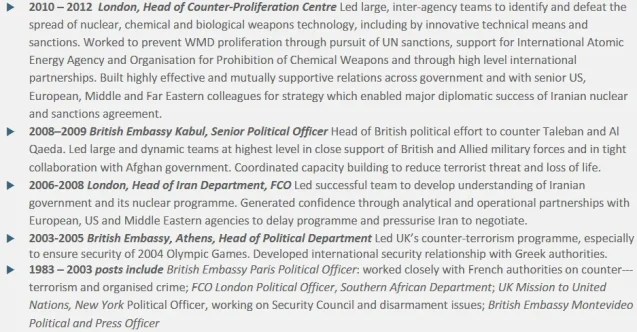
Nicholas Langman’s leaked CV
It was during the latter period that public and governmental attitudes across the West – and in vassal states – towards the Islamic Republic became highly belligerent, and negative. One by one, governments and international bodies – including the EU and UN – imposed ravaging sanctions against Tehran, devastating its economy, influence, and standing. MI6 journeyman Langman triumphed in his mission to foment concerted global hostility against Iran, based on the bogus spectre of the country posing a nuclear threat.
The question of whether British ‘intelligence’ on Iran’s nuclear program was the product of torture is an open and obvious one. Langman moved straight to leading MI6’s Iran Department from running the agency’s station in Athens, Greece. There, in late 2005, he was exposed by local media as having overseen an operation to abduct and ferociously mistreat 28 Pakistani guestworkers, wrongfully suspected of having had contact with individuals accused of perpetrating the 7/7 bombings in London in July that year.
That Langman wasn’t reprimanded over the incident strongly suggests he enjoyed a high level of protection, and London approved of his vicious intelligence-gathering methods – known to invariably produce false testimony from detainees. MI6 was not only an enthusiastic collaborator in the CIA’s global extraordinary rendition program, but led its own operations. Markedly, in at least one case, the British sought to sideline the CIA and ensure exclusive access to “intelligence” from a detainee in which Langley also had an interest.
The Obama administration was during its first year in office formally committed to non-interference in the Islamic Republic’s affairs, to the extent State Department apparatchik Jared Cohen was almost fired for publicly demanding Twitter halt planned maintenance during June 2009 protests in Iran, to ensure demonstrators could continue posting. It’s therefore unknown whether Washington was in on MI6’s Iran nuke con. If not, it wouldn’t be the first time British intelligence has misled the international community, with catastrophic results.
‘Possible Manipulation’
In July 2004, the Senate Intelligence Committee issued a scathing report on “the US intelligence community’s prewar intelligence assessments on Iraq.” It reserved particular disdain for how the CIA et al had “[relied] too heavily on foreign government services and third party reporting, thereby increasing the potential for manipulation of U.S. policy by foreign interests [emphasis added].” This was a reference to MI6’s central role in gathering – or concocting – intelligence on Baghdad’s purported WMD capabilities:
“Due to the lack of unilateral sources on Iraq’s links to terrorist groups like al-Qaida [redacted], the [US] Intelligence Community (IC) relied too heavily on foreign government service reporting and sources to whom it did not have direct access to determine the relationship between Iraq and [redacted] terrorist groups… The IC left itself open to possible manipulation by foreign governments and other parties interested in influencing US policy.”
As far back as the late 1990s, Britain’s foreign spying agency took the lead on sourcing dud ‘intelligence’ to manufacture consent for the against Baghdad. Under the auspices of a psychological warfare effort dubbed Operation Mass Appeal, MI6 black propaganda specialists circulated false information to foreign editors and reporters on its payroll “to help shape public opinion about Iraq and the threat posed by WMD,” which was then recycled by Western leaders and news outlets to reinforce its credibility.
In September 2002, then-MI6 chief Richard Dearlove personally approached British Prime Minister Tony Blair, claiming his agency had cultivated a source inside Iraq with “phenomenal access”, who could provide the “key to unlock” Iraq’s purported WMD program. Their assorted claims subsequently formed the basis of a dossier, which made a number of wild charges about Baghdad’s chemical and biological weapon capabilities. A prominently reported allegation was that Iraq could deploy WMD against Western countries within just 45 minutes. Its source was an Iraqi taxi driver.
This claim was repeated in a radio address by George W. Bush that month. In January the next year, as the invasion of Iraq rapidly loomed, the President declared in his State of the Union address, “the British government has learned that Saddam Hussein recently sought significant quantities of uranium from Africa.” That December, then-CIA chief George Tenet admitted this assertion was completely fallacious, and “these 16 words should never have been included in the text written for the President.”
The Zionist entity justified its unprovoked assault against Iran in June in large part on an intelligence dossier, which concluded the Islamic Republic had reached the “point of no return” in acquiring nukes. Its findings relied heavily on a May IAEA report that provided zero fresh information, but concluded Tehran supposedly maintained “undeclared nuclear material” until the early 2000s. While intended to trigger regime change, Tel Aviv’s broadside ended promptly in embarrassing failure, despite extensive foreign support, including US airstrikes.
Undeterred by the fiasco, Benjamin Netanyahu remains determined to crush the “Iranian axis”, while Trump has declared he would bomb Tehran “without a question” in response to indications the Islamic Republic has enriched uranium beyond agreed levels. We could be on the precipice of another war. As with the Iraq invasion, the perilous trail that brought us to this grave point could lead back to London. Yet again, MI6 may have taken the lead in concocting ‘intelligence’, justifying further US-Israeli aggression against the Islamic Republic.
Ex-CIA chief Petraeus hails former Al-Qaeda leader for ‘clear vision’ in Syria
The Cradle | September 23, 2025
Self-appointed Syrian President Ahmad al-Sharaa engaged in a wide-ranging dialogue on 22 September with former CIA director David Petraeus as part of his visit to New York.
Sharaa, a former Al-Qaeda commander, met Petraeus, who commanded troops in Iraq after the 2003 invasion, at the Concordia Summit on the sidelines of the UN General Assembly. They discussed issues facing Syria, including reconstruction, governance, economic sanctions, and regional relations.
“We faced massive destruction over the past years, but we are focusing on economic development and building capabilities,” Sharaa stated.
“Syrians by nature are people of work and trade. So please lift the sanctions and see what we can do,” he added, referring to the 2019 US Caesar Act, which imposed crushing economic sanctions on Syria, impoverishing millions.
US President Donald Trump removed some sanctions earlier this year, but Congress must authorize their permanent removal.
Petraeus said that the conversation with the former Al-Qaeda in Iraq commander “has filled me with enormous hope.”
“Your vision is powerful and clear. Your demeanor is very impressive as well … We obviously hope for your success, Inshallah, because at the end of the day, your success is our success,” Petraeus added.
Though Sharaa was deemed a terrorist by the US State Department in 2012, the CIA covertly provided arms and funding to the Al-Qaeda affiliate he founded in Syria, then known as the Nusra Front.
According to journalist Seymour Hersh, Petraeus established a “rat line” between Libya and Syria to send weapons to the Nusra Front and other extremist groups seeking to topple the government of former Syrian president Bashar al-Assad.
The CIA operation, known as Timber Sycamore, enjoyed a budget of over $1 billion per year. The operation finally allowed Sharaa to oust Assad and establish an extremist Islamic state over Syria in December.
According to former French intelligence officer and political analyst Thierry Meyssan, Petraeus continued to help fund Al-Qaeda groups, including ISIS, after he was forced to resign from the CIA in 2012 after a sex scandal.
Meyssan says that Petraeus joined the private equity firm Kohlberg Kravis Roberts (KKR), headed by Jewish billionaire Henry Kravis, which funded the Nusra Front and ISIS on behalf of the CIA in an off-the-books manner.
Addressing Israel’s war on Gaza, Sharaa dismissed speculation about Syria joining the Abraham Accords to normalize relations with Israel.
He claimed the destruction of Gaza has made any broad normalization with Israel impossible, but said limited security arrangements could be considered.
Before Sharaa’s trip to New York, Syrian and Israeli officials were carrying out security talks that would allow Israel to maintain control of the strategic Mount Hermon, establish a no-fly zone over the south of the country, and prevent Syrian forces from entering a demilitarized zone in the south.
In a personal question, Petraeus asked how Sharaa manages the pressure of leading a country after years of conflict.
“I spent 25 of my 43 years in conflict and crisis, so I am used to hardship. Decisions that carry the destiny of a nation must be taken with calm and an open mind.”
Sharaa first traveled to Iraq to join Al-Qaeda after the 2003 invasion and was known for dispatching suicide bombers to kill civilians. He was allegedly arrested by US forces in 2005 and sent to the US prison at Camp Bucca.
After his release in 2009, he became the Emir of the Islamic State of Iraq (ISI) in Mosul, before traveling to Syria to establish the Nusra Front in 2011 on the instructions of Islamic State (later ISIS) leader Abu Bakr al-Baghdadi.
Ayatollah Khamenei rejects talks with US, warns of ‘serious, irreparable harms’
Press TV – September 23, 2025
Leader of the Islamic Revolution Ayatollah Seyyed Ali Khamenei has rejected Washington’s demands over nuclear negotiations, saying that accepting talks under threat is something “no honorable nation would ever do, and no wise statesman would ever endorse.”
Speaking in a televised address to the nation on Tuesday, Ayatollah Khamenei said negotiations with Washington under the current circumstances would bring “no benefit” to Iran and instead carry “serious and possibly irreparable harms.”
“Accepting negotiations under such threats would mean that the Islamic Republic of Iran is susceptible to intimidation.”
“If we were to negotiate under such threats, it would mean that we tremble and surrender whenever threatened,” the Leader said.
“If such susceptibility to threats were established, it would never end. Today, they say: if you enrich, we will do this. Tomorrow they will say: if you have missiles, we will do that … There would be endless threats, forcing us to retreat step by step.”
Ayatollah Khamenei said the United States is predetermining the outcome of any dialogue, and that Washington’s demands amount to dictation rather than negotiation.
“They have announced that the only acceptable result of negotiations is the shutdown of Iran’s nuclear activities and enrichment. So, we would sit at the table, and the outcome of the talks would be exactly what they had dictated in advance.”
“That is not negotiation,” the Leader stated, “that is dictation, that is imposition.”
“To negotiate with a party where the result must necessarily be what they want, and what they say; is that negotiation?”
The Leader pointed to recent American calls for Iran to abandon not only long-range but even short-range missiles.
The aim of such demands, Ayatollah Khamenei said, was to render Iran so weak and defenseless that it could not respond in any form if attacked.
Trump scrambles to contain fallout from Israeli crime spree with meeting in New York
MEMO | September 22, 2025
President Donald Trump is set to host a high-level meeting with a select group of Arab and Muslim leaders on Tuesday in New York to discuss the ongoing Israeli genocide in Gaza. The summit, to be held on the sidelines of the UN General Assembly, comes as Western governments declared their recognition of the State of Palestine and amid growing international condemnation of Israel’s war crimes.
Two Arab officials confirmed to Axios that leaders from Saudi Arabia, the United Arab Emirates, Qatar, Egypt, Jordan and Turkey have been invited to the closed-door meeting, which will take place at 2:30pm Eastern Time.
The summit is expected to precede Trump’s meeting with Israeli Prime Minister Benjamin Netanyahu, scheduled for 29 September at the White House. Sources familiar with the preparations said Arab leaders will call on Trump to pressure Netanyahu to end the assault on Gaza and to abandon plans to annex the illegally occupied West Bank.
Washington’s agenda reportedly includes a proposal for Arab and Muslim countries to contribute to a post-war stabilisation plan in Gaza, including potential troop deployments to replace the Israeli occupation forces. However, such proposals are expected to meet resistance unless a political framework guaranteeing Palestinian sovereignty is agreed.
Trump is also expected to hold a second meeting on Tuesday with leaders of the Gulf Cooperation Council (GCC), including Oman, Bahrain and Kuwait, to address broader regional concerns including Israel’s escalation in the region.
The unprovoked attack on Doha two weeks ago by Israel was met was global condemnation. Qatar reportedly demanded an apology before the resumption of negotiations.
Israel’s strike triggered an emergency summit of Arab and Muslim countries in Doha, and was swiftly followed by a new Saudi-Pakistani security pact—widely interpreted as a response to growing doubts about Washington’s reliability as a security guarantor in the Gulf.
Israeli intransigence is also threatening to unravel the hallmark foreign policy initiative of Trump’s previous presidency: the so-called Abrahm Accords. The UAE has reportedly warned that any annexation of the West Bank could lead to the collapse of the agreement which saw a number of Arab states normalise ties with the occupation state. The White House has not issued an official statement in response to the reports.
Iranian parliament pushes for ‘nuclear option’ as deterrence to western threat
The Cradle | September 22, 2025
Over 70 members of Iran’s parliament on 22 September called for a reassessment of the country’s defense doctrine, pressing authorities to consider nuclear weapons as a deterrent.
In a letter addressed to the Supreme National Security Council and the heads of the executive, legislative, and judicial branches, the lawmakers demanded that the issue be raised urgently.
“We respectfully request that, since the decisions of that council acquire validity with the endorsement of the Leader of the Revolution, this matter be raised without delay and the expert findings communicated to the parliament,” the statement read.
The MPs argued that while the development and use of nuclear arms contradicts the 2010 ‘fatwa’ of Iranian Supreme Leader Ali Khamenei banning them, circumstances have changed.
They wrote that “developing and maintaining such weapons as a deterrent is another matter,” stressing that “in Shia jurisprudence, a change in circumstances and conditions can alter the ruling.”
“Moreover, safeguarding Islam – which today is bound to the preservation of the Islamic Republic – is among the paramount obligations.”
The push was led by Hassan-Ali Akhlaghi Amiri, a representative from the holy city of Mashhad, according to Hamshahri Online.
Lawmakers noted that the nuclear doctrine was shaped at a time when the international community was still able to restrain Israeli aggression.
They pointed to the large-scale assault launched by Israel in June, backed by the US, which included direct strikes on three Iranian nuclear facilities, among them Fordow.
Iran has long stated its nuclear program is peaceful, rejecting western claims it seeks weapons capability. Tehran continues to cite Khamenei’s fatwa as proof of its intentions.
At the same time, the Supreme National Security Council announced the suspension of cooperation with the International Atomic Energy Agency (IAEA) after the UN Security Council imposed sanctions.
State media quoted the body as saying the move was a response to the “ill-considered steps of three European countries.”
Lawmakers warned that pressure tactics by the E3 countries will draw a “harsher and more decisive” response than before.
SNSC says Iran will suspend cooperation with IAEA after re-imposition of sanctions
Press TV – September 20, 2025
Iran’s Supreme National Security Council (SNSC) says Tehran will suspend its cooperation with the International Atomic Energy Agency (IAEA) after the United Nations Security Council voted not to permanently lift sanctions on Tehran.
In a statement on Saturday, Iran’s top security body condemned the “ill-considered” moves by Britain, France, and Germany —known as the E3— regarding the Islamic Republic’s peaceful nuclear program.
On Friday, the 15-member Security Council failed to adopt a resolution that would have prevented the reimposition of UN sanctions on Iran after the E3 triggered the “snapback” mechanism, accusing Tehran of failing to comply with the 2015 deal, formally called the Joint Comprehensive Plan of Action (JCPOA).
Iran rejected the illegitimate move by the European troika, pointing out that the United States had already pulled out of the deal and accusing the European trio of siding with illegal sanctions instead of honoring their own commitments.
In a Saturday session, chaired by President Masoud Pezeshkian, the SNSC addressed the latest situation in the region and the Israeli regime’s adventurism, the statement said.
“Despite [Iranian] Foreign Ministry’s cooperation with the Agency and the proposals presented to settle the [nuclear] issue, the actions of European countries have effectively suspended the path of cooperation with the Agency,” the SNSC emphasized.
According to the statement, Iran’s top security body tasked the Ministry of Foreign Affairs with continuing its consultations within the framework of the SNSC decisions to safeguard the national interests.
It added that Iran’s foreign policy under the current circumstances will be based on cooperation to establish peace and stability in the region.
Earlier on Saturday, Pezeshkian said Tehran can overcome any re-imposition of sanctions and will never surrender to excessive demands.
“We should believe that we can overcome obstacles and that the ill-wishers of this territory cannot block our way,” the president added.
The SNSC was formally put in charge of overseeing cooperation with the IAEA in July, following a series of illegal and unprovoked Israeli and US attacks on Iranian nuclear facilities.
The shift came after Iran’s Parliament passed legislation on July 2, requiring that all IAEA inspection requests be reviewed and approved by the SNSC.
UN Security Council votes to reimpose nuclear sanctions on Iran
Al Mayadeen | September 19, 2025
The United Nations Security Council voted on Friday to reimpose nuclear sanctions on Iran, citing its alleged violations of the 2015 Joint Comprehensive Plan of Action (JCPOA).
The move, driven by Britain, France, and Germany, has sparked sharp criticism from Russia, China, and Iran, highlighting deepening divisions within the international community over the future of Iran’s peaceful nuclear program.
The three European signatories to the JCPOA called for the activation of the snapback mechanism, falsely claiming that Iran had breached commitments made under the 2015 deal, which was designed to prevent Tehran from acquiring nuclear weapons capabilities.
The European powers alleged that Iran’s advancements in uranium enrichment and reduced cooperation with the International Atomic Energy Agency (IAEA) constitute material violations of the agreement.
Iran, Russia, and China push back
In response, Iranian Foreign Minister Abbas Araghchi stated that Tehran had presented a “fair and balanced” proposal to European nations aimed at preventing the reimposition of sanctions.
Russia’s UN Ambassador, Vasily Nebenzia, rejected the European-led move, saying, “There are no grounds for reinstating UN sanctions on Iran.” He emphasized that the E3’s push for snapback sanctions has no legal authority and affirmed that Moscow would not recognize it.
Russia also called on Security Council members to support a joint Russian-Chinese draft resolution on Iran, offering an alternative diplomatic track to avoid escalation.
China’s envoy emphasized that pressure on Iran must stop and urged Tehran to reaffirm the peaceful nature of its nuclear program, noting Iran’s declared willingness to cooperate.
Iran maintains that its nuclear program remains peaceful and has accused Western powers of double standards and bad faith. Chinese Ambassador to the UN echoed this stance, stating, “It was the United States that withdrew from the agreement, attacked Iran militarily, and disrupted negotiations.”
China’s envoy also called on the European trio to immediately withdraw their notifications to reinstate sanctions, stressing that “pressure is not the solution.”
Snapback could nullify Cairo agreement
Al Mayadeen’s sources warned on Thursday that activating the snapback sanctions mechanism would nullify the Cairo Agreement and end cooperation between the IAEA and Tehran.
This would prevent international inspectors from accessing sensitive facilities, escalating the standoff even further.
According to the sources, the diplomatic window with Iran remains open, but indicators point to the potential activation of the snapback sanctions mechanism. They argued this is largely because Washington is steering the European Troika in the talks.
The sources warned that Washington is expected to call on Tehran to resume negotiations after activating the snapback mechanism, aiming to impose its conditions from what it perceives as a position of strength. They described this approach as a serious miscalculation of Iran’s stance and the way Tehran would respond.
US withdraws waiver for Iran’s Chabahar port, hitting India’s investment
Press TV – September 19, 2025
The United States has revoked the sanctions waiver for Iran’s Chabahar port, threatening India’s multi-million-dollar investment in the strategic project amid straining ties between Washington and New Delhi.
The White House announced on Thursday that the exemption, in place since 2018, will end on September 29.
The waiver had allowed India to develop the Shahid Beheshti terminal at Chabahar, seen as a key gateway to Afghanistan and Central Asia. With its withdrawal, entities involved in the project may now face penalties.
US State Department spokesperson Thomas Pigott said the decision was consistent with the Trump administration’s so-called “maximum pressure” policy. He said that the revocation means any person or company engaged in the port’s operation could be exposed to sanctions.
Located in Chabahar, the port gives India access to Afghanistan and beyond, while also feeding into larger connectivity schemes such as the International North-South Transport Corridor.
India has already provided equipment worth $25 million, shipped food supplies through the port, and, in May 2024, signed a 10-year agreement to operate it. Under that deal, India pledged $120 million in investment and offered an additional $250 million credit line for infrastructure upgrades.
The waiver was originally granted in recognition of the port’s importance for stabilizing Afghanistan and facilitating humanitarian shipments.
Iran, meanwhile, has long slammed Washington’s reliance on sanctions. Officials in Tehran describe the approach as an “addiction” that has persisted since the 1979 revolution, with various Iranian entities repeatedly targeted under shifting pretexts.
Meanwhile, the sanction comes as tensions between New Delhi and Washington have already been rising under the Trump administration. Earlier this year, the White House imposed 50 percent tariffs on Indian goods, doubling an earlier rate.
Trump justified the move by accusing India of indirectly financing Russia’s war in Ukraine through oil purchases. The tariffs, which came into force in August, now cover most Indian exports to the US.
The measures hit at a time when bilateral trade stood at more than $87 billion, making India one of America’s largest partners. Experts warn the duties could shrink India’s exports to the US to nearly half within two years.
New Delhi has condemned the tariffs as “unfair, unjustified, and unreasonable,” and signaled a stronger tilt toward Moscow and Beijing.
Who Killed Charlie Kirk?
By Ron Paul | September 16, 2025
I had the pleasure of appearing on Charlie Kirk’s program a few times over the years and I always found him to be polite, respectful, and genuinely interested in ideas. Even in areas where we might not have agreed, he listened carefully. He was a strong advocate of free speech and he made a career of trying to convince the youth of the value of free speech and dialogue regardless of political differences.
At the young age of 31 years old, he had already founded and ran the largest conservative youth organization in the country and as such he had enormous influence over the future of the conservative movement and even the Republican party. As I discovered during my Republican presidential runs, the youth of this country are truly inspired by the ideas of liberty, peace, and prosperity.
I do not believe we have anything near the real story about the horrific murder of Charlie Kirk last week. The narrative presented by the FBI and other government agencies is wildly contradictory, with an ever-changing plotline that makes little sense.
Some individuals close to Kirk have reported that his foreign policy position was shifting away from the standard neoconservative militarism in favor of a more non-interventionist approach. Tucker Carlson recently recounted that Kirk had even gone personally to the White House to urge President Trump to refuse to take military action against Iran. He was rebuffed by President Trump, Carlson informed us.
Likewise, conservative podcaster Candace Owens, who was a close friend of Charlie Kirk, has stated on her program that Kirk was undergoing a “spiritual crisis” and was turning away from his past embrace of militarism and in favor of America-first non-interventionism, particularly regarding the current unrest in the Middle East.
Was Charlie Kirk murdered – directly or indirectly – by powerful forces who could not tolerate such a shift in views in such an influential leader? We don’t know.
If anything, those seeking to prevent the ideas of peace from breaking out would wish to cover it up, as they have done in so many past political killings. As I recounted in my most recent book, The Surreptitious Coup: Who Stole Western Civilization?, the turbulent 1960s saw several killings of major US figures, including JFK, RFK, and Martin Luther King, who were challenging the status quo and pushing for a shift away from the Cold War confrontationist mentality.
The real assassins of these peace leaders from last century were nihilists who did not believe in truth. They only believed in power – the power that comes from the barrel of a gun. Rather than compete in the marketplace of ideas they preferred to snuff out any challenges and therefore decapitate any possibility that our country could take a different course.
More than sixty years after the murder of President Kennedy, the vast majority of the American people do not believe the official story of how he was killed and why. Truth will eventually break through even when the wall of lies seems impenetrable.
If it is true that Charlie Kirk was preparing to shift his organization toward a foreign policy embraced by our Founders, the killing was even more tragic. But no army – or assassin – can stop an idea whose time has come. That may be his most important legacy. Rest in peace.
Washington based think tanks advocate war on Lebanon
By Robert Inlakesh | Al Mayadeen | September 16, 2025
Despite the approval of a plan submitted on September 5, by the Lebanese Armed Forces, to disarm Hezbollah, the United States and Israeli regime are not satisfied with the move. What they had hoped for was an aggressive and destructive plot that could have plunged the nation into chaos.
The United States has been pushing the Lebanese government to order the full disarmament of Hezbollah, doing so without providing any tangible guarantees or even allowing Beirut to draft its own national defence strategy. Simply put, the US Trump administration hopes to pursue, through diplomacy, what the Israelis failed to achieve during their war of aggression against Lebanon.
While Lebanese Prime Minister Nawaf Salam has decided to take his orders from the United States on the question of disarmament, it is clear that the plan which was recently adopted by the Lebanese Armed Forces does not meet the standards set by the United States, and by extension, the Israelis.
The plan is supposedly divided into four separate phases, beginning in south of the Litani River. However, the plan was not revealed publicly, and there appears to be no specific deadline as to when Lebanon will achieve its stated mission. Everything has remained quite vague.
This predicament has now sparked outrage amongst Washington-based pro-war think tanks that have a significant impact on the US’s foreign policy decisions.
Take the Zionist Lobby cut out think tank, the Washington Institute for Near East Policy (WINEP), for example. Their most recent article on the issue is titled “Without a Hezbollah Disarmament Deadline, Lebanon Should Face Repercussions”.
The WINEP piece argues that the US government should pressure the Lebanese Army to take escalatory measures that would inevitably result in violent armed clashes with Hezbollah, including seizing a military position north of the Litani River as an initial step toward disarmament, and setting a specific deadline for this process.
The author of the piece, Hanin Ghaddar, writing for the Zionist think tank, advocates weaponising US aid to Lebanon by making it conditional on disarmament demands. She goes even further, arguing that the US should go after Lebanese Parliament Speaker, Nabih Berri, in order to turn the Amal Movement against Hezbollah and to destroy the Shia alliance in the upcoming elections. It is also noted that additional sanctions should be used to the effect of going after Lebanese Shia elected officials. This is a clear call for election interference.
Another notable piece was recently published by Haaretz and reposted by the infamous Zionist think tank, the Foundation for Defense of Democracies (FDD). The author of the piece, entitled “Why Israel Shouldn’t Celebrate Lebanon’s Promise to Disarm Hezbollah Just Yet”, was written by FDD senior fellow David Daoud.
In this article, the FDD think tank senior fellow argues that the Israeli regime should continue bombing Hezbollah sites throughout Lebanese territory and aim at significantly weakening the Lebanese resistance group in order to pave the way towards the Lebanese Armed Forces being able to carry out the rest of the job.
In the WINEP piece, delusional depictions of the Lebanese military’s capabilities when it comes to fighting a war with Hezbollah, use the likes of LAF’s operation in the Nahr al-Bared refugee camp, back in 2007, and the Army’s clashes with ISIS – in which Hezbollah fought alongside them – as examples of how they could prove successful. However, Daoud is less delusional and sets forth a strategy that allows for the Israelis to do all of the heavy lifting instead.
The Atlantic Council think tank has meanwhile been promoting the false idea that the Lebanese public, with the exception of the nation’s Shia population, are in favour of Hezbollah disarmament and that the resistance group has been all but defeated. Completely contradicting this notion however, is the fact that 58% of the Lebanese public polled said they oppose Hezbollah’s disarmament without a national defense strategy.
Even more revealing, however, was that the data published by Lebanon’s Consultative Center for Studies and Documentation exposed that 71.7% said they don’t believe the Lebanese army could defend the country from an Israeli attack, and 76% answered that they didn’t believe Lebanon’s diplomatic maneuvers could stop the Zionist regime from attacking.
The gap here, between 58% that opposed disarmament and the 71.7% to 76% that answered the way they did above, indicates that the respondents answered the disarmament question based upon emotion rather than logic, which could largely be attributed to the effectiveness of anti-Hezbollah propaganda.
Other Washington-based think tanks have also been active on this issue, including the most influential think tank over the Trump administration, the Heritage Foundation. In its case, it openly praised US President Donald Trump for his efforts to expel UNIFIL forces from Lebanon, which will occur under a phasing out approach come the end of 2026.
Across all of the prominent Washington-based Zionist think tanks, the message appears uniform, they all seek further pressure upon Beirut in order to force it to disarm Hezbollah, against the wishes of the majority of the Lebanese public.
The US is directly meddling in Lebanon’s affairs and its moves, including threatening Beirut with another Israeli war, are tantamount to violations of the nation’s sovereignty, in addition to being anti-democratic. For all the talk about “sovereignty”, Lebanese Prime Minister Nawaf Salam and his ilk have remained silent about the US imposing its will on Lebanon, nor do they have a strategy to liberate their territory in the south, or even stop the daily Israeli airstrikes carried out on Lebanese lands.
The US State Department’s Growing Thoughtcrimes Obsession
By Adam Dick | Peace and Prosperity Blog | September 16, 2025
The Trump administration’s Department of State has been placing a high priority on denying the granting of visas to, and revoking visas from, people who have said things critical of the Israel government, including the Israel government’s war activities. That looks like it is an early step of a trend at the United States government department. In a new Fox News interview this week, Secretary of State Marco Rubio announced his desire that the State Department would make an addition to the list of thoughtcrimes for which visas may be denied and revoked.
Rubio stated:
We should not be giving visas to people who are gonna come to the United States and do things like celebrate the murder, the execution, the assassination of a political figure. We should not. And, if they’re already here, we should be revoking their visa.
The strange thing is that the United States government and its tied-at-the-hip Israel government have a longtime penchant for undertaking just such murders, executions, and assassinations. People’s approval of those killings, though, should not be expected to cause much of a stir at the State Department. Don’t hold your breath for expressed approval of the assassination (ordered by Trump in his first presidential term) of Iran General Qassim Suleimani, for example, to result in denials or revocations of visas. The same goes for expressed approval of recent killings by the Israel government of “political figures” in Lebanon, Iran, and Yemen.
Rubio suggested immediately after his comment regarding changes in visas policy that the thoughtcrimes punished could expand into a much longer list. “Why would we want to bring people into our country that are gonna engage in negative and destructive behavior?” he declared. “Negative and destructive behavior” sure is a broad category. How close to qualifying to be Rubio’s bestie will someone have to come to make the visa cut?
Featured Video
Racist Seinfeld Dances for Joy as Bibi Unveils His New Map
or go to
Aletho News Archives – Video-Images
TV Drama Review
Japanese drama projects Japan’s wartime atrocities onto Chinese characters

Global Times | October 25, 2026
By portraying Chinese characters as perpetrators of ruthless violence while casting Japanese Self-Defense Forces (SDF) intelligence operatives as defenders, the season 2 of the Japanese drama Vivant has recently drawn criticism from Chinese netizens, who argue that its depiction turns historical reality on its head while ignoring Japan’s wartime atrocities.
The TBS drama series – a spy suspense story in which an alleged unofficial intelligence unit of the SDF operates across the globe — has attracted a passionate fanbase. Its currently airing season 2 opened with a household rating of 18.8 percent, the highest for a TV drama this year, according toa commentary article by Japanese media Toyo Keizai.
What draws attention is the portrayal of the enemies in the series, the article noted. Scenes in which the Chinese organization subjects kidnapped members of the SDF unit to brutal torture are repeated with unrelenting intensity.
It is rare for Japanese TV dramas to explicitly portray a real-life country as the enemy, the article noted.
Japanese Prime Minister Sanae Takaichi also made a reference to the drama, saying that she has been recording Vivant and hopes to binge-watch it over the year-end and New Year holidays, according to Japanese media outlets.
China’s CCTV News report on Sunday revealed that the drama features scenes in which Chinese personnel cut off the fingers of and stab Japanese intelligence operatives in the abdomen. Such acts bear striking similarities to the torture inflicted on Chinese nationals by invading Japanese troops during the World War II.
The drama distorts the truth by attributing these atrocities to modern Chinese characters. Beneath the surface, it subtly glorifies Japan’s cross-border overseas operations, blurs the functional boundaries of the SDF and implicitly promotes an expansionist narrative, per CCTV News. … continue
Blog Roll
 Aletho News
- Netizens condemn Japanese drama for projecting Japan’s wartime atrocities onto Chinese characters
- Racist Seinfeld Dances for Joy as Bibi Unveils His New Map
- A West Bank War for Netanyahu’s Election Campaign, Could It Backfire?
- Yemen denounces European Parliament’s ‘hypocritical’ push to blacklist Ansarullah
- Qalibaf: UAE’s UN bid aims to ‘clear the runway’ for ‘Greater Israel’, whitewash genocide
- Pakistan reopens Iran border after boosting security: Report
- Why are so many Brazilians voting for Flávio Bolsonaro?
- Democrats Put Anti-Russia Agenda Ahead of American Workers
- Elijah Magnier: Yemen’s Strikes Are Shattering Saudi Arabia’s Long-Term Strategy
- Pentagon designates Chinese cultural centers national security threat
- If Americans Knew
- Latest updates from Israeli assault on West Bank
- Tourism Ministry launches free food truck tour in US
- “So Much Worse Than People Realize”: Never-Before-Seen Images Reveal Damage at U.S. Bases as Troops Describe Being Abandoned
- UK Bell Review Confirms Only Anti-Israel Attitudes Are Rising, Not Antisemitism
- DAILY UPDATE: Latest essential news on Palestine, Israel, & region
- DAILY UPDATE: Latest essential news on Palestine, Israel, & region
- Damning report shows the media must confront its failures on Gaza
- BBC senior broadcaster speaks out on Gaza coverage
- Netanyahu vows vast West Bank invasion in response to 20-minute skirmish that left 2 Israeli soldiers and 2 Palestinian fighters dead
- Tied up and tortured: Israel using US-made electroshock weapons on Palestinian detainees
- No Tricks Zone
- Sudden Stratospheric Warming, Powerful El Niño Combination May Lead To Extreme Europe Cold, Energy Crisis!
- Two New Studies Find Thwaites Glacier Melt Cannot Be Driven By Human Activity Or A Warming Ocean
- E-Cars Reduce CO2 Emissions By Only 41% Compared To Internal Combustion Engine Vehicles
- Predictions Made By Renowned Climate Professor Over Past Decades Have Been Proven To Be Poor
- New Study Suggests Large Regions Of The Pacific Ocean Have Been Cooling For The Last 80 Years
- Germany’s Green Energy Debacle: High Energy Costs Force Kahla Porzellan to Close After 182 Years!
- New Study: 50 Years Of The Most Aggressive ‘Net Zero’ Policies Can Only Affect The Global Climate By 0.03°C
- US September “Heat” Was No Record…Many Records Set Decades Ago
- Latest European Green Energy Debacle; Portugal’s Largest Flagship Solar Park Insolvent!
- Green Energy Debacle: German Expert Professor Fritz Vahrenholt Warns Of Severe Economic And Social Consequences

