Billionaire Bill Ackman convened stormy Israel ‘intervention’ with Charlie Kirk, sources say

By Max Blumenthal | The Grayzone | September 15, 2025
A month before Charlie Kirk’s killing, billionaire pro-Israel moneyman Bill Ackman arranged an intervention in the Hamptons during which sources say he and others “hammered” Kirk for the conservative leader’s growing criticism of Israeli influence in Washington. Kirk came away fretting about Israeli “blackmail,” sources say, as he contemplated a Catholic conversion.
On September 11, one day after the assassination of Charlie Kirk, billionaire pro-Israel moneyman Bill Ackman took to Twitter/X to trumpet his relationship with the late conservative operative. “I feel incredibly privileged to have spent a day and shared a meal with @charliekirk11 this summer. He was a giant of a man.”
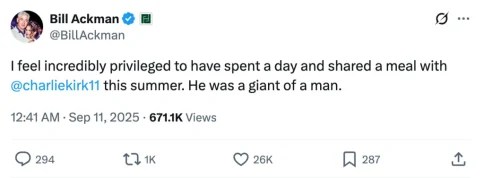
The Grayzone has spoken to five people with intimate knowledge of Kirk’s meeting with Ackman, which was held in early August under the guise of a summertime Hamptons lunch. According to one source, Kirk was left upset after the gathering turned into an “intervention” where he was “hammered” for his increasingly skeptical views on the US special relationship with Israel, and for platforming prominent conservative critics of Israel at his TPUSA events.
When his hosts presented him with a detailed list of every offense he supposedly committed against Israel, Kirk was “horrified,” said one person. At one point, according to another source, Ackman angrily chastised Kirk for his disobedience. The Zionist billionaire also allegedly demanded Kirk rescind his invitation for Tucker Carlson to speak at his upcoming America Fest 2025 in December.
The Grayzone reported on September 12, citing an associate of Kirk, that Netanyahu had offered to organize a massive infusion of pro-Israel money into TPUSA, and that Kirk refused. Another longtime friend of Kirk has told The Grayzone that the conservative activist also rejected an offer Netanyahu delivered two weeks before his death to meet with him in Jerusalem.
Kirk, according to one person with inside knowledge of the meeting with Ackman, said he left feeling as though he’d been subjected to “blackmail.”
In a series of text messages with The Grayzone, Ackman described these accounts of his meeting with Kirk as “totally false.” He pledged to release a public statement providing his own account of the event, but refused The Grayzone’s request for clarification or further details. He would not accept phone calls from this reporter.
“I think I can easily put this to bed,” Ackman promised, “I have receipts as they say.” He did not abide when asked to provide the so-called “receipts.”
In an apparent bid to reinforce the pro-Israel tone at the Hamptons meeting, Ackman hosted a coterie of pro-Israel operatives and conservative influencers at the off-the-record engagement. One was Instagram influencer Xaviaer DuRousseau of Prager U.
Reached by phone by The Grayzone, DuRousseau sounded flustered when asked about his presence at the meeting. He repeatedly demanded to know how this reporter obtained his number, and eventually hung up, refusing to answer questions about the event.
Several Instagram posts by DuRousseau show him and his friend, conservative influencer Emily Wilson, in the Hamptons on August 8 outside Topping Rose House, a posh hotel and restaurant in Bridgehampton, New York.

Two weeks after the meeting, DeRousseau was reportedly junketed on an all-expenses-paid trip by the Israeli government to visit a Gaza Humanitarian Foundation “aid” hub guarded by the IDF on the Gaza frontier. There, he recorded an Instagram video denying that the population of the besieged Gaza Strip was experiencing a famine.
The Grayzone received a similarly agitated response from Wilson, known online as Emily Saves America. Following a phone call and exchange of text messages in which this reporter asked her numerous times about her attendance of the meeting in the Hamptons, Wilson refused to comment. Instagram photos place her in the Hamptons at the same time as DuRousseau.
CJ Pearson, a leading youth coordinator for the Republican National Committee, immediately referred The Grayzone to his communications director when asked if he attended the Hamptons gathering.
The strong-arm tactics of the pro-Israel billionaires who helped fuel the growth of TPUSA were said to have contributed to Kirk’s alienation with evangelical Christianity, which emphasizes uncritical support for Israel as a bedrock principle. Several sources with access to Kirk said he had begun attending Catholic mass with his wife, Erika, and was considering a conversion before his death.
Bree Solsdadt, a Catholic Twitter/X influencer, has publicly corroborated this account of Kirk’s religious realignment. Kirk’s friend, the podcaster and former TPUSA personality Candace Owens, also alluded to the shift when she reflected that he was undergoing a “spiritual transformation” before his death.
Israel-centric influencer summit in the Hamptons
The Grayzone has obtained a partial list of attendees alleged to have been in attendance at the Bridgehampton meeting convened by Ackman this August. They include:
Seth Dillon – Dillion is the CEO of Babylon Bee, the conservative answer to the liberal The Onion satire outlet. Dillon and his crew have derisively mocked famine-stricken Palestinians and their supporters in the West, since Israel’s slash-and-burn campaign began in the besieged Gaza Strip. An evangelical Christian with Jewish heritage, he has claimed, “I did not cease having Ashkenazi blood when I put my faith in Jesus Christ (also a Jew).” Dillon did not answer calls from The Grayzone.
Xaviaer DuRousseau – DuRousseau is employed by Prager U, the premier right-wing “edu-tainment” hub targeting the minds of American youth. His boss, Marissa Streit, is a veteran of the Israeli army’s Unit 8200 cyber-spying division. A Black self-described former progressive, DuRousseau now appears firmly in the pocket of right-wing Zionist forces. During his Israeli government-funded visit to a Gaza Humanitarian Foundation “aid” hub inside Gaza, DuRousseau falsely claimed the United Nations and Hamas were to blame for the hunger sweeping the local population. “If I were Israel, I wouldn’t even provide matching socks to Gaza, but here’s all the aid that y’all claim doesn’t exist,” he said in an Instagram video filmed in front of boxes of aid blocked from entering Gaza. “Instead of Hamas distributing the ramen noodles,” DuRousseau continued, “their leaders are eating it all and that’s why they’re on Ozempic.”

DuRousseau vigorously defended his close friend, podcaster Emily Wilson, after she stated that “if everyone in the state [of Alabama]” wanted the return of chattel slavery, “go ahead, why do I give a shit?”
Emily Wilson aka Emily Saves America – Wilson is a Los Angeles-based self-described libertarian podcaster and social media influencer with over 500,000 followers on Instagram. On September 9, she recalled on Twitter/X how “a HUGE black guy” robbed her when she was 13. “I hate to say it but things like that just change the way you see certain people. After that I always thought, ‘oh, you guys just hate me,’” she reflected. This month, she and DuRousseau recorded a podcast in which they framed pro-Palestine activist Greta Thunberg’s hairstyle as evidence of her being “slow and short bus.”
“I don’t hang out with anyone really less attractive than me,” Wilson stated in a separate appearance.
Arynne Wexler – A former Goldman Sachs trader seeking cachet in the world of online influencers, Wexler is a vociferously Zionist, self-described “non-lib girl in a crazylib world.” In an interview with pro-Israel podcaster Dave Rubin, Wexler argued that “we need to bring bullying back” to enforce social norms, crack down on conspiracy theories, and stop the rise of antisemitism. Wexler has praised Ackman’s pro-Israel activism on multiple occasions. She did not answer calls from The Grayzone.
Nate Friedman – Friedman is a young ultra-Zionist influencer best known for New York City man-on-the-street confrontations with Palestine solidarity activists, whom he’s accused of being paid protesters.
Ory Rinat – Rinat was the former Special Media Advisor to Jared Kushner, the Trump son-in-law and advisor, before moving on to serve as White House chief digital officer during Trump’s first term. A Jewish pro-Israel operative said to have close ties to Netanyahu’s government, Rinat now serves as CEO of Urban Legend, a PR firm which commands “an army of 700 social media influencers who command varying degrees of allegiance from audiences that collectively number in the tens of millions,” according to Wired.
CJ Pearson – The chair of the Republican National Committee’s Youth Advisory Council, Pearson appeared in photos in the Hamptons alongside Wilson and DeRousseau. The Grayzone is awaiting further information from Pearson’s communications director.

CJ Pearson (left) with Emily Wilson, Xavaier DeRousseau, and an unknown person in the Hamptons
Bill Ackman’s war
As The Grayzone reported on September 12, Kirk was besieged with angry calls and messages from pro-Israel donors to his organization following TPUSA’s Student Action Summit this July in Tampa, Florida. Israeli Prime Minister Benjamin Netanyahu had also phoned him, according to a longtime friend of Kirk, and offered to orchestrate a massive infusion of pro-Israel money into his organization.
A longtime friend of Kirk told The Grayzone the mounting pressure had left him “angry” and “frightened.”
Kirk vented about the pro-Israel intimidation campaign in an August 6 discussion with Megyn Kelly, a former Fox News host who was also growing more critical of Israeli influence in Washington.
“It’s all of the sudden, ‘Oh, Charlie: he’s no longer with us.’ Wait a second—what does ‘with us’ mean, exactly? I’m an American, okay? I represent this country,” Kirk complained.
“The more that you guys privately and publicly call our character into question—which is not isolated, it would be one thing if it were just one text, or two texts; it is dozens of texts—then we start to say, ‘whoa, hold the boat here,’” Kirk continued. “To be fair, some really good Jewish friends say, ‘that’s not all of us’… But these are leaders here. These are stakeholders.”
He went on: “I have less ability… to criticize the Israeli government than actual Israelis do. And that’s really, really weird.”
Kirk delivered his comments around the same time as the tumultuous meeting in the Hamptons with Ackman and the crew of pro-Israel influencers.
A month earlier, Kirk had opened the stage at his TPUSA Student Action Summit for a cathartic outpouring of frustration and rage about Israel’s political hammerlock on the Trump administration. At the conference, speakers from Carlson and Kelly to the anti-Zionist Jewish comedian Dave Smith slammed Israel’s blood-soaked assault on the besieged Gaza Strip, branded Jeffrey Epstein as an Israeli intelligence asset, and openly taunted Zionist billionaires like Ackman for “getting away with scams” despite having “no actual skills.”
The mockery by Carlson was particularly galling for Ackman. One day after TPUSA’s conference, Ackman staged a 4,000 word Twitter/X meltdown defending his financial acumen, while insisting that he earned his vast fortune because, “I inherited good genes.”
In fact, the 59-year-old manager of the Pershing Square Capital hedge fund had presided over a precipitous decline in his own personal fortune through a series of bad bets. Between 2015 and 2018, amid a bull market, Ackman’s fund tallied embarrassingly negative returns that cost him an eye-popping $12 billion in losses. His “holy war” to short the multi-level marketing company Herbalife backfired, resulting in a devastating squeeze that cost him heavily. Ackman’s financial mishaps forced him to slash one fifth of his staff in 2018.
The billionaire also took issue with Carlson’s contention that he had been part of convicted sex offender and late Zionist financier Jeffrey Epstein’s “constellation of people.” Yet Carlson’s remarks were grounded in fact. Indeed, Ackman’s wife, the celebrity Israeli designer Neri Oxman, had gifted an artistic orb to Epstein after he plowed $125,000 in donations into her Media Lab at MIT. She was invited to lunch with Epstein on several occasions, according to the Boston Globe, and complied with MIT’s requirement to keep her gift to Epstein confidential.
Ackman has significantly elevated his public profile by leading fellow Zionist billionaires in a ruthless crackdown on post-October 7 Palestine solidarity activism in the US. By leveraging his fortune, Ackman helped dislodge the political scientist Claudine Gay as president of Harvard University, his alma mater, accusing her of adopting an insufficiently draconian policy toward students protesting Israel’s assault on Gaza.
After weeks of pummeling from Ackman, GOP members of Congress, and pro-Israel media, Gay finally quit when conservative activists produced evidence that she had plagiarized in her academic writing. While Ackman claimed victory, he howled with indignation when Business Insider returned the favor with a detailed article which documented multiple cases of plagiarism by his own wife, the designer Oxman. According to the outlet, Oxman “stole sentences and whole paragraphs from Wikipedia, other scholars and technical documents in her academic writing.”
Ackman responded by announcing that he would fund a plagiarism review of every MIT faculty member. He also delivered a 77-page lawsuit threat to Axel Springer, the publisher of Business Insider, accusing them of publishing claims “designed to cause her harm, principally because the reporters do not like me, my support for Israel, and my advocacy.” He quickly dropped the lawsuit, however, claiming he did so because Springer is “an important advocate against antisemitism.”
In May 2024, the Washington Post revealed Ackman as a leading member of a Whatsapp group of 50 ultra-wealthy Zionists coordinating counterinsurgency-style actions against student anti-genocide protesters at Columbia University.
According to the report, the millionaire cabal sought to buy off Black celebrities as propaganda puppets and dangled bribes before New York City Mayor Eric Adams to deploy the NYPD against student protesters. “Some members also offered to pay for private investigators to assist New York police in handling the protests, the chat log shows — an offer a member of the group reported in the chat that Adams accepted,” the Post reported.
This June 14, as Israel reeled at the Iranian response to its unprovoked assault days earlier, Ackman launched his next campaign: “@Israel needs our help to destroy Iran’s nuclear threat to the world…” the hedge funder declared on Twitter. “Israel does not have the equipment and armaments to complete the job. We do, and it does not require boots on the ground.”
Multiple sources including a Trump administration official have revealed to The Grayzone that Kirk personally visited Trump inside the White House to lobby him against attacking Iran. Trump “roared” at Kirk, one said, and shut down the conversation.
A month later, Kirk allowed the simmering rage within the conservative grassroots over Israel’s stranglehold on Washington to pour out at his TPUSA summit. Soon after, he was summoned to the Hamptons for a face-to-face with one of Netanyahu’s most influential allies in the US. Before Ackman and a cast of avaricious young influencers under Israel’s sway, he defied the billionaire power broker, then returned home to prepare for what would be his final speaking tour.
If the United States Wants to Survive It Must Free Itself from Israel
Israeli dominance over Washington has gone on for far too long
By Philip Giraldi • Unz Review • September 11, 2025
I have university degrees in ancient, medieval and early modern history but search as I may, I cannot find another example of a small, low population state largely devoid of natural resources that has been able to dominate the politics and policies of a much larger great power to the extent that Israel controls many aspects of America’s government, its economy, its education system, its media, and, most of all, its foreign and national security policies. Little Israel commands and the superpower United States obeys, a relationship that has coined the expression “the tail wags the dog.”
To be sure, Israel has resources that might be regarded as unconventional for most nation states around the globe, consisting of a large and astonishingly wealthy network of “diaspora” co-religionists who are prepared to corrupt the governments in the countries where they actually live to benefit the Jewish state in every way possible. Politicians can easily be bought by Jewish billionaires, as in the case of President Donald Trump who reportedly received $100 million as a campaign donation from Israeli Las Vegas casino magnate Miriam Adelson, plausibly in exchange for Israel having a free hand in the West Bank, up to and including total annexation and deportation of the inhabitants to eliminate a possible Palestinian state.
In the United States, this Zionist Lobby power has produced a series of presidents terrified to object to what Israel declares to be its interests, plus a Congress that has been bought and manipulated into total submission to war criminals like Israel’s ghastly Prime Minister Benjamin Netanyahu. Even the US Constitution is no defense against Israel’s interests, with First Amendment free speech rights being abridged through the interpretation that any criticism of the self-described Jewish state is ipso facto a hate crime, which is a felony.
The abuse inherent in the relationship, which is hugely expensive to the US and damaging to its real interests, is fortunately beginning to be so visible that a reaction to the arrangement is beginning to penetrate to the level of the average voters. Opinion polls suggest that most Americans oppose what Israel is doing to the Palestinians, but President Donald Trump and the clowns he has appointed to high office, Zionists all, are unmoved. Hopefully they will see the light if a strong message is sent during elections coming up in November.
In a recent interview, I declared that the only real national security threat against the United States comes from Israel in that it has repeatedly pushed America into bad policy choices to serve its own interests. That means that policymakers, in search of the number one “American enemy” in the world, should look no farther than Israel and they should immediately take steps to distance themselves from Israeli initiatives. In terms of other alleged threats to the US, one must concede that most analyses coming out of Washington are essentially phony, designed to deflect from real problems, including which is what to do about Israel and the all-powerful Israeli Lobby reenforced by the “waiting for a Rapture” Christian Zionists that have taken over so much of the government. Sorry Marco Rubio but Russia, China, Iran, and Venezuela do not threaten the United States of America. Continuation of the dance of death with the Israelis will on the contrary be likely to lead to ruin for Americans.
The sad truth is that the United States gains absolutely nothing from its bondage to Israel, quite the contrary. When I was in government in CIA Stations and Bases in Europe and the Middle East I used to hear US politicians proclaiming how Israel (Mossad) shared wonderful intelligence information that made America safer. The truth was quite different as I used to see the Israel-generated reports and they were consistently puff pieces intended to make Arabs and Iranians look bad by inventing “threats.” It was that type of information, i.e. the claimed existence of WMD, promoted by Jewish neocons in the media as well as in the Defense Department and in the Vice President’s office, that led to war against a completely non-threatening Iraq that killed as many as 600,000 Iraqis.
More recent developments illuminate just how poisonous the relationship with Israel is, though one might also dare to mention long ago Jewish state perfidy like the attack on the USS Liberty in 1967 that killed 34 sailors and the suspicions about Israeli involvement in both the killing of JFK and 9/11, all of which were subject to deliberate US government cover-ups and bungled investigations. Israel does not hesitate to kill Americans, witness the cases of protester Rachel Corrie and journalist Shireen Abu Akleh, both of whom were murdered by the Israeli army. In neither case did the US Embassy demand an explanation from the Israelis.
This past June, Israel decided to attack Iran and convinced Donald Trump to join in the game, with the argument that Iran is secretly building nuclear weapons, which was not true. Israel, of course, has its own secret nuclear arsenal, and has even threatened to use the weapons in the Samson Option, but both Tel Aviv and Washington apparently regard that as perfectly acceptable. So the United States, to oblige Israel, followed on to the Israeli attack and hit selected targets in Iran. This led to a lying or ignorant, you can take your choice, Trump boasting about how he had “obliterated” the Iranian nuclear development sites, which was not true. So what was gained? Again “nothing” but the US went to war, a war crime, solely to appease Israel and spent something like $1 billion to carry out the mission.
More recently, Israel bombed a residential building in Doha, the capital of Qatar, in a bid to kill Hamas officials who were in the city to negotiate a cease fire in Gaza with the Israelis. The meeting was allegedly backed and “guaranteed” by Washington but it now appears that, at the same time, Trump or his associates were conniving with Israel to assassinate the Hamas representatives. The US has its largest air base in the Middle East in Qatar at Al Udeid with 10,000 American military on site. Mysteriously, the base’s radar and air defense system appear to have been turned off when the Israeli planes were approaching the target. One wonders who ordered that. And the planes needed to be refueled to return to Israel after the attack. Conveniently, British Royal Air Force tankers were in the area to carry out that task. Sounds like a set-up to end any chance of a ceasefire by killing Hamas envoys in an ostensibly safe country Qatar that was orchestrated by Israel, the US and Britain. And what does the United States of America gain from it? “Nothing!” Or rather, global hatred of Washington due to its groveling support of all things Israeli just crept up by ten points!
And then there is the Genocide in Gaza itself. If there is any remaining confusion about Trump’s true intentions, one might cite Netanyahu, who has asserted that he has complete American support to do whatever he wants in Gaza, “no partial deals with Hamas, go with full force.” It is nevertheless difficult to imagine how average Americans benefit by allowing the crime against humanity to go on and on, something that could be stopped with a phone call if Donald Trump had even a trace of compassion hidden somewhere in that empty head that he bears.
Regrettably, the United States is completely complicit in the atrocity that is taking place in Gaza which is clearly visible to the entire world. And the US is even paying for and providing the arms for the slaughter. There is a certain irony in the fact that Washington funds the war for Israel, which has both free medical care and free higher education for its Jewish citizens, something that many American citizens are reportedly struggling with. One might well describe it as a misplaced priority, but it is in reality yet another symptom of the power that Israel has over the United States government from top to bottom.
Finally, if any additional evidence were required to demonstrate Israel’s power over the United States, the recent block by Washington on visa issuance for Palestinian participation in the United Nations opening session in New York as well as the general ban on accepting passports issued by the Palestine Authority are steps demanded by Israel to make it impossible for Palestinians to argue their own case for statehood and decent treatment in international fora. And what does the US get out of it even though it in theory supports a two-state solution for Israel/Palestine? Nothing.
Such is the level of pure evil emanating from Israel that many have come to believe that it is capable of any crime, which is quite likely true. Conservative activist Charlie Kirk, who was assassinated on Wednesday, reportedly had begun to entertain some criticism of Israel which had resulted in threats that led him to employ bodyguards. As a result of that and other developments, momentum is growing to do something about Israel, which is clearly considered a threat to all the world, completely reckless in its behavior, and having “secret” nuclear weapons that it is very likely prepared to use. Suspension from the UN and the insertion of an international protection force in Gaza to stop the genocide are being discussed under the “Uniting for Peace” resolution, which empowers the General Assembly to recommend such steps to take when the Security Council is unable to act due to the expected US veto. There are also calls for Israel’s presence and privileges within the UN system to be suspended until a ceasefire in Gaza and full humanitarian access to the strip is restored. But never fear, Donald Trump will receive his orders from Benjamin Netanyahu and the US will do everything in its power as the rogue state it has become to stop any such action, including threats of sanctions and even violence against those promoting those moves, just as the US has done with the International Criminal Court and other bodies seeking an end to Israel’s war crimes. That is the unfortunate reality.
Philip M. Giraldi, Ph.D., is Executive Director of the Council for the National Interest, a 501(c)3 tax deductible educational foundation (Federal ID Number #52-1739023) that seeks a more interests-based U.S. foreign policy in the Middle East. Website is councilforthenationalinterest.org, address is P.O. Box 2157, Purcellville VA 20134 and its email is inform@cnionline.org.
Hezbollah denies any links to arrestees in Damascus countryside
Al Mayadeen | September 11, 2025
Hezbollah has denied the Syrian Interior Ministry’s claim that several individuals arrested in the western Damascus countryside are members of the group.
In a statement issued by its Media Relations Office on Thursday, Hezbollah reiterated that it does not have any presence or any activity within Syrian territory, asserting that it is “deeply committed to Syria’s stability and the security of its people.”
This follows remarks by the head of internal security for the Damascus countryside governorate, Brigadier General Ahmad al-Dalati, who alleged that security forces arrested a cell operating in the western Damascus countryside towns of Sa’sa’ and Kanakir, which he claimed was affiliated with Hezbollah.
Al-Dalati further claimed that security forces had seized rocket launch platforms, 19 Grad-type rockets, anti-tank missiles, a number of individual weapons, and large quantities of various types of ammunition.
Not so new accusations
Syria has previously leveled similar accusations against Hezbollah, which consistently denies having any involvement or presence on Syrian soil.
On July 13, Hezbollah categorically denied similar allegations made by Syria’s Interior Ministry that one of the individuals arrested in Homs at the time was affiliated with the Lebanese Resistance group.
In a statement issued Sunday by its Media Relations Office, Hezbollah said it has “no presence or activity in Syria” and rejected any connection to local events or conflicts.
No involvement in Syria events
On March 8, Hezbollah issued a firm denial of media reports that claimed it was involved in the ongoing conflict in Syria, as a war monitor reported that recent violence had killed more than 500 people from the country’s Alawite minority community.
In its statement, Hezbollah’s Media Relations Office urged media outlets to refrain from falling for disinformation campaigns that serve questionable foreign agendas, asserting that “some parties are keen to drag Hezbollah’s name into the events taking place in Syria and accuse it of being a party to the conflict.”
The Lebanese Resistance group further called on media outlets to uphold accuracy in their reporting and to avoid being drawn into politically motivated disinformation campaigns that serve foreign interests.
US House votes to repeal president’s Middle East war powers
Al Mayadeen | September 11, 2025
In a significant move to reclaim Congressional authority over military engagement, the US House of Representatives voted on Tuesday to repeal decades-old laws that authorized war in the Middle East.
The 261-167 vote represents a bipartisan push to rescind the 1991 and 2002 Authorizations for Use of Military Force (AUMFs), originally enacted ahead of the Gulf War and the 2003 invasion of Iraq.
The repeal was adopted as an amendment to the annual National Defense Authorization Act (NDAA) and is being hailed as a victory for war powers reform advocates, who argue that outdated authorizations enable unchecked presidential use of military force.
Long-awaited win for war powers reform advocates
The amendment was co-sponsored by Rep. Chip Roy (R-TX) and Rep. Gregory Meeks (D-NY) and garnered support from 49 Republicans and 212 Democrats. Advocates argue that keeping these authorizations in place enables future administrations to bypass Congress in deploying US military power.
“We don’t need to have Congress effectively modern-day declaring war and leaving it in place for a quarter of a freaking century, or in this case, 34 years,” said Roy.
Meeks added that he was “prepared to fight” in upcoming Senate negotiations to ensure the repeal becomes law.
Pushback from opponents
The proposal had an uncertain path to passage. Initially excluded from the package of amendments allowed for floor debate, the measure was added only after an unusual procedural win in the House Rules Committee. Republicans Ralph Norman (SC), Morgan Griffith (VA), and Chip Roy broke with their party to help Democrats force a debate on the amendment.
Not all lawmakers welcomed the repeal. Rep. Joe Wilson (R-FL) warned that revoking the war powers laws would “tie the president’s hands” in responding to regional threats, including resistance movements in Iraq.
Despite these concerns, the amendment passed with bipartisan backing, though deeper divisions remain over broader defense policies.
Wider debate over executive military power continues
While the vote represents a symbolic step toward limiting presidential war authority, critics note that the repeal will not affect recent military actions, including President Donald Trump’s alleged strike last week on a vessel in the Caribbean he claimed was for smuggling drugs.
The war powers repeal is expected to become a central issue in House-Senate negotiations over the final defense policy package. Although both chambers have voted in recent years to repeal the 2002 Iraq AUMF, no repeal legislation has yet been enacted into law.
Background on AUMFs
- 1991 AUMF: Authorized military force during the Gulf War under President George H. W. Bush;
- 2002 AUMF: Enabled the 2003 invasion of Iraq under President George W. Bush;
- 2014: Former President Barack Obama used the authorization to justify airstrikes in Iraq and Syria;
- 2020: US President Donald Trump used it in his first term to greenlight the airstrike that killed the IRGC’s Quds Force commander General Qassem Soleimani in Baghdad.
While former President Joe Biden never formally used the authorization, his administration argued it was important to keep it intact to respond to any future threats.
Why Did Qatar’s Air Defenses Fail During Israel’s Attack?
By Ekaterina Blinova – Sputnik – 10.09.2025
The missiles fired by Israel could have been intercepted by Qatar’s US Patriot systems. Russian military expert Yuri Knutov weighs in: the Patriots were simply turned off by the US.
Patriots Offline
“The main feature of these systems is their close integration with airborne early warning and control aircraft (AWACS), satellites, and command centers that provide targeting data,” Knutov tells Sputnik. “In addition, they have a [remote] shutdown feature to prevent accidental friendly fire.”
This shutdown feature is problematic: Turkiye refused to purchase the Patriot specifically because the American side could disable these systems at any moment, and therefore preferred the S-400, according to the pundit.
US Didn’t Defend Qatar
Apart from using Patriots, Qatar hosts the US’ largest military base in the Middle East.
“According to the agreement between Qatar and the US, the Americans were, of course, supposed to defend Qatar’s airspace by opening fire on Israeli aircraft. However, this did not happen,” Knutov says.
The US military knew about the incoming Israeli aircraft yet took no action, effectively allowing them to operate freely against the Hamas delegation invited to Qatar for negotiations. The US was fully aware of this.
Arab countries — and not just them — should take note: wherever US Patriots are used, the US can disable them at any moment, leaving their skies completely defenseless.
US Always Sides With Israel
“This is undoubtedly a scandalous situation, given that Qatar is a close US ally and had promised to invest billions in the American economy,” Knutov says. “The Americans warned Qatar of the attack only ten minutes after it had taken place.”
Appeasing the US is futile — they always side with Israel.
Political Scene in Lebanon: Meetings Confirm Failure of Anti-Resistance Scheme
Al-Manar | September 8, 2025
Since the council of ministers convened at Baabda Palace on September 5 and decided to curb the process of targeting the resistance arms, political tensions in Lebanon started to slide.
The regular meetings between the senior officials in Lebanon was resumed with the House Speaker of Parliament Nabih Berri’s visit to Baabda Palace on Monday
Speaker Berri reviewed the general situation with President Joseph Aoun, affirming that everything is fine.
“With the blessings of Our Lady Mary, everything is fine.”
The House Speaker on Monday also met in Ain el-Tineh with Lebanese Army Commander, General Rudolf Haykal, who presented the military plan to confine weapons under the condition of the Israeli commitment to the ceasefire,
Commenting on the recent parliamentary session, Head of Hezbollah’s parliamentary bloc leader Mohammad Raad said the September 5 outcome signaled a retreat by many in government who realized the earlier arms decision had reached a dead end.
“They found a formula to delay implementation without fully withdrawing from their decision. It’s not a solution—it’s simply a pause,” Hezbollah’s MP asserted.
Raad asserted that Hezbollah’s weapons are “more legitimate than the government itself,” citing the group’s right to defend Lebanese land under national and international law.
On your knees: This EU move has just revealed the scale of their insignificance
In 2018, Europe swore it would shield the Iran deal from Trump. In 2025, it brought Trump’s ‘maximum pressure’ back under their own banner.
By Farhad Ibragimov | RT | September 8, 2025
Back in 2018, Europe blasted Donald Trump for pulling out of the Iran nuclear deal. Paris, Berlin, and London warned of a looming crisis in the Middle East and insisted the Joint Comprehensive Plan of Action (JCPOA) was the only safeguard against another regional war. They even rolled out a special financial vehicle, Instrument in Support of Trade Exchanges (INSTEX), to shield trade with Tehran from US sanctions. For a moment, it looked as if Europe was finally ready to assert its own strategic autonomy.
Seven years later, the picture couldn’t be more different. Britain, France, and Germany have triggered the snapback mechanism – a procedure written into UN Security Council Resolution 2231 back in 2015. On paper, snapback is a technical clause: if one of the deal’s signatories claims Iran is in breach, all the pre-2015 UN sanctions come rushing back. In practice, it’s a political bombshell. The very governments that once positioned themselves as defenders of the deal are now taking the first steps to dismantle it.
How snapback works
Snapback is a built-in device of Resolution 2231: once a party to the deal files a complaint, a thirty-day clock starts ticking. If the Security Council can’t agree to keep the sanctions lifted, the old restrictions automatically spring back into place – no new vote, no vetoes, just the force of the mechanism itself snapping shut.
And those sanctions aren’t symbolic. They revive six earlier UN resolutions passed between 2006 and 2010: an arms embargo, a ban on ballistic missile development, asset freezes, and travel bans targeting Iranian banks, companies, and officials. In other words, a full reset to the era of maximum pressure that Tehran endured more than a decade ago.
On paper, it reads like legalese. In practice, it carries weighty consequences. For Europe, it means slamming shut whatever limited doors were still open for trade and diplomacy with Tehran. For Iran, it’s a return to a familiar landscape of international isolation – one it has increasingly learned to navigate through ties with Russia, China, and regional partners.
Europe’s brief rebellion
When Donald Trump tore up the nuclear deal in 2018, Europe seemed almost defiant. Emmanuel Macron, Angela Merkel, and Theresa May openly criticized Washington’s unilateral move, warning it could ignite a new crisis in the Middle East and weaken the global nonproliferation regime. For a moment, it looked as if Europe was ready to chart its own course.
To prove it, Paris, Berlin, and London announced a special financial vehicle called INSTEX. On paper, it was meant to let European companies keep trading with Iran while bypassing US sanctions. In speeches, leaders cast it as a bold example of strategic autonomy – Europe standing by international law against American pressure.
In practice, it never delivered. Transactions were scarce, businesses stayed away, and INSTEX turned into little more than a symbol. What was meant to showcase Europe’s independence exposed instead its limits. Behind the rhetoric, the continent still lacked the muscle to stand up to Washington.
Even after the deal began to unravel, Tehran held on longer than many expected. For a time, Iran continued to observe key limits, signaling that it still wanted the agreement to survive. The steps it did take after 2019 – enriching uranium beyond agreed levels, reducing access for inspectors – were limited and largely declarative. They were less about racing toward a bomb than about sending a message: if Europe and the United States failed to keep their end of the bargain, Iran would not keep waiting forever.
Europe could have treated those moves as a call for dialogue. Instead, it chose to treat them as violations to be punished – leaning on legal mechanisms and pressure rather than genuine diplomacy. In practice, this meant not saving the deal but accelerating its collapse.
When Joe Biden took office in 2021, many in Europe breathed a sigh of relief. After four years of Trump’s “maximum pressure,” there was hope the US would return to the nuclear deal or at least give Europe more room to re-engage with Tehran. European diplomats saw Biden’s presidency as a reset button, a chance to salvage what was left of the JCPOA.
Talks resumed in 2022, bringing negotiators from Washington, the E3, and Tehran back to the table. But the optimism didn’t last. The West’s conditions went far beyond nuclear conditions: Iran was pressed to scale back its ties with Russia and cut off growing cooperation with China. To Tehran, those demands amounted to political disarmament – a direct threat to its sovereignty and security.
The negotiations collapsed. For Europe, it was a sobering moment: the Democratic administration they had counted on offered no breakthrough. For Iran, it confirmed what many suspected – that Washington’s return to the deal would come with strings too heavy to accept.
The US get what they want
The word snapback has already made waves in the halls of the UN back in August 2020. That summer, the Trump administration formally notified the Security Council that Iran was in breach of the nuclear deal and demanded that the old UN sanctions be reinstated. US lawyers pointed to Resolution 2231, which still listed Washington as a “participant” in the agreement – even though Trump had withdrawn the US two years earlier.
The reaction was swift and humiliating. Russia and China dismissed the move outright, and so did America’s closest allies in Europe. London, Paris, and Berlin all publicly declared that Washington had no standing to use the mechanism after quitting the deal. The snapback effort fizzled, and the sanctions remained suspended.
The irony is hard to miss. In 2020, Europe stood shoulder to shoulder with Moscow and Beijing to block Washington’s attempt. Five years later, the very same European capitals are the ones pulling the trigger.
When London, Paris, and Berlin announced they were triggering snapback, they wrapped the move in the language of diplomacy. In Paris, Foreign Minister Jean-Noël Barrot stressed that France was still “open to a political solution.” In Berlin, Johann Wadephul urged Tehran to re-engage with the IAEA. Britain’s David Lammy said Iran had provided “no credible guarantees” about the peaceful nature of its program.
On the surface, it sounded like a routine chorus of diplomatic talking points. But behind the careful wording was a clear message: Europe was abandoning the posture of dialogue and embracing pressure. What the E3 once condemned in Washington, they were now carrying out themselves – only this time under their own flag.
In Tehran, the language was restrained but pointed. Officials called the European move “illegal and regrettable,” a formula that barely concealed deep frustration. For Iran, Europe’s decision confirmed once again that Brussels talks about strategic autonomy but falls in line the moment Washington sets the course.
Across the Atlantic, the response was the opposite: warm approval. Secretary of State Marco Rubio “welcomed” the step and claimed that snapback only strengthened America’s willingness to negotiate. Formally it sounded like an invitation to dialogue. But the memory of the spring talks – which ended not with compromise but with Israeli sabotage and US strikes on Iranian facilities – made the words ring hollow.
A world that has moved on
Europe’s wager on sanctions is a throwback to the early 2010s, when Tehran was isolated and the West could dictate terms. But that era is gone. Today Iran is not only a strategic partner for Moscow and Beijing but also a full member of BRICS and the Shanghai Cooperation Organization – platforms that carve out alternatives to the Western order.
In this new landscape, snapback may sting in Tehran, but it hits Europe too. Brussels loses credibility as a negotiator and opportunities as a trading partner. Each step in Washington’s shadow makes the European claim to “strategic autonomy” sound thinner.
The paradox is striking. On paper, Europe insists on its independence. In reality, its voice is fading in a multipolar world. While Brussels signs off on sanctions, Beijing and Moscow are busy sketching the architecture of a new order – one where Europe is no longer at the center.
Farhad Ibragimov – lecturer at the Faculty of Economics at RUDN University, visiting lecturer at the Institute of Social Sciences of the Russian Presidential Academy of National Economy and Public Administration
@farhadibragim
Washington sanctions Palestinian rights groups for aiding ICC in Gaza war crimes probe
The White House is covering for Israeli war crimes amid its operation to ethnically cleanse and demolish Gaza City
The Cradle | September 5, 2025
The US has imposed sanctions on three Palestinian human rights organizations that previously petitioned the International Criminal Court (ICC) to investigate Israel for war crimes in Gaza.
“Today, the Trump Administration is sanctioning three NGOs – Al Haq, Al Mezan, and the Palestinian Centre for Human Rights – for assisting in the ICC’s illegitimate actions against Israel. The United States will continue to protect our own sovereignty and the sovereignty of our allies from the ICC’s overreach,” US Secretary of State Marco Rubio wrote on Thursday evening on X.
The announcement first appeared as a notice on the US Treasury Department’s website on Thursday.
In November 2023, the organizations requested that the ICC investigate Israel for war crimes in response to its actions in Gaza, including carrying out airstrikes on heavily populated civilian areas, imposing a complete siege to cut off food, water, and electricity to the civilian population, and causing the mass displacement of residents.
On 31 October 2023, Israel bombed the Jabalia refugee camp, killing some 120 people, mostly women and children, in one airstrike with a 2,000-pound (907 kilograms) bomb.
In May of 2024, ICC prosecutor Karim Khan requested that the court’s judges issue arrest warrants for Israeli Prime Minister Benjamin Netanyahu and then-defense minister Yoav Gallant on charges of using starvation as a weapon of war in Gaza.
The ICC issued the arrest warrants in November 2024.
The US responded by imposing sanctions on ICC judges and Khan, calling the Hague-based court a “national security threat.”
A smear campaign was also launched, accusing Khan of sexual misconduct in the workplace.
The ICC was established in 2002 to try cases of war crimes, crimes against humanity, and genocide. The jurisdiction of the court is recognized by its 125 member countries. However, the US, China, Russia, and Israel do not recognize the court’s authority.
The US Treasury announcement comes as Israel continues its destruction of Gaza City, which Tel Aviv is seeking to ethnically cleanse of its hundreds of thousands of Palestinian residents.
While Israeli leaders say they wish to defeat Hamas, the Israeli military is systematically demolishing Palestinian cities to make way for a mega real estate project backed by Israeli businessmen and the White House.
US President Donald Trump has stated that Palestinians will be forced to leave Gaza, which will be turned into a high-tech smart city and resort hub he has dubbed the “Riviera of the Middle East.”
Israel has issued evacuation orders for Gaza City as the demolition moves forward.
“The Israeli forces, when they mark any area by red color and they request the people to leave, they really will destroy it,” said Gaza City resident Mohammed Alkurdi while speaking with AP.
“It’s not something partial like before. It’s 100 percent,” he said. “The house, I’m telling my friends, it keeps dancing all the day. It keeps dancing, going right and left like an earthquake.”
Another Gaza City resident, Amjad Shawa, the director of a Palestinian NGO network, told AP that “Gaza [City] will be leveled and destroyed,” like other cities in the enclave.
After months of Israeli bombing, “there is no Rafah. Almost no Khan Yunis,” Shawa said.
Some residents of Gaza City are choosing to leave ahead of the Israeli warplanes and bulldozers.
For others, leaving is not possible at all due to age, sickness, and lack of anywhere else to go.
“The elders, they’re saying we will die here,” Shawa said. “This has pushed the other members of the family to stay, not to leave.”
The coming war on Iran will be regional, perhaps international
By Robert Inlakesh | Al Mayadeen | September 2, 2025
It is unlikely that the anticipated continuation of the war on Iran, spearheaded by the Israelis but led by the United States, will be confined to a simple tit-for-tat missile trade-off as we saw earlier this year. The reason for this is simple: too much is at stake if this front again flares up.
Since the US-brokered ceasefire between “Israel” and Iran went into effect on June 29, the United States and the Zionist regime have scrambled to move around military equipment, engage in mass surveillance flights over Lebanon and the Persian Gulf. More recently, the US began an early withdrawal of its forces from the Ain al-Assad base and other installations inside Iraq.
The first point of entry to understanding what is currently brewing across West Asia is understanding the mentality at play on both sides of the divide.
On one side, we have the Zionist regime and its Western allies, who are the aggressors and believe themselves to be fighting what Israeli Prime Minister Benjamin Netanyahu calls a “seven-front war”. Although the front in the Gaza Strip has pervaded public consciousness over the past 23 months, overshadowing the wars on Lebanon, seizure of territory in Syria, bombing of Yemen, and attack on Iran, it is very much part of this wider war.
From the Israeli-American perspective, their ongoing war carries the goal of eliminating what is known as the Axis of Resistance, the leader of which is the Islamic Republic of Iran. The thinking clearly is that this period in time has provided a unique opportunity to crush the regional resistance and with it, achieve regime change in Tehran.
In June, the Israelis clearly got ahead of themselves and believed that they could inflict a similar blow in Iran to the blow they inflicted on Lebanese Hezbollah back in September of 2024. In the first few hours of the Zionist Regime’s illegal attack on Iran, their media boasted of landing such a blow. However, to everyone’s surprise, within 15 hours, the Iranians were back on their feet and began firing bursts of ballistic missiles into central “Tel Aviv”.
Even the US strikes didn’t inflict any kind of kill blow that degraded Iran sufficiently, as it proved more than anything that their nuclear facilities could survive US strikes, even if they were badly damaged. The United States certainly poses a major threat to Iran, but the takeaway here is that the Zionist regime can’t take them on alone.
If there is another battle between Iran and the Israelis, the Zionist Entity is already low on interceptor missiles, and its arsenal would be severely drained within around a week or so. We also still do not know the extent of the damage inflicted by Iran’s ballistic missile strikes, due to Israeli military censorship. Simply put, they don’t even allow the public to know the true number of soldiers killed and wounded in Gaza, so forget the notion that they’d admit what Iran did to them.
Another major player here is Lebanese Hezbollah, which appears to be successfully rebuilding itself and is at an intelligence deficit compared to what they had built up over decades and utilized late last year. Yet, what the Israelis do understand is that in the event that a conflict with Iran arises where Hezbollah chooses to enter the fight on the ground, they may face an existential battle for their very survival.
If, and this evidently depends on varying factors, Hezbollah chooses to launch an all-out ground offensive as Iran fires ballistic missiles in bursts across occupied Palestine, it is plausible that the Lebanese party will inflict a total defeat on the Israeli ground forces and seize huge swaths of territory in the north of Palestine.
The Zionist regime is now claiming to be preparing for mission impossible in the Gaza Strip, amassing troops in order to try and occupy Gaza City, an operation that would take between two to five years to complete, according to Israeli military estimates. It would also be extremely costly for the Israeli ground forces and their military vehicles. If they do commit to this, it would leave them open on the northern front. There is, however, the possibility that this is all a bluff.
If the Israelis are bluffing, they could be preparing for an offensive against Lebanon instead. The thinking here would be to try and halt Hezbollah’s rebuilding process, setting it back even further, and could even involve a ground operation, likely using Syrian territory to invade the Bekaa Valley area.
Such a conflict would be existential for Hezbollah, especially as the US works with the Lebanese government to impose a seizure of its weapons. A repeat of what occurred a year ago would work only to advance the US-Israeli goal of seizing Hezbollah’s weapons, while a victory could at the very least liberate Lebanese territory and represent a massive blow to the disarmament agenda.
Therefore, if Iran is currently in the scope of the Zionists, it would make strategic sense for them to either attack Lebanon first or launch a major offensive at the same time it attacks Iran.
The US withdrawal of forces from Iraq is another major indicator of a regional escalation involving Iran, specifically because of the Popular Mobilization Units (PMU) and the potential they have to inflict enormous damage, given that they enter the fold of the war.
Iraq’s PMU is yet to be mobilized, and its role in the ongoing regional conflict has been minimal. The reason for this is that if some 230,000 men are mobilized, or even a portion of them, it is difficult to suddenly put a halt to their operations, and this will mean a dramatic regional escalation, the likes of which the United States will not be able to manage inside Iraq and will instead use their economic levers as a primary weapon of war.
Depending on how far such a conflict is going to go, there is even the possibility that it could go global. While there is currently no evidence to support this notion, there has been talk that the US naval deployment to the Caribbean, triggering a mass militia mobilization across Venezuela, could be connected. Additionally, China and Russia could use the opportunity of a major Iran-US war to carry out some of their long-desired goals, at a time when Washington has diverted its resources to West Asia.
There is again the possibility that another attack on Iran could look similar to what the world witnessed during what is dubbed the “12-day war”, yet the same stalemate outcome would only lead us back to square one again and beget yet another war. At some point, something will have to give.
The reason why the danger of an all-out regional conflagration appears high as of now is purely down to the Israeli-US refusal to end their genocide against Gaza, indicating that they seek total defeat of the Axis of Resistance and nothing less. Inevitably, one side must win and the other lose; there is currently no such thing as deterrence for either side, only who will triumph and carve out a new regional reality.
Seyed M. Marandi: Iran’s ‘End of Time’ Missile Ready for New War
Glenn Diesen | August 31, 2025
Seyed Mohammad Marandi is a professor at Tehran University and a former advisor to Iran’s Nuclear Negotiation Team. Prof. Marandi argues that another Israeli/US attack is likely coming, and Iran has prepared itself by developing new and more powerful missiles. Prof. Marandi also argues that the only influence the EU had over Iran was the threat of using the snap-back sanctions, and Iran will no longer listen to the EU, as the decision has been made to impose these sanctions.
Iran: Path for Negotiations with US Not Closed
By Kyle Anzalone | The Libertarian Institute | September 2, 2025
A top Iranian official said a deal with the US is still possible, but Washington must drop its demands to limit Tehran’s missile program. Talks between the US and Iran broke off in June when Israel launched an unprovoked war against the Islamic Republic.
On Tuesday, Ali Larijani posted a statement from the Iranian Supreme National Security Council on X. “The path for negotiations with the US is not closed; yet these are the Americans who only pay lip service to talks and do not come to the table; and they wrongfully blame Iran for it,” he wrote. “WE INDEED PURSUE RATIONAL NEGOTIATIONS. By raising unrealizable issues such as missile restrictions, they set a path which negates any talks.”
Since Donald Trump returned to office, the US and Iran engaged in five rounds of negotiations aimed at establishing a new nuclear agreement and lifting sanctions. A sixth round of talks was scheduled, but Israel attacked Iran, halting the diplomatic process. Iranian officials said the talks were progressing towards a deal before the attack.
The US participated in the Israeli war on Iran. Tehran has demanded that Washington give assurances that the US and Israel will not resume strikes on Iran while the talks are ongoing. However, Trump has not responded to Tehran’s demand and has threatened to attack Iran if Tehran restarts its nuclear enrichment program.
Trump has pressed Iran to agree to a new nuclear agreement after he scrapped the Joint Comprehensive Plan of Action (JCPOA) during his first administration. The 2015 Iran Nuclear deal established a strict inspection regime and limitations on Tehran’s nuclear program.
After Trump broke the agreement and reimposed sanctions on Iran, Tehran exceeded the limits set in the nuclear deal. In response to a series of Israeli assassinations and sabotage attacks, Tehran enriched uranium to a higher level and established a stockpile of 60% enriched Uranium.
Tehran expelled international nuclear inspectors following Israel’s attack on Iran in June.
What drives Americans to fight on the frontlines of Gaza’s war crimes
By Jamal Kanj | MEMO | September 1, 2025
Serving in the military is the ultimate test of loyalty. When young Americans raise their right hand, they pledge to defend their nation, their Constitution, their people. Yet for many young Americans, that oath is NOT made to the United States military. Instead, they pack their bags, fly across the Atlantic, and enlist in a foreign army—the Israeli War Machine, aka, Israeli Defence Forces (IDF).
The numbers speak loudly. According to the Washington Post, 23,000 Jewish American citizens are currently serving in the Israeli military. By contrast, US Department of Defence data shows that in 2006 fewer than 4,000 American service members identified as Jewish. A later DoD report in January 2019 placed the figure at roughly 0.4 per cent of active-duty personnel. Put simply, more Jewish Americans, both in numbers and percentage, serve under the misappropriated Star of David than under the Stars and Stripes.
Naturally, many new Americans maintain personal cultural and ancestral ties to their homelands—a land they actually come from, with real last names, not Hebraized East European family names. No ethnic group, however, has a lobby dedicated to serving the policy of a foreign country, like AIPAC. Mexican Americans celebrate Mexico’s victory on Cinco de Mayo, but do not promote enlisting in Mexico’s military. Irish Americans rejoice Saint Patrick’s Day, but had not lined up to join the Irish Republican Army. No ethnic American group raises nonprofit tax deductible funds for a foreign army, other than the Jewish billionaires, who bankroll “Friends of the IDF.”
Controlled by this foreign lobby, Congress not only tolerates the Israeli exception, rather it tries to reward it. Two Jewish Republican lawmakers; Guy Reschenthaler and Max Miller, have proposed legislation, H.R. 8445, to amend the American Servicemembers Civil Relief Act to include (Jewish) Americans serving in the Israeli army. If passed, the amendment would grant these “foreign” soldiers the same benefits reserved for Americans in uniform.
Let that sink in: Israeli (American) soldiers would have the same protections as American army soldiers. An Israeli who is starving babies and committing war crimes in Gaza, would be legally indistinguishable from an American marine guarding Camp Pendleton in California.
When it comes to Israel, AIPAC, through the disproportionate Jewish representation in both Houses—three to five times higher than their share of the U.S. adult population—exerts outsized clout. Combine this with the campaign finance power over elected officials, AIPAC can flex its muscles to institutionalize the Israeli exception. One could pose the question, if this is good for Israeli (American) soldiers, why not provide all Americans serving in foreign armies the same benefits? Maybe for a Muslim American soldier, if any, serving in Pakistan or Egypt. Such an idea would most likely cause a revolt in Washington. Accusations of dual loyalty, even treason, would dominate the headlines. If so, why not in the Israeli case?
One of those soldiers is David Meyers from California who spent six years in the Israeli navy. He explained his decision to enlist in the Israeli military, citing “… an incredibly deep and long connection that I have to Israel.” Answering a question for reasons he chose a foreign army over his own, his answer was more telling: “The United States with its strength and size, perhaps, isn’t quite needing your abilities and your efforts.”
Since when did America’s strength become an excuse to abandon it for a foreign army? Regardless, Meyers’s statement suggests he does not have a deep or long connection to the country of his birth—or at least not one as deep as to a foreign country. America is strong only because its citizens choose to serve it, not ditch it in favor of a foreign uniform. To dismiss the U.S. military as too mighty to need Jewish Americans isn’t about necessity, it’s about misplaced loyalty.
Many of the Americans serving in the Israeli army are called lone soldiers. They are the young Americans with New York or Texas accents; I’ve encountered at occupation checkpoints throughout Palestine. Their job is to humiliate Palestinians in the West Bank, and starve children in Gaza.
Some may frame their service as defending “the Jewish people.” When in fact, they are fueling Jewish hate in the West for being the face of the “Jewish-only” colonies built on stolen Palestinian land, or for imposing an apartheid occupation on behalf of a foreign political entity, whose leaders stand indicted by the International Criminal Court (ICC).
With this in mind, these Americans are participating in what the UN, Amnesty International, and Human Rights Watch have described as war crimes—from the engineered starvation of babies in Gaza, to the subjugation of Palestinians in the occupied West Bank. As the ICC continues to investigate Israeli crimes, one day, these “Americans” could face reality, not as heroes, but for their roles in the crimes against humanity. Ironically, Congress wants to make these potential war criminals equal to American servicemembers.
The numbers do not lie. Over-represented in elected offices, and underrepresented in the U.S. military, Jewish Americans enlist in the Israeli army at more than five times the rate they serve in their own country’s forces. This begs the question: why are so many Jewish Americans more willing to die for a foreign country than for nations that gave them everything they have? That is not an anti-Jewish statement; it is a fact that would, and should uniformly apply to any ethnic group.
If some Jewish Americans choose to devote their lives and loyalty to a foreign state, that is their business. However, it is an insult to every American in uniform when Congress considers equating American soldiers with those serving in a foreign army. Worse, by ignoring the moral and legal ramifications, U.S. policymakers risk entangling America in war crimes committed by these “paper” American citizens, crimes that may one day be judged in The Hague, and for which today’s members of Congress should be held to account by their own constituents.
Tribal loyalty, often disguised as religious or nationalistic virtue, distorts judgment and blinds individuals to injustice, elevating kinship above truth, morality, and humanity. It is this tribal blindness that drives some Jewish Americans to join a foreign army, and stain their souls with the blood of Gaza’s war crimes.
Featured Video

Racist Seinfeld Dances for Joy as Bibi Unveils His New Map
or go to
Aletho News Archives – Video-Images
TV Drama Review
Japanese drama projects Japan’s wartime atrocities onto Chinese characters

Global Times | October 25, 2026
By portraying Chinese characters as perpetrators of ruthless violence while casting Japanese Self-Defense Forces (SDF) intelligence operatives as defenders, the season 2 of the Japanese drama Vivant has recently drawn criticism from Chinese netizens, who argue that its depiction turns historical reality on its head while ignoring Japan’s wartime atrocities.
The TBS drama series – a spy suspense story in which an alleged unofficial intelligence unit of the SDF operates across the globe — has attracted a passionate fanbase. Its currently airing season 2 opened with a household rating of 18.8 percent, the highest for a TV drama this year, according toa commentary article by Japanese media Toyo Keizai.
What draws attention is the portrayal of the enemies in the series, the article noted. Scenes in which the Chinese organization subjects kidnapped members of the SDF unit to brutal torture are repeated with unrelenting intensity.
It is rare for Japanese TV dramas to explicitly portray a real-life country as the enemy, the article noted.
Japanese Prime Minister Sanae Takaichi also made a reference to the drama, saying that she has been recording Vivant and hopes to binge-watch it over the year-end and New Year holidays, according to Japanese media outlets.
China’s CCTV News report on Sunday revealed that the drama features scenes in which Chinese personnel cut off the fingers of and stab Japanese intelligence operatives in the abdomen. Such acts bear striking similarities to the torture inflicted on Chinese nationals by invading Japanese troops during the World War II.
The drama distorts the truth by attributing these atrocities to modern Chinese characters. Beneath the surface, it subtly glorifies Japan’s cross-border overseas operations, blurs the functional boundaries of the SDF and implicitly promotes an expansionist narrative, per CCTV News. … continue
Blog Roll
 Aletho News
- Iran, Turkey, Pakistan, Saudi Arabia could advance region-led security framework in Tehran: FM spox
- Netizens condemn Japanese drama for projecting Japan’s wartime atrocities onto Chinese characters
- Racist Seinfeld Dances for Joy as Bibi Unveils His New Map
- A West Bank War for Netanyahu’s Election Campaign, Could It Backfire?
- Yemen denounces European Parliament’s ‘hypocritical’ push to blacklist Ansarullah
- Qalibaf: UAE’s UN bid aims to ‘clear the runway’ for ‘Greater Israel’, whitewash genocide
- Pakistan reopens Iran border after boosting security: Report
- Why are so many Brazilians voting for Flávio Bolsonaro?
- Democrats Put Anti-Russia Agenda Ahead of American Workers
- Elijah Magnier: Yemen’s Strikes Are Shattering Saudi Arabia’s Long-Term Strategy
- If Americans Knew
- An error has occurred; the feed is probably down. Try again later.
- No Tricks Zone
- Sudden Stratospheric Warming, Powerful El Niño Combination May Lead To Extreme Europe Cold, Energy Crisis!
- Two New Studies Find Thwaites Glacier Melt Cannot Be Driven By Human Activity Or A Warming Ocean
- E-Cars Reduce CO2 Emissions By Only 41% Compared To Internal Combustion Engine Vehicles
- Predictions Made By Renowned Climate Professor Over Past Decades Have Been Proven To Be Poor
- New Study Suggests Large Regions Of The Pacific Ocean Have Been Cooling For The Last 80 Years
- Germany’s Green Energy Debacle: High Energy Costs Force Kahla Porzellan to Close After 182 Years!
- New Study: 50 Years Of The Most Aggressive ‘Net Zero’ Policies Can Only Affect The Global Climate By 0.03°C
- US September “Heat” Was No Record…Many Records Set Decades Ago
- Latest European Green Energy Debacle; Portugal’s Largest Flagship Solar Park Insolvent!
- Green Energy Debacle: German Expert Professor Fritz Vahrenholt Warns Of Severe Economic And Social Consequences

