US Company’s Rice Plantation Pushes out Nigerian Communities
teleSUR | January 29, 2015
After years of working with the government to develop a sustainable community agriculture system, over 40,000 Nigerians will now have to fend for themselves after their land was given away to U.S. food company Dominion Farms, international human rights groups told teleSUR Thursday.
“The land in question is taken from the farmers,” Raymond Nyayiti Enoch from the Center for Environmental Education and Development (CEED) Nigeria told teleSUR via email.
“Added still, they will have no alternative fertile land of food production because the Federal Government Agency, the Upper Benue River Basin Development Authority (UBRBDA) have spent years developing the land and working with the farmers to boost food production in the way and manner beneficial to the farmers and their community,” he said.
A report was released Wednesday detailing a land grab case in the Gassol community in Nigeria’s northeastern Tabara State, where Dominion Farms has taken over a large swath of fertile community land in order to develop a 300-square-kilometer rice plantation.
The move comes as a shock to the communities, who were kept in the dark about the development decision and who had previously been working with the government to develop small-scale, community agriculture that they could depend on for food.
For years, the federal government has been trying to increase international investment in Nigeria’s agriculture sector in order to increase local food production and become a food exporter in order to increase GDP.
However, according to Enoch, potential economic benefits for the country come at a high price. The secretive way in which the government carried out the transaction with Dominion Farms could cause internal conflict, not only between the federal government and the tens of thousand of Nigerians affected by the sudden loss of land, but also with the government-led UBRBDA who the federal bodies involved excluded from the deal.
“It poses a potential conflict that would mar the production process even before its started,” said Enoch, who added that this will make it hard to attract further international investment.
Ange David, member of GRAIN, an international rights group that supports small farmers, said the government is taking the wrong tactic if its trying to improve its economy.
“Nigeria has a target to resolve the problem of employment, so how [will it] resolve it by this kind of ‘investment’ who will put more than 40,000 persons on the street or push [them] to leave their village and to join the urban zone like Abuja or Lagos,” David told teleSUR in an email, referring to two of the most populous cities in Nigeria that experience high poverty rates.
“As we know, the major occupation of the people of Taraba is agriculture,” said David. “So how can we imagine that this land grab can help that communities who will lose the land for ever.”
According to Enoch, this is the first major land grab in Nigeria, with several others “looming” across the country, including in the same state of Tabara.
Nigeria is one of the many countries around the world being affected by U.S. multinational companies and their land grabbing strategies.
In Sierra Leone, a western African nation embattled by Ebola, the people have joined forces to combat another virus, that of “multinational companies,” which have recently taken advantage of the poverty stricken communities to buy up their lands at negligible prices. This only benefits the corporations, leaving the population without the possibility of cultivating their own land.
Also see: Paraguay: Big Business Want to “Eliminate Farmers and Indigenous Communities” Says Activist
UK government accused of sponsoring human rights abuses in Ethiopia

RT | January 21, 2015
A development project funded by the UK government and run by the World Bank could be facilitating a violent resettlement program in Ethiopia that has been dogged by allegations of forced displacement, physical assaults and rape, a leaked report suggests.
Britain’s Department for International Development (DfID) is the primary sponsor of the World Bank’s foreign aid initiative, supposedly set up to improve basic health, education and public services in Ethiopia. It has attracted over £388 million in UK taxpayer’s money to date.
According to a leaked report, obtained by the International Consortium for Investigative Journalists, the seemingly benign aid program is facilitating a controversial resettlement scheme driven by the Ethiopian government.
The scathing report, carried out by the Bank’s in-house watchdog, warns of poor oversight, inadequate auditing and a failure to adhere to its own regulations which has bred links between the development program and the forced displacement of the Anuak people.
The Anuaks are a marginalized minority Christian group in Ethiopia.
Severe human rights abuses
The Ethiopian government’s resettlement program has been condemned by human rights groups worldwide who warn it has led to the destruction of thousands of Ethiopians’ livelihoods.
The initiative, known as ‘villagization’, aims to relocate 1.5 million rural families from their homesteads to villages across Ethiopia.
Since its launch in 2010, the program has been the centre of allegations of rape, physical assaults, forced evictions and disappearances.
Many of those who are uprooted from their homes and resettled elsewhere are forced to reside in substandard living conditions in refugee camps in Southern Sudan.
While the World Bank’s top brass have long denied any links to the Ethiopian government’s villagization program, an inquiry conducted by the Bank’s internal watchdog indicates otherwise.
The inquiry’s leaked findings, which surfaced this week, said the Bank’s inadequate auditing controls created a situation whereby over £300m of the DfID’s foreign aid funding could have been siphoned directly into the contentious resettlement scheme.
The report did not examine allegations the resettlement program is responsible for human rights abuses in Ethiopia, however, stressing that such an inquiry was not within its remit.
Nevertheless, it uncovered a slew of failures in the planning and implementation of the World Bank’s foreign aid program, particularly the Bank’s failure to carry out risk assessments.
The watchdog also found the Bank did not adopt necessary safeguards to protect marginalized indigenous peoples.
Uneven economic development
Anuradha Mittal, founder of the Oakland Institute, a Californian development NGO that is active in Ethiopia, said the DfID participated in the World Bank’s development initiative, and should therefore take responsibility for the scheme’s failings.
“Along with the World Bank and other donors, DfID support constitutes not only financial support but a nod of approval for the Ethiopian regime to bring about ‘economic development’ for the few at the expense of basic human rights and livelihoods of its economically and politically most marginalized ethnic groups,” she told The Guardian.
David Pred of Inclusive Development International, an NGO that works to defend the rights of the Anuak people, said the World Bank has facilitated the forced displacement of “tens of thousands of indigenous people from their ancestral lands.”
“The Bank today just doesn’t want to see human rights violations, much less accept that it bears some responsibility when it finances those violations,” he told the Guardian.
A spokesman for the World Bank declined to comment on its internal watchdog’s leaked report.
Probed on the watchdog’s findings, the DfID also declined to comment.
A marriage of convenience?
In March 2014, an Ethiopian farmer secured legal aid to sue the British government following his claim UK taxpayers’ funds were sponsoring Ethiopia’s resettlement scheme.
He said murder, rape and torture were employed by Ethiopian authorities, as part of the forced displacement program.
The 34 year-old farmer, known as Mr. O, had been forced to flee Ethiopia after he was tortured and beaten for trying to protect his land.
He said the British government were contributing to the devastation of some of Ethiopia’s poorest people rather than assisting them.
In June, Britain’s DfID faced a judicial inquiry over its alleged funding of human rights abuses in Ethiopia.
A High Court judge ruled at the time that Mr. O had a case against the British government, and his legal challenge was upheld. His lawsuit is still ongoing.
Ethiopia’s single-party government is a core ally in the West’s war on terror.
It is also a leading recipient of UK aid, despite human rights groups’ repeated allegations the funding is used to crush dissent in the troubled state.
Assassination Nation
Drones and Targeted Killing
By Ron Jacobs | CounterPunch | January 16, 2015
Imagine living in a town or neighborhood where a serial killer is on the loose. The killer’s primary weapon is a pipe bomb filled with small metal projectiles like BBs and nails. The bombs are designed to kill and maim those in the vicinity of the explosion. The killer’s weapons are usually aimed at male targets, but quite often several others in the vicinity are also killed, including women and children. Oftentimes, a note is sent to the media after the attacks warning of future attacks unless the people being targeted give in to the killer or killers’ demands. The fact of the attacks’ unpredictability has created a perennial fear in the region, leaving every resident uncertain of their future and their family’s safety.
Now imagine the killer is the United States military and CIA. The pipe bombs are armed drones packing explosives powerful enough to kill everyone within a few hundred meters. Although the drones are not randomly aimed, the appearance to those targeted on the ground is that they are. In other words, nobody in the targeted vicinity knows when or exactly where the drone will hit and who it is intended to kill. In response, the local residents of the targeted area stay inside, not sending their children to school or going to work all the while hoping their families will not be murdered in the next attack. Then the drone strikes, killing at first a man and his fellow tea drinkers. The screams of the wounded and dying attract his neighbors, who go to retrieve the wounded. Some approach quickly while others much more tentatively, knowing of the likelihood of a second drone strike designed to kill the rescuers. Then, the silence.
Since the use of killer drones by the United States began, more than 3500 people have been killed. Many of those killed were civilians. The number of civilians killed depends on how one counts civilians. The US government tends to consider every male in a targeted area over the age of fourteen to be a militant (itself a rather ambiguous term) and does not count their deaths as civilian deaths even when it is clear they were not involved in hostilities. If we were to apply this metric to the deaths that occurred when the planes flew into the WTC on September 11, 2001, then it seems safe to assume that the number of civilian deaths in that event would drop quite a bit. I am not suggesting that we do this, merely pointing out that the statistics regarding deaths by drone published by the US government (and related corporations) are self-serving and, at best, only somewhat truthful when it comes to the numbers of civilian dead.
Marjorie Cohn is an attorney who teaches both international human rights law and criminal law. She is a former head of the National Lawyers Guild and the editor of the recently released book Drones and Targeted Killing: Legal, Moral and Geopolitical Issues. This text includes entries written by attorneys, religious leaders, antiwar activists and others. The writers, while predominantly from the United States, also include (among others) Bishop Desmond Tutu from South Africa and human rights activist Ishai Menuchin from Israel. As the title indicates, the essays cover the topic of assassination by drone and Special Forces hit squads through a variety of prisms. However, the primary prism is the prism of international law. The unanimous consensus of every writer is that these killings are illegal by virtually every measure and precedent that exists in the field of international law. […]
In short, this book is a rapid-fire attack on the US policy of targeted assassination by drone or other means. It is also a look at the origins of this policy in Tel Aviv’s onslaught against the Palestinians and its assassination of Palestinian leaders by missile strike and commando. Most importantly it is a reasoned and legalistic addition to the demand that this policy end now and forever. After reading this book, the best words I could come up with to describe the nature of the US policy of targeted killing and assassination by drone or other means are the same words spoken by Barack Obama in the wake of the recent murders of twelve journalists in Paris by men quickly labeled terrorists. To quote the US president, these killings are “cowardly, evil attacks.”
Charlie Hebdo Massacre: Another Staged Event to Incite War and Destroy Freedom?
By Brandon Martinez | Non-Aligned Media | January 11, 2015
The “Islamists” strike again – at least that’s what those who stand behind the latest outrage in Paris want us to believe.
On Wednesday, two masked gunmen wielding AK-47s stormed the headquarters of Charlie Hebdo, a satirical newspaper based in Paris, France, assassinating the entire leadership of the paper. Twelve people were killed in the ensuing rampage, mostly Charlie Hebdo employees and a few policemen. Days later, four more random civilians were gunned down at a kosher supermarket by two other militants allegedly connected to the shooters in Paris.
Sporadically shouting “Allah Akbar” throughout the duration of their onslaught, the two attackers were caught on video making a spectacle of themselves as they paraded down the Paris street guns blazing. It is typically unusual for terrorists to immediately make it known who they are and what they stand for before concluding their dirty work, an anomaly the mainstream media refuses to emphasize for obvious reasons.
Other anomalies are cause for skepticism. How did the terrorists get ahold of military-grade weaponry undetected? Journalist Gearoid O Colmain told Russia Today that the two deceased suspects, French-born Said and Cherif Kouachi, had received military training from militants in Syria and had also traveled to Yemen to meet with al-Qaeda leaders there. And yet the pair was able to return to France without interference from authorities. Other reports indicate that the brothers were known and being monitored by French intelligence, but were still able to obtain the necessary armaments to conduct Wednesday’s attack without a hiccup.
In a Jan. 8 article, Sputnik News reported: “Said and Cherif Kouachi, two brothers in their 30s who are suspected of committing the [Charlie Hebdo] terror attack, have been known to France’s General Directorate for Internal Security and the prefecture of Police of Paris, Le Point news magazine said Thursday.” The Sputnik article further revealed that in 2008 Cherif Kouachi had been arrested and sentenced to a prison term of three years for attempting to recruit others to fight for al-Qaeda in Iraq.
Others contend some aspects of the Paris shooting were completely staged like a scene from a Hollywood action movie. Ali Şahin, a Turkish MEP and member of the ruling AKP party, echoed this view, citing the mysterious absence of street traffic where the shooting took place, and the odd lack of blood or recoil when a Paris cop was shot point blank by one of the gunmen.
In an op-ed for Press TV, analyst Kevin Barrett calls into question the dubious story that authorities found IDs left behind in the terrorists’ get-away car, which led police to quickly identify the suspects. Barrett contends that such a ‘mistake’ would not be made by sophisticated terrorists, but rather bears the markings of a false flag deception aimed at implicating Muslims.
“Al-Qaeda in Yemen” is officially being blamed for the Charlie Hebdo massacre, an unusual detour from ISIS or ‘Islamic State’ (IS) as it is now called, which has been the go-to bogeyman for neoconservative talking heads on the mass media for months.
According to a Fox News report, “Cherif Kouachi told a French TV station before Friday’s raid at an industrial park that he was sent by Al Qaeda in Yemen and had been financed by the cleric Anwar al-Awlaki.” The same report goes on to admit that al-Awlaki was “killed by a U.S. airstrike in Yemen in 2011,” but failed to explain how a dead man was able to finance and direct an attack four years after his death.
Many questions about the Paris attack remain and will likely go unanswered by the subservient sell-outs who populate mainstream media outlets.
Western Foreign Policy and Muslim Discontent
Even if we were to presuppose that a group of Muslims carried out a terrorist attack like the one we saw in Paris, one question journalists and reporters should be asking is ‘why would Muslims be angry enough to want to harm France and its citizens?’ To evade this essential line of inquiry, the prevailing script contends that it was Charlie Hebdo’s anti-Islamic cartoons, which depict Islam’s prophet Mohammed in a derogatory manner, that motivated the attack, and nothing else — a convenient narrative for France’s political class whose militaristic foreign policy warrants scrutiny.
Following the lead of Washington and Tel Aviv, France has as of late pursued staunchly anti-Muslim foreign policies, yet it befuddles journalists to ask why Muslims are upset with the present pro-American, pro-Israeli puppet regime in Paris?
It cannot be overlooked that America and France led the NATO onslaught against Libya in 2011, bombarding civilians and infrastructure in the name of “liberating” the predominately Muslim North African country from a ‘dictator.’ Thanks to the US, Britain, France, Canada and other rogue states, Libya – once a boon of progress in an otherwise bleak part of the world – is now a failed state plagued by terrorism and civil war. The stability and prosperity that Libyans once enjoyed under Gaddafi is nothing but a distant memory as the country is teetering on collapse whilst NATO-backed Takfiri gangs and warlords wrestle for control of Tripoli.
Many have also forgotten that the French invaded Mali, a Muslim-majority country in West Africa, in January of 2013 to put down the rise of armed groups opposed to France’s puppet regime in Bamako. Add to that France’s unyielding support of Israel and its terroristic policies against the Palestinians.
In the case of real Muslim violence directed at France and other NATO member states, it would be wise to broach the underlying causes of Muslim discontent, rather than objectifying it with stale neocon propaganda memes about ’72 virgins in heaven’ and other inanities.
Could it be that the Muslim world has suffered a litany of Western military invasions over the past few decades, causing the deaths and displacement of a few million Muslims, which may lie behind the deep-seated consternation and disdain emanating from that part of the world? Or do they simply ‘hate us for our freedoms,’ as neocon warmongers and Zionists assure us?
An average intellect could easily deduce the above puzzle, but those are queries that few in the degenerated ‘mainstream’ dare to raise with any serious vigor.
Islamic Extremism: A Manufactured Enemy?
So now we’ve seen attacks in Ottawa, Sydney and Paris within a relatively short period of time. Is it reasonable to believe that this recent string of ‘lone-wolf jihadist’ attacks across the West have been organic occurrences, cooked up in the deranged minds of mad-men? Or is there something more sinister at work?
Many analysts are questioning the dubious timing and nature of all of these incidents, which come at just the right moment to lend credence to the US-led coalition against ISIS. It is nothing short of miraculous that just as various Western countries gear up for military strikes against ISIS in Iraq and Syria, ‘terror incidents’ hit their respective homelands right on cue to give the politicians their belated ‘casus belli’ for joining the campaign to be rid of ISIS.
In any case, the West’s crusade against ISIS is as counterfeit as it is comical. The West’s ‘fight against ISIS’ is not truly aimed at combatting the militant group, but rather at destabilizing the region as a whole to further weaken and disorientate Israel’s rivals. Al-Qaeda, ISIS, al-Nusra Front — they are all outgrowths of the same poisonous American-Zionist imperial tree. Washington and Tel Aviv have routinely sponsored Takfiri zealots against regimes they seek to depose, the latest victims being Bashar al-Assad in Syria and Muammar Gaddafi in Libya. These armed radical groups have served a two-tiered purpose for their clandestine backers in America and Israel: firstly, they provide a pretext for the US and its lapdogs to invade the Middle East; secondly, they act as scare-crows to corral public opinion behind the interventions, providing a replenishing source of patsies and dupes that can take the fall for false flag attacks engineered by the state.
After each and every one of these terror events, Western governments have immediately enacted legislation which increases the powers of the secret services and police, effectively establishing a police/surveillance state aimed at cracking down on civilian dissent against government policies. Extirpating the ‘war on terror’s’ critics at home, while attacking Israel’s enemies abroad – what a perfect brew for the masterminds of this global strategy of tension operating under the guise of ‘Jihadism.’
“Free Speech” to Bash Muslims, but not Zionists
In response to the atrocity in Paris, French politicians and other Western leaders have been pontificating about Western ‘values’ and have selectively invoked ‘freedom of speech.’ “We live in a free and open democracy which has freedom of speech,” the West’s dishonest leaders say. “Radical Muslims don’t believe in ‘our values,’ hence the necessity to fight them overseas” is the standard establishment talking point, trotted out time and again by the professional script readers fronting as presidents and prime ministers.
The hypocrisy is stunning. Like most of Europe today, France is certainly not a bastion of freedom of speech, having implemented numerous draconian laws over the years, especially the infamous “Gayssot Act” which criminalizes opinions that contradict official World War II and ‘holocaust’ historiography. French revisionists such as Robert Faurisson, Vincent Reynouard and others who have questioned the “Six Million” mythology have been jailed and fined extortionate amounts of money by the French state for their dissident historical viewpoints. The existence of such repressive laws in France unveils the duplicity of the newfound love of free speech being expressed by the likes of French President Francois Hollande and his ministers.
Taking a page out of Stalin’s playbook, the French regime recently banned pro-Palestine protests, even going so far as to prosecute a number of prominent pro-Palestinian activists as “hate criminals.” And while France’s reprobate leaders fully sanction and even encourage satirical assaults upon Islam and Muslims in the name of “free speech” – not to mention lobbing bombs on Muslims in places like Libya and Mali – these same miscreants have outlawed any parodying of Zionism and Jewish privilege.
While championing Charlie Hebdo’s anti-Muslim cartoons as “free expression,” France’s mealy-mouthed political class have simultaneously led a ceaseless witch-hunt against French comedian Dieudonne, whose anti-Zionist parodies have angered the country’s Jewish ruling class. French authorities have enacted stiff bans against the wildly popular Dieudonne, preventing him from performing at public venues across the country under penalty of prison time and fines. Britain too has banned the comic from entering that country on the grounds that his famous “Quenelle” gesture resembles a Nazi salute and is therefore ‘anti-Semitic.’
In reference to Dieudonne, French President Francois Hollande himself pledged to use every means at the disposal of his government to “fight against the sarcasm of those who purport to be humorists but who are actually professional anti-Semites.” In Hollande’s Orwellian France, “free speech” is reserved only for those who defame Islam, whereas critics of Zionism and Jewish exceptionalism are first stigmatized and then criminalized – a tribute to the real power behind the throne of that once-free country.
Copyright 2015 Brandon Martinez
IMF Policies Blamed for Rapid Ebola Spread in West Africa
teleSUR | December 23, 2014
Strict public spending cuts imposed by the International Monetary Fund (IMF) on Guinea, Liberia and Sierra Leone may have contributed to the rapid spread of Ebola in these countries, according to Cambridge University researchers.
“A major reason why the Ebola outbreak spread so rapidly was the weakness of healthcare systems in the region,” said Cambridge sociologist Alexander Kentikelenis, lead author of the study that appeared in the latest issue of medical journal The Lancet.
“Policies advocated by the IMF have contributed to underfunded, insufficiently staffed and poorly prepared health systems in the countries with Ebola outbreaks,” added Kentikelenis.
The first cases of the deadly virus were discovered in Guinea earlier this year, but quickly spread to neighboring Liberia and Sierra Leone. The three countries have been the worst affected by the epidemic, both in terms of lives lost and the damages to their already fragile economies.
According to the researchers, all three countries have been receiving aid from the IMF since the 1990s. However, the lending came with what the IMF calls “conditionalities” that required all three governments “to adopt policies that favor short-term economic objectives over investment in health and education,” reads the report.
Kentikelenis told the BBC that IMF imposed government spending cuts and caps on wages meant countries could not hire health staff and pay them adequately. He also added that the IMF emphasizes and supports decentralized health care systems, which made it harder to mobilize a coordinated response to the virus outbreak.
The IMF denied all accusations in a press release, and called them “factual inaccuracies.”
As of Dec. 21, at least 7,580 people have died from Ebola in six countries: Liberia, Guinea, Sierra Leone, Nigeria, the United States and Mali, making it the worse outbreak of the virus since it was first identified in 1976 in what is now the Democratic Republic of the Congo.
The Persistent U.S. Opposition To Self-Determination
By Matt Peppe | Just the Facts | December 21, 2014
There is no principle in international law more fundamental than the right of all peoples to self-determination. This is universally accepted by the entire world, yet nearly 70 years after the signing of the UN Charter, the United States continues to fight tooth and nail against this most basic human right.
On December 18, the U.S. was one of only seven countries to vote against a UN General Assembly resolution that passed with 180 votes affirming the right of the Palestinian people to self-determination.
Earlier this year, the U.S. also found themselves on the wrong side of the international consensus when the UN Special Committee on Decolonization approved a statement to “reaffirm the inalienable right of the people of Puerto Rico to self-determination.”
Self-determination “denotes the legal right of people to decide their own destiny in the international order,” according to the Legal Information Institute.
This right was enshrined in international law with its inclusion in the UN Charter in 1945. Article 1 of the Charter states that one of the purposes of the United Nations is: “to develop friendly relations among nations based on respect for the principle of equal rights and self-determination of peoples.”
In the International Covenant on Civil and Political Rights and the International Covenant on Economic, Social and Cultural Rights, this was made even more explicit: “All peoples have the right of self-determination. By virtue of that right they freely determine their political status and freely pursue their economic, social and cultural development.”
For people deprived of equal rights and political participation, self-determination could take many forms: independence, assimilation, sovereign association, or another form they choose for themselves. But no one has a right to self-determination at the expense of someone else.
“It is well known that any attempt to deny a human group its self-determination only intensifies its demand for sovereignty and enhances its collective identity,” writes Shlomo Sand in The Invention of the Jewish People. “This does not, of course, give a particular group that sees itself as a people the right to dispossess another group of its land in order to achieve its self-determination. But that is precisely what happened in Mandatory Palestine in the first half of the twentieth century.”
Some people justify Israel’s right to exist by claiming that Jewish people deserve self-determination just like all other peoples. But European Zionists seeking self-determination did not have a right to conquer the indigenous population of an already-populated land to establish a state which did not include Palestinians. In 1947, Jews represented no more than 33% of the population and owned no more than 10% of the land in Mandatory Palestine. There is no justification for ethnically cleansing people, stealing their land, and preventing the return of refugees for seven decades in order to manipulate the demographics of the state and engineer an artificial ruling majority.
The United States has never respected self-determination as a concept or a right. As independence movements from Asia to Africa to the Middle East fought wars of liberation following World War II, the United States fought on the side of colonial domination and subjugation.
Self-determination is not just a utopian ideal. It is a legal right. The contents of the UN Charter and the Covenant on Civil and Political Rights – as well as all treaties ratified by the U.S. government – are the “supreme law of the land,” per Article 6 of the U.S. Constitution. Therefore, prevention of self-determination is a legally enforceable human rights violation.
The “traditional American conception” of self-determination, writes Noam Chomsky in The Fateful Triangle: The United States, Israel, and the Palestinians, is that “we will determine, since we are plainly the authentic representatives of the Palestinians – as of the Filipinos, the Nicaraguans, the Greeks, the Vietnamese, the Chileans, the Salvadorans, and many others who have been privileged to enjoy our beneficient attentions.”
When France decided to abandon a failed war to maintain colonial rule over Vietnam, the United States stepped in and escalated the war, carrying out wholesale slaughter of people seeking their liberation. U.S. military forces killed between 2.5 and 5 million Vietnamese, most of them civilians, in an attempt to prevent them from choosing their socioeconomic system on their own.
When the Portuguese dictatorship fell in 1974, clearing the way for independence for former colonies like Angola, the United States encouraged South Africa to invade that country the next year to install a puppet government friendly to the apartheid regime. The racist South Africans would have succeeded if it weren’t for a massive military intervention by Cuba on behalf of the populist Angolan government that crushed the invading forces and sent them back to Pretoria with their tail between their legs.
In 1898, American ships landed at Guánica. One hundred sixteen years later, Puerto Rico is still a colonial possession of the United States. In 1946, Puerto Rico was placed on the United Nations List of Non-Self Governing-Territories. The United States was forced to report regularly on the island’s political status with the goal of decolonization. Not willing to give up ownership of their tropical cash cow, the U.S. backed a new Puerto Rican Constitution that disguised the colonial status of the island. It was given the euphemistic status of a “Commonwealth,” in which the U.S. maintained sovereignty over Puerto Rico. Only the U.S. Congress – which Puerto Ricans cannot elect representatives to or participate in – is empowered to relinquish sovereignty over the island.
The United States has partnered with Israel in keeping Palestinians stateless since the creation of the Israeli state in 1948. In Gaza, the West Bank and East Jerusalem, which Israel has occupied since 1967, Palestinians do not have citizenship in any state and do not enjoy sovereignty over the territory the entire world has recognized as their own.
Israel has for decades demonstrated that it intends to maintain the nearly half-century occupation indefinitely and prevent any Palestinian state. Benjamin Netanyahu’s Likud party charter states: “The Jordan river will be the permanent eastern border of the State of Israel,” and “The government will flatly reject Palestinian proposals to divide Jerusalem.” As the majority party in the Knesset, they have been carrying this out in practice.
There is an name for ruling over people while preventing them from being part of the political process that governs their lives. It’s called colonialism, In international law, it is a crime against humanity.
Israel’s plan is to simply continue the status quo under the guise of a “peace process.” While Israel, with the help of the United States, uses the farcical cover of negotiations, they continue to steal Palestinian land and water while transferring in hundreds of thousands of Jewish Israelis onto stolen land and evicting residents of East Jerusalem to clear the way for more Jews.
It is what historian Illan Pappe and others have called “slow-motion genocide.” They create the conditions intended to drive as many Palestinians as possible from their land – to Jordan, Syria, or anywhere outside Greater Israel. They hope that as more 1948 refugees grow older and die their ancestors will lose their claim to the land they were systematically driven away from before the formation of the state of Israel. In this way, the Jewish state hopes to establish its permanence from the Jordan river to the Sea.
All this is only possible because the Israeli state denies Palestinians sovereignty to govern themselves or participate in a binational arrangement to share governance in Greater Israel. People who can’t vote and have no voice in these policies obviously cannot change them. Which is why it is so important to Israel to continue to deny Palestinians self-determination. Preserving their colonial domination over territory and people they have conquered is much more important to Israel than having a legitimate claim to being a democratic state that values human rights.
The rest of the world showed in voting for the UN resolution affirming the right of the Palestinian people to self-determination how isolated the U.S. and Israel are as they cling to a morally and legally indefensible position. Only Canada and four American client states (all tiny Pacific Island nations) joined them in voting against the measure.
The vote is a “strong affirmation of the international support for the legitimate rights of the Palestinian people, led by their right to self-determination and liberation,” said Riyad Mansour, Permanent Palestinian Observer at the UN.
When the Palestinians finally are able to achieve their basic human right of self-determination, it will be in spite of decades of U.S. interference and complicity in Israeli repression. As they were in Vietnam and Southern Africa, and as they continue to be in Puerto Rico, the United States will shamefully be on the wrong side of history.
Illegal Financial Dealings Rob $1 Trillion from Poorer Nations
teleSUR | December 16, 2014
Global illicit financial flows (IFF), including crime, corruption and tax evasion, hit a historic high of US$991.2 billion dollars in 2012 alone – most of which was funneled out of developing and middle income economies, according to a new report released on Monday.
The new study by Global Financial Integrity (GFI), a United States-based watchdog that exposes financial corruption, reported that this number is a drastic increase from 2003, when illicit financial flows (IFF) totaled US$297.4 billion.
That means IFF increased an average of 9.4 percent (adjusted for inflation) a year – growing twice as fast as global GDP, said GFI President Raymond Baker.
Illicit funds from shady business, corruption and tax evasion have also been growing at an alarming rate in Sub-Saharan Africa and the Middle East and North Africa (MENA), at 24.2 and 13.2 percent respectively – more than double the global growth rate.
The report shows that developing countries lose more money through IFF than they gain from aid and foreign direct investment (FDI) combined.
“As this report demonstrates, illicit financial flows are the most damaging economic problem plaguing the world’s developing and emerging economies,” said Baker
In the time period between 2003 and 2012, the last year that data was available, developing countries lost about US$6.6 trillion dollars due to illicit transactions – what could have been invested in local business, healthcare, education or infrastructure, said one of the report’s authors Joseph Spanjers.
“It is simply impossible to achieve sustainable global development unless world leaders agree to address this issue head-on,” he added.
Sub-Saharan Africa saw some of the biggest losses as IFF comprised 5.5 percent of the country’s GDP.
China, Russia, Mexico, India and Malaysia saw the largest outflow of illicit funds in 2012.
The GFI study showed that trade misinvoicing – the overpricing of imports and the underpricing of exports – was the most common method to move money around illegally, accounting for 77 percent of illicit transactions.
“Suppose you live in Cameroon,” says Baker, “and want to get money out. As an importer, you ask your supplier abroad to increase the price by 20 percent and invoice you for 120 percent. When you pay that extra 20 percent is put into an account for you.”
To tackle the problem, GFI called for the United Nations to include specific targets to halve all trade-related illicit flows by 2030, as the international body prepares to discuss new Sustainable Development Goals to replace the Millenium Development Goals next year.
Ebola’s Racial Disparity
By Kwei Quartey | FPIF | November 26, 2014
American healthcare workers Nancy Writebol, Kent Brantly, Craig Spencer, and Rick Sacra, as well as NBC cameraman Ashoka Mupko, were all beneficiaries of the medical sophistication of the U.S. hospital system.
All of them contracted Ebola in West Africa and lived to tell the tale, emerging from the hospital Ebola-free and appearing remarkably robust. They benefited from early diagnosis, prompt evacuation to the leading U.S. special isolation centers, and in some cases, treatment with convalescent serum and the experimental drug ZMapp.
The story is quite different for some other high-profile Ebola victims.
Martin Salia, a legal and permanent Maryland resident, was the medical director of Sierra Leone’s Kissy United Methodist Hospital and its only full-time physician. As one of a shockingly small number of doctors in that country—a mere 136 for a population of 6 million—Salia was a rare breed of physician capable of treating anything from orthopedic injuries to myocardial infarction.
In Africa, physician scarcity often precludes the luxurious medical division of labor in the West. I once visited a mid-sized hospital in rural Ghana and foolishly asked the medical director how many other doctors shared his on-call schedule. “There aren’t any other doctors here,” he replied in bewilderment.
Salia, who was deeply religious, believed his calling was to serve the people of Sierra Leone, where Ebola continues to surge. Although he was not working at an Ebola treatment center, Salia could easily have been exposed to the disease through contact with surgical patients.
When Salia first fell ill in early November, his Ebola test returned negative. Three days later, a repeat test came back positive. But unlike white Americans Writebol, Brantly, Spencer, Sacra, and Mupko, Salia was not promptly transferred to the United States.
He began receiving convalescent serum in Sierra Leone, and five days elapsed before he was sent to an Ebola isolation center for treatment in the United States—around a week later into the illness than his white American counterparts. It seems clear that delays in Salia’s diagnosis and treatment resulted in his deterioration to a point beyond repair. By the time he arrived in the United States on November 15, his raging infection had already rendered him too ill to be saved.
But even worse was another Ebola case involving an African physician for whom therapy was withheld outright. Sheik Umar Khan, a Sierra Leonean specialist in viral hemorrhagic fever, was diagnosed with Ebola last July and admitted to the Ebola Treatment Center in Kailahun, Sierra Leone.
The team of physicians from Médecins Sans Frontières (MSF) and the World Health Organization who took care of Khan reportedly “agonized through the night” over whether to administer ZMapp to him.In the end, without discussing it with Khan, they decided against it. “What they really didn’t want to do was kill Dr. Khan with their attempt at therapy,” Armand Sprecher, a public health specialist at MSF, reportedly said.
But surely the converse question should also have been posed: what if they cured Khan? Sprecher, who is involved in procuring drugs for MSF, further offered what from my perspective as a physician was the flimsiest of excuses: that Khan’s virus levels were so high that it was believed the drug would “probably not work.”
So which is it? That the team thought that the ZMapp would do nothing for their patient, or that it would kill him? It cannot be both.
Khan died several days later, and the very ZMapp that had been denied him was later sent to Liberia and used instead for Writebol and Brantly, who recovered admirably (though we cannot say for certain how much ZMapp contributed to their survival). In addition, Spanish officials confirmed that they too had obtained a supply of ZMapp for a third patient—a 75-year-old Spanish priest who died after having been evacuated to Madrid from Liberia.
In the now infamous story of Liberian Thomas Eric Duncan—who died in a Texas hospital after contracting Ebola in Africa—Duncan’s nephew Josephus Weeks has raised the possibility that racial bias entered into the decision to send the febrile man home from the Texas Health Presbyterian Hospital emergency room on September 25. Similar broad ethical questions arise about whether the treatment of Ebola victims is being stratified on criteria of national origin, making some “more equal than others.”
The physicians who have cared for these patients themselves would deny that any racial bias ever consciously entered into their decisions over choice of therapy. That, however, is exactly the trouble. Most racial bias among doctors is unconscious, meaning we must carefully consider whether our medical decisions reflect a double standard in the treatment of our patients—Ebola-infected or otherwise.
Kwei Quartey M.D. is a crime novelist and physician who grew up in Ghana. He is now based in Los Angeles. His fourth novel, GOLD OF THE FATHERS, will be published in February 2016.
South Africa Marikana Massacre Defense Blames Victims
teleSUR | November 13, 2014
The defense team of the South African police who dispersed a demonstration by killing 34 miners on August 16, 2012, said on Thursday that the surviving demonstrators should be charged with treason.
The Marikana Massacre happened after the Lonmin mine workers started a strike to demand better wages.
Prior to the massacre, two police were killed by the miners during clashes outside the Lonmin compound; however, the legal representatives of the miners union asserts that the police were killed by one or two workers and that not everybody was violent or even armed at the time.
Ishmael Semenya, who is representing the South African Police Service (SAPS), says that the miners were planning to attack the police, a state organ, so they should be charged with treason.
However, lawyer Dali Mpofu, who represents the miners, said that the tension was caused by the police, who failed to advise the demonstrators that they were planning to disperse the rally.
Police assert that the miners, some of whom were armed with spears and sticks, tried to kill them; however, the union legal advisers assert that the police reactions were a result of the anger of their two colleagues’ death.
Mpofu also said that the police acted on political considerations and rushed to end the strike, fearing Julius Malema, a controversial politician who is popular among the poorer sectors of the population, could interfere and worsen the situation.
Malema said he was with the workers and urged them to maintain their strike. He has served in different public positions with the African National Congress party administration, but he was expelled from the party on 2012 over a hate speech accusation.
Now he is commander-in-chief of his new party, the Economic Freedom Fighters.
Both sides’ arguments were submitted this week, marking the final phase of the investigation being carried out by the Farlam Commission of Inquiry, which was ordered by President Jacob Zuma.
How does the Gates Foundation spend its money to feed the world?
GRAIN | November 4, 2014
“Listening to farmers and addressing their specific needs. We talk to farmers about the crops they want to grow and eat, as well as the unique challenges they face. We partner with organizations that understand and are equipped to address these challenges, and we invest in research to identify relevant and affordable solutions that farmers want and will use.” – First guiding principle of the Gates Foundation’s work on agriculture.1
At some point in June this year, the total amount given as grants to food and agriculture projects by the Bill and Melinda Gates Foundation surpassed the US$3 billion mark. It marked quite a milestone. From nowhere on the agricultural scene less than a decade ago, the Gates Foundation has emerged as one of the world’s major donors to agricultural research and development.
The Gates Foundation is arguably the biggest philanthropic venture ever. It currently holds a $40 billion endowment, made up mostly of contributions from Gates and his billionaire friend Warren Buffet. The foundation has over 1,200 staff, and has given over $30 billion in grants since its inception in 2000, $3.6 billion in 2013 alone.2 Most of the grants go to global health programmes and educational work in the US, traditionally the foundation’s priority areas. But in 2006-2007, the foundation massively expanded its funding for agriculture, with the launch of the Alliance for a Green Revolution in Africa (AGRA) and a series of large grants to the international agricultural research system (CGIAR). In 2007, it spent over half a billion dollars on agricultural projects and has maintained funding at around this level. The vast majority of the foundation’s agricultural grants focus on Africa.
Spending so much money gives the foundation significant influence over agricultural research and development agendas. As the weight of the foundation’s overall focus on technology and private sector partnerships has begun to be felt in the global agriculture arena, it has raised opposition and controversy, particularly around its work in Africa. Critics say that the Gates Foundation is promoting an imported model of industrial agriculture based on the high-tech seeds and chemicals sold by US corporations. They say the foundation is fixated on the work of scientists in centralised labs and that it chooses to ignore the knowledge and biodiversity that Africa’s small farmers have developed and maintained over generations. Some also charge that the Gates Foundation is using its money to impose a policy agenda on Africa, accusing the foundation of direct intervention on highly controversial issues like seed laws and GMOs.
GRAIN looked through the foundation’s publicly available financial records to see if the actual flows of money support these critiques. We combed through all the grants for agriculture that the Gates Foundation gave between 2003 and September 2014.3 We then organised the grant recipients into major groupings (see table 2) and constructed a database, which can be downloaded here.4
Here are some of the conclusions we were able to draw from the data.
1. The Gates Foundation fights hunger in the South by giving money to the North.
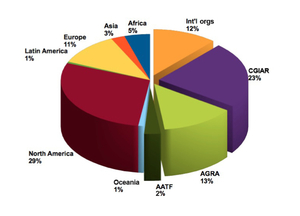
Click to enlarge – Graph 1: the Gates Foundation’s $3 billion pie (agriculture grants, by region).
Graph 1 and Table 1 give the overall picture. Roughly half of the foundation’s grants for agriculture went to four big groupings: the CGIAR’s global agriculture research network, international organisations (World Bank, UN agencies, etc.), AGRA (set up by Gates itself) and the African Agricultural Technology Foundation (AATF). The other half ended up with hundreds of different research, development and policy organisations across the world. Of this last group, over 80% of the grants were given to organisations in the US and Europe, 10% went to groups in Africa, and the remainder elsewhere. Table 2 lists the top 10 countries where Gates grantees are located and the amounts they received, highlighting some of the main grantees. By far the main recipient country is Gates’s own home country, the US, followed by the UK, Germany and the Netherlands.
When it comes to agricultural grants by the foundation to universities and national research centres across the world, 79% went to grantees in the US and Europe, and a meagre 12% to recipients in Africa.
The North-South divide is most shocking, however, when we look at the NGOs that the Gates Foundation supports. One would assume that a significant portion of the frontline work that the foundation funds in Africa would be carried out by organisations based there. But of the $669 million that the Gates Foundation has granted to non-governmental organisations for agricultural work, over three quarters has gone to organisations based in the US. Africa-based NGOs get a meagre 4% of the overall agriculture-related grants to NGOs.
2. The Gates Foundation gives to scientists, not farmers
As can be seen in Graph 2, the single biggest recipient of grants from the Gates Foundation is the CGIAR, a consortium of 15 international agricultural research centres. In the 1960s and 70s, these centres were responsible for the development and spread of a controversial Green Revolution model of agriculture in parts of Asia and Latin America which focused on the mass distribution of a few varieties of seeds that could produce high yields – with the generous application of chemical fertilisers and pesticides. Efforts to implement the same model in Africa failed and, globally, the CGIAR lost relevance as corporations like Syngenta and Monsanto took control over seed markets. Money from the Gates Foundation is providing CGIAR and its Green Revolution model a new lease on life, this time in direct partnership with seed and pesticide companies.5
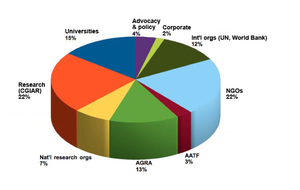
Click to enlarge – Graph 2: the Gates Foundation’s $3 billion pie (agriculture grants, by type of organisation).
The CGIAR centres have received over $720 million from Gates since 2003. During the same period, another $678 million went to universities and national research centres across the world – over three-quarters of them in the US and Europe – for research and development of specific technologies, such as crop varieties and breeding techniques.
The Gates Foundation’s support for AGRA and the AATF is tightly linked to this research agenda. These organisations seek, in different ways, to facilitate research by the CGIAR and other research programmes supported by the Gates Foundation and to ensure that the technologies that come out of the labs get into farmers’ fields. AGRA trains farmers on how to use the technologies, and even organises them into groups to better access the technologies, but it does not support farmers in building up their own seed systems or in doing their own research.6
We could find no evidence of any support from the Gates Foundation for programmes of research or technology development carried out by farmers or based on farmers’ knowledge, despite the multitude of such initiatives that exist across the continent. (African farmers, after all, do continue to supply an estimated 90% of the seed used on the continent!) The foundation has consistently chosen to put its money into top down structures of knowledge generation and flow, where farmers’ are mere recipients of the technologies developed in labs and sold to them by companies.
3. The Gates Foundation buys political influence
Does the Gates Foundation use its money to tell African governments what to do? Not directly. The Gates Foundation set up the Alliance for a Green Revolution in Africa in 2006 and has supported it with $414 million since then. It holds two seats on the Alliance’s board and describes it as the “African face and voice for our work”.7
AGRA, like the Gates Foundation, provides grants to research programmes. It also funds initiatives and agribusiness companies operating in Africa to develop private markets for seeds and fertilisers through support to “agro-dealers” (see box on Malawi). An important component of its work, however, is shaping policy.
AGRA intervenes directly in the formulation and revision of agricultural policies and regulations in Africa on such issues as land and seeds. It does so through national “policy action nodes” of experts, selected by AGRA, that work to advance particular policy changes. For example, in Ghana, AGRA’s Seed Policy Action Node drafted revisions to the country’s national seed policy and submitted it to the government. The Ghana Food Sovereignty Network has been fiercely battling such policies since the government put them forward. In Mozambique, AGRA’s Seed Policy Action Node drafted plant variety protection regulations in 2013, and in Tanzania it reviewed national seed policies and presented a study on the demand for certified seeds. Also in Tanzania, its Land Policy Action Node is involved in revising the Village Land Act as well as “reviewing laws governing land titling at the district level and working closely with district officials to develop guidelines for formulation of by-laws.”8
The African Agricultural Technology Foundation (AATF) is another Gates Foundation supported organisation that straddles the technology and policy arenas. Since 2008, it has received $95 million from the Gates Foundation, which it used to to support the development and distribution of hybrid maize and rice varieties. But it also uses funds from the Gates Foundation to “positively change public perceptions” about GMOs and to lobby for regulatory changes that will increase the adoption of GM products in Africa.9
In a similar vein, the Gates Foundation provides Harvard University University with funds to promote discussion of biotechnology in Africa, Michigan University with a grant to set up a centre to help African policymakers decide on how best to use biotechnology, and Cornell University with funds to create a global “agricultural communications platform” so that people better understand science-based agricultural technologies, with AATF as a main partner.
Gates & AGRA in Malawi: organising the agro-dealers
One of AGRA’s core programmes in Africa is the establishment of “agro-dealer” networks: small, private stockists who sell chemicals and seeds to farmers. In Malawi, AGRA provided a $4.3 million grant for the Malawi Agro-dealer Strengthening Programme (MASP) to supply hybrid maize seeds and chemical pesticides, herbicides and fertilisers.
The main supplier to the agro-dealers in Malawi has been Monsanto, responsible for 67% of all inputs. A Monsanto country manager disclosed that all of Monsanto’s sales of seeds and herbicides in Malawi are made through AGRA’s agro-dealer network.
“Agro-dealers… act as vessels for promoting input suppliers’ products,” says one MASP project document. Another states: “supply companies have expressed their appreciation for field days because MASP trained agro-dealers are helping them promote their products in the very remotest areas of Malawi.” Training the agro-dealers on product knowledge is carried out by the corporate suppliers of the products themselves. In addition, these agro-dealers are increasingly the source of farming advice to small farmers, and an alternative to the government’s agricultural extension service.
A project evaluation report states that 44% of the agro-dealers in the programme were providing extension services. According to the World Bank: “The agro-dealers have… become the most important extension nodes for the rural poor… A new form of private sector driven extension system is emerging in these countries.” The agro-dealer project in Malawi has been implemented by CNFA, a US-based organisation funded by the Gates Foundation, USAID and DFID, and its local affiliate the Rural Market Development Trust (RUMARK), whose trustees include four seed and chemical suppliers: Monsanto, SeedCo, Farmers World and Farmers Association.
Listening to farmers?
“Listening to farmers and addressing their specific needs” is the first guiding principle of the Gates Foundation’s work on agriculture.10 But it is hard to listen to someone when you cannot hear them. Small farmers in Africa do not participate in the spaces where the agendas are set for the agricultural research institutions, NGOs or initiatives, like AGRA, that the Gates Foundation supports. These spaces are dominated by foundation reps, high-level politicians, business executives, and scientists.
Listening to someone, if it has any real significance, should also include the intent to learn. But nowhere in the programmes funded by the Gates Foundation is there any indication that it believes that Africa’s small farmers have anything to teach, that they have anything to contribute to research, development and policy agendas. The continent’s farmers are always cast as the recipients, the consumers of knowledge and technology from others. In practice, the foundation’s first guiding principle appears to be a marketing exercise to sell its technologies to farmers. In that, it looks, not surprisingly, a lot like Microsoft. … Full article with tables and notes
‘Entire villages disappeared’: Ebola deaths in Sierra Leone ‘under-reported’
RT | November 1, 2014
Ebola’s toll on Sierra Leone is much greater than previously thought, with entire villages killed off by the virus. This means up to 20,000 people could have succumbed to the disease by now, a senior coordinator for Doctors Without Borders (MSF) believes.
According to Rony Zachariah, coordinator of operational research for MSF, the Ebola impact on Sierra Leone is in fact “under-reported,” AFP quotes.
“The situation is catastrophic. There are several villages and communities that have been basically wiped out. In one of the villages I went to, there were 40 inhabitants and 39 died,” Zachariah told the agency. “Whole communities have disappeared but many of them are not in the statistics. The situation on the ground is actually much worse.”
The latest figures from the World Health Organization (WHO) put the total number of dead at 4,951 out of 13,567 recorded cases.
But the real total could be up to 20,000 people dead, Zachariah argues. “The WHO says there is a correction factor of 2.5, so maybe it is 2.5 times higher and maybe that is not far from the truth. It could be 10,000, 15,000 or 20,000.”
Zachariah also highlighted the shortage of healthcare workers in the country.
“You have one nurse for 10,000 people and then you lose 10, 11, 12 nurses. How is the health system going to work?” he said.
Even at this point, the pace of dealing with Ebola is slow, he added. “We might get a vaccine and a treatment… but even now we need to go much faster because the clock is ticking…We want action now.”
Meanwhile, the latest cases of Ebola in Spain and the US have sparked fears of an even bigger outbreak, prompting Canada to step up its border security so as to limit the risk of infection spreading into the country.
The federal government announced on Friday it is suspending the processing of visa applications for residents and nationals who have been in Guinea, Liberia, and Sierra Leone in the last three months. The same goes for permanent residence applications. … Full article
READ MORE: Canada imposes visa ban on Ebola-hit African countries
Featured Video

Macgregor: We Haven’t Seen the Worst of the Iran War Yet
or go to
Aletho News Archives – Video-Images
From the Archives
15 Saudi ‘hijackers’ were CIA agents working for US: Scholar
Press TV – April 13, 2016
Fifteen of the 9/11 “hijackers” from Saudi Arabia were CIA agents working for the United States government, which was seeking to destroy the Middle East for Israel and to double the American military budget, says Dr. Kevin Barrett, an American academic who has been studying the events of 9/11 since late 2003…. continue
Blog Roll
 Aletho News
- Iran’s Plan to Shut Down AI in the Persian Gulf
- Israel seeks ‘compensation’ from Washington over Saudi F-35 sale
- Saudi crown prince seeks dialogue with Ansarullah after Yemeni blows: Report
- Damascus rejects Saudi request for Syrian fighters to counter Yemen: Report
- South Korea says will not send troops to join terrorist US war on Iran
- Russia Just Struck the Eyes of NATO’s War Machine in Ukraine
- Russia summons UK charge d’affaires over Kiev drone support
- NATO member warns bloc seeking pretext for war with Russia
- Macgregor: We Haven’t Seen the Worst of the Iran War Yet
- ‘We are not like everyone else’ laws that bind other nations do not apply to Israel, says Likud lawmaker
- If Americans Knew
- Debunking The Claim That Macklemore Has A “History Of Antisemitism”
- CPJ demands release of arrested Palestinian-US journalist near Bethlehem
- Robert Kraft: The Billionaire Friend of Netanyahu Pulling The Strings Behind the Macklemore/Ed Sheeran Blow Up
- Columbia Administered Fund Gives Big Money to Pro-Israel Groups
- Deportation Case of Palestinian Activist Salah Sarsour Tests First Amendment
- ‘We Will Not Forget’: Palestinians Mark 44 Years since Sabra and Shatila
- Why do we let Zionists decide what we can and can’t say?
- US welcomes Israeli, Iranian delegations to UN, but not Palestinians – Daily Update
- Biden’s Genocide Accomplices Targeted by New Accountability Campaign
- AIPAC’s Network Has Already Spent $67.2 Million to Shape the Midterm Elections
- No Tricks Zone
- New Study: ‘Global Drought Shows No Detectable Recent Acceleration Under Climate Warming’
- Economic Masterminds: German Socialists Suggest Taxing Productivity Gains Stemming From Using AI
- The South China Sea Has Not Been Cooperating With The Climate Change Narrative
- Energy Crisis: Germany Enters Heating Season With Historically Low Gas Reserve Fill Levels
- New Study: The Antarctic Ice Sheet Gained Mass From 2020-2024 Due To Staggering Snow And Ice Accumulation
- Study: Ocean Heating Rates From Thousands Of Years Ago ‘Dwarf’ Modern Ocean Heating Rates
- Climate Extremists Target, Attack Large-Scale Power Grid Infrastructure In Germany!
- New Study: Antarctic Ice Melt Has Contributed Less Than 1 Centimeter To Sea Level Rise In The Last 30 Years
- Fear Of Debate: Alarmist German Climate Scientist Calls On Mainstream Media To Discredit Skeptic Voices
- End-Of-August Arctic Sea Ice Extent Hasn’t Fallen In 20 Years, Official Data Show!
 Aletho News