French fox in African hen house
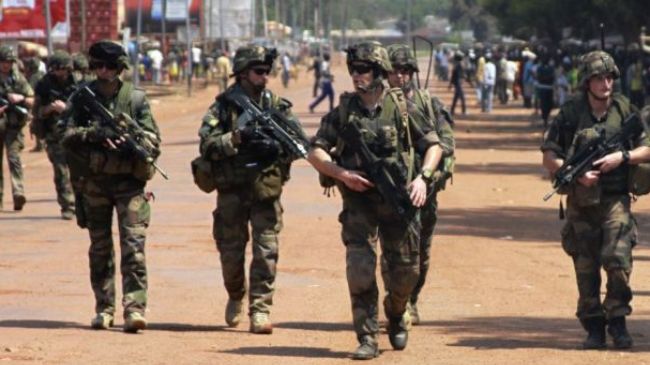
Press TV – January 11, 2014
The French finally got what they wanted in the restive Central African Republic – regime change.
Interim President Michel Djotodia and his Prime Minister Nicolas Tiengaye have resigned and the former French colony is now set to form a new government under the watchful eye of Paris.
Western media portray French conduct in the Central African Republic (CAR) as a benevolent force. “We are there to save lives,” said French President Francois Hollande recently.
This is like lauding a fox in a hen house. The reality is that violence and suffering have largely stemmed as a direct result of illegal French interference in that African country.
What’s more, we also can say that the violence has been deliberately provoked by the French as a cover for their real objective – regime change.
Djotodia was forced to step down after he was politically ambushed by other Francophile African leaders at a special conference convened at the end of the week in neighboring Chad.
Before the summit, French diplomats had been briefing the media and other African states that Djotodia “had to go”. The French tried to cover their tracks by saying “we are not here to give our thumbs up or down” but that is exactly what they were doing – giving the thumbs down.
French President Francois Hollande and his Foreign Minister Laurent Fabius have been carping about the CAR leader for weeks and undermining his authority. Obviously, the French wanted rid of Djotodia and his administration – and now they have gotten their illicit way. Lest we forget such interference in the sovereign affairs of another state is illegal.
Notably, just before the conference opened on Thursday in Chad, Djotodia rejected rumors of his impending resignation. In less than 24 hours, he then quit, evidently under duress.
Within minutes of Djotodia’s sacking on Friday, and even before he had returned from Chad, French military tanks had surrounded the presidential palace in the CAR capital Bangui. French Defence Minister Jean-Yves Le Drian also issued a call for Djotodia to be “replaced as soon as possible”.
Chadian President Idriss Déby had been one of the most vocal African leaders calling for Djotodia to quit. Déby, who is described as “a strong French ally” (in other words, “puppet”), was doing France’s bidding and giving an African voice to a directive from Paris, a directive which amounts to a coup d’état.
The Western media narrative, led by France, is that Djotodia “had not done enough to curb the violence” gripping the CAR. More than 1,000 people have been killed in recent weeks in sectarian clashes between Muslims and Christians. Roughly a quarter of the country’s five million population have been displaced in the fighting.
Djotodia came to power last year after Muslim rebels known as Seleka deposed the Christian president Francois Bozizé in March. Bozizé was notorious for corruption and had come to power through a French-backed military coup 11 years ago.
With major French commercial interests in the resource-rich country, in particular uranium mining, it seems that France was vexed about the new transitional government led by Michel Djotodia – the first Muslim leader of the mainly Christian country.
Djotodia’s interim administration was legally constituted last April and it was overseeing a transition with elections scheduled at the end of this year.
However, that did not seem good enough to allay the French, who wanted to exert tighter control over the political process within the CAR in order to secure favorable conditions for its commercial interests.
This is the real basis for the French military invasion, not the humanitarian pretext that the Hollande government has been trumpeting.
Last month, chaos and violence in the African country surged after France sent in its troops – allegedly to provide “humanitarian protection” in a situation where there had been no serious violence, apart from French government scaremongering of “imminent genocide”.
French military were dispatched to the CAR on December 2, three days before a French-drafted resolution was passed at the United Nations Security Council authorizing the intervention.
More French troops arrived on December 5, 2013, and only since then have the sectarian clashes in Bangui city and across the country escalated.
The conclusion is inescapable. The humanitarian crisis in the CAR was precipitated by French involvement, not prevented. A major factor for the violence is that the French military moved to unilaterally disarm the Seleka rebels while ignoring Christian vigilante groups known as Anti-Balaka.
The latter were, in effect, given a free hand to maraud Muslim communities and businesses with deadly consequences.
It is therefore obtuse and mendacious for the French government and its African clients to blame Michel Djotodia for not controlling security in his country.
The real culprit for the bloodshed and pandemonium that jolted the CAR is French interference in that country– interference that was illegal and was cynically disguised as “humanitarian.”
There are deep fears that violence against Muslim communities will increase further now that Michel Djotodia has been forced from office.
The Christian Anti-Balaka militias will feel emboldened by the French political interference. Many believe that the Anti-Balaka is being orchestrated by the former French puppet Bozizé from his exile in France.
Tragically, this is just the latest episode of misery for the Central African Republic caused by French neo-imperialist predation.
Since gaining so-called independence from France in 1960, the French have launched more covert coups and countercoups in that country than in any other former African colony.
The CAR remains politically and economically underdeveloped – despite its teeming natural wealth – precisely because of systematic French predatory exploitation.
Poverty in the Central African Republic, as in many other African countries, is a direct result of French policy, primarily due to the “franc afrique” monetary system set up at the time of independence.
This systematic poverty enables France to exploit raw materials and the people mercilessly. And when the racket comes a bit unstuck, the French send in their troops to “restore order”.
What the international community, such as the Non-Aligned Movement of over 100 nations, should be doing is to call for the prosecution of France, not applauding this fox in a hen house.

Featured Video

Seyed M. Marandi: US-Iran War Inevitable: Kuwait and Bahrain May Fall
or go to
Aletho News Archives – Video-Images
From the Archives
USS Liberty Massacre: A Pivotal Moment in the Hostile Takeover of America
By Kevin Barrett | Crescent | Dhu al-Qa’dah 24, 1445
In corporate America, hostile takeovers are commonplace. They occur when an aggressor—a larger corporation or rich individuals—seizes control of a smaller corporation without asking permission.
What few recognize is that the United States itself has been subjected to a hostile takeover. Since the aggressor, the illegitimate settler colony known as “Israel,” is much smaller than the US, the takeover has necessarily been surreptitious.
As of June, 2024, Israel’s gradual takeover of the US has become obvious and undeniable—a proverbial “elephant in the living room.” … continue
Blog Roll
 Aletho News
- Seyed M. Marandi: US-Iran War Inevitable: Kuwait and Bahrain May Fall
- Leaders Condemn Ansarallah Attack on Saudi Arabia While Ignoring Illegal War Against Yemen
- Leaked: Britain’s Covert Iraqi Psyops Network
- Yemeni Armed Forces Warn Airlines Against Using Saudi Airports, Exempt Mecca and Medina
- Iran security chief says powers greater than US tried to conquer Iran but ended in ‘dustbin of history’
- Europe’s mounting social chaos… chickens coming home to roost for proxy war against Russia
- US-Russia Diesel Deal Becomes Massive Defeat for Ukraine
- Hormuz and the Looming Economic Catastrophe
- Dhubab offensive, media blitz and the rapid unraveling of Saudi-backed coalition’s new gambit
- Putin Conveys to Trump Iran’s Vision on Possible Conflict Resolution – Kremlin
- If Americans Knew
- Gaza: Ceasefire Anniversary Marks Year of Failed Promises
- The American Conservative: Mike Huckabee Should Resign
- A C-Section in Shackles: A Palestinian Woman’s Harrowing Birth in Israeli Detention
- ‘He’s Desperate’: AIPAC Begins Spending Against Abdul El-Sayed to Boost Mike Rogers:
- Trump, Hormuz, and the Looming Economic Catastrophe
- For three years, Israel has killed a child in Gaza every 71 minutes – Daily Update
- Israeli forces kill another child in Gaza – Daily Update
- Gaza ceasefire exists in name only, say more than 100 organizations
- Nearly 2 Million in Gaza Need Urgent Shelter Assistance as Winter Looms: IOM Chief Warns
- Suppressing Palestinian resistance: US charity under fire for AI monitoring of Gaza classrooms
- No Tricks Zone
- Germany’s Green Energy Debacle: High Energy Costs Force Kahla Porzellan to Close After 182 Years!
- New Study: 50 Years Of The Most Aggressive ‘Net Zero’ Policies Can Only Affect The Global Climate By 0.03°C
- US September “Heat” Was No Record…Many Records Set Decades Ago
- Latest European Green Energy Debacle; Portugal’s Largest Flagship Solar Park Insolvent!
- Green Energy Debacle: German Expert Professor Fritz Vahrenholt Warns Of Severe Economic And Social Consequences
- Two More Paleo Reconstructions Affirm Meters-Higher Sea Levels Across Ireland, Brazil 7000-6000 Years Ago
- New Study: Earth And Venus Surface Warmth Largely Explained By Convection And Lapse Rate, Not CO2 Or Radiation
- 2025 Nature Paper Claiming Worsening Global Drought Gets RETRACTED …Heavily Flawed
- New Study: ‘Global Drought Shows No Detectable Recent Acceleration Under Climate Warming’
- Economic Masterminds: German Socialists Suggest Taxing Productivity Gains Stemming From Using AI

