The Nation’s Top Scientists Lied
By Dr. Scott Atlas | Brownstone Institute | April 13, 2022
This adapted excerpt is from Dr. Scott W. Atlas’ bestselling book, A Plague Upon Our House, published by Bombardier.
CDC Director Robert Redfield’s congressional testimony on September 23, 2020, immediately caught my attention. I watched in disbelief as Redfield told Congress that “more than 90 percent of the population”—more than three hundred million people in the US—remains susceptible to the illness.
The statement was based on incomplete and outdated data, as well as an apparent lack of understanding of the literature, and it struck me as one of the most erroneous and fear-inducing proclamations of any public health official to that moment. Approximately two hundred thousand Americans had already died from COVID; the last thing the public needed was an exaggeration of the future risks, implying to some that ten times that number could still die.
First of all, the numbers didn’t add up. At that point, confirmed cases in the US already totaled approximately seven million, and the CDC itself had estimated that approximately ten times the number of confirmed cases, a very conservative estimate, were likely to have had the infection. A Stanford seropositivity study back in April had shown that confirmed cases underestimated the total infections by a factor of approximately forty times. It made no sense that only 9 percent, or thirty million Americans, had been infected.
Second, the 9 percent calculation was blatantly wrong. That number came from antibody testing by the states. I looked at the CDC website myself, and sure enough, the data was based on antiquated testing from several states.
Some antibody totals were pulled from several months earlier, before many of those states had experienced a significant number of cases. It therefore grossly underestimated the number of cases that had already occurred. The data was simply not valid, but you needed to pay attention to the details.
More importantly, Redfield’s basic claim was fundamentally flawed. The conclusion that serum antibody testing revealed the entire population of those protected from COVID was counter to an entire body of published literature and contrary to fundamental knowledge of immunology, including other coronavirus infections.
It was well known that antibody tests showed one cross-section in time—they were transient—even though immune protection can last. From studies on SARS-2 and most other viruses, antibody levels change over a span of months. They typically appear in the first couple of weeks, peak in a few months, and then decrease over a span of several months.
The literature on COVID had already shown these patterns. A month before this press conference, a Nature Reviews Immunology study on COVID-19 explicitly stated, “The absence of specific antibodies in the serum does not necessarily mean an absence of immune memory,” and explained, “memory B-cells and T-cells may be maintained even if there are not measurable levels of serum antibodies.”
Japan’s study demonstrated this dramatically. In their study, antibody levels increased from 5.8 percent to 46.8 percent over the course of the summer. The most dramatic increase occurred in late June and early July, paralleling the rise in daily confirmed cases within Tokyo, which peaked on August 4.
Out of the 350 individuals who completed both offered tests, 21.4 percent of those who tested negative became positive, and 12.2 percent of initially positive participants became negative for antibodies. A striking 81.1 percent of IgM-antibody-positive cases at first testing became negative in only one month. They stated that “[antibody tests] may significantly underestimate previous COVID-19 infections.” It had also been widely reported in several major scientific journals that antibody responses are not necessarily detectable in all COVID patients, especially those with less severe forms.
But the flaws in Redfield’s estimate extended deeper. Even those familiar with first-year college biology know that other components of the immune system, memory B-cell and T-cells, provide protection from virus infections. Some T-cells kill the virus, and they also help antibodies form. T-cells develop and provide protection that lasts far longer, even after antibodies disappear—sometimes for years in other SARS viruses.
T-cells for this virus had already been documented, even in people unexposed to SARS-2, meaning that in these cases, cross-protection was present from T-cells originating in response to other coronaviruses. T-cells had also been found in individuals with completely asymptomatic SARS-2 infections.
NIH Director Francis Collins had highlighted that very data in his Director’s Blog a few weeks earlier, writing, “In fact, immune cells known as memory T cells also play an important role in the ability of our immune systems to protect us against many viral infections, including—it now appears—COVID-19.”
Scientists from some of the top research institutions in the world, like Sweden’s Karolinska Institute, San Diego’s La Jolla Institute, Duke University, Berlin, and others had published this evidence. Karolinska demonstrated T-cell immunity in both asymptomatic and mild cases of COVID—even if antibody-negative.
Singapore researchers had noted robust T-cell responses to this virus, SARS2, from seventeen-year-old SARS1 samples. Since T-cells are obviously not discovered by antibody tests, those individuals were not included in Redfield’s count. Yet he apparently had not considered this essential, indeed fundamental, point as he testified to Congress and made headlines.
After watching this debacle on TV, I knew full well what was coming later that day. The media would latch on to this and create even more public panic. I also knew that the responsibility for clarifying this grossly erroneous statement would be mine. There was no question it would come up at the president’s press conference, and even if it did not, it still needed to be explained.
I rushed over to Derek Lyons’s office to update him and to make sure we would alert the president beforehand. A few others in the West Wing were there, so I summarized to them what had been said to Congress.
The mood ranged from amazement to dejection to frustration. An advisor to the president on legal matters warned me, with a smile on his face, “Scott, don’t just bluntly say, ‘Redfield is wrong!’ Say something softer, like ‘He misstated things.’”
I nodded, knowing that I needed to restrain my words, even though this was the same man who had tried to destroy me in the national press a few days earlier. But this wasn’t personal at all. Clarifying the facts about the pandemic and countering the unending barrage of misinformation and pseudoscience about it, in this case coming from within the administration itself, was one of my most important roles in this national crisis.
During the pre-brief in the Oval Office a few hours later, I outlined the issue to the president. It was decided, as expected, that I would answer the question when it came up. And so it did.
A reporter from ABC News directly asked me if Redfield’s statement that more than 90 percent of Americans remained susceptible to the disease was true. I took the friendly advice I had received earlier in the day.
“I think that Dr. Redfield misstated something there,” I said, and then did my best to calmly explain the problems with outdated information and the contribution of cross-reactive T-cells and T-cell protection that would not have been included in his data. I correctly stated what was widely known and factual—that the protection from the virus “is not solely determined by the percent of people who have antibodies.” During my answer, as I fended off interruptions, I tried to explain in understandable language as best I could.
I also made a serious effort to be somewhat delicate, because I felt extremely uncomfortable about having to correct the director of the CDC on the national stage.
Unfortunately, my disgust with the confrontational mood in that press room prevented me from being more diplomatic when that reporter asked, “Who are we to believe?” My reflexive answer was “You’re supposed to believe in the science, and I am telling you the science.” Then I referred him to several expert scientists by name. However, I had the strong sense that he was not really interested in the facts at all. Rather, it was another attempt to amplify discord.
After exiting the press room, I walked alongside the president. He briefly stopped to check the news coverage on the set of TV monitors outside the briefing room, as he typically chose to do. After some banter between the president and the staff standing in the area, we began walking back toward the Oval Office.
President Trump turned to me on his right, smiling wryly but with a genuinely puzzled look on his face. “Is Redfield political or just stupid?” he asked, subtly shaking his head. I looked right back at the president and hesitated. The answer was obvious to both of us.
Needless to say, the media immediately played up the disagreement between me and Redfield. It fed into their narrative of conflict between me and the other Task Force doctors, one that Redfield personally caused with his offensive and unwarranted remark that everything I said was “false.”
Later, Dr. Fauci appeared on TV and criticized my straightforward attempt to clarify important information as “extraordinarily inappropriate.” I wondered if he was more concerned with protecting his bureaucrat colleague’s reputation and undermining mine than ensuring that correct information was being told to the American public.
Martin Kulldorff, the world-renowned Harvard epidemiologist, posted his reaction on Twitter: “Scott Atlas stated the simple fact that immunity is higher than those with antibodies, whereupon Dr. Fauci criticizes him without contradicting what was actually said. Stating a simple scientific fact is not ‘extraordinarily inappropriate.’ What is going on?”
Scott W. Atlas, M.D., is the Robert Wesson Senior Fellow in health care policy at the Hoover Institution of Stanford University and a fellow at Hillsdale College’s Academy for Science and Freedom.
Christian Drosten, Karl Lauterbach try to block Health Ministry committee set to evaluate lockdowns and other containment measures

Health minister Karl Lauterbach caught maskless on a train
eugyppius | April 25, 2022
In March 2021, the German Bundestag ordered the Ministry of Health to set up an expert committee to evaluate the effectiveness of containment measures in Germany, from lockdowns to masks. They required this committee to complete their evaluation by 30 June 2022, and to publish a report before the end of September.
The committee finally convened on 22 April via video conference, delayed apparently because communicating with Karl Lauterbach’s ministry has been a huge problem. In the hours after that meeting, the committee chair notified its members that he had finally heard from Lauterbach. The health minister had raised the idea of extending the evaluation deadline to 31 December, and suggested that the committee mandate might end up being redefined.
As Welt explains, Christian Drosten had previously voiced staunch opposition to the project of investigating the efficacy of containment measures:
… [A]n internal virtual meeting in March, Charité virologist Christian Drosten argued against individually evaluating the containment measures. In a nine-minute speech, he said there was too little data, it was too early for such a study, and one could end up “in hot water,” according to WELT information. In view of this intervention from Drosten, who has been one of the most important advisers to political decision-makers since the start of the pandemic, the committee turned to the Ministry of Health for further instructions.
Nothing came of that meeting; the committee had a mandate from the Bundestag, the legal force of which does not rest upon Drosten’s feelings.
When Welt asked the health ministry to comment on the latest delays, a Lauterbach spokesman said the experts don’t have sufficient data, and that the ministry is in discussions with the Bundestag about how to handle this. He even denied that there would be any delay in the committee’s work, which is plainly a lie, because Welt has documents and off-the-record statements from committee members to the opposite effect. One such member even complained to their reporter that “It shows great disrespect to try to withdraw our mandate to evaluate containment measures after so many hours of work.”
We are asked to believe that containment measures have been super successful in the past, and that they remain an important tool for future waves. Lauterbach himself has promised the return of containment in the Fall, because he did not get his vaccine mandate. At the same time, nobody must be permitted to evaluate the efficacy of these allegedly crucial measures. We can’t be allowed to know which ones work and which ones don’t. That would be dangerous somehow, even for an expert committee. In fact it would be so dangerous, that Christian Drosten, the public face of mass containment in Germany, felt compelled to deliver a secret lecture warning against any such evaluative process.
What’s really galling about all this, isn’t that they’re lying, but that they’re terrible at it.
Why We Sued to Overturn the Federal Travel Mask Mandate — And Why We Won
By Leslie Manookian | The Defender | April 22, 2022
In America, the ends don’t justify the means. There are legal guardrails in place to protect our basic liberties and rights — even during a pandemic.
That was the message in the decision handed down Monday by a federal judge in our lawsuit to overturn the federal travel mask mandate.
Since early 2021, anyone traveling on a plane, bus or train, or anyone who used a shared ride service — or even walked into an airport or train station — was compelled to wear a face covering, often for hours at a time.
President Biden, on his first full day in office, signed an executive order on mandatory masking.
The Centers for Disease Control and Prevention (CDC), citing a public health emergency, promulgated the order just eight days later.
The CDC circumvented a required notice and comment period and issued no scientific justifications for the specifics of the order.
Americans were supposed to take the government’s word for it, put on our masks and ask no questions.
But when flight attendants announced — repeatedly on each flight — that compliance is required “by federal law,” did you ever wonder: what federal law?
I did. And it led us at the Health Freedom Defense Fund to file suit against the mandate in federal court.
With assistance from our lawyers at the Davillier Law Group, we learned there is no “federal law” compelling masks for travel.
The CDC does not have the statutory authority to issue a sweeping mandate requiring masking. Nor does the agency have the authority to penalize Americans for non-compliance.
The Biden administration claimed its mask mandate was rooted in authority granted under the Public Health Service Act.
However, a careful reading of that law shows Congress never intended to grant such sweeping powers. In fact, the law is limited and specific, as the court pointed out in its decision.
One of the bigger red flags for the court was the CDC’s claim it could bypass a period of public notice and comment.
The CDC cited the pandemic “emergency” as justification for bypassing notice and comment.
Yet, as we all recall, by early 2021, the pandemic had been wreaking its havoc for nearly a year, yet the agency had proposed no such travel mask mandate.
It is hard to justify requiring emergency powers and circumventing all citizen comments when the CDC was marking time on masks for more than a year.
Indeed, if a mask mandate was key to the pandemic battle, Congress could have enacted such a bill, with debate, transparency and accountability. It did not.
In fact, public comment is at the core of credible and transparent regulatory policy because it allows for flaws and pitfalls to be cited and hopefully corrected.
Despite telling us all for years to “follow the science,” the CDC cited no scientific research to justify the mandate, nor did it offer justification for choosing the age of 2 for its exemption — clearly indicating the agency arbitrarily chose that age.
An abundance of research in major medical and scientific publications, including in the Journal of the American Medical Association, details the negative effects of prolonged mask-wearing, including among medical professionals and the military.
The CDC also ignored the serious, and medically verified, concerns voiced by Americans about how mask-wearing creates severe anxiety, as the two individual plaintiffs in our case detailed.
Clearly the federal government simply brushed away bona fide questions about mask efficacy and risk, and chose not to cite rationale of its own.
The government’s rationale is what we parents say often when our children question our demands: “Because I said so.”
That approach usually doesn’t work well with kids — and it sure falls short in setting policy for hundreds of millions of Americans.
As our lawsuit pointed out, never has a president entered an executive order mandating that every American citizen be required to don a type of garment or device, whether when traveling or otherwise, for any reason whatsoever.
And the U.S. Constitution certainly doesn’t grant the president power to enact nationwide edicts just because Congress failed to pass legislation he deems needed.
So now that you can choose to fly or ride mask-free, remember: Even in response to a pandemic, your government cannot do what it wants, when it wants and to whom it wants.
We are governed by laws, not the preferences of elites, and the Constitution is not suspended in an emergency.
Leslie Manookian is president and founder of Health Freedom Defense Fund, a nonprofit which seeks to rectify health injustice through education, advocacy and legal challenges to unjust mandates, laws and policies that undermine our health freedoms and human rights.
© 2022 Children’s Health Defense, Inc. This work is reproduced and distributed with the permission of Children’s Health Defense, Inc. Want to learn more from Children’s Health Defense? Sign up for free news and updates from Robert F. Kennedy, Jr. and the Children’s Health Defense. Your donation will help to support us in our efforts.
How to lie with statistics – Vaccine efficacy edition
The Naked Emperor’s Newsletter | April 23, 2022
Just a quick post to show another method of how to increase vaccine efficacy. This time looking at data from Switzerland and Liechtenstein (S&L).
By mid December 2021, S&L were at the peak of their third wave. It was ok though because 67% of the country had been fully vaccinated, 17% with a booster. 32% of selfish people had still not been vaccinated however.
As the vaccines stop people from going to hospital this would show up in the stats.
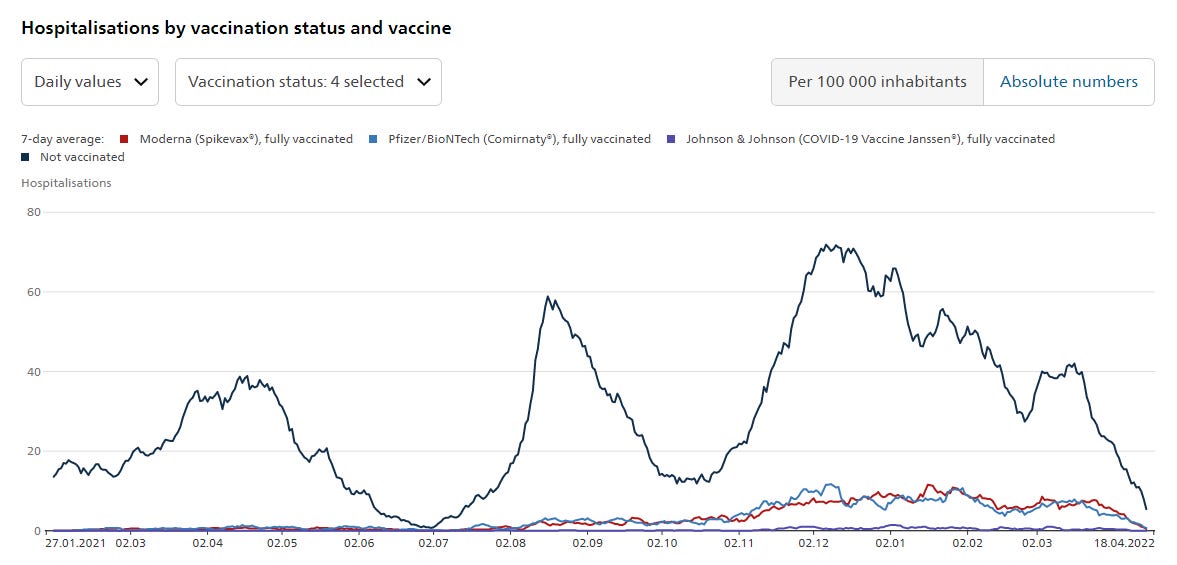
Yes, as predicted, there was a slight increase in hospitalisations for fully vaccinated citizens (Moderna – red line, Pfizer – light blue line) but a massive spike in hospitalisations for those pesky unvaccinated (dark blue line).
Job done, vaccine efficacy proven.
But hold on a second, there is another category. “Vaccine unknown, fully vaccinated”. Let’s add this to the graph.
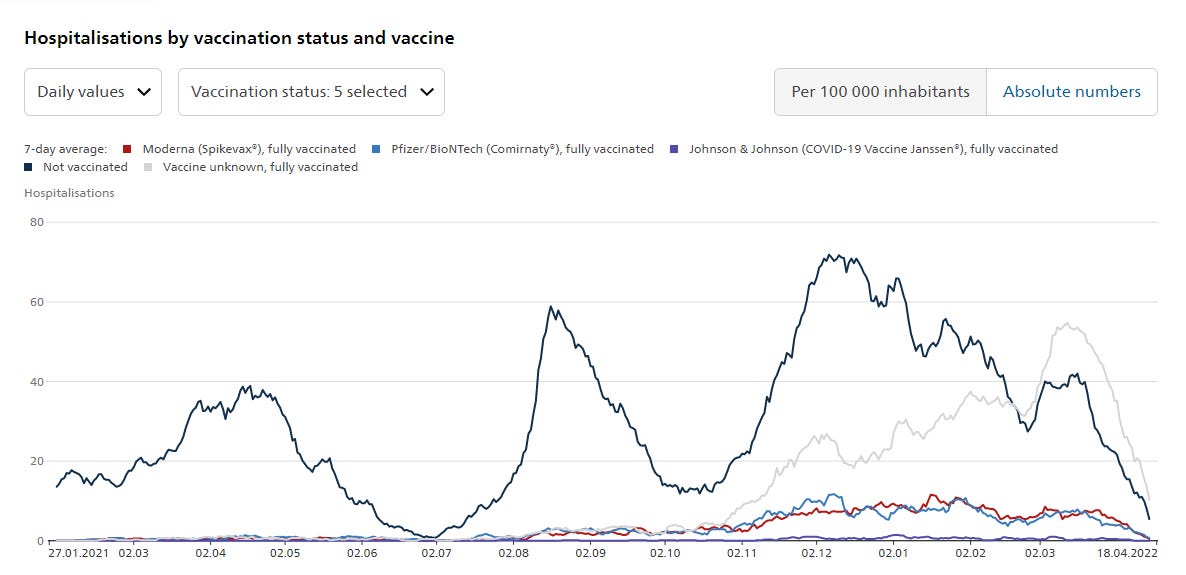
They don’t really want you to see this line so have made it a faint grey colour. However much they would like to pretend it wasn’t there, it is. And it shows a lot of fully vaccinated people going to hospital, and continuing to go to hospital, until March 2022, well after the peak for unvaccinated individuals.
Lot’s of fully vaccinated people going into hospital who have forgotten which vaccines they had. Did they forget or were they too ill? Is this an admin issue or are these people who had a combination of vaccines and so couldn’t be put in one category?
Either way, this grey lined category shifts a lot of people out of the Pfizer and Moderna vaccinated categories. It makes vaccine efficacy look much better than it actually is by saying only this many Pfizer or Moderna vaccinees were hospitalised.
Another great example of how to lie with statistics.
TSA mask mandate
By Vinay Prasad | April 20, 2022
Just imagine we had a competent CDC who ran a cluster Random Controlled Trial of cloth masking mandate in airplanes and measured spread. It could even be factorial design and test different ventilation filters. Imagine the trial was negative– a judge would not need to strike down the mandate. It would have fallen by scientific consensus.
Imagine now it were positive. We could have a discussion about the effect size, if it varies by case rate at the flight origin city or traveller origin cities. We could discuss when the tradeoff might be worth it, and when it might be not worth it.
Imagine the trial was large. It could be powered for interaction by age. Do cloth masks protect babies or is it a false reassurance? Does it protect immunocompromised? Or again, false reassurance?
Imagine the trial had arms for different rules. An ok to snack arm or a no snacking arm. Does it work with a rule modification?
We ran zero such trials. The CDC ran no studies. No one knows the answer to these questions, despite their bluster. The truth is it seems highly implausible that wearing a mask on one ear lobe, while eating pretzels for an hour works.
The CDC failed it’s social contract. It implemented a policy and never generated evidence. This turned a scientific question into a political one. Naturally battle lines were drawn.
Finally a judge comes in and throws out the mandate. Many people are upset with the judge. But the judge didn’t fail you. The CDC failed you. It never ran a trial. It never generated knowledge. It kept us in the dark. It should be no surprise that it lost it’s power and legitimacy. It proved it does not deserve the power it was was entrusted by the people. It failed to use science to reduce uncertainty. We should be ashamed of the organization. I certainly am.
‘Explosive’ Legal Agreement With U.S. Lets Wuhan Lab Destroy Data
By Emily Kopp | U.S. Right to Know | April 20, 2022
The Wuhan Institute of Virology has the right to ask a partnering lab in the U.S. to destroy all records of their work, according to a legal document obtained by U.S. Right to Know.
A memorandum of understanding between the Wuhan lab and the Galveston National Laboratory at the University of Texas Medical Branch states that each lab can ask the other to return or “destroy” any so-called “secret files” — any communications, documents, data or equipment resulting from their collaboration — and ask that they wipe any copies.
“The party is entitled to ask the other to destroy and/or return the secret files, materials and equipment without any backups,” it states.
This right is retained even after the agreement’s five year term ends in October 2022. All documents are eligible for destruction under the agreement’s broad language.
“All cooperation … shall be treated as confidential information by the parties,” the agreement states.
The directors of the maximum biocontainment labs in Wuhan and Texas announced a formal cooperative agreement in Science in 2018. The labs are two of just a handful of facilities in the world that do similar cutting edge work on novel coronaviruses. The lab in Texas, with funding from the National Institutes of Health, was doing biosafety training with the lab in Wuhan, which operates under the Chinese Academy of Sciences. The labs also intended to do joint research projects and share resources, according to the agreement.
The revelation that the Wuhan lab retained the right to call for the destruction of data on U.S. servers funded by U.S. taxpayers comes amid a debate about what sort of investigation is necessary to exculpate the city’s coronavirus research from suspicions it sparked the COVID-19 pandemic. It also raises questions about assurances from Wuhan Institute of Virology senior scientist Zhengli Shi that she would never delete sensitive data.
The clause also raises a number of legal red flags for the Texas lab, experts say.
“The clause is quite frankly explosive,” said Reuben Guttman, a partner at Guttman, Buschner & Brooks PLLC who specializes in ensuring the integrity of government programs. “Anytime I see a public entity, I would be very concerned about destroying records.”
Guttman said that even private entities are expected to have internal records retention and destruction policies, but that as a public institution the Texas lab faces an even higher standard under laws meant to safeguard federal and state taxpayer dollars. These laws include the federal False Claims Act and the Texas Public Information Act. The Galveston National Laboratory is part of the University of Texas System and receives federal funding.
“You can’t just willy nilly say, ‘well, you know, the Chinese can tell us when to destroy a document.’ It doesn’t work like that,” he said. “There has to be a whole protocol.”
The clause could also risk obstructing Congressional investigations into the COVID-19 pandemic.
The Texas lab was “built by the National Institutes of Health to help combat global health threats,” said Christopher Smith, a spokesman for UTMB, in a statement. “As a government-funded entity, UTMB is required to comply with applicable public information law obligations, including the preservation of all documentation of its research and findings.”
“UTMB believes it is an operational — and moral — imperative that all scientists working in biocontainment anywhere in the world have first-hand knowledge of the proven best practices in biosafety and laboratory operations,” Smith continued. “All research at UTMB is subjected to a rigorous and transparent pre-experiment approval protocol, including involvement and oversight by scientific experts who helped design federal guidelines.”
Only the Texas attorney general can make a determination about what otherwise releasable public records should be exempted from disclosure, according to Kelley Shannon, executive director of the Freedom of Information Foundation of Texas. It’s also unlawful to destroy records requested under the Texas Public Information Act.
Liza Vertinsky, an expert in global health law and intellectual property at Emory University, said that the all-encompassing definition of what is considered “secret” in the memorandum of understanding, or MOU, is problematic.
“The way I read the MOU, although it is poorly drafted, ‘secret’ refers to the ‘cooperation and exchanges, documents, data, details and materials’ that are part of this MOU,” she said. “It is as broad as the MOU, covering what the MOU is intended to cover.”
Edward Hammond, an independent biosafety proponent and a longtime advocate for more transparency at the Galveston lab, also flagged the broad language.
“In agreements like this that I’ve seen before, you have confidentiality provisions in relation to intellectual property… I can’t recall seeing an instance of these more general confidentiality provisions,” he said in an email. “Doesn’t this run against the purportedly pure academic interests of UTMB?”
In 2009, the Galveston lab unsuccessfully lobbied the Texas legislature for an exemption to the Texas Public Information Act to be written in order to prevent records being released to Hammond.
WIV calls data deletion accusations ‘appalling’
The agreement could also undermine claims that the WIV would never delete records. A WIV virus database that went dark in 2019 remains a source of intrigue for reporters, scientists, and U.S. intelligence agencies interested in the pandemic’s origins.
Wuhan Institute of Virology senior scientist Zhengli Shi told MIT Technology Review that allegations by Western biosecurity experts that her lab may have scrubbed records relevant to COVID-19 are “baseless and appalling.”
“Even if we gave them all the records, they would still say we have hidden something or we have destroyed the evidence,” Shi told the outlet, which cast any such suspicions as rooted in anti-Chinese prejudice.
The agreement also seems to address suspicions that the partnership could aid a bioweapons program either in the U.S. or in China, stating the labs will “exchange the virus resources strictly for the scientific research purposes.”
A number of clunky or unusual provisions in the agreement suggests it may have been drafted at least in part by Chinese partners and translated into English.
For example, it states nothing in the agreement should be construed as establishing a relationship between “master and servant,” unusual language in modern American legal documents.
Other documents obtained by U.S. Right to Know demonstrate that despite the formal collaboration, Galveston National Laboratory faced delays in obtaining a sample of SARS-CoV-2, the virus that causes COVID-19, from its partner lab at the pandemic’s epicenter. The Texas lab ended up obtaining its first sample from the U.S. Centers for Disease Control and Prevention.
U.S. Right to Know obtained the WIV-UTMB memorandum of understanding through the Texas Public Information Act as part of an investigation into risky viral research funded through taxpayer dollars.
CDC Weighs ‘Upgrades’ to COVID Vaccines as Booster Strategy Fails
By James Lyons-Weiler | PopularRationalism | April 21, 2022
According to CNN, CDC’s Advisory Committee on Immunization Practices (ACIP) continue to “mull over” what’s next for Covid-19 boosters, and indeed are even considering what the “upgrades” Covid-19 vaccines. There are indications that they know that “entirely different vaccine formulations could be needed”.
Currently, additional booster doses are recommended only for certain people with weakened immune systems and adults 50 and older.
CDC quoted Dr. Sara Oliver, one of CDC’s epidemic intelligence service officers with the Division of Viral Diseases, who provided a robust soundbite:
“Policy around future doses require continued evaluation of Covid-19 epidemiology and vaccine effectiveness, including the impact of both time and variants, and the ability of doses to improve this protection.”
The specifics CNN cited Oliver as seeing CDC needing to take into account include recent case counts, hospitalization rates, and vaccine effectiveness in the US, and also – shocking – including whether it’s waning over time. They also cited that she thought CDC should weigh “the impacts of circulating coronavirus variants”.
We know vaccine effectiveness is unacceptably low – and given Dr. Fantini’s results may actually be negative, indicating disease enhancement.
Oliver stated that the evolution of the virus will be an important consideration for considering “platforms” for future COVID-19 vaccinations.
It’s not hard to read between the lines here. Readers of PopularRationalism already know that the mRNA vaccines have proven to be worse than a dismal failure. This is CDC putting the word out that a second round of vaccine development is expected, and is about the closest we’ll ever see to CDC admitting the vaccination program has flopped.
And it’s surprising to see ACIP being focused on future “effectiveness”. Clearly, if newly formulated vaccines are proposed, they will be a square one in terms of the regulatory stage of development, and we should be seeing data on efficacy, which is a measure of a vaccine’s ability to reduce transmission in a prospective randomized clinical trial, not effectiveness, which is measured using real-world data.
As the real-world data on COVID-19 vaccine effectiveness came in, it was quite bad, so the net was lowered from “preventing transmission” and “reducing new infections” to “producing an antibody response”.
So far, according to USASpending.Gov, the US has now spent over 3.63 trillion dollars in its response to COVID-19. According to the US Center for Economic Studies, the US suffered record-smashing loss of -9.5% of its GDP in 2020, and over 30% shrinkage in economic growth.
Nevertheless, both Pfizer and Moderna are taking a stab at vaccines meant to be available against Omicron, but it is doubted whether the variant will be around long enough to even be targeted by the new vaccines. Pfizer is hoping for a vaccine that will remain effective for more than a year, while Moderna’s non-peer-reviewed preprint containing data from their internal study of the efficacy of their bivalent vaccine was cited by CDC with the careful caveat that the preprint had “not been peer-reviewed or published in a professional journal.”
In the heyday of the pandemic, Pfizer and Moderna could get away with sending FDA assurances that they would share data mentioned in press releases once the FDA gave EUA or full-out approval. Now that the fog of the pandemic has lifted, it seems that the standard practice of labeling press releases, such as Moderna’s recent one on their bivalent vaccine as “Forward Looking Statements” is in place, so I suspect Moderna, Pfizer and the SEC got my memos.
Due to evidence of lack of efficacy and need, FDA, Pfizer and Moderna have delayed further consideration of COVID-19 vaccines for young children until June, according to Politico (SeekingAlpha, Politico).
Unfortunately, the companies are still communicating “success” as equivalent with “antibody response” when we all know (or at least my immunology students know that they really should be measuring and reporting memory B-cell responses and the degree of match between the antibodies produced by B-cells upon reinfection and whatever variant or variants have taken over after Omicron is a distant memory.
CDC also shared that Kaiser Permanente – which profits from vaccine sales – was in the driver’s seat of the CDC’s ACIP committee, with Dr. Matthew Daley, ACIP Vaccine Working Group Chairperson and senior investigator at the Kaiser Permanente Institute for Health Research issuing “marching orders” to the rest of ACIP to be “be more proactive than reactive” on the future of Covid-19 vaccinations.
This article is just a reminder to those who need it that #ParentsAreWatching, and that #ScientistsAreWatching, too.
Migratory birds of mass destruction

Albatross, famous migratory bird, is also a love bird. It is known for being monogamous, forming long-term bond with one partner that is rarely broken. Mated pairs never split up until one bird dies.
BY M. K. BHADRAKUMAR | INDIAN PUNCHLINE | APRIL 21, 2022
The UN Security Council held an extraordinary event on April 6 under the rubric Arria Formula Meeting on Biological Security regarding the biological activities in countries including Ukraine. Predictably, the US and UK representatives didn’t show up at the event and the western media also blacked out the proceedings. But that does not detract from the profound significance of what transpired.
The highlight of the Security Council proceedings lasting over two hours was the disclosure by General Igor Kirillov, chief of the Radiation, Chemical and Biological Defense Forces of the Russian Armed Forces, that Washington is creating biological laboratories in different countries and connecting them to a unified system.
He said the US has spent more than $5 billion on military biological programs since 2005 and detailed that in territories bordering Russia and China alone, about 60 facilities have been modernised during this period. The Ukrainian network of laboratories is designed to conduct research and monitor the biological situation consisting of 30 facilities in 14 populated locations.
Highly sensitive materials from the Ukrainian biological laboratories were exported to the US in early February just before the Russian special operation began, and the rest were ordered to be destroyed lest they fell into Russian hands. But the cover-up was only partially successful. Indeed, Russia is in possession of highly incriminating evidence.
Previously also, Russia had released a number of documents related to the biological military activities of the Pentagon, which pointed toward a worldwide project to set up biological laboratories in rival countries with the goal of developing targeted viral weapons against those countries.
The proceedings of the Security Council conference on April 6 are in the public domain and are accessible. See the video below:
Russia has made specific allegations, pointing finger at:
- Pentagon funding for the bio-labs in Ukraine;
- Location of these bio-labs(not only in Ukraine but in 36 countries around the world);
- Diseases and epidemics on which research work is going on, focusing on the means for their release, the countries where they are being tested (even without the knowledge of the governments of these countries); and, of course,
- Experiments relating to coronavirus (and bats used to transmit this virus).
However, the US has so far point-blank refused to accept any supervision and verification of such incriminatory evidences and has stonewalled the demand for a verification mechanism. It is unlikely that the US will permit an international verification process that holds the potential to expose it as indulging in crimes against humanity — although there are appropriate frameworks in place including the Biological Weapons Convention (BWC) and the UN, to hear the clarifications from the relevant country in a fair and impartial manner.
A mind-boggling “discovery” that Russian forces in Ukraine stumbled upon is the use of numbered birds by the Pentagon-funded labs. This almost falls out of science fiction and Sir Alfred Hitchcock could have made an epic movie out of it where deception mixes with innocence and man’s cruelty to nature becomes unbearably grotesque. The project works like this:
To begin with, the Pentagon accesses the scientific data available with environmental specialists and zoologists after studying the migration of birds and observing them throughout the seasons, relating to the path these birds take each year on their seasonal journey from one country to another and even from one continent to another.
On the basis of this data, groups of migratory birds are caught, digitised and capsules of germs are attached to them that carry a chip to be controlled through computers. The birds are then released to the flock of the migratory birds in those target countries toward which the US intelligence has malevolent intentions.
Of course, these migratory birds travel great distances. The wandering albatross, for instance, is known to migrate at least 8500 km eastward across the South Pacific to the coast of South America, and many shy albatrosses migrate westward across the Indian Ocean to the coast of South Africa.
During the long flight of the birds that have been digitised in the Pentagon bio-labs, their movement is monitored step by step by means of satellites and the exact locations are determined. The idea is that if the Biden Administration (or the CIA) has a requirement to inflict harm on, say, Russia or China (or India for that matter), the chip is destroyed when the bird is in their skies.
Plainly put, kill the bird carrying the epidemic. Sadly, my mind goes back to the novel by the American author Harper Lee To Kill a Mocking Bird, the haunting story of innocence destroyed by evil.
To return to reality, once the “digitised” bird is killed and the capsule of germs it carries is released, the disease spreads in the “X” or “Y” country. It becomes a highly cost-effective method of harming an enemy country without any need of war or coup d’état or colour revolution.
The Russians have made the shocking claim that they are actually in possession of such migratory birds digitised in the Pentagon’s bio-labs.
International law expressly forbids the numbering of migratory birds because they freely criss-cross the blue sky and air of other countries. By supplying them with germs, these birds become weapons of mass destruction. What human ingenuity! But the US enjoys total immunity from international law.
The bottom line is that only the US intelligence — and President Biden, perhaps, if he remembers — would know where all humans have been infected so far in this century by the Birds of Mass Destruction. Was Ebola that devastated Africa a test case and precursor of things to come?
What about Covid-19, which is known to have originated from funded laboratories that were administered by the US? It is very likely that the US might have used migratory birds to kill Chinese citizens. Clearly, the US in its desperation to reverse its global decline is pulling out all the stops to restore its hegemony in a world order that is inexorably moving toward multipolarity.
Lockdown ideology remains a widespread global plague upon humanity
Faucism infects Shanghai
By Jordan Schachtel | April 18, 2022
To the ruling class, human rights are an afterthought.
Far from perceiving each other as adversaries, the Public Health cartel in the West and in China are more accurately defined as competitors in a friendly game of chess, and humanity are their pawns.
As global leaders remain noticeably silent on the situation in Shanghai (some have taken to explicitly endorsing the lockdowns), there seems to be unanimous approval for the idea that top-down draconian lockdowns are both ethical and moral, no matter how many human beings must suffer in the process. In China, a large swath of the United States, and almost everywhere in between, COVID Mania has shined a light on the negligence and inhumanity of our ruling class, which views citizens as subjects and serfs unworthy of their unalienable rights.
The lockdown ideology, or in one-word, Faucism, remains prevalent everywhere. And in Shanghai, the projected commitment to Zero COVID remains intact.
If you thought the Chinese Communist Party (CCP) — which first popularized the lockdown ideology in Wuhan — was ready to admit to the catastrophic failures of its Zero COVID lockdown program, think again.
Now almost a month into its hard lockdown of over 25 million people in Shanghai, China continues to rally behind its purported commitment to Zero COVID, or the fraudulent notion that a respiratory virus can be eliminated from a population through top-down government action.
In a front-page article in Monday’s Study Times (the publication for the CCP’s Central Committee), Ma Xiaowei, China’s minister of its National Health Commission, stood behind China’s “dynamic zero-Covid” policy. Dismissing dissent from the Zero COVID narrative, Ma attacked the “erroneous” idea of “coexisting with the virus.”
China’s state-run Global Times and other Party platforms echoed the message:
“Scientific, precise and dynamic zero tolerance is a major decision made by the Communist Party of China (CPC) and President Xi Jinping based on science and laws, Ma said, urging officials to oppose claims about co-existing with the virus and treating the virus as flu.”
In another interesting tidbit, the Global Times interviewed a senior Chinese CDC epidemiologist, whose pro-lockdown message may sound remarkably similar to that of his western counterparts:
“Those three deaths serve as an alarm for the country not to let its guard down in the face of Omicron, as it is extremely dangerous for unvaccinated vulnerable groups with underlying diseases, a senior expert from the Chinese Center for Disease Control and Prevention (CDC) told the Global Times on condition of anonymity, noting that this is a fundamental reason why many epidemiologists agree not to ease the current antivirus strategy.”
As we’ve observed over the course of COVID Mania, China is not unique in its depravity. Though their lockdowns are the most strict to date, quarantine camps, movement restrictions, and digital tyranny has populated every corner of the globe.
Dr Anthony Fauci, the top government health bureaucrat in America, and the go-to “public health expert” for COVID doctrine in the West, unsurprisingly has no issue with the humanitarian catastrophe that is the Shanghai lockdown.
In an interview this weekend, Fauci remarked: “you use lockdowns to get people vaccinated,” endorsing government barbarism to compel behavior.
If this was only a China problem, surely, world leaders would be lining up to condemn the human rights crimes being committed against Shanghai citizens.
However, throughout the world, the hubris-fueled Public Health cartel remains absent from commenting on the Shanghai situation. Instead, with plenty of lockdown blood on their own hands, they stick to the message, and remain insistent upon top-down pandemic policies that have resulted in societal and economic ruin.
As COVID Mania has made clear, the entire “Public Health” system is a force for destruction, whether its proponents propagandize for it in English, Chinese, or another language.
The war against Corona cannot be won, and so for many it will never end

Three thousand retweets for the transparent panic mongering of everybody’s fake epidemiologist
eugyppius | April 18, 2022
Many of you are probably tired of hearing me write about Karl Lauterbach, but he is the health minister of a major European nation, and his increasingly crazed bearing is becoming an important story unto itself. Infections are collapsing in Germany and across Europe, despite the lifting of all restrictions, which is like garlic to Lauterbach’s peculiar brand of vampire. Thus he took to BILD on Easter Sunday, in a desperate effort to stir up some fresh fear. In the fall, he said,
“It’s quite possible we’ll end up with a highly contagious Omicron variant that is as deadly as Delta. That would be an absolute killer-variant.” … The intervals at which new variants emerge to replace old ones are getting shorter and shorter [he said], which is “cause for concern.”
He also said it’s very likely that we’ll have to bring back the mask mandate sooner or later, and advised everyone to continue muzzling themselves voluntarily. There is no longer even any pretence, of restrictions as temporary measures or of the pandemic as a transitory phenomenon.
Featured Video

Racist Seinfeld Dances for Joy as Bibi Unveils His New Map
or go to
Aletho News Archives – Video-Images
TV Drama Review
Japanese drama projects Japan’s wartime atrocities onto Chinese characters

Global Times | October 25, 2026
By portraying Chinese characters as perpetrators of ruthless violence while casting Japanese Self-Defense Forces (SDF) intelligence operatives as defenders, the season 2 of the Japanese drama Vivant has recently drawn criticism from Chinese netizens, who argue that its depiction turns historical reality on its head while ignoring Japan’s wartime atrocities.
The TBS drama series – a spy suspense story in which an alleged unofficial intelligence unit of the SDF operates across the globe — has attracted a passionate fanbase. Its currently airing season 2 opened with a household rating of 18.8 percent, the highest for a TV drama this year, according toa commentary article by Japanese media Toyo Keizai.
What draws attention is the portrayal of the enemies in the series, the article noted. Scenes in which the Chinese organization subjects kidnapped members of the SDF unit to brutal torture are repeated with unrelenting intensity.
It is rare for Japanese TV dramas to explicitly portray a real-life country as the enemy, the article noted.
Japanese Prime Minister Sanae Takaichi also made a reference to the drama, saying that she has been recording Vivant and hopes to binge-watch it over the year-end and New Year holidays, according to Japanese media outlets.
China’s CCTV News report on Sunday revealed that the drama features scenes in which Chinese personnel cut off the fingers of and stab Japanese intelligence operatives in the abdomen. Such acts bear striking similarities to the torture inflicted on Chinese nationals by invading Japanese troops during the World War II.
The drama distorts the truth by attributing these atrocities to modern Chinese characters. Beneath the surface, it subtly glorifies Japan’s cross-border overseas operations, blurs the functional boundaries of the SDF and implicitly promotes an expansionist narrative, per CCTV News. … continue
Blog Roll
 Aletho News
- EU facing trillion-euro debt hole while seeking more cash for Kiev
- How US, Europe, Persian Gulf states exhausted missile stockpiles, splurged billions to defend Israel
- Up in arms… Koreans reject U.S. empire’s plan to make South Korea the next Ukraine
- Iran, Turkey, Pakistan, Saudi Arabia could advance region-led security framework in Tehran: FM spox
- Netizens condemn Japanese drama for projecting Japan’s wartime atrocities onto Chinese characters
- Racist Seinfeld Dances for Joy as Bibi Unveils His New Map
- A West Bank War for Netanyahu’s Election Campaign, Could It Backfire?
- Yemen denounces European Parliament’s ‘hypocritical’ push to blacklist Ansarullah
- Qalibaf: UAE’s UN bid aims to ‘clear the runway’ for ‘Greater Israel’, whitewash genocide
- Pakistan reopens Iran border after boosting security: Report
- If Americans Knew
- An error has occurred; the feed is probably down. Try again later.
- No Tricks Zone
- Sudden Stratospheric Warming, Powerful El Niño Combination May Lead To Extreme Europe Cold, Energy Crisis!
- Two New Studies Find Thwaites Glacier Melt Cannot Be Driven By Human Activity Or A Warming Ocean
- E-Cars Reduce CO2 Emissions By Only 41% Compared To Internal Combustion Engine Vehicles
- Predictions Made By Renowned Climate Professor Over Past Decades Have Been Proven To Be Poor
- New Study Suggests Large Regions Of The Pacific Ocean Have Been Cooling For The Last 80 Years
- Germany’s Green Energy Debacle: High Energy Costs Force Kahla Porzellan to Close After 182 Years!
- New Study: 50 Years Of The Most Aggressive ‘Net Zero’ Policies Can Only Affect The Global Climate By 0.03°C
- US September “Heat” Was No Record…Many Records Set Decades Ago
- Latest European Green Energy Debacle; Portugal’s Largest Flagship Solar Park Insolvent!
- Green Energy Debacle: German Expert Professor Fritz Vahrenholt Warns Of Severe Economic And Social Consequences

