“White Helmet” “Save Aleppo” Protest Proves How Easy it is to Dress Up Actors as “War Victims”
By Tony Cartalucci – Land Destroyer – October 3, 2016
Recent protests held across North America and Europe staged by supporters of armed militants in Syria have staged scenes in Western streets eerily similar to those featured in the photos and videos of the US-European funded “Syrian Civil Defence” also known as the “White Helmets.”
 |
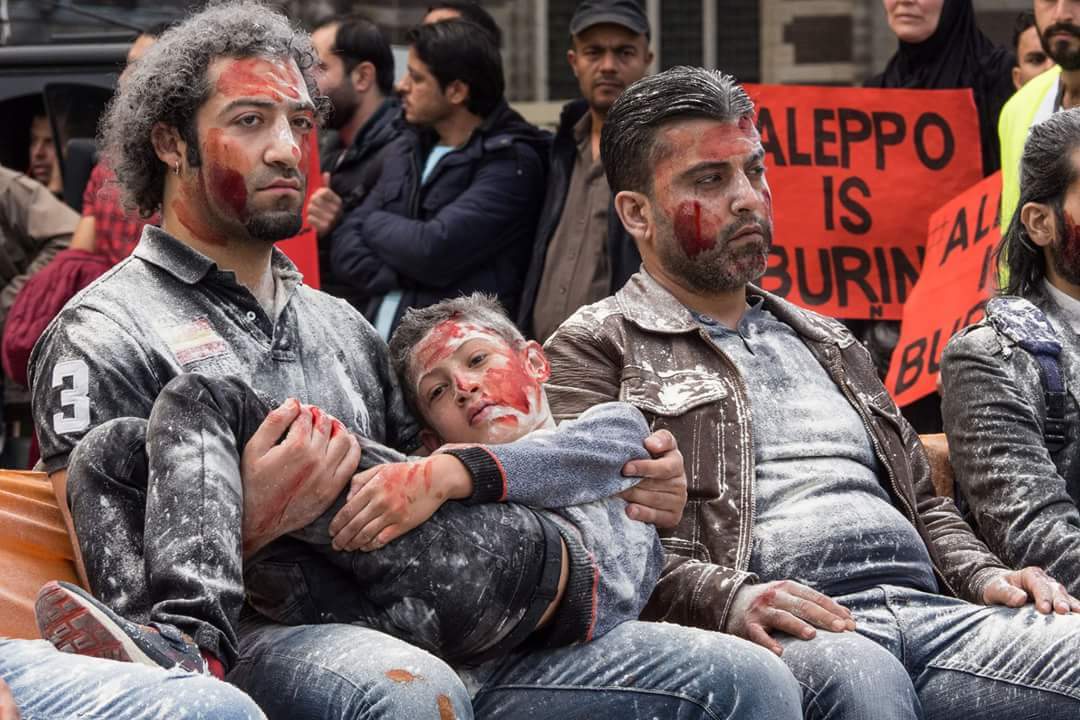
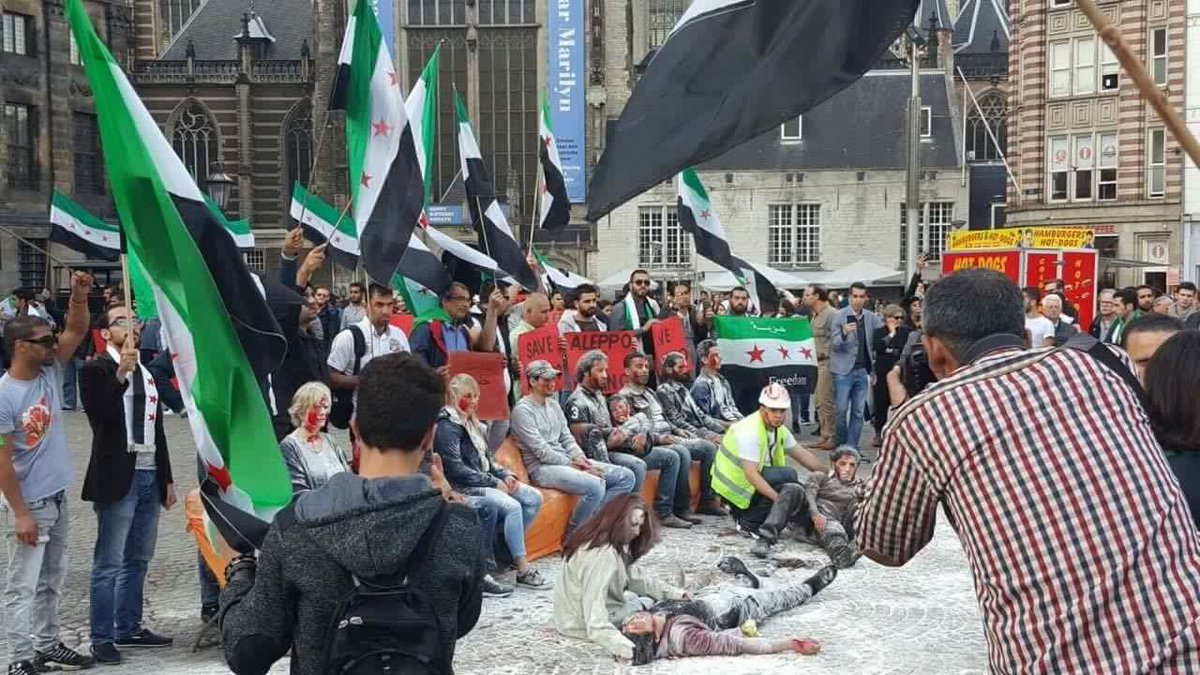
This is not Aleppo, Syria, but rather the streets of Europe where a recent “save Aleppo” protest was staged. Actors posing in fake dust and blood proved just how easy it is for anyone to create “war victims” anytime, anywhere. |
Saudi state media, Al Arabiya English would report in an October 1, 2016 article titled, “Worldwide protest against Assad, Russia to ‘save Aleppo’,” that:
The stalling talks between international powers on Syria – with Russia ramping up its air raid campaign – has ignited worldwide protests calling for an end to the horror in Aleppo.
Protestors in Turkey, France, Netherlands, America and Canada took to the streets opposing Bashar al-Assad’s and Russia’s crimes in Aleppo, carrying posters that read “Stop bombing Aleppo” and “Save Aleppo”.
Al Arabiya’s ironic hand-wringing over Syria as Riyadh devastates Yemen with its own aerial bombardment and ground incursion, attempts to portray eastern Aleppo as a horrific cauldron where “where more than 250,000 civilians are trapped without food or clean water.”
And while undoubtedly war is raging in eastern Aleppo, it should be noted that the vast majority of Aleppo’s population – 1.75 million in fact – live in the government-controlled majority of Aleppo. But despite this reality, the West and its allies – including Saudi Arabia – have attempted to use their sway over international public opinion to exaggerate Syrian security operations and fabricate a “humanitarian catastrophe” to serve as yet another pretext for wider Western intervention.
Central to this appeal to public opinion has been the so-called “White Helmets,” also referred to as the “Syrian Civil Defence” despite the nation of Syria already having a legitimate, professional civil defense force.
Posing as an impartial rescue force, the “White Helmets” are transparently auxiliaries serving exclusively side-by-side armed militants including US State Department, UN, and EU designated foreign terrorist organizations. Their primary function is not “rescuing” anyone, but to manage a public relations campaign aimed at swaying public and political opinion, leveraging “humanitarian” sympathy worldwide.
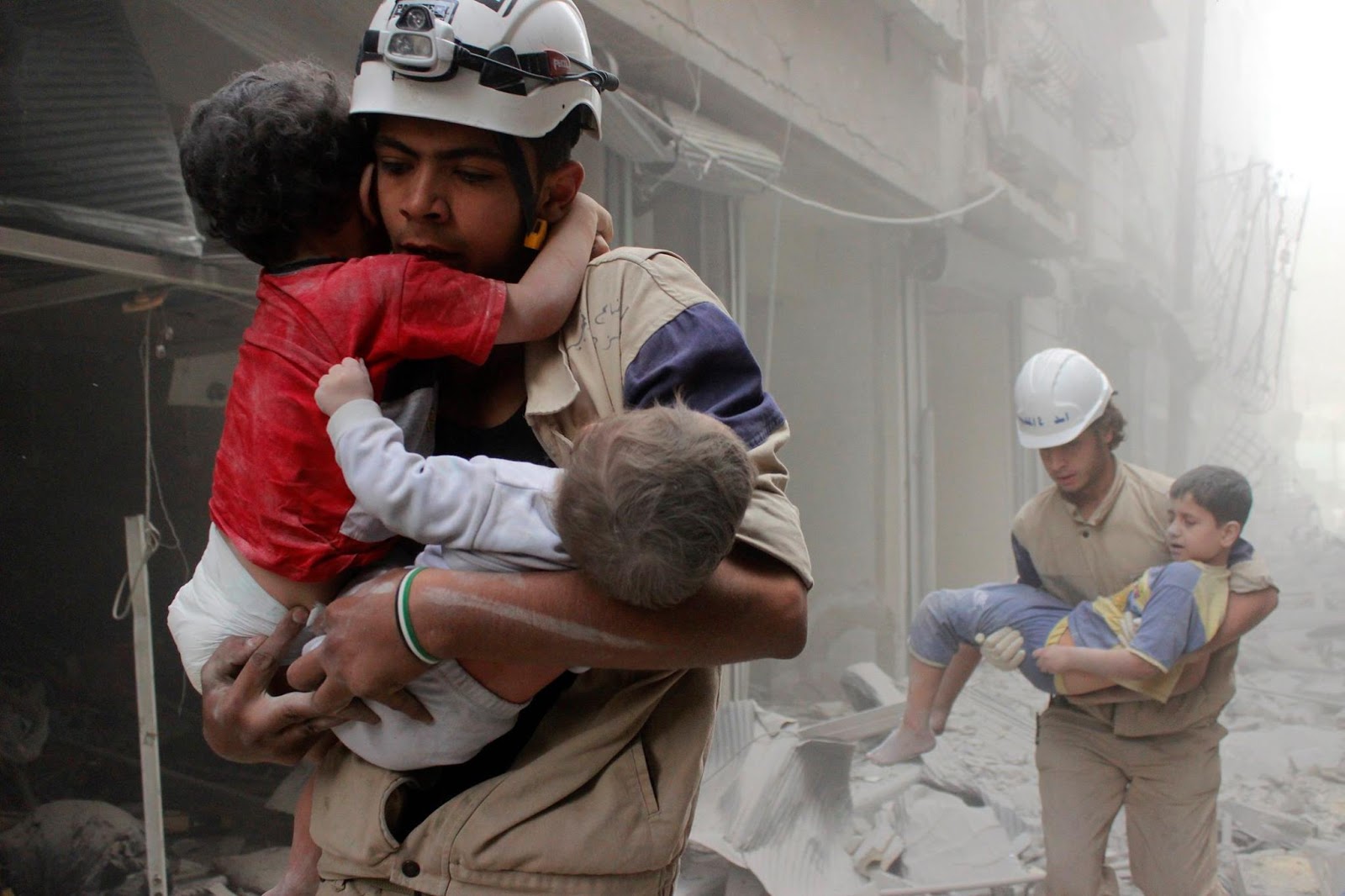
Their primary means of doing this is publishing photos and videos of their members – wearing elaborate, matching uniforms and driving brand new ambulances – pulling dust and blood covered victims from rubble allegedly brought down upon them by Syrian and Russian airstrikes.
The veracity of their photos, videos, and many claims have never been independently verified, and in many cases, evidence suggests that much of what they present to the public across their extensive, well-funded social media presence has been fabricated.
The recent coordinated “save Aleppo” protests held across Europe and North America, perhaps revealed just how transparently fabricated and fictional the “White Helmet’s” work really is. During one protest, photos retweeted by the official “White Helmet’s” Twitter account showed actors dressed up as “war victims,” covered in fake dust and blood, appearing almost indistinguishable from the alleged “victims” the “White Helmets” regularly “save” in Syria.
The protest, staged in European streets far from the Syrian conflict, even included children – likewise covered in fake dust and blood – cradled in the arms of adults, posing with despondent looks upon their faces. Also part of the staged scene were actors dressed like the “White Helmets” themselves.
 |
The only difference between admittedly staged scenes in European streets during a recent “save Aleppo” protest, and the daily output of the Western created and funded “White Helmets” acting troupe in Syria is that in Syria, the devastation of war provides a much more convincing “set” for the actors to perform on. |
While the acting troupe that organized this protest may have thought they were cleverly “bringing the conflict to the streets of Europe” to invoke global sympathy for their cause, what they really proved was just how easy it really is for the “White Helmets” to create “war victims” anytime, anywhere.
In Syria, where years of US-backed violence has left many parts of the country devastated, such staged scenes playing out with the devastation of war as a backdrop become all the much more convincing. With “White Helmet” videos heavily edited before reaching the public, they are able to create tragic scenes of war, anytime, anywhere – even in the streets of Europe thousands of miles away from where Syrian and Russian warplanes are operating.
Their primary goal and that of the special interests funding them tens of millions of dollars, is to manipulate the hearts and minds of the global public in support of Western-backed armed militants – not “save lives” nor bring peace to Syria.
Hamas should be removed from EU terror list: Lawyer
Press TV – September 22, 2016
A top European Union lawyer says Hamas should be dropped from the bloc’s blacklist, citing lack of concrete evidence showing the involvement of the Palestinian resistance movement in alleged terrorist activities.
Eleanor Sharpston, an advocate general at the European Court of Justice (ECJ), urged on Thursday the removal of both Hamas and the Liberation Tigers of Tamil Eelam (LTTE), a Sri Lankan rebel group, from the EU terror list.
The EU “cannot rely on facts and evidence found in press articles and information from the internet, rather than in decisions of competent authorities, to support a decision to maintain a listing,” Sharpston said.
In 2001, the EU adopted regulations to combat terrorism. Under the rules, the bloc imposed travel bans and asset freezes against Hamas and the LTTE.
In 2014, however, the General Court of the European Union, the second-highest court in the bloc, ordered both Hamas and the LTTE to be struck off the bloc’s terror list in two separate decisions. The court said the EU had based its decision, regarding the blacklist of the groups, on publicly available information rather than on any finding by a competent authority.
The Council of the EU, representing the governments of member states, in turn appealed the court ruling.
Elsewhere in her remarks, the top EU lawyer called on the ECJ to reject the appeal.
Given that “some of the reasons advanced could not justify the decision to maintain the listing of LTTE and Hamas,” the General Court was correct to dismiss the EU appeal when it could find no other sufficient reasons for their listing, Sharpston said.
Accordingly, the ECJ “should annul the measures maintaining Hamas and LTTE on the EU list of terrorist organizations on procedural grounds,” she added.
Hamas has ruled the impoverished and the Israeli-blockaded Gaza Strip since 2006, when it scored a landslide victory in legislative polls.
An American in Latakia: “this was no revolution”
By Lily Martin | OffGuardian | September 21, 2016
As an eye witness to the entire war in Syria, from March 2011 to present, I can state this was no revolution. I am an American citizen living permanently in Syria, which is my husband’s birthplace. I have been here 24 years.
A real revolution would have the support of the people, inside Syria, not Syrians living in Paris and London for the past 40 years. To have a real grassroots uprising, you need the support of the people living inside Syria, who would share your views.
If it had been a real uprising/revolution, the whole process could have taken 3-6 months, because the Army would have followed the will of the people, given the fact the Syrian Army is made up of Syrians of all ethnic and religious sects. The Syrian Army is a true representative of the Syrian population. If the population wanted the goals stated by the ‘protesters’, which was to establish Islamic law in Syria, and to abolish the current secular government, the Army would have eventually followed along, expressing the will of the people.
However, you had a small minority in the Syrian population who were for regime change, but this very small group was backed by USA, UK, NATO, EU, and the Arab Gulf Monarchies. Money talks, as we say in America.
Yes, Syria is home to many Radical Islamic ideology followers, as is UK, USA and Europe. However, their numbers are still in the minority. In a democracy, the majority rule. The Syrian opposition does include non-Islamist political people, mainly communists and other secular thinkers, but those people have never held a gun, and have never advocated violence, destruction or armed revolution. It has been strictly the Radical Islamic ideology followers who have supported armed rebellion. Because their numbers were, and are still, so small comparing to the rest of the 20 million Syrians, they never had a chance to win, and can not win on the ground. Their ‘revolution’ has just been an attack on the unarmed civilian population who do not agree with them.
We are hoping that a peaceful negotiated settlement, with positive changes and reforms, can be made through joint talks between the UN, and both sides of the Syrian conflict. This is our chance for peace.
Finally, this morning Sept 14, 2016 on the BBC they announced a UK Members of Parliament commission, studying the role of the UK in the war in Libya, had concluded the UK role was wrong, shameful and “opportunistic, and for regime change”. Meaning, the UK under PM Cameron should not have participated in the NATO and US attack on Libya, which was not a humanitarian effort, but an ‘opportunistic attack for regime change’, as stated on BBC. This is the same story of Syria. Perhaps in 5 years time, we may watch BBC announcing a UK Parliament commission, studying the UK role in the death and destruction in Syria.
My question to myself, and all others: Why can’t we study these types of decisions BEFORE we commit to destroying lives and countries abroad? I asked this question out-loud at the breakfast table this morning, and my son who is an MBA graduate, answered back, “Mom, because UK always takes their orders from USA, regardless of the consequences”.
That view should be the focus of every UK citizen and politician, on how UK can stand alone, and make decisions in the future which benefit UK, and not follow USA blindly, down a road of regret.
Lilly Martin is an American citizen, living permanently in Syria for 24 years. She is a retired medical professional, and now a homemaker and activist-writer during the Syrian conflict. Her son is the journalist Steven Sahiounie. She lost her home to terrorists in Kessab on March 21, 2014.
Astonishing as it may seem, chanting ‘Viva Palestina’ could soon be a ‘hate crime’
MEMO | September 21, 2016
“Viva Palestina” is an enduring chant along with “Long Live Palestine” and “Long Live Gaza”, all of which are often used by human rights activists and others who want to show their support and goodwill for the long life and well-being of the state and its people. However, using such slogans and messages of solidarity could soon become a hate crime in Scotland, a nation which has often been praised for its refusal to give unconditional support to Israel and its brutal military occupation of Palestine.
To the astonishment of legal observers and human rights activists, a landmark trial is set to go ahead in Aberdeen after Scottish Palestine Solidarity Campaign (SPSC) member Alister Coutts, 56, was charged with “acting in a racially aggravated manner with intent to cause distress and alarm”. His “crime” was to utter “Viva Palestina” next to the Jericho Cosmetics stall in the city’s Union Square shopping mall.
His arrest, charge and impending court appearance has now fuelled speculation that pro-Israel Zionist groups in Scotland are exerting undue pressure on the authorities to “get tough” with SPSC and other Palestinian-supporting groups. Following an initial crime investigation the police will send a report to the local Procurator Fiscal, who will consider the content and decide whether to take any further action.
While such decisions are said to be taken in the public interest, the disclosure of a host of secret email exchanges between the Crown Office and Procurator Fiscal service on one hand, and Zionist organisations on the other, has alarmed SPSC, which says that they reveal the existence of a “cosy relationship” between the public prosecutor and the pro-Israel lobby in Scotland. The emails came to light after a Freedom of Information request was made to the Crown Office and Procurator Fiscal Service in Edinburgh. SPSC officials are now scrutinising the content of the dossier before making public its findings.
“It is extremely sinister for anyone to be charged with expressing the idea of saying ‘long live’ to a community,” commented SPSC co-founder Mick Napier. “The charge therefore seems to have a patina of wishing harm to the Palestinian people. If so, this is certainly breaking new ground in the Scottish legal system; that by saying ‘Viva Palestina’ you are considered to be attacking someone.”
After Coutts had said “Viva Palestina” a policeman arrived and ordered him to leave the shopping mall, a request which, his defence team will argue, was in itself illegal. As soon as he stepped outside, he was handcuffed, held for seven hours and charged.
“He is now deemed to be a racist for saying Viva Palestina in the vicinity of a cosmetics stall,” Napier pointed out. “In the meantime, we are examining what some might regard as the overly-chummy emails.”
The trial, expected to commence next month, comes amidst the backdrop of a nationwide campaign by SPSC against the Israeli-linked cosmetics firm Jericho SkinCare. The group accuses the firm of using minerals extracted from the Dead Sea on the coast of the illegally-occupied West Bank, which is Palestinian territory. SPSC notes that the extraction and commercialisation of resources from an occupied territory breaches UN conventions and it has launched a boycott campaign against a number of cosmetic firms linked to the practice and is lobbying for them to be removed from Scottish shopping centres.
According to Canadians for Justice and Peace in the Middle East (CJPME), Dead Sea products are linked closely to the commercial viability of Israel’s illegal settlements and are targeted as part of the global boycott movement. The organisation has produced a fact sheet outlining the legal position. Jericho SkinCare’s website states that the company’s products are “based on Dead Sea minerals”.
A Crown Office spokesman said that he was unable to comment on ongoing criminal cases [sic] but added: “The Crown Office and Procurator Fiscal Service corresponds with many community and faith groups, particularly in relation to the impact of hate crime in their communities. All prosecution decisions are taken following an independent and thorough assessment of the available evidence.”
Let’s see what this translates to in practice.
IMF: Mideast conflicts have erased development gains for whole generation
Press TV – September 16, 2016
The International Monetary Fund (IMF) says conflicts in the Middle East are not only devastating economies in countries such as Iraq, Libya, Syria and Yemen, but they have also erased “development gains for a whole generation.”
The fund issued a report titled the Economic Impact of Conflicts and the Refugee Crisis in MENA (Middle East and North Africa) on Friday, where it said conflicts were killing economies in the countries gripped by war and sapping growth in neighboring countries and those hosting millions of refugees.
Middle Eastern and North African countries battered by fighting have suffered average losses of 6-15 percentage points in the gross domestic product (GDP) in three years, compared to a 4-9 percentage-point average worldwide, according to the report.
The IMF report showed that the drops in economic output in Syria, Libya and Yemen in recent years have far exceeded the worldwide average.
Syria’s gross domestic product level is currently less than half the level it was five years ago before the start of the conflict, the IMF stated.
The report showed Yemen lost 25-35 percent of its GDP in 2015 alone, in the wake of the deadly Saudi campaign.
Oil-dependent Libya saw its GDP fall 24 percent in 2014, the IMF said.
Physical infrastructure damage, now estimated at $137.8 billion in Syria and more than $20 billion in Yemen, has reduced trade and output in neighboring countries, according to the report.
Countries bordering high-intensity conflict zone showed an average annual GDP decline of 1.4 percentage points worldwide, with a bigger drop of 1.9 percentage points in the Middle East and North Africa region.
Refugees’ plight
The fleeing of more than half of Syria’s 22 million population, 6.6 million internally and more than five million to other countries, has magnified economic losses, dramatically escalating poverty, unemployment and school dropouts in countries that were already struggling, the IMF said.
Many of the refugees seeking asylum in other countries are skilled workers and professionals forced by war and persecution to leave the conflict zones in hope of better lives.
However, according to the IMF, because refugees often have fewer rights than local populations, those landing in developing countries are often absorbed into already disadvantaged local communities forming a new underclass comprising refugees and the existing poor in the host country, which in turn leads to a detrimental effect on the host countries.
For those refugees that land in Europe, where the influx of refugees has only had a small impact on economy, there have been some positive effects on the host countries, according to the report.
More funds needed
The IMF report has revealed the huge scale of the refugee crisis and the pressure it put on several United Nations institutions, especially the United Nations High Commissioner for Refugees (UNHCR) and the World Food Programme.
The two UN organizations have been playing a leading role in the provision of humanitarian assistance, both to internally displaced people and refugees.
However, the IMF report says funding has not kept up with the sharp increase in needs.
For instance, the World Food Programme and the UNHCR have had to cut their services to refugees in Jordan due to funding constraints, which may have contributed to the acceleration of refugee flows to Europe from late 2014, according to the report.
The IMF report urged policymakers to scale up humanitarian aid in conflict zones and neighboring countries hosting refugees and prioritize fiscal spending to protect human life and serve basic public needs.
The report comes as the UN General Assembly is preparing to host a summit on refugees in New York next week.
The UN plans to use the summit as a platform to urge governments, private donors, and humanitarian agencies to support the organization in its efforts to ease suffering of the victims of world conflicts.
Analysts believe the MENA conflicts and the following refugee crisis are the outcome of the West’s policies in the Middle East and North Africa.
European companies export highly-polluted fuel to West Africa: Report
Press TV – September 16, 2016
European companies are accused of taking advantage of weak fuel standards in African countries to export highly-polluted fuel to West Africa, a new report says.
The report, from the Swiss watchdog group of Public Eye, said major European oil companies and commodity traders take crude oil from African countries, blend it with highly-polluted additives, and then sell it back to them.
“Many West African countries that export high grade crude oil to Europe receive toxic low quality fuel in return,” it wrote.
Toxic products that the companies add to make the so-called “African Quality” fuels are far higher than those allowed in Europe, according to Public Eye.
“Their business model relies on an illegitimate strategy of deliberately lowering the quality of fuels in order to increase their profits,” the report read.
It said companies, among them the Swiss commodity traders Trafigura and Vito, increased their profits at the expense of Africans’ health.
While the European Union (EU) has allowed ten parts per millions (ppm) of sulfur in diesel in the continent, the legal limit on sulfur petrol in some African countries like Nigeria is 3,000 ppm.
After burning, the sulfur is released into the atmosphere as sulfur dioxide and other particulates that provide a major contributor to respiratory symptoms such as bronchitis and asthma.
According to the report, 20 million people in the Nigerian state of Lagos breathe 13 times more particulate matter than people in London, with dirty fuel being the main reason.
This is while Nigeria and some other West African countries produce petroleum with the world’s lowest sulfur levels. They do not have refining capabilities, however, and have to import fuel from Europe.
“Africa could prevent 25,000 premature deaths in 2030 and almost 100,000 premature deaths in 2050” if the export of low-quality fuel is stopped, Public Eye said.
It called on African governments “to protect the health of their urban population, reduce car maintenance costs, and spend their health budgets on other pressing health issues.”
“If left unchanged, their practices will kill more and more people across the continent,” the report warned.
In response to the allegations, the report said, three of the companies denied any wrongdoing, arguing that they meet the regulatory requirements of the market.
Public Eye, however, said that the companies adjusted their blends with no increased costs when Ghana lowered its sulfur content level in 2014.
Reported Death Of TTIP – An Abhorrent Political Deception

By Graham Vanbergen | TruePublica | September 9, 2016
The global mainstream media have loudly hailed the stunning success of the peoples uprising against the Transatlantic Trade and Investment Partnership or TTIP in the light of its demise. In the last few years protests broke out all over Europe as the unelected bureaucrats steamed ahead with this unpopular trade deal, even after the results of the largest ever consultation study in the EU Commission’s history resulted in a 97% negative response of 150,000 people.
The emerging movement spawned enormous online activism never seen before, culminating in the largest petition in Europe’s history with a staggering collective of over 3.2 million signatures delivered by passionate foot-soldiers right to the epicentre of where the political elite inhabit in the EU. The beating heart of TTIP activism was Berlin, Paris and London. This is not to forget the huge protest effort made by citizens across almost all of the EU’s major cities.

Infographic: Corporate Europe Observatory
When preparing for TTIP negotiations, 560 meetings took place between 2012 and 2013. Just 4% were represented by public interest and civil society. Unashamedly, the Commission allowed 92% of all TTIP meetings to be dominated by lobbyists and corporate trade associations Today, these shadowy agitators amount to over 30,000 grey suits stalking the halls of the Commission HQ in the de facto capital of the European Union in Brussels.
In May of this year Wikileaks confirmed that TTIP amounted to “a huge transfer of power from people to big business.” Greenpeace Netherlands then leaked 248 secret pages of the controversial trade deal between the U.S. and EU, exposing how environmental regulations, climate protections and consumer rights were effectively being “bartered away behind closed doors.” Tensions amongst civil society rose to fever pitch with the devastating news.
Der Spiegel Germany wrote “Protests Threaten Trans-Atlantic Trade Deal” as the leaks became public. With concerted effort activists seemingly brought the trade agreement to the brink of collapse within days. At the same time, Merkel’s grandly staged meeting with US President Barack Obama in Hanover was nothing more than showmanship. It aimed to show the strain of negotiations, as if somehow Germany (and therefore the EU) was going to get a better deal from TTIP and pacify the building rage of her citizens.
As if to rub salt into the wounds a report by TruePublica, published in The European Financial Review confirmed that corruption in the EU trading bloc had now reached 14 per cent of GDP – a staggering €1 trillion. By now 70 per cent of all European citizens believe corruption to be at the heart of their respective governments and the EU Commission itself, and that a corporate coup d’tat is taking the place of democratic principles that Europe fought so hard for over generations.
Then, out of the blue, an unexpected announcement is made last week. The media on all sides of the spectrum is broadly going along with the story that French Prime Minister Manuel Valls and German Vice Chancellor and Economy Minister Sigmar Gabriel have agreed that negotiations between the EU and the US on TTIP, have essentially failed. That’s it – the deal is dead. Hoorah!
The Telegraph – “EU’s TTIP trade deal with the US has collapsed, says Germany”
The Independent – “TTIP negotiations should stop, French government says”
ZeroHedge – “The Americans Give Us Nothing”: France Effectively Kills TTIP’
RT – ‘TTIP negotiations between EU and US have de facto failed’ – German economy minister”
Not so fast. You don’t think that the American’s are going to let the biggest trade deal in human history fail just because 97% of citizens reject it do you? No, France and Germany just need a plan. After Brexit, Britain can stay out of the firing line of the protest movement for a while.
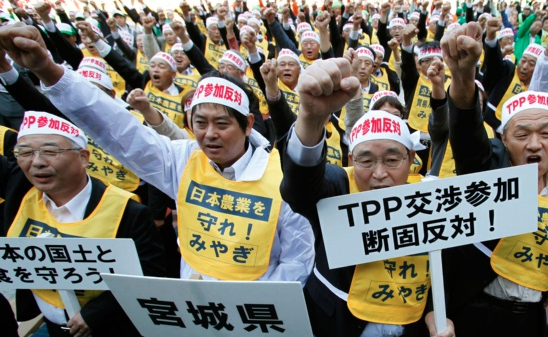
Mass protests in Japan
So, they looked to Japan. It had the same problem with its version of the trade deal similarly called TPP. Mass protests broke out as the same secret meetings gripped the political foreground. Its Prime Minister “Shinzo Abe, instructed the coalition early in the year not to “forcibly” proceed with the TPP negotiations until after elections, Kyodo News reported. Abe genuinely “feared a voter backlash in the Upper House elections” amid the growing scandal of a 242 page leaked document laying bare the bones of the deal. Having been elected June 11th, Abe now intends to force the deal through “this fall”.
I made enquiries with sources close to the ground on the EU/US TTIP deal along the same lines; was this simply a delaying tactic until after elections in 2017 for France’s Hollande and Germany’s Merkel? The response was not wholly unexpected.
“The seemingly early celebration of the end of TTIP has also surprised us a bit. Despite last week’s statements by the German and French trade ministers and the way these have been portrayed, we are continuing to campaign against the deal.”
In another exchange:
“The declarations of French and German leaders aim to: divert attention away from CETA, reduce the numbers in the streets of Germany on 17th September, put TTIP on hold while elections take place in France, Germany and the USA. The fifteenth round of TTIP negotiations will happen in the first week of October… This has been confirmed by our US friends.”
I then contacted Corporate Europe Observatory (CEO). It is a research and campaign group working to expose and challenge the privileged access and influence enjoyed by corporations and their lobby groups in EU policy making. They have been exposing the misinformation and propaganda of the EU Commission for years.
The CEO response to my same question was emphatic and quite clear:
“Public opposition to CETA and TTIP has led French and German leaders to please voters with words against TTIP. Unfortunately, the next round of TTIP negotiations is scheduled for early October and no EU leader has publicly said he or she will vote against CETA in the EU Council in October. This is clearly not the end of TTIP and CETA, just the beginning of electoral campaigns in France and Germany.”
Germany and France have taken the same stance as Japan on these trade agreements, they are not dead at all – they are lying.
I then spoke to Peter Koenig, an economist and geopolitical analyst. He is also former World Bank staff and worked extensively around the world in the fields of environment and water resources and posed the same question. He said:
“Following a debate on PressTV Edition Française, where I was one of the interviewees, the focus was on the German and French Ministers’ expressed conclusion that TTIP negotiations failed. I wrote an article “The TTIP is Dead”, hoping that spreading of this ‘promise’ by the highest authorities of the two key countries in the EU would make sure among the European populace that any deviation from this ‘promise’ would be perceived as a lie and receive strongest public expressions of protest.”
“In the meantime, it has become clear that the TTIP and TISA ‘deals’ are not at all dead. In fact, shortly after the German and French announcements, Jean-Claude Juncker, the unelected President of the European Commission, declared majestically that for him the negotiations are not dead.”
Koenig continues,
“There are other means to infiltrate the TTIP into the EU, i.e. through CETA and according to Juncker, doesn’t need ratification of each EU members’ parliament. Then there is TISA, the even more secret ‘trade agreement’ between 50 countries around the globe. TISA could easily be used to clandestinely impose TTIP rules on Europe.”
Nick Dearden, Director of Global Justice Now confirmed what Peter Koenig is saying in a Guardian piece “Think TTIP is a threat to democracy? There’s another trade deal that’s already signed”
“TTIP is not alone. Its smaller sister deal between the EU and Canada is called CETA (the Comprehensive Economic and Trade Agreement). CETA is just as dangerous as TTIP; indeed it’s in the vanguard of TTIP-style deals, because it’s already been signed by the European commission and the Canadian government. It now awaits ratification over the next 12 months.
The one positive thing about CETA is that it has already been signed and that means that we’re allowed to see it. Its 1,500 pages show us that it’s a threat to not only our food standards, but also the battle against climate change, our ability to regulate big banks to prevent another crash and our power to renationalise industries.
CETA contains a new legal system, open only to foreign corporations and investors. Should the British government make a decision, say, to outlaw dangerous chemicals, improve food safety or put cigarettes in plain packaging, a Canadian company can sue the British government for “unfairness”. And by unfairness this simply means they can’t make as much profit as they expected. The “trial” would be held as a special tribunal, overseen by corporate lawyers.”
What is missing from this statement is that any American corporation headquartered in Canada can sue any nation in the EU via CETA for the same reasons – namely, loss of ‘expected’ profits. They don’t actually have to be Canadian corporations.
As Global Justice also confirms, Canada has itself fought and lost a plentiful and diverse range of legal cases brought by US corporations under the North American Free Trade Agreement (Nafta) for “outlawing carcinogenic chemicals in petrol, reinvesting in local communities and halting the devastation of quarries.” If TTIP doesn’t bring this horrific erosion of democratic power to the shores of Europe, CETA will. ‘Brexit’ will mean for nothing. It will be sold to the British people as a global trade agreement which will be heralded as a great success and supported by much of the media who themselves have a vested interest in such deals.
In the end, does it matter if it’s called TTIP, CETA, TISA and the like, they are all shadowy unaccountable acronyms designed to enrich the few via extreme neoliberal capitalism under the guise of free trade.
European Copyright Ruling Ushers in New Dark Era for Hyperlinks
In a case which threatens to cause turmoil for thousands if not millions of websites, the Court of Justice of the European Union decided today that a website that merely links to material that infringes copyright, can itself be found guilty of copyright infringement, provided only that the operator knew or could reasonably have known that the material was infringing. Worse, they will be presumed to know of this if the links are provided for “the pursuit of financial gain”.
The case, GS Media BV v. Sanoma, concerned a Dutch news website, GeenStijl, that linked to leaked pre-publication photos from Playboy magazine, as well as publishing a thumbnail of one of them. The photos were hosted not by GeenStijl itself but at first by an Australian image hosting website, then later by Imageshack, and subsequently still other web hosts, with GeenStijl updating the links as the copyright owner had the photos taken down from one image host after another.
The court’s press release [PDF] spins this decision in such a positive light that much reporting on the case, including that by Reuters, gets it wrong, and assumes that only for-profit websites are affected by the decision. To be clear, that’s not the case. Even a non-profit website or individual who links to infringing content can be liable for infringing copyright if they knew that the material was infringing, for example after receiving notice of this from the copyright holder. And anyway, the definition of “financial gain” is broad enough to encompass any website, like GeenStijl, that runs ads.
This terrible ruling is hard to fathom given that the court accepted “that hyperlinks contribute to [the Internet’s] sound operation as well as to the exchange of opinions and information in that network”, and that “it may be difficult, in particular for individuals who wish to post such links, to ascertain whether [a] website to which those links are expected to lead, provides access to works [that] the copyright holders … have consented to … posting on the internet”. Nevertheless, that’s exactly what the judgment effectively requires website operators to do, if they are to avoid the risk of being found to have knowingly linked to infringing content.
There are also many times when knowingly linking to something that is infringing is entirely legitimate. For example, a post calling out a plagiarized news article might link to the original article and to the plagiarized one, so that readers can compare and judge for themselves. According to this judgment, the author of that post could themselves be liable for copyright infringement for linking to the plagiarized article—madness.
This judgment is a gift to copyright holders, who now have a vastly expanded array of targets against which to bring copyright infringement lawsuits. The result will be that websites operating in Europe will be much more reticent to allow external hyperlinks, and may even remove historical material that contains such links, in fear of punishing liability.
EU Lies to Moscow: Official Reveals Sanctions Not Related to Ukraine Peace Deal
Sputnik – 28.08.2016
Interviewed by Ukrainian radio station Radio EC-Evropeiska Stantsiya on the eve of his departure earlier this week, the ambassador, who played a critical support role in the EuroMaidan riots which culminated in the February 2014 coup d’etat in Kiev, explained that Russia’s ostensible obligations under the Minsk agreements were in no way connected to European officials’ decision to prolong anti-Russian sanctions. Accordingly, Tombinski noted, the sanctions can be extended whether Russia ‘complies with its obligations’ or not.
The diplomat did not reveal what exactly those “obligations” might be, given that Moscow is not even a direct party to the conflict, but a mediator. Instead, he suggested that the sanctions were connected with Russia’s “aggression” against Ukraine and the “annexation” of Crimea, whose population voted overwhelmingly to break off from Kiev and rejoin Russia amid the instability that followed the 2014 coup.
Tombinski’s remarks, essentially revealing that EU sanctions against Russia might remain in place indefinitely, come at an unfortunate time for German Chancellor Angela Merkel.
A day prior to his comments, Merkel reiterated to Czech Prime Minister Bohuslav Sobotka the oft-used mantra that the EU’s sanctions were directly connected to Moscow living up to its commitments under Minsk.
Commenting on the apparent inconsistency between the talking points used by Brussels and Berlin, Azhdar Kurtov, a senior expert at the Russian Institute for Strategic Studies, told the Svobodnaya Pressa online paper that this not the first time Western leaders have effectively lied to Moscow about sanctions being connected to concrete actions.
In fact, he suggested, it’s become somewhat of a tradition.
“It’s worth recalling that during the Soviet period, there was a legislative amendment created by US congressmen which limited US trade with our country.” Called the Jackson-Vanik Amendment and in 1974, “it was approved in connection with alleged Soviet violations of the rights of citizens of Jewish nationality.”
“This piece of legislation remained in force several decades after the legal basis itself disappeared,” (and long after the Soviet Union itself ceased to exist). That law, Kurtov suggested, was never really connected to the persecution of Soviet Jews in the first place.
Now, the situation surrounding the modern-day anti-Russian sanctions is much the same, the expert suggested. “We’re seeing the same thing today. There is the formal aspect, linked to the fact that Russia is always being urged to ‘fulfill its obligations’, even though it is not even a subject to the Minsk agreements. But that’s not the main issue: even sticking to formalities, it’s necessary to read the text of these agreements. And that’s something no one wants to do, apparently.”
Kurtov pointed out that simply going back and reading the Minsk peace deal’s 13 points confirms that neither Moscow nor the self-declared Donbass republics are responsible for violating the agreement.
“These violations don’t exist because Minsk provides a coherent chain of actions [which must be fulfilled in order]. And this chain was broken – in the sense that it’s points were not carried out, not by the Donetsk or Lugansk republics, but by Kiev authorities. Therefore, even formally, there are simply no grounds for blaming Russia.”
In reality, the expert said, Western countries’ sanctions policy against Russia has never been about things like the alleged violation of human rights or failure to live up to some agreement. After all, Russian President Boris Yeltsin’s decision to fire into the Russian parliament in 1993 was, “from the perspective of refined Western democracy, a clear violation, for which sanctions could have followed, but they didn’t.This indicates that some other issues are at stake.”
“In my opinion, these circumstances are obvious: Russia has begun to consistently pursue an independent policy.”
Throughout the 1990s, Kurtov recalled, Russia held a pro-American line in international relations, and eagerly listened to Western advisors’ advice on reforming the economy, which virtually collapsed as a result. The country’s armed forces were degraded, the latest weapons systems systematically destroyed, and Moscow withdrew from the areas around the world traditionally considered part of its sphere of influence.
“Now, when we have begun consistently and firmly asserting our national interests, and have even come to serve as a kind of ‘guide’ to other countries wishing to do the same, the main blow [from the West] has been directed against us. Sanctions serve as one form of this kind of pressure. And so an excuse was invented – and more precisely, not invented but artificially constructed. After all, the coup in Kiev took place with the direct involvement of the West.”
Effectively, Kurtov suggested that the Ukrainian crisis beginning in 2014 “was just an excuse used to try to stop a trend that started in the early 2000s – the trend of Russia strengthening itself as an active player in global geopolitics.”
Of course, the analyst admitted that Western sanctions are harmful to Russia, insofar as they limit bilateral contacts, and damage economic and trade relations. On the other hand, Kurtov emphasized that Russia “must not allow the sanctions to string us along. It’s not necessary to fulfill their requirements, since new requirements will always appear in their place so long as their reasons are contrived and artificially constructed.”
Ultimately, the expert suggested that whatever else happens, Russia must push for cooperation on an equal basis, must strive “to make it so that the Russian position is properly understood not only by the political elites of other countries, but also by their people.”
For his part, Sergei Kalmykov, the deputy director of the Association of Military Diplomats, generally agreed with Kurtov’s assessment, suggesting that unfortunately, Washington “has always regarded Russia as a strategic adversary.”
“This has been the case not just for decades, but for over a century. It’s worth recalling that as soon as the Jackson-Vanik Amendment, which continued to function for an unjustifiably long period, was repealed [in late 2012], it was immediately replaced by the so-called Magnitsky Act. Now, the Magnitsky Act has faded into the background, because the ‘Crimean issue’ and the whole situation around Ukraine has taken its place.”
“What we’re seeing is a pure political con game – a con game which simply involves the juggling of a variety of motives and terminology, but which only has one goal: to prevent Russia from emerging as a leader in global geopolitics. And today the West is using any excuse to try to carry out this policy,” Kalmykov concluded.
Armed French Police Force Woman to Strip off Burkini on Beach

Woman on Nice beach being forced to remove her burkini by armed police, Aug. 23, 2016. | Photo: AFP
teleSUR | August 24, 2016
Armed French police ordered a Muslim woman to remove her burkini swimsuit on a Nice beach Tuesday, adding further controversy to a ban on the garment amid growing Islamophobia in France.
Photographs show the woman removing her burkini—a full-body swim piece, while four armed police surround her on the Promenade des Anglais in Nice. The woman was issued a ticket by police for not wearing “an outfit respecting good morals and secularism,” according to AFP.
“I was sitting on a beach with my family … I was wearing a classic headscarf. I had no intention of swimming,” said the 34-year-old mother, who only gave her first name, Siam.
“Today we are not allowed on the beach. Tomorrow, the street? Tomorrow, we’ll be forbidden from practicing our religion at all?” Siam asked.
Mathilde Cousin, witnessed the incident and told the Guardian, “The saddest thing was that people were shouting ‘go home,’ some were applauding the police. Her daughter was crying.”
Nice is the latest of 15 towns to ban the burkini. The mayor of nearby Villeneuve-Loubet said that the ban was important to “protect the population.”
Last week three Muslim women were fined $US43 for wearing burkinis in Cannes. On Tuesday, a mother of two reported she had been fined on the Cannes beach for wearing leggings, a tunic and a headscarf.
French Prime Minister Manuel Valls defended the ban, saying that “Beaches, like all public areas, must be protected from religious claims. The burkini is not a new range of swimwear, a fashion. It is the expression of a political project, a counter-society, based notably on the enslavement of women.”
The niqab and burqa veils were banned by France in 2010. Critics say the burkini ban is steeped in Islamophobia and secular extremism. Some advocacy groups have filed legal action against the ban that “pits citizens against one another,” said Marwan Muhammad from the Collective Against Islamophobia in France.
The burkini was originally designed in 2004 by Australian-Lebanese fashion designer, Aheda Zanetti, who also created the “hijood,” a head covering that can be used by Muslim women to play sports.
“This has given women freedom, and they want to take that freedom away? So who is better, the Taliban or French politicians? They are as bad as each other,” Zanetti said to the Guardian.
Since the crackdown on burkinis, its sales have seen a dramatic increase of 200 percent, with many non-Muslims buying the swimsuit to protest its ban.
Featured Video
John Mearsheimer: Why Russia Gains By Hitting Ukraine Harder
or go to
Aletho News Archives – Video-Images
From the Archives
A Climate Scientist Who Engages Skeptics
By Judith Curry | November 27, 2009
An open letter to graduate students and young scientists in fields related to climate research:
Based upon feedback that I’ve received from graduate students at Georgia Tech, I suspect that you are confused, troubled, or worried by what you have been reading about ClimateGate After spending considerable time reading the hacked emails and other posts in the blogosphere, I wrote an essay that calls for greater transparency in climate data and other methods used in climate research. The essay is posted over at climateaudit.org.
What has been noticeably absent so far in the ClimateGate discussion is a public reaffirmation by climate researchers of our basic research values: the rigors of the scientific method (including reproducibility), research integrity and ethics, open minds, and critical thinking. Under no circumstances should we ever sacrifice any of these values; the CRU emails, however, appear to violate them. … continue
Blog Roll
 Aletho News
- Content control: USAID docs expose Biden admin’s grip on Ukraine coverage
- Ukraine destroying itself: every attack on the Crimean Bridge will come at a price
- NATO capital under protest siege, so NATO escalates war
- A Climate Scientist Who Engages Skeptics
- John Mearsheimer: Why Russia Gains By Hitting Ukraine Harder
- Argentina’s Perito Moreno Glacier Joins Antarctica and Arctic In Defying Doomsday Melt Claims
- ‘Chinagate’ Is Here
- Iran, four other countries condemn US plans to deploy weapons in outer space
- US media brings back the Iraq war playbook and why it won’t work
- Zakharova schools German FM on history basics
- If Americans Knew
- An error has occurred; the feed is probably down. Try again later.
- No Tricks Zone
- Alarmist Climatologists In Shock! 2026 Atlantic Hurricane Season Sees Lowest Count In 101 Years
- New Study: Modern Temps Are Among The Coldest Of The Last 10,000 Years In East Central Europe
- Germany’s Renewable Energies Lead to 1.4 Billion Euro Electric Power Trade Deficit
- Argentina’s Perito Moreno Glacier Joins Antarctica and Arctic In Defying Doomsday Melt Claims
- New Study: Barents Sea Temperatures Were Warmer And Sea Ice Less Extensive In The 1700s Than Today
- German Authorities Start Initiative To Evaluate Public Register For Climate “Disinformation” Spreaders!
- Zonal Asymmetry of Temperature Change in the Antarctic Circumpolar Current
- New Study: The Net Fossil Fuel Contribution To Rising Atmospheric CO2 Has Been Zero For 500 Years
- Germany’s Green Energy Transition Becoming Increasingly Expensive…Another 6 Trillion Euros!
- Sudden Stratospheric Warming, Powerful El Niño Combination May Lead To Extreme Europe Cold, Energy Crisis!

