Facebook investigated by German prosecutors for failing to stop ‘hate speech’
RT | November 4, 2016
Facebook’s founder Mark Zuckerberg and other senior executives are being investigated in Germany after a lawyer filed a complaint accusing them of allegedly allowing racist and violent posts to remain on the social networking site.
The social media giant was accused of doing little to stop racism, Holocaust denial and violent threats on the site, according to Der Spiegel.
A Bavarian lawyer initiated the case by reporting Facebook to the police, accusing the company’s management of allowing such hateful posts to stay on the site without any consequences.
Chief Operating Officer Sheryl Sandberg, European policy director Richard Allan and company head in the Berlin office Maria Kirschsieper, are also under investigation.
German law requires Facebook to delete any content considered to be inciting hatred. Earlier this year, the company was also hit with a criminal complaint, but authorities said at the time they were unable to investigate because the accused, Zuckerberg, was not residing within German borders when it was brought to light.
German politicians have criticized Facebook for reportedly failing to take action against hate speech on the site.
In October, Volker Kauder, a member of Angela Merkel’s Christian Democratic Union, said Facebook and other social media giants should face penalties for not taking action against hate speech, following the rise of xenophobic comments amid the refugee crisis in Europe.
Kauder said he had “run out of patience” with how social media giants were dealing with abusive content.
Many users of Facebook, Twitter and Google said that despite pledges from the companies to remove hate speech within 24 hours from their sites, users complaints were not adequately dealt with, the Local reports.
Facebook did not comment on the investigation status but said “the allegations lack merit and there has been no violation of German law by Facebook or its employees.”
Misplacing priorities and freedom of expression
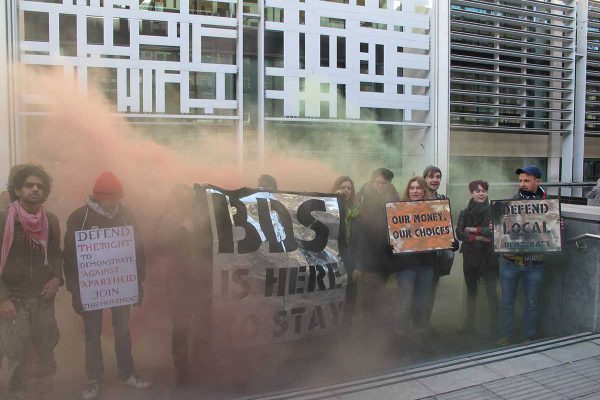
BDS supporters protest anti BDS activities in London
By Ramona Wadi | MEMO | November 3, 2016
It would be slightly premature to consider the statement by the EU Representative for Foreign Affairs and Security Policy, Federica Mogherini, regarding the right of EU citizens to boycott Israel as some sort of victory. At first glance, it might look as if activism has overcome a significant hurdle, given the Israeli government’s obsession with suffocating the Boycott, Divestment and Sanctions movement (BDS). A study of the brief statement actually suggests otherwise, and all in the name of freedom of expression.
Mogherini asserted that the EU “stands firm in protecting freedom of expression and freedom of association in line with the Charter of Fundamental Rights of the European Union”, even when such information or ideas “offend, shock or disturb the State or any sector of the population.” You just knew that there was a “but” coming: she made it equally clear that “the EU rejects the BDS campaign’s attempts to isolate Israel and is opposed to any boycott of Israel.” The EU official missed the point, of course; Israel isolates itself by its contempt for international laws and conventions, along with its brutal military occupation and colonisation of Palestine.
Commenting on Mogherini’s statement, BDS Europe Campaigns Officer Riya Hassan voiced the expectation that the EU should respect “its obligations under international law and its own principles and laws by, at the very least, imposing a military embargo upon Israel,” as well as a suspension of the EU-Israel Agreement signed in 1995. The latter stipulates regulations regarding political dialogue, economic cooperation, security and cooperation on social matters, based upon the premise in Article 2 of the agreement that all provisions “shall be based on respect for human rights and democratic principles.” Israel has no such respect; it is a colonial entity and the EU functions as a protector of colonialism. The entire agreement should thus be declared null and void, or amended according to each entity’s characteristics, without the need to drag pretentious terms such as democracy into the equation.
Through Mogherini’s recent statement we have a clear example of how the EU actually demeans human rights and freedom of expression by utilising the discourse meant to uphold them. The entire essence of the EU’s true intentions lies in its opposition to BDS. Hence, any concession given by the EU should not be misconstrued as support, or upholding the right to freedom of expression. It is merely a recurring political ploy that ridicules the very essence of freedom. At the same time, it is through these clauses that BDS has managed to retain ground. Notwithstanding the genuine efforts of the masses which have embarked upon collective and individual efforts to boycott Israel, the fragile compromise upon which the global boycott outlook rests may well become tarnished if it continues to laud statements blatantly supportive of Israel while grudgingly allowing dissent as proof of freedom of expression.
Hence, Mogherini’s statement is not welcome. It is a calculated contribution to the debate that places Israel’s interests above the legitimate demands and legal rights of the Palestinians. BDS should distance itself from the litany of symbolic gestures that have taken precedence over genuine, active support for the anti-colonial struggle unless, that is, the movement seeks to become just another actor that thrives upon Palestinian demands as the means for the entity’s survival. If the movement’s chartered course is in the slightest way intertwined with that of the EU, however insignificant it may seem on the surface, Palestine may well be destined to accumulate festering wounds; the objective — which is already compromised due to the two-state subjugation rhetoric — will in the meantime become ever more distant from the land and the indigenous people.
Europe’s Battle: Nationalists vs. Elites
By Andrew Spannaus | Consortium News | October 26, 2016
In recent years “nationalism” has become a bad word in Europe, a synonym of closure, racism and wars. Over the past 20-25 years European elites have instead embraced a concept of globalization based on a world without economic, physical and social borders.
This view assumes the gradual affirmation of a set of shared values internationally, consisting of human rights and economic freedom, that however much the remaining closed, autocratic regimes may try, will inevitably become the standard for the entire world.
It is essentially the argument put forward by Francis Fukuyama in “The End of History:” liberal democracy and free markets have won the ideological war, and represent the culmination of human evolution.
The political events of 2016 are upending this view of the globalization of human rights and economic liberalism. The American electorate has supported a series of outsiders – most notably Donald Trump, who has run his campaign in direct opposition to the U.S. political and financial class, invoking economic protectionism and a stronger national identity.
Against expectations, the population of the United Kingdom voted to leave the European Union, marking an irreparable break in the supposedly inevitable process of European unification. And across Europe support is growing for more extreme, anti-system political forces, that threaten not only to withdraw from the common currency – the Euro – but also to seal the borders in response to economic and security threats associated with immigration.
Establishment’s Failure
It is no exaggeration to speak of the failure of the entire transatlantic political establishment. Since the 1970s, Western economies have undergone a post-industrial transformation that has favored short-term gain over long-term investment. The notion of economic freedom has translated principally into support for deregulation and speculative finance.
Central Banks have made unlimited resources available to the financial sector while large areas of the real economy struggle to survive, feeding discontent among the population. It is true that new economic sectors have arisen, along with widespread changes made possible by technologies that were inconceivable until a few years ago, but the overall effect has been to hollow out the middle class and create large-scale income equality.
In Europe, the principal vehicle of this process has been the economic policy of the European Union. From the implementation of the Maastricht Treaty in 1993, European nations have been stuck in a monetary straitjacket, that prevents governments from taking effective economic action. In the name of market principles, liberalization has been implemented that favors large financial interests while lowering standards of living for the middle class.
Countries are constitutionally required to move towards a balanced budget, with the European Commission and the European Central Bank essentially having veto power over national policies. This has translated into harsh austerity, including the massive budget cuts and tax increases inflicted on countries such as Greece, Spain and Italy in recent years.
Despite paying lip service to the need for change, the economic and political elites have refused to abandon this approach, that not only ignores the suffering of the population, but actually makes the problem worse. In fact the austerity causes a drop in economic activity and thus exacerbates budget problems, leading to a vicious cycle that Europe seems unable to stop.
A Big Backlash
The resulting backlash is calling into question the process of European integration as a whole, provoking a strenuous defense by the elite of institutions that are said to have guaranteed “50 years of peace” after the Second World War.
It is true, of course, that there are some benefits to E.U. integration, and that nobody wants to return to a situation of conflict among the member states. But the current policies are quite different than the fruitful cooperation that existed until the 1990s, when the financial elite began its move to exert supranational control.
Now, the failed economic policies of the past 20 years are no longer sustainable. Governments are forced to negotiate over .1 percent of the budget deficit with the bureaucracy in Brussels, while the need for public and private investment runs in the trillions.
The pro-finance, anti-production policies must change not for ideological reasons or to serve some specific interest group; they must change because there is no other choice. People are revolting against a political class that does not respond adequately to widespread economic and social discontent. In times of economic distress the population becomes more vulnerable to demagogues, raising the risk of dangerous outcomes, as seen with Fascism and Nazism in the 1920s and 1930s.
Currently, there are unprepared and unpredictable political forces with growing support across Europe, that in some cases represent a threat to the democratic rights and values that the European Union aims to promote. Defending the orthodoxy of E.U. policy against popular movements that target failed economic policies, will only further damage precisely those values on which Europe is said to stand.
What to Do
At this point Europe needs a return to measures that promote productive investment and innovation, rather than cut social welfare programs and encourage further deregulation.
There are two potential directions: a wholesale change in the policies of the E.U. institutions, without modifying their essential structure, or a step back from the process of cancellation of national sovereignty.
The first option seems unrealistic, for various reasons. These include the constitutional nature of many economic and budget constraints, and the stubbornness demonstrated by the European ruling class in recent years; a class that, despite numerous alarm bells, does not at all seem ready to abandon an elitist view of globalization.
The response to the Brexit vote is a glaring example. Representatives of the E.U. institutions lashed out with arrogance and bitterness, essentially accusing half of the British population of being ignorant, racist and isolationist. It’s a comforting excuse based on partial truths, that avoids reflection on Europe’s own mistakes.
At this point a return of decision-making power to national governments is becoming inevitable: not in order to stop international cooperation, or to reject shared values, but because the model pursued by the supranational institutions and their allies in the financial world has failed, and risks producing both serious internal conflicts, and unacceptable strategic failures in an increasingly complex world.
Andrew Spannaus is a freelance journalist and strategic analyst based in Milan, Italy. He is the founder of Transatlantico.info, that provides news, analysis and consulting to Italian institutions and businesses.
Belgium’s Wallonia rejects ‘undemocratic’ EU ultimatum on CETA
RT | October 24, 2016
Wallonia is not going to be pressured into agreeing the EU-Canada trade deal according to the leader of the French-speaking Belgian region Paul Magnette. The EU has given Belgium an ultimatum to end its objection to the agreement by Monday.
“Every time you try to put an ultimatum it makes a calm debate and a democratic debate impossible,” Magnette said at a meeting in Brussels.
“We don’t need an ultimatum,” he told reporters. “We will not decide anything under an ultimatum or under pressure.”
On Sunday the leader of the Wallonia region told the Belga news agency the ultimatum from the EU “is not compatible with the exercise of democratic rights.”
“We are not against a treaty with Canada,” Magnette said. “But we won’t have one that jeopardizes social and environmental standards and the protection of public services and we want absolutely no private arbitration mechanisms.”
Magnette was referring to an introduction of a secret corporate court system, empowering big business to sue states for policies that threaten their profits.
Belgium has been given until Monday to resolve an internal disagreement holding back the CETA trade deal with Canada. The pact needs the backing of all 28 EU countries to be passed. Belgium cannot sign without Walloon support.
The EU has warned that unless Belgium makes its position clear, it will cancel this week’s EU-Canada summit. Belgian Prime Minister Charles Michel is expected to make a speech on Monday, an EU source told Reuters.
Wallonia is a region of 3.6 million people, and has become an obstacle in the controversial free trade agreement between the European Union and Canada. The region has refused to approve the deal, fearing an influx of Canadian pork and beef products would undermine local farmers.
CETA promises to eliminate tariffs on 98 percent of goods traded between the EU and Canada. The agreement encompasses regulatory cooperation, shipping, sustainable development and access to government tenders.
Supporters of CETA say the deal will be worth $13 billion a year to the EU and $9 billion to Canada.
Opponents say the trade deal will violate workers’ rights and benefit the interests of the wealthy elite and corporations.
The EU has warned a failure to complete the agreement after seven years of negotiations will jeopardize the bloc’s trade policy.
Israel refuses to sign US document regulating export of killer drones – report
RT | October 24, 2016
Israel is reportedly refusing to sign a US document on the use and export guidelines of armed drones, fearing it would hurt its defense industries. The State Department paper aims to establish international standards in the production and selling of UAVs.
The one-page document, titled “Joint Declaration for the Export and Subsequent Use of Armed or Strike-Enable Unmanned Aerial Vehicles (UAVs),” covers a number of topics regarding the selling and usage of drone systems, according to Defense News.
Those topics include applying international law and human rights when using UAVs; following existing arms control laws in selling armed drone systems; considering the buyer country’s history on “adherence to international obligations and commitments”; following “appropriate transparency measures”; and ensuring the sold unmanned system’s capabilities are “transferred and used responsibly by all states.”
The document has been provided to countries which are considered to be US allies and has already been signed by over 40 nations, including Austria, Germany and Italy.
Israel, however, has so far refused to sign the document, with sources in the country’s defense industry telling Haaretz that the sector is concerned it could limit the nation’s export business.
Israel is potentially already facing a loss of business when it comes to drone exports, following the admission of India to the multilateral Missile Technology Control Regime by the US – a move which removes barriers to the sale of American UAVs to the country.
Following India’s admission into the regime, Delhi has shown an interest in acquiring the US-made Predator drone rather than Israeli UAVs.
Another threat to Israel’s share of the drone market includes a lawsuit by the American firm General Atomics, which is aiming to block the lease of the Israeli Heron TP drone to Germany.
However, a senior air force official told Haaretz that Israel still has one advantage when it comes to drones – the promise for the country’s drone squadron to train buyers of Israeli UAVs, as Israel’s air force is considered a world leader in the field.
In addition to its efforts to maintain its stronghold in the market, Israel is also seeking to have limitations placed on information regarding its deployment of drones. When German MPs demanded answers regarding Berlin’s lease of Heron TP drones earlier this year, they were denied information and told the matter was considered confidential by Israel, and that any information was subject to limitations imposed by Tel Aviv.
If EU leaders can be so wrong on Russia & Syria, no wonder the bloc is in crisis
By Finian Cunningham | RT | October 21, 2016
Russophobic rants by some European Union leaders and their willful distortion of events in Syria is a reflection of why the 28-member bloc is careering toward disaster. We are witnessing a crisis of appallingly inept leadership.
German, British and French leaders were among the most hawkish voices at the EU leaders’ summit in Brussels this week, denouncing what they claimed were Russian “war crimes” in Syria and calling for additional economic sanctions on both Moscow and Damascus.
German Chancellor Angela Merkel said Russian-backed Syrian air strikes were “inhumane and cruel,” while Britain’s Prime Minister Theresa May took the “most shrill prize” with her condemnation of Moscow’s “sickening atrocities.”
French President Francois Hollande echoed their calls for the EU to slap more sanctions on Russia – in addition to those the bloc has implemented over the Ukraine conflict.
This came only days after Belgian F-16 fighter jets reportedly killed six civilians in the Aleppo countryside, adding to a catalog of illegal aggression committed in Syria by French, British and American warplanes bombing the country without any legal mandate.
In the end, good sense among certain member states prevailed, and the EU summit concluded without imposing additional punitive measures. As the Financial Times reported: “Italy’s Renzi forces a retreat from new sanctions on Russia… Germany, France and UK rein in demand for fresh EU sanctions over Aleppo bombardment.”
Italy, Spain, Austria, Hungary, Greece, Malta and Cyprus were some of the EU members wary of escalating economic and political problems already incurred from loss of trade with Russia over the Ukraine debacle.
Britain’s premier May gave a particularly asinine speech in Brussels. She called for a “robust and united European stance in the face of Russian aggression.” This from the leader of a government currently embroiled in bitter rows over its divorce from the EU.
So, the British leader wants to bequeath even more tension and economic hardship between the people of Europe and Russia, just before she packs up Britain’s membership.
In the Russophobic rousing, European Council President Donald Tusk also excelled. Despite the EU summit rejecting the adoption of more sanctions against Russia over Syria, Tusk was later threatening that such measures remained an option. Tusk had regaled the summit with a list of alleged Russian “misdemeanors” including “air-space violations, disinformation campaigns, cyber-attacks, interference in the EU’s political processes and beyond. Hybrid tools in the Balkans, to developments in the MH17 investigation.”
Then he declared: “Given these examples, it is clear that Russia’s strategy is to weaken the EU.”
Please note that Tusk is supposed to be a leading light for the EU as it negotiates a raft of existential problems, from intractable international trade deals, migration and border disputes, anti-EU political parties, and ongoing economic stagnation for 500 million citizens.
But if Tusk and other EU leaders like Merkel and Hollande can come out with such inane views on Russia, what chance has the bloc got in dealing effectively with other challenging issues? No wonder, EU citizens are losing respect and faith in political leaders when they are seen to be so utterly incompetent and detached from reality.
Yet to make matters even worse, Tusk and his Russophobic ilk turn around and blame the imploding EU crisis on alleged Russian plots to “weaken and divide.”
Just ahead of the EU leaders’ summit in Brussels, Merkel and Hollande met Russian President Vladimir Putin in Berlin for a conference on the Ukraine crisis. The Kiev regime’s President Petro Poroshenko was also in attendance.
The Berlin meeting did not result in any progress toward resolving the Ukraine dispute. While the German and French leaders wanted to penalize Russia over alleged violations in Syria, they seemed oblivious to hundreds of attacks by Kiev’s armed forces on civilian centers in breakaway eastern Ukraine. The assassination of a military commander in the self-declared Donetsk People’s Republic last week by suspected Kiev agents has heightened fears of a return to all-out war.
Where are Merkel and Hollande’s condemnations and calls for sanctions on the Kiev authorities whom they patronize with billions of dollars in financial aid and NATO military support?
Also, Merkel, Hollande and Britain’s May have little to say about recorded “cruel, inhumane, sickening” massacres in Yemen committed by the Saudi coalition bombing that country. Their silence no doubt is owing to the fact that their governments sell billions of dollars worth of weapons to the Saudi regime even as it slaughters women and children in Yemen.
And, indeed, let’s talk about Syria and the besieged northern city of Aleppo.
The crimes that European leaders allege against Russia and its Syrian ally are based on unverified claims issued by dubious networks evidently under the control of the anti-government militants. The militants besieging east Aleppo are dominated by head-chopping terrorist groups like the internationally proscribed Jabhat Al-Nusra.
When Russia unilaterally implemented a temporary ceasefire this week in Aleppo, an innovative live-streaming broadcast from the appointed humanitarian corridors proved once again the real nature of the violence.
Civilians trapped in the militant-held areas were shown to be held as “human shields” by the insurgents. While buses and other vehicles were waiting to ferry civilians out of the conflict zone, video footage recorded militants shelling and sniping at the humanitarian aid effort.
Those violations corroborated what citizens in east Aleppo have been saying for a long time – that they are being held against their will by the gunmen. Besieged people are even calling on the Syrian and Russian forces to continue in their operations to break the hostage situation and liberate that part of the city.
All across Syria, hundreds of villages and towns have been liberated by the Syrian army and its Russian allies since Putin ordered his air force to intervene in the stricken country at the end of last year.
One of the recent successes was the town of Qudsaya near the capital Damascus. Last week, thousands of residents rallied in the main square cheering President Bashar Assad, the Syrian army and Russia for their “liberation” after the foreign-backed mercenaries were routed from the town.
The foreign backers of the mercenary army that has plunged Syria into horror since March 2011 – with perhaps half a million dead – include the supposedly leading EU members Britain and France. Hollande is on record for admitting that France supplied weapons to insurgents in Syria as far back as 2012, when the siege of Aleppo began, and in breach of a European arms embargo.
What is going on in Syria is a military victory over a foreign-sponsored terrorist war on that country. Russia’s role in the liberation of Syria is principled and commendable.
Those who should be facing prosecution for war crimes include pious, pompous government leaders, past and present, in London and Paris.
If such prominent EU governments can be so wrong and distorting about something so glaringly obvious as Syria and Russia’s support, then no wonder the EU is in free-fall over so many other pressing matters. With criminally incompetent politicians in power, the EU is a bus with its driver slumped at the wheel.
UK spying agencies collected Britons’ data for 17 years: Court
Press TV – October 18, 2016
UK spying agencies secretly and unlawfully collected and stored personal data of Britons for 17 years, according to a court ruling.
MI5, MI6 and GCHQ collected data on everyone’s communications between 1998 and 2015, according to the Investigatory Powers Tribunal, the watchdog for intelligence agencies.
The agencies tracked individual phone and web use and other confidential information without having adequate safeguards or supervision, senior judges ruled on Monday.
They did not abide by article 8 protecting the right to privacy of the European convention of human rights (ECHR), they added.
“The BPD (bulk personal datasets) regime failed to comply with the ECHR principles, which we have above set out throughout the period prior to its avowal in March 2015. The BCD (bulk communications data) regime failed to comply with such principles in the period prior to its avowal in November 2015, and the institution of a more adequate system of supervision as at the same date,” the ruling stated.
Spying agencies, however, will still be able to continue to do so due to small tweaks to the law that allow them to flout the ruling.
Millie Graham Wood, legal officer at Privacy International, said “today’s judgment is a long overdue indictment of UK surveillance agencies riding roughshod over our democracy and secretly spying on a massive scale.”
“There are huge risks associated with the use of bulk communications data,” Wood said. “It facilitates the almost instantaneous cataloging of entire populations’ personal data.”
According to Privacy campaigners, the ruling was “one of the most significant indictments of the secret use of the government’s mass surveillance powers” since Edward Snowden, a former contractor of the US National Security Agency, who first released the extent of American and British surveillance of citizens in 2013.
Secret documents leaked by Snowden also revealed that the GCHQ and the NSA had monitored more than 1,000 targets in at least 60 countries between 2008 and 2011 by secretly accessing cable networks carrying the world’s phone calls and internet traffic.
Swedish MEPs in Soros’ Servitude
Sputnik – 14.10.2016
Swedish politicians, who are known for their penchant for multiculturalism and diversity, have been found to be the most loyal allies of Hungarian-American business magnate George Soros who chairs the Open Society Foundation, leaked documents reveal.
The Open Society Foundation was found to have hired a consulting firm to evaluate members of the European Parliament and assess their support of the foundation’s values until the end of their tenure in 2019, Swedish news outlet Fria Tider reported, referring to the leaked document.
An itemized list of European MPs indicated that Swedish politicians are by far the most loyal to George Soros’ political ambitions. As many as 13 of the 20 Swedish MEPs (equivalent to 65 percent) were classified as “loyal allies.” Remarkably, the list of Swedish Soros loyalists includes representatives of parties from both ends of the political spectrum, who happen to be opponents on the home arena.
Among others, Lars Adaktusson of the Christian Democrats Party, Anna Maria Corazza Bildt of the Conservative Party, Peter Ericsson of the Green Party, Fredrick Federley of the Center Party and Soraya Post of the Feminist Initiative, were pointed out as loyalists. On the opposite side of the list, Eastern European countries like the Czech Republic, Lithuania and Hungary were placed, with only 2 of 21, 1 of 11 and 1 of 21 Soros loyalists among its MEPs.
Previously, 86-year-old financier George Soros, was found to have sponsored Swedish far-left activists Expo to train leftists within the framework of the pan-European election campaign.
Additionally, Swedish entrepreneur Daniel Sachs was found to receive a grant from Soros for combatting “nationalism” during the 2014 parliamentary elections. In 2014, millions of dollars were handed out to various European organizations by the Open Society in an attempt to manipulate the outcome of the elections held in Europe that year, Fria Tider earlier reported, citing the DC Leaks portal, where some 2,500 documents from the Open Society were made public.
In 1992, Soros became famous in Sweden after an extensive currency speculation affair against the Swedish krona, which subsequently triggered a mass shift of deposits to other currencies for fears of the krona’s collapse. In 1998, six years thereafter, Soros was invited to Sweden. In addition to a dinner with the Royal family, a meeting with Swedish magnate Peter Wallenberg and a lecture at the School of Economics, he also held a lecture to at the Stockholm International Peace Research Institute (SIPRI).
Irish bank closes Palestine solidarity group’s account
MEMO | October 4, 2016
The Bank of Ireland has been criticised after shutting the account of the Ireland Palestine Solidarity Campaign (IPSC), the latest in a string of similar moves by European banks.
IPSC has formally complained, following the closure of its account which it uses to lodge donations, and intends to take a case to the Financial Services Ombudsman.
Earlier this year, the Bank of Ireland requested information from IPSC about its funding and how funds were spent, in response to which, IPSC submitted its audited accounts.
According to IPSC, the Bank of Ireland has “failed to give a specific explanation of why it was closing the accounts.”
Kevin Squires, IPSC coordinator told TheJournal.ie : “Bank of Ireland’s silence speaks volumes. Honestly it’s hard to not view this as part of a wider campaign which has seen banks close accounts in the UK, Austria and France.”
“In the last year or so we have had €1,200 go to Palestine to pay for Palestinian scarves, which is a tiny amount. That’s trade with Palestine. It’s not like we’re sending money to people there.”
Vice-President of Sinn Fein and a Teachta Dala for Dublin Central, Mary Lou McDonald, said the decision was “outrageous”.
“The Ireland Palestine Solidarity Campaign are an established advocacy group that have spent years protesting against the treatment of the Palestinian people. To close their account citing that they associate with a ‘high risk country’… this is not only outrageous; this is insulting to the Palestinian people.”
“Bank of Ireland cannot stay silent on this matter,” she added.
The following is from a statement by the IPSC:
This denial of banking rights, the ensuing loss of income and the potential reputational damage to the IPSC comes in the context of similar seemingly coordinated attacks on Palestine solidarity organisations across Europe and the United States. Numerous bank accounts belonging to such organisations have been closed in France, Germany, Austria and the UK. It is difficult to escape the conclusion that this attack on the IPSC’s ability to bank – which is, in effect, the ability to function at all – is political in nature and forms part of this wider attack on organisations that advocate for peaceful action to secure Palestinian rights enshrined in international law.
Israel has boasted of conducting a global campaign of ‘lawfare’ – using legal and other punitive threats to silence and attack supporters of Palestinian rights. This attack on the IPSC It appears to be part of this campaign, a politically motivated measure to silence a human rights organsiation that campaigns for Boycott, Divestment and Sanctions (BDS) against Israel until it fulfils its obligations under international law – a campaign the Irish government views as an entirely “legitimate” means of protest “intended to pressure Israel into ending the occupation.”
Featured Video
John Mearsheimer: Why Russia Gains By Hitting Ukraine Harder
or go to
Aletho News Archives – Video-Images
From the Archives
A Climate Scientist Who Engages Skeptics
By Judith Curry | November 27, 2009
An open letter to graduate students and young scientists in fields related to climate research:
Based upon feedback that I’ve received from graduate students at Georgia Tech, I suspect that you are confused, troubled, or worried by what you have been reading about ClimateGate After spending considerable time reading the hacked emails and other posts in the blogosphere, I wrote an essay that calls for greater transparency in climate data and other methods used in climate research. The essay is posted over at climateaudit.org.
What has been noticeably absent so far in the ClimateGate discussion is a public reaffirmation by climate researchers of our basic research values: the rigors of the scientific method (including reproducibility), research integrity and ethics, open minds, and critical thinking. Under no circumstances should we ever sacrifice any of these values; the CRU emails, however, appear to violate them. … continue
Blog Roll
 Aletho News
- Content control: USAID docs expose Biden admin’s grip on Ukraine coverage
- Ukraine destroying itself: every attack on the Crimean Bridge will come at a price
- NATO capital under protest siege, so NATO escalates war
- A Climate Scientist Who Engages Skeptics
- John Mearsheimer: Why Russia Gains By Hitting Ukraine Harder
- Argentina’s Perito Moreno Glacier Joins Antarctica and Arctic In Defying Doomsday Melt Claims
- ‘Chinagate’ Is Here
- Iran, four other countries condemn US plans to deploy weapons in outer space
- US media brings back the Iraq war playbook and why it won’t work
- Zakharova schools German FM on history basics
- If Americans Knew
- An error has occurred; the feed is probably down. Try again later.
- No Tricks Zone
- Alarmist Climatologists In Shock! 2026 Atlantic Hurricane Season Sees Lowest Count In 101 Years
- New Study: Modern Temps Are Among The Coldest Of The Last 10,000 Years In East Central Europe
- Germany’s Renewable Energies Lead to 1.4 Billion Euro Electric Power Trade Deficit
- Argentina’s Perito Moreno Glacier Joins Antarctica and Arctic In Defying Doomsday Melt Claims
- New Study: Barents Sea Temperatures Were Warmer And Sea Ice Less Extensive In The 1700s Than Today
- German Authorities Start Initiative To Evaluate Public Register For Climate “Disinformation” Spreaders!
- Zonal Asymmetry of Temperature Change in the Antarctic Circumpolar Current
- New Study: The Net Fossil Fuel Contribution To Rising Atmospheric CO2 Has Been Zero For 500 Years
- Germany’s Green Energy Transition Becoming Increasingly Expensive…Another 6 Trillion Euros!
- Sudden Stratospheric Warming, Powerful El Niño Combination May Lead To Extreme Europe Cold, Energy Crisis!

