Maidan and Odessa – The West’s Ukrainian Massacres
By Sonja van den Ende | Strategic Culture Foundation | April 12, 2025
In 2016 and 2017, I was invited by the families of the victims of the 2014 Odessa Trade Union House massacre to document this atrocity. The slaughter on May 2, 2014, received little – if any – attention in Western media. Over 40 people were burned alive after a mob of neo-Nazi hooligans, backed by the West, attacked peaceful protesters demonstrating against the fascist regime installed in Kiev. This regime was the product of a 2013 coup d’état orchestrated by the U.S. and its EU accomplices, branded as the “Maidan Revolution.” By 2014, its violence had spread to Odessa.
The Mothers of Odessa – echoing Argentina’s Mothers of the Plaza de Mayo – sought justice for the massacre. Like the Argentine mothers who protested the disappearances under military dictatorship, they demanded accountability for May 2, a day the West has long buried in silence – because it was complicit in Kiev’s coup and, indirectly, Odessa’s tragedy.
That day, a football match between Kharkov’s Metalist and Odessa’s Chornomorets had drawn hooligans, including followers of Andriy Parubiy – a self-proclaimed admirer of Hitler’s national socialism. Many of these neo-Nazis later joined the Azov Regiment, entrenching themselves in Mariupol’s Azovstal plant. But on May 2, 2014, they descended on the Trade Union House, slaughtering 42 protesters.
Parubiy, a fascist and neo-Nazi, would later ascend to Ukraine’s political elite, serving as Secretary of the National Security and Defence Council and Speaker of Parliament. He was warmly received by EU officials, including Victoria Nuland, even as he pushed laws banning Russian, Crimean Tatar, Romanian, and Hungarian in official spheres.
In March 2025, the European Court of Human Rights finally ruled on the case – eleven years late. It found Ukraine guilty of failing to investigate and awarded each victim’s family a meagre €14,000 in damages. The court also condemned Kiev for delaying the return of one victim’s body to his family. A token verdict for state-sanctioned murder.
The police and judiciary’s refusal to act in Odessa mirrored the Maidan massacre in February 2014, where fascist gunmen – backed by the U.S. and EU – fired on protesters from the Hotel Ukraina, sparking chaos to enable the coup. Among the orchestrators were EU figures like the late Dutch politician Hans van Baalen (VVD) and Belgium’s Guy Verhofstadt, who incited the mob with inflammatory speeches.
Recent revelations expose the role of Georgian mercenary Mamuka Mamulashvili and U.S. sniper Brian Christopher Boyenger, a former US Army soldier. Both apparently helped lead the group of snipers who fired on the protesters from the Ukraina hotel in Kiev during the Maidan coup.
It’s worth noting that these efforts were likely supported – and possibly encouraged – by former Georgian President Mikheil Saakashvili. Mamuka Mamulashvili, who served as a senior military advisor to Saakashvili, played a key role in what was termed the “revolution” in Ukraine. Saakashvili’s involvement bore fruit: on May 30, 2015, Ukrainian President Petro Poroshenko appointed him governor of Odessa. To assume the role, Saakashvili took Ukrainian citizenship, renouncing his Georgian ties. However, in 2017, his Ukrainian citizenship was revoked, leaving him stateless and residing in the Netherlands. Later, President Volodymyr Zelensky reinstated Saakashvili’s citizenship and, in May 2020, appointed him head of Ukraine’s National Reform Council. In 2021, Saakashvili returned to Georgia, where he was arrested on corruption charges and remains imprisoned.
Mamuka Mamulashvili has led the Georgian Legion, a military unit fighting against Russia in Ukraine, and is wanted by Russian authorities. Likely recruited between 2013 and 2014, Mamulashvili allegedly served American interests, including acting as a sniper in Kiev during that period. His involvement spans decades of conflicts in the Caucasus, including wars in Abkhazia, Chechnya, South Ossetia, and now Ukraine, where he commands the Georgian Legion.
A recent report highlighted American fighters returning from Ukraine, bringing violence home. One such figure, Brian Christopher Boyenger, served with the Right Sector in Ukraine during the summer of 2016. Boyenger appeared in a Ukrainian documentary aired in April 2016, alongside another American, showcasing their combat roles. A former sniper with the U.S. 101st Airborne Division in Iraq, Boyenger later joined the 2014 Maidan events in Kiev as a sniper.
The conflict in Ukraine didn’t begin with Russia’s Special Military Operation in 2022 but traces back to the 2013 coup, often labelled a “revolution.” This event, one of many U.S.-backed regime changes – frequently in collaboration with the EU – spiralled out of control. The West believed it had Russia cornered, expecting NATO’s expansion to Ukraine would weaken Moscow. The U.S. and Europe anticipated an easy victory in this proxy war, pushing toward Odessa to spark another uprising. They overlooked Odessa’s predominantly Russian-speaking population, miscalculating the city’s loyalties. The ultimate aim was regime change in Russia, a goal partially achieved in places like Afghanistan, Iraq, Libya, and Syria. Yet Ukraine exposed the limits of Western hubris, costing countless lives since 1945. Europe now faces decline, no longer aligned with the “MAGA” vision of America.
The “Make America Great Again” movement prioritizes self-interest but hasn’t abandoned imperialism. It backs Zionism – a colonial project since 1948 – in Israel and seeks global dominance through commerce, though it shuns investment in Gaza, as Trump recently stated. America now operates like a ruthless corporation, trading overt wars for business deals while still fuelling conflicts in Palestine, Syria, and Yemen. Europe, meanwhile, reels from its defeat in Ukraine, fearing an eventual war with Russia – perhaps by 2030, some speculate.
The scars endure in Odessa, Kharkov, Mariupol, and Volnovakha, where war has claimed countless loved ones. Calls for peace echo loudly, yet for the residents of Russia’s four new regions, peace remains elusive. They know who fired the shots: Western proxies, including Americans and Europeans, with the latter still clinging to the path of conflict.
Ukraine’s Kursk Incursion Robbed Western Taxpayers of $7.8Bln in Lost Military Equipment

Sputnik – 12.04.2025
MOSCOW – Kiev lost in the Kursk Region 5,500 units of equipment supplied by the West worth $7.8 billion, Sputnik calculations based on the data provided by the Russian Sever group of forces, as well as on the data on the equipment’s cost from open sources revealed on Saturday.
Earlier Sputnik, on the basis of the data from the Russian Sever group of forces calculated that during the hostilities in the Kursk Region Kiev spent more than $27 billion, which is more than half of all foreign financial aid received by Ukraine from Western countries in 2024.
According to open sources, the average cost of a tank is $4.5 million, a self-propelled artillery unit – $4 million, an APC – $300,000, a BMP – $600,000, etc. The total value of the trophy equipment destroyed and taken by the Russian Armed Forces was calculated by Sputnik and amounted to about $7.8 billion.’
“Part of the allocated funds was spent by the Ukrainian armed forces for supplemental staffing and partial repairs before sending the equipment into combat operations,” the Sever group of forces said.
NATO needs Romania to launch WWIII – Georgescu
RT | April 11, 2025
Calin Georgescu, a former Romanian presidential candidate whose bid was controversially invalidated earlier this year, has claimed that NATO wants to “launch World War III from Romania.” In an interview with US journalist Tucker Carlson, he said his staunch pro-peace stance was among the main reasons why he was barred from running for president.
The right-wing politician, known as an outspoken critic of NATO, the EU, and Western support for Ukraine, scored a surprise win in the first round of November’s presidential election, receiving 23% of the vote. However, the country’s Constitutional Court swiftly moved in to annul the result over alleged “irregularities” in his campaign. Later, Georgescu was stripped of his right to run for office.
Appearing on Carlson’s podcast on Thursday, the former Romanian presidential candidate alleged that NATO wants to “launch… World War III from Romania.” The politician cited the fact that the “largest military base of NATO is in Romania,” coupled with the 380-mile (612 km) long border that his country shares with Ukraine.
“In this situation of course Romania is the asset for [the] European Union, for [French President Emmanuel] Macron in order to launch the war,” Georgescu insisted.
“They want to turn NATO [into] an offensive force” and are “pushing for war,” he alleged, adding that “my position was exactly against them.”
According to Georgescu, “all my campaign was just concentrate[d] on peace[.] When I said… the word ‘peace’, they immediately alerted… because they need war.”
The right-wing politician went on to say that the “majority of Romanian people… have this position against any intervention and any participation [in] war.”
“I was denied [the right to run for president] by the globalist mafia,” the former candidate alleged, further claiming that the people behind the invalidation of his candidacy were the same people who attempted to derail Donald Trump’s presidential campaign in the US, using similar smear tactics.
Appearing on ‘The Shawn Ryan Show’ in January, Georgescu similarly suggested that NATO military infrastructure in Romania could be used to launch a major offensive against Russia.
Bucharest, a NATO member since 2004, has been expanding the MK Air Base to make it the largest NATO installation in Europe.
Moscow has described the base as “anti-Russian” and warned that it would be among the first targets for retaliatory strikes in a military conflict.
Marine Le Pen on trial while corrupt Ursula von der Leyen protected
By Ahmed Adel | April 10, 2025
Although European Commission President Ursula von der Leyen should be in prison for the Pfizergate scandal, not to mention inciting war crimes in Ukraine and the Gaza Strip, nothing will come of it as Brussels is evidently corrupt. However, following the verdict handed down to right-wing French National Rally party leader Marine Le Pen, the question arises as to why Ursula von der Leyen has not been indicted for the Pfizergate scandal, which is worth several billion euros.
Le Pen has been sentenced to four years in prison, fined 100,000 euros, and banned from running in the 2027 presidential election. She was convicted of corruption, having allegedly embezzled 2.9 million euros from European Parliament funds. Nonetheless, no one cares whether Marine Le Pen will actually be in prison or not. What matters is that she is banned from political activity and that a coup is carried out against the National Assembly at a time when the ruling paradigm is in crisis.
The case against the former French presidential candidate is not the first instance of a political process canceling unsuitable politicians in the EU, nor is it a precedent, as seen in the ban on Călin Georgescu’s candidacy, where it is clear that the European Commission undermined democracy in Romania.
It is also recalled that in 1999 and 2000, when the right-wing Austrian Freedom Party won 27 percent of the vote in the elections, its then-leader, Jörg Haider, was supposed to be the prime minister. However, Brussels completely isolated Austria, and it ended with Haider giving up, even resigning from the party leadership, and eight years later, he died in a suspicious car accident.
Therefore, the ban on political activity by politicians unsuitable for Brussels is not a surprise, as the EU has never been distinguished by its democratic character, which is why it has often been advertised as “the greatest peace project.” The EU has long had a European Commission composed of unelected bureaucrats, which is why Ursula von der Leyen, as an unelected politician from Germany, has often been perceived as acting like the de facto leader of Europe, or one of two, alongside French President Emmanuel Macron.
EU elites support all authoritarians on the continent that suit their interests, such as Ukrainian President Volodymyr Zelensky and Moldovan President Maia Sandu, and even on Europe’s periphery, such as Syria’s self-designated president, Ahmed al-Sharaa, regardless of the fact that he committed genocide against Alawites and Christians last month.
Corruption is also an integral part of EU structures. It would not be so significant if it were not accompanied by political action. This is exemplified by the fact that liberal Ursula von der Leyen escapes prosecution for Pfizergate, while right-wing Marine Le Pen is imprisoned.
During the COVID-19 pandemic, von der Leyen made a deal with Albert Bourla, the CEO of US pharmaceutical giant Pfizer, to purchase 1.8 billion doses of untested COVID-19 vaccines, valued at approximately $37.6 billion. Von der Leyen negotiated this deal through a series of text messages that she eventually deleted — supposedly by mistake — along with those she exchanged with her husband, Heiko, a medical director at a biotech company with ties to Pfizer. As a result, von der Leyen was accused of corruption and “abuse of power.”
Even before becoming European Commission president, at the end of her term as Germany’s Defense Minister (2013-2019), von der Leyen became the target of an investigation by the Federal Audit Office for continually awarding lucrative contracts to external consulting firms. In its 2018 report, the Federal Audit Office questioned the awarding procedures of some of these contracts, worth millions of euros, which appeared to have been made without proper cost assessment or a proper tendering process.
Although this may seem like incompetence at first, the American consulting firm McKinsey, for example, attracted attention when its Berlin office hired the daughter of von der Leyen. The firm eventually won contracts worth millions of euros.
While von der Leyen is protected from prosecution by German and European Union authorities, Le Pen is being prosecuted because she does not conform to the liberal values of Brussels and is described as far-right.
US President Donald Trump even demanded on April 4 for Le Pen to be freed and allowed to run for office, calling her ban a “witch hunt.”
On Truth Social, he described the court case as “another example of European Leftists using Lawfare to silence Free Speech and censor their Political Opponent, this time going so far as to put that Opponent in prison.”
Trump added that it is “all so bad for France and the Great French People”, before ending his post with “FREE MARINE LE PEN!”
In this way, while von der Leyen is protected, Le Pen is being prosecuted on allegations stemming from her time in the European Parliament that are not yet fully substantiated, all because she threatens the rule of Macron, a loyal servant of Europe’s elites.
Ahmed Adel is a Cairo-based geopolitics and political economy researcher.
‘Signalgate’ Highlights the Trump Administration’s Disregard for Civilian Life
By James Rushmore | The Libertarian Institute | April 8, 2025
Much of the media discourse surrounding Signalgate has focused on its national security implications. Nevertheless, the most important—and most overlooked—dimension of The Atlantic leak is the unvarnished look it provides at the Trump administration’s disregard for civilian life. At no point before or after the U.S. airstrikes against Yemen do any members of the Houthi principals committee acknowledge the human cost of such military operations. This brazen approach to warfare contravenes the America First ethos that President Donald Trump and his allies purport to embody.
Many have cited Vice President J.D. Vance’s contributions to the group chat as evidence of some non-interventionist undercurrent running within the administration. On Friday, March 14, Vance questioned the prudence of bombing Yemen. Vance’s instincts lead him to the right conclusion (“I think we are making a mistake”), but his slavish commitment to certain political imperatives (“The strongest reason to do this is, as POTUS said, to send a message”) lead him to preemptively kneecap his own argument (“I am willing to support the consensus of the team and keep these concerns to myself”), effectively nullifying any critiques he might have offered.
Furthermore, Vance fails to mention the fact that the Houthis had refrained from attacking U.S. military and commercial vessels since a temporary ceasefire between Israel and Hamas was announced back in January, nor did he mention that the Houthis were only reimposing the blockade on Israeli shipping in the Red Sea after Israel reneged on the terms of the ceasefire. His failure to acknowledge the elephant in the room—the fact that the attack on Yemen is being carried out exclusively for the benefit of Israel—is glaring.
Joe Kent, Trump’s nominee to serve as director of the National Counterterrorism Center, responds to Vance by agreeing that there was no need to expedite the strikes. He is also the first person in the chat to reference the Israel factor. However, he inexplicably describes the likelihood that Israel “will take strikes” and “ask [the U.S.] for more support to replenish whatever they use against the Houthis” as “a minor factor.” Like Vance, Kent offers a very feeble critique of the proposed airstrikes, and the threadbare nature of his contribution becomes all the more indefensible when one considers the vehemence with which he previously opposed military action in the Middle East.
To no one’s surprise, Secretary of Defense Pete Hegseth and National Security Advisor Michael Waltz manage to easily neutralize Vance’s irresolute objections. Later in the chat, Vance says, “I just hate bailing Europe out again,” which prompts Hegseth to respond with, “I fully share your loathing of European free-loading. It’s PATHETIC.” Note that neither official objects to Israeli freeloading.
On Saturday, March 15, about two hours before the first strikes, Hegseth shares the tentative schedule for the forthcoming operation. He follows up that post by wishing, “Godspeed to our Warriors.” Vance writes, “I will say a prayer for victory,” prompting two participants to respond with prayer emoji reactions.
At 2:00 p.m., Waltz tells Vance, “The first target—their top missile guy—we had positive ID of him walking into his girlfriend’s building and it’s now collapsed.” Vance offers a one-word response: “Excellent.” What follows is a series of congratulatory, emoji-heavy responses from the other officials in the chat. Among them is Director of National Intelligence Tulsi Gabbard, who writes, “Great work and effects!” Gabbard previously opposed U.S. support for “Saudi Arabia’s genocidal war in Yemen.” In September 2018, she charged that the war had “killed thousands and thousands of innocent Yemeni people and caused mass starvation and suffering, a cholera epidemic, [and] the worst humanitarian crisis in the world.” In November 2018, she famously tweeted:
U.S. Special Envoy to the Middle East Steve Witkoff, who received much of the credit for the now defunct ceasefire agreement between Israel and Hamas, also joins in the festivities. He shares two prayer emojis, a flexed muscle emoji, and two American flag emojis.
Nobody in the conversation displays any interest in the humanitarian implications of destroying an apartment building, nor does anybody ask about collateral damage. At least 53 people, including five children and two women, were killed in that day’s strikes. But even if the numbers provided by the Houthi-run Health Ministry were entirely fraudulent, the fact that none of the participants raise any objections to U.S. attacks on civilian infrastructure is, while unsurprising, still disturbing. It also undermines the notion that the second Trump administration is an America First one. It is not difficult to envision a scenario in which the U.S. assault on Yemen fuels Islamist recruitment efforts, leading to deadly consequences for American civilians and military personnel down the line.
Le Pen’s verdict exposes Western Europe’s dangerous trend
The EU’s repression is backfiring spectacularly
By Vitaly Ryumshin | Gazeta.ru | April 4, 2025
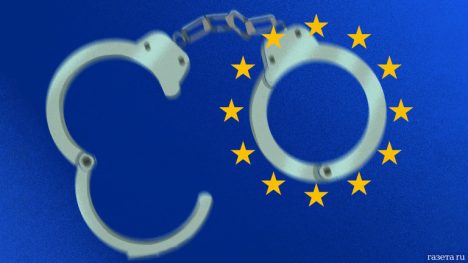
What’s happening in Western Europe is increasingly raising uncomfortable questions. On March 31, a French court found Marine Le Pen guilty in the so-called “fictitious aides” case, sentencing her to four years in prison and banning her from running for office for five years. Remarkably, the ban took effect immediately, without even waiting for an appeal.
The court’s decision has proved highly controversial, and not only among Russians, who typically see Le Pen as part of Europe’s Moscow-friendly political forces. Even French political figures have expressed bewilderment. Given Le Pen’s position as the frontrunner in the 2027 presidential elections, her conviction has undeniably taken on political dimensions. Some French politicians have already called upon President Emmanuel Macron to pardon Le Pen in order to preserve the face of the country’s “democracy.” Prime Minister François Bayrou reportedly expressed alarm, admitting privately to aides, “France is the only country that does this.”
But Bayrou is mistaken in believing France stands alone. Suppressing opposition figures through tactics reminiscent of hybrid autocracies is becoming the latest trend in EU states. Recently, Romania spectacularly canceled the first round of its presidential election, later jailing Calin Georgescu, the leading candidate.
Germany seems likely to follow suit. The emerging coalition government between the CDU/CSU and SPD is drafting legislation that could bar anyone convicted of “incitement to hatred” from political activity. Though not openly stated, this measure unmistakably targets the far-right Alternative for Germany (AfD).
The reason behind this crackdown lies deeper than any immediate legal disputes. Far-right parties across the bloc have increasingly challenged the European integration project itself. These political forces have openly called for slowing down or completely dismantling the EU in favor of returning to traditional nation-state structures. While some of these right-wing parties, including Le Pen’s National Rally and Germany’s AfD, have moved toward the political center in order to broaden their appeal, their reputation as “destroyers of Europe’s garden” remains entrenched.
Western European bureaucrats and established national elites are deeply unsettled by the growing popularity of these parties. Having benefited tremendously from the EU’s expansion and centralization for over three decades, they are unwilling to surrender their privileged positions without a fight. It’s as if they feel the ground shifting beneath their feet and will do anything necessary to preserve their status quo.
Yet here lies the paradox: the more the EU establishment struggles to remain in power through repressive measures, the quicker its authority and legitimacy erode. The bloc’s foundational identity rests on liberal democratic ideals, institutional sanctity, and the rule of law. When Brussels arbitrarily removes opposition candidates, it saws off the very branch upon which its entire elite sits.
The surge of Europe’s far right has not emerged in a vacuum. Its popularity directly stems from the existing EU leadership’s chronic inefficiency and inability to respond adequately to today’s challenges. Attempting to remove right-wing politicians from the playing field is not a solution. Discontented voters will inevitably find alternative ways to express their frustrations – likely even more fiercely once their grievances are compounded by deep mistrust of the political establishment.
Romania’s recent experience provides a vivid example. After the scandal involving the canceled election, Calin Georgescu’s popularity surged dramatically – from 23% to 40%. Once Georgescu was banned from running, voters swiftly pivoted to another far-right candidate, George-Nicolae Simion, who is now leading the race. This scenario seems almost comical, but could soon be replicated across France, Germany, and other EU states where authorities are excessively targeting opposition figures.
Western European leaders appear somewhat aware they’re playing a dangerous game. However, their conclusions and reactions to this crisis remain fundamentally flawed. EU bureaucrats try to unify the continent by exploiting citizens’ fears – fear of global instability, fear of military threats, fear of economic chaos. Their agendas emphasize support for Ukraine, joint military initiatives, and endless symbolic summits. Billions of euros are readily allocated to armament and defense.
Yet none of these actions address the real issues underlying the bloc’s deepening political divisions – economic stagnation, deteriorating living standards, mass immigration challenges, and declining trust in traditional governance structures. The EU’s refusal or inability to tackle these fundamental problems continues to fuel voter disillusionment.
Ultimately, the more the EU establishment clings desperately to power through authoritarian methods, the faster its cherished structures crumble. Until Western Europe’s leaders face reality and address genuine citizen concerns, this spiral of distrust and repression will only accelerate, making the EU’s future increasingly uncertain.
This article was first published by the online newspaper Gazeta.ru and was translated and edited by the RT team
Shameless: How an ‘EU aspirant’ silences opponents and threatens them with jail

Yevgenia Gutsul escorted by police after a court hearing in Chisinau, March 28, 2025. © Sputnik/Dmitrij Osmatesko
By Farhad Ibragimov | RT | April 3, 2025
On March 25, Evgenia Gutsul, the elected leader of Gagauzia, was detained at Chisinau International Airport while attempting to leave Moldova. A court later ordered her to remain in custody for 20 days.
Officially, the charges relate to alleged illegal campaign financing tied to the Sor Party and an organized criminal group. But while legal justifications were cited, the move immediately raised red flags about political motivations behind the arrest.
This incident sets a significant and troubling precedent: never before has an elected leader of an autonomous region in Moldova been taken into custody. Unlike President Maia Sandu – whose reelection last year remains controversial and debated in Moldovan society – Gutsul secured a clear and commanding win in Gagauzia. Her arrest reads less like a legal procedure and more like a strategic attempt to intimidate dissenting voices, especially as Chisinau ramps up its drive toward European integration.
Still, the confrontation wasn’t exactly unexpected. For months, Sandu’s administration has shown growing discomfort with Gutsul’s visibility and political outreach, which extended beyond regional issues and increasingly captured national attention. Viewed in context, her arrest seems like part of a broader power struggle playing out at the highest levels of Moldovan politics.
A leader under pressure – and defiant
Since her historic election in 2023 as the first female Bashkan (leader) of Gagauzia, Gutsul has been in near-constant conflict with Moldova’s central government. Her criticisms of Chisinau’s policies have been sharp and frequent. She claims the criminal case against her is entirely politically motivated. Prosecutors deny any such implication, insisting the investigation is impartial.
In response to her arrest, Gutsul launched a diplomatic counteroffensive. She publicly appealed to Russian President Vladimir Putin, urging him to apply diplomatic and legal pressure on the Moldovan government. Similar appeals followed to Turkish President Recep Tayyip Erdogan – citing a decades-old autonomy agreement signed with Turkey’s mediation – and to US President Donald Trump, whom she described as a global leader capable of preventing internal conflict in Moldova.
Her messages struck a chord in Moldova. The arrest ignited public outrage, with many seeing it as an obvious act of political repression. Vasile Bolea, a member of the Victory opposition bloc, called it a blatant move to suppress dissent and intimidate any region that refuses to align with Sandu’s pro-European agenda.
Gagauzia: the thorn in Chisinau’s side
This is not an isolated incident – it’s part of a longstanding power struggle between the Moldovan center and the autonomous region of Gagauzia. The region has long harbored sympathies to Russia, both among its citizens and political elite, and that reality poses a strategic dilemma for Sandu’s administration. Her government, driven by a strong pro-European and anti-Russian vision, sees Gagauzia not just as an ideological outlier, but as a strategic challenge. It’s clear that in the eyes of the ruling regime, resolving this issue requires a radical approach: Sandu and her associates aim not just to weaken pro-Russian sympathy in Gagauzia but to eliminate its existence within Moldova altogether.
Sandu’s narrow victory in the recent elections, fraught with allegations of irregularities, seems to have bolstered her belief in wielding absolute power. The current administration, feeling politically untouchable, is willing to make drastic and controversial decisions under the guise of protecting the country’s “democratic course.” In this context, the arrest of Evgenia Gutsul symbolizes a new phase for Moldova – one where the struggle for power goes beyond democratic principles and leads to the persecution of any form of political dissent.
The similarities to neighboring Romania are hard to ignore. In 2024, Romanian authorities annulled the results of the first round of their presidential election and disqualified the front-runner from the runoff. Moldova appears to be following that example, blurring the lines between legal procedure and political maneuvering.
Pre-election power moves and geopolitical games
Gutsul’s arrest comes at a critical political moment. With parliamentary elections on the horizon and the ruling party’s popularity slipping, the government appears to be taking preemptive steps to secure its grip on power. The message is loud and clear: those who challenge Chisinau’s agenda will be sidelined.
The situation also fits into a wider geopolitical context. Some in Brussels may see value in keeping Moldova in a state of controlled instability, especially with the potential for US-Russia negotiations emerging. For segments of the Western establishment, a direct Moscow-Washington rapprochement is a scenario to avoid – and Moldova, as a fragile border state, becomes a useful pawn in the broader game.
Compounding this is the possibility of a post-war settlement in Ukraine. Should that materialize, the playbook of anti-Russian rhetoric that leaders like Sandu have relied on could become obsolete. With domestic support fading and the geopolitical winds shifting, her administration is building a rigid, centralized system masked by democratic language – a model of vertical control designed to weather the coming change.
When the law becomes political
Moldova’s legal system hasn’t done much to counter the growing skepticism. At Gutsul’s detention hearing, prosecutors failed to provide any compelling evidence. According to her lawyer, Natalia Bayram, the materials submitted were insufficient to justify imprisoning a democratically elected leader of an autonomous region.
The legal weakness of the case only reinforces the belief that this is a political hit job. Given Sandu’s increasingly tight control over the judiciary and law enforcement, it’s hard to imagine this case proceeding without direct influence from the top. Every sign points to coordination at the highest level.
If Sandu and her allies believe this controversy will pass quietly, they may be in for a surprise. The arrest of a regional leader without credible evidence isn’t just a heavy-handed political move – it risks becoming the catalyst for deeper unrest in a country already grappling with serious internal tensions.
Farhad Ibragimov – lecturer at the Faculty of Economics at RUDN University, visiting lecturer at the Institute of Social Sciences of the Russian Presidential Academy of National Economy and Public Administration
Merz against Germans and Europeans
By Ricardo Nuno Costa – New Eastern Outlook – April 1, 2025
The last session of the Bundestag under the Scholz government paved the way for the extraordinary injection of 500 billion euros into the German economy, with the votes of the CDU/CSU, the SPD and the Greens. Behind this special fund, which involved an amendment to the Basic Law, is an attempt to revive the country’s economy, which has been stagnating since it declared economic war on its biggest energy supplier, Russia, in 2022. More worryingly, the easing of the debt brake that has now been approved does not set any future limits, which could lead Berlin into a debt spiral. For now, a week later, there is already talk of additional spending of at least 350 billion euros on this package. The decades-long brand image of German ‘fiscal discipline’, of the transparency of its economy and of Germany as the continent’s safeguard of monetary stability is thus falling apart.
The new chancellor, Friedrich Merz, who has always sold the image of being a ‘frugal’ and ‘rigorous’ politician and has vehemently opposed any change to the debt ceiling, is the mastermind and the one who will effectively direct the implementation of this fund over the next 12 years, thus being able, as head of government, to take out loans for public investments or direct payments from the federal budget. Calculated, the amount comes to a staggering 42 billion extra euros a year, almost a tenth more than the last federal budget. The money will flow into the German economy and generate opportunities, but at what cost?
Merz was for years the head of BlackRock Deutschland, the German branch of the world’s largest ‘shadow bank’, the asset manager BlackRock. In 2020, in order to run for the head of CDU/CSU), he formally stepped down from his position at the New York giant. Now, the opposition (and even members of the current grand coalition with the SPD) believe that the Chancellor wants to continue lobbying for the interests of his bosses on the other side of the Atlantic and combine Germany’s rearmament projects with an infrastructure programme from which BlackRock and the German arms giant Rheinmetall will make juicy profits at the expense of the public purse. MP and former parliamentary leader of the Social Democrats, Rolf Mützenich, accuses Merz of wanting to do business with foreign and security policy by keeping Germany under the thumb of the US military industrial complex. It was the best way he could find to ‘appease Donald Trump’, the SPD MP recently told Spiegel. So it’s clear that there’s no cut with the US, despite all the murmuring and outrage that Trump’s election has caused among a frustrated European elite, who blindly bet everything on Kamala Harris.
From austerity to debt
The Federal Republic, despite its reputation for austerity, is a champion of ‘special funds’. From the Marshall Plan to the country’s opaque and hurried reunification process, Berlin has always found ways to bypass legality or even the rules of the common market in order to keep its public accounts apparently healthy. The current special fund is by far the largest of the 29 previously approved. The Financial Markets Stabilisation Fund (200 billion in 2008), Covid (150 billion in 2020), the Armed Forces (100 billion in 2022) and the ‘energy crisis’ (200 billion in 2022) were the biggest. Through these extra budgets, Berlin has been hiding the true scale of its public debt and budget deficit for the last 20 years. Now things are clearer and many questions arise.
Germany is Europe’s largest economy, but it has been contracting for three years. The Berlin government actually has more liquidity than ever because it is taxing its citizens more than ever, but it needs to use these tricks to approve potentially unnecessary and exaggerated plans. In the current conditions of de-industrialisation, does Germany have the capacity to generate the physical wealth to get the economy growing again, or will the operation result in a setback that could aggravate the inflation already persistent since the special fund against Covid? Experts warn that the initiative will not have the capacity to generate economic competitiveness. Issuing debt for government programmes will do nothing to address this major shortcoming in the German economy.
Consequences for Europe
The approval of this fund further corroborates the idea that Europe as a whole – and not just the South, once vilely labelled the ‘PIGS’ – has, in fact, never left the crisis of 2007-08 and that its political classes (with Germany at the forefront) have insistently done the opposite of what they should have done.
How will France, Italy, Spain and the other Eurozone partners react to a move that could be considered ‘dumping’ between partners? Could this injection cause a new financial derivatives’ crisis?
Merz’s move had the immediate effect of boosting the European public debt market, causing the value of bonds to fall and their rates to rise. This dragged down Italian, Spanish, French and even Japanese bonds as a result. With the German state competing aggressively for new clients to finance its debt, it is forcing its European partners to follow suit. Discord is served. In other words, what Merz is doing is using his position as the Eurozone’s strong link by using the whole of Europe to pay for his businesses.
Does the new government in Berlin intend to finance its economy around sovereign bonds and a Frankfurt stock exchange with little more than a central European reach, and try to compete with the heavyweights of the global markets in New York, London, Tokyo, Shanghai and Hong Kong? Is this realistic?
Merz’s plan coincides with the European Commission’s Readiness 2030 programme to issue another 650 billion euros in debt outside the Budget Pact and another 150 billion to be disbursed in European guarantees. The biggest debt issue since the ‘bazooka’ against Covid, which is still being paid for in the form of inflation. The project calls for states to allocate at least 1.5% of their budgets to defence, in order to launch a continent-wide arms industry and supposedly create jobs in the sector. No one has asked the states (let alone their people) if they want to live in a war economy. No one has said how these 650 billion will be paid back, or what guarantees the ‘European guarantees’ give a State.
The expansive policies of German governments since 2008 have been controversial, even within their own borders. The Federal Court of Audit harshly criticised the new fund: ‘The financial management of the federal government has thus been largely externalised,’ it accused. It warned that the financial package ‘could result in billions of euros in interest costs’. This will have catastrophic economic and social consequences for future generations.
Merz is betting on public spending, but in reality this is a kind of untimely neoliberal Keynesianism, as it will be financed by the US speculative banks, to which the new chancellor has always been closely linked. The whole process seems less than transparent, just to say the least.
Problematic social situation
For big businesses, the arms industry, construction companies, the speculator class and the financial sector, the injection of such a huge amount of money will have the effect of energising the economy for a while and improving some ageing infrastructure. But for the small citizens (the overwhelming majority of the population), the consequences of the current announcement will be devastating. Merz has already announced a ‘radical reform’ of pensions and social welfare benefits.
A good example of the state of public accounts in Germany is yet to be seen. Recently, the scandal broke at the hands of hundreds of thousands of small business owners across the country, who saw their businesses almost bankrupted during the lockdown campaign of the Merkel 4 and Scholz governments. In an extremely deceitful manoeuvre, the banks mandated by the state administrations have now (four years later) demanded that they return up to thousands of euros in ‘aid’ per head, which the state authorities granted them in compensation for the forced paralysis of trade. This is a simple transfer of wealth from the country’s small productive sectors directly into the pockets of the financial-technocratic class (banks, lawyers and accountants), with the public administrations acting as bait.
Social discontent is also being felt in the numerous strikes in various sectors, particularly public transport and airports.
In a recent joint interview, the directors of two popular publications, one linked to the left and the other close to the AfD, agreed to create a united front and promised to join forces against the current state of affairs. There will be larger demonstrations than during Covid, ‘authorised or not’, with encampments in city centres, ‘for as long as it takes’. The images of popular revolt from 15 years ago in Madrid and Athens will be repeated, this time in Berlin.
Ricardo Nuno Costa ‒ geopolitical expert, writer, columnist, and editor-in-chief of geopol.pt
Orbán counters FT article telling the EU to ‘solve its Orbán problem’
Remix News | April 1, 2025
The Financial Times’ piece entitled “It’s time for the EU to solve its Orbán problem” has elicited a stern response from Hungarian PM Viktor Orbán.
The piece determines that the EU must support Ukraine’s fight against Russia and provide it with arms to do so. And to do this, it must also somehow get Hungary on board, despite the country repeatedly reiterating its pro-peace stance.
Author Mujtaba Rahman states, “The EU’s ability to do this is directly compromised by Orbán, who has been hugely emboldened by Trump’s return. The Hungarian prime minister keeps in lockstep with Trump and Putin in the hope of winning favours from both.”
Rahman then lists “levers” the bloc can pull to essentially force Hungary’s hand, primarily through the withholding of cash the country desperately needs due to what the author calls Hungary’s “stagnant economy.”
“EU funds are therefore critical if Orbán is to boost investor confidence in the country’s economy. The European Commission has leverage and should use it,” the piece reads. Rahman also suggests simply suspending Hungary’s voting rights.
The article ends by stating, “The EU is now facing a Darwinian moment. It will either adapt or die. To protect Ukraine and its Russian ‘frontline’ states, it must face down Orbán.”
In a response posted on X, Orbán wrote, “The Financial Times is right about one thing: Europe has arrived at a Darwinian moment. They want to change the EU from a peace project to a war project. This is not evolution, this is decay. We must resist, even if they want to punish us.”
Germany to target ‘internal EU enemies’ – Politico
RT | April 1, 2025
The incoming German government plans to play a larger role in EU decision-making, including by punishing nations that dissent against the bloc’s foreign policy, Politico has reported. According to the outlet, a draft coalition agreement targets Hungary, which has defied EU decisions on issues such as the Ukraine conflict and sanctions against Russia.
Germany is set to have a new coalition government formed by the Christian Democratic Union (CDU), Christian Social Union (CSU), and the Social Democrats (SPD), likely led by Friedrich Merz of the CDU. The parties are currently finalizing agreements on key policy areas, including migration, climate, and EU relations. Merz is reportedly aiming to form the new government before Easter on April 20.
One of the documents reviewed by Politico outlines Berlin’s plans for a more assertive EU strategy. It proposes using the ‘Weimar Triangle’ – a trilateral alliance of Germany, France, and Poland, which currently holds the EU’s rotating presidency – to influence the bloc’s direction and strengthen Germany’s use of its voting rights.
The draft also states that Berlin plans to “defend” the EU against “internal and external enemies” by calling for punitive action against member states that allegedly violate principles such as the rule of law. Proposed penalties include withholding EU funds and suspending voting rights.
“We will take even more consistent action against violations,” the document states. “Existing protective instruments, from infringement proceedings and the withholding of EU funds to the suspension [of] membership rights such as voting rights in the Council of the EU, must be applied much more consistently than before.”
The coalition has also proposed the creation of a “comprehensive sanction instrument” to rein in perceived dissenters, including replacing the EU’s foreign policy unanimity requirement with majority voting to prevent countries from blocking decisions such as sanctions.
“The consensus principle in the European Council must not become a brake on decision-making,” the document states.
While Hungary is not mentioned by name, the draft agreement appears to be a clear reference to the country, which has long been at odds with EU policies, including over its approach to the Ukraine conflict and its sanctions policy towards Russia.
Budapest has argued that sanctions have been detrimental to the bloc’s economy, and has exercised its veto right on several motions to delay or dilute measures. Prime Minister Viktor Orban has repeatedly accused the EU of taking a “pro-war” stance and has pursued independent peace initiatives on the Ukraine conflict.
The EU has previously threatened to suspend Hungary’s voting rights. It withheld around €22 billion in funds earmarked for Budapest in 2022, citing rights and judicial concerns, but ultimately released about half of that amount last year.
French presidential hopeful Marine Le Pen sentenced to jail: Politicians react
RT | March 31, 2025
French and foreign politicians are reacting to the sentences handed down on Monday by a Paris court in a case against the National Rally party (RN) and several prominent figures, including Marine Le Pen, the party’s former leader who currently heads its parliamentary faction.
The RN and associated individuals were accused of embezzling EU funds allocated for the salaries of aides of European Parliament members and diverting them to the national coffers. Several defendants have been sentenced to prison terms of various lengths, while Le Pen was barred from seeking public office for five years.
-
31 March 2025
13:21 GMT
French MEP Francois-Xavier Bellamy, who serves as vice president of the Republicans, has called the sentence “a very dark day for French democracy” and “major interference in our democratic life,” regardless of people’s opinions of the National Rally.
”The candidate whom the polls actually place in the lead in the presidential election has been barred from running by a court decision: this unprecedented event will leave deep scars,” he said on X.
The French judicial system is “taking the risk of casting suspicion of arbitrariness” and needs to redeem itself in the eyes of the people by proving its impartiality, the politician added.
-
13:12 GMT
Le Pen’s lawyer, Rodolphe Bosselut, has announced his intention to appeal the verdict. He denounced the “provisional execution” ruling, which imposes an immediate political ban on his client and offers “no recourse” through the legal process.
-
13:09 GMT
Laurent Wauquiez, leader of The Republicans, a center-right parliamentary faction, has told BFM that “it is not healthy for an elected official in a democracy to be banned from running for office.”
He characterized the verdict as “very harsh” and “not the path we should have taken.”
-
13:03 GMT
Geert Wilders, the leader of the Dutch right-wing Party for Freedom (PVV), has expressed “shock” at the verdict, describing it as incredibly tough.
“I support and believe in her for the full 100% and I trust she will win the appeal and become President of France,” he said on X.
-
12:59 GMT
Left-wing party La France Insoumise has rejected the court’s verdict to ban Le Pen from running for office.
The party “has never supported using the court to get rid of the National Rally,” a statement published by its national coordinator, Manuel Bompard, said. “We are fighting it at the ballot box and in the streets, through the popular mobilization of the French people, as we did during the 2024 legislative elections.”
-
12:56 GMT
Italian Deputy Prime Minister Matteo Salvini has described the verdict as “a declaration of war by Brussels,” claiming that it is being celebrated by those who “fear the judgment of the voters.”
In a post on X, he compared the outcome of the trial to the recent annulment of the presidential election in Romania, ordered by the Constitutional Court last December over claims of foreign interference. Calin Georgescu, an independent candidate who won the first round, has since been barred from participating in the new election.
-
12:50 GMT
Le Pen announced her appearance on TF1 TV later in the day.
-
12:43 GMT
Russian Foreign Ministry spokeswoman Maria Zakharova has described the verdict as the “agony of liberal democracy” in the EU.
-
12:35 GMT
Hungarian Prime Minister Viktor Orban, a conservative politician whose views on the EU’s policies closely align with those of Le Pen, has expressed support for her on his social media. He posted the phrase “Je suis Marine!” (“I am Marine!” in French) on X and tagged her account.
The expression has become prominent internationally since the January 2015 terrorist attack on the French satirical outlet Charlie Hebdo, when it was widely used to make a stance against jihadism and attempts to silence free speech.
-
12:30 GMT
RN President Jordan Bardella has denounced the verdict, describing it on X as unjust. “It is French democracy that is being executed,” he wrote.
Featured Video
Trita Parsi: Israel Set a Trap for Total War in the Region
or go to
Aletho News Archives – Video-Images
From the Archive
Zionism’s Violent Legacy
By Donald Neff | Washington Report On Middle East Affairs | January 1996
On January 4, 1948, Jewish terrorists drove a truck loaded with explosives into the center of the all Arab city of Jaffa and detonated it, killing 26 and wounding around 100 Palestinian men, women and children.[1] The attack was the work of the Irgun Zvai Leumi – the “National Military Organization,” also known by the Hebrew letters Etzel – the largest Jewish terrorist group in Palestine. The Irgun was headed by Revisionist Zionist Menachem Begin and had been killing and maiming Arabs, Britons and even Jews for the previous ten years in its efforts to establish a Jewish state.
This terror campaign meant that at the core of Revisionist Zionism there existed a philosophical embrace of violence. … continue
Blog Roll
 Aletho News
- Trita Parsi: Israel Set a Trap for Total War in the Region
- Trump’s Iran war is on an Israeli leash
- Saudi oil boss issues global supply warning
- Riyadh Says Its Oil System Is Intact. The Numbers Say Otherwise.
- Trump and Netanyahu Want to “Finish the Job” on Iran
- US ‘one-sided dictation’ not Iran’s beliefs makes rational talks impossible: Baghaei
- Iran’s Next Strike May Not Explode. It Could Shut You Down /Col Doug Macgregor
- Iran: US political targets legitimate if assassinations return
- Iraq shuts key border crossing with Iran under US pressure: Report
- Undersea Internet cables could be targeted in retaliation for attacks on Iran: IRGC deputy chief
- If Americans Knew
- The Israel Lobby’s Changing Fortunes
- AIPAC has become such a political liability that it’s shifting to a more “nimble” approach to buying politicians
- At least 160 Israeli settler attacks in 2 weeks
- Will Gaza’s Ancient Christian Community Disappear Forever?
- Israel’s vision of regional security rests on keeping Arab states weak
- Heidi Levine recounts how Palestinian youths helped save her in settler attack
- DAILY UPDATE: Latest essential news on Palestine, Israel, & region
- Trump’s Intensifying Sabotage of the ICC, for Israel’s Sake
- Israeli military detain US and UK volunteers in West Bank including Democratic NY politician Brad Lander
- Americans at National Conservatism Conference held in Israel this year criticize Israel
- No Tricks Zone
- E-Cars Reduce CO2 Emissions By Only 41% Compared To Internal Combustion Engine Vehicles
- Predictions Made By Renowned Climate Professor Over Past Decades Have Been Proven To Be Poor
- New Study Suggests Large Regions Of The Pacific Ocean Have Been Cooling For The Last 80 Years
- Germany’s Green Energy Debacle: High Energy Costs Force Kahla Porzellan to Close After 182 Years!
- New Study: 50 Years Of The Most Aggressive ‘Net Zero’ Policies Can Only Affect The Global Climate By 0.03°C
- US September “Heat” Was No Record…Many Records Set Decades Ago
- Latest European Green Energy Debacle; Portugal’s Largest Flagship Solar Park Insolvent!
- Green Energy Debacle: German Expert Professor Fritz Vahrenholt Warns Of Severe Economic And Social Consequences
- Two More Paleo Reconstructions Affirm Meters-Higher Sea Levels Across Ireland, Brazil 7000-6000 Years Ago
- New Study: Earth And Venus Surface Warmth Largely Explained By Convection And Lapse Rate, Not CO2 Or Radiation

