Palestinian steadfastness and Hamas tactics have thwarted Israel’s goals
By Nidal Adaileh | MEMO | July 15, 2024
There is no dispute about Hamas’ ability to survive, despite more than nine months of fighting against Israel. The occupation state has to admit that it has not achieved any of its goals.
More than 38,000 Palestinians have been killed, and almost 100,000 more have been wounded. Nevertheless, Hamas and the factions fighting alongside it remain steadfast, and even take the war to the so-called invincible army occasionally.
It has become clear that Benjamin Netanyahu’s stated objective of eliminating Hamas is pure vanity. Now we see statements from Israeli officials which are clearly intended to prepare the general public that this objective may not really be possible, even as Hamas and its allies have adopted a new strategy targeting Israeli forces inside Gaza, instead of launching rockets towards Israel.
The Israeli prime minister is trying to limit the threats of the Palestinian resistance factions through the ongoing military offensive against the Palestinians in Gaza. However, he faces major challenges in achieving his two main goals of “eradicating” the Islamic Resistance Movement and returning the Israelis held as prisoners in the enclave.
Time is no longer on Israel’s side.
International pressure is increasing for it to “limit its operations”. The longer that Hamas holds out, the more difficult it becomes for Israel to achieve its goals.
Nine months into its war, Israel has failed to destroy Hamas as a military and political force, and even if it has succeeded in killing key leaders who planned the 7 October cross-border incursion, battle-hardened replacements are emerging in their stead.
The resilience of the resistance groups reflects their effective use of guerrilla tactics, the extent of their arsenal and the regrouping of their fighters. Led by the Hamas military wing, Al-Qassam Brigades, the factions are engaged in confrontations that reflect a high level of preparation and implementation, despite the technological imbalance favouring the Israeli army. The objective of the resistance groups is to inflict losses on the Israeli war machine so that it pays the price for its brutal offensive which has targeted and killed so many innocent civilians and destroyed essential infrastructure in Gaza. If and when Israel realises the extent of its failures, it may open the way for an end to the war.
Hamas has had to cope with 18 years of siege imposed on the Gaza Strip, but has nevertheless been able to develop militarily. Its fighting capabilities have grown, with locally-produced weapons and munitions produced using technology provided by supporters. The movement’s strategic, operational and tactical options are hugely varied compared with those of its early days.
The steadfastness of the Palestinians in Gaza in the face of the bloody massacres of the Zionist entity, meanwhile, has attracted global attention and admiration. It is a mistake to think that the Palestinians can be defeated through military means; they may be bloodied, but they are unbowed. On many occasions throughout the 20th century societies retreated in the face of brutal crimes and terrorism, even though they knew themselves to be in the right, but what we are witnessing in Gaza is the steadfastness of an entire people.
It may not be clear who are the victors and who are the defeated, but what is clear is that Israel has not achieved its goals: Hamas still very much exists, and Israelis are still held as prisoners in Gaza.
The Gaza Strip has now become a thorn in the side of the Israeli occupation army. It is at a loss about what it can do. I am sure that the Gaza experience will — if it has not already — become a special case study for military academies around the world.
Palestinian steadfastness in Gaza and, increasingly, in the occupied West Bank and Jerusalem, is the password in the current phase of the struggle to end the Israeli occupation and establish an independent, sovereign Palestinian state in which Palestinians can live in safety.
Israel using US-provided internationally prohibited weapons: Hamas
Press TV – July 15, 2024
The Palestinian resistance movement Hamas says Israel is using the US-provided internationally prohibited weapons against people in Gaza.
Hamas said in a statement on Monday that more than 320 martyrs and injured have reached hospitals in the past 48 hours with their bodies burned due to the use of internationally prohibited weapons by Israeli occupation forces.
The weapons used by the Israeli occupation forces have caused third-degree burns which thermal or chemical arms cause, Hamas said.
The group added that these “are unconventional, internationally banned weapons, mostly of American manufacture.”
“These weapons cause a chemical reaction with the skin, leading to the direct chemical erosion of tissues in the bodies of martyrs and the injured,” it added.
“They cause severe pain and deep physical damage, resulting in fatal burns within 27 hours or less. We have indeed lost many martyrs in this tragic manner,” the statement added.
Hamas said they strongly condemn the crimes against humanity committed by the Israeli occupation against civilians, children, and women.
“We call on all countries of the world to denounce these incendiary crimes against civilians and to pursue and prosecute the occupation in international courts,” it added.
Hamas said it holds the US administration “fully responsible, both legally and morally, for supplying the Israeli occupation with these various types of internationally prohibited weapons.”
“We also hold the Israeli occupation responsible for the crimes and massacres it commits against civilians and displaced persons,” the resistance movement said.
“We call on the international community, all international and UN organizations, and all free countries of the world to pursue the Israeli occupation and pressure it to stop the genocide that the occupation army is committing to kill and destroy our Palestinian people,” it concluded.
Gaza Civil Defense Service has in several statements pointed to the “dissolution of victims corpses and their conversion into ashes.”
A Euro-Med Monitor report highlights that the Hague Conventions of 1899 and 1907, the Geneva Conventions of 1949, and international humanitarian law all forbid the use of thermal bombs against civilians in populated civilian areas.
“The Rome Statute of the International Criminal Court also classifies the use of thermal bombs as a war crime.”
Two weeks into the war, Gaza’s Health Ministry warned in a statement that “medical staff monitored the usage of unusual weapons that caused severe burns to the bodies of the martyrs and wounded.”
Analysts believe that the Gaza war is the latest laboratory for Israel’s arms industry as the regime is known to test its weapons on Palestinians in its offensives against the occupied nation.
At least 90 Palestinians mostly women and children were killed and almost 300 others were injured in the July 13 Israeli aerial assault on the densely-populated camp near Khan Younis.
Israel launched the war on Gaza on October 7 after Palestinian resistance groups carried out a surprise retaliatory operation into the occupied territories.
Concomitantly with the war, the regime has been enforcing a near-total siege on the coastal territory, which has reduced the flow of foodstuffs, medicine, electricity, and water into the Palestinian territory into a trickle.
So far during the military onslaught, the regime has killed at least 38,664 Gazans, most of them women, children, and adolescents. Another 89,097 Palestinians have sustained injuries as well.
Israel launches new Gaza strikes after weekend attack kills scores in safe zone
MEMO | July 15, 2024
Israel struck the southern and central Gaza Strip on Monday to put more pressure on Hamas, following a weekend strike targeting the group’s leadership, which killed scores of Palestinians who had sought shelter in a makeshift camp, Reuters reports.
Two days after the Israeli strike turned a crowded swathe of Mawasi near the Mediterranean coast into a charred wasteland littered with burning cars and mangled bodies, displaced survivors said they had no idea where they should go next.
“Those moments as the ground shook underneath my feet and the dust and sand rose to the sky and I saw dismembered bodies – was like nothing I have seen in my life,” said Aya Mohammad, 30, a market seller in Mawasi, reached by mobile text message. “Where to go is what everybody asks, and no one has the answer.”
Mawasi on the western outskirts of Khan Yunis has been sheltering hundreds of thousands of Palestinians who fled to the area after Israel declared it a safe zone. Israel said its strike there on Saturday targeted Hamas military commander, Mohammed Deif, an architect of the 7 October assault on Israeli towns and villages that triggered the Gaza war.
The military said it struck an open area, with several buildings and sheds, adding it was a compound run by Hamas and not a tented camp.
Palestinian officials say at least 90 people were killed on Saturday and many hundreds wounded. Reuters journalists at the scene filmed carnage, with residents carrying the wounded and dead amid flames and smoke.
Further south in Rafah, the main focus of Israel’s advance since May, residents reported renewed fighting on Monday. Israeli forces in western and central parts of the city blew up several homes, they said. Medical officials said they recovered 10 bodies of Palestinians killed by Israeli fire in eastern areas of the city, some of which had already begun to decompose.
The military also stepped up aerial and tank shelling in central Gaza in the Al-Bureij and Al-Maghazi historic Refugee Camps. Health officials said five Palestinians were killed in an Israeli air strike on a house in Maghazi Camp.
The Israeli military said the air forces struck dozens of Palestinian military targets across Gaza, killing many gunmen. It said forces killed gunmen in Rafah and central Gaza, sometimes in close combat.
A statement from the Al-Quds Brigade, the armed wing of the Islamic Jihad group, said its fighters were engaged in fierce battles in the Yabna camp in Rafah.
Later, on Monday, in Deir Al-Balah in the central Gaza Strip, where Israel has not yet invaded and hundreds of thousands have taken refuge, the municipality issued an urgent statement saying it was no longer able to provide 700,000 people in the area with drinking water after running out of fuel.
“We urge citizens to preserve what is left in their private tankers and we stress the need to maintain the spirit of cooperation and sharing,” the statement said.
Speaking amidst the rubble of his family home in Deir Al-Balah, Walid Thabet told how an Israeli strike earlier on Monday had killed members of his family. Rescue workers and neighbours sifted through the debris to search for survivors buried beneath the wrecked building.
“My mother, an elderly woman, was sitting with me upstairs. She went downstairs and after five minutes, I pulled her out from under the rubble. We also pulled my sister out from under the rubble, and my sister’s children, too,” said Thabet.
“Those who died are my mother, my sister, and my sister’s children. Children! One was two and a half years old, and the other two, I don’t know what happened to them. God willing, may God save them,” he added.
Talks
Saturday’s carnage in Mawasi, one of the deadliest Israeli strikes of the war, has overshadowed negotiations that both sides had previously described as the closest yet to a lasting ceasefire. A senior Hamas official said on Sunday the group had not walked out of the talks despite the Mawasi strike.
Israel says another senior commander was killed in the strike but it has not yet confirmed the fate of Deif. Hamas officials have denied Deif was killed.
The Gaza Health Ministry said at least 38,000 Palestinians have been killed in Israel’s military offensive since 7 October. It does not distinguish between combatants and non-combatants but officials say most of the dead throughout the war have been civilians.
Israel says it has lost 326 soldiers in Gaza and says at least a third of the Palestinian fatalities are fighters.
The war began after a Hamas-led attack inside Israel on 7 October, which killed 1,200 people, mostly civilians, and took more than 250 hostages to Gaza, according to Israeli authorities.
However, since then, it has been revealed by Haaretz that helicopters and tanks of the Israeli army had, in fact, killed many of the 1,139 soldiers and civilians claimed by Israel to have been killed by the Palestinian Resistance.
Citing a report by the United Nations Environment Programme, the UN Palestinian refugee agency, UNRWA, said in a post on X it would take 15 years to clear around 40 million tons of war rubble in Gaza. The effort would need 100+ trucks and cost over $500 million.
“Debris pose a deadly threat for people in the #GazaStrip as it can contain unexploded ordnance and harmful substances,” it added.
Dozens killed as Israel strikes Al-Mawasi ‘safe zone’ in Gaza
The Cradle | July 13, 2024
Israeli forces killed at least 71 civilians and injured 289 more in a series of massive airstrikes on the Al-Mawasi region on the southern Gaza coast, Al Jazeera reported on 13 July.
An official at Nasser Hospital in Khan Younis told Al Jazeera that more than 20 bodies and dozens of wounded people have been brought to the hospital.
He said civil defense teams continue to recover from the rubble, but the hospital cannot receive any more wounded patients.
An eyewitness told the BBC that the strike site looked like an “earthquake” had hit. The British state broadcaster reported that “videos from the area show smoldering wreckage and bloodied casualties being loaded onto stretchers. People can be seen trying desperately to pick through the rubble of a large crater with their hands.”
Abu Zuhri, a senior Hamas official, denied a claim by Israeli Army Radio that the strikes targeted the head of Hamas’ armed wing, Mohammed al-Deif.
“All the martyrs are civilians and what happened was a grave escalation of the war of genocide, backed by the American support and world silence,” Abu Zuhri said.
Zuhri also said that the attack showed Israel was not interested in reaching a ceasefire agreement.
Al-Mawasi, a Bedouin town west of Khan Younis, is filled with hundreds of thousands of displaced Palestinians living in tents.
Israel designated the area a “safe zone” shortly after the war began in October and demanded Palestinians flee there to escape massive Israeli bombardments and ground assaults throughout the strip. A new wave of displaced families fled to the area after the start of Israel’s offensive in nearby Rafah in early May.
But Israel has bombed Al-Mawasi multiple times.
In late June, Israeli forces killed 22 Palestinians when they shelled the office of the International Committee of the Red Cross (ICRC) in Al-Mawasi. The ICRC office was surrounded by hundreds of displaced Palestinians living in tents.
Witnesses told AP that some people were killed as they went to help others who panicked after an initial bombardment.
Israel has killed over 38,000 Palestinians, the majority women and children, since the beginning of the war in October.
Thousands more are feared dead, trapped under the rubble and in streets inaccessible to rescue and ambulance crews.
UNRWA: UNRWA staff tortured in Israeli jails
Palestinian Information Center – July 12, 2024
GAZA – The United Nations Relief and Works Agency for Palestine Refugees (UNRWA) said on Friday that its staff who were detained by Israeli forces were subjected to “ill-treatment and torture.”
This came in a press conference held by the Agency’s Commissioner-General, Philippe Lazzarini, during a pledging conference at the United Nations headquarters in New York.
Today, UNRWA is staggering under the weight of relentless attack, Lazzarini said.
“In Gaza, it has paid a terrible price, 195 of our colleagues were killed and nearly 190 installations were damaged or destroyed, killing over 500 people seeking United Nations protection.”
It comes at a critical time as UNRWA undergoes unprecedented attacks and systematic attempts to dismantle it, he added.
“It is a tribute to our staff working across the region, including on the humanitarian front lines in Gaza.”
“We are committed to continuing to deliver assistance and basic services, including education to Palestinian boys and girls.”
Antonio Guterres, the UN secretary-general, also spoke at the UNWRA pledging conference at the UN headquarters in New York.
Guterres appealed to everyone to protect UNRWA and its employees, saying that “there is no alternative to it.”
3 Palestinians found dead after Israel released them
Press TV – July 8, 2024
Israeli forces have killed three more Palestinians shortly after their release from a detention camp in the occupied territories.
The bodies were found handcuffed and without clothing on Sunday in the vicinity of the Karam Abu Salem (Kerem Shalom) crossing in southern Gaza.
The three were among several Palestinians detained on Saturday.
Abdel Hadi Ghabayen said he went searching for his nephew, Kamel Ghabayen, early Sunday morning.
“I found him left on the ground along with the other two martyrs. They were without clothes, and their hands had plastic cuffs put on them by the Israeli army.”
Ghabayen said his nephew and the other two men were attacked by Israeli forces shortly after their release. One man was missing a leg, and his body was “in pieces.”
When Ghabayen tried to recover the man’s dismembered leg, Israeli troops “started shooting at me, so I stopped,” he said.
He later collected the bodies and took them in his truck to Nasser Hospital in Khan Yunis.
According to another released detainee, Israeli forces fired on them shortly after their release.
“We reached Karkar Street [in Gaza]. After 10 minutes of being there, we found a bomb thrown at the people with me. Thank God I was at the front. The bomb hit six or seven people who were detained with us. Thank God I am alive,” Mahmoud Abu Taha said.
Israeli forces recently killed more than a dozen Palestinian detainees, hours after releasing them from a detention center in the southern city of Rafah.
On June 6, the New York Times published a report with accounts of torture at Israel’s Sde Teiman camp. Israeli guards used sexual violence and electric chairs to shock detainees and forced them to sit on hot, electrified metal rods.
At least three dozen Palestinians from Gaza detained at the Sde Teiman detention facility have died, the Times reported.
Some of the former Gaza abductees have said they were blindfolded, beaten and bitten by dogs during detention.
Hamas denies Israeli allegations of presence in UNRWA school

Press TV – July 7, 2024
The Palestinian resistance movement Hamas has condemned a deadly Israeli attack on a UNRWA-affiliated school in central Gaza, dismissing as “pure lies and deception” Israel’s claim that resistance fighters had been present in the building.
Hamas in a statement on Saturday called the Israeli airstrike on Al-Jaouni school, a UN-run school sheltering 7,000 displaced people at Nuseirat refugee camp in central Gaza, a “horrific massacre” in which 16 Palestinians were killed and many others wounded.
The Palestinian group’s statement came after the Israeli forces claimed the UNRWA-run school was used by Hamas fighters as a command center.
“This criminal enemy is trying to pass and market its crimes to public opinion, and hide its clear objectives, which it seeks to implement by exterminating our Palestinian people and destroying all the components of life in the Gaza Strip,” Hamas said in the statement.
Hamas’s statement noted that shelters, schools, and UNRWA facilities have been systematically targeted and destroyed, resulting in the killings of hundreds of displaced individuals, including children, women, and the elderly.
“The number of UNRWA facilities targeted has reached one hundred and ninety centers, confirming the criminal intentions of the fascist occupation government and its pursuit of destruction and inflicting the maximum number of unarmed civilians inside, in a continuation of the war against our people,” the statement added.
Hamas labeled the Israeli attacks as war crimes and blatant violations of international law, urging the international community to take a firm stand in denouncing these attacks, taking action to stop them, and ensuring that those responsible, including occupation leaders, are held accountable for their actions.
Moreover, the Popular Front for the Liberation of Palestine in a statement strongly condemned the Israeli assault on Al-Jaouni school, describing it as a new chapter of Zionist brutality that highlights a surge in Zionist aggression backed by the American government.
“These massacres will not undermine the determination and steadfastness of our people, who refuse to succumb to oppression, massacres, and aggression. The enemy will certainly pay the price for its crimes,” the statement added.
The United Nations agency for Palestinian refugees (UNRWA) announced that 250,000 people have been impacted by Israel’s latest evacuation order for parts of southern Gaza.
The mass displacement of Gaza in the war-torn territory comes amid the World Health Organization’s warning of a public health catastrophe as it says diarrhea, chickenpox and jaundice are spreading fast among Gaza’s displaced population due to lack of clean water and personal hygiene materials.
More than 38,098 Palestinians, mostly women and children, have been killed and 87,705 wounded so far throughout Israel’s brutal military onslaught.
Israel using water as weapon of genocide in Gaza Strip, says Euro-Med
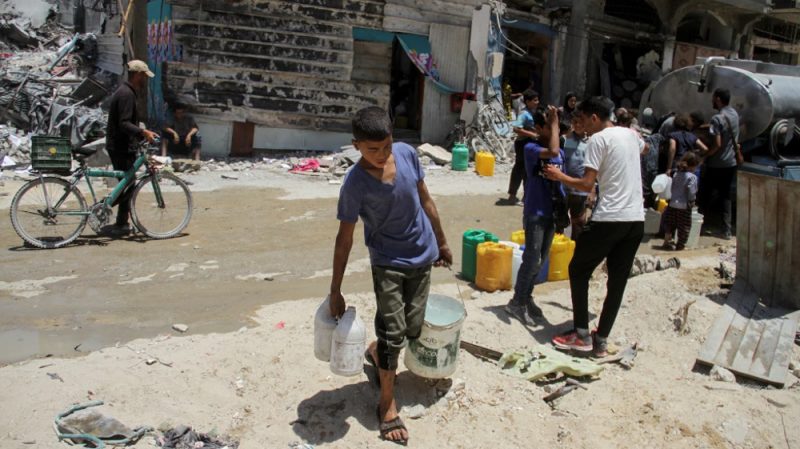
A displaced Palestinian boy carries water containers in Jabalia refugee camp, following an Israeli raid, in the northern Gaza Strip, on June 2, 2024. (Photo by Reuters)
Press TV – July 5, 2024
An international human rights organization says Israel is using water as another weapon of genocide against Palestinians in the Gaza Strip by deliberately reducing the amount of water available to them, especially potable water sources.
The Euro-Med Human Rights Monitor said in a new press release issued on Thursday that the Tel Aviv regime is purposefully causing the death of over 2.3 million people as part of its genocide war.
The Euro-Med noted that its field team observed significant damage to a desalination plant in the al-Zaytoun neighborhood, south of Gaza City, as a result of an Israeli strike. The attack claimed the life of a young man who was filling a gallon with water there and left several other individuals wounded.
The station, which provided services to at least 50,000 people in several nearby residential neighborhoods, sustained significant damage after being struck by an Israeli guided bomb that broke through multiple stories and detonated on the first floor.
The statement noted that the residents of the Gaza Strip are facing significant challenges in getting access to water as summer temperatures rise.
Estimates show that the per capita share of water in the Gaza Strip has decreased by 97% due to the extensive destruction of water infrastructure. As a result of the Israeli onslaught, the per capita share of water in the territory has decreased to between 3 and 15 liters per day.
Euro-Med highlighted that continued destruction and devastation by the Israeli army renders the Gaza Strip unlivable, particularly after nine out of ten water tanks and half of the water networks were destroyed.
The Israeli regime has so far killed at least 38,011 Palestinians, mostly women and children, and injured 87,445 others, since it waged the brutal war on the Gaza Strip in October 2023, according to the Gaza-based health ministry.
The occupying entity has also imposed a “complete siege” on the territory, cutting off fuel, electricity, food, and water to the more than two million Palestinians living there.
The regime is facing genocide charges at the International Court of Justice as the top court has ruled that Israel must stop its military activities in Rafah immediately. This is the place where more than a million Palestinians had taken shelter from the war before it was invaded on May 6.
Khan Yunis back under Israeli siege as 250,000 face renewed displacement
The Cradle | July 3, 2024
Thousands of Palestinians have been displaced from Gaza’s southern city of Khan Yunis due to new evacuation orders issued by the Israeli army.
The UN has warned that 250,000 people would be affected by the evacuation orders.
“Just weeks after people were forced to return to a devastated Khan Yunis, Israeli authorities have issued new evacuation orders for the area. Yet again, families face forced displacement. We estimate 250,000 people will have to flee. Even though nowhere is safe in Gaza,” UNRWA said on 2 July.
Sigrid Kaag, UN humanitarian coordinator for Gaza, said the new evacuation orders increased the number of displaced people in Gaza to 1.9 million, around 80 percent of the territory’s population.
As people flee the southern city, Israel’s relentless attacks have continued.
Twelve people were killed in the central city of Deir al-Balah on Tuesday after an Israeli airstrike on a home. Nine of the casualties were members of one family who had fled Khan Yunis after the evacuation order. Five children and three women were among those killed.
“The bodies of 12 people were brought to Al-Aqsa Martyrs Hospital in Deir al-Balah, following an airstrike by the occupation forces on the Eslayyim family house in the city,” WAFA news agency’s correspondent reported.
The family had fled from Khan Yunis to a designated “safe zone” in Deir al-Balah, where they were killed by the Israeli strike.
The Palestinian Red Crescent Society (PRCS) said that eight people were killed and 30 injured in other Israeli attacks, which targeted densely populated neighborhoods that Palestinians were fleeing from in Khan Yunis on Tuesday.
The attacks came a day after the Palestinian Islamic Jihad (PIJ) movement’s Quds Brigades launched around 20 rockets towards Israel.
Shortly after the rocket attack on Monday, Israel ordered the evacuation of Al-Qarara, Bani Suheila, and other areas of Khan Yunis.
Israeli forces withdrew from Khan Yunis in April following months of extensive operations that began in December, leaving much of the city destroyed. Tel Aviv claimed that Hamas was cleared from the area.
Israeli troops are currently operating and taking heavy losses in the southernmost city of Rafah, which Israel previously claimed was Hamas’ final stronghold.
It is also facing fierce resistance in Gaza City’s northern Shujaiya neighborhood – an area that Tel Aviv’s forces recently re-entered after claiming it had “dismantled” Hamas in the north.
A compound crime: Israeli army hits Gaza family, uses them as human shields, and runs over their mother
Euro-Med Monitor | June 30, 2024
Palestinian Territory – The Israeli army continues to use its tanks to deliberately run over live Palestinian civilians and crush their bodies, in addition to using civilians as human shields, in the ground operations of its crime of genocide in the Gaza Strip that has been ongoing since 7 October 2023.
The Euro-Med Human Rights Monitor field team documented a compound and comprehensive crime against a civilian family comprising an elderly woman and her four children, including three young women and a one-and-a-half-year-old granddaughter. The family was attacked with gunfire and bombs after Israeli forces stormed their house on Thursday evening, 27 June. They were later taken outside and detained for over three hours despite their injuries in their home, near Israeli tanks in a dangerous combat zone, where they were used as human shields. The 65-year-old mother, identified as Safiya Hassan Musa Al-Jamal, was run over by an Israeli tank and killed in front of her son.
In his testimony to the Euro-Med Monitor team, the elderly woman’s son, Muhannad Al-Jamal, 28, said: “We were living in Al-Nazaz Street in Al-Shuja’iya, east of Gaza, when at approximately 10 a.m. on Thursday we were surprised to hear the sound of shelling and explosions. We made an unsuccessful attempt to leave. All around us was chaos. We went inside, up to the first floor, and sat in a room in the center of the house. As we were sitting there, we noticed that Israeli tanks were moving closer to the area. Then the bombing started to get more intense, and I saw that many of the tanks had turned and were now positioned on the adjacent land of our neighbours, bulldozing and destroying it before raising the Israeli flag on the property. I was with my mother, my three sisters, and niece in the room. We were very careful not to make any noise. At the end of the afternoon or before sunset, the tanks began firing shells toward my brother’s ground floor flat in our home. I got my family together and we sat in one of the rooms, reciting the Shahada (a statement of belief that Muslims recite before death) and waiting to see what would happen to us.
“After sunset, we heard gunfire in the street, and then I realised that the soldiers had stormed the house after blowing up a wall. When they found us in the room, they started firing at the walls randomly and threw five bombs amid gunfire. They were shouting in Hebrew, and we did not understand what they were saying. I was hit by shrapnel in my back, along with my sisters. My mother was struck by a large piece of shrapnel in her chest while my sisters were screaming, “We are civilians.” The soldiers then moved forward one by one, yelling, “Shut up,” before dragging me away. They forced me to take off my clothes and put me against the wall. After my mother and sisters entered with a female soldier, the soldiers pointed their weapons at me for half an hour.
“They asked me to carry my mother on my back. After that, a different soldier ordered me to place her on a stretcher, so I did. I then carried her with another soldier out through the opening that the army attack had made. We then went to a nearby area and were placed in a tank, where I placed the stretcher in front of me before exiting. After that, they brought me back to the house. They later took me down and handcuffed me. My sisters were at the tank’s door when a soldier arrived at roughly 9:45 p.m. and asked them to wait before he removed the handcuffs and put shackles on my hands and a blindfold on my eyes. He stopped me on a sand hill, and he was shining a laser at me. I felt that they were going to execute me. Then he turned on the tank and ordered me to get into it. It was a different tank from the one my mother was in. Later, the tank shifted and swung around. After that, they dropped me in what appeared to be a set of stairs, and I had no idea where I was. I was asked to follow their directions as I moved. This went on for about 15 minutes while rude remarks were made. Then I was grabbed by the neck by one of the soldiers. After I moved fifty meters, they put me in yet another tank. I moved in, then they took me down and put me in a tank that contained the stretcher that we used to transport my mother. Later on, the tank moved.
“I had assumed that we would be taken to a medical facility so that my mother could be treated, but instead they tackled me and my mother, putting her on the ground. After a few minutes, I realised we had arrived at the Mushtaha Roundabout, at the end of Al-Nazzaz Street. I inquired as to my location. “Your mother will be taken by ambulance,” he said. My mom was on the ground, unconscious. There were two tanks on the right and left surrounding the roundabout. After the soldiers entered the tank, it started to move backward and ran over my mother.
“When I saw the scene, I thought I had gone insane and began to cry and scream… I fled, fearing for my life, as the tank on the right tried to run me over. However, the two tanks moved in another direction, and the tank on the left was trying to run my mother over once more, but that did not happen. Afterwards, the tanks pivoted and pointed their weapons towards me. Out of fear, I hid by taking cover. All I could hear as I started to scream was the sound of gunfire. Dogs were getting closer to my mother’s body and I shoved them away as they were going to eat her body. This was on Friday just after midnight, around 1 a.m. The soldier in the tank knew where he had placed her and was able to avoid her, but he deliberately ran over her. I could not bear the situation amid the heavy gunfire, and I could not carry my mother after the tank ran over her. I was shocked by what had happened, but I could hardly cover my mother and ran from the place, thinking if there had been an ‘ambulance,’ as he said, he would not run over her. I went looking for my sisters, as I did not know their fate. I kept crying as I walked through the intense gunfire until I came across someone on a balcony who offered me a bottle of water and directed me along a safe route that would get me to my friends’ location in a stairwell. I made every effort to get in touch with my sisters, and eventually I found out that they were receiving medical care at Baptist Hospital. They inquired about my mother, so I told them.”
His sister, Areeji, 30, added to the Euro-Med Monitor team: “When the soldiers stormed our house and started shooting and throwing bombs, we told them that my mother was injured and dying. We noticed that she had a large wound, and a female soldier arrived to provide first aid. We observed her attempting to treat her repeatedly, and I witnessed my mother on the verge of death. After they had taken my brother, they held us for a while before telling us to head to Salah al-Din Street. When we asked about my mother, they said they would take her to the hospital. Then, they gave us a green light (torch) and we started to move. We were injured and bleeding, and we had a one-and-a-half-year-old baby girl with us. When we got to the area before the Shuja’iya intersection at 11:30 p.m., there were tanks there, a lot of gunfire, and I waved the green light (torch) until we passed. No one was following us until we got to the Baptist Hospital.”
Euro-Med Monitor has previously documented many instances of the Israeli army killing Palestinian civilians by intentionally running over live civilians with military tanks.
Sixty-two-year-old Jamal Hamdi Hassan Ashour was one such victim. He was deliberately run over in Gaza City’s Al-Zaytoun neighbourhood on 29 February after he was arrested. The father of five was subjected to harsh interrogation by members of the Israeli army, who bound his hands with plastic zip-tie handcuffs before running him over with a military vehicle from the bottom to the top of his body.
Ashour’s home was targeted by Israeli aircraft, killing his nephew, before the family had to evacuate it. The incident occurred on the main Salah al-Din Street in the Zaytoun neighbourhood, according to eyewitnesses who spoke to the Euro-Med Monitor team. Israeli forces besieged Ashour and his wife inside their home, before arresting him and transferring him to a building in the neighbourhood designated for interrogating detainees. Israeli soldiers restrained the victim’s hands with plastic shackles before they crushed him, and tramped on his body from the legs up, confirming that he was alive during the incident. To guarantee thorough and complete crushing, the victim was placed on asphalt rather than on an adjacent sandy area.
Another documented incident took place on 23 January, when an Israeli tank ran over members of the Ghannam family while they were sleeping in a shelter caravan in the Taiba Towers area of Khan Younis. As a result, a man and his eldest daughter were killed, and his remaining three children and wife were injured. Amina, his 13-year-old daughter, confirmed that her father and older sister were killed when an Israeli tank unexpectedly and repeatedly ran over the caravan, where the family had been sleeping. While her mother and two other siblings survived the attack, Amina experienced extreme pressure in her eyes, nearly losing her sight.
In another incident documented by Euro-Med Monitor, Israeli tanks and bulldozers ran over and crushed displaced people inside their tents in Beit Lahia’s Kamal Adwan Hospital courtyard on 16 December 2023. Several people were killed, including individuals who were initially injured and did not ultimately survive. The corpses of those who had been previously buried in the courtyard were also crushed in the 16 December incident.
Euro-Med Monitor has also documented numerous incidents of Israeli army tanks destroying civilian property, particularly cars, during Israel’s ground incursions into different parts of the Gaza Strip. Most of these tank attacks have targeted vehicles with no evident military connection, parked in the streets, demonstrating the Israeli army’s deliberate and systematic destruction of Palestinian property.
These violations are part of a larger Israeli effort to dehumanise every Palestinian in the Gaza Strip, apparently in an attempt to justify and normalise the crimes being committed against them. Crushing civilians with tanks is just one of the many brutal ways the Israeli army murders Palestinians in the Gaza Strip, denying their humanity, suffering, and dignity. These practices reflect the intention of Israel’s government and military to collectively punish the Palestinian people, with the aim of eliminating, intimidating, and/or harming them physically and psychologically. These crimes come in tandem with a public incitement campaign by Israeli officials, media figures, and settlers calling for the annihilation of Palestinians in Gaza, and are committed with total impunity by the perpetrators—which is evident in the absence of any meaningful action by the Israeli government or military at any level to hold the perpetrators accountable.
Israeli military attacks continue in various parts of the Gaza Strip, with ongoing aerial and artillery bombardment targeting residential homes. The Israeli army has also escalated its targeted killings, and extrajudicial executions against Palestinian civilians since 7 October 2023 through direct targeting with snipers, drones, and continuing operations in various regions of the Gaza Strip. These actions against civilians amount to war crimes and crimes against humanity under the Rome Statute, and are all part of the Israeli crime of genocide that has been ongoing in the Gaza Strip since 7 October.
The widespread and indiscriminate destruction of property caused by the Israeli army, as observed in the Shujaiya neighbourhood east of Gaza City, Rafah, Khan Yunis, and Jabalia north of the Gaza Strip, affecting over 65% of the buildings, is also considered a war crime under the Rome Statute.
The international community must take immediate action to fulfil its international obligations to put an end to the crime of genocide that Israel has been committing against all Palestinians in the Gaza Strip for nine months. Measures must be taken to ensure that Israel complies with its international obligations, the Security Council’s ceasefire resolutions, and the International Court of Justice’s rulings, and to ensure Israel is held accountable for the crimes it has committed against the Palestinian people.
Featured Video

Armando Mema: Finland Used as New Frontline Against Russia
or go to
Aletho News Archives – Video-Images
New Documentary
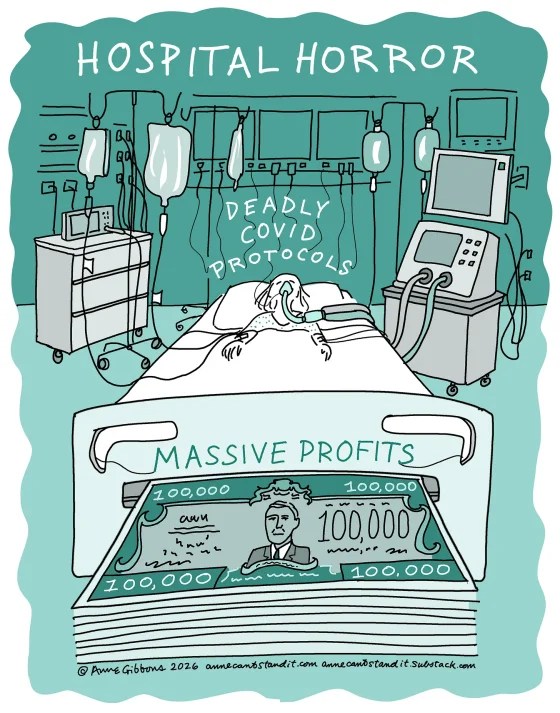
Hospital Horror
Documented in the film,“Bad Medicine”
Blog Roll
 Aletho News
- CENTCOM rejects Israeli claims of preparations for new Iran attacks
- Your Shopping Bag Runs Through Hormuz
- Armando Mema: Finland Used as New Frontline Against Russia
- Gestapo 2.0? Germany grants spy agencies sweeping new powers
- Franco-Palestinian group seeks court ban on Israeli real estate fair in Paris
- How British foreign policy is frozen in the ruins of empire
- EU risks investor exodus over Russian assets – Euroclear chief
- Moscow warns NATO over troop buildup
- EU leaders prolonging Ukraine conflict to stay in power – Swiss journalist
- Moscow car bombing injures former aide to Ukraine’s ex-PM Azarov
- If Americans Knew
- An error has occurred; the feed is probably down. Try again later.
- No Tricks Zone
- New Study: Barents Sea Temperatures Were Warmer And Sea Ice Less Extensive In The 1700s Than Today
- German Authorities Start Initiative To Evaluate Public Register For Climate “Disinformation” Spreaders!
- Zonal Asymmetry of Temperature Change in the Antarctic Circumpolar Current
- New Study: The Net Fossil Fuel Contribution To Rising Atmospheric CO2 Has Been Zero For 500 Years
- Germany’s Green Energy Transition Becoming Increasingly Expensive…Another 6 Trillion Euros!
- Sudden Stratospheric Warming, Powerful El Niño Combination May Lead To Extreme Europe Cold, Energy Crisis!
- Two New Studies Find Thwaites Glacier Melt Cannot Be Driven By Human Activity Or A Warming Ocean
- E-Cars Reduce CO2 Emissions By Only 41% Compared To Internal Combustion Engine Vehicles
- Predictions Made By Renowned Climate Professor Over Past Decades Have Been Proven To Be Poor
- New Study Suggests Large Regions Of The Pacific Ocean Have Been Cooling For The Last 80 Years

