‘Soft child-porn’ or honest political debate? Take a guess which one YouTube failed to censor
By Robert Bridge | RT | February 25, 2019
Despite employing a small army of ‘anti-extremist’ flaggers, YouTube somehow overlooked an entire prison block of pedophiles on its platform. Is the video-sharing site wasting too many resources censoring political content?
Last week, a regular guy named Matt Watson, working at his home computer, shook the wired world to its very foundations by providing convincing evidence that YouTube supports – either wittingly or unwittingly – a pedophile ring that openly preys on the most vulnerable members of society, children.
As Watson demonstrated, not only are these bottom feeders free to comment on videos that feature minors, but they also provide time stamps, presumably for the benefit of the wider pedophile community, indicating exactly when the children can be seen in their most compromising positions. They also actively promote links to porn sites that cater for these twisted minds.
The discovery prompted some of the most popular corporate brands, including Disney and Nestle, to bolt for the emergency exits after it was discovered their ads were running alongside the work of sexually depraved deviants. Needless to say, not the best business model.
Aside from the lewd comments accompanying the videos, which is not overly surprising considering the planet’s high creep factor, one of the most disturbing revelations is how ‘user friendly’ YouTube has become for pedophiles. Watson showed how Google-owned YouTube, through no more than a couple mouse clicks, navigates users to a frolicking playground where the sidebar is loaded with nothing but children-themed videos, a virtual pedophile paradise. But it gets more disturbing.
Once a user has entered this “wormhole,” as Watson calls it, there are no alternative video options available for escaping from it. A user will not even find ‘awareness’ videos, for example, that discuss the threat of child predators. In other words, once the user makes it to YouTube’s children video section it is game over, so to speak, unless he or she physically activates a new search.
The reason that this scandal makes no sense is that YouTube has known about its pedophile problem for years. Back in 2017, advertisers were fleeing the platform for the very same reason they are today – their ads were being featured next to scantily clad girls, as well as the predictable depraved comments. Today, algorithm technology is so advanced that Google Maps, for example, is able to blur out the faces of every single person’s image that is captured by its Google Street View. Yet somehow YouTube appears to be technologically handicapped when it comes to finding ways to combat online pedophiles. Why is that?
One possible explanation is that Google and YouTube, as well as the majority of other IT companies, have become overly attentive to politics at the expense of everything else – and more so ever since Donald Trump ‘stole’ the White House from the Democratic darling Hillary Clinton.
First, it is important to state the obvious: Silicon Valley is to Liberals what Yankee Stadium is to the New York Yankees. In other words, the holy of the holies. To quote Mark Zuckerberg, the CEO of Facebook, Silicon Valley, the home to hundreds of IT companies, is an “extremely left-leaning place.” Twitter CEO Jack Dorsey, meanwhile, admitted that his company is so liberal that conservative employees “don’t feel safe to express their opinions” in the workplace.
Given this blatant liberal predilection within the industry, who do you think Google and YouTube teamed up with to police its content from ‘extremist’ (i.e. conservative) content? Certainly not far-right groups.
In 2017, YouTube doubled the size of its so-called ‘Trusted Flaggers’ program, which now partners with over 100 organizations, the full member list of the program remains confidential. Among the few members that have been made public, however, including the Anti-Defamation League (ADL), No Hate Speech and the Southern Poverty Law Center (SPLC), they could best be described as ‘extremist’ in their liberal ideology. Meanwhile, as the Wall Street Journal reported, “less than 10 of the slots are filled by government agencies.”
Ironically, given the nature of this discussion, several of those agencies deal with “child-safety” issues.
Conservatives argue that the glaring lack of transparency with regard to the secretive ‘Trusted Flaggers’ program, combined with the IT industry’s well-known liberal affections, explains why so many right-wing and alternative news sites are being either demonetized, downgraded, or outright banned. And since we are talking about private businesses, these organizations have no legal obligation to uphold the Constitution’s Second Amendment that guarantees ‘freedom of speech.’ They just casually shrug their shoulders and blame everything on the almighty algorithms. Yet, as even the most technologically handicapped person knows, algorithms were not magically conjured up out of thin air. Human beings, not robots (at least not yet), work tediously to develop them.
As just one example of the Orwellian atmosphere now pervading Planet Google, Jordan Peterson, a professor with a reputation for opposing political correctness, had one of his YouTube videos blocked in over two dozen countries last year. YouTube duly informed him that it had “received a legal complaint” about the video and decided to block it. Just like that!
Only after a major outcry on multiple social media platforms, which included Twitter user Ethan Klein and his one million followers, did YouTube finally back down, while portraying the event as some sort of fluke that was “fixed.”
This isn’t the first time YouTube users have experienced “glitches” with the platform. Last year, it was forced to explain the mass removal of right-wing video channels, calling it a “mistake.” What is so strange about these technological breakdowns is that they always seem to affect conservative users. This snafu happened shortly after YouTube CEO Susan Wojcicki announced she was bringing on board – in addition to the so-called ‘Trusted Flaggers’ – some 10,000 moderators to crack down on rising occurrences of hate speech and – wait for it – “child safety.”
Meanwhile, Google can take draconian measures to downgrade RT and Sputnik, for example, over totally unfounded charges related to ‘Russiagate’ hysteria, yet they seem incapable of micromanaging the comments section in kiddie videos.
What this is intended to show is that YouTube does not hesitate to take deliberate steps to intervene in issues that matter most to them, which overwhelmingly seem to be of a political nature. Yet, when the welfare of children is at stake, the mini-surveillance state that the platform has built always goes missing in action, as it has now for many years.
How is it possible that one young man, working alone and without pay, is able to weed out a viper’s den of pedophiles from YouTube’s dungeon? Yet YouTube, with its army of ‘flaggers’ and moderators and government agencies, has failed to filter these miscreants for several years?
The sad reality is that the world of IT is totally consumed with politics, and politics is totally consumed with the world of IT, to the point where society’s most vulnerable are left at risk.
Unfortunately, parents must assume a great deal of vigilance against pedophiles when their children use the video sharing platform because YouTube has obviously dropped the ball on the issue and simply cannot be trusted. Like the rest of the IT kingdom, their heart is in politics, and that is it.
YouTube Will Determine What ‘Conspiracy’ Is and Stop Recommending Such Videos

By Michael Krieger | Liberty BlitzKrieg | February 11, 2019
While the evolution of Google’s YouTube from a free expression platform into something entirely different has been underway for a while, it just took another step in a very short-sighted and restrictive direction. NBC News reports:
YouTube has announced that it will no longer recommend videos that “come close to” violating its community guidelines, such as conspiracy or medically inaccurate videos… Chaslot said that YouTube’s fix to its recommendations AI will have to include getting people to videos with truthful information and overhauling the current system it uses to recommend videos.
There’s a lot to unpack here so let’s get started. First, it appears YouTube has announced the creation of a new bucket when it comes to content uploaded to the site. It’s no longer just videos consistent with company guidelines and those that aren’t, but there’s now a category for “conspiracy or medically inaccurate videos.” This is a massive responsibility, which neither YouTube or anyone else seems fit to be judge and jury. In other words, YouTube is saying it’s comfortable deciding what is “conspiracy” and what isn’t. Which brings up a really important question.
So no videos of government officials lying the public into wars, or is that the Silicon Valley approved type conspiracy? https://t.co/mUEQGMlLyr
— Michael Krieger (@LibertyBlitz) February 11, 2019
“Conspiracy” and covering up conspiracies is a fundamental part of the human experience, and always has been. It demonstrates extreme hubris for a tech giant to claim it can differentiate between a legitimate conspiracy to explore, versus an illegitimate one. One person’s righteous investigation is another’s conspiracy theory, with Russiagate serving as an obvious contemporary example.
Going back to the early 21st century, we witnessed a major conspiracy to start a war in Iraq based on lies; lies which were endlessly repeated uncritically throughout the mass media. Even worse, General Wesley Clark described an even larger conspiracy which consisted of starting multiple additional wars in the aftermath of 9/11. This conspiracy is ongoing and has continued to move forward in the years since, through both Republican and Democratic administrations.
It’s pretty clear what will end up happening as a result of this tweaking to YouTube’s recommended videos AI. The “conspiracies” of your average person will be pushed aside and demoted, while government and mass media lies will remain unaffected. Google will assume mass media and government are honest, so government and billionaire approved propaganda will be increasingly promoted, while the perspectives of regular citizens will be pushed further to the margins. YouTube is simply not a platform anymore, but rather a self-proclaimed arbiter of what is ridiculous conspiracy and what is truth.
The most dangerous and consequential liars on planet earth are those in government, yet I guarantee YouTube will gladly recommend such liars and their lies.
— Michael Krieger (@LibertyBlitz) February 11, 2019
While YouTube says videos it deems conspiracy will still be available via search, it’s not a stretch to imagine this is just the first step and before you know it certain categories will be banned from the site entirely. Either way, I think there’s a silver lining to all of this.
As I outlined in a recent post, U.S. tech giants, particularly Facebook, Google and Amazon, aren’t simply private companies. They appear more akin to quasi-government entities that increasingly view themselves as instrumental gatekeepers for a discredited status quo. Moreover, their primary business models consist of mass surveillance and violating our privacy.
Ultimately, I think the increasingly nefarious and desperate behavior of these tech giants will lead to their demise. More and more of us have looked under the hood and seen the seedy and privacy-destroying nature of these entities. We’ve also seen what it’s like to have genuine free expression on the internet and we don’t want to turn the web into another cable news where Facebook, Google and Amazon become the new CBS, NBC and ABC. If we do, then the entire promise of the internet will have turned out to be a giant waste.
But I don’t think that’s going to happen. I think most of us have had a taste of what’s possible, and agree that free speech and expression on the internet, the good, the bad and the ugly, is better than an internet censored by tech companies and their billionaire executives, who will always be biased toward the status quo point of view. It’s still not clear which platforms will emerge to replace the tech giants, but it seems fairly clear to me the best days are over for these companies, and it cannot come a moment too soon.
The EU and the warning signs of Fascism

Image source – here
By Kit Knightly | OffGuardian | December 10, 2018
Things are spiralling out of control in Europe, faster than many predicted. Outside of Brexit, there is strong anti-EU feeling in Hungary, Spain, Italy, Greece and France. The EU is in danger of crumbling, and people afraid of losing power are prone to extreme acts of dictatorial control.
How long before the EU truly becomes the authoritarian force that people from both ends of the political spectrum have always feared?
The EU Defence Force
Earlier this year, the EU voted to “punish” one of its own members, Hungary, for the internal policies of its elected government. To be clear about this – whatever you think of Viktor Orban, he was elected by the people of Hungary. He is their legally recognised democratic leader. Hungary voted for him – in contrast, Hungary did NOT vote for any of the 448 MEPs who supported the motion, posed by Dutch MEP Judith Sargentini, that:
The Hungarian people deserve better… They deserve freedom of speech, non-discrimination, tolerance, justice and equality, all of which are enshrined in the European treaties.”
Note that “democracy” is not included on that list. “Tolerance”, “justice” and “equality”, but not democracy. A Freudian slip, perhaps.
The European Parliament vote was, itself, a corrupt nonsense – one in which abstentions were disregarded so the 2/3rds majority could be reached. Forcing through a bill that, essentially, calls for a change of regime in Hungary via:
“appropriate measures to restore inclusive democracy, the rule of law and respect for fundamental rights in Hungary”
One suggested punishment – “The Nuclear Option” – is a loss of voting rights. Hungary would still be a member of the EU, would still have to pay into the EU, would still have to obey all EU laws and regulations, but would no longer have a say in what those laws were.
This would, notionally, be in defence of “inclusive democracy”.
How long before disapproval and punishment of certain leaders turns into outright removal? Can we really say that would never happen?
This month, Paris (and other French cities) have seen the massive Gilets Jaunes protests against the fuel tax, austerity and income inequality. The violent repression of these protests has received no criticism from either individual member states of the EU, or the EU itself. However, an armored vehicle painted with the EU’s insignia was seen on the streets of Paris.
Both Macron and Merkel have talked, recently, of the need for an EU Army – will these protests in France be used as an excuse to implement those plans?
Let’s assume the EU Army is brought about – let us supply the European Union with its coveted “defence force”. 250,000 hypothetical men, drawn from all the member states. What is their purpose? What is their function?
For example, would they have been deployed to Catalonia last year to “keep the peace”? Would an EU army have moved against a peaceful vote to “defend” the integrity of the Union?
Would a possible step in dealing with Viktor Orban’s government be to deploy the EU Defence Force to Budapest and remove the man who is a threat to “equality”? Would that count as “appropriate measures to restore inclusive democracy”?
If Brexit is ruled a “threat to human rights” (or some other collection of buzzwords), would the EU army be rolling armoured vehicles along the streets of London to protect us from ourselves?
There have been, and could be, many situations in the EU’s recent past where military intervention was only avoided because it literally wasn’t an option. An EU Army would make it an option, do we trust Brussels not to avail themselves of it?
Some argue that an EU Army would be a good thing because it would decrease Europe’s reliance on NATO, and remove US influence. I don’t believe that to be the case, and as evidence, I supply the fact that the Carnegie Endowment for International Peace, a well-known US-backed NGO, is very much in favour of the plan.
The EU’s Ministry of Truth
Of course, the increasing possibility of an EU consensus imposed by force is only one part of the threat.
Outside of physical repression – both by the EU (of national sovereignty), and by the state (of the individual right to protest) – there are warning signs of intellectual repression. A coming crackdown on freedom of expression and opinion.
There is a scary article on The Guardian today: Russia ‘paved way for Ukraine ship seizures with fake news drive’ . It’s not scary because of the headline – it’s scary because of the motivations behind it, and the implications for the future of Europe.
The meat of the article is an unsourced, unlinked, evidence-free claim of Russian malfeasance, and as such, Hitchens’ Razor applies.
The first half of the article is riddled with lies, omissions and mistakes. It’s the Guardian, you expect that. Disregard the babble about cholera and nuclear bombs. Disregard the factual errors – many though they are. In this instance, none of it matters.
All that matters is the second half – the proposed “solution” to the “problem” to which this article is a “reaction”. Namely, online disinformation. Specifically, “Russian” online disinformation.
Julian King, former UK ambassador to France and now EU security commissioner, wants tech companies to take steps to prevent the spread of “fake news”. It’s a war against dissent, with three fronts.
One – establish the “truth”:
Last week the European Commission announced it would set up a rapid alert system to help EU member states recognise disinformation campaigns
Essentially, there will be an EU mandated list of acceptable “news”, and anything which deviates from that in the slightest way will be branded “disinformation”. This will allow people to dismiss, rather than engage with, views that differ from their own.
Two – eliminate dissent:
King said social media platforms needed to identify and close down fake accounts that were spreading disinformation.
By “fake accounts”, they mean accounts which spread “disinformation”. Being a “bot” is not about whether or not you are a real person, it’s about whether or not you have the right opinions. As has been demonstrated, they either do not know or do not care who is real and who is not. Perfectly real people have been labelled Russian bots in the media, when they are proven to be neither Russian nor bots. Whether this is incompetence or corruption does not matter, the point is governments have shown they cannot be trusted on this issue.
Three – control the narrative:
We need to see greater clarity around algorithms, information on how they prioritise what content to display, for example. If you search for anything EU-related on Google, content from Russian propaganda outlets like RT or Sputnik is invariably in the first few results…. All of this should be subject to independent oversight and audit.
The Google algorithm is allowing news that either disagrees with the EU, or is directly critical of it, to be shown in their results. This is unacceptable. What the EU security commissioner wants is for Google to “fix” their system, to make sure news that deviates from the EU’s agenda does not show up in their results.
Now, if you think that sounds like censorship, don’t worry because [our emphasis]:
What we are not trying to do is to censor the internet. There is no suggestion that we – or anyone else – should become the arbiter of what content users should or shouldn’t be consuming online. This is about transparency, not censorship.
The EU wants Google to remove certain websites from their algorithm, but it’s about transparency, not censorship. So that’s OK.
Conclusion
To sum up:
- The European Union’s two major figureheads are both in favour of an EU army.
- The European Union’s flag is painted on armoured vehicles repressing anti-government protests in France.
- The European Union is putting aside £4.6 millio (5 million Euros) to “help people recognise disinformation”.
- The European Union wants to pressure social media companies into “shutting down” accounts that spread “fake news”.
- The European Union wants Google to alter their algorithm, to promote news that praises the EU and demote sites critical of it.
- The European Union wants us to understand that this is about “transparency” and is definitely NOT censorship.
Does this sound like an organization of which we want to be a part? Are we supposed to like the proposed multi-national EU “defense force” putting down anti-EU marches on the streets of Barcelona or Rome? To cheer on the idea that the EU Army could be sent into non-cooperative member-states to remove “dangerous” elected leaders because they are a threat to “equality”?
We won’t even be able to get to the truth of those matters, because the EU will be supplying lists of “fake news” social media accounts to Twitter and Facebook, who will dutifully shut them down. While Google alters and re-alters their algorithm to make sure any news covering EU repression of democracy is pushed so far down the results pages it may as well not exist.
The British press, pundits and talking heads are constantly referring to the “Brexit crisis”, but that’s just hysteria and fear mongering. Re-negotiating your position in a trade bloc is NOT a crisis. A crisis is what happens when an unelected, bureaucratic power structure suddenly senses its grip on power is slipping, and acts accordingly.
And a crisis could well be on the horizon. The signs are there, if you want to see them.
Kit Knightly is co-editor of OffGuardian. The Guardian banned him from commenting. Twice. He used to write for fun, but now he’s forced to out of a near-permanent sense of outrage.
gab.com & the Great Purge on the Horizon
By Kit Knightly | OffGuardian | October 30, 2018
gab.com is an alternative social network, set up and launched in 2016. It’s founder, Andrew Torba, stated he wanted to create a home for free speech, and counter what he perceived as “liberal bias” on other platforms, such as Twitter and Facebook.
Two days ago, their website was taken down. This was in response to being blocked by PayPal, and then having their server space taken away by their hosting service. gab’s founder posted this statement on their stripped-down website.
Why did this happen?
Because Robert Bowers, the alleged gunman at the synagogue shooting in Pittsburgh, had a gab account and posted some things about “the jews” on it.
Is it right, or sensible to punish a platform for the (alleged) actions of ONE user out of 100,000s? And is that really what’s going on?
Robert Bowers also had a Twitter account. And a Facebook page. Neither of these platforms has faced punishment, or censure, from any quarter.
Cesar Sayoc – the alleged MAGABomber – also had a twitter account and allegedly sent threatening messages to some public figures on it. Again, Twitter has not been blocked by PayPal.
In fact, Twitter and Facebook – though occasionally criticised for “not doing enough to combat hate”, have never been blocked, or threatened in any way. Even though Twitter hosted countless pro-ISIS accounts, regularly cited in the media.
So clearly, it can be reasoned, PayPal et al are not only responding to the alleged statements of Robert Bowers. There is a deeper agenda at work.
In fact, this isn’t the first time larger internet companies have tried to stymie gab’s existence. When they were first launched, in 2016, Apple denied them a place in their app store because they allegedly allowed pornography to be posted. When gab installed a filter to block people posting pornography, Apple again denied them access to the app store, this time for breaching their “hate speech” regulations. Google Play did the same in 2017 (reminder – Google allowed ISIS to release their own app on their marketplace).
Early this year a cross-university study conducted on gab (and other “alt-right” sites) found that gab.com used “free speech as shield to protect their “alt-right” views”. (I’m not sure what, if anything, that sentence really means. Surely free speech is a shield protecting all speech? Isn’t that the point?)
In April this year VICE magazine ran an article headlined “Gab Is the Alt-Right Social Network Racists Are Moving to”. It was resoundingly negative about the site, painting it as nothing but a home for racism and “conspiracy theorists”, despite the owner’s protestations that gab is all about free speech, and that anyone is free to join.
Logically, the emergence of networks like gab was inevitable. The internet has always been that way, you shut down one hallway and four more are forced open. Look at Piratebay, notionally banned, yet available through a million different proxies that spring up faster than governments can shut them down.
Social media has undergone unprecedented purges this year. Alex Jones was banned across virtually every mainstream platform. Hundreds of Facebook pages and Twitter accounts were shut down on spurious grounds – allegations of being “Kremlin backed” or “Iran bots”fly around, without any supporting evidence ever being released to the public. This summer, Twitter blocked millions of “fake accounts” (we covered that here).
These actions aren’t independent, either. Alex Jones was banned from multiple platforms, all within 24 hours. Just earlier this month, Facebook unpublished over 800 pages, whilst twitter blocked the accounts of the same pages… all on the same day. Clearly, the companies are either coordinating with each other (possibly in breach of anti-trust laws), or are receiving directions from the same source – almost certainly the government.
In that climate, new platforms were always going to emerge. It’s the classic “Well then I’m gonna build my own theme park, with blackjack and hookers” situation.
YouTube is increasingly corporate, controlled and fake. Demonetising user videos and adding more and more advertisements… so dtube and bitchute open. Twitter censors your free-speech, so we’ll start up a platform where you can say what you want.
Twitter and Facebook both saw their stock-prices tumble as a result of their respective “purges”. So, is the anti-gab movement simply a case of mega-corporations protecting their monopoly by shutting down a budding rival? Is this all just about control of the market and money?
Unfortunately, it seems not. Like the vast majority of media roll-outs, it seems this is a convergence of interests – financial on the one hand, and political on the other.
The push to ban the “alt-right” – or, the even broader term – “hate speech” has been on-going for several years now. It will inevitably pick up in the wake of the events of this week.
Within hours, predictable voices were discussing the “necessary limitations on free speech”:
The #Pittsburgh synagogue terror attack is a reminder of the necessary limits of free speech. Hate speech leads to acts of hatred.
— GeorgeMonbiot (@GeorgeMonbiot) October 28, 2018
Today, CNN ran this piece: “Big Tech made the social media mess. It has to fix it”.
Paul Mason, writing in the New Statesman, argued that YouTube needs to censor all the “alt-right” on their platform.
It’s a two-step process – having first established the need to “limit” hate speech, we can then move on to defining what “hate speech” really means.
They’ve started on that already. Criticising George Soros is “anti-semitic” now. As is the term “neocons”:
Speaking of anti-Semitic dog whistles. It’s not only “globalists” and “George Soros.” “Neocon” is often used the same way–by haters on both the left and the right. https://t.co/DWci2PCZES
— Max Boot (@MaxBoot) October 29, 2018
What else will be deemed hate speech? What does “hate speech” really mean? The simple answer to that is: Whatever they want it to mean.
It seems like there’s a purge coming, you can feel it in the wind. A purge motivated by the greed of multinational companies wielding power that rivals nations, and fuelled by the fascistic need of the “powers-that-shouldn’t-be” to limit and control our existence…just because they can.
It is both authoritarian power grab, and a manifestation of corporate greed. It’s amazing how often those two things come together.
Kit Knightly is co-editor of OffGuardian. The Guardian banned him from commenting. Twice. He used to write for fun, but now he’s forced to out of a near-permanent sense of outrage.
Shadow Banning Is Just the Tip of the Iceberg: We’re All Digital Ghosts Now
By Charles Hugh Smith | Of Two Minds | October 27, 2018
Just about the only bulwark against being silenced by the modern-day tech-corporate-NKVD-Stasi is Patreon.
If you do a search of shadow banning, you’ll find sites that claim to help you identify whether Twitter or Instagram has shadow banned your account. The basic idea of shadow banning is to spoof the shadow-banned user into believing their public posts are visible to all while in reality the posts are visible only to the user or in some cases to the users’ followers.
Wikipedia’s definition of shadow banning is:
“Shadow banning (also called stealth banning, ghost banning or comment ghosting) is the act of blocking or partially blocking a user or their content from an online community such that it will not be readily apparent to the user that they have been banned.”
Here is whatis.com’s description: “Shadow banning is controversial because it allows an administrator or moderator to effectively become a censor and prevent specific users from interacting with other members of an online community on an equal basis.”
Shadow banning and outright banning are only the tip of the iceberg: everyone who posts content on the web or social media is subject to much more subtle and completely opaque controls on how much of your digital presence has been ghosted–not just in social media communities but in searches and how links to your site/content and re-posts of your content are handled by the tech cartel that controls what’s visible and “found” on the web and social media.
This cartel is dominated by Google and Facebook. Google controls over 90% of all search: what search results are displayed, the weight given to links (the page-rank assigned to websites) and a variety of other factors that can be depreciated, removed, omitted or blocked by algorithms and/or human censors (a.k.a. administrators) without recourse and without the site or user being informed.
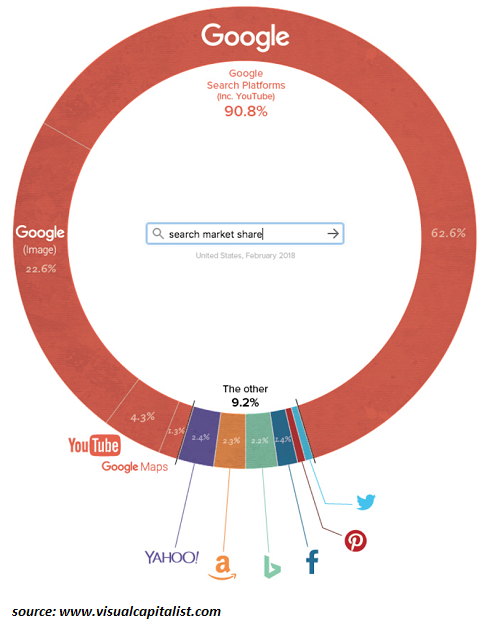
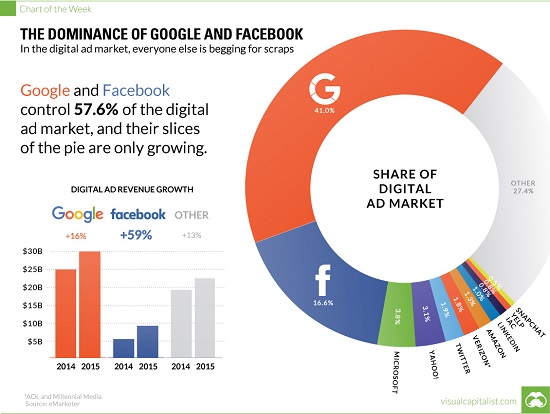
While this chart displays the dominance of Facebook and Google in digital ad revenues, it is a rough proxy for their dominance in mindshare, user data collected and control over what is displayed and not displayed in search results and social media.
We are all digital ghosts now, and how much of your digital shadow is visible to the world is secret / opaque. If you violate company policies or applicable censorship laws (as interpreted by the company attorneys), the corporation will notify you that your account has been frozen or banned.
In these instances, users and content creators are informed of their purported violation.
But this visible part of web / social media censorship is only the tip of the iceberg. Most of the censorship is invisible and undetectable. Here’s an example of how this might work.
Facebook has reportedly based one of its censorship programs on the demonstrably bogus (and anonymously produced) PropOrNot list that was hyped by the Washington Post in 2016. The list of sites accused of being Russian propaganda outlets was a grab-bag of left, right and center websites whose only “crime” was publishing some bit of skepticism about the coronation of Hillary Clinton.
So a bogus anonymous list becomes the foundation of Facebook’s censorship efforts. This is precisely how the former Soviet Union’s secret police operated: a falsely reported association became the foundation of surveillance and the setting of various traps and snares to catch anti-social elements in the act of undermining the regime.
That the association was false no longer matters. What matters is your name is on the list. It turns out oftwominds.com made it on the modern-day NKVD-Stasi list of PropOrNot, which despite being debunked has taken on a life of its own in the New Police State of Facebook, Google, et al.
You might have heard about a targeted website’s traffic suddenly plummeting 30% or 40% literally overnight. Well, it’s true. Many sites left and right report their traffic mysteriously and suddenly plummets without any explanation by the organs of censorship (Facebook, Google, et al.)
It happened to oftwominds.com this month. I have traffic data going back to 2005, and my traffic (visits and page views) has been remarkably steady for years. The number of my posts per week remains the same, my engagement on social media remains the same (as far as I can tell, heh) and my page rank remains the same (5) (again, as far as I can tell).
So when my traffic drops like a light switch was flipped, I notice.
I hope you’ll enjoy the irony that many if not most of the charts published on my site are from the Federal Reserve Economic Data site (FRED). But this is akin to the innocent citizen snagged by the NKVD or Stasi for unspecified crimes against the people protesting his innocence and good citizenship: none of that matters. What matters is your name is on the list, and our administrators are obligated to track your digital presence and digitally ghost you by adjusting search results to depreciate your presence, underweight links from other sites, jam attempts to re-post your content and so on.
None of this is visible or reported. It all happens behind the closed doors of Facebook, Google et al. Just as loyal employees of the NKVD and the Stasi were constantly told they were the bulwark of the people against enemies of the state, employees of Facebook, Google et al. are told they’re weeding out “fake news” and “propaganda” (like those charts from the Federal Reserve Economic Database) that is disruptive and divisive.
In other words, they’re good Germans doing their masters’ bidding, for very handsome salaries, bonuses and stock options.
Meanwhile, the incomes of those secretly ghosted without trial or recourse plummets along with their traffic. The net result of the perverse magic of tech cartel censorship is only the wealthy few can afford to keep posting original content after they’ve been ghosted.
Should Facebook, Google et al. reassure us we haven’t been ghosted, why should we believe them? Since the entire apparatus of censorship is operated by private, for-profit corporations in complete secrecy, on what basis would their assurances be credible or verifiable?
Just about the only bulwark against being silenced by the modern-day tech-corporate-NKVD-Stasi is Patreon–individuals who provide financial support of independent voices and analysis because they value those independent analysts and content creators.
It doesn’t matter whether you consider yourself left, right or center. If you want to resist secret censorship of both the left and the right, then please consider supporting the independent commentators and analysts who have enhanced your life with value, insight or entertainment. Thank you, patrons and financial supporters of oftwominds.com and other independent content creators. Thanks to you, the tech cartel can ghost us and our content but they can’t erase it entirely.
At least not yet.
If you’re not sure where to start, search Patreon.com for the names of those independent content creators you value.
[Aletho News notes that WordPress analytics recently zeroed out the tally of clicks to Al-Manar News from Aletho News in the middle of a reporting period, erasing prior clicks. Unless an administrator happened to be closely tracking traffic, one would presume that there was very little reader interest in certain content. Also, Gilad Atzmon’s site has had its RSS feed down for days now, a new record]
Leaked Google Secret Memo Admits Abandonment of Free Speech for ‘Safety And Civility’
Russia Insider | October 18, 2018
Despite leaked video footage showing top executives declaring their intention to ensure that the rise of Trump and the populist movement is just a “blip” in history, Google has repeatedly denied that the political bias of its employees filter into its products.
But the 85-page briefing, titled “The Good Censor,” admits that Google and other tech platforms now “control the majority of online conversations” and have undertaken a “shift towards censorship” in response to unwelcome political events around the world.

Talk about Russian, er, Jewish, meddling in our ‘democracy’ … Sergey Brin, Billionaire founder of Google
Examples cited in the document include the 2016 election and the rise of Alternative for Deutschland (AfD) in Germany.
Responding to the leak, an official Google source said the document should be considered internal research, and not an official company position.
The briefing labels the ideal of unfettered free speech on the internet a “utopian narrative” that has been “undermined” by recent global events as well as “bad behavior” on the part of users. It can be read in full below.
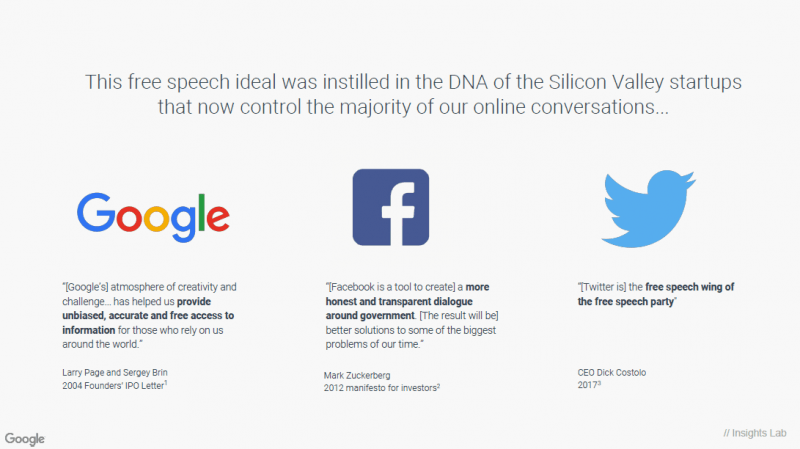
It acknowledges that major tech platforms, including Google, Facebook and Twitter initially promised free speech to consumers. “This free speech ideal was instilled in the DNA of the Silicon Valley startups that now control the majority of our online conversations,” says the document.
The briefing argues that Google, Facebook, YouTube and Twitter are caught between two incompatible positions, the “unmediated marketplace of ideas” vs. “well-ordered spaces for safety and civility.”
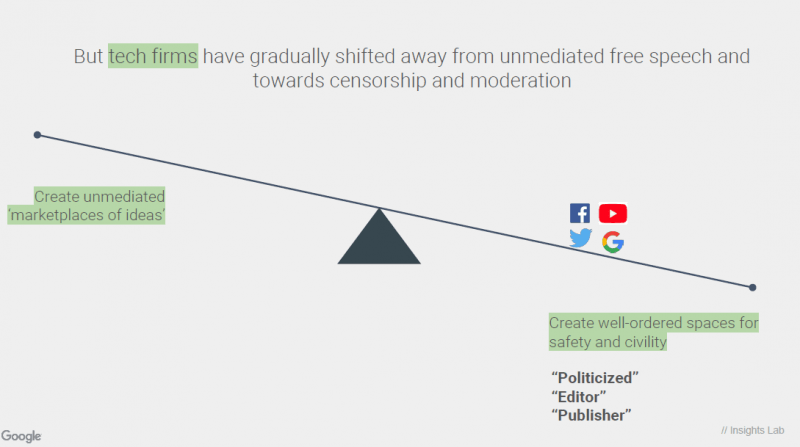
The first approach is described as a product of the “American tradition” which “prioritizes free speech for democracy, not civility.” The second is described as a product of the “European tradition,” which “favors dignity over liberty and civility over freedom.” The briefing claims that all tech platforms are now moving toward the European tradition.
The briefing associates Google’s new role as the guarantor of “civility” with the categories of “editor” and “publisher.” This is significant, given that Google, YouTube, and other tech giants publicly claim they are not publishers but rather neutral platforms — a categorization that grants them special legal immunities under Section 230 of the Communications Decency Act. Elsewhere in the document, Google admits that Section 230 was designed to ensure they can remain neutral platforms for free expression.
Trump, Conspiracy Theorist
One of the reasons Google identifies for allegedly widespread public disillusionment with internet free speech is that it “breeds conspiracy theories.” The example Google uses? A 2016 tweet from then-candidate Donald Trump, alleging that Google search suppressed negative results about Hillary Clinton.
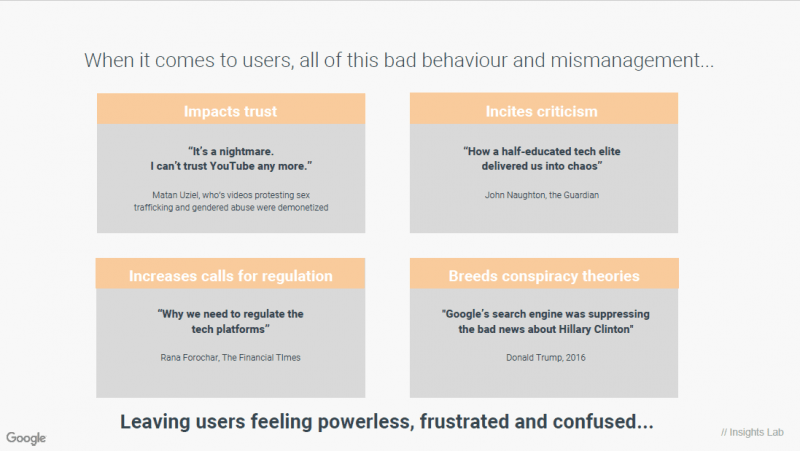
At the time, Google said that it suppressed negative autocomplete suggestions about everybody, not just Clinton. But it was comparatively easy to find such autocomplete results when searching for Bernie Sanders or Donald Trump. Independent research from psychologist Dr. Robert Epstein also shows that Google search results (if not autocomplete results) did indeed favor Clinton in 2016.
Twice in the document, Google juxtaposes a factoid about “Russian interference” in American elections with pictures of Donald Trump. At one point, the document admits that tech platforms are changing their policies to pre-empt congressional action on foreign interference.
The document did not address the fact that, according to leading psychologists, the impact of foreign “bots” and propaganda on social media has a negligible impact on voters.
From Suggestions to Company Policy
It is unclear for whom the “Good Censor” was intended. What is clear, however, is that Google spent (or paid someone to spend) significant time and effort to produce it.
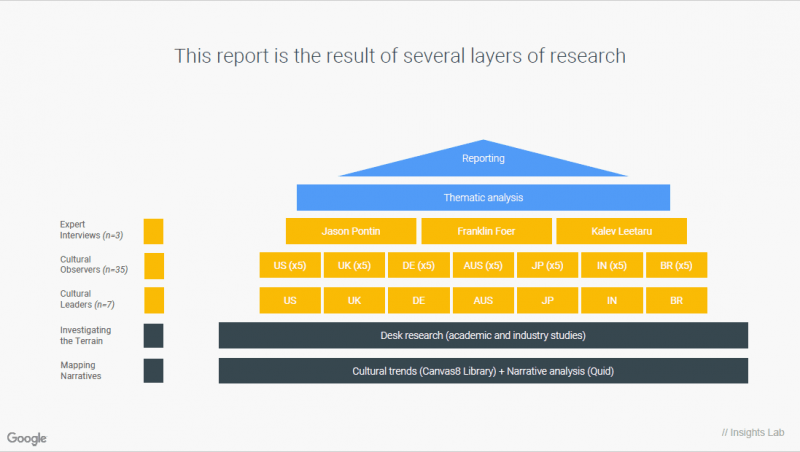
According to the briefing itself, it was the product of an extensive process involving “several layers of research,” including expert interviews with MIT Tech Review editor-in-chief Jason Pontin, Atlantic staff writer Franklin Foer, and academic Kalev Leetaru. 35 cultural observers and 7 cultural leaders from seven countries on five continents were also consulted to produce it.
What is also clear is that many of the briefing’s recommendations are now reflected in the policy of Google and its sibling companies.
For example, the briefing argues that tech companies will have to censor their platforms if they want to “expand globally.” Google is now constructing a censored search engine to gain access to the Chinese market.
The document also bemoans that the internet allows “have a go commenters” (in other words, ordinary people) to compete on a level playing field with “authoritative sources” like the New York Times. Google-owned YouTube now promotes so-called “authoritative sources” in its algorithm. The company did not specifically name which sources it would promote.
Key points in the briefing can be found at the following page numbers:
- P2 – The briefing states that “users are asking if the openness of the internet should be celebrated after all” and that “free speech has become a social, economic, and political weapon.”
- P11 – The briefing identifies Breitbart News as the media publication most interested in the topic of free speech.
- P12 – The briefing says the early free-speech ideals of the internet were “utopian.”
- P14 – The briefing admits that Google, along with Twitter and Facebook, now “control the majority of online conversations.”
- P15 – Section 230 of the Communications Decency Act is linked to Google’s position as a platform for free expression. Elsewhere in the document (p68), Google and other platforms’ move towards moderation and censorship is associated with the role of “publisher” – which would not be subject to Section 230’s legal protections.
- PP19-21 – The briefing identifies several factors that allegedly eroded faith in free speech. The election of Donald Trump and alleged Russian involvement is identified as one such factor. The rise of the populist Alternative fur Deutschland (Alternative for Germany) party in Germany – which the briefing falsely smears as “alt-right” – is another.
- PP26-34 – The briefing explains how “users behaving badly” undermines free speech on the internet and allows “crummy politicians to expand their influence.” The briefing bemoans that “racists, misogynists, and oppressors” are allowed a voice alongside “revolutionaries, whistleblowers, and campaigners.” It warns that users are “keener to transgress moral norms” behind the protection of anonymity.
- P37 – The briefing acknowledges that China – for which Google has developed a censored search engine – has the worst track record on internet freedom.
- P45 – After warning about the rise of online hate speech, the briefing approvingly cites Sarah Jeong, infamous for her hate speech against white males (Google is currently facing a lawsuit alleging it discriminates against white males, among other categories).
- P45 – The briefing bemoans the fact that the internet has until recently been a level playing field, warning that “rational debate is damaged when authoritative voices and ‘have a go’ commentators receive equal weighting.”
- P49 – The document accuses President Trump of spreading the “conspiracy theory” that Google autocomplete suggestions unfairly favored Hillary Clinton in 2016. (Trump’s suspicions were actually correct – independent research has shown that Google did favor Clinton in 2016).
- P53 – Free speech platform Gab is identified as a major destination for users who are dissatisfied with censorship on other platforms.
- P54 – After warning about “harassment” earlier in the document, the briefing approvingly describes a 27,000-strong left-wing social media campaign as a “digital flash mob” engaged in “friendly counter-commenting.”
- P57 – The document juxtaposes a factoid about Russian election interference with a picture of Donald Trump.
- P63 – The briefing admits that when Google, GoDaddy and CloudFlare simultaneously withdrew service from website The Daily Stormer, they were “effectively booting it off the internet,” a point also made by the Electronic Frontier Foundation and the FCC in their subsequent warnings about online censorship.
- P66-68 – The briefing argues that Google, Facebook, YouTube and Twitter are caught between two incompatible positions, the “unmediated marketplace of ideas” vs. “well-ordered spaces for safety and civility.” The first is described as a product of the “American tradition” which “prioritizes free speech for democracy, not civility.” The second is described as a product of the “European tradition,” which “favors dignity over liberty and civility over freedom.” The briefing claims that all tech platforms are now moving toward the European tradition.
- P70 – The briefing sums up the reasons for big tech’s “shift towards censorship,” including the need to respond to regulatory demands and “expand globally,” to “monetize content through its organization,” and to “protect advertisers from controversial content, [and] increase revenues.”
- P74-76 – The briefing warns that concerns about censorship from major tech platforms have spread beyond the right-wing media into the mainstream.
Read The Good Censor in full below. Alternative download option available here.
The Good Censor – GOOGLE LEAK by on Scribd.
Journalist explains why US doesn’t need hackers to control the world, and it’s hard to disagree
RT | October 5, 2018
‘Russian hackers’ have become the go-to bogeymen for Washington. There’s little mention of American hackers though – probably because they aren’t needed, since most of the internet is a branch of US intelligence.
The US, which is now raising massive alarm over Russia’s supposed efforts to hack everything Americans hold dear, has been refusing to sign a treaty on cyberspace behavior with Russia for almost a decade now. The reason is simple, one Russian-American author explains: Washington doesn’t need a treaty, because it dominates the digital space completely as it is.
Washington’s panic over ‘Russian hackers’ is just a reflection of what it’s been doing to the world for years, says Yasha Levine, the author of ‘Surveillance Valley: The Secret Military History of the Internet.’
And thanks to surveillance programs like PRISM, outed by Edward Snowden 2013, the US doesn’t even need hackers: just by being on social media or using Google, you’re voluntarily surrendering your data to the NSA.
Far from scaling back its snooping after Snowden pulled the curtain on PRISM, the US has multiplied its efforts. Citing ‘national security’, lawmakers renewed the NSA’s sweeping spying powers this year. Domestic phone surveillance tripled last year, user data requests to Apple doubled, and user data requests to Google were at an all-time high.
And just recently, the ‘Five eyes’ powers – the US, the UK, Canada, New Zealand and Australia – issued a memo demanding that tech giants implement ‘backdoors’ to allow governments direct access to users’ encrypted data.
The entire narrative of cyber threats to the “good guys” US is a smokescreen to hide the unenviable fact: it’s the US that’s the apex predator of the digital ocean.
Shutting Down Free Speech in America: Government and Lobbyists Work Together to Destroy the First Amendment
By Philip Giraldi | American Herald Tribune | September 24, 2018
During the past several years, there has been increased pressure coming from some in the federal government aided and abetted by powerful advocacy groups in the private sector to police social and alternative media. It is a multi-pronged attack on the First Amendment which has already limited the types of information that Americans have access to, thereby narrowing policy options to suit those in power
The process has been ostensibly driven by concerns over alleged Russian interference in the 2016 election, but it is really about who controls and limits the public’s right to know what is going on out of sight in Washington and New York City, where politics and money come together. If one is interested in the free flow of information and viewpoints that comes with the alternative media, it certainly does not look that way. Robert Parry described it as a deliberate process of “demonizing and silencing dissent that questions mainstream narratives.”
Last October top executives from Facebook, Google and Twitter were summoned to Capitol Hill for a discussion of their role in what is alleged to be Russia’s influence on the presidential campaign and went back home contrite and promising to improve. They have indeed improved by punishing members whose views have been found to be unacceptable, blocking them and suspending their access to the sites. Meanwhile, the federal government for its part has attempted to silence independent non-U.S. based voices by declaring Russian media outlets RT America and Sputnik to be “foreign agents,” requiring them to register under the Foreign Agents Registration Act of 1938 (FARA). It is an unprecedented action against a news agency and invites quid-pro-quo for U.S. media operating overseas, leaving the American public more ignorant of world affairs than it already is.
Qatar based Al-Jazeera, which has been particularly targeted by Jonathan Greenblatt of the Anti-Defamation League (ADL) as “a major exporter of hate against the Jewish people,” will also be required to register with FARA to comply with the new National Defense Authorization Act. Al-Jazeera, it should be noted, has employed undercover investigative journalism to expose the corruption of Britain’s government by Israeli supported Jewish groups. It’s similar series on the activity of Zionist lobbyists in America is on hold due to threats from Jewish organizations to severely punish the network if the documentary should ever be aired.
More recently Facebook has been active in removing accounts and advertising, much of it pro-Palestinian or otherwise critical of Israel, but also to include highly respectable Telesur’s “The Empire Files,” which looked at the consequences of U.S. sanctions on Venezuela. Anything that criticizes the corporate worldview is fair game for censorship. American Herald Tribune, which is critical of U.S. foreign policy in many areas, has recently had its Gmail shut down while Google also stopped servicing ads on its website. Its Facebook page was also closed, all done without any warning or explanation.
One of the organizations most interested in limiting conversations about what is going on in the world is the ADL which claims that it is “the world’s leading organization combating anti-Semitism and hate of all kinds,” though it clearly excludes incitement or even physical harm directed against Palestinian Arabs resentful of the Israeli occupation of their country. Its definition of “hatred” is really quite selective and is focused on anyone criticizing Israel or Jewish related issues. Its goal is to have any such speech or writing categorized as anti-Semitism and, eventually, to have “hate crime” legislation that criminalizes such expressions.
It is particularly ironic that Israel, which has now declared that it is in no way subject to international law, has itself proposed across the board censorship of the most prominent social media platforms on a global scale by creating an “international coalition that would make limiting criticism of Israel its primary objective.” It would operate through a “loose coalition… [that] would keep an eye on content and where it is being posted, and members of the coalition would work to demand that the platforms remove the content… in any of their countries at the request of members.”
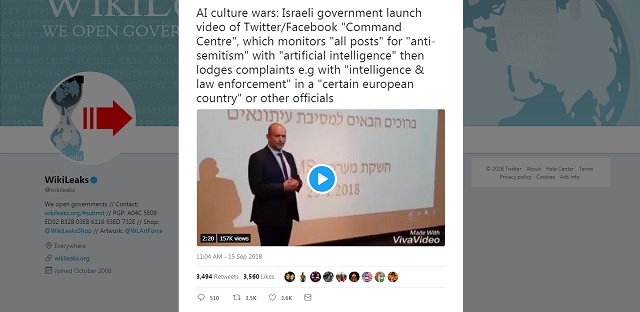
More recently, Israel has been exposed by Wikileaks as hosting a conference describing how it now has a Command Center that uses Artificial Intelligence (AI) to scan the internet worldwide looking for “anti-Semitic” content. For Israel, anti-Semitic content means any criticism of its government or its behavior towards the Arabs. It reportedly pulls 200,000 posts a day and then reviews them using AI for content considered to be unacceptable. The roughly 10,000 posts determined to be anti-Semitic are then passed on to “intelligence and law enforcement agencies” in countries that have hate speech legislation for further action. The Israeli government also complains directly to the social media source to have the material taken down and works through Jewish organizations in cities and countries where there is considerable “anti-Semitic” activity to pressure governments to act even if there is no legal basis.
As most genuine independent journalism is currently limited to the alternative media, and that media lives on the internet, the ADL and those who are acting in collusion with the Israeli government are focusing on “cyberhate” as the problem and are working with major internet providers to voluntarily censor their product. On October 10th, 2017 the ADL issued a press release out of its New York City offices to explain just how far the censorship process has gone. The organization boasted of the fact that it was working with Facebook, Google, Microsoft and Twitter “to engineer new solutions to stop cyberhate.” Apple is not identified by name in the press release but one should presume that it is also involved, as well as YouTube, which is owned by Google. When you consider that the associates in this venture with ADL are vast corporations that control huge slices of the communications industry, the consequences of some kind of corporate decision on what constitutes “hate” become clear. Combatting “cyberhate” will inevitably become across-the-board censorship for viewpoints that are considered to be unacceptable, including any criticism of Israel.
ADL will be the “convener” for the group, providing “insight on how hate and extremist content manifests – and constantly evolves-online.” Which means it will define the problem, which it calls the “spew[ing] of hateful ideologies” so the corporate world can take steps to block such material. And “the initiative will be managed by ADL’s Center for Technology and Society in Silicon Valley.”
Facebook already employs thousands of censors and there is literally no limit to how far those who want to restrict material that they consider offensive will go. To be sure, most groups who want to limit the flow of information do not have the clout or resources of ADL with its $64 million annual operating budget so its “cyberhate” campaign will no doubt serve as a model that others will then follow. For ADL, reducing criticism of Israel is a much-sought-after goal. For the rest of us, it is a trip into darkness.
Researcher Takes on Google’s Subversive Electioneering

Sputnik – September 21, 2018
Big tech companies like Google have the power to “shift upwards of 12 million votes with no one knowing they’re doing so,” a research psychologist told Radio Sputnik Thursday, underscoring the influence profit-making firms can have on public elections.
That, he said, is too much power for “just a couple of executives” and is why tech giant monopolies need to be thought of as public utilities and not private entities.
“Research I have been directing in recent years suggests that Google, Inc., has amassed far more power to control elections — indeed, to control a wide variety of opinions and beliefs — than any company in history has ever had,” research psychologist Robert Epstein says.
In 2015, Dr. Robert Epstein, senior research psychologist at the American Institute for Behavioral Research and Technology, wrote a groundbreaking paper about the Search Engine Manipulation Effect (SEME), published in the Proceedings of the National Academy of Sciences of the United States of America.
“Google’s search algorithm can easily shift the voting preferences of undecided voters by 20 percent or more — up to 80 percent in some demographic groups — with virtually no one knowing they are being manipulated,” Epstein wrote in Politico at the time.
That kind of a margin could tilt an election, he noted. Indeed, Epstein’s research shows that Google manipulated search results to display pro-Hillary Clinton results higher on the page than others.
With Google reaching a billion users last year, according to The Verge, and the company collecting over $100 billion a year in revenue, the tech giant has acquired an unheard-of power over how we think and how we access information.
Epstein spoke with Radio Sputnik’s Loud & Clear Thursday about the next phase of his studies: an “electronic cat and mouse game,” a system for collecting, monitoring and analyzing data that can identify and quantify “every single manipulation, every single kind of bias there is,” to hold tech giants accountable.
”I’ve calculated that the big tech companies can shift upwards of 12 million votes with no one knowing they’re doing so without and leaving a paper trail for the authorities to track,” Epstein told Sputnik.
Google claims user activity causes the manipulation, but Epstein said his research found that it affected both red and blue states and that the first 10 results in searches were consistently biased towards Hillary Clinton.
“All reasonable people… will agree that no private company should have the power to decide what content billions of people around the world will see or will not see. Just think about that issue. Whoever that power should be given to, it’s certainly not to a private company in Mountain View, California; it’s just not. We might need entities that are spin offs from the United Nations, we might need nonprofits, nonpartisan groups… we can all agree it can’t be in the hands of a private company. That’s absurd.”
“The search engine itself is an index to what’s on the internet; it’s an index, basically, to all knowledge. Well, the internet doesn’t belong to Google. The internet belongs to the world, and the index to the internet must be public. And by public I don’t just mean public like, USA; it has to be controlled internationally. There has to be transparency; a lot of cooperation is going to be necessary. And I’m not saying it’s going to be easy, but the fact is, that index has to be public — period.”
“In terms of laws or regulations or antitrust actions, there’s some things in motion. There’s lots going on in the EU in that regard; people are gearing up in Washington, DC. Right now there are hearings, there’s talk about antitrust actions — I think some things will happen. I don’t think law or regulation is going to help us very much, because law and regulation moves very slowly. Painfully slowly — sometimes, in fact, it gets stalled, completely stalled. Whereas tech, though, tech moves lightning fast,” Epstein said.
“There is a solution here — in some ways it’s a lighter touch because it doesn’t involve changes in laws and regulations — and that is monitoring. I successfully developed and implemented, deployed a monitoring system in 2016 that was written up in the Washington Post… I’m working now with business partners and with academics on three continents to scale up and broaden what we did in 2016. You have to envision here, probably within the next year, the beginnings of what I call a ‘worldwide ecology of passive monitoring systems.’ That is: systems that can’t be detected, that will show us 24/7 what these big tech companies are showing people or what they’re telling people through these new audio devices.”
“By collecting that data, by monitoring it, by analyzing it rapidly, we will be able to detect, very precisely, when Mark Zuckerberg sends out a targeted ‘go out and vote’ message, for example, that could easily flip an election. We’ll see whether there is bias in search results or search suggestions. We will actually be able to quantify shadowbanning, very precisely, on Twitter and elsewhere. So every single manipulation, every single kind of bias there is, we’ll be able to capture it at the moment. You see, it’s all ephemeral content; it’s transitory. It comes, it goes, it’s gone, it’s not stored anywhere, and then we speculate about what’s going on,” he said.
“Well, with monitoring systems in place, we won’t have to speculate. I believe that these systems will make the big tech companies accountable to the public for the first time. And there’s another advantage here: whereas law and regulation is always behind whatever’s going on, monitoring systems basically are their new technologies. We’re fighting tech with tech, and monitoring systems can keep up with whatever is happening in technology. As technology changes, matures, whatever, the monitoring systems change and mature; they adapt. A cat and mouse game, an electronic cat and mouse game that never stops, maybe goes on for decades.”
Noting how the first companies that provided services such as electrical power, fire departments and roads were initially private but are today thought of as ubiquitous public utilities, Epstein told hosts Walter Smolarek and John Kiriakou that “that’s what happening now with these big tech companies, particularly the search engines, but I would argue we could even put Facebook into that category as well. Once a market is dominated by a monopoly, once the barriers to entry are so large that really no one can get in, and that’s where we are now, and once we become dependent on these services, once they become essential services, which certainly Google’s search engine is, once that happens we have to look at it through a different lens. And that’s happened over and over again in recent history, and I think that’s where we are right now.”
“There is a big difference though,” between older monopolies like Standard Oil and AT&T and internet companies like Google and Facebook, he said. “Those companies were doing things that, for the most part, we could see and we could understand. Whereas what Google and Facebook and Twitter are doing — a lot of what they’re doing we can’t see, we can’t understand. That’s what my discoveries have been about for more than five years. We’re talking about extremely powerful tools for altering people’s thinking.”
“Let’s think about Google for what it really is: a surveillance machine,” he said.
“Let’s think about its real effect, which is the control of thinking and behavior and opinion. Basically it’s the most powerful mind control machine that has ever — ever — been invented in human history.”
“That brings me to the key question: what if the mind control machine doesn’t want you thinking bad things about the mind control machine?”
“This is not AT&T,” he said. “It’s a different beast entirely — and it’s a scary beast.”
Epstein said there wasn’t much recourse in the field of the law. He noted that Google gets sued — a lot — and you can view the catalog of cases brought against the tech giant at Google Crimes, but “when these cases go to court, 99 times out of 100 Google wins, hands down. Because we don’t have laws and regulations that protect us from these companies, and over and over again, the courts rule that these companies are protected, either by [Section 230 of the Communications Decency Act of 1996] or by the First Amendment right to free speech.”
Epstein noted that court rulings repeatedly recognized Google’s right to free speech as a private company. He further pointed out that Google, with “one of the highest profit margins of any country in history,” can simply shrug off any fines leveled against it for its conduct — such as the European Union did earlier this year, when it fined Google $5.1 billion, or last year when it leveled a $2.7 billion fine against it for having biased search results.
Epstein told Radio Sputnik about what he called “a landmark article” by him that will be published in the periodical Fast Company in the next few days, which is presently titled, “How Big Tech Could Quietly Hijack Democracy: A Researcher Describes 10 Ways that the Big Tech Companies Can Shift Millions of Votes in the Midterm Elections Without Anyone Knowing.”
“These are not old-fashioned techniques,” he said, like mudslinging ads or untrue billboards and TV ads. “This is all clandestine, this is all invisible to users and all involves ephemeral content, which means it doesn’t leave a paper trail. And it’s all in the hands of just a couple of executives in the northwest corner of the United States. And it’s affecting not just people here, it’s affecting billions of people around the world… Something is wrong with this system.”
See also:
Google Seeks to Dictate Truth Using Dubious New Technology
Google’s Pro-Clinton Search Bias Reflects US Tech Firms’ Ties to ‘Deep State’
Twitter blocks real Iranians’ accounts, overlooks US ‘regime change’ propaganda: Zarif
Press TV – September 16, 2018
Iranian Foreign Minister Mohammad Javad Zarif says Twitter has blocked the accounts of “real Iranians” but overlooks the “regime change” propaganda spewing out of Washington.
Zarif made the remarks in a post on his official Twitter page on Sunday addressing Jack Patrick Dorsey, the co-founder and CEO of Twitter.
He said the accounts of real Iranians, including TV presenters and students, have been shuttered for allegedly being part of an “influence operation.”
“How about looking at actual bots in Tirana used to prop up ‘regime change’ propaganda spewed out of DC?” the top Iranian diplomat asked, alluding to the anti-Iran terrorist Mujahedin-e Khalq Organization (MKO), whose members are currently based in Albanian capital city.
Back in August, Google removed 39 YouTube channels linked to the Iranian state broadcaster. Google terminated those accounts, along with six blogs on its Blogger service and 13 Google+ accounts linked with Iran. The move came after Twitter and Facebook also blocked hundreds of accounts on suspicion of possible ties with Iran.
The MKO has a dark history of assassinations and bombings against the Iranian government and nation. It notoriously sided with former Iraqi dictator, Saddam Hussein, in his eight-year war against Iran in the 1980s.
The group has been behind most of the terrorist attacks, which have claimed the lives of nearly 17,000 Iranians since the victory of the Islamic Revolution in Iran in 1979.
Initially designated as a terrorist organization by Europe and the US, the group has established close links with Western political parties.
In recent years, several media reports have emerged about top political figures in the US and Europe receiving money from the MKO to speak favorably of the terrorist group.
In September 2016, the last remaining members of the terrorist group were relocated from Camp Liberty (Hurriya), a former US military base near the Iraqi capital Baghdad, to Albania.
Iraq had long urged MKO remnants to leave the country, but a complete eviction of the terrorists had been hampered as a result of the US and European countries’ support for the group.
Featured Video

Trita Parsi: Israel Set a Trap for Total War in the Region
or go to
Aletho News Archives – Video-Images
From the Archive
Zionism’s Violent Legacy
By Donald Neff | Washington Report On Middle East Affairs | January 1996
On January 4, 1948, Jewish terrorists drove a truck loaded with explosives into the center of the all Arab city of Jaffa and detonated it, killing 26 and wounding around 100 Palestinian men, women and children.[1] The attack was the work of the Irgun Zvai Leumi – the “National Military Organization,” also known by the Hebrew letters Etzel – the largest Jewish terrorist group in Palestine. The Irgun was headed by Revisionist Zionist Menachem Begin and had been killing and maiming Arabs, Britons and even Jews for the previous ten years in its efforts to establish a Jewish state.
This terror campaign meant that at the core of Revisionist Zionism there existed a philosophical embrace of violence. … continue
Blog Roll
 Aletho News
- Trita Parsi: Israel Set a Trap for Total War in the Region
- Trump’s Iran war is on an Israeli leash
- Saudi oil boss issues global supply warning
- Riyadh Says Its Oil System Is Intact. The Numbers Say Otherwise.
- Trump and Netanyahu Want to “Finish the Job” on Iran
- US ‘one-sided dictation’ not Iran’s beliefs makes rational talks impossible: Baghaei
- Iran’s Next Strike May Not Explode. It Could Shut You Down /Col Doug Macgregor
- Iran: US political targets legitimate if assassinations return
- Iraq shuts key border crossing with Iran under US pressure: Report
- Undersea Internet cables could be targeted in retaliation for attacks on Iran: IRGC deputy chief
- If Americans Knew
- The Israel Lobby’s Changing Fortunes
- AIPAC has become such a political liability that it’s shifting to a more “nimble” approach to buying politicians
- At least 160 Israeli settler attacks in 2 weeks
- Will Gaza’s Ancient Christian Community Disappear Forever?
- Israel’s vision of regional security rests on keeping Arab states weak
- Heidi Levine recounts how Palestinian youths helped save her in settler attack
- DAILY UPDATE: Latest essential news on Palestine, Israel, & region
- Trump’s Intensifying Sabotage of the ICC, for Israel’s Sake
- Israeli military detain US and UK volunteers in West Bank including Democratic NY politician Brad Lander
- Americans at National Conservatism Conference held in Israel this year criticize Israel
- No Tricks Zone
- E-Cars Reduce CO2 Emissions By Only 41% Compared To Internal Combustion Engine Vehicles
- Predictions Made By Renowned Climate Professor Over Past Decades Have Been Proven To Be Poor
- New Study Suggests Large Regions Of The Pacific Ocean Have Been Cooling For The Last 80 Years
- Germany’s Green Energy Debacle: High Energy Costs Force Kahla Porzellan to Close After 182 Years!
- New Study: 50 Years Of The Most Aggressive ‘Net Zero’ Policies Can Only Affect The Global Climate By 0.03°C
- US September “Heat” Was No Record…Many Records Set Decades Ago
- Latest European Green Energy Debacle; Portugal’s Largest Flagship Solar Park Insolvent!
- Green Energy Debacle: German Expert Professor Fritz Vahrenholt Warns Of Severe Economic And Social Consequences
- Two More Paleo Reconstructions Affirm Meters-Higher Sea Levels Across Ireland, Brazil 7000-6000 Years Ago
- New Study: Earth And Venus Surface Warmth Largely Explained By Convection And Lapse Rate, Not CO2 Or Radiation

