US curbs bid to take Iran off FATF financial blacklist
Press TV – February 24, 2018
The world’s financial watchdog has extended a waiver for punitive measures against Iran for another six months but refused to remove the country from its blacklist.
The Paris-based the Financial Action Task Force (FATF) had been weighing Tehran’s request for the lifting of so-called countermeasures for some time but a flurry of recent visits by a top US official to France and other European countries thwarted the bid.
Change of heart
Iran’s removal from the blacklist had gained support in European capitals in recognition of the steps Tehran has taken in recent years to enact legislation barring terrorist financing and money laundering.
However, the US sent the official to France, Germany, the Netherlands and Belgium ahead of a plenary meeting of the task force Friday to warn that keeping Iran on the FATF blacklist was a top priority, and that Washington would aggressively pursue that policy.
As a result, the FATF decided to continue the suspension of countermeasures, taking into account the fact that Iran has draft legislation currently before Parliament, but did not remove the country from the list in a decision which many believe is political.
The FATF suspended its punitive measures for a year in 2016 when Iran reached a landmark nuclear deal and promised to step up its fight on money-laundering. The task force extended the waiver last July and again on Friday.
The Iranian government hopes that the exit from the FATF blacklist would remove one hurdle to foreign investment. Critics of the government, however, say membership in the Financial Action Task Force has not only failed to attract investment, but it has also exposed various institutions to extraterritorial regulations and penalties.
Iranian institutions targeted
In its Friday decision, the FATF threatened Iran with new penalties in June if it doesn’t bolster oversight of alleged terrorism financing and money laundering within its borders.
Some in Iran believe the US is using the FATF to target key organizations such as the Islamic Revolution Guards Corps (IRGC) which has both a role in the Iranian economy and supports groups such as Lebanon’s Hezbollah regarded as legitimate “resistance” entities by the Islamic Republic.
The FATF cited nine “action items” which Iran had to fully address before the body considers its bid for removal from the blacklist.
“Until Iran implements the measures required to address the deficiencies identified in the Action Plan, the FATF will remain concerned with the terrorist financing risk emanating from Iran and the threat this poses to the international financial system,” it said.
“The FATF, therefore, calls on its members and urges all jurisdictions to continue to advise their financial institutions to apply enhanced due diligence to business relationships and transactions with natural and legal persons from Iran, consistent with FATF Recommendation 19,” it added.
Countries that do not follow FATF are often labeled as high-risk or uncooperative jurisdictions by the West, making international trade costly and difficult.
US threats
Iran agreed to scale back its nuclear energy program in return for the lifting of sanctions which would facilitate business with the world and pave the way for foreign investment. However, US pressures on bodies such as FATF and its threats have driven away banks, investors and companies.
Earlier this week, Iran’s Deputy Foreign Minister Abbas Araqchi said Tehran will withdraw from the nuclear deal if there is no economic benefit and major banks continue to shun the Islamic Republic.
Big banks are afraid of falling foul of remaining US sanctions.
Araqchi said even if US President Donald Trump relents and issues fresh “waivers” to continue suspending sanctions on Tehran, the existing situation is unacceptable for Iran.
“The deal would not survive this way even if the ultimatum is passed and waivers are extended,” Araqchi, Iran’s lead nuclear negotiator, said in a speech at the Chatham House think tank in London.
“If the same policy of confusion and uncertainties about the JCPOA (Joint Comprehensive Plan of Action) continues, if companies and banks are not working with Iran, we cannot remain in a deal that has no benefit for us,” he said. “That’s a fact.”
US carrot-and-stick policy to Lebanon could push it into abyss
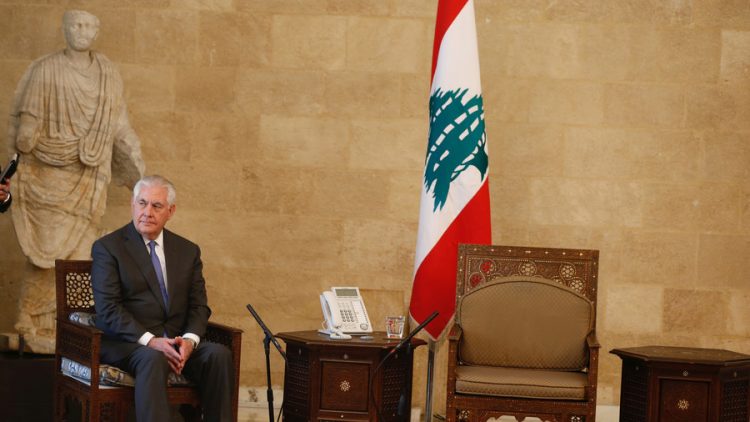
U.S. Secretary of State Rex Tillerson waits at the presidential palace in Baabda, Lebanon February 15, 2018. © Mohamed Azakir / Reuters
By Martin Jay | RT | February 19, 2018
Rex Tillerson’s visit to Beirut didn’t resolve Lebanon’s persistent war threat from Israel, or Hezbollah’s perceived threat to Washington. The US has its own agenda for this country, which is spooking Lebanon’s president.
It might have been just a miscalculation, rather than a diplomatic faux pas, as Rex Tillerson did in fact arrive early for his meeting with Lebanese dignitaries, but he had to wait a few minutes before a door at Baabda Palace was opened and he was greeted by President Michel Aoun. It couldn’t have been an easy moment, shaking hands with Lebanon’s Hezbollah-supporting President, but Aoun and Foreign Minister Gebran Bassil both viewed the visit by Trump’s own envoy with some suspicion. And they were right to.
The day before, in Jordan, Tillerson appeared to have gone off message while recognizing Hezbollah’s political role both in Lebanon and the region, but few in Lebanon held out any real hope that the 65-year-old Texan was going to either resolve Lebanon’s gas and oil dispute with Israel, or for that matter its border spat, following Israel’s land grabbing as it carries out construction of a wall. Tillerson said that Lebanon’s own security was compromised by Hezbollah, which he referred to more than once as a “terrorist” organization when he met Lebanese Prime Minister Saad Hariri. The latter pointed out that Israel’s constant threats of attack and encroaching on Lebanon’s sovereignty were making a permanent ceasefire hard; earlier, Aoun had asked the US to “play an effective role” in resolving the tension.
But both Aoun and Hariri know that the US has plans for Hezbollah of its own, which will make a mockery of Tillerson’s endearing comments about wanting to help Lebanon “prosper.” There are two critical plans by Washington that are likely to cause chaos in Lebanon if enacted upon that may come into play at the backdrop of the US pouring money into supporting Lebanon’s army, which it believes is the key to redressing the power balance in Lebanon between the state and Hezbollah.
Lebanese banks cleaned up their act for Congress
One, is how far the US goes in targeting Hezbollah’s finances. In January, it ratcheted up its sanctions on the Shiite group’s key money people. This recent move follows Obama’s ‘Hezbollah International Financing Prevention Act,’ which was expected to both destabilize the Lebanese banking sector and impact Hezbollah, which the US accuses of using Lebanese banks to launder money.
In fact, it did neither – and now the US is eager to find new ways of blocking the flow of Hezbollah’s money both inside and outside of Lebanon, as it has yet to find a way of preventing Iran’s $800 million dollars from circulating in the banking system. The US money laundering crackdown, aimed at Hezbollah and Shias in general, has actually resulted in Lebanese banks cleaning up their act, with some analysts even going as far to say that Hezbollah knows it can no longer even use the banks. And, given that the US has provided $1.5 billion USD to Lebanon since the beginning of the Syrian conflict (through the banking system), and Lebanese expatriates are sending less money back to make up the $8 billion USD annually that the central bank receives, Lebanon is more committed than ever to working with the US.
But now, with reports in January that Iran’s military budget is about to rise, Washington may be planning another ruse which could destabilize Lebanon and direct anger towards Hezbollah. While Aoun asked Tillerson to assist in the return of almost a million Syrian refugees, he also hinted that he knows Washington is always the ultimate threat to Hezbollah’s led government, which is to cut aid to both Syrian refugees and the Palestinians. Such a move could have seismic implications in Lebanon, as an ‘intifada’ against Israel and the West could easily be carried out in Lebanon itself with 175,000 Palestinians who live in camps that Lebanese security forces fear to enter.
The carrot and stick of Washington – increase military spending to Lebanon’s army, while at the same time causing widespread insecurity – seems like a nefarious tactic. But Washington is facing tough challenges when it comes to reigning in Hezbollah. Aoun wants help with repatriating Syrians and the US wants Hezbollah to reduce its regional intervention. Is there a deal there to be made?
Aoun knows that if the US cuts aid to Lebanon, it would be a catastrophe in terms of (local) crime rates, not to mention many turning to terrorism. The situation in the Palestinian camps is at breaking point and there have been a number of ugly incidents in recent months. Lebanon has a lot to lose as the terrorism in Tripoli, which was dealt with in 2014 with the number of key arrests, might return, as hardcore extremist groups already exist in the Palestinian camps. Or, if Palestinians want to fight Israel, they have Fatah and Hamas inside Lebanon who can organize and train them. This is Aoun’s worry about the US cutting aid to UNRWA, which he says so far only affects Palestinians in Gaza.
It’s a similar situation in the Syrian refugee camps, where this year has been dire, as a funding shortfall was the biggest yet. Most years, the UN falls short of its requests from member states, but this year it was at an unprecedented low, so refugees, in general, are suffering like never before. If a Palestinian-led insurgency got off the ground in Lebanon, many from Syrian camps might join it, as there was evidence in recent years that some from the camps have joined ISIS.
But Tillerson is not the deal maker for this. He is not respected by all the main players, so the Lebanese leaders know he is not the one to cut a deal. But, they also know that, even within Lebanon, Washington’s carrot-and-stick game is idiotic at best and dangerously ill-conceived at worst. The more the Americans interfere, the stronger Iran and Hezbollah get. Washington’s meddling in the Syria war has allowed the fatuous Tillerson and others to whine about Iran’s presence in Syria, rather like an old man complaining about how ungrateful the younger generation is these days. And Aoun and the political elite in Lebanon know only too well that, just as it was in Iran and Hezbollah, in Syria, which wiped out most of the Sunni extremist groups there, the same is the case along Lebanon’s border with Syria. Tillerson mentioning Hezbollah as a stoic political entity is what is important about this trip, as it is a coded message that the Americans are ready to talk, which is a milestone in itself. The US program to destabilize Hezbollah and the Lebanese banking system has simply backfired, as Congress under-estimated the resilience of the Lebanese and its formidable central bank governor. It seems Tillerson is going to have to get used to waiting.
Iran or US? Who is behind instability in Syria?
Press TV – February 14, 2018
As Syria is effectively emerging from more than seven years of conflict by successfully purging its territory of militants, the United States and allies are becoming increasingly vocal in their criticism of the governments who helped Syria clear the mess.
In comments dealing with a recent escalation of events in Syria’s border with the Israeli-occupied Palestinian territories, US Secretary of State Rex Tillerson has blamed Iran for the continued bloodshed in Syria, saying Tehran should end its “destabilizing” presence in Syria and allow peace to be restored to the Arab country.
However, many wonder who is really destabilizing Syria. Is it Iran, a country that has gone to any length to protect the legitimate government of Syria, or was it the US, which from the onset of war in March 2011 began to designate the heavily-armed militants and military defectors as the so-called moderate opposition of Syria and continued to generously support them through providing weapons, funding and training.
Washington cannot hide its anger at Iran and Russia becoming the saviors of Syria after an all-out war, which in the beginning was to change the political and security equations in the Middle East. For a long time, Syria was a major front in regional confrontation with Israel. It openly supported governments and fighters that countered Israel’s occupation of Palestine and its violation of the sovereignty of countries such as Lebanon.
The fall of Syria, as it was envisaged in the West, could mean an end to Damascus’ anti-Israeli policies and could create a sense of relief for the regime in Tel Aviv. That dream actually failed to materialize and after more than seven years, Israel and the US, as its main ally, feel more insecure than ever as Syria is regaining control over many parts of its territories. Moreover, Syria has established stronger military and political ties with Iran and Russia, the two countries that backed it in the war on terror, and it has become more engaged with the Lebanese resistance movement Hezbollah, an arch enemy of Israel.
Now, US officials are becoming more fearful about Israel’s grim future and what could happen to it in adjacency of a revitalized Syria. To offset those concerns, they now try to highlight Iran’s continued presence in Syria as a threat, pretending that Tehran is fueling the violence.
Tillerson said on Wednesday that Iran should withdraw from Syria, saying Tehran was responsible for a recent escalation on Syria’s borders with the occupied territories. He even accused Iran of hampering the United Nations’ efforts to restore peace in Syria.
“We are quite concerned about the recent incident involving Israel and Iranian assets inside of Syria. And I think this again illustrates why Iran’s presence in Syria is only destabilizing to the region,” Tillerson said, adding “Iran needs to withdraw its military, its militia from Syria, and allow a hope for the peace process to take hold in Geneva.”
Tillerson made the comments in Amman, the capital of Jordan, a kingdom which borders Syria’s province of Dayr al-Zawr, where government forces have managed to liberate key cities and towns relying on Iranian and Russian support. Russia, which unlike Iran, has a direct military presence in Syria, has repeatedly accused the United States of trying to hamper Syria’s full victory against the Daesh Takfiri terrorist group. Moscow has released evidence showing that US forces stationed in Dayr al-Zawr’s border regions and in Jordan have been collaborating with Daesh and other militants through providing intelligence about Syrian and Russian forces.
Tillerson’s comments came just days after the US military admitted it had carried out heavy bombardments on Syrian pro-government forces in Dayr al-Zawr, an attack that reportedly killed more than 200 people, including private Russian military contractors.
Russia is in Syria based on an official request by the government. Iran also helps Syria through its military advisors based on similar demands by Damascus. Lacking such a mandate and authorization, the US has operated around and inside Syria’s borders over the past years and reports show that it is increasing its deployment in the Jordanian border, a clear sign it is wary of the turn of events in the region.
So, the question is who is really behind the protracted violence in Syria and who is really destabilizing the country now that it is back on its feet?’
Syria has on several occasions called on the UN to force Washington to stop its aggression against on the Arab country’s sovereignty. It has designated as a violation of Syria’s territorial integrity the US airstrikes that are as part of a so-called campaign against Daesh, which began four years ago in neighboring Iraq and then expanded into Syria. US warplanes have targeted civilians in hospitals and schools as part of their alleged fight against Daesh. They are now becoming increasingly involved in attacks against government forces and allies in Dayr al-Zawr, where Iran played a huge role in bringing Daesh to its last legs.
Iran has officially called on the US to end its military adventures in Syria and allow the country to re-establish authority on its territories. Ali Akbar Velayati, a former foreign minister and a senior foreign policy adviser to Leader of the Islamic Revolution Ayatollah Seyyed Ali Khamenei, said on Wednesday that it was Washington, in fact, that was an unwelcome guest and a destabilizing force in Syria.
“Those should leave Syria who are there without the permission of the legal Syrian government,” said Velayati while reacting to Tillerson’s latest comments.
US deploys troops to occupied territories for joint war games with Israel
Press TV – February 2, 2018
The US has deployed military forces to the Israeli-occupied territories ahead of a joint war game with Tel Aviv as the regime ramps up its threats of a new war against Lebanon.
Israeli media outlets announced the arrival of the American troops on Thursday in preparation for the so-called Juniper Cobra biennial military drills, which will start next week.
The last edition of the drills enlisted more than 3,000 forces from the two sides.
The sources said the maneuvers simulate engagement with the countries lying to the north and south of the occupied territories, including Lebanon.
Israel and Lebanon are technically at war since 1967 when the regime occupied the country’s Shebaa Farms.
Israel staged two wholesale wars against Lebanon in 2000 and 2006 to defeat the country’s resistance movement of Hezbollah, which is Lebanon’s de facto military power.
Tel Aviv fell short of the ambition in both cases in the face of strong resistance by Hezbollah, backed by the national army, and instead saw its myth of invincibility being dealt a serious blow.
On Wednesday, the Israeli minister for military affairs, Avigdor Lieberman, renewed the threat of a new war against Lebanon, saying Beirut would “pay the full price” for its ties with Tehran in a future military offensive.
Lieberman also warned companies not to engage in oil and gas exploration activities with Lebanon.
Hezbollah responded by saying the group would “decisively confront any assault on our oil and gas rights.”
Prime Minister Sa’ad al-Hariri and other Lebanese statesmen also reacted, with Hariri saying Lieberman’s remarks were one of several “threatening messages” from Israel over the previous days.
Hariri had on January 25 called Israel the greatest threat to Lebanon’s stability amid similar indications that the regime could be contemplating new military offensive against his nation.
“The only threat I see is Israel taking some kind of action against Lebanon, out of a miscalculation,” Hariri told an audience at the World Economic Forum in Davos, Switzerland. “And this is the real threat, I believe. I think the other issues are challenges, yes … But when Israel decides to launch a war against Lebanon, this is something that is unexplainable,” he added.
Lieberman suggested that a war with Lebanon would also likely involve Syria.
“Israel’s northern front extends to Syria; it is not just Lebanon. I am not sure that the Syrian government can resist Hezbollah’s attempts to drag them into a war with Israel,” he said.
Hezbollah and Syria enjoy years-long experience of counter-terrorism cooperation. Hezbollah has been successfully lending battleground support to Syria during the latter’s operations against Takfiri militants.
Destroying Syria
Why does Washington hate Bashar al-Assad?

By Philip Giraldi • Unz Review • January 23, 2018
The Donald Trump administration is planning to install a 30,000 strong armed “security force” in northern Syria along the borders with Turkey and Iraq. This presumably will tie together and support the remaining rag-tags of allegedly pro-democracy rebels and will fit in with existing and proposed U.S. bases. The maneuver is part of a broader plan to restructure Syria to suit the usual crop of neocon geniuses in Washington that have slithered their way back into the White House and National Security Council, to include renewed demands that the country’s President Bashar al-Assad “must go,” reiterated by Secretary of State Rex Tillerson last Wednesday. He said “But let us be clear: The United States will maintain a military presence in Syria, focused on ensuring ISIS cannot re-emerge.” Tillerson also claimed that remaining in Syria would prevent Iran from “reinforcing” its position inside Syria and would enable the eventual ouster of al-Assad, but he has also denied that Washington was creating a border force at all, yet another indication of the dysfunction in the White House.
A plan pulled together in Washington by people who should know better but seemingly don’t is hardly a blueprint for success, particularly as there is no path to anything approximating “victory” and no exit strategy. The Syrians have not been asked if they approve of an arrangement that will be put in place in their sovereign territory and the Turks have already bombed targets and sent troops and allied militias into the Afrin region, also a U.S. supported Kurdish enclave on the border. President Recep Tayyip Erdogan has indicated clearly that Ankara will disrupt any U.S. devised border arrangement. From the Turkish point of view the border security force, which reportedly will largely consist of Kurdish militiamen, will inevitably work in cooperation with the Kurdish terrorist group PKK which is active on the Turkish side of the border, in seeking to create an autonomous Kurdish state, which Turkey reasonably enough regards as an existential threat.
And then there is one other little complication, which is that the United States presence in Syria is completely illegal both under international law and under the U.S. government’s War Powers Act. Syria is a sovereign state with a recognized government and there is no U.N. or Congressional mandate that permits Washington to station its soldiers, Marines and airmen within the country’s borders. The argument that the recent Authorizations to Use Military Force (AUMF) permitted the activity because groups linked to al-Qaeda were active there and the local government was unable to expel them is only thinly credible as the U.S. has also attacked Syrian Army forces and the militiamen linked to Syria’s ally Iran. That constitutes a war crime.
Trump can under the War Powers Act take military action to counter an imminent threat, which was never the case from Syria in any event, but after 60 days he has to cease or desist or go to Congress for authorization up to and possibly including a declaration of war. The military offensive against Syria began under President Barack Obama and it is far beyond that two-month window already, so egregiously in violation that some Congressmen are actually beginning to take notice. Democratic Senator Tim Kaine of Virginia has demanded that no military initiatives in Syria be undertaken without a Senate vote. He said on Thursday that“I am deeply alarmed that yet again, the Trump administration continues to raise the risk of unnecessary war, disconnected from any firm policy objectives and core national security interests. To be clear, neither the 2001 or 2002 AUMFs provide authority to target Assad or Iranian proxies in Syria, and it is unacceptable for this action to be taken absent a vote and approval of Congress.”
The animus against Syria runs deep, to include questionable claims from generally hostile sources that al-Assad has deliberately massacred hundreds of thousands of his own people as well as dubious assertations about the use of chemical weapons that led to a U.S. cruise missile attack on a Syrian airbase in Shayrat. A perfect example of how brain dead the western media is over the issue was provided by last week’s article by David Brunnstrom of Reuters on the Tillerson speech, where he wrote “U.S. forces in Syria have already faced direct threats from Syrian and Iranian-backed forces, leading to the shoot-down of Iranian drones and a Syrian jet last year, as well as to tensions with Russia.” The uninformed reader would assume that Americans were the victims of an attack and aggression by Moscow whereas the reality is quite different. Iran and Russia are allies of the legitimate Syrian government that are in the country by invitation to help in its fight against groups that everyone acknowledges to be terrorists. The United States is there illegally and is as often as not using its proxies to fight the Syrian Army.
Syria-phobia goes back to the George W. Bush Administration in December 2003, when Congress passed the Syria Accountability Act, House Resolution 1828. Syria at that time was already in the cross-hairs of two principal American so-called allies in the region, Israel and Saudi Arabia. Both were actively working to destabilize the regime, though for different reasons. The Saudis were fearful of Iranian influence over Damascus but also had a religious agenda in that the secular Syrian regime was protective of religious minorities and was itself an offshoot of Shi’a Islam referred to as Alawites. The Saudis considered them to be heretics.
The Israelis for their part were enamored of the Yinon Plan of 1982 and the Clean Break proposals made in 1996 by a team of Jewish American neocons. Their intention was to transform most of Israel’s neighboring Arab states into warring tribes and ethnicities so they would no longer be a threat. Israeli leaders have stated openly that they would prefer continued chaos in Syria, which remains a prime target. Israel is, in fact, currently bombing Syrian Army positions, most recently near Damascus, while also supporting the ISIS and al-Nusra Front remnants.
The Syrian Accountability Act does indeed read at times like the completely bogus indictment of Saddam Hussein that had led to the invasion of Iraq earlier in 2003. It cites development of weapons of mass destruction and missiles, but its main focus is related to the alleged support of terrorist groups by Damascus. It “Declares the sense of Congress that the Government of Syria should immediately and unconditionally halt support for terrorism, permanently and openly declare its total renunciation of all forms of terrorism, and close all terrorist offices and facilities in Syria, including the offices of Hamas, Hizballah, the Popular Front for the Liberation of Palestine, and the Popular Front for the Liberation of Palestine-General Command.”
One might note that the groups cited by name are not identified as being a threat to the United States. Rather, they are organizations hostile to Israel, which suggests that the motivation for the bill was the usual dominant pro-Israeli sentiment in Congress. The bill’s sponsor was Eliot Engel of New York, a passionately pro-Israeli legislator.
Be that as it may, the drive to “get” Syria has remained a constant in American Foreign Policy to this day. When the U.S. still had an Embassy in Damascus, in December 2010 President Barack Obama maladroitly sent as Ambassador Robert Ford. Ford actively supported the large demonstrations by anti-regime Syrians inspired by the Arab Spring who were opposed to the al-Assad government and he might even have openly advocated an armed uprising, a bizarre interpretation of what Ambassadors are supposed to do in a foreign country. He once stated absurdly that if the U.S. had armed opponents of the regime, al-Qaeda groups would have been “unable to compete.” Ford was recalled a year later, after being pelted by tomatoes and eggs, over concerns that his remaining in country might not be safe, but the damage had been done and normal diplomatic relations between Damascus and Washington have never been restored.
The desire to bring about regime change in Damascus gathered considerable steam in 2011. Harsh government efforts to repress the demonstrations that did take place inevitably led to violence in both directions and the United States, Saudis and the Gulf States subsequently began to arm the rebels and support the formation of the Free Syrian Army, which Washington assured the American public consisted of only good people who wanted democracy and fundamental rights. To no one’s surprise many of the fledgling democrats accepted U.S. training and weapons before defecting to the al-Qaeda affiliate al-Nusra Front or to ISIS.
Currently, the reconstruction of Syria is proceeding. The Syrian Arab Army is wiping out the last few enclaves controlled by ISIS in Idlib Province and the so-called Syrian Civil War will soon be over but for the mopping up. Many internal refugees have returned to their homes after the government reasserted control and also thousands who fled overseas have reportedly come back. Note that they are returning to areas where the al-Assad government is firmly in charge, perhaps suggesting that, while there were legitimate grievances among the Syrian people, the propaganda insisting that most Syrians were opposed to the regime was grossly overstated. There is considerable evidence that Bashar al-Assad is actually supported by a large majority of the Syrian people, even among those who would welcome more democracy, because they know the alternative to him is chaos.
One would like to think that Syria might again be Syria but Washington is baying for blood and clearly would like to see a solution that involves a fragmentation of the state enabling containment and rollback of Iranian influence there while also satisfying both its clients Israel and the Saudis as well as creating a possible mini-state for the Kurds. The destruction of Syria and the Syrian people will just be regarded as collateral damage while building a new Middle East. Hopefully the Syrians, backed by Iran, Russia and China will prevent that from happening and as the U.S. did not directly engage in much of the hard fighting that destroyed ISIS, it thankfully has little leverage over what comes next.
Whether it is Riyadh or Tel Aviv leading Washington by the nose is somehow irrelevant as the blame for what is taking place is squarely on the White House. The United States has no coherent policy, nor any actual national interest in remaining in Syria, but the strange political alignments that appear to be playing out in and around the Oval Office have generated a desire to destroy a country and people that in no way threaten the U.S. Someone should remind the president that similar scenarios did not turn out very well in Afghanistan, Iraq and Libya. No one should expect that Syria will be any different.
Hassan Nasrallah answers Trump on Hezbollah’s drug trafficking
Speech by Hezbollah Secretary General Sayed Hassan Nasrallah on January 19, 2018, on the occasion of the commemoration of the death of Fayez Moghniyeh, father of martyrs Jihad, Fouad and Imad Moghniyeh
In case this video is censored by Youtube, find it on Dailymotion, Vimeo or Rutube. See Kafka 2.0: How Youtube’s Political Censorship is Exercised
Hassan Nasrallah answers Trump on Hezbollah’s drug trafficking from Sayed Hasan on Vimeo
Transcript by Sayed Hasan | January 21, 2018:
In recent weeks, US accusations were made. They are not new but they are taking a new dimension. The US Department of Justice created a commission of inquiry that will come to Lebanon – I do not know if it is already there, the media have not made it clear – to meet with officials and Lebanese parties and to investigate. About what ? The Hezbollah links with drug trafficking.
A story was concocted in the US, that Obama would have prevented any investigation on the issue of Hezbollah drug trafficking, but Trump, being more intransigent, formed this Inquiry. The same approach is being carried out by France, and it seems there have been arrests of people linked to drug trafficking, money laundering, etc.
Anyway, I will not dwell at length on this subject, but I want to remind our unchanging position of principle. I want to tell you and all the spectators, categorically, that these are fabrications and false accusations which are not based on any fact and have no truth. Hezbollah, regarding this issue, has a clear religious, legal and ethical position. For us, the drug trade is illegal, prohibited, and is even among the major sins. And we prohibit drug trafficking even in the society of the enemy. Perhaps someone will say what is wrong with selling drugs to Israeli society to destroy it (from within)? Even the drug trade with Israeli society to destroy it is illicit in our view. The drug trafficking and spread are by principle illicit (whatever the circumstances) even to an enemy society. This has nothing to do with (warfare). Such are our ethics, such is our commitment, which stands absolutely.
And therefore, all (the accusations) have no basis of truth. The real question is: in what framework are these accusations made? I have already said and I repeat: as regards trade, and not just the issue of drugs, I have already reminded on more than one occasion, O people, that even the legal trade, we in Hezbollah are not doing. Even legitimate trade. All kinds of commercial or lucrative activity, we are completely detached from them. It is not by asceticism or because it would be illegal, I speak of legitimate trade. On the contrary, trade is a recommended action. Trade, from the standpoint of the (Islamic) law and rulings, is a recommended action. But as regards Hezbollah as a party, as a peculiar political and jihadist entity, we took the decision to make no trade.
And this decision is motivated by the sanctions, so that they will not harm the Lebanese traders, otherwise tomorrow all Lebanese traders would be accused of having Hezbollah money or of making it fructify. We conduct absolutely no lucrative activity. We do not invest our money (neither by trade, loans, bank interest …). The money we have at our disposal is only one that is sufficient for us, for our expenses on the various fields where we are, primarily the armed battles we lead. And therefore, we have no money fructifying, we have no business, and we do not have any member or office making any benefit from our money.
And also, incidentally, I have said it before and I repeat it today, for now, thanks God, after the victory in Iraq and the almost complete victory in Syria, the return of peace and reconstruction, there are companies and Lebanese traders who go to work in Iraq, Syria and other countries, I want to say to everyone: there is no one, no action project of this type belonging to Hezbollah. Hezbollah has nothing (like it). Hezbollah has nowhere any money invested, and is not involved nor a partner in any profit or commercial project.
Of course, we do not ban it. There are traders who are on the line of Hezbollah, who are our brothers, there may be rich, people who have abilities, but they work individually. We do not prohibit the Lebanese people to trade. If someone has money and does business, it is as as an individual, with his own money. These are individual companies. Hezbollah as Hezbollah hasn’t designated nor authorized anyone to speak in his name and conduct personal profit projects. For there is no such lucrative action. I say that to confirm this point.
On the issue of drugs, it is clearly an (unlawful) question for us, as I said, but (such accusations) are part of the war against us. It is part of the war being waged against us. And that’s a natural thing. When (former US ambassador) Feltman acknowledged that the US Embassy in Lebanon alone spent 5 billion – sorry, 5 million to sully the image of Hezbollah and keep young people away from it. This is part of the (enemy) effort to discredit us.
The Americans have done their best to convince the world that Hezbollah is a terrorist organization. Some countries went along, others not. And even some countries that have agreed to register us officially on the list of terrorist organizations, behind the scenes, they contact us and work with us and would (almost) be willing to die to preserve their relationship with us. The idea to (identify us as a) terrorist organization did not work. It is not logical.
Hezbollah has proved, especially in recent years, that it is one of the most important forces – not the largest, but one of the most important forces – fighting against terrorism and terrorist groups in the region. How could they describe us as terrorists while we fight the terrorists? Those that the world unanimously designates as terrorists (ISIS)?
This is why the Americans are trying something else. They want to present Hezbollah as a criminal organization. I hope that the public will pay attention to this. There’s designation as a terrorist organization and designation as a criminal organization. What is a criminal organization? An organization that makes drug trafficking, steals cars, made of gangsters, mercenaries and assassins, etc. They try to describe us as a criminal organization.
Very good. If they want to make an inquiry in Lebanon, they are welcome. I invite the Commission of the US Ministry of Justice to come do their investigation in Lebanon. And we hope that the Lebanese who will meet the members of this Commission will tell the truth and be honest. Let no one lie to incite against us. There are (unfortunately) people like that in Lebanon. In Lebanon, it is well known who has a tough stance on drug trafficking, drug traffickers and all of this. It’s well known. If someone has something against us, let him come forward. We hope they will tell the truth, even if I know that the Americans are not looking for the truth. They will look for anything to support that accusation and place Hezbollah on the list of criminal organizations.
Anyway, I said enough on this topic and I declare that we reject this accusation. On this issue, our position is firm and unchanging. We accept no charge. There is nothing dirty inside Hezbollah. Instead, they should first consider their own situation, investigate how the Americans, the CIA, the security agencies (FBI, etc.) themselves are trafficking drugs and destroying societies by spreading drugs there. So you should rather make a Commission on your own actions, investigate drug trafficking of your own officials and security agencies. […]
Kafka 2.0: How Youtube’s Political Censorship is Exercised
Five years of archives of resistance to Zionism and imperialism deleted by Google

By Sayed Hasan | January 13, 2018
“Someone must have been telling tales about Josef K., for one morning, without having done anything wrong, he was arrested.” Thus begins The Trial, Franz Kafka’s 1925 work, in which Joseph K., ordinary bank employee, is arrested at his home by mysterious agents and notified of legal proceedings against him. He is not informed of the offense or crime of which he would allegedly be guilty – he is only given to understand that he must have broken some unknown law – and is notified of a summons to court a certain day, without knowing the exact time or place. The protagonist is dragged into a completely absurd circle, wavering between inspectors, bailiffs, lawyers and judges, and not knowing at any time for what or against whom he must defend himself. He is finally executed by three distinguished executioners who, with “odious politeness”, plant a butcher’s knife in his heart.
The procedure by which Youtube deletes videos and even the entire content of a channel is comparable to this Gothic novel in more ways than one. As I mentioned in a previous article, my channel Sayed Hasan, which, for more than five years, has subtitled in French and English speeches of Sayed Hassan Nasrallah, Secretary General of Hezbollah, as well as Vladimir Putin, Bashar al-Assad and Sayed Ali Khamenei (in addition to interviews with Norman Finkelstein, content about revolutionary Latin America, etc.), was given two strikes by Youtube in less than one month because of two Hassan Nasrallah speeches, on the pretext of a “violation of the rules concerning violent or graphic content on Youtube”. The total suppression of the channel did not take long, since it occurred on December 20th, 2017, after a third and last strike announcing the guillotine, still because of a Hassan Nasrallah speech published in… 2014 – there is no prescription on Youtube, nor half measure. Thus, 400 videos, more than 6 million views and soon 10,000 subscribers have vanished, at the time of the greatest growth in their history. Youtube strives to hide its censorship behind a pseudo-legalistic procedure, but in fact, as we will see, all creators are under the constant threat of its political blade that drastically restricts tolerated contents.
The first strike is dated October 24, 2017, and concerns a February 2015 speech titled “Hassan Nasrallah: ISIS is Israel’s ally and aims Mecca and Medina”. Its complete transcript is available here: http://sayed7asan.blogspot.fr/2018/01/hassan-nasrallah-isis-is-israels-ally.html. As we can see, this speech only denounces the terrorist group ISIS, characterizing it as a danger for Islam, Muslims and all humanity, and recalls its collusion with Israel. It contains absolutely nothing legally reprehensible (call to hatred, murder, etc.). Youtube does not in any way indicate where or how such a video would have violated the “rules regarding violent or graphic content”, probably relying on the acumen of the accused – who finds himself de facto convicted. I have found absolutely nothing wrong with it, even by the strictest standards – unless, of course, any negative mention of Israel is unsustainable for the good souls of the IDF, who are tirelessly and relentlessly striving in this work of cyber-denunciation (their soldiers and mercenaries are more enterprising on the Internet than facing real fighters), and find in Google, Facebook and other giants of the Web a particularly complacent ear. We will come back to this point in more detail.
In good faith, I immediately appealed this decision – shockingly, Youtube does not grant more than 200 characters for this “procedure” (spaces included), but true, it is difficult to be loquacious in the face of an unknown crime – and to date, I have received no response. It is a sort of witchcraft trial, where, in violation of the most elementary principles of law, it is up to the accused to prove his innocence in the face of an unspecified violation, and where the mere fact of being suspected by (or denounced to) the all-powerful “Google” Inquisition entails an automatic conviction, without at any time the grievances being clearly stated, the defense, even muzzled, being heard, a semblance of reasoned judgment being rendered or the pseudo-appeal procedure being taken into account, even formally. “We don’t answer questions like that,” opposes a police officer to Joseph K.’s requests regarding the reason for his indictment. “But in general we don’t proceed with trials we’re not certain to win.”
The second strike came on December 14, and concerns a December 11, 2017 speech entitled “Hassan Nasrallah: We are about to liberate Al-Quds (Jerusalem) and all of Palestine,” which only stayed online half an hour before its suppression. Its transcript is available here: http://sayed7asan.blogspot.fr/2017/12/hassan-nasrallah-we-are-about-to.html. Again, beyond the title of the offense regarding “violent or graphic content”, Youtube has not provided any details to justify its decision. It is true that in this extract, Hassan Nasrallah supports the dismantling of the racist, terrorist and colonialist state of Israel, world champion of human rights abuse and international law violations, and invites Palestinians and all the Resistance Axis to take up arms in defense of Palestine and the holy places of Islam and Christianity (he is joined by the Neturei Karta, an orthodox Jewish group that publicly burns Israeli flags in the heart of Jerusalem, as can be seen on its YouTube channel). And it turns out that the rallying slogan “Death to Israel” is spoken by Hassan Nasrallah and echoed by thousands of protesters participating in an opposition rally to Donald Trump and his decision to recognize Al-Quds (Jerusalem) as the capital of Israel. But beyond the fact that armed resistance to an occupier is perfectly legal according to international law (United Nations Resolution 37/43 of December 3, 1982 reaffirming “the legitimacy of the struggle of peoples for independence, territorial integrity, national unity and liberation from colonial and foreign domination and foreign occupation by all available means, including armed struggle”), the right to information must prevail, because without this, no political speech in a warlike context could be published on Youtube. However, Google does not consider in any way problematic statements much more “violent or graphic” like Donald Trump threatening to “completely destroy” North Korea, the Israeli bragging about bombing Iran and toppling its regime, assassinating Hassan Nasrallah or even General de Gaulle’s June 1940 appeals, or Aimé Césaire’s speeches, which should be banned on Youtube according to a purely literal application of the regulation concerning violent content or call for violence (in these cases, calls to resist against Nazism or colonialism). But obviously, with Kafka, Youtube seems to have also integrated Orwell: “All [contents] are equal but some are more equal than others.” Only videos hostile to imperialism and Zionism are subject to censorship and banishment.
With two strikes in less than a month, the life of my Youtube channel was hanging by a thread: it is true that after 3 months, a warning is removed, but three successive warnings on an account lead to outright removal of the channel and all its content, not just the videos concerned. And it was clear to me that these two unjustified and unprecedented warnings would soon be followed by a third and a complete suppression of my channel. To make a judicial analogy, it is as if a conviction for defamation (which, in any body of law, cannot be held from 3 months to 1 year after the offense, but Google seems to have opted for imprescriptibility) resulted in the removal not only of the passage incriminated (for example, in Zola’s “J’Accuse”, the two incriminated words “by order”, Zola obviously not having the means to prove materially that the second War Wouncil had been forced to acquit Esterhazy by the military hierarchy), but of all the work of the journalist, author – or producer of Youtube content. Without conviction, I conducted the Orwello-Kafkaesque 200-character appeal, protested to Google by email and published an article denouncing this censorship and the announced deletion of my channel. This time, I received a response from Youtube in 12 hours, which showed me, if any doubt still remained, that these procedures are nothing more than a masquerade meant to conceal the totally arbitrariness, or rather political orientation of Google’s censorship: indeed, the answer was in three lines in which Youtube thanked me for having made this appeal procedure, informed me that after a closer examination of the content of my video, they determined that it did not respect the Community rules, and addressed me cordial greetings. Can we conceive of a judgment, let alone an appeal procedure, which dispenses with all argumentation? Google has completely automated the pseudo-legalistic process of deleting content, which is done for the unfortunate victim without any human interlocutor and therefore without any possibility of defense.
As expected, the third warning, which was but a mere formality, came soon: it occurred on December 20, 2017 and concerns a 2009 speech published in 2014 (re-sic) entitled “Hassan Nasrallah: the next war will change the face of the region.” In this excerpt, Hassan Nasrallah considers the hypothesis of an Israeli aggression against Lebanon, and asserts that this threat can be turned into an opportunity if the enemy army is crushed on Lebanese soil, after which even Palestine and Al-Quds (Jerusalem) could be liberated, as was southern Lebanon in 2000. This video does not even include the slogan “Death to Israel”. The formulation of the very hypothesis of the liberation of Palestine after an Israeli aggression (many empires collapsed because of their external military expeditions, as recalled by Hassan Nasrallah) would therefore constitute a taboo. Once again, one would be right to wonder why Netanyahu can for its part freely threaten Gaza, Lebanon, Syria or Iran with invasion/destruction, without Youtube considering they should remove these videos. One understands that when Youtube wants to delete a channel, it will use the meanest pretexts and fatally plant its “butcher’s knife” in the heart of its victim.
It is necessary to specify, to the credit of Youtube, that an appeal procedure also exists against the suppression of a channel, and this time, not 200 but 1000 characters are allowed, about 180 words. It may seem light for a job of several years (maybe the work of a lifetime), completely destroyed in a few clicks by Google, but legalistic to the end, I followed this pseudo-procedure the same day. The response was quick – to the credit of Youtube, let us quote again this particularly expeditious and recurrent judicial time: 12 hours, against several years for the traditional justice system. It seems obvious that the appeal procedures are systematically rejected by a mail-type sent automatically after 12 hours. This answer is worth quoting in its entirety, its brevity lending itself willingly:
Greetings.
Thanks for appealing the suspension of your account. We decided to maintain the suspension, in accordance with the Community Guidelines and our Terms of use. For more information, see http://www.youtube.com/t/community_guidelines.
Best,
Youtube Team
This is the epilogue – and the only epitaph – of a Youtube channel that dared publish anti-Zionist and anti-imperialist content. Denouncing the muzzling of the Internet is now a cliché, but it is always good to illustrate it with concrete examples, this process being known only to its victims.
There is no doubt that all videos broadcasting the point of view of the Resistance Axis (Iran, Syria, Lebanon, Palestine, Yemen, Iraq) are being stalked by IDF cyber-soldiers. The fact that this video was flagged and deleted as soon as it was published would even suggest that a soldier or paid – not just zealous – agent of “the most moral army in the world” was on the alert, especially in this hot context following Donald Trump’s recognition of Al-Quds (Jerusalem) as the capital of Israel. Social networks, following the dominant media, tend to integrate and anticipate government directives through a process of self-censorship well described by Noam Chomsky, so it is quite possible that employees of Youtube themselves take care of this task, especially at the time of the official hunt against the so-called “fake news” – which is only an attempt to preserve the monopoly of mainstream patented liars in the service of power and major economic interests, put in mortal danger by the freedom of the Internet. The voice of Hassan Nasrallah in particular is targeted by this censorship, because he is the only Arab leader who inflicted two – humiliating – defeats to Israel (2000 and 2006), and whose fighters played a leading role in the defeat of ISIS: if irreducible agents still dispute the quality of terrorists of the “Jewish jihadists” of Israel, nobody dares to do it anymore for the “Wahhabi jihadists” of ISIS. More than ever, the voice of the Secretary General of Hezbollah is able to find an echo in the Arab-Muslim world and beyond, and cannot be tolerated. After the multi-removal of channels such as Pure Stream Media or Anti-Zionist Party, the main channel translating Hassan Nasrallah’s speeches into French and English was unlikely to escape censorship for long.
Google claims to stick to political neutrality, respect for freedom of expression and the right to information and transparency. But its Transparency Report published every year is singularly lacking in transparency: it evokes (very succinctly), as regards the deletions of content, only those concerning 1 / Copyright, 2 / The European law upholding the right to be forgotten and 3 / Formal requests for deletion by States – the United States and Israel are in a good position. But what about other deletions, especially due to “individual” flagging or Google initiatives, which certainly represent the majority of these deletions? “Individual” flagging apparently only, as many emanate from governmental agencies or from State propaganda. The IDF cyber-soldiers or “Hasbara trolls” have already been reported for their active and paid propaganda at the highest levels on Wikipedia, Facebook, and other social networks. The Netanyahu government just gave 37 million dollars to such an agency, Kella Shlomo. The New York Times itself has revealed that “Israeli security agencies monitor Facebook and send the company posts they consider [hatred/violence] incitement. Facebook has responded by removing most of them.” Glenn Greenwald, who published the Snowden case, just revealed that Facebook is coordinating with the Israeli and American governments the suppression of anti-Zionist and anti-imperialist voices, as recently shown by the removal of Ramzan Kadyrov’s Facebook account. It goes without saying that Israel’s propagandists are also particularly active on YouTube, the world’s leading online video-sharing platform (and the main source of content whose suppression is requested by States according to the Transparency Report), conferring a kind of near-monopoly on Google, who, in its hubris, allows itself to flout the right in its decisions to delete content.
Such decisions do not spare anyone on Youtube, and the biggest names of this platform have complained about the utmost contempt with which it treats its creators. This is the case of PewDiePie, the number 1 of Youtube, whose channel of Gaming / Vlogs itself (nearly 60 million subscribers and 17 billion views) has recently suffered the (pro)-Zionist wrath which clearly spares nobody. The Wall Street Journal itself took care of this odious witch hunt, engaging in slanderous accusations against PewDiePie to Youtube and his own sponsors, Disney in particular, presenting him as an anti-Semite and admirer of Hitler (sic). The WSJ failed to have his channel closed, but Disney broke their contract with PewDiePie, and YouTube excluded him from their paid programs, causing him to lose considerable sums (he does not even appear in Youtube Rewind 2017). PewDiePie had already denounced the arbitrary demonetizations of videos, including all those containing any kind of political content. This censorship policy was formalized in June 2017, with Youtube announcing that “Video content that features or focuses on sensitive topics or events including, but not limited to, war, political conflicts, terrorism or extremism, death and tragedies, sexual abuse, even if graphic imagery is not shown” are not suitable for ads, and therefore demonetized. This is how YouTube keeps its creators at bay, forbidding them to merely speak about “Controversial issues and sensitive events” by this more discreet form of censorship, namely demonetization, and confining them exclusively to simple “entertainment”, in the most restrictive sense of the word. Youtube obviously dares not remove all videos or channels that do not comply for fear of the harm that it would cause them, given the notoriety of some creators, and is content with a pecuniary sanction just as crippling, but has absolutely no scruples for channels with a modest audience like mine, which are suppressed without qualms. As we can see, freedom of expression stops at the (eternally extensible) borders of Israel and its exacerbated “sensitivity”.
This is obviously a significant loss for the individual who has spent hundreds or even thousands of hours translating and subtitling these videos, and who sees five years of effort erased with a stroke of pen – or rather an ax. The impact that these videos have been able to have for five years is not reduced to nothing, but it is the possibility of seeing it grow which is indeed destroyed, and the public acquired for the next videos reduced from ten thousand to the unit. But is this censorship a sign of strength on the other side? Certainly not. The fact that the voluntary work of a private individual in his free time can disturb to this point is only a telling indication of the monumental failure of the billion dollar Zionist propaganda, supported by the mainstream media and by most political forces in the West. But despite all the efforts of Israel and its omnipresent “Thought Police”, its mercenaries and other rabid guard dogs mercilessly sent against any form of criticism of Israel (CRIF or LICRA in France, ADL, AIPAC and others), the Zionist entity remains widely regarded as a criminal state and pariah by the majority of the populations, principal threat for the peace in the world even in Europe, and cannot bear that the speeches of Hassan Nasrallah reach the Western public, considering that they endanger its security and its very existence. Let us remember that Israel is the only state in the world to claim a “right to exist”, aware that its existence is factitious – and temporary. In his last speech at the UN, Netanyahu, striving to demonstrate that Israel has support all around the world, expressed his wish to visit Antarctica, because it was reported to him that “penguins too are enthusiastic supporters of Israel.” There is no need for the defenders of Palestine to flag Zionist videos for censorship, Israeli leaders and their sycophants doing an excellent job of discrediting themselves – and that is certainly why Hezbollah does not engage in targeted operations to avenge its leaders murdered by Israel, relying on their “wisdom” and “charisma” to help destroy the Zionist entity from within.
This incessant and fierce censorship demonstrates, as the Secretary General of Hezbollah has asserted, that the Zionist state is “weaker than a spider’s web”, and that its days are numbered, just like those of the monopoly of the dominant social networks – Youtube, Facebook, and others Twitter, which owe their success to their universalist policy of openness, but dig their own grave with their policy of censorship and submission to governments, imperialism and Zionism. Day after day, the giants of the Web are unveiled more and more like simple agents of the power, whether political or economic, and will be progressively deserted by those who look for authentic and unfiltered information. Freer, parallel platforms are emerging and will continue to emerge, gradually ending their monopoly. Hassan Nasrallah does not even lose anything: while at the beginning of my channel, only specialized or even marginal alternative information sites relayed his speeches (Al-Manar, AlAhed News, …), today, the whole mainstream press is forced to do so to avoid being on the margins of international news and its main actors (New York Times, Washington Post, Daily Mail, Le Monde, Le Figaro,…). Youtube, yesterday precursor, is today an exception.
Hariri lauds Hezbollah, wants ‘best of relations’ with Iran
Press TV – January 12, 2018
Lebanon’s Prime Minister Saad Hariri has called for his county to be kept out of regional conflicts, lauding the Hezbollah resistance movement for doing its part to de-escalate the tensions.
In an interview with The Wall Street Journal on Wednesday, Hariri said he was open to Hezbollah continuing to participate in the government following the elections slated for May.
“Hezbollah has been a member of this government. This is an inclusive government that has all the big political parties, and that brings political stability to the country,” Hariri said during Wednesday interview, defying pressure from Saudi Arabia to confront the resistance movement.
“My main goal is to preserve this political stability for the unity of the country,” said Hariri, who reached a power-sharing deal with Hezbollah in 2016.
Hariri abruptly declared his resignation from Saudi Arabia and from Saudi-owned television on November 4, accusing Iran and Hezbollah of interfering in the region and signaling that that was his reason to quit.
But Lebanese President Michel Aoun, who suspected that Hariri had been forced to step down, refused to accept his resignation and demanded his return from Saudi Arabia first. Lebanese intelligence sources soon concluded that Hariri was under restrictions in Riyadh.
Sayyed Hassan Nasrallah, the Hezbollah secretary general, said back then that Saudi authorities had clearly and openly declared a war on Lebanon by holding Prime Minister Hariri hostage and forcing him to quit.
That drama ended when Hariri returned to Lebanon on November 22 — partially after a diplomatic intervention by France — and rescinded his resignation on December 5.
In the Wall Street Journal interview, Hariri declined to discuss the details of his stay in Saudi Arabia.
The Lebanese prime minister then outlined in his interview a vision under which Lebanon will finally focus on its own affairs and reject foreign interference.
“We cannot accept interference from anyone in Lebanese politics,” Hariri said, adding “Our relationship with Iran—or with the [Persian] Gulf —has to be the best relationship, but one that serves the national interests of Lebanon.”
Hariri further highlighted Hezbollah’s willingness to comply with a policy of “disassociating” Lebanon from regional conflicts.
Hariri, however, admitted that Hezbollah’s withdrawal from Syria will take time as the situation there is more complex.
Hezbollah has been helping the national Syrian army in the fight against terrorists in an effort to prevent the spillover of the crisis into Lebanon.
The Lebanese premier also cautioned Israel against any military action against Lebanon, saying any such war would be counterproductive.
”Every time, they say they [Israelis] want to launch a war with the purpose of weakening Hezbollah. And every single time they went to war with Lebanon, they actually strengthened Hezbollah—and weakened the state.”
Hezbollah is Lebanon’s de facto military power, and has been fighting off recurrent acts of Israeli aggression against the homeland. Riyadh, which reportedly maintains clandestine ties with Tel Aviv, however, has made no secret of its opposition to the group, and has been trying for more than a decade to weaken it.
Lebanon has repeatedly praised Hezbollah’s key role in the war against terrorism, with Lebanese President Michel Aoun defending the resistance movement’s possession of arms as essential to Lebanon’s security
Goodbye and Good Riddance
By Jeremy Salt | Palestine Chronicle | December 25, 2017
 Holding hands, the US and Israel have decided to walk out of UNESCO. Nothing could be more appropriate. Two rogue states run by two dangerous buffoons. Two states that have wreaked immense violence across the Middle East ever since ‘Israel’ was implanted in Palestine. In addition to Palestine, the US has launched genocidal wars against three countries just since 1990, Iraq (twice), Libya and Syria and continues to back Saudi Arabia in its equally genocidal war on Yemen.
As for Israel, living permanently outside international law is a necessary condition of its existence. It should have been tossed out of the UN long ago, or at least suspended, until it mended its ways. After all, what club continues the membership of someone who does not obey the rules, is warned once, once, twice, thrice, even 50 times, but still refuses to obey the rules? But Israel does not have to mend its ways and remains a member of the ‘international community’ because another state that does not obey the rules, and shows no respect for international law either, the US, protects it at every level and in every way, fomenting even more violence.
UNESCO has done its best to protect the cultural heritage of Palestine. Nothing that is not Jewish matters to the Zionists and so little of it is Jewish that Muslim and Christian Palestine has been ravaged, not just once (1948) or twice (1967) but continuously. The destruction of Palestine is the necessary condition for the creation of Netanyahu’s ‘Jewish state.’ It is all or nothing: there can be no compromise, no either/or. The Palestinians have set forth options, one secular state, two states living side by side, but the only option acceptable to Israel is all Palestine for us and none for you.
The elimination of the Palestinian human presence in 1948 was accompanied by the destruction of close to 500 of Palestinian villages or hamlets, irrespective of their historical and cultural worth. More destruction followed after 1967, beginning with the demolition of the Magharibah quarter in 1967 to make way for a ‘plaza’ around the Haram al Sharif and continuing in the years that followed. The war also created the opportunity for more Palestinians to be driven out of their homeland, this time from the West Bank, where many had taken refuge during the Zionist onslaught in 1948.
The war was another opportunity to drive Palestine further into history, towards the point where the physical evidence had all been destroyed and the Zionists could say ‘What Palestine? There was never a Palestine here.’ In fact this is what they have been saying all along, anyway, convincing no-one outside their own ranks because the Palestinians have not gone away, because their numbers are increasing (possibly there are now more Palestinians between the Mediterranean sea and the Jordan River than the Zionist settler population) and because too much of their history can still be seen on the landscape. This is why the danger to Al Aqsa, glowing above Jerusalem, is so great because it is the living symbol of the lies being told by the Zionists.
On this subject how intriguing it is, and how frustrating for the Zionists, that in the half century they have been burrowing under and around the Haram al Sharif they have not found one object proving that the temple was ever there. There are far older structures whose ruins can be seen today. Turkey is full of them: the excavated temple at Gobeklitepe in south-eastern Turkey is 12,000 years old so how can it be that nothing is left of the grandiose structure said to have been built by Solomon where Al Aqsa now stands? The Bible speaks of a building more than 60 meters high, built from wood (the cedars of Lebanon) and huge blocks of stone. Similar material is said to have been used in the building of the second temple, completed in 515 BC and destroyed by the Romans in AD 70. It is said to have been of the same massive dimensions yet nothing has been found, no remnants of fallen stone pillars, no votive bowls, absolutely nothing, suggesting that if the temple did stand on this site the biblical descriptions were fantastically exaggerated (no surprise in a book full of fantastic exaggerations).
Furthermore, the modern day Zionists are connected to ancient Israel only by their religion. Their first colonists had no living connection with the land and no ethnic connection with the people who lived on it. Zionists continue to play on the living Jewish connection in Palestine over the centuries but do not mention that the Jews who were there when their forefathers arrived regarded Zionism as a heresy. Netanyahu’s claim that Jerusalem has been Israel’s capital for 3000 years could convince only idiots, seeing that Israel is only seven decades old and that the last Jewish state in Palestine collapsed in the sixth century BC.
In any case, irrespective of these questions, the ancient Jewish presence in Palestine cannot be accepted as justification for the destruction of what was there until the arrival of Zionist colonists in the late 19th century.
The Zionists share with the Crusaders the unsavory distinction of bringing to Palestine the greatest destruction known in its modern history. After conquering Palestine in the late 11th century the Crusaders massacred or drove all Muslims and Jews out of Jerusalem. The restitution of Muslim rule was followed from the early 16th century by four centuries of a long Ottoman peace until the British capture of Jerusalem in December, 1917. From that time onwards, Palestine has not known a day of peace. Violence and repression by the British occupiers was followed by massive violence, repression and dispossession by the Zionists, continuing down to the present day.
Jerusalem was always a prime target. Massacres and the seizure of Palestinian property in 1948 were repeated after the seizure of the eastern half of the city in 1967, followed by a continuing racist demographic war launched in complete breach of international law and the laws of any country claiming to be called civilized. What this underlines is that at heart Israel is not a modern state but a tribal, atavistic community that lives by its own brutal standards, certainly insofar as the Palestinians are concerned, and is indifferent to what the rest of the world thinks, when not actually contemptuous of what it thinks. For the Zionists to think that they can get away with this endlessly is a sure indication of the madness and delusions in their minds.
The US has now gone so far as to ‘recognize’ Jerusalem as Israel’s capital when in international law, Jerusalem is an occupied city, all of it, not just the eastern half, captured by force of arms and settled in direct violation of the laws or war. Commenting on the UN General Assembly vote rejecting the Trump declaration, Nikki Haley, the US ambassador, openly threatened those who had voted in its favor. Names had been taken and punishment would be inflicted at the appropriate time. By voting for the resolution UN members had shown a lack of respect for the US, according to Haley: where, one might ask, is US respect for international law and the right of UN members to take independent decisions on the basis of that law?
The Trump declaration on Jerusalem has had an incendiary effect across the Middle East and amongst Muslims everywhere. It should be welcomed because it rips the last veil from the deceit known as the peace process. Mahmoud Abbas has had his nose rubbed in the dirt. The Saudi and Qatari governments, dealing with the Zionists behind the thinnest of veils, have had to fall into line on the question of Jerusalem. The Trump declaration has united Muslims across all divides.
By themselves, as brave as they are, as much fortitude and steadfastness as they have always shown, the Palestinians were never going to be able to defeat their enemies on their own. They were far too powerful. The road back to Palestine was always going to lead through the Arab world, as George Habash wrote in the 1950s, now to be extended, given the rise of Iran, to the Islamic world. Nasser fired up the Arab people in the 1950s and together, Hizbollah and Iran have again set an example of defiance of the US and Israel, so successfully that Israel is now well into preparations for the war intended to destroy them once and for all.
This will be an existential war for survival, an extremely violent war for which Israel has been making intensive preparations. It is warning of total destruction and Hasan Nasrallah is warning back that Hizbollah is ready with missiles that can reach any part of occupied Palestine. The stakes in Middle Eastern wars have never been higher, the possible consequences never graver and even potentially cataclysmic. The consequences of Trump’s declaration would have been so well known beforehand that it seems insufficient to call it stupid. Perhaps it was intended to bring on the war with Iran that Israel and [Zionists in] the US have wanted for a long time.
Featured Video
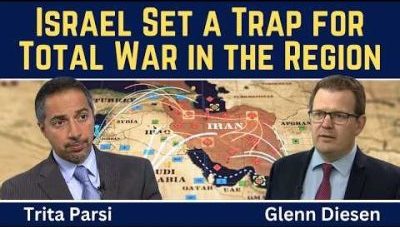
Trita Parsi: Israel Set a Trap for Total War in the Region
or go to
Aletho News Archives – Video-Images
From the Archive
Zionism’s Violent Legacy
By Donald Neff | Washington Report On Middle East Affairs | January 1996
On January 4, 1948, Jewish terrorists drove a truck loaded with explosives into the center of the all Arab city of Jaffa and detonated it, killing 26 and wounding around 100 Palestinian men, women and children.[1] The attack was the work of the Irgun Zvai Leumi – the “National Military Organization,” also known by the Hebrew letters Etzel – the largest Jewish terrorist group in Palestine. The Irgun was headed by Revisionist Zionist Menachem Begin and had been killing and maiming Arabs, Britons and even Jews for the previous ten years in its efforts to establish a Jewish state.
This terror campaign meant that at the core of Revisionist Zionism there existed a philosophical embrace of violence. … continue
Blog Roll
 Aletho News
- Trita Parsi: Israel Set a Trap for Total War in the Region
- Trump’s Iran war is on an Israeli leash
- Saudi oil boss issues global supply warning
- Riyadh Says Its Oil System Is Intact. The Numbers Say Otherwise.
- Trump and Netanyahu Want to “Finish the Job” on Iran
- US ‘one-sided dictation’ not Iran’s beliefs makes rational talks impossible: Baghaei
- Iran’s Next Strike May Not Explode. It Could Shut You Down /Col Doug Macgregor
- Iran: US political targets legitimate if assassinations return
- Iraq shuts key border crossing with Iran under US pressure: Report
- Undersea Internet cables could be targeted in retaliation for attacks on Iran: IRGC deputy chief
- If Americans Knew
- The Israel Lobby’s Changing Fortunes
- AIPAC has become such a political liability that it’s shifting to a more “nimble” approach to buying politicians
- At least 160 Israeli settler attacks in 2 weeks
- Will Gaza’s Ancient Christian Community Disappear Forever?
- Israel’s vision of regional security rests on keeping Arab states weak
- Heidi Levine recounts how Palestinian youths helped save her in settler attack
- DAILY UPDATE: Latest essential news on Palestine, Israel, & region
- Trump’s Intensifying Sabotage of the ICC, for Israel’s Sake
- Israeli military detain US and UK volunteers in West Bank including Democratic NY politician Brad Lander
- Americans at National Conservatism Conference held in Israel this year criticize Israel
- No Tricks Zone
- E-Cars Reduce CO2 Emissions By Only 41% Compared To Internal Combustion Engine Vehicles
- Predictions Made By Renowned Climate Professor Over Past Decades Have Been Proven To Be Poor
- New Study Suggests Large Regions Of The Pacific Ocean Have Been Cooling For The Last 80 Years
- Germany’s Green Energy Debacle: High Energy Costs Force Kahla Porzellan to Close After 182 Years!
- New Study: 50 Years Of The Most Aggressive ‘Net Zero’ Policies Can Only Affect The Global Climate By 0.03°C
- US September “Heat” Was No Record…Many Records Set Decades Ago
- Latest European Green Energy Debacle; Portugal’s Largest Flagship Solar Park Insolvent!
- Green Energy Debacle: German Expert Professor Fritz Vahrenholt Warns Of Severe Economic And Social Consequences
- Two More Paleo Reconstructions Affirm Meters-Higher Sea Levels Across Ireland, Brazil 7000-6000 Years Ago
- New Study: Earth And Venus Surface Warmth Largely Explained By Convection And Lapse Rate, Not CO2 Or Radiation

