Palestinian detainee reveals that Israeli occupation forces used him as a human shield for 40 days
Palestinian Information Center – August 15, 2024
RAMALLAH – The testimony of a Palestinian detainee revealed that Israeli occupation forces (IOF) used him and another prisoner as human shields for 40 days in Gaza.
The Palestinian Prisoner Affairs Authority and the Palestinian Prisoner Society said in a joint statement on Thursday that the IOF forced the Palestinian detainee to wear a military uniform, placed a camera on him, and accompanied him with a drone.
The Authority and the Society confirmed that if the prisoner refused to be used as a human shield, he would be subjected to brutal beatings, deprived of food and basic needs, in addition to being shot and prevented from receiving medical treatment.
The joint statement presented the testimony of the 21-year-old Gaza youth “M.D.,” who was used by the IOF as a human shield for more than 40 days, along with another detainee who was with him.
The same source said that the Palestinian young man, who was working at the Kerm Abu Salem crossing, was subjected to acts of torture, deliberate humiliation and assault, starvation, terrorism and threats, after he and a group of citizens were arrested by the IOF soldiers last June and detained between the Palestinian-Egyptian borders and Rafah.
According to the testimony of the Gaza youth, the IOF used him as a human shield on a daily basis, through several methods, such as placing him at the front of IOF military vehicles, with his hands and feet tied, and forcing him to wear the Israeli military uniform and attaching a camera to his body.
According to the horrifying testimony of the young man, if he refused to go along with the IOF orders, he was subjected to beatings, and added that a drone was used to guide him during his movements. During his detention, the young man confirmed that the IOF soldiers did not provide him with enough food, deprived him of using the bathroom or taking a shower, and this continued throughout his detention period, until he was shot in the chest on the 6th of August, and he remained without treatment for about half an hour.
The Palestinian young man found himself the next day in the Israeli Soroka hospital, where he stayed for 3 days, until he was released on the 9th of August through the Kerm Abu Salem crossing, and he was then transported by ambulance to the Nasser Medical Hospital. The tests showed that the injury caused him a fracture in his chest and another injury in his lung, and he still needs urgent treatment.
For their part, the two bodies concerned with the affairs of Palestinian prisoners considered that the young man from Gaza was exposed to a complex and horrific war crime, starting from his arrest and using him as a human shield throughout this period, and torturing and humiliating him, and then injuring him, and releasing him from the hospital without completing his treatment.
The two bodies once again called on the international human rights institutions to regain their necessary and required role in the face of the ongoing genocide war and the systematic crimes committed by Israel against prisoners and detainees, and to assume their necessary responsibilities, and stressed the need to overcome the horrific state of impotence that surrounds their role, and to go beyond this role that is limited only to monitoring crimes and violations and issuing positions and statements, to a level that leads to holding Israel and its supporters accountable.
International humanitarian law and the 1949 Geneva Convention prohibit armies from using civilians as human shields, and the International Criminal Court considers this a war crime.
Israel has been continuously waging its devastating war on the Gaza Strip for more than 10 months, which has so far resulted in more than 40,000 martyrs and more than 92,000 injuries, mostly women and children, in addition to massive destruction of vital facilities, residential buildings, and an exacerbating famine in the besieged Strip.
Israel continues its war despite two resolutions from the UN Security Council to stop it immediately, and orders from the International Court of Justice to end the invasion of Rafah and take measures to prevent genocide and improve the dire humanitarian situation in Gaza.
Resistance to military conscription deepens in Ukraine as leaders talk of role as a mercenary power
By Dmitri Kovalevich | Al Mayadeen | August 15, 2024
Every day, across the country, police are reporting arson attacks against Ukrainian military vehicles. Military personnel in the rear are increasingly wary of leaving their vehicles on the streets overnight, instead parking them near police stations. But even this does not always help.
Those detained by police for these attacks have mostly been teenagers between 12 and 18 years of age, according to governor Oleh Sinegubov of Kharkiv Oblast (province), writing in early August.
Shoot the youth who are attacking military vehicles?
As a result of such attacks increasing in number, Oleh Romanov, commander of an anti-tank unit of the Armed Forces of Ukraine (AFU), has declared he has given permission to shoot on sight those who set fire to military vehicles in the rear. “In coordination with higher command, using military immunity, I give verbal permission to my fighters to shoot those things on the spot. Such traitors must be eliminated on the spot, considering wartime conditions.” His unit is the 3rd Separate Assault Brigade, formerly a unit of the neo-Nazi ‘Azov Battalion’ now fully integrated as an autonomous unit of the regular army.
So the commander of what is today a regular Ukraine military unit is openly claiming that he has issued orders to shoot without trial civilian youths should they be caught in the act of damaging military equipment… or be only accused of doing so.
Ukrainian authorities are not denying that many of the attacks against military equipment are carried out by teenagers, nor do they deny that orders to shoot perpetrators are being issued and are bypassing the formal, decision-making of the country’s government and armed forces general staff. Such orders are also bypassing the Ukraine constitution, which since the year 2000 (at the insistence of the European Union at the time) has prohibited the death penalty.
All of this highlights once again that the ultra-nationalist and neo-Nazi formations embedded within the AFU are accustomed to acting without regard for the law and at their own discretion, arguing that without their actions, the military front and the entire Ukrainian state machine could well crumble.
At the same time, the Ukrainian telegram channel Rubicon believes that the order issued by the commander of the 3rd Separate Assault Brigade to “shoot on the spot” arsonists or others engaged in damaging military equipment could only be authorized from above (for example, from the presidential office), aiming to intimidate not only potential arsonists but anyone contemplating civil disobedience against the Ukraine government’s war policies.
Fear of military conscription only deepening
Ukrainian authorities traditionally blame Russia for any antiwar protests that may take place in Ukraine, but the fact that the vehicles of military enlistment officers were the first to be burned many months ago suggests more of a spontaneous protest against conscription than anything being covertly organized.
The Ukrainian Telegram channel Kartel comments on the recent trends, writing, “Arson attacks against the vehicles of employees of [military enlistment officers in Ukraine], that is, the vehicles of those who are hunting down men of the age of military service, are now being recorded all over the country. And the public does not consider the people behind these incidents as playing along with Moscow; the arsons have actually become a symbol of protest against forced conscription, corruption, and all the other injustices committed by authorities.”
Protests against conscription have manifested themselves in the form of arson attacks on military vehicles, physical assaults on individual Ukrainian soldiers in the rear, and spontaneous rallies against conscription officers at work. In early August, the town of Kovel near the Polish border in western Ukraine exploded. Crowds turned out for a rally demanding the release of three forcibly conscripted locals. The crowd stormed the military enlistment office and the protest continued through the night until residents secured the release of the three detainees.
The next day, authorities accused the protesters of “working for Russia” and launched criminal prosecutions. Ukrainian MP Yevhen Shevchenko wrote in Telegram on August 3 that the events in Kovel showed that “the party of peace is growing in the form of people voting against the war with their feet”. He continued, “How are the blind philosophers in Ukraine coping with this? Will they continue to brag about the fact there is no such thing in Ukraine as a formal party of peace?”
The Telegram channel Rubicon notes that riots against military enlistment officers are not a rare or unique phenomenon in Ukraine. There have been mass rallies protesting the continued war against Russia in Zaporozhye city and region; in Carpathia region (western Ukraine), where road blockades of burning tires have been erected by Roma people; and in Odessa city several months ago, where a mass brawl took place between ambulance crews and military enlistment officers when one of the crew was seized and threatened with forced conscription. But what happened in Kovel differs significantly from everything that has happened before. There, it was a mass confrontation and brawl against military and government authorities that unfolded in which men who would ‘normally’ be quietly hiding at home to avoid being forcibly conscripted took part.
The conscription crisis is a sign of a failing war
According to the writers at ‘Rubicon’, the government in Kiev cannot change its current conscription regime. Volunteering for the army has run out, all-but ending as early as 2022. Meanwhile, financial motivations to gain recruits, as are widely available in Russia, are very expensive and unrealistic for a depopulated Ukraine with a moribund economy, notwithstanding the funds that the U.S. government has allocated to boost recruitment.
Nevertheless, the large Western governments continue to demand intensified conscription by the Ukraine government, which means more capture and kidnapping by military conscription officers without the slightest heed or attention to human rights. Ukrainian MP Fyodor Venislavskyy wrote on Telegram on August 6 that Ukraine’s Western ‘partners’ are also raising periodically the proposal that Ukraine lower its official age of military service (conscription). He writes, “They believe that the age range of 18-25 is the most optimal and effective age of military service for citizens when physical and psychological qualities needed to be able to fight are at their prime.”
Currently, the age of military registration in Ukraine is 18, while the youngest age for military service is 26.
Ukrainian politicians and analysts typically offer ‘regrets’ to the Ukrainian population for the demands by Western governments for more military recruitment, at the same time saying that Ukraine’s Western allies have the right to pronounce on such a domestic matter because they are the ones providing the funds and equipment to wage war against Russia.
More war dead in order to improve negotiating position
Western analysts and politicians are unrelentingly pushing Ukraine further into battle, using the argument that Kiev needs more combat in order to improve its future negotiating position. This argument was used in 2022 and again in 2023. Today, it is the equivalent of flogging an exhausted and worn-out horse. It also shows a complete misunderstanding of the aims of the political and military leadership in Russia.
Western capitalists measure everything against themselves. They imagine future negotiations between Russia and Ukraine as resembling one company up against its business competitor, each side seeking to strengthen its respective position. But for the Russian leadership, nothing changes should the AFU occupy a Russian town or two or should it withdraw from there to the relative safety of the border of Poland.
The list of demands and conditions by Russia for an end to the war (including an end to the dream by NATO and Kiev for a rump, NATO-member Ukraine) will remain unchanged no matter what happens. This rigidity and unchanging of military goals is the key to Russian stability and to the slow and steady military advances it is making.
This is being continually reinforced by the deep wellspring of historic memory of the Russian people. They recall only too well the harsh, social and economic disaster of the post-Soviet years of the 1990s, when promises by the West to Russia of eventual integration into the Western world’s economy had the ear of the Russian governments of the day while many Russian people themselves held such hopes. The 25 years since then, and in particular the past ten years, have shown to the Russian people that their country does not need economic ties to the Western economy to survive and even prosper. Indeed, Russia is doing quite well today having lost much of its trade and investment ties to the West.
Flight of youth from Ukraine, and mass desertions from the armed forces
Expecting a lowering of the conscription age, young people in Ukraine are fleeing the country daily by the dozens and hundreds. Some are dying while making perilous crossings across the rough river border in western Ukraine. Oleksiy Arestovich, a former adviser to the head of the Office of the President of Ukraine, wrote in early August in the online Eurasia Daily that ‘official’ estimates of the flow of men of conscription age trying to escape from Ukraine are being underestimated by 30 times.
“If I tell you how many people are trying to escape from Ukraine every day, you would gasp. The State Border Service admits 100 or so people trying to leave each day, while a Rada deputy has recently admitted 200. But the real figure is approximately 30 times higher… Imagine, each day, the equivalent numbers of five military brigades are seeking to escape from Ukraine. Many try to cross the Tisa (Tisza) River [which borders Romania, Hungary, and Slovakia in places] each day by whatever means possible.”
According to recent estimates by the National Bank of Ukraine, a further 700,000 people will leave Ukraine in 2024-2025. The Bank expects a gradual return of Ukrainians to their homeland only from 2026 and only if, by then, the security situation improves, new housing is built, and the overall economic situation improves.
Mass desertion is no less of a problem than is conscription for the Ukrainian Armed Forces. Germany’s Deutsche Welle state broadcaster reported on August 2 that desertion from the Ukrainian army in 2024 has reached an alarming scale. Every 14th serviceman has quit his unit arbitrarily, the publication reports. Overall, since the beginning of 2022, the prosecutor’s office has counted 63,200 criminal proceedings for desertion.
Poliltnavigator news website reports on August 5 that according to retired SBU (secret police) colonel Oleg Starikov, more and more soldiers are deserting. “I have a comrade who is now deputy commander of a battalion of paratroopers. He is not a professional soldier; he was conscripted and rose to the rank of lieutenant. I asked him about the personnel situation he faces, and he replied that the soldiers serving under him, quite simply, ‘do not want to serve, they do not wish to fight’.”
” ‘So what are they doing out there?’, I asked. ‘They dig trenches and build fortifications’, he replied. ‘But that is logistical support,’ I replied, ‘who is doing the actual fighting?’, I asked again. ‘They do not want to fight’, came the reply.”
A mercenary role for the future Ukraine?
Although the Armed Forces of Ukraine are constantly short of men and Ukrainian troops have been slowly retreating along the front lines all year, Ukrainian authorities and security services are finding in countries other than Ukraine new recruits, weapons, and other means to fight for the interests of the West. Ukraine has no special interests in these other countries, but the U.S., UK, Germany, and France do.
In August, two African countries, Mali and Niger, severed diplomatic relations with Ukraine. Both accuse Kiev of supporting radical terrorist groups [linked to Al Qaeda] that have been fighting the governments of these two countries since they began to distance themselves economically and militarily from the West last year.
The Mali government reacted to statements by Ukraine’s military intelligence agency (GUR) which praised an alleged involvement by Kiev in an attack against Mali government forces last month near the border with Algeria. “The actions taken by the Ukrainian authorities violate the sovereignty of Mali, go beyond the scope of foreign interference, which is already condemnable in itself. They constitute clear aggression against Mali and clear support for international terrorism,” the Malian government charged.
In Senegal, Ukraine’s interference in Mali’s affairs also caused outrage. The Ukrainian ambassador was summoned to that country’s foreign ministry to hear its condemnation.
On July 31, the Kyiv Post reported that Ukrainian forces made a strike on Russian and Syrian forces at the Kuweires Air Force base in Syria. As well, in the spring of 2024, there were published reports of Ukraine’s involvement in the fighting in Sudan. As reported by the Wall Street Journal in March, Ukraine has participated in combat in Sudan because “the West has been reluctant to get directly involved”.
Thus does the Kiev regime try to sell itself to the West as resembling an effective, private military company that will fight against anti-imperialist movements around the world whenever and wherever the Western governments do not dare to introduce their own troops. Rubicon Telegram channel reports on August 6, “We can only state this curious precedent in international relations when an entire state begins to position itself as a large, highly specialized, private military company (PMC).
In the early days of August, the Ukrainian Defense Ministry announced its support for a draft law ‘On International Defense Companies’ which, in essence, would legalize the operations of PMCs (mercenary companies) on the territory of Ukraine. One author of the bill, MP Serhiy Grivko, proposes to send Ukrainian soldiers to serve in other global hot spots, saying that many will not wish to surrender their weapons and return to peaceful life.
“Following the demobilization of a large number of personnel of the Armed Forces of Ukraine, there is a risk of a wide range of negative consequences,” the bill says. The ‘negative consequences’ for Ukraine in this case is the presence of a large number of foreigners with weapons in hand on Ukrainian soil, the reactions should payments to PMCs (which the Ukrainian budget cannot afford) ever be reduced, and the beginning of anticipated “destructive political processes in the country”.
Simply put, Ukrainians are to become expendable human material spending their entire lives fighting wars and working to pay off international loans, all for the sake of preserving the hegemony of Western imperialism.
The FBI ‘Visits’ Scott Ritter

By Andrew P. Napolitano | Ron Paul Institute | August 15, 2024
Among the lesser-known holes in the Constitution cut by the Patriot Act of 2001 was the destruction of the “wall” between federal law enforcement and federal spies. The wall was erected in the Foreign Intelligence Surveillance Act of 1978, which statutorily limited all federal domestic spying to that which was authorized by the Foreign Intelligence Surveillance Court.
The wall was intended to prevent law enforcement from accessing and using data gathered by America’s domestic spying agencies.
Government spying is rampant in the US, and the feds regularly engage in it as part of law enforcement’s well-known antipathy to the Fourth Amendment. Last week, the FBI admitted as much when it raided the home of former Chief UN Weapons Inspector Scott Ritter. Scott is a courageous and gifted former Marine. He is also a fierce and articulate antiwar warrior.
Here is the backstory.
After President Richard Nixon resigned the presidency, Congress investigated his use of the FBI and CIA as domestic spying agencies. Some of the spying was on political dissenters and some on political opponents. None of it was lawful.
What is lawful spying? The modern Supreme Court has made it clear that domestic spying is a “search” and the acquisition of data from a search is a “seizure” within the meaning of the Fourth Amendment. That amendment requires a warrant issued by a judge based on probable cause of crime presented under oath to the judge for a search or seizure to be lawful. The amendment also requires that all search warrants specifically describe the place to be searched and the person or thing to be seized.
The language in the Fourth Amendment is the most precise in the Constitution because of the colonial disgust with British general warrants. A general warrant was issued to British agents by a secret court in London. General warrants did not require probable cause, only “governmental needs.” That, of course, was no standard whatsoever, as whatever the government wants it will claim that it needs.
General warrants authorized government agents to search wherever they wished and to seize whatever they found — stated differently, to engage in fishing expeditions.
FISA required that all domestic spying be authorized by the new and secret FISA Court. Congress then unconstitutionally lowered the probable cause of crime standard for the FISA Court to probable cause of speaking to a foreign agent, and it permitted the FISA Court to issue general warrants.
Yet, the FISA compromise that was engineered in order to attract congressional votes was the wall. The wall prohibited whatever data was acquired from surveillance conducted pursuant to a FISA warrant to be shared with law enforcement.
So, if a janitor in the Russian embassy was really an intelligence agent who was distributing illegal drugs as lures to get Americans to spy for him, any telephonic evidence of his drug dealing could not be given to the FBI.
The purpose of the wall was not to protect foreign agents from domestic criminal prosecutions; it was to prevent American law enforcement from violating personal privacy by spying on Americans without search warrants.
Fast forward to the weeks after 9/11 when, with no serious debate, Congress enacted the Patriot Act. It removed the wall between law enforcement and spying. And by 2001, the FISA Court had on its own lowered the standard for issuing a search warrant from probable cause of speaking to a foreign agent to probable cause of speaking to a foreign person. This, too, was unlawful and unconstitutional.
The language removing the wall sounds benign, as it requires that the purpose of the spying must be national security and the discovered criminal evidence — if any — must be accidental or inadvertent. In January 2023, the FBI admitted that it intentionally uses the CIA and the NSA to spy on Americans as to whom it has neither probable cause of crime nor even articulable suspicion of criminal behavior.
Articulable suspicion is the linchpin of commencing all criminal investigations. Without requiring suspicion, we are back to fishing expeditions.
The FBI’s admission that it uses the CIA and the NSA to spy for it came in the form of a 906-page FBI rulebook written during the Trump administration, disseminated to federal agents in 2021 and made known to Congress last year.
Last week, when FBI agents searched Ritter’s home in upstate New York, in addition to trucks, guns, a SWAT team and a bomb squad, they arrived with printed copies of two years’ of Ritter’s emails and texts that they obtained without a search warrant. To do this, they either hacked into Ritter’s electronic devices — a felony — or they relied on their cousins, the CIA and the NSA, to do so, also a felony.
But the CIA charter prohibits its employees from engaging in domestic surveillance and law enforcement. Nevertheless, we know the CIA is physically or virtually present in all of the 50 US statehouses. And the NSA is required to go to the FISA Court when it wants to spy. We know that this, too, is a charade, as the NSA regularly captures every keystroke triggered on every mobile device and desktop computer in the US, 24/7, without warrants.
The search warrant for Ritter’s home specified only electronic devices, of which he had three. Yet, the 40 FBI agents there stole a truckload of materials from him, including his notes from his U.N. inspector years in the 2000s, a draft of a book he is in the midst of writing and some of his wife’s personal property.
The invasion of Scott Ritter’s home was a perversion of the Fourth Amendment, a criminal theft of his private property and an effort to chill his free speech. But it was not surprising. This is what has become of federal law enforcement today. The folks we have hired to protect the Constitution are destroying it.
To learn more about Judge Andrew Napolitano, visit https://JudgeNap.com.
COPYRIGHT 2024 ANDREW P. NAPOLITANO
DISTRIBUTED BY CREATORS.COM
‘Over 1,000 children and patients died due to Israel’s closure of Rafah crossing’
Palestinian Information Center – August 14, 2024
GAZA – Gaza’s Government Media Office (GMO) has said that the Israeli occupation army’s closure of the Rafah border crossing over the past 100 days has claimed the lives of more than 1,000 children, patients and wounded civilians, warning that the humanitarian disaster in the war-ravaged costal enclave has deepened.
“The occupation army continues to close the Rafah border crossing between Palestine and Egypt for the 100th day running after burning and bulldozing it and putting it out of service,” GMO said in a statement on Wednesday.
“This Israeli closure of the crossing continues to take place as the humanitarian tragedy has deepened at all levels and affected all aspects of life,” GMO added.
GMO condemned the ongoing closure of the crossing as a “crime” and an “obvious legal violation of the international law, the international humanitarian law and all international conventions.”
GMO accused the Israeli occupation of preventing the entry of all sorts of humanitarian aid into the Gaza Strip, including vital medical needs, which seriously worsened the health and humanitarian situation.
GMO also accused the Israeli occupation of seeking to destroy Gaza’s health system in its entirety and using the starvation policy as a tool for political pressure.
Israeli regime’s actions against civilians ‘blatant example of terrorism’: Iran envoy

Iran’s permanent representative to the UN Office in Geneva, Ali Bahraini.
Press TV | August 14, 2024
Iran’s permanent representative to the United Nations Office in Geneva has called for Israeli institutions to be recognized as “terrorists,” stressing that the regime’s inhumane actions against Palestinian civilians constitute “a clear example of terrorism.”
Ali Bahraini made the appeal in three separate letters to UN High Commissioner for Human Rights Volker Turk, the UN special rapporteur on extra-judicial summary or arbitrary executions, Morris Tidball-Binz as well as UN Special Rapporteur on human rights in the occupied Palestinian territories Francesca Albanese on Wednesday.
According to Article 2.1 of the international convention to prevent the financing of terrorism, the institutions of “the Zionist regime” must be identified as terrorists, he said, adding that “the actions carried out by the Israeli regime against civilians and Palestinian areas are a clear example of terrorism.”
Bahraini also noted that from Iran’s point of view, Hamas is “a liberation organization” that fights for the freedom and independence of Palestine.
Therefore, he said, the assassination of Hamas leaders is aimed at undermining the morale of the Palestinian people in their struggle to end the occupation and achieve the right to self-determination.
The Iranian diplomat also emphasized that by eliminating the Palestinian leaders, Israel seeks to destroy the Palestinian political identity and the inalienable right of the Palestinian people to have an independent state.
He further referred to the advisory opinion of the International Court of Justice (ICC), which recognizes the right of Palestinians to self-determination, and described any action that violates this right as illegal.
Elsewhere in his remarks, Bahraini strongly denounced as “a gross violation of international law” the assassination of Hamas leader Ismail Haniyeh in the capital Tehran.
He also urged UN officials to condemn the assassination decisively and to document it in their future reports.
The top Iranian diplomat also stressed the need for more efforts to achieve justice for the Palestinian people and to hold the Israeli regime accountable for its crimes.
Haniyeh, who was in Tehran to attend the swearing-in ceremony of Iran’s newly-elected President Masoud Pezeshkian, alongside other Axis of Resistance leaders, was martyred in an attack early on July 31.
Leader of the Islamic Revolution Ayatollah Seyyed Ali Khamenei has warned the Israeli regime of a “harsh response” for Haniyeh’s assassination, calling it the Islamic Republic’s duty to avenge the Palestinian resistance leader’s blood.
CAIR files lawsuit against FBI, US govt agencies over blacklisting of Palestinian-Americans
MEMO | August 13, 2024
An American Muslim advocacy group has filed a lawsuit against the Federal Bureau of Investigations (FBI) and the leaders of other United States government agencies after two Palestinian-American men were blacklisted due to their pro-Palestine activism.
On Monday, the Council on American-Islamic Relations (CAIR) filed the lawsuit in response to what it called a discriminatory and racist placement of two Palestinian Americans – Osama Abu Irshaid and Mustafa Zeidan – on a watch list by US federal authorities.
According to the lawsuit, Irshaid, the Executive Director of an organisation named American Muslims for Palestine, travelled to Qatar from the US in late May and returned in early June. Upon his return, federal agents forced him to undergo extra screening and questioning – reportedly focusing on his activism and organising against Israel’s offensive on Gaza – while seizing his phone, which has not yet been returned.
The California-based Zeidan, meanwhile, who often visits his ailing mother in Jordan, was not allowed to board a flight on his way to the country earlier this year, with authorities later informing him that he was placed on the no-fly list.
Filed in the US District Court for the Eastern District of Virginia, the lawsuit stated that “CAIR is challenging the mistreatment of these Palestinian-American activists on constitutional grounds”, asserting that their blacklisting is based on discrimination and racism rather than actual criminal or national security concerns. “Neither Dr. Abu Irshaid nor Mr. Zeidan have ever been charged or convicted of a violent crime,” it said.
Aside from the FBI, other defendants named in the lawsuit are the leaders of government agencies, including the State Department and the Homeland Security Department.
Specialist UK Police Teams Target “Hate” on Social Media
By Cindy Harper | Reclaim The Net | August 13, 2024
The UK authorities and the media either willing to or feeling pressure to take their cues from the government, continue to assert that the root cause of the serious rioting that hit the country this month is to be found on – social media.
This, in turn, makes for a convenient excuse to ramp up police surveillance of online content. Special police teams are now going through social sites in order to identify those said to have “incited” the riots, and there’s a special name for them – “hate influencers.”
The said teams consist of what reports refer to as “specialized” officers, those investigating serious crimes (i.e., murder and the like) and terrorism, as well as local units whose job is normally to investigate organized crime.
“Other” national-level teams are also mentioned as taking part in scouring the internet, and what they might be doing is suggested by the goal of this exercise being gaining “a clear intelligence picture,” as one article put it, citing the National Police Chiefs’ Council (NPCC).
A statement on the NPCC site said that the search for “online offenders” is being led by regional organized crime units (ROCUs) and that the offense is spreading hate and inciting violence on the internet.
NPCC Chief Constable Chris Haward is quoted as saying that the large number of people taking part in protests and riots “did not mobilize spontaneously.”
“It was the result of dozens of so-called influencers, exploiting the outpouring of grief from the tragic loss of three young girls in Southport,” Haward said, referring to the knife attack that resulted in the three murders.
Still talking about “hate influencers,” Haward added: “They knowingly spread misinformation, stoked the flames of hatred and division, and incited violence from the comfort of their own homes – causing chaos on other people’s doorsteps. (…) Online crimes have real-world consequences and you will be dealt with in the same way as those physically present and inflicting the violence.”
Thus far, the NPCC has said that it is investigating hundreds of leads. The content targeted by law enforcement and intelligence units is reportedly spread across a range of unnamed social sites and platforms, according to the press release.
It is also revealed that “hate influencers” as the British legacy press calls them will not be held responsible simply for using the internet to allegedly incite real-world violence – but also for something separate which the NPCC calls “violence online.”
“A senior investigator” will have the last word on whether any of this can be treated as a crime – and if so, people behind the accounts and/or content will be identified and arrested.
Tyranny in the UK – Can it Happen Here?
By Ron Paul | August 12, 2024
As the UK descends into tyranny, where just re-Tweeting something the government doesn’t like can land a person a multi-year jail sentence, Americans are wondering, “can it happen here?” After all, we have the guarantees of the First Amendment.
But while we shake our heads at UK authorities jailing people for their social media posts this past week, we should not kid ourselves. The answer is that silencing dissent can happen here and it is happening here.
Here are just three recent examples of how the “deep state” or the permanent government is conspiring to restrict political dialogue in the United States.
First is the revelation that former US Representative and former US presidential candidate Tulsi Gabbard has been placed under the bizarrely named “Quiet Skies” program. As reported by journalist Matt Taibbi based on revelations by TSA whistleblowers, this July Gabbard was flagged as a terror threat, and every time she travels her boarding pass is marked so that she is pulled aside for extensive screening. According to the whistleblowers, “Gabbard is unaware she has two Explosive Detection Canine Teams, one Transportation Security Specialist (explosives), one plainclothes TSA Supervisor, and three Federal Air Marshals on every flight she boards.”
As Gabbard herself revealed recently on the Laura Ingraham show, “A few weeks ago, I had the audacity to tell the truth: that Kamala Harris would essentially be a mouthpiece and puppet of the Military Industrial Complex and National Security State. The next day, July 23, they retaliated. Sadly this is what we can expect from the ‘Harris Administration.’”
Next we have the attempted assassination of former president Donald Trump. It seems every day brings a new revelation that calls into question whether the massive failure to protect the Republican presidential candidate was just an “honest mistake.” We know from 1963 what can happen to presidents who cross the “deep state” and we know from Trump’s four years in office how “former” deep state officials can conspire to undermine the presidency with lies like “Russiagate.”
Finally we have the case of Robert F. Kennedy, Jr. Up until the Trump assassination attempt, the Biden/Harris Administration refused to provide the independent presidential candidate with Secret Service protection. RFK, Jr. has consistently and effectively criticized not only the current administration but the “deep state” itself while out on the campaign trail. Even though there were credible threats against him on the campaign trail the Biden/Harris administration refused to budge for months. Why? Did they want to silence him?
The US government learned an important – and dangerous – lesson from Covid: all you have to do to crush political dissent is to use the weight of the government to force the “private” sector to do the censoring for you. It is only a half-step away from forbidding us from expressing our thoughts on a virus to sending us to prison for expressing other thoughts the government does not like. And maybe worse.
There will be a reaction in the UK to the brutality of the Starmer regime. We can only hope for their – and our – sake that the reaction will be a newfound determination by the people that no government should have the authority to shut them up or jail them for their political views. To paraphrase Benjamin Franklin, “free speech, if you can keep it.”
Scott Ritter: FBI Raids Part & Parcel of US Government’ Intimidation
By Svetlana Ekimenko – Sputnik – August 12, 2024
Former USMC intelligence officer and Sputnik contributor Sсott Ritter’s New York home was raided earlier this month over allegations he had violated the Foreign Agents Registration Act (FARA), which requires anyone who acts on behalf of a foreign nation to register as such to the US government.
The US government is “not happy” with the truthful message that he is conveying as a Sputnik contributor, former UN weapons inspector Scott Ritter believes.
This explains the recent FBI raid on his home over claims he had violated the Foreign Agents Registration Act (FARA).
It was “disconcerting and chilling” when around 40 FBI agents raided his house, revealed Ritter.
“I asked repeatedly, ‘Why are you doing this?’’ What are you concerned about? Tell me what specific actions you’re concerned about and I can help resolve this.’ Now, we had a lengthy conversation, the special agents and I, but never once were they able to say this is why we believe you’re in violation,” he said.
However, what the agents did talk a lot about was the pundit’s relationship with Sputnik.
“They were very concerned about the work that I do as a contributor to Sputnik […] The US government is clearly unhappy with my message, unhappy with the impact that I’m having, and nervous that they can’t control me. And so I think that this raid, this search warrant, this ongoing investigation is part and parcel of a larger project of intimidation that unfortunately will continue, I believe, for the near future,” Ritter said.
The FBI and US Department of Justice are bothered by the impact people like him are having “on informing an audience not only inside the United States, but around the world about the malfeasance of American foreign policy,” Scott Ritter said. However, the author and commentator refused to be intimidated, saying he looked forward to continuing to operate as a contributor to Sputnik.
“I’m very proud of this relationship and I think highly of the editors and producers that I work with, and I look forward to continuing to do this for the foreseeable future,” Ritter stated.
EU Threatens Musk Over “Harmful” Speech Ahead Of Trump Interview

By Cindy Harper | Reclaim The Net | August 12, 2024
On the day of Elon Musk’s interview with President Donald Trump on X, the EU’s top digital official, Thierry Breton, issued a reminder to Musk of his responsibilities under EU law to curb the spread of “harmful content.”
Breton, the pro-censorship internal market commissioner, emphasized the significance of platform moderation in a letter and a post on X, stating, “With great audience comes greater responsibility.”
The European Union, under its censorship law, the Digital Services Act (DSA), mandates that digital platforms stringently monitor online content to shield users from potential “harm.”
This legislation is part of a broader scrutiny of X, which has consistently been targeted by the EU. Breton’s correspondence highlighted that the DSA’s mandates apply uniformly, including to Musk.
The reminder was prompted by concerns over the “risk of amplification of potentially harmful content in the EU,” particularly with Musk’s upcoming interview with Trump and Musk’s own recent remarks concerning the attack on free speech currently being experienced in the UK.
Breton further warned, “My services and I will be extremely vigilant to any evidence that points to breaches of the DSA and will not hesitate to make full use of our toolbox, including by adopting interim measures, should it be warranted to protect EU citizens from serious harm.”
As the European Union persists in the stringent enforcement of its censorship law, the imposition of its regulatory well beyond its borders, notably into the United Kingdom—a nation no longer tethered by EU membership—raises profound concerns about the overreach of censorship under the guise of protection.
The EU’s call for rigorous content moderation, even in territories outside its jurisdiction, smacks of an unsettling desire to extend its influence, stifling discourse and dissent not only within its member states but also in nations that have consciously chosen a different path.
The insistence on such broad and pervasive controls over digital content by an entity like the EU, which should ostensibly champion democratic values, is alarming.
This form of interventionism in the UK, under the pretense of safeguarding EU citizens from “harm,” undermines the very essence of free speech—a cornerstone of democratic societies. By dictating terms and conditions that stretch its authority into non-EU territories, the European Union not only compromises the sovereignty of other nations but also sets a dangerous precedent for global digital governance, where freedom of expression becomes a casualty in the battle against vaguely defined “harmful content.”
Walz’s 2020 Covid Snitch Hotline Sparks Debate Amid VP Bid
By Cindy Harper | Reclaim The Net | August 8, 2024
In 2020, as the reaction to the Covid pandemic tightened its global grip, the administration of Minnesota’s Democratic Governor, Tim Walz, controversially initiated a hotline encouraging citizens to report non-compliant neighbors, opening a Pandora’s box of surveillance reminiscent of dystopian literature.
This move has once again sparked discussion about Walz, following his newly-minted status as the running mate for Vice President Kamala Harris in the imminent 2024 presidential election.
Serving a dual purpose, the hotline — referred to by critics as the Covid snitch line — enabled thousands of Minnesotans to both voice their concerns about perceived health risks and expose those allegedly flouting the restrictive coronavirus-sensitive rules revolving around gatherings and social activities.
Referred to by some as “the Office of Public Safety Stay At Home Hotline,” the service became a platform for callers to report everything from religious congregation activities to outdoor sports events.
The line even reportedly recorded concerns about a local church’s activities potentially violating the mandated rules.
Complaints received via the hotline were varied in nature. Anything from unmasked shopping for nonessential items to unsanctioned social gatherings was fair game, echoing mistrust amongst friends and neighbors in the wake of the controversial crackdown.
Featured Video
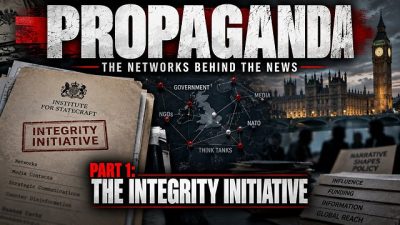
Integrity Initiative: UK-funded network framed dissent as Russian disinformation for years
or go to
Aletho News Archives – Video-Images
From the Archives
Why Saudi Ties to 9/11 Mean U.S. Ties to 9/11
By Kevin Ryan | Dig Within | September 27, 2015
Media interest in Saudi Arabian connections to the crimes of 9/11 has centered on calls for the release of the 28 missing pages from the Joint Congressional Inquiry’s report. However, those calls focus on the question of hijacker financing and omit the most interesting links between the 9/11 attacks and Saudi Arabia—links that implicate powerful people in the United States. Here are twenty examples. … continue
Blog Roll
 Aletho News
- EUROPE FEARS RUSSIA’S NEXT MOVE / Ian Proud
- Big tech hands in its DSA censorship reports to the EU
- ‘A Big Victory’ – Palestine Chronicle Wins Two-Year Legal Battle
- IAEA inspectors cannot return to Iran amid US threats: Russia
- Senate Rejects Iran War Powers Resolution Passed By House
- ‘We did not attack Pakistan with drones’: Afghan sources
- Iraqi Resistance faction links arms to sovereignty, questions US exit
- Cannon fodder no more… South Korea rejects Trump’s pressure to join his criminal war on Iran
- Neria Leiter Was A Legitimate Military Target
- Integrity Initiative: UK-funded network framed dissent as Russian disinformation for years
- If Americans Knew
- ‘This is where I live now, the back of a truck’: a day in the life of a grandmother in Gaza
- In UN Speech, Iran’s President Displays Pictures of Children Killed by US, Brings Attention to Israel’s Nuclear Arsenal
- Israel displaces hundreds of Palestinians amid wave of demolitions in West Bank
- Aid, reconstruction, and Israel’s history of obstruction in Gaza
- Trump administration digs an ever-deeper hole of complicity in genocide – Daily Update
- US-Israel $2.8 Billion Arms Deal, 40,000-Bomb Supply Faces New Gaza Complicity Accusations
- Caught on Tape: AIPAC CEO Boasted of Controlling Trump’s National Security Officials
- Why Hamas Attacked Israel in October 2023 – Israeli professor Ilan Pappé
- They see them, then kill them: Israeli quadcopters track, deliberately target civilians in Gaza
- Winter could turn Gaza’s treacherous, war-damaged buildings into deathtraps
- No Tricks Zone
- New Study: Earth And Venus Surface Warmth Largely Explained By Convection And Lapse Rate, Not CO2 Or Radiation
- 2025 Nature Paper Claiming Worsening Global Drought Gets RETRACTED …Heavily Flawed
- New Study: ‘Global Drought Shows No Detectable Recent Acceleration Under Climate Warming’
- Economic Masterminds: German Socialists Suggest Taxing Productivity Gains Stemming From Using AI
- The South China Sea Has Not Been Cooperating With The Climate Change Narrative
- Energy Crisis: Germany Enters Heating Season With Historically Low Gas Reserve Fill Levels
- New Study: The Antarctic Ice Sheet Gained Mass From 2020-2024 Due To Staggering Snow And Ice Accumulation
- Study: Ocean Heating Rates From Thousands Of Years Ago ‘Dwarf’ Modern Ocean Heating Rates
- Climate Extremists Target, Attack Large-Scale Power Grid Infrastructure In Germany!
- New Study: Antarctic Ice Melt Has Contributed Less Than 1 Centimeter To Sea Level Rise In The Last 30 Years

