The media are (finally) admitting lockdown is worse than “Covid”… but why?
By Kit Knightly | OffGuardian | August 19, 2022
The latest figures from the UK’s Office of National Statistics (ONS) suggest that the knock-on effects of lockdown may be harming more people than “Covid” ever did, or so the press are saying anyway.
The ONS’s weekly data apparently shows over 10,000 more reported deaths than expected.
Since none of these excess deaths has been “linked with Covid”, the press is calling them the “true cost of lockdown”, with some papers suggesting lockdown is “killing more people than Covid”.
To which the only proper response is: “No shit.”
Even for those who still cling to the orthodoxy that “Covid” actually exists, the fact lockdown was going to do more damage than it prevented was obvious from the moment early mortality studies showed “Covid” had a 99.5% survival rate, back in the spring of 2020.
Many experts in economics, statistics, epidemiology and virology voiced this opinion, and were vilified and abused for their trouble.
And, really, anyone with the smallest shred of common sense could figure it out for themselves. Shutting down the health service and crashing the economy is never going to end well (unless you want to kill people, then it’s a great plan).
Even Dr David Nabarro, World Health Organization special envoy for Covid-19, described lockdowns as a “global catastrophe” in October 2020:
We in the World Health Organization do not advocate lockdowns as the primary means of control of the virus[…] it seems we may have a doubling of world poverty by next year. We may well have at least a doubling of child malnutrition […] This is a terrible, ghastly global catastrophe.”
So the question is not “Is lockdown worse than Covid?” The answer to that is “yes”, and we’ve known that for over two years.
The real question is: why are they finally admitting it?
It’s not just this week’s excess deaths either. Elsewhere the media is concerned about the mental health impacts of lockdowns, delays in cancer treatments, the “lockdown drinking”, the impact on children missing school, teenagers self-harming and so and so on.
Professor Karol Sikora – one of those vilified experts I mentioned earlier – has even been given space in the Telegraph to write a 2000 word “I told you so”.
Why?
Perhaps the answer to that lies not in what they’re talking about, but in what they are most pointedly not talking about.
The excess deaths are being very definitely laid at the feet of lockdowns, not the experimental “vaccines”.
Now, were the deaths really caused by the lockdown? Or by the “vaccines”? Or a mix of both? We don’t know, and can likely never know.
At this point our collective trust in institutions and official figures should be low enough to question if there were any excess deaths. Maybe they just made them up. They do that.
Regardless of the truth of it, the narrative is certainly shifting to highlight “the true cost of lockdowns”.
This could be about disguising the harm done by untested vaccines, admitting to potentially deleterious effects of lockdown to spare Pfizer’s blushes.
There’s a lot more invested in the vaccines than the lockdown – in every sense of the word – and if something has to be blamed it makes sense they would much rather it be lockdowns than jabs.
That’s a decent explanation, but I wouldn’t be surprised if there were more to it.
This narrative could be about setting up the public for the next “covid” wave or some new “pandemic”.
Consider how quickly the “true cost of lockdown” story could be parlayed into a new mainstream consensus that “Lockdown was so damaging, we must do whatever it takes to avoid another“.
Then consider how “Whatever it takes” could take the form of quarantine camps for the unvaccinated, vaccines mandates, enforced testing and surveillance…or whatever the hell else they want.
Crisis Government
eugyppius | August 20, 2022
To reduce energy consumption in the face of the looming German gas crisis, Economics Minister Robert Habeck has proposed a bizarre set of indoor temperature ordinances that continue the pattern of direct state interventions in the everyday life first established by mass containment.
Workspaces where hard physical labour is performed are not to be heated above 12 C, under the new rules. Those involving moderate labour while standing will have their temperatures capped at 16 C, and moderate labour while sitting at 17 C. Places where light labour is performed standing, will be permitted temperatures as high as 18 C, while white-collar office spaces where everybody sits and types will be permitted nothing warmer than 19 C. The heating of hallways and other common spaces will be outlawed, as will certain kinds of restroom water heaters. There will be a general ban on using electricity or gas to heat private pools, and shops will be ordered to keep external doors closed at all times. Political pressure is growing for similar ordinances limiting gas consumption in residences.
While some doubt that these rules can be enforced, German police have already proven effective at enforcing pandemic-era contact limits in private homes. And even if indoor temperatures are never systematically checked by authorities, I’m pretty sure that the simple prospect of unannounced inspections and fines will be enough for most employers to declare a third season of home office, with the added prospect of offloading higher gas prices onto their employees.
It is most curious, how this totally new catastrophe should call forth some of very same measures demanded by the Corona pandemic. Not only will home office return, but municipal pools will close again and cities will be kept dark at night, a de facto limitation on evening mobility that might well encourage some places to reimpose the curfews last seen in the winter of 2020/21. Meanwhile, some of the very same spaces recently commandeered for excess hospital capacity and mass vaccination will be repurposed as heated shelters for the old, the sick and the poor.
Not any unified plan, but rather a long series of contingencies, have caused the German gas crisis. Yet the steadfast refusal of the Scholz government to consider any course of action that might ameliorate the shortage, always with a new excuse, grows every day more unsettling.
There’s the obvious explanation, that the Greens in government are merely taking advantage of this opportunity to achieve their higher goal of restricting fossil fuel consumption, as they’ve always wished. But I think there might be another, deeper way to understand this too. I suggest that we’re seeing here the emergence of a new political style, which you might call Crisis Governance—or, as a friend put it, “the continuation of Corona policy by other means.” One of my core themes here has been the deepening demobilisation of western states, as power is diffused downwards from the political apex into the bureaucratic institutions, the press and major corporate enterprises. The great advantage of this power-sharing is a near-total uniformity of political views that it has inspired across the socio-cultural elite, but it comes at the cost of initiative, coordination and strategy. Crises seem to be one of the only ways our new, demobilised states can overcome their paralysis and act to further any kind of positive political programme.
More at A Plague Chronicle.
German Electricity Prices Spiraling Out Of Control… Tripling Since 2000… Blackouts, Unrest Loom
By P Gosselin | No Tricks Zone | August 19, 2022
Sun and wind don’t send any electric bills, the green energy swindlers used to tell us.
Changing over to sun and wind energy would cost only one euro a month more, Germany’s former Environment Minister Jürgen Trittin once promised. All we had to do was accept their master plan.
Today the swindle is uncovering, and it may be too late to avert the massive damage that’s coming our way.
At Facebook, Helmut Bauer posted the most recent chart depicting Germany’s electricity rates for end-consumers. It’s a blood bath:

Electricity prices for German end-consumers, in eurocents per kilowatt-hour. Source: BDEW, Verivox.
What a mess; they’ve reached 41 cents a kilowatt-hour and it’s about to get much worse – especially for the people who can least afford it. Expect social unrest to boil over the months ahead as prices and shortages inflict pain on the poor. We’re in uncharted territory.
Hey, not to worry: German Chancellor Olaf Scholz promised that police will not open fire on demonstrators.
Israeli soldiers raid, occupy Episcopal Church in West Bank

By Francis Martin – Church Times – August 19, 2022
The Episcopal Church in Jerusalem and the Middle East has condemned a “flagrant” raid on the premises of its church in Ramallah, in the occupied West Bank, in the early hours of Thursday morning.
In a statement released by the diocese of Jerusalem later on Thursday, the actions of the Israeli forces involved in the incident are described as “a violation of international law and a terroristic act against the entire community”.
It was revealed later that the focus of the raid was the offices of Palestinian NGOs that rent space in the church compound, including the human-rights organisation Al-Haq. [NOTE: read more about the raids here.] In October last year, Al-Haq was classified as a terrorist organisation by the Israeli government, a move that was criticised by the Office of the United Nations High Commissioner for Human Rights (OHCHR).
A spokesperson for the US State Department has also expressed “concern” about the raid on the NGOs.
The Rector of St Andrew’s, Ramallah, the Revd Fadi Diab, told Agence France-Press : “The soldiers came into the premises around 3 a.m. and we started hearing shots and banging on the doors.”
The diocesan statement details how the door to the church complex was smashed, and the entire building — including the sanctuary and rectory — occupied for two hours. “The sound of gunshots, stun grenades, and the smashing of doors caused terror among the families living inside the compound,” the statement says.
The Guardian reports that the Israeli forces took equipment from the offices and sealed the doors, leaving a notice saying that they had been closed for “security reasons”. But later on Thursday, staff from Al-Haq removed the barriers and vowed to continue its work.
In a statement issued on Thursday, Al-Haq urged the international community to “take concrete measures, such as trade restrictions and arms embargoes, to ensure that Israel is held internationally responsible for its ongoing systematic inhumane acts of apartheid, including the persecution of Palestinian human rights defenders.”
Also on Thursday, the Episcopal Peace Fellowship Palestine/Israel Network condemned the attack as “illegal”. Under international law, Israeli forces require the permission of the Palestinian Authority to operate in Ramallah.
The diocese of Jerusalem asserts: “Places of worship and church compounds should be sanctuaries for communities to feel safe to practice their faith and ministry.” It is calling for a “speedy and impartial investigation into this incident, followed by serious disciplinary action against the offenders”.
The CDC Failed, So Spin It Off and Make It More Powerful?
BY JEFFREY A. TUCKER | BROWNSTONE INSTITUTE | AUGUST 17, 2022
The failure of the CDC to manage Covid-19 was baked in from the first moments of its response. A government agency was never going to mitigate much less get rid of this sort of pathogen. This is because the virus never cared a whit about prestige degrees, job descriptions, big budgets, high-end connections, media agitprop, or polls. It went on its merry way, hit everyone, and immune systems adapted as they always have done.
The great experiment was an enormous flop.
The costs of the experiment we know: it is the catastrophe that Donald Henderson predicted it would be in 2006.
Thus does it make sense that the present overlords of the agency have admitted at least partially to have made some errors. The question is what were these errors. From the latest news concerning some impending shakeup, I see no evidence of any serious rethinking of the crazed and cockamamie lockdown orders it issued from March 2020 onward. Not even preposterous mandates like plexiglass at retail counters, two years of school closures, “six feet of distance,” one-way grocery aisles, band members in bubbles, mask mandates, and limits on how many people you can have in your home have prompted remorse.
Instead, every indication is that the CDC believes the real problem was that it did not have a high-enough budget and enough power. Plenty of lawmakers are willing to go along – not that anyone is asking them. Therefore, its tremendous pandemic powers need to be tweaked and invested mainly in a division known as the Office of the Assistant Secretary for Preparedness and Response, or ASPR.
Says The Washington Post :
The Biden administration is reorganizing the federal health department [HHS] to create an independent division that would lead the nation’s pandemic response, amid frustrations with the Centers for Disease Control and Prevention.
Joy!
The new head of this high-level division (same level as FDA/CDC) is Dawn O’Connell who has a background in literature (Vanderbilt) and law (Tulane), not science or medicine. She is a political appointee who took the reins as Assistant Secretary of Health and Human Services for Preparedness and Response, as confirmed by the Senate in 2021. She is now elated to report that her division will be elevated to become just as important as the CDC and the FDA.
Here is her memo to the staff:
ASPR Team:
As you know firsthand, ASPR is at the forefront of many of HHS’s and the Biden-Harris Administration’s top priorities. Whether your work involves strengthening our core preparedness and response capabilities, tackling new and emerging challenges, or providing essential support services to the team, please know that the work that you do matters and that it is making a big difference.
In recognition of the tremendous value this team brings to the Department and the American people – and due to the increasing size and scope of what we do – I asked Secretary Becerra to consider making us an Operating Division and I am pleased to report that Secretary Becerra has made the critically important decision to elevate our team from a Staff Division to an Operating Division (OpDiv)!
This change allows ASPR to mobilize a coordinated national response more quickly and stably during future disasters and emergencies while equipping us with greater hiring and contracting capabilities. As an OpDiv, we are now in the same category as other large HHS teams with core operational responsibilities such as CDC, NIH, FDA, CMS, and ACF. This change is an important next step for our organization which has continued to grow and evolve since its creation in 2006 – the pace of which has quickened over the past year. This change is also a recognition of the good work you all have been and continue to do on behalf of the American People…
Along with this reclassification, moving forward we will be known as the Administration for Strategic Preparedness and Response (ASPR). The adjustment to our name signals our elevation to an OpDiv, while maintaining the equity and brand recognition we have built with key internal and external stakeholders, particularly over the course of the pandemic.
Thus must we ask: what the heck is going on here? The Biden administration has no idea. Indeed the Washington Post reports that “some senior Biden administration officials said they were unaware of the plan to reorganize the department, which was approved by HHS Secretary Xavier Becerra and has been held close by his deputies.”
This point is crucial. This is how the administrative state works. It cares nothing for the elected officials who come and go. It moves on its own, fueled by money baked into the budgets and with power hardly anyone dares to challenge. There is never any accountability. There is only one path forward: more power. Elections be damned.
The most important part of the memo here is the idea of mobilizing a “coordinated national response.” It drove these people utterly bonkers that during the pandemic, several states went their own way. South Dakota never shut down. Georgia opened a month after the shutdowns. Florida and Texas were next. Finally all the states with Republican governors opened while most states with Democratic governors remained closed to some degree.
The empirical results are incredibly obvious. The open states performed as well and often better on disease demographics. Meanwhile their economies did not suffer nearly as much. The kids stayed in school. The churches functioned. There were live musical performances. The museums, libraries, and playgrounds opened. People are less traumatized.
The migration of people from blue to red tells the whole story. Masses of people fled the lockdown states for the open states.
A “coordinated national response” would make such federalist solutions impossible. Forget the 9th and 10th Amendments. These agencies and these people care nothing for them, nor actual science which would encourage a plethora of experiments in the management of a pathogen. These bureaucrats in Washington think they have all the answers, and they demand complete compliance.
Meanwhile, the CDC itself is being reorganized. But don’t be fooled by any appearance of contrition. They still have a legal appeal in process that would put a mask back on your face when traveling. The new agency to which some of its pandemic responsibilities will be transferred will have a 1,000-person staff to start, people paid the big bucks to sit around coming up with new ways to whip up disease panic and start another crackdown.
A better solution would be to abolish the CDC. States can handle all its responsibilities. It did not even exist until 1947. Its purpose was mosquito control, spraying a now-banned chemical (DDT) everywhere. These days we handle that by going to Home Depot.
The CDC as an agency grew out of the 1944 Public Health Services Act that permitted nationally ordered quarantines for the first time. The legislative history of that thing remains a mystery to me. Regardless, it is nowhere justified in the US Constitution. This act needs to go too. So too all the federal agencies to which it gave rise. This is the only real solution.
Certainly creating a new agency is not the answer. And note that ASPR has its roots in 2006 as an outgrowth of the Bush administration’s obsessive panic over bioterrorism. It was also the first year that anyone imagined that lockdowns could be an appropriate path for any free society. It was the year that “social distancing” was invented by a cabal of computer scientists with zero experience in infectious disease.
These fanatics need to be out of power completely, and the regulations, laws, and agencies that enabled them to ruin the country and its freedoms must be ended. This is what any responsive government in a modern society would do. It would see failure and call it and then do something about it. It certainly would not go in this new direction and reward the disease planners with more power and money!
We must learn real lessons and act on them.
Jeffrey A. Tucker is Founder and President of the Brownstone Institute and the author of many thousands of articles in the scholarly and popular press and ten books in 5 languages, most recently Liberty or Lockdown. He is also the editor of The Best of Mises. He writes a daily column on economics at The Epoch Times, and speaks widely on topics of economics, technology, social philosophy, and culture.
Israeli Forces Storm, Seal Offices of Seven Palestinian Human Rights and Humanitarian Organizations in Ramallah
Al-Manar – August 18, 2022
The United Nations Human Rights Office today expressed alarm at Israel’s arbitrary closure of seven Palestinian human rights and humanitarian organizations and called on Israel to immediately reverse these decisions, reiterating the High Commissioner’s call to revoke the designations of the organizations as “terrorist” and “unlawful.”
At dawn today, Israeli occupation forces broke into, searched and sealed the offices of seven Palestinian human rights and humanitarian organizations in Ramallah. Their property was confiscated and destroyed. Israeli forces left copies of military orders to close the offices of the organizations.
“The closure orders are a step to enforce previous Israeli declarations of these organizations as “unlawful” and as “terror organizations” in 2021,” said the Human Rights Office in a statement. “Despite offers to do so, Israeli authorities have not presented to the United Nations any credible evidence to justify these declarations. Several Member States have also stated that the evidence shared with them does not justify the designations. As such, the closures appear totally arbitrary.”
The UN office said the shutting down of the organizations represents the latest in a series of attacks that are further drastically shrinking space for human rights and humanitarian work in the occupied Palestinian territory, affecting all institutions working on human rights, including the UN Human Rights Office. “Human rights defenders must be immediately protected from these unjustified attacks,” it said.
The organizations affected are Addameer Prisoner Support and Human Rights Association; Al Haq; Bisan Center for Research and Development; Defense for Children International – Palestine; Health Work Committees (HWC); Union of Agricultural Work Committees (UAWC); the Union of Palestinian Women’s Committees (UPWC).
German Official Trashes Cost of Living Protesters as “Enemies of the State”
Says they’re extremists who want to overthrow the government

Getty Images
By Paul Joseph Watson | Summit News | August 17, 2022
A top German official has trashed people who may be planning to protest against energy blackouts as “enemies of the state” and “extremists” who want to overthrow the government.
The interior minister of the German state of North Rhine-Westphalia (NRW), Herbert Reul (CDU), says that anti-mandatory vaxx and anti-lockdown demonstrators have found a new cause – the energy crisis.
In an interview with German news outlet NT, Reul revealed that German security services were keeping an eye on “extremists” who plan to infiltrate the protests and stage violence, with the unrest being planned via the Telegram messenger app, which German authorities have previously tried to ban.
“You can already tell from those who are out there,” said Reul. “The protesters no longer talk about coronavirus or vaccination. But they are now misusing people’s worries and fears in other fields. (…) It’s almost something like new enemies of the state that are establishing themselves.”
Despite the very real threat of potential blackouts, power grid failures and gas shortages, Reul claimed such issues were feeding “conspiracy theory narratives.”
However, it’s no “conspiracy theory” that Germans across the country have been panic buying stoves, firewood and electric heaters as the government tells them thermostats will be limited to 19C in public buildings and that sports arenas and exhibition halls will be used as ‘warm up spaces’ this winter to help freezing citizens who are unable to afford skyrocketing energy bills.
As Remix News reports, blaming right-wing conspiracy theorists for a crisis caused by Germany’s sanctions on Russia and its suicidal dependence on green energy is pretty rich.
“Reul, like the country’s federal interior minister, Nancy Faeser, is attempting to tie right-wing ideology and protests against Covid-19 policies to any potential protests in the winter.”
“While some on the right, such as the Alternative for Germany (AfD), have stressed that the government’s sanctions against Russia are the primary factor driving the current energy crisis, they have not advocated an “overthrow” of the government. Instead, they have stressed the need to restart the Nord Stream 2 pipeline, end energy sanctions against Russia, and push for a peaceful solution to end the war.”
Indeed, energy shortages and the cost of living crisis are issues that are of major concern to everyone, no matter where they are on the political spectrum.
To claim that people worried about heating their homes and putting food on the table this winter are all “enemies of the state” is an utter outrage.
As we highlighted last week, the president of the Thuringian Office for the Protection of the Constitution, Stephan Kramer, said energy crisis riots would make anti-lockdown unrest look like a “children’s birthday party.”
“Mass protests and riots are just as conceivable as concrete acts of violence against things and people, as well as classic terrorism to overthrow it,” Kramer told ZDF.
Washington’s Assassination Bureau
BY PHILIP GIRALDI • UNZ REVIEW • AUGUST 16, 2022
I often complain that Washington’s heavily lopsided relationship with Israel is an arrangement that brings absolutely no benefit to the American people, and even less to our national security as it has involved the US in an endless series of completely avoidable conflicts. But there is one exception to that generalization, though one hesitates to call it a benefit, consisting of the White House’s adoption of the Israel practice of referring to opponents as “terrorists.” Israel uses it as a generic cover designation to denigrate and humiliate the Palestinians while also delegitimizing their resistance, permitting them to torture and kill Arabs at will, destroy their homes, and bomb them mercilessly. Washington, which claims to be the font of a “rules based international order” as well as the defender of global “democracy” and “freedom,” has developed since 9/11 an unfortunate tendency to do the same thing as the Israelis to justify its attacks on civilians and its brutal assassination policies.
In fact, the US and Israel are generally speaking the only two countries that openly use “targeted assassination” as a political tool without even bothering to fall back on “plausible denial” to conceal their actions. Israel only last week, initiated a politically motivated bombing attack on Gaza, which killed 45 civilians, including seventeen children and destroyed numerous homes. No Israelis were killed or even injured when the Gazans struck back with their home-made rockets. Both the White House and leaders in the US Congress congratulated the Israelis for “exercising their right to defend themselves.”
The principal targets of the Israeli onslaught were two Islamic Jihad leaders whom both Israel and the international media have described as “terrorists” and “militants.” The Israeli Prime Minister Yair Lapid described the operation as successful as the two men were reported killed. A retired Israeli general went so far as to describe the massacre as “really clean, very nice” and an “exceptional achievement.”
The Israeli action recalls the recent assassination of Dr. Ayman al-Zawahiri by the US Central Intelligence Agency (CIA). The media coverage described how the Agency relentlessly stalked al-Zawahiri, described as the mastermind of 9/11, eventually learning that the 71-year-old was living in a house in an upscale Kabul neighborhood. It was also determined that he spent most days sitting on a terrace at the top of the house. The hellfire drone that killed him targeted the terrace at the time of day when he was normally sitting outside. Taliban sources report that his body was torn apart and incinerated by the two missiles that apparently struck him.
The White House is, of course, framing the assassination as a great success, a major blow in the war against terror. Joe Biden is hoping that it will improve the administration’s dismal approval ratings in the lead-up to the November elections, but the information given to the media regarding the incident praising the CIA’s tenacity and professional expertise is perhaps a bit over the top. Alternative reports from Afghanistan suggest that al-Zawahiri was living quite openly in Kabul and that he has not been active in any presumably radical activities for many, many years beyond making a number of “conspiracy theory” videos. Both al-Zawahiri and al-Qaeda founder Osama bin Laden were, at the times when they were assassinated by the US, leading quiet lives with little protection even though they allegedly continued to be nominal leaders of al-Qaeda, an organization that had lost its raison d’etre years before.
Al-Zawahiri’s record as a terrorist comes largely from US and UK intelligence sources as well as media innuendo, which should be automatically considered unreliable. Recall for a moment the lying that the George W. Bush administration engaged in to go to war with Iraq, with folks like Condoleezza Rice speaking of mushroom clouds spewing radiation over the US and a shop in the Pentagon run by a group of neocons producing fabricated intelligence reports. What has been confirmed from independent sources is that al-Zawahiri, an Egyptian medical doctor, was savagely tortured by the secret police during a crackdown on political dissidents initiated by US puppet President Hosni Mubarak. The torture reportedly radicalized him, and he joined Osama bin Laden’s underground group, later apparently becoming its nominal leader after bin Laden was himself killed in May 2011 by US Navy Seals. Much of the rest of al-Zawahiri’s presumed biography relies on little in the way of actual evidence.
What actually happened on 9/11 and who was behind it remains somewhat a mystery as all the apparent perpetrators of which might have occurred are dead. Consider for a moment that Osama bin Laden and Ayman al-Zawahiri never actually admitted that their group al-Qaeda was the perpetrator of the attack. In fact they denied it, sometimes attributing it to other radicalized Saudi Arabian underground groups. Nor is there any actual evidence that they planned the attack. They were accused because they had the claimed track record, resources, motive and possible access to carry out the incident, not because there was any real evidence that they had done the deed. When the US approached the Taliban government of Afghanistan in late 2001 and demanded that bin Laden be turned over to American law enforcement, the Afghans responded that bin Laden was a guest in their country, but they would surrender him if Washington could demonstrate that he had organized and ordered the attacks. George W. Bush’s Pentagon and the CIA apparently could not make that case based on actual evidence, leading to the decision to go to war instead.
Also, of all the hundreds of “terrorist” prisoners that have been recycled through the US military prison at Guantanamo only five have ever been charged with any involvement in 9/11. They are still being held but have never been tried and it is quite possible the case against them can never be made. They might even be completely innocent.
And there is more to the story. Bin Laden could have been arrested and tried but the Barack Obama administration decided to kill him and dump his body at sea, presumably to avoid a courtroom drama that would reveal government malfeasance. And then there are Anwar Nasser al-Awlaki and his son Abdulrahman, both of whom were American citizens killed by CIA drones in Yemen, where their family originated. The al-Awlakis may or may not have been actual members of al-Qaeda, but the elder al-Awlaki’s sermons and writings certainly inspired groups that opposed US foreign policy’s hostility towards Muslims. It is widely believed that Anwar al-Awlaki could have been captured and tried in the US if an attempt to do so had been pursued, but instead the Obama Administration again decided that he should be killed.
Finally, there is the death by drone of Iranian General Qassem Soleimani in January 2000 under President Donald Trump. In a recent book, Trump’s Defense Chief Mark Esper claims that Trump lied after the assassination was criticized by saying that Soleimani was actively preparing “terror” attacks on four American Embassies in the Mideast region. Esper confirms that there was no intelligence to back up that claim, but interestingly goes beyond that to make clear that there was no specific intelligence at all suggesting that such an attack was imminent or even being planned. There were only generic regional security threats that many embassies in the world respond to and make preparations to defend against.
The Esper claim is supported by the Iraqi government itself, which declared that Soleimani, widely regarded as the second most powerful official in Iran after the Ayatollah, was in Baghdad to discuss peace arrangements and that the US Embassy had been informed of his planned trip and had raised no objection to it. Instead, the US used the opportunity to launch an armed drone to kill him and nine Iraqi militia members that were accompanying him from the airport. In other words, there was no imminent threat, nor even a plausible threat, and the US went ahead anyway and killed a senior Iranian government official in a targeted assassination.
So, the United States and Israel have a formula down pat whereby they can kill anyone anywhere without any due process or rule of law, even if they don’t know who you are as in the cases of the “signature” or “profile” executions by drone in Afghanistan. And all the presidents and senior officials know that no matter what they do there will be no accountability. All one has to do is call it terrorism prevention, which might include citing terrorist attacks that can in no way be linked by way of actual evidence to the person being killed. Once a terrorist, always a terrorist, repeat as needed, and the public and media will swoon with pleasure at being so well-protected. And, as the Israeli general described it, the end result will be “really clean, very nice” an “exceptional achievement.”
Philip M. Giraldi, Ph.D., is Executive Director of the Council for the National Interest, a 501(c)3 tax deductible educational foundation (Federal ID Number #52-1739023) that seeks a more interests-based U.S. foreign policy in the Middle East. Website is councilforthenationalinterest.org, address is P.O. Box 2157, Purcellville VA 20134 and its email is inform@cnionline.org.
Featured Video
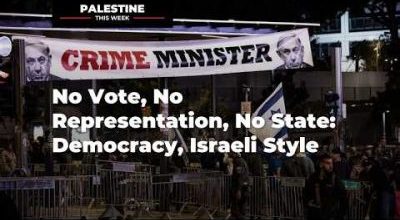
No Vote, No Representation, No State: Democracy, Israeli Style
or go to
Aletho News Archives – Video-Images
From the Archives
Sanctions, War and the Policy of Dual Containment
By SASAN FAYAZMANESH | March 17, 2008
It is now nearly three decades since the Unites States adopted the policy of dual containment of Iran and Iraq. While much has been written about the containment of Iraq, there has been very little in-depth analysis of this policy when it comes to Iran. In a book that is going to be released on March 31, 2008, entitled The United States and Iran: Sanctions, Wars and the Policy of Dual Containment (Routledge), I attempt to address this shortcoming by investigating when and why the US policy of containment of Iran came about, how it evolved, and where it stands today.[1] To the extent that Israel has been involved in US policy making, the study will also include the role that Israel has played in the containment of Iran. Also, since the fate of Iran has been inextricably linked to that of Iraq, occasionally the investigation will overlap with the containment of Iraq.
The policy of dual containment of Iran and Iraq originated during the Carter Administration, but it was not until the Clinton Administration that the expression “dual containment” became popular. … continue
Blog Roll
 Aletho News
- No Vote, No Representation, No State: Democracy, Israeli Style
- Zionist Bought Senate Blocks Information About American Citizens Killed By Israel
- While Gaza dominates the UN, these are the people keeping it alive
- New Report: “Scholasticide and Genocide in Gaza: Assessment, Testimonies and Legal Analysis”
- ‘THAAD Delusion’: Iran war exposes US missile shield limits – The Atlantic
- Moscow issues warning to NATO over Russian exclave
- Yes, the Iran war has destroyed Trump’s presidency
- The fallacy of US delusions about Iran’s economic collapse
- Hezbollah denies Syria cell link, warns of Israeli plan to sow discord
- The legacy of US sanctions, war, and occupation in Iraq
- If Americans Knew
- Mamdani releases plan to combat antisemitism and hate crimes in New York City
- Iran’s Revolutionary Guards Publish Letter to the American People
- DMFI launches $1 million ad campaign supporting Virginia’s Elaine Luria
- US Senate blocks resolution seeking report on Americans killed by Israel
- Israeli Attacks Kill Ten Palestinians in Gaza
- Massacre at Minab: The School That Became a Grave
- Israeli media: The IDF Shows It Doesn’t Turn a Blind Eye; It Actively Emboldens Settler Havoc
- As settlers ravage West Bank, Israeli forces kill 10 in Gaza – Daily Update
- New Report: “Scholasticide and Genocide in Gaza: Assessment, Testimonies and Legal Analysis”
- Ex-Biden officials are desperate for a Gaza scapegoat
- No Tricks Zone
- Green Energy Debacle: German Expert Professor Fritz Vahrenholt Warns Of Severe Economic And Social Consequences
- Two More Paleo Reconstructions Affirm Meters-Higher Sea Levels Across Ireland, Brazil 7000-6000 Years Ago
- New Study: Earth And Venus Surface Warmth Largely Explained By Convection And Lapse Rate, Not CO2 Or Radiation
- 2025 Nature Paper Claiming Worsening Global Drought Gets RETRACTED …Heavily Flawed
- New Study: ‘Global Drought Shows No Detectable Recent Acceleration Under Climate Warming’
- Economic Masterminds: German Socialists Suggest Taxing Productivity Gains Stemming From Using AI
- The South China Sea Has Not Been Cooperating With The Climate Change Narrative
- Energy Crisis: Germany Enters Heating Season With Historically Low Gas Reserve Fill Levels
- New Study: The Antarctic Ice Sheet Gained Mass From 2020-2024 Due To Staggering Snow And Ice Accumulation
- Study: Ocean Heating Rates From Thousands Of Years Ago ‘Dwarf’ Modern Ocean Heating Rates

