‘Dictatorship has Returned to Bolivia’: Morales to teleSUR
teleSUR | November 17, 2019
 The legitimately-elected President of Bolivia, Evo Morales, told teleSUR on Saturday that dictatorship has returned to the South American country, given the recent events that triggered intense repression exerted by the de-facto government chaired by Senator Jeanine Áñez .
“The Bolivian people and the whole world know that we guarantee political stability. They said ‘Evo dictatorship’, now what Bolivia is living in is what we call a dictatorship.”
The Bolivian President said he was appalled by the recent reports regarding the civilian deaths at the hands of this new dictatorship.
“The people will always be united (…) The Bolivian people have never been taken from my memory. At any moment we will be as always sharing a resistance against economic policies, but for now, for democracy, for life, my dear Bolivia,” President Morales said.
On the media censorship imposed by the de-facto government in Bolivia, President Morales said that “now there is no freedom of expression” in the country. “The de facto communication minister who answers to the dictatorship in Bolivia said that seditious journalists, national and international, will be arrested.”
He also highlighted how the integration processes promoted by past governments such as those of Venezuela, Ecuador (by former President Rafael Correa) or Brazil (with former president Lula da Silva) seek to be destroyed by the interests of the U.S. empire.
“Unfortunately, some countries subject to the U.S. empire, destroy the integration processes: Unasur a political instance, Mercosur an economic instance, Celag an integration of all Latin America towards the liberation of the peoples,” President Morales continued.
In this sense, the legitimate President of Bolivia stressed that “we, Latin Americans, have the enormous responsibility, regardless of an economic, programmatic or social liberation, to free ourselves from the technological part.”
“Those who seek disintegration are not thinking about technological liberation, they are instruments of the capitalist system that will never like us to free ourselves from the technological part to establish sovereignty in our Latin America,” he added.
France’s year of Yellow Vests protests
By Nebojsa Malic | RT | November 16, 2019
As the ‘Yellow Vests’ protests in France come full circle, some vow to keep fighting for a more just society, while others believe the movement has gone too far. Though rattled, the system they rose up against is still in power.
Every Saturday for a year now, tens of thousands of people all over France have taken to the streets, fed up with not just the neoliberal and austerity policies of President Emmanuel Macron, but apparently the entire political system of the Fifth Republic.
The government has gone after them in force, pushing the police to their breaking point. The mainstream media has demonized them as anti-Semites, homophobes, far-right. Nevertheless, the ‘Yellow Vests’ (Gilets Jaunes) have persisted.
How it all began
A Frenchman marching through the streets of Paris, Lyon, Nice, Marseille, Dijon or any other city this Saturday might recall the very first protest, on November 17, 2018, with 300,000 across the country wearing the government-mandated safety vests as a protest symbol against that very government.
While it is unclear which particular pebble started this avalanche, the general consensus points to that summer’s new speed limit of 80 km/h, ostensibly enacted to cut carbon emissions and fight climate change. That was followed by an “eco-tax.” Whether or not those had the ulterior motive of replenishing the empty French treasury, the people were having none of it.
Trucker Eric Drouet and businesswoman Priscillia Ludosky circulated a petition against the tax in October, which quickly snowballed. Then a resident of Brittany named Jacline Mouraud posted a video on Facebook that went viral. Someone called for a street protest. There has been one every Saturday, ever since.
‘Repression is out in the open now’
Here and there, the protests turned violent. Rocks were thrown at the police. By week two, someone had vandalized the Arc de Triomphe in Paris and set cars on fire. Police responded as they do to riots in the banlieues – suburbs where many of France’s immigrants live in public housing: with overwhelming force.
This kind of repression has been around for a long time, Yellow Vest activist turned journalist Maxime Nicolle tells RT France. Now it’s out in the open, for everyone to see.

Yellow Vests’ Maxime Nicolle (right) speaks with RT France’s Nadège Abderrazak © RT France
Exact numbers are difficult to come by, but French media estimate that over 10,000 people have been detained over the past year. Some 3,000 have been prosecuted and over 400 sentenced to jail time. The carnage on the street has been real as well: 11 people have died over the course of the protests, and over 500 were injured. Of those, 23 lost an eye to “flash-balls,” non-lethal police rounds that maim nonetheless.
Perhaps the most famous among them is Jérôme Rodrigues, a plumber who believes the police deliberately targeted him that January day. Wearing a prosthetic eye, Rodrigues tells RT France he struggles with anger issues and fears for his safety, but if he could turn back time, he would do it all over again.
‘Upside-down world’
The 32-year-old Nicolle, also known as “Fly Rider,” lives in Dinan, Bretagne. His eyes light up with anger when he talks about his compatriots reduced to poverty in their twilight years and his generation sleeping in their cars because they can’t afford the rent and taxes. Meanwhile, he says, the elites are “eating caviar, drinking €500 bottles of wine, living in pretty Paris apartments.”
He rejects the argument that France’s national debt is 98 percent of its GDP and that there is simply no money for social services. Nicolle points out the government takes out loans from private banks, then has to pay steep interest. Why not nationalize the banks, he wonders.
Hundreds of kilometers away, in Paris, the one-eyed Rodrigues argues the same thing. He describes the debt as “numbers in a computer,” and scoffs that somehow there is always money for the wealthy, yet never any for the common man. Corporations have their subsidies and tax havens, yet the working poor have to pay the tax to clean up their pollution. What gives?
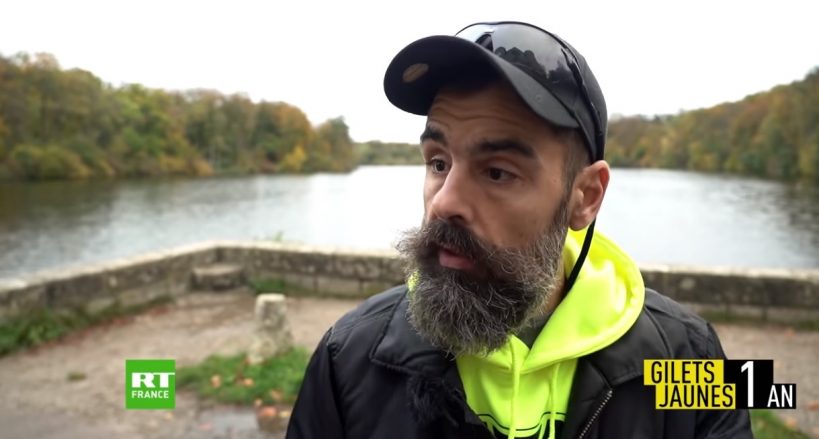
Yellow Vests’ Jérôme Rodrigues speaks with RT France © RT France
“Today, if you make €1,500 [a month] in France, you can’t afford rent, you have to sleep in your car. That’s not normal. A working person has the right to live decently,” says Rodrigues. “It’s an upside-down world.”
In separate interviews, both Rodrigues and Nicolle argue that the system itself is unjust, as it thinks nothing of humanity, only of ones and zeroes on the balance sheets. The institutions that were supposed to serve the people have failed, and perhaps it’s time to create new ones. Could the Fifth Republic, around since 1968, be on its last legs?
Almost a revolution
That’s precisely what almost happened within the first month of the Yellow Vests protest, according to one Elysee Palace guard. A member of the special police unit specializing in crowd control (CRS) said this week that the handful of them could not have resisted the 3,000 or so protesters for long.
“If we had been attacked, where I was, we could not have held: the Elysee would fall. In retrospect, it’s really scary,” said the man, who gave his name as Stéphane.
The Yellow Vests did not attack. Macron’s presidency survived. Although the French president has since pledged some €17 billion in tax relief, one-time bonuses and subsidies, he remains determined to reject their demands for systemic reforms. While the protesters never quite numbered the original 300,000, they still turn out every Saturday.
Protests have taken their toll on the police, too, with the rising number of suicides prompting a protest march of their own back in October. The thin blue line is still holding, for now, but it cannot stretch forever.
Parallel to the police repression, the government has implemented a media one. The Yellow Vests were accused of anti-Semitism, homophobia, Islamophobia, xenophobia, racism – just about every possible issue considered beyond the pale in modern liberal discourse.
Nicolle says it was an attempt to label the movement and put it into a box, which failed. People who took a moment to think saw that there was nothing to it and that the Yellow Vests were not an instrument of any political party, whether on the far right or the far left. The smears did have a negative effect, however, fracturing the movement and sending some members running.
Gone too far?
One of them is Jacline Mouraud, the author of the Facebook video that helped kick-start the protests. She lives in Morbihan, Bretagne and still champions the movement’s social and economic justice values – but says they lost her when the Arc de Triomphe was vandalized in December, and “black bloc” anarchists were allowed to torch cars and loot stores in March.

Yellow Vests’ Jacline Mouraud speaks to RT France © RT France
“Violence is counterproductive,” she tells RT France. “Bad dialogue is better than a good war.” At the start of the protests, 80 percent of the French supported the protests, but the tide has turned and now four fifths of the country want nothing to do with the Yellow Vests, she says. “One should know when to stop.”
The March 16 riot in particular alienated many moderates, Mouraud argues. She had already turned political by that point, launching a political party in January 2019. Called The Risen (Les Émergents), it intends to run candidates in France’s local elections in 2020.
Even though she had split off from the ‘Yellow Vests,’ Mouraud’s party exemplifies their desire to bring more direct democracy to France, a country where the existing political establishment is increasingly seen as out of touch.
‘People will make you great’
President Macron “lives in another world,” Rodrigues tells RT France. The one-eyed plumber described the French leader as isolated from reality, in an ivory tower guarded by police, working for the benefit of “his rich friends” – Macron became a millionaire working as an investment banker at Rothschild & Co after the 2008 financial crisis – rather than the “folks in the rafters.”
“You want to be a great man? It’s the people that make you great,” Rodrigues said, noting that the French history remembers the statesmen who served the nation well, rather than just themselves.
Macron and the media have tried to paint the Yellow Vest as “far-right,” but their platform seems to have more in common with the left of yesteryear. They say they fight not just for their children – such as Nicolle’s 9-year-old daughter – but for the memory of their grandparents’ generation, which fought for the rights the French of today take for granted; the 40-hour workweek, weekends and annual leave.
Not quite a revolution, but definitely not business as usual, the ‘Yellow Vests’ defy categorization. Though maybe not attracting the numbers they once did, the Gilets Jaunes are still going strong. For better or for worse, stopping is the last thing on their mind.
Also on rt.com:
March of the mutilated: Injured Yellow Vests protest police brutality in Paris (VIDEO)
UN Votes to Renew UNRWA Mandate
Palestine Chronicle – November 16, 2019
The overwhelming vote at the United Nations General Assembly’s Fourth Committee in favor of renewing the mandate of the UN Relief and Works Agency for Palestine Refugees (UNRWA) dominated the front page of the three Palestinian Arabic dailies today.
This issue was given special attention in light of American and Israeli efforts to do away with UNRWA as part of a plan to undermine Palestinian refugee rights in their homeland they were expelled from 70 years ago when Israel was created on their land and in their homes.
The US and Israel were the only two states voting against the renewal of the mandate while 170 countries voted in favor.
Al-Hayat al-Jadida said President Mahmoud Abbas welcomed the vote.
Kashmir after India’s unilateral move: A story of fear and hopelessness
By Shahana Butt | Press TV | Nov 15, 2019
Indian-Administered Kashmir – More than 100 days have passed since India stripped Kashmir of its autonomous status and divided the state into two federally-ruled territories. The region has been observing a protest close down ever since; with shops, businesses and schools shunned by the people in protest against New Delhi’s move.
Although India has promised the return of normalcy in the region through equal rights and development; rumors are moving the other way round.
The return of check posts and eruption of new security bunkers across the Muslim majority region has pulled back the horror scenes of 1990’s in Kashmir and has all together made it more difficult for the people living in the world’s largest militarized zone.
In the past 100 plus days hundreds of bunkers have been built in addition to the existing security vigil; the prevailing circumstances have further silenced the people of Kashmir.
Press TV spoke to a cross section of people in Kashmir to know how they see this new Kashmir and what they faced in the past 100 plus days.
Since august 5 people of Kashmir are living in a controlled communication zone; with no internet facilities and limited cellular network that was provided after the intervention of India’s top court and international criticism.
In the absence of international concern and given New Delhi’s ‘not so clear’ Kashmir agenda people of Kashmir are caught in skepticism, doubt and fear.
Sooner or later so called ‘normalcy’ might return to the valley of Kashmir. But India’s unilateral move and the world’s turning a blind eye to the issue has left a deep-rooted impact on the lives of people here. This has added to the existing alienation of Kashmir, where people accuse both India and Pakistan of playing the Kashmir card for political and strategic gains.
Israel has cracked down on Palestinian education, criminalising hundreds of students
By Megan Giovannetti | MEMO | November 15, 2019
Khaleel Shaheen is a senior at Birzeit University in Ramallah. When he heard that four close friends and fellow students were arrested by the Israeli authorities, he didn’t go to the campus for five days.
As a volunteer with Birzeit’s Right to Education Campaign — a student-led group which monitors Israeli violations against students — Shaheen is finding it difficult to continue his work as normally as possible while this latest crackdown against students unfolds.
“I feel so angry,” he told me. “I feel so helpless. “I cannot just go to school. I cannot focus. I cannot function to go to class.”
According to the Right to Education Campaign, 20 students have been detained by the Israeli authorities since the beginning of the current academic year. This is nothing new. Since 2004, more than 1,000 students enrolled at Birzeit have been arrested, 80 of whom are still in Israeli prisons. Seventeen of these are currently held under administrative detention, a process which Israel uses systematically to hold Palestinians indefinitely with neither charge nor trial.
Students are often denied access to a lawyer for up to 60 days and subjected to harsh interrogation and treatment in Israeli custody. Most are taken from their homes in the middle of the night or even kidnapped directly from campus.
Addameer, a Palestinian prisoner support and human rights association, told me that a total of 250 students across various Palestinian universities are currently in Israeli prisons. “There are also around 190 Palestinian children detained and imprisoned in Israeli jails, of whom 20 are under 16 years old,” Addameer’s advocacy officer pointed out. “Those children are all students in primary or secondary schools.”
In an exclusive statement to MEMO, Birzeit University described this escalation of arrests as an ongoing Israeli policy targeting students who have political affiliations and activism. “They are targeting students who are very active in the student movement in the university,” Shaheen explained. “They are not just going after people at random.”
Birzeit University is the only West Bank higher education institution which holds student body elections, with representation from all Palestinian political parties. In a society that has not held a General Election since 2007 — hence the deadlocked political system and a president whose own term ended 10 years ago — Birzeit University’s elections are one of the only ways to gauge public opinion.
“These elections are very, very important for both the [Palestinian] government and the [Israeli] occupation [because] it depicts the streets… and what the new generations are voting for,” said Shaheen. He confirmed that no particular political party’s members appear to be targeted; arrests occur across the spectrum of political affiliation.
Birzeit seems to be targeted because of its reputation for producing politically active students. “The students care so much about politics,” added Shaheen. “They care about what is happening on the streets.” He told me about the weekly demonstrations that students arrange in support of prisoners, refugees and martyrs; or simply demanding their right to education.
The student body council has the power to gather students together and give them a voice. “For the Israelis, this is dangerous. It’s dangerous for them [to have] active students who have a voice and opinions, and influence the opinions of others.”
Last year, a video went viral of undercover Israeli forces kidnapping the president of the student body council, Omar Kiswani, directly from Birzeit’s campus. The video and various reports show six plain-clothed officers beating Kiswani and firing their guns in broad daylight.
Birzeit University faculty member and Professor of Media Dr Widad Bargouthi was swept up in the latest round of Israeli arrests based on a military law of “incitement”. According to Addameer, the indictment was based on social media posts made by Dr Bargouthi, despite them being a part of a class regarding the basic journalistic principles of freedom of expression.
“I believe that most of those arrests [are carried out] to create an atmosphere of fear inside the university,” Shaheen said. This has drawn students away from making social media posts or even simply attending classes. “They want to make students fearful of everything.”
When asked for a comment, the office of the Israel Defence Forces spokesperson indicated that the cases are under investigation by Shin Bet, the internal security agency, and no information could be shared. “The students that are in custody have been suspected of terrorist attacks in which Israeli citizens were killed,” is all that the spokesperson would say. No details of the specific “terrorist attacks” in question were provided.
A public gag order on all student cases was issued on 10 September and has been renewed twice. The current order will expire on 7 December. This limits Addameer’s ability for advocacy. The order — requested by Shin Bet — was not issued by a military court, but a civil court in Jerusalem. “The session was one-sided, without the prisoners or their lawyers [present],” said Addameer’s advocacy officer.
Birzeit University told MEMO that Israel’s policy of arresting students and teachers is a “grave violation” of basic rights to education and academic freedom. “The reality now is turning higher education in Palestine from safe spaces where students can grow, excel and express themselves freely, into zones where students are in grave danger both on and off campus.”
Israel’s crackdown on Palestinian education is criminalising hundreds of young people. This is not the act of a genuine democracy.
READ ALSO:
Jewish Nation-State Law added to Israel high school curriculum
Israel students forced to pass government propaganda course before overseas school trips
Tehran rejects Canada-drafted human rights resolution against Iran
Press TV – November 15, 2019
Tehran has rejected a United Nations human rights resolution against Iran as a “politically motivated” instance of hypocrisy and “abuse” of UN mechanisms by Western governments targeting independent states.
Foreign Ministry spokesman Abbas Mousavi made the comments on Thursday shortly after the Third Committee of the United Nations General Assembly passed a Canada-drafted resolution criticizing Iran’s human rights record earlier in the day.
Of a total number of 182 countries participating in the vote, 84 voted in favor of the resolution while 30 voted against it. Another 66 states abstained.
During the voting session, representatives from countries including Pakistan, Syria, Venezuela and Belarus expressed opposition to the motion.
China and Russia also rejected the resolution as “politicization” of human rights issues while North Korea and Cuba described the vote as an excuse for destabilizing and pressuring other governments.
Double standards
Speaking on Thursday, Mousavi said that among the states backing the resolution were “governments with a long record in the systematic violation of human rights.”
The spokesman added that countries whose interventions in foreign countries and “their allies’ dictatorships and occupation” have left “bitter memories for people across the world” are “in no position to make human rights recommendations for Iran.”
“One of the main backers of this resolution, the United States, is violating the most basic rights of more than 83 million Iranian citizens by engaging in economic terrorism, specifically targeting women, children, seniors and medical patients,” he said.
Mousavi highlighted that certain backers of the resolution, such as Israel and other “backward regimes” in the region, are guilty of killing the people of Palestine, Yemen and oppressing domestic dissidents.
The spokesman added that the Universal Periodic Review, a periodic review of the rights situation held on a rotational basis for all UN member states every three years, presented a suitable opportunity to evaluate the conduct of states far from any sort of discrimination.
“Iran, as a religious democracy, seeks to take steps in the betterment of human and citizen rights on a domestic, regional and international level within the framework of its constitutional and civil commitments and international undertakings,” he said.
Canada, under the heavy influence of Zionist interest groups, is known to regularly draft an anti-Iran resolution every year.
Tehran has in response highlighted that Ottawa itself has long been involved in a broad range of human rights abuses at home and elsewhere.
Canada has proceeded with its plans to supply Saudi Arabia with weapons in the past year despite human rights concerns regarding their use in the ongoing war on Yemen.
Canada has also been accused of a wide range of abuses targeting its aboriginal population.
At Least 12 Dead Following Coup in Bolivia
teleSUR | November 14, 2019
At least 12 Bolivians have been killed and more than 530 injured by the violence that escalated in Bolivia following the coup against constitutional president Evo Morales, denounced the Ombudsman’s Office.
The human rights agency explained on its official website that among the injured are women, children, adolescents and journalists.
In turn, the institution – created in 1994 by constitutional mandate – posted on its Twitter account that on November 11 and 12, five Bolivians were killed (out of the total).
Of those deaths, four were due to the gunshots fired by the Armed Forces and the Police, and one due to suffocation by strangulation, the Ombudsman’s Office explained on its digital platform.
The events that forced Evo Morales’s resignation and consummated the coup d’état were unquestionably violent, as reported in an article published on the Mision Verdad webpage.
Opposition gangs attacked numerous politicians of the ruling Movement Towards Socialism, looted Morales’ house, and burned the residences of several high-level politicians, detailed the article.
Evo Morales announced his resignation as president on November 10 to stop the bloodshed, however, during a press conference in Mexico a country that granted him political asylum to preserve his life – he acknowledged that his decision did not halt the social upheaval.
In that sense, Morales called on the military to stop the bloodshed and initiate a national dialogue.
Federal Court Rules Suspicionless Searches of Travelers’ Phones and Laptops Unconstitutional
Activist Post | November 12, 2019
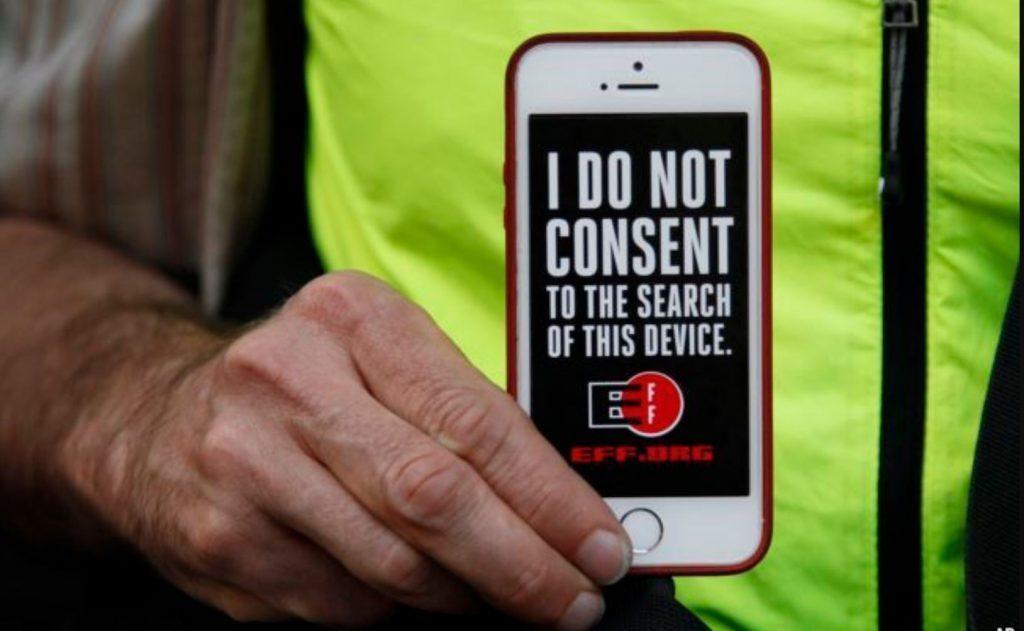
In a major victory for privacy rights at the border, a federal court in Boston ruled today that suspicionless searches of travelers’ electronic devices by federal agents at airports and other U.S. ports of entry are unconstitutional.
The ruling came in a lawsuit, Alasaad v. McAleenan, filed by the American Civil Liberties Union (ACLU), Electronic Frontier Foundation (EFF), and ACLU of Massachusetts, on behalf of 11 travelers whose smartphones and laptops were searched without individualized suspicion at U.S. ports of entry.
“This ruling significantly advances Fourth Amendment protections for millions of international travelers who enter the United States every year,” said Esha Bhandari, staff attorney with the ACLU’s Speech, Privacy, and Technology Project. “By putting an end to the government’s ability to conduct suspicionless fishing expeditions, the court reaffirms that the border is not a lawless place and that we don’t lose our privacy rights when we travel.”
“This is a great day for travelers who now can cross the international border without fear that the government will, in the absence of any suspicion, ransack the extraordinarily sensitive information we all carry in our electronic devices,” said Sophia Cope, EFF Senior Staff Attorney.
The district court order puts an end to Customs and Border Control (CBP) and Immigration and Customs Enforcement (ICE) asserted authority to search and seize travelers’ devices for purposes far afield from the enforcement of immigration and customs laws. Border officers must now demonstrate individualized suspicion of illegal contraband before they can search a traveler’s device.
The number of electronic device searches at U.S. ports of entry has increased significantly. Last year, CBP conducted more than 33,000 searches, almost four times the number from just three years prior.
International travelers returning to the United States have reported numerous cases of abusive searches in recent months. While searching through the phone of Zainab Merchant, a plaintiff in the Alasaad case, a border agent knowingly rifled through privileged attorney-client communications. An immigration officer at Boston Logan Airport reportedly searched an incoming Harvard freshman’s cell phone and laptop, reprimanded the student for friends’ social media postings expressing views critical of the U.S. government, and denied the student entry into the country following the search.
For the order:
https://www.eff.org/document/alasaad-v-nielsen-summary-judgment-order
For more on this case:
https://www.eff.org/cases/alasaad-v-duke
For more about border searches:
https://www.eff.org/issues/border-searches
The “Officer Friendly” Police Fantasy
By James Bovard | FFF | November 11, 2019
Police in Tempe, Arizona, announced plans in July for a “positive ticketing” campaign to pull over drivers who had violated no traffic laws. A Phoenix TV station reported that the police would give the people they targeted free soft-drink coupons for Circle K as a reward for their “good driving behavior.” Police in other areas have run similar programs in recent years but the TV news report on Tempe’s plan spurred a torrent of testy Tweets:
“Keep your hands on the wheel and don’t make any sudden moves while you are being rewarded, it could cost you your life.”
“We gunned him down…. well, he refused to stop for his coupon. Self defense. Case dismissed.”
“Um, WHAT?!? They better not stop me for driving legally cause that’s illegal! #harassment”
“What if you don’t stop?”
“Cops to profile for illegal immigrants under the guise of campaign to promote good driving.”
“There goes probable cause right out the window. Police state 101.”
“I would get a panic attack. My reward for driving well is not dying. That’s all I want.”
“Unless it’s a ruse to illegally search your vehicles. And if they notice anything out of line during the mock pullover you’ll be arrested.”
“What’s next? Are they going to start walking into people’s houses to congratulate them for not breaking the law?”
One commenter suggested he could be fined for “resisting a coupon” for free drinks.
A few months before its “positive ticketing campaign” announcement, Tempe police were harshly criticized after one of their officers shot a 14-year-old boy in the back, killing him as he was running away while holding a replica airsoft pistol. An Arizona ACLU employee summarized the situation on Twitter:
“Tempe cops: the community doesn’t trust us after we shot and killed an unarmed teen (sic) what do we do
Community: stop killing us
Tempe cops: FREE THIRSTBUSTERS AND UNREASONABLE STOPS”
The Tempe Police Department responded to the uproar by issuing a statement stating that they never intended to pull over motorists without good cause. Instead, the free-coupon program would be targeted to pedestrians, bicyclists, and skateboarders. But the furious reaction of people across the nation signaled the profound distrust of police.
This is presidential campaign season, and Democratic presidential candidate Pete Buttigieg claims that he will be able to end the pervasive distrust of the police. In one of the first candidate debates, he said he is “determined to bring about a day when” any driver, white or black, has “a feeling not of fear but of safety” when he sees a police officer approaching.
And how would Buttigieg, the mayor of South Bend, Indiana, achieve this profound change? He has not yet detailed his panacea. Perhaps he believes that sensitivity training or racial consciousness-raising classes could do the trick. But Buttigieg has ignored the real source of the problem: politicians have given police so much power that citizens naturally fear them.
Arresting anyone
In 2001, the Supreme Court ruled that police can justifiably arrest anyone believed to have “committed even a very minor criminal offense.” That case involved Gail Atwater, a Texas mother who was driving slowly near her home but, because her children were not wearing seatbelts, she was taken away by an abusive cop whose shouting left her children “terrified and hysterical.” A majority of Supreme Court justices recognized that “Atwater’s claim to live free of pointless indignity and confinement clearly outweighs anything the City can raise against it specific to her case” — but upheld the arrest anyhow.
Justice Sandra Day O’Connor warned that “such unbounded discretion carries with it grave potential for abuse.” Unfortunately, there are endless pretexts for people to be arrested nowadays because federal, state, and local politicians and officials have criminalized daily life with hundreds of thousands of edicts. Capt. Steve Powell of the Colorado State Patrol commented, “Ninety percent of the cars out there are doing something that you can pull them over for. There are a jillion reasons people can be stopped — taillights, windshields cracked, any number of things.” Gerard Arenberg, executive director of the National Association of Chiefs of Police, told me in the 1990s, “We have so damn many laws, you can’t drive the streets without breaking the law. I could write you a hundred tickets depending on what you said to me when I stopped you.”
Justice O’Connor noted in her dissent that the Fourth Amendment “guarantees the right to be free from ‘unreasonable searches and seizures.’” But when politicians have enacted endless laws that make almost everyone a criminal, then the Fourth Amendment is practically null and void.
Asset-forfeiture laws give police sweeping arbitrary power over Americans’ wallets, cars, and homes. Indiana Solicitor General Thomas Fisher told the Supreme Court in 2018 that the government is entitled to confiscate cars that exceed speed limits by 5 miles per hour — a standard that would justify seizing most vehicles. Between 2001 and 2014, lawmen seized more than $2.5 billion in cash from 60,000 travelers on the nation’s highways — with no criminal charges in the vast majority of cases, the Washington Post reported.
Police have been trained to confiscate private property of drivers by absurdly claiming that “trash on the floor of a vehicle, abundant energy drinks, or air fresheners hanging from rearview mirrors” are signs of criminal activity. Blacks and Hispanics have been victimized far more often by such laws. Tenaha, Texas, police ran an operation that stopped and plundered almost anyone passing through their East Texas locale. The names of the court filings capture Tenaha’s voraciousness, such as State of Texas v. One Gold Crucifix. “The police had confiscated a simple gold cross that a woman wore around her neck after pulling her over for a minor traffic violation. No contraband was reported, no criminal charges were filed, and no traffic ticket was issued,” the New Yorker noted. If drivers “refused to part with their money, officers threatened to arrest them on false money laundering charges and other serious felonies,” an ACLU lawsuit charged. Tenaha police stopped a 27-year-old black man who worked as a chicken slicer in a Tysons plant in Arkansas and fleeced him of $3,900 after detecting him “driving too close to the white line.”
Subverting the Fourth Amendment
Police have gutted the Fourth Amendment with dogs that will give them a positive alert almost any time they seek a pretext to forcibly search someone’s vehicle. The fact that canines are sometimes trained to give false alerts is irrelevant as long as the government always wins. Canine alerts to currency are routinely used to justify seizures even though most U.S. currency has trace amounts of drug contamination. For 30 years, the courts have condemned the abuses based on currency seizures due to dog alerts. But the official robberies continue.
There is a long history of federal, state, and local officials partnering to fabricate pretexts to stop drivers. From 1992 through 2013, the Drug Enforcement Administration illegally commandeered the phone records of all Americans who called most of the foreign nations in the world, as USA Today revealed in 2015. To keep its phone-record seizures secret, the DEA partnered with local police to concoct phony reasons for traffic stops that sometimes included staging fake auto accidents and even car thefts. Why should citizens trust law-enforcement agencies that engaged in decades of systemic fraud? If bureaucrats and cops gave themselves an unlimited right to lie regarding the source of their evidence, what other lies have they permitted themselves in the war against any American who possesses substances of which politicians disapprove?
Uncle Sam has brought the surveillance state to the nearest police car dashboard. Federal grants have enabled many states and localities to equip police cars with license-plate scanners that provide plenty of bogus pretexts to harass hapless drivers.
License-plate readers often misread plates. Brian Hofer was pulled off Interstate 80 in California and handcuffed and held at gunpoint after his rental vehicle was misreported as stolen. Hofer commented in 2019, “I’m sitting ice-cold and saying nothing because I do not want any itchy trigger fingers.” With an error rate approaching 10 percent, license-plate readers effectively generate potentially thousands of false accusations each day.
Subverting the Second Amendment
Local officials exploit surveillance data to subvert the Second Amendment. John Filippidis was driving with his family through Maryland when he was pulled over by a Maryland transportation policeman outside a Baltimore tunnel. The policeman ordered Filippidis out of his car and angrily demanded to know where his gun was. Filippidis has a Right to Carry (RTC) permit from Florida — where he had left his firearm. Police spent hours questioning him and searching his minivan before permitting him to move on, leaving his wife and daughters utterly distraught. Maryland police have targeted and rigorously searched other out-of-state drivers with RTC permits (which Maryland does not recognize). Federal grants enabled Maryland to equip hundreds of police cars with license-plate scanners that create almost 100 million records per year detailing exactly where and when each vehicle travels.
The war on drugs and its endless crackdowns and intrusions spurred far more distrust of police but politicians learned nothing from its debacles. Sixteen states have raised the smoking age to 21, and there is a push (supported by Sen. Majority Leader Mitch McConnell) to dictate a federal smoking age of 21. Why not simply issue a federal mandate for an annual additional 10 million unnecessary confrontations between police and youth? Criminalizing private vices is the surest way to make law enforcement a public menace.
Citizens are wary of police cars in their rear-view mirrors because politicians and judges made average Americans legally inferior to anyone with a badge and a gun. Police almost always receive legal immunity when they unjustifiably shoot people — it is practically a perk of their job. The existence of video footage from dashboard cams and police cameras is helping to ravage the final remnants of police credibility in many areas. The pervasive cover-ups and lies that follow dubious killings by police do more to spur wariness than a million “Officer Friendly” public-service announcements can counteract.
The best way to encourage citizens to have “a feeling not of fear but of safety” when they see a cop is to repeal legions of laws empowering police to unjustifiably accost and wrongfully subjugate peaceful citizens. But that is unlikely to happen as long as most politicians are more interested in power than in domestic tranquility.
A lesson for the Palestinian leadership: Real reasons behind Israel’s arrest and release of Labadi, Mi’ri

Jordanian citizen Heba Al-Labadi (C), following detention by Israeli forces, was released from prison and returned to Jordan on 6 November 2019
By Ramzy Baroud | MEMO | November 11, 2019
The release on November 6 of two Jordanian nationals, Heba al-Labadi and Abdul Rahman Mi’ri from Israeli prisons was a bittersweet moment. The pair were finally reunited with their families after harrowing experiences in Israel. Sadly, thousands of Palestinian prisoners are still denied their freedom, still subjected to all sorts of hardships at the hands of their Israeli jailers.
Despite the jubilant return of the two prisoners, celebrated in Jordan, Palestine and throughout the Arab world, several compelling questions remain unanswered: why were they held in the first place? Why were they released and what can their experience teach Palestinians under Israeli occupation?
Throughout the whole ordeal, Israel failed to produce any evidence to indict Labadi and Mi’ri for any wrongdoing. In fact, it was this lack of evidence that made Israel hold the two Jordanian nationals in Administrative Detention, without any judicial process whatsoever.
Oddly, days before the release of the two Jordanians, an official Israeli government statement praised the special relationship between Amman and Tel Aviv, describing it as “a cornerstone of stability in the Middle East”.
The reality is that the relationship between the two countries has hit rock bottom in recent years, especially following US President Donald Trump’s advent to the White House and the subsequent, systematic dismantling of the “peace process” by Trump and the Israeli government.
Not only did Washington and Tel Aviv demolish the region’s political status quo, one in which Jordan featured as a key player, top US diplomats also tried to barter with King Abdullah II so that Jordan would settle millions of Palestinian refugees in the country in exchange for large sums of money.
Jordan vehemently rejected US offers and attempts at isolating the Palestinian leadership in Ramallah.
On October 21, 2018, Jordan went even further, by rejecting an Israeli offer to renew a 25-year lease on two enclaves in the Jordan Valley, Al-Baqura and Al-Ghamar. The government’s decision was a response to protests by Jordanians and elected parliamentarians, who insist on Jordan’s complete sovereignty over all of its territories.
This particular issue goes back years. Jordan and Israel signed a peace treaty in 1994. An additional annex in the treaty allowed Israel to lease part of the Jordan Valley for 25 years. A quarter of a century later, the Jordan-Israel Peace Treaty failed to achieve any degree of meaningful normalization between both countries, especially as neighboring Palestine remains under Israeli occupation. The stumbling block of that coveted normalization was – and remains – the Jordanian people, who strongly rejected a renewed Israeli lease over Jordanian territories.
Israeli negotiators must have been surprised by Jordan’s refusal to accommodate Israeli interests. With the US removing itself, at least publicly, from the brewing conflict, Israel resorted to its typical bullying, by holding two Jordanians hostage, hoping to force the government to reconsider its decision regarding the Jordan Valley.
![Palestinians stage a demonstration in support of Palestinian-Jordanian woman Hiba Al-Labadi, who stages a hunger strike after she was arrested by Israeli forces, in East Jerusalem on 31 October 2019. [Mostafa Alkharouf - Anadolu Agency]](https://i0.wp.com/www.middleeastmonitor.com/wp-content/uploads/2019/11/20191031_2_39089439_49038745.jpg?resize=933.5%2C622&quality=85&strip=all&ssl=1)
Palestinians demonstrate in support of hunger striking Hiba Al-Labadi, after her arrest by Israeli forces, in East Jerusalem on 31 October 2019. [Mostafa Alkharouf – Anadolu Agency ]
The Israeli strategy backfired. The arrest of Labadi – who started a hunger strike that lasted for over 40 days – and Mi’ri, a cancer survivor, was a major PR disaster for Israel. Not only did the tactic fail to deliver any results, it further galvanized the Jordanian people, and government regarding the decision to reclaim Al-Baqura and al-Ghamar.
Labadi and Mi’ri were released on November 6. The following day, the Jordanian government informed Israel that its farmers will be banned from entering Al-Baqura area. This way, Jordan retrieved its citizens and its territories within the course of 24 hours.
Three main reasons allowed Jordan to prevail in its confrontation with Israel. First, the steadfastness of the prisoners themselves; second, the unity and mobilization of the Jordanian street, civil society organizations and elected legislators; and third, the Jordanian government responding positively to the unified voice of the street.
This compels the question: what is the Palestinian strategy regarding the nearly 5,000 Palestinian prisoners held unlawfully in Israel?
While the prisoners themselves continue to serve as a model of unity and courage, the other factors fundamental to any meaningful strategy aimed at releasing all Palestinian prisoners remain absent.
Although factionalism continues to undermine the Palestinian fight for freedom, prisoners are fighting the same common enemy. The famed “National Conciliation Document”, composed by the unified leadership of Palestinian prisoners in Israeli jails in 2006, is considered the most articulate vision for Palestinian unity and liberation.
For ordinary Palestinians, the prisoners remain an emotive subject, but political disunity is making it nearly impossible for the energies of the Palestinian street to be harnessed in a politically meaningful way. Despite much lip service paid to freeing the prisoners, efforts aimed at achieving this goal are hopelessly splintered and agonizingly factionalized.
As for the Palestinian leadership, the strategy championed by Palestinian Authority leader, Mahmoud Abbas, is more focused on propping up Abbas’ own image than alleviating the suffering of the prisoners and their families. Brazenly, Abbas exploits the emotional aspect of the prisoners’ tragedy to gain political capital, while punishing the families of Palestinian prisoners in order to pursue his own self-serving political agenda.

Jordanian citizen Heba Al-Labadi (C) was released from an Israeli prison and has returned to Jordan on 6 November 2019
“Even if I had only one penny, I would’ve given it to the families of the martyrs, prisoners and heroes,” Abbas said in a theatrical way during his United Nations General Assembly speech last September.
Abbas, of course, has more than one penny. In fact, he has withheld badly needed funds from the families of the “martyrs, prisoners and heroes.” On April 2018, Abbas cut the salaries of government employees in Gaza, along with the money received by the families of Gaza prisoners held inside Israeli jails.
Heba al-Labadi and Abdul Rahman Mi’ri were released because of their own resolve, coupled with strong solidarity exhibited by ordinary Jordanians. These two factors allowed the Jordanian government to publicly challenge Israel, leading to the unconditional release of the two Jordanian prisoners.
Meanwhile, thousands of Palestinian prisoners, including 500 administrative detainees continue to languish in Israeli prisons. Without united and sustained popular, non-factional mobilization, along with the full backing of the Palestinian leadership, the prisoners are likely to carry on with their fight, alone and unaided.
See also:
Israel and the PA: security relations have never been better
Israel is silencing the last voices trying to prevent abuse of Palestinians
By Jonathan Cook – The National – November 11, 2019
It has been a week of appalling abuses committed by Israeli soldiers in the West Bank – little different from the other 2,670 weeks endured by Palestinians since the occupation began in 1967.
 The difference this past week was that several entirely unexceptional human rights violations that had been caught on film went viral on social media.
One shows a Palestinian father in the West Bank city of Hebron leading his son by the hand to kindergarten. The pair are stopped by two heavily armed soldiers, there to help enforce the rule of a few hundred illegal Jewish settlers over the city’s Palestinian population.
The soldiers scream at the father, repeatedly and violently push him and then grab his throat as they accuse his small son of throwing stones. As the father tries to shield his son from the frightening confrontation, one soldier pulls out his rifle and sticks it in the father’s face.
It is a minor incident by the standards of Israel’s long-running belligerent occupation. But it powerfully symbolises the unpredictable, humiliating, terrifying and sometimes deadly experiences faced daily by millions of Palestinians.
A video of another such incident emerged last week. A Palestinian man is ordered to leave an area by an armed Israeli policewoman. He turns and walks slowly away, his hands in the air. Moments later she shoots a sponge-tipped bullet into his back. He falls to the ground, writhing in agony.
It is unclear whether the man was being used for target practice or simply for entertainment.
The reason such abuses are so commonplace is that they are almost never investigated – and even less often are those responsible punished.
It is not simply that Israeli soldiers become inured to the suffering they inflict on Palestinians daily. It is the soldiers’ very duty to crush the Palestinians’ will for freedom, to leave them utterly hopeless. That is what is required of an army policing a population permanently under occupation.
The message is only underscored by the impunity the soldiers enjoy. Whatever they do, they have the backing not only of their commanders but of the government and courts.
Just that point was underlined late last month. An unnamed Israeli army sniper was convicted of shooting dead a 14-year-old boy in Gaza last year. The Palestinian child had been participating in one of the weekly protests at the perimeter fence.
Such trials and convictions are a great rarity. Despite damning evidence showing that Uthman Hillis was shot in the chest with a live round while posing no threat, the court sentenced the sniper to the equivalent of a month’s community service.
In Israel’s warped scales of justice, the cost of a Palestinian child’s life amounts to no more than a month of extra kitchen duties for his killer.
But the overwhelming majority of the 220 Palestinian deaths at the Gaza fence over the past 20 months will never be investigated. Nor will the wounding of tens of thousands more Palestinians, many of them now permanently disabled.
There is an equally disturbing trend. The Israeli public have become so used to seeing YouTube videos of soldiers – their sons and daughters – abuse Palestinians that they now automatically come to the soldiers’ defence, however egregious the abuses.
The video of the father and son threatened in Hebron elicited few denunciations. Most Israelis rallied behind the soldiers. Amos Harel, a military analyst for the liberal Haaretz newspaper, observed that an “irreversible process” was under way among Israelis: “The soldiers are pure and any criticism of them is completely forbidden.”
When the Israeli state offers impunity to its soldiers, the only deterrence is the knowledge that such abuses are being monitored and recorded for posterity – and that one day these soldiers may face real accountability, in a trial for war crimes.
But Israel is working hard to shut down those doing the investigating – human rights groups.
For many years Israel has been denying United Nations monitors – including international law experts like Richard Falk and Michael Lynk – entry to the occupied territories in a blatant bid to stymie their human rights work.
Last week Human Rights Watch, headquartered in New York, also felt the backlash. The Israeli supreme court approved the deportation of Omar Shakir, its Israel-Palestine director.
Before his appointment by HRW, Mr Shakir had called for a boycott of the businesses in illegal Jewish settlements. The judges accepted the state’s argument: he broke Israeli legislation that treats Israel and the settlements as indistinguishable and forbids support for any kind of boycott.
But Mr Shakir rightly understands that the main reason Israel needs soldiers in the West Bank – and has kept them there oppressing Palestinians for more than half a century – is to protect settlers who were sent there in violation of international law.
The collective punishment of Palestinians, such as restrictions on movement and the theft of resources, was inevitable the moment Israel moved the first settlers into the West Bank. That is precisely why it is a war crime for a state to transfer its population into occupied territory.
But Mr Shakir had no hope of a fair hearing. One of the three judges in his case, Noam Sohlberg, is himself just such a lawbreaker. He lives in Alon Shvut, a settlement near Hebron.
Israel’s treatment of Mr Shakir is part of a pattern. In recent days other human rights groups have faced the brunt of Israel’s vindictiveness.
Laith Abu Zeyad, a Palestinian field worker for Amnesty International, was recently issued a travel ban, denying him the right to attend a relative’s funeral in Jordan. Earlier he was refused the right to accompany his mother for chemotherapy in occupied East Jerusalem.
And last week Arif Daraghmeh, a Palestinian field worker for B’Tselem, an Israeli human rights group, was seized at a checkpoint and questioned about his photographing of the army’s handling of Palestinian protests. Mr Daraghmeh had to be taken to hospital after being forced to wait in the sun.
It is a sign of Israel’s overweening confidence in its own impunity that it so openly violates the rights of those whose job it is to monitor human rights.
Palestinians, meanwhile, are rapidly losing the very last voices prepared to stand up and defend them against the systematic abuses associated with Israel’s occupation. Unless reversed, the outcome is preordained: the rule of the settlers and soldiers will grow ever more ruthless, the repression ever more ugly.
Jordanian Detained by Israel Says He was Used as ‘Bargaining Chip’ for Jordan Valley Lands

Heba al Labadi and Abdul Rahman Miri have been held in Israeli prisons without charges for over two months
Palestine Chronicle – November 10, 2019
A Jordanian man formerly detained in Israel has accused the neighboring country of using him and another prisoner as “bargaining chips” to prevent the loss of two Jordan Valley territories.
Abdul Rahman Miri, a Jordanian citizen of Palestinian descent, was held by the Israeli authorities for months without charge alongside fellow Jordanian Heba al-Labadi.
Their detention was not the only issue causing a diplomatic scuffle between Israel and Jordan over the past months, however.
The kingdom announced last year it would not extend a lease to Israel on two pieces of land in the Jordan Valley, ending 25 years of de facto Israeli authority over the Al-Baqura and Al-Ghamar areas.
Despite Jordan announcing its intention a year in advance of the leases’ expiration, Israeli officials and civilians in the valley have reportedly continued to hold out hope that Israeli farmers will continue to be able to live and work on the land.
Speaking on the sidelines of a meeting held by the National Committee for Jordanian Detainees and Missing Persons Held in Israeli Prisons on Friday, Miri alleged that the Israeli authorities had attempted to use his and Labadi’s detention as a “bargaining chip” with which to secure the continued lease of al-Baqura and al-Ghamar.
The Wadi Araba peace deal, signed in 1994, restored diplomatic and economic relations between Jordan and Israel. As part of the agreement, the kingdom leased Israel the Jordan Valley farmlands.
The agreement is highly contentious in Jordan, of which a significant number of citizens are of Palestinian descent. Anti-normalization activists in the kingdom have previously called for the cancellation of the Wadi Araba treaty.
Miri and Labadi returned to Jordan on Wednesday after months in detention, where they were allegedly tortured after being accused of links to Hezbollah and Hamas.
Their release came a week after Jordan recalled its ambassador to Israel over their detention.
Jordan has said Israeli citizens will be banned from entering Baqura from Sunday onward.
The kingdom has not yet stated whether Israeli farmers will be allowed to access lands in al-Ghamar.
Featured Video
The Search for Truth: Charlie Kirk’s Assassination One Year Later
or go to
Aletho News Archives – Video-Images
From the Archives
US murdering 1 million Iraqis is democracy, Iran giving yogurt to Iraq is “domination”
By Ali Salaam | American Herald Tribune | July 31, 2017
The New York Times, owned by the Zionist Jewish supremacist Ochs-Sulzberger family, has no problem with Iraqi suffering as long as Iran is not the one behind it.
The Iraq War was a genocide of the Iraqi people by Zionist supremacists in the Bush administration. Over 1 million innocent people were killed based on a lie. American soldiers died in an Israeli war and now an average of 22 soldiers commit suicide every day because their consciences cannot cope with the fact they committed crimes in an illegal war that served no purpose other than to benefit Israel, not America.
Benjamin Netanyahu, Prime Minister of the Zionist regime, once said “We are benefiting from one thing, and that is the attack on the Twin Towers and Pentagon, and the American struggle in Iraq.”
Paul Wolfowitz had his sights on Iraq since his time in the first Bush administration. Former Israeli official and Bush administration official Richard Perle had his eyes on Iraq since at least his authorship of the Clean Break white paper. The Zionist regime had their eyes on Iraq since the 1980s when strategist Oded Yinon wrote his white paper in support of dividing the Arab-Muslim world along ethnic and sectarian lines. The global Zionist lobby has had their eyes on Iraq since Theodor Herzl stated that Eretz Israel’s true borders go from the Nile River in Egypt to the Euphrates River in Iraq. … continue
Blog Roll
 Aletho News
- The Search for Truth: Charlie Kirk’s Assassination One Year Later
- ‘Harsh reality’: Iran says France seeks monopoly on power and intimidation, not peace for all
- When Will This White House Madness End?
- Huckabee aide goes to ‘unusual lengths’ to portray ‘Israel’ positively
- Trump Announces Diesel Supply Deal With Putin Following Phone Call
- MEP blasts ‘Euro-Gestapo’ for lecturing Russia on democracy
- Syria May Send Troops to Saudi Arabia Amid War with Ansar Allah
- UK whines about losing billions to ‘Putin tax’
- Baghaei to Rubio: Distorted narratives cannot erase US record of broken commitments
- Houthis Don’t Have to Conquer Saudi Arabia to Make It Pay
- If Americans Knew
- Gaza ceasefire exists in name only, say more than 100 organizations
- Nearly 2 Million in Gaza Need Urgent Shelter Assistance as Winter Looms: IOM Chief Warns
- Suppressing Palestinian resistance: US charity under fire for AI monitoring of Gaza classrooms
- Thousands Are Held in Israeli Torture Camps. This Is What Happens Inside
- Israel puts Gaza’s sick, injured, newborn in peril – Daily Update
- Report claimed Mark Levin used by Israeli government to influence Trump
- Over 2,000 Gazans have died awaiting medical evacuation amid Israel’s continued siege
- How a U.S. Diplomat Suppressed and Altered Reports Critical of Israel
- 5 Palestinians Die from Israeli Strikes in Gaza as Relentless Attacks Continue
- Report: Ceasefire Slows Killing but Leaves Devastation Intact
- No Tricks Zone
- New Study: 50 Years Of The Most Aggressive ‘Net Zero’ Policies Can Only Affect The Global Climate By 0.03°C
- US September “Heat” Was No Record…Many Records Set Decades Ago
- Latest European Green Energy Debacle; Portugal’s Largest Flagship Solar Park Insolvent!
- Green Energy Debacle: German Expert Professor Fritz Vahrenholt Warns Of Severe Economic And Social Consequences
- Two More Paleo Reconstructions Affirm Meters-Higher Sea Levels Across Ireland, Brazil 7000-6000 Years Ago
- New Study: Earth And Venus Surface Warmth Largely Explained By Convection And Lapse Rate, Not CO2 Or Radiation
- 2025 Nature Paper Claiming Worsening Global Drought Gets RETRACTED …Heavily Flawed
- New Study: ‘Global Drought Shows No Detectable Recent Acceleration Under Climate Warming’
- Economic Masterminds: German Socialists Suggest Taxing Productivity Gains Stemming From Using AI
- The South China Sea Has Not Been Cooperating With The Climate Change Narrative

