Trump’s new cyber strategy seeks global dominion over internet
RT | September 21, 2018
Setting the global standard for online behavior, preserving American dominance, political and economic interests, punishing ‘malicious actors’ like Russia and China: these are the ambitious goals of the new US cyber-strategy.
The White House published the 40-page document on Thursday afternoon, the first comprehensive cyber strategy in 15 years. The strategy’s core assumption is that the US created the internet and that Washington must maintain the dominant role in defining, shaping and policing cyberspace in much the same way as it does the globe.
All strategies are but broad outlines of general measures and overall objectives, and this one is no different. Beyond merely defending US computer networks – that’s just the first part, devoted to protecting the “American People, the Homeland, and the American Way of Life” – it wants to promote US economic prosperity while advancing influence around the world and achieving “peace through strength” as well.
The Trump administration’s approach to cyberspace is “anchored by enduring American values, such as the belief in the power of individual liberty, free expression, free markets, and privacy,” the strategy says right at the start.
It also takes as an article of faith that Russia, China, Iran, and North Korea use “cyber tools to undermine our economy and democracy, steal our intellectual property, and sow discord in our democratic processes.”
Having signed on to this central assertion of Russiagate-peddlers, the Trump administration lays out the ways in which it intends to achieve its pie-in-the-(cyber)sky objectives.
‘Securing US democracy’
The Department of Homeland Security, a vast bureaucracy established after 9/11, is supposed to centralize management and oversight of federal computer networks, with the notable exceptions of those belonging to the Pentagon and the intelligence community. Reforms are supposed to make government networks more secure, reliable and efficient, while federal contracting will drive improvements in both products and services. This is the same process that has produced the F-35, a trillion-dollar clunker.
Those obsessed with seeing Russian hackers behind every voting machine might be interested in page 9, where the strategy proposes to “secure our democracy” by… offering training and risk management to state and local governments “when requested.” Admittedly, there isn’t much more the federal government can do to protect election systems, aside from securing the network infrastructure.
A particularly interesting tidbit here is also that law enforcement will “work with private industry to confront challenges presented by technological barriers, such as anonymization and encryption technologies” to obtain “time-sensitive evidence.” This is basically a rehash of former FBI Director James Comey’s perpetual refrain about the need for backdoor access to encrypted products and services.
The most (in)famous example of this was when the FBI took Apple to court over accessing the San Bernardino terrorist suspect’s iPhone, then hiring an Israeli company to crack the device, only to find… nothing of interest.
Privacy and civil rights advocates will be overjoyed to hear that Trump also wants to “update electronic surveillance and computer crime statutes” to make sure law enforcement can gather more evidence of cyber crimes and “impose appropriate consequences upon malicious cyber actors.”
‘Promoting American prosperity’
The second pillar talks a lot about the US government sponsoring innovation and creating jobs, but its key objective is to “promote the free flow of data across borders” (p.15). And if “repressive regimes” use US-made cybersecurity tools to “undermine human rights,” Washington will expose and counter them.
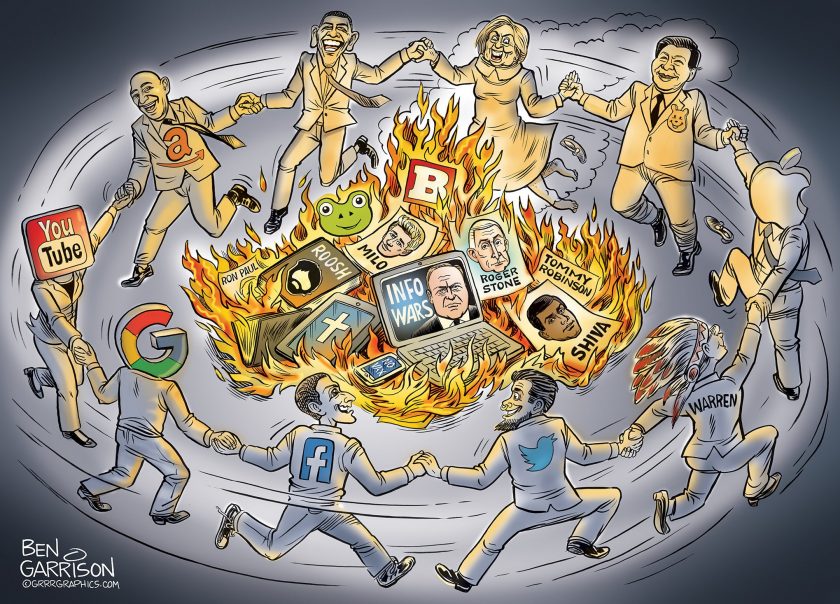
No word on whether that will apply to Google’s work in China, or Twitter, YouTube and Facebook’s throttling of speech that runs counter to their executives’ politics.
‘Preserving peace through strength’
Pillar three is where things get offensive – literally. Its objective is to “identify, counter, disrupt, degrade, and deter behavior in cyberspace that is destabilizing and contrary to national interests” while preserving US “overmatch.”
In addition to authorizing offensive cyber operations against suspected bad actors, the strategy proceeds from the assumption that the world craves US leadership, and envisions Washington promoting a “framework of responsible state behavior in cyberspace” based on international law and “voluntary non-binding norms.”
A coalition of like-minded states, led by the US would “coordinate and support each other’s responses to significant malicious cyber incidents.”
How? Well, through intelligence sharing, but also “buttressing of attribution claims, public statements of support for responsive actions taken, and joint imposition of consequences against malign actors.”
If that sounds a bit like what happened after the UK accused Russia, without evidence, of using a chemical agent to poison ex-spy Sergey Skripal and his daughter in Salisbury, and the US and other allies just took Whitehall’s word for it… that’s because it does.
‘Advancing US influence’
That leads us to the fourth and final pillar, advancing US influence around the globe. Accusing China not only of wanting to create a closed, censored internet by exporting that model elsewhere, the strategy envisions US evangelizing for a “free and open” internet.
Washington “will continue to work with like-minded countries, industry, civil society, and other stakeholders to advance human rights and Internet freedom globally and to counter authoritarian efforts to censor and influence Internet development,” the strategy says.
Does that mean the State Department intends to challenge the new EU copyright rules that would effectively outlaw memes and charge a “link tax”? Somehow that seems highly… unlikely.
Read more:
UK to set up new internet regulator to monitor ‘hate speech’ and enforce ‘code of conduct’ – report
RT | September 20, 2018
Free speech advocates are appalled at news that the UK government may create a new regulator, empowered to heavily fine social media giants that fail to clamp down on rogue posts, and even banish sites for ‘non-illegal’ content.
The new legislation for reducing online “social harms” will be presented this winter, according to a Buzzfeed report, whose veracity has been confirmed in a statement by the Conservative government.
According to the proposals, Facebook, Twitter and other websites offering user-generated videos, photos and posts will be forced to remove content such as –but not restricted to– child pornography, terrorist incitement and hate speech within a tight time limit, or face hefty fines.
This follows the controversial German model, approved last year, in which companies have to take down posts that violate the law within 24 hours, lest they be penalized with fines of up to €50 million. Critics there have said that the legislation is unenforceable, due to the sheer volume of published information, that it provokes a chilling effect among online voices and forces internet companies into engaging in heavy-handed censorship.
Of even more concern will be the new body’s role in producing “new regulations on non-illegal content and behaviour online” – which could force content that does not actually violate any laws, but is considered undesirable, such as publicly humiliating posts or “fake news” to be removed. Authors note that there are fiery internal debates about whether the government has the right to try and monitor or control such speech, or what the exact boundaries are.
Websites will also be forced to introduce a mechanism of secure age verification, as opposed to current methods, in which the users themselves say how old they are. A similar proposal has been touted for adult content websites accessed from the UK for several years, but plans have been repeatedly delayed over privacy and workability considerations.
Websites, many of which operate outside the UK, will be asked to sign up to a code of conduct, saying that they agree to the above regulations. It is suggested that those that fail to do so will face punishment, and could potentially be blocked altogether to British internet visitors.
Those concerned about the free speech dimension have slammed the idea of a regulator, calling the potential development a step towards total control of the UK population. Others wondered who will be entrusted with controlling and censoring the virtual space, and who would “guard the guards.”
Facebook Turns Into Manipulative Tool of US Intelligence – Moscow
Sputnik – 20.09.2018
ST PETERSBURG – Facebook is transforming into a manipulative tool of the US intelligence services and a lever to influence the domestic policy of other states, Russian Foreign Ministry spokeswoman said.
“Facebook continues to follow the path of stricter censorship… [Facebook], which was presented and has established itself as a means of free communication and exchange of various kinds of content, is now being transformed into an instrument of US intelligence agencies to cleanse the information space of materials that are unwanted by Washington,” Russian Foreign Ministry spokeswoman Maria Zakharova told a briefing on Thursday.
As an example, she named the agreement between Facebook and the Atlantic Council stated to be aimed to help monitor attempts to spread “disinformation” in elections around the world.
She further called the process “a manipulation and a deception” stressing that “the fighters for free democratic elections and the purity of the information space themselves are engaged in interference in affairs of other states and in the dissemination of false information.”
In addition, she said that under the pretext of fighting fake news, Facebook planned to check the personal data of users, as well as audio and video materials.
After the 2016 US presidential election, Facebook said it would take a number of steps to improve transparency, including stricter rules for ad placement, fact-checking photos, videos and links, as well as adding technology to get rid of fake accounts and improve security.
The United States has accused Moscow of meddling in its 2016 presidential election, with Russian authorities denying the accusations as groundless.
New report documents ‘torture in the heart of Jerusalem’

Israeli security forces brutally arrest Palestinian protesters in West Bank [Issam Rimawi – Anadolu Agency]
MEMO | September 20, 2018
A new report by Palestinian prisoners’ rights group Addameer claims that Israeli officials “routinely” carry out the “practice of torture” at a key interrogation facility in occupied East Jerusalem.
The report, “I’ve Been There: A Study of Torture and Inhumane Treatment in Al-Moscobiyeh Interrogation Centre”, is based on the testimonies of 138 individuals held in the Russian Compound of Jerusalem gathered during the period 2015-2017.
“For generations of Palestinians, the Russian Compound has represented the most severe interrogation facility in all of the occupied territory,” Addameer states.
“It has been the place of intentionally inflicted suffering for hundreds of prisoners. Its location in the heart of Jerusalem, next to the Old City, is something of a metaphor for the whole apparatus of the occupation. The domination is hidden in plain sight.”
According to the testimonies acquired by Addameer, eight forms of abuse were identified at the facility: positional torture such as “stress positions”; beatings during interrogation; isolation/solitary confinement, sleep deprivation and long interrogation, threats to family members, being subjected to sounds of torture, deliberate medical neglect, and screaming and cursing.
More than half of those surveyed reported being held in stress positions; one 18-year-old former prisoner was held in a stress position for eight hours a day, for 18 days. A third of prisoners reported being beaten, while a fifth of individuals were subjected to violent shaking.
Addameer noted that “children are no exception when it comes to mistreatment and intimidation”, with 47.8 per cent reporting “that they were beaten during their arrest”, 45.5 per cent experiencing positional torture during interrogation, and 40.9 per cent “threatened with the potentially injuring of their families if they did not cooperate”.
According to the rights group, “the primary conclusion that the above research and indicators provide is that mistreatment, and coercion, amounting to torture, are commonplace and systematic within the occupation’s interrogation systems”.
Addameer added that “as a result of torture’s status in international law, the international community has a distinct responsibility to take action to sanction the perpetrating entity”, urging “the international community to begin sanctioning the occupier for its crimes”.
Read also:
Palestinian man dies after Israel forces beat him at his home
Court orders psychiatric evaluation for Marine Le Pen, she slams it as ‘hallucination’
RT | September 20, 2018
French politician Marine Le Pen said a court ordered her to undergo psychiatric evaluation over a series of images she posted on Twitter showing Islamic State executions. She slammed the order as a “hallucination.”
The president of France’s National Rally (formerly Front National) has released an order saying it comes from the magistrates in Nanterre near Paris, calling on her to “undergo a psychiatric examination.”
“For denouncing the horrors of Daesh (Islamic State/IS, formerly ISIS) by tweets the “justice system” has referred [me] to a psychiatric assessment. How far will they go?!” she tweeted in response.
The 2017 presidential candidate denounced the order as “a hallucination,” saying: “This regime is really starting to scare [us].”
French major outlet BMFTV, which also broke the story, said that the procedure was in fact a “common” occurrence. The comment did not go down well with Le Pen though, who branded the claim “a lie.” Such an examination is required of “pedophiles or [those with] sexual deviance,” she argued.
In December of 2015, Le Pen tweeted three pictures of killings carried out by IS terrorists accompanied by the text “Daesh [Arabic term for ISIS] is THIS!” The tweets had been a response to journalist Jean-Jacques Bourdin, who compared Le Pen’s nationalist rhetoric to that of the Islamic terrorist group.
One of the pictures showed the body of James Foley, whom the extremists beheaded in August 2014. Back then his family said they had been “deeply disturbed by the unsolicited use of Jim for Le Pen’s political gain.”
Le Pen later deleted the images. Speaking to French media earlier this year she said that she is being charged for “having condemned the horrors of Daesh.”
If convicted, the politician faces a maximum punishment of a €75,000 fine and up to three years in prison.
A number of politicians have lambasted the judges’ decision towards Le Pen. According to National Assembly member Gilbert Collard, the order simply means “the psychiatrization of political opinion.”
Italian Deputy Prime Minister Matteo Salvini also took to Twitter to express support for the French politician. “A court orders a psychiatric assessment for Marine Le Pen. Words fail me! Solidarity with her and with the French who love freedom!” he wrote.
This is not the first time Marine Le Pen has locked horns with the authorities. In 2017, roughly two months before the presidential election, she was summoned by judges for alleged misuse of EU funds. The court said that Le Pen’s staff was fictitiously employed at the European Parliament as assistants. She denied the allegations.
This July, French judges blocked €2 million of subsidies to Le Pen’s party. Le Pen condemned the move as “a blow to democracy,” since withholding the funding would likely result in her party becoming defunct.
Free Press Advocates Alarmed by US Government’s “Terrifying” Secret Rules for Spying on Journalists
Jessica Corbett – CommonDreams – September 17, 2018
Journalists and free press advocates are responding with alarm to newly released documents revealing the U.S. government’s secret rules for using Foreign Intelligence Surveillance Act (FISA) court orders to spy on reporters, calling the revelations “important” and “terrifying.”

The documents – obtained and released by the Freedom of the Press Foundation and the Knight First Amendment Institute at Columbia University through an ongoing Freedom of Information Act (FOIA) lawsuit filed last November – confirm long held suspicions that federal officials can target journalists with FISA orders.
New documents – obtained by @knightcolumbia and @FreedomofPress – appear to confirm longstanding suspicion that government has relied on Foreign Intelligence Surveillance Act to monitor journalist communications. @2ramyakrishnanhttps://t.co/VFDjk9oJqq pic.twitter.com/ybnEeuNsby
— Knight 1st Amendment (@knightcolumbia) September 17, 2018
The two 2015 memos from former Attorney General Eric Holder to the Federal Bureau of Investigation (FBI) lay out procedures to ensure that the attorney general or deputy attorney general signs off on any FISA applications “targeting known media entities or known members of the media.”
These secret rules, as Cora Currier reported for The Intercept, “apply to media entities or journalists who are thought to be agents of a foreign government, or, in some cases, are of interest under the broader standard that they possess foreign intelligence information.”
“There’s a lack of clarity on the circumstances when the government might consider a journalist an agent of a foreign power,” Ramya Krishnan, a staff attorney with the Knight Institute told Currier.
“Think about WikiLeaks; the government has said they are an intelligence operation.”
Additionally, even if they aren’t personally targeted by FISA orders, Krishnan pointed out that “journalists merely by being contacted by a FISA target might be subject to monitoring – these guidelines, as far as we can tell, don’t contemplate that situation or add any additional protections.”
Freedom of the Press Foundation executive director Trevor Timm noted that while “the fact that these were kept secret during the Obama administration is cause for great concern,” President Donald Trump “has repeatedly stated his hatred for the media, and his Attorney General Jeff Sessions has already tripled the amount of leak investigations since the Obama era (when they were already at an all time high).”
“This is critically important information at a time when press freedom has been under threat from the government, and its role in our democracy has never been more important,” Timm added, calling on the DOJ to disclose how often journalists have been subjected to FISA court orders, and why the rules were kept secret until this suit.
“It makes me wonder, what other rules are out there, and how have these rules been applied?” Victoria Baranetsky, general counsel with the Center for Investigative Reporting, previously of Reporters Committee for the Freedom of the Press, told Currier. “The next step is figuring out how this has been used.”
The DOJ’s rules for obtaining a FISA court order to target a journalist, Timm explained, “are entirely separate from – and much less stringent—than the rules for obtaining subpoenas, court orders, and warrants against journalists” detailed in the DOJ’s “media guidelines,” which Holder “strengthened in 2015 after several scandals involving surveillance of journalists during the Obama era.”
However, Holder’s guidelines still concerned media advocates, Currier noted, “because they left room for the use of National Security Letters,” which “are administrative orders with which the FBI can obtain certain phone and financial records without a judge’s oversight.” Currier previously reported on the FBI’s 2013 rules for such orders, and concerns about them, in 2016.
You can read the DOJ’s rules for targeting journalists with FISA court orders here.
Palestinian Dies after Brutal Assault by Israeli Forces

Mohammed Al-Rimawi (24) was beaten to death in his bedroom by the Israeli forces in Beit Rima. (Photo: via Facebook)
Ma’an – September 18, 2018
RAMALLAH – A 24-year-old Palestinian succumbed to his injuries, on Tuesday morning, after he was brutally assaulted by Israeli forces as they detained him from his home in the Beit Rima village in the central occupied West Bank district of Ramallah in predawn raids.
The Palestinian liaison identified the youth as Muhammad Zaghlul Rimawi (al-Khatib), 24.
Muhammad’s brother, Bashir Rimawi, told Ma’an that some 40 Israeli soldiers raided their house in Beit Rima on predawn Tuesday, assaulted Muhammad while he was still laying in bed, wearing his nightwear, which Israeli forces ripped off of his body.
Bashir added that Israeli forces continued to brutally beat his brother, while unconscious, carried him outside the house and took him to an unknown location.
Bashir said that the Palestinian liaison contacted the family later and informed them that Muhammad had succumbed to his wounds; no other information was given regarding Muhammad’s death or when would his body be returned to the family for funeral processions.
The Israeli authorities reportedly transferred Muhammad’s body to Abu Kabir Forensic Center in Jaffa for an autopsy to determine the cause of death.
The Rimawi family accuse Israeli forces of being responsible for the death of their son, Muhammad, due to the brutal assault he was subjected to during his detention hours before being declared dead.
The Palestinian Prisoner’s Society (PPS) also confirmed that Muhammad’s death resulted from excessive beating by Israeli forces.
PPS held Israel fully responsible for the killing of Muhammad Rimawi, “whose death was added to a long list of crimes and unjust executions carried out against Palestinian detainees and prisoners inside detention centers and prisons.”
The Addameer human rights organization said that the excessive use of force by Israeli soldiers during Rimawi’s detention was the cause for his death.
Addameer added that Rimawi did not pose any threat to the soldiers to require them to use such excessive force against him, pointing out that this is a violation of the international humanitarian law which bans the use of force against civilians who do not pose any real and direct threat.
The organization considered the use of such lethal force in this manner extrajudicial execution.The number of killed Palestinian detainees and prisoners since 1967 has risen to 217, according to a report by PPS; 75 of whom were executed after detention, 72 died of torture, 62 of “medical neglect” and seven were “directly shot and killed by Israeli soldiers and guards inside jails and detention centers.”
PPS also warned against the continued silence of the international community and international organizations, which allow Israeli forces to kill Palestinians “in cold blood,” without any restraint to the ongoing crimes.
According to the testimonies of hundreds of Palestinian detainees and prisoners, who were transferred for interrogation and into detention centers, 95% of them were subjected to both physical and mental abuse, PPS reported.
PPS pointed out that Rimawi is the 3rd Palestinian to be tortured to death by Israel this year; Palestinian Yassin al-Saradih from Jericho was assaulted to death by Israeli forces following his detention on February 22nd, 2018, and prisoner Aziz Eweisat from Jerusalem, who was killed after being assaulted by Israeli “Nahshon” forces inside Israeli jails on May 19th, 2018.
UN Special Coordinator: ‘Israel’s demolition of Khan al-Ahmar contrary to international law’
Ma’an – September 16, 2018
BETHLEHEM – The United Nations Special Coordinator for the Middle East Peace Process, Nikolay Mladenov, expressed his concern on Sunday at the intention of Israeli authorities to demolish the Bedouin village of Khan al-Ahmar, east of Jerusalem.
Mladenov said in a statement “I am concerned at the intention of the Israeli authorities to demolish the Bedouin village of Khan Al-Ahmar, a community of 181 people, over half of which are children.”
He also called on the Israeli authorities not to proceed with the demolition and to “cease efforts to relocate Palestinian communities in the occupied West Bank.”
Mladenov concluded “Such actions are contrary to international law and could undermine the chances for the establishment of a viable, contiguous Palestinian state.”
Mladenov’s statement comes after the Israeli High Court had rejected an appeal against the demolition of the village and approved its demolition and evacuation of its residents.
Since July, Khan al-Ahmar has been under threat of demolition by Israeli forces. The residents of the village have been since then subjected to threats, assaults, closures, and other forms of Israeli attempts to displace its residents.
The demolition would leave more than 35 Palestinian families displaced.
Israel has been constantly trying to uproot Palestinian Bedouins from the east of Jerusalem area to allow settlement expansion in the area, which would later turn the entire eastern part of the West Bank into a settlement zone.
When Social Networks Care About National Security

By Harry Bentham | OffGuardian | September 16, 2018
Controversies surrounding online fake news, having alarmed political activists in Britain and the US, are prompting social media companies to be more active in combating the alleged threat. For many people in opposition to the policies of US President Donald Trump and Britain’s exit from the EU, the internet is to blame for the situation because it illicitly influenced voters. As a result, increased policing of social networks to root out foreign spies and domestic dissidents seems necessary to them. One of the latest examples is Twitter’s permanent suspension of American conspiracy theorist entertainer Alex Jones.
The responsibility to police the social networks seems to have largely been placed, by pushy and concerned politicians, on the management of tech companies themselves. British MPs and US senators did this by summoning them to hearings and campaigning openly against the internet’s permissiveness on political content, making demands they should shut down dissident and foreign outlets because they have gone too far.
Although the most vocal of them are not actually in the incumbent government and therefore not responsible for national security responses, they are still lawmakers representing constituents and can threaten legislation to compel social media companies to change. Preferring instead to make the policing of social media posts look voluntary, they seem to have capably persuaded the management of the tech companies to enforce their views on national security.
Therefore, now, we are at an awkward point where transnational social networks must care about so-called national security – specifically the US’s national security, based on that country’s strange and self-obsessed drivel about being exceptional and better than others. What next?
Recently, we have seen police-like enforcement action against dissident users and outlets present on a variety of social media platforms and applications used by a probable majority of people in the UK and the US. This removal of controversial figures from online platforms is presented as not being censorship, but rather the enforcement of decent community guidelines by companies that have every right to withhold services. However, this argument is not very convincing. The political pressure has been immense. The results have not been targeted at bad social media behavior like spam and harassment, but against alternate political views on both the left and the right. If we look at the actions of the tech companies, they are not only encouraged by elements of the state but have made themselves into state-like actors by describing themselves as stopping foreign threats and extremism.
Brexit was the mistake of a misled public, perhaps. We are told so by influential media personalities – almost all of them – and the same narrative is presented when it comes to the election of Trump. We are encouraged to lean towards the same common solution to both of these mishaps, and it consists of mostly a crackdown online – especially on Twitter. We will be shutting down online accounts and channels belonging to the supporters of such causes as Trump and Brexit, after quickly and conveniently finding them guilty of being bots or possibly foreign. No attention is given to bad behavior as a whole.
For example, no enforcement action is used against pro-EU accounts or anti-Trump accounts, many of which self-identify as foreign or completely automated. Some even blatantly violate Twitter’s rules on inflated hashtag campaigns, doing things like using the hashtag #FBPE to get followers and retweets from pro-EU bots. Their own determination to trick users and violate the community guidelines is openly celebrated by them, so oblivious are these kinds of activists to their own hypocrisy.
So, in fact, what seems at first a principled argument against bad behavior is really a cliché so we can pretend there was some civilized reason for thuggishly silencing other points of view.
Much of the commentary by the Democratic Party, as with opponents of Brexit in the UK, focuses on national security and the need to silence or eliminate bad people and Russians. It is presented as war, using the language of military propaganda. Being in opposition, these democracy-loving people in the Democratic Party and other groups now presume it is the job of civil society – news networks like CNN and tech companies like Apple mainly – to not only take charge of national security themselves but also engage directly in censorship.
But censorship, the shutting down of opposing views and channels on grounds that they are treasonous, is not an exertion of soft power but hard power. It is a state-like activity, and the sole responsibility of states in all previous cases. By taking part in censorship without being part of the elected leadership of the state and the command structure it possesses to deal with national security threats, unelected elements in civil society are allowed to commit what would be a crime if they had been elected to do it. They engage in a coup-like activity, since, not being part of an elected government, they are nonetheless engaged in state-like activity and are trying to invasively police matters that only a heavily expanded state or dictatorship is ever expected to police.
What is presented above makes it justifiable to consider whether traditional models of state censorship would be more consistent with the rule of law and the importance of a democratic mandate than the current capricious enforcement by private companies. A party whose candidate failed to win power over the whole state, such as the Democrats, is not able to implement a program of state censorship at the moment they most want to. The reason this is the case is because of their very loss in the 2016 US election, which makes them not responsible for matters of national security and not tasked with securing the information space against threats, and yet they try. For them to seek routes around this failure, going to non-elected entities such as the tech companies in an attempt to dictate terms of censorship and actual national security policies via them, can be compared with a coup or a form of separatism. This is the creation of a second state, the seizure of infrastructure to interdict citizens. It is completely outside the bounds of normal political processes, which focus solely on democratic and valid elections as the only means of changing power.
Each point made in relation to the US Democrats here is equally true of influencers and leaders who seek to invalidate the results of the UK’s Brexit referendum, in large part because these are the same kind of civil society actors. In their attempts to portray the activity of the national government itself as treasonous and wrest control of the management of national security from the British government, entities with no democratic mandate are hopelessly creating a second state – one without elections – to take control over national security.
It is not political opposition but a second state because, for the first time ever, it wants not just persuasive soft power but hard power in the capability to suppress targets or eliminate their influence on command. Not only would this realization make these parties and their tech industry collaborators a state-like entity, but it could make such actors as the Democratic Party traitors at war with the electorate.
While this article doesn’t make such a claim, it is one Trump and his supporters have come close to making when the President accused unrelenting elements of the press of being “enemies of the people”, and could eventually create a national security crisis. The reason it would be a crisis is because both Trump and his critics will have a point. It is the role of activists and media to be adversarial, but if they are too aggressive and specifically driven to remove an elected head of state from power, their actions may be seen as the de facto overthrow of the republic to install themselves as political arbiters and impose a moral aristocracy.
Many leaders and followers in the political opposition in the US and UK are supportive of censorship, slithering around constitutional safeguards against state censorship. Whether in public hearings or behind closed doors, they have been going directly to tech companies and other parts of civil society to physically disrupt or silence speech they dislike. If they are such supporters of national security and censorship, and are really so concerned about traitors, they should not conspire. Rather, these people should approach the elected government with their concerns, to avoid being deemed traitors themselves.
They can achieve censorship by working to convince the elected government to change the law in relation to such practices and introduce programs of lawful censorship, as well as bodies to reliably and authoritatively identify traitors. This means national security can be pursued in a way at least consistent with electoral democracy, even if it erodes human rights further. Otherwise, we will continue to see electorally defeated parties and elements of civil society acting like terrorist hijackers determined to take power. They will be gaining state-like powers, harassing citizens who did not vote for them, carrying out targeted censorship, and enforcing their values over the corpse of the democratic state.
It should be concluded that none of the above is a desirable conversation to take part in and it is regrettable that it would need to be published. Ideally, neither state censorship nor corporate censorship should be tolerated. The internet should continue to be home to an anarchic culture at all costs, not a state-like one. However, as rhetoric becomes more warlike and paranoid and positions become irreconcilable, all spaces could become politically aligned and everyone’s freedom to communicate could catastrophically reduce. With constant political censorship, critical thinking will rewind a hundred years and the internet will talk like propaganda from 1914 when you try to search for the truth.
After Cutting All UNWRA Humanitarian Aid, US to Award Israel with $3.3B/Year in Military Aid
By Whitney Webb | Mint Press News | September 14, 2018
WASHINGTON — A massive spending bill, which would deliver $3.3 billion dollars in military aid to Israel over the next year, passed the House on Wednesday under cover of a media blackout. The U.S. Senate had passed a different version of the same bill in early August, a vote that also went largely unreported.
Now, after the House’s passage of a slightly altered version of the Senate’s spending bill, officially titled the “Ileana Ros-Lehtinen United States-Israel Security Assistance Authorization Act of 2018,” all that remains is for the two chambers of Congress to reconcile their versions before the product is sent to President Trump’s desk to be signed into law. According to Skopos Labs, the bill now has a 90 percent chance of being enacted. If enacted, the bill will be the largest aid package in American history.
As MintPress previously reported, $3.3 billion was supposed to be the annual limit for U.S. military aid to Israel. However, the figure is actually set to be higher this year as a result of Congress’ recent passage of a massive $716 billion defense bill that provides an additional $550 million in U.S. aid for Israeli missile defense systems. That defense bill also authorizes an additional $1 billion for U.S. weapons stockpiles in Israel.
Furthermore, the $3.3 billion in annual aid is set to continue for the next decade based on the current text of the bill and the 2016 Memorandum of Understanding between Israel and the Obama administration — totaling over $38 billion over the next decade when accounting for annual military aid and annual aid given specifically to fund Israeli missile defense.
That startling figure roughly equates to $23,000 for every Jewish family living in Israel.
In addition to the massive sum the legislation would give to the Israeli military, the bill would also mandate that NASA closely cooperate with the Israel Space Agency (ISA), despite the latter’s history of espionage targeting NASA.
The massive amount of aid the U.S. government is set to give to Israel comes amid Israel’s unprecedented crackdown on unarmed protesters in the Gaza Strip and a looming Israeli military operation aimed at “conquering” the Palestinian enclave. The aid package’s imminent package is also set to coincide with efforts to annex the vast majority of Palestine’s West Bank, which has been militarily occupied by Israel since 1967.
As MintPress noted in a previous report, such grave violations of human rights would normally prevent the U.S. government from providing aid to Israel, given that the Leahy Laws enable the U.S. to withhold military assistance from units and individuals in foreign security forces if they have committed a gross violation of human rights.
However, the U.S. government – particularly under the rabidly pro-Israel administration of President Trump, which just last week cut all funding for Palestinian humanitarian relief through UNRWA – has consistently shown that it is willing to bend the rules for Israel.
Congress waves the Israeli flag
The $3.3 billion military aid package was only one of the bills passed by the House that is set to benefit Israel. Another bill, which has also been largely overlooked by the media, would seek to create a special government envoy tasked with monitoring “anti-Semitism” and criticism of Israel worldwide.
According to the text of the bill – officially titled the “Special Envoy to Monitor and Combat Anti-Semitism Act of 2017” – the envoy would “serve as the primary advisor to, and coordinate efforts across, the United States government relating to monitoring and combating anti-Semitism and anti-Semitic incitement that occur in foreign countries,” and have the rank of ambassador. Only two members of the House voted against the bill: Rep. Justin Amash (R-MI) and Rep. Jerry McNerney (D-CA).
While an effort to combat “anti-Semitism” is a noble cause, the recent endorsement of a controversial definition of the term by Congress, which defines certain criticisms of the state of Israel as anti-Semitic, makes it likely that any envoy appointed to this position would be focused on clamping down on domestic and international criticisms of the Israeli government.
Given the potential dangers that such a position could pose to free speech, not just in the U.S. but abroad, it is surprising that this bill’s passage by an overwhelming majority received next to no media attention. Yet, in light of the media blackout also surrounding the imminent approval of the U.S.’ massive aid package to the Israeli military, it is perhaps not so surprising.
Whitney Webb is a staff writer for MintPress News and a contributor to Ben Swann’s Truth in Media. Her work has appeared on Global Research, the Ron Paul Institute and 21st Century Wire, among others. She has also made radio and TV appearances on RT and Sputnik. She currently lives with her family in southern Chile.
Lebanon rejects alleged plan to ‘resettle’ Palestinians
MEMO | September 13, 2018
Lebanese Foreign Minister Jebran Bassil has slammed an alleged US plan to “resettle” Palestinian refugees in neighboring Arab states, Lebanese daily Al-Joumhouria reported Thursday.
Bassil’s remarks came in response to a tweet two days earlier by Israeli Intelligence Minister Yisrael Katz, in which the latter welcomed an alleged plan by US President Donald Trump to “resettle Palestinian refugees in Jordan, Syria, Lebanon and Iraq”.
In his tweet, Katz did not provide any additional details regarding the alleged US proposal.
Speaking to Al-Joumhouria on Thursday, Bassil stressed his country’s rejection of any such plan.
“Even if the entire world accepted resettlement [of Palestinian refugees], we would reject it,” he was quoted as saying.
“Like we defeated Israel by expelling its occupation [from Southern Lebanon in 2000], we will defeat its resettlement project,” the foreign minister asserted.
“The ‘right of return’ is sacrosanct,” Bassil added, referring to the right of Palestinian refugees to return to their homes in historical Palestine from which they were driven in 1948 to make way for the new state of Israel.
Lebanon is currently home to roughly 590,000 Palestinian refugees (out of some five million worldwide), according to official Lebanese figures.
Featured Video

The Failed Air War Over Vietnam
or go to
Aletho News Archives – Video-Images
From the Archives
USS Liberty Massacre: A Pivotal Moment in the Hostile Takeover of America
By Kevin Barrett | Crescent | Dhu al-Qa’dah 24, 1445
In corporate America, hostile takeovers are commonplace. They occur when an aggressor—a larger corporation or rich individuals—seizes control of a smaller corporation without asking permission.
What few recognize is that the United States itself has been subjected to a hostile takeover. Since the aggressor, the illegitimate settler colony known as “Israel,” is much smaller than the US, the takeover has necessarily been surreptitious.
As of June, 2024, Israel’s gradual takeover of the US has become obvious and undeniable—a proverbial “elephant in the living room.” … continue
Blog Roll
 Aletho News
- Europe’s mounting social chaos… chickens coming home to roost for proxy war against Russia
- US-Russia Diesel Deal Becomes Massive Defeat for Ukraine
- Hormuz and the Looming Economic Catastrophe
- Dhubab offensive, media blitz and the rapid unraveling of Saudi-backed coalition’s new gambit
- Putin Conveys to Trump Iran’s Vision on Possible Conflict Resolution – Kremlin
- The Search for Truth: Charlie Kirk’s Assassination One Year Later
- ‘Harsh reality’: Iran says France seeks monopoly on power and intimidation, not peace for all
- When Will This White House Madness End?
- Huckabee aide goes to ‘unusual lengths’ to portray ‘Israel’ positively
- Trump Announces Diesel Supply Deal With Putin Following Phone Call
- If Americans Knew
- Israeli forces kill another child in Gaza – Daily Update
- Gaza ceasefire exists in name only, say more than 100 organizations
- Nearly 2 Million in Gaza Need Urgent Shelter Assistance as Winter Looms: IOM Chief Warns
- Suppressing Palestinian resistance: US charity under fire for AI monitoring of Gaza classrooms
- Thousands Are Held in Israeli Torture Camps. This Is What Happens Inside
- Israel puts Gaza’s sick, injured, newborn in peril – Daily Update
- Report claimed Mark Levin used by Israeli government to influence Trump
- Over 2,000 Gazans have died awaiting medical evacuation amid Israel’s continued siege
- How a U.S. Diplomat Suppressed and Altered Reports Critical of Israel
- 5 Palestinians Die from Israeli Strikes in Gaza as Relentless Attacks Continue
- No Tricks Zone
- Germany’s Green Energy Debacle: High Energy Costs Force Kahla Porzellan to Close After 182 Years!
- New Study: 50 Years Of The Most Aggressive ‘Net Zero’ Policies Can Only Affect The Global Climate By 0.03°C
- US September “Heat” Was No Record…Many Records Set Decades Ago
- Latest European Green Energy Debacle; Portugal’s Largest Flagship Solar Park Insolvent!
- Green Energy Debacle: German Expert Professor Fritz Vahrenholt Warns Of Severe Economic And Social Consequences
- Two More Paleo Reconstructions Affirm Meters-Higher Sea Levels Across Ireland, Brazil 7000-6000 Years Ago
- New Study: Earth And Venus Surface Warmth Largely Explained By Convection And Lapse Rate, Not CO2 Or Radiation
- 2025 Nature Paper Claiming Worsening Global Drought Gets RETRACTED …Heavily Flawed
- New Study: ‘Global Drought Shows No Detectable Recent Acceleration Under Climate Warming’
- Economic Masterminds: German Socialists Suggest Taxing Productivity Gains Stemming From Using AI

