Israel considering death penalty… but only for Palestinian prisoners
MEMO | January 4, 2018
The Israeli Knesset approved on Wednesday a first reading of the death penalty bill which would allow the authorities to execute Palestinian prisoners accused of taking part in “operations against Israeli targets,” Anadolu has reported. The bill was proposed by the right-wing leader of the Jewish Home party Naftali Bennet; it was approved by a vote of 52 to 49 but needs a second and third reading before it becomes law.
Extremist Avigdor Lieberman, Israel’s Moldovan-born Defence Minister, endorsed the bill, which he said would increase Israel’s deterrence effect. In televised comments last week, Lieberman said that the law would specifically target Palestinians convicted of attacking Israeli civilians and soldiers.
Last year, at a rally following the death of three Israeli police officers, Prime Minister Benjamin Netanyahu voiced his support for the death penalty for Palestinians, whom he described as “terrorists with blood on their hands.”
Israel applies civilian law to illegal Jewish settlers in the occupied Palestinian territories of the West Bank and East Jerusalem. Palestinians, however, face military courts and military law. The proposed death penalty would only be applicable in military courts. In the already unlikely event of an Israeli being convicted for killing a Palestinian, the accused would never face the death penalty.
“The fact that Israel lacks a constitution allows its prime ministers to enact legislation that serves the interests of their respective racist governments,” explained Mohammed Dahleh, a Palestinian expert on Israeli affairs. “Israel refuses to adopt a constitution. This also allows it to create laws — or modify them — to suit its expansionist tendencies.”
According to international lawyer Yasser Al-Amouri, the proposed Israeli law violates basic international legal tenets. “The conflict between the Palestinians and Israelis is not criminal in nature but nationalist,” he pointed out. “This means Israel cannot sentence Palestinian prisoners to death under the provision of the Fourth Geneva Convention relating to the treatment of prisoners of war.”
One commentator in London suggested that this legal nicety wouldn’t make any difference. “Israel already treats international laws and conventions with contempt,” said MEMO’s senior editor Ibrahim Hewitt, “so why would it sit up and take notice of this point? The state is guilty of the crime of apartheid, and this bill demonstrates that fact.”
What Do You Call Somebody Who Supports Israel?
Racist

By Stuart Littlewood | American Herald Tribune | January 3, 2018
“If opposing Israel is anti-semitism then what do you call supporting a state that has been engaged in brutal ethnic cleansing for seven decades. What does that make you?” It’s a question posed by Miko Peled, an Israeli Jew and son of an Israeli general, former Israeli soldier and now a leading voice in the struggle for Palestinian freedom. You couldn’t find a more authentic insider.
What else has Peled been saying about Israel?
- “The name of the game: erasing Palestine, getting rid of the people and de-Arabizing the country…”
- As for talk about Israel giving up the West Bank for a Palestinian state: “If it wasn’t so sad it would be funny. It shows a complete misunderstanding of the objective of Zionism and the Zionist state…. By 1993 the Israelis had achieved their mission to make the conquest of the West Bank irreversible.”
- Peled also describes the Israeli army, in which he served, as “one of the best trained and best equipped and best fed terrorist organisations in the world.”
So let’s repeat Peled’s question. What does supporting Israel make you when Israel has been busy ethnically cleansing the native Palestinians for seven decades? What should we call people who defend the indefensible?… who admire the despicable?… who applaud the expulsion at gunpoint of peaceable civilians and the confiscation of their homes and land?
Give them a name, one that will stick.
The claim by Conservative Friends of Israel that 80 percent of the party’s MPs and MEPs are members is alarming and reveals how lacking in integrity we are at the heart of government. It puts us almost on a par with US Congress which is almost totally controlled by the Israel lobby through AIPAC.
Being a Friend of Israel, of course, means embracing the whole rotten kit and caboodle, including the terror and racism on which the state of Israel was built. It means embracing the dispossession and oppression of innocent Palestinians. It means embracing the discriminatory laws against those who remain n their homeland. It means embracing the jackboot thuggery that abducts civilians — including children — and imprisons and tortures them without trial. It means embracing the theft and annexation of Palestinian land and water resources, the imposition of hundreds of military checkpoints, severe restrictions on the movement of people and goods, and maximum interference with Palestinian life at every level.
It means approving the bloodbaths inflicted by Israel on Gaza and feeling comfortable with blowing hundreds of children to smithereens, maiming thousands more, trashing vital infrastructure such as hospitals, schools, power plants and clean water supplies, and causing $6bn of devastation that will take 20 years to rebuild. And, by the way, where is the money coming from?
It means embracing the strangulation of the West Bank’s economy and the vicious ten-year blockade on Gaza. It means embracing the denial of Palestinians’ right to self-determination and return to their homes. It means embracing the religious war that humiliates Muslims and Christians and prevents them from visiting their holy places. It means endorsing a situation in which hard-pressed American and British taxpayers are having to subsidise Israel’s illegal occupation of the Holy Land.
And if, after all that, you are still Israel’s special friend, where is your self-respect?
It is ludicrous that a foreign military power which has no regard for international law and rejects weapons conventions and safeguards can exert such influence on foreign policy in the US and UK. Pandering to Israel has been immensely costly in blood and treasure and stupidly damaging to our reputation.
Everyone outside the Westminster/Washington bubble knows perfectly well that there can be no peace in the Holy Land without justice. In other words no peace until the occupation ends. Everyone knows that international law and countless UN resolutions still wait to be enforced. Everyone knows that Israel won’t comply unless sanctions are imposed. Everyone knows that the siege on Gaza won’t be lifted until warships are sent.
What’s more, everyone now knows that the US is not an honest broker, Israel wants to keep the pot boiling and justice won’t come from more sham ‘negotiations’. Nor will peace. Everyone knows who is the real cause of turmoil in the Middle East. And everyone knows that Her Majesty’s Government’s hand-wringing and empty words serve no purpose except to prolong the daily misery for Palestinians and buy time for Israel to complete its criminal scheme to make the occupation permanent.
Churchgoing British prime minister Theresa May praises Israel for being “a thriving democracy, a beacon of tolerance” when it is obviously neither. It’s an obnoxious ethnocracy. She says our two countries share “common values” when we obviously don’t — although her rotten party probably does.
Given the Israeli regime’s endless crimes against humanity and cruelty to the rightful inhabitants of the Holy Land her remarks are insulting to anyone who lives by Christian values. She even claims that Israel is a country where people of all religions “are free and equal in the eyes of the law” and “Israel guarantees the rights of people of all religions, races and sexualities, and it wants to enable everyone to flourish”. Her ignorance in these matters rivals Trump’s.
And May would do well to call off her efforts to ciminalise the successful BDS (boycott, divestment and sanctions) campaign, which is a grass-roots civil society based resistance movement. She warns that her government will “have no truck with those who subscribe to it”. But Article 19 of the Universal Declaration of Human Rights bestows on everyone “the right to freedom of opinion and expression; this right includes freedom to hold opinions without interference and to seek, receive and impart information and ideas through any media and regardless of frontiers”. So she boobs even on that.
In an interview with Jonas Alexis, Miko Peled sounds upbeat about BDS. As long as Israel has a blank check [cheque] from the US and the UK and is undefeatable militarily and diplomatically, BDS “is possibly the only positive change one can point to at this time.”
Many of us have urged beefing up BDS, extending its reach and orchestrating its efforts globally. There seems no other way to force the spineless international community to finally impose the sanctions they should have slapped on Israel decades ago.
It has got to the point where I wouldn’t mind seeing individuals among the political élites targeted by BDS if they deserve it. And many of them surely do.
Macron vows to tighten media control because ‘fake news threatens democracy’
RT | January 4, 2018
France’s media watchdog will be given broader powers in 2018 to combat the “fake news” phenomenon which threatens democracy, President Emmanuel Macron promised during a New Year’s address to the press corps Wednesday.
“I have decided that we will change our legal system to protect [our] democratic life from this ‘fake news,” Macron said at the Elysee Palace in Paris. “During the election period, on the internet, content will no longer have exactly the same rules,” he added.
Macron described ‘fake news’ as a threat to democracy due to it “fostering doubt and forging alternative realities which allows people to say that the media and politicians are always more or less deceptive.”
“If we want to protect liberal democracies, we must have strong legislation,” the French president said. The new law will see the role of France’s media watchdog, CAS, expanded in order to deal with attempts to destabilize the situation in the country by broadcasters “controlled or influenced by foreign states,” he said. CAS will be granted the right to refuse, suspend or cancel agreements with such broadcasters based on their content, including online publications, the president said.
The anti-fake news legislation will target social media in particular, making online platforms more transparent on their sponsored content. It will also allow specific content or entire websites to be taken down should there be violations, the French head of state said, promising the new law will come into force this year.
While Macron didn’t mention any names this time, he particularly singled out RT and Sputnik throughout his election campaign and presidency, repeatedly slandering the Russian outlets as “deceitful propaganda” entities and accusing both of spreading “disinformation” about him. He barred RT journalists from his campaign headquarters without a valid reason, and later denied access to the Elysee Palace to a producer of RT’s Ruptly video agency. “I have always had an exemplary relationship with foreign journalists, but they have to be real journalists,” Macron told RT France head Xenia Fedorova during a joint news conference with Russian President Vladimir Putin in Versailles in May.
French news outlets, however, are concerned about Macron’s push to control the media. In the summer, unions representing journalists from more than 20 outlets, including AFP, BFMTV, Liberation and Le Monde, released statements saying “the new government has chosen to pressure” media outlets.
RT launched its French-language channel, RT France, in mid-December, consistent with it’s mandate of shedding light on issues and points of view that have traditionally been ignored by the mainstream media.
Read more:
Expect Even Less Freedom of Internet in 2018
By Philip M. GIRALDI | Strategic Culture Foundation | 04.01.2018
Users of social media have been increasingly reporting that their accounts have been either censored, blocked or suspended during the past year. Initially, some believed that the incidents might be technical in nature, with overloaded servers struggling to keep up with the large and growing number of accounts, but it eventually emerged that the interference was deliberate and was focused on individuals and groups that were involved in political or social activities considered to be controversial.
At the end of last year a number of Russian accounts on Facebook and elsewhere were suspended over the allegations that social media had been used to spread so-called false news that had possibly materially affected the 2016 presidential election in the United States. Even though it proved impossible to demonstrate that the relatively innocuous Russian efforts had any impact in comparison to the huge investment in advertising and propaganda engaged in by the two major parties, social media quickly responded to the negative publicity.
Now it has been learned that major social media and internet service providers have, throughout the past year, been meeting secretly with the United States and Israeli governments to remove content as well as ban account holders from their sites. The United States and Israel have no legal right to tell private companies what to do but it is clearly understood that the two governments can make things very difficult for those service providers that do not fall in line. Israel has threatened to limit access to sites like Facebook or to ban it altogether while the U.S. Justice Department can use terrorist legislation, even if implausible, to force compliance. Washington recently forced Facebook to cancel the account of the Chechen Republic’s leader Ramzan Kadyrov, a Putin loyalist that the White House has recently “sanctioned.”
Israel is not surprisingly most active in patrolling the Internet as it is keen to keep out any material sympathetic to the Palestinian cause or critical of Israeli treatment of Arabs. Its security services scan the stories being surfaced and go to the service providers to ask that material be deleted or blocked based on the questionable proposition that it constitutes “incitement” to violence. Facebook reportedly cooperates 95% of the time to delete material or shut down accounts. Palestinian groups, which use social networking on the internet to communicate, have been especially hard hit, with ten leading administrators’ accounts being removed in 2017. Israeli accounts including material threatening to kill Arabs are not censored.
Microsoft, Google, YouTube, Twitter and Facebook are all also under pressure to cooperate with pro-Israel private groups in the United States, to include the powerful Anti-Defamation League (ADL). The ADL seeks “to engineer new solutions to stop cyberhate” by blocking “hate language,” which includes any criticism of Israel that might even implausibly be construed as anti-Semitism. Expanding restrictions on what is being defined as “hate speech” will undoubtedly become common in social media and more generally all across the internet in 2018.
The internet, widely seen as a highway where everyone could communicate and share ideas freely, is actually a toll road that is increasingly managed by a group of very large corporations that, when acting in unison, control what is seen and not seen. Search engines already are set up to prioritize information from paid “sponsors,” which come up prominently but often have nothing to do with what material is most relevant. And the role of intrusive governments in dictating to Facebook and other sites who will be heard and who will be silenced should also be troubling, as it means that information that would benefit the public might never be seen, particularly if it is embarrassing to powerful interests. And speaking of powerful interests, groups like the ADL with partisan agendas will undoubtedly be able to dictate norms of behavior to the service providers, leading to still more loss of content and relevancy for those who are looking for information.
All things considered, the year 2018 will be a rough one for those who are struggling to maintain the internet as a source of relatively free information. Governments and interest groups have seen the threat posed by such liberty and are reacting to it. They will do their best to bring it under control.
As US seeks emergency UN meeting on Iran, Russia reminds it of Ferguson & Occupy crackdowns
RT | January 4, 2018
The US has said it will call an emergency UNSC meeting to discuss the unrest in Iran, citing the need to support the protesters. Moscow says the move is hypocritical, given Washington’s own history of cracking down on protests.
While the US envoy to the UN, Nikki Haley, said Washington would call for an “urgent” UN Security Council (UNSC) meeting on Iran Monday, there’s been no word yet from the UN on such a meeting being scheduled. Kairat Umarov, Kazakhstan’s envoy to the UN, who is now holding the rotating presidency in the UNSC, said Tuesday the council has not yet added Iran to its agenda and no decision has been yet taken on the issue.
Haley was emphatic in her support of Iran’s anti-government protesters, praising their “great bravery” and calling on the international community to support them. “The people of Iran are crying out for freedom,” Haley told journalists at a news conference. “All freedom-loving people must stand with their cause,” she added, while promising to seek an emergency session of the UN Human Rights Commission.
Washington’s latest attempt at masquerading as a global human rights defender was met with ridicule in Moscow, which reminded the US about its own approach when dealing with protests whenever they occur on American soil. “There is no doubt that the US delegation to the UN has something to tell the world,” Russian Foreign Ministry spokeswoman, Maria Zakharova said on Facebook.
“Haley can, for example, share the US experience of putting down protests, tell [the Security Council] about the mass arrests and crackdown against the Occupy Wall Street movement or about the “clean-up operation” in Fergusson,” she sarcastically added.
The Occupy Wall Street protests began in the world’s financial capital, New York City, in September 2011. People came to Zuccotti Park located in the Wall Street financial district to protest against social and economic inequality in the US. Despite the peaceful nature of the protest, the police crackdown was swift, arresting as many as 700 protesters in one day as they marched across Brooklyn Bridge on October 1. Later, it was also revealed that the FBI monitored the movement through its Joint Terrorism Task Force and used counterterrorism agents to investigate OWS, despite labelling it peaceful.
Fergusson, Missouri, witnessed massive protests in 2014 following the death of Michael Brown, an unarmed 18-year-old black man who was shot and killed by a police officer. US authorities imposed a curfew in the area while military police repeatedly dispersed the protesters using tear gas and other means. Later, the Missouri governor deployed National Guard troops to secure the area.
Facebook ‘Routinely’ Blocking Accounts at US, Israel’s Requests – Giraldi
Sputnik – January 2, 2018
Facebook and other Silicon Valley firms choose to comply with the requests of Washington and Tel Aviv to delete undesired accounts because they fear US and Israeli influential political elites, Philip Giraldi, a former CIA officer, has told Sputnik, adding that the practice, which he described as “illegal,” has become routine.
Glenn Greenwald’s article is completely accurate, Philip Giraldi, a former counter-terrorism specialist and military intelligence officer at the CIA, told Sputnik, commenting on the Pulitzer-Prize winning journalist’s recent op-ed which shed light on Facebook’s controversial practice of blocking accounts of individuals at the request of the US and Israeli governments.
“The blocking of accounts of people who are on lists maintained by the US government has become routine,” Giraldi said. “It is also illegal as the account holders have broken no laws and are in compliance with the rules set up by the sites themselves.”
Greenwald raised the alarm over the supposed state censorship exercised by the social networking service against Palestinian activists and Russian officials.
Citing Al Jazeera and The New York Times, the investigative journalist emphasized the alleged mutual consent reached by the Israeli government and Facebook which resulted in the closure of numerous accounts and pages of Palestinian individuals and media outlets deemed as “inciting violence.”
“That means that Israeli officials have virtually unfettered control over a key communications forum of Palestinians,” Greenwald concluded, suggesting that at the same time “calls by Israelis for the killing of Palestinians are commonplace on Facebook, and largely remain undisturbed.”
According to the journalist, Facebook’s decision to close the account of Ramzan Kadyrov, the leader of the Chechen Republic, Russia, is similarly “disturbing and dangerous.” Greenwald highlighted that while the social media service claims that “Mr. Kadyrov’s [Facebook and Instagram] accounts were deactivated because he had just been added to a United States sanctions list and that the company was legally obligated to act,” Venezuelan President Nicolas Maduro remains active on both platforms despite the fact he is on the same sanctions list.
“Does anyone trust the Trump administration — or any other government — to compel social media platforms to delete and block anyone it wants to be silenced?” Greenwald asked rhetorically.
The CIA veteran says that there is nothing new in what the investigative journalist is describing: “Those of us in the activist community have long been observing how some articles have been blocked or made to disappear.”
“Israel and Jewish groups in the United States have led discussions with Facebook, Google and other sites to restrict what they choose to describe as hate speech. They have been successful, obtaining the agreement of those companies to set up standards that will in effect limit any criticisms of Israel and permit criticism of the Palestinians and other Arabs,” Giraldi explained.
He noted that “the companies can, in fact, do what they want as they are private entities. However, “if the public begins to understand that they are cooperating with governments to censor their product it will hurt their bottom lines as advertisers will go elsewhere,” he pointed out.
Commenting on what is behind the Silicon Valley giant’s apparent pliability to Washington and Tel Aviv, the ex-CIA officer opined that “the companies for the most part go along with Israel and the US government because they are fearful that the US government will intervene to regulate the system.”
“In the case of Israel, they fear lawsuits from Israel’s many and powerful friends in the United States,” Giraldi suggested.
Regardless of Donald Trump’s assuming office, the United States government has been doing much of the same since the time of the Obama administration, the former intelligence official underscored.
Israeli army arrests Palestinian parliamentarian Nasser Abdel Gawad
MEMO | January 1, 2018
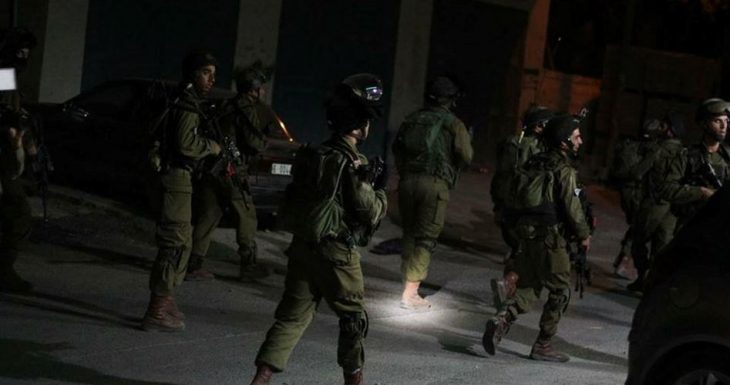
The Israeli army arrested a Palestinian parliamentarian in the West Bank city of Salfit this morning, according to a report by Anadolu Agency.
According to eyewitnesses, the Israeli forces raided Nasser Abdel Gawad’s residence and arrested him.
Palestinian MP Fathi al-Qaraawi of the Hamas-affiliated Change and Reform bloc said continuous arrests of deputies of the Palestinian Legislative Council who are entitled to parliamentary immunity is a flagrant violation of international law.
“Israel rejected the results of the Palestinian parliamentary elections in 2006 and arrested all Hamas deputies (in the West Bank including Jerusalem) and continues to punish the Palestinian people for this by arresting the group’s deputies,” al-Qaraawi said.
The Change and Reform bloc won the 2006 Palestinian elections with an overwhelming majority.
Al-Qaraawi added the arrest is an attempt to block opposition to US President Donald Trump’s recognition of Jerusalem as Israel’s capital.
The latest arrest raises the number of jailed Palestinian parliamentarians to 11.
Peaceful Protests Constitutional Right of Iranians – President Rouhani
© Sputnik/ Aleksey Nikolskyi
Sputnik – 31.12.2017
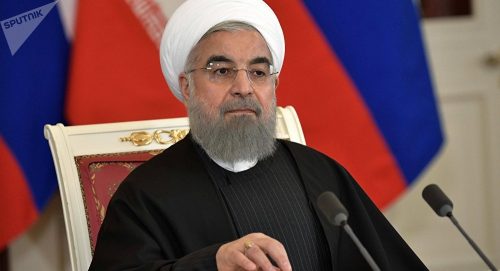
Protests and criticism, not involving violence, are the constitutional rights of the Iranians, the country’s President Hassan Rouhani said on Sunday.
Since Thursday, Iran has been rocked by the largest protests over the past years. Thousands have been protesting across Iran against poverty and unemployment. The protesters have been chanting slogans, criticizing Rouhani and Iran’s Supreme Leader Ali Khamenei. Earlier in the day, Tehran’s mayor Mohammad Ali Najafi said that traffic in some part of the city had been disrupted due to the rallies, adding that some municipal properties, including a number of bus stations, suffered damages during the protests.
“Protest, criticism constitutional rights of people… Criticism different from violence, inflicting damage on public properties,” Rouhani said as quoted by Iranian Press TV broadcaster in the outlet’s Twitter post.
The protests have been suppressed in Iran’s second most populous city of Mashhad by the authorities who used tear gas against the demonstrators.
Earlier on Sunday, authorities of the country’s western Lorestan province confirmed that two people had died during the protests in the province. The local authorities added, however, that the security forces had not opened fire at protesters.
Officials from several countries, including UK Foreign Secretary Boris Johnson, have expressed concerns over the rallies in Iran, calling on the country’s authorities to ensure the citizens’ right to peaceful demonstration.
NYT Trumpwashes 70 Years of US Crimes
By Adam Johnson | FAIR | December 30, 2017
Trumpwashing—defined as whitewashing, obscuring or rewriting the broader US record by presenting Donald Trump as an aberration (FAIR, 6/3/16)—was on full display Thursday in a nominally straight news report from the New York Times’ Mark Landler (12/28/17) on how Trump has reshaped US foreign policy. Buried in the otherwise banal analysis was this gem of US imperial agitprop:
Above all, Mr. Trump has transformed the world’s view of the United States from a reliable anchor of the liberal, rules-based international order into something more inward-looking and unpredictable. That is a seminal change from the role the country has played for 70 years, under presidents from both parties, and it has lasting implications for how other countries chart their futures.
There’s lots of ideology to unpack here, but let’s start with the empirically false assertion that the “world” viewed the United States as a “reliable anchor of the liberal, rules-based international order.” Poll (Guardian, 6/15/06) after poll (Pew, 3/14/07) after poll (PRI, 1/3/14) throughout the years has shown that much of the world views the United States as threat to peace, often taking the top spot as the single greatest threat. What evidence Landler has for the world viewing the US as a sort of good-natured global babysitter is unclear, as he cites nothing to support this hugely important claim (since if Trump’s cynical disregard for “human rights” is nothing new, then there’s no real story here). It’s just thrown out with the assumption the Times readership is sufficiently nationalistic and/or amnesiac to either not notice or not care. It’s designed to flatter, not to elucidate.

The US invasion of Iraq in defiance of international law
The second dubious assertion is the idea that the US is “viewed” as being (or, by implication, objectively is) concerned with “liberal, rules-based international order.” Perhaps Landler missed the part where the US runs offshore penal colonies for untried political prisoners, and a decade-long drone war that’s killed thousands—both entirely outside the scope of international law. Or the time the US invaded and destroyed Iraq without any international authorization, killing hundreds of thousands. Or perhaps he missed the part where the United States refuses to sign “liberal, rules-based international order” treaties such as the International Criminal Court or the ban on bombs and or a prohibition on nuclear weapons. Or the part where the US not only doesn’t recognize the International Criminal Court, but has a law on its books (dubbed “the Hague Invasion Act,” passed in 2002) that if an American is ever held by the ICC for committing war crimes, the US is obligated to literally invade the Hague and free them.
And this is just in the past 15 years. Landler, even more laughably, starts the clock in 1947, which would include dozens of non-“liberal,” non-“rules-based” coups, invasions, bombing campaigns, assassinations, extrajudicial murders and so forth. The number of actions carried out by the US not sanctioned by even the thinnest pretext of “international order” is too long to list.
What exactly is this “liberal, rules-based international order,” and when did “the world” view the United States as its most reliable anchor? Landler doesn’t say, he simply asserts this highly contestable and ideological claim, and moves on to pearl-clutch about Trump ruining the US’s hard-won moral authority. He has some 100 percent uncut pro-US ideology to push under the guise of criticizing Trump, and no amount of basic historical facts will get in his way.
Who Is In The Right In The Canada-Venezuela Diplomatic Dispute?
By Yves Engler | Venezuelanalysis | December 29, 2017
Lying is so common in diplomacy that it can be hard to tell heads from tails in international disputes. In the recent tussle between Caracas and Ottawa, for instance, Venezuela says it is trying to protect itself from foreign “interference” while Canada claims it is promoting “democracy and human rights”. Given the ever-present possibility of a complete disregard for truth on both sides, which government might be more credible in this instance?
Let us consider the background.
Last week Venezuela declared Canada’s chargé d’affaires in Caracas persona non grata. In making the announcement the president of the National Constituent Assembly Delcy Rodriguez denounced Craib Kowalik’s “permanent and insistent, rude and vulgar interference in the internal affairs of Venezuela.”
Is Rodriguez’s explanation for expelling Kowalik convincing?
In recent months foreign minister Chrystia Freeland has repeatedly criticized Venezuela’s elected government and reiterated that Canada is part of the so-called Lima Group of foreign ministers opposed to President Nicolás Maduro.
Following Washington’s lead, Ottawa has also imposed sanctions on Venezuelan officials and supported opposition groups.
In one project, the Canadian embassy distributed $125,212 through the Canadian Funding to Local Initiatives program, which “provided flexible, modest support for projects with high visibility and impact on human rights and the rule of law, including: enabling Venezuelan citizens to anonymously register and denounce corruption abuses by government officials and police through a mobile phone application in 2014-15.”
In August outgoing Canadian ambassador Ben Rowswell, a specialist in social media and political transition, told the Ottawa Citizen: “We established quite a significant internet presence inside Venezuela, so that we could then engage tens of thousands of Venezuelan citizens in a conversation on human rights. We became one of the most vocal embassies in speaking out on human rights issues and encouraging Venezuelans to speak out.”
(Can you imagine the hue and cry if a Venezuelan ambassador said something similar about Canada?)
Rowswell added that Canada would continue to support the domestic opposition after his departure from Caracas since “Freeland has Venezuela way at the top of her priority list.”
So, obviously it’s hard to argue with Rodriguez’ claim that Canada has been “interfering in the internal affairs of Venezuela.”
But, what to make of Freeland’s statement when Ottawa declared Venezuela’s top diplomat persona non grata in response, stating that “Canadians will not stand by as the government of Venezuela robs its people of their fundamental democratic and human rights”?
A series of decisions Freeland’s government has pursued over the past two weeks make it hard to take seriously Canada’s commitment to democracy and human rights:
- Canada signed a defence cooperation arrangement with the United Arab Emirates. According to Radio Canada International, the accord with the monarchy “will make it easier for the Canadian defence industry to access one of the world’s most lucrative arms markets and bolster military ties between the two countries.”
- Canada sided with the US, Israel and some tiny Pacific island states in opposing a UN resolution supporting Palestinian statehood backed by 176 nations.
- Immigration Minister Ahmed Hussen promoted Canadian energy and mining interests during a meeting with Kenyan President Uhuru Kenyatta, who is seeking international legitimacy after winning a controversial election (re-run) boycotted by the opposition.
- The Liberals added Ukraine to Canada’s Automatic Firearms Country Control List, which allows Canadian companies to export weapons to that country with little restriction. President Petro Poroshenko, who has a 2% popular approval rating, needs to make gains in the Ukraine’s civil war to shore up his legitimacy.
Just before expelling Venezuela’s chargé d’affaires Ottawa officially endorsed an electoral farce in Honduras. Following Washington, Global Affairs tweeted that Canada “acknowledges confirmation of Juan Orlando Hernandez as President of #Honduras.” But, Hernandez defied the country’s constitution in seeking a second term and since the election fraud on November 26 his forces have killed more than 30 pro-democracy demonstrators.
Author of Ottawa and Empire: Canada and the Military Coup in Honduras, Tyler Shipley responded: “Wow, Canada sinks to new lows with this. The entire world knows that the Honduran dictatorship has stolen an election, even the Organization of American States (an organization which skews right) has demanded that new elections be held because of the level of sketchiness here. And — as it has for over eight years — Canada is at the forefront of protecting and legitimizing this regime built on fraud and violence. Even after all my years of research on this, I’m stunned that Freeland would go this far; I expected Canada to stay quiet until Juan Orlando Hernandez had fully consolidated his power. Instead Canada is doing the heavy lifting of that consolidation.”
During the past two weeks Canadian decision makers have repeatedly undermined or ignored democracy and human rights.
While Caracas’ rationale for expelling Canadian diplomats appears credible, the same cannot be said for Ottawa’s move. In the tit-for-tat between Canada and Venezuela Canadians would do better to trust Caracas.
Israeli police close probe into January killing of Palestinian teacher
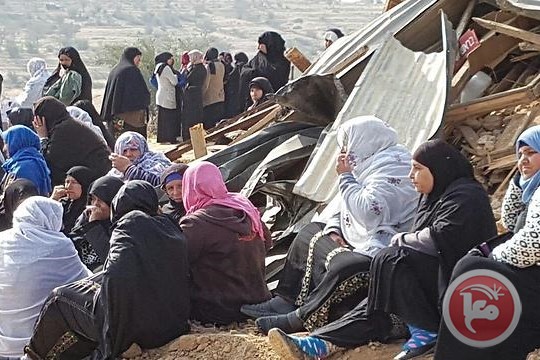
Palestinian women in Umm al-Hiran mourn death of Abu al-Qian in January
Ma’an – December 30, 2017
The Israeli Police Investigations Division (PID) has decided to close its probe into the January police killing of Palestinian math teacher Yaqoub Abu al-Qian, and to not hold any officers responsible for his death, Adalah – The Legal Center for Arab Minority Rights in Israel, said in a statement on Thursday.
Abu al-Qian, a 50-year-old math teacher from the Bedouin village of Umm al-Hiran in southern Israel’s Negev desert, was shot dead by Israeli police in January while he was driving at night, causing him to spin out of control and crash into Israeli officers, killing one policeman.
Abu al-Qian was driving through the village as dozens of Israeli forces were preparing for a large-scale home demolition in Umm al-Hiran. Israeli forces at the time claimed he was attempted to carry out a vehicular attack, though witness testimonies and video footage of the incident proved contradictory to police accusations.
Israeli police footage appeared to show police officers shooting at al-Qian as he was driving at a very slow pace, and only several seconds after the gunfire does his car appear to speed up, eventfully plowing through police officers.
The killing of Abu al-Qian sparked widespread outrage amongst Palestinian civilians and politicians, who claimed he was “extrajudicially executed.
After demands from his family and the community for police to conduct a probe into his killing, Adalah filed a request demanding the PID open an investigation into the death of Abu al-Qian.
“The closure of this investigation means the PID continues to grant legitimacy to deadly police violence against Arab citizens of Israel,” Adalah said in it’s statement.
“Though it was clear from day one that officers opened fire on a civilian without justification and in contravention of the police’s own open-fire regulations, it appears as if the PID is again whitewashing the most serious incidents. Just as the PID failed to hold any officers responsible for the October 2000 killings and the subsequent police killings of more than 50 Palestinian Arab citizens of Israel, this latest decision is further indication of the systemic failure of the PID.”
“The Israeli police and public security minister continue to propagate the same lie they initially promoted the day of the killing, according to which the incident was an intentional vehicular ramming attack against Israeli police officers. This lie was repeatedly refuted by multiple sources and video documentation of the incident,” Adalah added.
Abu al-Qian’s hometown of Umm al-Hiran is one of 35 Bedouin villages considered “unrecognized” by the Israeli state, and more than half of the approximately 160,000 Negev Bedouins reside in unrecognized villages.
The unrecognized Bedouin villages were established in the Negev soon after the 1948 Arab-Israeli war following the creation of the state of Israel.
Now more than 60 years later, the villages have yet to be recognized by Israel and live under constant threats of demolition and forcible removal.
Featured Video
Armando Mema: Finland Used as New Frontline Against Russia
or go to
Aletho News Archives – Video-Images
New Documentary
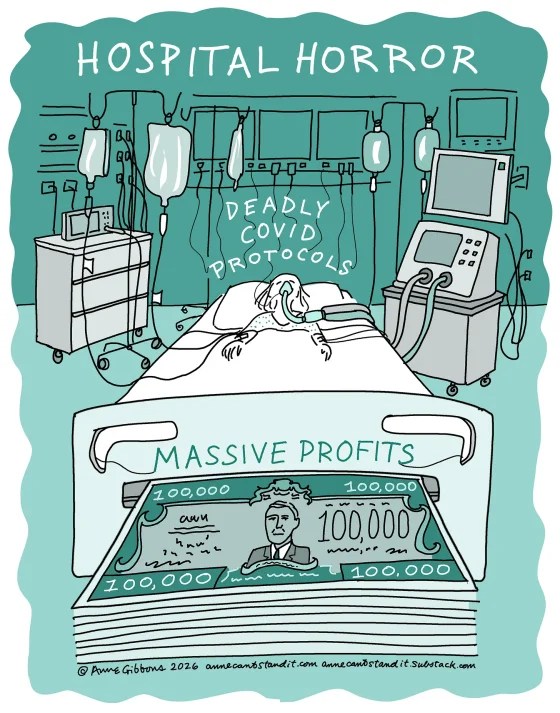
Hospital Horror
Documented in the film,“Bad Medicine”
Blog Roll
 Aletho News
- Poland and Bulgaria put brakes on Ukraine weapons funding
- Russia Reaffirms Its Support for Sovereignty, Territorial Integrity of Lebanon – Russian MFA
- Araghchi: Failure to punish aggressors against Iran endangers all nations
- Iran tells UN Security Council to stop reversing roles of ‘aggressor and victim’
- Disgraced neocons Feith & Libby: stop whining about ‘endless war’
- CENTCOM rejects Israeli claims of preparations for new Iran attacks
- Your Shopping Bag Runs Through Hormuz
- Armando Mema: Finland Used as New Frontline Against Russia
- Gestapo 2.0? Germany grants spy agencies sweeping new powers
- Franco-Palestinian group seeks court ban on Israeli real estate fair in Paris
- If Americans Knew
- An error has occurred; the feed is probably down. Try again later.
- No Tricks Zone
- New Study: Barents Sea Temperatures Were Warmer And Sea Ice Less Extensive In The 1700s Than Today
- German Authorities Start Initiative To Evaluate Public Register For Climate “Disinformation” Spreaders!
- Zonal Asymmetry of Temperature Change in the Antarctic Circumpolar Current
- New Study: The Net Fossil Fuel Contribution To Rising Atmospheric CO2 Has Been Zero For 500 Years
- Germany’s Green Energy Transition Becoming Increasingly Expensive…Another 6 Trillion Euros!
- Sudden Stratospheric Warming, Powerful El Niño Combination May Lead To Extreme Europe Cold, Energy Crisis!
- Two New Studies Find Thwaites Glacier Melt Cannot Be Driven By Human Activity Or A Warming Ocean
- E-Cars Reduce CO2 Emissions By Only 41% Compared To Internal Combustion Engine Vehicles
- Predictions Made By Renowned Climate Professor Over Past Decades Have Been Proven To Be Poor
- New Study Suggests Large Regions Of The Pacific Ocean Have Been Cooling For The Last 80 Years

