Israel to expel Al Jazeera, block broadcasts & revoke journalists’ credentials
RT | August 6, 2017
Israel has announced plans to effectively expel the Al Jazeera network from the country, revoking journalists’ credentials, shutting the company’s bureau in Jerusalem and pulling its broadcasts from national cable and satellite television networks.
Israeli Communications Minister Ayoub Kara announced the measures Sunday at a news conference. Journalists and representatives from Al Jazeera were not permitted to attend.
“We are going to set measures in order to illustrate our war on terrorism, on radical Islam and our solidarity with the sane Arab world,” Kara stated.
While the proposal will not take immediate effect, Kara confirmed that both the Arabic and English versions of the news channel will be shuttered once the proposal is passed in the Knesset (Israel’s parliament).
“I am the only one [in government] who is an Arabic speaker, who understands Arabic and my native language is Arabic. You cannot fool me with Al Jazeera English and Al Jazeera Arabic. I know how to identify how disturbing reporting becomes incitement instead of being free speech,” he added.
Kara claimed that such extreme measures are ostensibly intended to improve journalistic practice in the country by creating “a situation that channels based in Israel will report objectively.”
“We have based our decision on the move by Sunni Arab states to close the Al Jazeera offices and prohibiting their work.”
“I congratulate the Minister of communications, Ayoob for my guidance took today in line with practical steps to stop the activity of incitement in Israel,” Israel’s Prime Minister Benjamin Netanyahu said of Kara’s proposal on Twitter.
In July, Netanyahu announced that he was working to shut down the network which he accuses of stoking tensions and inciting violence in Israel, particularly at the al-Aqsa mosque where six Palestinians and five Israelis, including two police officers, have been killed in recent clashes.
“This attack on Al Jazeera is really an attack on all critical independent journalism.” Aidan White, director of the London-based Ethical Journalism Network told Al Jazeera.
The network’s offices in the Palestinian territories of Gaza and the West Bank city of Ramallah would not be affected.
The network will not give up its Jerusalem bureau without a fight, however.
“Al Jazeera deplores this action from a state that is called the only democratic state in the Middle East and considers what it has done is dangerous,” an unnamed official with Al Jazeera told the AFP.
The broadcaster “will follow up the subject through appropriate legal and judicial procedures,” he added.
Saudi Arabia and Jordan have both shut Al Jazeera bureaux this year as part of the ongoing ‘cold war’ playing out in the Gulf, which culminated in the full blockade of Qatar.
Egypt banned the Al Jazeera network and several other websites that were critical of the government in May and broadcasts have also been blocked in the UAE.
British Army must stop recruiting child soldiers, veteran tells RT
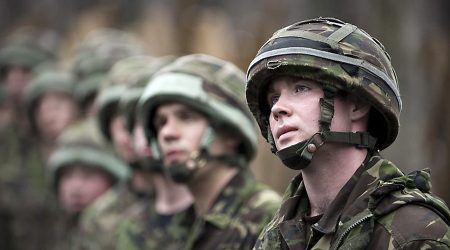
© defenceimagery.mod.uk
By Claire Gilbody-Dickerson | RT | August 4, 2017
Britain should raise the military recruitment age from 16 to 18 because joining the services at such a tender age can cause irreversible psychological damage, a British Army veteran has told RT.
Wayne Sharrocks, who joined the army when he was 17, has spoken out against current military regulations, which allow recruiters to accept under 18s, who are effectively children based on international standards.
Sharrocks is calling for the recruitment age to be raised following a recent report published by Veterans for Peace (VFP) UK, which sheds light on the detrimental effects of army training on soldiers in general, and young people in particular.
Twenty-two out of every 100 British soldiers are under the age of 18. However, they are exempt from combat operations until they reach adulthood.
The 72-page report, ‘The First Ambush? Effects of army training and employment,’ says military training alone increases violent offending among recruits, with the rate of offenses rising again once they return from the front line.
The report, assembled through the testimonies of army veterans and more than 200 separate studies, also found recruits are twice as likely to drink heavily – all factors which may in turn lead to unemployment and homelessness.
Regardless of recruitment age, Sharrocks believes “military training and culture is damaging and not healthy for a person to go through.” But because young people’s minds are more “malleable” than those of adults, the effects of training are far worse for them.
It emerged last month that the British Army is actively trying to fill its ranks with young people from households with a £10,000 (US$13,000) annual income.
In a document for the British Army’s ‘This Is Belonging’ campaign, seen by the Independent and Child Soldiers International, the military says it is deliberately targeting 16 to 24-year-olds from social classes known as C2DEs – denoting the three lowest ranks of society.
The VFP report says the British Army “strategically” targets such youngsters from deprived neighborhoods by presenting a “romanticized” image of the soldier.
Members of the Scottish Parliament have backed a petition calling for further research into military recruitment of youth.
There have also been calls by the Scottish National Party (SNP) Youth for a review of the policy on military recruitment age, but a motion to raise it was opposed by senior MPs in December last year.
Sharrocks, who twice served in Afghanistan and left the army after being severely injured by an improvised explosive device (IED), said more information should be made available to young people so they know what they are signing up for.
Jay Sutherland, a Scottish 16-year-old student who has founded a campaign group against “militarism” in schools, said advertisements are “glossed over, with the military not even showing important regulations such as when you sign up you are locked in until 18 and the fact that younger recruits are twice as likely to be killed in Afghanistan than older recruits.”
An MoD spokesperson told RT it rejects claims it is targeting youth only, but said it is “proud” of offering young people in the Armed Forces opportunities that “aren’t always available elsewhere, from basic literacy education and support for postgraduate degrees, to high-quality accredited training and unique employment prospects.”
The spokesperson added that the Armed Forces allows for everyone, regardless of their background, the opportunity to reach their full potential, before adding it is encouraging young people to “aim higher” while “teaching them valuable skills”.
Dehumanizing training
Sharrocks claims military training requires soldiers to “follow orders without questioning them,” so that their “natural aversion” to killing is also “altered.”
The report itself reads: “To ensure that recruits will follow all orders and kill their opponents in war, army training indoctrinates unconditional obedience, stimulates aggression and antagonism, overpowers a healthy person’s inhibition to killing, and dehumanizes the opponent in the recruit’s imagination.”
Such practices can lead to long-lasting psychological issues such as post-traumatic stress disorder (PTSD), which can lead to suicide.
VFP UK describes the case of Dan, who joined the army at 18 and developed PTSD after training and service in Iraq.
When he returned to Britain, he served time in a military prison for assaulting a warrant officer.
“After the conviction the army wouldn’t support me, my mental health deteriorated and I was left feeling isolated and alone.
“I resorted to alcohol abuse and became homeless for a year, and I have suffered with chronic PTSD.
“I really believe that underlying all my problems was the effect of the training I was put through when I joined the army.”
Sharrocks accused the army of turning its back on soldiers, who are “pushed aside” once they are deemed no longer “useful.”
Because they have been in the army for so many years, Sharrocks says some veterans lack fundamental qualifications to get a decent job in civilian life, as they have the same skill-set of a 16-year-old who has “just left school.”
Many find themselves in manual, low-skill factory jobs.
Rather than leaving charities to pick up the pieces, Sharrocks appealed for more to be done to smooth the transition from soldiering to civilian life.
Writing for the ForcesWatch website, Douglas Beattie, a member of VFP UK, said soldiers are dehumanized right from the start, regardless of their age.
“This [process] begins with isolation – for the first few weeks trainees, heads shaved and in uniform, have no right to see family or friends; they are not allowed to leave base and cannot terminate their contract.”
He also said soldiers become targets of “beastings” – humiliating treatment involving both verbal and physical violence, aimed at the individual’s utter debasement.
Read more:
Rutherford Institute Asks Virginia Supreme Court to Prohibit Police From Using License Plate Readers as Surveillance Tool to Track Citizens
Rutherford Institute | August 2, 2017
RICHMOND, Va. — Denouncing the fact that Americans cannot even drive their cars without being enmeshed in the government’s web of surveillance, The Rutherford Institute has asked the Virginia Supreme Court to prohibit Virginia police from using license plate readers as surveillance tools to track drivers’ movements. Mounted next to traffic lights or on police cars, Automated License Plate Readers (ALPR), which photograph up to 3,600 license tag numbers per minute, take a picture of every passing license tag number and store the tag number and the date, time, and location of the picture in a searchable database. The data is then shared with law enforcement, fusion centers and private companies and used to track the movements of persons in their cars. There are reportedly tens of thousands of these license plate readers now in operation throughout the country. It is estimated that over 99% of the people being unnecessarily surveilled are entirely innocent. In challenging the use of license plate readers by Fairfax police, Rutherford Institute attorneys argue that Fairfax County’s practice of collecting and storing license plate reader data violates a Virginia law prohibiting the government from amassing personal information about individuals, including their driving habits and location.
The amicus brief in Neal v. Fairfax County Police Department is available at www.rutherford.org.
“We’re on the losing end of a technological revolution that has already taken hostage our computers, our phones, our finances, our entertainment, our shopping, our appliances, and now, it’s focused its sights on our cars,” said constitutional attorney John W. Whitehead, president of The Rutherford Institute and author of Battlefield America: The War on the American People. “By subjecting Americans to surveillance without their knowledge or compliance and then storing the data for later use, the government has erected the ultimate suspect society. In such an environment, there is no such thing as ‘innocent until proven guilty.’”
Since 2010, the Fairfax County Police Department (FCPD) has used Automated License Plate Readers (ALPR) to record the time, place, and driving direction of thousands of drivers who use Fairfax County roads daily. License plate readers capture up to 3,600 images of license tag numbers per minute and convert the images to a computer format that can be searched by tag number. This information, stored in a police database for a year, allows the police to determine the driving habits of persons as well as where they have been. In 2014, Fairfax County resident Harrison Neal filed a complaint against FCPD asserting its collection and storage of license plate data violates Virginia’s Government Data Collection and Dissemination Practices Act (Data Act), a law enacted because of the fear that advanced technologies would be used by the government to collect and analyze massive amounts of personal information about citizens, thereby invading their privacy and liberty. The lawsuit cited a 2013 opinion by Virginia Attorney General Ken Cuccinelli that ALPR data is “personal information” that the Data Act forbids the government from collecting and storing except in connection with an active criminal investigation. Despite this opinion, FCPD continued its practice of collecting and storing ALPR data in order to track the movements of vehicles and drivers. In November 2016, a Fairfax County Circuit Court judge ruled that license plate reader data was not “personal information” under the Data Act because license tag numbers identify a car and not a person. In weighing in on the case before the Virginia Supreme Court, Rutherford Institute attorneys refute the lower court ruling and argue that the history of the Data Act affirms its prohibition on the collection and maintenance of ALPR data by the government.
The Rutherford Institute, a nonprofit civil liberties organization, provides legal assistance at no charge to individuals whose constitutional rights have been threatened or violated and educates the public on a wide spectrum of issues affecting their freedoms.
Opposition journalist investigated for ‘treason & terrorism’ in Ukraine
RT | August 2, 2017
Ukraine’s Security Service have launched an investigation into a journalist and blogger whom they accuse of treason as well as his alleged attempts to violate the country’s territorial integrity via publications critical of the government in Kiev.
The Security Service of Ukraine (SBU) released a statement Wednesday, reporting that it had “ended the activity” of a journalist from the Zhitomir region in central Ukraine, who they claim worked on the “instructions of Russian curators” and “prepared and distributed anti-Ukrainian materials.”
“Since 2014 the journalist had been writing tendentious articles at the request of the Russian government propaganda news agencies,” the agency said without releasing the name of the suspect.
His work has had a “manipulative influence on the readers’ minds” and threatened “the sovereignty and independence of our state,” the SBU claimed.
The blogger, identified by the Ukrainian media as Vasily Muravitsky, was publishing his articles on at least six websites, the SBU said, adding, that the man initially signed his work under his real name, but started using aliases after that.
The journalist’s works also allegedly contained “calls to incite national enmity within the country and between Ukraine and neighboring friendly states,” the security agency added.
If found guilty the opposition journalist may face up to 15 years in prison, according to Ukrainian authorities.
The Russian foreign ministry has condemned the persecution of the journalist, saying in a statement the investigation of the blogger is “just another episode of the campaign led by Kiev and aimed at violent suppression of the opposition journalists and total cleansing of Ukraine’s information sphere for the benefit of the ruling regime.”
“The mass closure of Russian news and internet media outlets as well as persecution and oppression of the Ukrainian journalists conducted on a large scale are blatant violations of the fundamental principles of the freedom of expression that lie at the core of the civilized approach to the media and are embodied in the key documents of the UN, OSCE and the Council of Europe,” the statement said.
The ministry further called on member states of the OSCE and the Council of Europe as well as other international organizations to join Russia in condemning “Kiev’s barbaric and criminal policy towards media.”
‘No Time For Shallow Diplomacy Christians’ In The Religious War On Churches In The Holy Land
By Stuart Littlewood | American Herald Tribune | August 2, 2017
A month ago, after reading a desperate cry for help from the National Coalition of Christian Organisations in Palestine (NCCOP) addressed to the World Council of Churches, I emailed eight churches in my locality asking whether that heart-rending appeal had trickled down to them at parish level.
If not, I hoped to find out where the break in communications occurred, as this wasn’t the first time churches in the Holy Land had sought support from Western Christendom. Previous appeals were largely ignored and left to civil society for action.
Now, say the Palestinians, the situation is “beyond urgent”. So had the NCCOP’s latest plea actually arrived on the desks of parish priests in my neighbourhood? And if so, how were grass-roots Christians responding?
I included a link to the actual crisis document, which should have made every churchman sit up, and a gentle reminder that their faith and their job of work are rooted in the Holy Land. “So what are the chances, I wonder, of seeing concerted action from Western churches before it’s too late? And what part can local parishes play?”
The key point was this: it’s beyond urgent. So are our spiritual leaders, those upstanding ‘men of the cloth’, mobilising their troops?
Only one of the eight replied — the local Catholic vicar-general — who dismissed the subject in two sentences. So there you have it. If this local bunch are representative of the Christian community in the UK, they don’t give a four-X for their brothers and sisters in the Occupied Palestinian Territories. And they are utterly indifferent to the fact that the place where Christianity was born is being stolen from under their noses.
If that’s a wrong interpretation, and Christians in the West do actually wish to help, the issue is straightforward enough. Churches in Palestine are asking churches here to call things as they are: to recognize Israel as an apartheid state in terms of international law and the UN report which says so. They are concerned that States and churches are still dealing with Israel on a business-as-usual basis, as if the situation were normal, and ignoring the criminal reality of military occupation.
Churches came together in opposition to apartheid in South Africa and helped end it. Why haven’t they done the same in Palestine?
They ask us to unequivocally condemn the Balfour Declaration as unjust, and they rightly demand that the UK asks forgiveness and compensates the Palestinian people for their losses. Theresa May’s government, however, plans to celebrate the centenary of the Balfour Declaration “with pride” and has invited Mr Netanyahu to the fun.
Clearly Mrs May, God-fearing churchgoer that she is, needs to feel the heat of His wrath. The woman is so arrogant that her government intends to appeal against the recent decision by the Royal Courts of Justice defending our right to boycott Israel.
End the ‘Ecumenical Deal’, put interfaith dialogue through the wringer
The Palestinians want us to take the strongest possible stand against any theology or group that seeks to justify the occupation. That means of course challenging our religious dialogue partners and withdrawing from those partnerships if they won’t condemn Israel’s brutal occupation.
But I can hear our canting clerics muttering: “Oh dear, no, no, no. We mustn’t upset our interfaith colleagues. That would never do.”
Churches that sell their holdings or otherwise divest from companies that profit from the occupation of Palestinian lands often take years of agonising confab to reach such a commonsense position. But they needn’t think just moving their money is enough. A recent example is the Mennonite Church USA, where it took (they say) a three-person writing team and a 10-member reference group working intensely during the past two years and consulting widely across the church and with Palestinian and Jewish partners, to come up with a modest proposal. And to sugar the divestment pill they declared that “the legacy of Jewish suffering is intertwined with the suffering of Palestinians”. What the Palestinians had to do with Jewish suffering or ever did to deserve having their lands and homes confiscated, isn’t explained. But it is used to provide an excuse to call on Mennonites to strengthen relationships with Jewish communities.
Why? Can they not understand that you have to be consistent in boycotting Israel? It involves boycotting the people who also support and advocate for Israel including those who fail to condemn the Zionist regime’s vile policies that hurt our Palestinian friends. As George Galloway has said, you simply don’t engage with them.
Christians who cannot grasp what is really going on out there, and don’t see what is needed to stop it, might find Robert Cohen’s excellent article Brace Yourselves for Costly Palestinian Solidarity helpful in pointing towards proper, meaningful action.
He explains why the Christian-Jewish dialogue needs re-setting. Central to the problem is the so-called Ecumenical Deal, a reluctance to question Jewish support for Israel for fear of unpicking decades of interfaith reconciliation following the Holocaust. We appear to have cast ourselves in the self-defeating role of repenting for age-old Christian anti-Jewishness. Breaking out of it and criticising Israel would be seen as a re-emergence of that anti-Jewishness.
I’m not aware of Christian anti-Jewishness although continuing failure on the part of Jewish leaders to condemn the cruel policies of the Israeli regime, aka ‘the Jewish State’, is surely asking for it. Does anyone inside or outside the bubble of the Church seriously buy into this repentence stuff? From outside, among people who would never set foot in a church again but still call themselves Christians because they were brought up according to the Christian code, it looks pathetic.
Christians in Palestine, says Cohen, despair of our Church leaders’ endless hiding behind the cover of political neutrality and their unwillingness to offend their religious dialogue partners. Consequently, he predicts, Jewish-Christian dialogue “is about to go through the wringer”.
Time for some ‘really uncomfortable conversations’
Pressing the re-set button means “refusing to allow your local Jewish communal leadership to set the boundaries of permissible debate on Israel”. It also means “listening to the Christian voice under occupation before the Jewish voice living comfortably, with full equal rights, many thousands of miles from that same occupation”.
Operating the wringer, of course, will be followed by a distinct chill in relationships forcing Church leaders, local ministers and their congregations, as well as the Jewish leaders they have dialogue with, out of their comfort zone. Good. As Rebecca Vilkomerson, Jewish Voice for Peace, recently wrote in Haaretz, after 70 years of dispossessing and expelling Palestinians, 50 years of Israeli military occupation and 10 years of blockading Gaza, it is time for Jewish communities “to have some really uncomfortable conversations”.
Palestinians say no to ‘shallow diplomacy’ but it’s all they’re likely to get
How does the World Council of Churches react to those urgent pleas from Palestine?
They will study and analyse. “As we at the WCC consider our plans for 2018 and beyond, we want churches in Palestine to know that their perspective is heard and it is vitally important,” said the WCC’s general secretary. “We will continue with the same passionate spirit to work on specific objectives, strategies and partners for advocacy to end the occupation and to work for just peace in Palestine and Israel.”
The WCC’s Commission of the Churches on International Affairs has been asked to contribute a thorough analysis of the changing political landscapes and dynamics in the Holy Land with an eye toward developing a more specific advocacy strategy that works through nations and organizations with significant influence.
WCC has also started an online campaign, Seek #JusticeAndPeace in the Holy Land, which features profiles of peacemakers and various cries for justice.
WCC also plans to “explore theological reflections, studies and projects that will bring a perspective on just peace in the Holy Land from all parts of the world”, and strengthen communication about the situation in Palestine so that it can “help churches and other ecumenical partners address their constituencies and governments in a more systematic way”. This includes developing a set of principles and practices of responsible pilgrimages of justice and peace to the Holy Land.
Will the Palestinian churches be impressed? Their cry for help stated specifically: “We stand in front of an impasse and we have reached a deadlock. Despite all the promises, endless summits, UN resolutions, religious and lay leader’s callings, Palestinians are still yearning for their freedom and independence, and seeking justice and equality.”
They stressed that religious extremism is on the rise, with religious minorities paying a heavy price. “We need brave women and men who are willing to stand in the forefront. This is no time for shallow diplomacy Christians.”
When I called the Church of England press office yesterday they didn’t think any response had been made. Such concern, then. And when I ran through the members of the WCC’s Central Committee I noticed the two representatives from the Church Of England were both based in Europe. How helpful is that?
The power of hope
Christianity sometimes has great trouble telling right from wrong and doing something about it. The Holy Land is a case in point. Evil reigns there. Christianity across the world cowers. What would Christ say to that?
I know what Michel Sabbah says. He is a former Catholic Patriarch of Jerusalem, a courageous man of the front line and one of the great heroes of the struggle.
“The current situation is hopeless. In reality, there are no signs of hope at all for the Palestinian people. In spite of that, we hope.
We hope because we are Christians, and God is present.
We hope because we believe in the fundamental goodness of the human being, Israeli and Palestinian. Human goodness will prevail at the end upon the human power of evil.We hope because Palestinians are persevering in claiming their rights.
It is a source of hope that we never gave up….We hope because among Israelis, there are people who are trying to work with Palestinians for what is right. And there are an increasing number of movements for peace, strong in will….
If we had no hope we would not live. Hope is life, and history gives us hope. What is right will prevail.”
Michel Sabbah
Catholic Patriarch Emeritus
I fear that if he pins any hopes on the wets of the Western churches he’ll be disappointed. But he already knows that, surely.
Saudi forces set ablaze Shia homes in restive Awamiyah
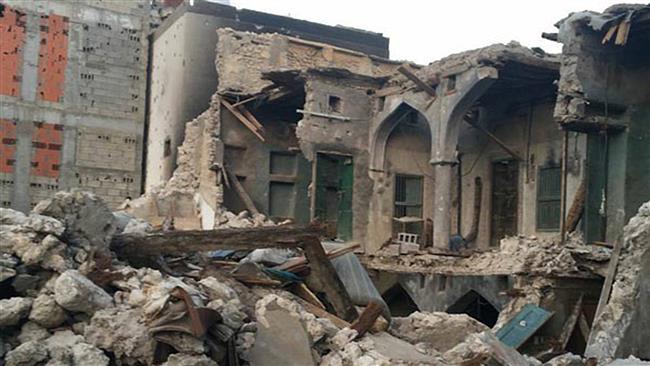
An al-Alam photo shows rubble caused by the Saudi demolition of Awamiyah, Eastern Province, Saudi Arabia.
Press TV – August 1, 2017
Saudi forces have set fire to homes belonging to Shia residents in the besieged town of Awamiyah that has been the scene of a heavy-handed regime crackdown on the minority community.
Based on local reports, Saudi forces have thrown Shia citizens out of their homes and then torched their properties.
Awamiyah, situated in Eastern Province, has long been a flashpoint between the Saudi kingdom and the inhabitants complaining of discrimination.
It has witnessed renewed deadly clashes between the military and residents since May, when Saudi forces began razing the town’s old quarter, known as al-Mosawara.
Saudi authorities claim that Mosawara’s narrow streets have become a hideout for militants suspected of being behind attacks on security forces in Eastern Province.
The UN, however, said Saudi Arabia was erasing cultural heritage and violating human rights through Mosawara’s demolition.
Karima Bennoune, the UN special rapporteur in the field of cultural rights, said Saudi authorities ignored repeated pleas by the world body to halt the destruction.
“These destructions erase the traces of this historic and lived cultural heritage and are clear violations of Saudi Arabia’s obligations under international human rights law,” Bennoune said, accusing the Saudi forces of “irreparably burning down” historic buildings and forcing residents to flee their homes.
Leilani Farha, the UN special rapporteur on the right to adequate housing, also warned that the Saudi move “constitutes a forced eviction under international human rights law.”
Additionally, Ali al-Dubisi, the head of the Berlin-based European Saudi Organization for Human Rights, said the Saudi forces were following a scorched-land policy in Awamiyah, launching rocket attacks and shelling residential buildings and civilians who are resisting Saudi pressures to evacuate.
Since February 2011, Saudi Arabia has stepped up security measures in Shia-dominated Eastern Province, which has been rocked by anti-regime demonstrations, with protesters demanding free speech, the release of political prisoners, and an end to economic and religious discrimination.
The government has suppressed pro-democracy movements, but they have intensified since January 2016 when Saudi Arabia executed respected Shia cleric Sheikh Nimr al-Nimr.
Israel shoots Palestinian minor in both legs and arm
MEMO | July 31, 2017
Israeli forces shot an unarmed Palestinian minor in both legs and in one arm last week, according to Haaretz.
Thirteen-year-old Mohammed Qaddumi was collecting firewood near the West Bank Separation Wall on Tuesday when Israeli occupying forces fired at him. Qaddumi was admitted to Meir Hospital in Kfar Saba and underwent a long operation. His condition remains severe though his health has improved.
Qaddumi’s father said his son was one of four children walking by the barrier next to their home in the village of Jayus:
He was by the fence, the children were there, four children, and there were soldiers under the olive trees. They went up there by the fence, they could have grabbed him by the arm but they shot him three times.
His father emphasised that Qaddumi did not try to cross into Israel as the army claims, nor did the children throw stones at the soldiers who were hidden from their view.
Israel’s Civil Administration initially prevented Qaddumi’s family from accompanying their son to hospital in Israel, but relented after NGOs Mahsom Watch and Physicians for Human Rights intervened.
The army is said to have initiated legal proceedings against the wounded teenager, on suspicion of throwing stones.
Israeli forces have long been accused of implementing a “shoot to cripple” campaign against Palestinians in the occupied West Bank. A report released by the Badil resource centre found that in the first six months of 2016, at least 30 of the 86 Palestinians that were shot in Bethlehem alone were shot in the legs or knees.
Israeli generals have also been known to encourage such tactics against Palestinian youth. Reports surfaced last year that Palestinians in numerous West Bank cities speak of Shin Bet officials known only as “Captain Nidal” and “Captain Imad” among others, who regularly threaten to disable young men if they fail to comply with Israeli soldiers.
How Prison Labor is the New American Slavery and Most of Us Unknowingly Support it
If you buy products or services from any of the 50 companies listed below (and you likely do), you are supporting modern American slavery

Return to Now | June 13, 2016
American slavery was technically abolished in 1865, but a loophole in the 13th Amendment has allowed it to continue “as a punishment for crimes” well into the 21st century. Not surprisingly, corporations have lobbied for a broader and broader definition of “crime” in the last 150 years. As a result, there are more (mostly dark-skinned) people performing mandatory, essentially unpaid, hard labor in America today than there were in 1830.
With 5 percent of the world’s population and 25 percent of the world’s prison population, the United States has the largest incarcerated population in the world. No other society in history has imprisoned more of its own citizens. There are half a million more prisoners in the U.S. than in China, which has five times our population. Approximately 1 in 100 adults in America were incarcerated in 2014. Out of an adult population of 245 million that year, there were 2.4 million people in prison, jail or some form of detention center.
The vast majority – 86 percent – of prisoners have been locked up for non-violent, victimless crimes, many of them drug-related.
Big Business is making big bucks off of prison labor:

While prison labor helps produce goods and services for almost every big business in America, here are a few examples from an article that highlights the epidemic:
Whole Foods – You ever wonder how Whole Foods can afford to keep their prices so low (sarcasm)? Whole Foods’ coffee, chocolate and bananas might be “fair trade,” but the corporation has been offsetting the “high wages” paid to third-world producers with not-so-fair-wages here in America.
The corporation, famous for it’s animal welfare rating system, apparently was not as concerned about the welfare of the human “animals” working for them in Colorado prisons until April of this year.
You know that $12-a-pound tilapia you thought you were buying from “sustainable, American family farms?” It was raised by prisoners in Colorado, who were paid as little as 74 cents a day. And that fancy goat cheese? The goats were raised and milked by prisoners too.
McDonald’s – The world’s most successful fast food franchise purchases a plethora of goods manufactured in prisons, including plastic cutlery, containers, and uniforms. The inmates who sew McDonald’s uniforms make even less money by the hour than the people who wear them.

Wal-Mart – Although their company policy clearly states that “forced or prison labor will not be tolerated by Wal-Mart,” basically every item in their store has been supplied by third-party prison labor factories. Wal-Mart purchases its produce from prison farms, where laborers are often subjected to long hours in the blazing heat without adequate food or water.
Victoria’s Secret – Female inmates in South Carolina sew undergarments and casual-wear for the pricey lingerie company. In the late 1990’s, two prisoners were placed in solitary confinement for telling journalists that they were hired to replace “Made in Honduras” garment tags with “Made in USA” tags.
AT&T – In 1993, the massive phone company laid off thousands of telephone operators—all union members—in order to increase their profits. Even though AT&T’s company policy regarding prison labor reads eerily like Wal-Mart’s, they have consistently used inmates to work in their call centers since ’93, barely paying them $2 a day.

BP (British Petroleum) – When BP spilled 4.2 million barrels of oil into the Gulf coast, the company sent a workforce of almost exclusively African-American inmates to clean up the toxic spill while community members, many of whom were out-of-work fisherman, struggled to make ends meet. BP’s decision to use prisoners instead of hiring displaced workers outraged the Gulf community, but the oil company did nothing to reconcile the situation.

The full list of companies implicated in exploiting prison labor includes:
Bank of America
Bayer
Cargill
Caterpillar
Chevron
Chrysler
Costco
John Deere
Eli Lilly and Company
Exxon Mobil
GlaxoSmithKline
Johnson and Johnson
K-Mart
Koch Industries
McDonald’s
Merck
Microsoft
Motorola
Nintendo
Pfizer
Procter & Gamble
Pepsi
ConAgra Foods
Shell
Starbucks
UPS
Verizon
WalMart
Wendy’s
While not all prisoners are “forced” to work, most “opt” to because life would be even more miserable if they didn’t, as they have to purchase pretty much everything above the barest necessities (and sometimes those too) with their hard-earned pennies. Some of them have legal fines to pay off and families to support on the outside. Often they come out more indebted than when they went in.
“Prison farms” aka “modern plantations”

In places like Texas, however, prison work is mandatory and unpaid – the literal definition of slave labor.
According the Texas Department of Criminal Justice, prisoners start their day with a 3:30 a.m. wake-up call and are served breakfast at 4:30 a.m. All prisoners who are physically able are required to report to their work assignments by 6 a.m.
“Offenders are not paid for their work, but they can earn privileges as a result of good work habits,” the website says.
Most prisoners work in prison support jobs, like cooking, cleaning, laundry, and maintenance, but about 2,500 of them work in the Texas prison system’s own “agribusiness department,” where they factory-farm 10,000 beef cattle, 20,000 pigs and a quarter million egg-laying hens. The prisoners also produce 74 million pounds of livestock feed per year, 300,000 cases of canned vegetables, and enough cotton to clothe themselves (and presumably others). They also work at meat packaging plants, where they process 14 million pounds of beef and 10 million pounds of pork per year.

While one of the department’s stated goals is to reduce operational costs by having prisoners produce their own food, the prison system admittedly earns revenue from “sales of surplus agricultural production.”

Prisoners who refuse to work – again, unpaid – are placed in solitary confinement. When asked if Texas prisons still employ “chain gangs” in the FAQ section, the department responds:

“No, Texas does not use chain gangs. However, offenders working outside the perimeter fence are supervised by armed correctional officers on horseback.”
Similar “prison farms” exist in Arizona, Alabama, Alaska, Arkansas, California, Colorado, Florida, Georgia, Hawaii, Louisiana, Mississippi, Ohio and other states, where prisoners are forced to work in agriculture, logging, quarrying and mining. Wikipedia says while the agricultural goods produced on prison farms is generally used to feed prisoners and other wards of the state (orphanages and asylums) they are also sold for profit.
In addition to being forced to labor directly for the profit of the government, inmates may be “farmed out” to private enterprises, through the practice of convict leasing, to work on private agricultural lands or related industries (fishing, lumbering, etc.). The party purchasing their labor from the government generally does so at a steep discount from the cost of free labor.
Israeli forces shoot, injure Palestinian in Salfit tending to his land near separation wall
Ma’an – July 29, 2017
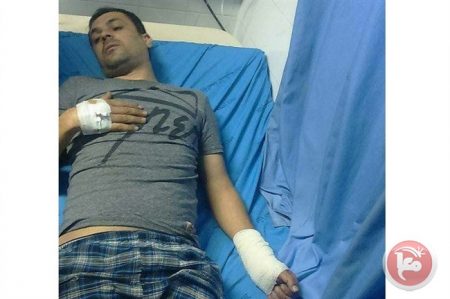 SALFIT – Israeli forces shot and injured a Palestinian on Friday while he was tending to his land near Israel’s separation wall in the village of Deir Ballut in the western part of Salfit district in the occupied West Bank.
Medical sources at the Palestinian Red Crescent told Ma’an that Faed Saleh Odeh Moussa, 33, was injured with a live bullet in his left hand after Israeli forces opened fire on him while he was on his land watering trees.
The sources added that he was transferred to the Yasser Arafat Hospital in Salfit, where doctors reported his injury as moderate.
Saed, Moussa’s brother, told Ma’an that they were caring for their land near Israel’s separation wall, like every Friday, when Israeli forces arrived in the area at 7:30 p.m. and randomly opened live ammunition on them.
Saed said that they quickly hid behind rocks before his brother was injured. He added that their children were also with them at the time and two men from Qalqiliya city in the northern West Bank who were en route to Israel.
Israeli forces remained in the area for some time before leaving following the incident, Saed noted. He added that he had called the Deir Ballut municipality to inform them of the incident, who said that they would notify the Palestinian liaison of the incident.
An Israeli army spokesperson told Ma’an she would look into reports on the incident.
According to the Bethlehem-based Applied Research Institute — Jerusalem, the village of Deir Ballut has had thousands of dunams of land confiscated for the purpose of illegal Israeli settlement building, while Israel’s separation wall — deemed illegal by the International Court of Justice in 2004 — is expected to swallow up at least 35 percent of the village’s lands.
Such Israeli activities in Palestinian villages coincide with upticks of Israeli violence against Palestinians — both by Israeli forces and settlers, as Palestinians are stripped of their lands and often barred from entering Israel’s so-called security “buffer zones” on the Palestinian side of the separation wall.
The UN has reported that at least 92 Palestinians are injured by Israeli forces every two weeks, while 1,444 Palestinians were injured by Israeli forces this year, as of July 17. However, this data does not include the hundreds of Palestinians who were injured during Al-Aqsa protests post-July 17.
‘An attempt to drown out Palestinian voices’: RT’s office building raided in Ramallah

RT | July 29, 2017
The Israeli military raided the PalMedia building in Ramallah on the West Bank early Saturday morning. It is home to a number of international media organizations, including RT’s regional office. Property belonging to other media channels was either damaged or seized.
No RT employees were harmed during the raid on the PalMedia building which also houses the offices of Al-Quds, Al-Mayadeen, France 24 and Al-Manar.
Witnesses told the Ma’an News Agency that 10 Israeli army vehicles had surrounded the building before carrying out the search.
Several doors and editing rooms were damaged while some computers and other property were taken away.
An Israeli army spokesperson told Ma’an that Israeli forces had “seized media equipment and documents used for incitement” from a media office in Ramallah, though did not say which agency they were specifically targeting.
The satellite channel Al-Quds said the search was directed at them.
The Palestinian Union of Journalists condemned the raid, which it said had led to “the destruction of property and the theft of equipment, computers and archival materials belonging to the satellite channel Al-Quds,” adding, that it was “an obvious attempt to drown out the voice of the Palestinians and make the Palestinian narrative invisible.”
The Palestinian Ministry of Information also released a statement denouncing the raid, saying, that targeting the media “proves Israel’s intentions to prevent the guardians of truth from continuing their media, national, and ethical role of transferring the message of our people’s desired freedom.”
This is not the first time Israeli authorities have mounted a search of the building, having done so in June 2014. At the time, Reporters Without Borders said the raid “joined the long list of violations of Palestinian news media rights by the Israeli security forces, with never-ending threats, arrests and military operations.”
RT’s offices in the Gaza Strip were also hit by an airstrike during Operation Pillar of Defense in November 2012. Though the building was severely damaged, none of RT’s employees were hurt.
Israeli authorities have long restricted Palestinian freedom of expression through censoring social media activity and imprisoning journalists, activists, poets, and novelists.
The Dawn of an Orwellian Future
By Robert Parry | Consortium News | July 28, 2017
It seems that The New York Times can’t let a good lie lie. Even after being pushed into running an embarrassing correction retracting its false claim that there was a consensus of all 17 U.S. intelligence agencies that Russia hacked Democratic emails and made them public to help Donald Trump defeat Hillary Clinton, the Times is back suggesting exactly that.
The Times’ current ploy is to say the Russian hacking claims are the “consensus” judgment of the U.S. intelligence community without citing a specific number of agencies. For instance, on Friday, the Times published an article by Matt Flegenheimer about the U.S. Senate vote to prevent President Trump from lifting sanctions on Russia and deployed the misleading phrasing:
“The Trump administration has opposed the sanctions against Russia, arguing that it needs flexibility to pursue a more collaborative diplomacy with a country that, by American intelligence consensus, interfered in last year’s presidential election.”
So, instead of explaining the truth – that the Jan. 6 “Intelligence Community Assessment” was the work of a small group of “hand-picked” analysts from three of the agencies under the watchful eye of then-CIA Director John Brennan and beneath the oversight of then-Director of National Intelligence James Clapper – the Times opts to give its readers the misleading impression that there was a “consensus” within the U.S. intelligence community.
In other words, unless a Times reader knows the truth by having read it at a non-mainstream media outlet such as Consortiumnews.com, that reader would continue to believe that all 17 intelligence agencies were in agreement on this foundational point in the Russia-gate affair.
Marginalizing Dissent
And the continuation of this willful deception comes as the Times and other mainstream media outlets make progress in their plans to deploy Internet algorithms to hunt down and marginalize what they deem “fake news,” including articles that challenge the mainstream media’s power to control the dominant news narrative.
A report by the World Socialist Web Site found that “in the three months since Internet monopoly Google announced plans to keep users from accessing ‘fake news,’ the global traffic rankings of a broad range of left-wing, progressive, anti-war and democratic rights organizations have fallen significantly.”
Google’s strategy is to downgrade search results for targeted Web sites based on a supposed desire to limit reader access to “low-quality” information, but the targets reportedly include some of the highest-quality alternative news sites on the Internet, such as – according to the report – Consortiumnews.com.
Google sponsors the First Draft Coalition, which was created to counter alleged “fake news” and consists of mainstream news outlets, including the Times and The Washington Post, as well as establishment-approved Web sites, such as Bellingcat, which has a close association with the anti-Russia and pro-NATO Atlantic Council.
This creation of a modern-day Ministry of Truth occurred under the cover of a mainstream-driven hysteria about “fake news” and “Russian propaganda” in the wake of Donald Trump’s election.
Last Thanksgiving Day, the Post ran a front-page article citing accusations from an anonymous Web site, PropOrNot, that identified 200 Web sites — including such Internet stalwarts as Truthdig, Counterpunch and Consortiumnews — as purveyors of “Russian propaganda.”
Apparently, PropOrNot’s standard was to smear any news outlet that questioned the State Department’s Official Narrative on the Ukraine crisis or some other global hot spot, but the Post didn’t offer any actual specifics of what these Web sites had done to earn their place on a McCarthyistic blacklist.
An Orwellian Future
In early May 2017, the Times chimed in with a laudatory article about how sophisticated algorithms could purge the Internet of alleged “fake news” or what the mainstream media deems to be “misinformation.”
As I wrote at the time, “you don’t need a huge amount of imagination to see how this combination of mainstream groupthink and artificial intelligence could create an Orwellian future in which only one side of a story gets told and the other side simply disappears from view.”
After my article appeared, I received a call from an NPR reporter who was planning a segment on this new technology and argued with me about my concerns. However, after I offered a detailed explanation about how I saw this as a classic case of the cure being far worse than the disease, I was not invited onto the NPR program.
Also, as for the relatively small number of willfully produced “fake news” stories, none appear to have traced back to Russia despite extensive efforts by the mainstream U.S. media to make the connection. When the U.S. mainstream media has tracked down a source of “fake news,” it has turned out to be some young entrepreneur trying to make some money by getting lots of clicks.
For instance, on Nov. 26, 2016, as the anti-Russia hysteria was heating up in the weeks following Trump’s election, the Times ran a relatively responsible article revealing how a leading “fake news” Web site was not connected to Russia at all but rather was a profit-making effort by an unemployed Georgian student who was using a Web site in Tbilisi to make money by promoting pro-Trump stories.
The owner of the Web site, 22-year-old Beqa Latsabidse, said he had initially tried to push stories favorable to Hillary Clinton but that proved unprofitable so he switched to publishing anti-Clinton and pro-Trump articles whether true or not.
While creators of intentionally “fake news” and baseless “conspiracy theories” deserve wholehearted condemnation, the idea of giving the Times and a collection of Google-approved news outlets the power to prevent public access to information that challenges equally mindless groupthinks is a chilling and dangerous prospect.
Russia-gate Doubts
Even if the Russian government did hack the Democratic emails and slip them to WikiLeaks – a charge that both the Kremlin and WikiLeaks deny – there is no claim that those emails were fake. Indeed, all evidence is that they were actual emails and newsworthy to boot.
Meanwhile, U.S. government accusations against the Russian network, RT, have related more to it covering topics that may make the Establishment look bad – such as the Occupy Wall Street protests, fracking for natural gas, and the opinions of third-party presidential candidates – than publishing false stories.
In some cases, State Department officials have even made their own false allegations in attacking RT.
The current Russia-gate frenzy is a particularly scary example of how dubious government conclusions and mainstream media falsehoods can propel the world toward nuclear destruction. The mainstream media’s certainty about Russia’s guilt in the disclosure of Democratic emails is a case in point even when many well-informed experts have expressed serious doubts — though almost always at alternative media sites.
See, for instance, former WMD inspector Scott Ritter’s warning about lessons unlearned from the Iraq debacle or the opinions of U.S. intelligence veterans who have questioned the accuracy of the Jan. 6 report on Russian hacking.
Perhaps these concerns are misplaced and the Jan. 6 report is correct, but the pursuit of truth should not simply be a case of grabbing onto the opinions of some “hand-picked” analysts working for political appointees, such as Brennan and Clapper. Truth should be subjected to rigorous testing against alternative viewpoints and contradictory arguments.
That has been a core principle since the days of the Enlightenment, that truth best emerges from withstanding challenges in the marketplace of ideas. Overturning that age-old truth – by today unleashing algorithms to enforce the Official Narrative – is a much greater threat to an informed electorate and to the health of democracy than the relatively few times when some kid makes up a bogus story to increase his Web traffic.
And, if this new process of marginalizing dissenting views is successful, who will hold The New York Times accountable when it intentionally misleads its readers with deceptive language about the U.S. intelligence community’s “consensus” regarding Russia and the Democratic emails?
Investigative reporter Robert Parry broke many of the Iran-Contra stories for The Associated Press and Newsweek in the 1980s.
Opening Gitmo to the World
By Robert Koehler | CounterPunch | July 28, 2017
To read Witnesses of the Unseen: Seven Years in Guantanamo is to run your mind along the contours of hell.
The next step, if you’re an American, is to embrace it. Claim it. This is who we are: We are the proprietors of a cluster of human cages and a Kafkaesque maze of legal insanity. This torture center is still open. Men (“forever prisoners”) are still being held there, their imprisonment purporting to keep us safe.
The book, by Lakhdar Boumediene and Mustafa Ait Idir — two Algerian men arrested in Bosnia in 2011 and wrongly accused of being terrorists — allows us to imagine ourselves at Guantanamo, this outpost of the Endless War.
“‘Take him outside,’ the interrogator told them. They led me up a flight of eight or nine concrete steps to a long gravel drive. It was pitch black out, and completely quiet. There was no one around. One of the soldiers grabbed my left arm, and another took my right. And then they started running.
“I tried to keep up, but my legs were shackled together. First, my flip-flops fell off, and after a few barefoot strides, my legs fell out from under me. The soldiers didn’t even slow down. They kept a firm grip on my arms while my legs bounced and scraped along the ground, gravel biting into them. When the run finally ended, the soldiers brought me back to the interrogation room, bloody and bedraggled.”
This is one fragment, one story of the seven years these two innocent men endured: these two fathers who were pulled away from their wives and children, yanked from their lives, stuffed into cages, interrogated endlessly and pointlessly, humiliated, force-fed (in Lakhdar’s case) . . . and finally, finally, ordered by a U.S. judge to be freed, when their case, Boumediene v. Bush, was at long last heard in a real court and the lack of evidence against them became appallingly clear.
The book is the story of the courage it takes to survive.
And it’s a story that can only be told because of the work of the Boston legal firm WilmerHale, which spent more than 17,000 pro bono hours litigating the case, “work that would have cost paying clients more than $35 million.”
Lakhdar and Mustafa were freed in 2008 and began rebuilding their lives. They eventually decided they wanted to tell their story — to an American audience. Daniel Norland, who was a lawyer at WilmerHale when the case was making its way through the court process (but was not part of the litigation team) and his sister, Kathleen List, who speaks fluent Arabic, conducted more than 100 hours of interviews with the two men, which were shaped into Witnesses of the Unseen.
In October 2011, the two men, who were living and working in Sarajevo, were among six Algerians who wound up being arrested by Bosnian authorities and charged with plotting to blow up the American embassy in Sarajevo. They were held for three months, then released. There was no evidence to back up the accusation.
But this turns out to be the beginning of their story, not the end of it. The men were released not back to their own lives but to an authority more powerful than the Bosnian judicial system: They were released to the Americans, who had begun rounding up Muslims . . . uh, terrorists. Evidence, or lack thereof, didn’t matter. These men were shipped to a new military prison, built at the Guantanamo Bay Naval Base in Cuba — an offshore prison, in other words, unencumbered by the U.S. Constitution. The detainees there allegedly had zero rights. That was the whole point.
Much of what Lakhdar and Mustafa describe is the efficiency of the U.S. military in dehumanizing its prisoners. The beatings and physical pain inflicted by guards, interrogators and even medical personnel were only part of it. The men also endured sexual humiliation, endless mocking of their religion — “I heard . . . that a soldier went into someone’s cell and flushed his Qur’an down the toilet” — and the cruel, teasing “misplacement” or censorship of letters from the prisoners’ loved ones.
Several years into his imprisonment, Lakhdar went on a hunger strike, which meant he was subjected to force-feeding, which the U.N. Human Rights Commission has called a form of torture:
“The soldier brought out an apparatus with a long yellow tube and started measuring out the length of tube he needed. He stopped when he got to a marking somewhere between 45 and 50 inches. That was the amount of tube he was going to insert through my nostril. . . .
“It’s almost impossible to explain what a feeding tube feels like to someone who hasn’t experienced it. I felt like I was choking, and being strangled, and yet somehow still able to breathe, all at the same time.
“The soldier taped the tube in place. I could see the Ensure trickling through the tube, one droplet at a time. It felt cold as it reached my stomach. I later learned that a full feeding normally takes fifteen to twenty minutes, but that first time they went exceptionally slowly. I sat in the clinic, chained to the chair, a tube protruding down my throat, for the rest of the afternoon and all through the night.”
It took no less than a Supreme Court ruling to start ending this nightmare.
In early 2007, a U.S. Circuit Court judge had refused to hear Boumediene v. Bush on the grounds that Guantanamo prisoners had no Constitutional rights. But the Supreme Court agreed to hear an appeal, and in June 2008 ruled that Guantanamo counted as part of the U.S. and, as Justice Anthony Kennedy wrote, the government couldn’t “switch the Constitution on and off at will.”
Thus the case went back to the Circuit Court and a real hearing got underway, leading to one of the most appalling revelations in the book: “Our lawyers had told us, in the days leading up to our trial, about a recent bizarre development in our case: the government had dropped its allegation that we had plotted to blow up the U.S. Embassy in Sarajevo. Just like in Bosnia seven years before, authorities were eager to toss around bomb-plot allegations right up until a court required them to provide evidence.
“Instead, our lawyers told us, the government now said that the reason it considered us ‘enemy combatants’ was that it had evidence — classified evidence that I wasn’t allowed to see — that we had made a plan to fly to Afghanistan and join Al Qaeda’s fight against American forces there. This was the first time I had ever heard this allegation. No one — no police officer, no Bosnian official, no American interrogator — had ever asked me a single question about it.
“And it was a ludicrous allegation. . . .”
And the judge ruled in their favor and they eventually were set free, to reclaim their lives, to see their children for the first time in seven years — and to give their story to the world.
But as long as Gitmo remains open and the Endless War continues — and no one is held accountable — there is no ending to this story, just an open wound.
Robert Koehler is a Chicago award-winning journalist and editor.
Featured Video

Why Hamas Really Attacked Israel on Oct. 7
or go to
Aletho News Archives – Video-Images
From the Archives
Israel: Strategic Ally or Liability?
By Stephen Sniegoski | My Catbird Seat | June 12, 2010
The claim that Israel serves as a valuable ally for the United States is made by both pro-Zionists and much of the anti-war and anti-Zionist Left that is influenced by Noam Chomsky. As a result of the Gaza flotilla massacre, which has caused a world-wide uproar against Israel, the value of Israel to the United States is being publicly questioned in more mainstream foreign policy forums. … continue
Blog Roll
 Aletho News
- Why Hamas Really Attacked Israel on Oct. 7
- Declassified UK exposes British man who fought for ‘Israel’ in Gaza
- West’s death cult in a theater near you
- How the Yandex ‘Russian bots’ lie fell apart
- Burnham’s ‘Russia did Brexit’ ruse crumbles
- Estonia making movies and games to encourage war against Russia
- Four in five new UK jobs taken by foreigners – report
- Here’s what Trump’s latest U-turn really means for Russia and Ukraine
- The Houthis Are Not an Iranian Proxy
- Europe’s Energy Hypocrisy, Russian LNG Profits and US Dependence
- If Americans Knew
- Activists Abused By Israel Return to New Freedom Flotilla Mission
- 60 Minutes won’t tell the full truth about Israeli settler violence
- Nearly 50,000 women, girls killed or severely injured in Gaza since October 2023: UN Women
- ADL is working with AI companies to suppress alleged ‘antisemitism’
- Israeli occupation forces using social media surveillance unit to target hundreds of Palestinians in the West Bank
- Israel’s New – and Terrifying – Security Doctrine
- Israeli Attacks Kill Five in Gaza, Including a four-year-old and a woman
- Air Force Major Who Called for Trump’s Impeachment Held in Solitary Confinement
- It’s a Genocide, I’m Into It’: Seinfeld Mocks Protest over Palestinian Children Killed
- Universities fire dozens amid pressure from Zionist billionaires
- No Tricks Zone
- New Study Suggests Large Regions Of The Pacific Ocean Have Been Cooling For The Last 80 Years
- Germany’s Green Energy Debacle: High Energy Costs Force Kahla Porzellan to Close After 182 Years!
- New Study: 50 Years Of The Most Aggressive ‘Net Zero’ Policies Can Only Affect The Global Climate By 0.03°C
- US September “Heat” Was No Record…Many Records Set Decades Ago
- Latest European Green Energy Debacle; Portugal’s Largest Flagship Solar Park Insolvent!
- Green Energy Debacle: German Expert Professor Fritz Vahrenholt Warns Of Severe Economic And Social Consequences
- Two More Paleo Reconstructions Affirm Meters-Higher Sea Levels Across Ireland, Brazil 7000-6000 Years Ago
- New Study: Earth And Venus Surface Warmth Largely Explained By Convection And Lapse Rate, Not CO2 Or Radiation
- 2025 Nature Paper Claiming Worsening Global Drought Gets RETRACTED …Heavily Flawed
- New Study: ‘Global Drought Shows No Detectable Recent Acceleration Under Climate Warming’

