DHS is paying college students to create extremist propaganda games and videos
MassPrivatel | July 27, 2017
According to EdVenture Partners, college students are being paid to create DHS propaganda videos, games and much more.
Two weeks ago, the University of Maryland won this year’s DHS competition by creating a video game and social media campaign that ‘helps’ people recognize radicalization.
Helps, doesn’t begin to describe what DHS is doing.
College students make DHS propaganda educational tool-kits, apps, etc.
Students, at twenty three universities are being paid $2,000 to make DHS propaganda “mobile apps, cultural activities, videos, campus movements, social campaigns, websites, viral videos, blogs, education tool-kits.”
This is horrifying, DHS is paying colleges to create propaganda yearly.
DHS and the University of Maryland’s (UMD) want students to become participants in their ‘It Takes Just One‘ propaganda movement.
By action, they mean report them to law enforcement and ultimately Fusion Centers.
UMD’s propaganda game claims alt-right people must be dealt with
DHS’s UMD’s ‘Operation Genovese‘ game, gives players a choice between an ‘alt-right’ man and an Islamic woman who has been radicalized by ISIS. The game claims, both of their views and anti-social behavior are an issue. The game says, that both of them MUST be deradiclized or stopped.
The game also claims, they will harm themselves or others unless they’re dealt with.
UMD’s game and ‘movement’ are designed to keep fear alive and report people based on their ideology.
UMD claims, people should share their stories (report) as in ‘See Something, Say Something’ “even if it is not specific to countering violent extremism.” You know, so law enforcement can target innocent people.
UK Police Spied on Over 1,000 Political Groups Over 40 Years
Sputnik – July 27, 2017
UK undercover police officers who adopted fake identities and infiltrated political groups in deployments often lasting several years spied on more than 1,000 such factions over four decades, the judge-led public inquiry into the scandal has revealed. It’s the first time the number of infiltrated movements has been officially confirmed.
The inquiry, set up to examine into police spying practices since 1968, was launched by then-Home Secretary Theresa May in 2014 following revelations police spies had gathered information on the grieving relatives and friends of Stephen Lawrence and Jean Charles de Menezes, formed long-term relationships with female activists and stolen the identities of dead children to create their pseudonyms.
More than a dozen official inquiries have been announced, but all others are internal and will remain confidential, overseen or carried out by the very forces involved in the scandal. The public inquiry has been much delayed, as police chiefs have attempted to block its investigations, arguing its proceedings should be private in order to protect their spies and spying techniques. The police have also submitted legal applications to keep the identities of their spies secret. It disclosed the figures after campaigners inquired how many political groups were known to have been infiltrated — although requests for a full list of the targeted organizations, and the fake identities used by undercover officers, were not answered. In the former instance, previous exposures suggest it will likely include environmental, anti-racist and animal rights movements, and both left wing and far-right parties and collectives.
Since the 2010 exposure of Mark “Stone” Kennedy as a long-term undercover infiltrator of activist groups in the UK and abroad, it has been determined at least 144 undercover police officers have been deployed to spy on political groups since 1968. Extensive profiles of 20 agents have been compiled by the Undercover Research group — as documented undercover agents typically spied on more than one group (whether at once or at different times), it’s almost certain the total number of undercover police officers that inveigled themselves in activist circles is several times what was initially thought.
The spies developed elaborate false identities supported by fake documentation provided by the state, and typically spent five years pretending to be political activists while they fed back to their superiors information about the activities of campaigners and the protests they organized. Moreover, officers testified in Court under their false names, withheld exculpatory evidence, acted as agent provocateurs and planned and participated in serious crimes.
The most notorious “spy cops” yet uncovered include Bob Lambert, who moonlighted as “Bob Robinson” in the Animal Liberation Front and London Greenpeace in the 1980s. Over the course of his deployment, he is alleged to have planted a fire bomb in a branch of department store Debenhams, committed perjury and co-authored the infamous “McLibel leaflet” — the pamphlet documented McDonald’s unethical practices, leading the fast food giant to sue London Greenpeace leaders Helen Steel and David Morris for defamation, in a case that lasted a decade. He also fathered a child with an activist.
In May, Andy Coles, Deputy Police and Crime Commissioner for Cambridgeshire and Peterborough, resigned after being unmasked as an undercover operative who spied on animal rights groups from 1991 — 1995, under the pseudonym Andy Davey. In a lengthy profile, based on evidence collected by URG, it is noted suspicions about the bogus activist abounded contemporaneously, but were largely silenced due to “Davey’s” specialist IT skills.
Coles has also been accused of attempting to foster, and successfully fostering, sexual relationships with fellow activists. The practice is alleged to have contravened strict internal guidelines on undercover conduct, and has been dubbed by the Metropolitan Police as a “violation” of the victims’ human rights, and “an abuse of police power” that caused “significant trauma.” Nonetheless, examples of known police spies that didn’t do so, or attempt to do so, are exceptionally rare — leading some activists to suggest such practices were deliberate policy.
On July 25, the Home Office confirmed the public inquiry would now be headed by a new judge, Sir John Mitting. He replaces Sir Christopher Pitchford, who stepped down after being diagnosed with motor neurone disease.
AIPAC threat to free speech
By Ron Forthofer | Dissident Voice | July 26, 2017
There is a Senate bill, along with a companion bill in the House, working its way through Congress with strong bipartisan support, that poses a significant danger to free speech. One would think this bill would be a big deal but, surprisingly, the bill has not received much coverage in the mainstream media.
Fortunately the American Civil Liberties Union is alert to efforts undermining free speech. Thus, in a July 20th article on the ACLU website about S. 720/H.R. 1697, the Israel Anti-Boycott Act, Bryan Hauss, Staff Attorney, wrote:
The bill would amend existing law to prohibit people in the United States from supporting boycotts targeting Israel — making it a felony to choose not to engage in commerce with companies doing business in Israel and its settlements in the occupied Palestinian territories. Violations would be punishable by a civil penalty that could reach $250,000 and a maximum criminal penalty of $1 million and 20 years in prison.
Hauss continues:
The bill is aimed at advocates of boycotts targeting Israel, most notably the Boycott, Divestment, Sanctions (BDS) movement — a global campaign that seeks to apply economic and political pressure on Israel to comply with international law. Specifically, the bill sponsors intend the act as a response to the U.N. Human Rights Council’s 2016 resolution calling on companies to respect human rights, including in occupied Palestinian territories. No matter what you think about the Israeli-Palestinian conflict, one thing is clear: The First Amendment protects the right to engage in political boycotts.
Amazingly, supporters of this bill seem to have a problem with calling on companies to respect human rights! Who would draft such a problematic bill that stifles free speech and nonviolent political action?
The Intercept website carried a July 19th article by Glenn Greenwald and Ryan Grim that said:
The Jewish Telegraphic Agency reports that the bill “was drafted with the assistance of the American Israel Public Affairs Committee.” Indeed, AIPAC, in its 2017 lobbying agenda, identified passage of this bill as one of its top lobbying priorities for the year.
This AIPAC-influenced bill is consistent with AIPAC’s long-term pattern of advocating for the interests of a foreign nation, Israel. AIPAC is one of the most powerful lobbies in Washington, D.C. and many members of Congress seem to automatically toe its line. Thus it is not surprising that 46 senators and 245 representatives have already signed on to the bill originally introduced on March 23rd.
Greenwald and Grim added that cosponsors include liberal Senators Ron Wyden, Richard Blumenthal, Maria Cantwell as well as conservative Senators Ted Cruz, Marco Rubio and Ben Sasse. In the House, cosponsors include conservatives such as Jason Chaffetz, Liz Cheney, and Peter King as well as liberals Ted Lieu, Adam Schiff, and Eric Swalwell. Greenwald and Grim noted that these latter three members, who have built a wide public following by posturing as opponents of authoritarianism, are cosponsoring one of the most oppressive and authoritarian bills that has pended before Congress in quite some time.
Many of the cosponsors claim they were unaware of the penalties that could be applied in the bill whereas a few others state that they have a different reading of the bill, particularly related to the criminal penalties.
In addition to using AIPAC and other groups to lobby Congress, Israel previously directly inserted itself into our legislative process. For example, in 2015 Israeli Prime Minister Benjamin Netanyahu blatantly campaigned to derail the nuclear agreement with Iran. Also of concern, many U.S. and Israeli political experts thought Netanyahu clearly tried to sway the outcome in the 2012 U.S. Presidential election in favor of the Republican candidate Mitt Romney.
We must protect our free speech by opposing this highly questionable bill designed to benefit a foreign nation. In Colorado this means questioning Senator Bennet and Representatives Lamborn, Coffman and Buck, about their support for this appalling bill. We can also thank the other members of the Colorado delegation for not cosponsoring this terrible affront to free speech and the Constitution.
Ron Forthofer is a retired professor of biostatistics from the University of Texas School of Public Health in Houston and was a Green Party candidate for Congress and also for governor of Colorado.
Seven killed as Saudi forces intensify attacks on besieged Shia town
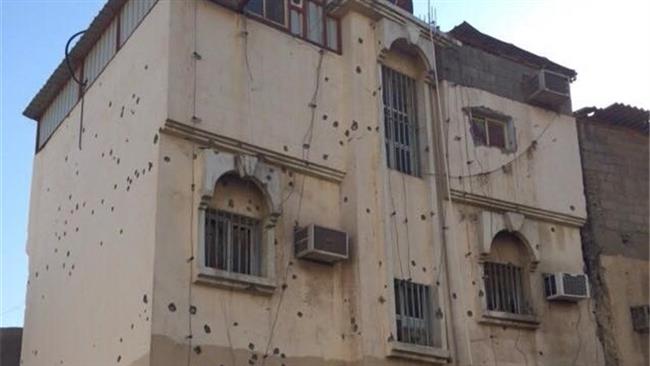
Awamiyah amid an ongoing crackdown by Saudi regime forces
Press TV – July 27, 2017
Saudi forces have waged a fresh wave of attacks against a besieged town in the kingdom’s Shia-populated Eastern Province, killing at least seven people and injuring several others over the past few hours.
The casualties were reported over the past 48 hours after Saudi regime forces, equipped with artillery and heavy weapons, launched a series of fresh attacks against Awamiyah, located some 390 kilometers northeast of the capital Riyadh.
Human rights activists and media outlets confirmed on Thursday that at least seven local Shia residents lost their lives after they were sprayed with bullets by Saudi forces.
There are reportedly several women and children among those injured in the raids. There are also at least two Indian refugee workers among those injured in the attacks.
The death toll is expected to rise as some of the injured are said to be in critical condition.
On Wednesday, a series of video footage circulating on social media websites showed Saudi regime forces shelling homes and buildings in al-Jamima neighborhood and al-Mosara, the old quarter of the town of Awamiyah.
Several homes, business and historical sites have been totally destroyed or partially damaged across the region.
The Saudi regime forces in riot gear have also set up barricades and security checkpoint to prevent people from organizing any gathering or protest rally. Local residents complain that police deployed at the checkpoints are snatching and stealing their personal belongings.
Several main entrances to the region have been closed and the regime forces have imposed heavy restrictions on movement of the citizens.
Saudi authorities also shut down internet and mobile services across the area.
Residents have been forced to stay indoors as the regime has deployed snipers across the entire region.
Reports also indicate that garbage has piled up as Saudi forces continue to prevent relevant authorities from collecting trash across several areas.
The developments come as a fierce crackdown on protesters there enters its 77th day.
Awamiyah has witnessed an increase in anti-regime protests and an ensuing crackdown as Riyadh has insisted to destroy al-Mosara, claiming the neighborhood’s narrow streets have become a hideout for militants believed to be behind attacks on security forces in the region.

Shia activists who were among those killed in fresh attacks by Saudi regime forces in Awamiyah
Saudi authorities intend to turn al-Mosara into a commercial zone, despite warnings both by locals and the United Nations that the controversial plan would ruin the 400-year-old neighborhood’s historical and cultural heritage and could eventually lead to the forced eviction of hundreds of people from their businesses and residence.
Saudi troops equipped with heavy weapons have been deployed in Awamiyah since May 10, following fierce clashes between the regime forces and locals protesting against the destruction.
A large number of civilians have lost their lives in the ongoing heavy-tactic crackdown by the Riyadh regime since then.
A number of human rights groups and activists have expressed deep concern about the living conditions of people in Awamiyah, who are suffering from a severe water shortage and are using private generators to produce electricity.
On May 24, UN experts criticized the ongoing attempts to demolish al-Mosara and accused the Saudi kingdom of erasing cultural heritage, violating human rights, and forcing residents to flee their homes.
US Air Force Admits to Poisoning Colorado Groundwater
Sputnik – July 26, 2017
On Tuesday, the US Air Force finally acknowledged responsibility for contaminating the water at a east Colorado Springs air base and its surrounding areas.
In a report released Tuesday, service investigators confirmed that groundwater surrounding Peterson Air Force Base had been tainted by perfluorinated firefighting foam chemicals, based on dozens of water and soil tests taken at the base last year.
Several sites where the chemicals had been sprayed directly on the ground by firefighters since the 1970s were highlighted in the report. Despite decades of research noting the danger of using the chemicals, they remained in wide use, and military officials are dealing with similar contamination issues all across the country.
Research has found that laboratory animals exposed to the chemicals suffered low birth weights and cellular and liver damage, according to KKTV.
The levels of perfluorinated chemicals found during testing at the Colorado Springs site were more than 1,000 times higher than the limit put forth by a national health advisory.
Greg Lauer, a council member from nearby Fountain City told the Denver Post, “It makes me really angry that it has taken them this long to get some numbers — and more than a little concerned.”
“We and our ratepayers are going to be dealing for a very long time with this problem we did not create.”
Roy Heald, who manages the Security Water and Sanitation District near Colorado Springs, said that after municipal wells were contaminated the agency spent $3.6 million on alternative water sources and pipelines. But the US Air Force has not yet furnished the $800,000 in reimbursements they promised.
Notably, Tuesday’s report said contamination at the base was most acute at Peterson’s fire training pit, despite there being a plastic liner in place to prevent the chemicals from leeching into the groundwater. Investigators blamed this on “overspray” from firefighters.
Though Air Force investigators admitted that Colorado Springs sewers had been used to dispose of contaminated waste, they glossed over any possible pollution of drinking water.
“The holding tank is occasionally drained into the sanitary sewer system, but such events are rare,” they wrote, adding that 10,000 to 20,000 gallons of chemical-laden wastewater was drained with each release.
Peterson officials last year admitted to storing chemical-tainted water from the fire pit in a tank nearby, pumping it into Colorado Springs’ sewers three times a year, likely tainting the Widefield Aquifer nearby, where high quantities of the chemicals were found last year. The aquifer serves about 65,000 residents, among them the 20,000 of Fountain City, according to the Colorado Department of Health and Environment.
When the water passes through the Colorado Springs Utilities’ treatment plant the chemicals are not removed, and once it leaves the plant that water heads for the aquifer’s primary water source, Fountain Creek.
Rep. Doug Lamborn (R-CO) called for funds to be allocated for testing people for health issues related to toxic water and contamination clean up. “The people of the surrounding communities are patriotic Americans who will do whatever they can to help our national defense,” he said in a statement. “But they should not be called upon to suffer needless environmental burdens.”
READ ALSO:
Radioactive Contamination from Nuclear Waste Site Spreads in Washington
Jeff Sessions sued over 1970s cannabis law
RT | July 26, 2017
A former NFL star and an Iraq War veteran suffering from post traumatic stress disorder have launched a suit against US attorney general Jeff Sessions over federal cannabis laws.
The pair have teamed with a group advocating the use of cannabis on medical and business grounds and are suing Sessions, the Department of Justice as well as the Drug Enforcement Agency.
In total, the five plaintiffs include former New York Jets football player Marvin Washington, US Army veteran Jose Belen, and an 11-year-old girl who suffers from epilepsy.
They all believe the 1970s Controlled Substance Act (CSA) signed into law by former US President Richard Nixon is unconstitutional.
Under the legislation, marijuana is said to be as dangerous as heroin and N-Ethyl-3-piperidyl benzilate, a chemical which acts on the central nervous system.
“The CSA has wrongfully and unconstitutionally criminalized the cultivation, distribution, sale, and possession of cannabis, which, historically, has been harvested to produce, among other things, medicine, industrial hemp, a substance known as tetrahydrocannabinol,” the suit states.
It adds: “Classifying cannabis as a Schedule 1 drug, while ignoring the undeniable addictive and lethal chemical properties of nicotine and tar, which kill millions of Americans every year, renders this mis-classification of cannabis utterly irrational and absurd.”
The court documents reveal that Washington opposes the act because he fears it could damage his business of treating head injuries with cannabidiol and tetrahydrocannabinol, both components in marijuana.
Meanwhile, the other plaintiffs are seeking legalization of the drug for medical reasons, since they either live in states where marijuana is illegal, or are restricted from travelling with the drug.
In the case of Iraq War veteran Jose Belen, the suit argues that he has not been able to obtain treatment from the US Veterans Administration for his PTSD and“cannot safely” enter an airplane or federal building with the drug.
US Attorney General Jeff Session has previously highlighted his opposition to legalizing the drug on a federal level and once commented that “good people don’t smoke marijuana.”
The US Department of Justice or the Drug Enforcement Agency has yet to respond to the filing.
Silenced stones mark hard path to Sri Lankan reconciliation
Security forces have erected numerous monuments celebrating their 2009 victory over Tamil Tiger rebels. No such privilege has been accorded to the Tamil insurgents or civilians who died in the fight
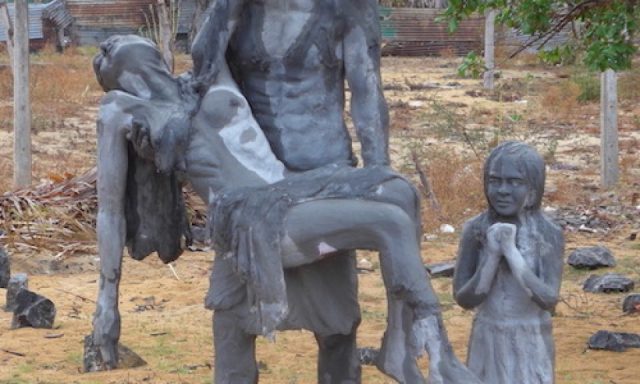
A monument to Sri Lanka’s civil war victims. Photo: Duncan McCargo
By Duncan McCargo | Asia Times | July 26, 2017
An eerie art installation near an idyllic Sri Lankan beach symbolizes many of the contradictions of this post-war society, comprising a sculpture of a man carrying his brutalized daughter, an old suitcase full of clothes and a small ‘graveyard’ punctuated by tiny stones.
The core sculpture was inaugurated on May 18, 2016 – the seventh anniversary of the end of the decades–long civil war, which the Sri Lankan government celebrates as a day of victory over the Tamil insurgent
One year later, police obtained a court order preventing Father Elil Rajendram, the Tamil Jesuit priest behind the project (and an activist and co-spokesperson for the Tamil Civil Society Forum), from presiding over a ceremony to add some stones bearing the names of people who had died during the war.
The following day, after a legal challenge mounted by Kumaravadivel Guruparan, head of the law department at Jaffna University, the court decreed that the ceremony could only take place within the premises of the nearby church. The name-bearing stones have since remained out of public view, while Father Elil was questioned by the authorities on four separate occasions.
The police claimed that some of those memorialized might be members of the banned Liberation Tigers of Tamil Eelam (LTTE) separatist group, better known as the Tamil Tigers, although Guruparan argued that commemorating the names of deceased LTTE members was not banned under any Sri Lankan law.
In the event, the police proved unable to confirm that any of the names were actually those of LTTE members: they were simply acting on suspicion.

A cemetery of stone markers inscribed with the names of victims of Sri Lanka’s civil war. Photo: Duncan McCargo
Mullivaaikaal, the beach in question, lies at the heart of ‘the cage’, a narrow isthmus where the remnants of the Tamil Tigers were slaughtered by the Sri Lankan army in the bloody culmination of a long-running civil war in May 2009. Tens of thousands of people were killed in what the government still refers to as a ‘humanitarian’ operation.
Sri Lankan security forces have erected numerous monuments to celebrate their victory and to recognize their war dead, but no such privilege has been accorded to those from the LTTE, nor to the Tamil civilians who perished during the fighting.
In refusing to allow ordinary families to honor or even to remember their dead, Sri Lankan authorities claim they are responding to pressure from hardline Buddhist groups who insist that brutal terrorists are not entitled to such decencies.
The outspoken Chief Minister of the Northern Province, former Supreme Court Justice Canagasabapathy Visuvalingam Vigneswaran, has been the one of the loudest elected voices for the Tamil cause in recent years.
This writer asked why he couldn’t erect a memorial to the Tamil war dead right in front of his office (there is a handy patch of waste ground right next to the gate), but he answered rather melodramatically that if he pushed too hard on this issue, even he could be taken into custody: the government has made holding meetings about memorials hard enough, let alone building them.
I later had chance to ask a senior military commander why the memorialization issue was so sensitive. While acknowledging that during many years of fighting the army had developed ‘a bit of an arrogant mindset’, he insisted that negative sentiments of people and politicians in the South were now the main obstacle to any memorial to Tamil victims or LTTE fighters, rather than military obstructionism.
Nevertheless, he personally believed such memorials should be possible in the future. Meanwhile, he noted, progress had been made – until recently, even private memorial ceremonies were banned, not just public commemorations.
The 30-year civil war in Sri Lanka remains a subject of intense controversy. But since the more compromising and pragmatic President Maithripala Sirisena assumed power in early 2015 with the support of the country’s Tamil minority, reconciliation has figured prominently in public discourse.
The incoming government established the Office for National Unity and Reconciliation (ONUR), chaired by the redoubtable former president Chandrika Bandaranaike Kumaratunga.
Numerous worthy unity and reconciliation projects have been initiated, focusing on areas such as youth exchanges, vocational training, agricultural livelihoods and the construction of new homes for those displaced during the conflict.
Yet in the Northern Province – an overwhelmingly Tamil region where much of the fighting took place – local people remain skeptical about development-oriented, top-down reconciliation projects that are largely conceived and implemented by the bureaucracy and security forces. Among recurrent local concerns are missing persons, military land occupation and memorialization.
Critical observers, such as human rights activist Ruki Fernando, argue that until these core issues are addressed, token projects will do little to assuage Tamil frustrations with the state. He argues that rather than exercising leadership, the Colombo government has become the captive of the military and Buddhist hardliners.
During the civil war, huge numbers of people were driven out of their homes in the North and East of the country. When they tried to return after 2009, many found their land occupied by the military. In the Jaffna peninsula alone, the military currently holds more than 10,000 acres of land, around half of it used for bases.
The military points to progress in releasing occupied land, but insists that for security reasons the process has to be incremental.
In recent months, there has been a mushrooming of protest encampments by villagers seeking the return of their property from security forces. These round-the-clock vigils illustrate a remarkable opening up of political space in Sri Lanka: they would have been unthinkable during the time of hardline former president Mahinda Rajapaksa.
Yet while they have attracted some attention from the media and Tamil political parties, and in a few cases have won concessions from the military, most of the protests are being quietly ignored. Similar vigils have been established in other locations to demand information about those who went missing during the war.
Since 1994, the government has received more than 65,000 complaints relating to missing persons: in the absence of death certificates, their surviving relatives face serious problems over access to bank accounts, inheritance and re-marriage.
A major government initiative is needed to resolve these issues, but so far efforts to address them have been piecemeal; the president only finally approved the establishment of a long–promised Office of Missing Persons on July 20.
Land, missing persons and monuments are important examples of reconciliation-related issues. All highlight the importance of granting agency and authority to victims in a post-war order like Sri Lanka’s. Similar challenges have dogged other post-conflict societies such as that of Northern Ireland: education and development projects can only go so far, if sensitive core concerns remain unaddressed.
While the international community is now pressing for large-scale transitional justice initiatives in Sri Lanka, neither a hybrid tribunal nor a truth commission will be easy to realize. In the meantime, displaying the names of some Tamil war victims near a Northern beach might be one small place to start.
Duncan McCargo is the author of Tearing Apart the Land (2008), a study of the Southern Thai conflict
Tillerson to Remain at State Department Despite Reports of Resignation
Sputnik – 26.07.2017
 WASHINGTON – US Secretary of State Rex Tillerson will remain in office contrary to reports that he was going to resign, State Department spokesperson Heather Nauert said in a press briefing.
“The Secretary has been very clear he intends to stay here at the State Department,” Nauert said on Tuesday.
On Monday, CNN reported that Tillerson was considering resigning from the State Department before the end of the year due to growing frustration with President Donald Trump’s administration.
The report claimed Tillerson was at odds with the White House over several issues including department staffing and Iran policy.
RELATED:
ZOA Calls For Tillerson’s Resignation
Jewish Insider · July 24, 2017
Amid reports that Secretary of State Rex Tillerson is growing frustrated with the White House, even considering stepping down, the Zionist Organization of America (ZOA) on Monday called on Tillerson to resign. The group accused Tillerson of contradicting pro-Israel statements made by President Donald Trump and UN Ambassador Nikki Haley.
“In light of the U.S. State Department’s new, bigoted, biased, anti-Semitic, Israel-hating error-ridden terrorism report, the Zionist Organization of America (ZOA) calls on Secretary of State Tillerson to resign,” the ZOA said in a statement.
The ZOA — headed by Morton Klein — took issue with the State Department’s annual terrorism report listing Israeli settlement construction, violence against Palestinians in the West Bank, and the perception that Israel’s government was changing the status quo on the Temple Mount as “continued drivers of violence.” … Full article
America’s Militarized Police
Made in Israel?

By Philip Giraldi • Unz Review • July 25, 2017
The horrific execution by police of an Australian woman in her pajamas that took place last week in Minneapolis has again produced a torrent of criticism over killings initiated by law enforcement in situations in which the officers are in no way threatened. America has always been a violent place relative to much of the rest of the world, but even so there has been a noticeable shift in how, since the trauma of 9/11, some policemen believe themselves to be superior to and detached from the society they are supposed to be protecting. And the public is reciprocating, seeing the police frequently as a force that is no longer there to serve the people and instead something that should be feared. Even in the upper middle class predominantly white county that I live in, residents not infrequently discuss the increasingly visible and aggressive police presence. It is widely believed that arguing with cops or showing even the slightest attitude in contacts with them is done at one’s peril.
Even in low crime parts of the country, the police are able to deploy fully armed and equipped swat teams that are more military than civilian in their threatening demeanor as well in the body armor and weapons they carry. Many cities and counties now have surplus military armored vans for crowd control even if they have no crowds. Armed drones are increasingly becoming part of the law enforcement arsenal and it sometimes appears as if the police are copying the military as a model of “how to do it.”
The various levels of government that make up the United States seem to be preparing for some kind of insurrection, which may indeed be the case somewhere down the road if the frustrations of the public are not somehow dealt with. But there is another factor that has, in my opinion, become a key element in the militarization of the police in the United States. That would be the role of the security organs of the state of Israel in training American cops, a lucrative business that has developed since 9/11 and which inter alia gives the “students” a whole different perspective on the connection of the police with those who are being policed, making the relationship much more one of an occupier and the occupied.
The engagement of American police forces with Israeli security services began modestly enough in the wake of 9/11. The panic response in the United States to a major terrorist act led to a search for resources to confront what was perceived as a new type of threat that normal law-and-order training did not address.
Israel, which, in its current occupation of much of Palestine and the Golan Heights as well as former stints in Gaza, southern Lebanon and Sinai, admittedly has considerable experience in dealing with the resistance to its expansion manifested as what it describes as terrorism. Jewish organizations in the United States dedicated to providing cover for Israeli’s bad behavior, saw an opportunity to get their hooks into a sizable and respected community within the U.S. that was ripe for conversion to the Israeli point of view, so they began funding “exchanges.”
Since 2002 there have been hundreds of all-expenses-paid trips including officers from every major American city as well as state and local police departments. Some have been sponsored by the American Jewish Committee (AJC) and the Jewish Institute for National Security Affairs (JINSA). The Anti-Defamation League (ADL) has also been directly funding trips since 2008, explaining that “As a people living under constant threat of attack, the Israelis are leading experts in security enforcement and response strategies.” The intent? To “learn” and “draw from the latest developments” so the American cops can “bring these methods back home to implement in their communities.”
AIPAC has several pages in its website dedicated to security cooperation between the two countries. It asks “Did you know? In May 2010, 50 retired Generals and Admirals wrote to President Obama, highlighting the value of U.S. Israeli cooperation.” It goes on to cite an Alabama sheriff who enthuses that “There is no other country [Israel] that shares the same values and overarching goal to allow others to live in peace.” Regarding airport security, it also quotes a U.S. “security expert” who states “We should move even closer to an Israeli model where there’s more engagement with passengers… We’ve just started to do that at TSA…” Indeed. That’s called profiling and pre-boarding interrogations.
Even the federal government has gotten onto the Israel bandwagon, perhaps not a surprise given the number of Israel Firsters in Congress. In 2003, the Department of Homeland Security established a special Office of International Affairs to “institutionalize the relationship between Israeli and American security officials.” The New York City Police Department has a branch in Israel and carries out frequent exchanges.
It should be noted from the git-go that Israel is no more knowledgeable about possible responses to acts of terror than is anyone else. The techniques employed to create physical barriers, to develop sources for intelligence gathering, and to train in tactical responses are quite familiar to anyone who has studied modern-style terrorism since it emerged in Western Europe in the 1970s.
Most countries that have a high or even moderate risk level deriving from terrorists, either domestic or foreign, have recruited and trained special police and paramilitary forces that are familiar with the basic techniques and are quite capable of responding. Ironically, even though the United States government and local police forces have tended to look at the “real pro” Israelis for guidance, state of the art resources for learning about how to deal with terror are available right here at home. JSOC has teams that are every bit as effective – and lethal – as anything the Israelis can muster and the CIA and FBI together know far more about terrorists and how they behave than do the ideologically driven Mossad and Shin Beth.
The American policemen who go on the “exchanges” are probably only dimly aware that what they are being shown is part of Israel’s military justice system, which has nothing to do with Israeli criminals, but instead is designed to keep the lid on the millions of Palestinians who live in what has become a virtual outdoor prison camp. It is an apartheid police state that uses deadly force as a form of crowd control. And the Palestinian former residents of the lands Israel now holds are the “terrorists” that Israel is protecting itself against.
You can bet that the American guests for their part clearly do not realize that they are being trained as prison guards and you also can be sure that they never catch so much as a glimpse of the 300 child prisoners that Israel continues to hold without charges.
Israel’s reputation for “dealing with” terrorism has in any event been glamorized by the Israel-friendly media and entertainment industry while also being promoted by Jewish organizations. It has meant in practical terms that many of the contract security firms operating at airports in the United States and Europe are Israeli. They have also infiltrated state Homeland Security agencies and corporate security in the U.S. Many of the Israeli companies with offices in the United States work closely with Mossad and might reasonably be considered arms of the Israeli government.
Where Israel really excels is in its willingness to kill large numbers of Arabs of all ages and genders using the excuse that they are terrorists. It does so with impunity because Israeli courts almost never hold the army and police accountable for whatever they do. It might reasonably be suggested that when American police officers go through their training in Israel they acquire at least a bit of that attitude from their instructors.
Recognizing that Israel is not exactly a model to be emulated when it comes to the human rights of its Palestinian victims, there is an alternative viewpoint which suggests that American law enforcement might just be learning the wrong things when it travels to Israel. Amnesty International asks “With Whom are Many U.S. Police Departments Training? With Chronic Human Rights Violator Israel.” It notes that last August when the Department of Justice documented numerous violations by the Baltimore Police Department the report failed to mention that policemen from that city had received training in Israel.
Amnesty makes clear what we are dealing with when our policemen are being trained – “… military, security and police systems that have racked up documented human rights violations for years… carrying out extrajudicial executions and other unlawful killings, using ill treatment and torture (even against children). Suppression of freedom of expressions/association, including through government surveillance, and excessive use of force against peaceful protesters.”
And actually, it is worse than that. The American visitors will be welcomed to contemplate the Potemkin village miracle of a democratic, multicultural, inclusive, clever Israel. They will not be allowed to see how the soldiers training them, representatives of “the most moral army in the world,” force Palestinian women to give birth at military checkpoints and watch their babies die, shoot Palestinian teenagers as they are running away for throwing stones, drag men and women out of their beds and kill them while terrorizing their children and dragging them off to jail during midnight raids.
Amnesty’s article documents many of the abuses by Israeli security forces and concludes that using “Public or private funds spent to train our domestic police in Israel should concern all of us. Many of the abuses [in the U.S.] parallel violations by Israeli military, security and police officials.” I would also add that the training provided by JINSA, ADL and the AJC is also partly on the American taxpayers’ dime as the organizations are all tax exempt.
Finally, Israel’s ability to market its state sponsored brutality has even become a form of light entertainment. A company in Israel called Caliber 3 that was set up by a reserve colonel in the Israeli army is offering what has been described as a two hour “boot camp” counter-terrorism experience. It includes a life size target consisting of a man in Arab attire holding a cell phone. The mostly Jewish American audience ponders if he should be shot, but the instructors eventually intervene and declare that he does not quite meet the standard for being killed. Visitors are also treated to simulations of Israeli commandos taking down terrorists and can even shoot live rounds from a semi-automatic weapon at a firing range. Ironically, the Caliber 3 gated compound camp is located in the Gush Etzion settlement bloc on the West Bank, land that was stolen from the Palestinians.
Policing for Profit: Jeff Sessions & Co.’s Thinly Veiled Plot to Rob Us Blind
By John W. Whitehead | The Rutherford Institute | July 24, 2017
Let’s not mince words.
Jeff Sessions, the nation’s top law enforcement official, would not recognize the Constitution if he ran right smack into it.
Whether the head of the Trump Administration’s Justice Department enjoys being the architect of a police state or is just painfully, criminally clueless, Sessions has done a great job thus far of sidestepping the Constitution at every turn.
Most recently, under the guise of “fighting crime,” Sessions gave police the green light to rob, pilfer, steal, thieve, swipe, purloin, filch and liberate American taxpayers of even more of their hard-earned valuables (especially if it happens to be significant amounts of cash) using any means, fair or foul.
In this case, the foul method favored by Sessions & Co. is civil asset forfeiture, which allows police and prosecutors to “seize your car or other property, sell it and use the proceeds to fund agency budgets—all without so much as charging you with a crime.”
Under a federal equitable sharing program, police turn asset forfeiture cases over to federal agents who process seizures and then return 80% of the proceeds to the police. (In Michigan, police actually get to keep up to 100% of forfeited property.)
This incentive-driven excuse for stealing from the citizenry is more accurately referred to as “policing for profit” or “theft by cop.”
Despite the fact that 80 percent of these asset forfeiture cases result in no charge against the property owner, challenging these “takings” in court can cost the owner more than the value of the confiscated property itself. As a result, most property owners either give up the fight or chalk the confiscation up to government corruption, leaving the police and other government officials to reap the benefits.
And boy, do they reap the benefits.
Police agencies have used their ill-gotten gains “to buy guns, armored cars and electronic surveillance gear,” reports The Washington Post. “They have also spent money on luxury vehicles, travel and a clown named Sparkles.”
Incredibly, these asset forfeiture scams have become so profitable for the government that, according to The Washington Post, “in 2014, law enforcement took more stuff from people than burglars did.” As the Post notes, “the Treasury and Justice departments deposited more than $5 billion into their respective asset forfeiture funds. That same year, the FBI reports that burglary losses topped out at $3.5 billion.”
In 2015, the federal government seized nearly $2.6 billion worth of airplanes, houses, cash, jewelry, cars and other items under the guise of civil asset forfeiture.
According to USA Today, “Anecdotal evidence suggests that allowing departments to keep forfeiture proceeds may tempt them to use the funds unwisely. For example, consider a 2015 scandal in Romulus, Michigan, where police officers used funds forfeited from illicit drug and prostitution stings to pay for … illicit drugs and prostitutes.”
Memo to the rest of my fellow indentured servants who are living through this dark era of government corruption, incompetence and general ineptitude: this is not how justice in America is supposed to work.
We are now ruled by a government so consumed with squeezing every last penny out of the population that they are completely unconcerned if essential freedoms are trampled in the process.
Our freedoms aren’t just being trampled, however. They’re being eviscerated.
At every turn, “We the People” are getting swindled, cheated, conned, robbed, raided, pickpocketed, mugged, deceived, defrauded, double-crossed and fleeced by governmental and corporate shareholders of the American police state out to make a profit at taxpayer expense.
Americans no longer have to be guilty to be stripped of their property, rights and liberties. All you have to be is in possession of something the government wants. And if you happen to have something the government wants badly enough, trust me, their agents will go to any lengths to get it.
If the government can arbitrarily freeze, seize or lay claim to your property (money, land or possessions) under government asset forfeiture schemes, you have no true rights.
Here’s how the whole ugly business works in a nutshell.
First, government agents (usually the police) use a broad array of tactics to profile, identify, target and arrange to encounter (in a traffic stop, on a train, in an airport, in public, or on private property) those individuals who might be traveling with a significant amount of cash or possess property of value. Second, these government agents—empowered by the courts and the legislatures—seize private property (cash, jewelry, cars, homes and other valuables) they “suspect” may be connected to criminal activity.
Then—and here’s the kicker—whether or not any crime is actually proven to have taken place, without any charges being levied against the property owner, or any real due process afforded the unlucky victim, the property is seized by the government, which often divvies it up with the local police who helped with the initial seizure.
In a Kafkaesque turn of the screw, the burden of proof falls on the unfortunate citizenry who must mount a long, complicated, expensive legal campaign to prove their innocence in order to persuade the government that it should return the funds they stole. Not surprisingly, very few funds ever get returned.
It’s a new, twisted form of guilt by association, only it’s not the citizenry being accused of wrongdoing, just their money.
Motorists have been particularly vulnerable to this modern-day form of highway robbery.
For instance, police stole $201,000 in cash from Lisa Leonard because the money—which Leonard planned to use to buy a house for her son—was being transported on a public highway also used by drug traffickers. Despite the fact that Leonard was innocent of wrongdoing, the U.S. Supreme Court upheld the theft on a technicality.
Police stole $50,000 in cash from Amanee Busbee—which she planned to use to complete the purchase of a restaurant—and threatened to hand her child over to CPS if she resisted. She’s one of the few to win most of her money back in court.
Police stole $22,000 in cash from Jerome Chennault—which he planned to use as the down payment on a home—simply because a drug dog had alerted police to its presence in his car. After challenging the seizure in court, Chennault eventually succeeded in having most of his money returned, although the state refused to compensate him for his legal and travel expenses.
Police stole $8,500 in cash and jewelry from Roderick Daniels—which he planned to use to purchase a new car—and threatened him with jail and money-laundering charges if he didn’t sign a waiver forfeiting his property.
Police stole $6,000 in cash from Jennifer Boatright and Ron Henderson and threatened to turn their young children over to Child Protective Services if they resisted.
Tenaha, Texas, is a particular hotbed of highway forfeiture activity, so much so that police officers keep pre-signed, pre-notarized documents on hand so they can fill in what property they are seizing.
As the Huffington Post explains, these police forfeiture operations have become little more than criminal shakedowns:
Police in some jurisdictions have run forfeiture operations that would be difficult to distinguish from criminal shakedowns. Police can pull motorists over, find some amount of cash or other property of value, claim some vague connection to illegal drug activity and then present the motorists with a choice: If they hand over the property, they can be on their way. Otherwise, they face arrest, seizure of property, a drug charge, a probable night in jail, the hassle of multiple return trips to the state or city where they were pulled over, and the cost of hiring a lawyer to fight both the seizure and the criminal charge. It isn’t hard to see why even an innocent motorist would opt to simply hand over the cash and move on.
Unsurprisingly, these asset forfeiture scams have become so profitable for the government that they have expanded their reach beyond the nation’s highways.
According to USA Today, the U.S. Department of Justice received $2.01 billion in forfeited items in 2013, and since 2008 local and state law enforcement nationwide has raked in some $3 billion in forfeitures through the federal “equitable sharing” program.
So now it’s not just drivers who have to worry about getting the shakedown.
Any American unwise enough to travel with cash is fair game for the government pickpockets.
In fact, the Drug Enforcement Administration (DEA) has been colluding with the Transportation Security Administration (TSA) and local police departments to seize a small fortune in cash from American travelers using the very tools—scanners, spies and surveillance devices—they claimed were necessary to catch terrorists.
Mind you, TSA agents already have a reputation for stealing from travelers, but clearly the government is not concerned about protecting the citizenry from its own wolfish tendencies.
No, the government bureaucrats aren’t looking to catch criminals. (If so, they should be arresting themselves.)
They’re just out to rob you of your cold, hard cash. … Full article
Okinawa files new lawsuit to block relocation of US Marines base – local media
RT | July 24, 2017
The Japanese prefecture of Okinawa filed a new lawsuit against the government demanding a halt to construction work for the relocation of the US Futenma base, local media report. The relocation has been the target of protests among locals.
The prefectural authorities say that Tokyo is acting illegally without permission from the Okinawa governor, as seen in a copy of the lawsuit sent on Monday and obtained by the Okinawa Times.
The relocation of the base involves damaging seabed rock, which would harm the fishing grounds, the lawsuit states.
Earlier in July, an Okinawa Prefectural Assembly committee asked for legal action against damage to the fishing grounds caused by the relocation.
“The granting of fishing rights is considered a local government matter and it’s the prefecture that determines how to interpret those local government matters,” Kiichiro Jahana, the head of the executive office of the governor, told the assembly.
The US Marine Corps Futenma Air Station is going to be moved from the densely populated city of Ginowan to the less populated city of Nago in the Henoko coastal area. The city is already home to Camp Schwab, another US Marines camp which has caused numerous protests among the local population.
The base relocation has been repeatedly halted due to resistance from the Okinawa authorities and local residents.
Japanese authorities began the relocation of the base back in February this year, despite stiff opposition from the population. Local residents regularly stage protests with thousands of people, often resulting in confrontation with police.
According to the relocation plan, the flight functions of the Futenma airfield will be transferred to Camp Schwab. Tokyo also plans to reclaim around 157 hectares of land in Henoko waters and build a V-shaped runway.
Okinawa Governor Takeshi Onaga is among those who stand firmly opposed to the US military presence on the archipelago, calling for the removal of the Futenma base.
Onaga says that the relocation would destroy the environment of the bay surrounding the new base site.
Around 100,000 US military personnel are currently stationed in Japan, according to the official website of US Forces, Japan. Home to about one percent of Japan’s population, Okinawa hosts almost half of the troops (47,000), according to media reports.
Read more:
‘Palestinians reject Israel’s system of apartheid and racial discrimination’
RT | July 24, 2017
The escalation in the Israeli-Palestinian conflict isn’t religious, it’s about the rights of Palestinian people to be free from the longest occupation in modern history, says Mustafa Barghouti, the General Secretary of the Palestinian National Initiative.
Palestinian President Mahmoud Abbas suspended all ties with Israel on Friday after deadly clashes erupted between protesters and Israeli police. Protests broke out after Israeli authorities installed security cameras and metal detectors at the revered Al-Aqsa Mosque, Jerusalem’s most sensitive holy site.
Temple Mount, or Haram esh-Sharif as it is known to Muslims, is one of the most contested religious sites in the world. For Jews, it is believed to have been the site of two biblical temples, the Al-Aqsa Mosque on the hill is Islam’s third holiest site.
The Arab League has warned Israel about crossing “a red line” in the ongoing Israeli-Palestinian conflict over the sacred city of Jerusalem. Meanwhile, an Israeli minister said the metal detectors that triggered the violence will remain.
The League’s foreign ministers will hold an emergency meeting in Cairo on Wednesday.
RT: Palestinian President Abbas suspended all relations with Israel. How would you comment on that? Are you surprised?
Mustafa Barghouti: No, I am not, actually. He should have done that some time ago because the Israeli behavior is a behavior that wants to kill any possibility of peace in this place. Its policy is directed at destroying the two-state solution either by the measures they are taking at the Al-Aqsa Mosque, which is a very provocative act or by the law they have just passed which prohibits even negotiations over Jerusalem or by the increased settlement activities which have exceeded any previous expansion before. All these factors have led to this reaction. They have killed three of our people and injured no less than 432 demonstrators. All the people were just praying peacefully, I was there myself, and I saw myself – there was no violence from the Palestinian side and suddenly we were attacked with bullets, with the clubs, they were very aggressive toward the Palestinian prayers.
RT: Surely Israel has the right to step up security given what has happened [two Israelis policemen were killed at the entrance to the Temple Mount in Jerusalem on July,14]? Can you understand Israel’s nervousness?
MB: No, I think Netanyahu has heard his own security people advising him to take away these metal detectors and stop changing the status quo in the Al-Aqsa Mosque, but he didn’t listen to them. He proceeded by listening to the extreme ministers in his cabinet. The result is this explosion that we see. Not only in Jerusalem but all over the West Bank. You must understand this is not a religious conflict. This is about national rights; this is about the right of the Palestinian people to be free from occupation. To get their freedom after 50 years of occupation which is the longest occupation in modern history. This is about people rejecting to be treated as third class citizens; this is about rejecting a system of apartheid and racial discrimination that Israel has created. To people in Jerusalem and the rest of the Palestinian territories, people are saying “enough is enough, we cannot take it anymore, we want our freedom, we want our independence.” This is the essence of what is happening.
‘Palestine freezing contacts with Tel Aviv is right move amid constant Israeli provocations’
RT: What is your reaction to the move by Palestinian President Abbas to freeze all contacts with Israel?
Miko Peled, peace activist: It is certainly the right move. Israeli provocations have led to these massive protests; this is definitely the right approach and the right move. We need also to remember Israel has been denying two million people in Gaza water and electricity in this terrible heat – people are dying of thirst and heat just a 45-minute drive away from Jerusalem. Israel has been engaged in serious provocations against the Palestinians.
RT: What is your opinion about the Israeli argument that more security measures are needed?
MP: The presence of the Israeli security forces in the old city of Jerusalem, around the Al Al-Aqsa Mosque are a constant provocation to the Palestinians and an infringement of the Palestinians’ right to practice their faith, to worship at the Al-Aqsa Mosque… And the provocation is not just an existence of this huge number of forces but also the way they behave, the way they treat the Palestinians, the way they arrest youth, the constant harassment as people try to get in and out of the old city, in and out of the holy sanctuary. So, to expect that there will be such oppression on the rights of Palestinians and there will be no violence in return is a little naïve. But we have to look at the fact that the main form of resistance has been in a form of civil disobedience with thousands of worshipers refusing to go through the metal detectors, standing outside the mosque and praying peacefully albeit standing under the weapons and the guns of the Israeli security forces…
Featured Video

Why Hamas Really Attacked Israel on Oct. 7
or go to
Aletho News Archives – Video-Images
From the Archives
Israel: Strategic Ally or Liability?
By Stephen Sniegoski | My Catbird Seat | June 12, 2010
The claim that Israel serves as a valuable ally for the United States is made by both pro-Zionists and much of the anti-war and anti-Zionist Left that is influenced by Noam Chomsky. As a result of the Gaza flotilla massacre, which has caused a world-wide uproar against Israel, the value of Israel to the United States is being publicly questioned in more mainstream foreign policy forums. … continue
Blog Roll
 Aletho News
- Why Hamas Really Attacked Israel on Oct. 7
- Declassified UK exposes British man who fought for ‘Israel’ in Gaza
- West’s death cult in a theater near you
- How the Yandex ‘Russian bots’ lie fell apart
- Burnham’s ‘Russia did Brexit’ ruse crumbles
- Estonia making movies and games to encourage war against Russia
- Four in five new UK jobs taken by foreigners – report
- Here’s what Trump’s latest U-turn really means for Russia and Ukraine
- The Houthis Are Not an Iranian Proxy
- Europe’s Energy Hypocrisy, Russian LNG Profits and US Dependence
- If Americans Knew
- Activists Abused By Israel Return to New Freedom Flotilla Mission
- 60 Minutes won’t tell the full truth about Israeli settler violence
- Nearly 50,000 women, girls killed or severely injured in Gaza since October 2023: UN Women
- ADL is working with AI companies to suppress alleged ‘antisemitism’
- Israeli occupation forces using social media surveillance unit to target hundreds of Palestinians in the West Bank
- Israel’s New – and Terrifying – Security Doctrine
- Israeli Attacks Kill Five in Gaza, Including a four-year-old and a woman
- Air Force Major Who Called for Trump’s Impeachment Held in Solitary Confinement
- It’s a Genocide, I’m Into It’: Seinfeld Mocks Protest over Palestinian Children Killed
- Universities fire dozens amid pressure from Zionist billionaires
- No Tricks Zone
- New Study Suggests Large Regions Of The Pacific Ocean Have Been Cooling For The Last 80 Years
- Germany’s Green Energy Debacle: High Energy Costs Force Kahla Porzellan to Close After 182 Years!
- New Study: 50 Years Of The Most Aggressive ‘Net Zero’ Policies Can Only Affect The Global Climate By 0.03°C
- US September “Heat” Was No Record…Many Records Set Decades Ago
- Latest European Green Energy Debacle; Portugal’s Largest Flagship Solar Park Insolvent!
- Green Energy Debacle: German Expert Professor Fritz Vahrenholt Warns Of Severe Economic And Social Consequences
- Two More Paleo Reconstructions Affirm Meters-Higher Sea Levels Across Ireland, Brazil 7000-6000 Years Ago
- New Study: Earth And Venus Surface Warmth Largely Explained By Convection And Lapse Rate, Not CO2 Or Radiation
- 2025 Nature Paper Claiming Worsening Global Drought Gets RETRACTED …Heavily Flawed
- New Study: ‘Global Drought Shows No Detectable Recent Acceleration Under Climate Warming’

