Committee: Convicted Israeli terrorists receive support from Israeli state

Ma’an – July 10, 2017
RAMALLAH – Amid what the Palestinian Committee of Prisoners’ Affairs has described as a “frenetic Israeli campaign” against Palestinian authorities’ payment of allowances to prisoners of Israel and their families, the committee published a list on Monday of Israelis convicted of murdering Palestinians and anti-Palestinian extremist organizations, who have received financial and legal support from the state of Israel.
Committee head Issa Qaraqe has accused the Israeli government of “supporting Jewish terrorists and their extremist organizations both financially, socially, and legally through organizations authorized by the Israeli government,” calling Israel “the biggest funder of official terrorism in the Middle East.”
A large number of the criminals mentioned on the list were convicted and received life sentences, “but only served only five to seven years in Israeli jails,” according to the committee. Additionally, the Israelis used “deceitful methods” to bypass law and pardon certain criminals, some of them before ever entering a prison cell, the statement added.
Rights groups have meanwhile documented the discriminatory and racist manner in which the Israel Prison Service (IPS) classifies its prisoners, specifically “to violate the rights of Palestinian prisoners defined as ‘security’ prisoners, while at the same time providing benefits to Jewish prisoners also defined as ‘security’ prisoners,” as legal NGO Adalah put it.
The Jewish Underground movement
The first item on the committee’s list was the Jewish Underground, a right-wing terror organization that carried out and plotted a string of attacks in the 1980s, with some of its members being decorated officers in the Israeli army and widely respected in the Israeli settler community.
Members of the group were convicted in 1985 of committing of a number of attacks — marking the first time a group of Israeli Jews were convicted of being part of a terrorist organization.
Among the Jewish Underground’s crimes were car bombings targeting Palestinian mayors: Nablus Mayor Bassam al-Shakaa lost both of his legs, Ramallah Mayor Karim Khalaf lost a foot, and al-Bireh Mayor Ibrahim al-Tawil was saved when the device planted in his car was discovered.
The defendants also plotted to blow up the Dome of the Rock in Jerusalem, attempted to murder three Palestinian college students in Hebron, and booby-trapped Palestinian buses with bombs.
Menachem Livni, Shaul Nir, and Uziah Sharabaf received life sentences defined as lasting 24 years, while the others received terms of imprisonment ranging from three to nine years. Twenty members were released after less than two years, and none served more than five years. The three life sentences were commuted three times, finally to 10 years. With time off for good behavior, they were released in 1990.
The committee’s statement said that all have received monthly benefits, by order of Israeli law, from the Israeli Social Affairs Ministry and from Israeli National Insurance.
Three of the members of the group currently work at Israeli prime minister’s office. Nathan Nathanson, convicted of involvement in the car bombings against the Palestinian mayors, has since been employed as a political adviser for Israeli Education Minister and chairman of the Jewish Home party Naftali Bennett.
One of the three original founders of the cell, Yehuda Etzion, is the founder and current chairman of the right-wing Jewish group Hai Vekayam, dedicated to allowing Jewish prayer in the Al-Aqsa Mosque compound.
A number of others have since become heads of settlement councils, according to the committee’s statement.
Dani Eizman, Michal Hillel, and Gil Fox
The second group of “Jewish terrorists,” according to the prisoners’ affairs committee, consisted of Dani Eisman, Gil Fox, and Michal Hillel, who were convicted for the 1985 kidnapping and murder of taxi driver Khamis Tutanji, a Palestinian resident of Israel. They were each sentenced to life in prison, but released after serving between five and seven years.
The three also received the usual benefits from the Israeli Ministry of Social Affairs and Israeli National Insurance while in prison.
The case was cited in a report, which indicated that unlike Jewish prisoners who are citizens of Israel and perpetrated acts against Arabs or Palestinians based on ideological motives, Palestinian prisoners who are citizens of Israel have yet to receive any real commutation of their sentence or early release.
David Ben-Shimol
David Ben-Shimol fired an anti-tank missile at a Palestinian bus in 1985, killing one person and injuring dozens. He was sentenced to life, serving only 11 years of his sentence. He also received benefits while in prison, according to the statement.
Ami Popper
After Ami Popper massacred seven Palestinians in 1990, he was found guilty of seven counts of murder and initially handed seven life sentences, before seeing his sentence commuted to 40 years.
He has reportedly been granted furlough more than 100 times in the 18 years since his conviction, marrying three times while in prison custody. He fathered six children while in custody, according to the prisoners’ committee.
The statement said in addition to the usual social benefits, his family has been the recipient of financial support from far-right Israeli NGO Honenu, which is reportedly indirectly funded from tax deductible US donations.
Zeev Wolf and Gershon Hershkovich
Zeev Wolf and Gershon Hershkovich were convicted of hurling a hand grenade at a market in Jerusalem in November 1992, killing one Palestinian and injuring 20 others, according to the statement which didn’t provide further details on the attack. They were released after serving six years and a half in prison, and received social benefits while in prison.
Yoram Shkolnik
Israeli settler Yoram Shkolnik shot and killed Moussa Suleiman Abu Abha multiple times at close range while the Palestinian was blindfolded, bound hand and foot, and guarded by Israeli soldiers after allegedly attempting to detonate a hand grenade in 1993. Shkolnik’s life sentence was later reduced.
In addition to the allowances Shkolnik received from the Israeli National Insurance and the Social Affairs Ministry, the prisoners’ committee said the Israeli government “gave him a grant to start a project of his own,” without providing additional details.
Nachshon Wales
According to the committee, Nachshon Wales was sentenced to life in prison for killing a Palestinian woman in August 1990 while she was tending her olive grove. His sentence was twice commuted, and he was released after serving 11 years. He currently works as a security guard in an illegal Israeli settlement, according to the committee.
Bat Ayin Underground
Members of terrorist organization Bat Ayin were convicted of parking a booby-trapped car in the yard of a Palestinian girls school in East Jerusalem in 2002. Some of the defendants remain in custody, receiving social benefits as well as financial support from the right-wing settler organization Elad, according to the committee, as well as from Honenu.
Dawabsha murderers
The committee’s statement also mentioned the two Israelis convicted of murder for the 2015 deadly arson attack that killed three members of the Palestinian Dawabsha family in the occupied West Bank.
Amiram Ben-Uliel was charged with three counts of murder, while a minor was charged as an accessory to murder and unnamed by Israeli media due to gag orders on the identities of underage Israeli suspects.
The prisoners’ committee’s statement named Yoram Stenhil to have been found guilty of firebombing and killing the Dawabsha family, though it could not immediately be confirmed if this was referring to the minor convicted in the case alongside Ben-Uliel.
Stenhil, in addition to receiving social benefits from the state, allegedly also is funded by Honenu and received 600,000 shekels ($169,000) in one year, according to the statement.
Yigal Amir
After being convicted for the 1995 murder of Israeli Prime Minister Yitzhak Rabin, Yigal Amir was given a life sentence and remains in prison. He has since been married in custody and is allowed to meet with his wife in prison. He receives social benefits and has been receiving “generous donations from extremist right-wing Jewish groups,” including Honenu, the statement said.
Elor Azarya
Israeli soldier Elor Azarya shot dead Abd al-Fattah al-Sharif in Hebron in March 2016 after the young Palestinian had already been shot and incapacitated by another Israeli soldier for allegedly attempting a knife attack. Azarya was convicted of manslaughter and sentenced to 18 months in prison.
The sentence has been appealed by both the prosecution and the defense for being both too lenient and too harsh.
According to the prisoners’ committee, Azarya has continued to receive his salary from the Israeli army, while his father founded a charitable organization and named it after him. The organization has so far received more than 8 million shekels ($2.25 million) in donations, according to the committee.
Bus 300 Affair
Ehud Yatom, a former member of Israeli Knesset and former deputy chief of Israeli general intelligence, was among members of the Shin Bet involved in the Bus 300 Affair of 1984 in which Shin Bet members executed two Palestinian bus hijackers.
Yatom expressed pride over “smashing their skulls” with rocks after capturing them alive.
Yatom, Shimon Malka, and Yosi Genswar were convicted but did not go to jail due to a full presidential pardons.
Honenu organization
The committee’s statement also listed the aforementioned Honenu organization for offering financial and legal support to extremist Israelis who have been convicted or are on trial for terror attacks against Palestinians. The group, which raises funds in the US, also receives approximately 6 million shekels ($1.69 million ) from the Israeli government every year, according to the committee.
Dr. Goldstein organization
Dr. Goldstein organization, named after the US-born Israeli settler Baruch Goldstein who massacred 29 Palestinians inside Hebron’s Ibrahimi Mosque in 1994, “attempts to perpetuate the terrorist Goldstein as a national hero,” the committee said, adding that the group receives direct and indirect financial support from the Israeli government.
Rehavam Zeevi organization
The prisoners’ committee also identified the Rehavam Zeevi organization as an example of Israeli state-sponsored anti-Palestinian extremism. The organization was named after the right-wing Israeli politician who was assassinated by Palestinian gunmen affiliated to the Popular Front for the Liberation of Palestine.
Zeevi was known for establishing the extremist Moledet (Homeland) party that advocates for the population transfer of Palestinians from the West Bank and the Gaza Strip to neighboring Arab countries.
According to the committee, the group receives direct support from the Israeli government.
Israeli forces shoot teargas and rubber coated steel bullets at the 6th anniversary demonstration of Kafr Qaddum
International Solidarity Movement | July 9, 2017
Hebron, occupied Palestine – On Friday 7th of July the residents of Kafr Qaddum gathered for their weekly demonstration marking its 6th anniversary, which was repressed by the Israeli forces shooting teargas, stun grenades and rubber-coated steel bullets at demonstrators. Israeli forces approached the demonstrators in a jeep and were seen on a hill next to the road connecting Kafr Qaddum and the Israeli settlement. Towards the end of the demonstration Israeli forces also forced their way into a Palestinian house to use it as a vantage point to aim at the demonstrators.

Kafr Qaddum peaceful demonstration
After the afternoon prayers at 1 pm, the people of Kafr Qaddum started their non-violent demonstration marching towards the illegal Israeli settlement of Kedumim. Soon after, the Israeli forces welcomed the demonstrators by shooting rubber-coated steel bullets and teargas. Halfway through the demonstration, an elderly Palestinian man was shot in the head with a rubber-coated steel bullet while taking cover from the shooting. Towards the end of the demonstration, an additional five Palestinians and a Korean activist were injured by the Israeli forces. Those who were injured were taken to receive treatment.

One of the Palestinians injured by Israeli forces gun-shots is brought to receive treatment
According to information provided by the Israeli military spokesperson to Ma’an news, no Israeli army forces were present at the demonstration, but instead it was the Israeli police that repressed the non-violent demonstration. This however is not true, as later during the demonstration Israeli army soldiers were seen at a nearby hill, and soon replaced the police on the road with more jeeps and an armored personnel carrier. The soldiers then proceeded to fire rubber-coated steel bullets at protesters and activists, and threw several stun grenades in an attempt to disperse the demonstration. Israeli soldiers also forced their way into a house and took up positions on the balcony overlooking the road.

Israeli forces inside a civilian Palestinian home aiming at protestors
Why The European Community (“the EU”) Must Collapse
By Robin Mathews | American Herald Tribune | July 8, 2017
The simple reason for the coming collapse of what we call the European Union is the essentially unjust, unequal, undemocratic, and punitive nature of its basic legal structure. The EU Commission and other arms of the (unelected) bureaucracy work happily in that structure, increasing anti-democratic tensions. Their connection with the Imperial Globalizers is almost flagrant. But the source of trouble lies in The European Court of Justice, the Community’s (apparently) highest authority.
The explanation of the truth is revealed by Dieter Grimm, a former member of the German Federal Constitutional Court. In his role there he had (between 1987 and 1999) to meet EU incursions into the German Constitution and its defenses of democratic freedoms. On March 29, 2017, he explained the situation at the invitation of the College de France. (“Quand le juge dissout l’electeur” – Le Monde diplomatique, July, 2017, p. 19). (Narrowly translated, that means “When the judge erases the voter”.)
Very much of German response and (guarded) acceptance of EU “treaty-making” is marked by what is called the “as long as” clause in German ratifications. That clause states that “as long as” all fundamental rights are not guaranteed by the European Community, all new treaties must submit to strict respect for the sovereignty of the German people as written in their fundamental law. That most powerful nation in the European Union declares, in fact, that the European Community is structured as a threat to fundamental human rights and freedoms. Not much more needs to be said.
The present situation explains the (apparent) flailing of new political formations in Europe (and Britain), trying for a grasp on power. Since the tendency of EU national governments has been acceptance of undemocratic power in the Community, and since the mainstream media and “respected” commentators support the undemocratic basis of the Community, the first resistances have been eruptive, uncertain, belligerent. UKIP in England, Marine Le Pen’s National Party in France, The Five Star Movement in Italy and other like formations have not been welcomed in “acceptable” circles.
They are deemed, condescendingly, to be “populist movements”. The word takes its meaning from a nineteenth century, U.S. Party wishing to broaden democracy, to nationalize some infrastructure (i.e. Railways), to limit private ownership of land, and to use a graduated tax system. The term ‘populist’ was also used of a movement in Russia (very early) seeking increased collectivism. Clearly the smell of democracy hangs about the word “populist”. And so the persistent use of the word as a pejorative says much. With all their faults, the “populist” parties in Europe began the demand for action to work against what might fairly be called “creeping fascism” in that Community.
The whole fake target – immigration and immigrants – might be seen, among the new political forces, to be a simple matter of their racism and inhumanity. Except for one thing – the wealthy, the coddled corporations, and international capital want a borderless Europe in order to move low-wage earners from poorest countries across the Community to help force down living standards … and raise profits. That fact becomes obscured by the unique problem caused with the flood of immigrants pressing for acceptance in Europe as a result of the ravages left by Western countries seeking “regime change” in the Middle East.
“Good” political activities, according to the Mainstream Press and its owners are ones like that of Matteo Renzi in Italy (Centre Left) which recently tried to reduce democratic responsibility of the elected by referendum – and was rejected. Or like Emmanuel Macron’s new French “En Marche” Party, a neo-liberal force that also wants to bridle democracy, in France. Macron, like Renzi in Italy, has announced he is willing to go to referendum in his attack on democracy – if he can’t get what he wants through France’s National Assembly. (Both, of course, put forward the claim to want to streamline democracy and speed it up.) The surge of support for Macron in France was almost a desperation measure after the “Socialist” government of Francois Hollande sold out completely to the European Commission and international capital. Macron’s solution is no solution … as time will tell.
In England, Labour Leader Jeremy Corbin points to the biggest symptom of “creeping fascism” in Britain, calling it the folly of “The Austerity State”… the situation in which the general population is increasingly undefended and subjected to ‘precarious’ living, while the wealthy are coddled, corporations are given free rein, and international capital is the de facto legislator. In confronting The Austerity State and vowing to change it, Jeremy Corbin (specifically) and the British Labour Party he leads are climbing in popularity, as the European population – misled by the European Commission, its bureaucratic back-up, and their ‘owned’ media – is finally coming to a slow understanding about where real power resides in European “government”.
Plainly, most economic and trade initiatives in Europe spring (primarily) from profit-seeking corporations, banking institutions, and others in the investment community – not from forces desiring the well-being of all Europeans. And so conflict is assured until national governments in the Community are formed by forces truly representing the larger population … which address the fundamental weakness expressed in basically flawed inter-Community treaty-making.
Briefly – history tells all:
From the time of the Marshall Plan (at the end of the Second World War) the U.S. set about to re-create Europe as a gigantic marketplace. The creation of NATO (1949) furthered a U.S./European integrated military led by the U.S.A. NATO and U.S. corporate interests worked to encourage the establishment of a European Union. The cry to the public was that an integrated Europe would end the costly and destructive history of war-making there, a noble aspiration that caught the popular imagination.
But integral to the communitarian cry was the unending ambition of the global imperialists, of “dark” government, of ‘the deep State’ – whatever name is chosen for the (in fact) fascist One Per Cent – the ambition to be, in fact, the real government of Europe and to exploit its wealth and population.
Dieter Grimm puts the matter simply. What he calls “the democratic deficit” of the Union is no longer in doubt and is based upon the transformation of Europe by treaties. The European Court of Justice regards inter-community treaties as the foundation of a European Constitution. It apparently (from what base and/or source of influence?) sees its role as the maker of a European Constitution … through treaty-making – without first demanding that all treaties are based in the protection of fundamental Rights and Freedoms.
Apparently an unique situation in Europe, the condition Dieter Grimm describes is, of course, not unique. Across the world, forces of Imperial Globalization (call it what you will) have been shaping so-called Free Trade treaties (with the apparent close co-operation of “democratic” governments in power) which shift sovereign power away from the elected representatives of the people and their carefully constructed court systems to various forms of faceless, “irresponsible”, privately-appointed decision-making bodies. Those bodies oversee the gigantic raid made by private corporations upon populations helpless to prevent the massive grabbing which results from claims that the country in question is interfering with the right of the private corporations to exploit wealth and people.
Stripping a people of its fundamental human rights and freedoms clears the way for a world of corporate decision making in which all criteria of effectiveness and efficiency are the criteria of the capitalist entrepreneur. In Europe, cooperation between the Globalizers and supine governments is eating at the fundamental protections of working people, structures to insure universal health care and security in old age … and is proposing to “release” people entering the labour market from any defensive organizations so they will be free (as they were in the slave days of the Industrial Revolution) to – singly and freely as independent entities – negotiate with corporations the terms of their employment.
We remember … if the Court doesn’t … that in 2005 the unelected ruling forces in Europe produced a three-volume proposed Constitution for Europe, one which legitimized the neo-liberal structure growing in place. France and Holland rejected it by referendum and, effectively, killed it. Undaunted, the bureaucrats largely resurrected its intentions in the 2007 Treaty of Lisbon. The Treaty did not need referendum approval and was signed into being by all member States, including the governments of France and Holland – flying in the face of what was clearly a democratic expression of the popular will. In 2009 the Treaty of Lisbon came into force. Dieter Grimm argues that the European Court of Justice is “constitutionalizing” treaties … arguing for and accepting them as ‘basic law’, superior to all national law and national Constitutions. Germany, for one, disagrees.
In short, at least since 1964 (the Treaty of Lisbon being merely another nail in the coffin of European Union democracy) the European Court of Justice has ruled that all treaties (and, indeed, all Court of Justice rulings) take precedence over national laws and Constitutions. But since that process is constructing, in Jeremy Corbin’s words, an “Austerity State” which is plainly unjust, unequal, undemocratic, and punitive to the larger European population, it cannot survive.
Failing an internal reconstruction of the Community – which seems (at present) almost impossible, European Union national populations – sooner or later – will elect governments that set in motion the clause in the European rule-book that begins exit from the Union. Then Britain’s much berated Brexit, voted to begin Britain’s withdrawal from the European Community, will become the rule, rather than – as it is now – the highly criticized exception.
Robin Mathews is Professor emeritus at Simon Fraser University in Vancouver.
North Carolina 22nd state to pass anti-BDS legislation promoted by Israel lobby groups

Still taken from JBSTV news report June 29, 2017
By Alison Weir | If Americans Knew | July 8, 2017
The pro-Israel campaign in state legislatures against boycotting Israel just scored another victory in North Carolina. Last month corresponding bills were passed in Nevada, Ohio, and Kansas.
Similar laws are also being passed in U.S. cities and at the federal level.
Members of the North Carolina House of Representatives voted 96 to 19 and state Senators voted 45 to 3 for legislation that prevents state institutions from doing business with companies that boycott Israeli companies and/or products made in Israel.
The original sponsors of the bill were Senators Tommy Tucker, Rick Gunn and Andrew Brock, and Representatives. John Szoka, Stephen Ross and Jon Hardister.
Israel’s Jerusalem Post newspaper reported: “Representatives from the various Jewish Federations across North Carolina praised the passage of the legislation.”
“This bill makes it clear that the State of North Carolina stands with Israel, which has long been an important trading partner of North Carolina,” said Carin Savel, CEO of the Jewish Federation of Raleigh-Cary. [The Federation’s mission includes helping “to meet the shared obligations of our local community to Israel and international Jewry.”]
“Charlotte Jewish Federation executive director Susan J. Worrel said the bill “will solidify the relationship between North Carolina and Israel, who share important values and a mutually beneficial business relationship.”
“Jill Madsen, CEO of the Jewish Federation of Durham-Chapel Hill, said the bill “is an important step in the right direction.”
She added, “It prevents companies which boycott Israel based on national origin from doing business with the state of North Carolina.”
Marilyn Forman Chandler, executive director of the Greensboro Jewish Federation, said, “This sends a significant message against hatred and discrimination and will outlaw and condemn discrimination against Israel and Israelis. We look forward to Governor Roy Cooper’s signature, making North Carolina the 22nd state to take such action.”
Some of the other groups promoting the legislation are The Israel Project, a national pro-Israel organization; United for Israel, an international organization; and the American Jewish Committee, which created a letter opposing BDS that all 50 US governors signed. The AJC called it “a big win for Jewish advocacy and Israel.” Some groups label the BDS movement “antisemitic.”
The North Carolina bills are Senate Bill 329 and House Bill 161 – short title: “Divestment from Companies That Boycott Israel,” full title: “An Act Requiring State Divestment from, and Prohibiting State 3 Agencies from Contracting with, Companies that Boycott Israel.
JTA reports that this is at least the 22nd state with anti-BDS laws or executive orders. Previous states include Alabama, Arizona, California, Colorado, Florida, Georgia, Illinois, Iowa, Indiana, Kansas, Michigan, Nevada, New Jersey, New York, Ohio, Pennsylvania, South Carolina, Tennessee and Virginia.

Jewish community representatives join Pennsylvania Governor Tom Wolf as he signs anti-boycott legislation. Photo from the Jewish Federation of Greater Pittsburgh
Diverse groups push for ‘Anti-Semitism Envoy’ who monitors criticism of Israel

Former Antisemitism Envoy Hannah Rosenthal promoting a “Walk for Israel” event in Milwaukee in 2017 (video below). As envoy, Rosenthal adopted a new, Israel-centric definition for antisemitism, and then used it to train U.S. diplomats. Now groups from the ADL to the Southern Poverty Law Center are disturbed that Trump isn’t filling the position.
By Alison Weir | If Americans Knew | July 6, 2017
The Trump administration has failed to appoint an antisemitism monitor or staff the State Department’s antisemitism monitoring office, drawing fire from diverse groups that range from the Anti-Defamation League (ADL) and Israel lobbying organizations to Think Progress and the Southern Poverty Law Center.
But the State Department Office to Monitor and Combat Anti-Semitism, and the “antisemitism envoy” who heads it, haven’t just been keeping tabs on anti-Jewish bigotry around the world. In reality, they have been monitoring international pro-Palestinian activism and promoting a crackdown on such activism in various countries.
Congress created the antisemitism monitoring office and envoy in 2004. Since then, the office has adopted a definition of antisemitism that includes many forms of criticism of Israel and it has pushed for that definition to be used worldwide to crack down on criticism of Israel. (Read more about who else has adopted the definition and how it is being used to curtail criticism of Israel and pro-Palestinian activism.)
Allan C. Brownfeld of the American Council for Judaism is disturbed by this trend, commenting: “The redefinition of antisemitism to mean criticism of Israel is clearly an effort to end freedom of speech and discussion when it comes to Israel and its policies. It has nothing to do with real antisemitism, which this effort trivializes and which, fortunately, is in retreat.”*
In 2015 Brownfeld wrote “What they seek to silence are criticisms of Israeli policies and efforts to call attention to them through such things as campaigns for academic boycotts or BDS. Whether one agrees with such campaigns or not, they are legitimate criticisms of a foreign government and of U.S. aid to that government. Only by changing the meaning of words entirely can this be called ‘antisemitism.’”
The organization Palestine Legal has similarly objected to the new definition, pointing out that the redefinition of antisemitism allows “virtually any criticism of Israel to be labeled as antisemitic.” It states: “The effect of blurring antisemitism with criticism of Israel is to censor speech. It aims to silence those who wish to criticize Israel’s well-documented human rights violations by making it unacceptable and taboo to do so. It silences the everyday observer of Israel’s actions who may wish to comment and draw parallels with other experiences, or do anything at all to oppose it.”
Meanwhile, the antisemitism envoy position has proved a revolving door to Israel lobbying organizations and activities.
State Department Antisemitism Office Monitors Criticism of Israel
The monitoring office’s 2016 report on global antisemitism included monitoring of pro-Palestinian activism. Below are a few quotes from the report:
♦ “50 Palestinian students protested and boycotted a conference presentation by an Israeli professor who was a guest speaker at the Eastern Mediterranean University (EMU). Approximately 50 Palestinian students opened banners during the conference reading, ‘Free Palestine,’ ‘Terrorist Israel,’ and held photos of suffering Palestinian children.”
♦ “Following the September 28 death of former Israeli president Shimon Peres, the FPDC [Palestinian Federation of Chile] labeled him a ‘war criminal’ on its official Twitter account.”
♦ “activists of the Boycott, Divestment, and Sanctions (BDS) movement against Israel, spilled red paint on the facade of the restaurant and posted signs reading: ‘Free Palestine,’ ‘Avillez collaborates with Zionist occupation,’ and ‘Entree: A dose of white phosphorus.’ The attack followed picketing opposite the restaurant by BDS activists…”
In addition, the report cited statements that connected Israeli actions to all Jewish people, reporting, for example, that some Kuwaiti columnists “often conflated Israeli government actions or views with those of Jews more broadly,” and “Swedish Jews were at times blamed for Israeli policies.” While it is incorrect and unfair to associate Israeli actions with all Jewish people, the report entirely omitted reference to the many Israeli leaders and pro-Israel organizations who promote this view, claiming that Israel represents all the world’s Jewish people.
There were additional questionable listings of alleged antisemitism related to Israel, for example: “the RT channel’s June 27 airing of Palestinian allegations [by Palestinian Authority head Mahmoud Abbas in an address to the European Parliament] that an Israeli rabbi approved the poisoning of Palestinian wells.” Reporting allegations made by national leaders is what news media do, particularly when there is a context supporting the allegations. There is a documented record of Israeli settlers and, longer ago, the early Israeli military contaminating Palestinian water supply, cisterns, and wells, and of some extremist Israeli rabbis approving – and even calling for – the killing of civilians of all ages.**
Antisemitism Office Promotes Crackdown on Palestine Activism
When Congress created the antisemitism monitoring office and envoy in 2004, the legislation included criticism of Israel among the “antisemitism” to monitor (although that inclusion was buried and not obvious in a quick read of the main legislation).
At that time, the State Department declared publicly that such an office was unnecessary and would be a “bureaucratic nuisance” that would actually hinder the Department’s ongoing work against antisemitism. A State Department press release opposing the new office described the many actions the department was already taking against antisemitism.
After the office was in place, the conflation of criticism of Israel with antisemitism grew incrementally, until it became part of the office’s official definition.
The first antisemitism envoy, Gregg Rickman, endorsed an Israel-centric definition originally proposed by an Israeli government minister and disseminated by Israel partisans in Europe. After his term of office, Rickman went to work for the pro-Israel lobbying organization AIPAC (the American Israel Public Affairs Committee).
The second antisemitism envoy, Hannah Rosenthal, officially adopted the new Israel-centric definition in 2010, making it “the State Department definition.” She then pushed through a training program about antisemitism for U.S. diplomats that used what she called the new “breakthrough definition.”
After she left the envoy position, Rosenthal headed up the Jewish Federation of Milwaukee, where she worked on numerous activities supporting Israel, including promoting a Stand with Israel event (see her promotional video for the event here and below).
The next envoy, Ira Foreman, also worked for AIPAC, and was instrumental in spreading the new Israel-centric definition to other nations. Indeed, Forman declared that “the United States pushed for a global definition of antisemitism” and that this “changed the global discourse on the issue” during an Anti-Defamation League press conference.
Pressure to Staff Antisemitism Monitoring Office
The administration has indicated it may not fill these positions as part of budget cutting; out of 13 Special Envoy positions in the State Department, 8 are currently vacant (there is no Special Envoy to monitor and combat other forms of racism, for example against African Americans)***. Trump’s failure to fill the antisemitism positions has provoked an escalating bipartisan outcry by Congressional representatives and advocacy groups, amplified by certain media coverage and commentary.
Among those pushing for Trump to fill the office are the Anti-Defamation League, the American Jewish Committee, various pro-Israel groups, diverse Congressional representatives supportive of Israel, and, more mildly, the liberal organizations Think Progress and the Southern Poverty Law Center.
♦ The Anti-Defamation League has long used an Israel-centric definition of antisemitism and is known for hardcore Israel advocacy that leans heavily towards blind promotion of the most extremist right-wing elements of Israel’s government. It has created a petition demanding that Trump fill the envoy position. Former ADL director Abe Foxman said: “The special Ambassador to combat antisemitism at the State Department is one of those things that ‘make America great.’”
♦ The American Jewish Committee says it engages in “pro-Israel advocacy at the highest levels.” It has also called for Trump to name an envoy and has created its own petition.
♦ Think Progress, a progressive organization close to the Democratic Party, featured an article critical of the failure to fill the post, announcing: “Attacks targeting Jews are at a record high at home, but the State Department doesn’t think special monitoring abroad is necessary.”
♦ The Southern Poverty Law Center then featured the Think Progress article about the State Department “abandoning the office” in its “Hate Watch Headlines.” The SPLC is often revered for its important work to oppose bigotry and hate, but it has praised Israel and been criticized for equating anti-zionism with antisemitism. Furthermore, its over $300 million operation has sometimes been brought into question as a cash cow that benefits from finding “hate” where it might not actually exist.
The various advocates, as well as the Think Progress article, have cited an Anti-Defamation League report that antisemitism is on the rise, and fast. On the face of it, this certainly should be disturbing to anyone who supports equality and human rights. However, a number of groups have questioned the ADL report, and an ADL official admits that it is “not a scientific study.” The ADL report does not include a spreadsheet of the incidents it has included for independent researchers to examine, and it is unknown how many of the incidents may have been actually pro-Palestinian activism, but we do know that the “rise” included 2,000 hoax threats made by a young Jewish Israeli reportedly suffering from mental problems.
♦ Members of the House of Representatives’ Bipartisan Task Force Against Anti-Semitism initiated a letter in March calling on Trump to fill the position, another bipartisan letter was sent in June, and Democratic Senator Ben Cardin implored Trump to fill the “critical” position. Legislation was introduced into both the Senate and the House that would elevate the envoy position to ambassadorial level and would require even more detailed reporting than it is already doing.
♦ Most recently, Katrina Lantos Swett, whose father Congressman Tom Lantos sponsored the legislation that created the position, sent a letter to Tillerson outraged that there hasn’t been “great eagerness to move swiftly to fill this post.” The Daily Caller reports her view that the special envoy is the “tip of the sword’ to focus on and combat antisemitism on a global scale.”
On June 26 the ADL organized a conference call with the media in which former envoys Hannah Rosenthal and Ira Forman called on Trump to fill the position, saying that “the envoy’s working definition of antisemitism helped U.S. personnel in foreign countries determine what is and is not antisemitism” — in other words, clarifying to them that they must consider various forms of criticism of Israel as antisemitism.
Rosenthal told NBC News: “This is another example of America losing its leadership role in the world.”
In arguing for the office, ADL head Jonathan Greenblatt pointed out: “These dedicated diplomats drove an exponential growth in U.S. reporting on antisemitism and mobilized a full arsenal of U.S. diplomatic tools and training.”
Prognosis
The next tactic may be for Congress to vote to fund the office. Since Israel lobby bills usually easily pass, often with overwhelmingly positive votes (most recently, 98-2), this will quite likely go through. The Religious Action Center of Reform Judaism already has a petition telling Congress to “Fully Fund State Department Office for Monitoring and Combating Anti-Semitism.”
Both Forman and Rosenthal say they expect Congress to fund the envoy’s office in the coming budget, and expect this will succeed in pushing Trump to appoint someone to the post.
Unfortunately, given Trump’s failure to failure to reign in bigotry and antisemitism among some of his supporters, it may be unlikely that the new envoy will turn a focused attention to real cases of anti-Jewish bigotry. In fact, given Middle East advisor and son-in-law Jared Kushner’s support for rightwing Israeli settlers, as well as the Islamophobia embraced by elements of the Trump circle, the Trump administration could well move the office even more in the direction of suppressing support for Palestinian rights and criticism of Israel.
Meanwhile, on July 3rd alone, Israeli authorities forced a Palestinian family to demolish its own home, Israeli forces rounded up 18 Palestinians in predawn raids, prisoners in Israel’s notorious Ktziot prison faced life-threatening conditions (40 percent of Palestinian males have cycled through Israeli prisons), and the Israeli military invaded and bulldozed land in Gaza. A typical day in Palestine. But don’t let the special envoy hear you say that.
Alison Weir is executive director of If Americans Knew, president of the Council for the National Interest, and author of Against Our Better Judgment: The Hidden History of How the U.S. Was Used to Create Israel. Additional citations and information on this topic are in her recent report and timeline: “International campaign is criminalizing criticism of Israel as ‘antisemitism’”.
* Allan C. Brownfeld, Publications Editor of the American Council for Judaism, provided the comment below for inclusion in discussing the expanded definition of antisemitism:
The meaning of the term “anti/Semitism” has undergone dramatic change in recent years. It used to refer to hostility to Jews and Judaism. It has been redefined by some to mean criticism of Israel. In recent days, establishment Jewish organizations from the Anti-Defamation League (ADL) to the Simon Wiesenthal Center have called the BDS movement “anti-Semitic”—despite the fact that it is supported by groups such as Jewish Voice for Peace and such international groups as Jews for Palestinian Right of Return and the Israeli activist organization Boycott from Within.
The effort to redefine anti-Semitism as criticism of Israel has been going on for more than four decades. In 1974, Benjamin Epstein, the national director of the ADL co-authored “The New Anti-Semitism,” a book whose argument was repeated in 1982 by his successor at ADL, Nathan Perlmutter, in a book entitled “The Real Anti-Semitism In America.” After World War II, Epstein argued, guilt over the Holocaust kept anti-Semitism at bay, but as memories of the Holocaust faded, anti-Semitism had returned—this time in the form of hostility to Israel. The reason: Israel represented Jewish power. Jews are tolerable, acceptable in their particularity, only as victims,” wrote Epstein and his ADL colleague Arnold Forster, “and when their situation changed so that they are either no longer victims, or appear not to be,the non-Jewish world finds this so hard to take that the effort is begun to render them victims anew.”
Jewish critics of Israel are as likely to be denounced as “anti-Semites” as non-Jews. For example, columnist Caroline Glick, writing in the International Jerusalem Post (Dec. 23-39, 2011) found New York Times columnist Thomas Friedman guilty of employing “traditional anti-Semitic slurs” and “of channeling long-standing anti-Semitic charges.” In a February 2012 Commentary article, Ben Cohen writes that, “The list of flagrant Jew-baiters is growing; those with Jewish names provide an additional frisson.” Among those he names are M.J. Rosenberg, a former employee of AIPAC. Mondoweiss editor Philip Weiss, New Yorker correspondent Seymour Hersh, and Time Magazine columnist Joe Klein.
The redefinition of anti-Semitism to mean criticism of Israel is clearly an effort to end freedom of speech and discussion when it comes to Israel and its policies. It has nothing to do with real anti-Semitism, which this effort trivializes and which, fortunately, is in retreat.
** Abbas later apologized for and retracted his allegation that the rabbi had approved contaminating wells, which numerous media had compared to Medieval “blood libels” of Jews. The Western media and the antisemitism report did not mention the extensive evidence that Israeli settlers have contaminated wells and that the state of Israel did the same during the conquest of Palestine. The suggestion that evidence of human rights violations cannot be discussed if similar accusations have been unfairly made against other people at another time in history enables current violations to continue.
*** State Department Special Envoys (as of June 30, 2017)
Climate Change (Special Envoy): Vacant
Closure of the Guantanamo Detention Facility (Special Envoy): Vacant
Energy Resources (Special Envoy and Coordinator): Mary Warlick (Acting)
Holocaust Issues (Special Envoy): Thomas K. Yazdgerdi
Israeli-Palestinian Negotiations (Special Envoy): Frank Lowenstein
Monitor and Combat Anti-Semitism (Special Envoy): Vacant
North Korean Human Rights Issues (Special Envoy): Vacant
Organization of Islamic Cooperation (Special Envoy): Vacant
Six-Party Talks (Special Envoy): Vacant
Special Envoy and Coordinator of the Global Engagement Center: Vacant
Special Envoy for Sudan and South Sudan: Vacant
Special Envoy for Syria: Michael Ratney
Special Envoy for the Human Rights of LGBT Persons: Randy Berry
Special Ambassadors (A similar but higher position)
Global Criminal Justice (Ambassador): Todd F. Buchwald
Global Women’s Issues (Ambassador-at-Large): Vacant
Office of International Religious Freedom (Ambassador-at-Large): Vacant
Office to Monitor and Combat Trafficking In Persons (Ambassador-at-Large): Susan Coppedge
Below is a promotional video that the second anti-Semitism envoy, Hannah Rosenthal, made to promote a “Walk for Israel” event in Millwaukee in May, 2017 . The event was to celebrate the creation of Israel, “the world’s first Jewish state in 2,000 years.”
Apartheid illustrated: Israeli soldier shoots another soldier in Hebron
International Solidarity Movement | July 6, 2017
Hebron, occupied Palestine – On Tuesday, 4th July 2017, Israeli forces were conducting a ‘military training’ in a civilian Palestinian neighborhood near Gilbert checkpoint in Tel Rumeida in occupied al-Khalil (Hebron). The result of this ‘military training’ was a fatal shot by one Israeli soldier to the other. The injured commander was immediately evacuated to hospital by an Israeli ambulance, and was later confirmed dead. The Israeli forces immediately closed the whole area to Palestinians by closing all the checkpoints, collectively punishing the civilian Palestinian population. The army, after the incident, announced that these ‘military trainings’ will be suspended in al-Khalil.
The whole incident, though, needs to be contextualized: an occupying army conducted a ‘military training’ near a checkpoint installed for the control and humiliation of the occupied population, in a civilian residential neighborhood. Immediate medical assistance to the injured occupying soldier, with an ambulance that, without any problems, was granted immediate access to the injured.
Military trainings, under international humanitarian law, are prohibited in civilian areas. The Israeli occupying army in al-Khalil, and all over the occupied territories, though, conducts trainings in civilian areas. This serves two functions: for one, it is more ‘real’, a training in the area where the perceived ‘enemy population’ is living, and second, the intimidation of the population. Israeli forces in al-Khalil are sometimes seen ‘practicing’ the ‘neutralization’, as it is called in Israeli rhetoric, of Palestinians at checkpoints. In those cases, a Palestinian that allegedly carries a knife is seen as a threat to the life of the heavily armed and armored occupation forces – and thus has to be shot and, as documented in so many cases, left to bleed to death on the ground without any medical assistance. The idea is always to shoot to kill.
Whereas an Israeli soldier or settler from the illegal settlements would immediately receive medical assistance, as Israeli ambulances are free to pass, Palestinian ambulances, and actually any Palestinian vehicles (often including donkeys and bicycles) are not allowed to drive on one of the (primary artery) roads in al-Khalil – which conveniently connects the settlements in down-town al-Khalil with the Kiryat Arba settlement on the outskirts of the city. Palestinian ambulances, as they are not allowed on this street, instead, are often detained by Israeli forces at the checkpoints, denied to pass and thus denied access to give first aid.
Immediately after the incident, the Israeli forces closed all the checkpoints in the area, effectively putting the area under curfew – for Palestinian residents. Any Palestinian civilian inside the area, thus, was prevented from leaving, and anyone outside trying to reach their homes, was prevented from coming back home. This is clearly collective punishment of the Palestinian civilians, who are not involved in the incident at all – other than living in an area that the Israeli forces are trying hard to rid of any Palestinian presence. Whereas Palestinian movement was completely restricted and Palestinians trying to film the incident and it’s aftermath were stopped and harassed by soldiers. Settlers, however, from the illegal settlements, were allowed to move around freely. In a separate incident, a settler beat up a Palestinian young man, causing his face to be unrecognizable as it was covered in blood. The settler though, can be sure that he’ll enjoy full impunity under the protection of the Israeli forces.
These kinds of military trainings in the aftermath were declared ‘suspended’ in the city of al-Khalil. However, only because a soldier was killed, not because of their illegal nature in civilian areas or a possible threat to the occupied population.
This incident illustrates the apartheid system installed by the Israeli occupying forces in al-Khalil, and all over the occupied Palestinian territories. An apartheid-strategy that aims to displace the Palestinian population from their homeland in favor of illegal settlements.
Haneyya delivers first speech as Hamas’s leader

Palestine Information Center – July 5, 2017
GAZA – The newly-elected head of Hamas’s political bureau, Ismail Haneyya, delivered on Wednesday his first speech since taking office in which he addressed all Palestinian issues.
Held in Gaza city, the speech was attended by a large number of officials from different Palestinian factions as well as other political, media and religious figures.
Haneyya stressed that the escalation waged against the Palestinian prisoners in Israeli jails must stop, describing the administrative detention policy targeting both Palestinian citizens and MPs in the occupied West Bank as “terrorism”.
He expressed his pride of the Palestinian resistance, especially the Qassam Brigades, the armed wing of Hamas Movement, and denounced labeling it as a form of terrorism, explaining that the real terrorism is embodied in the Israeli occupation.
Haneyya pointed to a US-Israeli project that is aimed at liquidating the Palestinian cause, stressing that the Palestinian people will never accept any settlements that contradict their rights of return and establishing a Palestinian state.
As for Jerusalem and al-Aqsa Mosque, Hamas’s leader asserted that the attempts exerted by the Israeli occupation to obliterate the Islamic identity of al-Aqsa Mosque through the repeated settlers’ incursions and the temporal and spatial division of the mosque will fail.
Haneyya praised in his speech the steadfastness of the Palestinians in the occupied West Bank, “the center of conflict”, as he put it, and those in the 1948 occupied territories who are constantly subjected to Israeli terrorism and racial discrimination.
On the issue of the Palestinian refugees in the diaspora, he underlined that the right of return is sacred and inalienable, appealing to the Arab countries hosting Palestinian refugees to provide them decent living conditions.
Speaking about the situation in Gaza, he strongly condemned the latest decisions imposed by the Palestinian Authority on the Gaza Strip which led to furthering the suffering of the Gazan citizens living under an 11-year blockade.
Haneyya pointed out that efforts are ongoing with the Egyptian authorities to reach solutions for Gaza’s crises, appreciating at the same time the role Qatar has played in the past years in supporting Gaza by all means.
He proposed a political initiative that stipulates the formulation of a unified political program and the formation of a national unity government that assumes its obligations toward the Palestinian people in both the West Bank and the Gaza Strip.
The initiative also includes preparing for free and fair legislative and presidential elections with the participation of all parties, ending security coordination between the Palestinian Authority and Israel, and removing all obstacles to achieving the initiative, the foremost of which is reversing all punitive measures taken against Gaza.
Haneyya stated that Hamas seeks to maintain good relations with all Arab countries without interfering in their internal conflicts.
At the international level, Hamas’s leader asked the international community not to believe the “black propaganda” waged by Israel against his movement, emphasizing that Hamas is a national liberation movement and a genuine part of the Palestinian people.
Ecuador’s Public Healthcare System Named Most Innovative by UN
teleSUR | July 3, 2017
Public health care in Ecuador was internationally recognized as the most innovative and progressive in the world when they were awarded the United Nations Public Service Award.
The prestigious award, presented on June 23, praised the South American country’s delivery of health services which Ecuadoreans have access to through the Public Health Network (RPIS), from which stem other branches of state medical aid such as the Ministry of Public Health (MSP), Ecuadorean Institute of Social Security (ISSFA), and the National Police Social Security Institute (ISSPOL).
Ecuadoreans will receive medical attention from any one of these institutions at any location, irrespective of their member status or their economic situation per the country’s constitution which guarantees free health care.
Additionally, Ecuador’s public health takes a step further, breaking convention and putting the welfare of its citizens first. In the case that a medical procedure is not available in the country, the patient in sent outside the country to undergo medical aid, free of charge.
One such case was that of Sofia Echeverria, a young woman who had suffered from biliary atresia, a sickness of the liver, since birth. As liver transplant is impossible in Ecuador, she was sent to the Austral Hospital in Argentina to undergo surgery.
Since its initiation, RPIS has treated more than 8 million patients and members the state medical institutions as well as transferred 40,000 to outside private services.
“This has implied great changes in our institutions and state officials attitude since the system was divided and full of barriers that did not allow citizens to benefit from hospital services due to the lack of funds,” Minister of Health, Veronica Espinosa stated.
Espinosa said that despite the progress made, there is still much left to do.
The minister explained the need for a legislative framework which will guarantee universal medical care for future generations – a proposal that will be discussed at the National Assembly.
What I Hear in Every European Country I Visit: The Politicians Are All in Bed with the Israeli Government
By Miko Peled | American Herald Tribune | July 3, 2017
I recently returned from a ten – day speaking tour in Europe, to launch the German language translation of “The General’s Son, Journey of an Israeli in Palestine.” I had lectures to German speaking audiences and even and interviews with main stream media outlets. The tour also included two lectures in Italy, one in Milan and one in the small town of Biella, which of course were not related to the German edition. All the lectures were well attended and people did not mind sitting through the extreme hot weather plaguing Europe this summer or the lengthy process of translation – indeed the audiences sat for hours and listened and then remained for lengthy discussions and Q&A sessions.
This was the latest of many speaking tours I have had in Europe and there is a line that I hear and that is repeated in every European country I visit: “Here in (fill in the blank) the Zionist lobby is very strong, the politicians are all in bed with the Israeli government and media will not report on Palestine.” This stands in contrast to the prevailing opinion which is, that in Europe there is a strong Palestine solidarity movement. That people in general are sympathetic to the cause of justice for Palestine and the BDS movement has recorded serious accomplishments in Europe. And yet, it is true that European governments and mainstream media and the EU as a body are fully supportive of Israel and collaborate with Israel on every level which means that there is an enormous gap between the politicians and their constituents on this issue.
One example of the official and perhaps true attitude of the European Union to Israel and the issue of “illegal settlements” is the following: In the spring of 2016 a conference was held in Jerusalem under the title of “How to Fight the BDS.” I was in Jerusalem at the time and decided to attend. After all, Israeli television news channel 10 described me as a leader of the BDS movement and “the nightmare of the Israeli Hasbara,” two claims in which there is very little truth. The event was very well attended and among the many panels there was one that included the European Union ambassador to Tel Aviv, his Excellency, Lars Faaborg-Andersen. The ambassador was asked about the EU law demanding that products made in the Israeli settlements in the West Bank be labeled indicating that they are not made in Israel but in the West Bank. “We welcome the products from the Settlements” the ambassador responded, “the labeling is merely for accuracy.”
There have been several attempts by the European states and the EU to pacify the pro-Palestinian sentiment and surprisingly, they seem to have worked. One such attempt is the recognition by several European governments and parliaments of a Palestinian state. This recognition is received by many supporters of the Palestinian cause as a reason to rejoice, a reason to feel that justice is being served. But the recognition of a state that does not exist does nothing to promote justice for Palestinians or change the reality in Palestine. The recognition of a fictional Palestinian state does not change the fact that for seven decades Palestine is occupied, Palestinians are subjected to genocide, ethnic cleansing and are forced to live in an apartheid regime. In fact, even the name Palestine has all but been erased off the map and the area recognized as what may one day be a Palestinian state, i.e., the West Bank, is now Judea and Samaria and has – much like all other parts of Palestine – been settled by Jews and, with the exception of some three million Palestinians living there, has been fully integrated into the state of Israel.
So what has this recognition done? Nothing but placate, sedate and allow the Zionist regime to go on with its policies of extermination and dispossession. Instead of recognizing and declaring that Palestine is occupied and should be freed from the regime that has been on a mission to destroy it and its people, the Europeans have recognized a state that has no defined boundaries, no capital, no citizenry and certainly no sovereignty. But as former colonizers themselves, the European states are quite accustomed to the practice of imposing puppet regimes that have no authority or real legitimacy, recognizing a so called state and then doing with it as they will. This is what they are now allowing Israel – a settler colonial project – to do.
The other placating measure was the law that prohibits the labeling of products made in Jewish settlements in the West Bank as made in Israel. This law, as it happens exists in the US as well since the Clinton Administration. It was reiterated by the Obama administration in 2016, and as JPost reported, “The move signals the Obama administration’s continued resistance to folding recognition of settlement products into goods made within Israel’s pre-1967 borders.” but US government officials claimed this was only for providing guidance and is in no way a boycott “or anything like that.”
This ridiculous demand for labeling forces all involved to put forward enormous efforts to define what is “Israeli proper,” or “Legal Israel” as opposed to the expanded or “greater” Israel which includes the West Bank and the Gaza strip. Where do the occupied territories begin and which of the illegal settlements are to be labeled? Are the settlements that are attached to East Jerusalem legal or illegal? What about products that are grown in other areas but get their water from the West Bank which has an enormous water reservoir from which Israel gets much of its water? But in reality there is no West Bank and there is no “Israel proper.” Whichever way we choose to look at it, all of Israel is occupied Palestine, and all of Palestine is occupied. There is no more a line that defines any single area within Palestine that is not part of the State of Israel. So, its either all legal and acceptable or all illegal and unacceptable.
If we take a moment to discuss the US, in what is a bizarre chain of events, we should thank Donald Trump’s ignorance and his close advisors’ hawkish stance on Israel for changing the conversation on Israel and bringing its apartheid nature of the state into the forefront. In his ignorance Trump suggested that any solution is fine with him, one state, two state – whatever. His advisors, the son-in-law Jared Kushner and his ambassador to Israel David Friedman who have funded and supported settlements and even the notorious IDF, have allowed the conversation to move far away from a two-state solution. This can only mean one thing: Is it going to be a democracy which will require equal rights for Palestinians or an apartheid state with a US stamp of approval? Arguably Kushner and Friedman have no problem with the latter, but now the truth is out and clearly there is no third option.
But the European approach is a more subtle one. Labeling the products of Jewish settlements and pretending that there is such a place as the West Bank, and that Israel must not settle Jews in that West Bank while pretending there is a Palestinian state and at the same time arming and funding Israel as it continues to execute its policies of genocide, ethnic cleansing and apartheid. It is what you might call win-win except that Israel is always winning and the Palestinians keep losing. The US – for comparison sake – wouldn’t dream of recognizing a Palestinian state and blatantly and unapologetically arms and supports Israel even though this violates US law.
The spineless attitude towards Israel and the lack of regard for human rights and human lives that are expressed both by the US and the EU create a reality in which anyone who does not stand clearly in opposition to Israel is in fact complicit with Israeli crimes. And while the European approach is somewhat different than that of the US, the result is the same – in both cases the governments work closely with Israel and ignore the plight of the Palestinian people. This places greater demands on people of conscience who need to act, to organize until the political climate is such that supporting Israel is political suicide.
The nuclear bomb is a weapon of crime and mass destruction
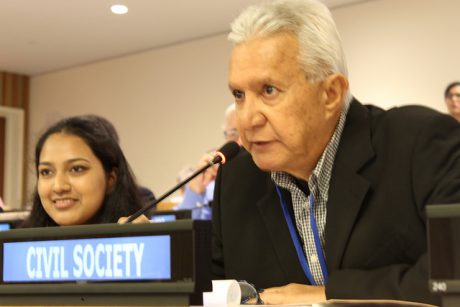
Roland Oldham, head of the nuclear test veterans organization Mururoa e tatou, addresses UN conference to negotiate the Treaty on the Prohibition of Nuclear Weapons on 21 June.
By Roland Oldham – International Physicians for the Prevention of Nuclear War – July 3, 2017
Moruroa e Tatou, Tahiti – The nuclear bomb is a weapon of crime and mass destruction.
We should all be well aware of the examples of Hiroshima and Nagasaki, where the consequences still today have effects across generations.
Like those in other places, nuclear tests in the Pacific by France, America and Britain were a crime towards indigenous people, and the defenceless people of the Pacific. It is a racist crime—nuclear racism. This destroyed and contaminated their environment, the natural resources that they depend on to live. The damages are irreversible.
Look at Moruroa for example—137 nuclear blasts underneath the coral atoll have severely fractured the atoll which is sinking down into the rising ocean, leaking radioactive gases and plutonium into the sea, risking disastrous damage for marine life. French authorities have assessed that there is a danger of a landslide of 670 million cubic meters of rock at Moruroa, creating a 15-20 meter tsunami.
The responsible governments used the Pacific as a dumping ground for nuclear waste—in the Marshall Islands, Moruroa, Fangataufa, Christmas Island, and elsewhere. Plutonium is in the lagoon of Moruroa and leaking from the 147 underground test explosion holes in Moruroa and Fangataufa. Not to mention the widespread radioactive fallout from atmospheric nuclear explosions.
There are thousands, millions of victims out there around the world—former test and weapons production site workers, military staff, civilians; women and children. They are invisible. They are voiceless. They have cancers: leukemia, thyroid, others…. Women in French Polynesia now have the highest rates of thyroid cancer and myeloid leukemia in the world. Their children through many generations will be affected by genetic mutations and damage.
It is a poisonous heritage that is left to humanity and future generations.
It is a crime against humanity.
I don’t see much of the word “crime” in the ban treaty: crime against our planet, crime against our environment, crime against humanity. The aim of the treaty is to stop all these crimes.
Why is there no word about these crimes.
Is there pressure from somewhere? Is there censorship?
Have we lost our morality?
But as victims we are not begging for favour, we are just standing up for our rights and our dignity.
There exists an obligation for the nuclear-armed states to compensate their victims, and to make reparation for the damage done to the environment.
There must be no more mushroom clouds producing untold numbers of new victims.
Roland Oldham, the head of the nuclear test veterans organization Mururoa e tatou, addressed the UN conference to negotiate the Treaty on the Prohibition of Nuclear Weapons on 21 June. The above piece is based upon his remarks, which he delivered in French on behalf of IPPNW and ICAN Australia.
Featured Video
Why Hamas Really Attacked Israel on Oct. 7
or go to
Aletho News Archives – Video-Images
From the Archives
Israel: Strategic Ally or Liability?
By Stephen Sniegoski | My Catbird Seat | June 12, 2010
The claim that Israel serves as a valuable ally for the United States is made by both pro-Zionists and much of the anti-war and anti-Zionist Left that is influenced by Noam Chomsky. As a result of the Gaza flotilla massacre, which has caused a world-wide uproar against Israel, the value of Israel to the United States is being publicly questioned in more mainstream foreign policy forums. … continue
Blog Roll
 Aletho News
- Why Hamas Really Attacked Israel on Oct. 7
- Declassified UK exposes British man who fought for ‘Israel’ in Gaza
- West’s death cult in a theater near you
- How the Yandex ‘Russian bots’ lie fell apart
- Burnham’s ‘Russia did Brexit’ ruse crumbles
- Estonia making movies and games to encourage war against Russia
- Four in five new UK jobs taken by foreigners – report
- Here’s what Trump’s latest U-turn really means for Russia and Ukraine
- The Houthis Are Not an Iranian Proxy
- Europe’s Energy Hypocrisy, Russian LNG Profits and US Dependence
- If Americans Knew
- Activists Abused By Israel Return to New Freedom Flotilla Mission
- 60 Minutes won’t tell the full truth about Israeli settler violence
- Nearly 50,000 women, girls killed or severely injured in Gaza since October 2023: UN Women
- ADL is working with AI companies to suppress alleged ‘antisemitism’
- Israeli occupation forces using social media surveillance unit to target hundreds of Palestinians in the West Bank
- Israel’s New – and Terrifying – Security Doctrine
- Israeli Attacks Kill Five in Gaza, Including a four-year-old and a woman
- Air Force Major Who Called for Trump’s Impeachment Held in Solitary Confinement
- It’s a Genocide, I’m Into It’: Seinfeld Mocks Protest over Palestinian Children Killed
- Universities fire dozens amid pressure from Zionist billionaires
- No Tricks Zone
- New Study Suggests Large Regions Of The Pacific Ocean Have Been Cooling For The Last 80 Years
- Germany’s Green Energy Debacle: High Energy Costs Force Kahla Porzellan to Close After 182 Years!
- New Study: 50 Years Of The Most Aggressive ‘Net Zero’ Policies Can Only Affect The Global Climate By 0.03°C
- US September “Heat” Was No Record…Many Records Set Decades Ago
- Latest European Green Energy Debacle; Portugal’s Largest Flagship Solar Park Insolvent!
- Green Energy Debacle: German Expert Professor Fritz Vahrenholt Warns Of Severe Economic And Social Consequences
- Two More Paleo Reconstructions Affirm Meters-Higher Sea Levels Across Ireland, Brazil 7000-6000 Years Ago
- New Study: Earth And Venus Surface Warmth Largely Explained By Convection And Lapse Rate, Not CO2 Or Radiation
- 2025 Nature Paper Claiming Worsening Global Drought Gets RETRACTED …Heavily Flawed
- New Study: ‘Global Drought Shows No Detectable Recent Acceleration Under Climate Warming’

