Remembering the Naksa

Image of Israeli soldiers interrogating Palestinians during the 1967 Gaza war [Miren Edurne/facebook]
By Nasim Ahmed | MEMO | June 5, 2017
Fifty years ago this month, Israel launched a war against its neighbours and took control of the parts of Palestine which it had failed to capture during its 1948 “War of Independence”.
What: The Palestinian Naksa (“Setback”)
When: 5 June 1967
Where: Palestine
What Happened?
On 5 June 1967, Israel launched a pre-emptive strike against Egypt, Jordan, Iraq and Syria. After knocking out the air defences of these countries, it occupied East Jerusalem, the West Bank and the Gaza Strip, as well as the Syrian Golan Heights and Egypt’s Sinai Peninsula. Thus, it had taken control of the final 22 per cent of historic Palestine that it wasn’t able to occupy in 1948.
Nearly 400,000 Palestinians were added to the hundreds of thousands of refugees displaced in 1948 and their homes and villages were razed to the ground by the Israelis. Around half were being displaced for the second time in less than 20 years. Israel’s ethnic cleansing of Palestine was ongoing (as it is to this day).
The number of Palestinian refugees in the camps operated by the UN Relief and Works Agency (UNRWA) in the West Bank, Gaza Strip, Jordan, Syria and Lebanon grew.
The Naksa commemorates this tragic setback in the Palestinian struggle for freedom and self-determination.
What Happened Next?
The outcome of the war launched by Israel was, for many of its citizens and supporters, the fulfilment of God’s promise. Adding 44 per cent of the territory allocated by the 1947 UN Partition Plan for a Palestinian state, to the 56 per cent set aside for a Jewish state, marked a new beginning for both Israel and stateless Palestinians.
Within 20 years of being recognised as an independent state, Israel began an occupation that would become the longest in modern history, at 50 years and counting. Palestinians in the “occupied Palestinian territories” were subjected to a brutal Israeli military occupation as well as the activities of armed, right-wing Jewish settlers, for whom Israel’s victory was God’s handiwork and a licence to colonise the land which they believed was promised to them and them alone.
Israel’s already repressive military rule over Palestinians living within its undeclared borders was transferred to the West Bank and Gaza. Very soon, a matrix of control and domination, that included checkpoints, permits and home demolitions, was imposed on the lives of millions of Palestinians under Israeli occupation.
For the Palestinians, the combination of the Arab defeat during the “Six-Day War”, the repeated failure of the international community to protect their human rights, and Israel’s total colonisation of Palestine, prompted a serious re-evaluation of their situation. Having witnessed the futility of relying on others to end the indignity from which they had suffered for decades, they began to organise politically in an attempt to reverse the losses of 1948 and end their misery and statelessness.
In the years following the Naksa, Palestinian communities in the refugee camps and diaspora began to organise themselves politically and socially. A number of setbacks against the Palestine Liberation Organisation (PLO) did not deter them. Such civil society activities led to the formation of the Islamic Resistance Movement (Hamas) in the late eighties; the popular uprising now known as the First Intifada; and the PLO under the control of the secular Fatah movement gaining recognition by Israel and its allies as the “sole representative of the Palestinian people”. This phase of the political process ended with the signing of the Oslo Accords in 1994, providing the Palestinians in the West Bank and Gaza Strip with “interim self-governing arrangements”.
Trump Rescued US from ‘Disastrous’ Paris Climate Accord Obligations
Sputnik – 03.06.2017
President Donald Trump saved the US economy from disastrous economic consequences in terms of soaring energy costs by repudiating the obligations his predecessor Barack Obama made in the Paris Climate Accords, analysts told Sputnik.
“The treaty itself would have been a disaster for the United States — Trump made an excellent case explaining why,” Ohio Northern University Assistant Professor of History Robert Waters said.
Trump announced on Thursday that the United States would withdraw from the Paris Climate Accords signed in December 2015 to reduce greenhouse gas emissions in an effort to combat global warming.
As well as forcing domestic energy costs to dramatically rise, the commitments Obama made in the Paris Accords would have badly hurt small US businesses at the expense of huge corporations, Waters noted.
“It was impressive that Trump decided to kill [the accords] because most of his big business friends supported them because smaller business competitors would have been driven out of business by the expense of implementing them. He also had to stand against the establishments of both parties,” he said.
By using executive authority to pull out of the treaty, Trump had frustrated his liberal opponents in the US federal judiciary who would have been determined to rule in favor of implementing all the most economically damaging and repressive of Obama’s commitments under it, Waters added.
“Trump withdrawing from the Paris climate treaty was huge… If Trump had not repudiated the climate treaty, there is no doubt that a judge would have tried to force him to implement the treaty,” Waters said.
Trump also pleased his supporters by carrying out his repeated promise during the 2016 presidential election campaign to pull out of the Paris Accords, Waters observed.
“It was very important that Trump kept this promise and killed US participation in the treaty,” he said.
Trump had begun to disillusion some of his populist supporters because he has not pushed Congress for money to build the border wall with Mexico and has not proposed a significant infrastructure program, Waters recalled.
However, Trump had redeemed his credibility with his political base by his withdrawal from the Paris accords, Waters maintained.
“This was a big issue for populist voters and he came through. Combined with his [NATO] speech… Trump has done a good job of showing that he is looking out for the American people’s interests and will not be cowed by foreign policy elites and their shibboleths,” he said.
Retired Canadian diplomat Patrick Armstrong expressed skepticism at the scientific theories claiming greenhouse gas emissions were generating global warming and agreed that Trump’s withdrawal from the climate accords would benefit the US economy.
“What are the likely consequences of pulling out of the Paris accords? If you believe in anthropomorphic climate change, catastrophic; if you don’t, advantageous,” he said.
Armstrong suggested that scientific theories, when found not to be supported by empirical evidence, should be abandoned or modified.
European Parliament calls on members to adopt Israel-related definition of antisemitism
If Americans Knew | June 2, 2017
The European Jewish Press reports that the European Parliament has adopted a resolution calling on all member states to adopt a definition of anti-Semitism that contains Israel-centric items.
The resolution was adopted at its plenary session in Brussels and officially endorses the International Holocaust Remembrance Association’s (IHRA) working definition of antisemitism. The definition consists of a synopsis followed by guidelines that include Israel related items originally created by an Israeli governmental minister in 2003. This formulation has since been disseminated around the world.
For more information see: International campaign is criminalizing criticism of Israel as ‘antisemitism’
VIDEO: The Naylor Report – Tories Plan to Sell the NHS
OffGuardian | June 1, 2017
YouTuber Chris Holden’s video on the Naylor Report and Theresa May’s plans for the NHS has gone viral in the last week. Deservedly so, he’s done the hard yards – reading an interminably dull report – so we don’t have to. His summary is concise, revealing, and very worrying.
“In an interview with Andrew Neil, Theresa May slipped out a single line about the NHS; she’s made the 2017 election all about her, strength and stability and Brexit. In half an hour, this was all she had to say about her plans on the NHS – “we support the Naylor Report”. It sounded so tediously dull, it couldn’t possibly be of any interest.”
End the Greedy Silence – Enough Already!
By Ralph Nader | May 30, 2017
It is time Americans rise up against the corruption, inefficiency, and cruelty of our healthcare system and tell its corporate captors and Congress – Enough Already!
For decades other countries have guaranteed universal health insurance for all their people, at lower costs and better outcomes (President Truman proposed it 72 years ago in the US). When are we going to break out of this taxpayer-subsidized prison built by the giant insurance companies, drug goliaths and monopolizing hospital chains?
How long is Uncle Sucker going to pay through the nose for gouging drug prices, patient-denying health insurance companies and all the brutal fine print rules in consumer contracts whose trap doors are maddening tens of millions of Americans?
Deductibles, exclusions, waivers, co-pays, corporate immunities from injured patients, disqualifying changes in patients’ status and just plain stonewalling are just some examples of this cruel madness.
Not to mention the endless electronic bills with their inscrutable codes and unchallengeable charges – that is if you can get anyone on the phone to answer your questions. Billing fraud and abuses alone cost us up to $330 billion a year!
Why do we put up with “pay or die” drug prices? Why do we tolerate our fellow Americans dying in the tens of thousands each year because they cannot afford health insurance to get diagnosed and treated in time?
Do we know that the profiteering drug companies regularly are given a slew of handouts, including huge tax breaks, free drugs developed by our National Institutes of Health, and few restraints on their high pressure sales of dangerous and addictive drugs (eg opioids) or, together with their corporate middlemen, return the favor by charging Americans the highest prices in the world? Other countries put limits on such blatant greed and exploitation.
Groping for ever more profits, the big drug companies offshore production to less regulated labs in China and India, which amount to 60% of the drugs we buy and 80% of the active ingredients in all medicines sold in the US. Unpatriotic in the extreme!
Compounding these inhumane practices is a supine Congress, with few exceptions like Rep. Lloyd Doggett (D, TX), and state legislatures, misusing the power we entrusted to them. These legislators see large pharmaceutical companies as honey pots for campaign cash that work as hush money paid by hordes of drug industry lobbyists. So craven was the majority in Congress in 2003 that, when the drug benefits bill was passed, it prohibited Medicare from negotiating volume discounts for this lucrative corporate sales bonanza (Past Congresses authorized the Pentagon and Veterans Administration to bargain and they get lower prices as a result).
Despite the fact that these healthcare challenges have been dealt with more humanely and economically by other Western countries in the world, Americans are consistently told to tolerate an aggravating status quo. Scores of books, articles and television exposés highlight all the ways we’re pushed around, denied, excluded, harmed, overcharged and deceived, yet so many of these authors still maintain that our system of health insurance/healthcare can’t be replaced with a much better one? So these writers continue to advise us how to duck, slide and swivel our escape from a few of these commercials chains and scams.
In all the fine articles written to help consumers navigate Obamacare, Medicare, and private health plans, the authors trap themselves in this vast corporate cul-de-sac by never mentioning the way out.
That way is Single Payer or Full Medicare for all, everybody in, nobody out, with free choice of doctors and hospitals – at far lower costs, mortality and morbidity. These narrow reformers can’t escape their “it ain’t going to happen here” syndrome.
Really? Don’t they know that the public has long viewed Single Payer favorably (including a majority of doctors and nurses), even without political leaders standing up for it or mass media reporting this proven safe path.
The surrender to corporate tyranny infects the 112 members of the House of Representatives who have co-signed HR 676 to create full Medicare for all. They signed, but then gave in to a silent resignation by not fighting for it in Congress and back home.
When the companies and their apologists argue for a “free market” approach to healthcare, you can retort – what free market? Half the money coming to these companies is from the federal, state and local governments. Taxpayers also pay tens of billions of dollars for much of the discovery and testing of drugs. Tax breaks and loopholes in patent laws block generic drugs and distort the free market.
Drug patents are by definition monopolies. Concentration by mergers and acquisitions of hospitals, clinics and physician practices (note dwindling independent cardiology practices) raise serious anti-trust issues. Fine print contract peonage takes away the consumers’ freedom of contract, as do the daily buy and sell equations, so often rendered by third parties for patients. Corporate billing and other crimes are endemic. What free market?
Each of you can help the Single Payer movement build momentum. Ask your members of Congress in writing if they support HR 676 and, if not, demand their appearance in person at a town meeting arranged by people like you to answer why. If they refuse, peacefully picket their local offices.
Ask the newspapers, radio and television stations, including the culpable public radio and public television, when are they going to cover the basic full Medicare reform supported by tens of millions of their listeners and viewers?
Finally, go to the website SinglePayerAction.org to find out what other people are doing and what more you can do with your friends and co-workers.
One percent of you, together with popular backing, can make it happen, through a persistent civic hobby. Remember, you only have to turn around less than 450 members of Congress.
Enough Already?
Israel arrests hundreds of Palestinians over Facebook posts
MEMO | May 30, 2017
The Israeli occupation authorities have arrested and prosecuted hundreds of Palestinians since 2015 after analysing data on their Facebook pages and judging that they are potential terrorists, Haaretz revealed on Monday.
An investigation by the Israeli journalists Orr Hirschauge and Hagar Shezaf found that Israel has violated its own and international laws regarding the detention of Palestinian youths. The domestic intelligence agency Shabak, apparently, has decided that Palestinians are terrorists if they mention the world “martyr” on Facebook.
They cited the example of a 29-year-old Palestinian woman from Hebron, whose husband was killed in a car accident in Israel in 2010. She was arrested on 2 December, 2015 and said that the Israeli interrogators handed her a screenshot of a Facebook post in which there is a picture of her husband with a caption written by her, “May God unite us in heaven”.
The woman also said that she mentioned the word shahada — “martyrdom” — on Facebook, noting that this worried her interrogators. “I told them it is a word we use regularly,” she said. “The fact that I wrote it on Facebook does not mean I will do anything. Even when someone dies in a car accident we call him shahid (martyr).”
It seems that this was an unacceptable explanation for the Israelis as she was imprisoned under administrative detention for four months with neither charge nor trial. When this term ended, it was renewed. According to the Israeli journalists, when such interrogators fail to obtain the confessions they want from Palestinians over their Facebook posts, they keep them under administrative detention or turn them over to the military courts to be sentenced.
Prior to the launch of Facebook, Israel used to arrest Palestinians on other pretexts, such as contacting organisations hostile to Israel, without specifying the identities of the organisations in question. The Haaretz investigation noted that this woman was arrested in 2008 and spent time in prison over charges of contacting an organisation hostile to Israel.
Palestinian women’s center to keep name despite pressure from UN, Norway
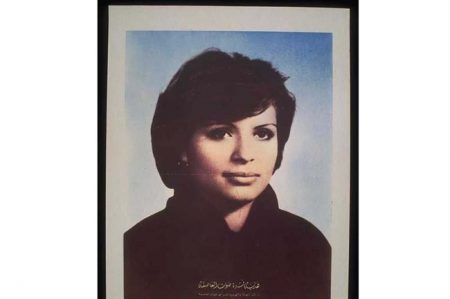
Poster of Dalal al-Mughrabi, published by Al-Asifah in 1978 (Source: The Palestine Poster Project Archives)
Ma’an – May 30, 2017
BETHLEHEM – Days after Norway pulled its sponsorship from an occupied West Bank women’s community center and demanded a refund for construction costs from the Palestinian Authority (PA), with the United Nations (UN) promptly pulling its backing as well, the center has reportedly said it will not change its name, which the UN said “glorifies terrorism.”
The Dalal al-Mughrabi Women’s Community Center — named after a fighter in the Palestine Liberation Organization (PLO) who played a role in a 1978 attack that left over 30 Israelis and 12 Palestinian fighters dead, including al-Mughrabi herself — was built in the Nablus-area village of Burqa in the northern West Bank.
The center was sponsored by both the UN and the Norwegian government, who provided partial financial support for the construction of the center, which had remained nameless until it was officially inaugurated earlier this month.
Official PA-owned Wafa news agency reported Tuesday that the head of the Burqa village council, Sami Daghlas, said “the center has no intention of caving in to the pressure and changing its name.”
Daghlas told Wafa that the center was built “to serve and empower young women in the village and to help them develop to become active members in society.”
According to Daghlas, the name Dalal al-Mughrabi was chosen by the villagers “to commemorate a Palestinian hero who sacrificed herself for her country and therefore they have no intention to change its name, regardless of the price.”
“Instead of fighting a community center that does not exceed 50 square meters in area and works on serving young women in the community, they should be objecting to regular attacks by (Israeli) settlers against the village and its people and to allow farmers to reach their land that was taken away from them,” Daghlas said, as he expressed his surprise at the actions of the UN and Norway, which he said were done “to satisfy Israel.”
The Times of Israel reported last week that the Norwegian Foreign Minister had condemned the PA for the name choice of the center, saying “Norway will not allow itself to be associated with institutions that take the names of terrorists in this way,” and demanded that the PA reimburse Norway for the costs contributed to the center.
In his interview with Wafa, Daghlas said that the people of Burqa did not object to returning the money to Norway, which he said “was only few thousand dollars used to repair and refurbish the building, and would never capitulate to pressure and blackmail.”
One day after Norway’s move to pull funding from the center, the UN pulled its sponsorship from the center, which it called “offensive.”
“The United Nations disassociated itself from the Center once it learned the offensive name chosen for it and will take measures to ensure that such incidents do not take place in the future,” the Times of Israel said, quoting a statement from Stephane Dujarric, spokesman for UN Secretary-General Antonio Guterres.
“The glorification of terrorism, or the perpetrators of heinous terrorist acts, is unacceptable under any circumstances,” the UN statement said, adding that the UN had requested that the logo of UN Women be removed from the building.
According to Wafa, Daghlas said that the UN was responsible for funding some projects put on by the center.
Wafa also quoted Ahmad Majdalani, member of the Executive Committee of the PLO, as saying that “Israel glorifies Jewish terrorists and pays them money and no one objects to that,” referencing the assassin of Israeli Prime Minister Yitzhak Rabin and other Jewish extremists convicted of attacking and killing Palestinians and Israelis, who Majdalani said still receive Israeli government stipends through the national insurance plan.
Trump’s visit to Israel: How Palestine disappeared from US media coverage
By Ramzy Baroud | MEMO | May 28, 2017
As if he has, overnight, been transformed into a master politician, Donald Trump’s 27-hour trip to Israel has left many analysts mystified.
Quoting former Israeli political adviser, Mitchell Barack, the New York Times referred to Trump as the “Liberace of world leaders”, in reference to flamboyant, piano player, Wladziu Valantino Liberace. The latter, known as “Mr. Showmanship”, was, at times, the highest paid entertainer in the world and his successful career lasted over four decades.
New York Magazine Online quoted former US ambassador to Israel, Dan Shapiro, too, trying to decipher the supposedly complicated persona of Trump.
“Either Trump’s visit was substance-free – or he ‘is being uncharacteristically subtle’ in planting the seeds for new round of peace negotiations,” NYmag quoted and paraphrased Shapiro’s tweets.
“Liberal” US media, which has stooped to many lows in its attacks on Trump – including his family, his mannerism, his choice of words, even mere body language – became much more sober and quite respectful in the way they attempted to analyze his short trip to Israel, and the very brief detour to Bethlehem, where he met with Palestinian Authority leader, Mahmoud Abbas.
“Mr. Trump’s speech at the Israeli Museum was so friendly and considerate of Israeli emotions,” reported the New Your Times, “that one right-wing Israeli legislator described it as deeply expressive of the ‘Zionist narrative’.”
Palestinian emotions, however, were of no consequence, neither to the Trump entourage, nor, of course, to the New York Times or others in mainstream media.
The Washington Post, on the other hand, still found faults, but, certainly not because of Trump’s lack of balance and his failure to deride the Israeli occupation and Israel’s mistreatment of Palestinians.
Despite the fact that Trump has, indeed, fully embraced a “Zionist narrative”, and a rightwing version of it (for example, he made no reference to a Palestinian state), he still fell short. His performance at Israel’s national Holocaust Memorial (Yad Vashem) did not impress.
Max Bearak wrote in the Post : “Trump’s entry in the guest book at Israel’s National Holocaust Memorial was strangely upbeat, self-referential and written in his signature all caps: ‘IT IS A GREAT HONOR TO BE HERE WITH ALL OF MY FRIENDS — SO AMAZING & WILL NEVER FORGET!’”
Bearak found such choice of words and the style in which it was written sort of offensive, especially if compared with the supposed thoughtfulness of former President Barack Obama.
In contrast, Obama wrote a significantly longer note, which partly read: “At a time of great peril and promise, war and strife, we are blessed to have such a powerful reminder of man’s potential for great evil, but also our capacity to rise up from tragedy and remake our world.”
Neither then, nor now, did the Washington Post bother to examine the historical context in which this particular sentence was written and find the hypocrisy of the whole endeavour.
If they bothered to ask Palestinians, they would have found a whole different interpretation of Obama’s words.
Indeed, wherever occupied Palestinians look, they find “man’s potential for great evil”: a 400-mile Israeli Wall being mostly built over their land; hundreds of military checkpoints dotting their landscape; a suffocating military occupation, controlling every aspect of their lives. They see the holiest of their cities, Bethlehem and Al-Quds – occupied East Jerusalem – subdued by a massive military force; thousands of their leaders thrown into prison, many without charge or trial. They see siege; an endless war; daily deaths and senseless destruction.
But since none of this matters to the “Zionist narrative”, it subsequently matters so very little to mainstream American media, as well.
Trump’s trip to Israel, however short, was, indeed, a master stroke by the ever-unpredictable Liberace of world politics, although, it takes no particular genius to figure out why.
From an American mainstream media perspective, to be judged “presidential” enough, all US presidents would have to commit to three main policies. They are, in no particular order: privileging the economic business elites, war at will and unconditionally supporting Israel.
So far, US media, which has been otherwise polarized based on political allegiances, has taken a break from its raging conflict over Trump’s presidency, and rallied behind him on two separate occasions: when he randomly bombed Syria and during his visit to Israel.
Ironically, the man has been often judged for lacking substance on numerous occasions in the past. In fact, his trip to Israel was the most lacking and most divisive. However, the fact that he, time and again, reiterated Israeli priorities was all that the media needed to give the man a chance. Their collective verdict seems to rebrand his lack of substance as his unique “subtle” way of making politics.
Israeli media, which is often more critical of the Israeli government than US media ever dare, needed to keep up with its “democratic” tradition. But Trump’s groveling also gave them little room for criticism. The often-impulsive Trump, this time stuck to the script and followed his repeatedly rehearsed speech and media comments to the letter.
But Josefin Dolsten insisted on finding a way to nitpick, composing for the Times of Israel the “7 awkward moments from Trump’s Israel trip.”
One of these awkward moments, Dolsten wrote was “a White House statement listing Trump’s goals for the trip included a hilarious (and juicy!) typo: ‘Promote the possibility of lasting peach’ between Israel and the Palestinians. Yes, we get it — it meant to say peace, but who’s to say the two sides can’t bond over some delicious fruit?”
For Palestinians, it must not be easy to find the humour in these tough times. Hundreds of their prisoners, including their most popular leader, Marwan Barghouthi, were enduring a prolonged and life-threatening hunger strike in which they were making the most basic demands for better treatment, longer visitation hours with their families and ending of arbitrary detentions.
More telling, on the day Trump, along with rightwing Israeli Prime Minister Benjamin Netanyahu, lectured Palestinians on peace, a 17-year-old Tuqua Hammad was shot for allegedly throwing stones at Israeli military vehicles at the entrance of her village of Silwad, near Ramallah.
Tuqua “was shot in the lower extremities and Israeli troops prevented a Palestinian ambulance from accessing the victim to treat her,” Ma’an news agency reported.
Merely a few miles away, Trump was writing his remarks after visiting Israel’s Holocaust Museum. Regrettably, he failed to meet the expectations of the Washington Post, for unlike Obama, he was not poignant enough in his language and style.
The irony of the whole story is inescapable; but American media cannot see this, for it, too, seems to follow a script, in which Palestinian rights, dignity and freedom are hardly ever mentioned.
Featured Video
Why Hamas Really Attacked Israel on Oct. 7
or go to
Aletho News Archives – Video-Images
From the Archives
Israel: Strategic Ally or Liability?
By Stephen Sniegoski | My Catbird Seat | June 12, 2010
The claim that Israel serves as a valuable ally for the United States is made by both pro-Zionists and much of the anti-war and anti-Zionist Left that is influenced by Noam Chomsky. As a result of the Gaza flotilla massacre, which has caused a world-wide uproar against Israel, the value of Israel to the United States is being publicly questioned in more mainstream foreign policy forums. … continue
Blog Roll
 Aletho News
- Why Hamas Really Attacked Israel on Oct. 7
- Declassified UK exposes British man who fought for ‘Israel’ in Gaza
- West’s death cult in a theater near you
- How the Yandex ‘Russian bots’ lie fell apart
- Burnham’s ‘Russia did Brexit’ ruse crumbles
- Estonia making movies and games to encourage war against Russia
- Four in five new UK jobs taken by foreigners – report
- Here’s what Trump’s latest U-turn really means for Russia and Ukraine
- The Houthis Are Not an Iranian Proxy
- Europe’s Energy Hypocrisy, Russian LNG Profits and US Dependence
- If Americans Knew
- Activists Abused By Israel Return to New Freedom Flotilla Mission
- 60 Minutes won’t tell the full truth about Israeli settler violence
- Nearly 50,000 women, girls killed or severely injured in Gaza since October 2023: UN Women
- ADL is working with AI companies to suppress alleged ‘antisemitism’
- Israeli occupation forces using social media surveillance unit to target hundreds of Palestinians in the West Bank
- Israel’s New – and Terrifying – Security Doctrine
- Israeli Attacks Kill Five in Gaza, Including a four-year-old and a woman
- Air Force Major Who Called for Trump’s Impeachment Held in Solitary Confinement
- It’s a Genocide, I’m Into It’: Seinfeld Mocks Protest over Palestinian Children Killed
- Universities fire dozens amid pressure from Zionist billionaires
- No Tricks Zone
- New Study Suggests Large Regions Of The Pacific Ocean Have Been Cooling For The Last 80 Years
- Germany’s Green Energy Debacle: High Energy Costs Force Kahla Porzellan to Close After 182 Years!
- New Study: 50 Years Of The Most Aggressive ‘Net Zero’ Policies Can Only Affect The Global Climate By 0.03°C
- US September “Heat” Was No Record…Many Records Set Decades Ago
- Latest European Green Energy Debacle; Portugal’s Largest Flagship Solar Park Insolvent!
- Green Energy Debacle: German Expert Professor Fritz Vahrenholt Warns Of Severe Economic And Social Consequences
- Two More Paleo Reconstructions Affirm Meters-Higher Sea Levels Across Ireland, Brazil 7000-6000 Years Ago
- New Study: Earth And Venus Surface Warmth Largely Explained By Convection And Lapse Rate, Not CO2 Or Radiation
- 2025 Nature Paper Claiming Worsening Global Drought Gets RETRACTED …Heavily Flawed
- New Study: ‘Global Drought Shows No Detectable Recent Acceleration Under Climate Warming’

