Steelworkers urge EU protection against imports
Press TV – November 9, 2016
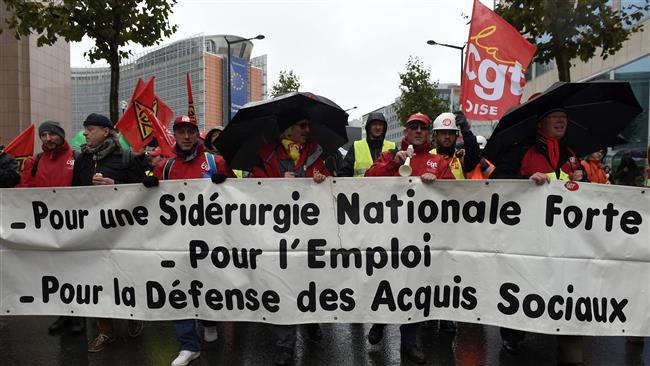
Steelworkers from across the European Union have held a protest in front of the EU headquarters in Brussels to demand protection, as cheap foreign import mostly from China keeps threatening job security in the industry.
The protesters on Wednesday urged the EU to impose tough restrictions on steel imports from China and adopt better regulations for the market.
Reports said at least 5,000 people from various EU countries attended the demonstration.
Recent studies show that an estimated 330,000 people are working in Europe’s steel factories, the lowest in the history of the industry in the continent. That comes as many think Europe owes its industrial revolution to the boom in steel production.
The European Union has moved to adopt policies that could prevent the import of cheap products to its market. The aim is to cut the flow of steel from China, which has swamped the European markets at dumping prices.
Luc Triangle, the general secretary of Industrial Europe union, said the EU must do more to ensure the rights of the steelworkers were protected.
“You cannot throw workers in the arena of globalization without any protection,” Triangle added.
EU Competitiveness Commissioner Jyrki Katainen said the policies were meant to create a fair competition in the European steel market, noting, “Free trade must be fair, and only fair trade can be free.”
Workers have already staged mass protests in developed EU countries such as Germany, saying the widening trend of cheap imports from China and a global oversupply of the product have already created many uncertainties about the prospects of the industry.
About 50,000 steel workers attended such rallies in three German cities, including the capital Berlin, in April, denouncing the EU’s unfair environmental regulations.
Andrew Korybko – We shouldn’t be surprised about Trump’s victory

Katehon Think Tank | November 9, 2016
Leave those kids alone! Thousands of schoolchildren being spied on without their knowledge
RT | November 8, 2016
At least 1,000 schools have installed software that allows teachers to monitor their students’ internet activity, but most schools have failed to inform youngsters that they are being watched.
According to a report by civil liberties watchdog Big Brother Watch, several secondary schools in England and Wales have installed the Classroom Management Software in more than 821,000 devices owned by the institutions and by pupils themselves.
The tool can allow teachers to monitor the screens on every single desktop in the classroom, as well as access the students’ internet browsing history and alert staff of “signs of extremism and radicalization.”
Campaigners were shocked to find that of the few institutions (149) able to provide Acceptable Use policies on their management of the software, over 80 percent did not give detailed information on the monitoring process.
Big Brother Watch believes although the software may have a role to play in keeping students safe, children and parents should be advised about the privacy settings of the program.
“Finding the balance between keeping pupils safe online without impinging on their right to privacy is a challenge for every school,” said the group’s chief executive Renate Samson.
“But encouraging schools to track and monitor pupils creates a worrying precedent, particularly if pupils and parents are being left in the dark.
“As technology in the classroom becomes the norm, schools must ensure they don’t become modern day panopticons, where children grow up believing their every digital move is being watched.”
It cost the taxpayer a total of £2 million (US$2.48 million) to install the controversial software. More is spent each year on maintenance and subscription fees.
Israeli forces demolish residential buildings in occupied East Jerusalem neighborhoods

Ma’an – November 8, 2016
JERUSALEM – Israeli authorities Tuesday morning demolished two residential buildings in the occupied East Jerusalem neighborhoods of Wadi al-Jouz and al-Issawiya for building without Israeli-issued licenses.
Locals told Ma’an that Israeli forces escorted two excavators to the Wadi al-Jouz neighborhood at 4 am. Israeli soldiers were also deployed throughout the alleys of the neighborhood, before surrounding a three-story building as Israeli excavators tore it down.
According to locals, the building consisted of stores on the ground floor, apartments on the second, while the third floor was still under construction.
Local sources highlighted that the stores on the first floor contained food supplies belonging to Palestinian families, adding that Israeli forces demolished the stores without allowing families to remove their supplies.
The demolition occurred after the building was constructed without Israeli-issued building permits, locals said, much like most of East Jerusalem as the process to obtain the permits are often time-consuming and expensive.
After Israeli forces completed the demolition in Wadi al-Jouz, they headed to the neighborhood of al-Issawiya and demolished a residential building, claiming it was lacking Israeli-issued building permits, according to locals.
Member of a local committee in al-Isawiya, Muhammad Abu al-Hummus, told Ma’an that the building was a two-story building, still under construction.
According to Abu al-Hummus, the first floor consisted of commercial stores, while the second served as a residential floor.
A spokesperson for the Jerusalem municipality was not available for immediate comment.
Demolitions in the occupied West Bank and East Jerusalem have seen an unprecedented surge in recent months, with the number of structures demolished in the first half of 2016 already well exceeding the total number of demolitions carried out in all of 2015.
More than 1,383 Palestinians have been displaced since the beginning of 2016 as a result of demolitions in the occupied territory, compared to 688 Palestinians displaced over the entirety of 2015, according to UN documentation.
Israel rarely grants Palestinians permits to build in ‘Area C’ of the West Bank — the area under full Israeli security and civilian control — and East Jerusalem, though the Israel’s Jerusalem municipality has claimed that compared to the Jewish population, they receive a “disproportionately low number of permit applications from Palestinian communities,” which they boasted “see high approval ratings.”
However, testimonies collected by the Applied Research Institute – Jerusalem (ARIJ) in the East Jerusalem neighborhood of Silwan found that the procedures to apply for Israeli-issued building permits were lengthy, sometimes lasting for several years, while the application costs could reach up to 300,000 shekels ($79,180).
As four out of five of Palestinians in East Jerusalem live under the poverty line, applying for costly building permits is nearly impossible, and only seven percent of Jerusalem building permits go to Palestinian neighborhoods.
‘Conspiracy Vs. Government’ Is Part of an Elite Wave of Propaganda Justifying Violent Repression
The daily Bell – October 31, 2016
The rise of paranoid politics could make America ungovernable – and the FBI is fuelling the fire … Nothing can disprove the fears of a paranoiac. Indeed, everything confirms them … It takes away politicians’ incentive to understand one another and get things done. It says that if you scream loud enough, established norms will buckle under the pressure. And while those norms might be annoying and flawed, we’ll all miss them if they go. –UK Telegraph
With US belief in “conspiracy theory” over 50 percent (see our previous article here) elites are showing increasing concern that they have lost control of their narrative.
This article again illustrates elite push back. The article explains that if people grow paranoid about government, then the “norms” of government will collapse.
Conspiracy theory is called “paranoid politics” in this article but it amounts to the same thing.
The article also has parallels to an article we analyzed recently here by Cass Sunstein. His Bloomberg editorial suggested that nothing was more important from a political standpoint than returning “civility” to Congress and politics generally.
This article runs along the same lines: Negative perceptions of the US government can make the process of “governing” dysfunctional
More:
Take the “chemtrails” conspiracy theory: the idea that the white trails left behind in the sky by aeroplanes are sinister chemicals dispersed to sterilise or control voters.
If a government declares there is “no evidence” of such chemicals, that itself must be clear evidence that there’s something “they” don’t want us to know. But if that government were to open up an investigation, that too would be incontrovertible proof: “they” must have found something.
Let’s reverse this reasoning. Apparently, one can’t question much that government does because skepticism puts government in a no-win situation.
Better to accept official pronouncements, then. The only trouble is that almost anything modern Western governments say are lies.
Governments aren’t even important these days. The world from what we can tell is run by a small banking elite that controls the awesome power of central banks and the money they print.
The trillions available to this small group has allowed it to change the nature of society around the world.
The goal is global government and every kind of violence and corruption is employed to achieve it.
Secrecy is still employed by those creating “one world.” Thus the world is bent on the task of creating global governance while never admitting it.
But in the past several decades, the Internet has credibly exposed plans for world government. As a result, people have lost faith in mainstream media, politicians and capitalism itself.
This is the reason for the rise in “conspiracy theory” and “paranoid politics.”
This is also the reason elites would like to shut down the Internet, or at least control it more thoroughly.
Part of the push for control involves making a case that the Internet needs to be better regulated and appropriately censored.
To this end, elite propaganda has been aimed at justifying various anti-‘Net actions.
One justification involves the “populism versus globalism” meme we’ve covered extensively. (Just use a search engine for the phrase and “Daily Bell.”)
Another justification – another emergent meme – is that government itself is jeopardized by pervasive distrust.
One would think the answer would be to lie less, but this is not the conclusion we’re being furnished.
Both Sunstein in his article, and now the argument in this article, show us clearly that the solution to pervasive electoral cyncism and worse is to better control one’s attitude.
In other words, paranoia and conspiratorial cynicism need to be damped for government to survive and perform its proper function.
Here:
Why, then, did a seasoned operator like Mr Comey, whose judiciousness was praised by the Clinton campaign through the summer, feel the need to divulge this half-baked and potentially insignificant development before assessing it? There is one answer: fear of the mob.
The director of the FBI – those tough guys who smash in doors and shoot people – was scared that if he didn’t talk now and the news leaked out, it would confirm every conspiracy theory going about how the agency was in the Clintons’ pocket. In other words, we’ve reached a point in the politics of the world’s most powerful democracy where the appearance of probity matters more than the reality.
This is a key point in the article. It is one that fully reveals the cognitive dissonance at the heart of this particular argument. The idea is that government is too delicate to sustain itself in the face of the “mob.” The mob must therefore be silenced or “probity will matter more than reality.”
But who is to determine what constitutes a “mob”? And who is determine that the mob’s “reality” is false?
Both the Sunstein article and now this one are erecting very specific kinds of arguments. Government, we are told, is fragile and must be protected from forces that will undermine its credibility.
But this conclusion is merely assumed. It is never proven.
This argument begins and ends with government. Yet the Internet and its recovered history shows us clearly that Western governments mostly provide concealment for the world’s real powers that prefer to operate behind the scenes.
This is the reason for so much cynicism. Many have realized that the society constructed around them is lie. They have reacted by distrusting almost anything associated with modern society.
But in these articles, we can see the forces being marshaled against this state of mind. The preferred antidote is simply to assert that people’s distrust is corrosive to government authority and democracy generally.
No logic bolsters this argument. That’s why it is an emergent elite meme.
The goal of an elite meme is to be convincing not truthful.
And if it is not convincing – and increasingly elite memes are not – then its function is, anyway, to provide a justification for what we call directed history. These are the authoritarian strategies that elites wish to inflict on the rest of us.
This latter meme is an outgrowth of “populism versus globalism.” Populists, as we’ve pointed out, are being cast as ignorant, violent and intolerant. The current meme – let’s call it “conspiracy versus government” – lumps in conspiracy with populism.
Populists, we learn, are apt to adopt an irrational distrust of government. And what is government? It must comprise all that is good and virtuous in an uncivil world.
Both populists and conspiracy theory are to be vanquished, eventually, by wise globalists who understand that the absence of government will lead to violent “anarchy.”
Would that it were true. It is not. Government is merely in this day-and-age a curtain hiding the world’s real controllers who use endless violence, monetary debasement and economic depression to get their way.
Conclusion: We are watching the emergence of a new, dangerous memes. Increasingly and forcefully, it is being argued that “government” is good and that the truths people have discovered about their lives and society are destabilizing to government, and therefore “bad.” The idea will be to use these memes to make a case for increased censorship and even, eventually, violent repression – and worse.
Facebook investigated by German prosecutors for failing to stop ‘hate speech’
RT | November 4, 2016
Facebook’s founder Mark Zuckerberg and other senior executives are being investigated in Germany after a lawyer filed a complaint accusing them of allegedly allowing racist and violent posts to remain on the social networking site.
The social media giant was accused of doing little to stop racism, Holocaust denial and violent threats on the site, according to Der Spiegel.
A Bavarian lawyer initiated the case by reporting Facebook to the police, accusing the company’s management of allowing such hateful posts to stay on the site without any consequences.
Chief Operating Officer Sheryl Sandberg, European policy director Richard Allan and company head in the Berlin office Maria Kirschsieper, are also under investigation.
German law requires Facebook to delete any content considered to be inciting hatred. Earlier this year, the company was also hit with a criminal complaint, but authorities said at the time they were unable to investigate because the accused, Zuckerberg, was not residing within German borders when it was brought to light.
German politicians have criticized Facebook for reportedly failing to take action against hate speech on the site.
In October, Volker Kauder, a member of Angela Merkel’s Christian Democratic Union, said Facebook and other social media giants should face penalties for not taking action against hate speech, following the rise of xenophobic comments amid the refugee crisis in Europe.
Kauder said he had “run out of patience” with how social media giants were dealing with abusive content.
Many users of Facebook, Twitter and Google said that despite pledges from the companies to remove hate speech within 24 hours from their sites, users complaints were not adequately dealt with, the Local reports.
Facebook did not comment on the investigation status but said “the allegations lack merit and there has been no violation of German law by Facebook or its employees.”
AL-KHALIL (HEBRON): A week in photos 25-31 October 2016
CPT | November 4, 2016
|
|
|

|
|
|
|

|
|
|
|

|
|
|
|

|
|
|
|

|
|
|
|

|
|
|
|

|
ICC: Africa Obsessed and Ineffective
By Khavheni Shope | teleSUR | November 2, 2016
To date, the ICC has investigated about 39 cases and 38 of them are on the African continent.
The International Criminal Court was initially viewed as the world’s haven from atrocities and a tribunal that would protect the rights of those whose freedoms had been taken away and whose voices had been silenced. The court was established by the 1998 Rome Statute with 139 signatories and 123 ratifications.
Fast forward about 14 years from the year the statute entered into effect in 2016, when three ratifying countries—South Africa, Burundi and Gambia—have announced their withdrawal from the entity. Although the decisions have proven to be controversial both within and outside of nations’ borders, the question is why?
One of the biggest criticisms facing the international body is that it is biased against African states. The African Union has long pointed this out and in 2013 it called for immunity for sitting leaders indicted by the court. It was denied in 2015 in the pursuit of Sudanese President Omar al-Bashir along with the subsequent prosecution against the South African government for failure to detain him.
To see why these accusations persist is to understand the context: to date, the ICC has investigated about 39 cases and 38 of them are on the African continent. This fact undoubtedly places the court’s supposed impartiality under scrutiny when it appears to cast a blind eye on the doings of Western leaders. The court’s legitimacy is further questioned by the fact that super powers such as the U.S., China and Russia have yet to be subjected to its authority.
The legal body shrugged off the claims by reiterating that the ICC is comprised of some African officials and therefore cannot be biased against the continent. The ICC flaunted its double-standards when it announced that it would not investigate former British prime minister Tony Blair for sending U.K. troops into Iraq under false pretenses. However, British soldiers may still face prosecution.
According to an article published by Forbes in 2014, the ICC had only convicted two out of all the people it had indicted with an expenditure of about US$1 billion. Earlier in 2016, the court pursued its third prosecution against former vice-president of the Democratic Republic of Congo Jean-Pierre Bemba Gombo who was sentenced to 18 years for rape and pillage committed by his troops in the Central African Republic.
The irony of this conviction lies in the countless incidents of child abuse committed by European troops deployed in peace-keeping missions in that very nation. The U.N. rid itself of responsibility, stating that the onus is on each country to prosecute its own troops.
So another criticism of the legal body is that it has so far been ineffective and expensive, that in all of its 14 years, only perpetrators from two parts of the whole world have been indicted while everyday there are crimes ravaging humanity in all corners of the globe, many at the hands of the same members of the institutions who dominate the world.
It is not to say that such crimes should not be addressed, however if humanitarianism is going to continue to be used as a cloak that serves both as a hero’s cape during the day and a blanket to cover the truth at night, then the court’s mandate is skewed. Justice should not only be a privilege for the 1 percent.
Trigger Warnings, Safe Spaces, Bias Reporting: The New Micro-techniques of Surveillance and Control
By Michael Rectenwald, Ph.D. | Legitgov | September 12, 2016
A singular orthodoxy has infiltrated the discursive parameters of U.S. and other universities and colleges. This orthodoxy now constitutes the ethical vocabulary of academia. Adopted from feminism, anti-racism, and LGBTQ theory and practice, the language, doctrines, and mechanisms of this orthodoxy now dominate academia’s policies, procedures and handbooks. The terminology has become the vernacular among the swelling ranks of administrators, especially the relatively new cohort of chief diversity officers, directors of diversity, associate provosts of diversity, assistant provosts of diversity, diversity consultants, and so on and so on. I refer not merely to the orthodoxy of “diversity,” but in particular to “diversity” initiatives as they are currently administered, using a particular set of policies, procedures, and mechanisms: trigger warnings, safe spaces, bias reporting, and the like.
While ridiculed by media outlets, and, at least where trigger warnings are concerned, disavowed by the American Association of University Professors, nevertheless, American colleges and universities are dominated by this ethos and its collective techne. At the University of Chicago for example, the Dean of Students, John (Jay) Ellison, Ph.D., announced (to the great chagrin of some faculty and many students):
Our commitment to academic freedom means that we do not support so-called “trigger warnings,” we do not cancel invited speakers because their topics might prove controversial, and we do not condone the creation of intellectual “safe spaces” where individuals can retreat from ideas and perspectives at odds with their own…
Yet, the same university has also assembled and maintains a “Bias Response Team,” and “urges anyone who has experienced or witnessed a Bias Incident to report it to the Bias Response Team.”
As it usually happens, any perspective that deviates from this “academic” orthodoxy – or any opposition expressed by faculty members in reasoned commentary or debate about the premises of the creed and/or its techniques – is virtually proscribed in advance. Whether or not they happen to be progressives, left communists, or radicals of another stripe, potential critics rightly fear being figured as right-wing reactionaries opposed to diversity and the confrontation of oppression. Any complaints or criticisms, they fear, would be peremptorily dismissed, and likely circulated among other faculty members within their own universities or in academia at large as gossip, subjecting the critic to ridicule and disrepute.
Indeed, despite the fact that a new form of policing has been surreptitiously introduced into academia at large, one would be hard-pressed to find a single article, essay, or book that subjects the entire administratively controlled apparatuses of “diversity” to any kind of real scrutiny. While innumerable articles have appeared on one or another of these topics (mostly on trigger warnings and safe spaces), no one has explained the structural provenance nor analysed the probable effects of these developments as a whole. Nor has anyone provided a theoretical or historical framework with which to understand them.
Ironically, perhaps, the most clearly appropriate critical theoretic for grasping the structural origins, as well as the social and political implications of this new largely “academic”1 development, can be found within the ambit of postmodern theory itself. The new mechanisms adopted and adapted by academic administrations clearly and incredibly mirror those described in a text widely read within humanities and social science studies courses throughout American universities and beyond. Indeed, it is a wonder that no one has, until now, applied this critique to the mechanisms of this academic creed. Faculty members, graduate students, and even many undergraduates, who have had even the slightest brush with trends in the humanities and social sciences, will know to what I refer here: Michel Foucault’s brilliant 1975 book, Discipline and Punish: The Birth of the Prison. Particularly uncanny is the resemblance of the academic mechanisms in question to the “micro-physics of power” described in the third chapter, “Panopticism.”
In this riveting essay, Foucault effectually describes the transmutation of power from the pre-modern to the modern period. Adducing Jeremy Bentham’s architectural model of the “Panopticon,” Foucault proffers what at the time was an utterly novel understanding of modern “discipline” and control. The new disciplinary mechanisms that Foucault discusses replace the earlier corporeal forms of punishment, such as quartering people in public, or branding them with the crimes they supposedly committed, and so forth. While the Panopticon was first introduced by Bentham as a model of prison, asylum, and school reform, the forms of surveillance and discipline to some extent prefigured by the Panopticon and in some sense preceding it, for Foucault had already metastasized beyond the prison system, becoming the general means of discipline and control in so-called “democratic” societies.
The Panopticon itself is a circular building, in which its subjects – inmates, patients, students, etc. – are arrayed in cells surrounding a central tower. The subjects can be seen at any time by a guard, who may (or may not) occupy the central tower. The captive subjects cannot see into the tower, nor can they see each other. Likewise, they are never certain whether or not they are being observed:
Bentham’s Panopticon is the architectural figure of this composition. We know the principle on which it was based: at the periphery, an annular building; at the centre, a tower; this tower is pierced with wide windows that open onto the inner side of the ring; the peripheric building is divided into cells, each of which extends the whole width of the building; they have two windows, one on the inside, corresponding to the windows of the tower; the other, on the outside, allows the light to cross the cell from one end to the other. All that is needed, then, is to place a supervisor in a central tower and to shut up in each cell a madman, a patient, a condemned man, a worker or a schoolboy. By the effect of backlighting, one can observe from the tower, standing out precisely against the light, the small captive shadows in the cells of the periphery. They are like so many cages, so many small theatres, in which each actor is alone, perfectly individualized and constantly visible. The panoptic mechanism arranges spatial unities that make it possible to see constantly and to recognize immediately. In short, it reverses the principle of the dungeon; or rather of its three functions – to enclose, to deprive of light and to hide – it preserves only the first and eliminates the other two. Full lighting and the eye of a supervisor capture better than darkness, which ultimately protected. Visibility is a trap (Foucault 200).
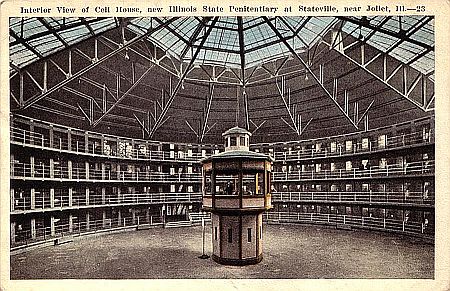
Although the captive individual can never verify with certainty that she is being observed, the very possibility of being observed at any time produces the intended effects of hyper-vigilance and self-circumspection on the part of the subject. As such, the subjects themselves internalize the observer, and effectively monitor and police themselves. As Foucault brilliantly describes the effects of this technological innovation:
He who is subjected to a field of visibility, and who knows it, assumes responsibility for the constraints of power; he makes them play spontaneously upon himself; he inscribes in himself the power relation in which he simultaneously plays both roles [that of observer and observed]; he becomes the principle of his own subjection (203, emphasis added).
Make no mistake, Foucault describes and mobilizes the architectural model of the Panopticon in order to introduce his central argument – in modernity, entire societies are inscribed with, underwritten by, and even predicated upon a generalizable and generalized method of surveillance and control – panopticism. Even the once structure-bound, institution-specific disciplinary techniques as represented so well by the Panopticon have metastasized and traveled well beyond their former institutional borders. They now permeate the entire social body. In fact, in an important section, Foucault discusses “the swarming of the disciplinary mechanisms” of panopticism. The phrasing will invoke for contemporary readers the sentinels in “The Matrix,” the legion of squid-like robots that seek out, locate, and swarm about the escapees from the matrix in sweltering masses.
For our purposes, perhaps the most salient aspect of panopticism is the way that it makes all of its subjects into potential sentinels of surveillance: “We have seen that anyone may come and exercise in the central tower the functions of surveillance” (207). That is, anyone and everyone can be interpellated as a functionary of panopticism. “If you see something, say something” is the mantra that effectively encapsulates this logic. Universities and colleges employ the micro-techniques of power precisely in the fashion described by Foucault.
At this point, I should make clear a parallel between the late eighteenth/early nineteenth-century model that Foucault treats, and the contemporary devices employed in academia and beyond. A point that is often lost on many readers of Foucault’s “Panopticism,” especially those unfamiliar with nineteenth-century British cultural history, is that Jeremy Bentham was not some reactionary, right-wing or even conservative thinker attempting to impose a nefarious, draconian form of discipline and punishment upon the population. In fact, during his time, Bentham was regarded as a radical, what today we would call a “progressive.” Bentham was known as the principle member of an early nineteenth-century group of reformers known as “the philosophical radicals.” As noted in the Encyclopaedia Britannica, he advocated numerous liberal reforms, including “annual elections; equal electoral districts; a wide suffrage, including woman suffrage; and the secret ballot. He supported in principle the participation of women in government and argued for the reform of marriage law to allow greater freedom to divorce.”
My point here is that regardless of the political provenance or original intention of the repertoire of diversity mechanisms, as Foucault makes clear, such methods and techniques, whether introduced initially by reformers for progressive ends or not, can and have often been co-opted by administers of power and wielded to oppressive ends. Likewise, the origin of the new academic instruments or “micro-physics of power” in feminism, anti-racism and LGBTQ discourse and practice in no way exempts them from being employed as mechanisms of surveillance and control.
Academia has co-opted and now brandishes identity-politics and its techniques of micro-power – including trigger warnings, safe spaces, and bias reporting – as means of the disciplining of the subject. Bias reporting lines are examples of the ways colleges and universities are able to enlist everyone within their ambit as sentinels of surveillance, discipline, and punishment. Bias reporting lines and reporting systems encourage everyone to act as an instrument of panopticism, an instrument of self- and other-policing.
In terms of the academy, however, the use of such mechanisms does not represent a perversion of intent. They are coercive as such, by definition. They are part of a growing panoply of micro-techniques of power representing the appropriation and defusing of politics, rather than opposition to the systems of oppression that such politics intend to represent.
These techniques of surveillance and control recall such organizations of the nineteenth century as The Society for the Suppression of Vice, founded in 1802. The only real difference involves what now count as punishable offenses. In the early to mid-nineteenth century in Britain, offenses included the production, distribution and consumption of pornography, as well as expressions of blasphemy, and the like. Today, “vices” and “blasphemies” include real or imagined “micro-aggressions,” or any conceivable displays of “bias,” however absurdly construed. Both regimes, however, are equally religious in character, involving as they do moralistic, individualized, and personalized policing. While both are insidious, only contemporary academic panopticism, operating under the guise of protecting and encouraging “diversity,” is anathema to academic freedom and inquiry, while simultaneously underming any potential for collective agency, or solidarity, among its subjects. Above all, panopticism individualizes.
Meanwhile, and probably most importantly, none of this policing and self-policing will do anything to challenge or overturn systemic oppression in the least. In fact, while serving the ideological function of obscuring the underlying structural inequities, oppression and exploitation of capitalism, they also constitute their own form of oppression.
[1] As Lori R. Price has pointed out, these same mechanisms have metastasized and infiltrated such social media platforms as Twitter, Facebook and YouTube.com.
Michael Rectenwald is a professor in Global Liberal Studies at New York University. He is the author of Nineteenth-Century British Secularism: Science, Religion and Literature (Palgrave Macmillan, 2016), primary editor of Global Secularisms in a Post-Secular Age (De Gruyter, 2015), and primary author of Academic Writing, Real World Topics (Broadview Press, 2015). His essays have appeared in numerous periodicals and anthologies, including the British Journal for the History of Science, Endevour, and George Eliot in Context (Cambridge University Press, 2013).
Misplacing priorities and freedom of expression
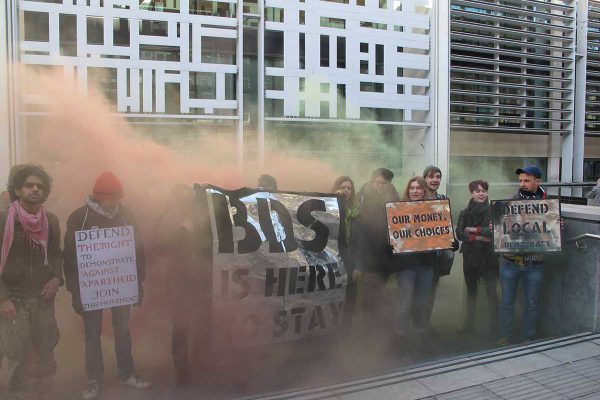
BDS supporters protest anti BDS activities in London
By Ramona Wadi | MEMO | November 3, 2016
It would be slightly premature to consider the statement by the EU Representative for Foreign Affairs and Security Policy, Federica Mogherini, regarding the right of EU citizens to boycott Israel as some sort of victory. At first glance, it might look as if activism has overcome a significant hurdle, given the Israeli government’s obsession with suffocating the Boycott, Divestment and Sanctions movement (BDS). A study of the brief statement actually suggests otherwise, and all in the name of freedom of expression.
Mogherini asserted that the EU “stands firm in protecting freedom of expression and freedom of association in line with the Charter of Fundamental Rights of the European Union”, even when such information or ideas “offend, shock or disturb the State or any sector of the population.” You just knew that there was a “but” coming: she made it equally clear that “the EU rejects the BDS campaign’s attempts to isolate Israel and is opposed to any boycott of Israel.” The EU official missed the point, of course; Israel isolates itself by its contempt for international laws and conventions, along with its brutal military occupation and colonisation of Palestine.
Commenting on Mogherini’s statement, BDS Europe Campaigns Officer Riya Hassan voiced the expectation that the EU should respect “its obligations under international law and its own principles and laws by, at the very least, imposing a military embargo upon Israel,” as well as a suspension of the EU-Israel Agreement signed in 1995. The latter stipulates regulations regarding political dialogue, economic cooperation, security and cooperation on social matters, based upon the premise in Article 2 of the agreement that all provisions “shall be based on respect for human rights and democratic principles.” Israel has no such respect; it is a colonial entity and the EU functions as a protector of colonialism. The entire agreement should thus be declared null and void, or amended according to each entity’s characteristics, without the need to drag pretentious terms such as democracy into the equation.
Through Mogherini’s recent statement we have a clear example of how the EU actually demeans human rights and freedom of expression by utilising the discourse meant to uphold them. The entire essence of the EU’s true intentions lies in its opposition to BDS. Hence, any concession given by the EU should not be misconstrued as support, or upholding the right to freedom of expression. It is merely a recurring political ploy that ridicules the very essence of freedom. At the same time, it is through these clauses that BDS has managed to retain ground. Notwithstanding the genuine efforts of the masses which have embarked upon collective and individual efforts to boycott Israel, the fragile compromise upon which the global boycott outlook rests may well become tarnished if it continues to laud statements blatantly supportive of Israel while grudgingly allowing dissent as proof of freedom of expression.
Hence, Mogherini’s statement is not welcome. It is a calculated contribution to the debate that places Israel’s interests above the legitimate demands and legal rights of the Palestinians. BDS should distance itself from the litany of symbolic gestures that have taken precedence over genuine, active support for the anti-colonial struggle unless, that is, the movement seeks to become just another actor that thrives upon Palestinian demands as the means for the entity’s survival. If the movement’s chartered course is in the slightest way intertwined with that of the EU, however insignificant it may seem on the surface, Palestine may well be destined to accumulate festering wounds; the objective — which is already compromised due to the two-state subjugation rhetoric — will in the meantime become ever more distant from the land and the indigenous people.
Son of Honduran Human Rights and Resistance Activist Murdered

teleSUR | November 2, 2016
In post-coup Honduras, a coup which Democratic presidential candidate Hillary Clinton supported, the corpses continue to pile up.
Human rights organizations are raising alarm after yet another assassination in Honduras, this time of the son of a prominent resistance activist, human rights defender, and aspiring progressive candidate for local political office with the left-wing Libre party.
Fernando Aleman Banegas was shot dead in the early hours of Monday morning when we was getting into his car after leaving a club in the northern port city of La Ceiba, according to local reports. The gunmen reportedly fled the scene on a motorcycle.
Aleman will be buried in the nearby city of Tocoa, which borders the Aguan Valley agricultural region, home to a brutally repressive land conflict between campesino communities and large private landowners.
Aleman’s mother, Elsy Banegas, has accompanied the campesinos struggle for years as the President of the Coordinator of Popular Organizations of the Aguan, known as COPA, a human rights group focused on labor and campesino issues in the region. Banegas is also an aspiring mayoral candidate for Tocoa with the Libre party, founded as an offshoot of the popular resistance movement in the wake of the 2009 U.S.-backed coup, in order push for a constituent assembly to rewrite the Honduran constitution at the ballot box, to complement their street resistance.
According to the Honduran human rights organization COFADEH, Banegas’ candidacy “threatens the interests of transnational mining companies and large landowners in the region.” The prominent activist has long been a vocal critic of systematic grave human rights abuses, impunity and the consequences of militarization in the region, particularly since the coup.
Banegas’ organization COPA reported after the murder that the social leader has “on many occasions received death threats for acting against mining companies, privatization and against the violation of human rights.”
Aleman’s assassination came hours before Libre kicked off its internal elections process to select the party’s new leadership leading up to the 2017 general election. Despite the shadow of violence, participation in the process surpassed the party’s own goals, according to Libre leader and ousted President Manuel Zelaya, with at least 239,000 people casting votes when estimates expected participation of 150,000 in the country of about 8 million.
Human rights organizations have called for a thorough and impartial investigation into Aleman’s murder.
The killing comes just two weeks after two Aguan campesino activists were murdered. Jose Angel Flores, president of the Unified Campesino Movement of the Aguan, one of the most prominent land rights organizations on the forefront of the Honduran resistance movement, and his fellow activists Silmer Dionisio George were both gunned down on Oct. 17. Since 2010, the bloody land conflict in the Aguan has claimed the lives of nearly 150 campesinos, according to human rights groups.
The wave of assassinations also comes months after the high-profile killing of internationally-renowned Indigenous activist Berta Caceres in March. Caceres’ case has come to epitomize the grave human rights situation in Honduras and systemic impunity enjoyed by perpetrators of political violence.
Human rights organizations have stressed that the United States — which under the leadership of former Secretary of State Hillary Clinton helped secure the 2009 coup — is complicit in the ongoing crisis in Honduras and must cut all aid funding to the Honduran government and military.
Featured Video

Why Hamas Really Attacked Israel on Oct. 7
or go to
Aletho News Archives – Video-Images
From the Archives
Confronting the Threat of Ethnic Bioweapons
By Tony Cartalucci – New Eastern Outlook – 29.11.2017
The United States Air Force’s 59th Medical Wing’s molecular biology branch recently was revealed to have been collecting specifically Russian RNA and synovial (connective) tissue samples, prompting fears in Russia of a possible US directed ethnic-specific bioweapons program. … continue
Blog Roll
 Aletho News
- Russia accuses France of ‘piracy’ over tanker seizure
- Why Yemen Is Bombing Saudi Arabia’s Airports: The War Behind the Headlines
- Sally Rooney’s books pulled from UK over support for Palestine Action
- Bombs for Tel Aviv, Promises for Riyadh
- Israeli ad agency conducted vast global espionage campaign using online ads: Report
- Oct. 7 Forever Marks The Big Reveal: ‘We See You, Israel, We Revile You, We Reject You!’
- Meet the US generals and admirals advancing Israeli policy
- Israel’s Straw Widow Protocol: The Kill Zones Where Civilians Were Labelled ‘Terrorists’
- Leading Israeli Think Tank Publishes Psychotic Israeli ‘National Security’ Doctrine
- Are the United States and Israel in Decline-and-Fall Mode?
- If Americans Knew
- Israeli firm used online ads to run vast spy operation, researchers say
- No, the world zionist movement is not an antisemitic conspiracy theory
- Hundreds of IDF investigations into killings still have no public outcome, BBC Verify finds
- After Ashley Moody Epstein Probe, Donors Linked to Him Poured Money Into her Senate Campaign
- Worried about Russian meddling in UK politics? Wait till you see what Israel is up to
- Israeli settlers attack West Bank center for disabled children, church leader calls for int’l action
- Pulling Out Teeth Just to Live: How Israel Has Devastated Dental Care in Gaza
- Gaza’s “ceasefire” death toll passes 1,500 – Daily Update
- Activists Abused By Israel Return to New Freedom Flotilla Mission
- 60 Minutes won’t tell the full truth about Israeli settler violence
- No Tricks Zone
- New Study Suggests Large Regions Of The Pacific Ocean Have Been Cooling For The Last 80 Years
- Germany’s Green Energy Debacle: High Energy Costs Force Kahla Porzellan to Close After 182 Years!
- New Study: 50 Years Of The Most Aggressive ‘Net Zero’ Policies Can Only Affect The Global Climate By 0.03°C
- US September “Heat” Was No Record…Many Records Set Decades Ago
- Latest European Green Energy Debacle; Portugal’s Largest Flagship Solar Park Insolvent!
- Green Energy Debacle: German Expert Professor Fritz Vahrenholt Warns Of Severe Economic And Social Consequences
- Two More Paleo Reconstructions Affirm Meters-Higher Sea Levels Across Ireland, Brazil 7000-6000 Years Ago
- New Study: Earth And Venus Surface Warmth Largely Explained By Convection And Lapse Rate, Not CO2 Or Radiation
- 2025 Nature Paper Claiming Worsening Global Drought Gets RETRACTED …Heavily Flawed
- New Study: ‘Global Drought Shows No Detectable Recent Acceleration Under Climate Warming’

