Navajo Nation struggles with fallout from uranium mining
RT | May 9, 2015

Waste outside an abandoned uranium mine on the Navajo Nation, Cameron, Arizona (Image from ehp.niehs.nih.gov)
As part of a cleanup settlement, the US will pay out more than $13 million to start dealing with hundreds of abandoned uranium mines on Navajo Nation territory. Navajo officials tell RT it is just the first step on a long road ahead.
The money will be put into an “environmental response trust” managed by the Navajo Nation with the support of the US Environmental Protection Agency (EPA), according to the US Department of Justice (DOJ).
“It will provide us with funding to do a very specific task under the cleanup process that’s authorized by the federal superfund law,” Stephen Etsitty, executive director of the Navajo Nation’s EPA, told RT’s Ben Swann.
The funds will cover evaluations of 16 abandoned mines throughout Navajo lands, chosen from a list of 46 priority sites. There are hundreds of sites that still need to be addressed. By one estimate, there are more than 1,200 abandoned uranium mines within the borders of the Navajo Nation, a 27,000-square-mile territory stretching across Utah, New Mexico and Arizona.
The EPA says it has repaired 34 homes, surveyed 521 mines, compiled a list of 46 priority sites for cleanup, and performed stabilization or cleanup work at nine mines so far. The agency has also provided safe drinking water to more than 1,800 families.
A 2014 settlement set aside $985 million from a multi-billion dollar settlement with subsidiaries of Anadarko Petroleum Corp to clean up approximately 50 abandoned Kerr-McGee mining operations in the Navajo Nation.
Federal surveyors found rich uranium deposits on Navajo lands in the 1940s, and the government authorized private contractors to extract the ore for US weapons and energy needs. About 4 million tons of uranium ore were extracted from the area between 1944 and 1986, after which the mining was halted. The federal government, through the Atomic Energy Commission, was the sole purchaser of the ore until 1966.
Navajo miners worked without any kind of protective gear or decontamination protocols for wages sometimes less than $1 an hour. In her 2011 book, Yellow Dirt: A Poisoned Land and a People Betrayed, journalist Judy Pasternak wrote that the miners suffered radiation exposure four times that of the Japanese exposed to nuclear bombs during World War II.
In the 1950s, cancer rates among the Navajos were so low, they were thought naturally immune, wrote environmental journalist Sonia Luokkala. By 2004, cancer had become the leading cause of illness and death among the Navajo.
A 2014 survey by the EPA of about 500 abandoned mines found radiation levels up to 25 times higher than normal. Many of the mines with the highest radiation levels were found within a quarter mile of human habitation.
“Chronic exposure is definitely one thing we want to get a better understanding of,” Etsitty told RT. Many of the Navajo live in the remote areas of the reservation, often close to the abandoned mining pits that have since filled up with water. Humans and animals drink the water from the pits, often not aware of the possible issues with radiation or toxicity.
“We still have not completed meaningful public health studies to begin answering those questions,” Etsitty said. The DOJ settlement should offer a little bit of help in the process, but merely surveying the extent of the contamination and environmental impact will take much more money and time.
Israeli State threatening immediate demolition of entire Palestinian village
Operation Dove | May 5, 2015
At-Tuwani, Occupied Palestine – The entire Palestinian village of Susya is in danger of demolition and expulsion. By refusing to issue an interim order preventing preemptive demolitions before their case is heard, the Israeli High Court is allowing for the demolition of the entire Palestinian village of Susya and subsequent expulsion of its 340 residents. The refusal of the State to commit to not demolishing before the conclusion of proceedings suggests it has plans to destroy the village in the near future.
On one hand, the High Court of Justice is willing to hear the village’s petition to legitimize its status, but on the other hand, the court allows the village to be destroyed before even deciding on the case.
On May 5 2015, High Court Judge Noam Solberg rejected the request for an interim order by the Palestinian village of Susya, represented by Rabbis for Human Rights, in a petition against the Civil Administration’s decision to reject the master plan prepared by the village and subsequent demolition of the entire village.
The village argued that their plan was rejected for non-professional reasons and that the village should be legalized due to its unique history. The residents sought an interim order to freeze the implementation of the demolitions until the petition is heard, as is standard practice in these sort of cases.It was against this request for an interim order that Justice Solberg, without even conducting a hearing on the request, made the unusual move of granting the state’s request not to freeze the orders. This decision means that the Civil Administration can now destroy Susya at any time. The demolition of the village will lead to hundreds of residents living in the desert with no roof over their heads and may result in their displacement. The state’s refusal to commit to waiting for a conclusion to the court proceedings raises great alarm that it intends to implement the demolition order in the near future; tragically, it seems the villagers are in real danger.
In the petition, Susya’s residents claimed that the army is obliged to legalize their village as it was the one to confiscate their land and their caves in 1986, leaving them without a housing solution and forcing them to move to their adjacent agricultural lands. As evidence to the life in the village prior to the expropriation, various testimonials and photographs of life in caves were presented to the judge. Among other things, there were documented photos of a visit by the US Consulate to the village at the beginning of 1986. The photos and testimony clearly shows that the Palestinian village of Susya is an old village formed prior to the Israeli occupation and the declaration of the area as an archaeological site.
Among the evidence was the opinion of the late governmental legal adviser Plia Albeck (considered to be very pro-settlement and who wrote in her memoirs that she tried to find legal ways to declare Palestinian land as State land), indicating the existence of a Palestinian village in 1982 where today the archaeological site stands.
Despite the evidence presented before him, revealing the many injustices done to the villagers – from the expropriation and dispossession of their lands, to the refusal by the state to recognize the status of the village in its new location – Judge Sohlberg did not agree to hear the case before allowing the demolition of the village and setting the fate of its inhabitants.
Attached to the petition, inter alia, was an expert opinion by Prof. Eyal Benvenisti, a renowned expert in international law, stipulating that the demolition of the village of Susya constitutes a war crime.
This week, a report by radical right-wing NGO “Regavim” (which has close ties to the settlement enterprise) was exposed indicating that in the nearby Jewish settlement, also called Susia, there are 23 illegal homes built on private Palestinian land. We have no indication of any attempt by the state to demolish these illegal structures in the settlement Sussia or in its nearby outposts. We see in this current situation that this Jewish settlement, whose very existence is prohibited by international law, and where some of its homes are sitting on private Palestinian land, is prosperous, while the Palestinian village of Susya, whose inhabitants are on their own private land, is at risk of displacement and loss of their entire village.
Background:
In 1986 the village of Susya was declared an archaeological site, its land expropriated, and its inhabitants, who lived in caves, were deported. While the Palestinians were told that they could not reside in an archeological site, Israeli settlers live in an illegal outpost located inside the archeological site.
After the expulsion, villagers were forced to move to their neighboring agricultural plots. Because there was no willingness to grant a zoning plan, they involuntarily became illegal builders. Dozens of villagers followed procedures in attempts to obtain building permits, but those attempts were rejected. In 2012 the villagers raised funds and submitted a proposed master plan, drawn up by Professor Rassem Khamaiseh, for the Civil Administration for review. The plan would authorize construction in the village according to accepted standards of professional planning.
The plan was rejected in 2013 on very questionable grounds, indicating a double standard in planning, and blatant discrimination against the Palestinian population. For example, it was argued that the number of residents in the village, which is a few hundred people, is not substantial enough to grant it independent planning as its own entity. On the other hand, dozens of unauthorized outposts which are built housing only a handful of residents are approved by the Civil Administration’s planning body. In addition, it was argued that the plan will prevent the population from properly developing and moving out of poverty, and therefore, they should be moved to an adjacent city. It should be noted that the city is, of course, in Area A, and what actually prevents the progress of Susya is the lack of infrastructure which they are prevented from building. Also important to note is that Israelis are permitted to choose their preferred way of life – be it urban or rural, and are not forced by the state into one or the other.
In 2014, Rabbis for Human Rights petitioned the High Court on behalf of the Susya village council and its residents against the decision to reject the village master plan (HCJ 1420/14). As mentioned, on May 5th the court rejected the request for an interim injunction, leaving the whole village vulnerable to imminent demolition.
The big picture:
The danger of demolishing and expropriating the village of Susya reflects the systemic problem of planning for Palestinian villages located in Area C; in these villages, planning is done by military planning committees, without representation of Palestinians, with the intent of preventing residents from building on their own land based on reasonable and professional planning standards. A recent High Court petition, submitted by the village council Dirat, Rabbis for Human Rights, Jerusalem Legal Aid and Human Rights Society, the Israeli Committee Against House Demolitions, and St. Yves – Catholic Human Rights Center, demands planning authority be returned to Palestinian villages for their own communities in order to prevent the tragic demolitions of hundreds of homes every year due to the impossibility of obtaining building permits.
More Neocon-Zionist Theater in Texas
More Neocon-Zionist Theater in Texas
By Brandon Martinez | Non-Aligned Media | May 8, 2015
What a surprise – another extremely dubious, synthetic scandal that played out the familiar neocon script of ‘violent Muslims are attacking free speech’ has hit the American south.
Since the Ottawa shooting back in October of 2014, the Neocon-Zionist false flaggers who control most Western governments have executed a series of highly choreographed public relations stunts designed to re-enforce the contrived ‘war on terror’ narrative as well as submerge the public in fear, thereby ripening the masses for government power-grabs in the form of ‘anti-terrorism’ legislation.
According to media reports, on May 3 two assailants purportedly opened fire outside an anti-Muslim ‘cartoon contest’ event organized by Pamela Gellar, a radical Jewish activist who has made a career out of vilifying Muslims and inciting for more Zionist wars in the Middle East. Gellar’s event, held in Garland, Texas, challenged people to submit derogatory cartoons of the Prophet Muhammed in a similar vein to Charlie Hebdo’s rancid provocations. Gellar offered a $10,000 prize for the “best depiction of Muhammad.”
We are told that two American Muslims, Elton Simpson and Nadir Soofi, showed up at the event with automatic assault rifles and managed to shoot and injure a police officer before being gunned down in front of the Curtis Cullwell Center. It is difficult to confirm if any of this actually happened.
Media are insinuating that the two men had tenuous links to ISIS, but these ‘links’ amount to nothing more than pro-ISIS Twitter accounts praising them.
What is for certain is that one of the alleged shooters, 30-year-old Elton Simpson, was on the FBI’s radar since 2007 and had even been convicted in 2011 for lying to Federal authorities about trying to join the al-Shabaab group in Somalia. Court records show that Simpson was in contact with an FBI informant named Daba Deng who was paid more than $100,000 by the notoriously corrupt agency to befriend Simpson. Strangely, Simpson was only given three months probation and released.
What are the odds that the FBI didn’t continue to keep tabs on Simpson after his arrest and conviction in 2011? What are the chances that Simpson and his alleged co-conspirator were able to purchase a stash of handguns and rifles that they supposedly used in the failed Garland attack without the Feds noticing? What is the likelihood that the FBI, in conjunction with the Zionist neocon clique led by Pamela Gellar, didn’t fabricate this whole scenario out of thin air as per the neocon ‘big lie’ technique?
The Wall Street Journal reported that the FBI in fact warned Garland police hours before the shooting that Simpson was a threat. The International Business Times tells us: “FBI Director James Comey said on Thursday that his agency issued a bulletin to the Garland police department that included a photo of Simpson just hours before the affront.” Reuters also confirmed that the FBI’s warning mentioned that Simpson was interested in the anti-Muslim event hosted by Gellar.
The FBI covered for itself by saying that although they warned Garland police about Simpson, he supposedly “gave no indication that he planned an attack.” WFAA8 News added that “Garland police spokesman Officer Joe Harn said at a 10 a.m. news conference Monday that security had been ramped up for the controversial event, and a plan had been in place involving the FBI for months.” What “plan involving the FBI” was he referring to? After the alleged shoot-out with Simpson and Soofi, police are said to have bizarrely detonated the suspects’ car as a ‘precaution,’ even though they found no explosives in it.
Much like all of the other patsies in the Ottawa, Sydney, Paris and Copenhagen shootings that conveniently all transpired over a six month time-frame, one of the two individuals allegedly involved in the Garland shooting was well-known to authorities and had previously been in contact with an FBI informant posing as an Islamic radical. It’s the same modus operandi every time – pay an informant to induce, incite or otherwise cajole an impressionable, inept and perhaps desperate young Muslim into planning a violent act, and then clear the way for that individual to follow through on it. Then play dumb about the ‘threat’ this person posed, denying any knowledge of ill intent despite having enormous resources, making it all but impossible not to have known. And make sure the dupe/patsy is killed so they can’t talk and so nothing can come to light in a proper trial.
Even if this failed attack unfolded just as the media says it did, the FBI is ultimately at fault for ‘dropping the ball’ yet again (irrespective of their dubious ‘warning’ that amounts to a convenient alibi), even though they had more than enough reason to suspect Simpson and his companion were plotting something. They also undoubtedly knew that Gellar’s ‘Draw the Prophet’ charade was the perfect bait for any would-be radical trying to make a name for himself, yet allowed the provocation to proceed under the pretext of ‘upholding the first amendment.’ As the Garland police spokesman confessed, this had all been pre-planned months beforehand. Only the very naïve or hopelessly deluded will put any faith in the FBI’s lame-duck denials that they deliberately allow attacks of these sorts to take place, or organize them directly by way of informants, such as the one linked to Simpson.
The Zionist-influenced mass media has predictably seized on this latest terror stage-play to push the fear campaign of ‘homegrown terror’ harder than ever before, plunging the already credulous masses deeper into an artificially-induced slumber of willful ignorance about the fabricated nature of ‘terrorism’ in the West.
Copyright 2015 Brandon Martinez
White House psychologist implicated in CIA torture now helping FBI
RT | May 8, 2015
Before the dust has had a chance to settle on the report detailing the American Psychologists Association’s complicity in the CIA torture program, the psychologist found to have violated the ethics code now appears to be helping the FBI do the same thing.
In late April, a 60-page report entitled ‘All the President’s Psychologists’ pointed to Susan Brandon as the White House architect behind the policies regulating the legality of an interrogator’s actions – something that goes against the APA’s own rulebook, which prohibits psychologists from making such judgments.
The document alleges the APA’s close coordination with the White House, the CIA and the Department of Defense on the formulation of a legal policy that would exempt the interrogators from prosecution, following a scandal involving allegation of torture at Iraq’s notorious Abu Ghraib prison. “Susan Brandon … played a central role in the development of the 2005 [Psychological Ethics and National Security] policy,” the report alleges – the second inquiry investigating the medical role in the practice.
“What we see is associations. And the associations with the apparent supervisor of [James] Mitchell and [Bruce] Jessen at each step of the process over a period of three years,” the report said then, in reference to the two masterminds of the CIA torture program, whom Brandon was allegedly in contact with in 2003, as evident from a string of emails.
Brandon’s complete role in the program is at this point unknown, but one particular email she was included on focuses on the pair “doing special things to special people in special places.”
“The issue here is not about what she thinks about torture; the issue is about what she did in the past to knowingly or unknowingly create a legal heat shield for the president using the ethics of the APA. That’s the issue. This is not a question of torture. It’s a question of alleged corruption,” says the report’s co-author and program director at the Harvard Humanitarian Initiative, Nathaniel Raymond, according to the Huffington Post.
Now Brandon is advising the FBI’s High-Value Detainee Interrogation Group – essentially the Obama’s administration continuation of the CIA program regarded as having crossed the line. She is tasked with research into determining whether a crime has been committed in the course of an interrogation.
The FBI has not officially commented on the claims yet. Journalists might not get a reply from Brandon anytime soon, as she’s still an HIG adviser and is not expected to break protocol – the association has a policy of operating in secrecy, according to fellow member Mark Fallon.
The initial reason for the government’s acceptance of the CIA torture program hinged, in part, on the presence of psychologists and their expertise acting as a check, as is evident from a 2005 Justice Department document.
The reason the APA had to be called in was apparently due to the CIA’s own psychologists’ refusal to sign off on the memo, claiming that the proposed assessments simply strayed outside of medical professionals’ competence.
As a result, Brandon’s Psychological Ethics and National Security policy became the document that could be “seen as opening the door for psychologists to fulfil a function that [CIA Office of Medical Services] health professionals were resisting,” according to the report.
Brandon’s own language went in a separate direction from the CIA doctors’, effectively paving the way for a psychologist’s role in judging the harm and effectiveness of an interrogation.
The APA has denied the report’s findings. Its own review of the complicity in the Bush-era program is ongoing.
Brandon’s role as one of the HIG’s top specialists is now under scrutiny, but she has defenders as well. Fallon, for one, has since said that Brandon “is a research scientist who was helping craft language, from what I can read in those emails, that might in fact be totally appropriate.”
“[Was] it a witting collaboration, or is it an unwitting person within the government who’s a research scientist looking to ensure that we’re at least learning lessons? I just could not conceive that she would ever do anything that would support degrading and inhumane treatment,” he added.
Read more: Study accuses psychologists group of complicity in CIA torture program
Not Racist Policing, But US State Oppression is Key Issue
By Finian Cunningham – Sputnik – 05.05.2015
Of the three cops charged over the death of African-American man Freddie Gray, media hand-out photos show that three of the arraigned officers are themselves of black ethnicity or “people of colour”.
The brutal death of 25-year-old Gray from a severed spinal cord while in police custody has become the latest symbol of racist policing in America.
Amateur video footage shows the young Baltimore man being hauled into a police van, limp and in agony, moments after his prone body on a sidewalk had been knelt on by at least two officers. Gray died a week later on April 19, with an autopsy showing that at least three of his spinal vertebrae had been crushed.
Maryland state attorney Marilyn Mosby has concluded that Gray’s death was homicide and she has moved to bring criminal charges against all six police officers involved in the man’s arrest. He had, by the way, been arrested for no probable cause, or as some witnesses said because he merely “looked at the cops the wrong way”.
All across America, thousands of indignant citizens — black, white, latinos and others — have taken to the streets over the past week to proclaim “Black Lives Matter” and to denounce “racist policing”. One protest banner read: “End America’s Blue KKK” — comparing the blue-uniformed law-and-order force to the white supremacists of the banned Klu Klux Klan.
But what do we mean by “racist policing” when three of the officers charged over Freddie Gray’s killing are themselves non-Caucasian?
Moreover, the public face of Baltimore’s police force has emerged as senior officer Anthony Batts — an African-American — who has been leading the force’s media response.
The Maryland state attorney, Marilyn Mosby, who delivered the homicide charges on the suspected police officers in the Gray case, is also of African-American heritage.
Justice campaigners and the Gray family welcomed Mosby’s decision to prosecute as a step in the right direction. Previous cases of black men dying as a result of police misconduct have conspicuously gone without any prosecution of the officers concerned, compounding the anger of civil rights and justice advocates. State attorney Mosby trenchantly declared that “no-one would be above the law” before her announcement on the filing of charges.
Furthermore, it is noted that the mayor of Baltimore City — whose population is 63 percent black — is an African-American woman.
And while we are at it, let’s go all the way to the top here to include President Barack Obama — the first elected black holder of the White House. Also only last week, Obama appointed another African-American, Loretta Lynch, as the US federal attorney-general — the highest law-and-order official in the country.
With African-Americans featuring prominently in the Gray case — from the prosecuting attorney to the three cops who are being charged over the man’s death — what does it mean to accuse US police forces of racism? Some might ask, is it even appropriate to level the accusation given the circumstances of Baltimore?
These apparent contradictions in the Gray case are just that. The operative word is “apparent”. That three police officers who allegedly meted out lethal force to Freddie Gray are themselves black should not distract from the fact that in the vast majority of cases black people are the victims of a largely white police force.
The deaths last year of Michael Brown in Ferguson, Missouri, and of Eric Garner in New York are much more typical of the circumstances surrounding police violence. Black men are 20 times more likely than whites to die from lethal police force. And, disproportionately, in such cases no officer is ever charged.
What we are dealing with is the structural nature of police violence and impunity in America. And a racial aspect of this structural problem is irrefutable. From stop-and-search practices on the streets, to traffic police harassment of “driving-while-black”, to prison incarceration rates and ultimately the use of lethal extra-judicial force — the oppressive problem is predominantly burdened on African-Americans and people of colour.
America therefore surely has institutionalised racist policing.
However, it would be mistake to see the problem as merely a racial issue.
What needs to be addressed is the structural condition of oppressive state policing that is now prevalent in America. Last week, the Washington Post published an analysis of deaths at the hands of US police officers during the last 10 years. It reported that out of thousands of deaths over the past decade, only 54 police officers ever faced criminal charges, and most of those prosecutions resulted in the officers being acquitted.
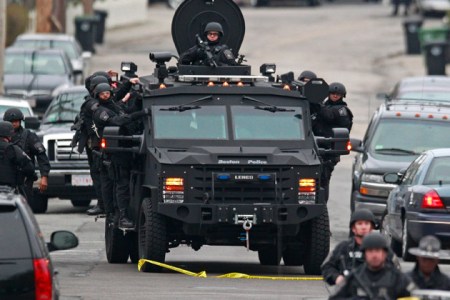
The increasing militarisation of America’s police force, from the deployment of heavy-duty weaponry to the use of “war on terror” tactical assaults on inner-city communities, seems to be the bigger issue that needs to be addressed. Black communities, being disproportionately impoverished and ghettoised, are at the front-line of this systematic police state violence.
But it is all marginalised communities within the US that are potential targets for the country’s surge in militarised policing.
Growing poverty, social exclusion and the erosion of civil liberties for all citizens across the US go hand-in-hand with this increasingly oppressive police power.
The debate over racist policing in American needs to be broadened to confront the general state of oppressive policing that is directed against all those — the majority of the population — who are increasingly disenfranchised by an oligarchy where one per cent of the nation owns nearly 90 per cent of the total wealth. That polarisation of wealth and massive impoverishment of the majority is itself a form of state violence inflicted on the nation; and the police are the front-line enforcers of this systematic violence.
The fact that three police officers implicated in the brutal death of Freddie Gray are non-whites; the fact that the police chief and mayor of Baltimore are African-Americans; the fact that government attorneys are black; and the fact that the president of the United States is also black, all that serves to show that the inherent nature of police state violence in the US is both structural and endemic. The problem of how America has now degenerated into an oppressive police state is thus the central issue.
Today over 2.2 million people are imprisoned in jails across America — an incarceration rate that is said to be the highest in the world.
Some observers have noted that the US has locked away more people in its jails than there were even during the supposed Stalinist despotism of the former Soviet Union. Now that is saying something about the Orwellian nature of life in present-day USA — the “land of the free”.
Ancestry.com’s Promise of Privacy isn’t Real
By Noel Brinkerhoff | AllGov | May 7, 2015
Michael Usry Jr. is an example of what happens when a company doesn’t abide by its own privacy policy.
Usry found himself being investigated for a cold-case murder in Idaho after an Ancestry.com-owned business, Sorenson Database, which has about 100,000 DNA samples on file, shared its database with Idaho Falls police without asking for a warrant.
After matches came up, police obtained a warrant requiring Ancestry.com to provide the “protected” name of donors and all “all information including full names, date of births, date and other information pertaining to the original donor to the Sorenson Molecular Genealogy project,” according to Jennifer Lynch of the Electronic Frontier Foundation (EFF).
This allowed police to locate Usry Jr.’s father, but he didn’t fit the age profile of their suspect. So they turned to Usry Jr., and after discovering some thin connections and circumstantial evidence, detectives contacted him and lied to get him to come in for questioning. Usry particularly piqued investigators’ interest when they found he was a filmmaker who specialized in horror films.
“They took him to an interrogation room, questioned him without a lawyer present, and eventually collected a DNA sample. Then Usry sat on pins and needles for a month waiting for the results,” Lynch wrote.
Fortunately for Usry, the DNA sample did not link him to the 1996 murder of Angie Dodge.
Usry would never have gone through this ordeal if Sorensen had just lived up to its consent form, which says: “The only individuals who will have access to the codes and genealogy information will be the principal investigator and the others specifically authorized by the Principal Investigator, including the SMGF research staff.”
To Learn More:
How Private DNA Data Led Idaho Cops on a Wild Goose Chase and Linked an Innocent Man to a 20-Year-Old Murder Case (by Jennifer Lynch, Electronic Frontier Foundation)
Ancestry.com Caught Sharing Customer DNA Data with Police with No Warrant (by Jay Syrmopoulos, Free Thought Project )
New Orleans Filmmaker Cleared in Cold-Case Murder; False Positive Highlights Limitations of Familial DNA Searching (by Jim Mustian, New Orleans Advocate )
Police Have Officially Killed 400 People in 2015, A New Grieving Family Every Seven and a Half Hours
By Cassandra Fairbanks | The Free Thought Project | May 6, 2015
As of May 5, 2015, the police in the United States of America have killed 401 people that we know of.
Deaths By Law Enforcement 2015:
- 91 in the 31 days of January
- 85 in the 28 days of February
- 115 in the 31 days of March
- 101 in the 30 days of April
- 8 people in the 5 days of May
Extrapolating those numbers out to an hourly figure and the police have killed someone on average, every 7.48 hours. While there is no government-run database, Killed By Police has taken it upon themselves to keep track, and are doing a fantastic job thus far. It’s truly a Cop Crisis.
The three youngest are A’donte Washington, Jason C. Hendrix, and Kendre Omari Alston who were all only 16-years-old. The oldest was 87-year-old Lewis Becker. At least four officers have also been shot and killed by other officers.
Meanwhile, the Officer Down Memorial Page is reporting gunfire related deaths of on-duty officers is down 43%.
Law Enforcement Deaths 2015:
- 9/11 related illness: 2
- Accidental: 1
- Assault: 1
- Automobile accident: 12
- Gunfire: 8
- Gunfire (Accidental): 2
- Heart attack: 10
- Motorcycle accident: 1
- Struck by vehicle: 2
- Vehicle pursuit: 2
The death by assault was Patrolman George Nissen, and they are referring to injuries sustained 10 years earlier when he was attempting to break up a large fight on February 13th, 2005.
A look at the two which were struck by vehicles, both were accidents, with one occurring while the officer was off duty and had stopped to help someone on an icy road. The other was an accident where a semi truck crashed into the officer’s vehicle.
That leaves the eight by gunfire as deaths due to suspects actively attempting to harm them this year.
Deaths of officers directly at hands of suspects this year:
- 0 in January
- 0 in February
- 6 in March
- 0 in April
- 2 in May
This means that in the 125 days of 2015, the police have been killed after being shot by a suspect, on average, every 375 hours.
According to an FBI report, Americans are less violent than ever, yet the police seem to be growing increasingly violent. These numbers seem to agree.
Being a police officer isn’t even close to being in the top 10 most dangerous jobs in this country. According to the 2013 report by the Federal Bureau of Labor Statistics on work-related fatal injuries, “Police and sheriff’s patrol deputies” ranked as the 41st most dangerous occupation.
Just some numbers for you to consider next time you or someone you know tries to claim that the “brave” men and women in blue are perpetually “fearing for their life” so that they “can get home to their families.”
Every seven and a half hours our police leave another family planning a funeral. Enough is enough; visit our #solutions section if you’d like to find out some of the many ways we can change this paradigm.
Amnesty whitewashes another massacre
By Paul de Rooij | MEMO | May 6, 2015
Amnesty International has issued four reports on the Israeli massacre in Gaza in 2014.1 Given the scale of the destruction and the number of fatalities, any attempt to document the crimes committed should be welcomed. However, these reports are problematic, and raise questions about the organisation itself, including why the reports were ever written at all.2 They also raise questions about the broader human rights industry that are worth considering.
Basic background
July 2014 marked the onset of the Israeli massacre in Gaza (I will dispense with the Israeli sugar-coated “operation” name). The Israeli army trained for this attack for several months before finding a pretext to attack the Gaza Strip, shattering an existing ceasefire; this was the third such post-“disengagement” (2004) attack, and possibly the worst so far. At least 2,215 people were killed and 10,000+ wounded, most of them civilians. The scale of destruction was staggering: tens of thousands of houses were rendered uninhabitable; several high-rise buildings were struck by huge American-supplied bombs; schools and hospitals were targeted; 61 mosques were totally destroyed; water purification and sewage treatment plants were damaged; Gaza’s main flour mill was bombed; and all chicken farms in the territory were ravaged. There was incalculable devastation.3
Israeli control over Gaza has been in place for decades, with violence escalating over time, and the Palestinians there have been under siege for the past eight years. The Israelis have placed Gaza “on a diet”,4 permitting only a trickle of strictly controlled goods to cross the border, enough to keep the population above starvation levels. The whole Gaza Strip is surrounded on all sides, blocked off from the outside world: military bulldozers raze border areas, snipers injure farmers, and warships menace or destroy fishing boats with gunfire. Periodically, the Israelis engage in what they term “mowing the lawn” massacres and large scale destruction. It is this history that must serve as the foundation of any report that attempts to describe both the intent of the participating parties and the relative consequences.
Context-challenged – by design
The ongoing crimes perpetrated against Gaza are chronic and, indeed, systematic. Arnon Soffer, one of Israel’s Dr Strangelove types and “intellectual father of the wall”, had this to say about the enclave:
Q (Ruthie Blum): Will Israel be prepared to fight this war?
Arnon Soffer: […] Instead of entering Gaza, the way we did last week, we will tell the Palestinians that if a single missile is fired over the fence, we will fire 10 in response. And women and children will be killed, and houses will be destroyed. After the fifth such incident, Palestinian mothers won’t allow their husbands to shoot Kassams, because they will know what’s waiting for them. Second of all, when 2.5 million people live in a closed-off Gaza, it’s going to be a human catastrophe. Those people will become even bigger animals than they are today, with the aid of an insane fundamentalist Islam. The pressure at the border will be awful. It’s going to be a terrible war. So, if we want to remain alive, we will have to kill and kill and kill. All day, every day.5
To determine the reasons behind Israeli actions, one only has to read what such Dr Strangeloves say; it is no secret. The aim is to create miserable conditions to drive the Palestinians off their land, warehouse the population in an open air prison called Gaza, and to repress any Palestinian resistance disproportionately. Israelis have to “kill and kill and kill, all day”. Such pathological reasoning puts Israeli actions into perspective; they are major crimes, possibly genocidal. Recognition of such crimes has some consequences.
First, the nature of the crimes requires their recognition as crimes against humanity, arguably one of the most serious crimes under international law. Second, Israeli crimes put the violence of the Palestinian resistance into perspective; Palestinians have a legitimate right to defend themselves against the occupying power. Third, the long history of violence perpetrated against the Palestinians, and the resulting power imbalance, suggests that one should be in solidarity with the victim, not the aggressor.
Amnesty, though, refuses to acknowledge the serious nature of Israeli crimes, by using an intellectually bankrupt subterfuge. It insists that as a rights-based organisation it cannot refer to historical context; doing so would be considered “political”, in its warped jargon. An examination of what Amnesty considers as “background” in its reports confirms that there is virtually no reference to relevant history or context, such as the prior Israeli attacks on Gaza, who initiated those attacks, the Goldstone Report, and so on. Hey presto! Now there is no need to mention serious crimes. It also doesn’t recognise the nature of the Palestinian resistance, and their right to self-defence. Nowhere does Amnesty International acknowledge that Palestinians are entitled to defend themselves against Israel’s military occupation. Finally, the rights group cannot express solidarity with the victim because, hey, “both sides” are victims!
At this point, once Amnesty has chosen to ignore the serious Israeli crimes, it takes on the Mother Teresa role of sitting on the fence castigating “both sides” for non-compliance with international humanitarian law that determines the rules of war. Thus, Amnesty criticises Israel not for the transgression of attacking Gaza, but for utilising excessive force or targeting civilians. The group’s favourite term to describe such events is “disproportionate”. This is problematic because it suggests that there is no problem with the nature of the action, just with the means or scale of it. While Amnesty bleats that a one-ton bomb in a refugee camp is disproportionate, it would seem that using a 100kg bomb would be acceptable. Another favoured term is “conflict”, a state of affairs where both sides are at fault, both are at once victims and transgressors.
Notice that while Amnesty avoids recognising major crimes by using its rights-based framework, it suddenly changes its hat, and takes on a very legalistic approach to criticise the violence perpetrated by the Palestinians. It manages then to list the full panoply of international humanitarian law which it deems to be applicable.
The key thing to watch in the upcoming International Criminal Court (ICC) investigation of the 2014 massacre will be whether the court will copy the Amnesty approach. Any investigation that doesn’t focus on the cause of the violence and who initiated it will result in another fraud, and no pixel of justice.
Criminalising Palestinian resistance
Amnesty dispenses with the Palestinians’ right to defend themselves by stating that the rockets fired from Gaza are “indiscriminate”, and proceeds to call their use a war crime. Palestinian resistance groups are also told not to hide in heavily populated areas, not to execute collaborators, and so on. While Palestinians are told that their resistance amounts to war crimes, the Israelis aren’t told that their attacks are criminal per se; for them, it is only a matter of scale.
The “Unlawful and deadly rocket and Mortar Attacks…” report condemns repeatedly Palestinian rocket firing with inaccurate weapons, deems these “indiscriminate”, and ipso facto war crimes. Amnesty confuses the term “inaccurate” with “indiscriminate”. Examining the table below suggests that Israel killed proportionately far more civilians, albeit with more accurate weapons. It is quite possible to target indiscriminately with precision munitions. There is also a possibility, which Amnesty International appears to disregard, that the Israeli military targeted civilians intentionally. Indeed, it is likely that Israeli drones targeted children intentionally. A report by Defence for Children International states: “As a matter of policy, Israel deliberately and indiscriminately targeted the very spaces where children are supposed to feel most secure.”6

Regardless of the accuracy of the weapons, the key issue is one of intent. Amnesty dwells on an explosion at the Shati refugee camp on 28 July. On the basis of one field worker’s testimony, Israeli-supplied evidence and an unnamed “independent munitions expert”,7 the organisation concludes that:
Amnesty International has received no substantive response to its inquiries about this incident from the Palestinian authorities. An independent and impartial investigation is needed, and both the Palestinian and Israeli authorities must co-operate fully. The attack appears to have violated international humanitarian law in several ways, as the evidence indicates that it was an indiscriminate attack using a prohibited weapon which may well have been fired from a residential area within the Gaza Strip and may have been intended to strike civilians in Israel. If the projectile is confirmed to be a Palestinian rocket, those who fired it and those who commanded them must be investigated for responsibility for war crimes.
Mother Teresa certainly provides enough comic material; an occasional joke makes it easier to read a dull report. The evidence for the provenance of this missile is taken at face value although it is supplied by Israel, but, of course, it requires an “investigation”; Amnesty is suggesting that both Israel and the Palestinians should investigate this incident. If the Palestinian resistance was responsible for this explosion, then it was caused by a misfire; thus, there was no intention to cause the consequent deaths. Suggesting that this amounts to a war crime is rather absurd, but the title of the section advertising the report on the Amnesty International website suggests a motive for harping on about this incident: “Palestinian armed groups killed civilians on both sides in attacks amounting to war crimes”. This conveys a rather warped and negative view of the Palestinian resistance – they kill civilians on both sides – and it suggests that it is not possible to be in solidarity with them.
Tyranny of reasons
After any Israeli attack, the pro-Israel propagandists offer a rationale about why a given target was struck. They claim that there were Palestinian militants firing rockets from hospitals, schools, mosques, the power plant and other civilian buildings. At a stroke, such locations are legitimised as Israeli targets whether or not the propaganda statements are true. What is disconcerting in the two reports on Israeli crimes is that Amnesty International imputes reasons for the targeting of buildings or families.
One finds, for example, statements such as:
- Amnesty International believes this attack was targeting one individual.
- The apparent target was a member of a military group, targeted at a time when he was at home with his family.
- The fighters who were the apparent targets could have been targeted at a different time or in a different manner that was less likely to cause excessive harm to civilians and destruction of civilian objects.
- The apparent target of Israel’s attack was Ahmad Sahmoud, a member of the al-Qassam Brigades, Hamas’ armed wing. […] Surviving family members and neighbours denied this.
Amnesty parrots the rationales provided by the Israeli military; one only needs to look at the footnotes of its reports to check the veracity of this claim. And Amnesty discounts the intentional bombing of buildings to create misery among the Palestinian middle class and demoralise a key sector of society; and that destroying the power plant amounts to collective punishment. But don’t worry, Mother T will always check with the Israeli military to determine why something was targeted.
AI is not an anti-war organisation
One would expect a human rights organisation to be intrinsically opposed to war, but Amnesty International is a cheerleader of so-called humanitarian intervention, and even “humanitarian bombing”.8 Despite such a predisposition, it was honoured with the Nobel Peace Prize, yet another questionable recipient of a prize meant to be given only to those actively opposed to wars. Today, one wonders if AI is going to jump on the R2P (Right to Protect) neocon bandwagon. A consequence of its “not-anti-war” stance is that it doesn’t criticise wars conducted by the United States, Britain or Israel; it is only the excesses that merit Amnesty’s occasional lame rebuke, often prefaced with the term “disproportionate” or “alleged”. This stance is evident in its latest reports; here the premise is that the Israeli attack on the Gaza Strip was legitimate, but it is the conduct of “both sides” that is the object of the reports’ criticism.
Can’t see the wood for the trees
Amnesty International is a small organisation with insufficient resources to conduct a proper report on the massacre in Gaza last year. Given the fact that it didn’t have direct access to Gaza approved by Israel, it chose to focus on two aspects of the Israeli attack: the targeting of entire families and the destruction of landmark buildings. Within these two categories it chose to focus on a handful of examples of each. The main problem is that Amnesty harps on about a few cases to the exclusion of the totality; it can’t see the wood for the trees. There is no mention of some of the most significant total figures, say, of the number of hospitals and schools destroyed, the tonnage of bombs dropped on Gaza,9 the tens of thousands of artillery shells used, and so on. The seriousness of the crime is lost by dwelling on a subset of a subset of the crimes committed. Amnesty isolates a few examples, describes them in some detail, and then suggests that unless there were military reasons for the attacks, then there should be an “investigation”. Oh yes, and it has sent some polite letters to the Israeli authorities requesting some comment, but the Israelis have been rather unresponsive. Quite possibly the likes of Netanyahu, Ya’alon, Ganz and their colleagues are too busy rolling on the floor laughing.
Given such a warped framework one would expect symmetry in the way that the attacks are described, but no. While Amnesty provides the total number of rockets fired by the Palestinian resistance, it gives no similar numbers of the tens of thousands of Israeli artillery shells fired, nor the total tonnage of bombs dropped on Gaza. The Israeli military propagandists were all too happy to provide detailed statistics about the Palestinian rockets, and Amnesty does not seem to express any misgivings about using this data. It is also clear that Mother T didn’t ask the propagandists to supply statistics on the lethal Israeli tonnage dropped on Gaza.
Methodology and evidence
Every report contains a methodology section admitting to the fact that AI didn’t have direct access to Gaza. All of its research was done on the Israeli side, and by two Palestinian fieldworkers in the besieged and occupied territory. The inability to enter Gaza possibly explains the reliance on many Israeli military statements, blogs and the foreign ministry about the Palestinian rocket attacks. One can verify all the footnotes to find a significant number of official Israeli statements to provide so-called evidence. It is rather jarring to find Amnesty relying on information provided by the offensive military forces to implicate Palestinian resistance in war crimes. How appropriate is it to use “Hamas’ Violations of the Law” issued by the Israel Ministry of Foreign Affairs, or “Declassified Report Exposes Hamas Human Shield Policy” issued by the Israeli military?
It is also jarring to find Amnesty referring to Israeli claims that rockets were fired from schools, hospitals and the electricity power plant. This information was provided as a justification for Israel’s destruction of such sites, but in the report Amnesty uses it to wag its finger at the Palestinian resistance.10
Amnesty International’s access to Israeli victims of Palestinian rockets produced emotional statements by the victims, and complied with Israeli propaganda needs. Israeli PR was keen to take journalists or visiting politicians to the border towns to show the rocket damage, and Amnesty seems to have been pleased to tag along. At the same time, Israel prevented any Amnesty access to Gaza; clearly, any information coming out of the territory would not be compliant with Israeli PR requirements. Thus, why send any researchers to the Israeli border area?
Execution of collaborators – who will be criticised?
Amnesty has announced the publication of a forthcoming report on the execution of collaborators, and one can only speculate on its contents. It is odd that while AI is not opposed to wars it is opposed to the death sentence; it is opposed to some deaths, but silent about others. Couple this stance with an unwillingness to recognise the Palestinian right to self-defence and, consequently, AI will inevitably deem the execution of Palestinians who collaborate with Israel as abhorrent.
There are many collaborators in the West Bank and they are evident at all levels of society, even in the so-called Palestinian Authority. The PA has even committed itself to their protection. Collaboration with Israel in the West Bank is thus a relatively low-risk activity. In Gaza there are also collaborators, who are used to infiltrate and inform on the armed resistance groups, and also to sow black propaganda. During the 2014 massacre, collaborators were instrumental in pinpointing the location of the resistance and its leadership. In most countries, treason and espionage in time of war merits execution, but it is doubtful that Amnesty International will accept this, and will instead urge a judicial process with no death sentence.
The key aspect of the forthcoming report will be whether the organisation deems the Israeli use of collaborators as an abhorrent practice. Israel not only uses collaborators to gather information, but they are also meant to fragment Palestinian society, and to sow discord. With a society already under massive stress due to economic hardship and military repression, collaborators are a pernicious means to break morale and undermine Palestinian resilience. Will Amnesty criticise Israel’s use of collaborators, or will its report merely castigate Hamas for the way it deals with collaborators?
Why were these reports written at all?
All Amnesty International reports follow the same formula: a brief overview, a methodology section about data sources, some emotional quotations by the victims, a section on accountability, and then some recommendations. They are trite, barely readable and certainly not very useful either for legal purposes or to educate its volunteers. So why are these reports published and who actually reads them? Amnesty would like to be known as one of the leading human rights organisations and it must be seen as reporting on major human rights violations and crimes. Its volunteers must be given the impression that the organisation cares for some of the wholesale atrocities, and not merely the retail crime or violation.
The timing of the publication of one report (“Unlawful and deadly: Rocket and mortar attacks…”) is rather curious. The report dealing with the Palestinian rockets was published a few days before the Palestinian accession to the International Criminal Court. A coincidence? While some Palestinians are gearing up to prosecute Israel for war crimes and crimes against humanity, a leading human rights organisation publishes a report which goes on about Palestinians being guilty of war crimes. Amnesty has published reports in the past that were exploited for propaganda purposes; the Iraqis throwing-the-babies-out-of-the-incubators propaganda hoax, for example.11 Those reports were published just in time to provide a justification for war.
Impotence by design
All the reports contain a list of recommendations for Israelis, Palestinians and other states. One is struck by the impotence of the recommendations. The group urges Israel to cooperate with the UN commission of inquiry; allow human rights organisations access to Gaza; pay reparations to some victims; and ensure that the Israeli military operates within some legal limits. Given that Israel can more or less do as it pleases in any case – ignoring commissions of inquiry, proclaiming loudly that it will engage in disproportionate attacks (that is, the Dahiya doctrine), and that it refuses to compensate any Palestinian victim of its previous massacres – all these recommendations ring hollow.
Amnesty urges Palestinians to address their grievances via the ICC. It is curious that while international law apparently provides the Palestinians with no protection whatsoever, they are urged to jump through international legal hoops. It is also questionable to suggest a legal framework meant for interstate conflict when dealing with a non-state dispossessed native population. Of course, Amnesty fails to mention that Israel has avoided and ignored international law with the complicity and assistance of the United States.
Finally, Amnesty International requests other governments to assist the commission of inquiry and to assist in the prosecution of war criminals. It remains to be seen whether the commission of inquiry will actually publish a report that has some teeth. The group also urges other countries to stop supplying weapons to “both sides”. There is no mention of the fact that the US resupplied Israel with weapons during last year’s massacre in Gaza. It is very unlikely that the US or Britain will stop arming Israel; as such, Amnesty’s recommendations are ineffective rhetoric.
Amnesty trumpets that it has 7 million supporters world-wide;12 a few months ago this number was 3 million; two years ago it was 400,000, and a few more years ago it was 200,000. One should marvel at this explosive growth. If the organisation really can tap into the support of even a fraction of these volunteers, then it can urge them to do something that has tangible results; it could, for example, ask its members and supporters to boycott Israeli products or products made by western companies complicit in Israeli crimes. Such action would be far more effective than the meaningless recommendations that are ignored regularly by Israel and its western backers. Alas, it is difficult to conceive that Amnesty will issue a call for a boycott to its ever expanding army of supporters. It is difficult for Mother T to change her stripes.
The human rights industry
There are thousands of so-called human rights organisations. Anyone can set up such a group, and thereby specify a narrow focus for the NGO, determine the parameters within which it will operate – even define who is human – and then the new organisation can chime in with press releases, host wine and cheese receptions, bestow prizes, lobby politicians, launch investigations and castigate the enemy du jour. Bono, Geldof and Angelina might even hop along and sit on the NGO’s board. The human rights framework is elastic and can be moulded to fit legitimate purposes, but it can also be manipulated for propaganda purposes. The history of some of the largest human rights organisations shows that they were created originally with the propaganda element foremost in mind.13 This suggests that NGO output, such as Amnesty’s reports, for example, merit scrutiny not so much for what they say, but for what they omit. In the Palestinian context, a simple test on the merits of a so-called human rights organisation is whether it challenges state power, calls for accountability and the prosecution of war criminals, and urges its supporters to do something more than write out cheques or very formal and polite letters to governments engaged in criminal acts.
Another test for the merits of a human rights NGO is whether it is in solidarity with the victims of violence, and whether victims are treated differently depending on their support or demonisation by “the west”. In Amnesty’s case, consider that on the one hand it provides long lists of “prisoners of conscience” pertaining to prisoners held in Cuba, Syria, etc., but on the other hand it explicitly does not make such a list of Palestinian prisoners available.[14] We have no means of knowing how many Palestinian political prisoners Amnesty actually cares about, and whether its volunteers engage in letter writing campaigns on their behalf. One thing is certain, though, that while the majority of Cuban political prisoners are considered prisoners of conscience, only a tiny fraction of the Palestinian political prisoners have been given such status. In reality, of course, Mother Teresa doesn’t give a hoot about political prisoners who might have been involved in violence, so Palestinians are just a stone’s throw away from being ignored by Amnesty International. Some victims are more meritorious than others.
In trying to justify the organisation’s double standard, Malcolm Smart, Amnesty’s Director of the Middle East and North Africa Programme, stated:
“By its nature, the Israeli administrative detention system is a secretive process, in that the grounds for detention are not specified in detail to the detainee or his/her legal representative; inevitably, this makes it especially difficult for the detainee to challenge the order for, by example, contesting the grounds on which the detention was made. In the same way, it makes it difficult or impossible for Amnesty International to make a conclusive determination in many cases whether a particular administrative detainee can be considered a prisoner of conscience or not.”15
It thus provides yet more comic material. AI admits that Israeli military courts can determine who can be considered a Palestinian prisoner of conscience. The only thing that those courts need to do is to keep their proceedings secret or not reveal “evidence”. Alternatively, they can simply imprison the victims without trial or declare that they are members of a “banned” organisation16 and then the Israelis won’t have to reply to those pesky polite letters written by AI volunteers. Once again, double standards in the treatment of victims raise questions about the nature of any human rights NGO.
Human rights is denatured justice
Pushing for the observance of human rights doesn’t necessarily imply that one will obtain justice. The human rights agenda merely softens the edges of the status quo. As Amnesty’s position on the Israeli attacks on Gaza illustrates, pushing human rights can actually be incompatible with obtaining justice. Human rights are a bastardised, neutered and debased form of justice. The application and effectiveness of international law is bad enough, but a pick and choose legal framework with no enforcement is even worse. If one seeks justice, then it is best to avoid the human rights discourse; above all, it is best to avoid human rights organisations.
Palestinians should be wary of Mother Teresas peddling human rights snake oil. In exchange for giving up their resistance and complying with Amnesty’s neutered norms, they are unlikely to obtain any justice. One should be wary of human rights groups that don’t push for justice, play the role of Israel’s lawyer, and are bereft of solidarity with the victims. When the likes of Amnesty International come wagging their finger, it is best to keep the old blunderbuss near to hand.
Further Reading
- Nabeel Abraham, et al.; International Human Rights Organizations and the Palestine Question, Middle East Report (MERIP), Vol. 18, No. 1, January-February 1988, pp. 12 – 20.
- Dennis Bernstein and Francis Boyle, Amnesty on Jenin: an interview, CAQ, Summer 2002, pp. 9 – 12, 27.
- Paul de Rooij, AI: Say It Isn’t So, CounterPunch, 31 Oct. 2002
- Paul de Rooij, Amnesty International: The Case of a Rape Foretold, CounterPunch, 26 November 2003
- Paul de Rooij, Double Standards and Curious Silences / Amnesty International: A False Beacon, CounterPunch, 13 October 2004.
- PIWP database: list of articles on the politics of human rights
Footnotes
- Families Under the Rubble: Israeli Attacks on Inhabited Homes (MDE 15/032/2014), 5 November 2014.
“Nothing is immune”: Israel’s destruction of landmark buildings in Gaza (MDE 15/029/2014), 9 December 2014.
Unlawful and deadly: Rocket and mortar attacks by Palestinian armed groups during the 2014 Gaza/Israel conflict (MDE 21/1178/2015), 26 March 2015.
The fourth report about the execution of collaborators has not been published yet. - I distinguish between Amnesty International, the international organization, and its well intentioned letter-writing volunteers.
- Possibly the best overview of the Gaza Massacre 2014 is Al Haq’s Divide and Conquer; http://alhaq.org/publications/publications-index/item/divide-and-conquer
- Statement made in 2006 by Dov Weisglas, one of Israel’s Dr. Strangeloves and close confidant of Ariel Sharon. Source: http://www.corkpsc.org/db.php?qid=1013
- Ruthie Blum interviews Arnon Soffer, ONE on ONE: It’s the demography, stupid, Jerusalem Post, 10 May 2004
- Ali Abunimah , Israel “directly targeted” children in drone strikes on Gaza, says rights group, Electronic Intifada, 17 April 2015.
- Amnesty loves to trot out military experts and dwell on the type of weapons used. First, there is an issue about the military expert, and who they are. What is the ethics about showing up in Gaza with a military person who might still be in the armed forces of, say, the UK? One can hardly expect them to be “independent”. And why dwell on the type of munitions if their use is already criminal to begin with? Focusing on the type of weapon deflects attention from the damage and the victims – that should be the emphasis.
- Alexander Cockburn, “How the US State Dept. Recruited Human Rights Groups to Cheer On the Bombing Raids: Those Incubator Babies, Once More?”, CounterPunch newsletter, April 1-15, 1999.
- While AI reports the total number of Palestinian rockets fired, there is no equivalent number to the totals used by the Israeli military. That number would be of interest because it would indicate the scale of the crimes committed. Tens of thousands of artillery shells were used, requiring them to be restocked by the United States in the middle of the offensive.
- The UN report on the Israeli attacks against schools lists several incidents where the Israelis falsely accused the Palestinians of firing on these schools. Such evidence should reduce the credibility of Israeli statements. See, e.g., Ali Abunimah, UN finds Israel killed dozens at Gaza schools but ducks call for accountability, Electronic Intifada, 28 April 2015.
- In the lead up to the 1991 invasion of Kuwait/Iraq, Amnesty issued a report on the so-called babies out of incubators story. President Bush Senior showcased the report on the eve of the attack, and used it for its full propaganda potential. When it was pointed out to Amnesty that they were pushing a propaganda hoax, it doubled its estimate of the number of children dumped from the incubators. To this day, the organisation has never apologised for playing a role in selling an American war.
- See: https://www.amnesty.org/en/who-we-are/ And notice that in the page after title page of Amnesty International’s reports the number of supporters increases from one report to the next.
- Kirsten Sellars, The Rise and Rise of Human Rights, Sutton Publishing, 29 April 2002. Herein she discusses the origin of Human Rights Watch.
- Malcolm Smart, Letter: Amnesty International’s Prisoner of Conscience lists and the reason for double standards, 9 August 2010 http://www.corkpsc.org/db.php?aid=133223.
- Ibid.
- Another technique to rule out sympathetic treatment of Palestinians is to suggest that they are members of a banned organisation. NB: it is Israel which does the banning. Any organisation seeking liberation or to confront the Israeli dispossession or violence is deemed by the Israelis to be a “terrorist organisation”. Currently, Amnesty plays along with this charade, and also ignores Palestinians belonging to “political” organisations.
‘Father of internet’ speaks out against government demand for back doors in encryption
RT | May 5, 2015
Internet pioneer Vint Cerf said Monday that creating defects in encryption systems for law enforcement, often known as “back doors,” was “super, super risky” and not the “right answer.”
Cerf, recognized as a “father of the internet,” currently working at Google, told an audience at the National Press Club that he understood law enforcement’s desire to avoid being locked away from evidence that could be used to prevent crimes. He went on to say, however, that providing such access raises constitutional and legal questions.
“The Congress is forced now to struggle with that, and they’re going to have to listen to these various arguments about protection and safety on the one hand and preservation and privacy and confidentiality on the other,” Cerf said, as reported by The Hill.
The Obama administration has been trying to force companies like Google and Apple to create defects in encryption so the FBI and other government agencies can gain access to people’s information; this despite mounting criticism over the plan – a criticism that’s shared by Cerf.
“If you have a back door, somebody will find it, and that somebody may be a bad guy or bad guys, and they will intentionally abuse their access,” said Cerf.
“Creating this kind of technology is super, super-risky,” he added. “I don’t think that that’s the right answer.”
Former National Security Agency contractor Edward Snowden revealed a program codenamed “Bullrun,” which showed that the government penetrated encryption securities through the use of “supercomputers, technical trickery, court orders and behind-the-scenes persuasion.”
Since those disclosures, Silicon Valley industries have been working feverishly to adopt encryption technology beyond the reach of law enforcement agencies that haven’t first obtained a warrant, and to appease customers worried about their privacy. Law enforcement sees it differently, however.
“If this becomes the norm, I suggest to you that homicide cases could be stalled, suspects walked free, child exploitation not discovered and prosecuted,” FBI Director James Comey warned in October, reported The Hill.
For tech companies, though, it is not a question of creating “back doors” or “front doors” – it’s just a matter of secure technology and unsecure technology.
Last week, a bipartisan group of legislators attempted to add an amendment prohibiting the government from forcing companies to build back doors into their devices to a bill reforming the National Security Agency. Despite full support from House Judiciary Committee members, the measure was dropped over concerns it would sink the underlying bill.
Pennsylvania Court strikes down law aimed at keeping convicts out of public eye
RT | May 5, 2015
A federal court in Pennsylvania overturned the Revictimization Relief Act, which aimed to ban convicted criminals from speaking publicly.
The federal district court on Monday said the statute introduced by lawmakers violated the first amendment rights of one-time death row inmate Mumia Abu-Jamal and other prisoners. The law was introduced in response to Abu-Jamal’s [recorded] appearance at a Goddard College commencement address in Vermont in October 2014.
“The fact that certain plaintiffs have been convicted of infamous or violent crimes is largely irrelevant to our first amendment analysis. A past criminal offense does not extinguish the offender’s constitutional right to free expression,” Judge Christopher Conner wrote. “The First Amendment does not evanesce at the prison gate.”
Judge Conner wrote the law was unconstitutionally vague and over-broad. He worried that it would deter not only the speech of convicted criminals, but also people who redistribute speech such as producers quoting criminals in radio programs or newspapers publishing interviews with criminals. Conner said a law restricting expression based on content was “inherently suspect.”
Attorney Eli Segal and the American Civil Liberties Union, who brought suit against the law, told the Associated Press that the decision “says loud and clear that all of us in this commonwealth have the right to freedom of speech.”
Steve Miskin, the spokesman for the Pennsylvania House GOP leadership told AP that Conner’s ruling “is woefully short of the fact. It begs the question: Did he even read the law?”
“The point of the law was to look out for victims,” he added.
The Revictimization Relief Act, passed by Pennsylvania lawmakers in October 2014, said a victim of a personal injury crime may bring a civil action against an offender to restrict them from conduct that could perpetuate the continuing effect of the crime on the victim, including conduct causing a temporary or permanent state of mental anguish.
Mumia Abu-Jamal, an American activist and journalist, was convicted in 1982 for the 1981 murder of Pennsylvania Police Officer Daniel Faulkner. He was on death row for 30 years before appeals converted his death penalty to life without parole. Abu-Jamal claims he is a victim of a racist justice system. The Faulkner family, public authorities, police organizations and self-described conservative groups have maintained that Abu-Jamal’s trial was fair, his guilt undeniable, and his death sentence appropriate.
Earlier this year, Tom Wolf, the Governor of Pennsylvania, offered the state’s 186 death row inmates temporary reprieves from execution, calling the system “error prone, expensive and anything but useful.”
Wolf said that if the state is going to “take the irrevocable step of executing a human being, its capital sentencing system must be infallible.” He said the system was riddled with flaws and studies had called into question the accuracy and fundamental fairness of Pennsylvania’s capital sentencing system. The studies suggested there were inherent biases indicating that a person is more likely to be charged with a capital offense and sentenced to death row if he is poor or part of a minority racial group; especially so if the victim of the crime was white.
When the police act like a gang
By Yossi Gurvitz | Yesh Din | May 5, 2015
A journalist learns that if you photograph Border Policemen committing a felony, you’ll probably end up paying for it.
Near the end of January 2015, Amin Hassan Raneh Alawiya left his home in East Jerusalem’s Al-Azariya neighborhood and made his way to a wedding. As he later described it in his police complaint, upon leaving the house, lawiya – a photojournalist by profession – noticed a demonstration taking place nearby. Naturally, he picked up his camera and went over to document it. A Border Policeman, whom Alawiya recognized, ordered him to move away. In fact, he gave Alawiya the choice of either moving away, getting arrested or getting shot. Alawiya went back home and photographed from there.
Two policemen then came to the house and called Alawiya to come out. When he did the two cops jumped him. They continued hitting him as he was led to their vehicle, and from what they said on the two-way radio, Alawiya understood that he was to blame for disregarding their instructions. Inside the vehicle, the policemen kept hitting him, one of them shouting “this is for our friend” and “our friend will shoot you,” using the name of a third policeman. One of them also used the opportunity to curse the founder of Islam, Muhammad, until the other one told him to stop.
Who is the third cop? Ah! This is the core of the story. In May 2014, as part of his job, Alawiya documented Border Policemen assaulting a hooded child in East Jerusalem, after he was suspected of throwing stones. The policemen also took photos of themselves with the wounded child. The “friend” is one of those documented in Alawiya’s video, which enjoyed widespread distribution on Al Jazeera and other networks. Ever since, he says, he became a target for the Border Police in East Jerusalem, which he claims prevent him from filming in the city and even broke one of his cameras.
Alawiya’s detention in January was part of the Border Police’s quest for vengeance. One of the problems with police forces, particularly forces that are not subject to serious oversight, is that they tend to become a kind of gang: the permeation of a culture of violence and lies becomes common. We have seen the violence, now let’s deal with the deceitfulness.
After his detention, Alawiya was held, handcuffed and blindfolded, in the Abu Dis Border Police base for some two hours. He was then transferred to the police station in the West Bank settlement of Ma’ale Edumim. There he requested to file a complaint of assault against the cops, but the officer present refused to receive the complaint, and told him he should turn to Israel’s Internal Affairs Division. As we will see, this was a hollow demand that reflected the police’s negligence. Alawiya was immediately informed that he was charged with assaulting and obstructing an officer. The police then demanded Alawiya sign a document saying he was not attacked by the police. He did so, but added in Arabic that it was he who was assaulted. Soon afterward, Alawiya was led to an interrogation room, where he was informed by the interrogator that he was suspected of obstructing an officer.
Did you get what, according to the complaint, just happened? Prior to signing a document saying he was not assaulted by the police, Alawiya was accused of assaulting an officer. After he signed the document, the charge of assaulting an officer simply evaporated. There is a method here, well-known to veterans of demonstrations in Israel and East Jerusalem: as soon as you complain about police brutality, you are automatically charged with assaulting an officer.
When a police force fabricates a complaint against a civilian, especially after he complains of being assaulted by a cop, there is, to put it mildly, a gross misunderstanding of the function of the police. Its duty is to maintain law and order, not to protect itself. When it distorts reality, it lies to itself, to the public that pays its salary and to the courts. When it pins false charges on a person, it is conspiring to damage his good name, his livelihood, and in the worst case scenario, deprives him of his liberty. It then ceases to be the servant of the public and becomes its enemy; it ceases being a vehicle for safeguarding human rights and becomes a tool for their denial.
Alawiya couldn’t file a complaint with the Internal Affairs Division, since he lives in East Jerusalem, specifically in a neighborhood that lies east of the separation wall. Despite the fact that Israeli Police (which includes the Border Police) have been active in East Jerusalem since it was occupied in 1967, there is no Internal Affairs Division station there. In order to lodge a complaint, Alawiya either needs a permit to enter Israel, or needs to use mediators such as human rights organizations. He says that ever since he documented the young boy being abused in May 2014, his permit has been denied.
And if you thought that was bad, the story doesn’t end there: a relative of Alawiya paid NIS 2,000 for his release on bail, since being assaulted by police and and then being wrongfully detained means you need to post bail. The relative, however, did not receive a receipt for the money. What happens to money given to a policeman when no receipt is given? Your guess is as good as mine.
In March 2014, Yesh Din Attorney Emily Schaeffer Omer-Man, sent a complaint to the Internal Affairs Division, demanding an immediate investigation on suspicion of, inter alia, false arrest, assault, abuse of the power of office and conduct unbecoming.
Given that in 93 percent of the complaints submitted in 2011-2014, the Internal Affairs Division closed the case without any investigation; that of the 11,282 complaints in the years 2011-2013, only 2.7 percent turned into indictments; and that the former chief of the division is on record saying that the police suffer from a “culture of lies” and that policemen cover for each other, one cannot hope too much that a journalist who exposed the face of the police will see justice. And these, we note, are the results for all complaints to the Internal Affairs Division, not just those by Palestinians. We’ll keep you posted.
Featured Video

Liberty Cannot Exist Inside a Panopticon
or go to
Aletho News Archives – Video-Images
From the Archives
Left-leaning despisers of 9/11 Truth movement: Do you really believe in miracles?
David Ray Griffin | Global Research | 06 Jul 2010
An Open Letter to Terry Allen, Noam Chomsky, Alexander Cockburn, David Corn, Chris Hayes, George Monbiot, Matthew Rothschild, and Matt Taibbi.
[1]According to several left-leaning critics of the 9/11 Truth Movement, some of its central claims, especially about the destruction of the World Trade Center, show its members to be scientifically challenged. In the opinion of some of these critics, moreover, claims made by members of this movement are sometimes unscientific in the strongest possible sense, implying an acceptance of magic and miracles. … Full article
Blog Roll
 Aletho News
- SVR Report on Ukraine’s Mexican Drug Gang Links Could Pressure Zelensky, Won’t Change US Policy
- British Government Employees Were Fact-Checking the News at the BBC. Nobody Told You.
- Albania on fire: who’s behind the riots?
- Egypt’s Civil Democratic Movement rejects involvement in regional war
- Egypt collaborates with Israel to build ‘Green Rafah’ project over erased Palestinian city
- Rising fuel prices and shortages have helped drive ongoing protests and rioting in France
- Tokyo protests demand Takaichi’s resignation over support for ‘Israel’
- Jennifer Kavanagh: Why the U.S. Should Pull Back From the First Island Chain
- Yemen denounces international community’s silence on Saudi aggression, siege
- UAE and Saudi Arabia move toward renewed coordination against Sanaa
- If Americans Knew
- More on how Bari Weiss is using CBS on behalf of Israel
- What the UK Is Doing to Pro-Palestine Novelist Sally Rooney Is an Act of Orwellian Villainy
- ‘We will build palaces for Jews in Gaza’: Right-wing activists establish new outpost near border
- ‘You see us burning, you stay silent’: Family’s agony over mother and sons burned to death in Gaza tent
- Israel keeps Palestinian journalist Bushra al-Tawil in isolation for 46 days
- US-Israel integration plan puts US military tech in Israel’s hands
- Israeli Strike Burns Gaza Mother Alive in Front of Toddler, ‘Without Generating Any Headlines’
- ‘The Israel Experience with Mike Huckabee’: The Ambassador’s Family Sells Trips to Israel
- As Gazans carry out mass burial, food insecurity is getting worse – Daily Update
- Israeli rabbi permits occupiers to steal Palestinian olive harvest in West Bank
- No Tricks Zone
- Predictions Made By Renowned Climate Proifessor Over Past Decades Have Been Proven To Be Poor
- New Study Suggests Large Regions Of The Pacific Ocean Have Been Cooling For The Last 80 Years
- Germany’s Green Energy Debacle: High Energy Costs Force Kahla Porzellan to Close After 182 Years!
- New Study: 50 Years Of The Most Aggressive ‘Net Zero’ Policies Can Only Affect The Global Climate By 0.03°C
- US September “Heat” Was No Record…Many Records Set Decades Ago
- Latest European Green Energy Debacle; Portugal’s Largest Flagship Solar Park Insolvent!
- Green Energy Debacle: German Expert Professor Fritz Vahrenholt Warns Of Severe Economic And Social Consequences
- Two More Paleo Reconstructions Affirm Meters-Higher Sea Levels Across Ireland, Brazil 7000-6000 Years Ago
- New Study: Earth And Venus Surface Warmth Largely Explained By Convection And Lapse Rate, Not CO2 Or Radiation
- 2025 Nature Paper Claiming Worsening Global Drought Gets RETRACTED …Heavily Flawed

