Professor at Center of Columbia University Deportation Scandal is Former Israeli Spy
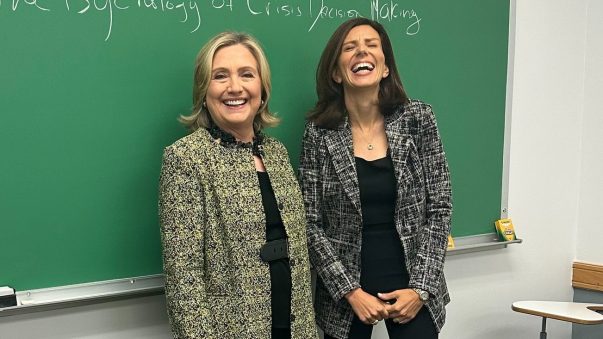
Keren Yarhi-Milo poses with Hillary Clinton during Clinton’s 2023 guest teaching stint at Columbia. Photo | Facebook | Hillary Clinton
By Alan MacLeod | MintPress News | March 11, 2025
The professor at the center of the Columbia University deportation scandal is a former Israeli intelligence official, MintPress News can reveal.
Mahmoud Khalil, a recent graduate of the university’s School of International and Public Affairs (SIPA), was abducted by Immigration Customs Enforcement (ICE) Saturday for his role in organizing protests last year against Israel’s attack on Gaza. Khalil’s dean, Dr. Keren Yarhi-Milo, head of the School of International and Public Affairs, is a former Israeli military intelligence officer and official at Israel’s Mission to the United Nations. Yarhi-Milo played a significant role in drumming up public concern about a supposed wave of intolerable anti-Semitism sweeping over the campus, thereby laying the groundwork for the extensive crackdown on civil liberties that has followed the protests.
Spooks in Our Midst
Before entering academia, Dr. Yarhi-Milo served as an officer and an intelligence analyst with the Israeli Defense Forces. Given that she was recruited into the intelligence services because of her ability to speak Arabic fluently, her job likely entailed surveilling the Arab population.
After leaving the world of intelligence, she worked for Israel’s Permanent Mission to the United Nations in New York. While there, she met and married her husband, Israel’s official United Nations spokesperson.
Although she is now an academic, she has never left the world of international security, making the subject her area of expertise. She has made a point of trying to lift women’s voices in the field. One of these was the then-U.S. Director of National Security, Avril Haines, whom she spoke with in 2023. But even though Khalil was a student in her school, she had nothing to say about his arrest. Indeed, rather than speak out on the issue (as activists have demanded), she instead chose this week to invite Naftali Bennett, prime minister of Israel from 2021 to 2022, to speak at Columbia. Students protesting Tuesday’s event were condemned by university authorities for “harassing” Yarhi-Milo.
Unprecedented Protests, Unprecedented Repression
Columbia was the epicenter of a massive protest movement across university campuses nationwide last year. It is estimated that at least eight percent of all American college students participated in demonstrations denouncing the genocidal attack on Gaza and calling on educational institutions to divest from Israel. The response was equally vast in its scale. Well over 3,000 protestors were arrested, including faculty members themselves.
The nationwide movement began at Columbia on April 17, when a modest Gaza solidarity encampment was established. Protestors were shocked when university president Minouche Shafik immediately called in the New York Police Department – the first time the university had allowed police to suppress dissent on campus since the famous 1968 demonstrations against the Vietnam War.
Mahmoud Khalil was among the leaders of the movement. The Syrian-born Palestinian refugee was willing to speak calmly and cogently to the press about the protest’s goals. A permanent resident of the United States, he was abducted by ICE on Saturday.
“ICE proudly apprehended and detained Mahmoud Khalil, a radical foreign pro-Hamas student on the campus of Columbia University. This is the first arrest of many to come,” President Trump stated. Secretary of State Marco Rubio echoed Trump’s ominous threat, announcing, “We will be revoking the visas and/or green cards of Hamas supporters in America so they can be deported.” In another clear threat, the Trump administration moved to cancel $400 million in funding to Columbia University, citing the institution’s failure to sufficiently crack down on “antisemitic” incidents on campus.
Khalil’s eight-month pregnant wife was initially told that he had been taken to a facility in Elizabeth, New Jersey. In fact, he had been moved halfway across the country to a center in Jena, Louisiana. Journalist Pablo Manríquez of Migrant Insider explained that ICE often goes “immigration ‘judge shopping’ by putting detainees in detention centers under jurisdictions of courts that very rarely decide in favor of migrants.”
The very high-profile attempt to deport the holder of a Green Card because of political speech criticizing a foreign government has left many civil rights lawyers deeply worried. Alec Karakatsanis, for example, stated that “I’ve never seen a more clear-cut First Amendment violation, or a more flagrant government declaration of intent to violate blackletter law.” “The government does not claim he committed a crime, just that he held views that the government doesn’t like about Israel. Bone chilling,” he added.
Columbia’s Billionaire Pro-Israel Backers
Much of Columbia’s funding comes from donations from billionaire benefactors. But those gifts come with strings attached. This became apparent in the wake of the protest movement, as many pro-Israel patrons demanded the university take action. Manufacturing magnate Robert Kraft, for example, publicly announced he was cutting his alma mater off from his lavish funding over its failure to effectively suppress the demonstrations.
Hedge fund manager Leon Cooperman did the same, demanding that Columbia’s “crazy kids” “have to be controlled.” These “kids” evidently also included 61-year-old Jordanian professor Joseph Massad, whose views on the Middle East Cooperman found intolerable, and called for his firing. Soviet-born oligarch Len Blavatnik, meanwhile, urged police to hold the protestors to account.
Between them, Kraft, Cooperman and Blavatnik are believed to have donated nearly $100 million to Columbia, giving them considerable influence over the political direction of the university.
There were also voices from within the university clamoring for the violent suppression of the student movement. Assistant Professor of Business Management Shai Davidai, for example, denounced the protestors as “Nazis” and “terrorists” and called for the National Guard to be set upon the encampment, obliquely referencing the Kent State University Massacre while doing so. Davidai, an Israeli-American, served in the IDF and has publicly expressed his pride in doing so.
Given its most recent addition, it appears unlikely that the School of International and Public Affairs will moderate its pro-Israel positions. In January, the school announced that Jacob Lew would join the faculty. Lew had just left his job as the U.S. Ambassador to Israel under the Biden administration, a role in which he facilitated American complicity in genocide, supplying Israel with weapons and providing it with diplomatic support for its efforts.
Defending Israel, Destroying Free Speech
Longtime readers of MintPress News will be less surprised than many to hear that Israeli military intelligence officials hold such important positions in American public life. Previous MintPress investigations have uncovered giant networks of former Israeli spies working in top jobs in big tech and social media companies, including Microsoft, Google, Meta, and Amazon. Even TikTok, often labeled a Chinese spying app, has hired former Israeli spies to run its affairs. And in October, we revealed that former Israeli spooks are writing America’s news, with multiple former agents working at top U.S. outlets, including CNN, Axios, and the New York Times.
Perhaps, then, the fact that the dean of the very school at the center of a worldwide media storm is a former Israeli military intelligence officer should not be such a shock. But it remains a stark reminder of the level of extraordinary institutional bias in favor of Israel displayed across the United States.
Kiev does kill civilians, contrary to the claims of EU’s top diplomat – Moscow
RT | March 12, 2025
EU High Representative for Foreign Affairs Kaja Kallas’ claim that Russian civilians “are not dying” in the Ukraine conflict is erroneous, Russia’s envoy to the UN Vassily Nebenzia has said.
During a UN Security Council meeting on Tuesday, Nebenzia denounced Kallas’s remarks from February as “immoral assertions” from an official peddling “fantasies.” He said that in 2024 alone, Ukrainian military action resulted in the death of 809 Russian civilians, including 51 children.
Those killings constituted “real crimes” and not a “theatrical performance like Bucha that was staged by the Ukrainian authorities” to garner Western support, Nebenzia stated. Kiev has cited claims that Russian forces had committed a “massacre” in the town in 2022 to justify its decision to abandon peace talks, while Russia contends that the evidence was fabricated.
Speaking at a panel discussion during the Munich Security Conference, Kallas claimed that the two nations take radically different positions: “The difference is that Russian civilians are not dying. I mean Russian children and women are not dying, it’s soldiers on the ground” who do, she stated.
In response, Russian Foreign Ministry spokeswoman Maria Zakharova labeled Kallas’s comments as evidence of the “degradation” of senior EU officials, asserting that the senior diplomat has reached a new low in “cynicism and immorality.”
“How can one seriously negotiate with people who have declared lies as their official position?” Zakharova questioned.
Kallas, known for her hawkish stance towards Russia, became the EU’s foreign policy and security chief last December after stepping down as Estonia’s prime minister under public pressure.
USAID funded Ukraine group that smeared Vance
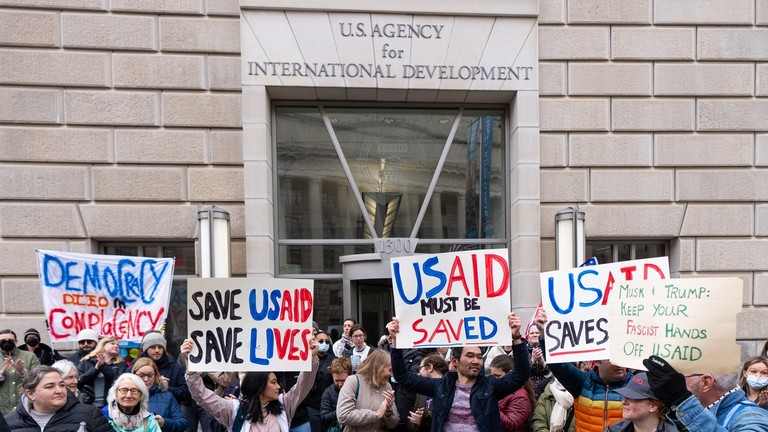
Protesters gather outside USAID headquarters, February 3, 2025 © Bill Clark / CQ-Roll Call, Inc via Getty Images
RT | March 10, 2025
The US Agency for International Development (USAID) has been implicated in funding a Ukrainian organization, Molfar, which labeled Vice President J.D. Vance and other US officials and public figures as “foreign propagandists” aligned with Russia, according to an investigation by The Grayzone.
Molfar, established in 2019, describes itself as an open-source intelligence community platform which “collects lists of Ukrainian enemies to bring war criminals to justice.” The group’s website identifies USAID and the US Civil Research and Development Fund (CRDF) as partners, indicating financial and operational support from US government agencies.
The group’s online blacklist not only targeted Vice President Vance for his statements opposing continued US financial support for Kiev and his stance against Ukraine’s NATO membership, but also targeted other American figures, including US Counterterrorism Director Joe Kent and Representative Thomas Massie. Molfar’s website advocated for their “removal from public positions, the introduction of sanctions, and investigations into personal involvement in crimes.”
In addition to political figures, Molfar has targeted American journalists, including Max Blumenthal, editor-in-chief of The Grayzone. The organization accused Blumenthal of disseminating Russian narratives and threatened to expose his personal information, including home addresses and family details.
Other notable figures targeted by Molfar include billionaire tech entrepreneur Elon Musk, journalists Glenn Greenwald and Tucker Carlson, and award-winning American economist and public policy analyst Jeffrey Sachs.
A report published by Ukraine’s National Coordination Cybersecurity Center (NCSCC), bearing USAID’s logo, highlighted that Molfar assisted in training thousands of Ukrainian government employees in cyber warfare techniques and psychological operations. The report stated that over 2,000 public workers participated in practical assignments covering topics such as open-source searches, contact search, using Telegram bots, psyop as a method of information warfare, human intelligence and social engineering.
According to The Grayzone, Molfar’s activities are part of a broader network of Ukrainian organizations involved in Kiev’s information war efforts at the expense of US taxpayer money.
Another self-styled “fact-checking” outfit, VoxUkraine, has received substantial funding from the National Endowment for Democracy (NED) and USAID. Its VoxCheck project has been involved in censoring Americans’ social media posts deemed pro-Russian. Similarly, the Center for Countering Disinformation (CCD), an official body under Ukraine’s National Security and Defense Council, has collaborated with both Molfar and VoxUkraine to combat “disinformation,” often labeling US public figures as promoters of Russian propaganda, including smearing now-Director of National Intelligence Tulsi Gabbard.
Immediately upon assuming office, President Donald Trump suspended most US foreign assistance pending a three-month review to determine whether programs should continue based on their alignment with the new administration’s “America First” goals.
USAID, Washington’s primary mechanism for funding political projects abroad, has seen tens of billions of dollars’ worth of approved grants frozen as a result. The NED’s government funding was also frozen. Officially a US State Department-funded nonprofit for distributing grants to pro-democracy causes abroad, the NED has long faced allegations of acting as a CIA cutout for toppling foreign governments.
The questions they didn’t ask Marty Makary at his confirmation hearing

By Maryanne Demasi, PhD | March 9, 2025
By all accounts, Marty Makary’s confirmation hearing to lead the FDA went smoothly. As an experienced surgeon at Johns Hopkins with impeccable credentials, he handled questions with ease.
But the real issue was not what the senators asked Makary—it was what they didn’t ask him that was most concerning. They sidestepped the FDA’s recent, glaring failures, leaving critical issues unaddressed.
Much of the hearing consisted of senators pressing Makary for commitments on data he had not yet reviewed, such as mifepristone, vaping, and food additives. They also questioned him about recent FDA job cuts—decisions in which he had no involvement. As a result, there were no substantive revelations.
Makary promised greater transparency at the FDA and vowed to restore public trust. But why did no one press him on the agency’s most egregious missteps?
Speedy drug approvals
One of the most troubling trends at the FDA is its increasing reliance on expedited drug approval pathways.
Today, 65% of new drugs are pushed through these faster routes, despite clear evidence linking them to greater safety risks and a higher likelihood of requiring black box warnings.
The case of Aducanumab, the controversial Alzheimer’s drug, exemplifies this problem. It was approved in 2021 based on surrogate markers rather than meaningful clinical outcomes.
Despite an almost unanimous vote against its approval by the FDA’s advisory committee, the agency proceeded regardless, leading three committee members to resign in protest.
Harvard professor of medicine Aaron Kesselheim called it “probably the worst drug approval decision in recent US history.” Yet not a single senator questioned Makary on how he planned to reform this broken system.
When drugs are rushed through accelerated pathways, companies are required to conduct confirmatory trials to confirm efficacy and safety. But these confirmatory trials are frequently delayed, never completed, or ignored when results are unfavourable.
The FDA rarely penalises companies for non-compliance, allowing unsafe or ineffective drugs to remain on the market. Yet, the senators failed to ask Makary whether he would commit to stricter enforcement of these requirements.
A culture of secrecy
The FDA is the only major drug regulator in the world that receives individual participant data from clinical trials—yet it refuses to routinely release these data for independent scrutiny. If the agency stands by its approvals, why not allow external verification?
During the Covid-19 pandemic, the FDA granted Emergency Use Authorisation (EUA) for Pfizer’s mRNA vaccine trial in just 22 days—an unrealistic timeframe for proper analysis.

Worse still, it failed to conduct trial site inspections, despite knowing billions of doses would be administered, with experts calling the FDA’s oversight “grossly inadequate.”
When whistleblower Brook Jackson provided documented evidence of scientific misconduct in Pfizer’s pivotal clinical trial, the FDA ignored her.
The agency’s own Office of Criminal Investigations, whose job it is to conduct criminal investigations into illegal activities involving FDA-regulated products, turned a blind eye.
How can the agency expect public trust when it turns ignores such evidence?
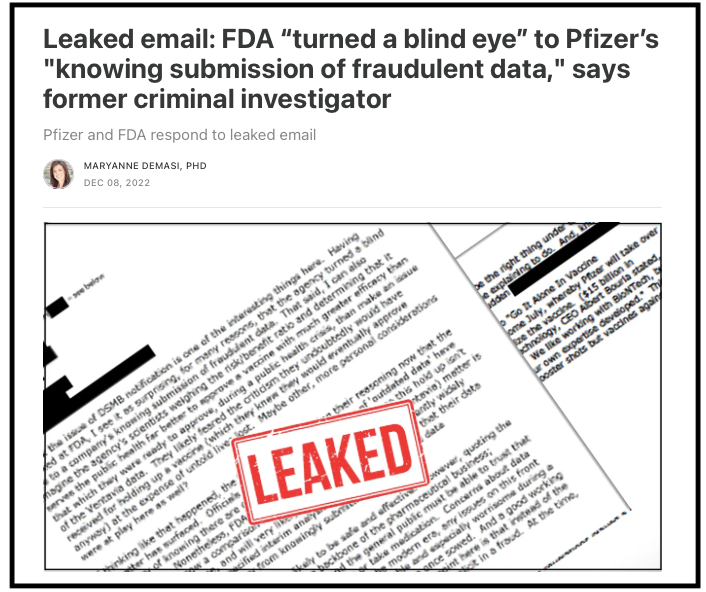
Adding to its opacity, the FDA attempted to withhold Pfizer’s vaccine trial data for 75 years, only relenting after a legal battle. The Judge in this case said the court order would “pierce the veil of administrative secrecy.”
This should have been a major topic at the hearing. I personally have had an FOIA request pending with the FDA for over three years, and the last time I checked, the agency claimed it was still “in triage.”
Concealing data
The FDA knew early on that the immunity conferred by Pfizer’s mRNA vaccine waned rapidly, yet it withheld these findings for months, during which time millions of people queued to get vaccinated under the assumption they offered lasting protection.
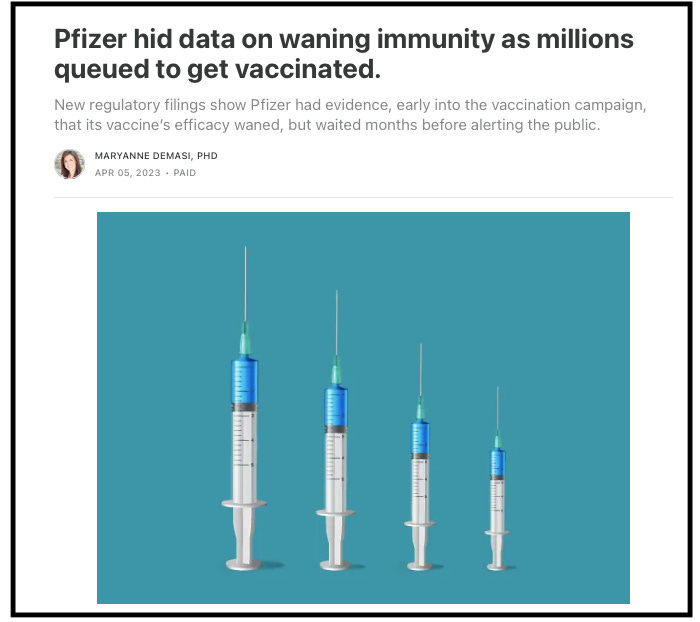
The agency, despite promising transparency early in the pandemic, consistently delayed releasing safety data, preventing doctors and the public from making informed decisions. None of this was brought up by Senators at the hearing.
FDA’s drug promotion
The FDA is a regulatory body, not a marketing agency—yet it actively promoted Covid-19 vaccines, claiming they prevented long Covid despite no supporting evidence.
Former FDA Commissioner Robert Califf falsely stated that the Pfizer’s antiviral Paxlovid could prevent long Covid and even admitted to deliberately “cheerleading” the drug.
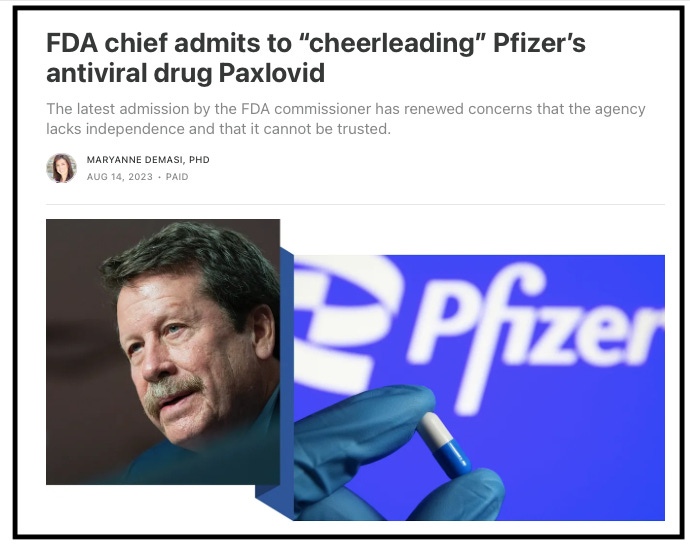
Meanwhile, the agency mocked alternative treatments like ivermectin, infamously tweeting: “You are not a horse, you are not a cow, seriously, y’all. Stop it.” It later removed the tweet after being sued. The FDA has no business dictating treatment choices or engaging in pharmaceutical advertising.
The agency also capitulated to political pressure.
The Biden administration pushed for universal Covid-19 booster approval despite weak data, prompting the resignation of two top vaccine officials, Marion Gruber and Phillip Krause. Senators should have demanded to know exactly how Makary would prevent future political interference.
False advertising
Pfizer CEO Albert Bourla publicly claimed that the company’s Covid-19 vaccine prevented transmission, even though the FDA’s own EUA documents stated this was never assessed.
The agency did nothing to correct this false advertising, yet no senator questioned Makary about how he would address misleading pharmaceutical advertising going forward.
Nor did they raise the issue of banning direct-to-consumer advertising—a policy Robert F. Kennedy Jr. has pledged to end.

Unanswered safety questions
Despite the pandemic ending, Moderna and Pfizer vaccines for young children remain under EUA. Why? There is no emergency justifying this continued authorisation.
Moreover, independent researchers have repeatedly raised concerns about excessive residual DNA in Covid-19 mRNA vaccines. The FDA has refused to investigate these findings, even as scientists continue to warn of potential risks.
Now, legal and medical experts have petitioned the FDA, citing regulatory violations and concluding the vaccines were “unlawfully approved.” Why was this not discussed at the hearing?
Beyond vaccines, the FDA has persistently ignored citizen petitions on other drug safety issues.
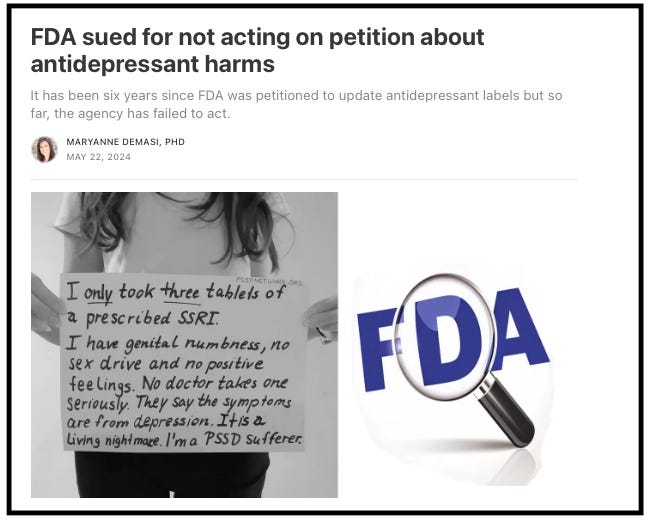
One example is its failure to update SSRI labelling to include warnings about post-SSRI sexual dysfunction (PSSD), despite overwhelming evidence. This inaction has led to legal action against the agency. Why did no senator demand accountability?
The task ahead
Makary was not responsible for the FDA’s past transgressions, but when confirmed, he inherits an agency in crisis.
To his credit, he was one of the few who publicly challenged flawed Covid policies during the pandemic.
Many hope he will now use his surgical precision to excise the rot within the FDA.
CHD, Doctors Ask Supreme Court to Hear Medical Free Speech Case
By Michael Nevradakis, Ph.D. | The Defender |March 6, 2025
Children’s Health Defense (CHD), Physicians for Informed Consent and a group of doctors who sued the Medical Board of California after it disciplined them for allegedly spreading COVID-19 “misinformation” have asked the U.S. Supreme Court to review their case.
The plaintiffs in Kory v. Bonta submitted their petition on March 1, following the November 2024 dismissal of their case by the 9th U.S. Circuit Court of Appeals.
California Attorney General Rob Bonta is named in the suit, along with the state’s medical board.
The lawsuit, filed in January 2024, is a follow-up to a previous complaint filed in 2022 and an amended suit filed in 2023, which challenged California’s Assembly Bill (AB) 2098 — a law allowing the medical board to discipline doctors who give “false” information about COVID-19 for engaging in unprofessional conduct.
A federal judge blocked AB 2098 in January 2023, and the law was later repealed. However, according to the lawsuit, the Medical Board of California is still targeting “COVID misinformation” and is threatening physicians with disciplinary action.
Three medical professionals — Dr. Brian Tyson, a board-certified family practitioner who owns an urgent care facility; Dr. LeTrinh Hoang, a pediatric osteopathic physician; and Dr. Pierre Kory, president emeritus of the Independent Medical Alliance, launched the lawsuit.
According to the petition to the Supreme Court, the Medical Board of California and the Osteopathic Medical Board of California, “with the assistance of the California Legislature,” have threatened disciplinary actions against the plaintiffs and other physicians for offering information to patients that departs from official COVID-19 narratives.
In April 2024, a federal district court rejected the plaintiffs’ request for an injunction against the medical board. The 9th Circuit upheld the ruling in November 2024. In January, the Supreme Court rejected the plaintiffs’ emergency application for an injunction.
Lawsuit hopes to set precedent that ‘informed consent is free speech’
The case seeks to resolve contradictory precedents from two federal appeals courts on whether the First Amendment protects physicians’ communications to patients — “a question that is particularly significant in a field like medicine, where scientific understanding is continually advancing and rarely settled.”
In a Physicians for Informed Consent press release, Rick Jaffe, who represents the plaintiffs, said the lawsuit “touches on the foundational rights of professionals to share knowledge and opinions essential for patient autonomy and informed consent.”
Tyson said patients cannot provide informed consent if their physicians are denied the opportunity to speak freely.
“We want doctors and all providers to be able to discuss risks and benefits with our patients, be able to speak out against things that are wrong, and be heard when breakthroughs are made,” Tyson said. “The hope is the Supreme Court will set the precedent that informed consent is free speech.”
Supreme Court asked to decide between competing legal precedents
According to the petition, federal courts have established competing legal precedents relating to medical free speech.
In a 2022 decision in Tingley v. Ferguson, the 9th Circuit upheld the ability of professional boards in Washington to restrict members’ speech, arguing this is similar to the boards’ enforcement of “other restrictions on unprofessional conduct.”
But in a 2020 decision in Otto v. City of Boca Raton, the 11th Circuit struck down local ordinances that limited the speech of therapists and counselors, finding that such content-based and viewpoint-based restrictions violate the First Amendment, which has no carveout for controversial speech.
Tyson said the California Medical Board’s disciplinary proceedings against him jeopardized his career. “I had to defend my position against the [board] and almost lost my license … That would have been devastating to the community I serve and to all those I employ.”
Jaffe said Kory v. Bonta is similar to another First Amendment case relating to medical speech, Stockton v. Ferguson. Filed in March 2024, the lawsuit seeks “to protect the right of physicians to speak” and the public’s right to hear such speech.
CHD is a plaintiff in the lawsuit, as are several doctors facing disciplinary proceedings by the Washington Medical Commission for their public statements criticizing mainstream COVID-19 narratives. Basketball legend John Stockton is also a plaintiff, advocating for the public’s right to access and listen to “soapbox speech.”
In January, the Supreme Court denied the plaintiffs’ emergency appeal in Stockton v. Ferguson. The case remains active before the 9th Circuit. Oral arguments are scheduled for May 14, Jaffe said.
“The two cases represent the entire spectrum of cases involving what physicians say and would allow the court to give a definitive and comprehensive answer to whether and how much the First Amendment protects professionals when they communicate to patients and the public,” Jaffe said.
According to Physicians for Informed Consent, four justices must agree before the full court can hear Kory v. Bonta. If the Supreme Court decides to take the case, it will hear Kory v. Bonta in October.
Jaffe said the Supreme Court may ultimately jointly consider Kory v. Bonta and Stockton v. Ferguson. He credited CHD with its role in supporting both cases.
“We hope to establish the constitutional right of healthcare providers to speak out against the prevailing medical and scientific consensus about COVID-19, as well as whatever public health challenges face the country in the future,” Jaffe said.
This article was originally published by The Defender — Children’s Health Defense’s News & Views Website under Creative Commons license CC BY-NC-ND 4.0. Please consider subscribing to The Defender or donating to Children’s Health Defense.
Yemen gives Israel four-day ultimatum to stop blocking Gaza aid
The Cradle | March 8, 2025
The leader of Yemen’s Ansarallah resistance movement, Abdul Malik al-Houthi, announced on 7 March a four-day grace period for Israel to resume ceasefire talks and lift its blockade on humanitarian aid for Gaza, threatening to resume Sanaa’s naval operations against Israeli-linked ships.
“We meet the siege with a siege,” Houthi emphasized, adding that Yemen “cannot stand by and watch the Israeli enemy’s aggressive approach in starving the Palestinian people in Gaza.”
“We do not just issue statements, but we can support the Palestinians in several areas,” the Ansarallah leader said, pointing out that “in the course of implementing the ceasefire in Gaza, it was clear that the Israeli enemy was procrastinating in fulfilling its obligations, especially those related to the humanitarian file.
The Ansarallah-led Yemeni Armed Forces (YAF) ceased military operations in support of Palestine following the start of a US-sponsored ceasefire in Gaza earlier this year. Since November 2023, the YAF repeatedly targeted US, UK, and Israeli-linked commercial ships and western warships in the Red Sea, the Indian Ocean, and the Mediterranean Sea.
Sanaa’s efforts to stop the US-Israeli genocide in Gaza prompted an illegal war initiated by Washington and London, resulting in hundreds of airstrikes in the Arab world’s poorest nation.
Despite the western onslaught, the YAF were undeterred in their military campaign and forced several US aircraft carriers and European warships out of the Red Sea. The country has also downed 15 US MQ-9 Reaper drones and recently fired its air defenses on a US F-16 jet.
A year ago, the former US Special Envoy for Yemen, Timothy Lenderking, admitted that “there is no military solution” for Yemen.
“I don’t think people really understand just kind of how deadly serious it is what we’re doing and how under threat the ships continue to be,” Commander Eric Blomberg with the USS Laboon told US media last year.
Houthi’s warning comes almost a week after Israel reimposed a total blockade on humanitarian aid shipments for Gaza after obstructing the ceasefire agreement from moving forward by demanding an extension of the first phase.
Hamas has rejected any extension of phase one and is demanding strict adherence to the agreement and international pressure on Israel.
“The resumption of war on Gaza will be met with the entire [Israeli] enemy entity coming under fire … If the war returns to Gaza, we will intervene with support through various military means,” Houthi warned on Sunday.
Trump cuts $400 million to Columbia Uni. over pro-Palestine protests
Al Mayadeen | March 8, 2025
US Federal Authorities announced on Friday a cut in grants and contracts with Columbia University in New York, citing pro-Palestine protests, which the Trump administration labels as “anti-semitic”.
The US Departments of Justice, Health and Human Services, Education, and the General Services Administration— all part of the Trump Administration’s Joint Task Force to Combat Anti-Semitism— announced the cuts in a statement, citing Columbia’s ongoing failure to stop pro-Palestine protests.
The statement adds that the cuts are the “first round of action” against the Ivy League university, emphasizing that more cancellations are anticipated as Columbia has more than $5 billion in federal grant commitments.
The agencies stated that they would issue stop-work orders for the grants and contracts, which will immediately freeze Columbia’s access to the funding without divulging details about the specific programs that will be affected.
Columbia under fire for alleged ‘anti-semitism’
Columbia University has been the battleground for threats and measures targeting pro-Palestine students who organized and shared in protests against “Israel’s” genocide in Gaza, which “Israel” supporters have labelled as anti-semitic.
The US House Committee on Education and the Workforce demanded in February that Columbia University submit disciplinary records by the end of this month for students involved in anti-“Israel” protests between April and January 2024, criticizing the Ivy League institution’s handling of the matter.
The House panel sent a six-page letter to Columbia University’s leadership on February 13, stating that the institution had failed to fulfill its promise to students, faculty, and Congress to address “anti-Semitism,” asserting that “Columbia’s ongoing failure to confront the widespread anti-Semitism on campus is unacceptable, especially given the university receives billions in federal funding.”
The university’s newly established Office of Institutional Equity launched multiple investigations to track down students who voiced their opposition to “Israel”, according to the Associated Press.
Columbia sent notices to dozens of students for activities ranging from sharing pro-Palestinian social media posts to taking part in protests that the school considers “unauthorized,” while the creation of the “disciplinary office” sparked concerns among students, faculty members, and free speech advocates who said Columbia caved in to Trump’s pressure.
Israel demolishes 50 Palestinians homes in single day in West Bank

MEMO | March 7, 2025
The Israeli occupation army yesterday demolished 50 homes in Nur Shams refugee camp, east of Tulkarm city, in the northern occupied West Bank.
Local sources said occupation forces brought huge bulldozers to the refugee camp earlier in the morning and began the demolition operations.
According to the sources, the Israeli occupation army allowed some families to enter their homes in Nur Shams camp on Wednesday and retrieve some of their belongings before carrying out the large-scale demolition operation the following day.
The army detained a woman for a short period before releasing her, they added.
The Israeli military escalation in the camps in the northern occupied West Bank forced tens of thousands of families to flee their homes, amidst widespread destruction of homes and infrastructure.
German ministry dismisses lawyer for supporting Gaza, rejecting genocide
MEMO | March 4, 2025
https://twitter.com/Melaniebelizi/status/1895904365225058324
Hamas: We will not be part of post-war Gaza on condition of national consensus
Palestinian Information Center – March 4, 2025
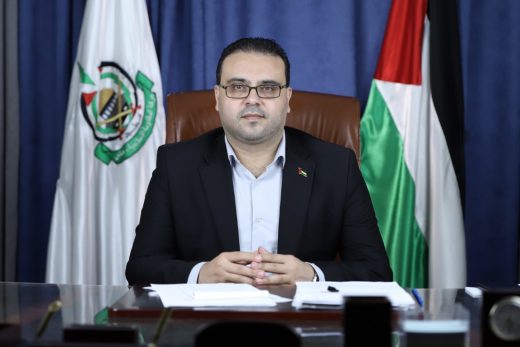
GAZA – The Hamas Movement said it will not be part of any administrative arrangements in the post-war Gaza Strip on condition of a national consensus.
“It is not necessary for Hamas to be part of the administrative arrangements in Gaza. It is not interested in that, and does not want to be in these arrangements at all,” Hamas spokesperson Hazem Qassem told Anadolu agency.
“Any arrangements for Gaza’s future after the [Israeli] aggression must be based on national consensus, and we will facilitate this. Hamas will not allow any external force to interfere,” he added.
Qassem said these arrangements must lead to “launching a serious and genuine reconstruction process to save our people in Gaza from the catastrophe they have endured” due to Israel’s war.
The comments come as Arab leaders prepare to meet in Cairo to formulate a unified Arab stance on the Palestinian issue and present a counterproposal to US plans for the displacement of Gaza’s population
Egypt unveils Gaza reconstruction plan ahead of emergency Arab summit
Al Mayadeen | March 4, 2025
On Tuesday, Egypt’s Al-Qahera Al-Ikhbariya channel published Egypt’s plan for rebuilding Gaza, which will be presented to Arab leaders at the emergency summit hosted in Cairo on Tuesday.
Egyptian Foreign Minister Badr Abdelatty previously stated that the plan was designed to ensure the Palestinian people’s dignity and rights, and would be presented on March 4.
According to Abdelatty, Egypt’s alternative reconstruction plan will not be solely Egyptian or Arab but will include international support and funding to ensure its effective implementation.
“We will hold intensive talks with major donor countries once the plan is adopted at the upcoming Arab Summit,” he stated during a press conference with European Union Commissioner for the Mediterranean Dubravka Suica.
Into Egypt’s plan
The plan, which is based on preserving the rights and dignity of the Palestinian people, includes the formation of a Gaza Administration Committee to oversee the governance of the territory during a six-month transitional period. This committee will be independent, composed of non-partisan technocrats, and will operate under the Palestinian government.
According to the plan, the committee will be established throughout the current phase and pave the way for the full return of the administration, which would manage the next phase under Palestinian decision-making.
The plan also states that Egypt and Jordan will train Palestinian police forces in preparation for their deployment in Gaza. It calls for mobilizing political and financial support to back Egyptian-Jordanian efforts in training Palestinian security personnel.
Additionally, the plan suggests that the UN Security Council consider an international presence in the Palestinian territories, including the West Bank and Gaza, and issue a resolution to deploy international peacekeeping forces as part of a comprehensive framework for establishing a Palestinian state.
On stabilizing the ceasefire
The reconstruction statement also condemned the killing and targeting of civilians, as well as the high levels of violence and humanitarian suffering caused by “Israel’s” war on Gaza, claiming that the two-state solution is the most viable resolution under international law and consensus, emphasizing that Gaza is an inseparable part of Palestinian territory.
Egypt stressed the importance of safeguarding Palestinian rights and ensuring their continued presence on their land without displacement, calling on the international community to unite on a humanitarian basis above all else to address the catastrophic consequences of the war.
Any attempt to strip the Palestinian people of their hope for statehood or seize their land would only further fuel the struggle and instability, it also warned.
Additionally, the plan also underscored the need to maintain the ceasefire in Gaza, ensure the sustainability of the current truce, and secure the release of prisoners and detainees. It noted that successful reconstruction requires transitional governance arrangements and security measures that uphold the prospects of a two-state solution.
Furthermore, it urged the international community to support Egypt, Qatar, and the United States in stabilizing the ceasefire agreement, warning that a collapse of the truce would severely hinder humanitarian efforts and the reconstruction process.
The plan emphasized the importance of a gradual approach that ensures the Palestinian people’s right to remain on their land while also safeguarding their legitimate aspirations for an independent state with territorial continuity between Gaza and the West Bank. It called for handling Gaza’s situation through a political and legal framework that aligns with international legitimacy and UN Security Council resolutions.
The plan also stressed the need to begin planning for the early recovery phase in a way that guarantees Palestinian ownership of the process. It underscored the importance of continued efforts by the Palestinian Authority to take further steps in strengthening and developing Palestinian institutions and governance structures.
Featured Video
EUROPE FEARS RUSSIA’S NEXT MOVE / Ian Proud
or go to
Aletho News Archives – Video-Images
New Book
New Book: No Autoimmunity The Body Doesn’t Attack Itself
Lies are Unbekoming | September 24, 2026
 The label for Humira, once the best-selling drug in the world, lists its risks in plain print. One of them, in the label’s own words, is new “autoimmune” disease.
A drug prescribed for a condition labelled autoimmune carries a warning that it can cause a condition labelled autoimmune. That contradiction sits in every box, on a folded paper almost nobody reads.
My new book starts there.
No Autoimmunity: The Body Doesn’t Attack Itself
For seventy years, “your body is attacking itself, and we don’t know why” has ended the conversation for people diagnosed with multiple sclerosis, lupus, rheumatoid arthritis, Hashimoto’s, Type 1 diabetes, Crohn’s and psoriasis. More than eighty conditions now carry the autoimmune label. The diagnosis comes with a prescription for life. It almost never comes with a question about cause.
This book asks the question and answers it from the framework’s own records: its drug labels, its journals, its regulatory filings, and its own experiments. … continue
Blog Roll
 Aletho News
- Merz regime wants ‘secret police’ – opposition
- Israeli settlers terrorize West Bank Palestinians with state-provided drones: Report
- They see them, then kill them: Israeli quadcopters track, deliberately target civilians in Gaza
- Debunked: Trump’s egregious UNGA claims on war against Iran crumble under scrutiny
- Europe was part of the infrastructure of US aggression against Iran: Deputy FM
- New evidence on the Bucha Massacre
- Italy and France debunk reports CIA issued ‘Russian drone threat’ warning
- How Russia is Rewiring the Global South
- Britain’s elites want you ready to die for a war they keep imagining
- Inside Ukraine’s propaganda operation targeting Americans
- If Americans Knew
- Trump betrayed voters with his campaign lies and prioritized a foreign country once he took office
- Netanyahu calls Israel’s war in Gaza ‘opposite of genocide’ in UN speech to near-empty hall
- Settler Kidnappings: Torture, Sexual Abuse and Terrorisation of Palestinian Abductees as Israel Deepens Annexation of West Bank
- Gaza winter nears as 162,000 tents become unusable, raising fears of humanitarian crisis
- Netanyahu says, “It’s the opposite of genocide”; UN says Gaza economy is world’s ‘most severe crisis on record’ – Daily Update
- Israel’s US-Backed Assault on Gaza Has Created the ‘World’s Most Severe Economic Crisis on Record’: UN
- ‘Protecting U.S. Citizens’… From Israel
- ‘This is where I live now, the back of a truck’: a day in the life of a grandmother in Gaza
- In UN Speech, Iran’s President Displays Pictures of Children Killed by US, Brings Attention to Israel’s Nuclear Arsenal
- Israel displaces hundreds of Palestinians amid wave of demolitions in West Bank
- No Tricks Zone
- New Study: Earth And Venus Surface Warmth Largely Explained By Convection And Lapse Rate, Not CO2 Or Radiation
- 2025 Nature Paper Claiming Worsening Global Drought Gets RETRACTED …Heavily Flawed
- New Study: ‘Global Drought Shows No Detectable Recent Acceleration Under Climate Warming’
- Economic Masterminds: German Socialists Suggest Taxing Productivity Gains Stemming From Using AI
- The South China Sea Has Not Been Cooperating With The Climate Change Narrative
- Energy Crisis: Germany Enters Heating Season With Historically Low Gas Reserve Fill Levels
- New Study: The Antarctic Ice Sheet Gained Mass From 2020-2024 Due To Staggering Snow And Ice Accumulation
- Study: Ocean Heating Rates From Thousands Of Years Ago ‘Dwarf’ Modern Ocean Heating Rates
- Climate Extremists Target, Attack Large-Scale Power Grid Infrastructure In Germany!
- New Study: Antarctic Ice Melt Has Contributed Less Than 1 Centimeter To Sea Level Rise In The Last 30 Years

