U.S. Tells Iran’s Oil Customers Not To Expect New Waivers
By Tsvetana Paraskova | Oilprice.com | February 7, 2019
Iran’s oil customers should not expect new U.S. waivers in May, the U.S. Special Representative for Iran, Brian Hook, said this week, urging buyers to stop importing Iranian oil.
“What we have announced is the policy to get to zero imports of Iranian crude as quickly as possible. We are not looking to grant any future waivers or exceptions to our sanctions regime, whether it is oil or anything else,” Hook told Japanese public broadcaster NHK while on a visit to Japan.
When it re-imposed sanctions on Iran last November, the U.S. granted waivers to eight countries so they could continue purchasing oil from Iran at reduced rates until early May 2019.
Some of those buyers, including the four major Asian buyers of Iranian oil—China, India, Japan, and South Korea—have recently resumed buying limited volumes of Iranian crude oil, after a period of around a month and a half in which they had to clarify how much and under what conditions they would purchase oil from Iran.
Earlier this week, Iran criticized Italy and Greece for not buying Iranian oil despite the fact that they had obtained waivers to do so.
The U.S. Administration has not officially said that no waivers will be issued, but officials have said that the goal is to drive Iranian exports to zero. Analysts, however, believe that there will be a direct correlation between the U.S. Iran waivers policy and the price of oil at the time Washington decides.
Despite the fact that the U.S. is not looking to grant any waivers to Iranian oil customers when the current ones expire in early May, it shouldn’t be taken for granted that no waivers will be issued, Hook and analysts hinted last month.
“We did not want to lift the price of oil, and we were successful doing that. So when the president left the deal it was trading at $74. When our sanctions went back into effect, and we had taken off a million barrels of Iranian crude, oil was at $72,” Hook said at Atlantic Council’s 2019 Global Energy Forum in Abu Dhabi in mid-January.
Trump’s Syria ‘Pullout’ Aimed at Aggressing Iran

By Finian CUNNINGHAM | Strategic Culture Foundation | 09.02.2019
US President Donald Trump again this week portrayed his plan to pull troops out of Syria as a “victory homecoming” and “an end to endless wars”. Then, in stepped Secretary of State Mike Pompeo to clarify what’s really going on: it’s a “tactical change” to put Iran in the crosshairs.
The purported pullout is not a return of US military from the Middle East, as Trump has been trumpeting with self-congratulations. It’s more a reconfiguration of American military power in the strategically vital region, and in particular for greater aggressive leverage on Iran.
In his State of the Union speech to Congress this week, Trump talked about giving a “warm welcome home to our brave warriors” from Syria. Supposedly it was “mission accomplished” for the US in defeating the ISIS terror group in that country.
It should be pointed out that ISIS would not have been in Syria or Iraq if it were not for criminal American military interventions, covert and overt, in those countries.
In any case, Trump was proclaiming America “victorious”, and so it was time, he said, to follow up on his order given in December for the 2,000 or so troops (illegally present) in Syria to withdraw.
The day after his nationwide address, Trump reiterated the theme of glorious homecoming at a forum of the Global Coalition to Defeat ISIS, held in Washington DC. This was a two-day gathering of dozens of US allies who have been attacking Syrian territory in the name of fighting terrorists (terrorists that many of these same coalition members, such as Saudi Arabia and Turkey, have been covertly sponsoring.)
“We look forward to giving our warriors a warm welcome home,” Trump again told delegates after informing them that the ISIS caliphate had been virtually destroyed by US forces and partners.
His top diplomat Mike Pompeo, however, assured the gathering that the US was still “leading the fight against terror” and that the planned troop withdrawal from Syria was only a “tactical maneuver”. He said that what Washington wanted was for more regional partners to take over military operations from the US.
When Trump first made the announcement of a troop withdrawal from Syria on December 19, there was immediate pushback from military figures in the Pentagon and politicians in Washington. Together with a proposed drawdown of US forces in Afghanistan by Trump, it was construed that the president was signaling a wholesale retreat from the region.
Since the “surprise” announcement by Trump, lawmakers within his Republican party have been doubling down to prevent any pullout from Syria or Afghanistan. This week, the US Senate voted through legislation to block any abrupt withdrawal, claiming that, contrary to Trump’s assertions, ISIS has not been defeated and still poses a national security threat.
The Pentagon has also been warning of a “resurgence” of ISIS in Syria and Iraq if US forces were to pull out. A Department of Defense document published this week quoted Pompeo. “Following the president’s announcement in December 2018 to withdraw troops from Syria, Secretary of State Mike Pompeo stated that the policy objectives of defeating ISIS and deterring Iran had not changed.”
In other words, the Pentagon is busily rationalizing for entrenchment in the region, not for a retreat.
Last month, while on a nine-nation tour of the Middle East, Pompeo was at pains to emphasize to America’s Arab client regimes that Trump’s pullout from Syria was a reorganization of military forces, not an overall withdrawal. During his tour, Pompeo renewed Washington’s project to create an “Arab NATO” for the region, with the top priority being to contain Iran. According to Radio Free Europe, he said, “the United States is redoubling efforts to put pressure on Iran.”
Next week, the US has organized a conference to be held in Poland which is dedicated to intensifying international pressure on Iran. The indications are that senior European Union officials will not attend the summit as it is stoking tensions with Tehran at a time when the EU is striving to save the nuclear accord with Iran.
However, the conference in Poland testifies to ramped up efforts by Washington to isolate Iran internationally and provoke instability in the country for regime change. Since Trump walked away from the internationally-backed nuclear accord last year, his administration has been piling on the aggressive rhetoric towards Iran, in particular from his national security advisor John Bolton, as well as Pompeo.
This obsession to confront Iran would explain the real significance of Trump’s supposed pullout plans in Syria and Afghanistan. Both countries have been utter failures for US imperialism. They are a dead loss, despite the self-congratulatory nonsense spouted by Trump.
What the White House is intent on doing, it seems, is redirecting its military forces in the region away from dead-end causes for a more aggressive stance towards Iran. Pompeo’s “clarifications” about Trump’s troop withdrawal makes it clear that what is going on is not a scaling down of American military power in the region, but a reconfiguration.
Trump himself has indicated that too. In a recent interview with the CBS channel, Trump said that US forces would be reassigned from Syria to Iraq where the Pentagon has several large military bases. He explicitly said that the US forces in Iraq would be used to “keep a watch on Iran” and the wider region.
Trump’s braggadocio immediately got him into hot water with the Iraqis. Iraqi President Barham Salih fulminated that the 5,000 or so US troops in his country were there strictly for the purpose of combating terrorism, not for “watching Iran” or any other neighboring country. Other Iraqi lawmakers have been so incensed by Trump’s comments that they are calling for the presence of US forces to be terminated.
Thus, the apprehensions among the bipartisan War Party in Washington and some at the Pentagon regarding Trump’s purported troop pullout from Syria and Afghanistan are misplaced. Trump is not “ending the endless wars” that feed American imperialism and its war-machine economy.
Far from it. The Condo King is simply moving the Pentagon’s real estate around the region in order to get a better view of the planned aggression towards Iran.
Iran FM Zarif to visit Lebanon amid Tel Aviv-Beirut tensions
Press TV – February 9, 2019
Iran’s Foreign Minister Mohammad Javad Zarif will pay a visit to Lebanon amid growing tensions between Beirut and Tel Aviv.
Foreign Ministry spokesman Bahram Qassemi said Zarif will travel to Lebanon at the head of a delegation on Sunday to hold talks with senior officials in the West Asian country.
The trip comes amid reports of a massive military exercise held by the Israeli army to simulate a war on Lebanon. Yiddish News reported on Friday that the drill involved tanks and warplanes.
The maneuver comes days after the secretary general of Lebanon’s Hezbollah resistance movement expressed his readiness to bring defense systems from Iran in order to confront Israeli aircraft.
Syria and Iraq are accepting Iran’s help and benefiting from it, Sayyed Hassan Nasrallah said, adding, “Whatever the Lebanese Army needs to become the strongest regional army, I am willing to go to Iran and bring it.”
“Why should Lebanon remain afraid to cooperate with Iran?” he asked.
“In the military field, wouldn’t people make an uproar and accuse Hezbollah of dragging Lebanon into war should the party shoot down an Israeli aircraft attacking Lebanon? I’m a friend of Iran, and I’m willing to bring the Lebanese Army air defense systems from Iran to confront Israel.”
Israeli warplanes regularly violate Lebanon’s sovereignty and targets belonging to Hezbollah, which has been successfully helping Syria contain Takfiri militancy.
Israel launched two wars on Lebanon in 2000 and 2006, in both of which Hezbollah inflicted heavy losses on the regime’s military. Israeli officials have even threatened another war on Lebanon.
Lebanese officials have repeatedly complained about Israeli jets’ violation of Lebanon’s sovereignty.
On Friday, Lebanon’s Prime Minister designate Saad Hariri blasted Tel Aviv for its “continued violation of Lebanese airspace and territorial waters.”
He made the remarks at a meeting with Major General Stefano Del Col of the United Nations Interim Force in Lebanon (UNIFIL).
“The escalation in the Israeli tone towards Lebanon does not serve the interests of the calm that has been going on for more than 12 years,” he said.
The Israeli army enjoys an overwhelming support from the Western countries.
Zarif told Russia’s RT television on Wednesday that the US and EU countries should be held accountable for exports of arms to the Middle East and stoking wars in the region.
“The arms which are daily fired above the heads of ordinary Yemenis and kill many people are not of local production. They were manufactured in the USA, France, the UK as well as in other European countries. They should be held accountable for that,” Zarif said.
Hopes Fade for EU to Rescue Iran Via Banking Scheme to Bypass Sanctions – but Was It Ever a Serious Plan?
By Martin JAY | Strategic Culture Foundation | 08.02.2019
At the end of September, the European Union unveiled plans to help Iran bypass sanctions imposed by the US, so that it could sell oil and even trade with EU countries. The move followed Trump finally losing his patience over the so-called Iran Deal – a treaty drafted by Barak Obama which effectively prevented Iran from developing nuclear weapons in return for opening up Iran’s economy to the West and unblocking funds held outside of the country – which he dismisses as a bad deal for American interests in the region.
In reality, Trump’s real problem with the Joint Comprehensive Plan of Action (JCPA), is the same one which vexed America’s two strongest allies in the Middle East, which is that it did nothing to curtail Iran’s real strength against any external threat: its ballistic missiles program.
And so, to appease these two partners, who felt betrayed by Obama, sanctions were imposed against Iran – along with secondary sanctions, imposed via other countries (although this has not been as successful as Trump would have hoped) – and a new ‘war’ against Iran began, aimed at largely toppling its moderate government, while Saudi Arabia gains time to move ahead with its own ballistic missile program.
A key part of spurring a downfall of the present regime in Tehran, was both secondary sanctions wielded against Turkey, China and India, threatening them against buying Iran’s cheap oil, along with forcing the EU to stop trading altogether with Tehran. At one point, Trump’s plan looked like it was working with Europe as all the main investors inside Iran packed their bags and promptly left Iran within weeks of his sanctions plan being announced.
But there was great optimism about Iran finding a clever go-around and still sell its oil to EU governments as well as foster trade with European companies who were not afraid of the threats from the US via its banking system to shut companies off from the US market.
The European Union’s own foreign policy damsel, Federica Mogherini, who stole a lot of the credit for the Iran Deal being signed in the first place (when in reality the Iranians humored her with this idea all along) had a plan. She soon announced that a new banking system to be called INSTEX would be created specifically to allow EU governments and companies to trade with Iran. Although on paper it seemed pretty simple, there were warnings from experts that it might be a difficult task to pull off, given the complexities of international banking, not to mention international laws; moreover, the EU has no real track record of pulling off anything so bold as this before as the so-called ‘foreign policy’ initiatives it has are largely grand ideas on paper – fantasies of what it might be one day rather than the present day European External Action Service which employs over a 100 ‘ambassadors’ who largely live in Djin palaces and keep the dream alive around the world in exotic locations whose governments are happy to give Brussels the cash-for-hegemony deal anytime.
Sadly, it seems that Mogherini’s plan for the banking scheme which was to send a clear signal to Trump as well as keep the Iran Deal alive, is folly and delusional – given that, for Mogherini and her colleagues, the Iran Deal is seen as their great success to exercise EU foreign policy into concrete terms and to create the first ever international treaty drafted by Brussels. It is more or less sacrosanct and considered to be a treaty which now can be used to exert EU hegemony against Trump’s new world order which they consider geopolitical heresy.
Yet the Iran Deal has so much fake news and false prophesies – like Trump’s claims that the Iranians got 150 billion dollars from it, when in reality they only got just over 30 and it was their money in the first place – and the EU’s idea seems just that. Just more fake news.
For the first time, there are growing doubts about both whether it can be pulled off and whether it was a genuine offer in the first place as Brussels appears to be at odds with the giants of the EU, who are cranking up the sanctions to new levels.
Just recently, France’s foreign minister warned Tehran of new sanctions if Tehran would not agree to curbs its ballistic missiles program, regardless of the fact that ballistics were never part of the Iran Deal. France, a founding member of the European Union itself and a country with real clout in Brussels seems to be at odds with the EU’s plans, to say the least. Or was the Brussels plan the real deal in the first place?
Concurrent to this, are also the first real signals from Tehran that it doubts the EU’s sincerity in the draft banking plan. Politicians there, feeling the heat from sanctions and living with daily rumours of a possibility of a military coup engineered by the charismatic, anti-US military figure Qasem Soleimani, are starting to cry foul.
In reality, we shouldn’t get too excited about the scheme, as Tehran clearly isn’t holding out too much hope. In addition to there being many doubts about whether European firms will sign up to it, even if it gets off the ground it will only appeal to smaller companies that are flying under the US radar anyway. Additionally, earlier hopes that it could be used to sell Iran’s oil to Europe, have been dashed.
The EU is living in dangerous times. With its own elections this May expected to give record wins to nationalist, populist parties – in particular in France – it is facing its worst ever credibility crisis, which explains the fear mongering led by President Macron with his latest Brexit speech. But if Brussels can’t deliver on Iran’s rescue package, then it won’t matter if far right parties dominate the European parliament, signaling the demise once and for all, of the EU as we know it. Brussels will never be taken seriously again around the world where it practices its fake hegemony as no one will forget the farce of the EU and the Iran Deal. INSTEX may well be the sword that the EU falls on, certainly on the world’s stage, when the hype dies down and it is dispatched to the press room floor as folly for a wannabee superpower.
US Sanctions Against Syria, Iran is ‘Economic Terrorism’ – Moscow
Sputnik – 07.02.2019
According to Deputy Foreign Minister Sergei Ryabkov, Moscow and Tehran will be advancing ways in which to defend their economies from US sanctions.
“We must — and many have already spoken about this, including our ambassador in Tehran — complete the transition process of economic interaction in the national currency as the best way to protect ourselves from the US abusing the role of the dollar”, Ryabkov told reporters on Thursday.
He also slammed Washington for the sanctions imposed on Damascus.
“There are ways to minimise the consequences of US sanctions, and these ways will be improved. There are alternative partners and formats, they need to be strengthened. I am sure that in the case of Syria, Russian-Syrian relations will only continue to ascend; neither the United States nor anyone else will interfere with this. And I agree that the US sanctions are economic terrorism”, the deputy minister stressed.
The statement by the Russian diplomat comes just a day after the US Senate voted to expand economic sanctions on Syria and to condemn President Donald Trump for announcing a full US troop withdrawal from that country.
Last November, a second package of US sanction against Tehran came into effect following the US withdrawal from the Joint Comprehensive Plan of Action (JCPOA) — the Iran nuclear deal — in May, 2018. The sanctions are aimed at exercising maximum pressure on Iran and forcing it to negotiate a new deal.
Iran Slams EU Accusations of “Assassination Attempts, Terrorist Plots in Europe”
Sputnik – 05.02.2019
Iran regrets the European Union “groundlessly” accusing it of hostile activities, such as alleged assassination plots in several EU states, the Iranian Foreign Ministry said on Tuesday.
“The unsubstantiated accusations, such as with regard to assassination attempts and attempted terrorist attacks in Europe, have been groundless and surprising from the very beginning. We are disappointed with such accusations and concerns of the Europeans, while in Europe itself terrorist and criminal groups are being active,” the Iranian Foreign Ministry wrote.
Tehran went on to express hope that Brussels would realistically approach the issue of terrorism, unlike those who use “double standards.”
Responding to the bloc’ concerns on Iran’s desire to increase the accuracy and range of its missiles, the Foreign Ministry said that Tehran’s activities were exclusively defensive.
On Monday, the European Union sanctioned two individuals and one entity in relation to Iran’s “hostile activities” in some European countries. The Council of the European Union also called on Iran to halt activities aimed at the development and testing of ballistic missiles.
Earlier, the Danish Security and Intelligence Service (PET) accused its Iranian colleagues of plotting an assassination of an Iranian separatist group member in Denmark. Dutch Foreign Minister Stef Blok and Interior Minister Kajsa Ollongren said in January that they had “strong indications” of Tehran being behind assassinations of two Dutch nationals of Iranian origin in 2015 and 2017.
Iran not accepting EU’s humiliating conditions on INSTEX: Judiciary chief
Press TV – February 4, 2019
Iran’s Judiciary Chief Ayatollah Sadeq Amoli Larijani says the Islamic Republic will never give in to humiliating conditions set by Europe for the enforcement of its new non-dollar mechanism aimed at facilitating trade with the Islamic Republic.
Addressing a meeting of high-ranking judicial officials on Monday, Iran’s top judge said, “After nine months of dawdling and negotiations, European countries have come up with a limited-capacity mechanism not for exchange of money with Iran, but to supply food and medicine.”
The European signatories to the 2015 nuclear agreement, officially known as the Joint Comprehensive Plan of Action (JCPOA), issued a joint statement on Thursday, announcing the launch of a long-awaited direct non-dollar payment mechanism meant to safeguard their trade ties with Tehran following Washington’s withdrawal from the nuclear deal and in the face of the “toughest ever” sanctions imposed by the United States against the Islamic Republic.
Following months-long preparations, the foreign ministers of France, Germany and Britain finally unveiled the mechanism, officially called the Instrument in Support of Trade Exchanges (INSTEX), after a summit in Bucharest, Romania.
Iran’s Judiciary chief further said, “European countries, which had promised to remain committed to Iran’s nuclear deal after the US withdrawal from it, have now restricted their efforts to INSTEX and have reportedly set two strange conditions for it to become effective.”
They have asked “Iran to join the FATF (the Financial Action Task Force) and start negotiations over its missile program,” before INSTEX enters into force, he added.
“These [European] countries must know that the Islamic Republic of Iran will by no means accept these humiliating conditions and will not give in to any demand in return for a small opening [in sanctions] like INSTEX,” Amoli Larijani emphasized.
He noted that today, European countries are moving in the same direction that the US had moved before “and we [the Iranian nation] must continue to stand fast as [we have] always [done].”
President Donald Trump withdrew the US in May from the landmark Iran nuclear agreement, reached between the Islamic Republic and the P5+1 group of countries in 2015, and decided to re-impose unilateral sanctions against Tehran.
Under the deal, Iran undertook to put limits on its nuclear program in exchange for the removal of nuclear-related sanctions.
Trump’s administration announced the re-imposition of the “toughest” sanctions ever against Iran’s banking and energy sectors with the aim of cutting off the country’s oil sales and crucial exports.
Iran’s nuclear chief said on Saturday that the establishment of the new mechanism to ease trade with Iran is a promising step, but noted the Europeans must act more swiftly and adopt final measures in this regard.
“The Europeans took a promising step in terms of economy and we hope that they will keep racing ahead on the same path,” the head of the Atomic Energy Organization of Iran (AEOI), Ali Akbar Salehi, told reporters.
Despite Washington’s withdrawal, Iran has not left the deal yet, but stressed that the remaining signatories to the agreement have to work to offset the negative impacts of the US pullout for Iran if they want Tehran to remain in it.
On Friday, China’s Foreign Ministry spokesman, Geng Shuang, appreciated the efforts made by European countries to uphold the JCPOA after the US withdrawal from the agreement.
“It (INSTEX) fully demonstrated the EU’s determination to uphold multilateralism. China firmly supports the continued cooperation between the EU and Iran to put the mechanism into operation as soon as possible and open it to third parties so as to promote normal economic and trade cooperation between the international community and Iran,” he said.
Death Knell For Syria Pullout: “We Have To Protect Israel” Says Trump
By Tyler Durden – Zero Hedge – 02/03/2019
After approaching two months of talk of a “full” and “immediate” US troop withdrawal from Syria, first ordered by President Trump on December 19 — which was predictably met with swift and fierce pushback from beltway hawks including in some cases his own advisers — it now appears the death knell has sounded on the prior “complete” and “rapid” draw down order.
Trump said in a CBS “Face the Nation” interview this weekend that some unspecified number of US troops will remain in the region, mostly in Iraq, with possibly some still in Syria, in order “to protect Israel” in what appears a significant backtrack from his prior insistence on an absolute withdrawal.
“We’re going to be there and we’re going to be staying. We have to protect Israel,” he replied when pressed by CBS reporter Margaret Brennan. “We have to protect other things that we have. But we’re – yeah, they’ll be coming back in a matter of time.” He did note that “ultimately some will be coming home.”
“Look, we’re protecting the world,” he added. “We’re spending more money than anybody’s ever spent in history, by a lot.” Trump’s slow drift and change in tune on the subject of a promised “rapid” exit comes after Israeli officials led by Prime Minister Netanyahu alongside neocon allies in Washington argued that some 200 US troops in Syria’s southeast desert along the Iraqi border and its 55-kilometer “deconfliction zone” at al-Tanf are the last line of defense against Iranian expansion in Syria, and therefore must stay indefinitely.
“I want to be able to watch Iran,” Trump said further during the CBS interview. “Iran is a real problem.” He explained that “99%” of ISIS’s territory had been liberated but that a contingency of US troops must remain to prevent a resurgent Islamic State as well as to counter Iranian influence, for which American forces must remain in Iraq as well.
“When I took over, Syria was infested with ISIS. It was all over the place. And now you have very little ISIS, and you have the caliphate almost knocked out,” the president said. “We will be announcing in the not too distant future 100% of the caliphate, which is the area – the land – the area – 100. We’re at 99% right now. We’ll be at 100.”
However Trump’s invoking Iranian influence as a rationale for staying further contradicts his prior December statement that the defeat of ISIS was “the only reason” he was in Syria in the first place.
MARGARET BRENNAN: How many troops are still in Syria? When are they coming home?
PRESIDENT DONALD TRUMP: 2,000 troops.
MARGARET BRENNAN: When are they coming home?
PRESIDENT DONALD TRUMP: They’re starting to, as we gain the remainder, the final remainder of the caliphate of the area, they’ll be going to our base in Iraq, and ultimately some will be coming home. But we’re going to be there and we’re going to be staying—
MARGARET BRENNAN: So that’s a matter of months?
PRESIDENT DONALD TRUMP: We have to protect Israel. We have to protect other things that we have. But we’re- yeah, they’ll be coming back in a matter of time. Look, we’re protecting the world. We’re spending more money than anybody’s ever spent in history, by a lot. We spent, over the last five years, close to 50 billion dollars a year in Afghanistan. That’s more than most countries spend for everything including education, medical, and everything else, other than a few countries. — CBS “Face the Nation” Feb.3 interview transcript
The Pentagon in recent weeks has reportedly been putting logistics in place for a troop draw down from northern and eastern Syria.
Though it remains unclear just how many troops could remain as the majority possibly begin to pullout toward US bases in Iraq, the Tanf base could remain Washington’s last remote outpost disrupting what US defense officials see as a strategic Baghdad-Damascus corridor and highway, and potential key “link” in the Tehran-to-Beirut so-called Shia land bridge.
Foreign Policy magazine has identified this argument as the final card the hawks opposing Trump’s draw down had to play in order to hinder to an actual complete US exit:
“Al-Tanf is a critical element in the effort to prevent Iran from establishing a ground line of communications from Iran through Iraq through Syria to southern Lebanon in support of Lebanese Hezbollah,” an unnamed senior US military source told the magazine.
The Israeli prime minister has pushed hard against the White House pullout plan, and “has repeatedly urged the U.S. to keep troops at Al-Tanf, according to several senior Israeli officials, who also asked not to be identified discussing private talks,” per Bloomberg. The Israelis have reportedly argued “the mere presence of American troops will act as a deterrent to Iran” even if in small numbers as a kind of symbolic threat.
The internal administration debate, following incredible push back against Trump’s withdrawal decision, has made entirely visible the national security deep state’s attempt to check the Commander-in-Chief’s power. And now US presence at al-Tanf represents the last hope of salvaging the hawks’ desire for permanent proxy war against Iran inside Syria.
It appears the deep state has won out over Trump’s initial policy decision once again; but it remains to be seen if, however slowly on what’s clearly a delayed timetable departing from his original plans, all US troops ultimately exit Syria. Until then there’ll be more time and perhaps more provocations the hawks can rely on to effectively ensure full circle return to indefinite occupation in Syria.
President Salih: Trump did not ask Iraq permission to watch Iran
Press TV – February 4, 2019
Iraqi leaders have hit back at Donald Trump after the US president said he plans to keep troops in the country to spy on Iran, with President Barham Salih saying the mission does not have Baghdad’s permission.
Their reaction on Monday came a day after Trump told CBS that US troops would leave Syria and Afghanistan but stay on in Iraq, partly “to be looking a little bit at Iran.”
Trump admitted that staying in Iraq is a “mistake” and that attacking Iran is not an option, but the remarks sparked a new round of demands in Baghdad for US forces to leave the country.
“The Iraqi constitution rejects the use of Iraq as a base for hitting or attacking a neighboring country,” President Salih said Monday.
Salih said US forces were in the country under an agreement between the two countries, but that “any action taken outside this framework is unacceptable.”
The Iraqi president insisted that Trump had not asked Baghdad’s permission for US troops in Iraq to “watch Iran.”
“Don’t overburden Iraq with your own issues,” Salih said. “The US is a major power … but do not pursue your own policy priorities, we live here.”
“It is of fundamental interest for Iraq to have good relations with Iran” and other neighboring countries, Saleh said.
He said US forces were in Iraq to fight terrorism and that he looked forward to hearing Washington’s clarification on the number of troops who were going to stay as well as their mission.
In his interview aired on Sunday, Trump defended his decision to end “endless wars” in Syria and Afghanistan by pulling out US troops from those countries.
However, he said not all of thousands of American forces stationed in Iraq, specially at the Ain al-Asad Air Base in the western Anbar Province, were going to return home.
“And one of the reasons I want to keep it (the base) is because I want to be looking a little bit at Iran because Iran is a real problem,” said the American president.
Asked whether he wanted the troops there to “strike” Iran at a later time, Trump responded: “No… All I want to do is be able to watch.”
“We have an unbelievable and expensive military base built in Iraq. It’s perfectly situated for looking at all over different parts of the troubled Middle East rather than pulling up,” he added.
Trump announced in December that all US military troops in Syria would return home in the coming months while the number of US forces in Afghanistan would also be reduced drastically.
Trump made an unannounced stop at Ain al-Asad base on Christmas, in a visit that drew fire from Iraqi officials and their counterparts in Iran and other neighboring countries.
Sabah al-Saadi, a member of parliament in the bloc led by influential anti-American cleric Moqtada Sadr, has proposed a bill demanding a US pullout.
Deputy speaker of parliament Hassan Karim al-Kaabi, also close to Sadr, said Monday Trump’s latest remarks have made passing such a law “a national duty” because they are a violation of Iraq’s sovereignty and constitution.
The remarks, he said, are a “new provocation,” weeks after the US president sparked outrage in Iraq by visiting US troops without meeting a single Iraqi official.
The Iraqi parliament, he said, will soon pass a bill that will end the ongoing security agreement with Washington as well as the presence of all foreign forces in Iraq.
Kaabi asserted that his country would never become a launchpad for attacks or a US backyard for intelligence gathering against other countries.
Iraqi leaders say there are no American bases on its soil, stressing that only instructors are deployed at Iraqi bases.
Kurdish MP Sarkawt Shams tweeted that the mission of US troops in Iraq was “to help Iraqi security forces against terrorism, not ‘watching’ others.”
“We are expecting the United States to respect our mutual interests and avoid pushing Iraq into a regional conflict,” he said.
Trump’s comments ‘embarrassing’ for Baghdad
Iraq’s former foreign minister Hoshyar Zebari also condemned Trump’s remarks, saying they were embarrassing for Baghdad.
The veteran Kurdish politician warned Iraqi officials that the country would face difficult choices in future following Trump’s controversial statements.
Jaafar al-Husseini, a spokesman for the Iraqi pro-government Kata’ib Hezbollah voluntary forces, warned the Trump administration against mounting offensives against Iran and Syria from Iraq.
He also called on parliament to speed up legislation to drive out foreign forces, warning that the anti-terror force won’t wait long.
The spokesman noted that Iraq’s security agencies should deem American military forces as “appropriate targets” as Iraqi resistance groups already do.
‘Greatest mistake US ever made’
In his interview on Sunday, Trump once again called the US war on Iraq as “one of the greatest mistakes” the United States had ever made.
He also defended his attacks on US intelligence assessments on Iran, saying they tend to miscalculate as they led former President George W. Bush into attacking Iraq by claiming that Baghdad had weapons of mass destruction (WMDs).
“President Bush had intel people that said Saddam Hussein in Iraq had nuclear weapons- had all sorts of weapons of mass destruction. Guess what? Those intel people didn’t know what the hell they were doing, and they got us tied up in a war that we should have never been in,” he said.
Last Wednesday, Trump went on a twitter rant to attack his intelligence chiefs’ assessments on Iran’s growing power despite Washington’s pressure campaign following his pullout from the 2015 Iran nuclear deal.
The tweets came in response to Tuesday statements by CIA Director Gina Haspel and Director of National Intelligence Dan Coats before the US Senate Intelligence Committee.
Haspel told the panel that despite Trump’s decision last May to withdraw from the nuclear deal, the Islamic Republic had been “making some preparations that would increase their ability to take a step back.”
Coats also acknowledged that Tehran was not seeking to develop nuclear weapons capabilities.
Forty years that changed Iran’s history

(Ayatollah Khomeini waves to followers from the balcony of his headquarters in Tehran, Feb 2, 1979, on second day of return from exile.)
By M. K. BHADRAKUMAR | Indian Punchline | February 2, 2019
The annual event known as the Ten Days of Dawn marking the political celebration of the Islamic Revolution in Iran on February 11 has begun. This year’s anniversary is a special occasion – the revolution completes 40 years. It becomes a defining moment.
Forty years ago, these ten days shook not only the Middle East but the Muslim world. The Islamic Revolution in Iran was a milestone for political Islam. It underscored that Islam and democracy are compatible. Iran’s electoral politics may have unique Iranian characteristics, which is only natural and far from unusual for other practitioners of democracy such as India or Brazil, for instance, but there can be no two opinions that Iran’s elected governments have acquired representative character and their legitimacy is not in doubt.
Basically, what irks many of Iran’s neighbours is also this compelling political reality of the empowerment of the people, which they themselves lack – be it Saudi Arabia, Bahrain, the UAE, Egypt or Jordan. They are nervous that their own people chaffing under authoritarian rule might get wrong ideas from Iran.
Several cross currents went into the alchemy of Iran’s Islamic Revolution ranging from Persian nationalists to the Communist Tudeh Party, and from Grand Ayotallah Sayyid Mohammad Kazem Shariatmadari (who was at odds with Imam Khomeini’s interpretation of the concept of Vilayat al-faqih or ‘Leadership of Jurists’ and espoused that the clergy ought to serve society and remain aloof from politics) to the charismatic ideologue of ‘Red Shi’ism’ Dr. Ali Shariati (who argued that religion in its pure form is concerned with social justice and salvation of the masses and should dispense with idolatrous rituals and established clergy – an entire current of non-Marxian socialism.) That explains the large social base of the Iranian revolution and its capacity to withstand relentless assaults by the US and its allies to undermine the established regime of the Vilayat al-faqih.
The Ten Days of Dawn is an occasion to read again the classic 1978 essay chronicling the upheaval leading to the Iranian revolution authored by the French philosopher Michel Foucault, What Are the Iranians Dreaming About? Foucault concluded his essay like this:
One bears on Iran and its peculiar destiny. At the dawn of history, Persia invented the state and conferred its models on Islam. Its administrators staffed the caliphate. But from this same Islam, it derived a religion that gave to its people infinite resources to resist state power. In this will for an “Islamic government,” should one see a reconciliation, a contradiction, or the threshold of something new?
The other question concerns this little corner of the earth whose land, both above and below the surface, has strategic importance at a global level. For the people who inhabit this land, what is the point of searching, even at the cost of their own lives, for this thing whose possibility we have forgotten since the Renaissance and the great crisis of Christianity, a political spirituality. I can already hear the French laughing, but I know that they are wrong.
“Political spirituality” – that is what gives a particular coloration to the Iranian revolution and makes it virtually impossible to repeat anywhere outside Iran.
The festivities of the Ten Days of Dawn began on February 1, which was the day Ayatollah Ruhollah Khomeini returned home from France after 14 years in exile to be the supreme leader of the Islamic Republic of Iran. They conclude on February 11, which dates back to the collapse of the Shah’s regime following clashes between some army units and revolutionaries triggered by nationwide protests.
The chartered Air France plane, which brought Khomeini from Paris was half empty so that it could carry extra fuel lest Shah didn’t allow the aircraft to land in Tehran. Khomeini’s allies in Tehran feared for his life. A 50000-strong police force deployed in Tehran on that day but it lost control in no time as swirling crowds overwhelmed the Shah’s security henchmen. An estimated 5 million people had lined the streets of Tehran to witness Khomeini’s homecoming. Read here a poignant BBC dispatch from Tehran on that historic day.
When the history of the decline of US influence in the Middle East gets written, the starting point has to be the Iranian Revolution of 1979. The US could never get over the “loss” of Iran as its key regional ally. An effective regional strategy became difficult to sustain. The consequent inability to let go of Iran accounted for much of the tensions in the Middle East politics in the past four decades. And, inevitably, the US kept losing ground while the Islamic regime in Iran gained in stature and influence as a permanent factor in the political life of the Middle East.
Suffice to say, it won’t be an exaggeration to estimate that the Iranian revolution has proved to be the nemesis of the Western political, economic, cultural domination of the Muslim Middle East. Having said that, it will be erroneous to estimate that the Islamic regime in Iran is locked in a mortal conflict with the West. Far from it. Iran is an ambitious regional power and it factors in that access to Western technology and capital is of crucial importance. Equally, the leadership is acutely conscious that for the preservation of the social base of the Islamic regime, economic development is critical, which again means trade and investment from the West. Iran’s middle class is heavily orientated toward ‘Westernism’.
The bottom line is that much as this may sound a paradox, the reality is that integration into the West is a core objective of the regime’s policies. Europe understands the complexity of Iran’s motivations. Interestingly, the European Union announced on January 31 (on the eve of the anniversary of Khomeini’s return from exile to Tehran) the creation of the so-called Instrument in Support of Trade Exchanges (INSTEX) as a channel for trade exchanges with Iran circumventing the US sanctions.
Tehran is delighted. Foreign Minister Mohammad Zarif promptly tweeted, “Iran welcomes #INSTEX—a long overdue 1st step—in E3 implementation of May 2018 commitments to save JCPOA (Iran nuclear deal) by ensuring dividends for Iranians after US’ illegal reimposition of sanctions. We remain ready for constructive engagement with Europe on equal footing & with mutual respect.”
The heart of the matter is that the fortieth anniversary of the Islamic Revolution would have been an occasion to bury the hostility between the US and Iran if only the Trump administration had the sense of history and political foresight to comprehend that Iran can be a factor for regional stability. President Trump did not have to look beyond Iran for an effective partner to bring to a closure the “endless wars” in the Middle East.
Your Complete Guide to the NY Times’ Support of US-Backed Coups in Latin America
By Adam H. JOHNSON | TruthDig | January 29, 2019
On Friday, The New York Times continued its long, predictable tradition of backing U.S. coups in Latin America by publishing an editorial praising Donald Trump’s attempt to overthrow Venezuelan President Nicolas Maduro. This will be the 10th such coup the paper has backed since the creation of the CIA over 70 years ago.
A survey of The New York Times archives shows the Times editorial board has supported 10 out of 12 American-backed coups in Latin America, with two editorials—those involving the 1983 Grenada invasion and the 2009 Honduras coup—ranging from ambiguous to reluctant opposition. The survey can be viewed here.
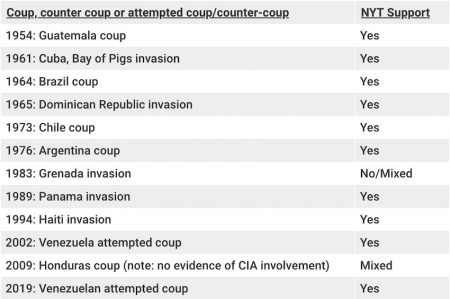
Covert involvement of the United States, by the CIA or other intelligence services, isn’t mentioned in any of the Times’ editorials on any of the coups. Absent an open, undeniable U.S. military invasion (as in the Dominican Republic, Panama and Grenada), things seem to happen in Latin American countries entirely on their own, with outside forces rarely, if ever, mentioned in the Times. Obviously, there are limits to what is “provable” in the immediate aftermath of such events (covert intervention is, by definition, covert), but the idea that the U.S. or other imperial actors could have stirred the pot, funded a junta or run weapons in any of the conflicts under the table is never entertained.
More often than not, what one is left with, reading Times editorials on these coups, are racist, paternalistic “cycle of violence” cliches. Sigh, it’s just the way of things Over There. When reading these quotes, keep in mind the CIA supplied and funded the groups that ultimately killed these leaders:
- Brazil 1964: “They have, throughout their history, suffered from a lack of first class rulers.”
- Chile 1973: “No Chilean party or faction can escape some responsibility for the disaster, but a heavy share must be assigned to the unfortunate Dr. Allende himself.”
- Argentina 1976: “It was typical of the cynicism with which many Argentines view their country’s politics that most people in Buenos Aires seemed more interested in a soccer telecast Tuesday night than in the ouster of President Isabel Martinez de Perlin by the armed forces. The script was familiar for this long‐anticipated coup.”
See, it didn’t matter! It’s worth pointing out the military junta put in power by the CIA-contrived coup killed 10,000 to 30,000 Argentines from 1976 to 1983.
There’s a familiar script: The CIA and its U.S. corporate partners come in, wage economic warfare, fund and arm the opposition, then the target of this operation is blamed. This, of course, isn’t to say there isn’t merit to some of the objections being raised by The New York Times—whether it be Chile in 1973 or Venezuela in 2019. But that’s not really the point. The reason the CIA and U.S. military and its corporate partisans historically target governments in Latin America is because those governments are hostile to U.S. capital and strategic interests, not because they are undemocratic. So while the points the Times makes about illiberalism may sometimes be true, they’re mostly a non sequitur when analyzing the reality of what’s unfolding.
Did Allende, as the Times alleged in 1973 when backing his violent overthrow, “persist in pushing a program of pervasive socialism” without a “popular mandate”? Did, as the Times alleged, Allende “pursue this goal by dubious means, including attempts to bypass both Congress and the courts”? Possibly. But Allende’s supposed authoritarianism isn’t why the CIA sought his ouster. It wasn’t his means of pursuing redistributive policies that offended the CIA and U.S. corporate partners; it was the redistributive policies themselves.
Hand-wringing over the anti-democratic nature of how Allende carried out his agenda without noting that it was the agenda itself—not the means by which it was carried out—that animated his opponents is butting into a conversation no one in power is really having. Why, historically, has The New York Times taken for granted the liberal pretexts for U.S. involvement, rather than analyzing whether there were possibly other, more cynical forces at work?
The answer is that rank ideology is baked into the premise. The idea that the U.S. is motivated by human rights and democracy is taken for granted by The New York Times editorial board and has been since its inception. This does all the heavy lifting without most people—even liberals vaguely skeptical of American motives in Latin America—noticing that a sleight of hand has taken place. “In recent decades,” a 2017 Times editorial scolding Russia asserted, “American presidents who took military action have been driven by the desire to promote freedom and democracy, sometimes with extraordinary results.” Oh, well, good then.
What should be a conversation about American military and its covert apparatus unduly meddling in other countries quickly becomes a referendum on the moral properties of those countries. Theoretically a good conversation to have (and one certainly ongoing among people and institutions in these countries), but absent a discussion of the merits of the initial axiom—that U.S. talking heads and the Washington national security apparatus have a birthright to determine which regimes are good and bad—it serves little practical purpose stateside beyond posturing. And often, as a practical matter, it works to cement the broader narrative justifying the meddling itself.
Do the U.S. and its allies have a moral or ethical right to determine the political future of Venezuela? This question is breezed past, and we move on to the question of how this self-evident authority is best exercised. This is the scope of debate in The New York Times—and among virtually all U.S. media outlets. To ante up in the poker game of Serious People Discussing Foreign Policy Seriously, one is obligated to register an Official Condemnation of the Official Bad Regime. This is so everyone knows you accept the core premises of U.S. regime change but oppose it on pragmatic or legalistic grounds. It’s a tedious, extortive exercise designed to shift the conversation away from the United States’ history of arbitrary and violent overthrows and into an exchange about how best to oppose the Official Bad Regime in question. U.S. liberals are to keep a real-time report card on these Official Bad Regimes, and if these regimes—due to an ill-defined rubric of un-democraticness and human rights—fall below a score of say, “60,” they become illegitimate and unworthy of defense as such.
While obviously not in Latin America, it’s also worth noting that the Times cheerled the CIA-sponsored coup against Iran’s President, Mohammad Mossadegh, in 1953. Its editorial, written two days after his ouster, engaged in the Times’ patented combination of victim-blaming and “oh dear” bloviating:
- “The now-deposed Premier Mossadegh was flirting with Russia. He had won his phony plebiscite to dissolve the Majlis, or lower House of Parliament, with the aid of the Tudeh Communists.”
- “Mossadegh is out, a prisoner awaiting trial. It is a credit to the Shah, to whom he was so disloyal, and to Premier Zahedi, that this rabid, self-seeking nationalist would have been protected at a time when his life would not have been worth the wager of a plugged nickel.”
- “The Shah … deserves praise in this crisis. … He was always true to the parliamentary institutions of his country, he was a moderating influence in the wild fanaticism exhibited by the nationalists under Mossadegh, and he was socially progressive.”
Again, no mention of CIA involvement (which the agency now openly acknowledges), which the Times wouldn’t necessarily have had any way of knowing at the time. (This is part of the point of covert operations.) Mossadegh is summarily demonized, and it’s not until decades later the public learns of the extent of U.S. involvement. The Times even gets in an orientalist description of Iranians, implying why a strong Shah is necessary:
[The average Iranian] has nothing to lose. He is a man of infinite patience, of great charm and gentleness, but he is also—as we have been seeing—a volatile character, highly emotional, and violent when sufficiently aroused.
Needless to say, there are major difference between these cases: Mossadegh, Allende, Chavez and Maduro all lived in radically different times and championed different policies, with varying degrees of liberalism and corruption. But the one thing they all had in common is that the U.S. government, and a compliant U.S. media, decided they “needed to go” and did everything to achieve this end. The fundamental arrogance of this assumption, one would think, is what ought to be discussed in the U.S. media—as typified by the Times’ editorial board—but time and again, this assumption is either taken for granted or hand-waved away, and we all move on to how and when we can best overthrow the Bad Regime.
For those earnestly concerned about Maduro’s efforts to undermine the democratic institutions of Venezuela (he’s been accused of jailing opponents, stacking the courts and holding Potemkin elections), it’s worth pointing out that even when the liberal democratic properties of Venezuela were at their height in 2002 (they were internationally sanctioned and overseen by the Carter Center for years, and no serious observer considers Hugo Chavez’s rule illegitimate), the CIA still greenlit a military coup against Chavez, and the New York Times still profusely praised the act. As it wrote at the time:
With yesterday’s resignation of President Hugo Chávez, Venezuelan democracy is no longer threatened by a would-be dictator. Mr. Chávez, a ruinous demagogue, stepped down after the military intervened and handed power to a respected business leader, Pedro Carmona.
Chavez would soon be restored to power after millions took to the streets to protest his removal from office, but the question remains: If The New York Times was willing to ignore the undisputed will of the Venezuelan people in 2002, what makes anyone think the newspaper is earnestly concerned about it in 2019? Again, the thing that’s being objected to by the White House, the State Department and their U.S. imperial apparatchiks is the redistributive policies and opposition to the United States’ will, not the means by which they do so. Perhaps the Times and other U.S. media—living in the heart of, and presumably having influence over, this empire—could try centering this reality rather than, for the millionth time, adjudicating the moral properties of the countries subject to its violent, illegitimate whims.
Facebook, Twitter delete accounts linked to Iran, Russia, Venezuela with anti-west content
Press TV – February 1, 2019
Facebook and Twitter say they have taken down hundreds of accounts they claim have been part of “coordinated influence operations” from Iran, Russia and Venezuela.
Facebook said it had removed 783 pages, groups, and accounts for “engaging in coordinated inauthentic behavior tied to Iran.”
The accounts, some of which had been active since 2010, had garnered about 2 million followers on Facebook and more than 250,000 followers on Instagram.
The decision came after the Atlantic Council’s Digital Forensic Research Lab said the accounts had been designed to amplify views “in line with Iranian government’s international stances.”
“The pages posted content with strong bias for the government in Tehran and against the ‘West’ and regional neighbors, such as Saudi Arabia and Israel,” the center wrote in a blog post.
Several of the accounts focused on sharing content supporting Palestinians and condemning Israeli crimes in French, English, Spanish and Hebrew, while others were critical of Saudi policies, it said.
Twitter separately announced that it had deleted thousands of “malicious” accounts from Russia, Iran and Venezuela. The accounts had “limited operations” targeting the US midterm elections in November, the company alleged, and the majority were suspended prior to election day.
Back in August 2018, Facebook targeted hundreds of accounts allegedly tied to Iran and Russia under the pretext of fighting what it calls “misinformation” campaigns.
Among the accounts was one belonging to the Quest 4 Truth (Q4T) Iranian media organization, which promotes Islamic values.
A similar move was taken by Google against 39 YouTube channels at the time.
The channels reportedly belonged to the Islamic Republic of Iran Broadcasting (IRIB), which condemned the move as a “coordinated” campaign and a “clear example of censorship” aimed at preventing the dissemination of truth and alternative viewpoints online.
Three months later in October, Facebook deleted 82 more Iranian accounts, claiming that it had detected “coordinated activity” between the accounts earlier in the month.
In September 2018, Iranian Foreign Minister Mohammad Javad Zarif harshly criticized Twitter for blocking the accounts of “real Iranians” but overlooking the “regime change” propaganda spewing out of Washington.
He said the accounts of real Iranians, including TV presenters and students, have been shuttered for allegedly being part of an “influence operation.”
Earlier in January, the detention of Press TV anchor Marzieh Hashemi in the United States raised deep concerns among the world’s media activists and journalists, who launched a social media campaign with the hashtags #FreeMarziehHashemi and #Pray4MarziehHashemi in support of the detained journalist.
Hashemi’s long detention without charge finally ended last Wednesday when she was released from a Washington jail. The newscaster’s ordeal is apparently over but Hashemi is taking a firm stance against the practices of the US judicial system.
Following her release, she said in a filmed statement that public support definitely played a part in her release and vowed to further protest rights violations in the US.
Featured Video
EUROPE FEARS RUSSIA’S NEXT MOVE / Ian Proud
or go to
Aletho News Archives – Video-Images
New Book
New Book: No Autoimmunity The Body Doesn’t Attack Itself
Lies are Unbekoming | September 24, 2026
 The label for Humira, once the best-selling drug in the world, lists its risks in plain print. One of them, in the label’s own words, is new “autoimmune” disease.
A drug prescribed for a condition labelled autoimmune carries a warning that it can cause a condition labelled autoimmune. That contradiction sits in every box, on a folded paper almost nobody reads.
My new book starts there.
No Autoimmunity: The Body Doesn’t Attack Itself
For seventy years, “your body is attacking itself, and we don’t know why” has ended the conversation for people diagnosed with multiple sclerosis, lupus, rheumatoid arthritis, Hashimoto’s, Type 1 diabetes, Crohn’s and psoriasis. More than eighty conditions now carry the autoimmune label. The diagnosis comes with a prescription for life. It almost never comes with a question about cause.
This book asks the question and answers it from the framework’s own records: its drug labels, its journals, its regulatory filings, and its own experiments. … continue
Blog Roll
 Aletho News
- Debunked: Trump’s egregious UNGA claims on war against Iran crumble under scrutiny
- Europe was part of the infrastructure of US aggression against Iran: Deputy FM
- New evidence on the Bucha Massacre
- Italy and France debunk reports CIA issued ‘Russian drone threat’ warning
- How Russia is Rewiring the Global South
- Britain’s elites want you ready to die for a war they keep imagining
- Inside Ukraine’s propaganda operation targeting Americans
- Hackers From US, France, Singapore Tried to Disrupt Russian Elections – Internet Provider
- New Book: No Autoimmunity The Body Doesn’t Attack Itself
- EUROPE FEARS RUSSIA’S NEXT MOVE / Ian Proud
- If Americans Knew
- Gaza winter nears as 162,000 tents become unusable, raising fears of humanitarian crisis
- Netanyahu says, “It’s the opposite of genocide”; UN says Gaza economy is world’s ‘most severe crisis on record’ – Daily Update
- Israel’s US-Backed Assault on Gaza Has Created the ‘World’s Most Severe Economic Crisis on Record’: UN
- ‘Protecting U.S. Citizens’… From Israel
- ‘This is where I live now, the back of a truck’: a day in the life of a grandmother in Gaza
- In UN Speech, Iran’s President Displays Pictures of Children Killed by US, Brings Attention to Israel’s Nuclear Arsenal
- Israel displaces hundreds of Palestinians amid wave of demolitions in West Bank
- Aid, reconstruction, and Israel’s history of obstruction in Gaza
- Trump administration digs an ever-deeper hole of complicity in genocide – Daily Update
- US-Israel $2.8 Billion Arms Deal, 40,000-Bomb Supply Faces New Gaza Complicity Accusations
- No Tricks Zone
- New Study: Earth And Venus Surface Warmth Largely Explained By Convection And Lapse Rate, Not CO2 Or Radiation
- 2025 Nature Paper Claiming Worsening Global Drought Gets RETRACTED …Heavily Flawed
- New Study: ‘Global Drought Shows No Detectable Recent Acceleration Under Climate Warming’
- Economic Masterminds: German Socialists Suggest Taxing Productivity Gains Stemming From Using AI
- The South China Sea Has Not Been Cooperating With The Climate Change Narrative
- Energy Crisis: Germany Enters Heating Season With Historically Low Gas Reserve Fill Levels
- New Study: The Antarctic Ice Sheet Gained Mass From 2020-2024 Due To Staggering Snow And Ice Accumulation
- Study: Ocean Heating Rates From Thousands Of Years Ago ‘Dwarf’ Modern Ocean Heating Rates
- Climate Extremists Target, Attack Large-Scale Power Grid Infrastructure In Germany!
- New Study: Antarctic Ice Melt Has Contributed Less Than 1 Centimeter To Sea Level Rise In The Last 30 Years

