Iran dismisses Canadian court ruling on asset freeze
Press TV – March 22, 2014
Iran has rejected a politically-motivated ruling by a Canadian court to seize more than USD 7 million of the Islamic Republic’s assets and properties.
Iranian Foreign Ministry Spokeswoman Marzieh Afkham said on Saturday that Iran was not informed about the legal proceedings, adding that the court ruling has therefore “no legal value” to Iran.
An Ontario judge in Canada recently ordered the seizure of more than USD 7 million of assets and properties belonging to Iran over some plaintiffs alleging that the Islamic Republic funds terrorist groups.
“Given the approach of the Canadian government, it is crystal clear that the verdict is politically-motivated and such rulings have no legal value,” Afkham said, reminding the Ottawa government of its international commitment to protect diplomatic properties.
Pointing to Canada’s move to sever ties with Iran unilaterally, Afkham said under international law diplomatic properties have immunity, warning Ottawa of the legal repercussions of disrespecting international regulations.
The Iranian official stated that Iran, as a victim of terrorism, has always denounced this inhuman scourge.
She warned that the double standards used by Western countries, including Canada, in the fight against terrorism will not only fail to uproot it but will also contribute to the spread of this phenomenon.
On September 7, 2012 the Canadian government closed its embassy in Tehran and ordered Iranian diplomats to leave Canada within five days.
In a statement, Canadian Foreign Affairs Minister John Baird cited a number of reasons for Ottawa’s decision to sever ties with Iran, including the West’s dispute over Tehran’s nuclear energy program, the country’s support for the government of Syrian President Bashar al-Assad as well as “threatening the existence of Israel.”
Related article


Media Theories on Missing Flight MH370 Fail Analysis
Though One Plausible Scenario, Consistent with Known Facts, Might Explain Mystery
By Doug E. Steil | Aletho News | March 17, 2014
Even though, the recent disappearance of Malaysian Flight MH370 continues to be a mystery, numerous scenarios that have been circulating in the past week can essentially be discounted, in particular technical failure.
The on-board hijacker scenario that media came up with over the weekend is highly implausible for at least five reasons because a putative hijacker would have to have (a) swiftly incapacitated the pilots without forewarning, so as to prevent the triggering of a hijack alert, (b) at exactly the correct and narrow time window, of approximately two minutes, after the co-pilot’s last voice sign-off but before entering Vietnamese air space, (c) known precisely how to fly and (d) disable the communications systems, and (e) surviving heights above the aircraft’s suggested operating limit as well as rapid descents of 40,000 feet per minute, equivalent a vertical speed of 444 knots per hour.
It has already been shown and asserted years ago, in the context of the government “Home Run” program, that an airplane can be commandeered from afar, intended back then to “counteract hijacking” situations. Last year at a hacker conference in Amsterdam, it was demonstrated, as a proof of concept, that an outside intruder could also manipulate the cockpit data visible to the pilot and take control of multiple functions and insert a flight path, essentially flying the simulated aircraft by remote control. This is something that has recently been acknowledged, as a possibility, but the media prefer not to dwell on this aspect, for obvious reasons. By contrast, staging a tacit vilification campaign by simply blaming one of the experienced pilots for the aircraft’s elusive behavior, due to some previously unexpected suicidal bent or spur of the moment inclination (which entails committing mass murder), though highly unlikely, is easier to suggest because it cannot be technically dis-proven and diverts attention away from a more plausible scenario, namely that of a “false flag” operation that was aborted.
Repeatedly we have been bombarded by the high-pitched and vociferous demands by Israeli politicians pertaining to the ongoing high-level negotiations with Iran regarding its nuclear program, directed at European and US political leaders, to take on an uncompromising stance and keep up the pressure. The main points the Zionist propagandists make on this topic are:
* Iran must not be allowed to enrich uranium and has to dismantle its reactors;
* Uranium enriched to 20% is just a few steps away from making a nuclear bomb;
* Iran has an aggressive weapons program, and its missiles threaten Israel;
* Iran is a major sponsor of international terrorism in Gaza, Syria, and elsewhere;
* Iran is a threat to the Arab world in the Gulf, as well as other Muslim countries;
* The new leader’s “charm offensive” is dishonest and deceptive; don’t be fooled!
However, these ongoing messages have tended to fall on deaf ears. Israeli prime minister Netanyahu is widely seen as both semi-comical and fanatical, the proverbial boy who cried “wolf” too often and discredited himself. What better method, then, to reinforce these anti-Iranian propaganda points more compellingly and convince the leaders of the western world to fall in line with the Israeli agenda, than to stage another spectacular “false flag” event, amplified in its effects by a scripted media follow-up campaign?
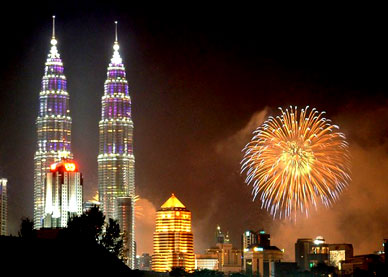 In light of the evidence surrounding the Malaysian Flight MH370, it now appears that exactly such an event almost occurred a week ago, but was apparently aborted at the last moment. Using the now ingrained imagery of jets flying into the World Trade towers more than a dozen years ago as an example, an attack on the Petronas twin towers in Kuala Lumpur would provide the requisite symbolic significance. Occurring in the middle of the night, when most people wouldn’t be able to witness it live, such an attack wouldn’t have required a dual attack, featuring two aircraft, or even for at least one the towers to ultimately collapse through timed explosions of thermite, in order to have been effective in achieving the primary goal. It would have been sufficient for the Malaysian airliner to have been guided to hit the spire near the top of one of the towers and temporarily create a huge fireball of kerosene, lighting up the sky and captured on a few closed circuit cameras, and played back endlessly afterwards.
The key ingredient this time would have been some uranium-235 (enriched to 20%) on board, ideally stolen from assassinated nuclear scientists working in the Iranian nuclear research program (so as to be authentic), then placed in the luggage of two young Iranians (surely also “shy with women”) traveling together on one-way tickets along a circuitous route to Europe, using stolen passports to board the flight. In the aftermath of the attack the media would quickly have elevated them to the status of probable hijackers, who had somehow managed to commandeer the plane. By virtue of their having used stolen passports, it would be evident that they had made contact to the underworld of international criminals and terrorists, who must have somehow prepared them to carry out a mission to deliver a “dirty bomb”.
Even with the Petronas Towers remaining intact after an aircraft attack, the radioactivity from the enriched uranium would have been highly disruptive to the economy of Malaysia. The world would have seen how damaging and crippling a few kilograms of enriched uranium could be if it came into the “wrong hands”, and therefore Iran, which the media will have convinced the public was undoubtedly responsible — and was purportedly also responsible for the bombing of PanAm 103 — must not be allowed to maintain a nuclear program. If two experienced and outgoing pilots in good standing can be vilified and denigrated in just a few days, just image how easily these two Iranian kids and their alleged handlers behind the scenes would have been transformed into mass murderers. The supporting narrative would have been far different from what was announced this week.
The point where the masterminds of this “false flag” operation had to decide whether to proceed with, or abort, the attack was as the remote controlled Flight MH370 approached the island of Penang in the Strait of Malacca. For whatever reason the operators decided to call off the operation. Perhaps not all the technical aspects of such an endeavor were confirmed to be in place for the complex operation to withstand scrutiny.
Aborting a planned mission like this, assuming the radioactive material on board, necessitated getting rid of the aircraft, during the middle of a weekend night with no moon, in a very remote location, deep underneath the southern Indian Ocean, where it may not be found for years and subsequent recovery would ultimately be extremely difficult. Once the westbound jet had safely circumvented Indonesian air space near the northwestern tip of Sumatra it could fly south and needed only evade airport ground radar at the atolls of Diego Garcia and the Cocos Islands by flying at a lower altitude above the length of the underwater East Indian Ridge, in some areas of which the depth exceeds 6,000 meters, where the nearest inhabited island is Île Amsterdam.
Since this particular “false flag” operation was apparently abandoned, will the perpetrators be brazen enough to attempt a different one in the near future?
Related articles
Gaza missile seizure, Netanyahu’s latest anti-Iran joke

By Finian Cunningham | Press TV | March 11, 2014
Comedians say that the art of telling jokes relies on “timing.” Israeli’s Prime Minister Benjamin Netanyahu, the world’s top comic politician, seemed to be proving the point with his “timely” claims about seizing Iranian rockets aboard a cargo ship in the Red Sea.
Standing in front of 40 pointed missiles, each carefully displayed on props (you sense the stilted exhibitionism here), the Israeli leader said the seized cache “showed the true face of Iran” in its support for terrorism. Netanyahu lashed out at Western leaders who are “shaking hands with Iran” and preparing to finalize a political settlement to the long-running nuclear dispute.
Iran swiftly denounced the Israeli allegations as orchestrated, indicating that the capture of munitions on a Panamanian-registered vessel was a set-up.
Even some of the Israeli media have grown weary of such “propaganda stunts,” as the newspaper Haaretz described Netanyahu’s melodramatic display of Iran’s alleged clandestine cargo in the port of Eilat at the weekend. Netanyahu’s corny sensationalist manner, standing in front of the green-colored rockets, was reminiscent of his previous presentation to the United Nations using a cartoon bomb in which he claimed then that Iran was “only months away from building a nuclear weapon.”
Netanyahu’s record of failure over the past 20 years in predicting “imminent” Iranian nuclear arms capability makes him a laughing stock. Some people watching the latest televised stunt of displaying “captured” Iranian rockets may have wished that one of the devices could have accidentally fired off during the Israeli premier’s speech.
The buffoonish Netanyahu cannot be taken seriously on anything he says. Nevertheless it is worthwhile defusing the latest Israeli propaganda hoax to reveal the mindset of those in Tel Aviv and their backers in Washington and the Western mainstream media who shamefully never fail to lend credibility to such reprehensible smear jobs. “Israeli forces seize rockets ‘destined for Gaza’ in raid on Iranian ship in Red Sea,” read a headline in the British Guardian.
It is amazing how much credence is afforded to baseless Israeli and Western government claims against Iran. In recent years, the Western public has been fed with tall tales of Iranian plots to assassinate diplomats in Washington, and involvement in bombings or attempted bombings in Argentina, Thailand, India, Georgia, Bulgaria and Kenya. Tellingly, none of these stories – always initially reported with ubiquitous fanfare in the Western media – are ever followed up or substantiated.
Yet the same absurd story line, with dramatic plot variations, is peddled over and over again. This systematic regurgitation shows that the Western media is nothing but an instrument of state propaganda.
Of course, Zionist lobby groups, sympathetic Zionist media owners, reporters, pundits are a big part of the charade. So too is the political agenda of Washington and its European allies who slavishly indulge Israel for geopolitical reasons, and who are only too glad to undermine Iran with regard to their support for Israel and the despotic Arab oil sheikhdoms, as well as in their covert war against Tehran’s ally, Syria.
The latest stunt may be also a pretext for the Western governments to procrastinate on the P5+1 settlement – and to subject Iran to further torturous illegal sanctions.
Let’s look at some of the claims in the latest smear job against Iran, which has seen US defense secretary Chuck Hagel also weighing in to accuse Iran of “destabilizing the region”.
The Israelis claim that Syrian-made M-302 rockets, with a firing range of 160km, were first flown by air cargo to Iran. Then Iran moved the ordnance to the port of Bandar Abbas, where it was loaded on to a ship, the KLOS-C. As mentioned, the ship is reportedly registered in Panama with an owner in the Marshall Islands. So what connection Iran has to the vessel is right away tenuous.
Next, the ship is said to have sailed north to the port of Umm Qasr in Iraq, where it was loaded with bags of cement conveniently bearing Iranian trademarks. The KLOS-C made its way out of the Persian Gulf and into the Red Sea, where Israeli Special Forces raided the ship last week off the coast of Sudan.
The Israelis claim – and Western media gave full vent to the claims – that the rockets were to be shipped over land from Sudan via Egypt’s Sinai Peninsula and delivered to Hamas in Gaza. Hamas, as well as Tehran, denies any involvement. It was even speculated in some Western media that the shipment of rockets could also have been intended by Iran for al-Qaeda groups based in Sinai.
This circuitous route, involving weeks of transport time over one of the most intensely surveyed sea-lanes in the world, does not bear serious scrutiny. The risk of such a smuggling plot being uncovered is so high as to make it implausible. Put another way, the chances of it being part of a stage-managed set-up are all the more plausible.
The destination aspect of the alleged plot does not hold water either. Egypt, under the military junta led by General Abdel al Sisi, has stepped up its collusion with Israel to seal off the Sinai Peninsula and all land crossings into Gaza. The notion of trucks carrying dozens of medium-sized surface-to-surface missiles driving into Gaza, undetected, is inconceivable to the point of ridicule.
So too is the Israeli-inspired sub-plot that Iran may have been trying to send the weapons to al-Qaeda in Sinai. This group is waging a Western-backed covert terrorist campaign against Syria and against Shia Muslims in particular. The idea that Shia Iran or its ally Syria would supply Syrian-made rockets to such enemies illustrates how moronic the thesis for this Israeli propaganda stunt is.
The Israeli seizure, by the way, was given the ever-so contrived title of “Full Exposure.” The give-away to this being a stunt is the timing. It came just as Netanyahu was in Washington trying to tell the world that the failure of Mid-East “peace talks” was all the fault of the Palestinians – not anything to do with the genocidal policies of Israel. In other words, it serves as a handy foil to shield Israel from international opprobrium. As Netanyahu was speaking in the White House, Israeli warplanes killed two Palestinians in air strikes on Gaza.
The second timed factor is that Iran is scheduled to complete the P5+1 negotiations for a final settlement over the nuclear dispute. EU foreign policy chief, Catherine Ashton, was in Tehran at the weekend when Netanyahu fired off rhetorical salvos about “Western hypocrisy in the face of Iranian support for international terrorism.” Israel is livid at the prospect of any nuclear deal being reached. And no doubt there are political forces in Washington and Europe that would relish an accord being sabotaged.
Netanyahu went on to warn about Iranian “armed nuclear suitcases” being sent to every port in the world.
Who needs imaginary nuclear-armed suitcases when we already have a nuclear-armed nutcase – Netanyahu and his apartheid regime?
Comic Netanyahu may have a dubious skill at timing, but his tedious jokes have by now become just stupidly bad. The latest one about “Full Exposure” of Iranian rockets has backfired.
Progress in Iran Nuclear Talks Depends on the Israeli Government Coming Clean on its Nuclear Disinformation Campaigns
By Dr. Yousaf Butt | Arms Control Law | March 4, 2014
One of the sticking points in the on-going Iran nuclear negotiations is the fate of the so-called “Possible Military Dimensions” (aka “Alleged Studies”) file. This is a compendium of allegations against Iran’s nuclear program – largely gathered by third-party intelligence agencies – that the IAEA would like Iran to respond to. Not only are the allegations largely outside the IAEA legal authority and expertise (because they do not directly deal with nuclear material diversion), but Iran has not been allowed to see much of this secret evidence that is being used against it. Such a process is, of course, not consistent with normal Western legal practice. Iran has responded to what little it has been shown of the PMD file by saying that the evidence thus far shown is fabricated.
Though this Iranian response is often cast as Iran “not cooperating with the IAEA” (or “refusing to discuss the matter”), another possibility must be considered: that Iran is correct. That is, that at least some the evidence has indeed been cooked-up by an adversarial Intelligence service (or by an agent recruited by such an Intelligence service).
A wonderful new book by Gudrun Harrer on the IAEA inspections in Iraq sheds some light on which countries could be involved in fabricating and planting such fake nuclear “evidence”. On p. 185 of the book, it is confirmed that Israel provided the IAEA with false information on Laser Isotope Separation activities in Iraq. The reference for this information is the author’s interview with David Albright of ISIS (see at this insert the relevant scanned pages from the book):
Israel has, of course, long been suspected of being behind some of the forged and suspect evidence against Iran: the neutron initiators, AP graphs, etc., but until now it was hard to definitely pin the blame on that country. Thanks to David Albright at ISIS, we now know that Israel has been guilty of planting disinformation with the IAEA in the past.
The German intelligence agency has also discredited much of the secret evidence against Iran.
Having myself analyzed some of what is (evidently) in this PMD file – with Dr. Ferenc Dalnoki-Veress of the James Martin Center for Nonproliferation Studies – I can say that the evidence is certainly of poor quality and/or an amateurish forgery. It does not look like anything a state-level research scientist would produce. There are large and conspicuous mathematical and physical errors in the material.
Similarly, Robert Kelley has assessed that at least some of the evidence purporting to show weaponization research work continuing past 2004 is less than compelling:
[The] evidence, according to the IAEA, tells us Iran embarked on a four-year program, starting around 2006, to validate the design of a device to produce a burst of neutrons that could initiate a fission chain reaction. Though I cannot say for sure what source the agency is relying on, I can say for certain that this project was earlier at the center of what appeared to be a misinformation campaign…. Mohamed ElBaradei, who was then the agency’s director general, rejected the information because there was no chain of custody for the paper, no clear source, document markings, date of issue or anything else that could establish its authenticity…
David Albright’s confirmation of Israeli nuclear disinformation goes hand-in-glove with statements from former IAEA director, and Nobel Prize winner, Mohammed ElBaradei. In his biography, ElBaradei says that the documents that the IAEA had about the alleged neutron initiators in Iran circa 2008 were given to the Agency by Israel. He further states that Israel gave him permission to show the evidence to Iran.
So the question is, why has the IAEA not cooperated with Iran in evaluating material like they did with Iraq circa 1995, in the incident mentioned by Harrer?
Iran could be genuinely helpful if they were allowed to see the original evidence and comment on it. When the IAEA worked with Iraq to evaluate documents, the Iraqis helpfully pointed out mistakes that the IAEA could independently confirm. Isn’t that the example we would like to see with Iran?
Being charged with secret evidence also goes against every notion of Western justice. The IAEA either needs to drop the PMD file, or amend their procedures.
Unfortunately, it is quite likely that the Israeli government is once again carrying out nuclear disinformation, possibly in collaboration with the MEK, an Iranian terrorist – in some nations, formerly terrorist – organization opposed to the current Iranian regime.
Over the past weekend, it was also confirmed that Israel masterminded the assassinations of Iranian nuclear scientists. These assassinations, too, perhaps were carried out with local MEK collaboration. If the Israeli government is capable of assassinating civilian Iranian scientists, would fabricating nuclear intel on Iran trouble their consciences? Presumably not. Especially as they have done it in the past, according to David Albright at ISIS.
Before further pursuing Iran on the PMD file – which may contain substantial forged evidence – it would make sense to ask Israel to come clean about any fabricated intelligence it may have planted with the IAEA. It is quite possible that some of the PMD file is not fake. Israel’s assistance and cooperation in identifying what is fake and what is not would be most helpful. If David Albright of ISIS has further insight into this – as he did in the Iraqi case – his involvement would also, of course, be very welcome.
It is becoming increasingly difficult to give credibility to hyperbolic Israeli statements about Iran’s underhandedness in pursuing its nuclear program, when Israel itself has been underhanded in pursuing clandestine disinformation campaigns against NPT states, while itself remaining resolutely outside the NPT.
There are several points for the IAEA to consider in light of these recent developments:
1. Should the IAEA reject all evidence from Israel against Iran and other adversarial states now?
2. Should the IAEA, generally, not accept intelligence from non-NPT states?
3. The IAEA should show Iran any evidence it wants an Iranian response on. Anything less is not consistent with Western notions of justice. Furthermore such cooperation could unveil the origin of any possible forgeries in the PMD file.
4. The IAEA and the US should ask Israel to come clean on any fabricated “evidence” it may have inserted into the PMD file.
5. As I have suggested previously, it would be best to simply drop the PMD file as it relates to decade old unauthenticated allegations of possible research. It is not even clear that what is in the PMD file – even if true – would be a violation of the NPT or the safeguards agreement.
6. If the IAEA really wants to pursue the content of the PMD in a legal way they can initiate special inspections or undertake arbitration as provided for in the CSA. The IAEA does not even have the technical expertise in-house to undertake investigations of missiles, warheads etc. which are mentioned in the PMD file.
7. Since Iran is now in compliance with its safeguards agreement, Iran’s nuclear file – currently hung-up in the Security Council – should return to the IAEA. The referral to the Security Council was unorthodox and politicized to begin with, and there is no rationale for Iran’s nuclear file to remain there post-2008. (Footnote 38 of the latest IAEA report on Iran makes clear that the remaining issues are not IAEA safeguards issues but extraneous UNSC ones).
8. This also means that the UNSC nuclear-related sanctions on Iran should now be dropped. In fact, they ought to have been dropped in 2008.
David Albright must be commended for his helpful insight into fabricated Israeli intelligence in Iraq, and hopefully can assist in tracking down similar disinformation in the case of Iran.
Relatedly, we must thank him and ISIS also for showing the international community expensive satellite pictures of Parchin, in which one can see that west of the paving activity, the site is untouched, and so the IAEA could get environmental samples there (if they even needed those). This undercuts ISIS’ own conclusion that the site has been magically “sanitized” by paving. Normally, of course, the IAEA would take such swipe samples from within the buildings where any suspect U naturally collects: in the corners and at the places where the walls meet the floor.
The technical weaknesses in ISIS’ and IAEA’s approach to Parchin were previously commented on.
The IAEA’s technically unsound obsession with environmental sampling at Parchin may also mean they are confusing the site at Marivan (where open-air implosion tests may have taken place) with the site at Parchin (where implosions in a chamber are alleged).
From the May 2008 Board report, referring to the Marivan site:
A.2. High Explosives Testing
[………….]
Document 3: Five page document in English describing experimentation undertaken with a complex multipoint initiation system to detonate a substantial amount of high explosive in hemispherical geometry and to monitor the development of the detonation wave in that high explosive using a considerable number of diagnostic probes.
And the alleged weapons’ studies annex Nov 2011:
43. Information provided to the Agency by the same Member State referred to in the previous paragraph describes the multipoint initiation concept referred to above as being used by Iran in at least one large scale experiment in 2003 to initiate a high explosive charge in the form of a hemispherical shell. [……] Further information provided to the Agency by the same Member State indicates that the large scale high explosive experiments were conducted by Iran in the region of Marivan.
So what is the point of carrying out environmental sampling at Parchin (where chamber experiments are alleged) and not at Marivan where open-air experiments were allegedly done? Is the IAEA – and ISIS – confused between Marivan and Parchin?
The IAEA’s unprofessionalism in vetting the content of the PMD file, and in the obsession over Parchin (which the IAEA visited twice already) vs. Marivan smacks of an agenda to target Iran rather than any sound technical analysis. It is likely to blow up the Iran nuclear deal for no good reason. Iran has cooperated with the IAEA on the PMD file by saying that the material it was shown was fabricated – this may be true. Now Israel should also cooperate and come clean about what forged material – or material from compromised sources like “Curveball” – may be within this file. David Albright, with his past knowledge and evident expertise in fabricated Israeli intelligence should also step up to the plate.
And, certainly, Iran should be shown any evidence it is being asked to answer to by the IAEA. The Agency should also spend about half an hour and check whether the site it is interested in for environmental sampling is Marivan or Parchin. Environmental sampling at Parchin makes little sense. At Parchin, swipes would be taken from within the buildings since chamber-based implosions are alleged. While it is at it, the IAEA should also review the technical basis of their conclusions on Syria.
It is hard to take the Agency seriously when it persists in being blatantly unprofessional.
Dr Jim Walsh, a research associate at MIT, has an excellent suggestion about what to do with Iran’s “PMD” file – as paraphrased by Mark Hibbs: “If the nuclear activities were in the past, I don’t care. It’s dead, and it’s regretful, but let’s do a deal with Iran that moves forward.”
But before we do that, the IAEA should ask Israel to come clean about its potential role in fabricating some of the “evidence” within the PMD file.
Given its historical misuse, the IAEA should also re-visit whether it will continue to accept intelligence from third-parties, especially non-NPT member states.
Dr. Yousaf Butt, a nuclear physicist, is Director of the Emerging Technologies Program at the Cultural Intelligence Institute, a non-profit organization dedicated to promoting fact-based cultural awareness among individuals, institutions, and governments. The views expressed here are his own.
Treasury Secretary Jack Lew: “The future of the United States is tied to the future of Israel”
EPJ | March 2, 2014
Below are the remarks of US Treasury Secretary Jack Lew before the 2014 Policy Conference of the American Israel Public Affairs Committee(AIPAC) These are clearly the remarks of the banker for the Empire. It should be noted that Lew’s remarks on Ukraine appear to be in line with those of Rand Paul and though Lew’s comments clearly show that he considers Israel as the 51st, and most important state, his views on sanctions are more moderate than those of Rand.
Read the remarks only if you have a strong stomach. Note the re-introduction of the IMF as key financial enforcer. During a stop over in SF, Lew admitted that the IMF is a tool of the US.
I want to thank President Kassen, incoming President Cohen, the Board of Directors, and everyone for inviting me here today. There are so many familiar faces in this room—friends of many years from my time in Washington, New York, and around the country. It is truly wonderful to be with you.
Before turning to the focus of my remarks, let me say that we are closely monitoring the situation in Ukraine with grave concern. As President Obama told President Putin yesterday, Russia’s clear violation of Ukrainian sovereignty and territorial integrity is a breach of international law. I have spoken several times to the Ukrainian Prime Minister who assures me that the government is prepared to take the necessary steps to build a secure economic foundation, including urgently needed market reforms that will restore financial stability, unleash economic potential, and allow Ukraine’s people to better achieve their economic aspirations.
The United States is prepared to work with its bilateral and multilateral partners to provide as much support as Ukraine needs to restore financial stability and return to economic growth, if the new government implements the necessary reforms.
An IMF program should be the centerpiece of the international assistance package, and the United States is prepared to supplement IMF support in order to make successful reform implementation more likely and to cushion the impact of needed reforms on vulnerable Ukrainians.
Now the reason we are all here is because for more than 40 years, AIPAC has been the indispensable leader in keeping the alliance between the United States and Israel unbreakable. And you have done that through your powerful example of advocacy and activism—you make your voices heard, you take your case to your representatives here in Washington, and you stand up for what you believe in. This is not just your right as Americans. It is your responsibility. It is the essence of our democratic system.
And as everyone here recognizes, the future of the United States is tied to the future of Israel. This is something that every President since Harry Truman has understood.
In fact, in 1948, it took President Truman only 11 minutes to recognize the Jewish state of Israel. And from then on, the American-Israel relationship has not been a Democratic cause or a Republican cause, it has been an American cause.
President Obama has remained true to this proud legacy since the first day he took office, and he has made it clear that for him and for this Administration, America’s commitment to Israel is ironclad. As he said as President-elect, before he even took office: “Israel’s security is sacrosanct. It is nonnegotiable.” And he has never wavered from that position.
Like the President, Israel’s security is not only a public policy conviction for me, it is a personal one. As many of you know, no one grew up with a deeper appreciation for the state of Israel than I did. And I have no doubt that a strong and secure Israel is vital to America’s strength and America’s security.
As we meet, America’s support for Israel’s security has never been stronger. And over the next three days, you’re going to hear about all the things that the Administration is doing to advance Israel’s security—from promoting a lasting peace with the Palestinians to preserving Israel’s military edge so it can protect itself against any threat.
Today, I will discuss one of the most pressing national security concerns for Israel and the United States—and that is Iran’s nuclear program.
Let us not forget that when President Obama took office, Iran was strengthening its position throughout the region and the international community was unable to provide a unified response. But because of President Obama’s leadership, Congressional actions, American diplomacy, which AIPAC has supported, we put in place a historic sanctions regime and Iran now finds itself under the greatest economic and financial pressure any country has ever experienced.
Initially, many claimed sanctions on Iran would never work, but we have proven exactly the opposite. From the beginning, this sanctions program has had one purpose: Persuade Iran to abandon its pursuit of a nuclear weapon. There can be no alternative.
To be clear, we never imposed sanctions just for the sake of imposing sanctions. We did it to isolate Iran and sharpen the choice for the regime in Tehran. And we did it by bringing the community of nations together. We are talking about China, Russia, India, Japan, Europe, Canada, South Korea, and the list goes on.
Having the international community united in opposition to Iran’s pursuit of a nuclear weapon made an enormous difference.
We now have in place the most sweeping, most powerful, most innovative, and most comprehensive sanctions regime in history. And because of the impact of these unprecedented, international sanctions, Iran finally came to the negotiating table seeking relief and fully aware that to get relief, it had to take concrete steps to curtail its nuclear program. Those negotiations led to the Joint Plan of Action, which went into effect in January.
Today, for the first time in a decade, progress on Iran’s nuclear program has been halted and key elements have been rolled back.
The temporary deal struck in Geneva provides us with a six-month diplomatic window to try to hammer out a comprehensive, long-term resolution, without fear that Iran, in the meantime, will advance its nuclear program. Now, I want to emphasize something: Before we agree to any comprehensive deal, Iran will have to provide real proof that its nuclear program, whatever it consists of, is—and will remain—exclusively peaceful.
This deal will only be acceptable if we are certain that Iran could not threaten Israel or any other nation with a nuclear weapon.
Yet make no mistake: Even as we pursue diplomacy, and even as we deliver on our commitments to provide limited sanctions relief, the vast majority of our sanctions remain firmly in place. Right now, these sanctions are imposing the kind of intense economic pressure that continues to provide a powerful incentive for Iran to negotiate. And we have sent the very clear signal to the leadership in Tehran that if these talks do not succeed, then we are prepared to impose additional sanctions on Iran and that all options remain on the table to block Iran from obtaining a nuclear weapon.
We are under no illusions about who we are dealing with. Iran has threatened Israel’s very existence, supports terrorist organizations such as Hezbollah, and has failed to live up to its promises in the past.
Still, it is critically important that we give negotiations, backed by continuing economic pressure, a chance to succeed. I have sat with two presidents as they weighed the enormous decision to send men and women into harm’s way to protect our nation. And while all options must remain available, I believe it is our responsibility to do as much as we reasonably can to reserve force as a last option.
This is as much a strategic obligation as it is a moral one. You see, maintaining the sanctions regime that has crippled Iran’s economy requires international cooperation. No amount of U.S. sanctions would have the same crippling power as this international effort. For other nations to continue to remain steadfast with us, they need to know that we have given negotiations every chance to succeed. And if the moment comes when we have to use force, the whole world needs to understand that we did everything possible to achieve change through diplomacy.
To that end, we do not believe that now is the time to adopt new sanctions legislation. We do not need new sanctions now – the sanctions in place are working to bring Iran to the negotiating table and passing new sanctions now could derail the talks that are underway and splinter the international cooperation that has made our sanctions regime so effective. But as I have said, and as President Obama has said, we continue to consult closely with Congress, and if these talks fail, we will be the first to seek even tougher sanctions.
Now, in the next two days or so, you may hear some say that the very narrow relief in the interim agreement has unraveled the sanctions regime or eased the choke-hold on Iran’s economy. Nothing could be further from the truth. And I want to take a few moments to go through a few basic facts.
The Treasury Department, which administers and enforces the sanctions, monitors the numbers carefully. And when you consider the ongoing sanctions that remain in place, the temporary, targeted, and reversible sanctions relief is extremely limited—totaling an estimated $7 billion. To put that into context, during the same six month period, Iran will lose roughly $30 billion in oil sales alone from the sanctions that remain in place.
Put simply, this relief will not enable Iran’s economy to recover from the deep economic damage inflicted by the sanctions program. The bulk of this relief does not come from suspending sanctions on economic activity like manufacturing or exports. It comes from the measured release of Iran’s own funds that are now impounded in overseas banks. The fact is, because of years of sanctions enforcement, Iran has about $100 billion locked up in overseas banks. The interim agreement allows Iran to access $4.2 billion of these funds.
I want to underscore that Iran’s access to this limited relief is neither immediate nor instantaneous. It will be provided in separate installments on a rolling basis over the six-month period of the Joint Plan, and it will only flow if Iran demonstrates week by week that it continues to comply with its agreement to freeze and rollback its enrichment program.
Other measures amount to less than $2 billion — the limited suspension of sanctions on the export of plastics, the import of parts for Iran’s automotive sector, and tuition assistance for students studying abroad. And the core architecture that makes the program work, oil and financial sanctions, remains in effect fully.
If at any point Iran fails to fulfill its commitments under the Joint Plan, the money will stop, and the suspended sanctions will snap right back into place. And when the six-month deal expires, so does the relief.
The bottom-line is: Promises are not enough—Iran must meet its obligations. This is not a case of trust and verify. This is a case of verify everything.
No matter what, Iran’s economy will continue to feel severe economic pressure from our ongoing sanctions regime. For example, our oil sanctions that remain in place have forced Iran’s oil exports to drop by more than 60 percent over the last two years. And we will continue to enforce them.
All told, the crushing sanctions have deeply damaged economic conditions in Iran. There are four key indicators that tell the whole story: first, last year the economy shrunk by 6 percent and it is expected to shrink again this year; second, the value of its currency, the rial, has plummeted, having lost about 60 percent of its value against the dollar; third, the unemployment rate is over 15 percent; and finally, the inflation rate is about 30 percent, one of the highest in the world.
The economic sanctions have crippled Iran’s economy on many fronts.
Claims that Iran’s economy is undergoing a recovery because of the Joint Plan of Action are just plain wrong. After the election of President Rouhani last June, and well before the Joint Plan took effect, there was a slight drop in the country’s very high inflation rate and small improvements in other economic indicators. This was due to a wave of public optimism that greeted the election of a new president, the appointment of a more capable economic team, and the hope that a deal to lift sanctions would soon materialize.
But the slight improvements in these indicators only mean that a badly wounded economy is not getting worse. It does not mean the economy is getting better. And it certainly does not mean that the Joint Plan has led to a recovery.
Further, if Iran fails to reach a deal with us, business and consumer confidence will quickly erode as will many of the gains the economy has seen over the last few months.
Iran’s economy suffered a serious blow from sanctions, and the impact of sanctions is not being reversed. Iran’s economy remains in the same state of distress that brought the government to the table in the first place. Imagine how any economy would feel, if, by a recovery, it meant leveling off at the bottom of a recession. That is what is happening in Iran today.
There is no question that the relief provided under the six-month plan will not steer Iran’s economy to a real recovery. It is a drop in the bucket. In fact, there will be a net deepening of the impact of sanctions when you consider the new damage that will be inflicted like the $30 billion in additional lost oil sales.
What this relief will do is give the people of Iran and their leaders a small taste of how things could improve if they were to take the steps necessary to join the community of nations. This is a choice for Iran to make. If it wants to pull its economy out of the deep hole it is in, it must remove any doubt that its nuclear program is peaceful and come to a comprehensive agreement with the international community. Until then, we will remain steadfast in our enforcement of U.S. and international sanctions.
Now, when I say we remain firm in our enforcement of sanctions, these are not just words, we are talking about action. For instance, shortly after the Joint Plan went into effect, we moved against more than 30 Iran-related entities and individuals around the globe for evading U.S. sanctions, for aiding Iranian nuclear and missile proliferation, and for supporting terrorism. As President Obama recently said, if anyone, anywhere engages in unauthorized economic activity with Tehran, the United States will—and I quote—“come down on them like a ton of bricks.”
I have personally delivered that message to hundreds of business and banking executives in America and around the world, and we are in regular contact with our international partners—including Israel—to sustain the pressure on Iran’s government.
On top of that, our enforcement officials at the Treasury Department who have been responsible for crafting and implementing this historic sanctions regime have been traveling around the world and putting their expertise and unremitting effort to bear to keep Iran isolated.
Even though I have said this before, it bears repeating: Iran is not open for business. Have no doubt, we are well aware that business people have been talking to the Iranians. We have been very clear that the moment those talks turn into improper deals, we will respond with speed and force. Anyone who violates our sanctions will face severe penalties. Our vigilance has not, cannot, and will not falter.
In closing, let me say, this is a time of great uncertainty. But during difficult times like these, the bonds between the United States and Israel do not grow weaker, they grow stronger.
The U.S.-Israel relationship, which is rooted in our shared story of people yearning to be masters of their own destiny, is as vibrant as ever. And that vibrancy is very much on display here. As I look out across this room, I am reminded of how every year hundreds of young people come to this conference from every corner of the United States. They travel to our nation’s capital because of their boundless hope, their sense of duty, and their unshakeable belief that the future can be brighter, better, more prosperous and more secure. And I am confident that by all of us working together, we can make that happen.
Thank you.
Related article
Lew tells AIPAC: War with Iran still an option
Press TV – March 3, 2014
The US Treasury Secretary, Jack Lew, has told the American Israel Public Affairs Committee (AIPAC) that all options against Iran “remain on the table.”
Lew, who is the highest ranking Jewish member of the administration of President Barack Obama, made the remarks on the opening day of AIPAC’s annual meeting which began on Sunday in Washington, D.C., and will end on Tuesday.
He also assured the most powerful pro-Israel lobby group in the US that “the vast majority of” Washington’s sanctions against Iran “remain in place,” adding “all options remain on the table.”
“You may hear some say that the very narrow relief in the interim agreement has unraveled the sanctions regime or eased the choke-hold on Iran’s economy,” Lew said at AIPAC’s 2014 Policy Conference. “Nothing could be further from the truth.”
In an interview with HuffPost Live earlier this year, Noam Chomsky said Washington’s threats of war against Iran are a violation of the United Nations Charter and there is no justification for the US sanctions against Iran as the US intelligence reports do not prove Iran is pursuing non-civilian purposes in its nuclear energy program.
AIPAC is currently pressing the Obama administration to take a tougher stand against Iran. Prior to its annual meeting, the lobby group distributed a position paper to congressional offices that demanded the dismantling of Iran’s nuclear energy program in order for a final agreement to be reached between Iran and the five permanent members of the UN Security Council – Britain, China, France, Russia, and the US – plus Germany.
AIPAC also released a letter from a bipartisan group of senators to Obama, which said US Congress needed “to rapidly and dramatically expand sanctions” against Iran.
This comes as a new study published by The Iran Project shows that new sanctions against Iran sought by hawkish senators on Capitol Hill would undermine the ongoing negotiations over Iran’s nuclear energy program and “would increase the probability of war.”
Iran and the P5+1 group signed an interim nuclear agreement in Geneva, Switzerland, last November. The deal is aimed at setting the stage for the full resolution of the West’s decade-old standoff with Tehran over its nuclear energy program.
In exchange for Iran’s confidence-building bid to limit certain aspects of its nuclear activities, the six world powers agreed to lift some of the existing sanctions against the Islamic Republic.
The two sides continued their talks in the Austrian capital Vienna last month in order to reach a final agreement. According to Iranian Deputy Foreign Minister Abbas Araqchi, the talks concluded on February 20 with “an agreement on the framework and plan of action for the comprehensive nuclear talks.”
Iranian Foreign Minister Mohammad Javad Zarif has already stated that Iran’s nuclear energy program “will remain intact” while the country is willing to address international concerns about its nuclear activities.
Related articles


IAEA rejects Israel’s anti-Iran nuclear rhetoric
Press TV – March 1, 2014
The International Atomic Energy Agency (IAEA) has rejected Israel’s demand to release an alleged report about the Iranian nuclear energy work, saying there is no report that may indicate any diversion in Tehran’s program.
“The IAEA has not prepared any report containing new information relating to possible military dimensions of Iran’s nuclear program,” spokeswoman Gill Tudor said on Friday.
The remarks came after Israel demanded that the UN nuclear watchdog agency go public with all information it has regarding the Iranian nuclear energy work.
The demand was made following a Thursday report by Reuters alleging that the agency had held off an update over the Iranian nuclear energy program last year due to concerns that it may undermine nuclear talks with Tehran.
“The agency’s reports on Iran to its Board of Governors are factual and impartial. Their content is not influenced by political considerations,” Tudor added.
Iran has repeatedly emphasized that its nuclear energy program is meant for civilian purposes.
Officials in Tehran have already called on the IAEA to come clean on anything it has regarding the suspicions over the diversion of the Iranian nuclear energy program.
However, the agency has so far found no diversion in Iran’s nuclear program to publicize it.
Iran is in talks with the five permanent members of the UN Security Council — Russia, China, France, the UK and the US — plus Germany to fully resolve the decade-old dispute over the Tehran’s nuclear energy program.
The two sides inked an interim nuclear deal in Geneva, Switzerland, on November 24, 2013. The Geneva deal took effect on January 20. The two sides are now in pursuit of a final comprehensive deal.
Israel’s allegations against Iran come as the Tel Aviv regime, which is widely believed to be the only possessor of nuclear arms in the Middle East, reportedly maintains between 200 and 400 atomic warheads.
Furthermore, the Israeli regime has never allowed any inspection of its nuclear facilities and continues to defy international calls to join the nuclear Non-Proliferation Treaty.
Related article
UN finds no evidence Iran seeks nuclear arms: Rouhani
Al-Akhbar | March 2, 2014
President Hassan Rouhani said Sunday that despite “thousands of hours” of inspection, the UN’s atomic watchdog has found no evidence of military objectives in Iran’s nuclear drive.
His remarks came on the eve of an International Atomic Energy Agency board of governors meeting in Vienna, on the sidelines of which Iran will hold expert-level talks with world powers.
Western powers “all know that nuclear science in Iran follows a peaceful path”, Rouhani said in a speech broadcast on state television.
“The agency has conducted thousands of hours of inspection, and announced it has not found any diversion from the peaceful use (of nuclear technology) to military purposes.”
In its latest report on Iran in late February, the IAEA said Iran was sticking to a nuclear freeze it agreed under a November interim deal with world powers.
The watchdog’s report came a month after the deal came into force.
Iran and the so-called P5+1 group of world powers are seeking to reach a lasting accord that would allay Western suspicions that Tehran’s nuclear activities mask military objectives.
As part of such a comprehensive deal, the six seek to pressure Iran over its ballistic missile program, which could theoretically provide Tehran with a device to deliver a nuclear warhead, should it choose to build one. Iran has consistently denied any claims that it seeks to militarize it’s nuclear program.
Rouhani on Sunday defended the program, saying it has “always been defensive in nature, and will always remain so”.
On Saturday, Rouhani had called for calm amid provocative rhetoric from Iranian hardliners.
“Sometimes one does not seek war but talks as if one does, and this is seen as a threat to other parties. This is an unnecessary provocation,” he told military personnel and defense ministry officials.
“The Islamic Republic of Iran’s foreign policy is based on detente and building trust,” he added.
Since taking office in August, Rouhani has vowed to rebuild strained relations with the West.
(AFP, Al-Akhbar)
Related article

Resolving Nuclear Arms Claims Hinges on Iran’s Demand for Documents
By Gareth Porter | IPS | March 2, 2014
The Barack Obama administration has demanded that Iran resolve “past and present concerns” about the “possible military dimensions” of its nuclear program as a condition for signing a comprehensive nuclear agreement with Tehran.
Administration officials have suggested that Iran must satisfy the International Atomic Energy Agency (IAEA) regarding the allegations in the agency’s report that it has had a covert nuclear weapons program in the past.
But the record of negotiations between Iran and the IAEA shows Tehran has been ready for the past two years to provide detailed responses to all the charges of an Iranian nuclear weapons work, and that the problem has been the refusal of the IAEA to share with Iran the documentary evidence on which those allegations have been based.
The real obstacle to providing those documents, however, has long been a U.S. policy of refusing to share the documents on the assumption that Iran must confess to having had a weaponization program.
The head of Iran’s Atomic Energy Organisation, Ali Akbar Salehi, declared February 12, “The authenticity of each allegation should be proven first, then the person who submitted it to the agency should give us the genuine document. When we are assured of the authenticity, then we can talk to the agency.”
Neither the IAEA nor the Obama administration has responded publicly to Salehi’s statement. In response to a query from IPS, the spokesperson for the National Security Council, Bernadette Meehan, said the NSC officials would have no comment on the Iranian demand for access to the documents.
The spokesperson for IAEA Director Yukiya Amano did not answer a request from IPS Thursday for the agency’s comment.
But a draft text of an agreement being negotiated between the IAEA and Iran dated February 20, 2012, shows that the only difference between the two sides on resolving issues about allegations of Iranian nuclear weapons work was Iran’s demand to have the documents on which the allegations are based.
The draft text, which was later published on the website of the Arms Control Association, reflects Iran’s deletions and additions to the original IAEA proposal. It calls for Iran to provide a “conclusive technical assessment” of a set of six “topics”, which included 12 distinct charges in the report in a particular order that the IAEA desired.
Iran and the IAEA agreed that Iran would provide a “conclusive technical assessment” on a list of 10 issues in a particular order. The only topics that Iran proposed to delete from the list were “management structure” and “Procurement activities”, which did not involve charges of specifically nuclear weapons work.
The two sides had agreed in the draft that the IAEA would provide a “detailed explanation of its concerns”. But they had failed to agree on provision of documents to Iran by the IAEA. The IAEA had proposed language that the agency would provide Iran with the relevant documents only “where appropriate”. Iran was insisting on deletion of that qualifying phrase from the draft.
The first priority on the list of topics to which both sides had agreed in the draft was “Parchin” – referring to the claim of intelligence from an unnamed state that Iran had installed a large cylinder at the Parchin military reservation.
A November 2011 IAEA report suggested the cylinder was intended for testing nuclear weapons designs and had been built with the assistance of a “foreign expert”. Iran also agreed to respond in detail on the issue of the “foreign expert”, who has been identified as Vyacheslav Danilenko, a Ukrainian specialist on nanodiamonds.
The evidence associated with that claim and others published in the 2011 report shows that they were based on intelligence reports and documents given to the IAEA by Israel in 2008-09. Former IAEA Director General Mohamed ElBaradei referred to a series of documents provided by Israel in his 2012 memoirs.
Iran also agreed to respond in detail to allegations that Iran had sought to integrate a nuclear weapon into the reentry vehicle of the Shahab-3 missile, and that it had developed high explosives as a “detonator” for a nuclear weapon.
Both alleged activities had been depicted or described in documents reported in the U.S. news media in 2005-06 as having come from a covert Iranian nuclear weapons program.
Those documents, about whose authenticity ElBaradei and other senior IAEA officials have publicly expressed serious doubts, have now been revealed as having been given to Western intelligence by an anti-regime Iranian terrorist organization.
Former senior German foreign office official Karsten Voigt revealed in an interview last year for a newly published book by this writer that senior officials of the German intelligence agency BND had told him in November 2004 that the BND had gotten the entire collection of documents from a member of the Mujahedin-e-Khalq (MEK) who had been one of their sources, and that they did not consider the source to be reliable.
The MEK, considered by the United States and European states as a terrorist organization, had been used by Saddam Hussein’s regime to support the war against Iran and by Israel to issue intelligence and propaganda that Mossad did not want attributed to it.
ElBaradei, who retired from the IAEA in November 2009, had declared repeatedly that sharing the documents was necessary to ensure “due process” in resolving the issue, but the United States had prevented him from doing so.
In his final statement to the Board of Governors on September 7, 2009 he appealed to “those who provided the information related to the alleged weaponization studies to share with Iran as much information as possible.”
A former IAEA official, who asked not to be identified, told IPS that the United States had allowed only a very limited number of documents to be shown to Iran in the form of Power Point slides projected on a screen.
A May 2008 IAEA report described a number of documents purported to be from the Iranian weapons program but said that the IAEA “was not in possession of the documents and was therefore unfortunately unable to make them available to Iran.”
Around 100 pages of documents were given by the United States to the agency to share with Iran, the former official said, but none of the documents described in the report were among them.
The U.S. policy of denying Iranian access to the documents continued during the Obama administration, as shown by a U.S. diplomatic cable from Vienna dated April 29, 2009 and released by WikiLeaks. At a P5+1 technical meeting, both U.S. and IAEA officials were quoted as implying that the objective of the policy was to press Iran to confess to the activities portrayed in the papers.
U.S. officials said that a failure by Iran to “disclose any past weaponization-related work” would “suggest Iran wishes to hide and pursue its past work, perhaps to keep a future weapons option”.
IAEA Safeguards Chief Olli Heinonen made it clear that no copies of the relevant documents charging Iran with weaponization would be provided to Iran and complained that Iran had continued to claim that the documents were fabricated.
In its report of November 14, 2013, the IAEA said it had received more information – presumably from Israel – that “corroborates the analysis” in its 2011 report.
The past unwillingness of the Obama administration to entertain the possibility that the documents provided by the MEK were fabricated or to allow Iran the opportunity to prove that through close analysis of the documents, and the IAEA’s continued commitment to the weaponization information it has published suggest that the issue of past claims will be just as contentious as the technical issues to be negotiated, if not more so.
Gareth Porter, an investigative historian and journalist specializing in U.S. national security policy, received the UK-based Gellhorn Prize for journalism for 2011 for articles on the U.S. war in Afghanistan. His new book “Manufactured Crisis: the Untold Story of the Iran Nuclear Scare”, was published Feb. 14.
How International Financial Elites Change Governments to Implement Austerity
By ISMAEL HOSSEIN-ZADEH | CounterPunch | February 28, 2014
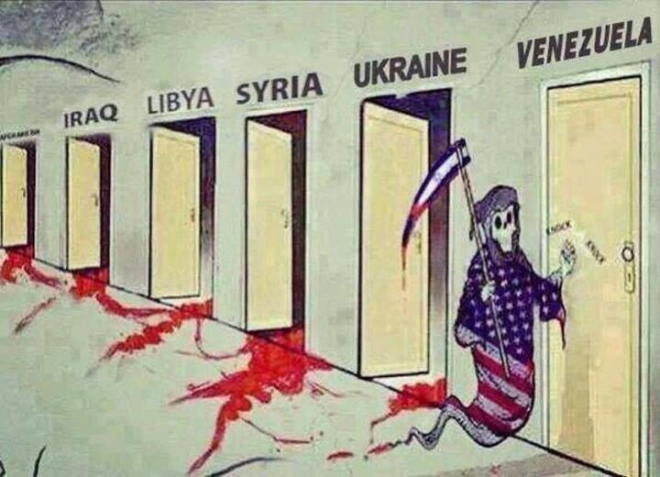
Many countries around the world are plagued by all kinds of armed rebellions, economic sanctions, civil wars, “democratic” coup d’états and/or wars of “regime change.” These include Ukraine, Venezuela, Syria, Thailand, Iran, Afghanistan, Iraq, Egypt, Yemen, Somalia and Lebanon. Even in the core capitalist countries the overwhelming majority of citizens are subjected to brutal wars of economic austerity.
While not new, social convulsions seem to have become more numerous in recent years. They have become especially more frequent since the mysterious 9-11 attacks on the World Trade Center in 2001 and the 2008 financial collapse in the United States, which soon led to similar financial implosions and economic crises in Europe and beyond.
Despite their many differences, these social turbulences share two common features. The first is that they are largely induced, nurtured and orchestrated from outside, that is, by the Unites States and its allies—of course, in collaboration with their class allies from inside. And the second is that, contrary to the long-established historical pattern of social revolutions, where the desperate and disenfranchised masses rebelled against the ruing elites, in most of the recent struggles it is the elites that have instigated insurgencies and civil wars against the masses. The two features are, of course, integrally intertwined: essentially reflecting the shared interests and collaborative schemes of the international plutocracies against the global 99%.
Fighting to Make Austerity Economics Universal
The official rationale (offered by the U.S. and its allies) that the goal of supporting anti-government opposition forces in places such as Syria, Ukraine and Venezuela is to spread democracy no longer holds any validity; it can easily be dismissed as a harebrained pretext to export neoliberalism and spread austerity economics. Abundant and irrefutable evidence shows that in places where the majority of citizens voted for and elected governments that were not to the liking of Western powers, these powers mobilized their local allies and hired all kinds of mercenary forces in order to overthrow the duly elected governments, thereby quashing the majority vote.
Such blatant interventions to overturn the elections that resulted from the majority vote include the promotion of the Orange Revolution in Ukraine (2004 and 2014), Rose Revolution in Georgia (2003), Cedar Revolution in Lebanon (2005), Tulip Revolution in Kyrgyzstan (2005) and the Green Revolution in Iran (2009). They also include the relentless agitation against the duly elected governments of the late Hugo Chavez and now his successor Nicolás Maduro in Venezuela, as well as the rejection (and effective annulment) of the duly elected Hamas government in Palestine.
So, the real driving forces behind wars of regime change need to be sought elsewhere; specifically, in the imperatives of expansion and accumulation of capital on a global level. Socialist, social-democratic, populist or nationalist leaders who do not embrace neoliberal economic policies, and who may be wary of having their markets wide open to unbridled foreign capital, would be targeted for replacement with pliant leaders, or client states. This is, of course, not a new explanation of economic imperialism; it is as old as the internationalization of trade and investment.
What is relatively new, and seems to be the main driving force behind the recent wars of regime change, is that, as the U.S. and other major capitalist powers have lately embarked on austerity economic policies at home they also expect and, indeed, demand that other countries follow suit. In other words, it is no longer enough for a country to open its markets to investment and trade with Western economic powers. It seems equally important to these powers that that country also dismantle its public welfare programs and implement austerity measures of neoliberalism.
For example, after resisting imperialist pressures for years, the late Libyan leader Muammar al-Gaddafi eventually relented in 1993, and granted major oil and other transnational corporations of Western powers lucrative investment and trade deals. Under pressure, he even dismantled his country’s nuclear technology altogether in the hope that this would please them to “leave him” alone, so to speak. None of the concessions he made, however, proved satisfactory to the U.S. and its allies, as his regime was violently overthrown in 2011and he was literally butchered by the thuggish gangs that were trained and armed by Western powers.
Why? Because the U.S. and its allies expected more; they wanted him to follow the economic guidelines of the “experts” of global finance, that is, of the U.S. and European economic “advisors,” of the International Monetary Fund and of the World Trade Organization—in short, to dismantle his country’s rather robust state welfare programs and to restructure its economy after the model of neoliberalism.
The criminal treatment of al-Gaddafi can help explain why imperialist powers have also been scheming to overthrow the populist/socialist regimes of the late Hugo Chavez and his successor in Venezuela, of the Castro brothers in Cuba, of Rafael Correa Delgado in Ecuador, of Bashar Al-assad in Syria and of Evo Morales in Bolivia. It also helps explain why they overthrew the popularly elected nationalist governments of Mohammad Mossadeq in Iran, of Jacobo Arbenz in Guatemala, of Kusno Sukarno in Indonesia, of Salvador Allende in Chile, of Sandinistas in Nicaragua, of Jean-Bertrand Aristide in Haiti and of Manuel Zelaya in Honduras.
The imperialist agenda of overthrowing al-Gaddafi and other “insubordinate” proponents of welfare state programs abroad is essentially part of the same evil agenda of dismantling such programs at home. While the form, the context and the means of destruction may be different, the thrust of the relentless attacks on the living conditions of the Libyan, Iranian, Venezuelan or Cuban peoples are essentially the same as the equally brutal attacks on the living conditions of the poor and working people in the US, UK, France and other degenerate capitalist countries. In a subtle way they are all part of an ongoing unilateral class warfare on a global scale. Whether they are carried out by military means and bombardments or through the apparently “non-violent” processes of judicial or legislative means does not make a substantial difference as far as their impact on people’s lives and livelihoods is concerned.
The powerful plutocratic establishment in the core capitalist countries does not seem to feel comfortable to dismantle New Deal economics, Social Democratic reforms and welfare state programs in these countries while people in smaller, less-developed countries such as (al-Gaddafi’s) Libya, Venezuela or Cuba enjoy strong, state-sponsored social safety net programs. Plutocracy’s intolerance of “regimented” economies stems from a fear that strong state-sponsored economic safely net programs elsewhere may serve as “bad” models that could be demanded by citizens in the core capitalist countries.
In a moment of honesty, former U.S. President Harry Truman is reported as having expressed (in 1947) the unstated mission of the United States to globalize its economic system in the following words: “The whole world should adopt the American system. The American system can survive in America only if it becomes a world system” [1].
In a similar fashion, Lord Cecil Rhodes, who conquered much of Africa for the British Empire, is reported to have suggested during the heydays of the Empire that the simplest way to achieve peace was for England to convert and add the rest of the world (except the United States, Germany and few other Western powers of the time) to its colonies.
The Mafia equivalent of Truman’s or Rhodes’ statements would be something like this: “You do it our way, or we break your leg.”
The mindset behind Truman’s blunt statement that the rest of the world “should adopt the American system” has indeed served as something akin to a sacred mission that has guided the foreign policy of the United States ever since it supplanted the British authority as the major world power.
It explains, for example, the real and the main reason behind the Cold War hostilities between the U.S. and its allies, on the one side, and the Soviet Union and its allies, on the other. While the “threat of communism” has been the official rationale for the start and escalation of those hostilities, there is convincing evidence that not only Joseph Stalin and his successors in the Soviet Union had no plans to wage war against the United States or its allies but that, in fact, they played a restraining role to contain independent revolutionary movements worldwide. “It is often forgotten,” points out Sidney Lens, “that for a few years after the war, he [Stalin] assumed an exceedingly moderate posture. . . . His nation had lost 25 million people in the war, was desperately in need of aid for rebuilding, and continued for a long time to nurture hopes of coexistence. Far from being revolutionary, Stalin in those years put the damper on revolution wherever he could” [2]. To accommodate the United States and other Western powers in the hope of peaceful coexistence, Stalin often advised, and sometimes ordered, the pro-Moscow communist/leftist parties in Europe and elsewhere in the world to refrain from revolutionary policies that might jeopardize the hoped-for chances of coexistence.
The goal or mission of converting other economies to the U.S.-style capitalism also helps explain why the United States has engaged in so many military operations and engineered so many coup d’états and regime changes around the world. The Federation of American Scientists has recorded a list of U.S. foreign military engagements which shows that in the first decade after the collapse of the Berlin Wall (1989-99) the U.S. engaged in 134 such operations, the majority of which are altogether unknown to the American public [3].
Global financial elites change “unaccommodating” regimes not only in the less developed countries but also in the core capitalist countries. They accomplish this not so much by military means as by utilizing two very subtle but powerful means: (a) artificial, money-driven elections, peddled as “democracy in action”; and (b) powerful financial institutions and think tanks such as the International Monetary Fund (IMF), central banks and bond/credit rating agencies like Moody’s, Standard & Poor’s and Fitch Group. An unfavorable rating report by these agencies on the credit status of a country can create havoc on that country’s economic, financial and currency position in world markets, thereby dooming its government to collapse and replacement. This is how during the ongoing financial turbulence of recent years a number of governments have been changed in places like Greece and Italy—no need for the traditional or military style regime change, the “soft-power” financial coup d’état engineered by the IMF and/or rating agencies would serve the purpose even more effectively.
Class War on a Global Scale
As noted, all the schemes and wars of regime change, whether by the traditional military means or by the “soft” power of the global financial juggernaut, essentially represent one thing: a disguised class war on a global level, a relentless worldwide economic war by the one percent financial-economic oligarchy against the rest of the world population.
Class struggle in an economically-tiered society is of course not new. What is relatively new in the recent years’ war of the 1% against the 99% is its escalated pace, its widespread scale and its globally orchestrated character. While neoliberal austerity attacks on the living conditions of the public in the core capitalist countries began (formally) with the supply-side economics of President Ronald Reagan and Prime Minister Margaret Thatcher more than three decades ago, the brutality of such attacks have become much more severe in the context of the current financial/economic crisis, which began with the 2008 financial crash in the United States.
Taking advantage of the crash (as an economic shock therapy, as Naomi Klein put it), the financial oligarchy and their proxies in the governments of the core capitalist countries have been carrying out a systematic economic coup d’état against the people the ravages of which include the following:
• Transfer of tens of trillions of dollars from the public to the financial oligarchy through merciless austerity cuts;
• Extensive privatization of public assets and services, including irreplaceable historical monuments, priceless cultural landmarks, and vital social services such as healthcare, education and water supply;
• Substitution of corporate/banking welfare policies for people’s welfare programs;
• Allocation of the lion’s share of government’s monetary largesse (and of credit creation in general) to speculative investment instead of real investment;
• Systematic undermining of the retirement security of millions of workers (both white and blue collar) and civil servants;
• Ever more blatant control of economic and/or financial policies by the representatives of the financial oligarchy.
Combined, these policies have significantly aggravated the already lopsided income/wealth distribution in these countries. The massive cuts in social spending have resulted in an enormous transfer of economic resources from the bottom up. The transfer has, indeed, more than made up for the 2008 losses of the financial speculators. In the U.S., for example, the wealthiest one percent now own 40 percent of the entire country’s wealth; while the bottom 80 percent own only seven percent. Likewise, the richest one percent now take home 24 percent of the country’s total income, compared to only nine percent four decades ago [4].
This shows that, as pointed out earlier, while neoliberal attacks on the 99% in the core capitalist countries may not seem as violent as those raging, for example, in Venezuela, Syria or Ukraine, the financial impact of such attacks on the living conditions of the 99% is not any less devastating.
Plutocrats of the World Are United
Policies of regime change are usually designed and carried out as collaborative schemes by cross-border plutocracies, that is, by the financial oligarchies of the imperialist countries in partnership with their native counterparts in the less-developed countries.
In addition to constant behind-the-scenes strategizing, representatives of transnational capital and their proxies in capitalist governments also routinely meet at international conferences in order to synchronize their cross-border business and financial policies—a major focus of which in recent years has been to implement global austerity measures and entrench neoliberal policies worldwide. These include the World Economic Forum in Davos, Switzerland, the World Bank and IMF annual meetings, the Periodic G20 meetings, the Aspen Institute’s Ideas Festival, The Bilderberg Group annual geopolitics forum, and the Herb Allen’s Sun Valley gathering of media moguls—to name only a handful of the many such international policy gatherings.
Through its global strategies and operations, transnational capital has broken free from national constraints and commitments at home and successfully shifted the correlation of class forces and social alliances worldwide. Today’s elites of global capitalism “are becoming a trans-global community of peers who have more in common with one another than with their countrymen back home,” writes Chrystia Freeland, Global Editor of Reuters, who travels with the elites to many parts of the world. “Whether they maintain primary residences in New York or Hong Kong, Moscow or Mumbai, today’s super-rich are increasingly a nation unto themselves,” she adds [5].
Implications for Globalization from Below
What conclusions can the 99% draw from this? What can the working people and other grassroots do to protect their jobs, their sources of livelihood, their communities and their environment? What can communities of ordinary people do to undermine the strategies of the global 1% that block life-sustaining progressive social and economic reforms?
In the same fashion that, in their fight against the working people, the elites of the international capitalist class are not bound by territoriality or national boundaries, so does the working class need to coordinate its response internationally.
A logical, first step deterrent to transnational capital’s strategy of blackmailing labor and communities through threats such as destroying or exporting jobs by moving their business elsewhere would be to remove the lures that induce plant relocation, capital flight or outsourcing. Making labor costs of production comparable on an international level would be crucial for this purpose. This would entail taking the necessary steps toward the international establishment of wage and benefits, that is, of labor cost parity within the same company and the same trade, subject to (a) the cost of living, and (b) productivity in each country.
A strategy of this sort would replace the current downward competition between workers in various countries with coordinated bargaining and joint policies for mutual interests and problem-solving on a global level. While this may sound radical, it is not any more radical than what the transnational 1% is doing: coordinating their anti-99% strategies on a global scale. If at an earlier stage of capitalist development “workers of the world unite” seemed an outlandish dream of the leading labor champion Karl Marx, internationalization of capital, the abundance of material resources and developments in technology, which has greatly facilitated cross-border organizing and coordination of actions by the 99%, has now made that dream an urgent necessity.
As capital and labor are the cornerstones of capitalist production, their respective organizations and institutions evolve more or less apace, over time and space. Thus, when production was local, so was labor: carpenters, shoemakers, bricklayers, and other craftsmen organized primarily in their local communities. But as capitalist production became national, so did trade unions. Now that capitalist production has become global, labor organizations too need to become international in order to safeguard their and their communities’ rights against the profit-driven whims of the footloose and fancy-free transnational capital.
Many would argue that these are not propitious times to speak of radical alternatives to capitalism. The present state of the sociopolitical landscape of our societies appears to support such feelings of pessimism. The high levels of unemployment in most countries of the world and the resulting international labor rivalry, combined with the austerity offensive of neoliberalism on a global level, have thrown the working class and other grassroots on the defensive. The steady drift of the European socialist, Social Democratic, and labor parties/governments toward the U.S.–style market economies and the erosion of their traditional ideology, power, and prestige have led to workers’ confusion there. The collapse of the Soviet Union, however much some socialists have always distanced themselves from that system, haunts the specter of socialism, and is likely to do so for some time to come. These developments have understandably led to workers’ and other grassroots’ confusion and disorientation globally.
None of these, however, mean that there is no way out of the status quo. Capitalism is not only “destructive,” it is also “regenerative,” as Karl Marx put. As it captures world markets, universalizes the reign of capital, and disrupts the living conditions for many, it simultaneously sows the seeds of its own transformation. On the one hand, it creates common problems and shared concerns for the majority of the world population; on the other, it creates the material conditions and the technology that facilitate communication and cooperation among this majority of world citizens for joint actions and alternative solutions.
When the majority of world population, the global 99%, will come to the realization and determination to actually appropriate and utilize the existing technology and material resources for a better organization and management of the world economy, no one can tell. But the potential and the long term trajectory of global socioeconomic developments point in that direction. The distance between now and then, between our immediate frustrations and the superior but elusive civilization of our desire, can be traversed only if we take the necessary steps toward that end [6].
Ismael Hossein-zadeh is Professor Emeritus of Economics, Drake University, Des Moines, Iowa. He is the author of The Political Economy of U.S. Militarism (Palgrave – Macmillan 2007), the Soviet Non-capitalist Development: The Case of Nasser’s Egypt (Praeger Publishers 1989), and most recently, Beyond Mainstream Explanations of the Financial Crisis (forthcoming from Routledge, April 29, 2014).
Iraq signs deal to buy arms from Iran: Report
Al-Akhbar | February 24, 2014
Iran has signed a deal to sell Iraq arms and ammunition worth $195 million, according to documents seen by Reuters – a move that would break a UN embargo on weapons sales by Tehran.
The agreement was reached at the end of November, the documents showed, just weeks after Iraq’s Prime Minister Nouri al-Maliki returned from Washington, where he lobbied the Obama administration for extra weapons to fight al Qaeda-linked militants.
Some in Washington are nervous about providing sensitive US military equipment to a country they worry is becoming too close to Iran. Several Iraqi lawmakers said Maliki had made the deal because he was fed up with delays to US arms deliveries.
A spokesman for the Iraqi prime minister would not confirm or deny the sale, but said such a deal would be understandable given Iraq’s current security troubles.
“We are launching a war against terrorism and we want to win this war. Nothing prevents us from buying arms and ammunition from any party and it’s only ammunition helping us to fight terrorists,” said the spokesman, Ali Musawi.
The Iranian government denied any knowledge of a deal to sell arms to Iraq. It would be the first official arms deal between Iran and Iraq’s government and it highlights the growing bond between them in the two years since the departure of US troops from Iraq.
One US official, told of Reuters’ findings, said such a deal could further complicate Washington’s approach to negotiating with Iran on easing international sanctions over its nuclear program, which the West suspects, with no evidence, is aimed at producing bombs. Iran says its aims are purely peaceful.
“If true, this would raise serious concerns,” the US official said. “Any transfer of arms from Iran to a third country is in direct violation of Iran’s obligations under UNSCR 1747.”
The official documents seen by Reuters showed that six of eight contracts were signed with Iran’s Defense Industries Organization to supply Iraq with light and medium arms, mortar launchers, ammunition for tanks as well as artillery and mortars.
A final two contracts were agreed to with the state-owned Iran Electronic Industries for night vision goggles, communications equipment and mortar guiding devices.
One of the contracts includes equipment to protect against chemical agents. An Iraqi army major with knowledge of procurement issues said that would include items such as gas masks and gloves, as well as injections. Baghdad has expressed fear the militants will use such agents against its forces.
Officials from the Iraqi and Iranian defense ministries signed the agreements, according to the documents. They did not list a timetable for deliveries and it was not possible to confirm whether they had taken place.
Maliki is engaged in a nearly two-month-old battle in western Iraq against al Qaeda-inspired militants and rebellious tribesmen. The prime minister has blamed the unrest in Anbar on the conflict spilling over from neighboring Syria.
One Western security official said US government experts believed an Iranian-Iraqi arms deal had been in the works for some time.
The growing friendship between the two countries is discomfiting for the United States.
Iran already supplies Baghdad with electricity and gas and reiterated an offer of military assistance in January.
The weapons purchases amount to a drop in the ocean for Iraq, which receives most of its arms from the United States and has also bought weapons and helicopters from Russia and other countries.
But they are politically significant as Maliki pursues a third term in office.
“We have here a political and not a military deal,” said Amman-based Iraq analyst Yahya al-Kubaisi from the Iraqi Center for Strategic Studies, a think tank filled with political opponents of the Iraqi government. “On one hand it is aimed at financing Iran, which is desperately in need of dollars, and on the other it is clearly aimed at winning Tehran’s support for Maliki’s third term.”
Three Iraqi lawmakers, who said they had knowledge of the deals, argued they were due to Maliki’s unhappiness with Washington’s response to his request to supply Iraq with arms and ammunition to fight militant groups during his visit late last year. Iraq has long complained the timetable for US weapons and aircraft delivery was too slow.
“The Americans were obviously dragging their feet from implementing the arms deals signed with Baghdad and under different pretexts, and that was a reason to get urgent shipments from Tehran,” said one of the lawmakers, who spoke on condition of anonymity due to the sensitivity of the subject.
The US government in recent months has delivered Hellfire missiles and surveillance drones to Iraq as part of its long-standing relationship with Baghdad, which it illegally invaded and occupied in 2003. It has also supplied Iraq with M1 Abrams tanks and is in process of delivering F-16 fighter jets.
Since fighting broke out in western Anbar in January, Washington has pushed to move ahead with the sale of 24 Apache attack helicopters to Iraq, which had been held up for months due to the concerns of US lawmakers about how Maliki would use them.
A lawmaker close to Maliki said the deal with Iran sent a message to Washington that threatening to withhold or delay arms purchases would no longer work.
“If you went to a shop to buy a toy and they refused to sell it to you, then as long as you have the cash, you can get it from the shop next door. It’s as simple as that,” said the official, who also asked to remain unnamed due to the sensitivity of the issue.
A senior Iraq army officer said Iran was the best source for quick shipments as some of the arms used by the Iraqi army are similar to those manufactured by Tehran, including assault weapons, mortars, artillery and tank ammunition. Iran even produces ammunition for US-made M-12 assault rifles, used by the Iraqi military.
(Reuters, Al-Akhbar)
U.S. Adopts Israeli Demand to Bring Iran’s Missiles into Nuclear Talks
By Gareth Porter | IPS | February 22, 2014
The Barack Obama administration’s insistence that Iran discuss its ballistic missile programme in the negotiations for a comprehensive nuclear agreement brings its position into line with that of Israel and senators who introduced legislation drafted by the pro-Israel lobby group AIPAC aimed at torpedoing the negotiations.
But the history of the issue suggests that the Obama administration knows that Iran will not accept the demand and that it is not necessary to a final agreement guaranteeing that Iran’s nuclear programme is not used for a weapon.
White House spokesman Jay Carney highlighted the new U.S. demand in a statement Wednesday that the Iranians “have to deal with matters related to their ballistic missile program.”
Carney cited United Nations Security Council resolution 1929, approved in 2010, which prohibited any activity related to ballistic missiles capable of delivering nuclear weapons, including missile launches. “So that’s completely agreed by Iran in the Joint Plan of Action,” he added.
Iranian Foreign Minister Mohammad Javad Zarif not only explicitly contradicted Carney’s claim that Iran had agreed to discuss ballistic missiles but warned that a U.S. demand for discussion of its missile programme would violate a red line for Iran.
“Nothing except Iran’s nuclear activities will be discussed in the talks with the [six powers known as the P5+1], and we have agreed on it,” he said, according to Iran’s IRNA.
The push back by Zarif implies that the U.S. position would seriously risk the breakdown of the negotiations if the Obama administration were to persist in making the demand.
Contrary to Carney’s statement, the topic of ballistic missiles is not part of the interim accord reached last November. The Joint Plan of Action refers only to “addressing the UN Security Council resolutions, with a view toward bringing to a satisfactory conclusion the UN Security Council’s consideration of this matter” and the formation of a “Joint Commission” which would “work with the IAEA to facilitate resolution of past and present issues of concern”.
It is not even clear that the U.S. side took the position in the talks last fall that Iran’s missile programme had to be on the table in order to complete a final agreement. But in any event it was not part of the Joint Plan of Action agreed on Nov. 24.
Past U.S. statements on the problem of the Security Council resolutions indicate that the administration had previously acknowledged that no agreement had been reached to negotiate on ballistic missiles and that it had not originally intended to press for discussions on the issue.
The “senior administration officials” who briefed journalists on the Joint Plan of Action last November made no reference to ballistic missiles at all. They referred only to “possible military dimensions” of the Iranian nuclear programme and to “Iranian activities at Parchin”.
The demand for negotiations on Iran’s missile programme originated with Israel, both directly and through Senate Foreign Relations Committee members committed to AIPAC’s agenda.
Citing an unnamed senior Israeli official, Ha’aretz reported Thursday that Israeli Minister of Strategic Affairs Yuval Steinitz had met with Sherman and senior French and British foreign ministry officials before the start of the February talks and had emphasised that Iran’s missile programme “must be part of the agenda” for negotiation of a final agreement.
By early December, however, Israel was engaged in an even more direct effort to pressure the administration to make that demand, drafting a bill that explicitly included among its provisions one that would have required new sanctions unless the president certified that “Iran has not conducted any tests for ballistic missiles with a range exceeding 500 kilometers.”
Since Iran had obviously tested missiles beyond that limit long ago, it would have made it impossible for Obama to make such a certification.
Although the bill was stopped, at least temporarily, in the Senate when enough Democratic members refused to support it, Republicans on the committee continued to attack the administration’s negotiating position, and began singling out the administration’s tolerance of Iranian missiles in particular.
At a Feb. 4 Senate Foreign Relations Committee hearing, the ranking Republican on the Committee, Sen. Robert Corker, ripped into Undersecretary of State Wendy Sherman, the chief U.S. negotiator in the nuclear talks with Iran.
After a highly distorted picture of Iran’s readiness to build a nuclear weapon, Corker asked, “Why did you all not in this agreement in any way address the delivery mechanisms, the militarizing of nuclear arms? Why was that left off since they breached a threshold everyone acknowledges?”
But instead of correcting Corker’s highly distorted characterisation of the situation, Sherman immediately reassured him that the administration would do just what he wanted them to do.
Sherman admitted that the November agreement covering the next months had not “shut down all the production of any ballistic missile that could have anything to do with delivery of a nuclear weapon.” Then she added, “But that is indeed something that has to be addressed as part of a comprehensive agreement.”
Sherman also suggested at one point that there would be no real need to prohibit any Iranian missile if the negotiations on the nuclear programme were successful. “Not having a nuclear weapon,” she said, “makes delivery systems almost — not wholly, but almost — irrelevant.”
That admission underlined the wholly political purpose of the administration’s apparent embrace of the Israeli demand that Iran negotiate limits on its ballistic missiles.
The Obama administration may be seeking to take political credit for a hard line on Iranian missiles in the knowledge that it will not be able to get a consensus for that negotiating position among the group of six powers negotiating with Iran.
Russia’s Deputy Foreign Minister Sergei Rybakov clearly implied that Moscow would not support such a demand in a statement Thursday that Russia “considers that a comprehensive agreement must concern only and exclusively the restoration of trust in a purely peaceful intention of Iran’s nuclear program.”
Although U.S., European and Israeli officials have asserted consistently over the years that Iran’s medium-range ballistic missiles are designed to carry nuclear weapons, Israel’s foremost expert on the Iranian nuclear programme, Uzi Rubin, who managed Israel’s missile defence programme throughout the 1990s, has argued that the conventional analysis was wrong.
In an interview with the hardline anti-Iran Wisconsin Project on Nuclear Arms Control in September 2009, Rubin said, “The Iranians believe in conventional missiles. Not just for saturation but also to take out specific targets…. Remember, they have practically no air force to do it. Their main striking power is based on missiles.”
Since 2008, the International Atomic Energy Agency has accused Iran of working on integrating a nuclear weapon into the Shahab-3 missile reentry vehicle in 2002-2003, based on a set of drawings in a set of purported Iranian documents. The documents were said by the George W. Bush administration to have come from the purloined laptop of a participant in an alleged Iranian nuclear weapons research programme.
But that account turned to be a falsehood, as were other variants on the origins of the document. The documents actually came from the Mujahedin-e-Khalq, the anti-regime organisation then listed as a terrorist organisation by the U.S. State Department, according to two German sources.
Karsten Voigt, who was the German foreign office coordinator, publicly warned about the MEK provenance of the papers in a November 2004 interview with the Wall Street Journal.
Voigt, who retired from the foreign office in 2010, recounted the story of how an MEK member delivered the papers to German intelligence in 2004 in an interview last year for a newly-published book by this writer.
Featured Video

AIDS Inc. by Gary Null (2007)
or go to
Aletho News Archives – Video-Images
From the Archives
Clash of Civilization, Iran Part II
By Jamal Kanj – Intifada-Palestine.com – January 14, 2011
Israel’s survival kit is: perpetuate conflict, insecurity to rationalize collective hate and finally playing victim.
Devoid of conflict, Israel implodes internally; without hate, Zionism loses its justification; and playing eternal victim to continue blackmailing the West. Absence of this holy trinity, Israel ceases to exist.
From its inception, the house of Zion has mastered exploiting adversarial powers to advance Israel’s cause. For instance, their influence over the Democratic Party in the US began with President Truman’s bid for 2nd term election in 1948.
Responding to strong opposition from Secretary of State General George Marshall and Department experts urging against recognition of Israel, President Truman replied: “I’m sorry gentlemen but I have to answer to hundreds of thousands [Jewish voters] who are anxious for the success of Zionism. I do not have hundreds of thousands of [voting] Arabs among my constituents”
Zionists influence over liberal American politics was matched with the doctrinal school of Conservative theoreticians aligning the Republican Party’s platform with Israel’s objectives. The Neoconservative Zionists, coined Zioncons, invented the “Clash of Civilization” concept to fight Israel’s wars. … continue
Blog Roll
 Aletho News
- Pro-Palestine protesters arrested outside UK’s ruling Labour Conference in Liverpool
- Mauritius denies landing permit to flight from Israel, forcing cancellation: Tour operator
- Israeli finance minister calls for genocidal war on West Bank, annexation of south Lebanon
- 12 Things Your Psychiatrist Was Trained Not to Tell You
- From Unipolar Universalism to Multipolar Civilizational Distinctiveness
- RSF military group defects, joins Sudanese army: State media
- Ireland goalkeeper refuses to play ‘Israel’ as squad weighs boycott
- China pushes back against US on Cuba, Iran
- Ukrainian Soldiers, Potential Mercenaries: Have Gun, Will Travel!
- Burnham’s UN debut… A masterclass in British disinformation
- If Americans Knew
- Israel forces Gazans to live in constant peril – Daily Update
- Deconstructing Netanyahu’s pants-on-fire UN rant – Daily Update
- Trump betrayed voters with his campaign lies and prioritized a foreign country once he took office
- Netanyahu calls Israel’s war in Gaza ‘opposite of genocide’ in UN speech to near-empty hall
- Settler Kidnappings: Torture, Sexual Abuse and Terrorisation of Palestinian Abductees as Israel Deepens Annexation of West Bank
- Gaza winter nears as 162,000 tents become unusable, raising fears of humanitarian crisis
- Netanyahu says, “It’s the opposite of genocide”; UN says Gaza economy is world’s ‘most severe crisis on record’ – Daily Update
- Israel’s US-Backed Assault on Gaza Has Created the ‘World’s Most Severe Economic Crisis on Record’: UN
- ‘Protecting U.S. Citizens’… From Israel
- ‘This is where I live now, the back of a truck’: a day in the life of a grandmother in Gaza
- No Tricks Zone
- New Study: Earth And Venus Surface Warmth Largely Explained By Convection And Lapse Rate, Not CO2 Or Radiation
- 2025 Nature Paper Claiming Worsening Global Drought Gets RETRACTED …Heavily Flawed
- New Study: ‘Global Drought Shows No Detectable Recent Acceleration Under Climate Warming’
- Economic Masterminds: German Socialists Suggest Taxing Productivity Gains Stemming From Using AI
- The South China Sea Has Not Been Cooperating With The Climate Change Narrative
- Energy Crisis: Germany Enters Heating Season With Historically Low Gas Reserve Fill Levels
- New Study: The Antarctic Ice Sheet Gained Mass From 2020-2024 Due To Staggering Snow And Ice Accumulation
- Study: Ocean Heating Rates From Thousands Of Years Ago ‘Dwarf’ Modern Ocean Heating Rates
- Climate Extremists Target, Attack Large-Scale Power Grid Infrastructure In Germany!
- New Study: Antarctic Ice Melt Has Contributed Less Than 1 Centimeter To Sea Level Rise In The Last 30 Years

