Russia Voted Under Fire. Washington Is Loading the Tankers.
By Larry C. Johnson | SONAR21 | September 20, 2026
Two things happened this weekend that belong in the same frame, though you will not see them connected anywhere in the Western press. Russia held a national election under a hail of drones and cyberattacks — and came through it. And overnight, the United States began signaling that it is about to widen the war in the Middle East. They are not separate stories. The same barrage that tried to break the Russian vote also tore a piece out of Russia’s refining capacity, and that connects directly to the fuel crisis Washington is about to make worse. Take them in order.
An election under attack
Russians voted over three days, September 18 through 20, to seat the ninth convocation of the State Duma, their national legislature — all 450 seats. What made the final day extraordinary was the effort, backed by the West, to disrupt it by force.
Overnight, Ukraine launched the largest drone assault of the war. Moscow’s mayor, Sergei Sobyanin, reported that air defenses brought down more than 1,600 drones across Russia since Saturday, roughly 450 of them bound for the capital region; the Russian Defense Ministry put the single-night intercept figure at 1,110, the highest it has ever reported. I will be candid: I woke up Sunday morning with no idea any of it had happened. The overwhelming majority were destroyed well before they reached Moscow. A handful got through — two people were killed and about twenty injured in the Moscow region. For those who lost their lives, and for their families, it is a tragedy. But set it against the scale: some seventeen million people live in the Moscow region, and their day went on. Then, through the voting hours, came waves of cyberattacks on the electronic voting system — another attempt to break the election that failed to break it.
Now the numbers that matter. Official turnout, per the Central Election Commission, came in around 56.7 percent over the three days. Ten parties qualified for the ballot. And in the four newly constituted republics — Donetsk, Luhansk, Zaporizhia and Kherson — turnout ran dramatically higher than the national figure, despite those regions being under active attack. People who face drones on their way to the polling station and vote anyway are telling you something about how much the franchise means to them.
The election was watched by international observers — independent-minded people, some of them frankly sympathetic to Gennady Zyuganov’s Communists, no friends of the ruling party. I spoke with several. Their verdict was the same: this was a free and fair election. I saw nothing to contradict it — no signs going up and being torn down, no one dragged away for campaigning.
Now, I know exactly what the Western press will wave in reply, so let me meet it head-on. Yes: the Supreme Court struck the federal list of Yabloko, the one small party that campaigned against the war, and Boris Nadezhdin was kept off the ballot and has since left the country. Those are the two names you will hear over and over as proof that the whole exercise was theater. It is not much of a case. Yabloko has polled below the five-percent threshold for the better part of two decades; the position it staked out — abandoning the four republics and the men fighting for them — is one almost no Russian holds. Excluding a marginal faction that stands where the West stands is not the same thing as crushing dissent, and it does not turn a three-day, ten-party election with 56.7 percent turnout into a fraud. The real spectrum of Russian politics does not run from pro-war to anti-war. It runs from those who support the special military operation to those who want it fought harder — and inside that spectrum the parties went at each other in the open, and the observers, including men who would sooner see a Communist in the Kremlin, judged the contest fair. On the evidence in front of me, the endless claim that Putin simply crushes all opposition is a fabrication.
Here is what the West consistently misreads. Russia’s parties argue fiercely about domestic policy — income inequality, taxes, education, health care, the ordinary business of any democracy. But on foreign policy they are united, something on the order of 95 percent behind the President and the special military operation. If the ruling bloc’s share slips, it will not be because Russians want the war to end. It will be because they want it prosecuted harder. That is the opposite of the war-weariness Western capitals keep predicting.
The refinery, and the squeeze
Here is the hinge the Western coverage misses entirely. In that same overnight barrage, a drone reached the Gazprom Neft refinery on Moscow’s southeastern edge — a plant that processes on the order of 245,000 barrels a day and supplies fuel to the capital region — and set it ablaze. Strip away the election framing for a moment and look at what that means for the world’s fuel balance. Every refinery knocked offline, in Russia or in the Gulf, tightens the same global distillate market. Ukraine, prodded and supplied by the West, is not only trying to break a Russian election; it is degrading Russian refining capacity at the precise moment the world can least afford to lose a barrel of diesel or jet fuel. That is the thread running straight into the second half of this story.
Washington reaches for the matches
The second development arrived overnight as well, and it points the other direction — toward escalation.
Late Saturday, September 19, the State Department sharpened its travel guidance, telling Americans outside the Middle East to seriously reconsider any travel to or through the region and warning those already there to brace for airspace closures and canceled flights. That advisory is confirmed and public. Alongside it came reports — which I have not been able to independently confirm, so I flag them as reports — that personnel manning Central Command’s operations centers are being recalled to duty, and that aerial refueling tankers are up and flying over the region. Anyone who has watched these sequences knows what airborne tankers usually precede.
The open question is the target. It could be Yemen and the Houthis — Ansar Allah — who have been trading strikes with Saudi Arabia and just put a plume of black smoke over Riyadh’s King Khalid airport. It could be Iran. It could be both. I cannot rule out any of the three. As I write this Sunday night, there is no sign that strikes are actually under way. So we will learn soon enough whether this is saber-rattling or whether Donald Trump means to escalate.
What we already know is that the global diesel and distillate crisis is getting worse, not better, and nothing on the horizon reverses it. The EIA now expects U.S. distillate inventories to sit below the five-year low through much of 2027; industry veterans reckon the world has lost something like seven million barrels a day of refining capacity to this year’s fighting. Last night’s strike on the Moscow refinery subtracts a little more. This is the box Trump has built for himself. He wants gasoline and diesel cheaper and inflation tamed — and every move he has made around the Persian Gulf, Iran, the Gulf states and now the Houthis guarantees tension stays high and the distillate squeeze stays on.
The market has been whipsawing on every on-again, off-again ceasefire rumor; crude actually eased into Friday’s close, near $104 Brent, on hopes that Saudi Arabia could restore pipeline flows. But if fresh American strikes land this week, expect that to reverse hard — crude spiking, equities selling off, the pump price and the diesel crack climbing right back up. These signals went out on a Sunday evening. Come Monday morning in New York, the odds favor a market moving the wrong way for a President who says he wants the opposite.
So that is where we stand. Trump, for all his talk of ending wars and lowering prices, keeps doing the one thing that makes both harder: pouring fuel on the fire. I will have more once the real shape of the Russian result is clear and once we know whether the tankers meant anything.
For now, the democracy that is Russia did more than survive this weekend. It was attacked, and it voted anyway. Thanks for reading.
Iran Judiciary issues indictments against 159 US, Israeli officials for assassination of Leader, commanders

Red Crescent relief workers search among the debris of homes destroyed in US-Israeli strikes in Kermanshah, west Iran, on April 1, 2026. (Photo by Tasnim)
Press TV – September 19, 2026
Iran’s Judiciary has issued indictments against 159 senior US and Israeli political and military officials over the assassination of the martyred Leader, Ayatollah Seyyed Ali Khamenei, and military commanders, Judiciary spokesman Ali Kazemi says.
Kazemi said on Saturday that 92 of the accused are US nationals and 67 are Israeli, adding that the indictments had been issued and the cases referred to court.
He said a separate civil case, filed collectively by people in Tehran and concerning material, moral and punitive damages, is being heard after the jurisdiction of Iran’s courts to consider the lawsuit was established. A hearing date will be set soon, he added.
Regarding the cases involving martyred commanders, Kazemi said cases have been opened and investigated concerning 19 commanders. Indictments were ultimately issued against 97 US and Israeli officials, including 74 Americans and 23 Israelis.
The Judiciary spokesman said around 400 cases have been filed with Iranian courts as part of domestic and international legal proceedings, adding that one case involved more than 350,000 plaintiffs.
He said the purpose of the measures was to document claims and evidence, conduct judicial proceedings and issue well-founded rulings, allowing the pursuit of legal claims inside Iran and, if necessary, internationally.
On February 28, the US and Israel launched the second round of aggression against Iran, assassinating Ayatollah Khamenei and several high-ranking commanders and officials. The war, which lasted for 40 days, was met with Iran’s decisive military response.
Iran has vowed to legally pursue those behind the assassinations at domestic and international levels.
Earlier this month, Minister of Justice Amin Hossein Rahimi said the crimes committed during the US-Israeli war on Iran are being documented for lawsuits and judicial and legal follow-up at international forums.
Iran’s Plan to Shut Down AI in the Persian Gulf
GCC internet will go dark if Trump renews hostilities
By Kurt Nimmo | Another Day in the Empire | September 18, 2026
The Gulf Cooperation Council (GCC) countries—Saudi Arabia, UAE, Qatar, Bahrain, and Kuwait—are heavily invested in AI as part of a strategy to diversify away from petroleum. National AI strategies across GCC countries emphasize investment in research and development, encourage public-private partnerships, and create regulatory frameworks that support innovation. The GCC AI market size increased from USD $6.22 billion in 2025 to USD $7.60 billion in 2026. It is projected to reach USD $23.03 billion by 2034.
In April, Iran’s Tasnim news agency mentioned the submarine cables, landing stations, and data hubs in the Gulf as strategic pressure points in the conflict initiated by the United States and Israel. According to the market research company IMARC Group, subsea internet data cables in the Gulf sit at the intersection of Europe, Asia, and Africa, and damage to these networks risks connectivity losses in one of the world’s most important internet traffic zones.
The economic importance of these cable systems extends far outside internet browsing or streaming services, notes Techstory, “because financial markets, payment systems and cloud computing firms depend on uninterrupted connections between continents every second of the day. Data centers in the Gulf and Asia also depend on those same cables to connect cloud systems serving businesses around the world.” Analysts estimate that networks linked to the GCC support roughly $10 trillion worth of financial transactions daily.
Iran claims the cables are within its territorial waters and fall under its jurisdiction. Tasnim and Fars suggest Iran may charge tech companies to use the internet cables, while Ebrahim Zolfaghari, a Brigadier General and the spokesperson for Iran’s Khatam al-Anbiya Central Headquarters, said that “companies like Google, Microsoft, Meta, and Amazon” will be required to “comply with Iranian law” and pay licensing fees for cable passage, with repair and maintenance rights given exclusively to Iranian firms.
The Islamic Republic cited the 1982 United Nations Convention on the Law of the Sea (UNCLOS), which includes provisions governing submarine cables. Article 79 of UNCLOS says coastal states have the right to establish conditions for cables or pipelines entering their territory or territorial sea.
On September 2, Iran’s Kayhan newspaper urged Iran’s IGRC to disrupt or sever international fiber-optic cables to pressure the United States and its allies. “Is it not our indisputable right, in order to bring these sources of evil to their knees and cut off their lifeline, to prevent internet cables from passing through the depths of the Persian Gulf and the Strait of Hormuz?” asked Kayhan editor-in-chief Hossein Shariatmadari. “This necessary measure could be carried out by seriously disrupting the cables’ operation or even cutting them.”
Iran has the ability to take out key cable networks, including the Fibre in Gulf submarine cable system, which connects Bahrain, Iraq, Kuwait Oman, Qatar, Saudi Arabia, and UAE. The Falcon Network connects Bahrain, Egypt, India, Iraq, Kuwait, Maldives, Oman, Qatar, Saudi Arabia, Sri Lanka, Sudan, and Yemen, while the the Gulf Bridge International links Bahrain, Iran, Iraq, Kuwait, Oman, Qatar, Saudi Arabia, UAE, and has onward connectivity to India, and Europe.
The Islamic Republic may decide to retaliate for the imposition of crippling sanctions which have negatively affected its economy, causing an increase in inflation and unemployment. Iran’s minimum wage stands at approximately 104 million rials, equivalent to roughly $110 US monthly. Essential commodity prices have risen sharply, with the International Monetary Fund documenting an annual inflation rate of 42.4%, according to October 2025 figures. Most estimates suggest sanctions have cost Iran approximately $60 billion each year by limiting investments in the energy sector. The sanctions have also significantly reduced Iran’s petroleum exports.
In 2023, the Iranian navy unveiled the domestically developed and manufactured Chamrosh-4 VTOL, a remotely operated drone designed for detecting, locating, and destroying both anchored and sleeping naval mines. Furthermore, Iran operates an undersea fleet of roughly 4 to 6 diesel-electric attack submarines well-suited to operate in the shallow waters of the Strait of Hormuz. In short, Iran has the ability to sabotage subsea internet data cables.
On September 17, President Trump, frustrated by the current stalemate in his war, said he faces a major decision over whether to escalate military action against Iran. “I have a big decision to make,” Trump said. “Do I want to go in and eliminate them or not? That’s a big decision. Anything can happen with me.”
Iran has given the United States an ultimatum for a period of three to four weeks, during which the United States must satisfy all Iranian demands. Failure to comply will result in severe escalation within the Strait of Hormuz and the execution of Iran’s planned preemptive military action targeting United States-backed Gulf infrastructure as well as American and Israeli assets, according to a senior Iranian official based in Tehran with direct knowledge of the situation.
The demands include $300 billion in reconstruction funds, a full release of Iran’s frozen assets of up to $120 billion, lifting of the US naval blockade, an end to war on all fronts (including Gaza and Lebanon), lifting of all sanctions on Iranian oil and gas, and acceptance of Iran’s permanent control of the Strait of Hormuz, including up to 7% transit fees.
President Trump is unlikely to accept these conditions, and as previously mentioned, may intensify military operations before the midterm elections. Should Trump choose to escalate, Iran has indicated it will heighten the intensity of its assaults against remaining American military and commercial infrastructure throughout the GCC region and West Asia.
On September 15, Amazon Web Services disclosed that Iranian drone strikes caused substantial damage to the corporation’s data facilities located in the United Arab Emirates and Bahrain. The preceding week, officials from the UAE declared that they were modifying their AI data center initiatives in response to the strikes, thereby underscoring a critical weakness that Iran continues to leverage with considerable facility.
South Korea says will not send troops to join terrorist US war on Iran
Press TV – September 18, 2026
South Korean President Lee Jae Myung has declared that his country will not deploy troops or military assets to join the US-led military adventurism against Iran, defying calls from Washington to support the illegal war.
“There won’t be deployment that would involve or enter war. I can tell you that very clearly,” Lee said during a news conference on Friday. “We won’t deploy military assets in any form to that end.”
He also emphasized that Seoul has maintained the principle of not becoming directly involved in combat and will continue to do so.
However, he added, South Korea is considering expanding the operational scope of its naval presence off the coast of Somalia for anti-piracy operations.
US President Donald Trump has openly lashed out at South Korea over its refusal to participate in the war against Iran and scaled back major joint military drills by the two countries’ armies this summer.
Reports said earlier this month that South Korea is flirting with the idea of deploying military assets to the Strait of Hormuz, which has remained under Iran’s control since the early days of the criminal US-Israeli war of aggression against Iran.
Iran’s Foreign Ministry spokesman Esmaeil Baghaei had warned that any military presence by other parties in the Persian Gulf and the Strait of Hormuz will constitute direct support for the aggressor, bearing serious consequences.
“No sovereign and responsible country will submit to US pressure and blackmail to collude in committing acts of aggression and heinous crimes against the great Iranian nation,” he said on September 7.
Iran restricted transit through the Strait of Hormuz in response to the terrorist US-Israeli aggression that began on February 28.
On June 17, Tehran and Washington signed the Pakistan-brokered Memorandum of Understanding (MoU), whose Article 5 places responsibility for reopening and managing the Strait squarely in Iran’s hands.
However, Washington attempted to undermine Iran’s sovereignty over the vital global energy chokepoint, resumed its airstrikes on Iran, and imposed a naval blockade in violation of the war-ending deal.
The unlawful US measures prompted Iran to re-impose restrictions on the Strait of Hormuz.
Macgregor: We Haven’t Seen the Worst of the Iran War Yet
Daniel Davis / Deep Dive – September 16, 2026
Houthis Keep Advancing as the Red Sea Crisis Deepens
Daniel Davis / Deep Dive – September 16, 2026
Prolonging US-Iran Conflict Not Meeting Interests of Int’l Community – China’s Wang Yi
Sputnik – 16.09.2026
BEIJING – The continuation of the conflict between the United States and Iran does not meet the interests of the two countries or the international community, Chinese Foreign Minister Wang Yi said on Wednesday.
Earlier in the day, Wang Yi held talks with Iranian Foreign Minister Abbas Araghchi.
“The continued prolongation of hostilities between the United States and Iran does not meet the common interests of either the parties to the conflict or the international community,” the Chinese minister was quoted as saying by CCTV.
He also noted that China has been consistent in its policy towards Iran, advocating for justice in the UN Security Council, opposing the use of force and defending the norms of international relations.
On February 28, the United States and Israel launched strikes against targets in Iran, prompting Iranian retaliatory strikes. In mid-June, Iran and the US signed a memorandum on the cessation of hostilities, but hostilities resumed shortly afterward.
The conflict remains unresolved, with hostilities resuming sporadically. Washington, however, has opted to increase economic pressure on the Islamic Republic in an effort to end the conflict by imposing additional financial hardships on Iran.
Iran & Its Allies Are Threatening Every Route for Saudi Oil
Daniel Davis / Deep Dive – September 15, 2026
Trump says Iran urgently seeks deal, Tehran sets conditions for talks
Al Mayadeen | September 15, 2026
US President Donald Trump said Monday that Iran is urgently seeking an agreement with the United States, while leaving open the question of whether Washington will engage in negotiations.
In a post on Truth Social, Trump described Iran as a “failed country” and said Tehran wants to reach an agreement with the United States “very quickly.”
Trump added that he would decide whether the United States would engage in the effort and enter negotiations, indicating that Washington remains open to the possibility of reaching an agreement with Iran.
The US president did not provide further details on what any potential agreement would entail or the conditions under which Washington would pursue talks with Tehran.
Tehran warns against mixed signals from Washington
Trump’s remarks come against the backdrop of sharply differing signals over the prospects for negotiations with Iran.
Iranian Supreme National Security Council Secretary Mohsen Rezaei warned against being misled by what he described as contradictory statements from Trump, pointing to the shift from declaring that there would be “no negotiations” to saying that Washington is ready to talk.
Rezaei stressed that Iran would not enter negotiations before its conditions are met, saying, “No negotiations before Iran’s conditions are met. Period.”
The Iranian official also said that the equations surrounding oil and strategic waterways had changed, warning that attempts to contain the consequences of the current situation would not prevent what lies ahead.
Iran sets seven conditions for reopening strait
Iran has told the United States that the Strait of Hormuz will remain closed until seven conditions approved by the country’s top officials are met, Iranian news agency Tasnim reported on Saturday, citing an informed source.
The message comes as Tehran prepares to meet with Iraq and Persian Gulf states in Oman on Monday to discuss safe routes for commercial shipping through the strategic waterway.
“Until these seven conditions, which have been approved by Iran’s top officials, are met, the Strait of Hormuz will remain closed,” the source told Tasnim.
The Iranian Foreign Ministry announced the planned meeting as efforts continue to coordinate maritime traffic amid the escalation of the US war on Iran.
Oman agreement does not include reopening waterway
The reported conditions come after Iran and Oman reached an agreement concerning the Strait of Hormuz, although the arrangement did not include reopening the waterway.
The understanding between Iran and Oman “does not provide for the immediate reopening of the Strait of Hormuz, but lays the groundwork that could allow for its reopening,” an Iranian source told Tasnim on Saturday.
The source added that the arrangement would be a step toward Iran exercising its sovereignty over the Strait and that reopening it depends entirely on the United States meeting Tehran’s conditions.
Under the agreement, the two sides coordinated the main routes for vessels entering and leaving the Strait of Hormuz.
The waterway has become a major point of concern for international shipping as the war has sharply disrupted maritime traffic through one of the world’s most important energy routes.
Austria bars Iran nuclear chief from IAEA summit due to US pressure
The Cradle | September 14, 2026
Iran’s top nuclear official has been blocked from addressing the International Atomic Energy Agency (IAEA) general conference in Vienna after pressure from Washington, Bloomberg reported on 14 September, citing a US official.
Iran’s vice president for nuclear affairs, Mohammad Eslami, left Tehran on Saturday and was slated to address the UN nuclear watchdog as part of its 70th General Conference, which began on Monday.
However, Austria denied Eslami entry at the request of the Trump administration, an anonymous US official told Bloomberg.
A spokeswoman for the Austrian government referred questions over the issue to the Foreign Ministry, which did not immediately respond to a request for comment.
“His attendance and early speaking slot could have been seen as lending credibility to Iran,” Bloomberg wrote.
Meanwhile, US Energy Secretary Chris Wright will be given a platform to speak at the conference. He plans to promote US claims that Iran is seeking to build a nuclear weapon.
While the US has attacked Iranian nuclear facilities, it has never produced evidence that Tehran is developing a nuclear weapon.
Iran has long said its nuclear program is for peaceful energy purposes and has allowed the IAEA to monitor its activities.
Wright’s planned speech follows a claim from the IAEA that the agency observed nuclear related construction activity at Iran’s Pickaxe Mountain.
President Trump claimed last Wednesday that there was “a little activity at Pickaxe” and warned Iran “not to get cute, because we will have to hit them very hard.”
In response, Iranian Foreign Ministry spokesman Esmail Baghaei said the IAEA and US claims of construction at the site are “part of Washington’s psychological warfare.”
They speak as if a secret and confidential case has been discovered while, in fact, “we are facing fuss for nothing,” Baghaei stated.
Iran submitted a formal request to the IAEA Secretariat to discuss at the conference the topic of “prohibiting all forms of attacks and threats of attack against nuclear sites and facilities that are under Agency safeguards and dedicated to peaceful purposes.”
US influence over the IAEA was apparent last week, when the UN agency referred Iran to the UN Security Council (UNSC) for “non-compliance” with its obligations under the Nuclear Non-Proliferation (NPT) treaty.
The board of governors of the UN nuclear watchdog passed a resolution at a meeting in Vienna claiming a lack of information on Iran’s nuclear material and the lack of access to nuclear facilities for IAEA inspectors.
The IAEA resolution was tabled by the UK, France, Germany and the US and called for IAEA chief Rafael Grossi to report Iran to the Security Council.
Representatives of 23 countries on the IAEA board of governors voted to approve the measure, while eight abstained. China, Russia and Niger voted against it.
The US and its European allies will likely use the decision to impose new sanctions on Iran through the Security Council.
However, Russia and China could block such efforts with their vetoes.
Tehran condemned the IAEA decision, saying that US and Israeli strikes on its nuclear facilities had disrupted nuclear inspections.
“They attack Iran’s safeguarded nuclear facilities, disrupt the normal process of verification, and then use that very disruption as a pretext to issue a resolution,” Iranian deputy Foreign Minister Kazem Gharibabadi wrote in a post on X.
The US and Israel targeted Iran’s nuclear facilities during their unprovoked 12-day war on the Islamic Republic in June 2025.
Washington and Tel Aviv renewed their aggression against Tehran during 40 days of intense strikes in February of this year.
The Crippling Effects of Unnecessary War
By Ron Paul | September 14, 2026
In California, gas stations are facing a unique challenge. The station signs are only configured to go up to $9.99 per gallon and at several stations the price of diesel has reached that maximum. Diesel prices are higher than they have ever been in history.
Worse, according to some news reports the advertising of the maximum price of $9.99 per gallon is meant to signal to truck drivers that they have run out of diesel altogether. Expensive diesel is a hit to the economy, but running out of the fuel at any price is a whole different kind of crisis.
Our highways are filled with semi-trucks burning diesel to bring the products we depend on to the markets. Our freight trains use diesel to transport what is not transported by truck. When the price of diesel increases, the cost of everything moved by that diesel also increases. This is one reason we are seeing much more inflation than the government wants to admit.
The diesel crisis is getting so serious that even President Trump has been forced to admit it. Of course, instead of taking at least part of the blame over his war of choice against Iran and his continuation of the proxy war against Russia through Ukraine, he is blaming Ukraine’s military strikes on Russian energy infrastructure.
President Trump is now asking Ukraine to stop attacking Russian energy resources because diesel is a global commodity and the scarcity produced by the attacks is hitting us here at home. But the strikes deep inside Russia are guided by US intelligence, which provides the targeting data for Ukraine.
The Russia/Ukraine war is only part of the problem. Despite President Trump’s bluster about controlling the Strait of Hormuz, the fact is Iran is in control and very little oil – or anything else – makes it out without Iranian approval.
Yemen’s Iran-allied Houthis joining the fight only makes matters worse. Over the weekend they attacked Saudi Arabia’s bypass pipeline, taking much more oil off the market.
The real problem here is not oil or diesel. The real problem is that wars of choice spin out of control and destroy the economies of those who launch them. Empires throughout history have been undone by endless overseas wars. No amount of bragging about the size and strength of our military can change this reality.
Now we are seeing the chickens coming home to roost.
President Trump has justified tanking the US economy by claiming the attack on Iran was essential because they were about to get a nuclear weapon. Our intelligence community disagreed, but he refused to listen and took his cue from Netanyahu instead.
It turns out Iran actually does have a “nuclear weapon.” That weapon is the ability to control the world’s oil flows at a margin high enough to cripple the economies of any country seeking to conquer it. According to press reports, former Director of National Intelligence Tulsi Gabbard tried to warn President Trump that Iran would close the Strait of Hormuz if attacked but he didn’t want to hear it.
The Founders were determined to prevent the executive branch from being able to start wars for this very reason. The “people’s branch” of government – Congress – is where they placed the power to launch wars. We are now seeing the consequences of ignoring their very wise advice.
Iran, UAE seek to restore ties after US war on Iran
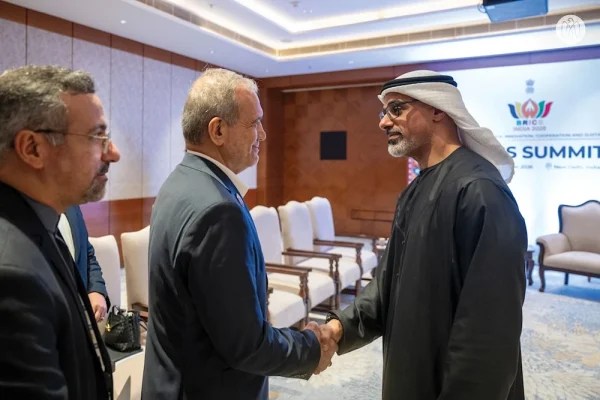
Al Mayadeen | September 13, 2026
Iranian President Masoud Pezeshkian said following the BRICS summit in India that Iran and the UAE want to restore relations following the US war on Iran.
“For the first time since the war and the incidents that occurred in the Persian Gulf, we had a constructive exchange with the crown prince of Abu Dhabi,” Pezeshkian said a day after a meeting with Abu Dhabi Crown Prince Khaled Bin Mohamed Bin Zayed Al Nahyan on the sidelines of the BRICS summit.
The Iranian President added that “it was agreed that we would turn the page, look to the future and build it together.”
Pezeshkian and Abu Dhabi’s Crown Prince met on the sidelines of the BRICS summit in New Delhi on Saturday, where the two discussed “regional and international issues, de-escalation, stability, and efforts to advance regional peace and development,” per the Abu Dhabi Media Office.
Featured Video

Racist Seinfeld Dances for Joy as Bibi Unveils His New Map
or go to
Aletho News Archives – Video-Images
TV Drama Review
Japanese drama projects Japan’s wartime atrocities onto Chinese characters

Global Times | October 25, 2026
By portraying Chinese characters as perpetrators of ruthless violence while casting Japanese Self-Defense Forces (SDF) intelligence operatives as defenders, the season 2 of the Japanese drama Vivant has recently drawn criticism from Chinese netizens, who argue that its depiction turns historical reality on its head while ignoring Japan’s wartime atrocities.
The TBS drama series – a spy suspense story in which an alleged unofficial intelligence unit of the SDF operates across the globe — has attracted a passionate fanbase. Its currently airing season 2 opened with a household rating of 18.8 percent, the highest for a TV drama this year, according toa commentary article by Japanese media Toyo Keizai.
What draws attention is the portrayal of the enemies in the series, the article noted. Scenes in which the Chinese organization subjects kidnapped members of the SDF unit to brutal torture are repeated with unrelenting intensity.
It is rare for Japanese TV dramas to explicitly portray a real-life country as the enemy, the article noted.
Japanese Prime Minister Sanae Takaichi also made a reference to the drama, saying that she has been recording Vivant and hopes to binge-watch it over the year-end and New Year holidays, according to Japanese media outlets.
China’s CCTV News report on Sunday revealed that the drama features scenes in which Chinese personnel cut off the fingers of and stab Japanese intelligence operatives in the abdomen. Such acts bear striking similarities to the torture inflicted on Chinese nationals by invading Japanese troops during the World War II.
The drama distorts the truth by attributing these atrocities to modern Chinese characters. Beneath the surface, it subtly glorifies Japan’s cross-border overseas operations, blurs the functional boundaries of the SDF and implicitly promotes an expansionist narrative, per CCTV News. … continue
Blog Roll
 Aletho News
- EU facing trillion-euro debt hole while seeking more cash for Kiev
- How US, Europe, Persian Gulf states exhausted missile stockpiles, splurged billions to defend Israel
- Up in arms… Koreans reject U.S. empire’s plan to make South Korea the next Ukraine
- Iran, Turkey, Pakistan, Saudi Arabia could advance region-led security framework in Tehran: FM spox
- Netizens condemn Japanese drama for projecting Japan’s wartime atrocities onto Chinese characters
- Racist Seinfeld Dances for Joy as Bibi Unveils His New Map
- A West Bank War for Netanyahu’s Election Campaign, Could It Backfire?
- Yemen denounces European Parliament’s ‘hypocritical’ push to blacklist Ansarullah
- Qalibaf: UAE’s UN bid aims to ‘clear the runway’ for ‘Greater Israel’, whitewash genocide
- Pakistan reopens Iran border after boosting security: Report
- If Americans Knew
- Why Israel’s latest assault on Hebron is so significant for the West Bank
- Israel Used “Where’s Daddy?” AI to Relentlessly Murder Palestinian Journalists and Their Families in Their Homes from October to December 2023
- DAILY UPDATE: Latest essential news on Palestine, Israel, & region
- Netanyahu Says Israel Must Prepare for Banking Sanctions, Floats Crypto as a Possible Bypass
- Latest updates from Israeli assault on West Bank
- Tourism Ministry launches free food truck tour in US
- “So Much Worse Than People Realize”: Never-Before-Seen Images Reveal Damage at U.S. Bases as Troops Describe Being Abandoned
- UK Bell Review Confirms Only Anti-Israel Attitudes Are Rising, Not Antisemitism
- DAILY UPDATE: Latest essential news on Palestine, Israel, & region
- DAILY UPDATE: Latest essential news on Palestine, Israel, & region
- No Tricks Zone
- Sudden Stratospheric Warming, Powerful El Niño Combination May Lead To Extreme Europe Cold, Energy Crisis!
- Two New Studies Find Thwaites Glacier Melt Cannot Be Driven By Human Activity Or A Warming Ocean
- E-Cars Reduce CO2 Emissions By Only 41% Compared To Internal Combustion Engine Vehicles
- Predictions Made By Renowned Climate Professor Over Past Decades Have Been Proven To Be Poor
- New Study Suggests Large Regions Of The Pacific Ocean Have Been Cooling For The Last 80 Years
- Germany’s Green Energy Debacle: High Energy Costs Force Kahla Porzellan to Close After 182 Years!
- New Study: 50 Years Of The Most Aggressive ‘Net Zero’ Policies Can Only Affect The Global Climate By 0.03°C
- US September “Heat” Was No Record…Many Records Set Decades Ago
- Latest European Green Energy Debacle; Portugal’s Largest Flagship Solar Park Insolvent!
- Green Energy Debacle: German Expert Professor Fritz Vahrenholt Warns Of Severe Economic And Social Consequences

