Trump and Iran, War or Negotiations?
By Samyar Rostami – New Eastern Outlook – January 26, 2026
Although the likelihood of a US attack on Iran has greatly increased. If Iran shows widespread strength and resistance, the Americans will retreat. Iran’s response to military attacks will certainly be more severe and comprehensive than in previous cases.
In the national security document published in Trump’s second administration, like the previous two documents, the national defense of the United States is characterized, as it includes the defense of the territory, the defense of the people, the defense of the political system, and the defense of the economy.
Iran’s position was also prominent in previous documents. In that document, the name of Iran was repeated six times, and it was one of the greatest threats to US national security. It was proposed, and in addition, in two other cases, it referred to the threat of Iran.
In the latest document, the number of these references has been reduced to three. In the new document, direct reference to Iran’s nuclear program has been almost eliminated. But the issue and role of waterways is still prominent in this document; in fact, this time the name of the Strait of Hormuz is explicitly mentioned and emphasized in the new document.
The new US national security document depicts Iran in the general framework of “weakening” and does not actually mention Iran as a fundamental threat. But this does not mean that the United States no longer considers Iran a threat.
War or negotiations
The behavior of the Trump administration, namely in recent months, has been not only in rhetoric but also in practice anti-Iranian, from pressuring European governments to activate the snapback mechanism to supporting Israeli military actions, seizing ships suspected of carrying weapons to Iran, and even actions such as seizing ships off the coast of Venezuela.
Given the current state of US-Iran relations, the US has two options: moving towards an agreement or adopting a military option, but Washington’s desire is to stop Iran’s nuclear capability without falling into the quagmire of eternal wars.
The issue of negotiations had been stalled since the 12-day war because Tehran refuses to return to negotiations before receiving the necessary guarantees from the US about not starting another attack against Iran by Israel or the US and having the right to enrich uranium.
Not all Trump officials and aides share the same view and approach, and some believe that negotiating with Tehran will increase Iran’s legitimacy. Within the administration, it seems that some are willing not to move towards a military option before diplomatic solutions are exhausted.
Also, the United States, which previously adopted a policy of “maximum pressure campaign,” still claims to protect the rights of the Iranian people. In this regard, Donald Trump has now imposed a 25% customs tariff on any country that has trade relations with Iran, which could have a negative impact on Iran’s economic relations. Trump also called for illegal actions, including the occupation of government institutions, by asking Iranian protesters to continue the protests and even promised that help was on the way.
The United States is also using the protests inside Iran as a tool to gain more concessions from Tehran in any possible agreement.
Iran’s readiness for diplomacy and defense
Previously, Iranian Foreign Minister Abbas Araghchi had emphasized that the United States and the regime would not achieve a different result by repeating the previous failed experience. “Iran is much more prepared than the 12-day war,” he said, adding, “I hope the wise option will be chosen. We will prepare diplomatic and economic options.”
In a situation where an average of $10 billion was allocated annually for the import of basic goods, the government came to the conclusion that economic surgery should be performed in this area; the preferential currency should be eliminated for consumers.
The protests in Iran have been carried out peacefully since early January by a group of people and trades in response to currency fluctuations and the living conditions. The government announced that it recognizes these protests and efforts to address these concerns are ongoing. However, after a week and on January 8-9, the protests by terrorist elements turned into riots in cities, destroying government, public, relief, and mosques.
Iranian authorities have made mass arrests of terrorist elements in team houses and terrorist cells, and they even have documents about the connections between these terrorist elements and the United States and Israel.
In the view of government spokeswoman Fatemeh Mohajerani, the peaceful protests of the people were subjected to a terrorist attack. Also, Brigadier General Ahmad Ali Goodarzi, Commander of the Faraj Border Guard, announced the identification and destruction of 3 terrorist teams before they entered the country at the country’s borders and the discovery of weapons and ammunition from them.
Amir Saeed Iravani, Ambassador and Permanent Representative of Iran in the United Nations, stated in a letter to the Security Council and the Secretary-General of the UN: “The Islamic Republic strongly condemns the continuous, illegal, and irresponsible behavior of the United States of America in coordination with Israel to interfere in Iran’s internal affairs through threats, incitement, and deliberate encouragement of instability and violence.”
Also, internal cohesion among political groups and figures in Iran is established and stable. Apart from the words and positions of the Leader of Iran, the representatives of the Islamic Consultative Assembly (Parliament) considered the government’s decision (end of the consumption chain) a courageous act and an important step.
The parliament speaker, Mohammad Bagher Ghalibaf, said, “At this time, the responsibility of us as Iranian officials is to confront the enemy in the economic war.”
From the perspective of Hassan Rouhani, if a foreign aggressor wants to abuse the protest within the family, the family members will put aside the difference and break the aggressor’s hand.
In fact, from Tehran’s perspective, Iran is ready for both war and negotiation. That means fair, honorable, and equal negotiations with mutual respect and based on mutual interests are still the priority, not giving orders and dictating. Iran also has preconditions.
Although the US has greatly increased its forces in the region. Iran’s military forces are also at the peak of defensive readiness and are ready to confront any aggression and evil of the enemy against Iran. Therefore, any action must face retaliation from Iran.
The amount of oil sales in the past 14 months in the form of export shipments has been record-breaking. The creation of new restrictions on the sale of Iranian oil does not create any serious restrictions on Iran’s oil sales processes.
Outlook
It seems that the US is paying special attention to shaping a soft transformation and a colorful and internal revolution in Iran, along with hard threats as a means of pressure. But internal cohesion among political groups and figures in Iran is established and stable.
Although the likelihood of a US attack on Iran has greatly increased. If Iran shows widespread strength and resistance, the Americans will retreat. Iran’s response to military attacks will certainly be more severe and comprehensive than in previous cases.
In the meantime, Washington’s failure in the direction of the hard programs could make the path of interaction or resolution of issues between Iran and the United States, in the new framework, more complex.
Samyar Rostami is а political observer and senior researcher in international relations.
Follow new articles on our Telegram channel
US pledges to ‘starve’ Iraq of oil revenue if pro-Iran parties join new government
The Cradle | January 23, 2026
Washington has threatened to block Iraq’s access to its own oil revenue held in the Federal Reserve Bank of New York if representatives of Shia armed parties enjoying support from Iran are included in the next government, Reuters reported on 23 January.
“The US warning was delivered repeatedly over the past two months by the US Charges d’Affaires in Baghdad, Joshua Harris, in conversations with Iraqi officials and influential Shi’ite leaders,” Reuters reported, citing three Iraqi officials and one source familiar with the matter.
The threat is part of US President Donald Trump’s effort to weaken Iran through a “maximum pressure” campaign of economic sanctions, including on the Islamic Republic’s oil exports.
Trump also bombed Iran’s nuclear sites as part of Israel’s unprovoked 12-day war on Iran in June.
Because of US sanctions, few countries can trade with Iran, increasing its reliance on Iraqi markets for exports and on Baghdad’s banking system as a monetary outlet to the rest of the world.
As punishment, the US government has restricted the flow of dollars to Iraqi banks on several occasions in recent years, raising the price of imports for Iraqi consumers and making it difficult for Iraq to pay for desperately needed natural gas imports from Iran.
However, this is the first time the US has threatened to cut off the flow of dollars from the New York Federal Reserve to the Central Bank of Iraq.
Officials in Washington can threaten Baghdad in this way because the country was forced to place all revenues from oil sales into an account at the New York Fed following the US military’s invasion of the country in 2003.
This gives Washington strong leverage against Baghdad, as oil revenue accounts for 90 percent of the Iraqi government’s budget.
While occupying Iraq for decades and controlling its oil revenues, Washington accuses Iran of infringing on Iraq’s sovereignty.
“The United States supports Iraqi sovereignty, and the sovereignty of every country in the region. That leaves absolutely no role for Iran-backed militias that pursue malign interests, cause sectarian division, and spread terrorism across the region,” a US State Department spokesperson told Reuters.
Some Shia political parties, including several that make up the Coordination Framework (CF), are linked to the Popular Mobilization Units (PMU), anti-terror militias formed in 2014 with Iranian support to fight ISIS and later incorporated into the Iraqi armed forces.
Iraq held parliamentary elections in November and is still in the process of forming the next government.
Prime Minister Muhammad Shia al-Sudani, who enjoyed good relations with both Washington and Tehran, has decided not to contend for another term as premier.
The decision has cleared the way for Nouri al-Maliki, of the State of Law Coalition and the Dawa Party, to potentially return to power.
Maliki, who enjoys support from the PMU-linked parties, served as prime minister between 2006 and 2014, including when ISIS invaded western Iraq and conquered large swathes of the country.
Trump threatened a new bombing campaign against Iran following several weeks of violent riots and attacks on security forces organized and incited by Israeli intelligence.
Trump allegedly called off the bombing after Israeli Prime Minister Benjamin Netanyahu warned him that Tel Aviv’s air defenses were not prepared for a new confrontation with Iran.
During the war in June, Iran retaliated against Israel by launching barrages of ballistic missiles and drones, which did severe damage to Israeli military sites, including in Tel Aviv.
Why is the US using Jordan as the main base in possible Iran attack?
By Ali Jezzini | Al Mayadeen | January 23, 2026
US forces have amassed in Jordan ahead of a possible war on Iran, aiming to shift early retaliation away from Israelis, and exploit US airpower, while risking strategic miscalculation and overreach.
Over the past week, the United States has significantly reinforced its military footprint in West Asia amid rising tensions with Iran, deploying F-15 fighter jets and KC-135 tanker aircraft to Jordan’s Muwaffaq Salti Air Base as part of a broader repositioning of airpower ahead of a potential attack on Iran.
This buildup, which can be tracked using publicly available satellite images, comes against the backdrop of Iranian warnings to retaliate against American bases in the region should Washington — or its allies — launch an attack on Iranian territory. It also follows movements of US forces and dependents at several regional posts as a staging for possible offensive operations. The intensification of US deployments has thrust installations like Muwaffaq Salti, long a strategic node in Western forces’ deployment in West Asia, into the spotlight as both a potential launch point for attacks and a possible target in any wider conflict.
Why Jordan’s Muwaffaq Salti Air Base?
Part of the United States’ increasing focus on Jordan’s Muwaffaq Salti Air Base is not simply due to its distance from Iran’s most accurate short-range ballistic missiles, approximately 800–900 kilometers from Iran’s borders, but also because it may be intended to function as a primary Iranian target, or punching bag, in any initial phase of a wider war.
What follows is an attempt to analyze American strategic thinking, though it does not claim that events will necessarily unfold in this precise manner. From Washington’s perspective, “Israel” remains the crown jewel of the imperial order, an extension of US polity itself. During the most recent phase of confrontation, “Israel” encountered serious difficulties intercepting Iranian ballistic missiles, threats it now equates with nuclear weapons in strategic gravity. This urgency explains the current haste, as Iranians ought to possess much greater defensive capabilities in the future, coupled with the baptism by fire they endured during the June 12-day war.
Destroying Iran’s missile program outright is unrealistic, since large parts of the supply and production chains are dispersed in highly fortified underground facilities. As a result, targeting the Islamic system itself, seeking regime change, and sustaining what the US deems as acceptable costs may appear more logical to American planners. In their calculation, such an outcome would justify heavy losses, provided it ends the conflict definitively.
Israeli claims regarding the self-sufficiency and effectiveness of their air defenses are among the most exaggerated on earth. In reality, NATO intelligence and military capabilities played a decisive role in interception efforts, operating out of Jordan. This included US, Jordanian, and French air forces taking off from Jordanian bases, in addition to extensive intelligence, logistics, and aerial refueling missions done by NATO countries, including the UK.
Israeli leadership attempted to strike early under ideal surprise conditions before defensive gaps accumulated and before they were drawn into a prolonged escalation cycle they could not sustain. Even internal measures, such as preventing Israeli settlers from leaving during the war, reflected an acute awareness of how fragile the situation could become if panic spread; that kind of optics is strategically disastrous for a regime that sells itself as secure, resilient, and permanent.
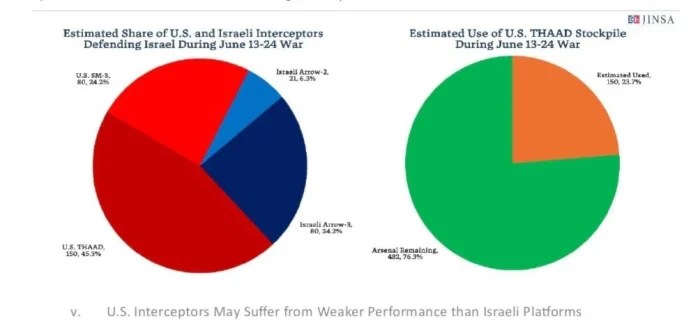
Most interception during the last confrontation in June 2025 was conducted by US naval assets using SM-3 interceptors and THAAD systems. Roughly 25 percent of all THAAD interceptors ever produced were reportedly consumed in that single episode. The persistent exaggeration of Israeli offensive and defensive capabilities, while significant but short-winded, serves two purposes:
- First, it counters the internal Israeli narrative that the United States “saved Israel” after October 7, a deeply sensitive issue tied to Israeli national security self-perception that panics at the idea of having such a level of dependency on the US.
- Second, it preserves an image of invincibility before regional actors, enhancing the regime’s deterrence.
Returning to Jordan: American planners show little concern for Jordanian costs or the consequences for the base itself, which is situated around 70km from the capital Amman. From this perspective, it may even be deemed acceptable for the US if Iran expends part of its ballistic arsenal striking the base, even at the cost of Jordanian casualties.
The American assumption is that they would then be able to launch a major air campaign to destroy Iranian missile production, storage, and launch sites. This would pave the way for an Israeli entry into a second phase of the war, one in which it would no longer face missile volumes it cannot absorb, as it almost did in the June war, as it was running out of interceptors after a presumed US airpower success in weakening the system and reducing launch capacity.
From Iran’s standpoint, directly starting with “Israel” may actually be more rational. An Israeli participation in any war appears almost inevitable, either immediately or at a later stage, for multiple reasons.
Despite the massive US buildup, which includes more than 36 F-15Es, an aircraft carrier, and several destroyers with capabilities to launch cruise missiles, Israelis still retain greater immediate regional firepower than the United States, but it seeks to avoid sudden, large-scale damage to its own infrastructure.
American intentions likely go beyond limited bombings, assassinations, or “decapitation” strikes, as seen previously, if their attack would make sense in terms of weighing gains and possible losses. They may include direct strikes targeting the Iranian leadership, severe economic and energy infrastructure degradation, and long-term destabilization designed to enable internal regime change, added to the sanctions.
The withdrawal of American aircraft from Gulf bases was not only due to their vulnerability to short-range, high-precision weapons that Iran’s arsenal is full of, but also to protect Gulf oil production in the event of war. Gulf states, for their part, would publicly distance themselves from hostilities to shield their economies and prevent market shocks, particularly to avoid upsetting Trump amid any market volatility.
While it is possible to disrupt US operations at Muwaffaq Salti Air Base, expending large numbers of ballistic missiles there, missiles that could instead strike high-value counter force and counter value Israeli targets, may be less strategically viable than other options if the US is prepared to escalate toward total confrontation regardless. Completely and permanently disabling the base would be difficult, and the strategic outcome would likely remain unchanged.
American planners appear convinced that Iran will avoid targeting Jordanian state infrastructure or attempting to destabilize the Jordanian monarchy, as such actions can be used for counterpropaganda. They assume Iran will focus on Western and Israeli forces, confining hostilities to sparsely populated desert areas that Jordan can absorb.
Jordan, governed by a monarchy heavily dependent on Western and Gulf countries’ political and economic support, appears to share this assessment. King Abdullah likely believes his rule faces no serious internal risk and that alignment with Western strategy is the safer course, as his country was credited for being “Israel’s” shield against Iranian drones in the June 2025 war.
Under this framework, the US would launch an air campaign using aircraft operating from Jordan to strike western Iran, while carrier-based aircraft in the Arabian Sea attempt to open corridors toward central Iran from the Gulf. This would allow heavy bombers from Diego Garcia to penetrate deeper and strike strategic targets. The Israeli occupation would then enter at a later stage.
The simplest counter-strategy is to do precisely what the Americans do not expect, and to inflict maximum cost. The theory that remains largely unrefuted: Trump is risk-averse. As Western media itself jokes, TACO (Trump Always Chickens Out), he dislikes long wars, favors last-minute, flashy interventions, and avoids sustained attrition. This suggests a vulnerability: American short-termism and reluctance to absorb prolonged pain, particularly when multiple theaters remain active.
Some may ask why Iran does not simply launch a preemptive strike. This is a clear option, but not an uncomplicated one. An initial Iranian strike could rally American public opinion behind a longer war, granting Trump broader authority, resources, and popular support. While it would disrupt US planning and cause early damage, it might ultimately strengthen Washington’s domestic position. By contrast, an American-initiated war, prolonged, unpopular, and costly, would be far more vulnerable to internal pressure, especially if American losses mount.
Adding to the complexity, two Emirati Il-76 cargo aircraft reportedly landed in Tel Aviv before flying on to Turkmenistan. These aircraft are known to be used by the UAE to supply proxy forces with weapons, particularly in Sudan and Somalia, raising the possibility that they were transporting drones or intelligence equipment for regional operations.
The picture remains highly complex, and it is entirely possible that nothing will happen. Still, based on current force deployments and escalation patterns, the probability of a US attack appears to have risen beyond a 50-50 threshold.
This analysis reflects what American planners may be thinking, not what will necessarily occur. It should be noted that after the previous war, many US and Israeli officials declared that Iran’s nuclear and missile programs had been torpedoed, and the system effectively destroyed, assessments that quickly proved false. Now, only months later, they appear to believe that an even more violent war is required to achieve what the last one supposedly already accomplished.
On the other hand, if endurance is possible and the United States is forced to retreat, Trump TACOs or abandon Israelis mid-conflict — an outcome not inconceivable under a president like Trump — the cumulative effects of “Israel’s” recent dominance and coercion across the region may yet be reversed.
As mentioned earlier, the US buildup is not sufficient to start a prolonged attack against Iran with the high goals of regime change. The buildup still does seem as defensive posturing shielding the Israelis, so a chance the Israelis might initiate and use the limited US and Western buildup as a shield is still significant. A scenario similar to what happened in the last war, but that does entail Israeli losses in the opening phase.
Conclusion
What emerges from this assessment is a US strategy built on supposed escalation control, risk displacement, and the assumption that others will behave within predefined limits. Washington appears to believe it can shape the battlefield geographically, pushing early phases of the war away from the fragile “Israel”, absorbing initial retaliation through peripheral bases, and then intervening decisively to reshape the balance before handing the fight back to Israelis under more favorable conditions. This is not a strategy aimed at victory in the classical sense, but at managing exposure and buying time.
The weakness in this thinking lies in its dependence on predictability. It assumes Iran will refrain from actions that collapse the carefully constructed sequencing of the war, that regional systems will remain stable under strain, and that American political leadership will tolerate the costs long enough to reach a decisive point. None of these assumptions is guaranteed. If any one of them fails, the entire escalation ladder becomes unstable.
Ultimately, the outcome of any confrontation will not be decided by the opening phase or by claims of technological superiority, but by endurance, political cohesion, and the ability to impose sustained costs on an adversary unwilling to absorb them.
The United States may possess overwhelming firepower, but it remains constrained by limited strategic patience and domestic vulnerability. If those constraints are effectively exploited, the very war designed to resolve the Iranian question may instead deepen American entanglement and erode the regional order it seeks to preserve.
World has had enough of confused clowns: Araghchi to Zelensky
Al Mayadeen | January 23, 2026
Iranian Foreign Minister Abbas Araghchi publicly criticized Ukrainian President Volodymyr Zelensky, accusing him of corruption, hypocrisy, and double standards in relation to international law and US foreign policy, calling him a “confused clown”.
In a post on X, Araghchi accused Zelensky of having been “rinsing American and European taxpayers” to benefit corrupt military figures.
At the same time, Araghchi accused Zelensky of double standards for openly advocating for US military action against Iran, an action illegal under international law, while the Ukrainian president also describes the war in Ukraine as an unlawful act in violation of the UN charter. “The world has had enough of Confused Clowns,” Araghchi wrote, asserting that Iran does not rely on foreign-backed or “mercenary-infested” forces and is capable of defending itself without outside assistance.
The comments reflect rising rhetorical tensions between Iran and Ukraine, as Tehran continues to position itself against Western military influence and US interventionism. Araghchi’s statement also aligns with Iran’s broader diplomatic messaging, which frames Western-backed military operations as violations of international law against Iran, a sovereign state resisting external pressure.
Araghchi’s comments come after Zelensky’s speech at Davos, where he claimed that “so much was said about protests in Iran, but they were drowned in blood.”
He added, “The world did not help the Iranian people enough; it stood aside. By the time politicians began forming positions, the Ayatollah had already killed thousands. What will Iran become after this bloodshed? If the regime survives, it sends a clear signal to every bully: kill enough people, and you stay in power.”
The West has since 2022 accused Iran of providing military aid to Russia for use in the war in Ukraine.
Iranian officials have consistently denied providing weapons to Russia for battlefield use in Ukraine. Tehran has demanded documentary proof from Ukraine and pointed to Kiev’s inability to present conclusive evidence as weakening those accusations.
Zelensky’s statements reflect how the US and its allies selectively invoke the UN Charter: Russia’s actions are condemned as aggression, while US-led wars, assassinations, and sanctions campaigns are normalized or justified as “rules-based order.”
Iran: The Eurasian Lock
Iran’s geography makes it a strategic hinge – one that anchors Russia’s southern depth and gives China an escape from US maritime containment
By Abbas al-Zein | The Cradle | January 22, 2026
In the corridors of US strategic decision-making, Iran is no longer treated as a discrete regional file. Dealing with Tehran has become inseparable from great-power competition itself. Coordination between Iran, Russia, and China has moved beyond situational alignment, coalescing into what western analysts increasingly describe as a form of “structural synergy” that undermines Washington’s ability to isolate its rivals.
This assessment overlaps with conclusions reached by the Carnegie Endowment in its report on America’s Future Threats, which identifies Iran as a “central node” in the Eurasian landmass – one that prevents Russia’s geographical isolation while securing China’s energy needs beyond the reach of US naval control.
Any serious destabilization of the Islamic Republic would not remain confined within its borders. It would translate into a dual strategic blockade targeting both China and Russia: reviving security chaos across Eurasia’s interior while striking at the financial and energy platforms that emerging powers increasingly rely on to loosen unipolar dominance.
Geography as strategic depth
For Moscow, Iran’s importance begins with geography. It offers Russia a vital geopolitical opening beyond its immediate borders. According to studies by the Valdai Club, Iran’s significance lies not in formal alliance politics but in its function as the sole land bridge connecting the Eurasian heartland to the Indian Ocean via the International North–South Transport Corridor (INSTC).
This route provides Russia with insulation from NATO’s maritime pressure in the Baltic and Mediterranean, effectively converting Iranian territory into strategic depth protecting Russia’s southern flank.
This geographic interdependence has produced a shared political interest that goes beyond tactical coordination. The stability of the Iranian state acts as a safeguard against the Caucasus and Central Asia drifting toward the kind of fragmentation that preceded the Ukraine war. Research by the Russian Council for International Affairs (RIAC) frames Iranian geography as a cornerstone of the “Greater Eurasia” concept, central to Moscow’s effort to dilute western hegemony across the continent.
For Beijing, Iran plays a comparable role within a different strategic equation. As US naval pressure tightens across the Pacific, China’s westward extension through Iran has become increasingly difficult to replace. Research by the Council on Foreign Relations (CFR) identifies Iran as one of the most critical geographic nodes in the Belt and Road Initiative (BRI), providing Beijing with a land-based corridor into West Asia that bypasses US-controlled maritime choke points – from the Taiwan Strait to the Mediterranean approaches.
Iran’s intermediate position between the Eurasian interior and open seas has therefore imposed a durable entanglement between Tehran, Moscow, and Beijing. In this configuration, political alignment is driven less by ideology than by physiogeographic necessity.
Any attempt to destabilize the Iranian plateau would likely trigger a cascading shock across Eurasia’s interior, escalating a regional confrontation into a systemic blockade aimed at arresting the rise of rival power centers.
Buffer state and security firewall
Beyond logistics, Iran functions as a stabilizing buffer within East Eurasia’s security architecture. One research report by RAND on “Extending Russia” speaks of adversary exhaustion strategies that emphasize the use of peripheral instability to drain rival powers. From this perspective, Iran represents a critical firewall.
Instability inside Iran would mechanically undermine security coordination across Russia’s southern periphery, particularly in the Caucasus and Central Asia. RIAC assessments warn that such a breakdown would open pathways for extremist networks, transcontinental smuggling, and militant spillover – threats Moscow has repeatedly classified as existential.
For China, the concern lies in contagion. Iran’s stability limits the transmission of unrest through Central Asia’s mountain corridors, where Tehran functions as an integral security partner within the Shanghai Cooperation Organization (SCO). This role provides Beijing with a degree of security insulation, allowing it to pursue global ambitions without being drawn into attritional border conflicts.
Energy and financial sovereignty
Economically, Iran’s role extends beyond conventional trade logic. Its partnerships with Russia and China increasingly form part of an alternative financial and energy architecture designed to blunt western leverage.
From Beijing’s perspective, Iranian oil has become a form of strategic insulation. Data indicates that China purchases roughly 1.3 million barrels per day (bpd) of Iranian crude – around 13.4 percent of its seaborne oil imports – with close to 80 percent of Iran’s exports flowing eastward. Increasing settlement through non-dollar mechanisms, including the digital yuan, has further reduced vulnerability to US pressure, particularly at choke points such as the Strait of Malacca.
Reports from the Electricity Hub confirm that China imported more than 57 million tons of Iranian – or suspected Iranian – oil in 2025, often routed via intermediaries such as Malaysia. The figures underscore the diminishing effectiveness of sanctions when confronted with geoeconomic necessity.
Russia’s calculus follows a different path to the same outcome. Cooperation with Iran has emerged as one of Moscow’s most important routes around SWIFT-based isolation. Government of the Russian Federation data shows bilateral trade rising by 35 percent following the Eurasian Economic Union free trade agreement implemented in May 2025.
A central shift has been monetary. In January 2025, the Central Bank of Iran announced full connectivity between Russia’s MIR and Iran’s Shetab payment systems, creating a protected financial corridor. According to Iranian officials, Iran and Russia aim to expand bilateral trade to $10 billion over the next decade, while Iran’s exports to Russia are expected to rise to about $1.4 billion by the end of the current Iranian calendar year (March 20, 2026).
Tehran has increasingly functioned as a re-export hub for Russian technologies and goods, frustrating efforts to economically isolate Moscow.
Washington’s strategy of separation
Against this backdrop, US strategy has evolved. Rather than relying solely on pressure or open confrontation, Washington has gravitated toward what western policy circles describe as a “strategy of separation.” This is an attempt to loosen the interdependence binding Tehran, Moscow, and Beijing by offering alternative pathways rather than confronting the bloc directly.
On the Chinese front, energy has emerged as the primary point of leverage. As the world’s largest oil importer, Beijing remains sensitive to supply stability and pricing. US moves in Latin America – particularly regarding Venezuela – are widely interpreted as efforts to reintegrate large oil reserves into global markets under western regulatory frameworks, potentially diluting Iran’s role in China’s energy security calculus.
In parallel, Washington has expanded its naval and coalition presence across key trade corridors stretching from the Indian Ocean to the western Pacific. This posture is framed not only as deterrence but as a persistent reminder that maritime supply security remains tied to US-led power balances.
On the Russian front, Ukraine occupies a central role. While sustained military and economic pressure aims to drain Moscow’s capacity, intermittent diplomatic signals suggest interest in compartmentalized understandings over European security. The underlying wager is that Russia’s core interests might be partially accommodated in Europe, reducing the long-term value of its partnership with Iran.
US engagement has also intensified across Central Asia and the Caucasus – regions that constitute strategic depth for Russia and critical corridors for China’s BRI. From Moscow and Beijing’s view, expanded security and investment ties in these areas represent an effort to geographically encircle Iran and weaken its role as Eurasia’s connective knot.
Why the bet fails
Despite the breadth of these efforts, the strategy of separation runs up against entrenched distrust in both Moscow and Beijing. For the two powers, the issue is not the scale of incentives on offer but the structure of the international system itself – and the accumulated experience of sanctions, coercion, and volatile western commitments.
From Russia’s vantage point, any trade-off between Iran and Ukraine constitutes a strategic trap. Iran anchors Russia’s southern access to the Indian Ocean; its collapse would expose the Caucasus–Central Asia arc to chronic instability. Gains in Eastern Europe would offer little compensation for a structurally weakened southern flank.
China’s reasoning is similarly grounded. Alternative energy suppliers remain embedded within supply chains that Washington can influence or disrupt. Iranian oil, by contrast, offers a higher degree of geographic and political autonomy. Its value lies less in price than in resilience.
The last barrier
At its core, the contest over Iran pits two logics against one another. One assumes geopolitical networks can be dismantled through incentives and selective realignment. The other recognizes that geography, accumulated experience, and the erosion of trust render such guarantees fragile in a world moving steadily toward multipolarity.
Iran’s collapse or prolonged internal destabilization would not merely reorder energy markets or regional alignments. It would reopen West Asia as a zone of near-exclusive US influence, completing a strategic arc across Western Eurasia. For more than a century, the region has served as a central theater of global power competition – from imperial rivalries to the Cold War and into the present transition toward multipolarity.
Therefore, Iran becomes more than a pivotal state. Much as Venezuela once represented the outer limit of resistance to US power in the Western Hemisphere, Iran now stands as the final geopolitical barrier to the consolidation of American hegemony across the heart of Eurasia.
Its cohesion serves not only its own national interest but also the broader objective shared by Moscow and Beijing: constraining unilateral dominance and preserving strategic autonomy in their immediate neighborhoods.
Introducing Mossad Farsi, the Motto and the Methods
By Ilana Mercer • Unz Review • January 21, 2026
I’ll stifle the impulse not to say the obvious, and say it: An Israeli-American regime-change operation is underway in Iran.
It’s “right out of the US-Israel playbook” for such operations, notes Professor John Merisheimer, a scrupulous scholar of “great-power politics,” or, more precisely, of naked imperial power.
First, the US “wrecked the country’s economy through crippling sanctions, making the populace profoundly unhappy, poor, desperate, hungry.” Next, cheek-by-jowl with Israel, massive protests were fomented, confirmation for which came in a December 29, Jerusalem Post article, the headline to which read as follows:
“Mossad spurs Iran protests, say agents with [the] demonstrators, in [a] Farsi message: As protests grow across Iran, the Mossad posted an unusual Farsi message urging demonstrators to act, saying it is with them in the streets, amid rising economic pressure and public unrest.”
To Israel, the United States of America offers service and subservience.
Thus, comments from Trump on Truth Social and Mike Pompeo, more openly, backed the fact of an orchestrated, malevolent intervention, in what were initially organic, peaceful protests that stemmed from ruthless economic warfare (American) against the Islamic Republic.
Duly, on January 2, 2026, Pompeo, former U.S. Secretary of state and CIA director, wrote: “Happy New Year to every Iranian in the streets. Also, to every Mossad agent walking beside them…”
As reported by the Times of Israel, on January 16, “Channel 14, seen as close to Prime Minister Benjamin Netanyahu,” initially said that “‘foreign actors’ are arming the protesters in Iran with live firearms, which is the reason for the hundreds of regime personnel killed.” A little later, a typically oleaginous Israeli source quipped: “Everyone is free to guess who is behind it.”
We’ve sensed as much. The Iranian January 2026 protesters are acting out-of-character. More like Israelis than ordinary Iranians. These protesters appear thoroughly Israelized—it is certainly unusual historically for the generally demure, respectful Iranians to burn down and desecrate their own holy sites; acts that conform, however, to the rules and customs of Israeli “transnational terrorism.”
Historically, Iranians in protest have targeted government symbols, but not national and religious symbols.
And, Lo: These Iranian protesters had enjoyed access to 40,000 StarLink terminals, a news tidbit confirmed by the Times of Israel and Fox News, in bursts of good cheer and cheerleading. The “live” firearms provided were in keeping with Israel’s terror-state tactics. Recall that, in June of 2025, in connivance with the CIA, Mossad, MI5 and Trump—Israelis had smuggled needed materiel into Iran for their war of aggression. Trump had done his part in the subterfuge by pursuing “diplomacy-as-deception” with his trusting Iranian interlocutors, thus distracting and deceiving them.
The third stage in the “US-Israel Axis’” “four-part regime change playbook,” avers Mearsheimer, is the disinformation campaign.
Before their respective, well-coordinated air forces and armies alight on their Iranian victims in targeted attacks and assassinations—the “transnational terrorists” of the “US-Israel Axis” have a trifling task: Convince the most-propagandized minds in the world, Westerners, that this grotesque burlesque of a regime-change farce is a naturally occurring thing.
In other words, that America’s color-coded, plant-based “democratic” revolutions, you know the kind—“Purple” in Iraq, “Blue” in Kuwait, “Cotton” in Uzbekistan, “Grape” in Moldova, “Orange” in the Ukraine, “Rose” in Georgia, “Tulip” in Kyrgyzstan, “Cedar” in Lebanon, “Jasmine” in Tunisia, “Green” in Iran, still un-christened in Russia and Syria—these are but natural uprisings, led by noble patriots, who just happen, all-too frequently, to be aligned with and sponsored by Foreign Policy Inc., the clubby DC foreign-policy establishment and its Israeli offshoots and operatives.
Mearsheimer appears to imply that the stages of regime change are consecutive, or sequential. I would argue that, as in all formulaic stage theories—the stages of regime change overlap, run into each other, reoccur and repeat. To wit, Iran has and will continue to endure this devilry for decades.
Over and above regime change, Israel, by Mearsheimer’s careful estimation, has a “deep-seated interest” in “wrecking Iran,” in breaking the Islamic Republic apart, and fracturing the surrounding nations.
“At bottom,” I posited during the 12-day war on Iran, “If Israel wanted to enjoy its neighborhood; it would not perennially reduce it to a primordial, pre-civilization stage, as in Gaza, by wiping out knowledge, experience, strength; smarts, beauty and goodness. … These Israeli atavists—who during the 2025 offensive in Iran murdered nearly 900 Palestinians in Gaza—don’t want educated, erudite neighbors; equals with whom to make magic in the region; they want subjects they can sanction and slaughter into submission.”(“IRAN: Everything You Need To Know But Were Too Afraid Of The Israel Lobby To Ask,” July 1, 2025.”)
I should revise that: According to the twinned belief-systems of Jewish supremacy and American exceptionalism; all ‘good,’ ‘happy’ human beings are either those who are like Americans or like Israelis, or en route to becoming clones of the one or the other.
Those involved in these foreign-policy drives honestly believe that to be American or Israeli is the existential Gold Standard. Lowly humanity is a pilgrim en route to the Promised Land, whether they know it or not —sometimes by hook or crook. Ultimately, the lives of all the Others being roused to revolt are just not worth much until they “arrive.”
As to their deep involvement in inciting regime-change riots in Iran: News tidbits to that effect have come to us directly via the Israelis themselves.
By now you know that Israel is “amoral,” it acts outside the laws of both man and God. By now you know that bursts of pride accompany Israeli barbarity. As is often the case, Israelis and their media openly report their crimes. And they are especially proud to be inciting regime-change in Iran. On the ground.
Take the X account titled “Mossad Farsi.” So nauseatingly audacious in content is it, that I doubted its authenticity.
In sickeningly sugared tweets, “Official Mossad in Farsi” and its bots (the programmed, online Artificial Intelligence responders or Israel’s paid lickspittles) profess the love Israelis have for the largely pro-Palestinian Iranians.
These are the same Israelis, still mid-murder in Gaza and the West bank, who were posting and celebrating imagery of murdered Palestinians with the flesh hanging on their bones in ribbons. That amoral Israel is now “loving on” the Iranians, a people who have generally resisted for Palestine.
Filled with love, “Mossad Farsi” has been loud and proud about its role in attempting to break the Islamic Republic. Here is the Mossad Farsi tweet that got world attention. Dated December 29, it reads as follows: “Let’s come out to the streets together. The time has come. We are with you. Not just from afar and verbally, we are with you in the field as well.”

Speaking in unison, Israeli media—Channel 14, i24, Israel Hayom, and others, no doubt—confirmed the authenticity and impetus of this account. In identically scripted messages, all outlets announced that a “Mossad X account in Farsi urges Iranians to protest as unrest sweeps the country.”
The criminal Svengali Bibi tips the nose toward Iran (allegedly), in a December 29 meeting at Mar-a-Lago, and Trump runs. “Fetch,” says Netanyahu to a pack of dreadful American curs, and they fetch. (Apologies, again, to animals for using them as the source of metaphor for things stupid and evil. It’s a regrettable feature of the English language.)
What might I add to the information provided by Mearsheimer (and reported by Max Blumenthal) in hashing out the finer points of the Israeli scheme? I can provide a translation from the Hebrew of the motto embedded by Mossad Farsi in its X account’s graphic. It reads as follows:
“Without connivance [as in scheming], a nation will fall”:
באין תחבולות יפול עם
Mossad Farsi’s motto is The Message. Israel’s message.
Trump presses aides to draw up ‘decisive options’ for strikes on Iran: Report
The Cradle | January 21, 2026
US President Donald Trump is pressing his team to draw up “decisive” options for an attack on the Islamic Republic of Iran, after canceling a planned strike earlier this month, the Wall Street Journal (WSJ) reported on 20 January.
Officials told the outlet that Trump repeatedly used the word “decisive” when telling his aides what desired outcome he wanted from striking Iran.
As a result, the Pentagon has devised several scenarios including attacks that aim to overthrow the Iranian government, the report said.
One of the options is described as more limited, however, and includes strikes on Iran’s Islamic Revolutionary Guard Corps (IRGC) facilities.
The officials added that Trump has not yet authorized an attack and that his final decision is still unclear at this point.
Washington is moving the USS Abraham Lincoln aircraft carrier toward West Asia after redeploying it from the South China Sea.
Aerial refueling tankers and additional squadrons of fighter jets are also being moved to the region.
The report coincides with Iranian Foreign Minister Abbas Araghchi’s most stern warning yet, which was conveyed in his own op-ed for the WSJ.
“Unlike the restraint Iran showed in June 2025, our powerful armed forces have no qualms about firing back with everything we have if we come under renewed attack. This isn’t a threat, but a reality I feel I need to convey explicitly, because as a diplomat and a veteran, I abhor war,” Araghchi said.
He also commented on the recent unrest in Iran. “The White House ought to be impervious to the wave of demonstrably false stories in western media about recent events in Iran, but it may be necessary to clarify some points. The protests began peacefully and were recognized as legitimate by the Iranian government.”
“They suddenly turned violent when foreign and domestic terrorist actors entered the scene, so blocking communication among organizers of the rioters and terrorists was an imperative. As those cells are being wrapped up by our intelligence and security agencies, the internet and all communications are slowly being restored,” the foreign minister added.
Over the past few weeks, Iran faced widespread riots after protests turned violent following the collapse of the Iranian currency, caused by years of brutal US sanctions.
Western-based rights groups claim thousands of peaceful protesters have been killed. Iran has detained hundreds of armed rioters, many of whom have been found with links to the Mossad, and are behind the killing of scores of civilians.
A former CIA director recently admitted that Mossad agents were on the ground in the protests.
Multiple reports confirmed Iran’s use of military-grade GPS jammers to shut off Starlink, which had been deployed to Iran in a US-backed effort to ‘aid’ protesters amid an internet shutdown.
As a result, Iran was able to significantly reduce riots and foreign-backed sabotage operations – which included the killing of over 100 security forces and police officers. Tens of thousands of Starlink devices were seized or shut off.
“The Americans and Israelis are shocked,” former MI6 agent Alastair Crooke, previously a British diplomat as well, told The Cradle in an interview.
Trump called off his planned attack on Iran earlier this month, after vowing to hit the country “hard” and “rescue” protesters. The president claimed he changed his mind after Iran decided against executing hundreds of detained rioters.
Abd al-Bary Atwan, a Palestinian-British journalist and editor of Rai al-Youm newspaper, said Trump “was forced to call off his attack” after US-Israeli destabilization efforts failed to weaken the government.
According to the WSJ, Israel requested that Trump call off the strike because Tel Aviv was not prepared for an Iranian retaliation.
Regime Change In Iran Is The Final Phase Of The ‘Clean Break’ Strategy
The Dissident | January 21, 2026
Lindsey Graham, the Neo-con Republican Senator, at the Zionist Tzedek conference, gave the real reason for America’s policy of regime change in Iran, namely to isolate the Palestinians in the Middle East and pave the way for Israeli domination.
Graham, referring to regime change in Iran said, “If we can pull this off, it would be the biggest change in the Middle East in a thousand years: Hamas, Hezbollah gone, the Houthis gone, the Iranian people an ally not an enemy, the Arab world moving towards Israel without fear, Saudi-Israel normalize, no more October the 7th”.
In other words, Lindsey Graham and the U.S. believe that regime change in Iran would lead to the collapse of Palestinian resistance and allied groups Hezbollah and Ansar Allah and lead Middle Eastern powers to normalize with Israel without any concessions to Palestinians, thus paving the way for the ethnic cleansing of Gaza and the West Bank, and further expansion into Syria and Lebanon in service of the Greater Israel project.
This motive is not only driving the desire for regime change in Iran, but has been the main motive for U.S. foreign policy in the Middle East since 9/11, not fighting a “war on terror”.
In 1996, key figures who ended up in high level positions in the Bush administration, such as Richard Perle, Douglas Feith and David Wurmser, who were at the time advising the newly elected Benjamin Netanyahu, sent him a letter titled, “A Clean Break: A New Strategy for Securing the Realm”, which called on him to make a “clean break” from peace talks with Palestinians and instead focus on isolating them in the region, first a for-most by, “removing Saddam Hussein from power in Iraq — an important Israeli strategic objective in its own right”.
Netanyahu kept to his word and made his “Clean Break” from the Oslo Accords during his first term as Prime Minister, later boasting:
how he forced former U.S. Secretary of State Warren Christopher to agree to let Israel alone determine which parts of the West Bank were to be defined as military zones. ‘They didn’t want to give me that letter,’ Netanyahu said, ‘so I didn’t give them the Hebron agreement [the agreement giving Hebron back to the Palestinians]. I cut the cabinet meeting short and said, ‘I’m not signing.’ Only when the letter came, during that meeting, to me and to Arafat, did I ratify the Hebron agreement. Why is this important? Because from that moment on, I de facto put an end to the Oslo accords.”
Soon after, the authors of the clean break document became key advisors on the Middle East in the George W. Bush administration.
After 9/11, they used the attack to carry out the “important Israeli strategic objective” of “removing Saddam Hussein from power in Iraq”, who was seen as too sympathetic to Palestinians.
As David Wurmser, one of the authors of the clean break document and the Middle East Adviser to former US Vice President Dick Cheney, later admitted , “In terms of Israel, we wanted Yasser Arafat not to have the cavalry over the horizon in terms of Saddam”.
George W. Bush aide, Philip Zelikow said , “the real threat (from Iraq) (is) the threat against Israel”, “this is the threat that dare not speak its name, because the Europeans don’t care deeply about that threat”, “the American government doesn’t want to lean too hard on it rhetorically, because it is not a popular sell”.
But for Israel and the Bush administration, the war in Iraq was just the first phase of the “clean break strategy”, to take out all of Israel’s enemies in the Middle East.
As the U.S. General Wesley Clark revealed the clean break went from a plan to take out Saddam Hussein in Iraq to a plan to “take out seven countries in five years, starting with Iraq, and then Syria, Lebanon, Libya, Somalia, Sudan, and, finishing off, Iran”. (Emphasis added)
As Clark later explained on the Piers Morgan show, the list came from a study which was “paid for by the Israelis” and said, “if you want to protect Israel, and you want Israel to succeed… you’ve got to get rid of the states that are surrounding”.
With every other country on the hit list either weakened (Lebanon, Somalia, Sudan) or taken out (Iraq, Libya, Syria) from the ensuing years of U.S. and Israeli intervention, Neo-cons and Zionists see Iran as the last bulwark in the way of carrying out the Clean Break plan.
How many regime change wars before we wake up?
By Robert Inlakesh | Al Mayadeen | January 21, 2026
It was truly astonishing, the speed with which online influencers, including many self-styled anti-war leftists, took to social media in order to espouse regime change propaganda against Iran over the past few weeks. This then begs the question as to how many times this has to happen before people finally wake up?
For each regime change war waged by the West in the MENA region, it is almost as if the collective memory of the Western anti-war movement somehow dissipates. As a result, some principled activists and honest journalists, who retain their memories, are forced to go around in circles, arguing that the latest war is wrong, just like the last one and that lies are being pushed to justify a moral outrage.
The US and “Israel” pick a new target. The same decades old propaganda is pulled out of the draw, and then serious people have to argue endlessly, as they are attacked as “regime defenders”, simply for establishing basic truths. What is perhaps the saddest part of this is that over two years of genocide in Gaza, which the Western Left has collectively come together to oppose, has seemingly failed to impress upon them that their government never cares about human rights or so-called “international law”.
When it comes to the recent series of allegations made against the Islamic Republic of Iran, it is nearly impossible to even engage in rational dialogue, as the pro-regime change crowd appear to be living in a parallel universe. This time, just like the last, they buy that the West is genuinely concerned by the alleged suffering of a foreign civilian population. However, in order to demonstrate just how ridiculous the latest round of propaganda has been, it is necessary to preface that with a little bit of history.
The same old pro-war lies again
If you are to listen to the mainstream corporate media and Western politicians, their portrayal of the Islamic Republic of Iran is of a “malevolent regime” that is negative in every conceivable way. That’s why none of them can ever mention something about Iran that is positive, or address the political climate of the country in any considerable kind of depth.
The primary excuses you’ll hear for why Iran needs a US-led regime change are that it will bring about “women’s rights”, “democracy”, “stop them developing weapons of mass destruction” and that the Iranian government is “killing its own people”.
Remember when we were told that Afghanistan had to be invaded and that the US had to kill innocent people as “collateral damage” in order to “free the women of Afghanistan”? The US invaded and remained there for 20 years, spent over 2 trillion dollars, and the government it built immediately fled the moment the Americans withdrew their forces.
These Colonial Feminist arguments aren’t even worth considering when it comes to the Islamic Republic of Iran, because they are disingenuous to begin with. The Israelis and elements of the Trump administration argue for re-installing the son of the deposed Shah of Iran. The Shah and his views on women were outright repulsive, yet the US government didn’t care about the repression of women’s rights when the Shah was in power, just like it didn’t care while Saudi Arabia prevented its women from driving cars.
Often, you may see people share old footage from Iran, in which women are seen in swimsuits on the beach, advertised as a magical time when the country was “free”. What you are watching is the former Iranian elite, a small segment of the economically advantaged who benefited from a repressive system.
But this all aside, just like was the case with the invasion of Afghanistan, it never had anything to do with women’s rights. Equally, you will see that the US’s soft power institutions use the issue of women’s rights as a means of social control and coercion. It’s not about empowering women, it’s about imperialism.
Iran is also accused of developing weapons of mass destruction. It is a well-established fact that when the US and UK claimed that former Iraqi leader, Saddam Hussein, possessed such weapons, it was a lie.
Some may then come along and cite human rights groups for various statistics they provide regarding the death toll amongst protesters and rioters in Iran. Amnesty International even labelled the protests as “largely peaceful”. Bear in mind here that Amnesty also helped spread and give credibility to the claim that the Iraqi military had thrown 300 babies out of incubators, one of the key lies used to justify the First Gulf War.
While this isn’t to simply discredit all human rights reports, it suffices to say that we must still check their sources and accept the reality that they are not beyond political pressure and the power of their donors. Recently, the major human rights groups have proven extremely diligent on the question of Palestine in particular, but one should note that this hasn’t always been the case, it is instead a newer phenomenon that the likes of Human Rights Watch and Amnesty International have taken such brave stances, particularly beginning in 2021.
Therefore, we should always be critical of everything we see when it comes to claims without any credible sources behind them, especially surrounding the buildup and justifications provided for regime change wars. In Libya, Afghanistan, Syria and even in Gaza, these human rights organizations and UN human rights reports have aided in justifying the arguments for interventionism and the alleged Israeli “right to self defense”.
Then we come to the next popular argument, which is Identity Politics at its core. This is the “listen to Iranians”. By this, of course, what is implied is that you only listen to a select group of Iranians who are in favour of bombing and destroying their own country.
Simply put, this is no different to the “ex-Muslims” who are paid to talk about how bad Muslims are, it is an argument devoid of any logic and relies purely upon emotion. This time it is “listen to Iranians”, in the past we were told to listen to members of the Iraqi, Afghan, Syrian and Libyan diaspora who would be paraded across all major broadcast media platforms to tell their extremely biased and personalised stories in order to argue in favour of regime change.
There is no difference between Iranians going on the BBC or CNN to argue for more sanctions and intervention, and Iraqis doing the exact same thing in the lead up to the US invasion of Iraq in 2003. Many Palestinians are also given jobs by pro-war think tanks and invited to tell their stories in the corporate media, if they simply choose to side with Israel over Hamas.
‘It’s a monstrous regime, but…’
Another popular argument you will see made, is one that automatically accepts all the propaganda used to justify illegal wars of aggression, before going on to make the counter point that “we still shouldn’t support this war”. In essence, this is a coward’s way out of being criticized and labelled.
This tactic is something we saw on display when it came to addressing the Israeli genocide against the people of Gaza. The entire Western media establishment demanded the condemnation of Hamas by any journalist or activist arguing in favour of the Palestinians. Many simply went along with this, blindly accepting much of the propaganda about Hamas without actually knowing anything about the group. Very few dared to go into the details of Operation Al-Aqsa Flood and point out the lies about it.
By starting with a condemnation of Iran, or the Palestinian Resistance, you immediately cede to the US-Israeli propaganda framing. These Western media ghouls do not actually care about the details, or the loss of human life on any side, they simply seek to frame the situation in a very specific way. They work to manufacture a controlled media environment, one in which anyone who refuses to utter condemnation is deemed an “extremist” and lacking in credibility.
If you don’t understand the accusations, the best course of action is to refrain from discussing something out of your depth. Alternatively, if you do understand the issue in depth, then explain it in its proper context.
The lies against Iran
There is no need to beat around the bush here, the riots that we saw on January 8-10 were part of an Israeli backed war on Iran. On December 28, legitimate protests began against the government’s mismanagement of the financial crisis, resulting in no violence and no arrests. One day later, suddenly, the former Prime Minister of the Zionist regime, Naftali Bennett, releases a video encouraging a nation-wide Iranian uprising to overthrow the government, something that would not begin until January.
What also occurred at the end of December was that Israeli PM Benjamin Netanyahu had just arrived in the US, where according to sources cited by Axios News, he was urging the US President to strike Iran. All of a sudden, violent rioters just so happened to hijack the totally peaceful protests and ignite a campaign of utter chaos.
The Western corporate media claims that the rioters, whom they refer to as “protesters”, were overwhelmingly peaceful and were subjected to massacres. They also acknowledge that over 160 Iranian security force members were killed over only a matter of days. Which begs the question, during which peaceful protest movements in history have there been so many members of the security forces killed over such a short period of time?
It’s not only police officers, as many civilians were brutally beaten to death by the rioters, as others were burned alive, and there were even cases of beheadings; women and children were also murdered by these rioters.
Peaceful protesters don’t attack 250 mosques, 20 religious centers, thousands of private vehicles, 364 large stores, 419 small shops, 182 ambulances, 4,700 bank branches, 1,400 ATM’s, 265 schools, 3 major libraries, 8 cultural heritage and tourism sites and 4 cinemas. They also don’t burn the Quran in the streets, destroy bus stops, the metro stations, burn down buses, or carry firearms and explosive devices. Although the exact statistics are difficult to ascertain and cannot yet be confirmed, these are the ones provided from sources inside Iran. At the very least, there is video evidence to confirm attacks on these targets.
The evidence about what just happened is there for the world to see. The statistics for the overall death toll range so dramatically that determining it at this moment has been rendered impossible. From the videos and photos of the bodies in morgues, it would appear as if hundreds are dead at the least.
There was no anti-government protest that numbered more than into the tens of thousands, at most, it was more likely only thousands, according to the footage available. Most of these riots and gatherings were small, not more than a few hundred, and in some cases, there were only small teams of men who showed up to cause chaos and then quickly ran away.
On the other hand, the pro-government protests numbered in the millions across the country. Initially, some tried to deny the footage and make up all kinds of lies about it. Everything from “that’s old” to “that’s AI” was claimed. Finally, when these excuses wore out, the pro-regime change media pivoted to “they were coerced”.
Days after the anti-government riots and protests had ended, the Western corporate media and Zionist social media influencers were still sharing old footage to claim that their imaginary “revolution” was still ongoing.
Without going into every minute detail, it suffices to say that the pro-regime change media and social media influencers are simply living in a parallel universe when it comes to this topic. It is impossible to even argue with them, they make up anything they choose and care not for objective realities.
As in any country, there are legitimate grievances from the people against their government in Iran, but these riots had nothing to do with the popular will and beliefs of the masses, this was an Israeli Mossad backed attempt to destabilize the country, then used to justify military intervention.
For saying this, you will be labelled, just as we were labelled before. But the truth is the truth: regime change in Iran serves the Israelis. Iran is the only country, along with the Ansar Allah government in Yemen, that has backed the Palestinians and retaliated against “Israel”. Tehran backs the Palestinian Resistance, which is why it is being targeted for regime change. If it were to abandon its values and the Palestinian cause tomorrow, the regime change threats against it would cease outright.
The Changing Face of Regime Change
By Daniel McAdams | Ron Paul Institute | January 19, 2026
The most disturbing lesson from the 2014 Maidan Revolution in Ukraine that has been well-learned by the various intelligence agencies in this business is that the application of extreme violence – especially aimed at law enforcement, other state authorities, and civilians – provides an effective template upon which to further the regime change narrative. Everything can be blamed on “the regime” and thus serve the purpose of the operation.
We have seen this recently in Iran.
When I was on the ground observing the early “color revolutions” in the 1990s in Eastern Europe it was simply about getting warm bodies in the street to wave the correct flags and mouth the NED-approved slogans and to demand a new election, the most recent one having been “stolen.”
Questioning legitimacy of elections was enough at that early stage. Even Western polls suggesting the election result matched the will of the people (as in the 2006 Belarus presidential election and subsequent “Denim Revolution” I monitored on the ground) did not dissuade the protesters. But that was all fun and games compared to what came next.
Now it is about bodies and blood and particularly the most gruesome injuries. This is difficult for any legitimate state authority to defend against, as any application of counter-force only feeds the narrative of a violent regime determined to quell “legitimate” desire for political pluralism.
For a successful regime change in the current conditions there must be maximum bloodshed. And it does not matter whose blood is shed, it can all be blamed on “the regime.” The bots and fake social media accounts under control of intelligence agencies can take care of that part. Amplify atrocities, regardless whence they came.
Heavier bloodshed also feeds the ignorance and voyeurism of the intended Western and (especially) US audiences. “Thar be dragons,” is the rallying cry. Everything beyond our borders is unsophisticated and bestial, while at the same time longing to be exactly as we are.
We saw this clearly in the well-orchestrated attacks against state law enforcement authorities in Ukraine/Maidan in 2014. What would normally have sufficed to return society to order was shown to be woefully inadequate in the face of extremely violent agents on the ground including snipers on the rooftops and “wet works” specialists willing to murder law enforcement with their bare hands. The more violence the better. The more gruesome the better.
Lenin understood it well: “The worse the better.” You must recruit the absolute lowest and most violent dregs of society to carry out the operation. But then that has been the CIA Operations Directorate modus operandi since its founding. Which is why President Truman was desperate to strangle his own baby in the cradle.
Through some serendipity, the extreme violence of the CIA/MI6/Mossad attempted regime change operation we just witnessed in Iran was defeated by technology (likely imported from Iran’s allies) targeting the plan at its weakest point: communications and coordination. Extreme acts of violence against state authorities and average citizens have no value unless coordinated for propaganda purposes.
No less than President Trump himself reduced the entire operation to body counts. So the regime-changers had the incentive to produce more bodies and their recruits on the ground were only too happy to comply.
But something happened: the shutdown of Elon Musk’s ill-advised gift of Starlink to the violent Israel-sponsored extremists was defeated somehow and you had a gang of violent killers with no directions from Langley or Tel Aviv on who to kill next.
And it turns out that no matter what you think about that country six thousand miles away, it is not as easy as the neocons claim to overthrow the government and usher in at the point of a gun “democracy” DC style. With rainbow parades and promises of an atheistic, multi-culti paradise a la – ironically – the ICE resisters in Minnesota or Seattle.
Overseas, the neocon Right becomes the most ideologically insane version of the Minnesota Left: “Iran needs to celebrate multi-culturalism, atheism, and pan-sexuality!”
OK.
In the world of US Middle East regime change hegemony there is no Right or Left. It’s all been contracted out to Tel Aviv, as our tech world has been contracted out to H1B visas. Connect the dots and realize, as the Communists so well realized, what are the correlation of forces for and against you.
Husbanding the entirety of the US global military empire to overthrow the main impediment of Israel’s “Greater Israel” goal to conquer the Middle East is in no way in accord to our own interests or future well-being. On the contrary.
The US embrace of extreme violence – the “Israel model” – overseas can only harm our actual national interest. Embracing the latest iteration of the “regime change” template not only betrays our supposed moral high-ground, it hastens the correlation of forces against dollar hegemony and against the survival of America’s own oligarch class.
Oppose this or get used to being poor, immoral, and dead.
Executive Director of the Ron Paul Institute for Peace and Prosperity and co-Producer/co-Host, Ron Paul Liberty Report. Daniel served as the foreign affairs, civil liberties, and defense/intel policy advisor to U.S. Congressman Ron Paul, MD (R-Texas) from 2001 until Dr. Paul’s retirement at the end of 2012. From 1993-1999 he worked as a journalist based in Budapest, Hungary, and traveled through the former communist bloc as a human rights monitor and election observer.
Truth as first casualty: Deconstructing disinformation campaign on Iran riots death toll
By Yousef Ramazani | Press TV | January 19, 2026
Amid the foreign-instigated riots and terrorism that struck Iran in recent weeks, a parallel narrative war also unfolded, centered on the deliberate propagation of wildly inflated and unverifiable casualty figures.
These figures were designed to manufacture global outrage and legitimize calls for American military intervention and yet another aggression against the Islamic Republic.
The discourse surrounding riot-related casualties in the past few weeks has been fundamentally shaped by a coordinated disinformation campaign originating from US-funded organizations operating entirely outside Iran. Central to this campaign was the circulation of sensational death tolls that bore little resemblance to verifiable facts on the ground.
The figure of 12,000 deaths was initially promoted by the New York–based Center for Human Rights in Iran, an organization financially linked to the National Endowment for Democracy (NED), a US Congress–funded entity with a well-documented history of interference in the internal affairs of sovereign states.
This claim was presented without transparent methodology, primary data, or independent verification, raising eyebrows both inside and outside the country.
Despite this lack of evidence, the narrative was uncritically amplified by major Western media outlets and online influencers, creating a pervasive – but demonstrably false – impression of mass violence. Iranian officials consistently rejected these claims, presenting forensic evidence of manipulated datasets and instead reporting a death toll in the hundreds, the majority of whom were security personnel and civilians killed by armed rioters with foreign backing.
The subsequent escalation of these figures to even more implausible numbers – such as claims of 52,000 dead – underscores the persistence of a hybrid warfare strategy aimed at demonizing Iran while obscuring or outright excusing the violence committed by its adversaries.
Genesis of a false narrative: Center for Human Rights in Iran and its backers
The primary source of the sensational 12,000-fatality claim was neither an Iranian authority nor a verifiable international body, but the Center for Human Rights in Iran, an organization headquartered in New York. Despite its name, the group operates entirely outside Iran and has no physical presence or investigative capacity within the country.
An examination of its leadership and funding reveals a clear political orientation inconsistent with impartial human rights monitoring. The chair of its board is Minky Worden, an American activist with a documented history of spearheading anti-China advocacy campaigns, including efforts to politicize the Beijing Winter Olympics.
Financially, the organization relies heavily on grants from the National Endowment for Democracy in Washington, D.C. The NED is a privately managed but publicly funded institution that receives annual allocations from the US Congress through the State Department budget.
Historians, observers, and former intelligence officials have long characterized the NED as a transparent successor to activities once conducted covertly by the Central Intelligence Agency, particularly the funding of political opposition groups and media outlets under the banner of “democracy promotion.”
The NED’s record includes extensive involvement in “regime-change” efforts across Eastern Europe, Latin America, and West Asia – regions that have consistently featured in American foreign policy campaigns.
Amplification network: From NED grantees to global headlines
The unfounded casualty figure did not remain confined to a single organization. It was rapidly injected into the global media bloodstream through a tightly networked ecosystem of interconnected groups.
Other NED-funded entities, including the Human Rights Activists News Agency and the Abdorrahman Boroumand Center, echoed and cross-cited the same unsubstantiated statistics.
Operating largely from the US, these organizations function within a closed loop of mutual citation, manufacturing the illusion of multiple independent confirmations.
This echo chamber was then leveraged by major Western media outlets, including BBC Persian, Voice of America, The Washington Post, and ABC News, which incorporated the figures into their reporting.
Typically, these outlets attributed the numbers vaguely to “human rights groups” or “activists,” effectively laundering the information and granting it a veneer of credibility without conducting any independent verification. This failure is particularly striking given the well-documented funding sources and political objectives of the originating organizations.
Crucially, much of this coverage omitted the context that these groups are financially and ideologically aligned with the very governments actively seeking to pressure, isolate, and destabilize the Islamic Republic of Iran.
Iranian rebuttal and exposure of fabricated evidence
Iranian government officials and domestic media mounted a comprehensive, forensic rebuttal to the widespread disinformation campaign. The judiciary’s spokesperson and the head of the Supreme National Security Council categorically denounced the claim of 12,000 deaths as “psychological warfare” and a “complete fabrication.”
They publicly challenged the originators of the figure to provide a single verifiable name, death certificate, or precise locational detail to substantiate their alleged casualty lists, a challenge that was never answered.
Cyber units affiliated with Iranian media conducted technical analyses tracing the viral dissemination of the figures to known bot networks operating from locations in the United States, Israeli-occupied territories, and Albania.
Further investigations revealed that purported “martyr lists” were riddled with fraud: hundreds of duplicate entries, names of individuals who had died decades earlier during the Holy Defense war, and even names copied directly from public cemetery records in other countries.
The case of Saghar Etemadi became emblematic of the deception. Widely declared a “martyr” by external outlets, she was later confirmed by the Iranian judiciary and by her own family to be alive and receiving medical treatment for injuries sustained during a riot.
Iranian reports emphasized that the actual death toll, resulting from terrorist acts carried out by foreign-backed armed rioters, numbered in the hundreds. A significant proportion of the victims were police officers, Basij forces, and civilians deliberately targeted by violent saboteurs.
Escalation to absurdity and the weaponization of atrocity propaganda
The disinformation ecosystem demonstrated its capacity for rapid and unchecked escalation.
From the initial claim of 12,000 deaths, narratives soon proliferated across social media platforms and activist circles alleging 52,000 fatalities and more than 300,000 wounded.
These figures, divorced from any conceivable reality, serve a deliberate psychological and political function. They are designed to induce global emotional shock, overwhelm critical scrutiny, and portray the Iranian state as uniquely and exceptionally undemocratic
This narrative fulfills a dual geopolitical purpose, according to experts. First, it seeks to manufacture consent for foreign intervention, intensified sanctions, or diplomatic isolation by invoking a humanitarian pretext. Second, it functions as a tool of distraction and moral laundering.
By creating a false equivalence, or even attempting to eclipse, the documented casualties inflicted by the Israeli regime in Gaza, the campaign aims to redirect global outrage and obscure the horrendous crimes of Washington’s and Tel Aviv’s allies.
Influencers and online networks aligned with the Israeli regime aggressively promoted the fabricated Iranian casualty figures in an effort to undermine the global Palestine solidarity movement and digitally overwrite the extensive evidence of Israeli war crimes.
Underlying architecture: NED as a US “regime-change” instrument
The role of the National Endowment for Democracy is central to understanding the structural foundations of this disinformation campaign. Leaked documents and historical analyses reveal the NED as a key instrument of US foreign policy, operating as a conduit for government funds to support political movements aligned with American strategic interests abroad.
The organization was established following congressional scrutiny of CIA covert operations. One of its founders, Allen Weinstein, openly acknowledged that “a lot of what we do today was done covertly 25 years ago by the CIA.”
The NED’s activities extend far beyond Iran. It has been a principal funder and organizer of so-called “color revolutions” in Eastern Europe and has been formally designated an “undesirable organization” by Russia for interference in domestic affairs. Its involvement in Hong Kong and Xinjiang has prompted sanctions from China.
In the Iranian context, the NED has for decades funded an array of exile media outlets, advocacy groups, and cultural figures, with the explicit aim of cultivating an alternative political leadership.
A leaked 2024 proposal revealed NED plans to funnel State Department resources into an “Iran Freedom Coalition” composed of US neoconservatives and selected exile figures, exposing the direct link between humanitarian narrative construction and overt regime-change ambitions.
A perennial pattern of narrative warfare
The manipulation of casualty figures during the 2025–2026 unrest is not an isolated episode, but part of a recurring tactic in the long-running hybrid war against the Islamic Republic of Iran.
The pattern is consistent and predictable: a US-funded NGO, operating safely from New York or Washington, releases an unverifiable and sensational claim. A network of affiliated organizations and social media assets amplifies it, after which mainstream Western media repackages it as credible reporting.
The objective is never truth, but the construction of a carefully engineered perceptual reality serving strategic interests. This reality is designed to demonize independent states, legitimize coercive policies, and erase or minimize the crimes of allied regimes.
The Iranian experience, from the myth of 12,000 deaths to the even more fantastical claim of 52,000, stands as a stark case study in the weaponization of information in the 21st century.
In this domain, the battlefield is not only the street, but global consciousness itself, and the most powerful weapons are often not missiles, but meticulously crafted falsehoods.
What a War on Iran Would Really Look Like — Beyond the Regime-Change Fantasy
By Robert Inlakesh | The Palestine Chronicle | January 19, 2026
While the corporate media and social media influencers run non-stop regime change propaganda, replete with unverified statistics, fabricated claims, and the denial of objective reality, it is important to cut through this and ask the more important question: What will a regime change war on Iran look like?
The following analysis must be first prefaced by stating that the unrelenting wave of regime change propaganda currently being disseminated with the implicit intent of manufacturing consent for war is, in essence, no different from the claims and rhetoric used over decades to justify various other wars of aggression.
Last year, Israel attacked Iran in a blatant violation of the United Nations Charter, and was later followed by the United States, which also participated in illegal aggression. Although it should be noted that using the metrics of International Law is at this stage redundant, as it has been rendered null and void by the US-Israeli alliance since October 7, 2023.
In the immediate aftermath of last June’s 12-Day-War, US-based pro-war think-tanks ranging from the Washington Institute for Near East Policy (WINEP), Foundation for the Defense of Democracies (FDD) all the way to the Atlantic Council, all began scheming about what the next round should constitute and its intended outcomes. Meanwhile, on July 7, Axios News cited its sources claiming that Israel was already seeking a greenlight for a new attack and that it believed the US would grant it.
Fast forward to December 28, 2025, when peaceful protests erupted in Iran over government mismanagement of the worsening economic crisis, caused by Western economic sanctions. The very next day, December 29, former Israeli Prime Minister Naftali Bennett posted a video talking about a mass anti-government uprising, which had not yet happened. His message was accompanied by countless old videos and AI-generated footage depicting such a rebellion.
As this was happening, Israeli Prime Minister Benjamin Netanyahu was visiting US President Donald Trump at Mar-a-Lago, where, according to several media reports, he was requesting an American attack on Iran and had received everything he had asked for. At the beginning of January 2026, violent elements suddenly emerged, and protests calling for the fall of the government began.
On January 8, 9, and 10, the situation dramatically escalated as Iran shut off the internet across the country. The footage revealed that the largest crowds participating in the riots and protests numbered only in the tens of thousands, yet numerous rioting groups emerged throughout the country.
The Western media and pro-Israeli social media influencers had by this time constructed their own narratives that deemed what was happening a “revolution” of “millions across Iran” and that peaceful protesters were being slaughtered for standing up for their freedom.
Without going into the fine details, it suffices to say that what we see portrayed in the corporate media about Iran is a reflection of a parallel universe. There is a total denial of any nuance, an inability to accept mass pro-government demonstrations that were bigger than the riots that occurred, a refusal to air the countless videos of armed militants on the streets and mass destruction caused by rioters.
Instead, Iran is an “evil regime” that is “slaughtering its own people” for absolutely no reason beyond that they are peacefully protesting for their freedom. There is also a particular focus on women’s rights when it comes to this propaganda. Even those who accept that over 160 members of the Iranian security forces were killed, including some who were beheaded and set on fire, still uphold that a peaceful revolution occurred. One that they all claimed would topple the government in days or weeks.
You need only look back over the past decades to see the same regime change scripts in action. The Colonial Feminism employed to justify these wars of aggression has been apparent throughout, especially in the case of Afghanistan. Yet, after 20 years of war and 2 trillion dollars in taxpayer dollars later, it was clear that the US’s longest war had nothing to do with “liberating the women of Afghanistan”.
Bear in mind also that atrocity propaganda can come from so-called trusted sources, especially when used to drum up support for such a major foreign policy objective as overthrowing the Iranian government. For example, Amnesty International gave credit to totally fabricated claims that Iraqi soldiers had thrown babies out of incubators in the lead-up to the First Gulf War.
Former Libyan President Muammar Gaddafi was also accused of “killing his own people” as the justification for NATO intervention, while it was claimed that peaceful protesters sought to achieve democracy. Then came a tirade of totally fabricated statistics and outlandish stories, none of which the corporate media dare challenge.
Every time it’s the same cycle, a totally fictitious narrative is constructed as a means of justifying a kind of “humanitarian intervention”, after which everyone will later acknowledge much of it was exaggerated or outright false. Then, anyone challenging this is labelled a “regime puppet” and called names to delegitimise their arguments. Disgruntled members of that nation’s diaspora are also employed to come up with sob stories and advocate regime change, a cheap identity politics trick.
What Will A War On Iran Look Like
A war with Iran could go in many different directions, depending on a large number of variables and how countless actions factor into decision-making on all sides. Therefore, the first point of entry into this brief analysis should be the reality inside Iran and separating this from the fictional depictions provided by the corporate media.
Iran is not Venezuela, nor is it Syria. The Islamic Republic of Iran, for a start, possesses military capabilities that are beyond any other player in West Asia, with exceptions of the Israelis and Turkish militaries. Even in these cases, they do not possess the volume of ballistic missiles, cruise missiles, or drones that Iran has mass-manufactured.
What Tehran lacks in terms of the latest in technological development, it makes up for with its offensive missile and drone arsenal, enabling it to hit the Israelis and US bases across the region. These capabilities are now tried and tested on the battlefield.
On the ground, Iran has its Islamic Revolutionary Guard Corps (IRGC) along with its regular army. The conservative estimates put the total active personnel of the IRGC at around 190,000 men strong, while the regular army is said to have 420,000 active duty members. In addition to this, there is a volunteer paramilitary force known as the Basij, which is said to be able to mobilise over a million fighters if needed.
The Iranian military is well trained, well armed and is constantly running exercises designed to combat insurgencies and foreign invasion forces. Iran’s terrain is also mountainous and vast, meaning that even in the event that mistakes are made, there is room for them to then regain lost ground. All previous US war games estimated that an invasion of Iran in the early 2000’s would have been a disaster for American forces. This was before the Iranians developed militarily in the way they have over the past decade or so.
Millions of Iranians who have demonstrated they will come to the streets in order to protest in solidarity with their government is also a strong sign of the base of support behind the current government. Although survey data is scarce, a large portion of the Iranian population is indeed socially conservative and believes in the religious doctrine of the Islamic Republic.
Another element to consider here is that the Iranian opposition has no real leader. The son of the Shah has a very small base of support inside Iran and is widely regarded as no more than an Israeli puppet. Then we have the Iranian minorities, who have managed to coexist much better under the Islamic Republic than the former Shah’s rule, as the Shia religious system does not rule for the Persian majority alone and does not have the same ethno-supremacist tendencies as previous Iranian leaderships.
On top of Iran’s own forces, there are also its regional allies. These include Ansarallah in Yemen, the Iraqi Hashd al-Shaabi, the Afghan Fatimeyoun, Pakistani Zeinabiyoun, the entire Palestinian resistance, and Hezbollah in Lebanon. These are the main players, but there are also various other groups that they have partnered with.
There is also a question mark surrounding what role China will play in support of Iran, while it is expected that Russia will also provide some kind of assistance. Beijing, in particular, cannot afford the fallout of losing Iranian oil and has already signed an economic partnership deal with Tehran.
Understanding all, there are clearly various cards that the Iranians have to play, and the idea that the government would simply fall without a fight and that its leadership would flee is pure fantasy. Several scenarios could play out given a war opens, including the following:
- Iran initiates a preemptive series of strikes.
- The US bombs Iran symbolically and tries to fight a limited conflict.
- An Israeli-US total regime change plot is hatched.
To address the first way this could unfold, it may be possible that, given the failure of the riots to create major fractures in the Islamic Republic’s system and drag the country to civil war, the US and Israelis may be trying to bait Iran into attacking first. The reason for this would be so they are able to gauge how broad the confrontation will be from the opening round of strikes and then adjust their own offensive from there. This kind of conflict would likely be limited.
The next option would be a US air campaign designed to deal a blow to Iran, with the hope that it could also lead to a change of events that results in regime change, but primarily to send a message and extend the conflict to another round. Such an exchange could end up getting out of hand, depending upon how both sides choose to retaliate against each other’s actions, yet the goal would be to avoid a long war.
If these kinds of 12-Day-War style rounds are to keep occurring each year or so, then this would greatly favour Iran. This is the case as Iran replaces its stockpiles infinitely quicker than the US and Israel.
Then there is the worst-case scenario, an all-out regime change war. Whether this arrives through a series of waves of attacks, both from the air and using militants on the ground, or through a tit-for-tat escalation that leads to it, expect enormous death and destruction on all sides.
There can be no disputing the US military edge here from the air, although an air campaign alone will not topple the government. If this happens, the worst-case scenario will be that the US will strike Iran repeatedly, perhaps alongside Israel’s attacks, assassinating political and military leaders, taking out weapons depots, missile launch sites, infrastructure targets, government buildings, and cultural sites. If Iran is unable to effectively defend from such an assault, it should be expected that it will take around 4 days to get on its feet.
This being said, such an assault would likely radicalise the population and make them double down. If the US and Israel succeed at assassinating Ayatollah Seyyed Ali Khamenei, then we should expect an unprecedented war that may even extend beyond the region. More than being the Iranian Supreme Leader, he is also a Shia Spiritual leader, meaning his role transcends that of a leader of a country. It would be the equivalent of assassinating the Pope.
Iran itself has several options: to pound American bases, strike US aircraft carriers, launch much larger waves of ballistic missiles into Israel, and at this point, it is likely its allies would have mobilised. The Iranians themselves could shut down the Persian Gulf by locking the Gulf of Hormuz, inflicting a global economic crisis.
Hezbollah, Ansarallah, the Hashd al-Shaabi, Zeinabiyoun, Fatemeyoun, and Palestinian factions could all then participate in an all-out war, one from which there is no turning back. For the Shia in particular, their ideology is not one of backing down in these situations; they will very likely interpret such circumstances as their equivalent to the battle of Karbala, where the Prophet of Islam’s grandson Hussein was martyred.
If this becomes an all-out battle, everyone will take the gloves off, and the only way the Israelis will likely prove capable of escaping is to begin using nuclear weapons, which may not even work.
Although the doomsday scenario is possible, it is likely the war will end before it gets to that stage, and although all of Iran’s allies may participate this time, it would appear the US would like to refrain from entering a long, unpopular, and unwinnable war of aggression. The Trump administration likes quick wars that don’t take much time and runs away when things don’t go their way, as we saw with their attack on Yemen.
It should be expected that the Israelis and their Western allies throw the kitchen sink at Iran in an attempt to manufacture civil war, also. So far, the Syriaization of Iran has failed, but this isn’t to say they will give up on implementing such an agenda.
All of this is to say that regime change in Iran is not a simple matter of committing a few airstrikes; it is an ideologically driven State with mass support and a large number of allies willing to fight on its side. Therefore, the likelihood of the Islamic Republic of Iran falling in a few days or weeks is outlandish to say the least.
– Robert Inlakesh is a journalist, writer, and documentary filmmaker. He focuses on the Middle East, specializing in Palestine. He contributed this article to The Palestine Chronicle.
Featured Video
Houthis Keep Advancing as the Red Sea Crisis Deepens
or go to
Aletho News Archives – Video-Images
From the Archives
15 Saudi ‘hijackers’ were CIA agents working for US: Scholar
Press TV – April 13, 2016
Fifteen of the 9/11 “hijackers” from Saudi Arabia were CIA agents working for the United States government, which was seeking to destroy the Middle East for Israel and to double the American military budget, says Dr. Kevin Barrett, an American academic who has been studying the events of 9/11 since late 2003…. continue
Blog Roll
 Aletho News
- Russia Just Struck the Eyes of NATO’s War Machine in Ukraine
- Russia summons UK charge d’affaires over Kiev drone support
- NATO member warns bloc seeking pretext for war with Russia
- Macgregor: We Haven’t Seen the Worst of the Iran War Yet
- ‘We are not like everyone else’ laws that bind other nations do not apply to Israel, says Likud lawmaker
- Report: Saudi Arabia seeks allies’ assistance as missiles deplete amid war on Yemen
- Fuel Crisis Deepens: Pakistan Warns Tanker Attack in Red Sea Would Be an ‘Act of War’
- ‘Bucha massacre’ a false flag orchestrated by UK – Moscow
- China Rejects Outside Pressure on Trade Ties After New US Russia Sanctions Bill
- Houthis Keep Advancing as the Red Sea Crisis Deepens
- If Americans Knew
- Robert Kraft: The Billionaire Friend of Netanyahu Pulling The Strings Behind the Macklemore/Ed Sheeran Blow Up
- Columbia Administered Fund Gives Big Money to Pro-Israel Groups
- Deportation Case of Palestinian Activist Salah Sarsour Tests First Amendment
- ‘We Will Not Forget’: Palestinians Mark 44 Years since Sabra and Shatila
- Why do we let Zionists decide what we can and can’t say?
- US welcomes Israeli, Iranian delegations to UN, but not Palestinians – Daily Update
- Biden’s Genocide Accomplices Targeted by New Accountability Campaign
- AIPAC’s Network Has Already Spent $67.2 Million to Shape the Midterm Elections
- Jewish Supremacist Manufacturing a Civilizational Threat to License Bigotry
- US bans Palestinian president from speaking at the UN
- No Tricks Zone
- New Study: ‘Global Drought Shows No Detectable Recent Acceleration Under Climate Warming’
- Economic Masterminds: German Socialists Suggest Taxing Productivity Gains Stemming From Using AI
- The South China Sea Has Not Been Cooperating With The Climate Change Narrative
- Energy Crisis: Germany Enters Heating Season With Historically Low Gas Reserve Fill Levels
- New Study: The Antarctic Ice Sheet Gained Mass From 2020-2024 Due To Staggering Snow And Ice Accumulation
- Study: Ocean Heating Rates From Thousands Of Years Ago ‘Dwarf’ Modern Ocean Heating Rates
- Climate Extremists Target, Attack Large-Scale Power Grid Infrastructure In Germany!
- New Study: Antarctic Ice Melt Has Contributed Less Than 1 Centimeter To Sea Level Rise In The Last 30 Years
- Fear Of Debate: Alarmist German Climate Scientist Calls On Mainstream Media To Discredit Skeptic Voices
- End-Of-August Arctic Sea Ice Extent Hasn’t Fallen In 20 Years, Official Data Show!
 Aletho News