Haifa missile strike by Iraqi resistance shows how fragile Israeli regime is
By Wesam Bahrani | Press TV | January 8, 2024
In yet another significant act of solidarity with the people of Gaza, the Islamic Resistance in Iraq on Sunday struck “a vital target in occupied Haifa” with an advanced long-range cruise missile, grabbing headlines and taking the embattled regime in Tel Aviv by another surprise.
In a statement, the Iraqi resistance emphasized that the operation was carried out because of “our ongoing support for people in Gaza,” who have been reeling under the Israeli aggression since Oct. 7.
The statement added that the operation was “in response to the massacres committed by the usurping entity against Palestinian civilians, including children, women, and the elderly.”
The Iraqi resistance, which has in recent months launched a string of attacks on US military bases in Iraq and Syria, said it will continue to hit enemy strongholds, warning that “more is yet to come”.
The concluding part of the statement was the most attention-grabbing.
Such is the stringent Israeli media censorship of the occupying regime’s war on the besieged Gaza Strip; it is difficult to speculate what vital infrastructure has been hit.
The Iraqi resistance struck Haifa with a long-range cruise missile, named al-Arqab, from Iraqi territory. The distance from Baghdad to Haifa is almost 1,000 kilometers.
According to sources, the launch of the missile took place closer to the Western Iraqi deserts. That is still roughly 600 kilometers away, or perhaps more, depending on the launch site.
It essentially means that Haifa, which is located in the northern part of the occupied territories, can expect attacks again from the Iraqi soil, the timing of which will be decided by the resistance.
More importantly, the long-range cruise missile traveled the same distance that can put Tel Aviv and all other Israeli-occupied Palestinian territories within the range of Iraqi fire.
On Monday, Iraq’s Harakat al-Nujaba resistance movement claimed responsibility for the strike, warning that Israel should await more crippling attacks in retaliation for its bloody war on Gaza.
“The Axis of Resistance is determined to disrupt US scenarios in the region and thwart the occupying Israeli regime’s schemes in Gaza,” Hussein al-Moussawi, spokesman for the group, said.
Should we be surprised that the Popular Mobilization Units (PMU), under which the Islamic Resistance in Iraq operates, possesses such world-class military technology?
The short answer is no.
The Iraqi government itself armed the PMU with the most capable military equipment from Baghdad’s weapons depots because it plays the most fundamental role of all the Iraqi armed forces.
The attack on Haifa points to the start of a new chapter by the Islamic Resistance in Iraq, in what is expected to be an even stronger show of support for the Palestinian resistance in Gaza and its people.
In this latest phase, we must expect an escalation in attacks on crucial Israeli infrastructure inside the occupied Palestinian territories, facilitated by the utilization of sophisticated long-range cruise missiles.
The Islamic Resistance in Iraq has made no secret of its iron-clad support and solidarity with the oppressed people of Gaza amid the Israeli regime’s indiscriminate bombings and inhumane siege.
It had also made no secret of its military operations against the Zionist regime and its Western backers, which has been completely evident in the past few weeks.
Shortly after the Israeli regime launched its war on Gaza on October 7, the Islamic Resistance in Iraq carried out a number of operations against Israeli interests and its main backer, the United States.
In late December, the Iraqi Resistance struck a vital target in the Eli-ad settlement, in the southern Israeli-occupied Syrian Golan Heights with drones.
Before targeting Eli-ad, the resistance also pounded the regime’s main offshore (occupied) Karish gas field in the eastern Mediterranean Sea with a direct hit, inflicting heavy damage.
That came after the Iraqi resistance struck a target in occupied Umm al-Rashrash (Eilat) with appropriate weapons and released images of the operation for the public.
The regime evacuated the settlers of Eilat, transforming the area into a military garrison. It made the site an ideal target for Iraq as well as Yemen, another Arab country that has upped the ante recently.
Yemen, Iraq and Lebanon’s Hezbollah resistance movement have carried out a series of operations against Israeli interests with a barrage of long-range drones and missiles.
At times, the goal has simply been to fire a barrage of missiles and drones to preoccupy the Israeli Iron Dome and Patriot Missiles. These calculated efforts have proven successful.
They effectively ease the pressure on the Palestinian resistance while at the same time drain out Israeli military resources, which have in recent months become extremely depleted.
The regime has killed more than 22,000 Palestinians since Oct. 7, the majority of whom have been women and children. Thousands more are missing, presumably dead under the rubble.
Among the countries and movements taking the lead in militarily pressuring the U.S. and its apartheid regime to end its inhumane attacks on Gaza, Iraqis have played a courageous role.
In Iraq, the resistance has targeted illegal American military bases on its territory as well as in Syria more than 110 times since the Israeli war against Gaza began three months ago.
Rockets, mortar shells, drones, and short and long-range ballistic missiles have all been used in these operations, leading to scores of casualties among US troops and collateral damage.
Now, the question that everyone is asking is: Why has the Iraqi resistance opened a new chapter?
Lately, the illegal US military occupation on Iraqi soil made a costly mistake by attacking sites belonging to the PMU, which means Washington and Tel Aviv have to pay the price.
Recent US attacks against affiliates of the PMU, including Kataib Hezbollah, and the recent deadly strike on the headquarters of Harakat al-Nujaba, which led to the assassination of one of its leaders in Baghdad, Haj Mishtaq, means the time is ripe for the resistance to expand its operations.
For context: In the eyes of the Iraqi resistance, there is no difference between the US military occupation of Iraqi soil and the Israeli occupation of Palestine. The liberation of the Palestinian territories begins with the expulsion of American troops from Iraq and the rest of the region.
While the Israeli regime commits horrendous crimes against humanity in Gaza, America is shielding, arming, funding and facilitating this madness of death and destruction campaign in the coastal strip.
Taking a closer look at the events unfolding in Gaza, it is, in essence, an American war on Gaza.
This direct complicity means that Washington has to pay the same price as the Israeli regime is paying for its massacres of civilians in Gaza. They are two sides of the same coin.
Whilst illegal US bases in Iraq and Syria are closer to the line of fire for the resistance, the indiscriminate Israeli attacks against women and children in Gaza have seen the PMU increasingly target the Israeli regime, the latest being Haifa.
What the Al-Aqsa Storm (or Al-Aqsa Flood) operation provided was an opportunity for the Iraqi resistance to strike at Israeli interests for the first time in history.
As pressure grows on the Iraqi government of Prime Minister Mohammad Shia’ al-Sudani to expel the illegal US forces, it has also opened a new window for the PMU to end the American occupation and avenge Washington’s assassination of its deputy leader Abu Mehdi al-Muhandis.
For the moment, the main goal of the resistance is to expand its scope of attacks against the Israeli regime in order to mount pressure on the apartheid occupation as well as the US.
And, as the Iraqi resistance warned after the Haifa attack, “more is yet to come”.
Wesam Bahrani is an Iraqi journalist and commentator.
Iraqi PM says plans underway for withdrawal of US-led coalition
The Cradle | January 5, 2024
Iraqi Prime Minister Mohammed Shia al-Sudani announced on 5 January that the Iraq-US bilateral committee, established late last year, has started the process of scheduling the withdrawal of the US-led “international coalition” from the country.
“We are in the process of setting a date for the start of the dialogue through the bilateral committee that was formed to determine the arrangements for the [withdrawal of foreign troops,” Sudani said during a ceremony commemorating the fourth anniversary of the US assassination of the Deputy Chairman of the Popular Mobilization Units (PMU), Abu Mahdi Al-Muhandis, and Iranian Quds Force Commander General Qassem Soleimani.
“We affirm our firm and principled commitment to ending the presence of the international coalition as the justifications for its existence have ended,” the Iraqi head of state stressed, referring to Washington’s allegations of keeping troops and heavy weapons in Iraq to help the country “fight ISIS.”
“[This] is a commitment that the government will not back down from, and we will not neglect anything that would complete national sovereignty over Iraq’s land, sky, and waters,” Sudani added.
The premier also lambasted the US for launching a drone strike on the Baghdad headquarters of the PMU, located meters away from the Interior Ministry complex, killing a top leader of the Nujaba Movement.
“Iraq has a strategic partnership agreement and diplomatic relations with the US, and in this way, the main principles of international relations and what was stipulated in the UN Charter regarding equality of sovereignty between countries and the prohibition of the use of force in international relations were violated,” Sudani said.
He then highlighted that the PMU – also known as the Hashd al-Shaabi – represents “an official presence affiliated with the state, subject to it, and an integral part of our armed forces.”
“We have repeatedly emphasized that in the event of a violation or transgression by any Iraqi party, or if Iraqi law is violated, the Iraqi government is the only party with the right to follow up on the merits of these violations … The government is the body authorized to impose the law, and everyone must work through it, and no one has the right to infringe on Iraq’s sovereignty,” the prime minister stressed.
The PMU was formed in 2014 in response to the ISIS invasion of northwest Iraq, including Mosul. Ali Sistani, the top Shia cleric in Iraq, called for the establishment of the PMU to protect Baghdad and defeat the US-proxy terror group in Mosul.
The PMU was established with support from Iran, most notably General Soleimani, and was later incorporated into the Iraqi government as part of its armed forces.
Following the 2020 assassination of Soleimani and Muhandis, the Iraqi parliament voted on a law to withdraw permission for the US to operate on Iraqi soil.
US troops first entered Iraq in 2003 to topple the government of Saddam Hussein under false pretenses. Washington initially withdrew its forces in 2011 when the White House failed to secure a new Status of Forces (SOFA) agreement with former Iraqi Prime Minister Nouri al-Maliki.
However, US troops returned to the Ain al-Asad base under the pretext of training Iraqis to fight ISIS six months after the extremist group invaded and occupied Mosul, Iraq’s second-largest city, in June 2014.
On 18 December 2021, the Iraqi government announced that “no combat forces of the international coalition or NATO” remained inside the Ain al-Assad base. However, at least 2,500 US troops remain in the country – many at the Ain al-Asad base – in a “training and advisory role.”
Their continued presence is part of an agreement reached between Washington and Baghdad in July 2021 that was meant to see the complete withdrawal of US troops – similar to their exit from Afghanistan.
China, Iraq begin construction of new city near Baghdad
The Cradle | December 29, 2023
Iraq broke ground on 29 December on 30,000 housing units near Baghdad, as part of a $2 billion project in partnership with Chinese firms to build five new cities across Iraq, Bloomberg reported on 29 December.
The government of Prime Minister Mohammad Shia al-Sudani is seeking to build 250,000 to 300,000 housing units for poor and middle-class families. The new city on the outskirts of Baghdad will include universities, commercial centers, schools and health centers and should be completed in four to five years.
Contracts to build the housing units were awarded to East China Engineering Science and Technology Co., Ltd. and China National Chemical Engineering Co., Ltd along with their Iraqi partner Shams al-Binaa.
Contracts to build four more cities are expected to be awarded soon and another 10 will be announced next year, including in Karbala, Anbar, Nineveh and Babel governorates.
Chinese firms have increased their presence in Iraq in recent years, in part due to a deal between Baghdad and Beijing.
In 2019, Iraq signed a 20-year contract, agreeing to supply Chinese firms with 100,000 barrels per day (bpd) of crude oil, with the revenue earmarked for funding various development projects in Iraq undertaken by Chinese firms.
Following the deal, Chinese firms built 1,000 schools, developed the Nasiriya city airport, erected power plants, and completed several other infrastructure projects.
China has accelerated its investment in Iraq and other West Asian nations as part of its Belt and Road Initiative (BRI) announced in 2013.
China seeks to maintain stability in West Asia, given the region’s energy resources and geo-strategic location, to safeguard Beijing’s energy imports and shipment of manufactured goods to foreign markets.
US jets strike resistance sites in Iraq
The Cradle | December 26, 2023
US warplanes launched airstrikes against several sites belonging to the Kataib Hezbollah faction early on 26 December, in Washington’s latest response to ongoing drone and missile attacks launched by the Iraqi resistance on US bases in Iraq and Syria.
The strikes resulted in large explosions south of Iraq’s capital, Baghdad, an Al-Mayadeen correspondent reported. One was killed and over a dozen wounded, according to an official statement.
The US hit “three locations utilized by Kataib Hezbollah and affiliated groups focused specifically on unmanned aerial drone activities,” a US National Security Council spokesman said in a statement.
The attack “likely killed several Kataib Hezbollah militants,” according to CENTCOM.
The Iraqi government said in a statement that the attack “harms bilateral relations between the two countries and represents an unacceptable violation of sovereignty,” which “harms” Baghdad’s bilateral ties with Washington. The statement added that an Iraqi service member was killed, while 18 were injured, including civilians.
Defense Secretary Lloyd Austin said the attack was a response to ongoing Iraqi operations targeting US bases, in particular one attack on the Erbil air base on Monday, 25 December, which left three US soldiers wounded, including one in critical condition.
An Iraqi Ministry of Interior official told AFP that the US airstrikes targeted a Popular Mobilization Forces’ site in the city of Hillah, the capital of Babylon Governorate in central Iraq. A site in the Wasit Governorate was also targeted, resulting in the wounding of at least four people.
In a statement, leader of the Nabni Coalition Hadi al-Amiri stressed his “strong condemnation and denunciation of the repetition of the sinful American attacks that were embodied at dawn this day in the provinces of Babil and Wasit.”
On the afternoon of Christmas Day, the Islamic Resistance coalition in Iraq said in a statement that it targeted “the occupied Harir base near Erbil Airport in northern Iraq with drones.”
The statement vowed that the Iraqi resistance would continue the “destruction of enemy strongholds” in line with its goals of “resisting the American occupation” in Iraq and responding to “the Zionist entity’s massacres against our people in Gaza.”
The Iraqi resistance also struck the US Green Village base in northern Syria, the group said in a separate statement earlier that day.
Following Operation Al-Aqsa Flood and the start of the Gaza-Israel war in October, Iraqi resistance groups banded together under a single coalition. They launched near-daily attacks on US bases in both Iraq and Syria in solidarity with the Palestinian resistance and in rejection of Washington’s support for the Israeli assault on Gaza.
The attacks also aim to hasten the withdrawal of US forces from Iraq.
The US air force has launched several attacks in response. One strike in early December resulted in the killing of five Iraqi resistance fighters.
While the US presence in Iraq is coordinated with the government of Prime Minister Mohamed Shia al-Sudani, a political alliance of Shia parties represented in his parliament are staunchly opposed to it.
In 2020, following the assassination of Iranian Quds Force commander Qassem Soleimani, Iraq’s parliament voted in favor of expelling the US from Iraq. The resolution specifically called for the cancellation of Iraq’s formal request for US military assistance against ISIS, which was issued in 2014.
Washington rejected the resolution and threatened to impose sanctions on Baghdad.
Ex-US Airman on Depleted Uranium: ‘I Saw Disfigured Newborns & My Dad Dying From Cancer’
By Ekaterina Blinova – Sputnik – 19.12.2023
It is only a matter of time before Ukraine uses depleted uranium ammunition on the battlefield, if it hasn’t already. The United States and United Kingdom sent the radioactive shells to the Zelensky regime earlier this year, and the rounds have been spotted in warehouses near the frontlines.
Following the costly failure of their “summer counteroffensive,” the Ukrainian military has begun desperately searching for “wonder weapons” to restore their battlefield fortunes.
Announcing the provision of DU rounds to Ukraine, Washington insisted in September that there’s nothing to worry about: the wonder-weapon is somewhat toxic, but overall harmless and fine. Rafael Grossi, International Atomic Energy Agency (IAEA) director general, joined the chorus, asserting to the public that there are “no significant radiological consequences” from the use of depleted uranium shells.
These are barefaced lies, according to Damacio A. Lopez, a US Air Force veteran who founded the International Depleted Uranium Study Team and co-founded the International Coalition to Ban Uranium Weapons (ICBUW).
“He [Grossi] is part of the team, part of the team that promotes this project, use of these weapons, he is part and parcel of the superpowers that use it and making excuses for it and trying to convince the public that this is not a problem, as they do repeatedly here in this country. You asked what the people thought about this. Well, they haven’t been getting accurate information. And I tried my best to get that information out in Uranium Battlefields and go in and talk to all these countries and try to explain what was going on.”
Damacio was one of the first Americans who raised the red flag about the disastrous consequences of the weapons. Since 1985, he has been seeking a global ban on depleted uranium arms, which are still not covered by international chemical or nuclear conventions, despite DU’s toxicity and radioactivity.
Sinister Black Cloud Over Socorro
Damacio was born in Socorro, a town in southern central New Mexico along the Rio Grande. Back in 1945, the Trinity nuclear test rocked the Jornada del Muerto Desert, only 36 miles southeast of his hometown. Damacio was only two years at that time, but later he became curious about radiation hazards.
The Trinity blast wasn’t the only US nuclear experiment in the region. In 1985, when Lopez visited his parents in Socorro during the Christmas holidays, the first thing he heard on his arrival was the sound of very loud explosions less than two miles from his house. Explosions occurred regularly, making dishes rattle and causing cracks in the walls. But even more alarming was a dark black cloud hovering over the town after the blasts.
“This was disturbing. And it wasn’t just my family. It was all the families in Socorro. From the middle of Socorro, the city park, to where the explosions had taken place, is two miles. That’s up. And the prevailing winds come over the community every time one of these bombs goes off. And of course, people were very concerned about what was going on. And my Mom asked me to look into this. And so I did. I contacted the Board of Regents of the New Mexico Institute of Mining and Technology, who are responsible for these explosions. Because they had been testing different kinds of weapons there since 1946.”
Lopez went to a Board of Regents meeting and asked about the explosions and dark clouds of smoke. But in response, he only got evasive answers.
Still, his efforts bore some fruit: one morning, he found five mysterious boxes in the front yard of his Socorro house. When he opened them, he found documents shedding light on the ongoing disaster.
“Well, those boxes were full of information about depleted uranium and testing in Socorro, and their ideas and what they were doing. And it went way, way back, before 1972, explaining the development of these weapons and what they were trying to do and the different kinds of weapons they were experimenting with, like cluster bombs instead of using metal or tungsten or titanium. They would try depleted uranium and see how that worked. So they were doing these kinds of preliminary testing, along with two other laboratories in New Mexico, plus laboratories outside of New Mexico. They were all working together. And I saw all this information. It wasn’t just about Socorro. It was about worldwide testing with what was going on in Europe and who was testing these weapons and what kind of weapons they were testing.”
He learned that the black cloud that he saw was radioactive and chemically toxic dust ejected into the atmosphere by depleted uranium blasts.
Damacio decided to dig deeper. He knew that the exposure to nuclear materials could lead to health problems, so he went to the Health Department in Santa Fe and sought information about Socorro’s residents. The records gave him the shivers: over past years, the community’s health problems had piled up, with the number of cases of hydrocephalus, cancer, and birth defects higher than in the other counties around the state.
This gruesome discovery prompted him to start researching the effects of depleted uranium contamination.
Horrific Effects of Exposure to Depleted Uranium
“I have a brother who’s bent over, and when he speaks, and he’s 10 years younger than me, something’s wrong with his spine,” Damacio said. “And his body is kind of flopped over. And when he looks at you, he looks like a turtle. He’s way down like this, and looks up. I mean, he’s normally about 5 ft 6 in. And now he looks like he’s about 4 ft. It’s a horrible sight. His teeth are all rotten. He’s the one who lives right next to the facility. You know, here’s the facility right here.
Here’s my house. And here is a town. There’s a fence between us and it says ‘Keep out, government property.’ And so our family is very close, one of the closest homes to this facility.”
“My dad ended up dying from cancer,” the activist continued. “And it was a sad situation for us. And like I said earlier, the people there, when they realized the truth about what was going on, instead of saying, ‘Oh, we want to stop this,’ no, they’re saying, ‘What? What can we do to survive? How can we survive this thing?’ And well, they couldn’t leave. So they just stay. And over the years, refusing sometimes to even acknowledge the dangers around them, because I believe they have no other choice. And it’s dehumanizing for people to be in that situation.”
In the late 1990s, Damacio was invited to Iraq by the nation’s authorities to speak at a conference on the depleted uranium weapons used in the country by the US during the Persian Gulf War (1990-1991). In 1993, Lopez and his fellows published the book Uranium Battlefields Home and Abroad: Depleted Uranium Use by the US Department of Defense, looking into DU testing sites in the US and the Pentagon’s use of the weapons abroad. The US and its allies unleashed over 300 tons of DU in Iraq.
“Well, when I went to Iraq and I told the people, I want to see if what’s happening here is happening there as well. So I’m not only the victim, but I’m also a researcher and I want to have accurate information. I just don’t want to take other people’s word for things. And I don’t, and I never have. Maybe at the very beginning of my discovery I did that. But since then, I want to see the people involved in these situations.”
“I found a lot of [health] related issues. At that conference that I went to, I learned a lot of things and I was one of the speakers at this conference. And so I was able to get studies from these medical people who had done a lot of studies on the people in Iraq and birth defects, cancers. These were the top things that were going on in their country, and some of the cancers were the same cancers, the same cancer that my father died from. And a lot of other people in the town were having problems in Socorro with birth defects. So I was able to go into hospitals in Iraq to see for myself the people who were victims.”
But the greatest shock for Damacio was Iraqi children who were born after the US bombing campaign. When he recalls them, he cannot hold back his tears.
“In one particular hospital I was able to see many, many children with birth defects that were so severe that it was so hard for me to think of them as even human.”
“I’m talking about very, very serious birth defects. Can you imagine walking into a place and seeing a child with one eye and his forehead? It’s like not even human. And I met this little boy. He was three years old. He was with his mother and he had a big head, hydrocephalus. And one eye was turned up and his other eye was turned down. He was skin and bones. He was three years old, couldn’t weigh more than 20 pounds. And his head was huge. Little tiny, tiny legs. It’s almost skin and bone. And the mother was holding him and wiping the blood from his mouth. And as I was leaving the hospital, tears started streaming down my face. I couldn’t control it. It was so, so bad.”
The little boy looked listless. Damacio thought for a moment that the toddler couldn’t see or hear. “And as I was leaving the room, I heard the little boy scream out: ‘Mama, mama!’ And it sent chills through my entire body.”
If Damacio were told at the time that the US government would throw another thousand tons of depleted uranium on Iraq in just three weeks during the Second Gulf War, it would have stopped the researcher’s heart.
Geiger Counter Never Lies: DU Weapons are Radioactive
Lopez suspected that these hideous birth defects and the spike in cancer cases were caused by depleted uranium’s radioactivity and toxicity. Preparing for his Iraq trip, he took his Geiger counter. The radiation detector “could identify alpha, beta, and gamma, and could identify whether it was depleted uranium or something more hot than depleted uranium,” according to the researcher.
While in Baghdad, Damacio visited the Amiriyah shelter, which was subjected to a US aerial attack that killed over 400 civilians, including children, on February 13, 1991.
“It was quite a sight when I was looking at the blood and hairs of the people on the walls and the children. And then there was an area where they had all their pictures. I was there with the Japanese delegation in this particular visit. And for them, it was common – it was not common, but they knew this well about the shadows on the wall and the hair and the blood from what happened in their country when they were bombed. So they understood all this.”
“Eyewitnesses told me, more than one said to me: ‘Damacio, what happened here is… I saw this projectile. I saw this large Tomahawk cruise missile making curves around streets.’ And then, when they got to the Amiriyah shelter, they went up high, came straight down in the middle of the shelter that had three stories, three feet of concrete between the stories to protect the people in there. In this case, children. There were more than 600 kids and school kids in that shelter at this time. The missile came down from the middle of the shelter, went through, went all the way down to the bottom of the shelter, and then went into a deep hole there. I saw all this, and they’re watching it.”
Lopez decided to find remnants of projectiles used during the US bombing of Baghdad and other areas and make measurements. He knew that typically, natural background radiation levels could range between five and 60 counts per minute, or a little more. Anything higher than that meant potential radioactive contamination.
“I found in one of the facilities in Baghdad after going to the Amiriyah shelter, there was an exhibition, there was a big building and they had picked up all the war remnants that they had found. One of them was partially, about three quarters, a Tomahawk cruise missile. And I had my detector and I checked it out. It was about a hundred counts per minute, which was an indication that there was radiation within this Tomahawk cruise missile.”
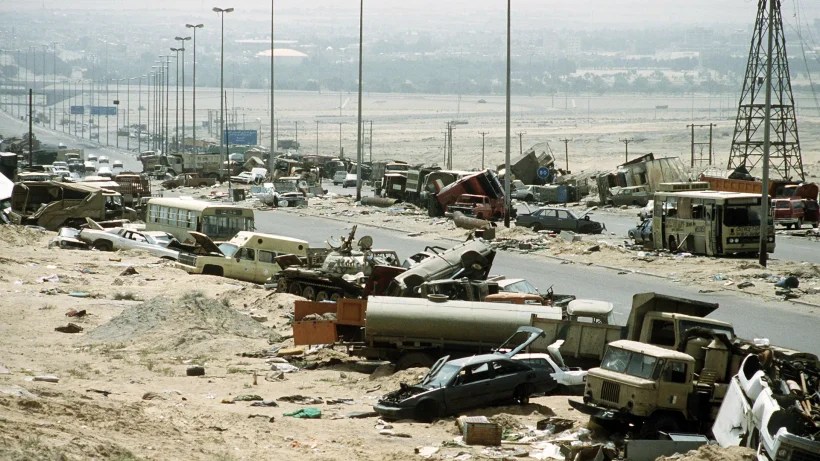
Then he travelled to a site on the border between Kuwait and Iraq, dubbed the “Highway of Death,” where thousands of Iraqi tanks and armored vehicles were pierced and burned by DU munitions fired by US A-10 Warthogs. There, he got readings of about 100-120 counts per minute on the holes of the damaged tanks. Lopez also collected small pieces of metal as samples that showed a reading of 600 counts per minute.
“And I happened to find several projectiles, 30 millimeters, that had missed the target and hit the ground and bounced. And they were intact. So I checked them out with my detector, thinking I’m going to get 600 counts per minute. I was getting 2,500 per minute on these projectiles, so high that my radiation detector wouldn’t go any higher than in its capabilities. And it would go ‘u-u-u-u,’ could have been higher than 2,400 counts per minute. And the only conclusion I could draw from that is that nuclear waste from nuclear facilities was being mixed with what was so-called depleted uranium. And this became even more alarming.”
DU Weapons are Made of Radioactive Waste
Lopez tried to find out why the US had decided to use depleted uranium for its ammo in the first place.
Damacio’s book Uranium Battlefields Home and Abroad: Depleted Uranium Use by the US Department of Defense explains that DU is a byproduct of the uranium enrichment process by which the fissionable isotope uranium-235 (U235) is extracted from natural uranium for subsequent use as fuel for nuclear reactors.
Natural uranium, a silvery-grey metal, contains 0.7% U235, 99.3% U238, and a small amount of U234 by mass. After producing 85 kilograms of enriched uranium, one would get 915 kg of U238, or depleted uranium.
The Pentagon argues that U238 retains “only” 60% of natural uranium’s radioactivity and emits alpha particles, which have low penetration depth and can be stopped by skin. Inside the body, however, alpha-emitters can be extremely harmful, damaging sensitive living tissue. After the explosion of DU projectiles, microscopic and light uranium dust can travel with the wind, be inhaled, swallowed, or enter the body through a wound, later causing cancer and chromosome damage.
One should bear in mind that depleted uranium is radioactive waste that should be disposed of, Lopez pointed out in his book. However, almost all DU tails have been saved by the US government since the early 1940s. Moreover, they can be purchased for commercial use, according to the researcher. To date, the US has accumulated a massive storage of DU amounting to over 700,000 metric tons.
Why Do Pentagon and Defense Contractors Like DU So Much?
Lopez explained that from a military standpoint, the most important property of DU is its great density, relatively low cost of fabrication, and availability. The material is used for tank armor and projectiles of different sizes.
Highly-dense DU munitions easily pierce tanks and other armored vehicles. While tungsten carbide projectiles are capable of doing the same, DU is cheaper, more accessible, and offers greater margins for US military firms.
On the other hand, turning spent uranium into bullets and shells has become an “ingenious” solution for the US nuclear industry on how to “dispose” of radioactive waste, Lopez said in his book. So, as money talks, the US’ testing and use of DU weapons continue unabated, according to the activist.
But has the Pentagon ever been aware of the long-lasting hazard related to DU projectiles?
The US Department of Defense’s internal memos, leaked to the press in the late 1990s and the beginning of the 2000s, indicate that the Pentagon knew. But why would it use the toxic and radioactive substance nevertheless?
A March 1, 1991 document shows the US DoD’s attitude to DU weapons use in a nutshell. Authored by US Lieutenant Colonel M.V. Ziehmn at the Los Alamos Laboratories in New Mexico, the memo reads:
“There has been and continues to be a concern regarding the impact of DU [sic] on the environment.
Therefore, if no one makes a case for the effectiveness of DU on the battlefield, DU rounds may become politically unacceptable and thus, be deleted from the arsenal.”
The memo went on by saying: “If DU penetrators proved their worth during our recent combat activities, then we should assure their future existence (until something better is developed),” adding “we should keep this sensitive issue at mind when after action reports [sic] are written”; otherwise the US may lose “a valuable combat capability.”
Why Are the Pentagon and White House Keeping DU’s Deadly Effects Secret?
The documentary Uranium 238: The Pentagon´s Dirty Pool (2009), used by Lopez’s International Coalition to Ban Uranium Weapons (ICBUW) as part of its international campaign to prohibit DU, said that the Pentagon is in denial about DU munitions potentially leading to carcinogenic diseases, birth defects, and environmental contamination.
The US Defense Department has even invented a sort of “DU diplomacy” to reassure the world community and American citizens that there is nothing to worry about, according to the ICBUW. Meanwhile, the US has not only failed to inform affected nations – Iraq, Bosnia, Serbia, Syria – about the DU hazard, but also repeatedly exposed American soldiers to the toxic and radioactive waste. Per the documentary, DU weapons in all but name are a “dirty bomb” – a mix of explosives and radioactive material – used by terrorists. Yet somehow DU rounds are still called “conventional weapons.”
One could easily imagine that if the US government admits DU’s hazardous effects, the weapon would be banned, influential defense contractors would be stripped of their profits, and Washington would be slapped with a heap of legal cases with compensation demands.
And the US is not the only country that uses depleted uranium as a weapon, as some of its NATO allies also do, according to Lopez.
“[The US keeps DU’s deadly effect secret], for the same reason all the other countries that have the weapon kept secret, as much as they can keep it secret, it is because they know they’re violating international laws, international conventions on weapons, and they know that they’re going to have to pay the price someday, and they may end up with charges of violations of international laws. And so they’re trying to protect themselves. And at the same time, they want to continue to keep the weapon because they’re afraid other countries have weapons too,” Lopez concluded.
USA and Israel Should be Worried: The Muslim Middle East is Moving Its Own Way
By Karsten Riise | Covert Geopolitics | December 7, 2023
Less than a month before Russia takes over the chairmanship of BRICS-11 where both UAE and Saudi Arabia will be full members, Russia makes a big move to bring cooperation with UAE and Saudi Arabia to an unprecedented level.
Russia ties everything together in this meeting: Head of States relations, Foreign Policy, Non-Dollar currency and Financial Policy, Industrial Policy, Nuclear Cooperation, Artificial Intelligence (AI), Space Development, International Direct Investments – and the whole private Business sector.
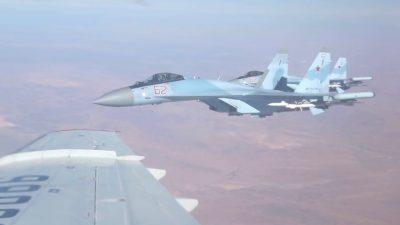 Note also that Putin travels safely in person to both the UAE and Saudi Arabia.
Both UAE and Saudi Arabia are visited by President Putin, Foreign Minister Lavrov, First Deputy Prime Minister of the Russian Federation Andrei Belousov, head of the Ministry of Industry and Trade Denis Manturov, Deputy Prime Minister Alexander Novak, head of the Central Bank Elvira Nabiullina, head of Roscosmos Yuri Borisov, head Rosatom Alexey Likhachev, and head of Russian Direct Investment Fund (RDIF) Kirill Dmitriev.
The RDIF recently published a Russian international platform for AI services. The delegation also includes representatives of the business community. See this.
In cooperation with Russia and China, the UAE and Saudi Arabia are becoming not only oil powers, but powers in the modern AI, hi-tech knowledge and Space economy – and military powers.
The central Middle Eastern powers, UAE, Saudi Arabia, Iran, and even Türkiye, are emerging as pillars in the international policies of Russia and China – in all dimensions.
Algeria builds deeper relations with its biggest arms supplier Russia, and Algeria opens defense cooperation China. Russia and Egypt have also for years been reinforcing cooperation, including defense cooperation, nuclear cooperation (a Russian nuclear powerplant is being built) and trade-logistics (a Russian trade zone near the Suez Canal).
In Syria, Russia has already long ago stabilized the government in Damascus, and even in Iraq, Russia just a few days ago took over Iraq’s biggest oil field and kicked out the biggest western player in Iraq’s oil sector.
Recently, Russia as the Chairman of BRICS-11 after 1 January 2024 even gave its nod of approval for the admission of China’s best friend Pakistan into BRICS in spite of Indian hesitations.
The Muslim Middle East is moving its own way – independently of the West. At a time when all the non-Western world including the Muslim world is outraged by Israel’s Nakba pressing out Palestinians with genocide on over 16,000 civilians in Gaza, Israel and its US backer should be worried.
Karsten Riise is a Master of Science (Econ) from Copenhagen Business School and has a university degree in Spanish Culture and Languages from Copenhagen University. He is the former Senior Vice President and Chief Financial Officer (CFO) of Mercedes-Benz in Denmark and Sweden.
The Real Problem With US Foreign Policy…

By Ron Paul | December 4, 2023
Over the weekend Defense Secretary Lloyd Austin explained to the American people what’s really wrong with US foreign policy. Some might find his conclusions surprising.
The US standing in the world is damaged not because we spent 20 years fighting an Afghan government that had nothing to do with the attacks on 9/11. The problem has nothing to do with neocon lies about Iraq’s WMDs that led untold civilian deaths in another failed “democratization” mission. It’s not because over the past nearly two years Washington has taken more than $150 billion from the American people to fight a proxy war with Russia through Ukraine.
It’s not the military-industrial complex or its massive lobbying power that extends throughout Congress, the think tanks, and the media.
Speaking at the Reagan National Defense Forum in California’s Simi Valley, Austin finally explained the real danger to the US global military empire.
It’s us.
According to Secretary Austin, non-interventionists who advocate “an American retreat from responsibility” are the ones destabilizing the world, not endless neocon wars.
Austin said the US must continue to play the role of global military hegemon – policeman of the world – because “the world will only become more dangerous if tyrants and terrorists believe that they can get away with wholesale aggression and mass slaughter.”
How’s that for reason and logic? Austin and the interventionist elites have fact-checked 30 years of foreign policy failures and concluded, “well it would have been far worse if the non-interventionists were in charge.”
This is one of the biggest problems with the neocons. They are incapable of self-reflection. Each time the US government follows their advice into another catastrophe, it’s always someone else’s fault. In this case, as Austin tells us, those at fault for US foreign policy misadventures are the people who say, “don’t do it.”
What would have happened if the people who said “don’t do it” were in charge of President Obama’s decision to prop-up al-Qaeda to overthrow Syria’s secular leader Assad? How about if the “don’t do it” people were in charge when the neocons manufactured a “human rights” justification to destroy Libya? What if the “don’t do it” people were in charge when Obama’s neocons thought it would be a great idea to overthrow Ukraine’s democratically-elected government?
Would tyrants and terrorists have gained power if Washington did NOT get involved? No. Tyrants and terrorists got the upper hand BECAUSE Washington intervened in these crises.
As Austin further explained, part of the problem with the US is democracy itself. “Our competitors don’t have to operate under continuing resolutions,” he complained. What a burden it is for him that the people, through their representatives, are in charge of war spending.
In Congress, “America first” foreign policy sentiment is on the rise among conservatives and that infuriates Austin and his ilk. He wants more billions for wars in Ukraine and Israel and he wants it now!
And our economic problems? That is our fault too. Those who “try to pull up the drawbridge,” Austin said, undermine the security that has led to decades of prosperity. Prosperity? Has he looked at the national debt? Inflation? Destruction of the dollar?
There is a silver lining here. The fact that Austin and the neocons are attacking us non-interventionists means that we are gaining ground. They are worried about us. This is our chance to really raise our voices!
Let’s Not Forget the U.S. Mass Killings of Children
By Jacob G. Hornberger | FFF | November 7, 2023
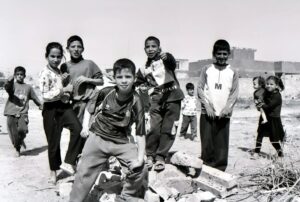
While some American mainstream commentators express concern about the large death toll among children in Gaza, we mustn’t forget that when it is the U.S. government — and, specifically, the U.S. national-security branch of the government — that is killing large numbers of children, most U.S. mainstream commentators go into silent mode or, even worse, play supportive roles in such killings.
Who can forget the 1990s, when U.S. officials were killing hundreds of thousands of Iraqi children, with nary a concern expressed by U.S. mainstream commentators? Oh, sure, it’s true that those killings were being inflicted by economic sanctions, rather than bombs, but so what? The Iraqi children were just as dead. What difference does it make whether a child is killed by sanctions instead of bombs?
The official mindset toward the mass numbers of Iraqi children being killed by the U.S. government was perfectly reflected in the infamous response that Madeleine Albright gave in 1996 to Leslie Stahl of Sixty Minutes. Stahl pointed out that half-a-million Iraqi children had been killed by U.S. and UN sanctions, more than the number killed at Hiroshima as a result of the U.S. government’s targeting of the civilian population, including children, of that city with a nuclear bomb. Stahl asked Albright, “Is the price worth it?” Albright replied, “We think the price is worth it.”
Albright was the U.S. Ambassador to the United Nations. As such, she was the official spokesperson for the U.S. government to the world. She was serving in the Clinton administration. No one within the government criticized her statement and there was little, if any, condemnation among U.S. mainstream commentators. That’s because her callous statement undoubtedly reflected the mindset of both her cohorts in the U.S. government and the mindset of the government’s loyal supporters in the mainstream press. That mindset was a classic example of Hannah Arendt’s term “the banality of evil.”
What was the “it” to which Albright was referring? The “it” was regime change, a U.S. foreign-policy concept that has been at the center of the U.S. national-security state ever since this governmental structure was brought into existence after the Second World War.
U.S. officials decided that they wanted to get rid of Iraq’s dictator, Saddam Hussein, and replace him with another U.S. stooge. But Saddam refused to budge. Thus, the purpose of the sanctions was threefold: (1) to induce Saddam to resign, after which the deadly sanctions would be lifted; (2) induce the Iraqi people to rise up in a violent revolution against Saddam’s government, which would produce more massive deaths; or (3) incite a coup in which Iraq’s national-security establishment assassinated or otherwise removed Saddam from power and replaced him with a U.S.-approved puppet.
According to a review at National Catholic Reporter of Joy Gordon’s excellent 2012 book Invisible War: The United States and the Iraq Sanctions, “UNICEF documented the deaths of 500,000 children under 5 from dysentery and malnutrition (Gordon says the latest figure is 880,000). All three U.S. administrations — Bush, Clinton, Bush — whenever challenged on its responsibility for an epidemic or a famine, simply blamed Hussein.”
How could they blame Saddam Hussein? They said that all he had to do to stop the killings of the Iraqi children was resign. U.S. officials made it clear that once he resigned, they would lift their deadly sanctions and, therefore, no more Iraqi children would have to die. Therefore, in their twisted and perverted logic, they said it was Saddam, not U.S. officials who were imposing and enforcing the sanctions, who was actually responsible for the deaths caused by the sanctions.
A 2003 article entitled “Sanctioned Genocide” stated:
The U.N. humanitarian reports on the blockade’s effects on Iraqi children tell a grisly tale. In December 1995, the U.N. Food and Agriculture Organization reported 567,000 Iraqi children had died as a direct consequence of economic sanctions. In March 1996, a World Health Organization study released found the blockade had caused a six-fold increase in the mortality rate of Iraqi children under age five. UNICEF reported in October 1996 that 4,500 Iraqi children under five were dying every month as a result of sanctions-induced starvation and disease.
Two high UN officials, Dennis Halliday and Hans von Sponeck resigned their posts because they did not want to be part of what they labeled as genocide. In a 2021 interview, Halliday stated:
This completely undermined the water treatment and distribution system of Iraq, which depended on electricity to drive it, and drove people to use contaminated water from the Tigris and the Euphrates. That was the beginning of the death-knell for young children, because mothers were not breast-feeding, they were feeding their children with child formula, but mixing it with foul water from the Tigris and the Euphrates rivers.
In addition, these conflicts introduced a new weapon called depleted uranium, which was used by the U.S. forces driving the Iraqi Army out of Kuwait. That was used again in southern Iraq in the Basra area, and led to a massive accumulation of nuclear debris which led to leukemia in children, which took three, four, or five years to become evident.
When I got to Iraq in 1998, the hospitals in Baghdad, and also of course in Basra and other cities, were full of children suffering from leukemia. Those children, we reckon perhaps 200,000 children, died of leukemia. At the same time, Washington and London withheld some of the medicines and treatment components that leukemia requires, again, it seemed, in a genocidal manner, denying Iraqi children the right to remain alive.
It’s worth mentioning that prior to the U.S. killing of Iraqi children as a way to get regime change in Iraq, Saddam Hussein had been a partner and ally of the U.S. national-security state during the 1980s. That was when U.S. officials were helping Iraqi forces to kill Iranian citizens in Iraq’s war of aggression against that country. See my articles “Where Did Iraq Get Its Weapons of Mass Destruction” and “Where Did Iraq Get Its Weapons of Mass Destruction, Part 2.”
Of course, Iran is pertinent to this discussion because while U.S. officials no longer target the people of Iraq with deadly sanctions, they continue to target people in other nations, including children, with death by sanctions. Iran, along with Venezuela, Cuba, North Korea, Russia, China, and other targets of regime change, come to mind, with nary a concern expressed by most U.S. mainstream commentators.
Between Iraq and a hard place: Sudani’s US dilemma over Gaza
By Khalil Harb | The Cradle | November 1, 2023
The Yamamah Palace, the epicenter of Saudi Arabia’s royal authority in Riyadh, is known for its deliberate and measured decision-making, particularly in the face of significant regional events.
But Israel’s genocidal war against Gaza proved an exception, warranting a rapid dispatch of Foreign Minister Prince Faisal bin Farhan to Baghdad within a mere 48 hours after the Hamas-led resistance operation Al-Aqsa Flood was launched. This is far from a coincidence; a large subset of Iraqis belong to the regional Axis of Resistance.
Likewise, it is noteworthy that Iraqi Prime Minister Mohammed Shia al-Sudani revealed a discussion point that was visibly absent from the White House statement on his 16 October phone call with US President Joe Biden. Specifically, the part where the Iraqi leader expresses that “the continued aggression in Gaza stirs outrage among people in the region and globally.”
These two incidents lay bare Iraq’s state of confusion. The Persian Gulf state’s inner turmoil became even more evident in the way it voted on the Arab draft resolution presented by Jordan at the UN General Assembly.
War in West Asia
Although Baghdad had a hand in sponsoring the draft calling for a “sustained humanitarian truce,” the electronic vote initially showed that it had abstained. The Iraqi delegation in New York later scrambled to amend its vote in support of the resolution, blaming the mishap on “technical issues.”
Geographically, Baghdad may seem distant from occupied Palestine, but for many Iraqis and Palestinians, the legacy of Iraqi soldiers who helped prevent the Zionist occupation of Jenin in 1948 remains a powerful memory, with the cemetery of Iraqi martyrs standing as a solemn tribute.
However, Prime Minister Sudani faces challenges far more treacherous than reviving the heroic legacy of the Palestinian cause. Over the past week, at the Trebil border crossing with Jordan, large crowds of Iraqi protesters have camped out, and Iraqi oil shipments offered to Jordan at favorable prices are being hindered.
Chants of “Give me the fatwa, and see with your eyes” reflect the Iraqi street’s desire for a fatwa from the supreme Shia authority in Najaf, calling for defensive “jihad” against Israel. Sudani is also dealing with almost daily attacks on US military bases since 17 October.
While there are no “official” military fronts opened against Israel by the Arab states, the intensity of the political scene in Baghdad makes it almost impossible for Iraq to remain immune from the ripple effects of the “Unity of Fronts” that brings together the forces of the Axis of Resistance in Palestine, Lebanon, Syria, and Yemen.
The Resistance’s ‘red lines’
If Israel has shown little concern – at least so far – about the extent to which its brutal assault on Palestinians in the besieged Gaza Strip and the occupied West Bank affects the passive Arab governments near and far, it is the US that should actually be most anxious.
The relentless Israeli onslaught on Gaza, which has so far claimed over 8,000 civilian lives and left more than 20,000 people injured, poses a significant threat to one of the few accomplishments the US could still claim from its illegal 2003 invasion of Iraq. Back then, Washington boasted it was establishing a democratic system to replace an authoritarian Iraqi regime.
However, even the staunchest American ideologues who defended and justified the invasion are lost for words today, as the Gaza war undermines any noble goals attributed to their intervention. This genocide being committed in Gaza before the eyes of the world is eroding the last remnants of respect and prestige associated with the US.
Indeed, the urgent visit of Prince Faisal bin Farhan to Baghdad underscores Saudi awareness, traditionally aligned with US interests, of the sensitivity of the situation in Iraq. It signals a growing conviction that Iraq may not stay neutral in the ongoing conflict, especially now that Iranian President Ebrahim Raisi has announced that Israel has crossed certain “red lines” set by the Axis of Resistance.
These red lines include the much-delayed ground invasion of Gaza, an attempt to completely uproot Hamas and other Palestinian resistance factions, and the Israeli government stepping up its acts of aggression against other fronts.
Checking US moves
For Sudani, being Iraq’s prime minister without a solid party, parliamentary support, or political base to weather the looming regional war is a daunting challenge. Diplomatically, Baghdad is also in an uneasy position.
Incidents such as the one at the UN, where Iraq supported a ceasefire resolution but balked over references to the defunct “two-state solution” – given Iraqi legal stances against normalization with Israel – and concerns about placing Palestinian civilians on the same footing as their occupying overlords.
Sudani’s biggest fear is being pulled into Iraq’s messy domestic politics over this issue. Observers believe that the “Coordination Framework” forces, which played a pivotal role in bringing him to power, won’t stand idle if the US allows Israeli President Benjamin Netanyahu to bring about another nakba.
Among these Framework forces, there are Iraqi factions that align themselves with the Resistance Axis, maintain close ties with Iran and Lebanese Hezbollah, and consider the Palestinian cause a central issue in their political discourse.
Hadi al-Amiri, leader of the Badr Organization, was among the first to escalate the rhetoric a day after Washington announced it would ramp up arms supplies to Israel, warning that: “If they intervene, we would intervene… if the Americans intervened openly in this conflict… we will consider all American targets legitimate … and we will not hesitate to target it.”
Three weeks into the current conflict, the extent of US involvement becomes clearer, including implicit and overt threats to prevent any regional party from intervening against US and Israeli interests. Calls and letters from western leaders to Baghdad have also been on the rise.
Jaafar al-Husseini, spokesman for the prominent Iraqi resistance faction Kataib Hezbollah, said that “the resistance in Iraq achieved its first attacks … and will continue at a higher pace,” adding that “The Americans are essential partners in killing the people of Gaza and therefore they must bear the consequences.”
US Proxy or Protector of Palestine?
The west, particularly the US, is employing intimidation tactics through messages conveyed to Baghdad. They are trying to push the Sudani government to act as their proxy within the “containment front,” which will potentially spark internal conflict.
This would jeopardize the relative calm that marked the first year of Sudani’s premiership. It will further undermine efforts to promote Iraq’s regional integration and distance it from Iran in exchange for closer ties with Arab states like Egypt, Jordan, Saudi Arabia, and the UAE.
Iraqi sources say that the status-of-forces agreement known as “SOFA” between Baghdad and Washington may be one of the first “victims” of the Israeli escalation in Gaza and the destabilizing US military involvement in the war.
If Iraqis cancel the agreement regulating US military presence in their country, it would render the US mission and presence illegitimate, effectively pushing Iraq out of the Atlanticist orbit two decades after the invasion.
Another potential casualty of Al-Aqsa Flood is the third Baghdad Conference backed by Paris – Its convening is now in doubt, especially if the region becomes further inflamed. This would be a setback for France’s influence and its role in Iraq, including a lucrative deal worth over $27 billion with French conglomerate Total Energy.
The “hands on the trigger,” as the Iranians have stressed repeatedly, are not just a threat but also a form of pressure to compel the US to rein in the Israeli government’s genocidal actions. Baghdad has conveyed a message from Washington to Tehran that calm is needed, and the Iraqis have also relayed to the Americans the importance of not provoking Lebanese Hezbollah if the US truly wants to contain the situation regionally.
The real question here isn’t whether Iraqi factions will engage in a major war, but whether Washington is so beholden to Israel that it will overlook the potential repercussions of the growing outrage within Iraq and the rest of West Asia, which will eventually engulf the US’s remaining overt colonial outpost in the region.
Large blasts heard inside US military bases in Syria, Iraq: Report
Press TV – October 20, 2023
Two military bases, used by American troops and their military advisors, in Syria’s eastern province of Dayr al-Zawr and near the Baghdad International Airport in the Iraqi capital have been hit by a series of large explosions amid rising anti-US sentiment in the two neighboring Arab countries.
Syria’s official news agency SANA, citing local sources speaking on condition of anonymity, reported that two separate missile attacks targeted the al-Omar oil field and the gas line connecting to the Conoco gas field in Dayr al-Zawr province early on Friday.
The sources added that a strike hit the transmission pipeline, used by US occupation forces and allied Kurdish-led militants affiliated with the so-called Syrian Democratic Forces (SDF) to steal natural gas from the Conoco field, in the Abu Khashab desert area.
American occupation forces and allied SDF militants were subsequently put on high alert, and many military aircraft were seen hovering in the skies over the area, according to the report.
The sources added that another missile attack targeted the al-Omar oil field. There were no immediate reports about possible casualties and the extent of damage caused.
Moreover, explosions were heard near the US-run Victoria military base, which is adjacent to Baghdad airport.
Lebanon’s al-Mayadeen television news network reported that three rockets were launched at the base early on Friday.
Earlier on Thursday, a US military base in southern Syria was targeted in a drone attack. The al-Tanf base, located in Homs province, was targeted by three drones, according to al-Mayadeen.
Sabereen News, a Telegram news channel associated with Iraqi anti-terror Popular Mobilization Units, also reported the incident.
US military contractor dies of heart attack during al-Asad airbase attack
Meanwhile, a US military contractor, whose identity has not been disclosed, lost his life during the recent attack on the al-Asad Airbase in western Iraq.
Brigadier General Patrick S. Ryder, the US Department of Defense Press Secretary, stated that the contractor, whose identity has not been disclosed, suffered a heart attack while attempting to seek shelter.
He added that Americans are “investigating the recent attacks and the party behind them.”
On Thursday, Iraq’s Harakat Hezbollah al-Nujaba movement claimed responsibility for the missile strike against the Ain al-Asad base.
Firas al-Yasser, a member of the political council of the movement, told al-Mayadeen that the attack was in line with the “fight on one front” doctrine.
Yasser highlighted that Islamic resistance groups in Iraq are gearing up to prepare surprises against American interests as Israeli aggression against the besieged Gaza Strip is poised to escalate.
Featured Video

Iran & Its Allies Are Threatening Every Route for Saudi Oil
or go to
Aletho News Archives – Video-Images
From the Archives
A short history of British torture
ICC | December 2005
When the House of Commons was debating how much to increase the time limit for detention without trial the question of torture came up. Officially this was limited to the nice considerations of whether it was all right to send people to places where torture is used and whether Britain can use information collected by the use of torture in other countries. This discussion gave an impression of democratic Britain as the home of civilised behaviour where the very idea of torture is repugnant to our legislators – unlike, say, the US with its secret CIA jails… In reality, the British state has a long history of using and developing a whole range of torture techniques. … continue
Blog Roll
 Aletho News
- House Votes to End Iran War for Third Time
- North Korea Slams US Plan for ‘AUKUS 2.0’ with South Korea and Japan
- Prolonging US-Iran Conflict Not Meeting Interests of Int’l Community – China’s Wang Yi
- EU bans former Zelensky aide from parliament
- NATO-backed Kosovo separatist ‘responsible for war crimes’
- US destroying international space law
- SCO Calls for Binding Global Deal to Prevent Arms Race in Space
- Iran & Its Allies Are Threatening Every Route for Saudi Oil
- ‘40,000 tons of bombs’: Report shows Trump planning ‘largest bomb transfer in modern US history’ to Israel
- Amazon says cloud infrastructure in Bahrain, UAE ‘beyond saving’
- If Americans Knew
- Groups urge Americans to support Van Hollen legislation on Israel’s killing of Americans & Palestinians
- Trump administration plans to send 40,000 tons of bombs to Israel: report
- Sanctions Target Iran’s Government, But Kill Hospitalized 23-Year-Old Woman
- An alternative view on the book “Israel’s Lobby: America in the Grip of a Foreign Power”
- Ed Sheeran’s band Beoga, other opening acts quit tour after Macklemore was dropped over his pro-Palestinian comments
- The assassination attempt on President Trump in Butler and the various Israeli connections to it
- “We Want That the Whole Land Be Jewish”
- BREAKING: Building collapse in Gaza kills at least 20 as they sleep – Daily Update
- ‘School is Life’: 1.5 Million Palestinian Children Face Fourth Year of Shattered Education
- Pentagon admits Iran war caused ammunition shortages, cost US $33.4bn
- No Tricks Zone
- Economic Masterminds: German Socialists Suggest Taxing Productivity Gains Stemming From Using AI
- The South China Sea Has Not Been Cooperating With The Climate Change Narrative
- Energy Crisis: Germany Enters Heating Season With Historically Low Gas Reserve Fill Levels
- New Study: The Antarctic Ice Sheet Gained Mass From 2020-2024 Due To Staggering Snow And Ice Accumulation
- Study: Ocean Heating Rates From Thousands Of Years Ago ‘Dwarf’ Modern Ocean Heating Rates
- Climate Extremists Target, Attack Large-Scale Power Grid Infrastructure In Germany!
- New Study: Antarctic Ice Melt Has Contributed Less Than 1 Centimeter To Sea Level Rise In The Last 30 Years
- Fear Of Debate: Alarmist German Climate Scientist Calls On Mainstream Media To Discredit Skeptic Voices
- End-Of-August Arctic Sea Ice Extent Hasn’t Fallen In 20 Years, Official Data Show!
- News-Making Nepal Region Has Had As-Warm Or Warmer Periods Than The 2000s In The 1600s, 1700s, 1800s
 Aletho News