IRAN LIE same as IRAQ LIE
TheParadigmShift | August 30, 2012
Once again America is lying for IsraHell. Once again we are draged into a global conflict by Zion and its Lobby.
September 11, 2012 Posted by aletho | Mainstream Media, Warmongering, Timeless or most popular, Video, Wars for Israel | George W. Bush, Iraq, United States | Leave a comment
Media hype 9/11, ignore 1m Iraqi victims: Ahmadinejad
Press TV – September 11, 2012
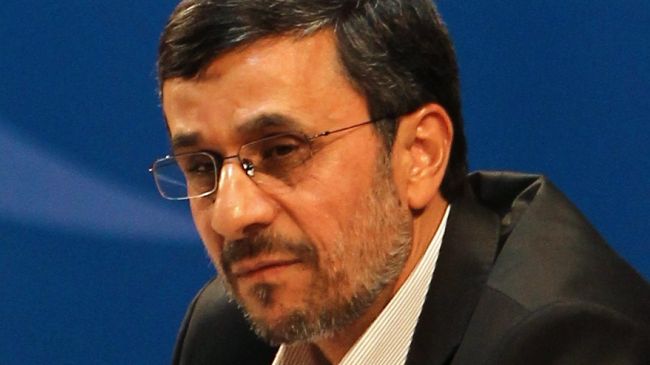 Iran’s President Mahmoud Ahmadinejad has criticized Western media for creating hype over the September 11 attacks and ignoring more than one million victims of the US wars in Iraq and Afghanistan.
“The materialistic view of Zionists has destroyed the sacredness of media and today media no longer regulate the relations among humans, but have turned into a means of domination and gaining power,” Ahmadinejad said on Monday.
The Iranian chief executive stated that a major part of the events surrounding the September 11 attacks was merely a “media operation”, adding, “Today American forces would not be in Afghanistan, Iraq and the Persian Gulf, if it was not for the media coverage of this incident.”
Why have the media that provoked public sentiments and emotions during the September 11 incident, remained silent regarding more than one million victims that have been killed in the aftermath of the attack?, he asked.
On September 11, 2001, a series of coordinated attacks were carried out in the United States leaving almost 3,000 people dead.
The US, under the administration of former President George W. Bush, invaded Afghanistan in 2001 after claiming that the 9/11 attacks were carried out by members of al-Qaeda harbored by the then Taliban regime in Afghanistan.
The US also attacked Iraq in 2003 claiming that the Middle Eastern country was in possession of weapons of mass destruction. Washington’s wars in Iraq and Afghanistan have claimed the lives of more than a million people.
September 11, 2012 Posted by aletho | Mainstream Media, Warmongering, Timeless or most popular | Afghanistan, Iraq, Mahmoud Ahmadinejad, September 11 attacks | Leave a comment
Unexploded Israeli cluster bomb kills Lebanese woman
Press TV – September 4, 2012
A woman has been killed and a soldier seriously injured after an unexploded cluster bomb detonated in Nabatiye Governorate in southern Lebanon, Press TV reports.
The incident occurred on Tuesday when a bomblet exploded in Bint Jbeil, the second largest town in the in southern Lebanon.
The injured soldier was rushed to the nearest hospital.
US reports say Israel dropped some 4.5 million cluster munitions in Lebanon during the last days of its military offensive on the country in 2006.
The move made Lebanon one of the worst affected countries by the internationally-banned arms, along with Iraq, Afghanistan and now Libya.
Six years after the 2006 war, Lebanon has not yet finished clearing the cluster munitions and landmines in the south, with Israel refusing to provide UN authorities with maps of the locations of the munitions it dropped.
Related articles
- Canada turns blind eye to cluster bomb treaty (alethonews.wordpress.com)
- Israeli troops steal 1000 goats from southern Lebanon (alethonews.wordpress.com)
- Two Serbian Soldiers Killed By Old NATO Cluster Bomb (rferl.org)
September 4, 2012 Posted by aletho | Ethnic Cleansing, Racism, Zionism, Timeless or most popular, War Crimes | Afghanistan, Bint Jbeil, Cluster bomb, Iraq, Israel, Lebanon, Libya, Southern Lebanon | Leave a comment
How much will America’s animus against Iran distort U.S. policy toward Syria?
By Flynt Leverett and Hillary Mann Leverett | Race for Iran | August 13th, 2012
Across most of the American political spectrum, policy elites are urging that the United States double down on the Obama administration’s failing Syria policy. America’s reliably pro-intervention senatorial trio (Lindsay Graham, Joseph Lieberman, and John McCain) recently argued that the “risks of inaction in Syria,” see here, now outweigh the downsides of American military involvement. Last week, the Washington Post prominently featured a piece by Ken Pollack, see here, asserting that negotiated settlements “rarely succeed in ending a civil war” like that in Syria—even though that it precisely what ended the civil war in Lebanon, right next door to Syria. From this faulty premise, Pollack argues that the only way to end a civil war like that in Syria is through military intervention. (After his scandalously wrong case for the 2003 U.S. invasion of Iraq, we wonder why the Washington Post or anyone else would give Pollack a platform for disseminating his views on virtually any Middle Eastern topic—but especially not for a piece dealing with the advisability of another U.S. military intervention in the region. In this regard, we note that the bio line at the end of Ken’s op ed makes no mention of his book that made the case for the U.S. invading Iraq, The Threatening Storm, describing him instead as “the author of A Path Out of the Desert: A Grand Strategy for America in the Middle East.)
A more chilling—and, in some ways, more candid—indicator of the direction in which the debate over American policy toward Syria is heading was provided last week in Foreign Policy by Robert Haddick (managing editor of the hawkish blog, Small War Journal), see here. Remarkably, Haddick argues that,
“rather than attempting to influence the course of Syria’s civil war, something largely beyond Washington’s control, U.S. policymakers should instead focus on strengthening America’s diplomatic position and on building irregular warfare capabilities that will be crucial in future conflicts in the region. Modest and carefully circumscribed intervention in Syria, in coordination with America’s Sunni allies who are already players in the war, will bolster critical relationships and irregular warfare capabilities the United States and its allies will need for the future.”
And why is bolstering these relationships and capabilities so critical? Because, as Haddick writes,
“The conflict in Syria is just one front in the ongoing competition between Iran and America’s Sunni allies on the west side of the Persian Gulf… The Sunni countries have a strong interest in stepping up their irregular warfare capabilities if they are to keep pace with Iran during the ongoing security competition. The civil war in Syria provides an opportunity for the United States and its Sunni allies to do just that… U.S. and GCC intelligence officers and special forces could use an unconventional warfare campaign in Syria as an opportunity to exchange skills and training, share resources, improve trust, and establish combined operational procedures. Such field experience would be highly useful in future contingencies. Equally important, it would reassure the Sunni countries that the United States will be a reliable ally against Iran.”
Foreign Policy has become arguably the leading online venue for topical discussion of key issues on America’s international agenda. And it is giving its platform to an argument that Washington should leverage the “opportunity” provided by the civil war in Syria to help its regional allies get better at killing Shi’a. And Washington should do this for the goal of prevailing in “the ongoing security competition” between the Islamic Republic and the United States (along with America’s “Sunni allies).
Such trends in the American policy debate show an appalling incapacity to learn from either current experience or history. And these trends are, in fact, influencing actual policy. Late last week, during a visit by U.S. Secretary of State Hillary Clinton to Turkey, Ankara and Washington agreed that “a unified task force with intelligence, military and political leaders from both countries would be formed immediately to track Syria’s present and plan for its future,” see here. After meeting with her Turkish counterpart, Ahmet Davutoğlu, Secretary Clinton said that the United States and Turkey are discussing various options for supporting opposition forces working to overthrow the government of President Bashar al-Assad, including the possibility of imposing a no-fly zone over rebel-held territory in Syria, see here.
In the wake of Clinton’s remarks, Flynt appeared on CCTV’s World Insight weekly news magazine to discuss the internal and international dimensions of the Syrian conflict, see here. Flynt and both of the other guests on the segment—Jia Xiudong from the China Institute of International Studies and our colleague Seyed Mohammad Marandi from the University of Tehran—agreed, contra Pollack, that the only way to resolve what has become a civil war in Syria is through an inclusive political process.
Getting to the heart of the matter, Flynt pointed out that “the United States and its regional partners are trying to use Syria to shift the balance of power in the Middle East in ways that they think will be bad for Iran.” This strategy is “ultimately doomed to fail”—but, as long as Washington and others are pursuing it, “the international community is going to be challenged to find ways to keep the violence from getting worse and try to get a political process started.” Flynt also observed that China and other players in the international community have historical grounds for concern about the imposition of a no-fly zone in Syria to create so-called “humanitarian safe havens” could lead to: since the end of the Cold War, every time that the United States has imposed humanitarian safe havens—in Somalia, Bosnia, Iraq, and most recently in Libya—this has ultimately resulted in a heavily militarized intervention by the United States and its partners in pursuit of coercive regime change.
In part, American elites persist in their current course regarding Syria because they continue to persuade themselves that, in the “security competition” between America and Iran, the United States is winning and the Islamic Republic is losing. At roughly the same time that Pollack and Haddick were holding forth last week, the New York Times offered an Op Ed by Harvey Morris purporting to explain Iran’s “paranoia” over Syria’s civil war by describing “What Syria Looks Like from Tehran,” see here. Morris claims that
“the impact of regime change in the Arab World has in fact been largely negative from Tehran’s perspective. The Muslim Brotherhood leadership in Egypt is closer to Saudi Arabia than it is to Iran. If the Alawite-dominated regime in Damascus were to fall, it would mean the loss of a non-Sunni ally.”
Our analysis—of both Tehran’s perspective on, and the reality of, how the Arab Spring is affecting the regional balance of power—is diametrically opposite to Morris’s. For an actual (and genuinely informed) Iranian view, we note that Al Jazeera devoted last week’s episode of its Inside Syria series to the topic, “Can Iran Help End the Syrian Crisis?,” see here. Once again, our colleague from the University of Tehran, Seyed Mohammad Marandi, gave a clear and concise exposition of Iranian views on the imperatives of and requirements for serious mediation of the struggle in (and over) Syria.
Related articles
- Syria and the Invisible Hand of Foreign Intervention (nationalinterest.org)
August 14, 2012 Posted by aletho | Mainstream Media, Warmongering, Timeless or most popular | Flynt Leverett, Hillary Rodham Clinton, Iran, Iraq, Syria, United States | Leave a comment
The Great American Culture of Cover-up
By Phillip Faruggio | Dissident Voice | August 13th, 2012
We have seen many cover-ups and scandals throughout the history of our nation. Barely twelve years into this, the 21st century, there are three major cover-ups that add to our national shame: 9/11, Iraq invasion and the Jerry Sandusky child abuse scandal. Each time, those at the very top of power failed, or chose to fail, to follow the narrow path of truth. Truth is this funny thing because the more you either stretch it or silence it, eventually, like that puppy that runs away… it always returns. It may take months or years, or even a generation or two, but it will come back!
There are many facts and half truths, disinformation of all types about what really went down on 9/11. This writer will not focus on what it took volumes of 9/11 Truth to uncover, that being to question how many rogue elements inside of our own intelligence agencies were somewhat involved. Sometimes it is the little things that reveal so much. When the president of the United States is told on August 6, 2001 that “…FBI information indicates suspicious activity in this country consistent with preparations for hijackings and other types of attack”… the threat was so real that the Attorney General of the United States, John Ashcroft, stopped flying on commercial aircraft that summer!
We had true patriots like Sibel Edmonds, a government translator, who warned in April of 2001 that “Bin Laden was planning a major attack in the US within a few months, using airplanes and targeting four or five American cities.” She went on to warn that the operatives were “already inside the United States”. There were diligent FBI agents like Coleen Rowley who actually pinpointed some of these possible Bin Laden operatives… and nothing was done to follow up. So, way before the heinous act was completed, the truth was swept under the rug by those who had the power to save lives.
The invasion of Iraq was consummated after a campaign of fear, disinformation and outright lying. We knew then that Iraq did not have weapons of mass destruction. In his 2003 resignation speech before Parliament, Labor MP Robin Cook, former cabinet member and one time confidante of Tony Blair, made things perfectly clear. Cook explained how not only did Saddam Hussein not possess WMDs in 2001, but any WMDs that he once had were supplied for him by the US, the Brits and the French. Here at home in America, the Bush cabal was working overtime to rally the public into a ‘fear plus revenge’ and ‘fight them there before they come here’ mode. An overly compliant mainstream media and bipartisan Congressional cowardice helped take the phony war on Iraq over the top.
Senator Robert Byrd was left with an almost empty Senate chamber to hear his warnings about rushing to war. Scott Ritter, former UN weapons inspector, was made into a raving fool by the media. Phil Donahue had his cable television talk show cancelled right before we invaded Iraq, because he covered the subject too well (and too balanced – Donahue always had more pro invasion talking heads on his panels than dissidents). So, we invaded and Shock and Awed that modern and culturally advanced sovereign nation back into the Stone Age.
Then the cover-up went into high gear. In October of 2006 a group of (so called) progressive Democrats held an impromptu panel discussion on the invasion of Iraq. Rep. John Conyers of Michigan made a most eloquent statement promising that when the Democrats took back control of the Congress and he became chair of the Judiciary Committee, his first order of business would be to conduct hearings on the run-up to the invasion of Iraq. History reveals that the Democrats did succeed and he did become chair… yet no hearings! The Military Industrial Empire once again ruled supreme.
As anyone who reads or watches television knows, former assistant football coach of Penn State University, Jerry Sandusky, was arrested, tried and convicted of repeated sexual child abuse, spanning decades. Football coach Joe Paterno and three school officials were either indicted or put under the public microscope for helping to cover up these heinous acts by Sandusky.
There were many other individuals, from government agencies to charity executives, to even janitors, who knew that this man was a sexual predator. Read the new book Game Over by Bill Moushey and Bob Dvorchak for the intricate details of this terrible crime and cover-up.
When a grown man is seen showering with a young boy, not even 12 years of age, that should be enough to begin investigations. Yet, there were much worse instances than that. When a mother goes to the high school where her son is a freshman, and sees him in a fetal position on a chair sobbing in the school office about how Sandusky had sexually violated him for years… that was in 2008, three years before any arrest! We can focus all our attention on Jerry Sandusky, who was and is a very sick man.
Yet, it was the multitude of individuals who refused to pursue the facts as they were given them. Why? Why was the young boy who was in the shower with Sandusky in 2002, the event that got Paterno and the Penn State officials into this fray, never questioned by any of them? If he was questioned, perhaps many other young boys could have been spared the most heinous violations of their beings by this perverse and mentally ill man.
Truth does always triumph in the end, but at whose expense?
Philip A Farruggio, a spokesperson for the 25% Solution Movement to Save Our Cities by cutting military spending 25%, can be reached at: paf1222@bellsouth.net.
Related articles
- Penn State Pedophile Ring Accomplices Get Plush Gov’t Jobs! (dprogram.net)
- Commonly Asked Questions about the USS Liberty (alethonews.wordpress.com)
- The Raw Story treats readers like “jerks” over Israel’s attack on USS Liberty (alethonews.wordpress.com)
- The USS Liberty Cover-Up (whatreallyhappened.com)
- On History and Intellectual Courage (alethonews.wordpress.com)
- 9/11: Explosive Evidence – Experts Speak Out (alethonews.wordpress.com)
August 13, 2012 Posted by aletho | Corruption, Deception, Timeless or most popular | Coleen Rowley, Iraq, Jerry Sandusky, Joe Paterno, Pennsylvania State University, Robert Byrd, United States | Leave a comment
Iraqi ambassador to Iran calls for closer economic ties
Press TV – August 12, 2012
Iraqi Ambassador to Iran Mohammad Majid al-Sheikh says there is a huge capacity for development of financial transactions between the two countries.
“Given the friendly and brotherly relations between the two neighboring countries and hundreds of kilometers of shared borders, there are many potentials for boosting bilateral trade ties,” he told IRNA on Sunday.
He noted that Iran-Iraq trade transactions amounted to $7 billion in 2011, and hoped that the number would rise to $10 billion in the near future.
He said that a high-ranking Iraqi delegation is to visit Tehran this Tuesday in order to further commercial relations.
Headed by Deputy Prime Minister Rozhi Nouri Shawis, the delegation will include Finance Minister Rafe al-Essawi, Trade Minister Khairullah Hassan Babakr, Industries and Mines Minister Ahmad Nasser Deli, and Governor of the Central Bank Sinan Al-Shabibi, the ambassador stated.
Al-Sheikh added that setting up an Iraqi bank in Iran will be on the delegation’s agenda.
“Establishing an Iraqi bank [in Iran] can greatly help enhance bilateral economic and commercial relations,” he underlined.
August 12, 2012 Posted by aletho | Economics | Iran, Iraq | Leave a comment
Israel seeks to destroy neighbours’ histories and identities
By Jeff Goodall | August 12, 2012
This would not be the first time that the Israelis have endeavoured to destroy historical and cultural artifacts in order to bolster their territorial claims and to eradicate inconvenient elements of the past.
In 2003, in an article headed “Pillaging 7000 Years Of Iraq History No Accident” sub-heading “The Sacking Of Iraq’s Museums – US Wages War Against Culture And History”, Patrick Martin wrote in Rense.com that
“US claims to have been taken by surprise by the ransacking of cultural facilities in Baghdad, Mosul and other cities are not credible. Such a tragedy was not only predictable, it was specifically warned against. . . . Attacking the cultural resources that connect the Iraqi people to 7,000 years of history is part of the process of systematically destroying their national identity.” (Emphasis added – link to full article).
A little-known event in 1948 during the “Naqba”, was the Israeli theft of books and manuscripts.
Journalist Arwa Aburawa, writing in “Sabbah Report” two years ago, refers to
“the systematic looting of more than 60,000 Palestinian books by Israeli forces and the attempted destruction of Palestinian culture… Between May 1948 and February 1949, librarians from the Jewish National Library and Hebrew University Library entered the desolate Palestinian homes of west Jerusalem and seized 30,000 books, manuscripts and newspapers alone. These cultural assets, which had belonged to elite and educated Palestinian families, were then “loaned” to the National Library where they have remained until now.” (See “The great book robbery of 1948″ here)
Not only does Israel wish to achieve complete domination of the Middle East, it also wants to destroy the history, the culture, and the very identity of its neighbours and those it occupies.
We can be sure that an attack on Iran, one of the oldest civilisations in the world with a massive treasure-trove of historical and cultural artifacts, will include widespread theft and destruction as was the case with Iraq.
The United States, Britain, and all other backers and enablers of “gallant little Israel” are fully complicit in these crimes against humanity.
Foreign-backed armed groups targeting Syrian history
PRESS-TV | August 11th, 2012
Clashes continue in Syria’s largest city Aleppo between the army and foreign-backed militant groups. This time the Aleppo Castle was the target, but the army managed to repel the assaults, and declared the historical building as safe and intact.
Castle of Aleppo, is a large medieval fortified palace in the centre of the old city of Aleppo. It is considered to be one of the oldest and largest castles in the world. Usage of the Citadel hill dates back at least to the middle of the 3rd millennium BC.
Foreign backed armed groups and supporting media outlets emphasized on controlling the castle repeatedly. Press TV crew headed to the castle, the tension was high, Syrian soldiers were almost everywhere fully geared, two tanks on the sides of the roads and a commander waiting for us.
Upon arriving the archaeological building, the traces of mortars were imprinted on the Defensive bridge, the main gate was Booby-trapped by the armed groups upon attempting to penetrate the historic fortifications and several Syrian soldering were assigned to protect the castle being under hours of attack by the armed groups.
Syrians believe this war against Syria, has already targeted all components of Syrian society, and now foreign backed armed groups and their sponsoring countries are after Syrian 7000 years history.
August 12, 2012 Posted by aletho | Ethnic Cleansing, Racism, Zionism, Timeless or most popular, Video, Wars for Israel | Aleppo, Iraq, Israel, Jerusalem, Middle East, Syria, Zionism | Leave a comment
The Yinon Thesis Vindicated: Neocons, Israel, and the Fragmentation of Syria
By Stephen J. Sniegoski | The Passionate Attachment | August 12, 2012
It is widely realized now that the fall of President Bashar Assad’s regime would leave Syria riven by bitter ethnic, religious, and ideological conflict that could splinter the country into smaller enclaves. Already there has been a demographic shift in this direction, as both Sunnis and Alawites flee the most dangerous parts of the county, seeking refuge within their own particular communities. Furthermore, it is widely believed in Syria that, as the entire country becomes too difficult to secure, the Assad regime will retreat to an Alawite redoubt in the northern coastal region as a fallback position.
Syrian Kurds, about ten percent of the country’s population, are also interested in gaining autonomy or joining with a larger Kurdistan. The Syrian Kurdish Democratic Party (PYD)—linked to the Kurdistan Workers Party (PKK), which has engaged in a separatist insurgency in Turkey’s Kurdish southeast region for nearly three decades—has gained control of key areas in northeast Syria. While Turkey has supported the Syrian opposition, it is terrified of a Kurdish autonomous zone in Syria, believing that it could provide a safe haven for staging attacks into Turkey. Moreover, Kurdish autonomy would encourage separatist sentiment within the Turkish Kurdish minority. Turkey has threatened to invade the border areas of Syria to counter such a development and Turkish armed forces with armor have been sent to Turkey’s border with the Syrian Kurdish region. A Turkish invasion would add further complexities to the fracturing of Syria.
What has not been readily discussed in reference to this break-up of Syria is that the Israeli and global Zionist Right has long sought the fragmentation of Israel’s enemies so as to weaken them and thus enhance Israel’s primacy in the Middle East. While elements of this geostrategic view can be traced back to even before the creation of the modern state of Israel, the concept of destabilizing and fragmenting enemies seems to have been first articulated as an overall Israeli strategy by Oded Yinon in his 1982 piece, “A Strategy for Israel in the Nineteen Eighties.” Yinon had been attached to the Israeli Foreign Ministry and his article undoubtedly reflected high-level thinking in the Israeli military and intelligence establishment in the years of Likudnik Menachem Begin’s leadership. Israel Shahak’s translation of Yinon’s article was titled “The Zionist Plan for the Middle East.”
In this article, Yinon called for Israel to use military means to bring about the dissolution of Israel’s neighboring states and their fragmentation into a mosaic of homogenous ethnic and sectarian groupings. Yinon believed that it would not be difficult to achieve this result because nearly all the Arab states were afflicted with internal ethnic and religious divisions, and held together only by force. In essence, the end result would be a Middle East of powerless mini-statelets unable to confront Israeli power. Lebanon, then facing divisive chaos, was Yinon’s model for the entire Middle East. Yinon wrote: “Lebanon’s total dissolution into five provinces serves as a precedent for the entire Arab world including Egypt, Syria, Iraq and the Arabian peninsula and is already following that track. The dissolution of Syria and Iraq later on into ethnically or religiously unique areas such as in Lebanon, is Israel’s primary target on the Eastern front in the long run, while the dissolution of the military power of those states serves as the primary short term target.”
Eminent Middle East historian, Bernard Lewis, who is a Zionist of a rightist hue and one of the foremost intellectual gurus for the neoconservatives, echoed Yinon with an article in the September 1992 issue of “Foreign Affairs” titled “Rethinking the Middle East.” In it, he wrote of a development he called “Lebanonization,” stating “[A] possibility, which could even be precipitated by [Islamic] fundamentalism, is what has of late been fashionable to call ‘Lebanonization.’ Most of the states of the Middle East—Egypt is an obvious exception—are of recent and artificial construction and are vulnerable to such a process. If the central power is sufficiently weakened, there is no real civil society to hold the polity together, no real sense of common identity. . . . The state then disintegrates—as happened in Lebanon—into a chaos of squabbling, feuding, fighting sects, tribes, regions, and parties.” Since Lewis— credited with coining the phrase “clash of civilizations”—has been a major advocate of a belligerent stance for the West against the Islamic states, it would appear that he realized that such fragmentation would be the result of his belligerent policy.
In 1996, the neoconservatives presented to incoming Israeli Prime Minister Benjamin Netanyahu their study “A Clean Break” (produced under the auspices of an Israeli think tank, the Institute for Advanced Strategic and Political Studies), which described how Israel could enhance its regional security by toppling enemy regimes. Although this work did not explicitly focus on the fragmentation of states, such was implied in regard to Syria when it stated that “Israel can shape its strategic environment, in cooperation with Turkey and Jordan, by weakening, containing, and even rolling back Syria. This effort can focus on removing Saddam Hussein from power in Iraq — an important Israeli strategic objective in its own right — as a means of foiling Syria’s regional ambitions.” It added that “Damascus fears that the ‘natural axis’ with Israel on one side, central Iraq and Turkey on the other, and Jordan, in the center would squeeze and detach Syria from the Saudi Peninsula. For Syria, this could be the prelude to a redrawing of the map of the Middle East which would threaten Syria’s territorial integrity.”
David Wurmser authored a much longer follow-up document to “A Clean Break” for the same Israeli think tank, entitled “Coping with Crumbling States: A Western and Israeli Balance of Power Strategy for the Levant.” In this work, Wurmser emphasized the fragile nature of the Middle Eastern Baathist dictatorships in Iraq and Syria in line with Lewis’s thesis, and how the West and Israel should act in such an environment.
In contrast to some of the Western democracies as well as Arab states, Israel did not publicly call for Assad’s removal until a few months ago. This, however, does not mean that the Netanyahu government did not support this outcome. This tardiness has a number of likely reasons, one of which being the fear that an Islamist government would replace Assad that would be even more hostile to Israel and more prone than he to launch reckless attacks. Moreover, instability in a country on Israel’s border is of tremendous concern to its security establishment. It is feared that in such a chaotic condition, Assad’s massive chemical weapons arsenal and advanced surface-to-air missile systems could end up in the hands of terrorist groups like the Lebanese Hezbollah, which would not be hesitant to use them against Israel.
Unlike the armchair destabilization strategists and the neocons, the actual Israeli leaders, including hardline Likudniks such as Prime Minister Netanyahu, have to be concerned about facing the immediate negative political consequences of their decisions even if they believe that the long-term benefits would accrue to the country. This invariably leads to the exercise of caution in regard to dramatic change. Thus, the concern about the immediate security risks cited above likely had a significant effect on their decision-making.
Furthermore, it could have been counterproductive for Israel to express support for the Syrian opposition in its early stages. For Assad has repeatedly maintained that the opposition is orchestrated by foreign powers, using this argument to justify his brutal crackdown. Since Israel is hated by virtually all elements in the Middle East, its open support of the opposition could have turned many Syrians, and much of the overall Arab world, against the uprising. While Israel did not openly support the armed resistance, there have been claims from reliable sources that Israeli intelligence has been providing some degree of covert support along with other Western intelligence agencies, including that of the United States.
Since May of this year, however, the Israeli government has become open in its support for the overthrow of the Assad regime. In June, Netanyahu condemned the ongoing massacre of Syrian civilians by Assad, blaming the violence on an “Axis of Evil,” consisting of Iran, Syria and Hezbollah. “Iran and Hezbollah are an inseparable part of the Syrian atrocities and the world needs to act against them,” he proclaimed. This inclusion of Iran and Hezbollah illustrates Israel’s goal of using the Syrian humanitarian issue to advance its own national interest.
If the Assad regime were to fall, Israel would certainly be more secure with a splintered congeries of small statelets than a unified Syria under an anti-Israel Islamist regime. Consequently, staunch neoconservative Harold Rhode presents the fragmentation scenario in a positive light in his article, “Will Syria Remain a Unified State?” (July 10, 2012). In contrast to what has been the conventional Western narrative of the uprising against the Assad regime, which presents a heroic Sunni resistance being brutally terrorized by government forces and pro-government Alawite militias, Rhode writes with sympathy for the pro-government non-Sunni Syrian minorities: “In short, what stands behind most of the violence in Syria is the rise of Arab Sunni fundamentalism in its various forms – whether Salafi, Wahhabi, or Muslim Brotherhood. All of those threaten the very existence of the Alawites, the Kurds, and other members of the non-Sunni ethnic and religious groups.
“It is therefore much easier to understand why the ruling Alawites feel they are fighting a life and death battle with the Sunnis, and why they believe they must spare no effort to survive. It also explains why most of Syria’s other minorities – such as the Druze, Ismailis, and Christians – still largely support the Assad regime.”
For a short aside, the neoconservative background of Harold Rhode is of considerable relevance, providing further evidence for the much denied neocon support for the fragmentation of Israel’s enemies. (The mainstream view is that the neocons are naïve idealists whose plans to transform dictatorships into model democracies invariably go awry.) Rhode, a longtime Pentagon official who was a specialist on the Middle East, was closely associated with neocon stalwarts Michael Ledeen, Paul Wolfowitz, and Richard Perle. He was also a protégé of Bernard Lewis, with Lewis dedicating his 2003 book, “The Crisis of Islam,” to him. Rhode served as a Middle East specialist for Douglas Feith, Undersecretary of Defense for Policy during the administration of George W. Bush, where he was closely involved with the Office of Special Plans, which provided spurious propaganda to promote support for the war on Iraq. Rhode was a participant in the Larry Franklin affair, which involved dealings with Israeli agents, though Rhode was not charged with any crime. Alan Weisman, the author of the biography of Richard Perle, refers to Rhode as an “ardent Zionist” (“Prince of Darkness: Richard Perle,” p.146), more pro-Israel than Perle, which takes some doing since the latter has been accused of handing classified material to the Israelis. Rhode is currently a fellow with the ultra-Zionist Gatestone Institute, for which he wrote the above article.
Obviously the very removal of the Assad regime would be a blow against Israel’s major enemy, Iran, since Syria is Iran’s major ally. Significantly, Assad’s Syria has provided a conduit for arms and assistance from Iran to Hezbollah and, to a lesser extent, Hamas, to use against Israel. If Israel and Iran had gone to war, these arms would have posed a significant threat to the Israeli populace. Moreover, a defanged Hezbollah would not be able to oppose Israeli military incursions into south Lebanon or even Syria.
A fragmented Syria removes the possible negative ramifications of Assad’s removal since it would mean that even if the Islamists should replace Assad in Damascus they would only have a rump Syrian state to control, leaving them too weak to do much damage to Israel and forcing them to focus their attention on the hostile statelets bordering them. Moreover, Israel is purportedly contemplating military action to prevent Assad’s chemical weapons from falling into the hands of anti-Israel terrorists. With such a divided country there is no powerful army capable of standing up to an Israeli military incursion.
The benefits accruing to Israel from the downfall of the Assad regime and the concomitant sectarian fragmentation and conflict in Syria go beyond the Levant to include the entire Middle East region. For sectarian violence in Syria is likely to cause an intensification of the warfare between Sunnis and Shiites throughout the entire Middle East region. Iran might retaliate against Saudi Arabia’s and Qatar’s support for the Syrian opposition by fanning the flames of Shiite Muslim revolution in Bahrain and Saudi Arabia’s oil-rich and majority Shiite Eastern Province. Both areas have witnessed intermittent periods of violent protest and brutal government suppression since the Arab Spring of 2011. And Iraq remains a tinderbox ready to explode into ethno-sectarian war among the Shiites, Sunnis, and Kurds, with violence already on an uptick since the formal departure of American troops in December 2011.
In assessing the current regional situation, American-born Barry Rubin, professor at the Interdisciplinary Center (Herzliya, Israel) and director of its Global Research in International Affairs Center, writes in the Jerusalem Post (“The Region: Israel is in good shape,” July 15, 2012) : “The more I think about Israel’s security situation at this moment, the better it looks.” He goes on to state: “By reentering a period of instability and continuing conflict within each country, the Arabic-speaking world is committing a self-induced setback. Internal battles will disrupt Arab armies and economies, reducing their ability to fight against Israel. Indeed, nothing could be more likely to handicap development than Islamist policies.”
It should be noted that the “period of instability and continuing conflict” in the Middle East region has been the result of regime change and is in line with the thinking of Oded Yinon who, along with the other aforementioned geostrategic thinkers, pointed out that the major countries of the Middle East were inherently fissiparous and only held together by authoritarian regimes.
America’s removal of Saddam Hussein in a war spearheaded by the pro-Israel neoconservatives served to intensify Sunni-Shiite regional hostility and, in a sense, got the destabilization ball rolling. Iran is targeted now, and Israel and its neocon supporters seek to make use of dissatisfied internal elements, political and ethnic—the radical MEK, democratic secularists, monarchists, Kurds, Arabs, Baluchis, and Azeris— to bring down the Islamic regime. And while Saudi Arabia is currently serving Israeli interests by opposing Iran, should the Islamic Republic of Iran fall, Israel and their supporters would likely turn to Saudi Arabia’s dismemberment, seeking the severance of the predominantly Shiite, oil-rich Eastern Province, with some neocons already having made such a suggestion—e.g., Max Singer, Richard Perle, and David Frum (schemes which have been put on ice while Israel and its supporters have focused on Iran). If everything went according to plan, the end result would be a Middle East composed of disunited states, or mini-states, involved in intractable, internecine conflict, which would make it impossible for them to confront Israeli power and to provide any challenge to Israel’s control of Palestine. The essence of Yinon’s geostrategic vision of Israeli preeminence would be achieved.
Related articles
- Orwellian Ramifications Begin to Unfold in Syria (alethonews.wordpress.com)
- Is Israel slyly inciting genocide against Alawites as prelude to creation of Kosovo-style enclave in Syria? (alethonews.wordpress.com)
- Militant Zionism and the Invasion of Iraq (alethonews.wordpress.com)
August 12, 2012 Posted by aletho | Ethnic Cleansing, Racism, Zionism, Timeless or most popular, Wars for Israel | Bashar al-Assad, David Wurmser, Iraq, Israel, Kurdistan, Kurdistan Workers Party, Middle East, Syria | Leave a comment
Ron Paul: US obsessed with ‘act of war’ on Iran
Press TV – August 3, 2012
Texas Congressman Ron Paul says the US is “obsessed with” keeping Iran under illegal sanctions, while pushing for furthering the embargoes in, what he calls, an “act of war” against the Islamic Republic.
Addressing Congress on Wednesday, Paul accused Washington of “marching into a determination to have another war.”
“When you put on sanctions on a country, it’s an act of war and that’s what this is all about,” he said.
“I think this bill would be better named Obsession with Iran Act 2012,” Paul said, referring to a bill, which has been approved by the House of Representatives and the Senate, targeting Iran’s energy sector.
In a statement, released by the White House, US President Barack Obama has said the existing illegal sanctions on Iran’s oil industry has been expanded “by making sanctionable the purchase or acquisition of Iranian petrochemical products.” He said that the US sanctions will apply to any financial institution that allows Iran to access the international financial system.
However, Paul said, “What we continue to be doing is obsess with Iran and the idea that Iran is a threat to our national security.”
He asserted, “The IAEA (International Atomic Energy Agency) and our CIA said they are not on the verge of a nuclear weapon. It is so similar to what we went through in the early part of this last decade, when we were beating the war drums to go to war against Iraq. And it was all a façade. There was no danger from Iraq.”
The new embargoes build on Iranian crude sanctions, signed into law in December and approved in March, that penalize other countries for buying or selling Iran’s oil. The sanctions took effect on June 28.
The US sanctions are meant to pile up pressure on Iran over its nuclear energy program, which Washington, Tel Aviv, and some of their allies claim may include a military aspect.
Iran refutes the allegation and holds that, as a signatory to the nuclear Non-Proliferation Treaty (NPT) and a member of the IAEA, it is entitled to enrich uranium for peaceful purposes.
August 3, 2012 Posted by aletho | Timeless or most popular, Video, War Crimes | Iran, Iraq, Obama, Ron Paul, Sanctions against Iran, United States | Leave a comment
Israel, US faking intelligence to attack Iran: Ex-CIA analyst
Press TV – July 31, 2012
A former CIA analyst says the United States and Israel seek to come up with a pretext for attacking Iran by fabricating intelligence, a ploy similar to the one adopted by the United States for justifying the war on Iraq a decade ago.
“As we saw 10 years ago with respect to Iraq, if one intends to whip up support for war, one needs to find a casus belli – however thin a pretext it might be,” Ray McGovern wrote in an article.
“How about juxtaposing ‘weapons of mass destruction’ with terrorism. That worked to prepare for war on Iraq, and similar rhetorical groundwork for an attack on Iran is now being laid in Israel,” his article further read.
Referring to the recent attack on a number of Israeli tourists in Bulgaria, McGovern said, “Netanyahu broke all records for speed in blaming Iran and Hezbollah” for the bombing.
“On Fox News, Sunday on July 22, Mr. Netanyahu claimed Israel has ‘rock-solid evidence’ tying Iran to the attack in Bulgaria. The same day on CBS’s Face the Nation, Mr. Netanyahu said, ‘We have unquestionable, fully substantiated intelligence that this [terrorist attack] was done by Hezbollah backed by Iran,’ adding that Israel gives ‘specific details to … responsible governments and agencies,’” McGovern went on to say.
The former CIA analyst added that Israel, however, has so far failed to provide any evidence for its claims of Iran’s involvement.
“Bulgarian Prime Minister Boyko Borisov has admitted that he was aware of no information concerning the terrorist or those who dispatched him,” he underlined.
McGovern then refered to the historical moment when British intelligence chief Sir Richard Dearlove admitted that intelligence on Iraq had been fixed.
“… Military action was now seen as inevitable. Bush wanted to remove [executed Iraqi dictator] Saddam [Hussein], through military action, justified by the conjunction of terrorism and WMD [weapons of mass destruction]. But the intelligence and facts were being fixed around the policy,” Dearlove said on July 23, 2005.
“The likelihood of hostilities with Iran before the [US] presidential election in November is increasing. Beware of “fixed” intelligence,” McGovern concluded.
Related articles
- Will Downing St. Memo Recur on Iran? (alethonews.wordpress.com)
July 31, 2012 Posted by aletho | Deception, Mainstream Media, Warmongering, Timeless or most popular, Wars for Israel | Boyko Borisov, Iran, Iraq, Israel, Netanyahu, Ray McGovern, Richard Dearlove, United States | Leave a comment
Britain’s ex-army commandos train armed rebels in Syria: UK media
Press TV – July 24, 2012
Britain’s former Special Air Service (SAS) commandos are reportedly training armed opposition groups fighting against the government of Syrian President Bashar al-Assad, reports say.
The Daily Mail and Sunday Express have revealed that the mercenaries have set up training camps in Iraq and on the Syrian border for the armed rebels.
British army sources, speaking on condition of anonymity, have said the militants are receiving instructions in military tactics, weapons handling and communications systems.
Groups of 50 militants at a time are being trained by two Mideast-based private security firms which employ former SAS personnel.
More than 300 rebel forces have completed the commando training program, and are said to account for a number of the opposition’s combatant units fighting Syrian security forces in Damascus.
Britain has also placed more than 600 troops on standby over the unrest in Syria.
UK Foreign Secretary William Hague says London should be acting outside the UN Security Council and step up its support for militant groups in Syria.
Syria has been the scene of violence by armed groups since March 2011.
Damascus blames “outlaws, saboteurs, and armed terrorist groups” for the unrest, asserting that it is being orchestrated from abroad.
July 24, 2012 Posted by aletho | Illegal Occupation, Militarism | Britain, Daily Mail, Iraq, Secretary of State for Foreign and Commonwealth Affairs, Syria | Leave a comment
A court for the savages
The Southern Times | July 12, 2012
Does anyone recall this statement: “If I may say so, this is not a court set up to bring to book Prime Ministers of the United Kingdom or Presidents of the United States”?
Those words are from none other than the late Former UK Foreign and Commonwealth Secretary, Robin Cook, live on television.
He had been asked in an interview if the UK did not fear prosecution by the International Criminal Court (ICC) for its actions during and after the invasions of Iraq and Afghanistan.
How much more bluntly can it be put? With such a plain explanation from such a powerful man, no one should bother about why the US and its European buddies are not prosecuted for their massive crimes against humanity in the decade that the ICC has been in existence.
But let us side-track a little.
Do we ever pause to consider the fact that the total membership of the ICC consists of just one-third of the world’s population?
We are often told that two-thirds of the members of the United Nations have ratified the Rome Statute that set up the ICC.
But this two-thirds of the UN membership, if we look at the populations of their countries, consist just 33 percent of the world’s population.
In essence, the ICC is made up of a group of small countries.
One analysis – as reported elsewhere in this paper – represents a minority of the world’s population despite the claim to being an “international” institution.
Says one analyst, “When you start down the list of the world’s largest countries, the first four, and six of the top 10, are not members of the Court.
“In addition, very significant regions of the world — Asia, the Middle East and North Africa — are woefully underrepresented in the Court’s membership.
“How do you create a significant international institution without the involvement of strategic powers such as China, India, Russia, Israel, Egypt, Pakistan, and the United States (a list that includes three of the five permanent members of the UN Security Council)?”
What we have then, in the ICC, is a minority court set up for the express purpose of not touching the leaders of the UK and the US, and imposing the will of these same untouchables on the rest of the world.
And while Robin Cook’s – and by extension the UK governing establishment’s ‑ attitude to the ICC is frankly disconcerting, more alarming is that of the United States.
Throughout the 1990s, the US Congress passed several resolutions supporting the creation of an international criminal court but one which provides safeguards to protect Americans from prosecution.
In between Monica Lewinsky and other shenanigans, Bill Clinton was involved in the negotiations leading to 1998 Rome Statute, which in turn led to the ICC’s creation on July 1, 2002.
But Clinton’s participation ‑ true to form – was to try and ensure an outcome that would not result in Americans being tried in an international court.
Clinton said, “I will not and do not recommend that my successor submit the treaty to the Senate … until our fundamental concerns are satisfied.”
His successor was to be George W Bush. And Bush’s reaction to the ICC was typical of the gung-ho cowboy with a nuclear arsenal who invaded Iraq because of non-existent weapons of mass destruction.
He not only declined to put the Rome Statue before the US Senate, he went a step further and – together with that dyed-in-the-wool rightwing Senator called Jesse Helms ‑ initiated what is known as the American Service-members’ Protection Act.
This law is also referred to as the Hague Invasion Act, and with good cause.
The Hague Invasion Act is an amendment to the National Defence Authorisation Act and its stated purpose is “to protect United States military personnel and other elected and appointed officials of the United States government against criminal prosecution by an international criminal court to which the United States is not party”.
The law gives the US President authority to use “all means necessary and appropriate to bring about the release of any US or allied personnel being detained or imprisoned by, on behalf of, or at the request of the International Criminal Court”.
This means the US can and will bomb The Hague in Holland – where the ICC is housed – if any American is brought before that court.
So there you have it: a minority court that survives at the mercy of the US and the UK is supposed to be responsible for maintaining global law and order.
Stephen Asiimwe, writing for the New Vision newspaper of Uganda ahead of the court’s 10th anniversary on July 1, 2012 said: “ICC will continue to pick the weak people, take them to The Hague and hang them.”
And Africa, as divided and lily-livered as we are, will not do anything about it, In fact, a la Joyce Banda, we will tell fellow Africans that they are not welcome in our countries if they are indicted by this minority court.
Not surprising at all.
Geoffrey Robertson, a prominent UK lawyer and a Queen’s Counsel, said at the time of the ICC’s inception,
Related articles
- AI calls on nations to back ICC (jurist.org)
July 23, 2012 Posted by aletho | Ethnic Cleansing, Racism, Zionism, Timeless or most popular, War Crimes | American Service-Members' Protection Act, George W. Bush, Hague, International Criminal Court, Iraq, United States | Leave a comment
Featured Video

The Truth About the Trump Shootings with Ken Silva
or go to
Aletho News Archives – Video-Images
From the Archives
Trans ‘milk’ as good as the real thing – NHS
RT | February 18, 2024
The drug-induced nipple secretions of trans women are as good as mothers’ breast milk for babies, the University of Sussex Hospitals NHS Trust claimed in a letter to campaigners made public in a report by British think tank the Policy Exchange on Sunday.
The healthcare trust’s medical director, Rachel James, argued that the off-label prescription drug cocktail men transitioning to female take in order to produce milk was “similar to the natural hormones which encourage lactation to develop when the baby is newly born.”
“The evidence which is available demonstrates that the milk is comparable to that produced following the birth of a baby,” James wrote in the letter, sent to Children of Transitioners last August.
Biological men who wish to lactate must first take hormones to grow milk glands and then take high doses of either domperidone or metoclopramide to stimulate milk production. Neither drug is approved for this use, though they are occasionally prescribed off-label to biological women who have trouble lactating.
However, domperidone’s own manufacturer, Janssen, warns patients the drug “may cause unwanted side effects affecting the heart in a breastfed baby” and “should be used during breastfeeding only if your physician considers this clearly necessary.” … continue
Blog Roll
-
Join 2,352 other subscribers
Visits Since December 2009
- 7,721,271 hits
Looking for something?
Archives
Calendar
Categories
Aletho News Civil Liberties Corruption Deception Economics Environmentalism Ethnic Cleansing, Racism, Zionism Fake News False Flag Terrorism Full Spectrum Dominance Illegal Occupation Mainstream Media, Warmongering Malthusian Ideology, Phony Scarcity Militarism Progressive Hypocrite Russophobia Science and Pseudo-Science Solidarity and Activism Subjugation - Torture Supremacism, Social Darwinism Timeless or most popular Video War Crimes Wars for IsraelTags
Afghanistan Africa AIPAC al-Qaeda Australia BBC Benjamin Netanyahu Brazil Canada CDC Central Intelligence Agency China CIA CNN Covid-19 COVID-19 Vaccine Donald Trump Egypt European Union Facebook FBI FDA France Gaza Germany Google Hamas Hebron Hezbollah Hillary Clinton Human rights Hungary India Iran Iraq ISIS Israel Israeli settlement Japan Jerusalem Joe Biden Korea Latin America Lebanon Libya Middle East National Security Agency NATO New York Times North Korea NSA Obama Pakistan Palestine Poland Qatar Russia Sanctions against Iran Saudi Arabia Syria The Guardian Turkiye Twitter UAE UK Ukraine United Nations United States USA Venezuela Washington Post West Bank WHO Yemen Zionism
 Aletho News
- Seyed M. Marandi: U.S. Strike Imminent – Toward Total War in the Middle East
- Russia Voted Under Fire. Washington Is Loading the Tankers.
- 12 Things Your Oncologist Was Trained Not to Tell You
- Anthrax Attacks Paved Way for COVID-Era ‘Junk Drugs and Vaccines’
- How Real Is the Impact of Western Sanctions on Israel?
- France, You Are Guilty: How Paris Turned Western Sahara into the Maghreb’s Powder Keg
- 2025 Nature Paper Claiming Worsening Global Drought Gets RETRACTED …Heavily Flawed
- Your Milk Is Not the Problem
- The Truth About the Trump Shootings with Ken Silva
- ARE PATIENTS BEING PROPERLY INFORMED ABOUT OZEMPIC?
- If Americans Knew
- Salah Sarsour’s Legal Team Says DHS Has Not Met Its Burden to Prove He Is Deportable
- An analysis of tax forms by The Intercept show Kraft’s charity and LLC have donated to Friends of the IDF and AIPAC’s super PAC.
- Israeli attacks kill four Palestinians in Gaza – Daily Update
- Inside Gaza’s death trap of collapsing, bombed-out buildings
- The everyday items Israel bans from Gaza every day
- Inside the siege, the ruined buildings of Gaza – Daily Update
- Debunking The Claim That Macklemore Has A “History Of Antisemitism”
- CPJ demands release of arrested Palestinian-US journalist near Bethlehem
- Robert Kraft: The Billionaire Friend of Netanyahu Pulling The Strings Behind the Macklemore/Ed Sheeran Blow Up
- Columbia Administered Fund Gives Big Money to Pro-Israel Groups
- No Tricks Zone
- 2025 Nature Paper Claiming Worsening Global Drought Gets RETRACTED …Heavily Flawed
- New Study: ‘Global Drought Shows No Detectable Recent Acceleration Under Climate Warming’
- Economic Masterminds: German Socialists Suggest Taxing Productivity Gains Stemming From Using AI
- The South China Sea Has Not Been Cooperating With The Climate Change Narrative
- Energy Crisis: Germany Enters Heating Season With Historically Low Gas Reserve Fill Levels
- New Study: The Antarctic Ice Sheet Gained Mass From 2020-2024 Due To Staggering Snow And Ice Accumulation
- Study: Ocean Heating Rates From Thousands Of Years Ago ‘Dwarf’ Modern Ocean Heating Rates
- Climate Extremists Target, Attack Large-Scale Power Grid Infrastructure In Germany!
- New Study: Antarctic Ice Melt Has Contributed Less Than 1 Centimeter To Sea Level Rise In The Last 30 Years
- Fear Of Debate: Alarmist German Climate Scientist Calls On Mainstream Media To Discredit Skeptic Voices
Contact:
atheonews (at) gmail.com
Disclaimer
This site is provided as a research and reference tool. Although we make every reasonable effort to ensure that the information and data provided at this site are useful, accurate, and current, we cannot guarantee that the information and data provided here will be error-free. By using this site, you assume all responsibility for and risk arising from your use of and reliance upon the contents of this site.
This site and the information available through it do not, and are not intended to constitute legal advice. Should you require legal advice, you should consult your own attorney.
Nothing within this site or linked to by this site constitutes investment advice or medical advice.
Materials accessible from or added to this site by third parties, such as comments posted, are strictly the responsibility of the third party who added such materials or made them accessible and we neither endorse nor undertake to control, monitor, edit or assume responsibility for any such third-party material.
The posting of stories, commentaries, reports, documents and links (embedded or otherwise) on this site does not in any way, shape or form, implied or otherwise, necessarily express or suggest endorsement or support of any of such posted material or parts therein.
The word “alleged” is deemed to occur before the word “fraud.” Since the rule of law still applies. To peasants, at least.
Fair Use
This site contains copyrighted material the use of which has not always been specifically authorized by the copyright owner. We are making such material available in our efforts to advance understanding of environmental, political, human rights, economic, democracy, scientific, and social justice issues, etc. We believe this constitutes a ‘fair use’ of any such copyrighted material as provided for in section 107 of the US Copyright Law. In accordance with Title 17 U.S.C. Section 107, the material on this site is distributed without profit to those who have expressed a prior interest in receiving the included information for research and educational purposes. For more info go to: http://www.law.cornell.edu/uscode/17/107.shtml. If you wish to use copyrighted material from this site for purposes of your own that go beyond ‘fair use’, you must obtain permission from the copyright owner.
DMCA Contact
This is information for anyone that wishes to challenge our “fair use” of copyrighted material.
If you are a legal copyright holder or a designated agent for such and you believe that content residing on or accessible through our website infringes a copyright and falls outside the boundaries of “Fair Use”, please send a notice of infringement by contacting atheonews@gmail.com.
We will respond and take necessary action immediately.
If notice is given of an alleged copyright violation we will act expeditiously to remove or disable access to the material(s) in question.
All 3rd party material posted on this website is copyright the respective owners / authors. Aletho News makes no claim of copyright on such material.
 Aletho News