‘US airstrikes in Libya can worsen the situation’
RT | February 19, 2016
NATO and US plan attacks against Libya under the pretext of rooting out Islamic State in an effort to fix what they had broken in the country and to restore security and stability, said political commentator Abdel Bari Atwan.
Following the US Congress considering re-launching military action in Libya last month, US warplanes have targeted an alleged Islamic State (IS, formerly ISIS/ISIL) camp in the Libyan city of Sabratha on Friday. The mayor of Sabratha, Hussein al-Thwadi, told Reuters the planes hit a building in the Qasr Talil district, adding that 41 people were killed and six others wounded. The NYT reported the strike targeted a senior Tunisian operative linked to terrorist attacks in Tunisia last year.
RT: Is this the official start of US military action in the country?
Abdel Bari Atwan: Yes, I believe that now NATO and America in particular is planning all-out attacks against Libya under the pretext of rooting out Islamic State from certain areas. I believe now the Americans are trying to fix what they had broken in Libya, which is the security and stability, the establishment, the government… I don’t know why they are rushing towards Libya like that because they haven’t had any mandate from the UN to go to Libya and bomb as they like. The second thing is that neighboring countries of Libya like Egypt, Tunisia, Algeria, all of them actually said clearly that they are against any American or Western intervention in Libya because such intervention will create more problems than they solve. I think it is surprising and it could make the situation worse in Libya.
RT: NATO supported the uprising against Gaddafi in 2011, now the US is back to bomb Libya. Will it help to stop ISIS or expand the chaos further?
ABA: Actually, this proves clearly that the first intervention was not necessary and it was completely counterproductive. Because this kind of military intervention created that environment, the best environment for Al-Qaeda and other armed militia to prevail in Libya. And also we can say that the NATO intervention prepared the ground, the incubator for the Islamic State to set up bases in Sirte, in Sabratha, in Benghazi, in the south of Libya… This is the outcome of uncalculated or miscalculated American and NATO intervention in Libya…
Will Geneva talks lead right back to Assad’s 2011 reforms?
By Sharmine Narwani | RT | February 10, 2016
Syrian peace talks have already stalled. The opposition refused to be in the same room as the government delegation, while the latter blamed opposition ‘preconditions’ and the organizers’ inability to produce a ‘list of designated terrorists’.
The UN’s special envoy for Syria Staffan de Mistura has now promised talks will reconvene on February 25, but how will he achieve this?
So much has shifted on the global political stage and in the Syrian military theater since this negotiation process first began gaining steam.
In just the past few weeks, the Syrian Arab Army (SAA) and its allies have recaptured key areas in Latakia, Idlib, Daraa, Homs and Aleppo, and are making their way up to the Turkish border, cutting off supply lines and exits for opposition militants along the way.
While analysts and politicians on both sides of the fence have warned that a ‘military solution’ to the Syrian crisis is not feasible, the SAA’s gains are starting to look very much like one. And with each subsequent victory, the ability for the opposition to raise demands looks to be diminished.
Already, western sponsors of the talks have as much as conceded that Syrian President Bashar al-Assad will continue to play a role in any future government – a slap in the face to the foreign-backed Syrian opposition that have demanded his exit.
And the long list of deliverables in peace talks yet to come – transitional governance, ceasefires, constitutional reform, and elections – are broad concepts, vague enough to be shaped to advantage by the dominant military power on the ground.
The shaping of post-conflict political landscapes invariably falls to the victor – not the vanquished. And right now, Geneva looks to be the place where this may happen, under the watch of many of the states that once threw their weight – weapons, money, training, support – behind the Syrian ‘opposition.’
So here’s a question: As the military landscape inside Syria continues to move in the government’s favor, will a final deal look very much different than the 2011 reforms package offered by Syrian President Bashar al-Assad?
Assad’s 2011 reforms
In early 2011, the Syrian government launched a series of potentially far-reaching reforms, some of these unprecedented since the ascendance of the Baath party to power in 1963.
Arriving in Damascus in early January 2012 – my third trip to Syria, and my first since the crisis began – I was surprised to find restrictions on Twitter and Facebook already lifted, and a space for more open political discourse underway.
That January, less than ten months into the crisis, around 5,000 Syrians were dead, checkpoints and security crackdowns abounded, while themes such as “the dictator is killing his own people” and “the protests are peaceful” still dominated western headlines.
Four years later, with the benefit of hindsight, many of these things can be contextualized. The ‘protests’ were not all ‘peaceful’ – and casualties were racking up equally on both sides. We see this armed opposition more clearly now that they are named Jabhat al-Nusra, Ahrar al-Sham and ISIS. But back in early 2012, these faces were obfuscated – they were all called “peaceful protestors forced to take up arms against a repressive government.”
Nevertheless, in early 2011, the Syrian government began launching its reforms – some say only to placate restive populations; others saw it as an opportunity for Assad to shrug off the anti-reform elements in his government and finish what he intended to start in 2000’s ‘Damascus Spring.’
Either way, the reforms came hard and fast – some big, some small: decrees suspending almost five decades of emergency law that prohibited public gatherings, the establishment of a multi-party political system and terms limits for the presidency, the removal of Article 8 of the constitution that assigned the Baath party as “the leader of state and society,” citizenship approval for tens of thousands of Kurds, the suspension of state security courts, the removal of laws prohibiting the niquab, the release of prisoners, the granting of general amnesty for criminals, the granting of financial autonomy to local authorities, the removal of controversial governors and cabinet members, new media laws that prohibited the arrest of journalists and provided for more freedom of expression, dissolution of the cabinet, reducing the price of diesel, increasing pension funds, allocating housing, investment in infrastructure, opening up direct citizen access to provincial leaders and cabinet members, the establishment of a presidential committee for dialogue with the opposition – and so forth.
But almost immediately, push back came from many quarters, usually accompanied by the ‘Arab Spring’ refrain: “it’s too late.”
But was it?
Western governments complained about reforms not being implemented. But where was the time – and according to whose time-frame? When the Assad government forged ahead with constitutional reforms and called for a nationally-held referendum to gain citizen buy-in, oppositionists sought a boycott and US Secretary of State Hillary Clinton called the referendum “phony” and “a cynical ploy.”
Instead, just two days earlier, at a meeting in Tunis, Clinton threw her significant weight behind the unelected, unrepresentative, Muslim Brotherhood-dominated Syrian National Council (SNC): “We do view the Syrian National Council as a leading legitimate representative of Syrians seeking peaceful democratic change.”
And when, in May 2012, Syria held parliamentary elections – the first since the constitution revamp – the US State Department called the polls: “bordering on ludicrous.”
But most insidious of all the catch-phrases and slogans employed to undermine the Syrian state, was the insistence that reforms were “too late” and “Assad must go.” When, in the evolution of a political system, is it too late to try to reform it? When, in the evolution of a political system, do external voices, from foreign capitals, get to weigh in on a head of state more loudly than its own citizens?
According to statements made by two former US policymakers to McClatchy News : “The goal had been to ‘ratchet up’ the Syria response incrementally, starting with U.S. condemnation of the violence and eventually suggesting that Assad had lost legitimacy.”
“The White House and the State Department both – and I include myself in this – were guilty of high-faluting rhetoric without any kind of hard policy tools to make the rhetoric stick,” confessed Robert Ford, former US Ambassador to Syria.
An analysis penned by veteran Middle East correspondent Michael Jansen at the onset of the talks in Geneva last week ponders the point: “The Syrian crisis might have been resolved in 2011 if US president Barack Obama had not declared on August 18th that year that his Syrian counterpart Bashar al-Assad had to ‘step aside.’”
Were the additional 250,000 Syrian deaths worth those empty slogans? Or might reforms, in Syrian hands, have been worth a try?
Domestic dissent, Assad and reforms
The story inside Syria, within the dissident community, still varied greatly during my January 2012 trip. But with the exception of one, Fayez Sara, who went on to eventually leave the country and join the SNC, Syrian dissidents with whom I met unanimously opposed sanctions, foreign intervention and the militarization of the conflict.
Did they embrace the reforms offered up in 2011? Mostly not – the majority thought reforms would be “cosmetic” and meaningless without further fundamental changes, much of this halted by the growing political violence. When Assad invited them to participate in his constitutional reform deliberations, did these dissidents step up? No – many refused to engage directly with the government, probably calculating that “Assad would go” and reluctant to shoulder the stigma of association.
But were these reforms not a valuable starting point, at least? Political systems don’t evolve overnight – they require give-and-take and years of uphill struggle.
Aref Dalila, one of the leaders of the ‘Damascus Spring’ who spent eight years in prison, told me: “The regime consulted with me and others between March and May and asked our opinion. I told them there has to be very serious reforms immediately and not just for show, but they preferred to go by other solutions.”
Bassam al-Kadi, who was imprisoned for seven years in the 1990s, managed to find one upside to reforms:
Speaking about the abolishment of the state security courts in early 2011, Kadi said: “Since 1973 until last May, it was actually a court outside of any laws and it was the strong arm of the regime. All trials held after abolishing this court have taken place in civilian courts. Sometimes the intelligence apparatus intervenes but in most cases the judge behaves according to his or her opinion. Hundreds of my friends who were arrested in the past few months, most were released within one or two weeks.”
This reform, by the way, took place a mere few months before Jordan’s constitutional reforms added another security layer – the state military courts – for which it was promptly lauded.
Hassan Abdel Azim, head of the National Coordination Committee (NCC) which included 15 opposition parties, took a different view: “Our point of view is that such reforms can only take place when violence stops against protestors… But since the regime tries to enforce its reforms, the result will only be partial reforms that enhances its image but not lead to real change.”
The NCC went on to have a short-lived alliance with the foreign-based SNC which fell apart over disagreements on “non-Arab foreign intervention.”
Louay Hussein who headed the Tayyar movement and spent seven years in prison when he was 22 (and recently as well), told me that January: “We consider Assad responsible for everything that’s happened but we are not prepared to put the country in trouble… In March, we wanted what the regime is giving now (reforms). But when the system started using live bullets we wanted to change it and change it quickly. But after all this time we have to reconsider our strategy.”
And the list goes on. The views ranged from dissidents who “like Assad, but hate the system” to those who wanted a wholesale change that was arrived at through a consultative process – but definitely not foreign intervention. Eighteen months later when I revisited some of these people, their views had transformed quite dramatically in light of the escalation of political violence. Even the ones who blamed the government for this escalation seemed to put their arms around the state, as nationalists first and foremost.
Had the conflict not taken on this stark foreign-backed dimension and become so heavily militarized, they may have expended their energies on pushing at the limits of reforms already on the table.
How can Geneva transform Syria?
First on the table in Geneva is the establishment of a transitional process that gets the two sides working on common governance. On a parallel track, demilitarization is on the menu – which basically consists of organizing ceasefires throughout Syria. The transitional team will then work on hammering out a new constitution, with elections to be held within 18 months.
That sounds a bit like the process already underway in Syria in 2011 and 2012.
Certainly, the opposition believes it has a stronger hand today than back in 2011, supported as it is by the UN-sponsored Geneva process. But the difficulties will start the moment decisions need to be made about which opposition participates in the transitional body, if they can even manage to convince the Syrian government – now racking up military victories every week – that it needs to relinquish a chunk of its authority to this new entity.
It is the kind of ‘opposition’ that eventually enters the transitional process that will help ultimately determine its outcome. Look for some Riyadh- and Turkish-backed opponents to be tossed by the wayside during this process.
With the introduction of Russian air power and qualitative military hardware last autumn, the Syrian army and its allies have gained critical momentum in the field.
So why would the Syrian state backtrack on that momentum to give up authority in Geneva? Even the expectation of this is illogical.
There is a growing consensus among Syria analysts that the Americans have ceded the Syrian theater to the Russians and Moscow’s allies. Washington has barely registered any meaningful objections to Russian airstrikes over the past months, apart from some sound bites about hitting ‘moderate rebels’ and not focusing enough on ISIS.
Part of the US problem is that, without any clear cut Syria strategy, it has found itself neck-deep in this crisis without any means to extricate itself from the uncomfortable dependencies of thousands of rebel militants, and the demands of increasingly belligerent allies like Turkey and Saudi Arabia.
They Russians offer that opportunity – like they did in 2013 by taking the Syrian chemical weapons program off the table – and it looks like Washington is grabbing it with both hands right now. It is likely that Moscow waited to intervene in the Syrian quagmire only when it was absolutely sure the US needed an exit – any earlier, and the Americans were still playing both sides and all cards.
For Geneva to move forward, the participants are going to have to make some awkward commitments. Firstly, the batch of Islamists-for-hire that currently makes up the opposition will need to be finessed – or torn apart – to include a broad swathe of Syrian ethnic groups, sects, political viewpoints and… women.
Secondly, all parties to the talks need to agree on which militants in the Syrian theater are going to make that “terrorist list.” This was a clear deliverable outlined in Vienna, and it hasn’t been done. This all-important list will make clear which militants are to be part of a future ceasefire, and which ones will be ‘fair game.’
After all, there can be NO ceasefires until we know who is a designated terrorist and who can be a party to ground negotiations.
I suspect, however, that this terrorist list has been neglected for good reason. It has spared western rebel-sponsors the discomfort of having to face the wrath of their militants, while allowing time for the Russians and Syrians to mow these groups into the ground. Hence the stream of recent victories – and the accompanying timid reaction from Washington.
As the balance of power shifts further on the ground, we may see a much-altered ‘Geneva.’ Will it genuinely beget a political process, will the players at the table change, will the ‘political solution’ be entirely manufactured behind the curtains… only to be offered up to an unsuspecting public as a victory wrenched from a ‘bad regime?’
Because, right now, Syria would be fortunate to have those 2011 reforms on that table, the rapt attention of the global community encouraging them forward, weapons at rest. A quarter million Syrians could have been spared, hundreds of towns, cities and villages still intact, millions of displaced families in their own homes.
Perhaps Geneva can bring those reforms back, wrapped in a prettier package this time, so we can clap our hands and declare ourselves satisfied.
Sharmine Narwani is a commentator and analyst of Middle East geopolitics. She is a former senior associate at St. Antony’s College, Oxford University and has a master’s degree in International Relations from Columbia University. Sharmine has written commentary for a wide array of publications, including Al Akhbar English, the New York Times, the Guardian, Asia Times Online, Salon.com, USA Today, the Huffington Post, Al Jazeera English, BRICS Post and others. You can follow her on Twitter at @snarwani
Russia has offered US ‘concrete plan’ to end Syrian crisis – Lavrov
RT | February 10, 2016
Russia’s Foreign Minister Sergey Lavrov has revealed the US is studying Moscow’s “concrete” plan to end the war in Syria, while expressing concerns that rhetoric over the humanitarian issue is hindering efforts to resolve the crisis in the Arab country.
“During our contacts with Washington, we have proposed an absolutely concrete plan which they are now studying… I hope the simple proposals the plan contains will not take too much time for Washington to consider,” Lavrov told the Russian daily MK in an interview, while stressing that he could not elaborate on the details of the plan.
The interview, which comes ahead of Diplomat Day in Russia, largely dealt with the “information war” Russia has been embroiled in, according to Lavrov. Russia’s top diplomat said the stand-off goes beyond Eastern Europe, with the settlement of the Syrian crisis seemingly falling prey to it as well.
“They’ve tried to turn the humanitarian situation in Syria into almost a measure of the ability to take further steps towards reaching a political settlement [of the crisis], making its resolution a preliminary precondition for starting any meaningful talks between the Syrians,” Lavrov said, adding that Moscow is now increasingly being accused of aggravating the situation by conducting its air campaign against terrorist groups in the Arab country.
Russia has even had to compile a report for the UN explaining who was behind the humanitarian crisis in Syria, he revealed.
The situation has been further aggravated by selective, incomplete coverage of the humanitarian crisis by the Western media, according to the official.
“Just for how long can you talk about 40,000 civilians in Madaya not getting enough food, medicine, and other basic necessities because they are surrounded by government troops, and at the same time turn a blind eye to the fact that 200,000 people have been surrounded by Islamic State fighters and other militants in the city of Deir ez-Zor?” Lavrov said.
The city of Deir ez-Zor is an enclave in eastern Syria controlled by government troops and surrounded by Islamic State (IS, formerly ISIS/ISIL) jihadists. Russia’s Defense Ministry delivered humanitarian aid to the besieged city in January.
“We started to airdrop humanitarian aid in such [besieged] settlements while being backed and accompanied by Syrian air forces. We were immediately blamed for dropping the cargo blindly, without guarantees that the aid would get into safe hands on the ground. One can invent any reason [for accusations],” Lavrov said.
Lavrov and Kerry agreed in a telephone call last week on plans to convene a meeting of the International Syria Support Group (ISSG) in Munich on February 11, when the sides are to consider “all the aspects of the Syrian settlement.”
The two top diplomats also urged both Bashar Assad and the opposition forces “to ensure humanitarian access… to the areas of the country blocked both by the government troops and the armed opposition units,” the Russian foreign ministry said, adding that Washington and Moscow will look into possibly coordinating their actions to deliver humanitarian aid to certain areas of Syria.
Saudi invasion of Syria: The bluff that could ignite World War III
By Finian Cunningham | RT | February 7, 2016
The Saudi plan to send ground troops into Syria appears to be just a ruse. But this is precisely the kind of reckless saber-rattling that could ignite an all-out war, one that could embroil the United States and Russia.
Saudi rulers have reportedly amassed a 150,000-strong army to invade Syria on the alleged pretext “to fight against terrorism” and to defeat the so-called Islamic State (also known as ISIS/ISIL). Saudi officials told CNN that in addition to Saudi troops there are ground forces from Egypt, Turkey, Sudan, Morocco, Jordan, Qatar, Bahrain and the United Arab Emirates.
Syria’s Foreign Minister Walid al-Muallem gave a categorical response, saying the move would be seen as an act of aggression and that any invasion force regardless of its stated reasons for entering Syria will be sent back in “wooden coffins”.
Nevertheless, US President Barack Obama has welcomed the Saudi plan to intervene in Syria.
Obama’s Defense Secretary Ashton Carter is this week due to meet in Brussels with counterparts from the US-led so-called “anti-terror” coalition to make a decision on the whether to activate the Saudi plan. A Saudi military spokesman has already said that if the US-led coalition gives its consent then his country will proceed with the intervention.
In recent weeks, Carter and other senior US officials, including Vice President Joe Biden, have been calling for increased regional Arab military action against ISIS in Syria and Iraq. Carter and Biden have also said the US is prepared to send in its own ground troops en masse if the Geneva peace talks collapse.
Now, those talks appear to be floundering. So, does that mean that a large-scale invasion of US-led foreign armies in Syria is on the way?
Let’s step back a moment and assess what is really going on. The Saudi warning – or more accurately “threat” – of military intervention in Syria is not the first time that this has been adverted to. Back in mid-December, when Riyadh announced the formation of a 34-Islamic nation alliance to “fight terrorism”, the Saudis said that the military alliance reserved the right to invade any country where there was deemed to be a terror threat – including Syria.
Another factor is that the House of Saud is not pleased with US-led diplomatic efforts on Syria. US Secretary of State John Kerry’s bustling to organize the Geneva negotiations – supposedly to find a peace settlement to the five-year conflict – is seen by the Saudis as giving too many concessions to the Syrian government of President Bashar al-Assad and his foreign allies, Russia, Iran and Lebanon’s Hezbollah.
The Geneva talks – which came unstuck last week – can be arguably assessed as not a genuine internal Syria process to resolve the war – but rather they are a cynical political attempt by Washington and its allies to undermine the Syrian government for their long-held objective of regime change. The inclusion among the political opposition at Geneva of Al Qaeda-linked militants, Jaish al-Islam and Ahrar al-Sham, with Western backing, illustrates the ulterior purpose.
The Washington Post gave the game away when it reported at the weekend: “The Obama administration has found itself increasingly backed into a corner by Russian bombing in Syria that its diplomacy has so far appeared powerless to stop.”
In other words, the Geneva diplomacy, mounted in large part by Kerry, was really aimed at halting the blistering Russian aerial campaign. The four-month intervention ordered by Russian President Vladimir Putin has turned the tide of the entire Syrian war, allowing the Syrian Arab Army to win back strategically important terrain.
That the Russian military operations have not stopped, indeed have stepped up, has caused much consternation in Washington and its allies.
Russia and Syria can reasonably argue that the UN resolutions passed in November and December give them the prerogative to continue their campaign to defeat ISIS and all other Al Qaeda-linked terror groups. But it seems clear now that Kerry was counting on the Geneva talks as a way of stalling the Russian-Syrian assaults on the regime-change mercenaries.
Kerry told reporters over the weekend that he is making a last-gasp attempt to persuade Russia to call a ceasefire in Syria. Indicating the fraught nature of his discussions with Russian counterpart Sergei Lavrov, Kerry said: “The modalities of a ceasefire itself are also being discussed… But if it’s just talks for the sake of talks in order to continue the bombing, nobody is going to accept that, and we will know that in the course of the next days.”
Moscow last week was adamant that it would not stop its bombing operations until “all terrorists” in Syria have been defeated. Syria’s Foreign Minister al-Muallem reiterated this weekend that there would be no ceasefire while illegally armed groups remain in Syria.
What we can surmise is that because the US-led covert military means for regime change in Syria is being thwarted and at the same time the alternative political means for regime change are also not gaining any traction – due to Russia and Syria’s astuteness on the ulterior agenda – the Washington axis is now reacting out of frustration.
Part of this frustrated reaction are the threats from Saudi Arabia, Turkey and other regional regimes – with US tacit approval – to go-ahead with a direct military intervention.
In short, it’s a bluff aimed at pressuring Syria and Russia to accommodate the ceasefire demands, which in reality are to serve as a breathing space for the foreign-backed terrorist proxies.
From a military point of view, the Saudi troop invasion cannot be taken remotely serious as an effective deployment. We only have to look at how the Saudi regime has been battered in Yemen over the past 10 months – in the Arab region’s poorest country – to appreciate that the Saudis have not the capability of carrying out a campaign in Syria.
As American professor Colin Cavell noted to this author: “Saudi intervention in Syria will have as much success as its intervention in Yemen. History has clearly shown that mercenary forces will never fight external wars with any success or elan, and no Saudi soldier in his right mind truly supports the Saudi monarchy. Everyone in Saudi Arabia knows that the House of Saud has no legitimacy, is based solely on force and manipulation, propped up by the US and the UK, and – if it did not have so much money – is a joke, run by fools.”
Thus, while a military gambit is decidedly unrealistic, the real danger is that the Saudi rulers and their American patrons have become so unhinged from reality that they could miscalculate and go into Syria. That would be like a spark in a powder keg. It will be seen as an act of war on Syria and its allies, Russia, Iran and Hezbollah. The US would inevitably be drawn fully into the spiral of a world war.
History has illustrated that wars are often the result not of a single, willful decision – but instead as the result of an ever-quickening process of folly.
Syria is just one potential cataclysm.
Finian Cunningham (born 1963) has written extensively on international affairs, with articles published in several languages. Originally from Belfast, Northern Ireland, he is a Master’s graduate in Agricultural Chemistry and worked as a scientific editor for the Royal Society of Chemistry, Cambridge, England, before pursuing a career in newspaper journalism. For over 20 years he worked as an editor and writer in major news media organizations, including The Mirror, Irish Times and Independent. Now a freelance journalist based in East Africa, his columns appear on RT, Sputnik, Strategic Culture Foundation and Press TV.
Syria: Terrorist bombings in Homs require immediate and stern condemnation from Security Council
Syria Online – January 27, 2016
The Foreign and Expatriates Ministry said that the two terrorist bombings that took place in Homs city on Tuesday and other similar terrorist crimes require an immediate and stern condemnation from Security Council and taking deterrent actions against the states that support and fund terrorism.
In two identical letters sent to the UN Secretary-General and to the head of the Security Council, the Ministry said that terrorist organizations detonated a car bomb on Tuesday morning in al-Siteen Street in al-Zahra’a neighborhood in Homs, and that attack was followed by another attack by suicide bomber using an explosive belt, claiming the lives of 24 civilian and injuring more than 100 civilians, some of whom sustained severe injuries, in addition to damaging houses and infrastructures in the area.
The Ministry noted that these bombings were carried out at a time when the date for holding the Geneva 3 meeting, which seeks to push towards a political solution for the crisis in Syria, is approaching.
The letters pointed out that Syria had informed the Security Council and the Secretary-General of numerous terrorist bombings that targeted the very same neighborhood, but sadly none of these attacks and none of the hundreds of victims who were killed or injured in them were paid any attention by the Council and the Secretary-General.
The Ministry said that those two brutal bombings constitute a continuation of the barbaric and methodical terrorist acts committed by terrorist groups in Syria, groups that are supported by well-known regional and international states that employ terrorists to serve their personal political interests and irresponsible agendas, adding that these crimes also constitute a response to the political efforts to find a political solution by Syrians and to the success of national reconciliation efforts.
The letters also noted that the bombings are also an attempt to raise the morale of terrorist groups that are suffering repeated defeats at the hands of the Syrian Arab Army.
The Ministry said that the crimes and massacres committed by terrorist organizations like ISIS, Jabhat al-Nusra, Jaish al-Islam, al-Jabha al-Islamiya, Jaish al-Fateh, Ahrar al-Cham, and the “Free Army” wouldn’t have taken place without the constant arming, equipping, funding, and logistic support provided to terrorists by the governments of certain states.
The letters said that the Syrian government stresses that as per relevant Security Council resolutions and the principles of international law, such terrorist crimes require an immediate and stern condemnation from Security Council and taking deterrent actions against the states that support and fund terrorism whose destructive impact on peace and security isn’t limited to Syria but also affects the entire world.
The Ministry also stressed the need to cooperate and coordinate with the Syrian government in any effort for combating terrorism.
‘Jihadi Jack’ denies joining ISIS, calls reports ‘awkward’

Jack Letts © Amaze with our planet / YouTube
RT | January 26, 2016
A 20-year-old boy accused of being the first white Briton to join Islamic State (IS, formerly ISIS) has distanced himself from allegations suggesting he is a terrorist, calling the claims “awkward.”
More than one year ago, Jack Letts – dubbed ‘Jihadi Jack’ – converted to Islam and traveled to Syria. He has since been accused of fighting for IS, but his family has dismissed these reports, insisting he is carrying out “humanitarian work.”
It is also claimed that Letts is now living under the name Abu Mohammed and has a wife and son.
‘Lies’
In private Facebook messages seen by the Independent, Letts denied the claims and said: “It’s sort of awkward when the media thinks your ISIS and you’re not.”
“Maybe they got bored worrying about what colour socks certain celebrities wear and took out the frustration on me? [sic]” he wrote on the social media site.
The suspected terrorist then went on to accuse the media of publishing lies about him because of his faith.
“The formula with the media is simple: English guy became Muslim + went to the Middle East + followed Islam = ISIS + eats babies x evil,” he said.
“It doesn’t help, admittedly, that bare [lots of] different people have used my fb account [some of whom are extreme etc.. and only got my password through one guy I stupidly trusted].”
Responding to allegations that he has been in contact with Omar Hussain, the former supermarket worker from High Wycombe who left Britain to fight for Isis in 2014, Letts said: “I just read that I met with some guy called umar in some article. First time I learn this amongst the other lies [sic].”
Mocking tabloid newspaper reports, he added: “One of the funniest articles was the one were the last sentence was ‘Jack Letts and ISIS have been contacted for comment. Like me and ISIS have like a shared office in which we receive requests for comment and were still thinking about whether to reply or not.”
‘Ridiculous’
Earlier this week, Letts’ mother Sally dismissed reports suggesting her son is a terrorist, saying they are “absolutely ridiculous.”
“He is not a member of ISIS, he is very probably not the first white convert that has gone out there. He does not have a son and is not known as Abu Mohammed,” she told the Evening Standard.
“We spoke to him yesterday and he said he had never had a weapon in his life. He went out there for humanitarian purposes to help kids in Syrian refugee camps.
“It is not as if he is hiding – he tells us what he has for breakfast. All this is absolutely ridiculous, it is shocking,” his mother continued.
‘Did talk passionately about ISIS’
However, according to the Mail Online, Letts is a frontline fighter for the terrorist group.
One anonymous source, believed to be a friend of Letts, claimed he started to “talk passionately about ISIS” after he befriended a group of Muslim boys at school.
“He started befriending a group of Muslim boys at the school and that exposed him to Islam. I noticed he started becoming very preachy and was using Arabic, which was strange because I only ever saw him as a typical Oxford boy,” the source told the paper.
“He did talk passionately about ISIS, but I always assumed he meant he opposed them, not that he would join them.”
Some 800 British citizens are thought to have traveled to Iraq and Syria and there are growing fears about them returning to the UK to plot terror attacks in Britain.
Earlier this month, Home Secretary Theresa May announced nearly 400 of the 800 Britons who traveled to Syria since the start of the civil war have returned.
“Since the start of the conflict in Syria, more than 800 people from the UK who are of national security concern are thought to have travelled to the region, and we believe that around half of those have returned. Those who have travelled include young women and families,” May told the House of Commons.
‘Great need to strengthen EU’s response to terror’
In a report published on Monday, International police agency Europol warned that IS is preparing to bring mayhem to the streets of Europe, similar to the suicide bombings and shootings which left 130 people dead in Paris in November.
Apart from the jihadist group’s main bases in Syria, it has “smaller-scale training camps in the EU and Balkan [region],” Europol found.
The report says there is “every reason” to expect another IS-led terror attack in the coming months, as the group has a new “combat style capability.”
“There is every reason to expect that IS, IS-inspired terrorists or another religiously inspired terrorist group will undertake a terrorist attack somewhere in Europe again, intended to cause mass casualties amongst the civilian population,” Europol said in the report.
In a statement, Europol stressed that the threat of further terror attacks in Europe remains high, but added that there is a “great need” within the EU to “strengthen our response to terror.”
The publication of Europol’s report comes after the release of IS’ new propaganda video, showing the alleged Paris attackers participating in murders in a desert.
Phony Global ISIS Threat
By Stephen Lendman | January 26, 2016
ISIS and similar terrorist groups are US creations, used as imperial foot soldiers in Syria, Iraq, Libya and elsewhere.
A video attributed to ISIS warned of attacks on US and European cities, saying “revenge has started… blood will flow. There will be no safety in this world from our guns and bullets and explosives.”
Nothing suggests it’s credible. Any nation, organization or individuals can produce videos saying anything.
ISIS claimed responsibility for last November’s Paris attacks. Evidence strongly indicates state-sponsored false flag responsibility – Western fear-mongering to enlist support for endless wars and homeland crackdowns on fundamental freedoms, a sinister US-led plot.
No evidence points to ISIS’ involvement in what happened. Current threats attributed to the group, claiming intended expanded global attacks, focusing on Europe, reflect state-sponsored deception.
Western officials and echo-chamber media are responsible for willful deceit, including Europol (European police) director Rob Wainwright.
On Monday, he claimed ISIS “developed a new combat style capability to carry out a campaign of large-scale terrorist attacks on a global stage” – no credible evidence supporting his claim.
State-sponsored fear-mongering substitutes for hard facts. Claiming ISIS intends going “global” is propaganda rubbish. Endless repetition gets most people to believe it.
Wainwright’s claim appeared strategically timed to coincide with an alleged ISIS video, again claiming responsibility for last November’s Paris attacks – showing them participating in murders at an undisclosed location, allegedly before entering Europe ahead of the Paris false flag, CIA operatives and their French counterparts likely sharing joint responsibility.
Europol’s report was willful deception, fear-mongering, claims without independently verifiable evidence, saying: “IS is preparing more terrorist attacks, including more ‘Mumbai-style’ attacks (an earlier false flag) to be executed in member states of the EU, and in France in particular, (mainly aimed at) soft targets” – for greater fear-mongering impact.
ISIS’ strength depends entirely on US-led NATO, Saudi-led rogue Arab states and Israeli support.
Europol claiming it developed an “external action command,” able to conduct “special forces-style attacks” has no credibility given its dependence on nations indicated as targets for support.
Headline-making “terrorist” attacks invariably are state-sponsored, groups or individuals named as perpetrators having nothing to do with them, patsy victims of Western imperialism.
Most ordinary people in allegedly targeted countries are out-of-touch, uninformed, indifferent, and easily duped by state-sponsored propaganda – raging to support imperial lawlessness.
Stephen Lendman can be reached at lendmanstephen@sbcglobal.net.
His new book as editor and contributor is titled “Flashpoint in Ukraine: US Drive for Hegemony Risks WW III.”
Congress is Writing the President a Blank Check for War
By Ron Paul | January 24, 2016
While the Washington snowstorm dominated news coverage this week, Senate Majority Leader Mitch McConnell was operating behind the scenes to rush through the Senate what may be the most massive transfer of power from the Legislative to the Executive branch in our history. The senior Senator from Kentucky is scheming, along with Sen. Lindsey Graham, to bypass normal Senate procedure to fast-track legislation to grant the president the authority to wage unlimited war for as long as he or his successors may wish.
The legislation makes the unconstitutional Iraq War authorization of 2002 look like a walk in the park. It will allow this president and future presidents to wage war against ISIS without restrictions on time, geographic scope, or the use of ground troops. It is a completely open-ended authorization for the president to use the military as he wishes for as long as he (or she) wishes. Even President Obama has expressed concern over how willing Congress is to hand him unlimited power to wage war.
President Obama has already far surpassed even his predecessor, George W. Bush, in taking the country to war without even the fig leaf of an authorization. In 2011 the president invaded Libya, overthrew its government, and oversaw the assassination of its leader, without even bothering to ask for Congressional approval. Instead of impeachment, which he deserved for the disastrous Libya invasion, Congress said nothing. House Republicans only managed to bring the subject up when they thought they might gain political points exploiting the killing of US Ambassador Chris Stevens in Benghazi.
It is becoming more clear that Washington plans to expand its war in the Middle East. Last week the media reported that the US military had taken over an air base in eastern Syria, and Defense Secretary Ashton Carter said that the US would send in the 101st Airborne Division to retake Mosul in Iraq and to attack ISIS headquarters in Raqqa, Syria. Then on Saturday, Vice President Joe Biden said that if the upcoming peace talks in Geneva are not successful, the US is prepared for a massive military intervention in Syria. Such an action would likely place the US military face to face with the Russian military, whose assistance was requested by the Syrian government. In contrast, we must remember that the US military is operating in Syria in violation of international law.
The prospects of such an escalation are not all that far-fetched. At the insistence of Saudi Arabia and with US backing, the representatives of the Syrian opposition at the Geneva peace talks will include members of the Army of Islam, which has fought with al-Qaeda in Syria. Does anyone expect these kinds of people to compromise? Isn’t al-Qaeda supposed to be our enemy?
The purpose of the Legislative branch of our government is to restrict the Executive branch’s power. The Founders understood that an all-powerful king who could wage war at will was the greatest threat to life, liberty, and the pursuit of happiness. That is why they created a people’s branch, the Congress, to prevent the emergence of an all-powerful autocrat to drag the country to endless war. Sadly, Congress is surrendering its power to declare war.
Let’s be clear: If Senate Majority Leader McConnell succeeds in passing this open-ended war authorization, the US Constitution will be all but a dead letter.
Featured Video
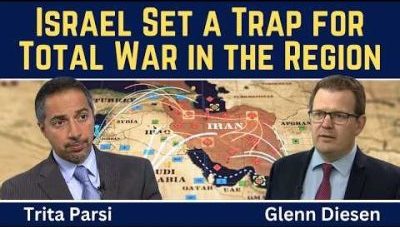
Trita Parsi: Israel Set a Trap for Total War in the Region
or go to
Aletho News Archives – Video-Images
From the Archive
Zionism’s Violent Legacy
By Donald Neff | Washington Report On Middle East Affairs | January 1996
On January 4, 1948, Jewish terrorists drove a truck loaded with explosives into the center of the all Arab city of Jaffa and detonated it, killing 26 and wounding around 100 Palestinian men, women and children.[1] The attack was the work of the Irgun Zvai Leumi – the “National Military Organization,” also known by the Hebrew letters Etzel – the largest Jewish terrorist group in Palestine. The Irgun was headed by Revisionist Zionist Menachem Begin and had been killing and maiming Arabs, Britons and even Jews for the previous ten years in its efforts to establish a Jewish state.
This terror campaign meant that at the core of Revisionist Zionism there existed a philosophical embrace of violence. … continue
Blog Roll
 Aletho News
- Trita Parsi: Israel Set a Trap for Total War in the Region
- Trump’s Iran war is on an Israeli leash
- Saudi oil boss issues global supply warning
- Riyadh Says Its Oil System Is Intact. The Numbers Say Otherwise.
- Trump and Netanyahu Want to “Finish the Job” on Iran
- US ‘one-sided dictation’ not Iran’s beliefs makes rational talks impossible: Baghaei
- Iran’s Next Strike May Not Explode. It Could Shut You Down /Col Doug Macgregor
- Iran: US political targets legitimate if assassinations return
- Iraq shuts key border crossing with Iran under US pressure: Report
- Undersea Internet cables could be targeted in retaliation for attacks on Iran: IRGC deputy chief
- If Americans Knew
- The Israel Lobby’s Changing Fortunes
- AIPAC has become such a political liability that it’s shifting to a more “nimble” approach to buying politicians
- At least 160 Israeli settler attacks in 2 weeks
- Will Gaza’s Ancient Christian Community Disappear Forever?
- Israel’s vision of regional security rests on keeping Arab states weak
- Heidi Levine recounts how Palestinian youths helped save her in settler attack
- DAILY UPDATE: Latest essential news on Palestine, Israel, & region
- Trump’s Intensifying Sabotage of the ICC, for Israel’s Sake
- Israeli military detain US and UK volunteers in West Bank including Democratic NY politician Brad Lander
- Americans at National Conservatism Conference held in Israel this year criticize Israel
- No Tricks Zone
- E-Cars Reduce CO2 Emissions By Only 41% Compared To Internal Combustion Engine Vehicles
- Predictions Made By Renowned Climate Professor Over Past Decades Have Been Proven To Be Poor
- New Study Suggests Large Regions Of The Pacific Ocean Have Been Cooling For The Last 80 Years
- Germany’s Green Energy Debacle: High Energy Costs Force Kahla Porzellan to Close After 182 Years!
- New Study: 50 Years Of The Most Aggressive ‘Net Zero’ Policies Can Only Affect The Global Climate By 0.03°C
- US September “Heat” Was No Record…Many Records Set Decades Ago
- Latest European Green Energy Debacle; Portugal’s Largest Flagship Solar Park Insolvent!
- Green Energy Debacle: German Expert Professor Fritz Vahrenholt Warns Of Severe Economic And Social Consequences
- Two More Paleo Reconstructions Affirm Meters-Higher Sea Levels Across Ireland, Brazil 7000-6000 Years Ago
- New Study: Earth And Venus Surface Warmth Largely Explained By Convection And Lapse Rate, Not CO2 Or Radiation

