Why the US anti-terror coalition is failing
By Finian Cunningham | American Herald Tribune | January 21 ,2016
There was an underwhelming sense when Pentagon boss Ashton Carter met this week in Paris with other members of the US-led military coalition supposedly fighting the ISIL terror group.
The US-led coalition was set up at the end of 2014 and in theory comprises 60 nations. The main military operation of the alliance is an aerial bombing campaign against terrorist units of IS (also known as ISIL, ISIS or Daesh).
At the Paris meeting this week, Secretary of Defense Carter was joined by counterparts from just six countries: France, Britain, Germany, Italy, Netherlands and Australia. Where were the other 54 nations of the coalition?
Carter and French defense minister Jean-Yves Le Drian patted themselves on the back about “momentum”in their campaign against the terrorist network. However, platitudes aside, there was a noticeable crestfallen atmosphere at the meeting of the shrunken US-led coalition.
One telling point was Carter exhorting Arab countries to contribute more. As a headline in the Financial Times put it: “US urges Arab nations to boost ISIS fight”.
Carter didn’t mention specific names but it was clear he was referring to Saudi Arabia and the other oil-rich Persian Gulf Arab states, including Kuwait, Qatar, United Arab Emirates and Bahrain.
When the US initiated the anti-IS coalition in 2014, fighter jets from the Sunni Arab states participated in the aerial campaign. They quickly fell away from the operation and instead directed their military forces to Yemen, where the Saudi-led Arab coalition has been bombing that country non-stop since March 2015 to thwart an uprising by Houthi revolutionaries.
But there is an even deeper, more disturbing reason for the lack of Arab support for the US-led coalition in Iraq and Syria. That is because Saudi Arabia and the other Sunni monarchies are implicated in funding and arming the very terrorists that Washington’s coalition is supposedly combating.
Several senior US officials have at various times admitted this. Democrat presidential hopeful Hillary Clinton labelled Saudi Arabia as the main sponsor of “Sunni extremist groups”in diplomatic cables when she was Secretary of State back in 2009, as disclosed by Wikileaks.
Vice President Joe Biden, while addressing a Harvard University forum in late 2014, also spilled the beans on the Persian Gulf states and Turkey being behind the rise of terror groups in the Middle East.
So there is substantial reason why the US-led anti-terror coalition in Iraq and Syria has not delivered decisive results. It is the same reason why Carter was joined by only six other countries in Paris this week and why there was a glaring absence of Saudi Arabia and other Arab members. These despotic regimes –whom Washington claims as “allies”–are part of the terrorist problem.
Not that the US or its Western allies are blameless. Far from it. It was Washington after all that master-minded the regime-change operations in Iraq and Syria, which spawned the terror groups.
In fact, we can go further and point to evidence, such as the testimony of Lt General Michael Flynn of the Defense Intelligence Agency, which shows that the US enlisted the terror brigades as proxies to do its dirty work in Syria for regime change.
The US and its Western allies conceal this collusion by claiming that they are supporting “moderate rebels”–not extremists. But the so-called moderates have ended up joining the terrorists and sharing their US-supplied weapons. The distinction between these groups is thus meaningless, leaving the baleful conclusion that Washington, London and Paris are simply colluding with terrorism.
US Republican presidential contenders and media pundits berate the Obama administration for not doing enough militarily to defeat IS. Or as Donald Trump’s backer Sarah Palin would say to “kick ass”.
The unsettling truth is that the US cannot do more to defeat terrorism in the Middle East because Washington and its allies are the source of terrorism in the region. Through their meddling and machinations, Washington and its cohorts have created a veritable Frankenstein monster.
The “coalition”that is actually inflicting serious damage to IS and its various terror franchises is that of Russia working in strategic cooperation with the Syrian Arab Army of President Bashar al-Assad. Since Russia began its aerial bombing campaign nearly four months ago, we have seen a near collapse of the terror network’s oil and weapons smuggling rackets and hundreds of their bases destroyed.
Yet Ashton Carter this week accused Russia of impeding the fight against terrorism in Syria because of its support for the Assad government. Talk about double think!
If we strip away the false rhetoric and mainstream media misinformation, Washington’s “anti-terror”coalition can be seen as not merely incompetently leading from behind.
The US, its Western allies and regional client regimes are in the front ranks of the terror problem.
Turkish PM Tries to Frame Syrian Kurds for Istanbul Bombing
By Joris Leverink | teleSUR | January 23, 2016
On Tuesday, Jan. 12 a big explosion took place in the heart of Istanbul’s tourist district of Sultanahmet. The explosion was caused by a suicide bomber who blew himself up next to a group of mainly German tourists, instantly killing ten and injuring 15 others. Soon, the bomber was identified as a Saudi born Syrian man who had recently entered Turkey and had registered himself as a refugee only days prior to his suicide mission.
According to the Turkish authorities the man was linked to the Islamic State group (IS, or ISIS/ISIL), making this the terrorist group’s fourth deadly suicide bombing in Turkey in one year. Previous attacks that have been ascribed to – but haven’t been claimed by – IS occurred in Diyarbakir in June, Suruc in July and Ankara in October, with a total death toll of around 140.
What set this latest attack apart from the others, however, is the explicit targeting of foreign nationals holidaying in Turkey. Previous attacks were all directed against Kurdish groups and their supporters, indicating a spillover from the wars in Syria and Iraq where Kurdish forces are seen as some of the most effective and reliable opponents of IS.
The Kurdish groups and organizations targeted by the Islamic State group were at the same time actively opposing the ruling Justice and Development Party (AKP). This sparked rumors of the terror group being in cahoots with the Turkish government. Accusations ranged from the two parties actively cooperating with each other to the government’s willful neglect of the safety of its Kurdish citizens.
That the Turkish government considers the Kurds at home and abroad as a bigger threat to the national security than IS has never been a secret. Moreover, the fact that IS is fighting against two of Turkey’s key enemies in Syria – the Assad government and local Kurdish forces – means that Turkey has always been hesitant about seriously and directly confronting the jihadists.
Questions and irregularities
It is in this context that the attack in Istanbul seems out of place. Why would the Islamic State group risk antagonizing one of the few parties in the region with which it has at least some shared goals? What is there to be gained from dealing a blow to Turkey’s already hampered tourist industry and forcing the country’s hand in taking a firm stance against the terrorist group?
There are a number of questions and irregularities that come up when looking at the facts that have thus far come out.
The first matter is the timing of the attack. If the aim of the attack is to hit Turkey by targeting its US$30 billion tourist industry, the bomber couldn’t possibly have chosen a worse time than a cold Tuesday morning in mid-January. The site of the attack is the exact location where during the holiday season thousands of tourists line up every day to visit the Blue Mosque. The number of victims would undoubtedly have been many times higher if the attack would have taken place a few months later, with an absolutely devastating effect on Turkey’s tourist industry.
Then there is the matter of the bomber’s identity. Mere hours after the attack the identity of the man who blew himself to pieces was already known and released. Nabil Fadli was a 28-year-old, Saudi-born Syrian man who had joined IS’ ranks after the terror group had occupied his hometown of Manbij, north of Aleppo.
According to unnamed Turkish officials Fadli had been part of a plot to attack the New Year’s celebrations in Ankara, but this mission had to be aborted after two of his collaborators were exposed and arrested. Fadli moved to Istanbul where he registered himself as a refugee, in the process giving away his fingerprints that would eventually lead to his identification as the bomber one week later.
The curious thing is, why would a member of the Islamic State group who has come to Turkey with the intention of committing a suicide bomb attack make himself known to the authorities – especially after two of his companions have just been arrested? Why have your picture and fingerprints taken and give away the address where you’re staying – which he did, according to the official reports – instead of laying low for a few days before executing the plan for the attack?
Finally, there is the curious issue of IS never actually having claimed responsibility for the attack. Nor for any of the other attacks mentioned above, which all have been attributed to the terrorist group by the Turkish government. The past year has seen a sting of terror attacks committed by the Islamic State group outside of the territories that are under its control – from Jakarta to Paris, Tunis to Beirut – and each and everyone of them has been claimed by the terror group. Oddly enough, not a single attack in Turkey that has been ascribed to IS has actually been claimed by them.
Raising these questions and irregularities is not done for the purpose of pointing fingers at one party or another. They simply serve as a mental exercise to remind one that, especially when entering the realm of terror and counterterrorism, the reality is rarely how it is presented to the public.
Shifting the blame
The day after the attack, Turkish prime minister Ahmet Davutoglu suggested that “certain powers could be using Daesh,” while referring to the Islamic State group by its Arab acronym. Which“certain powers” he had in mind became clear when anonymous government sources told Reuters that Fadli might have been “coerced by the PYD or by Syrian intelligence into the Istanbul bombing.”
These baseless allegations serve no other purpose but to frame the party of the Syrian Kurds, the Democratic Unions Party, or PYD, as the terrorist organization Turkish authorities claim it to be. Immediately after the Ankara bombings in October, similar attempts at spreading false propaganda were made. Prime minister Davutoglu coined the term “cocktail terrorism” and claimed on national television that the attack was the work of a coalition between the PYD, the Islamic State group, Syrian secret services and the PKK.
The Istanbul attack, regardless of who did it, will be used as propaganda by all the parties involved. For Turkey, which had come under increasing international pressure for failing to step up against IS, the attack firmly places them once again at the heart of the anti-terror coalition dominated by the US and Europe. Reports about retaliation attacks against IS in which supposedly 200 terrorists were killed in cross border artillery fire – an incredible (literally) high number – are meant to erase all doubts that Turkey is now seriously confronting IS.
The attack has also provided Turkey with the necessary pretext to launch attacks further into Syria, at the town of Manbij – the bomber’s hometown – to be precise. This is a highly strategic target because it’s location in the heart of the proposed “security zone” Turkey has wanted to establish for a long time. Coincidentally, Manbij is also the next stop for a coalition of Kurdish forces and their allies who have been gaining significant ground at the cost of the Islamic State group after a recent string of important victories.
Judging from the news, the Istanbul attack has certainly led to renewed efforts by the Turkish government to confront and attack IS. Targets in Syria have been hit, and dozens of alleged IS members have been arrested in the country. However, the fact that part of the blame has been tried to be placed on the Syrian Kurds shows that, besides a deeply tragic event, the suicide attack is at the same time a good opportunity to frame the public perception and pursue a very specific political agenda.
Joris Leverink is an Istanbul-based political analyst and writer with an MSc in Political Economy. He is an editor for ROAR Magazine. You can follow him on Twitter via @Le_Frique.
Russia, US agree to have 2 rebel delegations at Syria peace talks – reports
RT | January 24, 2016
Moscow and Washington are close to reaching a compromise on the participants of the Syria peace talks set to start next week. Two separate Syrian opposition delegations are expected to be invited to the negotiations in Geneva, according to media reports.
United Nations-sponsored negotiations between the Syrian government and the opposition have already been postponed over disagreements between the US and Russia, which could not reach agreement on which opposition groups should be represented. The talks are being arranged to try to bring an end to Syria’s five-year civil war.
Washington supports the participation of the Saudi-backed Islamist militia Jaysh al-Islam (Army of Islam) – something Moscow has strongly objected to. Russia insists that political figures it deems more moderate, such as Qadri Jamil, a former Syrian deputy prime minister, and Saleh Muslim, co-head of the Syrian Kurdish group PYD, should join the negotiations, Kommersant daily reported Saturday.
A compromise has allegedly now been reached, however, with Moscow agreeing to the presence of Jaysh al-Islam at the talks. In return, Washington will not object to a separate Syrian opposition delegation being invited, Bloomberg reports, citing three Western and UN diplomats who spoke on condition of anonymity.
The ‘main’ opposition delegation was rubber-stamped in the Saudi capital Riyadh in December, and represents opposition groups sponsored by Saudi Arabia and the West.
Staffan de Mistura, the UN special envoy for Syria, is now likely to send invitations to two opposition groups – one proposed by Washington, another recommended by Moscow.
“We are confident that with good initiative in the next day or so, those talks can get going,” US Secretary of State John Kerry told reporters on Saturday in Riyadh, where he has been seeking a deal on the Syria talks.
De Mistura is expected to elaborate on the latest details of the peace process at a press-briefing in Geneva on Monday, his spokeswoman Jessy Chahine said.
Russian Foreign Ministry spokeswoman Maria Zakharova made no comments in a press conference on Friday regarding which opposition groups will attend the talks in Geneva.
The nations assisting the Syria peace talks have reached an agreement to form a transitional government in Syria by mid-2016, with an aim to hold elections in 2017. According to Russian and Western diplomats, Moscow has managed to shutter Washington’s previously indispensable prerequisite that Bashar Assad must leave his presidential post before the transition process can start.
Moscow has always insisted that it is up to the Syrian people to decide whether President Assad should stay or go, and the participation of the acting president in the next elections remains on the table.
At the moment there are two anti-Islamic State (IS, formerly ISIS/ISIL) coalitions operating in Syria – one headed by the US, the other by Russia.
The Russian military’s air operation against IS in Syria began four months ago, and has significantly disrupted terrorist communications and supply routes. Islamic State’s illegal trafficking of stolen Syrian and Iraqi oil has been crippled to such an extent that the terrorists have been forced to compensate the shortfall in profits by increasing taxes, cutting salaries to militants and attempting to take drug production in Afghanistan under its control.
The Syrian Army loyal to President Assad is also conducting an offensive on terrorist positions, and has liberated a number of settlements. The spearhead of the assault is directed against the borders with Turkey and Jordan, in order to cut terrorist supply routes and prevent reinforcements from abroad from infiltrating Syria.
Turkey ‘threatens to withdraw’ from Syria talks over Syrian Kurds
RT | January 23, 2016
Ankara may boycott the upcoming Syria talks in Switzerland if Syrian Kurds are invited, media reports said, citing UN sources. Earlier, Turkey said their support for the peace process can only be ensured if there is no “representation of terrorist groups around the table.”
Turkey has privately warned that it might pull out from the Geneva talks now scheduled for January 25 if Saudi-backed Kurds and related parties are present, Foreign Policy reported Saturday citing UN-based officials.
Ankara is unwilling to cooperate with Syria’s Democratic Union Party (PYD) and its affiliate People’s Protection Units (YPG) since these leftist movements are allegedly linked to the Kurdistan Workers’ Party (PKK), which is considered a terrorist organization by Turkey.
The conflict between the Turkish government and Kurdish insurgent groups demanding greater autonomy for the large ethnic group has been going on for decades. With several failed ceasefires between the sides, Ankara has been blamed for putting civilians lives in Turkey’s mainly Kurdish southeast at risk by a number of international human rights groups.
Earlier this week, President Erdogan reaffirmed his unwillingness to search for a peaceful solution to the conflict, saying that “those with guns in their hands and those who support them will pay the price of treason,” meaning the Kurdish militants who are considered terrorists by the government.
Apart from Turkey, the historical Kurdistan region also includes territories in Iran, Iraq and northern Syria, where Kurdish fighters have proved to be some of the most effective forces in helping to combat Islamic State (IS, formerly ISIS/ISIL). Still Ankara believes that struggling against IS “does not grant them legitimacy,” according to the Turkish Prime Minister Ahmet Davutoglu. Turkey has carried out several attacks on Kurdish forces in northern Syria.
Moreover, Davutoglu accused Russia of as much as compromising Geneva talks by inviting the representatives of YPG – Syrian Kurdish forces – to join the peace process.
“Some circles, including Russia, want to spoil the opposition side, putting some other elements in the opposition side like the YPG, which has been collaborating with the regime and attacking the moderate opposition,” the PM said earlier this week.
“There should not be any representation of terrorist groups around the table,” he insisted.
Geneva talks on the Syrian crisis have recently become a bone of contention between international negotiators: the key issue is who would attend.
A resolution providing for the beginning of talks between the Syrian government and opposition groups was adopted by the UN Security Council in December. Scheduled to take place in Switzerland in January, the talks became known as Geneva III (Geneva II happened in January 2014), and are aimed at finding a solution to end the Syrian civil war, which has been ongoing in the country since 2011, with IS gaining strength in the region. While a number of countries, including Russia, the US, Saudi Arabia, Iran and Turkey are backing the peace talks, there is no apparent agreement on who should represent the Syrian opposition, and which fighting groups should be excluded for being proclaimed “terrorists.”
Turkey wouldn’t welcome a Kurdish presence at the talks. However, the US government still believes there is hope of changing Ankara’s opinion on the subject, according to Foreign Policy. Vice President Joe Biden arrived in Istanbul to discuss national security questions with the Turkish leaders on Saturday.
At the same time, US State Secretary John Kerry traveled to Riyadh in order to press Saudi officials to reconsider on a similar matter. Saudi Arabia previously threatened to boycott Geneva talks if certain pro-regime Syrian groups allegedly backed by Russia and Egypt were invited. In their turn, the opposition representatives urged UN special envoy Staffan de Mistura in a letter to disqualify Riyadh from peace talks as it was picking delegates for its own delegation talks “under obscure conditions,” Russia’s Sputnik agency reported.
As a result, de Mistura, responsible for issuing the invitations to the talks, accused a few states of jeopardizing the peace process by insisting that their opposing faction is more important than others.
“I would expect all sides to recognize my mandated responsibility to finalize a list of invitees to the process, to include all those I deem appropriate,” de Mistura reportedly said at a private UN briefing on January 18.
Russia and the US still hope that the talks will eventually take place on January 25. Foreign Minister Sergey Lavrov and State Secretary John Kerry had a phone talk on Saturday to discuss arrangements for the Geneva meeting, Russian foreign authority said. Both officials agreed that the International Syria Support Group format might be useful for holding further peace talks on Syria.
IRAQ: The War Legacy and the ‘Staggering’ Suffering of Its Civilian Population…
The Burning Blogger Of Bedlam | January 22, 2016
‘Staggering’ is how the UN has described the depth and nature of civilian suffering in post-war Iraq; citing over 18,000 civilians having been killed in the space of just this last year-and-a-half.
According to the report, conducted by the United Nations Assistance Mission for Iraq and the Office of the High Commissioner for Human Rights, an approximate 3.2 million people have also been displaced internally over this same period of time.
The UN report confirms the brutality of the so-called ‘Islamic State’ group, with its unprecedented levels of gruesome, rampant violence and criminality. But contrary to popular portrayal, the violence in Iraq isn’t limited to ISIS/ISIL, but includes various crimes committed by Iraqi troops, militiamen and Kurdish forces, as recorded in the UN report.
The UN also acknowledges that the recorded 18,802 civilians killed (and 36,245 wounded) between the beginning of 2014 and the end of 2015 could be much higher; the figures will logically be higher, because there are multiple no-go areas for journalists and activists, where crimes can’t be investigated.
Among the most brutal of the many brutal crimes committed by the foreign-backed ‘ISIS/ISIL’ was an incident in Mosul where victims were forced to lay down in front of a crowd while a bulldozer was driven over them, and the militants executing 19 women for refusing to submit to sex with ISIL fighters. Up to 900 children have also been reported abducted in Mosul and subjected to forced indoctrination and military training. The report also highlights the extent to which women and children have been subjected to sexual violence, and highlights the plight of some 3,500 people, mostly women and children from the Yazidi community, currently being held as slaves.
Read also, the UN Report on the Protection on Civilians in the Armed Conflict in Iraq, May – October 2015.
And yet for all the instability and horrors of Iraq, some 245,000 desperate Syrians have reportedly crossed into Iraq to escape the horrors of neighbouring Syria; Syrians too have been paying the price for the invasion of Iraq and the destabilisation of the entire region. These horrors are inter-related, as is what is happening in Libya.
All of the horrors highlighted in the report, however, are simply from the passed year or so. The suffering of the Iraqi people and the humiliation and destruction of Iraqi society had already been going on a long time before this and before even the rise of the horrendous, foreign-funded ISIS/ISIL proxy army.

The governments of the US/UK and NATO essentially already committed genocide against the Iraqi people between 1990 and 2012, killing an estimated 3.3 million, including 750,000 Iraqi children through either sanctions or war.
The illegal invasion and occupation from 2003 is estimated to have led to approximately 189,000 direct war deaths, but this doesn’t also include the hundreds of thousands more who died over the course of the invasion and occupation in general. This includes victims of displacement, victims of terrorism, and the many, many Sunni victims of the US-backed Shia ‘Death Squads’, and of course the many subsequent victims of the Sunni ‘ISIS/ISIL’, which many regard as a direct response to those US-backed Shia militias.
In every respect, the so-called ‘Islamic State’ owes its existence to its foreign patrons and to the illegal invasion of Iraq. As mass graves continue to be discovered, the UN has outright accused ISIS/ISIL of ‘war crimes’ and ‘crimes against humanity’ in Iraq. Whether that means scores of individual jihadists and European teenagers are going to eventually be tried in an international court (the leader or ‘caliph’ of ISIL – the elusive Abu Bakr al-Baghdadi – will probably never be tried, as he probably doesn’t exist), it’s a fair bet that the real funders and enablers of this ultra-violent sectarian nightmare will never face charges and neither will the governments, officials and corporations whose illegal warfare has created all of this suffering and death.
Whichever way we look at it – either by American/Western incompetence or by deliberate design; and there’s a massive case to be made for both – what we now know as ‘ISIS/ISIL’ is the monster-child of the 2003 Iraq invasion. Watch this video of an Iraq War veteran, and now-activist, recounting some of the horrific behaviour of invading American troops during the war, as he openly admits “I Helped Create ISIS”. Or examine the reality of the ISIS/ISIL ‘leadership’ and see where the organisation came from.
Aside from the invasion having been entirely illegal and aside from the false pretexts under which it was carried out, at least $75 billion was made in profit by American subcontracting companies alone, including Blackwater, CACI and Titan. United States’ Vice-President Dick Cheney’s company, Haliburton, made an approximate $39.5 Billion from the Iraq War alone.
Concerning the current situation, the UN High Commissioner for Human Rights has said the latest study “illustrates what Iraqi refugees are attempting to escape when they flee to Europe and other regions. This is the horror they face in their homelands”. Go back now and re-watch the old footage of Bush, Rumsfeld and the rest of the mafia of War Criminals/Profiteers talking about the need to invade Iraq; worse, go back and watch them smugly declaring ‘Mission Accomplished’.
Better yet, go re-watch this interview with former American ally and CIA asset, Saddam Hussein, on the eve of the invasion and listen to him talking passionately and proudly about the history, heritage, culture and unity of the Iraqi nation (no sectarian talk, no Sunni/Shia divide, no terrorism), and see if you can get through it without either goosebumps or feeling sick to the pit of your stomach for what was to follow. And for what is still following even now, all these years later.
US Role as State Sponsor of Terrorism Implied in US Congressional Research Service Report on Syria Conflict
By Stephen Gowans | what’s left | January 10, 2016
The implication of a report written for the US Congress is that the United States is a state sponsor of terrorism in Syria. At the same time, the report challenges widely held beliefs about the conflict, including the idea that the opposition has grass-roots support and that the conflict is a sectarian war between Syrian president Bashar al-Assad’s Alawite sect and the majority Sunnis.
Written in October 2015, the report was prepared by the Congressional Research Service, an arm of the United States Library of Congress. The Congressional Research Service provides policy and legal analysis to committees and members of the US House and Senate.
Titled “Armed Conflict in Syria: Overview and US Response,” the report reveals that:
1. The Syrian conflict is between Islamists and secularists, not Sunnis and Alawites.
Media reports often emphasize the dominant Sunni character of the rebels who have taken up arms against the Syrian government, while depicting the Syrian government as Alawite-led. What is almost invariably overlooked is that the largest Sunni fighting force in Syria is the country’s army. Yes, the rebels are predominantly Sunni, but so too are the Syrian soldiers they’re fighting. As Congress’s researchers point out, “most rank and file military personnel have been drawn from the majority Sunni Arab population and other (non-Alawite) minority groups” (p. 7). Also: “Sunni conscripts continue to fight for Assad” (p. 12). Rather than being a battle between two different sects, the conflict is a struggle, on the one hand, between Sunni fundamentalists who want to impose their version of Islam on Syrian politics and society, and on the other hand, Syrians, including Sunnis, who embrace a vision of a secular, non-sectarian government.
2. The Syrian Opposition Coalition is dominated by Islamists and is allied with foreign enemies of Syria.
According to the report, the Syrian National Council (whose largest member is the Syrian Muslim Brotherhood) is the “largest constituent group” of the Syrian Opposition Coalition (SOC). The SOC is based “in Turkey and considered to be close to foreign opponents of Assad.” (p. 14) The Muslim Brotherhood seeks to base political rule on the Quran, which it sees as divinely inspired, rather than on a secular constitution.
3. “Political opposition coalitions appear to lack…grass roots support” (p. 27).
This is consistent with the findings of a public opinion poll taken last summer by a research firm that is working with the US and British governments. That poll found that Assad has more support than the forces arrayed against him.

Syrians rally for Assad, October, 2011.
The survey, conducted by ORB International, a company which specializes in public opinion research in fragile and conflict environments, found that 47 percent of Syrians believe that Assad has a positive influence in Syria, compared to only 35 percent for the Free Syrian Army and 26 percent for the SOC. [1]An in-country face-to-face ORB poll conducted in May 2014 arrived at similar conclusions. That poll found that more Syrians believed the Assad government best represented their interests and aspirations than believed the same about any of the opposition groups. [2]
According to the poll, only six percent believed that the “genuine” rebels represented their interests and aspirations, while the ‘National Coalition/transitional government,” a reference to the SOC, drew even less support, at only three percent.
Assad has repeatedly challenged the notion that he lacks popular support, pointing to his government surviving nearly five years of war against forces backed by the most powerful states on the planet. It’s impossible to realistically conceive of his government’s survival under these challenging circumstances, he argues, without its having the support of a sizeable part of its population. [3]
4. A moderate opposition doesn’t exist. The United States is trying to build one to act as its partner.
The report refers to US efforts to create partners in Syria, a euphemism for puppets who can be relied upon to promote US interests.
“Secretary of Defense Carter described the ‘best’ scenario for the Syrian people as one that would entail an agreed or managed removal of Assad and the coalescence of opposition forces with elements of the remaining Syrian state apparatus as U.S. partners ….” (emphasis added, pp. 15-16).
Also: The Pentagon “sought to…groom and support reliable leaders to serve as U.S partners…” (emphasis added, p. 23).
To create partners, the United States is engaged in the project of building a “moderate” opposition. According to the report:
“On June 18, Secretary of Defense Carter said, ‘…the best way for the Syrian people for this to go would be for him to remove himself from the scene and there to be created, difficult as it will be, a new government of Syria based on the moderate opposition that we have been trying to build…” (emphasis added, footnote, p. 16).
In the report summary the researchers write that US strategy seeks to avoid “inadvertently strengthening Assad, the Islamic State, or other anti-U.S. armed Islamist groups” (emphasis added.) What’s left unsaid is that armed Islamist groups that are not immediately anti-U.S. may be looked upon favorably by US strategy. However, that “political opposition coalitions…appear to lack grass-roots support,” and that Washington can’t rely on an already-formed moderate opposition but needs to build one, shows that the set of rebels on which the US can rely to act as US partners who will rule with elements of the existing Syrian state in a post-Assad Syria is virtually empty. The conclusion is substantiated by the failure of a now-abandoned Pentagon program to train and equip vetted rebel groups. Gen. Lloyd J. Austin III, the top American commander in the Middle East, told the Senate Armed Services Committee that despite the Pentagon spending $500 million training and equipping “moderate” rebels, only “four or five” were “in the fight.” [4] As the Wall Street Journal observed in late December, moderate rebels don’t exist. They’ve either been absorbed into Jabhat al-Nusra, Ahrah al-Sham and ISIS—the extremist terrorist groups which dominate the opposition—or were Islamist militants all along. [5]
5. The United States is arming sectarian terrorists indirectly and possibly directly and covertly.
The report points out that not only has the Pentagon openly trained and equipped rebels, but that the United States has also covertly armed them. According to the Congress’s researchers:
“Then Secretary of Defense Chuck Hagel said in a September 2013 hearing before the Senate Foreign Relations Committee that the Administration was taking steps to provide arms to some Syrian rebels under covert action authorities” (p. 23).
Also:
“Secretary Hagel said, ‘it was June of this year that the president made the decision to support lethal assistance to the opposition….we, the Department of Defense, have not been involved in this. This is, as you know, a covert action’” (footnote, p.23).
If the United States was prepared to overtly arm some rebel groups, why is it covertly arming others? A not unreasonable hypothesis is that it is arming some rebel groups covertly because they have been designated as terrorist organizations. To be sure, a number of press reports have revealed that rebels who have received training and arms from the United States are operating with terrorist groups in Syria. According to the Wall Street Journal, “insurgents who have been trained covertly by the Central Intelligence Agency…are enmeshed with or fighting alongside more hard-line Islamist groups, including the Nusra Front, Al Qaeda’s Syria affiliate” [6]. Another report from the same newspaper notes that “al-Nusra has fought alongside rebel units which the U.S. and its regional allies have backed” [7]. A third report refers to collaboration between “CIA-backed Free Syrian army factions and extremist elements such as Nusra Front and Ahrar al Sham” [8]. Let’s be clear. Anyone who is enmeshed with and fighting alongside Al-Qaeda is a terrorist.
 According to Congress’s researchers, weapons the US furnished to selected groups have made their way to jihadists. “Some Syrian opposition groups that have received U.S. equipment and weaponry to date have surrendered or lost these items to other groups, including to extremist groups such as Jabhat al-Nusra” (p. 23).
When you consider that, as The Washington Post reported, “the CIA has trained and equipped nearly 10,000 fighters sent into Syria over the past several years” [9] and that, at best, there are 700, and more likely only 70 “moderate” rebels in Syria [10], then the bulk of the large rebel force the CIA has trained and equipped is very likely made up of Islamist extremists. Concealing this shameful reality from the US public is probably the principal reason the program is covert.
6. Washington wants to contain ISIS, but not eliminate it, in order to maintain military pressure on the Syrian government.
Based on the US coalition’s less than vigorous air campaign against ISIS, many observers have questioned whether the United States is at all serious about eliminating ISIS just yet, and is simply trying to contain it, to keep pressure on the Syrian government. For example, veteran Middle East correspondent Robert Fisk says: “I don’t think the U.S. is serious. Very occasionally, you can hear the rumble of American bombs. But they’re certainly not having much effect.” [11]
One day, soon after Russia began air operations in Syria, journalist Patrick Cockburn noted that “Russian planes carried out 71 sorties and 118 air strikes against Islamic fighters in Syria over the past two days compared to just one air strike by the US-led coalition – and this single strike, against a mortar position, was the first for four days.” [12] After ISIS captured Palmyra, and pushed into Aleppo, the US coalition did nothing to push back the ISIS advance, leading even rebels to question “the U.S.’s commitment to containing the group.” [13] Assad too has expressed scepticism about whether the United States is serious about destroying ISIS, pointing to the terrorist organization’s continued successes in Syria, despite the US coalition’s presumed war against it. “Since this coalition started to operate,” observed the Syrian president, “ISIS has been expanding. In other words, the coalition has failed and it has no real impact on the ground.” [14]
A tepid approach to fighting ISIS in Syria would fit with US president Barack Obama’s stated goal of degrading the Al-Qaeda offspring organization. Destroying it may be an ultimate goal, to be achieved after ISIS has served the purpose of weakening the Syrian government. But for now, the United States appears to be willing to allow ISIS to continue to make gains in Syria. The Congressional Research Service report concurs with this view: It concludes that “U.S. officials may be concerned that a more aggressive campaign against the Islamic State may take military pressure off the” Syrian government (p. 19).
By contrast, Moscow has pursued a more vigorous war against ISIS, and for an obvious reason. Unlike Washington, it seeks to prop up its Syrian ally, not give ISIS room to weaken it. It should be additionally noted that Russia’s military operations in Syria are legal, carried out with the permission of the Syrian government. By contrast, the US coalition has brazenly flouted international law to enter Syrian airspace without Damascus’s assent. It has, in effect, undertaken an illegal invasion and committed a crime of aggression, compounded by its training and arming of terrorists.
Conclusion
The report says that in the absence of grass-roots support for political opposition coalitions in Syria, the United States is relying on a number of tactics to pressure the current government in Syria to step down, including:
• Keeping ISIS alive as a tool to sustain military pressure on Damascus.
• Arming jihadist groups indirectly and (we can assume) directly (albeit covertly) to pressure Assad.
• Seeking to create a moderate opposition that will act as a US partner.
• Trying to co-opt parts of the existing Syrian state to take a partnership role in governing a post-Assad Syria.
The implication of points 1 and 2 is that the United States—as the trainer of, and supplier of arms, to rebels who are enmeshed with and fighting alongside Al-Qaeda in Syria, and in keeping ISIS alive, in order to use these terrorist organizations to achieve its political goal of installing a US-partner government in Syria—is a state sponsor of terrorism.
1. http://www.opinion.co.uk/perch/resources/syriadata.pdf
2. http://www.opinion.co.uk/perch/resources/syriadatatablesjuly2014.pdf
3. “President al-Assad: Russia’s policy towards Syria is based on values and interests, the West is not serious in fighting terrorists,” Syrian Arab News Agency, December 11, 2015, http://sana.sy/en/?p=63857
4. Philip Shishkin, “U.S. weighs talks with Russia on military activity in Syria,” The Wall Street Journal, September 16, 2015.
5. Stuart Rollo,“Turkey’s dangerous game in Syria,” The Wall Street Journal, December 28, 2015.
6. Anne Barnard and Michael R. Gordon, “Goals diverge and perils remain as U.S. and Turkey take on ISIS,” The New York Times, July 27, 2015.
7. Farnaz Fassihi, “U.N. Security Council unanimously votes to adopt France’s counterterrorism resolution,” The Wall Street Journal, November 20, 2015.
8. Sam Dagher, “Syria’s Bashar al-Assad Tries to Force the West to Choose Between Regime, Islamic State,” The Wall Street Journal, October 9, 2015.
9. Greg Miller and Karen DeYoung, “Secret CIA effort in Syria faces large funding cut,” The Washington Post, June 12, 2015.
10. Robert Fisk, “Is David Cameron planning to include al-Qaeda’s Jabhat al-Nusra in his group of 70,000 moderates?”, The Independent, December 1, 2015.
11. Thomas Walkom, “Journalist Robert Fisk explains why Canada should abandon ISIS war,” The Toronto Star, September 25, 2015.
12. Patrick Cockburn, “Russia in Syria: Air strikes pose twin threat to Turkey by keeping Assad in power and strengthening Kurdish threat,” The Independent, October 28, 2015.
13. Raja Abdulrahim, “Islamic State advances further into Syria’s Aleppo province,” The Wall Street Journal, June 1, 2015.
14. “President Assad’s interview with Russian media outlets, Syrian Arab News Agency, September 16, 2015 http://sana.sy/en/?p=54857
Feds framed my client, ISIS suspect’s lawyer says
RT | January 20, 2016
The attorney for one Virginia resident accused of backing ISIS says the plot was manufactured by three government informants. He claims federal agents are targeting Muslim Americans for fake terror plots, so they could take credit for stopping them.
“They had three informants in this case that were looking for people to get in trouble,” Ashraf Nubani told reporters on Tuesday, after the preliminary court hearing for Mahmoud Amin Mohamed Elhassan, arrested Friday on charges of aiding and abetting terrorism.
Elhassan, 25, is a US permanent resident of Sudanese origin. The government charges him of aiding Joseph Hassan Farrokh, 28, who allegedly wanted to join Islamic State (IS, formerly ISIS/ISIL). The federal complaint against the men says that Farrokh planned to travel via Richmond International Airport, to Jordan and then to Syria.
Nubani argued that the entire plot was cooked up by federal law enforcement, eager to present itself as doing something to stop terrorism.
“They create cases, and then they prevent them from happening,” Nubani said.
According to the complaint against Farrokh and Elhassan, three government informants were involved in the plot. One of them, identified only as CHS#3, is a convicted felon who received a reduced sentence in exchange for his cooperation. He has worked for the FBI since 2012, receiving over $10,000 in compensation.
Another informant, CHS#1, posed as an “ISIL facilitator” who told Farrokh he could help him join the terror group overseas. The third informant, identified as CHS#2, was introduced as a trusted “brother,” member of the terror group.
At a meeting in November, the informants told Farrokh he would need to swear an oath of allegiance, known as the Bay’ah, to the self-proclaimed Caliphate. It was CHS#1 who read out the oath, with Farrokh repeating after him.
Farrokh was arrested on January 15 at the Richmond International Airport, and charged with providing material support to a terrorist organization. Elhassan, a taxi driver who took Farrokh to a nearby shopping center – from which Farrokh took another cab to the airport – was arrested in Woodbridge, Virginia later in the day. Federal agents said he lied to them about Farrokh’s intentions, and charged him with aiding and abetting, as well as lying to the government.
Elhassan came from a “regular family,” Nubani said, according to the Washington Post, adding that “some people are Islamophobic, and they’re whipping up fear against Muslims.”
Investigative reporters have been pointing out for years that the majority of alleged terrorist plots foiled by the FBI involve FBI’s own informants acting as masterminds, catalysts and facilitators, leading along or entrapping suspects who are often mentally ill or socially inept.
Read more:
FBI entrapped suspects in almost all high-profile terrorism cases in US
Turkey blockades Syrian Kurdish areas surrounded by ISIS
RT – January 13, 2016
Turkey has established a strict blockade of the Kurdish regions in Syria surrounded by Islamic State (IS, formerly ISIS/ISIL), depriving Syrian Kurds of essential supplies and shooting people trying to enter Turkey from Syria, RT’s Murad Gazdiev reports.
The Turkish border with the Kurdish territories in the northern Syria, which stretches for 750 kilometers, has been fitted with two layers of barbed wire, a huge minefield, and sniper towers at regular intervals. It has only two border crossings that are closed most of the time.
“They [Turks] do not let anything across: neither food, nor humanitarian aid, nor medicine. They only let returning refugees cross,” Hadir Mustafa, the head of one of the border crossings on the Syrian side, told RT.
“The Turkish soldiers do not cooperate, they are aggressive and hostile. They push, hit people and tell them to never come back,” he added.
Murad Gazdiev reported from the border that Turkish border guards had refused to let an ambulance cross the border that was transporting a man critically injured in a terrorist act in a nearby Syrian Kurdish town, saying they needed to receive permission from Turkish provincial authorities first.
Apart from maintaining the blockade, Turkish snipers on towers also target civilians on the Syrian side. They recently shot and killed a Kurdish schoolboy, who was trying to cross the border in order to find work in Turkey.
“The Turks shot him 70 meters from the border, on the Syrian side. I saw the place myself,” the boy’s father told RT.
On Sunday, a 16-year-old girl was also shot dead as she was trying to get to Turkey from Kurdish territories in Syria, while others from her group were injured and had to be treated for gunshot wounds.
The Turkish blockade of Syrian Kurdistan is “total,” Gazdiev reports citing the locals.
“The large part of what we grow here we throw away because we can’t sell it outside,” a Kurdish fruit and vegetable seller named Beze told RT, adding that it is easier to smuggle goods through IS-controlled territories than to transport them through the Turkish border.
“Things that do not grow here also have to be smuggled in. By the time they get here they cost ten times as much,” Beze added.
At the same time, the Turkish border with jihadist-controlled territories in Syria remains open. Weapons, fighters and goods flow freely through checkpoints manned by Islamic militants.
Aggressive panhandling
Xymphora | January 1, 2016
“Ex-convict accused of planning ISIS attack in Rochester” It is funny how revealing these stories are if you read them carefully.
The FBI picked a mentally disturbed ‘self-professed Muslim convert’, described as ‘an aggressive panhandler‘, an ex-con who talked crazy violence, had their operative drive him to pick up terrorism supplies, in this case, knives, a machete, ski masks and plastic cable ties (and the operative paid for them as their patsy had no money), and then drive him by a target location – a place which he didn’t like as they apparently wouldn’t let him panhandle! – and got him to discuss it as a possible target, had another operative get him to pledge some kind of ‘allegiance’ to Baghdadi, and then, to emphasize the situation, after the plot was supposedly foiled by brave FBI work, had the fireworks show in Rochester canceled (note that only the fireworks was canceled, as I guess Muslims have a particular thing about fireworks).
Turkey blocks Carlos Latuff website: ‘This means I’m doing the right things’
RT | December 29, 2015
For over a decade Brazilian political cartoonist Carlos Latuff has championed what he calls “artistic activism” by animating world leaders and pressing global topics. No issue is considered too controversial by the artist, who has put his own spin on topics including the Gaza war, the rise of ISIS, Ebola, and the Scottish referendum. He’s also known for his bold cartoons depicting Turkey’s alleged links with ISIS.
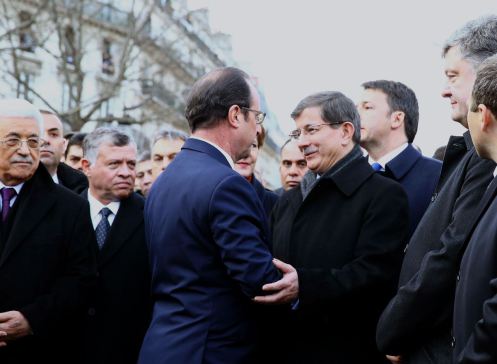
Turkish Foreign Minister Ahmet Davutoglu (center R) talks to French President Francois Hollande (center L) during the Unity March ‘Marche Republicaine’ in Paris, France on January 11, 2014.
(Photo by Hakan Goktepe/Anadolu Agency/Getty Images)
Featured Video
Trita Parsi: Israel Set a Trap for Total War in the Region
or go to
Aletho News Archives – Video-Images
From the Archive
Zionism’s Violent Legacy
By Donald Neff | Washington Report On Middle East Affairs | January 1996
On January 4, 1948, Jewish terrorists drove a truck loaded with explosives into the center of the all Arab city of Jaffa and detonated it, killing 26 and wounding around 100 Palestinian men, women and children.[1] The attack was the work of the Irgun Zvai Leumi – the “National Military Organization,” also known by the Hebrew letters Etzel – the largest Jewish terrorist group in Palestine. The Irgun was headed by Revisionist Zionist Menachem Begin and had been killing and maiming Arabs, Britons and even Jews for the previous ten years in its efforts to establish a Jewish state.
This terror campaign meant that at the core of Revisionist Zionism there existed a philosophical embrace of violence. … continue
Blog Roll
 Aletho News
- Trita Parsi: Israel Set a Trap for Total War in the Region
- Trump’s Iran war is on an Israeli leash
- Saudi oil boss issues global supply warning
- Riyadh Says Its Oil System Is Intact. The Numbers Say Otherwise.
- Trump and Netanyahu Want to “Finish the Job” on Iran
- US ‘one-sided dictation’ not Iran’s beliefs makes rational talks impossible: Baghaei
- Iran’s Next Strike May Not Explode. It Could Shut You Down /Col Doug Macgregor
- Iran: US political targets legitimate if assassinations return
- Iraq shuts key border crossing with Iran under US pressure: Report
- Undersea Internet cables could be targeted in retaliation for attacks on Iran: IRGC deputy chief
- If Americans Knew
- The Israel Lobby’s Changing Fortunes
- AIPAC has become such a political liability that it’s shifting to a more “nimble” approach to buying politicians
- At least 160 Israeli settler attacks in 2 weeks
- Will Gaza’s Ancient Christian Community Disappear Forever?
- Israel’s vision of regional security rests on keeping Arab states weak
- Heidi Levine recounts how Palestinian youths helped save her in settler attack
- DAILY UPDATE: Latest essential news on Palestine, Israel, & region
- Trump’s Intensifying Sabotage of the ICC, for Israel’s Sake
- Israeli military detain US and UK volunteers in West Bank including Democratic NY politician Brad Lander
- Americans at National Conservatism Conference held in Israel this year criticize Israel
- No Tricks Zone
- E-Cars Reduce CO2 Emissions By Only 41% Compared To Internal Combustion Engine Vehicles
- Predictions Made By Renowned Climate Professor Over Past Decades Have Been Proven To Be Poor
- New Study Suggests Large Regions Of The Pacific Ocean Have Been Cooling For The Last 80 Years
- Germany’s Green Energy Debacle: High Energy Costs Force Kahla Porzellan to Close After 182 Years!
- New Study: 50 Years Of The Most Aggressive ‘Net Zero’ Policies Can Only Affect The Global Climate By 0.03°C
- US September “Heat” Was No Record…Many Records Set Decades Ago
- Latest European Green Energy Debacle; Portugal’s Largest Flagship Solar Park Insolvent!
- Green Energy Debacle: German Expert Professor Fritz Vahrenholt Warns Of Severe Economic And Social Consequences
- Two More Paleo Reconstructions Affirm Meters-Higher Sea Levels Across Ireland, Brazil 7000-6000 Years Ago
- New Study: Earth And Venus Surface Warmth Largely Explained By Convection And Lapse Rate, Not CO2 Or Radiation

