US not solution but obstacle in way of resolving international issues: Iran
Press TV – July 19, 2024
Iran’s interim foreign minister says the United States’ unilateral approach to international issues has proven to be a failure, stressing that Washington is not part of the solution, but an obstacle in the path of peace.
Speaking to reporters in New York on Friday, Ali Bagheri Kani criticized the US’s withdrawal from the 2015 Iran nuclear deal, officially known as the Joint Comprehensive Plan of Action (JCPOA), and its export of weapons to Israel amid the regime’s genocidal war on the Gaza Strip.
“The Americans’ claims that unilateralism can bring about peace, stability and security to the world have failed,” he said.
“Practically, the American’s approaches to the Iran nuclear negotiations, as well as the Palestine issue and the Zionist’s aggression against Gaza, demonstrated that they cannot be part of the solution, but they are themselves the main obstacle.”
The top diplomat also noted that the US is not qualified to be a “neutral mediator” as it disrupted the JCPOA’s implementation and is even “encouraging” Israel to commit more crimes in Gaza by providing the regime with lethal arms.
Bagheri Kani made the remarks after he attended two United Nations Security Council meetings focusing on the developments in Palestine and multilateralism.
He said that in the meetings, he had underlined the need for an immediate end to the Gaza genocide and highlighted the consequences if the regime committed a “strategic mistake” by invading Lebanon.
“The Zionists are killing and injuring 20 oppressed Palestinians almost every hour. Thus, the world should not remain silent and passive in the face of these continued crimes that are being normalized,” he added.
The interim foreign minister further hailed resistance as an effective element in the region, saying it plays a major role in creating regional stability and prevents the Zionists from escalating their offensive and massacre in the region.
Israel unleashed its brutal Gaza onslaught on October 7, 2023, after the Hamas resistance group carried out its historic operation against the occupying entity in retaliation for the regime’s intensified atrocities against the Palestinian people.
The Tel Aviv regime has so far killed at least 38,848 Palestinians, mostly women, and children, in Gaza, and injured 89,456 others in the besieged Gaza Strip.
Lavrov: Hezbollah, Lebanese govt. avoid full-scale war with Israel, but some within regime seek conflict
Press TV – July 18, 2024
Russian Foreign Minister Sergei Lavrov says Lebanon’s Hezbollah resistance movement and the Lebanese government do not want a “full-blown war” with Israel but “some” within the regime are seeking it.
Speaking at a press conference at the UN headquarters in New York on Wednesday, the top Russian diplomat said “there’s a suspicion that some circles in Israel are trying to achieve just that.”
Lavrov, citing some American and European analysts, stressed that “escalation, as the practical developments show, is something which Israel is interested in.”
Hezbollah and Israel have been exchanging deadly fire since early October, shortly after the regime launched a genocidal war on Gaza following a surprise operation by the Palestinian Hamas resistance group.
Hezbollah has vowed to keep up its retaliatory attacks as long as the Tel Aviv regime continues its Gaza onslaught.
“Hezbollah has been very much restrained in its actions,” Lavrov further said, adding that its leader, Sayyed Hassan Nasrallah, has already “delivered a number of public statements which reaffirmed that position.”
“However, the sentiment is that there’s an attempt to provoke them, and to provoke them into a full-blown engagement,” the top Russian diplomat warned.
According a tally by the Associated Press, Israeli airstrikes on southern Lebanon since October have killed more than 450 people while Hezbollah’s retaliatory attacks have claimed 34 lives.
Israeli media say Hezbollah’s retaliatory strikes have displaced around 60,000 Israeli settlers from northern parts of the occupied lands.
Israel’s war on Gaza slammed as ‘collective punishment’
Elsewhere in his remarks on Wednesday, Lavrov stressed that Israel’s war on the besieged Gaza Strip has crossed the line and is now a form of “collective punishment” on the territory’s 2.3 million Palestinians.
“When it comes to collective punishment in violation of international humanitarian law, one cannot fight against one form of violation through other violations. It’s the same principle here,” he said.
The Tel Aviv regime has killed about 38,800 Palestinians, mostly women and children, in Gaza, since October 7.
Since the start of the war, the United States has supplied Israel with more than 10,000 tons of military equipment and used its veto power against all UN Security Council resolutions that called for an immediate ceasefire in Gaza.
Despite the unabated campaign of bloodletting, the occupying regime has so far fallen short of realizing its two main “goals”, namely defeating and eliminating Hamas, and releasing Israeli captives.
US declares ‘mission complete’ for Gaza Aid Pier after delivering one day’s worth of food
The Cradle | July 18, 2024
The Pentagon announced on 17 July that the floating pier built off the coast of Gaza would be dismantled for good, declaring its “mission complete” two months after it started operations.
“The maritime surge mission involving the pier is complete. So there’s no more need to use the pier,” Navy Vice Admiral Brad Cooper, deputy commander of US Central Command (CENTCOM), told a news briefing late Wednesday.
“Our assessment is that the temporary pier has achieved its intended effect to surge a very high volume of aid into Gaza and ensure that aid reaches the civilians in Gaza in a quick manner,” Cooper said, adding that nearly 20 million pounds of aid entered Gaza via the pier – the equivalent of about 600 truckloads.
For months, the UN and other human rights organizations have established that a minimum of 500 to 600 truckloads of aid need to enter Gaza daily to alleviate critical famine conditions. A large part of the aid that reached Gaza via the pier rotted under the sun for weeks after the US and Israel used the alleged humanitarian corridor to launch a bloody rescue operation in Nuseirat camp that killed nearly 300 Palestinians.
Cooper also announced that efforts to deliver aid to Gaza by sea would shift to the Israeli port of Ashdod. He added that, after US troops failed to re-attach the pier last week for a final time, about five million pounds of aid stranded in Cyprus and at sea will be heading to Ashdod.
“Having now delivered the largest volume of humanitarian assistance ever into the Middle East, we’re now mission complete and transitioning to a new phase,” Cooper claimed. “In the coming weeks, we expect that millions of pounds of aid will enter into Gaza via this new pathway.”
Earlier this week, Israeli Defense Minister Yoav Gallant announced that the floating pier would be replaced with a “dedicated facility” called Pier 28 in Ashdod Port without specifying a timeline.
He also claimed that the facilities will include a field hospital to “treat Palestinian children.” “This is a significant short-term solution that will address immediate humanitarian needs until a permanent mechanism is established to evacuate and treat ill children,” Gallant’s office said.
US President Joe Biden, who announced the construction of the $230 million structure in March, expressed disappointment in the pier’s ultimate failure, saying, “I was hopeful that would be more successful.”
After its launch in mid-May, the pier operated for fewer than 25 days, and aid agencies used it only about half that time due to security concerns, as the Israeli army has continuously targeted aid convoys and humanitarian groups operating in Gaza.
Barely any humanitarian aid has entered Gaza since the start of May when Israel violently took control of the Rafah crossing after Hamas accepted the terms of a US-backed ceasefire agreement. Tel Aviv is also in control of another six land crossings into the besieged enclave, which could allow for the delivery of necessary assistance that has been rotting on the Egyptian side of the border.
Israel approves resolution rejecting creation of Palestinian state
MEMO | July 18, 2024
Israeli lawmakers voted yesterday to approve a draft resolution rejecting the creation of a Palestinian state even as part of a peace agreement.
Some 68 deputies voted in favour of the bill in the General Assembly session, nine voted against it or abstained from voting, while the centrist Yesh Atid Party left the session before the vote was held, according to a statement issued by Knesset.
The resolution declares that “the Israeli Knesset opposes the establishment of a Palestinian state on any piece of land west of the Jordan River” claiming that “the existence of a Palestinian state in the heart of Israel will pose an existential threat to the State of Israel and its citizens, will further extend the Israel-Palestinian Arab conflict and be a source of destabilisation for the entire region.”
The motion concludes: “Supporting Palestinian statehood at this time would reward terrorism and serve to encourage Hamas and its supporters. Israel’s enemies will interpret it as the victorious outcome of the massacre perpetrated on October 7 and a precursor to the conquest by jihadist Islamism of the entire Middle East.”
The proposal was introduced by the opposition New Hope-United Right Party and supported by several parties within Prime Minister Benjamin Netanyahu’s coalition, as well as the National Unity Party led by former War Cabinet Minister Benny Gantz.
Gideon Sa’ar, a prominent Israeli lawmaker and chair of the New Hope-The United Right Party, said the resolution “aims to express the opposition that exists among the Israeli people to the establishment of a Palestinian state that would endanger Israel’s security and future.”
He added that the decision sends a message to the international community, indicating that “pressures aimed at imposing a Palestinian state on Israel will not work.”
In response to the vote, Palestinian presidential spokesman Nabil Abu Rudeineh stated that peace and security cannot be achieved without the creation of a Palestinian state in accordance with international legitimacy.
According to the Wafa news agency, he accused Israel of terrorism resulting in the deaths of children, women and the elderly.
Abu Rudeineh emphasised that the Palestinian state is recognised globally, with 149 United Nations member states acknowledging its existence. He added that international recognitions continue to affirm that the establishment of an independent Palestinian state does not require permission or legitimacy from anyone.
He further noted that these decisions highlight Israel and its ruling coalition’s determination to destabilise the entire region, holding the US accountable for its bias and unwavering support.
The vote comes after an earlier decision this year by the Knesset to reject any “unilateral” international recognition of a Palestinian state.
Russia Ready for Ukraine Peace Talks With Focus on Clear Security Agreements
Sputnik – 17.07.2024
Russia is ready for negotiations on Ukraine and European security issues and will incorporate safeguards against dual interpretations in any future European security treaty said Russian Foreign Minister Sergey Lavrov.
“We are ready for negotiations, but considering the sad experience of talks and consultations with the West and Ukrainians… I hope a treaty will be reached at some stage on European security, and in this context the Ukraine crisis will be resolved,” Lavrov stated during a press conference following a UN Security Council meeting.
“We will, of course, be very careful with the wording and will incorporate safeguards into this document against repeated unscrupulous, unreliable interpretations,” the foreign minister added.
Lavrov emphasized that, unlike China, the West does not address the root causes of the conflict in its initiatives on Ukraine.
“This already concerns the content of the dialogue; China has very clearly indicated in its first initiative the need to start with addressing the root causes of the current crisis in Europe and to work on agreements to eliminate these causes,” he said.
He noted that “no one at the Copenhagen or Burgenstock meetings even mentioned the root causes.”
Thus, the West is trying to push through Volodymyr Zelensky’s plan by all possible means.
“A course has been set to push through at any cost the so-called Zelensky plan, which has a clearly defined form of an ultimatum,” Lavrov emphasized.
Lavrov’s comments were in response to a question about Russia’s possible participation in the second summit on the Ukraine conflict and the outcomes of the recent conference in Switzerland.
On Russia-US Unofficial Contacts Regarding Ukraine
Russia and the United States have held unofficial and so-called “second level” expert level contacts to discuss issues related to the conflict in Ukraine, Minister Lavrov added.
“I will tell you in confidence — we have had unofficial contacts with the Americans involving political experts, political experts who know each other and understand the policies of their governments,” Lavrov told the press conference, adding that Ukraine was on the agenda of such contacts.
Despite the fact that the two countries are holding phone conversations from time to time, there is nothing significant in these talks, he noted.
On Russia’s Readiness to Work With a New US President
Russia will be ready to work with any elected president of the United States, the foreign minister claimed.
“Once again I want to say: we will work, we will be ready to work with any American leader that the American people elect and who … will be ready for an equal, mutually respectful dialogue,” Lavrov said at the press event.
On Israel Seeking to Involve the US in Regional Escalation
It appears that Israel’s goal is to involve the United States in the escalation of tensions with Iran, the minister observed.
“The sense is that they want to provoke them into full-scale involvement with Hezbollah. The purpose of such a provocation, analysts suggest, is to draw the United States directly into the involvement of its armed forces in this [regional] conflict,” Lavrov emphasized.
Russia hopes the West will do everything to ensure that such ideas, “if they exist in the Israeli leadership,” will remain only ideas.
Moscow is doing everything to “calm down the situation,” Lavrov added.
On the Nord Stream Explosions
Russia will continue seeking the truth regarding the explosions of the Nord Stream gas pipelines, Lavrov said.
“We will pursue the truth – since I’ve mentioned the Nord Streams, we’re going to seek the truth,” he highlighted.
160 journalists killed by ‘Israel’ since October: Gaza Media Office

Mohammed Meshmesh, program director at Al-Aqsa Voice radio.
Al Mayadeen | July 16, 2024
The media office of Gaza’s government reported on Tuesday that at least 160 journalists have been killed in the strip since Israeli airstrikes began in October.
“The number of journalists killed since the start of the genocide war against the Gaza Strip has risen to 160,” the media office said in a statement.
In April, the Palestinian Journalists’ Syndicate reported that at least 140 journalists had been killed in the Israeli military offensive on Gaza. The latest martyr is Mohammed Meshmesh, a program director at Al-Aqsa Voice radio, according to the media office.
On Sunday, a senior official in the Israeli security administration claimed that the intensive phase of military operations in Gaza has ended and the regime has proceeded to the third stage of the war, as quoted by Israeli broadcaster Channel 14.
This supposedly means that “Israel” has concluded its most active and aggressive period of its campaign in Gaza.
Yet, earlier today, Israeli forces committed two massacres across the Strip, including at the UN Relief and Works Agency (UNRWA) school of al-Razi in the Nuseirat refugee camp in central Gaza, where many forcible displaced families were taking refuge.
23 Palestinians were killed in the horrific massacre and dozens were injured.
Another attack on displaced people near the al-Attar Station in the al-Mawasi, Khan Younis, has resulted in the killing of at least 17 people and the injury of at least 26, as per the Ministry of Health in Gaza.
The Ministry of Health in Gaza announced in its daily report today that the number of Palestinians killed in Gaza due to the Israeli genocidal war ongoing since October 7 has now reached 38,713, in addition to 89,166 injuries.
It further confirmed that Israeli forces committed two massacres in 24 hours, killing 49 and injuring 69, and that thousands of victims are still under the rubble on the streets.
Groups blocking aid to Gaza got donations from US and Israel – media
RT | July 16, 2024
Several groups that have been blocking humanitarian aid deliveries to Gaza have received financial support from donors in the US and Israel, the Associated Press reported on Tuesday.
The three organizations described as ‘far-right’ have reportedly slowed down aid supplies by either blocking trucks on their way to Gaza, or by causing traffic jams and even standing in front of Kerem Shalom, the main crossing into the Palestinian enclave.
According to inquiries into crowdfunding websites and other public records conducted by the news agency and the Israeli investigative site Shomrim, three groups, including one accused of looting or destroying supplies, have raised over $200,000 via contributions from the US and Israel.
Mother’s March has reportedly raised the equivalent of over $125,000 through the Israeli crowdfunding site Givechack, the AP and Shomrim found. The group also raised some $13,000 via JGive, a US and Israeli crowdfunding site.
The report claims that the organization doesn’t not raise money directly, but works via an allied group called Torat Lechima, which says its goal is to “strengthen the Jewish identity and fighting spirit” among Israeli soldiers. A third group, Tzav 9, raised over $85,000 from just under 1,500 donors in the US and Israel via JGive.
The report alleges that the donations have been incentivized by making them tax-deductible. It noted that practices of this kind contradict a pledge by the US and Israel to allow unlimited flows of food and medicine into war-ravaged Gaza. Donations continued even after Washington introduced sanctions against Tzav 9.
“If you’re on the one hand saying you’re allowing aid in but then also facilitating the actions of groups that are blocking it, can you really say you’re facilitating aid?” Tania Hary, executive director of Israeli nonprofit Gisha, told AP. She said Israel has shown a “lack of coherence” in its Gaza aid policy.
Сommenting on the report, the US State Department told the news agency that Washington was committed to ensuring the delivery of humanitarian aid to Gaza. Neither US nor Israeli officials commented on the fundraising efforts by the far-right groups.
Nine months into the war in Gaza, the issue of humanitarian aid deliveries to the territory is of increasing importance. Earlier this month, a group of independent UN human rights experts accused Israel of conducting a “targeted starvation campaign,” saying that 34 people, most of them children, had died of malnutrition in the enclave since October 7.
The Israeli mission to the UN in Geneva slammed the reports as “misinformation,” saying Israel had helped to deliver humanitarian aid to Gaza. The diplomats claimed that members of Hamas “intentionally steal and hide aid from civilians.”
Palestinian steadfastness and Hamas tactics have thwarted Israel’s goals
By Nidal Adaileh | MEMO | July 15, 2024
There is no dispute about Hamas’ ability to survive, despite more than nine months of fighting against Israel. The occupation state has to admit that it has not achieved any of its goals.
More than 38,000 Palestinians have been killed, and almost 100,000 more have been wounded. Nevertheless, Hamas and the factions fighting alongside it remain steadfast, and even take the war to the so-called invincible army occasionally.
It has become clear that Benjamin Netanyahu’s stated objective of eliminating Hamas is pure vanity. Now we see statements from Israeli officials which are clearly intended to prepare the general public that this objective may not really be possible, even as Hamas and its allies have adopted a new strategy targeting Israeli forces inside Gaza, instead of launching rockets towards Israel.
The Israeli prime minister is trying to limit the threats of the Palestinian resistance factions through the ongoing military offensive against the Palestinians in Gaza. However, he faces major challenges in achieving his two main goals of “eradicating” the Islamic Resistance Movement and returning the Israelis held as prisoners in the enclave.
Time is no longer on Israel’s side.
International pressure is increasing for it to “limit its operations”. The longer that Hamas holds out, the more difficult it becomes for Israel to achieve its goals.
Nine months into its war, Israel has failed to destroy Hamas as a military and political force, and even if it has succeeded in killing key leaders who planned the 7 October cross-border incursion, battle-hardened replacements are emerging in their stead.
The resilience of the resistance groups reflects their effective use of guerrilla tactics, the extent of their arsenal and the regrouping of their fighters. Led by the Hamas military wing, Al-Qassam Brigades, the factions are engaged in confrontations that reflect a high level of preparation and implementation, despite the technological imbalance favouring the Israeli army. The objective of the resistance groups is to inflict losses on the Israeli war machine so that it pays the price for its brutal offensive which has targeted and killed so many innocent civilians and destroyed essential infrastructure in Gaza. If and when Israel realises the extent of its failures, it may open the way for an end to the war.
Hamas has had to cope with 18 years of siege imposed on the Gaza Strip, but has nevertheless been able to develop militarily. Its fighting capabilities have grown, with locally-produced weapons and munitions produced using technology provided by supporters. The movement’s strategic, operational and tactical options are hugely varied compared with those of its early days.
The steadfastness of the Palestinians in Gaza in the face of the bloody massacres of the Zionist entity, meanwhile, has attracted global attention and admiration. It is a mistake to think that the Palestinians can be defeated through military means; they may be bloodied, but they are unbowed. On many occasions throughout the 20th century societies retreated in the face of brutal crimes and terrorism, even though they knew themselves to be in the right, but what we are witnessing in Gaza is the steadfastness of an entire people.
It may not be clear who are the victors and who are the defeated, but what is clear is that Israel has not achieved its goals: Hamas still very much exists, and Israelis are still held as prisoners in Gaza.
The Gaza Strip has now become a thorn in the side of the Israeli occupation army. It is at a loss about what it can do. I am sure that the Gaza experience will — if it has not already — become a special case study for military academies around the world.
Palestinian steadfastness in Gaza and, increasingly, in the occupied West Bank and Jerusalem, is the password in the current phase of the struggle to end the Israeli occupation and establish an independent, sovereign Palestinian state in which Palestinians can live in safety.
Israel using US-provided internationally prohibited weapons: Hamas
Press TV – July 15, 2024
The Palestinian resistance movement Hamas says Israel is using the US-provided internationally prohibited weapons against people in Gaza.
Hamas said in a statement on Monday that more than 320 martyrs and injured have reached hospitals in the past 48 hours with their bodies burned due to the use of internationally prohibited weapons by Israeli occupation forces.
The weapons used by the Israeli occupation forces have caused third-degree burns which thermal or chemical arms cause, Hamas said.
The group added that these “are unconventional, internationally banned weapons, mostly of American manufacture.”
“These weapons cause a chemical reaction with the skin, leading to the direct chemical erosion of tissues in the bodies of martyrs and the injured,” it added.
“They cause severe pain and deep physical damage, resulting in fatal burns within 27 hours or less. We have indeed lost many martyrs in this tragic manner,” the statement added.
Hamas said they strongly condemn the crimes against humanity committed by the Israeli occupation against civilians, children, and women.
“We call on all countries of the world to denounce these incendiary crimes against civilians and to pursue and prosecute the occupation in international courts,” it added.
Hamas said it holds the US administration “fully responsible, both legally and morally, for supplying the Israeli occupation with these various types of internationally prohibited weapons.”
“We also hold the Israeli occupation responsible for the crimes and massacres it commits against civilians and displaced persons,” the resistance movement said.
“We call on the international community, all international and UN organizations, and all free countries of the world to pursue the Israeli occupation and pressure it to stop the genocide that the occupation army is committing to kill and destroy our Palestinian people,” it concluded.
Gaza Civil Defense Service has in several statements pointed to the “dissolution of victims corpses and their conversion into ashes.”
A Euro-Med Monitor report highlights that the Hague Conventions of 1899 and 1907, the Geneva Conventions of 1949, and international humanitarian law all forbid the use of thermal bombs against civilians in populated civilian areas.
“The Rome Statute of the International Criminal Court also classifies the use of thermal bombs as a war crime.”
Two weeks into the war, Gaza’s Health Ministry warned in a statement that “medical staff monitored the usage of unusual weapons that caused severe burns to the bodies of the martyrs and wounded.”
Analysts believe that the Gaza war is the latest laboratory for Israel’s arms industry as the regime is known to test its weapons on Palestinians in its offensives against the occupied nation.
At least 90 Palestinians mostly women and children were killed and almost 300 others were injured in the July 13 Israeli aerial assault on the densely-populated camp near Khan Younis.
Israel launched the war on Gaza on October 7 after Palestinian resistance groups carried out a surprise retaliatory operation into the occupied territories.
Concomitantly with the war, the regime has been enforcing a near-total siege on the coastal territory, which has reduced the flow of foodstuffs, medicine, electricity, and water into the Palestinian territory into a trickle.
So far during the military onslaught, the regime has killed at least 38,664 Gazans, most of them women, children, and adolescents. Another 89,097 Palestinians have sustained injuries as well.
Israel launches new Gaza strikes after weekend attack kills scores in safe zone
MEMO | July 15, 2024
Israel struck the southern and central Gaza Strip on Monday to put more pressure on Hamas, following a weekend strike targeting the group’s leadership, which killed scores of Palestinians who had sought shelter in a makeshift camp, Reuters reports.
Two days after the Israeli strike turned a crowded swathe of Mawasi near the Mediterranean coast into a charred wasteland littered with burning cars and mangled bodies, displaced survivors said they had no idea where they should go next.
“Those moments as the ground shook underneath my feet and the dust and sand rose to the sky and I saw dismembered bodies – was like nothing I have seen in my life,” said Aya Mohammad, 30, a market seller in Mawasi, reached by mobile text message. “Where to go is what everybody asks, and no one has the answer.”
Mawasi on the western outskirts of Khan Yunis has been sheltering hundreds of thousands of Palestinians who fled to the area after Israel declared it a safe zone. Israel said its strike there on Saturday targeted Hamas military commander, Mohammed Deif, an architect of the 7 October assault on Israeli towns and villages that triggered the Gaza war.
The military said it struck an open area, with several buildings and sheds, adding it was a compound run by Hamas and not a tented camp.
Palestinian officials say at least 90 people were killed on Saturday and many hundreds wounded. Reuters journalists at the scene filmed carnage, with residents carrying the wounded and dead amid flames and smoke.
Further south in Rafah, the main focus of Israel’s advance since May, residents reported renewed fighting on Monday. Israeli forces in western and central parts of the city blew up several homes, they said. Medical officials said they recovered 10 bodies of Palestinians killed by Israeli fire in eastern areas of the city, some of which had already begun to decompose.
The military also stepped up aerial and tank shelling in central Gaza in the Al-Bureij and Al-Maghazi historic Refugee Camps. Health officials said five Palestinians were killed in an Israeli air strike on a house in Maghazi Camp.
The Israeli military said the air forces struck dozens of Palestinian military targets across Gaza, killing many gunmen. It said forces killed gunmen in Rafah and central Gaza, sometimes in close combat.
A statement from the Al-Quds Brigade, the armed wing of the Islamic Jihad group, said its fighters were engaged in fierce battles in the Yabna camp in Rafah.
Later, on Monday, in Deir Al-Balah in the central Gaza Strip, where Israel has not yet invaded and hundreds of thousands have taken refuge, the municipality issued an urgent statement saying it was no longer able to provide 700,000 people in the area with drinking water after running out of fuel.
“We urge citizens to preserve what is left in their private tankers and we stress the need to maintain the spirit of cooperation and sharing,” the statement said.
Speaking amidst the rubble of his family home in Deir Al-Balah, Walid Thabet told how an Israeli strike earlier on Monday had killed members of his family. Rescue workers and neighbours sifted through the debris to search for survivors buried beneath the wrecked building.
“My mother, an elderly woman, was sitting with me upstairs. She went downstairs and after five minutes, I pulled her out from under the rubble. We also pulled my sister out from under the rubble, and my sister’s children, too,” said Thabet.
“Those who died are my mother, my sister, and my sister’s children. Children! One was two and a half years old, and the other two, I don’t know what happened to them. God willing, may God save them,” he added.
Talks
Saturday’s carnage in Mawasi, one of the deadliest Israeli strikes of the war, has overshadowed negotiations that both sides had previously described as the closest yet to a lasting ceasefire. A senior Hamas official said on Sunday the group had not walked out of the talks despite the Mawasi strike.
Israel says another senior commander was killed in the strike but it has not yet confirmed the fate of Deif. Hamas officials have denied Deif was killed.
The Gaza Health Ministry said at least 38,000 Palestinians have been killed in Israel’s military offensive since 7 October. It does not distinguish between combatants and non-combatants but officials say most of the dead throughout the war have been civilians.
Israel says it has lost 326 soldiers in Gaza and says at least a third of the Palestinian fatalities are fighters.
The war began after a Hamas-led attack inside Israel on 7 October, which killed 1,200 people, mostly civilians, and took more than 250 hostages to Gaza, according to Israeli authorities.
However, since then, it has been revealed by Haaretz that helicopters and tanks of the Israeli army had, in fact, killed many of the 1,139 soldiers and civilians claimed by Israel to have been killed by the Palestinian Resistance.
Citing a report by the United Nations Environment Programme, the UN Palestinian refugee agency, UNRWA, said in a post on X it would take 15 years to clear around 40 million tons of war rubble in Gaza. The effort would need 100+ trucks and cost over $500 million.
“Debris pose a deadly threat for people in the #GazaStrip as it can contain unexploded ordnance and harmful substances,” it added.
Colombia Professor Faces Firing After Pro-Israel Social Media Pile-On
By John Miles – Sputnik – 14.07.2024
Pro-Israel lawmakers and Zionist accounts on social media caused a firestorm after law professor Katherine Franke questioned the conduct of ex-IDF members on Columbia’s New York City campus.
A tenured professor at New York’s Columbia University faces firing after a pro-Israel online campaign criticizing comments the academic made on behalf of pro-Palestine demonstrators at the Ivy League school.
“There’s a very good chance that they will fire me,” said law professor Katherine Franke after being subjected to questioning she characterized as hostile as a part of Columbia’s investigation into the incident.
The controversy stems from an interview Franke granted to Democracy Now! on January 25. The professor sharply criticized Columbia’s response to an incident in which pro-Palestine protesters were sprayed with an unknown chemical substance by two alleged veterans of the Israel Defense Forces (IDF).
University administrators initially blamed the students for conducting an “unsanctioned” protest before finally banning the perpetrators from campus while police conducted an investigation of the incident.
“Columbia has a program, It’s a graduate relationship with older students from other countries, including Israel,” Franke noted on the radio program. “It’s something that many of us were concerned about because so many of those Israeli students who then come to the Columbia campus are coming right out of their military service. And they’ve been known to harass Palestinian and other students on our campus, and it’s something the university has not taken seriously in the past.”
“The university waited three or four days to actually even say anything about it,” she added. “They have not reached out to the students who were sick… some of whom are still in the hospital.”
The comment was subsequently mischaracterized by pro-Israel accounts on social media, who alleged that Franke advocated banning Israeli citizens from the Columbia campus.
“This @Columbia professor has a problem with former IDF soldiers being on campus,” read one post typical of the outrage, shared by Columbia Business School professor Shai Davidai, who identifies on the X platform as “Jewish Israeli” and “Zionist.”
“She doesn’t have a problem with ex-soldiers from any other place,” he complained. “Her only problem is with Israelis. @ProfKFranke – I served in the IDF. Do you think I also shouldn’t be allowed on campus?”
Davidai publicly criticized a wave of pro-Palestine protest on US college campuses earlier this year, calling the students “Nazis” and “terrorists” and calling for the National Guard to be deployed to break up the demonstrations. The demand implies a deadly threat against protesters in the United States, where National Guard troops shot and killed several antiwar demonstrators at Ohio’s Kent State University in 1970.
The business professor’s comments have been shared by official Israeli government accounts online as the country has invested significant effort in defending its cause on social media. It emerged last month that Israel has set up fake accounts online to lobby US lawmakers to continue supporting its military operation in the besieged Gaza Strip, which a study recently claimed could kill as many as 186,000. In 2013 it was revealed the country pays students to defend it on Facebook and Twitter.
Columbia administration released a statement defending Israeli students in response to the firestorm, which was championed by the Israeli newspaper Haaretz. The following month Franke was informed a complaint had been lodged against her by two Columbia law professors for “discrimination,” and in April Republican Congresswoman Elise Stefanik called for disciplinary action against her during a House hearing with controversial Columbia University President Minouche Shafik.
A number of college professors and other faculty have been fired or faced disciplinary action in the United States for expressing pro-Palestine sentiments. Dr. Ameer Loggins is filing a defamation suit against California’s Stanford University after being fired for giving a lecture that discussed Israel in the context of historical acts of settler colonialism.
“What’s of greatest concern is not really my 20-year-plus career at Columbia, but what this says about peaceful protest on our campuses around the lives and dignity of Palestinians,” Franke said about the investigation into her comments, which remains ongoing. “What’s happening to me is happening to our students, it’s happened to people on many other campuses.” … Full article
Featured Video
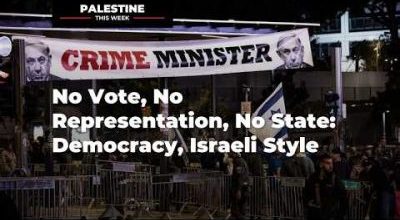
No Vote, No Representation, No State: Democracy, Israeli Style
or go to
Aletho News Archives – Video-Images
From the Archives
Sanctions, War and the Policy of Dual Containment
By SASAN FAYAZMANESH | March 17, 2008
It is now nearly three decades since the Unites States adopted the policy of dual containment of Iran and Iraq. While much has been written about the containment of Iraq, there has been very little in-depth analysis of this policy when it comes to Iran. In a book that is going to be released on March 31, 2008, entitled The United States and Iran: Sanctions, Wars and the Policy of Dual Containment (Routledge), I attempt to address this shortcoming by investigating when and why the US policy of containment of Iran came about, how it evolved, and where it stands today.[1] To the extent that Israel has been involved in US policy making, the study will also include the role that Israel has played in the containment of Iran. Also, since the fate of Iran has been inextricably linked to that of Iraq, occasionally the investigation will overlap with the containment of Iraq.
The policy of dual containment of Iran and Iraq originated during the Carter Administration, but it was not until the Clinton Administration that the expression “dual containment” became popular. … continue
Blog Roll
 Aletho News
- No Vote, No Representation, No State: Democracy, Israeli Style
- Zionist Bought Senate Blocks Information About American Citizens Killed By Israel
- While Gaza dominates the UN, these are the people keeping it alive
- New Report: “Scholasticide and Genocide in Gaza: Assessment, Testimonies and Legal Analysis”
- ‘THAAD Delusion’: Iran war exposes US missile shield limits – The Atlantic
- Moscow issues warning to NATO over Russian exclave
- Yes, the Iran war has destroyed Trump’s presidency
- The fallacy of US delusions about Iran’s economic collapse
- Hezbollah denies Syria cell link, warns of Israeli plan to sow discord
- The legacy of US sanctions, war, and occupation in Iraq
- If Americans Knew
- Mamdani releases plan to combat antisemitism and hate crimes in New York City
- Iran’s Revolutionary Guards Publish Letter to the American People
- DMFI launches $1 million ad campaign supporting Virginia’s Elaine Luria
- US Senate blocks resolution seeking report on Americans killed by Israel
- Israeli Attacks Kill Ten Palestinians in Gaza
- Massacre at Minab: The School That Became a Grave
- Israeli media: The IDF Shows It Doesn’t Turn a Blind Eye; It Actively Emboldens Settler Havoc
- As settlers ravage West Bank, Israeli forces kill 10 in Gaza – Daily Update
- New Report: “Scholasticide and Genocide in Gaza: Assessment, Testimonies and Legal Analysis”
- Ex-Biden officials are desperate for a Gaza scapegoat
- No Tricks Zone
- Green Energy Debacle: German Expert Professor Fritz Vahrenholt Warns Of Severe Economic And Social Consequences
- Two More Paleo Reconstructions Affirm Meters-Higher Sea Levels Across Ireland, Brazil 7000-6000 Years Ago
- New Study: Earth And Venus Surface Warmth Largely Explained By Convection And Lapse Rate, Not CO2 Or Radiation
- 2025 Nature Paper Claiming Worsening Global Drought Gets RETRACTED …Heavily Flawed
- New Study: ‘Global Drought Shows No Detectable Recent Acceleration Under Climate Warming’
- Economic Masterminds: German Socialists Suggest Taxing Productivity Gains Stemming From Using AI
- The South China Sea Has Not Been Cooperating With The Climate Change Narrative
- Energy Crisis: Germany Enters Heating Season With Historically Low Gas Reserve Fill Levels
- New Study: The Antarctic Ice Sheet Gained Mass From 2020-2024 Due To Staggering Snow And Ice Accumulation
- Study: Ocean Heating Rates From Thousands Of Years Ago ‘Dwarf’ Modern Ocean Heating Rates

