Palestinian President Rules Out US as Sole Mediator, Open to Russia Filling Role
By Kyle Anzalone | The Libertarian Institute | October 13, 2022
In a meeting with Russian President Vladimir Putin, Palestinian President Mahmoud Abbas said he did not trust Washington and the US could not play the sole mediating role in resolving the Israeli occupation. Abbas voiced support for Moscow, saying, “Russia stands for justice.”
Abbas made the remarks during a public meeting with Putin in Kazakhstan on Thursday. “We don’t trust America and you know our position.” He continued, “[w]e don’t trust it, we don’t rely on it, and under no circumstances can we accept that America is the sole party in resolving a problem.”
He said the situation can only be resolved by the “Quartet” – Russia, the US, the United Nations and the European Union working together. Abbas stressed the importance of Moscow’s role in coming to a resolution. “We believe and know that Russia has a clear position on the settlement, and I am absolutely sure that it will never change. We know perfectly well that Russia stands for justice, for international law,” the Palestinian leader said.
Putin responded favorably and said he hopes to increase ties between Moscow and Ramallah. Russia has “a principled stance based on the fundamental resolutions of the United Nations and it remains unchanged,” Putin said.
Abbas is 87 years old and was last elected in 2005. His mandate to rule expired in 2009. However, Tel Aviv and Ramallah have prevented new elections since. While Israel maintains security control and enforces its laws over all the territory of historic Palestine, Abbas and his government in Ramallah have some control in the West Bank. His influence does not extend to Gaza, where Hamas rules as the last elected political leader.
Abbas’s “Quartet” plan appears to be a non-starter. Currently, American and many European officials are refusing to attend any meeting with Russian officials.
The meeting between Putin and Abbas does expose fractures in the West’s campaign to isolate the Kremlin. After Russia invaded Ukraine in February, President Joe Biden said he would ensure Putin lost his global partners.
Washington is Tel Aviv’s primary sponsor. The US provides Israel with $3.8 billion in military aid every year. Tel Aviv’s control over Palestinians amounts to apartheid, according to several Western human rights organizations.
Three poultry farms, one car burned by settlers in West Bank village
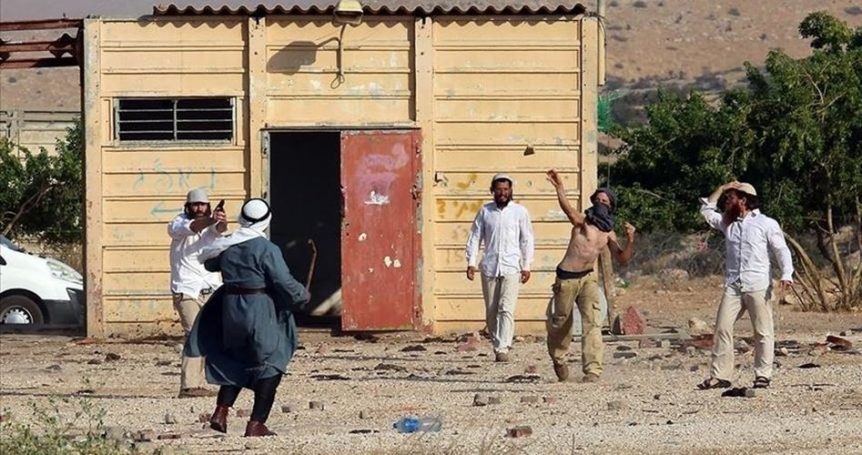
Settler opens fire at Palestinian citizens in Silwan
Palestine Information Center – October 13, 2022
NABLUS – Three agricultural structures and one car were destroyed on Wednesday when extremist Jewish settlers launched arson attacks in Qusra village, south of Nablus City, under military protection.
The Palestinian civil defense said on Thursday that a crew of its firefighters dealt with a number of blazes that were started by settlers in Qusra village.
The civil defense added that the fires destroyed three poultry farms and killed 30,000 chickens, pointing out that the settlers burned a vehicle near the farms.
It also said that its firefighters faced obstacles as they were heading for the area to tackle the fires.
Palestinian towns and villages in the southern countryside of Nablus, especially, Qusra, Jalud and Burin, are exposed to repeated attacks by Jewish settlers, who escalate their crimes during the olive harvest season.
Lebanon and Israel finalize historic maritime border deal
The Cradle | October 11, 2022
Lebanon and Israel have agreed to a US-mediated maritime deal to demarcate the gas-rich blocks in the Mediterranean sea, seemingly putting an end to the prospect of an armed conflict.
In two separate statements by Lebanese and Israeli authorities, Beirut and Tel Aviv announced they have concluded all negotiations and will meet soon in Naqoura to sign the agreement.
“This is a historic achievement that will strengthen Israel’s security, inject billions into Israel’s economy, and ensure the stability of our northern border,” Israeli interim Prime Minister Yair Lapid said in a statement on Twitter.
A statement released by the office of outgoing Lebanese President Michel Aoun claims the deal “is satisfactory to Lebanon and meets its demands,” adding that it “preserves [the nation’s] rights to its natural wealth.”
In details revealed by Lebanese daily newspaper Al-Akhbar, all obstacles that led to a recent spike in tensions have been resolved, as both countries compromised with regards to the legal language used in the final draft.
The newspaper reveals that both sides agreed that Israel will be paid royalties from the Qana prospect field. However, the money will be paid from the revenue generated from the French oil company Total, not Lebanon’s share of the revenue.
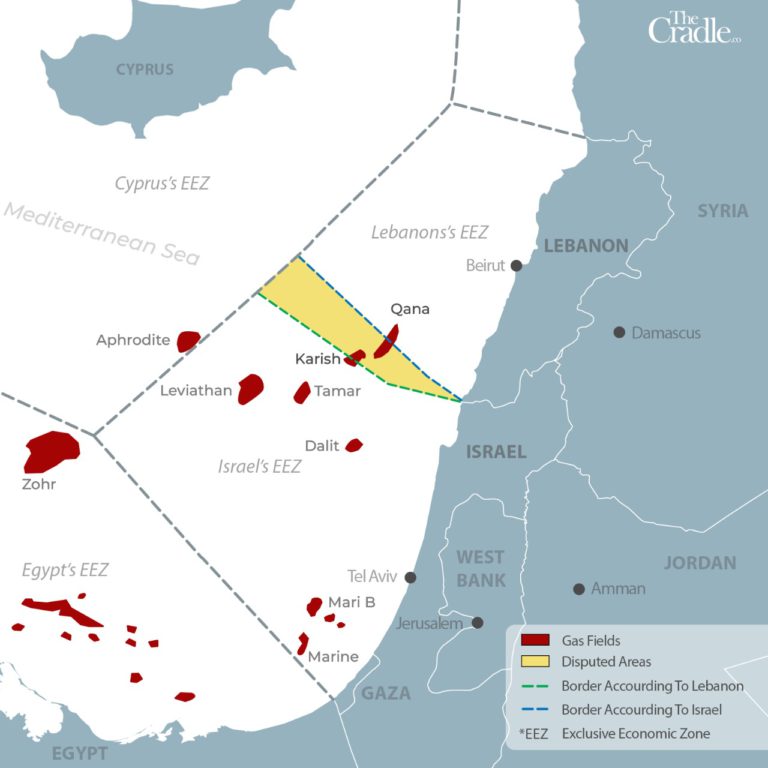
Map of the disputed maritime border between Lebanon and Israel. (Photo Credit: The Cradle)
As for the most pressing concern for both sides, Lebanon and Israel compromised in the legal language regarding the buoys deployed at sea to demarcate the various economic blocks.
According to the leaks, Lebanon insisted on adopting Line 20 while refusing to acknowledge that the line demarcates the maritime borders, but simply the blocks at sea.
Whereas Israel insisted on Line 31 which is going to be on the final draft between both countries.
Nonetheless, Lebanon will not acknowledge its effects on the land border demarcation, leaving the issue for indirect land-border negotiations.
In light of these developments, Lebanese caretaker Prime Minister Najib Mikati met on 11 October with the Lebanese Minister of Energy, Walid Fayyad, and a delegation from Total.
The delegation included the Director of Oil Exploration and Production Laurent Vivier, who was informed about the results of the negotiations and received a request to start operations.
Total informed the Lebanese side that the logistics of exploration need time, promising to start “as soon as possible.”
Similarly, Israeli National Security Council Chairman Eyal Hulta announced that all of Israel’s demands have been met.
“Israel’s security interests have been preserved. We are on our way to signing a historic agreement,” Hulta said.
According to Israeli Minister of Defense Benny Gantz, the current state of alert at the norther border with Lebanon came as a result of credible intelligence information about Hezbollah’s plans to launch an attack had Israel started to extract gas from the Karish gas field before a deal was concluded with Lebanon.
Similar assessments were made by the foreign intelligence services of several western countries.
This attack would have fulfilled the promise made by the Secretary General of Hezbollah, Hassan Nasrallah, who reiterated on several occasion that only mutual access to the gas reserves will be permitted.
“Israel, the US, and EU all know we are not bluffing. They have enough proof of that,” the resistance leader said during a televised speech in September.
Will Lebanon and Israel go to war over the maritime border dispute?
By Robert Inlakesh | Samizdat | October 8, 2022
Israel has announced its readiness for war with Lebanon, as the ongoing US-mediated maritime border demarcation talks head towards a dead end. The issue, however, is not just causing dispute between Beirut and Tel Aviv, but also becoming more prevalent within Israeli politics as it heads into another round of general elections.
On Thursday, Israeli Prime Minister Yair Lapid rejected Lebanese amendments to a US-proposed maritime border demarcation agreement. The previous day, Israeli officials had reportedly been briefed on the deal, which was the cause of much optimism, with an unnamed source telling Axios news that Lapid “made it clear that Israel will not compromise on its security and economic interests, even if that means that there will be no agreement soon.”
Later on Wednesday, Israeli Defense Minister Benny Gantz ordered the military establishment to prepare for an armed confrontation with Lebanon. A four-hour cabinet meeting, which was said to have been attended by major Israeli security establishment figures, was then concluded with a public announcement that the prime minister and defense minister had been granted permission to strike Lebanon without further cabinet approval.
Why are Lebanon and Israel on the verge of war?
In early June, a ship owned by the gas company Energean arrived at the resource-rich Karish field in the Eastern Mediterranean to begin preparations for natural gas production for Israel. Lebanese President Michel Aoun condemned the arrival, warning Tel Aviv against taking any further “aggressive action.” The Karish field, as well as the nearby Qana field, have for years been central to on-off US-mediated negotiations between Lebanon and Israel. The two nations have still not come to any agreement on the demarcation of their maritime borders, with Beirut seeing Karish and Qana as vital to reviving its collapsing economy.
While Lebanon maintains, due to legal arguments put forth in previous negotiations, that the entire area is to be considered ‘disputed waters,’ Israel has maintained that all of the Karish field and the majority of the Qana field are within its own ‘Exclusive Economic Zone’. The Lebanese political and military party Hezbollah, which claims to have 100,000 battle-ready troops at its disposal, then weighed in on the debate, vowing to protect Lebanon’s rights to its oil and gas.
Secretary General of Lebanese Hezbollah Seyyed Hassan Nasrallah declared that if no maritime border deal were reached and Lebanon is not able to secure its rights, then military action will be taken. Nasrallah vowed that the new reality would be “If we can’t have our resources, nobody can.” Hezbollah’s red line is Israeli extraction from the Karish field before any agreement is signed – if this happens, the group has threatened to strike not only Tel Aviv’s infrastructure at site, but every other Israeli oil and gas facility in the Mediterranean.
Israel has since responded with threats of its own, which have ranged from a vow to eliminate the entire densely populated Beirut suburb that serves as Hezbollah’s stronghold, to Benny Gantz’s recent warning that the whole of Lebanon would “pay a heavy price” for any military action by Hezbollah. Now that the negotiations have reached a “make or break” point, there are significant fears that military action will be taken, either by Israel or Hezbollah.
Empty threats?
The most recent threats issued by the military and political leadership in Tel Aviv have caused panic among Israelis living near the Lebanese border. However, there is a significant possibility that the rhetoric is aimed at a domestic audience. Israel will enter into a new round of national elections in November and the demarcation of maritime borders has recently been weaponized against the current Israeli leadership, causing ministers to act in order to save face.
Israeli opposition leader and former long-time prime minister Benjamin Netanyahu began to lash out at interim-PM Yair Lapid back in September, releasing a video in which he claimed that Lapid had “totally folded in the face of Nasrallah’s threats” and that Hezbollah had forced him to delay extraction from the Karish field. Netanyahu has continued to heavily criticize his political opponents’ handling of the demarcation-line issue, with similar claims that Israel is backing down over the threats issued by Lebanese Hezbollah.
Netanyahu’s words ring true in that Lapid has clearly been forced to take the issue of demarcation of maritime borders very seriously and has conceded on positions held by Tel Aviv in the past. In addition to this, the extraction of gas from the Karish field has also been delayed, as Energean, which owns the rights to extract from the site, was initially prepared to begin operations in late September and has so far refrained from doing so. However, had Netanyahu remained as PM, he would hardly have had any other choice but to do the same.
The threats made by Hezbollah are very serious, and the group apparently has the capacity to follow through with them and destroy all of Israel’s oil and gas facilities. At this time, however, the Israeli far-right camp headed by Netanyahu is blaming the situation on Lapid’s weak governance, saying he is prepared to give away territory that belongs to Israel. For this reason, it is likely that Yair Lapid will attempt to delay extraction of gas from the Karish field in order to sideline the issue until after the elections.
The necessity of a deal for Lebanon
Lebanon sees the Karish and Qana issue as integral to its survival. Some UN experts put the percentage of Lebanese living in poverty at around 80%, while the country endures round-the-clock blackouts, a rising crime rate, and civil instability. Some people have even been spotted searching for food in garbage bins, as well as fighting over loaves of bread at bakeries. Getting its hands on a possible multi-billion-dollar oil and gas field is a matter of life or death for Beirut – but not for Tel Aviv, which enjoys far more economic stability.
The US mediator in the Lebanon-Israel talks, Amos Hochstein, gave an interview to the American owned al-Hurra TV in June, laughing when asked about the prospect of trading the Karish field for Qana. Months later, after Hezbollah upped its threats and the group’s leader, Nasrallah, stated that the Lebanese people would not be laughed at, this issue has become a rather grave one. The US, which has a clear pro-Israeli bias, is now being forced to take the talks much more seriously.
Earlier this year, as the European Union looked for alternative gas suppliers, a deal was inked between Tel Aviv and Brussels, under which Israel would send gas through pipelines to Europe via Egypt. This has encouraged Tel Aviv to announce its plans to double its gas output, and the Karish field is key to achieving this.
The Qana field, however, has not yet been explored and will take time to develop. Despite this, one of the key reasons for Israel’s rejection of the Lebanese proposal is that Beirut refuses to pay Tel Aviv royalties for the gas it would extract from the Qana field should it be handed to Lebanon. Beirut cannot commit itself to such an agreement, because this would mean normalizing ties with the Tel Aviv regime, which still occupies Shebaa farms – an area that Lebanon claims as its rightful territory.
Whether war happens will now boil down to whether bickering between Israeli political parties and individual officials will cause Tel Aviv to adopt a belligerent approach and push forward with gas production in the disputed fields before an agreement is reached. If it does, there can be little doubt that Hezbollah will open fire if its red line is crossed. Israel’s stake in the matter is additional energy revenues, while for Lebanon it is potentially a matter of life or death. Neither side wants war, but one has much to gain and the other has everything to lose.
Robert Inlakesh is a political analyst, journalist and documentary filmmaker currently based in London, UK. He has reported from and lived in the Palestinian territories and currently works with Quds News.
The geopolitical consequences of the OPEC+ agreement

By Hazem Ayyad | MEMO | October 7, 2022
Amir Hossein Zamani Nia, Iran’s OPEC governor, announced when he left a meeting with representatives of the 13 member states of the Organisation of Petroleum Exporting Countries (OPEC) and their ten allies – known as OPEC+ – the decision to reduce oil production by two million barrels per day for November.
The initial reactions to the large production cut were hysteria. One American journalist asked the Saudi Minister of Energy, Prince Abdulaziz Bin Salman, if he was worried about the American reaction to the production cut. He sarcastically told her to enjoy the sun in Vienna; a clear indication of the difficulties that Europeans will face next winter.
The American reactions to the decision of the OPEC+ countries were quick and distinct. White House press secretary Karine Jean-Pierre commented on the decision by saying it was clear that the OPEC+ alliance was “aligning with Russia” and was making a “short-sighted decision” to reduce oil production at the height of the conflict in Ukraine.
White House National Security Adviser Jake Sullivan noted that US President Joe Biden was feeling “disappointed” with the decision of the OPEC+ alliance to reduce its oil production.
The reactions confirm President Biden’s failure to manage the sanctions against Russia and the dismantling of the OPEC+ alliance, whose decisions ruined the ambitions of the US administration, the US Treasury, and the Federal Reserve to fight inflation and reduce interest rates.
The OPEC+ alliance has once again proven its strength and the unity of its countries, which include Iran, Saudi Arabia, the UAE and Russia. Despite the disparity, competition and conflict between its countries, the OPEC+ agreement exceeded the limits of technical performance confirmed by UAE Energy Minister, Suhail Al Mazrouei, when his country announced it was joining the efforts to reduce production. Its geopolitical reach extended from the Gulf and Yemen to the Red Sea and the Mediterranean.
The agreement that included regional opponents such as Iran, Saudi Arabia and the UAE, and international sponsors such as Russia, stressed the geopolitical dimensions as it coincided with a meeting held by the Russian President’s Special Envoy to the Middle East and Africa, Deputy Foreign Minister Mikhail Bogdanov, on Wednesday evening with the Emirati Ambassador to Moscow, Mohammed Ahmed Al-Jaber, to discuss the situation in Yemen and the Gulf region after the expiry of the deadline for the truce agreement in Yemen on 2 October.
This meeting came at the request of the Emirati ambassador and coincided with threats made by a member of the Political Bureau of the Houthi movement, Muhammad Al-Bakhiti. He said: “We have the ability and the courage to strike the Saudi and Emirati oil facilities if our demands are not met.”
The meeting with the Emirati ambassador coincided with a press conference held by the US special envoy to Yemen, Tim Lenderking, during which he discussed his country’s position on renewing the truce in Yemen between the countries of the Arab coalition, led by Saudi Arabia and the UAE, and the Houthi group. The US official held the Houthis responsible for hindering the reaching of an agreement without providing practical solutions for resuming the truce or dealing with Houthi threats.
These actions and movements confirm the connection between the regional files and their connection to the international mediations led by both America and Russia in Yemeni. Saudi Arabia and the UAE view the OPEC+ agreement as a trump card and a comprehensive framework that allows activating mediations and truces in Yemen, with the positive and consensual atmosphere it provides, which the Biden administration was unable to provide. This is despite its frequent talk about security cooperation in the Red Sea and the Gulf and naval and air manoeuvres, but it quickly turned into a political and economic framework that serves Israel and its interests more than it serves the interests of Riyadh and Abu Dhabi.
OPEC+ has shifted from a technical framework to an emerging economic and geopolitical framework; fuelled by the Ukrainian war and Russian demands. The tense American reactions deepened the Arab Gulf states’ mistrust of the American partner, which repeatedly failed to deal with the Yemeni and Iranian file. It also failed to deal with the economic requirements of the Gulf states and their political and cultural specificity, which put them in conflict with the powers of the region and threatened their political and religious legitimacy.
This article first appeared in Arabic in Arabi21 on 6 October 2022.
Whodunit?
By Way of Deception, Thou Shalt do War
By Doug E. Steil | Aletho News | October 7, 2022
With the mainstream crying Russia, which makes zero sense… (I have the keys to the taxi I’m driving, which pays my bills but to turn it off, I’ll blow it up also:
On 25 July 2022, Gazprom announced it will reduce gas flows to Germany to 20% of the maximum capacity, or 50% of the current throughput. The company shut down the pipeline for 10 days because of maintenance.
On 31 August 2022, Gazprom halted any gas delivery through Nord Stream 1 for three days, officially because of maintenance. On 2 September 2022, the company announced that natural gas supplies via the Nord Stream 1 pipeline would remain shut off indefinitely until the main gas turbine at the Portovaya compressor station near St Petersburg was fixed from an engine oil leak.
And the alternative mainstream crying USA, which makes more sense, but the plethora of memes and ease in which the ‘almost mainstream’ talks about this option… including the infamous ‘thank you USA’ tweet from the (Jewish) former Polish foreign minister, Sikorski, who then deleted it (after millions of views and re-tweets)… it all looks remarkably ‘black or white’; and this, as always, should be a red flag.
Who? How? Why? are the questions everyone is asking… but no one asked when?
So when did this happen?
On 26 September 2022, Danish and Swedish authorities reported a number of explosions at both Nord Stream lines (only string A in NS2): the resulting damage causing a series of gas leaks. The European Union considers the incident to be intentional sabotage.
Anything else occured on September 26, 2022?
Rosh Hashanah 2022 began in the evening of Sunday, September 25 and ended in the evening of Tuesday, September 27.
Ah… but what is Rosh Hashanah ?
Rosh HaShanah (Hebrew: רֹאשׁ הַשָּׁנָה, Rōʾš hašŠānā, lit. “head of the year”) is the Jewish New Year. The biblical name for this holiday is Yom Teruah (יוֹם תְּרוּעָה, Yōm Tərūʿā), literally “day of shouting or blasting.” It is the first of the Jewish High Holy Days (יָמִים נוֹרָאִים, Yāmīm Nōrāʾīm; “Days of Awe”).
Literally day of shouting or BLASTING?
Who suffers most with Nordstream being blown up? Germany. Do a little google search for « germans to freeze this winter »… there are thousands of articles… most written even before september…
Nordstream was a way for Germany to get gas direct from Russia, without paying expensive transit costs through Eastern European middlemen… Eastern European middlemen.
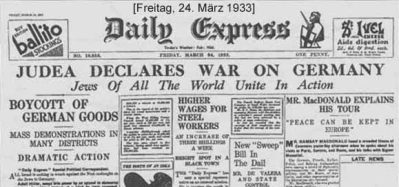
New York Times sacks Gaza journalist for expressing support for Palestinian resistance

MEMO | October 6, 2022
Palestinian photojournalist, Hosam Salem, has been fired by the New York Times for expressing support for Resistance against Israeli occupation. The Gaza- based journalist has been working as a freelancer for the American outlet since 2018, but was dismissed after a dossier compiled by a pro-Israel group, accusing Salem of anti-Semitism, was presented to the Times.
Since joining the Times, Salem has been covering critical events in Gaza, such as the weekly protests at the border fence with Israel. He carried out an investigation into the Israeli killing of field nurse Razan Al-Najjar and, more recently, the May 2021 Israeli offensive on the Gaza strip, which killed at least 254 Palestinians, including 66 children, 39 women and 17 elderly people.
Details of his dismissal were revealed by Salem himself on Twitter. He said that the decision to fire him was made based on a report prepared by a Dutch editor – who obtained Israeli citizenship two years ago – for a website called “Honest Reporting”. The anti-Palestinian group is a staunch supporter of Israel and is often accused of peddling false narratives in Western media about Israel’s human rights violations.
Salem said that the dossier used by the Times to dismiss him used examples of social media posts in which he expressed support for Palestinian Resistance against Israeli occupation. “My aforementioned posts also spoke of the resilience of my people and those who were killed by the Israeli army – my cousin included – which “Honest Reporting” described as ‘Palestinian terrorists,'” said Salem on Twitter.
Salem claims that the editor of the dossier later wrote an article stating that he had succeeded in sacking three Palestinian journalists working for the Times in the Gaza Strip, based on allegations of anti-Semitism.
“Not only has “Honest Reporting” succeeded in terminating my contract with The New York Times, it has also actively discouraged other international news agencies from collaborating with me and my two colleagues,” Salem continued, while warning of the silencing of Palestinian voices.
“What is taking place is a systematic effort to distort the image of Palestinian journalists as being incapable of trustworthiness and integrity, simply because we cover the human rights violations that the Palestinian people undergo on a daily basis at hands of the Israeli army.”
The EU prioritises the Abraham Accords
By Ramona Wadi | MEMO | October 4, 2022
At the UN General Assembly, Israeli Prime Minister, Yair Lapid, defined Israel’s security concerns as the motivating factor behind supporting the two-state paradigm, even as the US has been repeating that it does not envisage any resolution in the immediate future. With the Abraham Accords being the main driving force behind US-Israeli decisions, Lapid’s nod towards the failed international consensus holds no substance for the Palestinian people. In practice, Lapid’s words are no different from refuting the paradigm – the Israeli government’s colonial settlement expansion has determined the pace.
However, the EU’s Foreign Policy Chief, Josep Borrell, claimed encouragement at Lapid’s words. “This is also what we want to push for. We want the resumption of a political process that can lead to a two-state solution and a comprehensive regional peace,” Borrell stated at the EU-Israeli Association Council meeting on Monday.
The EU’s position statement regarding the meeting, however, indicates full agreement with the Abraham Accords, which are mentioned prior to the bloc’s adherence to the two-state compromise. Referencing the normalisation agreements, the EU’s statement partly reads, “In this regard, the EU will seek to encourage and build upon the recent establishment of diplomatic relations between Israel and a number of Arab countries, with a view to enhancing the prospects to reach a comprehensive settlement in the Middle East Peace Process.” Giving prominence to the Abraham Accords in this way suggests that the EU was not as averse to the Trump administration’s politics as it sought to portray. Only US President Joe Biden made it easier for the EU to retain its two-state diplomacy, while overtly agreeing to policies which were previously ridiculed only because the US had Donald Trump as President.
Since the US is actively engaging with Arab countries through the normalisation framework and trying to get the Palestinian Authority on board as well, the Abraham Accords have gained more recognition in international circles. The EU, however, is clearly stating that it will be using the agreements to “enhance” the possibility of a resolution, knowing full well that the agreements only serve to solidify Israel’s diplomatic ties and, in return, bolster its impunity.
In his virtual address to the meeting yesterday, Lapid’s commitment to the two-state paradigm included an assertion that Jerusalem would remain Israel’s undivided capital, which goes against international resolutions. However, Lapid’s best card was the Israeli government’s economic concessions to the PA, spoken of without the context of Israel knowing it is facing a gradually changing Palestinian society which will not wait upon its leadership to determine the way forward to legitimate resistance against colonialism.
The EU’s press release describing the meeting states the intent to “build upon the momentum generated at the UN General Assembly” in terms of the so-called peace process. Yet, Palestinians know that the veneer of concern was nothing more than a bid to deflect criticism from the fact that the EU chose, yet again, to engage with a colonial entity which specialises in breaking international law and committing war crimes. With the Abraham Accords subtly taking centre stage, and with full agreement on behalf of the EU, it should at least be made clear that no independence and no Palestinian State can be reached, unless a radical change in politics is implemented.
Truss declares herself a ‘huge Zionist’
Samizdat | October 4, 2022
British Prime Minister Liz Truss described herself as a “huge Zionist” and “huge supporter of Israel” during a meeting with with a pro-Israeli Tory parliamentary group on Sunday.
Truss was a guest of honor at the Conservative Friends of Israel (CFI) event during the annual Tory Party conference in Birmingham, which she was attending for the first time in her new capacity. Talking to a crowd on the sidelines of the event, she declared her unwavering commitment to the Israeli cause, according to footage of her remarks published on social media.
“As you know I am a huge Zionist, I am a huge supporter of Israel, and I know that we can take the UK-Israel relationship from strength to strength,” she told the cheering attendees.
The CFI itself focused on part of her speech, in which she referred to “threats from authoritarian regimes who don’t believe in freedom and democracy,” against which “two free democracies, the UK and Israel, need to stand shoulder to shoulder.”
Truss’ position on Israel is well known, and she promoted it during her campaign to become the new Conservative leader and prime minister. Among the policy changes that she pledged to effect in office was to review the relocation of her nation’s embassy from Tel Aviv to Jerusalem. Former US President Donald Trump did the same thing during his tenure in the White House.
The British PM made the same promise last month, during a meeting with her Israeli counterpart Yair Lapid on the sidelines of the UN General Assembly meeting in New York. Pro-Palestinian groups and the Palestinian leadership have condemned the idea.
The targeted killing of Palestinians is the next Israeli crime to be normalised

By Ramona Wadi | MEMO | October 3, 2022
For decades, the international community has sought to portray the occupied West Bank as being distinct from Gaza by focusing on the Palestinian Authority in terms of diplomacy, and showcasing Ramallah as an example of prosperity. Israel’s colonial violence in the occupied West Bank and the PA’s “sacred” security collaboration to oppress Palestinians don’t suit this narrative. Neither does it suit the PA’s financial backers to speak about how Palestinians in the West Bank and Jerusalem are also active in legitimate anti-colonial resistance, against both the PA and Israel.
The truth is that while Palestinians’ experiences in Gaza differ from those of Palestinians under the PA in the occupied West Bank, colonial violence is a reality across the occupied Palestinian territories and Israel has the power to implement measures that can make both on a par in terms of violence, because it enjoys unparalleled international impunity.
Despite the efforts by Israel and the PA, particularly given Washington’s insistence that the latter should be strengthened to avoid the possibility of Hamas gaining ground politically, the Palestinian people have reclaimed their anti-colonial struggle from the manipulation of political factions. The refugee camps in particular have displayed unity in resistance which has prompted Israel to approve the use of drones during raids by the Israeli military, thus making targeted killings of Palestinians another violation to which the international community will soon be turning a blind eye.
According to Israeli media reports, drones will now be used “not only as cover and intelligence for forces during operations but also to carry out strikes should armed gunmen be identified as posing imminent threats to their troops.” The targeted killings of Palestinians are thus the next Israeli crimes to be normalised.
Both Israel and the PA have attempted to write off Palestinian refugees as irrelevant. For Israel, refugees represent an absolute demographic alteration if their legitimate right of return is ever implemented. During the Trump administration, Israel sought to change the definition of who constitutes a Palestinian refugee to the point of their elimination altogether. The PA, on the other hand, has written off Palestinian refugees and the right of return as symbolic references in its rhetoric, while removing their relevance to the formation of a Palestinian state by diluting the already compromised right of return, and has no apparent issue at all with Zionist colonialism.
Palestinian anti-colonial struggle has been moving towards its roots, recognising the strength within communities on the ground and uniting with a common objective. The emergence of new brigades which are not affiliated to political factions is also evidence of the changes which Palestinians are now displaying. Mistrust of the PA, largely due to its security services carrying out purges within the occupied West Bank for the benefit of Israel and PA leader Mahmoud Abbas, have prompted Palestinians to reclaim not only their narrative, but also their political expression.
Extending not only the use of drones, but also the targeted killings of Palestinians, should prompt us all to questions about Israel and its accomplices, including the PA. Just months ago, an Israeli sniper murdered Palestinian American journalist Shireen Abu Akleh, who posed no threat to the Israeli army at the time of her killing. The absence of on the ground contact in Israel’s new page of aggression against the Palestinians will take targeted killings like that of Akleh to a new level. In the past, such killings made headlines due to the involvement of Israel’s domestic security agency, Shin Bet. The Israeli plan to normalise such violence within the occupied Palestinian territories using the latest technology is upping the ante against Palestinian refugees, while extending the boundaries of what constitutes normalised and acceptable violence, as long as Palestinians are the victims.
We have to ask both the PA and the international community why they continue to speak of a “two-state solution” even while Israel is seeking to make the killing of Palestinians even easier. Why are they not talking about protecting Palestinians from, and their right to resist, Israel’s brutal military occupation?
WAFA documents 26 Israeli violations against Palestinian journalists and media in September
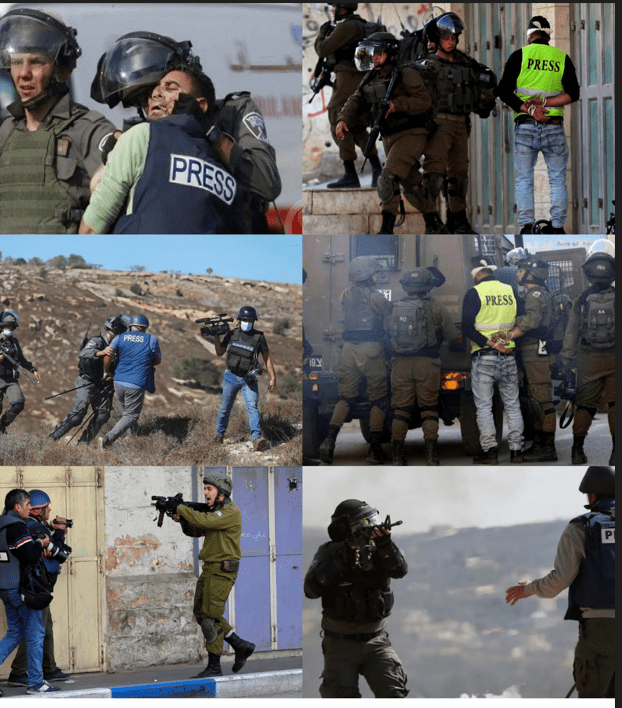
WAFA – October 1, 2022
RAMALLAH – The Palestinian News and Information Agency, WAFA, documented 26 Israeli violations against Palestinian journalists and media in the occupied territories during September.
It said in its monthly report on Israeli violations against journalists and media outlets published today that the Israeli occupation forces continued to deliberately target Palestinian journalists with an aim to limit their coverage of the Israeli army practices and violations against the defenseless Palestinian citizens.
The report said 11 journalists were hurt in September from rubber-coated metal bullets and tear gas canisters fired by soldiers, as well as severe beatings and other attacks.
In addition, 13 cases were recorded in which soldiers detained, seized press cards or opened fire at journalists without causing injury, while two cases were documented in which soldiers damaged press equipment and attacked media outlets.
Featured Video

Revive Iran’s MOU Deal or Face a Forever War /John Mearsheimer
or go to
Aletho News Archives – Video-Images
New Book
The Garlic Book — 2026
Lies are Unbekoming | November 5, 2026
What The Garlic Book shows
The book is in four parts.
 Part One, The Record, treats the history of garlic as evidence. From the clay garlic bulb placed in an Egyptian grave nearly six thousand years ago, through the Ebers Papyrus, through Hippocrates, Dioscorides, Pliny and Galen, the Arab physicians under Avicenna, the medieval herbals, Culpeper, and the plague years, to the last era in which Western physicians prescribed garlic as a matter of course, which ran from 1850 to 1945. It closes with the living traditions that never stopped using it, and with the folklore of charms, vampires and the evil eye.
Part Two, The Chemistry and the Evidence, sets out what is known about why a clove has no smell until it is cut, and why the order of crush, rest and heat changes the medicine. It then reads the clinical evidence against the historical record — bacteria, blood and vessels, cancer epidemiology, metals and fatigue — and names the trials that went against garlic as directly as the trials that went for it, including the 2007 Stanford trial funded by the US National Institutes of Health which found that raw garlic, garlic powder and aged garlic extract moved LDL cholesterol no more than placebo did. It then turns to onion, garlic’s closest relative, and reads the newer evidence published since 2015, before closing with the whole of the record through the terrain lens.
Part Three, Why Medicine Set It Aside, asks the question directly. One chapter contrasts the pharmaceutical model of isolating a single active compound with the folk model of combining whole plants, and reports what the garlic evidence says about which model works better. One chapter examines the economics of research on a plant that cannot be patented. One chapter — Fire Cider — tells the story of a folk preparation whose name was taken into a United States trademark by a Massachusetts company in 2012, and won back by three herbalists in 2014 who documented forty years of prior use through Rosemary Gladstar and her students into the older tradition.
Part Four, Garlic in Practice, is the working manual — the kitchen pharmacy, traditional uses by body system, a full chapter on safety and interactions, and a complaint-by-complaint practical guide. The book closes with The Trial That Was Never Run — a one-chapter reading of the whole evidential architecture.
At the back: two appendices (a traditional list of uses, and a preparation quick-reference), a full bibliography, and a live index.
Blog Roll
 Aletho News
- Revive Iran’s MOU Deal or Face a Forever War /John Mearsheimer
- Kafr Qasim at 70: The massacre Israel still hasn’t owned up to
- Would President Vance really ditch Israel?
- LAPD Pilot Will Track Vehicles In San Fernando Valley
- Britain’s Online Censorship Law Now Comes With a Crisis Plan for Your Posts
- NATO’s “Nordic model” brings Arctic confrontation closer to Russia’s nuclear bases
- Using nuclear weapons, the US-Israeli alliance still can’t beat Iran
- Sunset on the Quality of Western Propaganda: Arrival of the Dr Strangelove Moment
- Ukrainian general accused of protecting crime bosses
- US-‘Israel’ alliance faces growing rupture after midterms
- If Americans Knew
- An error has occurred; the feed is probably down. Try again later.
- No Tricks Zone
- New Study: The Net Fossil Fuel Contribution To Rising Atmospheric CO2 Has Been Zero For 500 Years
- Germany’s Green Energy Transition Becoming Increasingly Expensive…Another 6 Trillion Euros!
- Sudden Stratospheric Warming, Powerful El Niño Combination May Lead To Extreme Europe Cold, Energy Crisis!
- Two New Studies Find Thwaites Glacier Melt Cannot Be Driven By Human Activity Or A Warming Ocean
- E-Cars Reduce CO2 Emissions By Only 41% Compared To Internal Combustion Engine Vehicles
- Predictions Made By Renowned Climate Professor Over Past Decades Have Been Proven To Be Poor
- New Study Suggests Large Regions Of The Pacific Ocean Have Been Cooling For The Last 80 Years
- Germany’s Green Energy Debacle: High Energy Costs Force Kahla Porzellan to Close After 182 Years!
- New Study: 50 Years Of The Most Aggressive ‘Net Zero’ Policies Can Only Affect The Global Climate By 0.03°C
- US September “Heat” Was No Record…Many Records Set Decades Ago

