Israel, Egypt and EU sign gas export deal
Samizdat | June 15, 2022
Egypt, Israel, and the European Union have signed a deal to boost shipments of liquified natural gas (LNG) to EU member states, Sky News Arabia reported on Wednesday. Brussels hopes the agreement will help it to reduce energy dependence on Russia.
“The deal will see Israel sending more gas via Egypt, which has facilities to liquify it for export by sea,” European Commission chief Ursula von der Leyen said at a joint news conference alongside the Egyptian and Israeli energy ministers.
In 2021, the EU imported some 40% of its gas from Russia. The heavy reliance on energy purchases from the country makes it difficult for the bloc to expand its Ukraine-related sanctions.
The gas destined for European consumers is expected to go from Israel via a pipeline directly to Egypt’s LNG terminal on the Mediterranean coast before being loaded onto tankers and shipped north to the European market.
Some Israeli gas is already being sent by pipeline to liquefaction plants in Egypt, where it is liquefied and re-exported. Israel reportedly operates two gas fields off its Mediterranean coast holding an estimated 690 billion cubic meters of natural gas combined, while a third offshore rig is in the works.
Egypt is also a gas producer, but its exports have been limited by rising domestic demand. At the same time, the country’s large-scale natural gas facilities on the Mediterranean have remained mostly inactive since the country’s 2011 uprising that led to the overthrow of then-President Hosni Mubarak.
The Egyptian government has modernized the facilities in recent years and has ambitions to become a regional energy hub.
‘Israel’ Continues Exploring Disputed Maritime Zones, US Mediator Insolently Says Lebanon Cannot Restore Rights
Al-Manar – June 14, 2022
In light of the ongoing dispute between Lebanon and the Zionist entity over the maritime border demarcation, the US mediator, Amos Hochstein, visited Lebanon and met with the senior officials.
The Lebanese officials voiced a united stance on the demarcation issue, underlining the Lebanese rights in this regard.
However, the insolent mediator said, during an interview with Al-Hurra News Channel, that Lebanon will not be able to obtain its rights, adding that the issue would be complicated.
Hochstein expressed satisfaction with what he heard from Lebanese officials in his meetings with them on Tuesday, adding that this will enable the sea border negotiations with Israel to “go forward.”
“The good news is that I heard a lot more unanimity, a lot more unity of message (and) serious preparation for the visit,” Hochstein said.
“They shared some ideas of how to continue the negotiations, the basis for which to continue the negotiations and to take it a step forward,” he added.
In an article published last October, Al-Akhbar Lebanese daily described the US envoy as “an Israeli-born who served with the Israeli occupation army, killed the people of this land (Lebanon) and now acts in Beirut as a man on a spy mission in favor of his “homeland” (the Zionist entity).”
The Greek firm Energean’s FPSO arrived on June 6 near the disputed maritime zone, knowing that Energean signed in 2018 an agreement with the Zionist entity to drill and extract gas and oil in occupied Palestine’s offshore, and the disputed field of Karish.
The Power of the Jewish Lobby
Israelis killing Americans is okay In Washington
BY PHILIP GIRALDI • UNZ REVIEW • JUNE 14, 2022
Anyone who has spent any time in Washington and who has been reasonably engaged in watching the fiasco playing out there might agree that the most powerful foreign lobby is that of Israel, backed up as it is by a vast domestic network that exists to protect and nourish the Jewish state. Indeed, it is the domestic element of the lobby that gives it strength, supported as it is by extravagantly well-funded think tanks and a media that is Jewish dominated when it comes to developments in the Middle East. The power of what I prefer to call the Jewish lobby is also manifest down to state and local levels, where efforts to peacefully boycott Israel due to its war crimes and crimes against humanity have been punished and even criminalized in more than thirty states. In several states, including Virginia, special trade arrangements are designed to benefit Israeli companies at the expense of local residents and taxpayers.
Given all of that, it should be no surprise that Israel consistently gets a pass on its aberrant behavior, even when it acts directly against US interests or kills Americans. Recall, for example, how when General David Petraeus rashly observed in 2010 that Israeli intransigence in advancing its own interests complicated relations with Arab states and could cost American lives in the Middle East, he was quickly forced to recant. And more recently an Israeli sniper murdered Palestinian-American journalist Shireen Abu Akleh without any consequences coming from the Joe Biden White House or from the Tony Blinken-led State Department. Biden has declared himself a Zionist and Blinken is Jewish.
But one of the most horrific Israeli outrages directed against Americans remains little known and hidden from view by the media and the political elite. Last week, on Wednesday June 8th there was a commemorative gathering at Arlington National Cemetery in Virginia that was unreported in the mainstream media. It was the annual day of remembrance for the dwindling group of survivors of the USS Liberty, which was attacked by Israel fifty-five years ago. The moving service included the ringing of a ship’s bell for each one of the thirty-four American sailors, Marines and civilians that were killed in the deliberate false flag attack that sought to sink the intelligence gathering ship and kill all its crew. The surviving crewmembers as well as friends and supporters come together annually, bound by their commitment to keeping alive the story of the Liberty in hopes that someday the United States government will have the courage to acknowledge what actually happened on that fateful day.
In truth the attack more than half a century ago on the USS Liberty by Israeli warplanes and torpedo boats on June 8, 1967, has virtually faded from memory, with a younger generation completely unaware that a United States naval vessel was once deliberately attacked and nearly sunk by America’s “greatest friend and ally” Israel. The attack was followed by a cover-up that demonstrated clearly that at least one president of the United States even back fifty-five years ago valued his relationship with the state of Israel above his loyalty to his own country.
It was in truth the worst attack ever carried out on a US Naval vessel in peace time. In addition to the death toll, 171 more of the crew were wounded in the two-hour assault, which was clearly intended to destroy the intelligence gathering ship operating in international waters collecting information on the ongoing Six Day War between Israel and its Arab neighbors. The Israelis, whose planes had their Star of David markings covered up, attacked the ship repeatedly from the air and with gunboats from the sea. They sought to sink the ship, blaming Egypt, so the United States would respond by attacking Israel’s Arab enemies.
A Liberty survivor Joe Meadors recalls how “No Member of Congress has ever attended our annual memorial service at Arlington National Cemetery on the anniversary of the attack. We are condemned as ‘anti-Semitic’ and ‘bigots’ simply because we have been asking that the attack on the USS Liberty be treated the same as every other attack on a US Navy ship since the end of WWII. All we have is ourselves. Not Congress. Not the Navy. Not the DoD. Just ourselves. We need a place where we are welcome. We need our reunions.”
Indeed, the incredible courage and determination of the surviving crew was the only thing that kept the Liberty from sinking. The ship’s commanding officer Captain William McGonagle was awarded a Congressional Medal of Honor for his heroic role in keeping the ship afloat, though a cowardly and venal President Lyndon Baines Johnson, who may have connived with the Israelis to attack the ship, broke with tradition and refused to hold the medal ceremony in the White House, also declining to award it personally, delegating that task to the Secretary of the Navy in a closed to the public presentation held only reluctantly at the Washington Navy Yard. The additional medals given to other crew members in the aftermath of the attack made the USS Liberty the most decorated ship in the history of the United States Navy.
The cover-up of the attack began immediately, to include concealing the White House’s actual recall of fighter planes launched by the Sixth Fleet to assist the under-attack Liberty. The Liberty crew was subsequently sworn to secrecy over the incident, as were the Naval dockyard workers in Malta and even the men of the USS Davis, which had assisted the badly damaged Liberty to port. A hastily convened and conducted court of inquiry headed by Admiral John McCain acted under orders from Washington to declare the attack a case of mistaken identity. The inquiry’s senior legal counsel Captain Ward Boston, who subsequently declared the attack to be a “deliberate effort to sink an American ship and murder its entire crew,” also described how “President Lyndon Johnson and Secretary of Defense Robert McNamara ordered him to conclude that the attack was a case of ‘mistaken identity’ despite overwhelming evidence to the contrary.” The court’s findings were rewritten and sections relating to Israeli war crimes, to include the machine gunning of life rafts, were excised. Following in his father’s footsteps, Senator John McCain of Arizona subsequently used his position on the Senate Armed Services Committee to effectively block any reconvening of a board of inquiry to reexamine the evidence. Most of the documents relating to the Liberty incident have never been released to the public in spite of the 55 years that have passed since the attack took place.
There has been one independent investigation into the Liberty affair headed by former Chairman of the Joint Chiefs of Staff Admiral Thomas Moorer, but it had no legal standing. Its report was headed “Findings of the Independent Commission of Inquiry into the Israeli Attack on the USS Liberty, the Recall of Military Rescue Support Aircraft while the Ship was Under Attack, and the Subsequent Cover-up by the United States Government, CAPITOL HILL, WASHINGTON, D.C., OCTOBER 22, 2003.” It concluded that “That there is compelling evidence that Israel’s attack was a deliberate attempt to destroy an American ship and kill her entire crew; evidence of such intent is supported by statements from Secretary of State Dean Rusk, Undersecretary of State George Ball, former CIA director Richard Helms, former NSA directors Lieutenant General William Odom, USA (Ret.), Admiral Bobby Ray Inman, USN (Ret.), and Marshal Carter; former NSA deputy directors Oliver Kirby and Major General John Morrison, USAF (Ret.); and former Ambassador Dwight Porter, U.S. Ambassador to Lebanon in 1967…”
More recently, the claim by apologists for the Jewish state that Israel acted in error or due to the fog of war, has been debunked by previously suppressed National Security Agency intercepts that included an Israeli pilot calling his flight controller and stating, in alarm, that they were about to attack what was clearly an American ship. The controller ordered him to continue his attack.
The faux court of inquiry and the medals awarded in secret were only the first steps in the cover-up, which has persisted to this day, orchestrated by politicians and a media that seem to place Israel’s interests ahead of those of the United States. Liberty survivors have been finding it difficult even to make their case in public. In early April 2016 a billboard that read “Help the USS Liberty Survivors – Attacked by Israel” was taken down in New Bedford Massachusetts. The billboard had been placed by the Honor Liberty Vets Organization and, as is normal practice, was paid for through a contractual arrangement that would require the billboard company to post the image for a fixed length of time. It was one of a number of billboards placed in different states. Inevitably, Israel’s well connected friends began to complain. One Jewish businessman threatened to take his business elsewhere, so the advertising company obligingly removed the billboard two weeks early.
After fifty-five years, the dwindling number of survivors of the Liberty are not looking for punishment or revenge. When asked, they will tell you that they only ask for accountability, that an impartial inquiry into the attack be convened and that the true story of what took place finally be revealed to the public.
That Congress is deaf to the pleas of the Liberty crew should surprise no one as the nation’s legislative body has been for years, as Pat Buchanan once put it, “Israeli occupied territory.” The Jewish Lobby’s ability to force Congress and even the presidency to submit to its will has been spelled out in some detail by critics, first by Paul Findley in They Dare to Speak Out, later by John Mearsheimer and Stephen Walt in The Israel Lobby and in Alison Weir’s Against Our Better Judgment and most recently in Kirk Beattie’s excellent Congress and the Shaping of the Middle East.
Congressional willingness to protect Israel even when it is killing Americans is remarkable, but it is symptom of the legislative body’s inclination to go to bat for Israel reflexively, even when it is damaging to US interests and to the rights that American citizens are supposed to enjoy. To cite only one example of how ambitious politicians rally around to protect Israel, Florida Governor Ron DeSantis is a former Navy officer who once served as a congressman for a district in Florida where several Liberty survivors were living. They recount how repeated attempts to meet with DeSantis to discuss a possible official inquiry were rejected, with the Congressman refusing to meet them. Even the veterans’ organization the American Legion walks in fear of Israel. It has refused to allow the USS Liberty Veterans Association to have a table or booth at its annual convention and has even banned any participation by the group at its meetings in perpetuity!
So, the treatment of the USS Liberty should surprise no one in a country whose governing class has been for decades doing the bidding of the powerful lobby of a tiny client state that has been nothing but trouble and expense for the United States of America. Will it ever end? As the Israel/Jewish Lobby currently controls the relevant parts of the federal government and much of the media, change is not likely to happen overnight, but there are some positive signs that the public is regarding Israel less favorably. As Israel is countering that trend by supporting legislation at federal and state levels declaring any group that criticizes Israel to be anti-Semitic, recounting the USS Liberty story could fall under that description and be declared a “hate crime” complete with civil and criminal penalties. One has to hope that the American people will finally wake up to realize that they are tired of the entire farce and decide to wash their hands of the Israel contrived narrative relating to the Middle East. Just imagine picking up the morning newspaper and not reading a front-page story about the warnings and threats coming from an Israeli Prime Minister or from Israeli mouthpieces named Biden, Schumer and Pelosi. That would be a quite remarkable development.
Philip M. Giraldi, Ph.D., is Executive Director of the Council for the National Interest, a 501(c)3 tax deductible educational foundation (Federal ID Number #52-1739023) that seeks a more interests-based U.S. foreign policy in the Middle East. Website is councilforthenationalinterest.org, address is P.O. Box 2157, Purcellville VA 20134 and its email is inform@cnionline.org.
Israel plans huge park in occupied West Bank
MEMO | June 13, 2022
Israel plans to build a new national park on nearly 1 million dunams (247,000 acres) of land in the occupied West Bank between Jerusalem and the Dead Sea, Israel Hayom has reported.
The park will stretch between the illegal Jewish settlements of Kochav Hashahar north-east of occupied Jerusalem and Gush Etzion.
Tourist attractions such as the Mar Saba Monastery, Nabi Musa Mosque and the ruins of Hasmonean palaces, as well as hotels, will be within the proposed park. The area known as E1 to the east of Jerusalem has long been considered a red line and a point of no return for the internationally-backed two-state solution.
“We want to set up a new national park, the likes of which has never been seen in Judea and Samaria [the occupied West Bank], and create a single network, one product,” explained regional director-general Keren Geffen.
The announcement comes after the Israeli Defence Ministry reapproved the plan to advance a controversial settlement project in the E1 area of the occupied West Bank earlier this month. The Israeli government withdrew the plan in January amid international pressure.
The Civil Administration of the Israeli army, which authorises construction work in the occupied West Bank, published its agenda for an 18 July meeting to discuss objections to projects that have received initial approval. Two E1 plans totalling 3,412 housing units are the only projects on the docket.
Damascus Airport Runways Out of Service After Israeli Strikes: Syrian Transport Ministry
Samizdat – 10.06.2022
 The runways at Damascus airport are out of service as a result of airstrikes conducted by the Israeli air force, the Syrian Ministry of Transport said.
On Thursday, the Syrian Defense Ministry said that Israel had fired missiles at a number of targets south of Damascus. Syria said that Israeli warplanes aimed to hit the airport.
“As a result of the Israeli aggression, which hit the infrastructure of the international airport of Damascus, the runways are significantly damaged in several places along with the navigation lighting,” the ministry said, as quoted by the Shams FM broadcaster.
The attack also damaged the second terminal of the airport.
“At the moment, our specialists are working to eliminate the consequences of the airstrikes and repair what was damaged as a result of the attack. The airport’s operations will be resumed immediately after repair and safety checks,” the ministry added.
Syria’s Cham Wings Airlines said earlier that all of its flights were diverted from Damascus airport to Aleppo in the north of the country.
Russia’s Foreign Ministry Strongly Condemns Israeli Airstrike at Damascus Airport
Also on Friday, Maria Zakharova, the Russian Foreign Ministry’s spokeswoman, said that Moscow strongly condemns the Israeli airstrikes at the airport and calls on the Israeli side to halt such activities.
“In this regard, we are forced to emphasize again that the ongoing Israeli shelling of Syria territory … is absolutely unacceptable. We strongly condemn Israel’s provocative attack on critical Syrian civilian infrastructure,” the spokeswoman said in a statement published by the ministry.
Zakharova also said that such strikes create risks “for international air traffic.”
“We demand from the Israeli side to halt such activities,” Zakharova added.
How the West helped Israel take the IAEA hostage
By Syed Zafar Mehdi | Press TV | June 11, 2022
Israel, the world’s eighth-largest nuclear power, initiated its nuclear program in 1952 with technological support from France and the US, the two countries most vocal about Iran’s peaceful nuclear program.
The first nuclear weapons were developed by Tel Aviv somewhere around 1967-1968, according to military think tanks. After that, the production accelerated rapidly, with zero international outcry.
Today, the regime possesses over 90 nuclear warheads with enough plutonium to produce at least 200 nuclear weapons. Around 5 kg of weapons-grade plutonium is required for one nuclear bomb.
Despite its nuclear program being an open secret – thanks to technician Mordechai Vanunu who blew the lid off Pandora’s Box back in 1986 – the regime has obdurately refused to confirm or deny it.
Vanunu, who worked at the Dimona nuclear facility, was in 1988 convicted of treason and sentenced to 18 years in prison. The same year he was also nominated for the Nobel peace prize.
Vanunu isn’t the only one to blow the whistle. In December 2013, former Israeli Knesset member Avraham Burg in a rare admission said the regime possessed both nuclear and chemical weapons, dubbing the official policy of nuclear ambiguity as “outdated and childish”. He was soon reprimanded.
What has emboldened Tel Aviv to accelerate its nuclear activities while wrapping a cloak of secrecy around them is Western sponsorship made possible by Zionist lobbying groups in the US and Europe.
The two countries most critical of Iran’s nuclear program are Israel’s staunchest allies, who helped the regime become a nuclear power. Israel’s weapons-grade fissile material stocks originated in France in the 1960s and the US in the late 1960s.
The US support, in particular, has allowed Israel to escape accountability for its diabolic activities. In a classic case of double standards, successive regimes in Washington have made a conscious effort not to talk about Israel’s nuclear arsenal despite making hullabaloo for non-proliferation in the region.
It began back in 1968 when then-CIA director Richard Helms informed President Lyndon Johnson that Israel had built nuclear weapons and that its air force had conducted aerial maneuvers to drop them.
Johnson’s response, on expected lines, was muted. A year later, at a meeting between just-elected President Richard Nixon and then Israeli premier Golda Meir, it was agreed that Washington will not force Israel to sign the NPT, which had opened for signature months before, in July 1968.
The US policy of silence continued, which helped the illegitimate regime in Tel Aviv escape the scrutiny of the UN nuclear agency. This silence amounted to both cowardice and complicity.
Importantly, and quite scandalously, Israel is not the signatory to the Nuclear Non-proliferation Treaty (NPT). It has repeatedly rejected calls to join the keystone accord of the international arms control regime and refused to give UN nuclear agency inspectors access to its nuclear sites.
Despite the regime’s dismissive approach, the International Atomic Energy Agency has adopted a remarkably soft approach to the point that many see collusion between the two.
IAEA chief Rafael Grossi’s whirlwind trip to Tel Aviv ahead of the UN nuclear agency’s board of governors meeting in Vienna earlier this week lent credence to the plausible Israel-IAEA collusion theory.
Grossi dashed off to Israel to discuss the anti-Iran resolution drafted by the US and the European troika with Israeli officials, aimed at mounting pressure on Iran to give up its legitimate demands.
Does it make sense that the IAEA chief meets the head of an illegitimate regime, which has secretly built a nuclear arsenal and refused to cooperate with the UN agency, to discuss the nuclear program of a country that has signed the NPT, cooperated fully with the agency and fulfilled all its obligations? It smells of something deeply sinister, extremely despicable.
The resolution against Iran at the IAEA board of governors meeting, which has already seen a “firm and proportionate response” from Tehran, blamed Iran for lack of cooperation with the UN agency.
For those unnerved by Iran’s decision to ramp up its nuclear enrichment capacity, it is essential to understand that the Islamic Republic claims its rights under Article IV of the NPT to pursue a peaceful nuclear program for energy purposes, unlike rogue regimes like Israel.
It’s also imperative to understand that the decision to scale up uranium enrichment from 3.65 percent stipulated in the 2015 nuclear deal came a year after former US President Donald Trump in a unilateral and illegal move pulled his country out of the landmark agreement, followed by reinstatement of sanctions.
The negotiations between Iran and the world powers to salvage the deal have been paused not because of Iran’s excessive demands or non-compliance but due to the West’s obstructionism. Iran did everything to save the deal but the other parties continue to make all-out efforts to kill the same deal.
The latest move to remove cameras operating beyond the NPT safeguards agreement at some Iranian nuclear sites and feed gas into machines including IR-6 is a milder reaction to the hostile move at the IAEA board of governors meeting.
As Iran’s nuclear body chief Mohammad Eslami stated, it’s preposterous that the IAEA has been taken hostage by the illegitimate regime, which raises questions over its credibility and independence.
Unless the agency comes out of the ominous Israeli shadow and makes a concerted effort to focus on its professional and technical mandate, beyond politics, Iran reserves the right to take remedial measures.
And as President Ebrahim Raeisi asserted unambiguously, the Islamic Republic will not back down even an inch. The writing is on the wall.
Syed Zafar Mehdi is a Tehran-based journalist, editor and blogger. He has reported extensively from Kashmir, India, Pakistan, Afghanistan and Iran for leading publications worldwide.
Leslie Wexner’s Inner Demon
This short excerpt from Whitney Webb’s upcoming book “One Nation Under Blackmail” examines an obscure media profile of Leslie Wexner, Jeffrey Epstein’s mentor, from the 1980s that contains disconcerting revelations about Wexner’s personality and his inner world.
BY WHITNEY WEBB |
UNLIMITED HANGOUT| JUNE 10, 2022
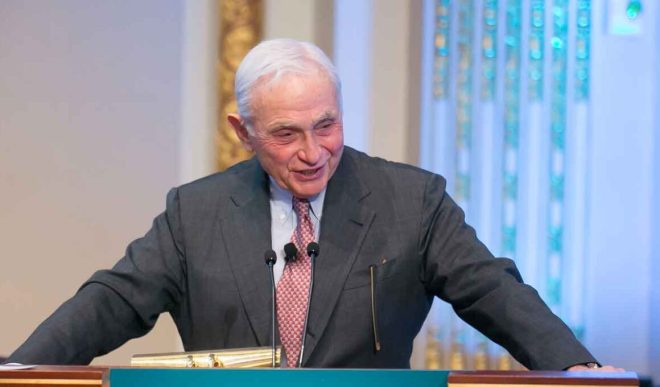
1985 was the year that Leslie Wexner became a billionaire. It was also that year that the chairman of The Limited (now L Brands) began to build up his public persona. This effort to “re-brand” himself began with a series of fawning media profiles. The main outlets that participated in Wexner’s first main, personal PR campaign were written by prominent New York City-based outlets, like New York magazine and the New York Times.
The New York magazine profile, which was the cover story for its August 5, 1985 issue, was entitled “The Bachelor Billionaire: On Pins and Needles with Leslie Wexner.” Though filled with photos of a middle-aged Wexner grinning and embracing friends as well as lavish praise for his business dealings and his “tender” and “gentle” personality, one of the main themes of the article revolves around what is apparently a spiritual affliction or mental illness of Wexner’s, depending on the reader’s own spiritual persuasion.
The New York magazine article opens as follows:
“On the morning Leslie Wexner became a billionaire, he woke up worried, but this was not unusual. He always wakes up worried because of his dybbuk, which pokes and prods and gives him the itchiness of the soul that he calls shpilkes [“pins” in Yiddish]. Sometimes he runs away from it on the roads of Columbus, or drives away from it in one of his Porsches, or flies from it in one of his planes, but then it is back, with his first coffee, his first meeting, nudging at him.”
One may interpret this use of shpilkes, literally “pins” or “spikes” in Yiddish and often used to describe nervous energy, impatience or anxiety, as Wexner merely personifying his anxiety. However, his decision to use the word dybbuk, which he does throughout the article, is quite significant. Also notable is how Wexner goes on to describe this apparent entity throughout the article and his intimate relationship with it.

First page of New York magazine’s 1985 profile of Wexner
As defined by Encyclopedia Britannica, a dybbuk is a Jewish folklore term for “a disembodied human spirit that, because of former sins, wanders restlessly until it finds a haven in the body of a living person.” Unlike spirits that have yet to move on but possess positive qualities, such as the maggid or ibbur, the dybbuk is almost always considered to be malicious, which leads it to be translated in English as “demon”. This was also the case in this New York magazine profile on Wexner.
The author of that article, Julie Baumgold, describes Leslie Wexner’s dybbuk as “the demon that always wakes up in the morning with Wexner and tweaks and pulls at him.” Wexner could have easily chosen to frame the entity as a righteous spirit (maggid) or as his righteous ancestors (ibbur) guiding his life and business decisions, especially for the purpose of an interview that would be read widely throughout the country. Instead, Wexner chose this particular term, which says a lot for a man who has since used his billions to shape both mainstream Jewish identity and leadership in both the US and Israel for decades.
As the article continues, it states that Wexner has been with the dybbuk since he was a boy and that his father had recognized it and referred to it as the “churning”. Per Wexner, the dybbuk causes him to feel “molten” and constantly pricked by “spiritual pins and needles”. It apparently left him at some point as a young man, only to return in 1977 when he was 40, half-frozen during an ill-fated trip up a mountain near his vacation home in Vail, Colorado. This specific trip is when Wexner says he both rejoined with his childhood dybbuk and decided to “change his life.”
He told New York magazine that his dybbuk makes him “wander from house to house”, “wanting more and more” and “swallowing companies larger than his own.” In other words, it compels him to accumulate more money and more power with no end in sight. Wexner later describes the dybbuk as an integral “part of his genius.”
Wexner further describes his dybbuk as keeping “him out of balance, emotionally stunted, a part of him — the precious, treasured boy-son part — lagging behind [the dybbuk].” This is consistent with other definitions of the term in Jewish media, including a feature piece published in the Jewish Chronicle. That article first defines the term as “a demon [that] clings to [a person’s] soul” and then states that: “The Hebrew verb from which the word dybbuk is derived is also used to describe the cleaving of a pious soul to God. The two states are mirror images of each other.” Per Wexner’s word choice and his characterization of what he perceives as an entity dwelling within him, the entity — the dybbuk — is dominant while his actual self and soul “lags behind” and is stunted, causing him to identify more with the entity than with himself.
 This is also reflected in the concluding paragraph of the New York magazine article:
“Les Wexner picks up his heavy black case and flies off in his Challenger, with his dybbuk sitting next to him, taunting and poking him with impatience, that little demon he really loves. The dybbuk turns his face. What does he look like? ‘Me,’ says Leslie Wexner.”
Outside of the spiritual aspect of this discussion, it can also be surmised from the above that there is a strong possibility that Wexner suffers from some sort of mental disorder that causes him to exhibit two distinct personalities which continuously battle within him. What is astounding is that he describes this apparent affliction to a prominent media outlet with pride and the author of the piece weaves Wexner’s “demon” throughout a piece that seeks to praise his business acumen above all else.
Yet, perhaps the most troubling aspect of Wexner’s experience with his “dybbuk”, whether real or imagined, is the fact that Wexner, in the years before and after this article was published, has had a massive impact on Jewish communities in the US and beyond through his “philanthropy.” Some of those philanthropic efforts, like the Wexner Foundation, saw Wexner mold generations of Jewish leaders through Wexner Foundation programs while others, such as the Mega Group, see the organized crime-linked Leslie Wexner joined by several other like-minded billionaires, many of which also boast considerable organized crime connections, in an effort to shape the relationship of the American Jewish community, as well as the US government, with the state of Israel.
For a man of such influence in the Jewish community, why have there been essentially no questions raised as to Wexner’s role in directing the affairs of that ethno-religious community given that he has openly claimed to be guided by a “dybbuk”? This is particularly odd when one considers that Wexner has come under increased scrutiny in recent years after his protege and closest associate for decades, Jeffrey E. Epstein, was outed as both a pedophile and serial sex trafficker. Did Wexner’s dybbuk draw him to Epstein and prompt him to financially support his horrific crimes against minors?
Note: The above is an adapted excerpt from Whitney Webb’s upcoming book “One Nation Under Blackmail: the sordid union between Intelligence and Organized Crime that gave rise to Jeffrey Epstein”. Those interested may pre-order the book directly from the publisher’s website or from Amazon.
‘Israel has failed to prove its history in al-Quds despite extensive excavations for decades’
Press TV – June 9, 2022
Palestinian Prime Minister Mohammad Shtayyeh says the Israeli regime has dismally failed to prove it is steeped in the history of al-Quds despite the regime’s extensive excavations of sacred sites of the occupied holy city for decades.
“Fifty-five years of excavations and tunnel digging did not prove that there is a temple in the city,” Shtayyeh said as he addressed a conference dubbed “Property Documentation and the Historical Status of the Holy al-Aqsa Mosque” in the central West Bank city of al-Bireh on Wednesday.
He added that events like such a conference will reinforce the Palestinian narrative of al-Quds history, and will thwart the Tel Aviv regime’s systematic distortion of facts and its attempts to disguise the Arab, Muslim and Christian identities of the city.
Shtayyeh called on Arab rulers not to contribute to Israel’s Judaization plans in al-Quds, stressing that helping Palestinian residents of the holy city does not go hand in hand with implementing joint projects with the occupying regime.
He demanded that Arab statesmen prop up the Palestinian resistance front in any possible way.
In recent months, the Palestinian Hamas resistance movement has warned that any Israeli attempt to seize al-Aqsa Mosque in the occupied Old City of al-Quds will have “damaging consequences” for Israel.
Hardline Israeli legislators and extremist settlers regularly storm the al-Aqsa Mosque compound – a provocative move that infuriates Palestinians. Such mass settler break-ins almost always take place under the protection and support of Israeli military forces.
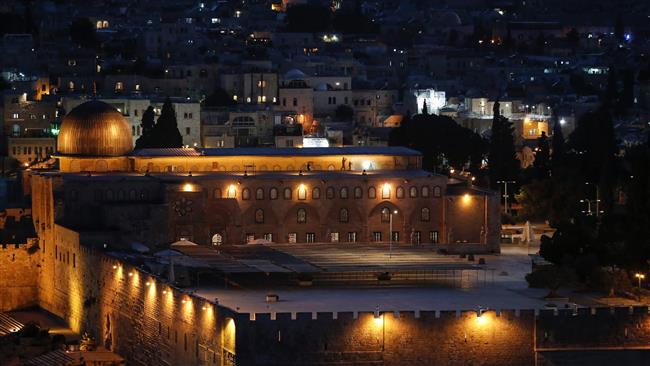
The al-Aqsa Mosque compound, which sits just above the Western Wall plaza, houses both the Dome of the Rock and al-Aqsa Mosque.
The Jewish visitation of al-Aqsa is permitted, but according to an agreement signed between Israel and the Jordanian government in the wake of Israel’s occupation of East al-Quds in 1967, non-Muslim worship at the compound is prohibited.
Back in May last year, frequent acts of violence against Palestinian worshipers at al-Aqsa Mosque led to an 11-day war with Palestinian resistance groups in the besieged Gaza Strip, during which the Israeli regime killed at least 260 Palestinians, including 66 children.
US ‘Acknowledged’ Tehran is Not Looking to Build a Nuclear Bomb: Iranian Foreign Minister
By Dhairya Maheshwari – Samizdat – 09.06.2022
Iran has rejected a resolution adopted by the IAEA’s Board of Governors (BoG) censuring it for not disclosing the site of three uranium enrichment facilities. Tehran claims that the IAEA’s findings are based on inputs from Israel, as the agency’s director general Rafael Grossi met the Israeli PM in Tel Aviv this month.
Iranian Foreign Minister Hossein Amir-Abdollahian has claimed that the US and its Western allies have “acknowledged” that Tehran isn’t looking to build a nuclear bomb.
“The United States and the West know that the atomic bomb has no place in Iran’s Islamic beliefs,” Abdollahian remarked during an address to Indian Islamic scholars in New Delhi, as per a video released by Iran’s Foreign Ministry on Thursday. The visiting Iranian FM was speaking through a Hindi translator.
The foreign minister kickstarted his maiden three-day visit to India on Wednesday, meeting Indian Prime Minister Narendra Modi, Foreign Minister S. Jaishankar and National Security Advisor Ajit Doval on the opening day.
“The West once acknowledged in the nuclear talks that they could ignore all their problems with Iran’s nuclear programme as long as Iran stopped supporting Palestine and recognised Israel,” Abdollahian remarked at the gathering.
“With such incorrect excuses, the West sought the recognition of Israel by the Islamic Republic of Iran in order to achieve their goals, which, of course, failed,” the top Iranian diplomat added.
Abdollahian declared that in spite of the Western countries’ appeals, Iran remained steadfast in supporting “the cause of Palestine”.
“Iran considers it its religious and moral duty to support the liberation of Holy Quds (Jerusalem) and is fully committed to it,” added the dignitary.
Abdollahian told his audience that he wanted to give them a sense of ongoing negotiations between Tehran and Western powers, seeking to bring the US back into the Joint Comprehensive Plan of Action (JCPOA), or the Iran Nuclear Deal.
Former US President Donald Trump unilaterally pulled Washington from the pact in 2018, but his successor Joe Biden has indicated his willingness to reverse the controversial decision.
Tehran Slams US, EU Allies for ‘Political Resolution’
The Iranian Foreign Minister’s remarks came hours after the 35-member Board of Governors (BoG) of the International Atomic Energy Agency (IAEA) overwhelmingly approved a resolution calling upon Tehran to take “urgent steps” to comply with the IAEA’s nuclear safeguards.
The resolution was co-sponsored by the US and the E3 allies—Germany, the United Kingdom and France. Russia and China were the only countries which opposed the resolution, while three nations, including India, abstained from the IAEA vote.
The resolution was floated after a report this month from IAEA’s Director General Rafael Grossi claimed the “presence of uranium particles of anthropogenic origin at Turquzabad, Varamin and Marivan”.
Grossi has said that the three sites weren’t previously disclosed under ‘Safeguards Agreement and Additional Protocol’ negotiated between Tehran and IAEA in March.
The Iranian Foreign Ministry has rejected the resolution as “political, incorrect and unconstructive action”.
“The adoption of the resolution, which is based on the hasty and unbalanced report of the Director General of the IAEA and based on the Zionist regime’s false and fabricated information, will only weaken the process of Iran’s cooperation with the IAEA,” the Iranian Foreign Ministry said in a statement.
Tehran has claimed that the locations cited by the IAEA DG had been cleared by the agency “once and for all” in December 2015 and weren’t supposed to be covered under the March 2022 pact.
Enjoying Your Membership in the Mass Shooting of the Day Club?
Made-to-order censorship from the people who brought you 9/11
Helen of desTroy | June 9, 2022
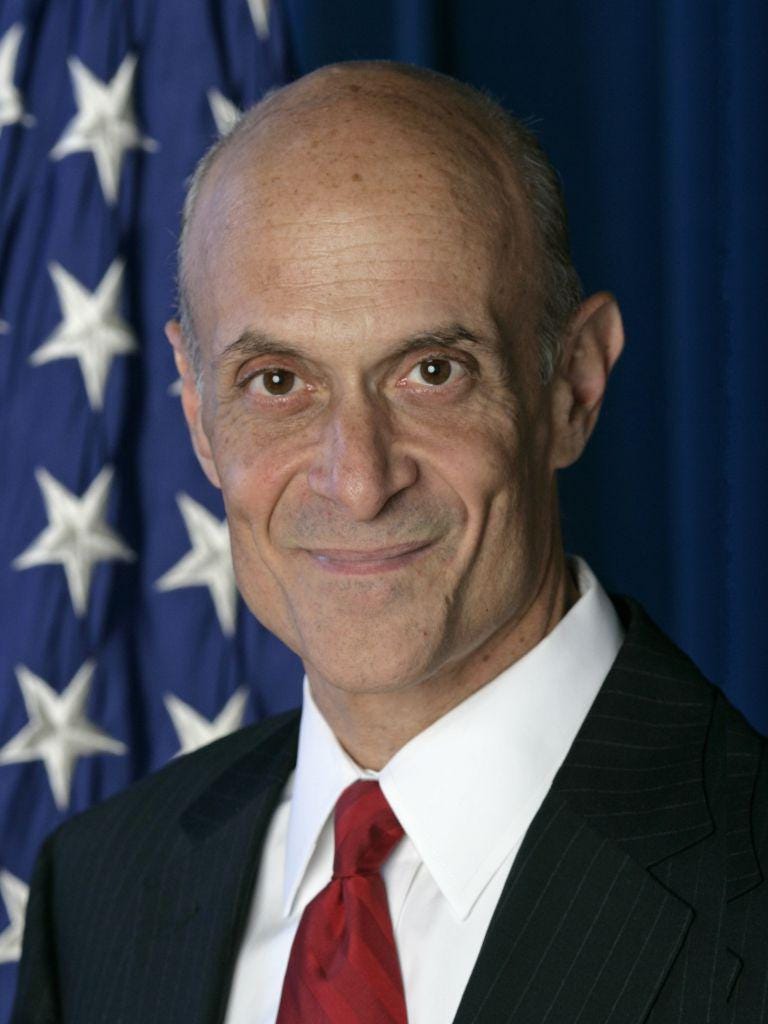
When Nina “Mary Sloppins” Jankowicz predictably crashed and burned as the standard-bearer for the Biden administration’s Ministry of Truth, most people with two brain cells to rub together rejoiced. This was a logical response to aesthetic terrorism, as the gratingly-voiced compulsive liar being shoved in our face was a clear example of the narrative managers adding insult to injury. But anyone who thought we had heard the last of Washington’s Disinformation Governance Board was sadly mistaken. The creature which has replaced Jankowicz is significantly more horrifying, a nightmarish Nosferatu whose mommy was in the Mossad, who’s played a starring role in some of the most heinous crimes against humanity of the last two decades.
sleep tight
I’m talking, of course, about Michael Chertoff.
While there’s no direct smoking-gun proof that the current Mass Shooting Of The Week Club is connected to the Disinformation Governance Board, Chertoff has something of a history of weaponizing extremely dodgy incidents of “terrorism” to advance his agenda, whether that’s getting the Patriot Act passed after 9/11 or having the full nude body scanners manufactured by his company the Chertoff Group’s client Rapiscan (yes, the horrifically invasive body scanner company actually had the word “rape” in the name) installed in airports across the US after the “underwear bomber” Umar Farouk Abdulmutallab supposedly tried and failed to detonate a bomb in his big-boy panties aboard an airplane.
The Chertoff Group’s client list is positively bursting with the sort of company that would benefit from a rash of mass shootings, and Chertoff himself sits on the board of the Jeffrey Epstein-backed Carbyne911, a firm perhaps most notable for its many links to Israeli intelligence, the cartoonish way in which Tel Aviv has sold it as precisely the solution to America’s mass shooting ‘problem,’ and the ease with which it can be turned into a Trojan horse for the Unit 8200 alumni who founded it, allowing Israeli spies to slurp up a wealth of sensitive information without even having to deceive their targets. Carbyne911 turns the user’s phone into an audio/video transmitter in much the same way as infamous Israeli spyware firm NSO Group’s Pegasus malware did, except Carbyne911 is installed deliberately by the user, ostensibly to keep them “safe” – and activating one device activates all other devices in the area that have Carbyne911 installed, potentially giving the company access to an entire building’s worth of sensitive audio-visual data. The company also sells its services for non-emergency purposes, allowing it to keep its foot in the door for those slow times between mass shootings, and in addition to the US, Israel and Mexico, it has offices in Ukraine, which is surely just a coincidence…
Chertoff, one of the architects of the Bush administration’s post-9/11 torture policy, is also well-known for his utter lack of humanity – something that would have been inculcated in him from a young age if his mother Livia Eisen was, as many qualified investigators believe, an early Mossad member. One would have to look far indeed for anyone more likely to inaugurate a “mass shooting of the day” campaign in order to strip Americans of their Second Amendment rights once and for all, or have certain political views declared illegal and elevated to the level of domestic terrorism – all while making a buck for his Chertoff Group security industry clients. Guilford County, North Carolina reportedly plans in the wake of this sudden outpouring of senseless FBI-adjacent violence to begin installing body scanners at its 19 high schools and 23 middle schools, and with the bidding process open you can bet that Rapiscan or its parent company OSI Systems will be taking a big bite out of the taxpayer’s wallets in that state – if not, in reality, out of crime.
Setting up one mass shooting after another is quite clever, from the point of view of pure evil. Researchers digging through the exhaustive amount of evidence indicating at least one “retired” FBI agent had explicit advance knowledge of where, when, how, and with what weapons Payton Gendron was going to shoot up a supermarket in Buffalo will have their work cut out for them simultaneously researching the constantly-shifting stories fed the public by Uvalde, Texas authorities following the shooting at Robb Elementary School, where a kid supposedly so poor his peers mocked him mercilessly for it was suddenly able to afford over $5000 worth of high-end guns and ammo (we know the prices because he supposedly sent the receipt to one of his online “friends” – who couldn’t possibly have been another agent who wanted to make sure his donations to his little buddy in Uvalde were being well-spent! surely there’s an innocent reason CNN deleted that claim from their current version of the story!) while also keeping an eye out for any possible anomalies at the New Orleans graduation shooting and the Tulsa hospital shooting and the Pittston, PA Wal-Mart shooting and the Los Angeles high school shooting—which all took place in a 48-hour span. By the time the identity of Gendron’s FBI pal is confirmed, will anyone even remember who he is?
They won’t, of course, certainly not in the US’ goldfish-memory news cycle. But the ideas slipped into Gendron’s word salad of a manifesto will be added to the list of unacceptable views the holding of which makes an individual a terrorist in the eyes of the government. Unreadable mashups of copypaste, memes, and gearhead masturbation like his magnum opus make it clear that these incidents are being deployed as de facto shopping lists for ideas the narrative managers want removed from circulation. Gendron (or rather, the intelligence agents who programmed him to open fire inside a Buffalo supermarket last month) is not only obsessed with so-called assault rifles and military-grade body armor, “he” also appears to be capable of basic levels of pattern recognition regarding the activities of international financial cartels with a tendency to hide behind a certain ethnic group who use the religion to which they supposedly belong and its members as human shields for all manner of atrocities, then accuse anyone who notices of “antisemitism” for having eyes, ears and a functional brain. This phenomenon has been observed and described by scholars for centuries, and its perpetrators are sick of ordinary people noticing, hence their decision to shoehorn it in between an array of juvenile “white supremacist” cliches in the hope of having any mention of this reality declared “hate speech.”
This sort of thing is hardly new. The intelligence agents who crafted Gendron’s “manifesto” followed a long tradition of guilt-by-association when they larded it with credibility grenades largely consisting of the kind of dull-edged racism one generally sees in the kind of person who, in the absence of any real accomplishments of his own in which he can take pride, falls back on his ancestry, which he embraces with an overblown “pride” as if an accident of birth is an adequate substitute for achievement. No one with a functioning critical capacity actually believes these types are a threat before the FBI puts a gun in their hands and points them at the nearest pressure point. But throwing a bunch of bodies on the pile has ginned up a new round of well-funded outrage, perhaps best exemplified by New York Governor Kathy Hochul, who leveraged the death toll to pass a law against the contents of the manifesto so incomprehensible and unpopular even the media establishment can’t find anything nice to say about it.
Now anyone who expresses any of the ideas espoused by someone who later goes on a shooting rampage – whether he’s gently guided by an FBI agent (or a rumored yet frustratingly citation-deficient online cheerleading section) or merely motivated by revenge on an ex-girlfriend or a doctor who may have made a mess of his back surgery – becomes that much easier to tar and feather with the all-purpose “hate speech” brush.
For the parasitic elites and the intelligence agencies, who generally work hand in hand anyway, expressing such “white-supremacy-adjacent” ideas will be seen as a precursor to embarking on yet another mass shooting rampage, deemed “pre-crime” under the Domestic Terrorism bill recently passed in the House and only a few more mass shootings away from being rammed through the Senate. Anyone expressing such ideas can be imprisoned for their own “safety,” in the same way as was laid out in the Trump administration’s proposed HARPA and DEEP programs. HARPA proposed monitoring an individual’s electronic devices for signs of mental illness, which could be acted upon to neutralize the individual without evidence they would so much as hurt the proverbial fly; DEEP would similarly intervene against individuals deemed to be “mobilizing toward violence,” deploying “court ordered mental health treatment,” electronic monitoring, and every other tool in the I-can’t-believe-it’s-not-prison toolbox against individuals who’ve done nothing except set off what has become an absurdly sensitive set of pre-crime “red flags.” Given that the mass shooting of Columbine was believed by those closest to the perpetrators to be triggered by their use of antidepressant drugs, the idea of funneling would-be shooter types into psychiatric care instead of as far away from it as possible is ironic at best, a sick joke at worst.
And given the ever-yawning definition of Domestic Terrorism in 21st century America, the only way to escape the tightening net of absurdly punitive speech laws will soon be to curl up in the fetal position at the feet of BlackRock CEO Larry Fink as he lies sleeping, like a loyal pet, in order to prove oneself clean of ideological sins.
Thus, while the seemingly endless stream of mass shootings unfolding over the last two weeks is clearly designed to encourage Americans to beg their government to take their guns away, anything, anything to make it stop, for the children, et cetera, it’s also designed to encourage Americans to shut up those mean people online, because if they can’t convince the half of the population that owns guns to chuck them over an increasingly absurd series of “mass shootings,” taking away their right to complain is a sufficient consolation prize.
Playing chicken with dead kids is the sort of sick game only a Michael Chertoff could win, and given the absolute cowardice that sets in when anything about a mass shooting – even really obvious things like retired FBI agents befriending the shooters and being publicly told where and when they would commit their acts in time to prevent them – is questioned, he is likely to come out on top if we allow this insanity to continue without asking the obvious questions – not just about who benefits (that much is clear) but about who is setting these events up one after another to go off in a carefully timed string like fireworks on the 4th of July (and we can expect a biiiiiiig mass shooting that day, just to hammer their point home).
Israeli regime openly calls on IAEA to censure Iran
Press TV – June 7, 2022
The Israeli regime is openly putting pressure on the United Nations’ nuclear watchdog to censure Iran’s peaceful nuclear energy program.
“We expect the IAEA (the International Atomic Energy Agency’s) Board of Governors to place a clear warning light in front of the regime in Tehran, and make it clear that if it continues in its defiant nuclear policy, it will pay a heavy price,” the regime’s Prime Minister Naftali Bennett said on Tuesday, addressing the Knesset (Israeli parliament), The Times of Israel reported.
The comments came a day after the board started a five-day meeting in Vienna.
The event is set to adopt an anti-Iran resolution, drafted by Britain, France, Germany, and the United States to accuse the Islamic Republic of withholding cooperation with the agency.
Various media reports and official sources have warned about the existence of the Israeli regime’s footprints across the process that has led to the emergence of the draft resolution.
Raising even more suspicion was a Friday flying visit to the occupied territories by the IAEA’s Secretary-General Rafael Grossi, and his meeting there with Bennett, with some reports even sounding the alarm about the watchdog and Tel Aviv’s “collusion” against Iran.
“He (Grossi) arrived for a snap visit in Israel, and I made Israel’s stance clear — that we are operating and will continue to maintain our freedom of action to act against Iran’s nuclear program as long as necessary… nothing ties our hands,” Bennet said.
The Israeli regime has, over years, conducted several sabotage operations against Iran’s nuclear facilities and assassinated at least seven Iranian nuclear scientists.
The regime’s vicious anti-Iran campaign comes while Tel Aviv, itself, continues to be the sole possessor of nuclear arms in the Middle East region, with a stockpile of hundreds of atomic warheads. Due to the cover provided by the US and Europeans, however, the regime has refused to open up its nuclear sites to the IAEA’s inspectors and join the Nuclear Non-Proliferation Treaty (NPT).
“When it comes to nuclear weapons, we live in a world of double standards,” Frank N. von Hippel, an American physicist, who is a professor and co-director of the Program on Science and Global Security at Princeton University, told Press TV.
“This unequal situation cannot persist indefinitely: Either we get rid of nuclear weapons or nuclear weapons will get rid of us,” he added.
Iran and IAEA relations on tenterhooks
Press TV – June 7, 2022
The Vienna based International Atomic Energy Agency, the IAEA, is supposed to monitor compliance with the 1968 nuclear Non Proliferation Treaty, NPT, which has been described as the centerpiece of global efforts to prevent the spread of nuclear weapons, promote cooperation in the peaceful uses of nuclear energy and to achieve the ultimate goal of global nuclear disarmament.
The IAEA is supposed to engage upon technical, unbiased and professional cooperation with NPT signatories and to be free of politics or political considerations.
The IAEA has had a high profile role regarding Iran’s nuclear energy programme. In 2015, when Iran and the P 5+ 1 struck a deal known as a Joint Comprehensive Plan of Action. The IAEA was subsequently tasked with monitoring Iran’s compliance with the terms of the agreement.
In many of its reports over the years, the agency has said that it has found no evidence of any diversion in Iran’s nuclear programme.
As the fate of the faltering 2015 deal remains increasingly unclear, the technical role and supposed independence of the atomic watchdog are being tested.
In a recent report, the IAEA said Iran’s stockpile of enriched uranium had grown to more than 80 times the limit allowed in the 2015 agreement.
The agency also said Iran has failed to answer its remaining questions.
Tehran described the latest IAEA statements as one sided pointing out that it fails to reflect Iran’s extensive cooperation with the agency.
“The International Atomic Energy Agency seems to be succumbing to the same sort of takeover that the United States and the Anglo Zionist Empire has been doing to so many other international organizations such as, for example, in athletics, for example, in economics with the World Economic Forum, for example, all these organizations; they seem to want to control them.” – Tony Gosling, Investigative Journalist
Meanwhile, reports say Western countries lobbied by Israel are planning to push the International Atomic Energy Agency to criticize Iran at its upcoming meeting of the Board of Governors.
In March Rafael Mariano Grossi, the head of the International Atomic Energy Agency, visited Iran. The IAEA and Iran announced at the end of the visit that they had agreed on an approach for resolving remaining bilateral issues.
The visit came as representatives from Iran and the P 4+1 were trying to find a way to move forward in their negotiations which were aimed at reviving the 2015 deal. The talks are currently stalled with Iran saying the United States is failing to make necessary political decisions.
At this point, any stance by the IAEA could have an important effect on the stalled talks. This week Iran’s top diplomat said the agreement between Tehran and the agency in March was mutually satisfactory. He warned that political interference in the technical affairs of the agency is totally unconstructive.
The comments by Amir-Abdollahian came ahead of a meeting of the IAEA Board of Governors scheduled for June the sixth. With days left to the meeting the IAEA chief has arrived in Israel as Tel Aviv released documents alleging Iran spied on the IAEA.
Iran says Israel, which has refused to join the NPT and is believed to possess hundreds of nuclear warheads, hates the JCPOA and wants to derail the effort to revive it.
The problem with much of what the International Atomic Energy Agency has been doing is that it is trying to find excuses to, I suppose, make out that the Iranian nuclear programme is a military programme.
One of the problems with the IAEA is they’re not looking anywhere near as closely at the Israelis, who do have nuclear weapons.
“They tried to keep it secret, but Mordechai Vanunu blew the whistle in the Sunday Times here in Britain back in the 1980s and did a massive jail term for his, when he was kidnapped actually, for his trouble, that they do have many nuclear weapons, probably something like 200 …” – Tony Gosling, Investigative Journalist
Reports say the United States and its Western allies, pushed by Israel, plan to pile pressure on Iran at the upcoming IAEA meeting.
Tehran has warned that it would respond firmly and appropriately to any such move, because Iran has been cooperating based on the agreement reached in March.
The fate of months of negotiations between Iran and the P 4+1 seems to be at stake as a meeting of the IAEA Board of Governors draws close.
One wonders who would benefit from a possible collapse of the talks.
Featured Video

Houthis Don’t Have to Conquer Saudi Arabia to Make It Pay
or go to
Aletho News Archives – Video-Images
From the Archives
Newly Released FBI Docs Shed Light on Apparent Mossad Foreknowledge of 9/11 Attacks
By Whitney Webb | MintPress News | May 17, 2019
NEW YORK — For nearly two decades, one of the most overlooked and little known arrests made in the aftermath of the September 11 attacks was that of the so-called “High Fivers,” or the “Dancing Israelis.” However, new information released by the FBI on May 7 has brought fresh scrutiny to the possibility that the “Dancing Israelis,” at least two of whom were known Mossad operatives, had prior knowledge of the attacks on the World Trade Center. … continue
Blog Roll
 Aletho News
- MEP blasts ‘Euro-Gestapo’ for lecturing Russia on democracy
- Syria May Send Troops to Saudi Arabia Amid War with Ansar Allah
- UK whines about losing billions to ‘Putin tax’
- Baghaei to Rubio: Distorted narratives cannot erase US record of broken commitments
- Houthis Don’t Have to Conquer Saudi Arabia to Make It Pay
- MOE: Nearly 22,000 Students and Education Workers Killed
- Guterres in Islamabad: Genocide, cowardice, and the cage of Imran Khan
- Johnson, Marandi say Yemen holds upper hand over Saudi Arabia
- False flags won’t save aggressors, Iran FM spokesman says
- The Makkah Pact Enters Into Force: The End of American Dominance or Its New Form?
- If Americans Knew
- Report claimed Mark Levin used by Israeli government to influence Trump
- Over 2,000 Gazans have died awaiting medical evacuation amid Israel’s continued siege
- How a U.S. Diplomat Suppressed and Altered Reports Critical of Israel
- 5 Palestinians Die from Israeli Strikes in Gaza as Relentless Attacks Continue
- Report: Ceasefire Slows Killing but Leaves Devastation Intact
- Country Music Singer Zach Bryan Breaks Attendance Record at Robert Kraft’s Gillette Stadium While Wearing ‘Free Palestine’ Shirt for Second Night in a Row
- Three years of death and devastation: Israel’s war on Gaza in pictures
- Why Hamas believed the status quo was more dangerous than its 7 October gamble
- Debunking Israel’s latest list of ‘terrorist’ journalists in Gaza
- In Gaza, focus is on survival, “every step is a struggle” – Daily Update
- No Tricks Zone
- New Study: 50 Years Of The Most Aggressive ‘Net Zero’ Policies Can Only Affect The Global Climate By 0.03°C
- US September “Heat” Was No Record…Many Records Set Decades Ago
- Latest European Green Energy Debacle; Portugal’s Largest Flagship Solar Park Insolvent!
- Green Energy Debacle: German Expert Professor Fritz Vahrenholt Warns Of Severe Economic And Social Consequences
- Two More Paleo Reconstructions Affirm Meters-Higher Sea Levels Across Ireland, Brazil 7000-6000 Years Ago
- New Study: Earth And Venus Surface Warmth Largely Explained By Convection And Lapse Rate, Not CO2 Or Radiation
- 2025 Nature Paper Claiming Worsening Global Drought Gets RETRACTED …Heavily Flawed
- New Study: ‘Global Drought Shows No Detectable Recent Acceleration Under Climate Warming’
- Economic Masterminds: German Socialists Suggest Taxing Productivity Gains Stemming From Using AI
- The South China Sea Has Not Been Cooperating With The Climate Change Narrative

