Biden Goes to the Middle East
BY PHILIP GIRALDI • UNZ REVIEW • JUNE 28, 2022
The White House has confirmed that President Joe Biden will travel to the Middle East in mid-July. He intends to visit Israel, the Palestinian Authority and Saudi Arabia. The trip will be used to address outstanding bilateral and multilateral issues, including convincing the Saudis to pump more oil to bring down fuel prices. Among the key topics to be discussed will be the alleged Iran threat, a possible security alliance between Israel and Gulf states backed by Washington, the status of the US Consulate General in Jerusalem, and the future of the Palestinian Authority.
Biden has agreed to a controversial meeting with Saudi Crown Prince Mohammad bin Salman, in which he will ask the Kingdom to agree to “normalize” relations with Israel in addition to increasing its oil exports. There has also been considerable pressure on Biden to seek a commitment from the Prince to take steps to improve human rights in his country, but the subject is not likely to come up as it is Biden who is seeking concessions from the Saudis. The Prince, for his part, ordered the October 2018 killing of US resident and Washington Post journalist Jamal Khashoggi in Istanbul. Khashoggi had been highly critical of the Saudi monarchy, particularly regarding its human rights record. Some in Congress and the media have described the private meeting as inappropriate given that fact.
Indeed, pumping more oil aside, the trip is largely about doing many things to help Israel, which is expected to produce favorable reporting in the US media preceding the November mid-term election. Biden even described the trip as being “for Israel” and that loud sucking noise you hear is his repeated pledges of loyalty to the Jewish state. He has described himself as a “Zionist” and has enthused “My commitment to Israel is known and engraved in rock.” Lest there be any confusion in spite of all that, the White House statement regarding the trip also made very clear that the president will “reinforce the United States’ iron-clad commitment to Israel’s security and prosperity.” That means that Israel will not be pressured over its appalling human rights record, worse even than Saudi Arabia’s, to include the recent assassination of Palestinian-American journalist Shireen Abu Akleh. On the contrary, Biden is bearing gifts to reward the Israelis for being such great friends, including a proposal that increases US financial and logistical support for the Jewish state’s air and missile defense systems, which are already largely funded by Washington.
Other aspects reflecting the Israeli dominance of US-Mideast foreign policy include Biden’s convincing the Saudis and also representatives of the Gulf States to step up their efforts to actively counter what is being described as “threats from Iran.” It is being suggested that this might include a security arrangement, not quite an alliance, but a commitment by many of Iran’s neighbors to act jointly if the Islamic Republic threatens anyone in the region. The arrangement would have to include Saudi Arabia, the Gulf States and Israel, backed up by the US military presence in Kuwait, Bahrain and Qatar. Israel is also demanding a Plan B response proposal if Iran and Washington fail to restart the stalled Joint Comprehensive Plan of Action (JCPOA) nuclear monitoring program. Washington, under pressure from Israel, now appears to be reluctant to make the concessions that would reestablish the original plan and the Israeli government is seeking a commitment by the president to use force, if necessary, when Iran crosses an agreed upon “red line” by enriching uranium until it produces enough fissile material to put together a nuclear weapon. Of course, there is a trick to the demand as Israel claims that Iran already has enough enriched uranium to create one or more bombs.
Israel nourishes regional imperatives that might tempt it to steer the discussions in a direction that would be very favorable to itself at the expense of other US interests in the region. Israel’s leaders regularly boast about their ability to manipulate the American government. They might stage or manage an incident that takes place during the Biden visit to shift perceptions of the status quo in the Middle East. As Israel has demonstrated that at its most extreme it has little regard for American lives or property, one should not be surprised if something odd were to happen. Many credible observers credit the Israeli intelligence services with a whole series of attacks on American targets, possibly even including arranging the assassination of John F. Kennedy and instigating 9/11. And then there are also the Lavon Affair in 1954 which involved the bombing of US government buildings in Egypt, and the attack on the USS Liberty in 1967 which killed 34 American sailors. To be sure, Israel can be ruthless and its security services are very effective at assassinations and false flag attacks.
Israel wants very much to have two developments emerge from the Biden visit. First is to effectively eliminate Iran as a potential threat by degrading its military and preventing any moves to go nuclear and second is to delegitimize the Palestinians as negotiating partners for some kind of two-state solution, which Biden claims to support even though Israelis routinely and generically refer to the Arabs as “terrorists.” To prevent blowback coming from any direct moves to confront the Iranians and Palestinians, Israel would also prefer to have the United States take the lead and do the heavy lifting. To accomplish that, it is first necessary to change Washington’s assessment of the threats in the Middle East, and that just might be doable by arranging something spectacular while the president in the region, like a bombing, or an act of sabotage or even creating what appears to be a terrorist attack. If done properly, whatever occurs would have false flag Iranian and/or Palestinian fingerprints all over it.
To be sure, America’s Secret Service will do a thorough job to protect the president and his entourage, but the Israelis would be operating on their own turf or in their own backyard and would be able to run rings around them. They would also have intimate knowledge of exactly what is being done to protect the American party.
I am not at all suggesting that the Israelis would resort to lethal violence against a group of traveling top level American officials, but I am merely examining what might happen if Prime Minister Naftali Bennett’s government were to get a bit adventurous in an attempt to change the playing field. Bear in mind that Bennett’s government is in trouble. It lost a confidence vote and has called for new elections to be held on October 25th, which could mean a return to power of the truly ghastly Benjamin Netanyahu. What would be better than to stage an international crisis of some kind to rally the Israeli people behind the current government? That would be in addition to creating a mechanism for dealing effectively with the Iranians and Palestinians, which would be very popular among Israeli voters, if an election were to occur.
So, Joe Biden is heading into a crap shoot in the Middle East. Israel will be squeezing him hard and might even do something stupid, while the Saudis have little incentive to give the American president what he wants. The Palestinians meanwhile will wind up abandoned by everyone, once again. But one thing that is for sure is that when Joe returns the spin on how it was a fabulously successful trip will fill the newspapers and airwaves. And then everyone will sit back and hold their breath to see if that ploy has worked. Come November we will know.
Philip M. Giraldi, Ph.D., is Executive Director of the Council for the National Interest, a 501(c)3 tax deductible educational foundation (Federal ID Number #52-1739023) that seeks a more interests-based U.S. foreign policy in the Middle East. Website is councilforthenationalinterest.org, address is P.O. Box 2157, Purcellville VA 20134 and its email is inform@cnionline.org.
Iran Dismisses ‘Ridiculous’ Allegations of Planned Attacks on Israelis in Turkey
Al-Manar – June 24, 2022
Iran dismissed Israeli accusations that it is allegedly plotting to target Israelis in Turkey as “ridiculous” on Friday.
In a tweet from Iran’s Foreign Ministry, spokesperson Saeed Khatibzadeh said that Lapid’s “baseless accusations” about such Iranian activity are “ridiculous” and part of a “pre-designed scenario to destroy relations between the two Muslim countries.”
“It is expected from Turkey not to remain silent in the face of these divisive allegations,” he said.
Khatibzadeh also stressed that Iran would respond forcefully to “assassinations and acts of sabotage by the Zionist regime” but “without threatening the security of civilians and the security of other countries.”
Israel Murders Iranians While Biden Kills the Iran Deal
By Connor Freeman | The Libertarian Institute | June 23, 2022
In a clear message to Tehran, an American B-52 flew over the Persian Gulf as soon as Joe Biden entered the White House. Biden promised to return the U.S. to the Iran nuclear deal. But indirect talks to revive the Joint Comprehensive Plan of Action (JCPOA), which began last April, have stalled for three months without a resolution in sight. Counting on the reliable support of Biden and bipartisan Iran hawks in Congress, the nuclear-armed Israeli apartheid regime intends to kill the deal entirely.
Tehran, a decades-long signatory of the Non-Proliferation Treaty, is neither seeking nor has ever sought nuclear weapons. But the Islamic Republic, once Tel Aviv’s “best friend,” serves as Israel’s favorite boogeyman, superficially justifying billions of dollars in American military aid each year. The JCPOA threatens the racket.
Formally known for years as “Israel’s man in Washington,” President Biden is essentially pursuing ultra-Zionist Donald Trump’s foreign policy regarding Iran and supporting, tacitly or otherwise, Tel Aviv’s relentless attacks against Iran and its allies. Biden is continuously imposing yet more sanctions, increasing the “Maximum Pressure” on the economically crippled Iranian people.
The rial has hit all-time lows. With a population of 82 million, almost half of all Iranians live below the poverty line, and inflation is somewhere between 40-50%.
America’s self-styled sanctions artists delight in seeing the results of their economic war on Iran: excess deaths, severe medical shortages, prohibitively high prices for staple goods, plummeting incomes, and social unrest over food costs.
This year, Tel Aviv has been bombing Syria, Tehran’s ally, at the usual weekly rate. A recent strike, coming from the illegally occupied Golan Heights, attacked Damascus International Airport. The airstrike targeted the facility’s only working runway Israel had not yet destroyed, rendering the airport temporarily inoperable.
Shortly afterwards, The Wall Street Journal put out a story confirming that Tel Aviv coordinates with the Pentagon on many of its strikes in Syria.
The Israelis just wrapped up month-long war drills, the largest held in decades, aimed squarely at Tehran. Exercises over the Mediterranean Sea, with over 100 aircraft and navy submarines, spanned 10,000 kilometers and were designed to simulate repeated airstrikes on Iran and their civilian nuclear facilities.
Early reports were that the U.S. Air Force would participate, providing refueling planes, but this reportedly did not come to pass. Although General Michael Kurilla, the new head of U.S. Central Command (CENTCOM), observed some of these Chariots of Fire exercises.
On May 22, 2022, the Israelis carried out a high profile assassination of a senior colonel in the Iranian Revolutionary Guard Corps (IRGC), Col. Hassan Sayyad Khodaei. Shortly afterwards, citing an unnamed intelligence official, The New York Times reported Tel Aviv had informed Washington that it was responsible. Israel’s attacks seem to be primarily focused on the Iranians’ drone program, namely killing people who work on drone technology and attacking related sites.
As Dave DeCamp, Antiwar.com news editor, reported,
Israel was immediately suspected of the assassination since it has a history of carrying out targeted killings and other attacks inside Iran. Israel rarely officially acknowledges such operations, and it’s typical that its responsibility is revealed by leaks to the media, often by Israeli officials.
Israeli officials claimed to the Times that Khodaei was in charge of a secret covert IRGC group known as Unit 840, which Iran denies exists. The Israelis claim Khodaei was involved in plots to kill and kidnap Israeli civilians and officials around the world, but there’s no evidence Tehran was planning to target Israelis abroad.
Two people affiliated with the IRGC told the Times that Khodaei was a logistics officer who played a key role in transporting drone and missile technology to Syria and Hezbollah in Lebanon and advised militias in Syria. Iran has said Khodaei was involved in the fight against ISIS in Iraq and Syria.
Israel is suspected to have subsequently poisoned and murdered two Iranian scientists including Ayoub Entezari, an aerospace engineer, who reportedly worked on missile and drone projects, and Kamran Aghamolaei, a geologist.
Last month, a few dozen miles south of Tehran, quadcopter suicide drones attacked the Parchin military complex. The drones hit a building being used for drone development and killed a young engineer. In February, Israel used six quadcopter drones in a strike targeting another Iranian drone facility in Kermanshah which did significant damage. In Tabriz, there were reports of another Israeli attack on a drone factory, as many as three people may have been killed. This month, two additional IRGC members also working in the aerospace industry died during mysterious accidents in Iran. Both deaths were declared “martyrdoms.”
In the midst of these soaring tensions, Robert Malley, Biden’s Iran envoy, is telling Congress “all options are on the table.”
The U.S. Senate overwhelmingly voted to pass a non-binding resolution which insists they would never support a restoration of the JCPOA if the IRGC were removed from the Foreign Terrorist Organization (FTO) blacklist. The FTO designation is ostensibly one of the final sticking points preventing the deal’s straightforward revival. Congress has been sending messages, loud and clear, to Tehran and Biden that the deal has virtually no support.
Meanwhile, Secretary of State Antony Blinken is peddling baseless stories about Tehran attempting to assassinate his predecessor Mike Pompeo. Pompeo enthusiastically supported Trump’s Maximum Pressure campaign as well as the drone strike murder of top Iranian General Qasem Soleimani, leader of the IRGC Quds Force. Though these claims of Pompeo’s life being endangered remain unproven, U.S. taxpayers pay millions per month for a security detail to put his and Blinken’s mind at ease.
Much like Tel Aviv’s unproven accusations that the IRGC is out to kidnap and murder Israelis, especially in Istanbul for some reason, this obviously plays well with the overall anti-JCPOA campaign.
The IRGC is the only state military organization on the terrorism blacklist. Considering the myriad preexisting sanctions on the unit, it is a superfluous insult. In 2019, Trump implemented this policy at the behest of Israeli-partisan hawks like Mark Dubowitz at the Foundation For Defense of Democracies, a notoriously anti-Iran think tank. This is one of the largest bricks in the so called “sanctions wall” precluding any of Trump’s successors from ever returning to the deal for fear of the built-in political toxicity. It is enough to keep Biden and the cowardly Democrats from backing what is ultimately Barack Obama’s deal in favor of a neoconservative-style Iran policy.
As May began, Israel started making these claims about a global Iranian plot to kill Israelis. At that time, the JCPOA negotiations were seemingly stalled irrevocably because of the IRGC-FTO issue. But then the Vienna talks’ broker, European Union nuclear negotiator Enrique Mora, traveled to Tehran. He took meetings with Iran’s lead negotiator Ali Bagheri Kani as a last ditch effort to break the deadlock. Mora was sent by EU foreign policy chief Josep Borrell. As a result of the American led sanctions blitz on Russia, Europeans are in desperate need of another crude supplier as Borrell has noted. The same week, the emir of Qatar, Sheikh Tamim bin Hamad Al Thani, also made a trip to Tehran and pushed for progress during meetings with President Ebrahim Raisi as well as Ayatollah Ali Khamenei. On May 13th, Borrell announced Mora’s mission went “better than expected,” Vienna talks had been unblocked, and a final deal was within reach.
Days later, coinciding with Israeli Defense Minister Benny Gantz’s visit to Washington, and his meetings with National Security Adviser Jake Sullivan and Pentagon chief Lloyd Austin, Khodaei was murdered in the drive-by shooting. Israel’s assassination campaign had commenced.
Two days after the Khodaei killing, Politico reported that the final decision to keep the IRGC on the FTO list was made. On Twitter, Israeli Prime Minister Naftali Bennett thanked Biden for the “principled decision and for being a true friend of the State of Israel.”
Following Trump, Biden’s administration is also continuing to seize tankers, stealing Iranian oil and pirating it for profit. Ironically, after Russian President Vladimir Putin invaded Ukraine, there was some talk from Biden officials about making a deal with the Islamic Republic to put Iran’s abundant oil back on the market to reduce global energy prices. But this was apparently never taken seriously.
Biden instead prefers to kowtow to the genocidal Saudi regime which along with Abu Dhabi and Washington have starved to death and bombed over 400,000 Yemenis, including more than 263,000 children.
Those deaths mean little to the Abraham Accords caucus. This bipartisan coalition in Congress is working to ensure Washington arms these tyrants further while the Pentagon assists them in joining forces, as well as integrating missile defenses with Tel Aviv eyeing Tehran. As Biden heads to the Middle East, there is even talk of the U.S. offering security guarantees to the United Arab Emirates.
For almost a year, the Israelis have been pushing an anti-Iran, NATO-style, U.S. led alliance in the Middle East. In recent weeks, Gantz has openly promoted this strategy which Bennett is said to have suggested to Biden during a White House meeting last year.
As Iran is encircled militarily and strangled economically, the American Empire is refusing to allow them any breathing room. Each day the U.S. forgoes lifting sanctions and restoring the deal the likelihood of a hot war increases.
Given the size of Iran, its population, its geostrategic location, substantial ballistic missile deterrent, its Axis of Resistance partners, and the wide variety of U.S. military targets in the region, a war with Tehran would likely dwarf the catastrophic damage, scope, and deaths of America’s other Middle East wars.
If the JCPOA fails, the hawks armed to the teeth surrounding Iran may try to goad Tehran into leaving the NPT. Whether this happens ultimately or not, Israel may use the coming breakdown in diplomacy to justify instigating its long desired war. Rightfully, the Iranians will see such an Israeli attack as an American declaration of war.
This week, Tehran has formally dropped their demand for removing the IRGC from the FTO list. Washington has not yet responded. Contrary to the corporate press narrative, the ball is now firmly in Washington’s court.
Iran called Biden’s bluff. It is imperative that the American people now assert our support for terminating the unjustified and brutal Maximum Pressure campaign as well as denounce Israel’s murderous aggressions.
The Iranian people deserve to live and trade in peace.
Israeli forces beat up international activists in Masafer Yatta
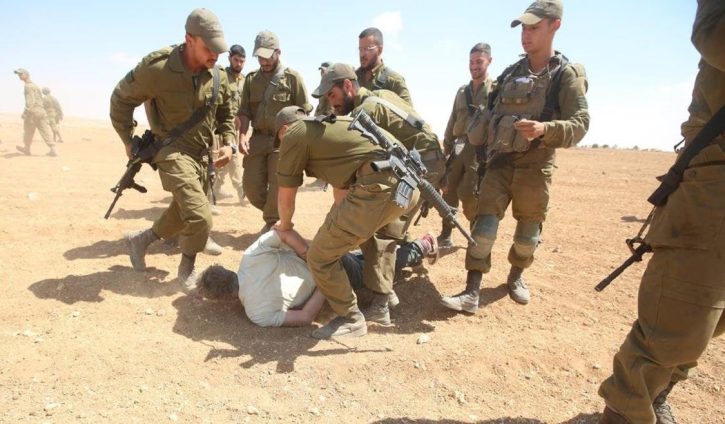
Israeli soldiers beat up a handcuffed international activist in Masafer Yatta
WAFA – June 22, 2022
HEBRON – Israeli forces today beat up a number of international solidarity activists in Masafer Yatta in the southern Hebron hills, according to local sources.
Coordinator of the Protection and Steadfastness Committee in Masafer Yatta, Fuad al-Amour, said the heavily-armed soldiers brutally assaulted a number of international activists while protesting the military drills close to and in al-Markez, and held two others for a long period.
The Israeli army have been conducting drills in al-Markez, one of 12 hamlets making up the Masafer Yatta, which rely heavily on animal husbandry as the main source of livelihood, for the second day in a row.
Al-Amour added that the army has built mock-ups as targets between the makeshift dwellings of the hamlet residents and has been conducting training with heavy weaponry, spreading panic among the residents.
The army has also deployed military checkpoints in the vicinity of the hamlets in the area, in preparation for military training, and perhaps paving the way for an imminent removal of the Palestinian residents.
Recently, Israel’s top court gave the army the green light to forcibly expel some 1,300 Palestinians living in twelve villages or hamlets making up the Masafer Yatta area marking one of the largest expulsions carried out by the State of Israel in recent decades.
Located in Area C of the West Bank, under full Israeli administrative and military control, the area has been subjected to repeated Israeli violations by settlers and soldiers targeting their main source of living – livestock.
It has been designated as a closed Israeli military zone for training since 1980s and accordingly referred to as Firing Zone 918.
Israeli violations against the area include demolition of animal barns, homes and residential structures. Issuance of construction permits by Israel to local Palestinians in the area is non-existent.
The Israeli occupation forces destroy an access road to a Ramallah-area village
WAFA – June 22, 2022
RAMALLAH – The Israeli occupation forces today destroyed an access road to Ras Karkar village, northwest of Ramallah, hampering the movement of people, according to the head of Ras Karkar village council, Marwan Nofal.
He said that the destroyed road had been partially paved for 20 years and that three months ago, following coordination with the Israeli military government, work on the rehabilitation of the road started. However, two days after the start of the work, the military forces raided the area and seized the vehicles used in the work, imposing a fine on their owners.
Nofal said that despite continuous promises to allow the rehabilitation work, the army sent its bulldozers today to destroy the road under the pretext that the road is located on “state land”.
The destruction of the road led to depriving farmers of access to their lands on the western side of the village, he said, and isolating several houses, noting that this is not the first time the Israeli military has targeted the village.
Ras Karkar suffers from the presence of seven iron gates at its entrances that limit the movement of people and access to their homes and lands.
At the same time, the Israeli military government does not allow it to carry out any work to improve the village’s infrastructure, said Nofal.
Palestine resistance seize Israel’s surveillance balloon

MEMO | June 18, 2022
The Palestinian resistance managed to seize control of the Israeli surveillance balloon early on Friday after it was shot down in the town of Beit Hanoun in the northern Gaza Strip.
Palestinian sources confirmed to Quds Press that the Israeli surveillance balloon seized by the Palestinian resistance was not the first it had seized. It has previously seized several balloons, as well as advanced drones.
Israeli sources revealed fears of dangerous information leaks and the resistance obtaining high-quality imaging equipment.
Palestinian writer and political analyst Mustafa Al-Sawaf believes: “What is important is that the resistance was able to seize this surveillance balloon, regardless of what method is used to shoot it down,” describing the incident as “serious”.
Al-Sawaf told Quds Press: “The occupation believes that the resistance is unaware and does not monitor its movements, so it tried to penetrate the Gaza Strip from the north and present a special force, but the resistance men were on the lookout, confronting the occupation and preventing them from entering the Gaza Strip.”
He pointed out: “The matter almost reached the level of a clash, but a reconnaissance aircraft intervened by firing two missiles, thus preventing this and securing the withdrawal of the special force.”
He added: “The occurrence of three incidents in Jenin and Gaza gives quick and dangerous indications that confrontation between the resistance and the occupation is fast approaching, and we must monitor the situation with high accuracy because the coming hours will carry a lot.”
It is worth noting that the Israeli army radio station, Doron Kadosh, announced: “The army’s initial investigation revealed that the surveillance balloon that fell in Gaza had fallen due to technical difficulty and that the army said there is no fear of significant information leakage, although the army tried to open warning fire near it, Hamas still managed to seize the balloon.”
Why India must decouple from I2U2
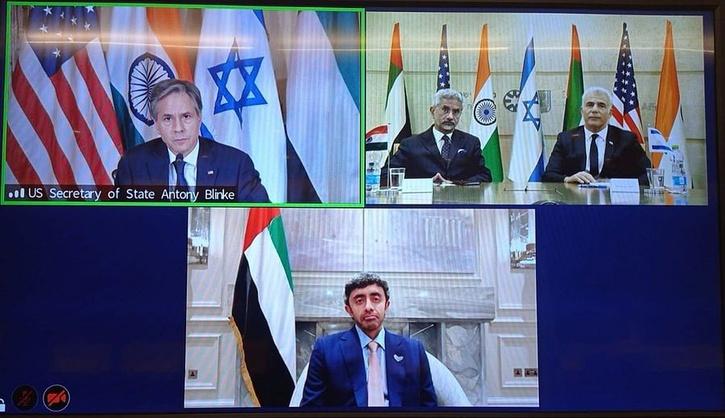
Foreign Ministers of India, Israel, UAE, US (clockwise) held a videoconference in October 2021 to launch a ‘Quad’ for West Asia
BY M. K. BHADRAKUMAR | INDIAN PUNCHLINE | JUNE 17, 2022
Indian diplomacy is descending from the sublime to the absurd. Such wild swings signal rank opportunism. These are extraordinary times when to be smart is equated as being opportunistic.
Hardly a week passed since PM Modi received the Iranian Foreign Minister Amir-Abdollahian in Delhi and expressed high hopes for India-Iran relationship. Now it transpires that India also forms part of the Gang of Four led by US President Joe Biden to “contain” Iran, from a new platform called I2U2 — the ‘I’ being India and Israel, and ‘U’ being US and UAE.
The I2U2 summit in mid-July between Biden, Israeli Prime Minister Bennett, Modi, and Emirati President Mohammed bin Zayed is destined to be a signpost in the geopolitics of West Asia. This new Quad first appeared on 18th October 2021 as an offspring of External Affairs Minister Jaishankar’s 5-day trip to Israel when from Tel Aviv he pulled a rabbit out of the hat, leaving the Indian public wonder what new grandstanding their impulsive minister was indulging in.
Between October and July this year, the I2U2 is getting an upgrade from foreign minister to prime minister/president level. On Tuesday, while announcing Biden’s first West Asian tour as president in mid-July, Washington has made some effort to rationalise Biden’s intentions in undertaking the planned visits to Israel and Saudi Arabia. A senior White House official said Biden intends:
- To demonstrate “the return of American leadership to bring countries together”;
- To create “new frameworks that aim to harness unique American capabilities to enable partners to work more closely together, which is essential to a more secure, prosperous, and stable Middle East region over the long term”;
- To build on the “resounding vote isolating Iran last week at the IAEA Board of Governors in Vienna where 30 countries condemned Iran’s lack of compliance with safeguard obligations” (where India, by the way, had abstained from supporting the US move);
- “To make sure we’re doing all we can to strengthen Israel’s security, prosperity, and integration into the larger region, both now and over the longer term”;
- To “focus on Israel’s increasing integration into the region” through new formats other than Abraham Accords, such as the “entirely new grouping of partners… what we call I2U2”!
So, that’s it. India will lend a hand to assist the US to refill the fizz that has gone out of the Abraham Accords. The hope that more countries would join Abraham Accords is withering away. Israel needs to be shown around to prospective suitors in its neighbourhood. I2U2 is, in essence, a dating agency. When it concerns Israel, the role of pandar comes naturally to the US presidents. But why should India squander away its soft power?
The US prestige and influence in West Asia has suffered a severe jolt during the Biden presidency. Not too long ago, Biden had called Saudi Arabia a “pariah” and pledged to make a horrible example of it on account of its human rights record. But now the shoe is on the other foot. Biden is craving for attention from Saudi Arabia. He had taken a second vow not to have any dealings with the powerful Saudi Crown Prince Mohammed bin Salman. But he is now beseeching the proud Prince for an audience. His recent phone calls weren’t answered.
The White House official explained Biden’s U-turn this way: “we have important interests interwoven with Saudi Arabia, and engagement is essential to protecting and advancing those interests on behalf of the American people.” In reality, Biden is swallowing pride and reviving the old matrix of US-Saudi relationship riveted on the petrodollar.
With poll rating falling abysmally low, Biden is desperate to tackle the rising inflation in the US economy, and the soaring price of oil is fuelling public disaffection. Saudi Arabia can help Biden salvage his standing.
However, it is the turn of the Saudis now to tell Americans there’s no free lunch. They want a written treaty to the effect that the US won’t ditch them when the crunch time comes or if the Kingdom or the ruling family feels insecure. Put differently, they want the Americans to act as their Praetorian guards as before.
In return, of course, Saudis will generate massive business for the US military-industrial complex, recycle their petrodollar to strengthen the Western banking system and create lucrative business for American companies — in short, help the beleaguered Western economies to pursue their post-pandemic recovery that is getting derailed by the war in Ukraine.
Indeed, the Saudis also have a rich history of lavishly greasing the palm of the American elite in the administration, the Pentagon and the Congress. In a nutshell, Biden as a seasoned operator in the Beltway knows which side of the bread is buttered.
But to rationalise his U-turn, an alibi is needed. So, Biden has decided to hoist “Iranian threat” as the leitmotif of the revamped US-Saudi security alliance. All signs are that Biden has acceded to the Saudi demand to scuttle the JCPOA and pile new sanctions against Iran, although the negotiations in Vienna are in home stretch and an agreement is within sight.
Biden’s West Asian agenda is completely US-centric, aimed at securing US business interests and shoring up its regional influence. Israel, of course, is a “holy cow”. Very soon Biden will begin fund-raising for his re-election bid in 2024, and Jewish donors are a generous lot.
However, the million dollar question remains: What has India got to do with Biden’s agenda? There are real risks, for the subplot here is that Biden hopes to nix India’s plans to revive its atrophied relationship with Iran. The recent visit of the Iranian foreign minister to India would have set alarm bells ringing in Washington and Tel Aviv.
Biden has a game plan for leaders like Modi who have a tendency to disregard the US diktat occasionally. Biden’s national security advisor Jake Sullivan spoke candidly just the other day:
“We’re playing the long game here. We are investing in a relationship (with India) that we are not going to judge by one issue even if that issue is quite consequential, but rather that we are going to judge over the fullness of time, as we try to work to convergence on the major strategic questions facing our two countries.
“On one of those questions — how to deal with the challenge posed by China — there’s much more convergence today, and that is important to US foreign policy. On the question of Russia, obviously, we have different historical perspectives, different muscle memories, but we feel confident that the dialogue we have going with India right now will bear fruit over time.”
Sullivan was discussing India’s time-tested relationship with Russia — how Washington hopes to erode and dissolve it all in good time.
Plainly put, Americans estimate that Indians have no “staying power,” or “big picture.” They probably estimate that the Indian government would grab the I2U2 platform to burnish its international image. But if there is any sanity left in the Indian foreign policy establishment, a subaltern role to serve US and Israeli interests cannot enhance India’s prestige in West Asia where, as it is, Modi government is perceived as an Islamophobic regime backed by religious fanatics.
In the life of individuals and nations alike, there are moments when one has to learn to say “no.” This self-serving, cynical overture from 78-year old Biden is one such moment. That’s why, despite zero chance of India turning down Biden’s invite, not to urge Modi to say “Nyet” to I2U2 will be a serious lapse.
South Block is underestimating the gravity of its folly. India never ever got entangled in the intra-regional issues in West Asia. It never acted as the surrogate of extra-regional powers, either. Most important, it never sought the “containment” of any regional state. That’s how it held its head high in the choppy waters of the Persian Gulf.
Iran blasts IAEA for repeating old allegations based on bogus Israeli claims
Press TV – June 17, 2022
Iran’s nuclear agency chief has again blasted the International Atomic Energy Agency (IAEA) for repeating old allegations against the country’s civilian nuclear program, based on bogus Israeli claims.
Mohammad Eslami, the head of the Atomic Energy Organization of Iran (AEOI), addressing a press conference in the central Iranian city of Natanz on Thursday, said the false allegations made by the IAEA are detrimental to ongoing negotiations to revive the 2015 nuclear deal.
“Now that the negotiations for [the US] return to the JCPOA [nuclear deal] are underway, the same old allegations are being repeated by citing fabricated claims made by the Zionist regime,” Eslami said.
He was referring to the UN nuclear agency’s mention of the so-called PMD (possible military dimensions) file on Iran’s nuclear program, insisting that such schemes will not help negotiations.
Eslami stressed that the reasoning behind signing the 2015 nuclear deal – officially referred to as the Joint Comprehensive Plan of Action (JCPOA) – was the closure of false Western allegations about possible military applications of Iran’s civilian nuclear program under the PMD file.
He said the PMD file was supposed to be closed as a key condition for reaching the accord and lifting anti-Iran sanctions — based on extensive inspections of Iran’s nuclear facilities and activities by the IAEA over the past two decades.
“We, in turn, accepted limitations on our nuclear activities and thereby yielded on our certain rights as well as accepted inspections on the condition that previous accusations would be permanently revoked and that we would be able to continue our activities under strict inspection and trust-building engagements,” the official added.
Eslami said Iran continues to operate under the IAEA regulations, while defending the removal of surveillance cameras functioning beyond the safeguards agreement, in reaction to the anti-Iran vote at the UN agency’s board of governors meeting recently.
Last week, Eslami slammed the IAEA for politicizing Iran’s peaceful nuclear program under Israeli pressure while disregarding Tehran’s extensive cooperation with the UN agency after the adoption of a resolution against Iran — drafted by the US and its European allies.
Eslami justified Tehran’s refusal to provide the IAEA with films of JCPOA’s monitoring cameras, stressing that the accord between Iran and the 5+1 countries will only exist as long as both sides remain committed to it.
“Today they want to return to JCPOA, but then raise the same old reasons for starting the nuclear talks. So we, in turn, did not grant them access to the film of the JCOPA cameras,” he stressed.
“Psychological operations, media campaigns and political pressures and controversies against Iran have never produced results in the past and will now remain ineffective as well because the PMD file was closed in the past, and reopening it will in no way help them,” he added.
He said Iran was in possession of “less than three percent of the world’s nuclear reserves” but still “more than 25 percent of [IAEA] inspections” were carried out in Iran, while the regimes that have waged wars against Iran have never allowed inspections of their nuclear facilities.
Iran’s foreign minister Hossein Amir-Abdollahian, in his remarks on Thursday, also blamed the US for IAEA’s recent anti-Tehran resolution, insisting that the move was aimed at mounting pressure on Tehran to give concessions in Vienna talks.
Iran’s top diplomat made the remarks in a Thursday phone call with his Iraqi counterpart, Fuad Hussein, during which the two sides also discussed bilateral issues and regional developments.
Negotiations have been underway in the Austrian capital since April last year to restore the 2015 Iran deal, which the former US President Donald Trump unilaterally abandoned in May 2018.
After quitting the deal, Trump introduced what he called the “maximum pressure” campaign to bring Iran to its knees, a policy that has failed miserably. The Joe Biden administration, despite its initial pledge to reverse Trump’s hard-nosed measures, has failed to deliver.
Iran has cited Washington’s indecisiveness as the reason behind the stalemate in talks, as many key issues remain unresolved, ranging from the removal of all post-JCPOA sanctions to the provision of guarantees by the American side that it will not leave the deal again.
AEOI spokesman Behrouz Kamalvandi on Wednesday advised IAEA director general Rafael Grossi to refrain from “complicating the situation” by making political statements after the UN agency called on Iran to resume talks before things get “much more problematic.”
“I amicably advise Rafael Grossi, the director-general of the [International Atomic Energy] Agency, to distance himself from making unprofessional statements of political color intended for media consumption,” Kamalvandi said.
“It is clear that if there is a technical issue, it should be presented professionally within the framework of the Agency’s duties and followed through its channels and the usual mechanisms of the Agency. Obviously, the arena for such interactions is not the media.”
Kamalvandi was referring to Grossi’s interview broadcast on June 12 on CNN, in which he made unusually menacing tropes against Iran.
Grossi sparked a controversy after he traveled to Israel and met the regime’s leaders late last month, just before the IAEA board of governors meeting.
The IAEA’s annual report, experts believe, was based on documents supplied by Israel about Iran’s nuclear program, which Tehran has rejected as fabricated.
Israel snubs Biden request to halt actions that could embarrass the US President
MEMO | June 16, 2022
US President, Joe Biden, sought assurance from Israel that no action is taken in the occupied West Bank and Jerusalem that could create tensions ahead of his controversial visit next month to the Apartheid State. Biden’s team made the request to the Israelis in what seems to be an attempt by the White House to avoid repeating the embarrassment Biden suffered over a decade ago when he visited the territory as Vice President under the administration of Barack Obama.
During the 2010 visit, Biden vowed unyielding American support for Israel’s security. The Israelis returned the favour by humiliating the then vice President with an announcement to build 1,600 new Jewish only houses, in illegal settlements, in occupied East Jerusalem. Biden condemned the move as “precisely the kind of step that undermines the trust we need right now.” A statement by the White House condemned “the substance and timing of the announcement.”
Barbara Leaf, the US Assistant Secretary of State for Near East Affairs, and her deputy for Israeli-Palestinian affairs, Hady Amr, are laying the groundwork for Biden’s visit scheduled for 13-15 July. Leaf asked Israel to halt actions like home demolitions, evictions of Palestinians and decisions on settlement building, as well as decrease Israeli military operations in the West Bank until after Biden’s visit, officials told Axios.
The Israelis have said they are not able to give such assurances, but they will, nevertheless, try their best. According to Axios, senior members of the Israeli team, including Defence Minister, Benny Gantz, told Leaf they will do their best, but explained the domestic political complexities of halting such actions, in addition to what they called the operational needs of the Israeli military in order to stop attacks.
With the trip coming fresh after the Israeli killing of Palestinian journalist, Shireen Abu Akleh, the Americans are fearful of a global outrage coinciding with Biden’s visit to the Apartheid State. “The Biden administration doesn’t want us to create any crisis in the West Bank … They want quiet and calm” for Biden’s visit, a senior Israeli official is reported saying.
Not only is the US team desperate to avoid embarrassment for Biden, they are also putting together a plan to show that the US President is capable of making progress. Israeli, Palestinian and US officials said Leaf, Amr and US ambassador to Israel, Tom Nides, tried to put together a package of tangible deliverables for the Palestinians to coincide with the Biden visit.
But they did not make significant progress on the package because there are not enough meaningful things the US can give and Israel is not willing to take any steps with political significance that will be enough for the Palestinians, the officials said, according to Axios.
“We need a political horizon. We want to hear President Biden say what his detailed position regarding the two state solution is,” PLO official and adviser to the Palestinian Authority (PA) President Mahmoud Abbas, Hussein Al-Sheikhal-Sheikh, is reported saying. “The US wants the visit to take place in a good atmosphere – different than the one now,” Al-Sheikhal-Sheikh added implying that Washington is more concerned about its image than it is about Israel’s daily human rights violations.
In a blow to the Biden team’s effort to portray the US President as the broker of peace, the PA and Israel rejected their proposal to meet. Palestinian officials stressed that such a meeting should include an Israeli commitment to the two-state solution based on the 1967 borders, otherwise, the meeting would be useless.
Iran vs. UAE – ‘Russia and Ukraine Gulf edition’ coming soon?
By Gavin O’Reilly | OffGuardian | June 15, 2022
Although receiving miniscule media coverage, Thursday’s announcement that Israel had deployed military infrastructure to the UAE and Bahrain in the shape of radar systems, ostensibly to counter an alleged missile threat from nearby Iran, should be a cause for concern amongst onlookers.
Coming in the same 24 hour period in which Israeli Prime Minister Naftali Bennett paid a surprise visit to the Emirates, and in which Israeli Forces bombed Damascus International Airport, the announcement that both Abu Dhabi and Manama had agreed to host Israeli military infrastructure should be seen as the first step towards current tensions between Tel Aviv and Tehran being placed on a possibly irreversible path towards conflict in the region.
Indeed, Israeli encirclement of Iran via Tel Aviv-allied Arab states possibly triggering a war between Tehran and both the UAE and Bahrain bears a stark similarity to the nine-year long build-up of provocations which would ultimately led Russia to launch a military intervention into neighbouring Ukraine in February of this year.
In November 2013, following the decision by then-Ukrainian President Viktor Yanukovych to suspend a trade deal with the EU in order to pursue closer ties with Russia, a CIA-orchestrated regime change operation, known as ‘Euromaidan’, would be launched in order to depose Yanukovych’s leadership and replace him with the pro-Western Petro Poroshenko – whose coalition government would contain rabid far-right sympathisers hostile to Moscow.
Indeed, such was the anti-Russian sentiment amongst the new US-backed Kiev government that the predominantly ethnic-Russian Donbass region in the east of the country would breakaway to form the independent republics of Donetsk and Luhansk in April 2014, following the previous month’s successful reunification of the Crimean Peninsula with the rest of Russia.
The establishment of these two pro-Russian Republics however, would spark a near eight-year long conflict in the eastern European country, in which Kiev would use neo-Nazi paramilitaries such as Azov Battalion and Right Sector to wage an ethnic cleansing campaign against the inhabitants of the Donbass.
In spite of Western media descriptions of ‘Russian aggression’ however, Moscow had sought to resolve the conflict in Donbass through peaceful mean via the Minsk Agreements – which would see both Republics granted a degree of autonomy whilst still remaining under the rule of Kiev.
With 14,000 dead in the Donbass conflict, NATO failing to honour a post-Cold War agreement not to expand eastwards, and the subsequent confirmation that US-funded labs were developing bioweapons in Ukraine however, Moscow’s hand was ultimately forced in February of this year when a Russian military intervention was launched into Ukraine in order to remove neo-Nazi elements from power and to destroy any military infrastructure that would ultimately have been used by NATO had Kiev gone on to become a member.
This is where the similarities with Iran and the neighbouring Gulf states of the UAE and Bahrain come into play, with both countries having formalised diplomatic links with Tel Aviv via the September 2020 US-brokered Abraham Accords.
Lauded as a ‘peace deal’ by the then-administration of Donald Trump, despite Israel, the UAE and Bahrain never actually being at war, the ‘normalisation’ agreements, coming eight months after the US had nearly triggered a new Gulf war with the assassination of Iranian Quds Force commander Qasem Soleimani in a drone strike, were seen by many geopolitical observers as a means to contain Iran within the region, a long-time foreign policy aim shared by both Washington and Tel Aviv.
Indeed, despite the relationship between Israel and both states initially starting off on a purely diplomatic basis, the announcement that Israeli radar systems are to be moved into both the UAE and Bahrain marks a dangerous step towards a scenario were Israeli military infrastructure is placed within striking distance of Iran – a situation that would likely lead to a major regional conflict, one that could reach far beyond the Persian Gulf.
Gavin O’Reilly is an Irish Republican activist from Dublin, Ireland, with a strong interest in the effects of British and US Imperialism; he was a writer for the American Herald Tribune from January 2018 up until their seizure by the FBI in 2021, with his work also appearing on The Duran, Al-Masdar, MintPress News, Global Research and SouthFront. He can be reached through Twitter and Facebook and supported on Patreon.
Nuclear-armed states spent $82.4bn on nukes in 2021, US topped list: Report
Press TV – June 15, 2022
The world’s nine nuclear-armed countries – led by the US – spent $82.4 billion upgrading their atomic arsenal in 2021, eight percent more than the previous year, an anti-nuke campaign group has unveiled.
The largest spender by far was the United States, which accounted for more than half the total expenditures on nuclear weapons – followed respectively by China, Russia, Britain, France, India, the Israeli regime, Pakistan and North Korea – the International Campaign to Abolish Nuclear Weapons (ICAN) stated in its annual report, titled “Squandered: 2021 Global Nuclear Weapons Spending.”
“Nuclear-armed states spent an obscene amount of money on illegal weapons of mass destruction in 2021, while the majority of the world’s countries support a global nuclear weapons ban,” the group said in the report, noting that the massive spending nevertheless failed to prevent a war in Europe.
“This spending failed to deter a war in Europe and squandered valuable resources that could be better used to address current security challenges, or cope with the outcome of a still raging global pandemic,” ICAN said. “This corrupt cycle of wasteful spending must be put to an end.”
The group said atomic arms producers had further spent millions of dollars on political lobbying efforts, saying that every $1 spent on lobbying had led to an average of $256 in new contracts involving nuclear weaponry.
“The exchange of money and influence, from countries to companies to lobbyists and think tanks, sustains and maintains a global arsenal of catastrophically destructive weapons,” it said.
The US spent $44.2 billion on atomic weaponry in 2021, followed by China’s $11.7 billion, Russia’s $8.6 billion, the UK’s $6.8 billion, and France’s $5.9 billion, according to the report. India led the more recent nuclear arms developers in expenditures on the mass-destructive weaponry, spending $2.3 billion, followed by the Israeli regime’s $1.2 billion, Pakistan’s $1.1 billion and North Korea’s $642 million.
The report came a week after US-led NATO alliance declared that it did not offer a guarantee to Russia that it would not deploy nuclear weapons on the territories of its two prospective new members, Finland and Sweden.
ICAN’s report further confirmed a statement released by the prominent Stockholm International Peace Research (SIPRI) a day earlier in which it had warned that all the nine nuclear-armed states were increasing or upgrading their arsenals, and that the risk of deployment of such weapons appeared higher now than at any time since the height of the Cold War.
While there is no official confirmation on the amount North Korea spends on nuclear weapons or its arsenal, SIPRI estimates that it possesses as many as 20 warheads.
The Israeli regime, along with India, Pakistan, and South Sudan have never joined the Treaty on the Non-Proliferation of Nuclear Weapons (NPT), an international treaty purportedly established to prevent the spread of nuclear weapons.
As of August 2016, 191 states have become parties to the NPT, though North Korea, which acceded in 1985, announced its withdrawal from the treaty in 2003, following detonation of nuclear devices in violation of core obligations.
Critics of the treaty insist, however, that the NPT cannot stop the proliferation of nuclear arms or the motivation to acquire them, arguing that the biggest possessors and developers of atomic weapons are leading members of the global accord. Officials of the treaty have been selective in enforcing nuclear disarmament, imposing sanctions on observant member nations, such as Iran, while ignoring certain atomic arms possessor and developers such as India, Pakistan, and the Israeli regime, which is widely believe to possess at least 300 nuclear warheads.
Featured Video

Houthis Don’t Have to Conquer Saudi Arabia to Make It Pay
or go to
Aletho News Archives – Video-Images
From the Archives
Newly Released FBI Docs Shed Light on Apparent Mossad Foreknowledge of 9/11 Attacks
By Whitney Webb | MintPress News | May 17, 2019
NEW YORK — For nearly two decades, one of the most overlooked and little known arrests made in the aftermath of the September 11 attacks was that of the so-called “High Fivers,” or the “Dancing Israelis.” However, new information released by the FBI on May 7 has brought fresh scrutiny to the possibility that the “Dancing Israelis,” at least two of whom were known Mossad operatives, had prior knowledge of the attacks on the World Trade Center. … continue
Blog Roll
 Aletho News
- MEP blasts ‘Euro-Gestapo’ for lecturing Russia on democracy
- Syria May Send Troops to Saudi Arabia Amid War with Ansar Allah
- UK whines about losing billions to ‘Putin tax’
- Baghaei to Rubio: Distorted narratives cannot erase US record of broken commitments
- Houthis Don’t Have to Conquer Saudi Arabia to Make It Pay
- MOE: Nearly 22,000 Students and Education Workers Killed
- Guterres in Islamabad: Genocide, cowardice, and the cage of Imran Khan
- Johnson, Marandi say Yemen holds upper hand over Saudi Arabia
- False flags won’t save aggressors, Iran FM spokesman says
- The Makkah Pact Enters Into Force: The End of American Dominance or Its New Form?
- If Americans Knew
- Report claimed Mark Levin used by Israeli government to influence Trump
- Over 2,000 Gazans have died awaiting medical evacuation amid Israel’s continued siege
- How a U.S. Diplomat Suppressed and Altered Reports Critical of Israel
- 5 Palestinians Die from Israeli Strikes in Gaza as Relentless Attacks Continue
- Report: Ceasefire Slows Killing but Leaves Devastation Intact
- Country Music Singer Zach Bryan Breaks Attendance Record at Robert Kraft’s Gillette Stadium While Wearing ‘Free Palestine’ Shirt for Second Night in a Row
- Three years of death and devastation: Israel’s war on Gaza in pictures
- Why Hamas believed the status quo was more dangerous than its 7 October gamble
- Debunking Israel’s latest list of ‘terrorist’ journalists in Gaza
- In Gaza, focus is on survival, “every step is a struggle” – Daily Update
- No Tricks Zone
- New Study: 50 Years Of The Most Aggressive ‘Net Zero’ Policies Can Only Affect The Global Climate By 0.03°C
- US September “Heat” Was No Record…Many Records Set Decades Ago
- Latest European Green Energy Debacle; Portugal’s Largest Flagship Solar Park Insolvent!
- Green Energy Debacle: German Expert Professor Fritz Vahrenholt Warns Of Severe Economic And Social Consequences
- Two More Paleo Reconstructions Affirm Meters-Higher Sea Levels Across Ireland, Brazil 7000-6000 Years Ago
- New Study: Earth And Venus Surface Warmth Largely Explained By Convection And Lapse Rate, Not CO2 Or Radiation
- 2025 Nature Paper Claiming Worsening Global Drought Gets RETRACTED …Heavily Flawed
- New Study: ‘Global Drought Shows No Detectable Recent Acceleration Under Climate Warming’
- Economic Masterminds: German Socialists Suggest Taxing Productivity Gains Stemming From Using AI
- The South China Sea Has Not Been Cooperating With The Climate Change Narrative

