The Fight to Save Lifta, the Last Remaining Palestinian Village
By Jessica Buxbaum | MintPress News | July 9, 2021
Yacoub Odeh is 81 years old but he can still remember his childhood in the Palestinian village of Lifta as if it were yesterday. Children playing together in the gardens, swimming in the pools and laying in the grass.
Today, Lifta remains as a frozen time capsule. While the residents were expelled during Israel’s 1948 ethnic cleansing campaign (Nakba), the ruins of their homes still stand. These ruins carved into the lush hillside are perceived as a symbol of the Palestinians’ right of return. This is the only town Israel did not demolish after the Nakba, but a government plan may soon change that.
In May, the Israel Lands Authority (ILA), the government agency in charge of managing public lands, issued a new tender for construction in Lifta. The development scheme, known as Plan 6036, seeks to build 259 housing units along with a commercial and business space and a luxury hotel on top of and around the existing houses. Daphna Golan-Agnon, a law professor at the Hebrew University of Jerusalem and part of the Save Lifta Coalition’s board, explained that while the homes may not be demolished, “the village will disappear behind walls of concrete needed to hold new construction.”
The bid was supposed to be held on July 4, but significant public opposition delayed it to July 29.

The ruins in Lifta, a Palestinian village ethnically cleased in 1948. Liebe Blekh | MintPress News
Attempts to demolish Lifta have been ongoing for years. The ILA first published a tender for Plan 6036 in 2010 after the Israeli state approved the construction plan for Lifta in 2006. A 2012 Jerusalem District Court ruling found Plan 6036 insufficient and requested amending it in accordance with a conservation survey on Lifta from the Israel Antiquities Authority (IAA).
The IAA survey was completed in 2017 and found that Plan 6036 could not be executed without making significant adjustments in order to preserve the ancient village. Plan 270b was drawn up to fit the survey’s findings but in 2017 the Local Planning and Building Committee of Jerusalem temporarily halted the initiative for further examination.
The recent ILA announcement was met with hundreds of letters to Jerusalem’s mayor rejecting the sale. When reached for comment, the Municipality of Jerusalem told MintPress News that it “wasn’t informed about the publication of this tender and didn’t approve it. The mayor of Jerusalem asked all the relevant authorities to reconsider the construction plan.” The Israel Lands Council, which operates the ILA, did not respond to a request for comment.
‘In one hour, we became refugees’
Lifta’s strategic location at the edge of Jerusalem has made it a prime target for land grabs. Acting as a suburb of Jerusalem, Lifta’s placement next to the Jerusalem-Jaffa Highway makes for an easy trip to the Mediterranean while still being tied to the city of Jerusalem.
Lifta, often referred to as the entrance to Jerusalem, was a wealthy, agricultural community supported by olive presses and flour mills and situated atop the Wadi al-Shami spring. Homes made of limestone were cut into the hillside and Lifta’s roads wended through the valley.
Prior to the 1948 Nakba, Zionist militias like the Haganah saw seizing Lifta as necessary to cement Jewish control over all of Palestine. According to the Haganah Historical Archives, “[s]ecuring the western exit of the city [of Jerusalem] entailed the eviction of Arabs.” Israeli historian Benny Morris said the Haganah fired the first shots in 1947, setting off the mass expulsion of Lifta’s 2,960 residents.
In December 1947, the Haganah killed a Palestinian business owner in Lifta. Later that month, one of Lifta’s two coffeehouses was ambushed with gunfire and grenades. The attack killed six and wounded seven. Two months into 1948, the Jewish Agency chairman and future first prime minister of Israel, David Ben-Gurion, boasted of the ethnic cleansing’s success, telling his political party members: “From your entry into Jerusalem through Lifta — Romema, through Mahane Yehuda, King George Street and Mea She’arim — there are no strangers. One hundred percent Jews.“
Odeh, head of the Lifta Cultural Heritage Protection Commission, was 8-years-old when Lifta came under siege by Zionist forces.
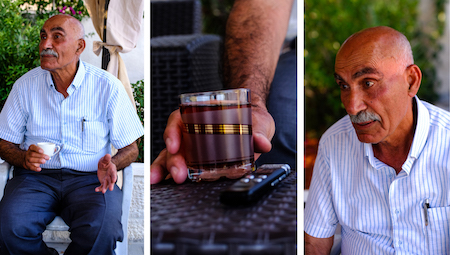
Yacoub Odeh, Nakba survivor and head of the Lifta Cultural Heritage Protection Commission. Liebe Blekh | MintPress News
“I remember one day my mother was preparing the fire to heat our room, and then [the Zionist miltiias] began to shoot. My brothers began to cry, ‘Mama, mama! They’re shooting us!’ My mom took us inside the room in the corner and under a table to protect us,” Odeh said, recalling two stories of Lifta — the town’s beauty and charm and then its tragic fall.
“There is the beautiful life and then began the miserable life because of the occupation.”
Toward the end of February 1948, Odeh’s father put him, his siblings and his mother into a truck heading to Ramallah to escape the violence in Lifta. Odeh’s father stayed behind to defend the village from the Zionist gangs.
“We were only wearing the clothing we had on because we are coming back tomorrow. We are coming back. Now we just want to be far from the shooting.” Odeh took a deep sigh and said, “In one hour, we became refugees.”
Today, 55 buildings out of approximately 450 remain in Lifta, including a club, mosque, cemetery and school, which now operates as a school for Israeli Jews. Liftawi refugees are estimated at around 30,000 and live in Jerusalem, the Occupied West Bank and the Diaspora. Most of the homes are empty, but a few are occupied by Israeli settlers. According to Zochrot, the Israeli nonprofit seeking to raise awareness of the Nakba, the “settlements of Mey Niftoach and Giv’at Sha’ul were built on village lands and now have become parts of the suburbs of Jerusalem.”
Saving Lifta
The Save Lifta Coalition orchestrated the campaign to the mayor and has been organizing since 2010 against Plan 6036. The organization spent five years working with scholars, activists, conservation specialists and higher education professionals to develop an alternative to 6036.
Their proposal aims to “expand the area of the national park and turn the village into a natural urban space for the adjacent neighborhoods,” while preserving Lifta’s cultural landscape.
The World Monuments Fund added Lifta to its list of endangered sites in 2018 and UNESCO added the village to its tentative list of world heritage sites.
‘Not something we can discuss now’
When asked about the plan’s responsibility regarding the right of return for Palestinians, Golan-Agnon said, “our plan is a plan to save Lifta as it is for the future generations to decide upon its fate.” She explained:
Many of us [in the coalition] do think there should be a right of return for Palestinians but we know it’s not something we can discuss now. So we say, it’s beautiful, keep it open, and then one day there can be a decision about what happens and who’s coming.
Dana Amawi’s grandmother grew up in Lifta and was expelled from the village in 1948. Now the family lives in Amman, Jordan. The 20-year-old said she was shaken to her core upon hearing the news of the sale. “Lifta symbolized a tiny, very small bit of hope that maybe we will be able to return to it,” Amawi told MintPress. “And now to think that other people might live in the house that I have the right to be in, it’s very sad.”

A Palestinian woman holds a partially eaten fig picked from a tree in Lifta. Liebe Blekh | MintPress News
Amawi said that her grandmother fell ill after learning of the auction. “She got sick. She had a fever and she was really, really sad because to her, this is where she grew up. This is where her earliest memories are and this is where she has the right to be,” Amawi said.
Stone houses like the one Odeh spent his early childhood in now crumble from neglect. The walls are sprayed with graffiti and piles of trash line the floors. On Shabbat (the Jewish sabbath), you’ll often find Israelis bathing in the spring’s waters.
Aseel AlBajeh, advocacy officer and legal researcher at the Palestinian human rights organization Al-Haq, visited Lifta in 2018. Her grandmother, who lives in Ramallah, is from Lifta. “It was a painful experience,” AlBajeh said of her time in Lifta. “I wasn’t sure if I wanted to come back to Lifta in this situation.”
‘You are here as a visitor’
During her visit, AlBajeh tried recalling her grandmother’s memories of a flourishing Lifta, but she said those stories were disrupted by the fact that she’s only in Lifta because of a permit she received from the Israeli government to enter 1948-occupied Palestine or modern-day Israel from the West Bank. “You are here as a visitor. It’s like it’s not a place where you belong, or this is what [the Israeli government] intends for refugees to feel like,” AlBajeh said. “Settlers were swimming in the spring of the village and they were blasting loud music, and it also disrupted my ability to even imagine Lifta as Palestinian.”

Israeli settlers in Lifta hold a middle finger to a group of Palestinian children. Blekh | MintPress News
To help her reclaim Lifta, AlBajeh took a small piece of the village’s remains during her visit. She collected a broken tile painted with traditional designs from one of the house’s floors, knowing this might be the last physical object she can have of Lifta.
“Lifta is a witness of what happened during the Nakba,” AlBajeh said, explaining:
We have this connection as Palestinians, and when we see the cactus plants, we connect this as evidence that displacement happened here. And if you go to Lifta, you’ll see the huge amount of cactus. So even if the houses remain and [Israel] tries to remove the cactus, it’s still painful… It’s not about the stones or about the trees. It’s about the whole identity of Lifta and the Palestinian history, which we still connect to. “
‘We were kings in our village’
Odeh’s memories paint Lifta as an idyllic place, an oasis carved into the steep slopes of Jerusalem where life was carefree and bountiful. “We were kings in our village,” Odeh said. “Everything we need, we had — a life so simple. We didn’t need cinema or computers, no, everything we needed came from our land.”
But the minute Odeh and his family became refugees, their resources became scarce. “At that time there were no charitable associations or agencies ready to help,” Odeh recalled. “You know what Nakba means? Nakba does not mean to destroy homes. No, Nakba means to destroy the life — economic life, social life, educational life, political life. They destroyed our life.”
Upon reminiscing about Lifta, Odeh said his dream is to go back home:
I miss my childhood. Palestinian children have lost their childhood life to play like children, to go to the theater, to concerts, to football. No, until now we have house demolitions, we have arrests, we have land confiscation and killings. Every day we have events like these — if not my family, my neighborhood.”
Documents reveal US pressure on ex-Yemeni regime to agree on normalizing ties with Israel
Press TV – July 12, 2021
The interior ministry of Yemen’s National Salvation Government has released a series of confidential documents detailing the United States pressure on the administration of former Yemeni dictator, Ali Abdullah Saleh, to normalize relations with Israel and lift the blockade on products made in the Israeli occupied territories.
According to the documents, the US embassy in Sana’a had asked then-Yemeni authorities to end the economic embargo on Israeli goods, and not to participate in any activities deemed harmful to the Tel Aviv regime, the official Yemeni news agency Saba reported.
The papers expose the level of Washington’s and Tel Aviv’s discontent and frustration with the blockade, and how US officials left no stone unturned to force former Yemeni officials into opening the Arab country’s market to Israeli businesses and their products.
The former US ambassador to Yemen, Thomas C. Krajeski, called on Saleh’s regime to lift sanctions on companies with first-, second- or third-degree ties to Israel, which was not turned down by the Yemeni side.
Then-Yemeni foreign minister, Abu Bakr al-Qirbi, later told the US ambassador that the so-called embargo on US and Israeli goods was not actually being enforced.
The documents go on to reveal that the US embassy urged the Yemeni foreign ministry not to dispatch representatives to an anti-Israel event at the University of Damascus in Syria.
Moreover, the American diplomat described Yemen’s removal of boycott of Israeli products as the fundamental prerequisite for the Arab state’s membership in the World Trade Organization, and its access to free trade and international investment.
Last month, Spokesman for Yemen’s Armed Forces Brigadier General Yahya Saree announced that Yemeni security forces had arrested a man involved in espionage activities on behalf of Israel’s Mossad intelligence agency.
Saree said in a tweet at the time that more details on the matter will be provided in a documentary entitled “The Spy of Mossad in Yemen.”
The documentary will shed light on part of Israel’s intervention in the country and “the plan to target Yemen militarily, and other secrets revealed for the first time,” the senior Yemeni military figure pointed out.
The developments come as earlier reports said that Israel and the United Arab Emirates have been working to establish a spy base on Yemen’s strategically-located island of Socotra.
The UAE has also been accused of constructing an air base on the Mayyun Island, situated off the Yemeni coast in the Bab el-Mandeb.
Both activities have drawn strong condemnation from the Yemeni government, which has described them as violation of Yemen’s sovereignty and international law, especially following the illegally-run tours to Socotra from Abu Dhabi, some of which included Israeli tourists.
“The transfer of tourists to the Socotra Island reveals the plans and programs of the occupying UAE, which are in line with the Zionist schemes to dominate Yemeni islands as well as the steps towards normalization with the regime,” a statement read back then.
Yemen’s popular Ansaullah resistance movement has previously threatened to attack Israel if it was “involved in any action against Yemeni people.”
The Israeli regime took the threats seriously, and deployed its Iron Dome and Patriot missile systems around the southern city of Eilat early this year.
Israeli forces demolish water pond in northern Jordan Valley
WAFA – July 12, 2021
JORDAN VALLEY – Israeli forces today demolished a water pond near Bardala village in the northern Jordan Valley, according to sources.
Moataz Bsharat, an activist, told WAFA that the Israeli forces escorted a bulldozer to the village, where the heavy machinery tore down the 250-cubic-meter pond, which was used for agricultural purposes and belonged to Samer Sawaftah. The pool was a donation from the Ministry of Agriculture.
Meanwhile, Israeli forces seized a caravan, east of Yatta, south of Hebron.
Coordinator of the Popular Anti-Wall and Settlement Committees, Rateb Al-Jabour, stated that the Israeli forces seized a caravan used to serve as a physical and mental health clinic in Zweidin area, east of Yatta.
The clinic used to provide medical support and treatment to more than 1,200 residents of the area.
Under international law, driving residents of an occupied territory from their homes is considered forcible transfer of protected persons, which constitutes a war crime. But residents of Palestinian communities in the Jordan Valley are no strangers to such disruptive Israeli policies.
The valley, which is a fertile strip of land running west along the Jordan River, is home to about 65,000 Palestinians and makes up approximately 30% of the West Bank.
Since 1967, when the Israeli army occupied the West Bank, Israel has transferred at least 11,000 of its Jewish citizens to the Jordan Valley. Some of the settlements in which they live were built almost entirely on private Palestinian land.
The Israel military has also designated about 46 percent of the Jordan Valley as a closed military zone since the beginning of the occupation in June 1967, and has been utilizing the pretext of military drills to forcefully displace Palestinian families living there as part of a policy of ethnic cleansing and stifling Palestinian development in the area.
Approximately 6,200 Palestinians live in 38 communities in places earmarked for military use and have had to obtain permission from the Israeli authorities to enter and live in their communities.
In violation of international law, the Israeli military not only temporarily displaces the communities on a regular basis, but also confiscates their farmlands, demolishes their homes and infrastructure from time to time.
Besides undergoing temporary displacement, the Palestinian families living there face a myriad restrictions on access to resources and services. Meanwhile, Israel exploits the resources of the area and generates profit by allocating generous tracts of land and water resources for the benefit of settlers.
Israeli politicians have made it clear on several occasions that the highly strategic Jordan Valley would remain under their control in any eventuality.
Top UN expert: “Israeli settlements do amount to a war crime”
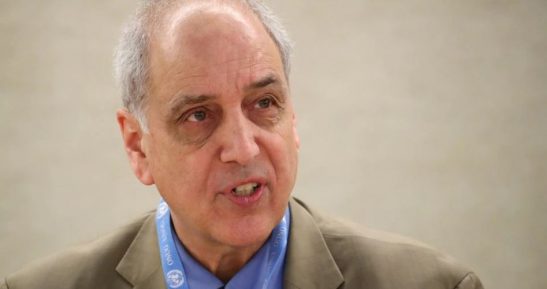
Palestine Information Center – July 10, 2021
GENEVA – A high-level UN human rights expert has called for Jewish settlements to be classified as a war crime, urging the international community to hold Israel accountable for a practice it has long considered illegal.
Presenting his latest report to the UN Human Rights Council in Geneva, Michael Lynk, the UN special rapporteur on the rights situation in the occupied Palestinian territories, said he examined whether the Israeli settlements were in violation of the absolute prohibition against “settler implantation” in the 1998 Rome Statute of the International Criminal Court and concluded that “the Israeli settlements do amount to a war crime.”
Talking about the human rights situation in Palestine recently, he said that in east Jerusalem, Jewish settler groups sought to evict Palestinian families from their homes, pointing out that under the Fourth Geneva Convention, forcible transfer of a protected population was prohibited, and the occupying power is forbidden from applying its own laws to the occupied territory.
“I submit to you that this finding compels the international community … to make it clear to Israel that its illegal occupation, and its defiance of international law and international opinion, can and will no longer be cost-free,” Lynk told the Geneva rights council.
Lynk said Israel’s demolition of Bedouin tent dwellings in a village in the West Bank on Wednesday left residents without food or water in the heat of the Jordan Valley, calling it “both unlawful and heartless”.
“Progressive seizure of Palestinian lands together with the protection of the settlements is a further consolidation of Israel’s de facto annexation of the West Bank,” he said.
There are nearly 300 settlements in east Jerusalem and the West Bank, with more than 680,000 Jewish settlers, Lynk noted.
The settlements have become “the engine of Israel’s 54-year-old occupation, the longest in the modern world”, he added.
He stressed the need for international action, not just words, in order to resolve the situation in Palestine.
“As long as the international community criticizes Israel without seeking consequences and accountability, it is magical thinking to believe that the 54-year-old occupation will end and the Palestinians will finally realize their right to self-determination,” he said.
A few days ago, the Israeli occupation army blocked the delivery of aid to Palestinians whose homes were demolished in the northern Jordan Valley and asked a UN aid team to leave the area, UN humanitarians said on Thursday.
The razing of 27 residential and animal structures and water tanks on Wednesday in the Palestinian herding community of Humsa al-Bqai’a was the first of its kind since February, the UN Office for the Coordination of Humanitarian Affairs (OCHA) said.
The Israeli army’s civil administration and forces also confiscated, among other things, food, milk for children, clothes, hygiene materials and toys during the demolition campaign.
The action involved 11 homes for about 70 people, including 36 children, the office said. Animals had no fodder and water as well.
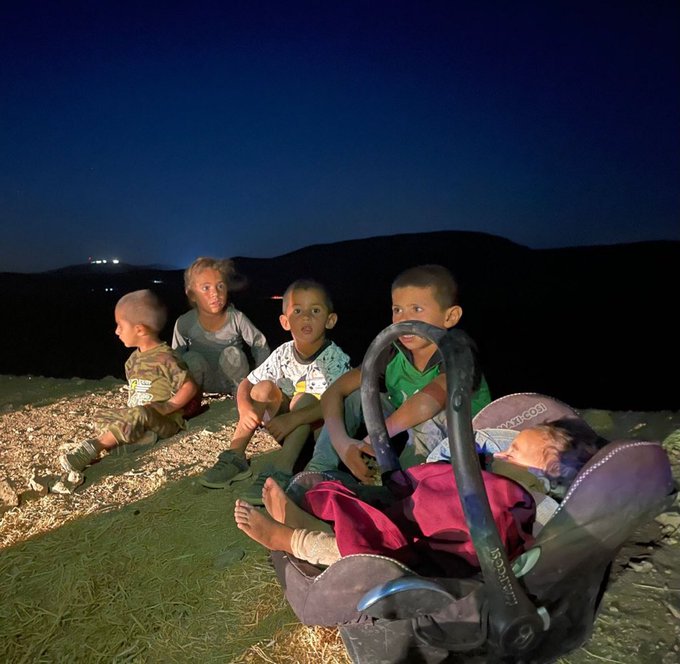
Representatives of OCHA and humanitarian partners visited the community Wednesday evening, but the army on Thursday asked them to leave.
The community rejected a proposal from the Israeli army to move it to a different location, OCHA said, adding that the army moved the residents’ belongings to the proposed site.
Humanitarians said 11 structures donated as humanitarian aid in February following similar demolitions were destroyed or seized by the army during Wednesday’s raid.
“The repeated destruction of their homes and property, including assistance provided by the humanitarian community is having a devastating economic, social and traumatic impact on the community, particularly children,” OCHA warned.
UN secretary-general Antonio Guterres voiced his deep concern over the demolition of property in the herding community, Stephane Dujarric, the chief spokesman for Guterres, stated.
“He reiterates his call on the Israeli authorities to cease demolitions and seizures of Palestinian property in the occupied West Bank,” Dujarric added in a regular briefing.
“Such actions are contrary to international law and could undermine the chances for the establishment of a viable, contiguous Palestinian state,” he read a statement issued by Guterres.
Ex-Mossad chief becomes head of new Saudi-backed SoftBank office: Report
Press TV – July 10, 2021
Yossi Cohen, the former chief of Israeli spy agency Mossad, is becoming head of the new office of the Saudi-backed conglomerate SoftBank in Israel, a report says.
Citing unnamed sources, the Israeli business newspaper Globes reported on Friday that SoftBank, a Japanese multinational conglomerate holding company led by Masayoshi Son, was appointing Cohen to head its new office in the occupied Palestinian territories.
Back in May 2017, Tokyo-based SoftBank and the Public Investment Fund of Saudi Arabia (PIF), which is the Arab kingdom’s main sovereign wealth fund, jointly created the Softbank Vision Fund. The joint venture is the world’s largest technology-focused private equity fund with a capital of $93 billion.
Having invested huge sums into companies such as Uber, Alibaba, and TikTok, SoftBank is seen as the world’s leading technology fund.
This is the second investment giant within three months to open a representative office in Israel, after Blackstone.
According to the daily, although Cohen does not have a background in investment, he is a well-known and popular figure in Israel, capable of connecting to Israeli entrepreneurs and opening doors for them in any company, government, or public authority in any territory.
His duties would include managing SoftBank’s activity in the occupied Palestinian territories and looking for investments.
Cohen has served as the head of Mossad since January 2016. He has reportedly served as former Israeli Prime Minister Benjamin Netanyahu’s special envoy for various tasks. Netanyahu reportedly sees him as his preferred successor.
Cohen played an important role in the Israeli regime’s normalization deals with a number of Arab states. He traveled to the United Arab Emirates and Bahrain.
The ex-Mossad chief reportedly joined Netanyahu on a 2020 visit to Saudi Arabia for talks with Crown Prince Mohammed Bin Salman.
Israel’s Flu/Covid Mass-Jabbing Problem
By Stephen Lendman | July 6, 2021
Israel is one of the world’s most extensively jabbed nation for flu/covid protection — not gotten, despite false claims otherwise.
Through mid-year, over 80% of its adult population got one or more flu/covid jabs, nearly 60% overall.
Last April while still prime minister, Netanyahu called Israeli mass-jabbing “enormously successful (sic)” — ignoring its harm to health, its deadly consequences to show up in the months and years ahead.
Israel’s foreign ministry spokesman Lior Haiat defied reality by calling flu/covid mass-jabbing “the solution” to the viral illness (sic).
Yet late last month, outbreaks began increasing — in summer when decreasing should be more likely.
On June 27, head of Israel’s health ministry, Chezy Levy, resigned.
Roni Numa replaced him as a Bennett regime flu/covid czar.
Nachman Ash was appointed new health ministry head.
What Netanyahu falsely called the world’s first country to “beat” flu/covid has a renewed viral illness outbreak problem on its hands.
Bennett falsely attributed increased outbreaks to what he called a “national weak point (at) Ben-Gurion airport,” adding:
“(I)n coordination with the transportation minister, the health minister and the interior minister, we decided to appoint a special director to handle transitions and prevent the entry of this virus and future variants and viruses from around the world into Israel.”
Everyone arriving in Israel from abroad who’s not jabbed or recovered from flu/covid is now quarantined until set free.
According to Bennett, his regime’s flu/covid policy is “maximum protection for Israeli citizens (sic), with minimum harm (sic) to routine and the economy in Israel; masks instead of restrictions (sic), (and toxic Pfizer mRNA jabs) instead of lockdowns.”
The above ignores that up to half of flu/covid outbreaks occurred in Israelis already jabbed.
On Tuesday, Israel’s health ministry reported a 50% increase in Monday outbreaks from the previous day, the highest number since March 30.
A 42% total of outbreaks occurred in flu/covid jabbed Israelis.
Falsely blaming them on the highly publicized Delta scariant ignores that it’s no more hazardous than other strains.
Yet Israel’s health ministry attributed over 90% of new outbreaks to what it falsely called the “highly contagious delta variant (sic).”
The health ministry also admitted that the efficacy of Pfizer’s mRNA drug is far removed from what Netanyahu called “enormously successful (sic).”
High-outbreak areas in the country are now labeled red, orange or yellow zones.
Despite mass-jabbing responsibility for increased outbreaks, the Bennett regime’s health ministry may call for a third one and new restrictions.
Flu/covid season runs from October through May when outbreaks are highest.
With large numbers of people jabbed for protection from the viral illness not gotten in the West, Israel and elsewhere, perhaps record numbers of outbreaks will occur from early this fall until year year’s warm weather season.
A Final Comment
According to the pro-Western, pro-toxic flu/covid mass-jabbing, pro-inflicting maximum harm on maximum numbers of people WHO, it’s too soon to resume normal activities (sic).
On Monday, the agency’s so-called top emergency expert Mike Ryan warned about increased outbreaks ahead.
“It’s not like this thing has gone away. It isn’t over,” he said — perhaps with the Delta scariant in mind that’s all about mind-manipulating refusniks to get theirs.
Indeed, flu/covid outbreaks are never over. They’ve showed up annually for time immemorial.
They will ahead during the 2021/22 flu-renamed covid season and others to follow.
Israel Attempts to Forcibly Relocate Bedouin Community
teleSUR | July 9, 2021
On Friday, the United Nations Office for the Coordination of Humanitarian Affairs. In the occupied Palestinian territory (OCHA oPt) territory warned that Israel is attempting to forcibly transfer the inhabitants of the Bedouin village of Humsa Al-Bqaia in the occupied West Bank.
The massive demolition and confiscation of property by Israeli forces in the Palestinian community of Humsa Al-Bqaia is “disturbing,” UN Resident Coordinator for the Occupied Palestinian Territory Lynn Hastings said, adding that “forcing this or any other community to move to an alternative site poses a serious risk of forced relocation.
Although Israel tries to justify the relocation by claiming that the area is designated for military training, “such measures by an occupying power are illegal under international law,” she pointed out and demanded “an immediate halt to all demolitions of Palestinian homes and possessions”.
Hastings also called on Israel to allow humanitarian agencies and NGOs access to the area to provide “shelter, food, and water” to the villagers so that “they can rebuild their homes in their current location and remain there in safety and dignity.
On Wednesday, the Israeli military forcibly entered the Palestinian village to demolish homes. During this operation, the Israelis blocked access to humanitarian personnel after destroying or confiscating tents, water tanks, and food and fodder supplies.
OCHA oPt indicated that the Israeli incursion left 42 people homeless, including 24 children. The Israeli humanitarian NGO B’tselem reported that nine tents, four residential huts, and 17 agricultural facilities were destroyed. The occupation forces also confiscated the Palestinians’ personal belongings and transported them to the area where they wish to relocate the people.
The inhabitants of Humsa Al-Bqaia became homeless in November 2020, when their homes were demolished by the Israeli army. However, many of them did not leave the territory and re-erected temporary dwellings.
Located in the Jordan Valley near the Jordanian border, Humsa Al-Bqaia is one of 38 Bedouin villages that are dedicated to livestock farming and whose dwellings are usually tents made of metal and other rudimentary materials.
Israel frequently demolishes these structures on the grounds that they lack permits. The UN and several international organizations, however, have denounced that it is impossible for Palestinians to obtain such permits.
In Germany, burning the Israeli flag is a problem, but killing Palestinians isn’t
By Motasem A Dalloul | MEMO | July 6, 2021
Israeli Deputy Foreign Minister Idan Roll met with the German Ambassador, Susanne Wasum-Rainer, on Monday along with visiting German parliamentarians. Roll thanked the German guests for their country’s strong support for Israel during its major military offensive against the Palestinians in Gaza from 10-21 May.
Germany’s unlimited support and cooperation make it a special friend of Israel. Among EU members it is the second-biggest supplier of weapons to the occupation state. Between 2009 and 2020, 24 per cent of Israel’s arms imports came from Germany.
When Israel treats international law, human rights, democratic principles, and liberal beliefs with contempt, Germany automatically takes its side, even when the result is the killing of innocent children and women. During the latest Israeli offensive, Germany supported Israel’s “right to defend itself” although it was killing civilians and destroying civilian buildings and infrastructure. The fact that an occupying state has no right to claim “self-defence” against the people under occupation was ignored by the Germans.
On 12 May, a German government spokesman, Steffen Seibert, refused to condemn Israel’s killing of 14 Palestinian children. He referred to the legitimate Palestinian resistance as “terrorist attacks” and that the resistance groups had to stop their action against Israel so that “people do not die”.
Seibert ignored the Israeli warplanes pounding the besieged Gaza Strip. He ignored the Israeli tanks firing indiscriminately towards densely-populated areas across Gaza. He ignored weeks of Israeli harassment and attacks on Palestinians worshipping in Al-Aqsa Mosque throughout Ramadan, and the residents of Jerusalem facing attacks by illegal settlers, which prompted the resistance groups to act. He ignored all of that.
On the same day, the deputy spokesman of the German Foreign Ministry, Christofer Burger, angered journalists when he said that the Palestinians had no right to self-defence. His claim that this right is only guaranteed by international law to sovereign states and Palestinians are not a state was palpable nonsense. All people living under occupation, collectively and individually, have the right to defend themselves and resist military occupation. Israel’s occupation of Palestine is a military occupation.
On day ten of the Israeli offensive, when the occupation state had killed 66 children, 40 women, and 16 elderly people out of 266 Palestinians killed in total, German Foreign Minister Heiko Maas insisted that, “Germany stands with Israel and its right to defend itself.” He even visited Israel to prove that his country’s support was not limited to words. “I came to Israel to show solidarity and support Israel. Israel’s security and that of the Jewish residents here are not negotiable.”
![German Foreign Minister Heiko Maas in Berlin, Germany on June 23, 2021 [Abdulhamid Hoşbaş/Anadolu Agency]](https://i2.wp.com/www.middleeastmonitor.com/wp-content/uploads/2021/06/20210623_2_48889287_66351096.jpg?resize=500%2C331&quality=85&strip=all&zoom=1&ssl=1)
German FM Heiko Maas, June 23, 2021 [Abdulhamid Hoşbaş/Anadolu Agency]
Two days earlier, German Chancellor Angela Merkel called the then Israeli Prime Minister Benjamin Netanyahu, and “sharply condemned the continued rocket attacks from Gaza on Israel and assured the prime minister of the German government’s solidarity.” She showed great interest in Israel’s security and safety of its people and condemned only the legitimate Palestinian resistance.
Germany’s verbal support for Israeli brutality and aggression against the Palestinians was backed up by officials who claimed that peaceful protests during which Palestinian flags were flown and anti-Israel slogans were chanted were “anti-Semitic”. Calls for Israel to be held accountable for its breaches of international law were described as “hate speech”.
According to Seibert, “Anyone who uses such protests to shout out their hatred of Jews is abusing the right to protest [in Germany].” He described the pro-Palestine protests which raised awareness about the ongoing Israeli crimes as “anti-Semitic rallies”, and stressed that they “will not be tolerated by our democracy.”
During a debate in the German parliament during the Israeli offensive on Gaza, Maas condemned the pro-Palestine demonstrations and called for a violent crackdown on them. “There shouldn’t be one centimetre of space for anti-Semitism on our streets. Never again.”
Germany has since banned the Hamas flag in the country in response to pro-Palestine demonstrations. “We do not want the flags of terrorist organisations to be waved on German soil,” Thorsten Frei, a lawmaker for Merkel’s CDU, told Die Welt. A ban, he added, would send “a clear signal to our Jewish citizens.”
President Frank-Walter Steinmeier told Israeli daily Haaretz that Germany believes that the International Criminal Court (ICC) has no jurisdiction to investigate Israeli war crimes in the occupied Palestinian territories because of the “absence of the Palestinian state”. Germany is not only unconcerned about Israeli crimes against the Palestinians, but also does not even want those crimes to be investigated. Palestine was, of course, granted the status of a “non-member observer state” by the UN in November 2012, a move described as “de facto recognition of the sovereign state of Palestine”.
Writing in Open Democracy, activist and sociologist Inna Michaeli said that Germans are against the entirely peaceful Boycott, Divestment and Sanctions (BDS) movement which seeks to end the Israeli occupation. Moreover, apparently, they do not like to hear anyone accusing Israel of killing children, despite this being “a description of horrendous reality — one in three Palestinians that Israel kills in Gaza are children.”
She asked rhetorically: “What should people chant when Israel is killing children? How can the victims express their rage and sorrow, how can they mourn their children who are killed again and again by Israel?”
Even the German mainstream media ignores Israeli brutality against the Palestinians. “Much of the mainstream media coverage of Nakba Day demonstrations did not even mention nor explain to the readers what the Nakba is, and its continuation in the form of ethnic cleansing and denial of Palestinians’ right to return,” Michaeli pointed out. “Berlin, with the largest Palestinian population in Europe, is home to people whose family members have been murdered by Israel in recent days. These protests are often framed as ‘anti’ Israel, but the fact that they are primarily ‘for’ Palestinian life is omitted.”
Omri Boehm is an Israeli philosophy lecturer in New York. “Whenever one attempts to raise this subject, one is immediately accused of anti-Semitism,” he noted. “It is impossible to simply state the facts. For example, that within Israel’s borders, three million Palestinians live under brutal military law without being recognised as Israeli citizens. The Germans do not want to see this.”
When pro-Palestine protesters burned an Israeli flag in Germany, Interior Minister Horst Seehofer described the act as “anti-Semitic” and said that Germany would crack down hard on anyone found to be spreading “anti-Semitic hatred” because “We will not tolerate Israeli flags burning on German soil.”
Commenting on this, Michaeli said: “Israeli flags matter, Palestinian lives do not. When people, politicians, and the media, care more about the burning of national flags than the burning of homes and neighbourhoods and the killing of entire families, they should really have a hard look at themselves.”
German support for Israel goes back to the early 1950s when reparations were paid to the state as the “heir” to the Holocaust victims who had no known surviving family. Billions of German marks and euros have been handed over in the intervening decades, helping to build Israel as a state. The fact that this is largely to the detriment of the people of occupied Palestine has, shamefully, been lost on successive German governments. Those parliamentarians who met Israeli officials earlier this week need to be educated about international laws and conventions, and the reality of Israel’s brutal military occupation which they and their colleagues in Berlin endorse so willingly.
Where the Abraham Accords are (and aren’t) going
Israel has improved its relationship with the UAE, but what about other Gulf countries?
By Giorgio Cafiero and Kristian Coates Ulrichsen | Responsible Statecraft | July 7, 2021
On June 29, Israel’s Foreign Minister Yair Lapid arrived in the United Arab Emirates, marking the first official trip by any chief Israeli diplomat to the Gulf country. Former Prime Minister Benjamin Netanyahu had wanted to visit Abu Dhabi while in office, so the timing of the visit so soon after the new Netanyahu-less government was sworn in was notable.
While Lapid was in the UAE, Israel inaugurated an embassy in Abu Dhabi and a consulate in Dubai, representing an important milestone in Emirati-Israeli relations nine months after the Abraham Accords were signed in Washington last September.
Lapid’s trip highlighted how the bilateral relationship has overcome challenges posed by the recent 11-day Gaza-Israel war. Although Emirati officialdom publicly condemned Israel’s conduct in East Jerusalem and the West Bank, and called on both Hamas and Israel to halt attacks (which notably did not single out Israel) in May, the UAE is not cooling its relations with Israel. To the contrary, Abu Dhabi is keen to find ways to build on the Abraham Accords and enhance its ties with the Israelis notwithstanding the unresolved question of Palestine.
While with Sheikh Abdullah bin Zayed Al Nahyan, the UAE’s Minister of Foreign Affairs and International Cooperation, Lapid signed an economic and commercial cooperation agreement. The two also co-authored a highly optimistic article in Abu Dhabi’s The National newspaper where they outlined their outlook for the Emirati-Israeli relationship as well as for “peace” across the greater region: “Peace isn’t an agreement you sign – it’s a way of life. The ceremonies we held this week aren’t the end of the road. They are just the beginning.” (Technically, the UAE-Israel accord is not a “peace” agreement because the UAE, which gained its independence in 1971, has never been at war with Israel.)
Beyond the rhetoric and the symbolism, what are this relationship’s substantive elements and what does this partnership truly mean in practice nine months after the accord’s signing?
Bilateral trade since September 2020 has reached around $675 million. The two countries have signed a long list of trade and cooperation agreements. Media, education, and tourism are all promising sectors that are starting to take off. It is significant that amid the global pandemic, which greatly harmed the UAE and all other Gulf Cooperation Council states’ tourism sectors, 200,000 Israeli tourists visited the UAE with most flying to Dubai.
Technology may be the area where the Emiratis have the highest hopes for this relationship. The potential benefits of formalized ties with the region’s most technologically innovative and advanced country are clear to the UAE. This is particularly true with respect to cybersecurity and to the potential acquisition of offensive cyber-capabilities by the UAE. As Sheikh Abdullah stated, the Emiratis are pleased that the Israelis will participate in Expo2020, an event to be held later this year in Dubai that will bring 192 countries together through technology, innovation, science, and art.
Nonetheless, the Emirati-Israeli trade relationship has thus far not lived up to its expectations. There has also been a degree of disappointment among those who were expecting the partnership to take off much faster following then-President Donald Trump’s announcement of the Abraham Accords.
Some anticipated deals have not taken place. For example, there was the suspension of the 50 percent sale of Beitar Jerusalem (a Jerusalem-based professional football club with an anti-Arab image) to a member of Abu Dhabi’s royal family in Abu Dhabi, Sheikh Hamad bin Khalifa Al Nahyan. In addition, an Israeli energy firm that planned to sell its share of a gas field to Mubadala Petroleum (a subsidiary of the UAE’s sovereign wealth fund, Mubadala Investment Company) missed a deadline for completing the agreement, although, according to the UAE’s side, the deal remains set to proceed. Time will tell how many and how soon major government-to-government and private sector transactions will indeed take place.
Abraham Accords, the Gulf, and Africa
Despite the political risks for any Arab state that normalizes relations with Israel, the UAE has vocally stood by the Abraham Accords, which, in the words of its ambassador to Washington, Yousef al-Otaiba, “move the region beyond a troubled legacy of hostility and strife to a more hopeful destiny of peace and prosperity.” But Abu Dhabi at this point does not appear to be leading any trend within the Gulf region toward the formalization of relations with Israel.
In Kuwait, Oman, Qatar, and Saudi Arabia, the 2002 Arab Peace Initiative remains popular and the only viable means of reaching a fair and lasting settlement between Israel and the Palestinians. This is true at the highest levels of government and among these countries’ general publics. But Tel Aviv almost certainly will not under any foreseeable circumstances agree to the API’s terms, which require Israel to return to the 1949-1967 borders and permit the Palestinians to have an independent state with East Jerusalem as its capital in exchange for opening diplomatic relations. Therefore, among GCC states, the UAE, along with Bahrain, will probably stand alone on the normalization question for some time.
As the GCC state with the most pro-Palestinian stance, Kuwait is most strongly opposed to normalization and unlikely to change its position. Oman maintains pragmatic, albeit unofficial, relations with Israel as highlighted by Lapid’s phone call with Oman’s foreign minister Badr al Busaidi on June 24, plus Netanyahu and other Israeli prime ministers’ visits to Muscat since the 1990s. But Oman remains committed to the API, as affirmed by Muscat’s chief diplomat at an Atlantic Council event held on February 11.
Qatar has a special role to play in Gaza that would be jeopardized by “abandoning” the Palestinians in exchange for normalization with Israel. Through Al Jazeera, which focuses heavily on the plight of Palestinians, and the tendency of Qatari diplomats to advocate on behalf of Palestinians in international forums, Doha’s regional and global image has much to do with its ability to take firm positions on certain international issues that contribute to the image of a pro-human rights foreign policy.
Finally, Saudi Arabia, due to its special role across the wider Islamic world, its authorship of the API, and its own internal dynamics that are fundamentally different than the smaller GCC states, will likely continue seeing normalization of relations with Israel as too risky, at least so long as King Salman remains on the throne.
Within this context, Israel will likely have its next diplomatic openings in the Islamic world not in the Persian Gulf, but instead in impoverished parts of sub-Saharan Africa where countries such as Niger, Mali, and Mauritania could have their economic interests advanced by joining the Abraham Accords. It will be important to see what actions Abu Dhabi might take to incentivize these African countries, many of which are major recipients of Emirati aid, to formalize ties with Israel. Enhanced Emirati assistance in exchange for normalization with Israel was already evident in Sudan’s decision to normalize ties with Israel, and the UAE may take a similar approach with these and other predominantly Muslim and poor African states.
Featured Video

When Israel Is Mighty
or go to
Aletho News Archives – Video-Images
From the Archives
US murdering 1 million Iraqis is democracy, Iran giving yogurt to Iraq is “domination”
By Ali Salaam | American Herald Tribune | July 31, 2017
The New York Times, owned by the Zionist Jewish supremacist Ochs-Sulzberger family, has no problem with Iraqi suffering as long as Iran is not the one behind it.
The Iraq War was a genocide of the Iraqi people by Zionist supremacists in the Bush administration. Over 1 million innocent people were killed based on a lie. American soldiers died in an Israeli war and now an average of 22 soldiers commit suicide every day because their consciences cannot cope with the fact they committed crimes in an illegal war that served no purpose other than to benefit Israel, not America.
Benjamin Netanyahu, Prime Minister of the Zionist regime, once said “We are benefiting from one thing, and that is the attack on the Twin Towers and Pentagon, and the American struggle in Iraq.”
Paul Wolfowitz had his sights on Iraq since his time in the first Bush administration. Former Israeli official and Bush administration official Richard Perle had his eyes on Iraq since at least his authorship of the Clean Break white paper. The Zionist regime had their eyes on Iraq since the 1980s when strategist Oded Yinon wrote his white paper in support of dividing the Arab-Muslim world along ethnic and sectarian lines. The global Zionist lobby has had their eyes on Iraq since Theodor Herzl stated that Eretz Israel’s true borders go from the Nile River in Egypt to the Euphrates River in Iraq. … continue
Blog Roll
 Aletho News
- When Will This White House Madness End?
- Huckabee aide goes to ‘unusual lengths’ to portray ‘Israel’ positively
- Trump Announces Diesel Supply Deal With Putin Following Phone Call
- MEP blasts ‘Euro-Gestapo’ for lecturing Russia on democracy
- Syria May Send Troops to Saudi Arabia Amid War with Ansar Allah
- UK whines about losing billions to ‘Putin tax’
- Baghaei to Rubio: Distorted narratives cannot erase US record of broken commitments
- Houthis Don’t Have to Conquer Saudi Arabia to Make It Pay
- MOE: Nearly 22,000 Students and Education Workers Killed
- Guterres in Islamabad: Genocide, cowardice, and the cage of Imran Khan
- If Americans Knew
- Gaza ceasefire exists in name only, say more than 100 organizations
- Nearly 2 Million in Gaza Need Urgent Shelter Assistance as Winter Looms: IOM Chief Warns
- Suppressing Palestinian resistance: US charity under fire for AI monitoring of Gaza classrooms
- Thousands Are Held in Israeli Torture Camps. This Is What Happens Inside
- Israel puts Gaza’s sick, injured, newborn in peril – Daily Update
- Report claimed Mark Levin used by Israeli government to influence Trump
- Over 2,000 Gazans have died awaiting medical evacuation amid Israel’s continued siege
- How a U.S. Diplomat Suppressed and Altered Reports Critical of Israel
- 5 Palestinians Die from Israeli Strikes in Gaza as Relentless Attacks Continue
- Report: Ceasefire Slows Killing but Leaves Devastation Intact
- No Tricks Zone
- New Study: 50 Years Of The Most Aggressive ‘Net Zero’ Policies Can Only Affect The Global Climate By 0.03°C
- US September “Heat” Was No Record…Many Records Set Decades Ago
- Latest European Green Energy Debacle; Portugal’s Largest Flagship Solar Park Insolvent!
- Green Energy Debacle: German Expert Professor Fritz Vahrenholt Warns Of Severe Economic And Social Consequences
- Two More Paleo Reconstructions Affirm Meters-Higher Sea Levels Across Ireland, Brazil 7000-6000 Years Ago
- New Study: Earth And Venus Surface Warmth Largely Explained By Convection And Lapse Rate, Not CO2 Or Radiation
- 2025 Nature Paper Claiming Worsening Global Drought Gets RETRACTED …Heavily Flawed
- New Study: ‘Global Drought Shows No Detectable Recent Acceleration Under Climate Warming’
- Economic Masterminds: German Socialists Suggest Taxing Productivity Gains Stemming From Using AI
- The South China Sea Has Not Been Cooperating With The Climate Change Narrative

