Israel Has “The Most Moral Army in the World”?
The creepy French “intellectual” Bernard-Henri Levy gets it wrong

By Philip Giraldi • Unz Review • July 30, 2019
Eight days ago eleven Palestinian buildings containing seventy family apartments located in the illegally Israeli occupied East Jerusalem village of Wadi al-Hummus were demolished in a military-led operation by more than 1,000 Israeli soldiers, policemen and municipal workers using bulldozers, backhoes and explosives. Residents who resisted were beaten by the soldiers, kicked down flights of stairs and even shot at close range with rubber bullets. The soldiers were recorded laughing and celebrating as they did their dirty work. Occupants who did not resist and who held their hands up in surrender were also not spared the rod, as were also foreign observers who were present to add their voices to those who were protesting the outrage. The injuries sustained by some of the victims have been photographed and are available online.
Twelve Palestinians and four British observers were injured badly enough to be hospitalized. The British reported that they were “stamped on, dragged by the hair, strangled with a scarf and pepper sprayed by Israeli border police.” One who was hospitalized described how Israeli soldiers dragged him by his feet, lifting him up, and kicking him in the stomach, while one soldier stamped on his head four times “at full force” before standing on his head and pulling his hair. Another suffered a fractured rib after “[the policeman] then stamped on my throat and others started punching my torso. It was a sadistic display of violence…”
Yet another foreign observer was dragged out of the house, “… her hands were crushed so badly that she suffered a fractured knuckle on her left hand, and her right hand suffered severe tissue damage ‘which will be permanently misshapen unless she gets cosmetic surgery.’”
Edmond Sichrovsky, an Austrian activist of Jewish origin, who was in one of the houses, described how Israeli forces broke the door down, first dragging out the Palestinians, “knocking the grandfather to the floor in front of his crying and screaming grandchildren.” Cell phones were forcibly removed to eliminate any picture taking or filming before soldiers began attacking him and four other activists. “I was repeatedly kicked and kneed, which left a bloody nose and multiple cuts, as well breaking my glasses from a knee in the face. Once outside, they slammed me against a car while shouting verbal insults at me and women activists, calling them whores.”
The buildings were destroyed due to claims that they were too close to Israel’s illegal separation wall, with the Benjamin Netanyahu government citing “security concerns.” The families living in the buildings that did not have either the time or ability to remove their furniture and other personal items will now have to comb through the rubble to see what they can recover, if the Israeli soldiers will even allow them that grace. They will also have to find new places to live as the Israelis have made no provision for housing them.
The homes were legally constructed on land that is nominally controlled by the Palestinian Authority (PA), a fine point that the Israeli authorities chose to consider irrelevant. When the Palestinians object to such arbitrary behavior, they are sent to Israeli military courts that always endorse the government decisions. And the Netanyahu regime of kleptocrats has made clear that it does not recognize international law about treatment of people who are under occupation.
The buildings were destroyed a few days after rampaging Israeli settlers on the West Bank continued their campaign to destroy the livelihoods of their Palestinian neighbors. Hundreds of olive trees were burned on the West Bank on July 10th, a deliberate attempt to drive the Arabs from their land by making it impossible to farm, strangling the local economy. Olive trees are particularly targeted as they are a cash crop and the trees take many years to mature and produce. The Israeli settlers have also been known to kill livestock, poison water, destroy crops, burn down buildings, and beat and even kill the Palestinian farmers and their families. And in Hebron the settlers have surrounded the old town, dumping excrement and other refuse on the Palestinians shops below that are still trying to do business. It should surprise no one that the Jewish settlers who engage in the violence are rarely caught, even less often tried, and almost never punished. The ghastly Benjamin Netanyahu’s government has declared that what was once Palestine is now a country called Israel and it is only for Jews. Killing a Palestinian by a Jewish Israeli is considered de facto to be a misdemeanor.
And meanwhile the carnage continues in Gaza, with the death toll of unarmed demonstrating Palestinians now at more than 200 plus several thousand wounded, many of them children and medical workers. Recently, orders to the Israeli army snipers direct them to shoot demonstrators in the ankles so they will be crippled for life. This is what it takes to be the “most moral army” in the world as defined by French fop pseudo intellectual Bernard-Henri Levy, demonstrating only yet again that the tribe knows how to stick together. But the war crimes carried out by Israel also require unlimited support from the United States, both in money and political cover to allow it all to happen. Israel would not be killing Palestinians with such impunity if it were not for the green light from Donald Trump and his settler-loving mock Ambassador David Friedman backed up by a congress that seems to cherish Israelis more than Americans.
How is it that the horrific treatment of the Palestinians by the Israelis as aided and abetted by the worldwide Jewish diaspora is not featured in headlines all over the world? Why isn’t my government with its highly suspect but nevertheless declared agenda of bringing democracy and freedom to all saying anything about the Palestinians? Or condemning Israeli behavior as it once did regarding South Africa?
Can one even imagine what The New York Times and Washington Post would be headlining if American soldiers and police were evicting and beating the residents of a housing project in a U.S. city? But somehow Israel always gets a pass, no matter what it does and politicians from both parties delight in describing how the “special relationship” with the Jewish state is cast in stone.
In the wake of the home demolitions, Washington yet again shielded Israel from a United Nations censure for its behavior by casting a Security Council veto. The Jewish state is consequently never held accountable for its bad behavior, and let us be completely honest, Israel is the ultimate rogue regime, dedicated to turning its neighbors into smoking ruins with U.S. assistance. It is evil manifest and it is not in America’s own interest to continue to be dragged down that road.
Philip M. Giraldi, Ph.D., is Executive Director of the Council for the National Interest, a 501(c)3 tax deductible educational foundation (Federal ID Number #52-1739023) that seeks a more interests-based U.S. foreign policy in the Middle East. Website is councilforthenationalinterest.org, address is P.O. Box 2157, Purcellville VA 20134 and its email is inform@cnionline.org
Russia wades into oily waters of East Mediterranean
By M. K. BHADRAKUMAR | Indian Punchline | July 29, 2019
The cold war brewing in the East Mediterranean over the vast hydrocarbon reserves in the region is already ‘multipolar’. Egypt, Israel, Cyprus, Greece, the United States and Turkey figure as the main protagonists. Then, in mid-July, the European Union grew out of its observer status and joined as active participant. Furthermore, as July ends, Russia is tiptoeing toward the theatre — not quite an actor yet but willing to be one if a role becomes available.
Last weekend, in a seemingly innocuous remark, the Russian Energy Minister Alexander Novak dropped the hint that Russian oil companies can roll out exploration in offshore Mediterranean energy fields in cooperation with Turkey. As he put it, “Russian companies have successfully implemented energy projects in the Mediterranean Sea. For example, Rosneft is working at Zohr [gas field in Egypt]. If these projects benefit all the parties from the commercial point of view, Russian companies can decide on cooperation with Turkey in the East Mediterranean.”
Novak saw it as a business proposition but is certainly savvy enough to know, being an influential Kremlin politician, that the geopolitics of oil and gas, be it in the Arctic or the Black Sea or the Persian Gulf and East Mediterranean, is integral to his country’s foreign policy. What made Novak’s remark particularly significant is not only that he singled out Turkey as Russia’s potential partner in East Mediterranean, but also that he made the remark in an exclusive interview with the Turkish official news agency Anadolu, which the Russian state news agency Tass promptly featured as a news report.
Russia’s locus standii is not in doubt, being an energy superpower and Turkey’s number one energy supplier. Surely, a partnership in the East Mediterranean can only further consolidate the entente between Russia and Turkey, which only recently acquired a new template of defence cooperation following Turkey’s bold decision to press ahead with the purchase of the Russian S-400 missile defence system despite the threat of US sanctions and notwithstanding Turkey’s NATO membership.
Interestingly, Novak’s remark comes at a time when the multi-vectored regional rivalries in the East Mediterranean pit Turkey against Cyprus (which is backed by Greece and Israel and enjoys US support.) The fierce rivalries spawned by the discovery of massive offshore hydrocarbon reserves in the East Mediterranean by Israel and Cyprus are hopelessly intertwined today with Turkey’s traditionally adversarial relationships with Greece and Cyprus.
The unresolved Cyprus question lurks just below the surface, dating back to 1974 when the then military junta in Athens orchestrated a coup’ d’etat in Nicosia in a bid to unify the two countries and Turkey subsequently intervened in Cyrus militarily and occupied one-third of the island in the north inhabited by the ethnic Turkish Cypriots, which has since become a de facto Turkish protectorate.
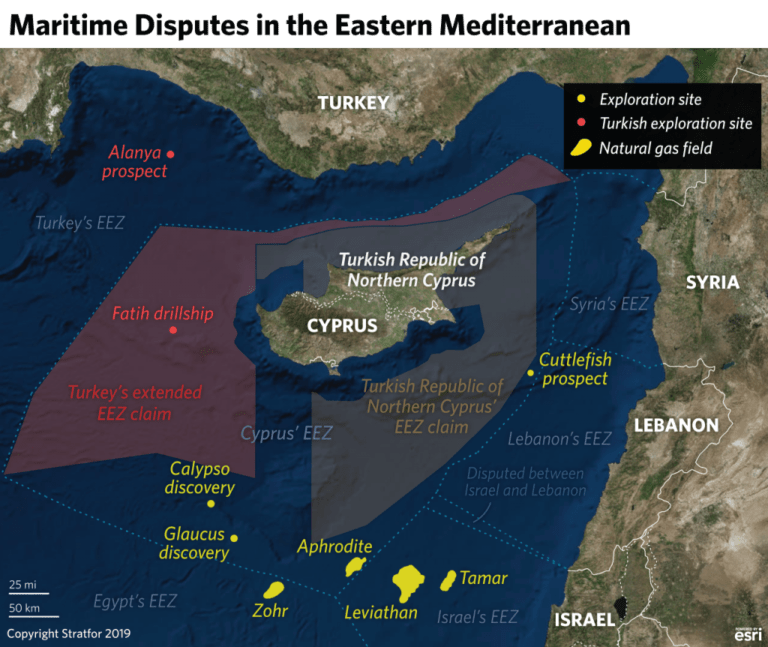
In sum, Turkey has a very serious territorial dispute with Cyprus and will not brook the latter’s unilateral moves to appropriate the massive hydrocarbon reserves in East Mediterranean in waters Ankara regards either belonging to the Turkish Cypriots as well or as falling within its exclusive economic zone (EEZ).
Suffice to say, a Cyprus settlement is the core issue here, but the Greek Cypriot opinion is disinterested in re-unification of the island. (The EU granted Cyprus full membership shortly after the ethnic Greek population voted against reunification, rejecting the settlement plan of then UN secretary general Kofi Annan.)
What complicates matters further is that Turkey has poor relations with Israel, which has banded together with Greece and Cyprus in a sort of tripartite alliance against Turkey lately (with Washington’s blessings.) The US resents Turkey’s independent foreign policies and American oil majors (ExxonMobil) are involved in prospecting / exploiting East Mediterranean’s oil and gas in the seas claimed by Cyprus.
ExxonMobil announced in February that it has made the world’s third-biggest natural gas discovery in two years off the coast of Cyprus in the Eastern Mediterranean at the Glaucus-1 well. The region is already known for some of the world’s largest such discoveries. The discovery could represent a natural gas resource of approximately 5 trillion to 8 trillion cubic feet.
Besides, the US geo-strategic objective is to market the energy supplies from East Mediterranean in Europe, which would erode Russia’s dominance as energy supplier while also enabling Israel to tap a big source of income.
Turkey is pretty much isolated today in the East Mediterranean rivalries, as Ankara intensifies its own exploration for natural gas in the region. After Cyprus after began its exploration (ExxonMobil) with the US ships providing security, Ankara despatched two drill ships to the seas and Turkey’s Naval Forces Command is providing “full and continuous protection” to the drilling vessels, with the help of unmanned aerial vehicles, watercraft, assault boats and submarines.
Turkey held a big naval exercise in in the eastern Mediterranean, Aegean and Black Sea in May asserting its rights not only in Cyprus, but also in Greece. Turkey claims its continental shelf not only takes in portions of Cyprus’s EEZ, but extends westwards to Crete in Greece’s EEZ. This in effect means that Turkey seeks to share the coastal energy resources of both Cyprus and Greece.
A time-bomb is ticking. Washington has repeatedly warned Turkey. In mid-July the EU foreign ministers also came down hard on Ankara, calling its actions “illegal”, punishing it by reducing EU’s assistance to Turkey for 2020 by €145.8 million, inviting European Investment Bank to review its lending activities in Turkey (€358.8 million last year) and threatening to “continue to work on options for targeted measures” (read sanctions.)
Turkey has defiantly rejected the EU intervention, but will feel its isolation mitigated if Russia stretches a helping hand at this juncture. The point is, the storm clouds gathering in East Mediterranean could have serious geopolitical ramifications. In a developing scenario of the West versus Turkey, which is already there, Moscow will be making a profound statement if Russian oil companies join hands with Turkey.
Any such Turkish-Russian collaboration will be a game changer for regional politics — in Syria, Levant, the Black Sea, etc. It coincides with a moment when the Pentagon just caricatured Russia in a strategy report last month as a “revitalised malign actor”, which, in league with China, “frequently jointly oppose US-sponsored measures at the United Nations Security Council” and works for a multipolar world order in which the US is “weaker and less influential.”
Indeed, any Turkish-Russian cooperation in the East Mediterranean will dovetail with global politics. Read a Xinhua report from the weekend titled China, Russia vow to strengthen cooperation, promote world stability.
Study finds 50-year history of anti-Palestinian bias in mainstream news reporting
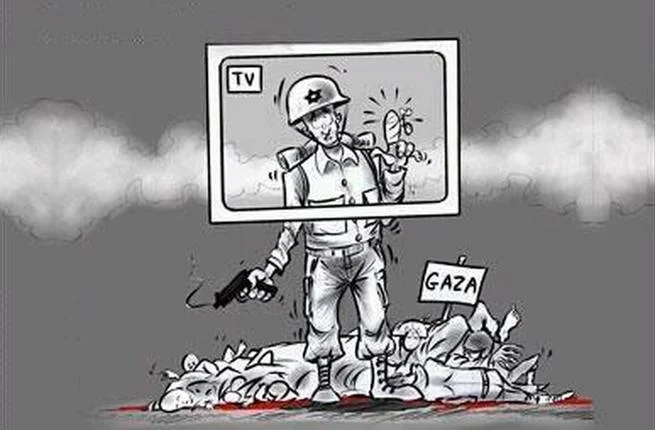
CONTEXT matters, and CONTEXT is often missing in news reports about Israel-Palestine
By Kathryn Shihadah – If Americans Knew – January 19, 2019
A recent media study based on analysis of 50 years of data found that major U.S. newspapers have provided consistently skewed, pro-Israel reporting on Israel-Palestine.
The study, conducted by 416Labs, a Toronto-based consulting and research firm, is the largest of its kind.
Using computer analysis, researchers evaluated the headlines of five influential U.S. newspapers: the Chicago Tribune, Los Angeles Times, New York Times, Washington Post, and Wall Street Journal from 1967 to 2017.
The study period begins in June 1967, the date when Israel began its military occupation of the West Bank and Gaza Strip – now officially termed the Occupied Palestinian Territories – following its Six Day War against Jordan, Egypt and Syria.
Methodology involved the use of Natural Language Processing (NLP), a type of computer analysis that sifts through large amounts of natural language data and investigates the vocabulary. NLP tabulated the most commonly used words and word pairs, as well as the positive or negative sentiment associated with the headlines.
Using NLP to analyze 100,000 headlines, the study revealed that the coverage favored Israel in the “sheer quantity of stories covered,” by presenting Palestinian-centric stories from a more negative point of view, as well as by grossly under-representing the Palestinian narrative, and by omitting or downplaying “key topics that help to identify the conflict in all its significance.”
Four times more headlines mentioned Israel than Palestine
The Fifty Years of Occupation study reveals a clear media bias first in the quantity of headlines: over the half-century period in question, headlines mentioned Israel 4 times more frequently than Palestine.
The study revealed other discrepancies in coverage of Israel and Palestine/Palestinians as well.
Sentiment
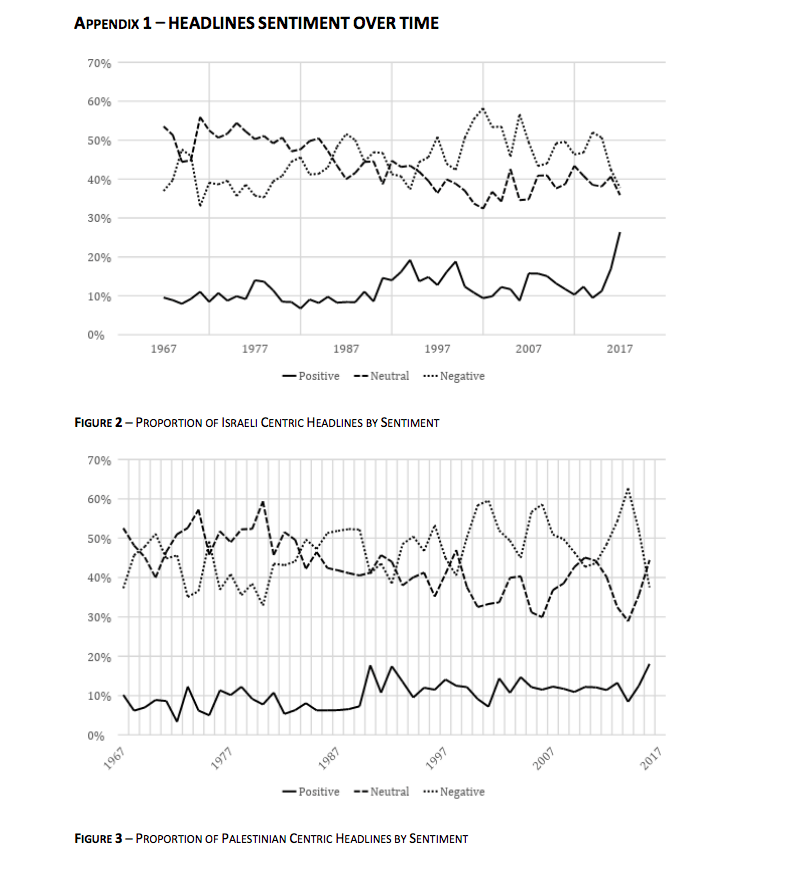
For all 5 newspapers studied, Israel-centric headlines were on average more positive than the Palestinian-centric headlines.
Sentiment analysis measures “the degree to which ideological loyalty colors analysis.”
In order to measure sentiment, the study employed a “dictionary” of words classified as either positive or negative; each headline was scored based on its use of these words.
The report explains that journalistic standards require news stories to be “neutral, objective, and derived from facts,” but the reports on Israel-Palestine “exhibit some form of institutionalized ideological posturing and reflect a slant.” [See graphs below post]
Under-representation of the Palestinian voice
The study also found Palestinians marginalized as sources of news and information.
A simple case in point: The fact-checking organization Pundit Fact examined CNN guests during a segment of the 2014 Israeli incursion into Gaza, Operation Protective Edge. Pundit Fact reported that during this time, 20 Israeli officials were interviewed, compared to only 4 Palestinians, although Palestinians were overwhelmingly victims of the incursion with 2,251 deaths vs. 73 Israeli deaths.
The study’s data reveal what it calls “the privileging of Israeli voices and, invariably, Israeli narratives”: the phrases “Israel Says” and “Says Israel” occurred at a higher frequency than any other bigram (2-word phrase) throughout the 50 years of headlines – in fact, at a rate 250% higher than “Palestinian Says” and similar phrases. This indicates that not only are Israeli perspectives covered more often, but Palestinians rarely have an opportunity to defend or explain their actions.
The report explains the significance of such asymmetry:
This imbalance matters, as official Israeli government policy is effectively made an intrinsic part of the discussion of the conflict, while the views of Palestinians living under occupation are subordinated to the margins.
Sins of omission and de-emphasis
The analysis turned up yet another significant problem with the newspapers’ coverage: failure to report, or to report adequately, on important aspects of the Palestine-Israel conflict.
The study found several critical topics that the 5 newspapers failed to cover adequately, resulting in reader misperceptions.
Peace process?
One misperception revolves around the alleged existence of an ongoing “peace process.”
The study points out the consistent use of bigrams such as “peace talks,” in spite of the fact that since 1993, peace talks have been essentially nonexistent. And,
A hallmark of the conflict has been the perception that there is an ongoing peace process which, from time to time, breaks down, thereby delaying resolution of the conflict…the dispute is effectively portrayed as being one between two equal warring sides, not one where one group is an occupier and the other the occupied.
Occupation
The researchers emphasize the fact that as the occupation of the West Bank (and de facto occupation of Gaza) drags on past 50 years, the brutality of the Israeli occupation is becoming normalized and its illegality forgotten.
They draw this conclusion from their analysis of the unigram “occupation,” which has appeared in headlines less and less frequently, dropping by 85% in Israel-centric headlines, and by 65% in Palestinian-centric headlines over the 50-year period.
Gaza
The blockade of Gaza, and the economic hardships of Gazans under the blockade, were mentioned in Palestine-centric headlines just 30 and 63 times respectively, in the 11 years since the blockade began.
In Covering Gaza: is the mainstream media discourse changing on Palestine-Israel?, Tamara Kharroub of the Arab Center in Washington DC censures mainstream media coverage of the Great Return March – a nonviolent demonstration by Palestinian Gazans for justice and the end of the blockade – for failing to report the names of Gazan civilians killed by Israeli snipers, “in stark contrast to the usual reporting on Israeli victims, in which their pictures, lives, and grieving families are repeatedly shown and discussed.”
… and more
As another example, Palestinian refugees – still waiting to be repatriated according to UN Resolution 242 of 1949 – have been forgotten as a group: the words “Palestine Refugee(s)” in headlines has declined by 93% over the last 50 years, reflecting a decline in concern from media.
The study reveals similar underreporting on topics including the illegality of Israeli settlements and Palestinians’ designation of East Jerusalem as the future capital of the future Palestinian state.
According to Siham Rashid, formerly of the Palestinian Counseling Center, these accumulated flaws characterize the Israel-Palestine issue as
a conflict revolving around security and terrorism, with Israel being the victim…So, for many people, the conflict is understood as a conflict of land and borders between two peoples who have equal claims, not as a conflict between an oppressed and oppressor and colonized and colonizer.
International consensus
As cited by the researchers, Marda Dunsky’s 2008 book, Pens and Swords: How the American Mainstream Media Report the Israeli-Palestinian Conflict, analyzed US media over a 4-year period. One of her most significant findings was the lack of coverage of the international consensus on important issues, for example the almost-universal conclusions that Israeli settlements are illegal, and that Palestinian refugees should be allowed to return to their homes.
Greg Shupak’s The Wrong Story: Palestine, Israel, and the Media offers an example from Operation Protective Edge, the Israeli aggression of 2014 into Gaza. He points out that the blockade of Gaza, a key antecedent to the violence, was mentioned only once in the many New York Times editorials on the conflict published just before and during the war.
Shupak’s work shows how NYT “frequently omits important details that would better contextualize the conflict.”
In More Bad News From Israel, Glasgow University researchers Greg Philo and Mike Berry examined British mainstream media coverage of Israel-Palestine. In a study of BBC coverage, the lack of adequate context resulted in
the failure to convey adequately the disparity in the Israeli and Palestinian experience, reflecting the fact that one side is in control and the other lives under occupation…BBC output does not consistently give a full and fair account of the conflict. In some ways the picture is incomplete and, in that sense, misleading.
Alison Weir of If Americans Knew has published extensive studies of American media coverage of Israel-Palestine which reveal “daily reporting [that is] profoundly skewed” and a “pervasive pattern of distortion” in which “[t]he favored population was the Israeli one.”
If Americans Knew has conducted six major studies and one shorter study on coverage of Israel-Palestine news and found that media had reported on Israeli deaths at far greater rates than they reported on Palestinian deaths. The studies also revealed the palpable pro-Israel bias, under-representation of the Palestinian voice and the omission or downplaying of critical topics.
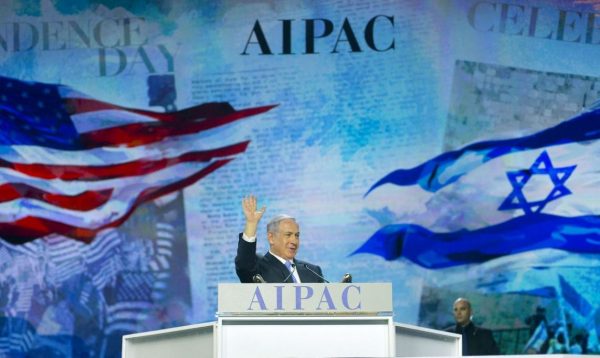
The American Israel Public Affairs Committee (AIPAC) is a lobbying group that advocates pro-Israel policies to the Congress and Executive Branch of the United States.
Causation?
The Canadian researchers found a “systemic problem in coverage,” but did not study the causation. Nevertheless, they excluded the possibility of “deliberate planned bias,” attributing the biased coverage to “the U.S. media’s affinity to broadly align and support their government’s foreign policy objectives.”
Some other researchers, however, report a wider range of factors, many connected to the pro-Israel lobby in the United States. For example, Alison Weir discovered deep links between US media and Israel (e.g. here, here, here, and here). Mearsheimer and Walt reported on the power of pro-Israel pressure in their book The Israel Lobby; Paul Findley in his book They Dare to Speak Out, and others report a wider range of factors, many connected to the pro-Israel lobby in the United States. In many cases, pressure from pro-Israel groups in the Israel lobby, contributed significantly to the consistent slant in mainstream media.
Conclusion
As the authors point out:
Whether online, television, or print, the mainstream media serves to provide most Americans with their daily news. How the media frames the news and presents it to viewers can profoundly shape their perception of current events.
Yet numerous analysts, across time and region, have established that this media consistently skews the news when it comes to Israel-Palestine. This results in nations and their governments upholding Israeli priorities rather than those of their own people, and perpetuating injustice toward Palestinians.
RELATED READING:
Why we urgently need alternative news sources
Mainstream media repeatedly shows its Israel bias
Keeping an eye on the curators of the news
Correcting a few distortions about Gaza
Associated Press Double Standard in Israel-Palestine Reporting
Media selectively report on Jerusalem unrest; the clock keeps ticking…
Vancouver City Council Won’t Set Precedent in Endorsing IHRA Definition
By Marion Kawas | Palestine Chronicle | July 28, 2019
The City of Vancouver, Canada might seem to be an odd place for a battle over the International Holocaust Remembrance Alliance (IHRA) definition of Anti-Semitism. But that is exactly what happened in the last week, and it all concluded with at least a temporary victory for free speech, human rights and common sense.
At the end of June, the federal government of Canada endorsed the IHRA definition as part of its new official “Anti-Racism Strategy” announced by minister Pablo Rodriguez. This was a unilateral move by the government which did not involve a vote in the House of Commons. The Israeli lobby, however, in their ecstatic gloating over the endorsement, made it clear they would be pushing to have the IHRA definition adopted at all levels of government, including provincial and municipal.
Which brings us to the Vancouver City Council, where one Non-Partisan Association (NPA) councilor introduced a motion to be heard at the last meeting before summer break. The motion contained the standard reasoning that one has come to expect from the Israeli lobby promoting the IHRA definition and concluded with adoption of the definition and its examples; it also explicitly instructed staff to share the definition with various city departments including the Police Department, School Board, Parks Board and the Public Library for “review and consideration as an additional practical tool.”
What the outcome would be of this “additional practical tool”, especially by the Police Department, one could only speculate. The history of what has transpired so far in other countries regarding the IHRA definition is extremely troubling and was called out a year ago by over 40 Jewish groups in an open letter. They noted that the definition is “intentionally worded such that it equates legitimate criticisms of Israel and advocacy for Palestinian rights with antisemitism, as a means to suppress the former.”
The IHRA definition includes several parts, two vaguely worded sentences that are accompanied by 11 illustrative examples; it is the examples and the way they have been applied that are the focus of most of the critique, including from one of the original authors of the document. As noted by Independent Jewish Voices Canada, the initial sentences fail to even clearly “identify antisemitism as a form of prejudice or racism, instead calling antisemitism ‘a certain perception of Jews, which may be expressed as hatred toward Jews’.” They add that “7 of the 11 examples refer not just to Jewish people, but to the state of Israel, a deliberate rhetorical strategy to label criticism of Israel and of Zionism antisemitic.”
In fact, some of these examples have been included almost verbatim in the justification for the anti-BDS bills that have been passed or are winding their way through several U.S. states, including Florida.
Passing this motion would have set a dangerous precedent as being the first municipal council in Canada to endorse the IHRA definition. Vancouver, however, has a long and proud tradition of being both anti-racist and defending free speech and Palestinian rights. A popular campaign was immediately launched to tell Vancouver City Council why this motion should not be adopted – letter writing, social media and articles in local papers all happened.
People from both within the Jewish community and other sectors were adamant in stating that this definition had more to do with squashing criticism of Israel than it did with contributing to the fight against racism.
The Palestinian community also pointed out that the definition actually promotes anti-Palestinian racism, as it severely limits and defines what the Palestinian narrative can be. The Vancouver & District Labour Council (VDLC), the BC Civil Liberties Association (BCCLA) and civic parties like the Coalition of Progressive Electors (COPE) all took the position that adopting the IHRA definition would be divisive and harmful.
It seems City Council heard the message. In a vote of 6-5 (the 5 were all NPA councilors), the Council decided to not proceed with the motion and instead referred it to committee for recommendations on how to combat ALL forms of racism.
“THAT Council refer this motion to the Racial and Ethno-Cultural Equity Advisory Committee to provide recommendations to Council on how the City of Vancouver can increase action to combat all forms of racism and hatred, including Antisemitism.”
Although referral to committee is often the bureaucratic tactic to not deal with issues, in this case, the instructions in the referral made it more meaningful. And most importantly, Vancouver City Council refused to set a precedent as the first Canadian city to endorse the IHRA definition.
Activists know that the struggle will continue at the committee level but the small amount of time they had to prepare for the council vote allowed them to educate many people on the dangers of the IHRA definition; they feel confident that more time is only to their advantage.
Canada’s main Israel lobby group, Centre for Israel and Jewish Affairs (CIJA), was not happy with the outcome. They had invested heavily in promoting the motion and one of their officials stated he would be at City Hall when it was introduced.
They issued a statement expressing their “disappointment”, claiming that this was a “setback in the struggle against racism and bigotry”.
They went on to allege that,
“By delaying the initiative to protect Jewish community members at a time of rising antisemitism, those councilors who voted against the motion are on the wrong side of history.”
Vancouver residents do not need these lectures by a lobby group that is more interested in punishing critics of Israel than it is in fighting racism. Members of the Jewish community in Vancouver made this exact point in their submissions to Council.
The active involvement of many progressive Jews against this motion endorsing the IHRA definition was one of the more uplifting aspects of this campaign, along with the support from broader sections of Vancouver society. This was also reflective of the majority of Canadians who support Palestinian human and national rights.
Palestinian activists have not had many occasions lately to be optimistic, especially in the Canadian political arena. Hopefully, what happened at Vancouver City Council is just the first step in pushing back against the censoring of free speech and the bullying of activists who support Palestinian rights.
– Marion Kawas is a member of the Canada Palestine Association and co-host of Voice of Palestine. Visit: www.cpavancouver.org.
Abbas must take practical measures concerning suspension of all deals with Israel: Hamas
Press TV – July 28, 2019
A senior official from the Palestinian Hamas resistance movement says the recent decision made by President of the Palestinian Authority (PA) Mahmoud Abbas to suspend all agreements signed with the Israeli regime needs practical steps.
Mousa Abu Marzouk, in a post published on his official Twitter page on Saturday, described the move as “a step reflecting the wishes of Palestinian people, who aspire for freedom and independence.”
He added that Abbas’s decision to stop implementing agreements signed with the Israeli regime needs practical steps, national unity and internal reconciliation in order to yield results, and to confront potential risks facing Palestinians.
On Thursday, the 84-year-old Palestinian president declared the suspension of all agreements with the Tel Aviv regime.
The measure came after an emergency meeting of the Palestine Liberation Organization in the wake of recent demolition of a cluster of Palestinian homes in Sur Baher neighborhood on the southeastern outskirts of occupied East Jerusalem al-Quds.
“We announce the leadership’s decision to stop implementing the agreements signed with the Israeli side,” Abbas said at a speech in the central occupied West Bank city of Ramallah.
He added that a committee would be formed in order to implement the decision, but did not provide further details.
“We will not bow to dictates and imposing a fait accompli by force in al-Quds (Jerusalem) and elsewhere,” Abbas stated.
Abbas said the move comes as Israeli authorities “ignore” all the signed agreements with the PA.
The Palestinian Authority and the Israeli regime work together on various matters, including water distribution, electricity, economic relations and security coordination.
Hundreds of Israeli troops with bulldozers tore down about 70 homes in 10 apartment buildings in Sur Baher on July 22, despite local protests and international criticism.
On Wednesday, the United States blocked the United Nations Security Council from passing a resolution condemning Israel’s demolitions.
Indonesia, Kuwait and South Africa had earlier circulated a draft statement, expressing grave concern over the demolitions. They stated that such practice would undermine the viability of the so-called two-state solution, and the prospect for a just and lasting resolution of the decades-long conflict between Israelis and Palestinians.
The Media Is Reluctant to Report Israel Boasts of Killing Iranians

Israel’s Regional Cooperation Minister Tzachi Hanegbi. Credit: Facebook
By Philip Giraldi | American Herald Tribune | July 27, 2019
It is rare that a high official in a government will admit that his country has been killing foreigners without any declaration of war or being subjected to an imminent threat, but that is exactly what Israeli Regional Cooperation Minister Tzachi Hanegbi has done recently, boasting on a Sunday morning talk radio show that “Israel is the only country in the world that has been killing Iranians for two years now.”
Hanegbi’s candid admission of a policy that is a war crime included his description of how Israel “strikes the Iranians hundreds of times in Syria, sometimes admits it and sometimes foreign reports reveal it. Sometimes the chief of staff [reveals it], sometimes the outgoing air force chief [reveals it], but it’s all coordinated policy.”
The interviewer then asked “what would happen should Israel get in trouble with Iran?” and Hanegbi responded that “You can see that the Iranians are very limited in their responses [to Britain’s seizure of their tanker], and it’s not because they don’t have abilities, it’s because they understand that Israel means business.”
Hangebi went on to add that Israel is “very aggressive when it comes to our national security… We still didn’t see the Iranians backing off from their intention to entrench themselves militarily in Syria, and this campaign isn’t over. But they know exactly who to mess with, and who can be annoyed. We can’t.”
The minister’s comments inevitably were not reported in the western media, which is reluctant to air anything that demonstrates just how irresponsible Israeli policies actually are. In the United States, in particular, the Jewish state is consistently portrayed as some kind of perpetual victim in spite of the fact that it is the only nuclear armed power in its neighborhood as well as having the most powerful conventional military arsenal.
The Iranian government did not respond directly to the report of the Israeli minister’s comments, but there was some mention on Tehran’s Press TV local broadcast, which noted that “This is how Israelis are freely and proudly talking about killing Iranians! Just imagine what would happen if it was the other way around!” Indeed. A boast by Iran that it had been very successful at killing Israelis would have produced shocked headlines in every European and American newspaper.
The Israeli admission that it is attacking targets in Syria should come as no surprise to anyone who has been following developments in the region. That there have been hundreds of attacks may be an exaggeration to impress the Israeli listeners regarding their country’s military prowess, but it is certainly true that numerous incidents have been recorded both by the Syrian government and by foreign observers. In one notorious incident on Christmas Day 2018, Israeli warplanes masked their approach to targets inside Syria by flying closely behind civilian airliners transiting the region. It has been speculated that they hoped that Syrian air defenses would respond by shooting down a civilian plane, creating a major crisis for the Bashar al-Assad government. In the event, the Syrians held their fire and the Israeli warplanes launched their missiles against targets near Damascus, killing Syrian military personnel and civilians on the ground.
What is astonishing is that Minister Hangebi does not perceive the implications of the Israeli government’s apparent willingness to kill Syrians on the ground by intent and also as collateral damage even though it is not at war with Damascus. It does so with the stated objective of killing Iranians even though it is also not at war with Iran. It is, to state it succinctly, several war crimes tied up in one package and it would make the Jewish state uniquely a rogue among nations but for the fact that the United States has done the same sort of thing with cruise missile strikes in Syria, though not in as sustained a fashion as have the Israelis.
Israel’s willingness to use its armed forces in what might be described as non-traditional roles creates some very specific problems for the region. One particular concern is that the Israelis might stage a false flag attack, possibly in cooperation with its temporary friend Saudi Arabia, to draw outside powers into a war with Iran. The recent incidents involving mining two tankers, attributed to Iran but much more likely a false flag, nearly succeeded in doing just that. Subsequent incidents involving the seizures of a tanker carrying Iranian oil by the British and a retaliatory move against two British tankers by the Iranians have threatened to escalate into a shooting war. There should be little doubt that any ambiguous armed exchange involving Iran and Israel would see the American Jewish dominated media immediately laying the blame on the Iranians, producing demands by the Israel Lobby, Christian Zionists and Congress to get involved in the conflict.
There should also be particular concern over developments in neighboring Iraq, even though the country is not yet under attack by the Israelis. Shi’te militias in the country, linked to Iran, have long demanded that American military bases be closed down. Recent rocket attacks on the bases have been blamed on the militias, with Washington placing particular emphasis on the militia links to the Iranian Revolutionary Guard Corp, which has now been listed as a state sponsor of terrorism by the U.S. State Department. The Israelis are well aware of the dynamics of what is going on in Iraq and might be inclined to stage an incident in that country that will kill Americans and be blamed on the Iranians. The comments by Minister Hangebi that Israel is “very aggressive when it comes to our national security” would strongly suggest that his country is prepared to do anything – even something quite stupid – to eliminate what it sees as the Iranian threat.
The tragedy in all this for Americans is that Washington is being led into war by an Israeli propaganda and influence machine that is second to none. In May four hundred Congressmen signed on to a generic bill that was intended as a blanket endorsement of Israeli behavior and a blank check for the ruthless Netanyahu government to do whatever it sees fit in “self-defense,” with Washington willing to be dragged into a conflict in which it has no real interest just to show its loyalty to the Zionist enterprise. More recently, by last Tuesday’s vote of 398 to 176, another Congressional bill condemned and established penalties against the nonviolent Boycott, Divestment and Sanctions (BDS) movement, which has become a bête noire for all of Israel’s friends. If America is ever to regain its independence from foreign entanglements the time to start is now and the process should begin by disengaging from Israel.
Porkins Policy Radio episode 191 Whitney Webb on Jeffrey Epstein and the history of sexual blackmail
Porkins Policy Review
Today I interviewed journalist Whitney Webb who writes for Mint Press news about her recent series “Hidden in Plain Sight: The Shocking Origins of the Jeffrey Epstein Case,” which covers the history of sexual blackmail, its connections to organized crime, intelligence services, and the uncanny parallels between historical blackmail rings and the Jeffrey Epstein case. We then went deeper on historical blackmail rings including Lewis Rosenstiel’s sexual blackmail ring, which connected J. Edgar Hoover and crime boss Meyer Lansky. We explored whether Rosensteil was an intelligence asset or other possibilities. We also talked about the bizarre close personal relations between Hoover and Rosensteil. Webb and I also discussed the historical links between organized crime and the Central Intelligence Agency. Later we talked about how Roy Cohn fits into this, Cohn’s own sexual blackmail ring, his connections to J. Edgar Hoover and Rosenstiel, and of course, Cohn’s role as Donald Trump’s mentor and lawyer. Here we focused on the parallels between Cohn’s blackmail and the Jeffrey Epstein’s case. We discussed the allegations that Jeffrey Epstein is an intelligence asset. We went in depth about his alleged connections to Mossad and the CIA. We also talked about the mega group and their connections to Epstein and organized crime, and Israeli elites.
Show Notes:
Hidden in Plain Sight: The Shocking Origins of the Jeffrey Epstein Case
Hollywood Studios, Networks Cut Ties With Peggy Siegal Over Jeffrey Epstein Scandal
Hamas lauds Abbas’s decision to revoke agreements with Israel
Palestine Information Center – July 26, 2019
GAZA – The Hamas Movement has applauded Palestinian Authority president Mahmoud Abbas’s decision to renounce the agreements signed with Israel as “a step in the right direction,” calling for translating it into actions immediately.
“This move is in line with the requirements of the difficult stage the Palestinian cause is facing and will repair wrong paths that have always twisted the Palestinian political trajectory and brought the Palestinian question to such difficult juncture,” Hamas stated on Thursday.
The Movement stressed that the Palestinian people looks forward to real and urgent practical measures that translate Abbas’s decision into actions.
Palestinian President Suspends Agreements with Israel Following Demolition of 70 Palestinian Homes
IMEMC News – July 26, 2019
The President of the Palestinian Authority, Mahmoud Abbas, announced Thursday evening the suspension of all agreements and accords signed with Israel, citing the demolition this week of 70 Palestinian homes in Sur Baher, an area that is supposed to be under full Palestinian control according to the signed agreements.
Abbas also cited the pressure put on him to accede to the Kushner Plan, called by Kushner and Trump a so-called ‘deal of the century’, which would force the Palestinians to give up their right to self-determination on their own land.
In his statement, Abbas also called for reconciliation between the Palestinian political factions to form a united front against the Israeli military occupation.
He said the suspension will take effect by Friday.
“We will not succumb to the dictates and the imposing of a fait accompli on the ground with brute force, specifically in Jerusalem. All that the (Israeli) occupation state is doing is illegal.
“Our hands have been and are still extended to a just, comprehensive and lasting peace. But this does not mean that we accept the status quo or surrender to the measures of the occupation.
“We will not surrender and we will not coexist with the occupation, nor will we accept the ‘deal of the century.’ Palestine and Jerusalem are not for sale or bargain. They are not a real estate deal in a real estate company…. no matter how much time it takes, the repugnant occupation is going to be defeated and our future state will be independent.”
He called for the implementation of th Egyptian-mediated Cairo Agreement of 2017 between the Palestinian factions, including Hamas, saying, “My hand is extended for reconciliation and it is time to get more serious”.
The statement came after Israeli military forces demolished 11 buildings, including a nine-story apartment building, and rendered 70 Palestinian families homeless on Monday and Tuesday of this week in Wadi al-Hummus, in the Sur Baher township.
Israel claimed that the buildings were too close to the Israeli-constructed Wall, which severs Jerusalem from West Bank.
The International Court of Justice (ICJ) ruled in 2004 that the barrier violated international law, but Israeli forces continued its construction throughout the West Bank.
Iran Delenda Est
By Stephen J. Sniegoski • Unz Review • July 25, 2019
After Carthage had been significantly weakened by Rome in the Second Punic War (218 to 201 BC), Cato the Elder, a leading Roman senator, is said to have ended all his speeches with the words: “Carthago delenda est!” (“Carthage must be destroyed!”). This destruction ultimately took place in the Third Punic War (149–146 BC). A somewhat similar situation exists today in the United States, where war hawks demand that Iran–which in no way could effectively attack the United States, or even conquer America’s Middle East so-called allies—be stripped of its ability to protect itself.
Of course, what makes the American situation different from ancient Rome’s is that Rome sought to eliminate Carthage for its own interests whereas the United States is largely acting to advance the military interests of Israel (and to a lesser extent Saudi Arabia) because of the immense power of the Israel lobby in the United States. In short, the destruction of Iranian power would enable Israel to solidify its dominance of the Middle East.
An insightful article by James North notes: “Iran in 2019 is no danger to U.S. interests anywhere. . . . The U.S. is squeezing Iran mainly because Israel wants it to. . . . Iran is the only regional power that is deterring him [Netanyahu] from completely annexing the West Bank. Iran is also a major supporter of Hamas, the resistance movement in Gaza.”
As North points out: “Israel wants the Iranian government destroyed, and Netanyahu has been instigating the United States for years to attack Teheran.” Obviously, Israel does not want any country in the Middle East to be able to contest its hegemonic power, which it maintains by virtue of its influence on the U.S. government and through its possession of top- level military weapons—especially its nuclear arsenal—the threatened use of which would likely cause the United States to intercede on Israel’s behalf to prevent a nuclear holocaust.
Support for Israel does not mean that American presidents have done everything sought by the Israel lobby, especially when it required outright war. Bush the Younger, for example, did not make war on Iran after defeating Saddam’s Iraq in 2003, although that was what Israel and its American supporters sought. And President Obama’s nuclear deal with Iran [Joint Comprehensive Plan of Action (JCPOA)] in 2015 to prevent its development of nuclear weapons was vehemently opposed by Israel and its American myrmidons because they regarded it as far too favorable toward Iran, especially since it would terminate sanctions that had been placed upon it.
While Iran is not allowed to develop nuclear weapons, a 2019 report by Stockholm International Peace Research Institute (SIPRI) described Israel’s nuclear arsenal as consisting of: “30 gravity bombs capable of delivering nuclear weapons by fighter jets; an additional 50 warheads that can be delivered by land-based ballistic missiles; and an unknown number of nuclear-armed, sea-launched cruise missiles that would grant Israel a sea-based second-strike capability.” Considering this completely unbalanced nuclear-arms situation, it would be reasonable to assume that Iran is threatened far more by Israel than Israel is by Iran. But that is not how the Alice-in-Wonderland U.S. media and politicians present the situation.
Israel and its American supporters wanted an overall diminution of Iranian military power—not just a restraint on nuclear power—which they contended would be enhanced by the increased wealth accruing to Iran due to the nuclear deal’s elimination of existing sanctions. Obama, however, held that he had maintained Israel’s military superiority over Iran. As Avi Schlaim, an Israeli historian, wrote: “Obama has given Israel considerably more money and arms than any of his predecessors. He has fully lived up to America’s formal commitment to preserve Israel’s ‘qualitative military edge’ by supplying his ally with ever more sophisticated weapons systems. His parting gift to Israel was a staggering military aid package of $38bn for the next 10 years. This represents an increase from the current $3.1 to $3.8bn per annum. It is also the largest military aid package from one country to another in the annals of human history.”
Donald Trump ran in the 2016 U.S. presidential election as something of a non-interventionist, especially promising to stay out of conflicts in the Middle East. Trump stated that “[w]e will stop racing to topple foreign regimes that we know nothing about, that we shouldn’t be involved with. Instead, our focus must be on defeating terrorism and destroying ISIS, and we will. Almost two year later, Trump would continue to repeat his non-interventionist promise when he stated on December 19, 2018, that “[w]e have defeated ISIS in Syria, my only reason for being there during the Trump Presidency.” However, from the beginning of Trump’s presidential campaign, his expressed non-interventionist position was negated by his staunch support for the interests of Israel.
Trump made the renegotiation of the Iran nuclear deal—a deal he described as disastrous—as one of his main foreign affairs campaign promises. Moreover, hardline supporters of Israel loomed large in his campaign team, such as son-in-law Jared Kushner, David M. Friedman, and Jason D. Greenblatt. And Trump selected Michael Flynn, a strong critic of Iran, who was a senior adviser to Trump during his presidential campaign and also his first national security adviser. Flynn’s pro-Israel credentials loomed large since he had coauthored a book, The Field of Fight: How We Can Win the Global War Against Radical Islam and Its Allies, with staunch neocon Michael Ledeen.
Trump’s advisers would become even more pro-Israel and anti-Iran with the addition of John Bolton, who played a significant role in bringing about the war on Iraq in 2003, as national security adviser in April 2018, and Mike Pompeo who became Secretary of State in April 2018. Both of these key figures have pushed for an attack on Iran.
Like many evangelical Christians, Pompeo is more supportive of Israel than most Jews. He has said that it is “possible” that Trump is meant to save the Jewish people, like Esther in the Old Testament, who used her wiles to prevent a massacre of Persian Jews.
Trump announced the U.S. withdrawal from the nuclear deal with Iran on May 8, 2018. This carried out his campaign promise and was something he could do unilaterally since the nuclear deal was a non-binding political agreement, not a treaty ratified by the U.S. Senate. Trump alleged that Iran was violating the agreement though there was no evidence for this. The International Atomic Energy Agency (IAEA), which was authorized to verify and monitor the nuclear deal, had repeatedly found Iran to be in compliance, and the Trump administration had not officially disputed IAEA’s assessment when the United States was still a member of the JCPOA.
After pulling out of the nuclear agreement, the United States was in the strange position of demanding that Iran still abide by it. Furthermore, the United States levied a series of sanctions which quickly had a devastating impact upon the Iranian economy.
On May 21, 2018 , almost two weeks after the United States exited from the nuclear deal, Secretary of State Pompeo, in a speech to the conservative Heritage Foundation, presented 12 demands (he would shortly add one more, human rights) for inclusion in any new nuclear treaty with Iran, most of which being unrelated to nuclear weapons. These requirements included: terminating support for any alleged terrorist groups—which meant groups hostile to Israel and Saudi Arabia, such as Hamas, Hezbollah, and the Houthis; removal of all forces under Iranian command in Syria, even though Iran played a significant role in defeating the Jihadi rebels there; disarming and demobilizing Shiite militias in Iraq, even though these militias played a major role in defeating ISIS; ending the Islamic Revolutionary Guard Corps’ support for alleged terrorists from the perspective of Israel and Saudi Arabia; ceasing Iran’s threatening behavior against its neighbors such as Israel, Saudi Arabia, and the United Arab Emirates; and ending threats to international shipping and cyberattacks. The totality of these requirements would have left Iran unable to defend itself against its enemies. In short, Pompeo’s demands could only be accepted by a government of a thoroughly defeated country. His demands emulated Rome’s treatment of Carthage after the Second Punic War before it was obliterated following the Third Punic War.
While the neocons and Israel firsters in his administration are pushing for war with the Iran, Trump acts as if he wants to avoid such a conflict. He certainly had the opportunity to launch war with Iran after it downed a U.S. surveillance drone—a massive RQ-4A Global Hawk costing around $130 million–over the Strait of Hormuz, which the United States claimed was in international waters. Whether this was true of not, the U.S. government has had a history of going to war over questionable, or outright false claims, such as the sinking of the U.S.S. Maine that led to the Spanish-American War; the alleged attack on an American ship in Gulf of Tonkin, which caused a much greater involvement in the Vietnam War; and the claim that Iraq had WMD, which ultimately led to the U.S. invasion of that country.
According to reports, Trump’s advisers were divided on how to respond. Bolton, Pompeo, and the CIA director, Gina Haspel, sought a military response, which Pentagon officials opposed. Trump initially called for a military strike on Iran in response but then aborted the mission at the last moment because, he claimed, it would lead to a large number of Iranian casualties, which was disproportionate to what Iran had done.
One interesting explanation for the non-attack put forth by the website Moon of Alabama provides some information that indicates that Trump planned a fake attack and instructed members of his administration to ask the Iranians for permission to bomb an area of their country that would not do any real damage. The Iranians, however, rejected this setup. While Trump’s explanation might seem questionable, given the myriad of leaks that have come out of his administration, it is hard to believe that this aforementioned strategy would be discussed, much less be proposed to Iran.
Trump realizes that war with Iran would not lead to any easy victory for the U.S. and would cause a devastating impact on the world oil market. He not only would want to avoid this situation per se but would grasp the likelihood that a war with Iran would entail a morass that would almost guarantee his defeat in the 2020 election, for it is quite clear that most Americans are opposed to such a war.
But how does this approach affect Israel and its American minions? Philip Weiss, a staunch Jewish critic of Israel, contends: “Trump’s climbdown represents a real defeat for the Israel lobby. Clearly Israel and its rightwing supporters wanted an attack on Iran and they did not get it.” But as I pointed out earlier, the Israel lobby does not get everything it wants especially when its plan might embroil the United States in a large war.
But what about Trump’s need for funds from large pro-Israel donors for the 2020 election? Last-minute funds from multi-billionaire Sheldon Adelson were quite likely the key to Trump’s hairbreadth victory in the 2016 election. Would he get support from Adelson and other pro-Zionist billionaires if he does not make war on Iran as they desire?
As pointed out earlier, if the United States were enmeshed in war with Iran, Trump would almost be guaranteed to lose the 2020 election no matter how much money Adelson and his fellow pro-Israel plutocrats contribute to his campaign. Also, this group will not be as crucial for Trump in the 2020 election because he has already amassed a large war chest, which was lacking in 2016. Moreover, Republican funders who provided monetary support to other Republican candidates in the 2016 primary election would have these funds available for Trump in 2020 since almost all would prefer Trump over any Democrat.
Furthermore, even if Trump does not make war on Iran, he has provided benefits to Israel and the Adelsons that the Democrats are not likely to offer. For example, Trump has moved the U.S. embassy to Jerusalem, recognized Syria’s Golan Heights as part of Israel, and, of course, placed heavy sanctions on Iran.
Moreover, Trump awarded the Presidential Medal of Freedom to Adelson’s wife, Miriam, and she has reciprocated, writing: “Would it be too much to pray for a day when the Bible gets a ‘Book of Trump,’ much like it has a ‘Book of Esther’ celebrating the deliverance of the Jews from ancient Persia?”
Given what Trump has already done for Israel and the Adelsons, it would be quite reasonable that the couple would believe that Trump would take a more militant stance toward Iran, even making war, in his second administration when he would not have to worry about re-election. Also, there is no evidence that any Democratic candidate for the presidency would do as much for Israel.
The fact of the matter is that by pulling out of Obama’s nuclear agreement and threatening sanctions on all countries that attempt to deal with Iran, the United States has already seriously weakened Iran, forcing it to greatly reduce its funding of Syrian groups and even its closest ally Hezbollah.
As an article in the Washington Post of May 18, 2019, points out: “Hezbollah, the best funded and most senior of Tehran’s proxies, has seen a sharp fall in its revenue and is being forced to make draconian cuts to its spending, according to Hezbollah officials, members and supporters.
“Fighters are being furloughed or assigned to the reserves, where they receive lower salaries or no pay at all, said a Hezbollah employee with one of the group’s administrative units. Many of them are being withdrawn from Syria, where the militia has played an instrumental role in fighting on behalf of President Bashar al-Assad and ensuring his survival.”
In addition to this diminution of support, Israel has been bombing Iranian targets in Syria. And Syria is of vital importance to Iran. Leading figures in Iran have referred to Syria as “a golden ring of resistance against Israel” and Iran’s “35th province.” Assad’s Syria has provided a conduit for arms from Iran to reach Hezbollah and, to a lesser extent, Hamas. With Iranian arms those groups play a critical role in Iran’s strategy to deter, and if necessary, retaliate against an Israeli attack on it. However, a weakened Hezbollah would not be able to effectively attack Israel, much less provide substantial help to Iran in combat with the United States.
But how long will the Iranian populace be willing to have their government supply its allies as their own standard of living continues to plummet due to the U.S. sanctions? Iran is not a totalitarian state, such as North Korea where the population is virtually under total control. There is considerable evidence that while the great bulk of the Iranian population is willing to undergo great sacrifice in defense of their own country, they are not willing to do the same in support of Iran’s allies. And a significant number of Iranians are already critical of these ties.
If the United States continues to rely on sanctions but does not attack Iran militarily, it could cause Iran to give up supporting its proxies, who themselves would have become weaker as a result of diminished support from Iran.
Although the current Iranian government could support some type of compromise peace, it certainly would not concede to the harsh demands put forth by Pompeo. Iranian Foreign Minister Mohammad Javad Zarif told NBC News that “room for negotiation is wide open” once the United States removes its stringent sanctions, but another Iranian official, presumably at the behest of Ayatollah Khamenei, who is the actual ruler of Iran, added that negotiations would not include Iran’s missiles.
What has been the result of Trump’s treatment of Iran? There has yet to be a Carthaginian peace that Israel and its American supporters would like. Iran will remain a power that could resist Israel. However, the sanctions have weakened Iran and its allies, which should mean that Iran will not be as aggressive as it has been, and thus Israel’s position in the Middle East has improved for the time being. Nonetheless, it is not apparent how long this will continue. And undoubtedly Israel and its American supporters will continue to believe, or at least pretend to believe, that Israel still faces annihilation unless the United States does more for it.
Featured Video

Seyed M. Marandi: US-Iran War Inevitable: Kuwait and Bahrain May Fall
or go to
Aletho News Archives – Video-Images
From the Archives
Oil and the Israel Lobby
Reknowned economist M. Shahid Alam offers this excellent critique of Noam Chomsky’s defective analysis of the relative influence of Oil versus the Israel lobby over US foreign policy: … continue
Blog Roll
 Aletho News
- ICC ignored ‘very well-documented’ NATO crimes – ex-Libyan minister
- SNSC secretary dismisses US response to Iran’s conditions as ‘inadequate’
- Sanaa says Taiz roads open, secure for residents, warns Saudi forces
- Iraqi resistance group urges Saudi leadership to admit defeat, lift Yemen siege
- Trump’s Retreat: How Al-Aqsa Flood Took Down the US Empire
- Israel’s Military Actions in Lebanon Grossly Violate International Law — Lavrov
- Seyed M. Marandi: US-Iran War Inevitable: Kuwait and Bahrain May Fall
- Leaders Condemn Ansarallah Attack on Saudi Arabia While Ignoring Illegal War Against Yemen
- Leaked: Britain’s Covert Iraqi Psyops Network
- Yemeni Armed Forces Warn Airlines Against Using Saudi Airports, Exempt Mecca and Medina
- If Americans Knew
- No state has a ‘right’ to exist – least of all an apartheid, genocidal state like Israel
- Testimonies about Gaza’s civilian death toll expose Israel’s atrocities – Daily Update
- How Israel Conquered the Latin American Right
- Agents search Rep. Omar’s Washington home in criminal probe as she vows she won’t ‘be silenced’
- “The Rule Was: ‘Shoot Everyone You See'”
- Israel goes ballistic over Nobel Laureate Navi Pillay
- U.S. May Join Yet Another Middle Eastern War — TCN
- Yellow Line moves again as Israel closes in on trapped Gazans – Daily Update
- Israeli Attacks Kill Seven Palestinians in Gaza Including Six-year-old Girl
- Gaza: Ceasefire Anniversary Marks Year of Failed Promises
- No Tricks Zone
- Germany’s Green Energy Debacle: High Energy Costs Force Kahla Porzellan to Close After 182 Years!
- New Study: 50 Years Of The Most Aggressive ‘Net Zero’ Policies Can Only Affect The Global Climate By 0.03°C
- US September “Heat” Was No Record…Many Records Set Decades Ago
- Latest European Green Energy Debacle; Portugal’s Largest Flagship Solar Park Insolvent!
- Green Energy Debacle: German Expert Professor Fritz Vahrenholt Warns Of Severe Economic And Social Consequences
- Two More Paleo Reconstructions Affirm Meters-Higher Sea Levels Across Ireland, Brazil 7000-6000 Years Ago
- New Study: Earth And Venus Surface Warmth Largely Explained By Convection And Lapse Rate, Not CO2 Or Radiation
- 2025 Nature Paper Claiming Worsening Global Drought Gets RETRACTED …Heavily Flawed
- New Study: ‘Global Drought Shows No Detectable Recent Acceleration Under Climate Warming’
- Economic Masterminds: German Socialists Suggest Taxing Productivity Gains Stemming From Using AI

