The ‘Last Martyr’: Who Killed My Neighbor, Kamal Al-Assar?
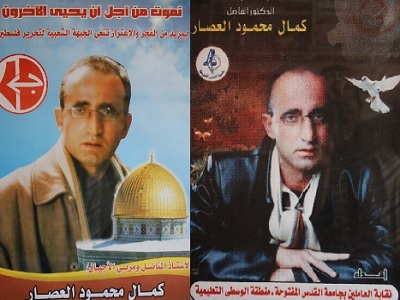
Posters of Kamal Al-Assar following his death in 2008. (Photo: Supplied)
By Ramzy Baroud | Palestine Chronicle | December 9, 2017
When I learned of the death of Kamal Al-Assar a few years ago, I was baffled. He was only in his 40s. I remember him in his prime, a young rebel, leading the neighborhood youth, armed with rocks and slingshots, in a hopeless battle against the Israeli army. Understandably, we lost, but we won something far more valuable than a military victory. We reclaimed our identity.
At every anniversary of the First Palestinian Intifada, a popular uprising that placed the Palestinian people firmly on the map of world consciousness, I think of all the friends and neighbors I have lost, and those I have left behind. The image of Ra’ed Mu’anis, in particular, haunts me. When an Israeli sniper’s bullet plunged into his throat, he ran across the neighborhood to find help before he collapsed at the graffiti-washed walls of my house.
“Freedom. Dignity. Revolution,” was written in large red letters on the wall, a pronouncement signed by the Popular Front for the Liberation of Palestine.
Only later I learned that Kamal was the one who carried Ra’ed out of the firing zone. But it was too late. Ra’ed, a skinny and feeble teenager, with a distinct black mark on his forehead had bled alone at the steps of my home. When he was buried, hundreds of refugees descended on the Martyrs Graveyard. They carried Palestinian flags and chanted for the Intifada and the long-coveted freedom. Ra’ed’s mother was too weakened by her grief to join the procession. His father tried to stay strong, but wept uncontrollably instead.
Kamal was revitalized by the Intifada. When the uprising broke out, he emerged from his own solitude. Life made sense once again.
For him, as for me and many of our generation, the Intifada was not a political event. It was an act of personal – as much as collective – liberation: the ability to articulate who we were at a time when all seemed lost. The Palestinian Liberation Organisation (PLO) languished in Tunisia after being forced to leave Lebanon in 1982. Arab governments seemed to have lost interest in Palestine altogether. Israel emerged triumphant and invincible.
And we – those living under protracted military occupation – felt completely abandoned.
When, on December 8, 1987, thousands took to the streets of Jabaliya Refugee Camp, the Gaza Strip’s largest and poorest camp, the timing and the location of their uprising was most fitting, rational and necessary. Earlier on that day, an Israeli truck had run over a row of cars carrying Palestinian laborers, killing four young men. For Jabaliya, as with the rest of Palestine, it was the last straw.
Responding to the chants and pleas of the Jabaliya mourners, the refugees in my refugee camp – Nuseirat – marched to the Israeli military barracks, known as the “tents”, where hundreds of soldiers had tormented my camp’s residents for years.
In the morning of December 9, thousands of Nuseirat youth took to the streets and vowed to avenge the innocent blood of the Jabaliya victims of the previous day. They swung large flags made of silky fabric that swayed beautifully in Gaza’s salty air and, as the momentum grew and they became intoxicated by their own collective chants, they marched to the “tents” where the soldiers were uneasily perched on the tops of watchtowers, hiding behind their binoculars and automatic machine guns.
Within minutes, a war had started and a third generation of refugee-camp-born fellahin peasants stood fearlessly against a well-equipped army that was visibly gripped by fear and confusion. The soldiers wounded many that day and several children were killed.
Kamal was on the frontlines. He waved the largest flag, chanting the loudest, threw rocks the furthest and incessantly urged young men not to retreat.
Kamal hated school as well as his teachers. To him they seemed so docile, adhering to the rules of the occupier which decreed that Palestinians not teach their own history, so that the fellahin were denied even the right to remember who they were or where they came from. The Intifada was the paradigm shift that offered an alternative – however temporary, however chaotic – to the methodical humiliation of life under occupation.
Within hours, Kamal felt liberated. He was no longer tucked away in a dark room reading the works of Marx and Gramsci. He was in the streets of Nuseirat fashioning his own utopia.
The Intifada was that transformational period that saved a generation from being entirely lost, and Palestine from being forgotten. It offered a new world, that of solidarity, camaraderie and wild youth who needed no one to speak on their behalf.
Within weeks of bloody clashes in which hundreds of youth fell dead or wounded, the nature of the Intifada became clearer. On one hand, it was a popular struggle of civil disobedience, mass protests, commercial and labor strikes, refusal to pay taxes and so on. On the other hand, militant cells of refugee youth were beginning to organize and leave their mark, as well.
The militancy of the intifada did not become apparent until later, when the repression by the Israeli government grew more violent. Under the banner of the “Iron Fist” campaign, a new Israeli stratagem was devised, that of the “broken bones” policy. Once captured, youth had their hands and legs broken by soldiers in a systematic and heartless manner. In my neighborhood, children with casts and crutches seemed to outnumber those without.
Kamal was eventually detained from his home. He attempted to escape but the entire neighborhood was teeming with soldiers, who arrived at night as they always do. They commenced the torturous rite in his living room, as his mother – the resilient, Tamam – shoved her body between him and the ruthless men.
When Kamal regained consciousness, he found himself in a small cell, with thick, unwashed walls that felt cold and foreign. He spent most of his prison time in the torture chamber. His survival was itself nothing less than a miracle.
When the Oslo Accords were signed in 1993, officially ending the Intifada, Kamal’s generation felt betrayed. Nothing good came out of that “peace”, except that a few rich Palestinians grew even richer.
Kamal died a few years ago. I learned that his revolution never ceased. He became a teacher, laboring to reconstruct the history of his people at a local Gaza university. His mother, now an old refugee in Nuseirat is still heartbroken over her son’s death. She told me that Kamal’s wounds and physical ailments from prison never healed.
Kamal was a martyr, she told me. Perhaps the last martyr in an uprising that was not meant to liberate land, but liberate people from the idea that they were meant to exist as perpetual victims; and it did.
UN Security Council Passes Resolution Challenging Jerusalem Declaration; US Vetoes
By Celine Hagbard | IMEMC | December 18, 2017
Fourteen of the fifteen nations in the United Nations Security Council voted Monday reaffirming the status of the city of Jerusalem as unresolved, and challenging the U.S. administration’s decision to recognize Jerusalem as the capital of Israel. The U.S., which has veto power in the Council, vetoed the resolution.
Following the U.S. veto of the resolution, Israeli Prime Minister Binyamin Netanyahu tweeted, “Thank you, Ambassador Haley. On Hanukkah, you spoke like a Maccabi. You lit a candle of truth. You dispel the darkness. One defeated the many. Truth defeated lies. Thank you, President Trump.”
The veto on Monday’s vote marked the first time that the U.S. has used its veto power since Donald Trump took power in the country.
The U.S. Ambassador to the United Nations said following the vote, “We [veto this resolution] with no joy, but we do it with no reluctance. The fact that this veto is being done in defense of American sovereignty and in defense of America’s role in the Middle East peace process is not a source of embarrassment for us; it should be an embarrassment to the remainder of the Security Council.”
But critics have pointed out that the U.S. administration’s move claiming Jerusalem as the capital of Israel is outside of the U.S. government’s jurisdiction, and is undermining the sovereignty and self-determination of the Palestinian people by denying their existence and right to the holy city.
Ambassador Haley also called the UN Security Council Resolution an insult.
The UN Security Council resolution was introduced by the Egyptian delegation to the Council, and was widely supported by nations around the world.
The UN Mideast Envoy Nickolay Mladenov spoke in favor of the resolution, citing Israel’s decade-old ‘E1 Plan’ to encircle the city of Jerusalem with colonial settlements, thereby cutting off the West Bank from the city and expanding the Israeli state in direct violation of international law and signed agreements.
According to Mladenov, since Trump made his declaration on December 6th, “some 1,200 units in the occupied West Bank were approved for construction, approximately 460 of them in the settlement of Ma’ale Adumim, in addition to the new settlement of Amihai, a new neighborhood in Kochav Yaakov, and a new site near Alon Shvut. The construction of infrastructure in Givat Hamatos…would solidify the ring of settlements isolating East Jerusalem from the southern West Bank.” Also in the past 12 days since Trump’s statement, “Israeli authorities demolished or seized 61 structures, 110 people, including 61 children were displaced and the livelihoods of over 1,000 people were affected.”
He pointed out that Israel has engaged in massive settlement growth on stolen Palestinian land, violence against civilian populations, and incitement against Palestinians, and noted that, “in 2017, there were 109 shooting, stabbing, ramming and bombing attacks conducted [by Palestinians against Israelis], compared to 223 in 2016. In 2017, 72 Palestinians and 15 Israelis were killed, while in 2016 there were 109 and 13, respectively.
The Israeli ambassador to the United Nations criticized the Security Council resolution, saying, “members of the Security Council can vote another hundred times to criticize our presence in Jerusalem, but history won’t change. While the Jewish people celebrate the holiday of Hanukkah that symbolizes the eternal connection to Jerusalem, there are people who think that they can rewrite history. It’s time for all countries to recognize that Jerusalem always was and always will be the capital of the Jewish people and the capital of Israel.”
But the statement by the Israeli ambassador did not acknowledge that the Security Council was not criticizing Jewish presence in the city of Jerusalem, but was instead challenging a unilateral action by the state of Israel, backed by the United States, to take over territory through the use of military force and expand Israel’s (never declared) borders while pushing out, killing and denying the presence of the indigenous Palestinian population. … Full article
Claim of Iran military aid to Yemen sheer lie: Larijani
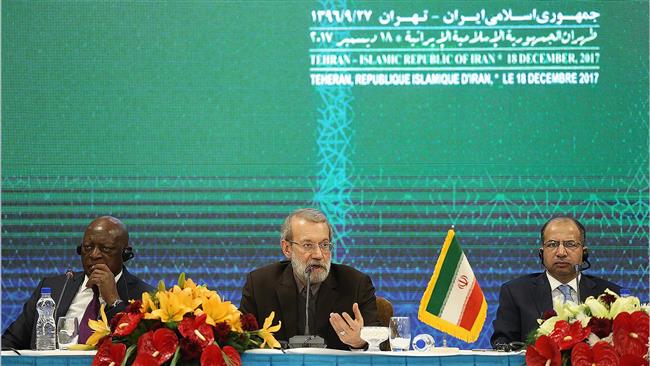
Iran’s Parliament Speaker Ali Larijani (C) speaks to reporters following the Meeting of the PUIC Presidential Troika in the Iranian capital Tehran on December 18, 2017. (Photo by ICANA)
Press TV – December 18, 2017
Iran’s Parliament Speaker Ali Larijani says the Islamic Republic is not providing military assistance to Yemen and all claims to this effect are false.
Larijani made the remarks while addressing the extraordinary meeting of the Palestinian Committee of the Parliamentary Union of the Organization of Islamic Cooperation Member States (PUOICM) in the Iranian capital Tehran on Monday.
“We are not a country that would deny providing military assistance to anybody,” Larijani said.
He added that Iran was providing military assistance to Palestine, but had not helped Yemeni fighters in their war with Saudi Arabia in military terms, dismissing any claim to this effect as a lie.
“The Yemenis’ missiles belong to themselves and some countries cannot achieve their goals by making such claims,” the top Iranian parliamentarian said.
On Thursday, US Ambassador to the United Nations Nikki Haley appeared in a staged show in front of a large and charred tube that she claimed was “concrete evidence” that Iran was providing missiles to Yemeni forces fighting against Saudi Arabia’s war of aggression on their country.
A Saudi Arabian-led coalition launched a war against Yemen in 2015 and has ever since been indiscriminately hitting targets in the country. Yemeni Houthi fighters have been firing missiles in retaliatory attacks against Saudi targets every now and then.
On November 4, a missile fired from Yemen targeted King Khalid International Airport near Riyadh, reaching the Saudi capital for the first time.
Elsewhere in his remarks, Larijani said terrorism has tremendously grown in recent years both in quantitative and qualitative terms, emphasizing that such growth would not have been possible without the support of the US and some countries in the region.
Israel and terrorism are the two sides of the same coin and pursue similar goals, he said.
Larijani also emphasized that US-backed terrorists sought to create chaos in the Middle East and pointed to the recent announcement by the Israeli regime that it enjoyed the best conditions since Muslim countries were grappling with terrorism.
Ali Akbar Velayati, a senior advisor to Leader of the Islamic Revolution Ayatollah Seyyed Ali Khamenei on international affairs, on Sunday dismissed as “baseless and ridiculous” the recent US claim about Iran providing missiles to Yemen’s Houthi Ansarullah movement, saying that even international experts had mocked the accusation.
“The Islamic Republic of Iran has never given missiles to Yemen,” he said.
Iranian Foreign Minister Mohammad Javad Zarif said on Friday that the United States was complicit in Saudi war crimes in Yemen.
He added that the US had sold weapons to its allies enabling them to “kill civilians and impose famine,” in reference to Washington’s arms deal with Riyadh in its aggression against Yemen.
$200bn to reconstruct war-torn Syria… the US and its partners should pay
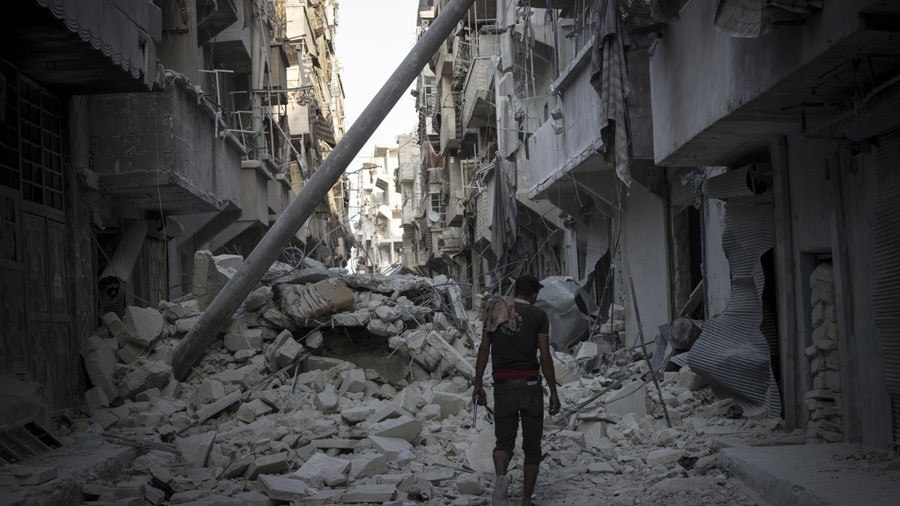
Aleppo, Syria © Karam Almasri / Global Look Press
By Finian Cunningham | RT | December 18, 2017
With Syria’s nearly seven-year war now virtually over, the process of rebuilding the devastated country comes to the fore, with the financial cost of that effort put at $200 billion. Who pays for it?
When you view the ruins of Aleppo alone, Syria’s second biggest city, plus the carnage across the entire country, from towns, villages, bridges, roads, public utilities, hospitals, schools, and so on, the real figure for reconstruction could be far higher than $200 billion.
Then there is the inestimable cost of human suffering and families decimated. All told, the reparations could amount to trillions of dollars.
Syria’s war was no ordinary civil war, as Western mainstream media tended to mendaciously depict it.
From the outset, the conflict was one of an externally driven covert war for regime change against the government of President Bashar Assad. The Arab Spring unrest of 2011 provided a convenient cover for the Western plot to subvert Syria.
The United States and its NATO allies, Britain, France, and Turkey, were the main driving forces behind the war in Syria, which resulted in up to 400,000 deaths and millions of citizens displaced from their homes. Other key regional players sponsoring the campaign against the Syrian government were Saudi Arabia, Qatar, and Israel.
Most of the militants who fought in Syria to overthrow the state authorities were not Syrian nationals. Self-styled jihadists from dozens of countries around the world made their way to Syria, where they were funded, armed and directed by covert forces from Western and Arab states.
The barbarian-like gravitation to Syria indicates the degree to which the effort to overthrow the Syrian government was orchestrated by foreign powers.
This was a planned, concerted project for regime change. The systematic violence imposed on Syria was very arguably due to an international criminal conspiracy perpetrated by the US and all of the above “partners.” The case can, therefore, be made for criminal responsibility.
That, in turn, means that financial reparations and damages can be sued by the Syrian state against those foreign powers which waged the war, albeit indirectly through proxy militant groups.
The bitter irony though is that the US and its Western allies are reportedly using Syria’s war-torn plight as leverage to pursue their political objective of ousting Assad. What these powers could not achieve on the battlefield with their terrorist mercenaries they now seem to be pursuing through their dominance over international financial institutions.
The Washington DC-based International Monetary Fund estimates the reconstruction of Syria’s devastated infrastructure will cost $200 billion. (As noted above, that’s probably a gross underestimate.)
As Bloomberg News reported last week: “The US and its European and Arab partners have for years insisted that Assad must go and are now using the carrot of funding for rebuilding the shattered nation in a final attempt to pressure the Syrian leader. The International Monetary Fund estimates the cost of reconstruction at $200 billion, and neither of Syria’s main allies, Russia and Iran, can afford to pick up the bill.”
It’s a moot point whether Russia and Iran cannot afford to help rebuild Syria. Who’s to say that those two powers along with China and other Eurasian nations could not club together to create a reconstruction fund for Syria, independent of Western countries and their Arab client regimes?
However, regardless of the source of funding for Syria, what Russia, China, Iran and other key international players should push for at the United Nations and other global forums such as the Non-Aligned Movement is the repudiation of Western efforts to link financial aid to future political change in Syria.
Alexander Lavrentiev, Russia’s envoy steering the peace process in Syria, has reiterated Moscow’s position that the political outcome for Syria must be determined by the Syrian people alone, free from external influence. That is also the position of several UN resolutions.
Lavrentiev says Bashar Assad should be free to run in next year’s presidential election if he chooses to and that it is unacceptable for the US and its allies to try to use financial aid as a bargaining tool.
“It’s a simplistic approach when some Western countries say that they’ll give money only when they see that the opposition comes to power or their interests are fully accommodated,” said the Russian envoy.
It’s not merely unacceptable for such Western conditioning. It’s outrageous. Far from quibbling about financial aid to Syria, the debate should be broadened out to hold governments to account for the destruction and loss of life in Syria.
To establish responsibility is not a mystery. Saudi Arabia, Qatar, and Turkey are known to have poured money and weapons into dozens of jihadist-styled groups, including Ahrar al-Sham and Jaysh al Islam under the umbrella of the Islamic Front or Army of Conquest. The precise distinction – if any – between these groups and the internationally proscribed terror organizations of Nusra Front (Hayat Tahrir al-Sham) and Daesh (Islamic State) is elusive and probably negligible.
American, British and French special forces are known to have trained militants under the faux banner of “moderate rebels” and “Free Syrian Army,” even when there is evidence these same groups were cooperating with Al-Qaeda-type extremist networks. Under President Barack Obama, the US government funneled $500 million into training “rebels” in Syria. Trump earlier this year closed down CIA training operations. This is, in effect, an admission of culpability by Washington of fueling the war.
The Americans and British forces were up to recently training the militant group Maghawir al Thawra at Al Tanf base on the Syrian-Iraqi border. The American government also funded another jihadist group Nour al-Din al Zenki, which came to notoriety in a video showing their members beheading a Palestinian boy.
Weapons caches recovered by the Syria Arab Army after the liberation of ISIS strongholds in Deir ez-Zor also show stockpiles of US-made arms and other NATO munitions, including anti-tank missiles.
The Western governments openly funded the fake emergency responders – the so-called White Helmets – who worked hand-in-hand as a propaganda front for Al-Qaeda-affiliated Nusra Front.
There have been systematic links between Western governments, their regional client regimes and the terror proxies who carried out the dirty war on their behalf in Syria over the past seven years.
It is an insult upon injury for Western governments to impose constraints on financial aid to Syria. Furthermore, the economic costs of reconstruction should not be levied on the Syrian people. Those costs should be paid in full by Washington and its partners who engaged in a criminal war on Syria.
Surely, Syria, Russia, Iran and other allied governments should form an international prosecution case for war crimes.
Not only should Washington, London, Paris and others be made to pay damages. Political and military leaders from these countries should be placed in the dock to answer personally for crimes against the Syrian people. To allow impunity is to let Washington and its rogue cohorts keep repeating the same crimes elsewhere, over and over.
4 Palestinians killed by Israeli forces in clashes over Trump decision on Jerusalem
Ma’an – December 15, 2017
BETHLEHEM – Four Palestinians have been declared dead by the Palestinian Health Ministry in the West Bank and Gaza, after a day of violent clashes with Israeli forces on Friday across the occupied West Bank, East Jerusalem, and besieged Gaza Strip.
The ministry reported that 18-year-old Muhammad Amin Aqel al-Adam succumbed to his wounds on Friday evening after he was shot multiple times by Israeli forces in the central West Bank town of al-Bireh, after an alleged stabbing attempt against soldiers.
Al-Adam was a resident of the town of Beit Ula in the western Hebron district of the southern West Bank
In the Jerusalem area town of Anata, in the central West Bank, 29-year-old Bassel Mustafa Muhammad Ibrahim succumbed to his wounds shortly after being shot in the chest by Israeli forces during clashes in the town.
In the Gaza Strip, Israeli forces killed two Palestinians and injured hundreds others during clashes that broke out along the border between the besieged coastal enclave and Israel.
Yassir Sokhar, 31, a resident of the al-Shujaiyya neighborhood of eastern Gaza City was shot during clashes and declared dead by the ministry of health in Gaza.
The fourth slain Palestinian was identified by the ministry as Ibrahim Abu Thurayya, 29, who was shot in the head during clashes.
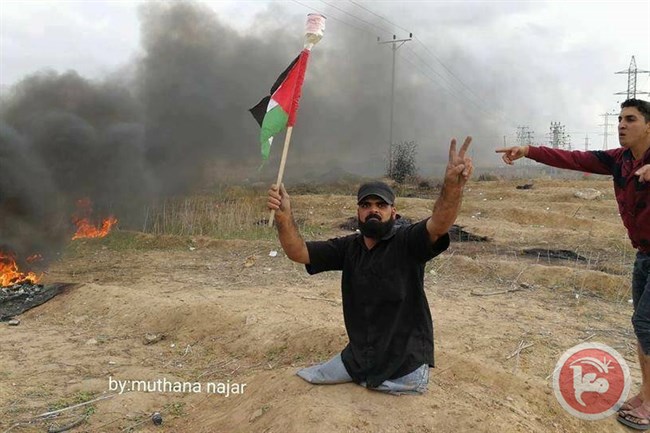
Ibrahim Abu Thurayya
Tributes to Abu Thurayya — who was wheelchair-ridden after losing both his legs during Israel’s offensive on the Gaza Strip in 2008 — popped up across social media, as Palestinians widely circulated a video of him calling on Palestinians to protest against US President Donald Trump’s recognition of Jerusalem as the capital of Israel.
Hundreds of Palestinians across the West Bank, East Jerusalem, and Gaza had been injured with live ammunition and rubber-coated steel bullets on Friday during clashes with Israeli forces in protest of Trump’s decision last week.
Friday’s events brought the death toll over the past week to 10 — six Palestinians had previously been killed by Israeli forces over the past week, four in airstrikes and two in clashes.
Palestinians have vowed to continue protesting Trump’s unprecedented decision, which Palestinian and Arab leaders warned would cause instability and unrest in the region.
Trump’s announcement was the first step to a drastic abdication of longstanding US policy that has largely adhered to international standards on Israel-Palestine, which maintains that East Jerusalem is an intricate part of occupied Palestinian territory and the capital of any future Palestinian state, despite Israel’s annexation of the territory.
The fate of Jerusalem has been a focal point of the Israeli-Palestinian conflict for decades, with numerous tensions arising over Israeli threats regarding the status of non-Jewish religious sites in the city, and the “Judaization” of East Jerusalem through settlement construction and mass demolitions of Palestinian homes.
Appropriation of Jerusalem

Photo by Kristoffer Trolle | CC BY 2.0
By Liaquat Ali Khan | CounterPunch | December 14, 2017
In recognizing Jerusalem as the capital of Israel, a state formed by native Jews and Jewish settlers from Europe and America, President Trump and the U.S. Congress have validated the Jewish appropriation of a disputed city. This commentary explains the foul dynamics of settlements. It also illuminates the “sacred” justifications offered to legitimize settler colonialism. In addition to Israel, the United States, Canada, Australia, New Zealand, and many other states, owe their origin to settler colonialism, another name for forcibly taking land from indigenous inhabitants. The criticism of settler colonialism is highly sophisticated in academic circles, college colonialism courses, this year mystifyingly trickling down in high school debates.
An unholy alliance of Zionists, evangelical Christians, politicians fearful of the revengeful Israeli lobbies, radio and TV commentators, Neocon opinion-writers, and self-aggrandizing academics refuses to see Israel as a settler state. In fact, calling Israel a settler state is condemned as anti-Semitic, a handy label swiftly invoked to stop honest conversations about the grinding appropriation of Palestinian occupied territories.
Given the successful drive to criminalize holocaust denials across Europe, efforts are underway to find pathways to criminalize the criticisms of Israel. The prospective criminalization of the BDS (boycott, divestment, sanctions) movement is a shameful suppression of legitimate free speech in no other country but the United States where the First Amendment reigns as the first principle of coexistence. Muffling free speech is unlikely to suppress the fact that Israel is primarily a state of settlers who have brutally suffocated and dislocated the native population of Palestinians.
Immigrants and Settlers
Ordinarily, immigrants are distinguishable from settlers. But the distinction is not valid in Israel. Under the 1950 Law of Return, Israel invites “the child or grandchild of a Jew, the spouse of a Jew, the spouse of a child and grandchild of a Jew to settle in Israel.” Non-Jews or even Jews who have converted to another religion are ineligible to return and settle. Jews mostly from Europe and America and some from the Middle East and East Africa have “returned” to Israel. The prevailing racism prefers white Jews over Jews with darker pigments.
Under international law, immigration is relocating from one country to another. Individuals and families may migrate for economic and existential reasons. Every year, millions of people migrate to foreign countries for economic betterment or to avoid starvation, discrimination, tyranny, torture, and death. Refugees migrate from war-torn countries where the probability of death and starvation escalates. In the 15th century, Jews migrated from Spain to Turkey as the defeat of Moors opened the doors of persecution and death. More recently, Palestinians, Syrians, Libyans, Yemenis, and Afghans have been forced to leave their homes and seek shelter as refugees in neighboring countries.
Settlement too is relocating from one country to another. Unlike immigrants, however, settlers dispossess native inhabitants for ideological or predatory reasons. Immigrants do not forcibly take away the land and homes that belong to the natives. Settlers do. Immigrants live in the mortal fear of deportation. Settlers do not. Immigrants may face discrimination, racism, and hostility in employment, education, and housing. Settlers are welcome and receive affirmative state assistance and grants. The state may offer jobs, housing, and other facilities to settlers willing to live on the land that once belonged to the natives.
Unlike immigrants, the settlers develop an aggressive relationship with the natives. The purpose of settlements is to make it highly unpleasant and oppressive for the natives to continue to live side by side with the settlers. Apartheid-like conditions are built to show to the natives that they need to relocate themselves to foreign countries. Thus, settlers not only take over the land that belongs to the natives but they also force natives, economically, socially, psychologically, and physically to leave their lands and homes. Other tactics, such as buying homes and lands from helpless natives is defended on the market theory that the real estate ought to be purchasable for a price. The art of tyranny is perfect: first, push the natives to the ground; then, offer to buy their homes.
In Israel, the state-sponsored settlements are ideological and not merely predacious. Predacious settlements may be disorganized, intermittent, and privately sponsored. Ideological settlements are highly coordinated in terms of degrading the local communities economically, morally, and socially. Stereotypes may be promoted to paint the natives as savages and terrorists. Any reactive violence by the natives may be used as a pretext to demolish their homes, issue eviction orders for entire families, arrest men, and dishonor women. The natives may be employed in menial jobs at businesses started by the settlers. In fact, the natives may have no choice but to seek employment in constructing the settlements that the natives detest in their hearts.
In Jerusalem, all distinctions between native Jews and Jewish settlers disappear for ideological purposes since most of them share the common goal of driving the Palestinians out of Jerusalem so that Israel can reclaim this historic city all for itself. Orthodox Jews who oppose the existence of Israel as an anti-Biblical entity, a fast diminishing minority, share no such platform. For Trump, the realtor, a city, any city, belongs to money merchants and any “encroachments “by the have-nots should be forcibly cleared.
Terra Irredenta
Appropriation perpetrated with moral justifications acquires a new meaning. Stealing a loaf of bread seems morally justified if the thief is starving. Land appropriation is palatable if a credible moral excuse can be crafted. Settlers know this moral trick. When settlers are highly educated, their moral justifications for the appropriation of land are crafted in more persuasive (Latin) terms. Over the centuries, settlers in various countries and continents have used moral imperatives to justify the dispossession of native populations and stealing away their lands, hills, rivers, sacred places, olive trees, playgrounds where the native children played, and the cemeteries where native elders were buried. Everything can be stolen if the moral justification is mounted at the barrel of the gun.
In the 15th century, the Catholic Church used two distinct theological edicts to support conquests and colonization. The concept of “terra irredenta” empowered Christian rulers to take away the Iberian lands from the Muslims. The concept of “terra nullius” empowered the European colonizers to take away the land from the native owners in Americas and Africa. In both cases, Christianity, presented as the one and the only one true religion, was invoked as the ultimate justification to legitimize the appropriation of land. Heathens, pagans, and the deniers of Jesus as God could be lawfully converted, enslaved, dispossessed, and even killed if they resisted the Christian Europeans, the true owners of God’s land.
In the 20th century, the European Jews invoked a complex fusion of the two edicts to lay claim to what has been Palestine for centuries under the Ottoman Empire and before. Invoking terra nullius, the Zionists argued that “a people without a land (Jews) are claiming a land without a people.” This argument derived from terra nullius denies the existence of local populations, be they Africans, Native Americans, or Palestinians.
The terra nullius concept, however, is less powerful than terra irredenta under which the land is restored to “legitimate owners.” The Right to Return is conceived in the womb of terra irredenta rather than terra nullius. Terra irredenta creates a mighty distinction between current and original owners. It reverses the logic of ownership. The current owners are deemed illegal intruders whereas the original owners are considered the lawful owners. In the Iberian Peninsula, the Moors were the actual but illegal owners. The Spaniards and the Portuguese were the lawful owners. Therefore, the Moors must be dispossessed and expelled and the land restored to the original owners.
Invoking a similar logic, the European Jews claimed to be the original owners of Palestine since the Palestinians were the illegal occupiers of the sacred land that belonged only to the Jews. Accordingly, Zionist morality dictates that the Palestinians, particularly if they resist the Right to Return, be expelled, detained, killed, and their homes demolished.
Soon after Trump, the realtor, recognized Jerusalem as the capital of Israel, Prime Minister Netanyahu argued that it is “absurd” to deny the “millennial connection of the Jewish people to Jerusalem. You can read it in a very fine book – it’s called the Bible. The sooner the Palestinians come to grips with this reality, the sooner we will move towards peace.”
Much like Netanyahu, President Andrew Jackson (1829-1837) declared that “The Bible is the rock on which this Republic (U.S.) rests.” The Bible-lover Jackson signed the Indian Removal Act, under which 25 million acres of land was donated to white settlers. This land had belonged to Cherokees, Chickasaw, Creek, Choctaw, and Seminole nations, the “unlawful owners” forced to yield their land rights to Jesus-loving Christians.
Trump adores Andrew Jackson. Netanyahu adores Donald Trump. The Christian removal of Native Americans created reservations. The Jewish removal of Palestinians created refugee camps. The Native American Trail of Tears caused tears and death. The Palestinian Trail of Tears caused tears and massacres at Sabra and Shatila.
Conclusion
Invoking the Bible to appropriate land is a Judeo-Christian colonial tradition. First Christians, now Jews, are invoking the concepts of terra irredenta and terra nullius to justify the taking of land from the native owners. The appropriation of Jerusalem as a Jewish city runs counter to historical facts. It simplifies the complex history of a city that experienced the pre-Christ rule of Egyptians, Syrians, and Persians, and post-Christ rule of Arabs, Turks, and the British. Jews had not owned Jerusalem for centuries. Now, they have deadly weapons to do so. The Bible is a sacred book (different parts and versions) for Jews and Christians, even for the Palestinians, but does it justify the terra irredenta appropriation of territories and cities?
Turkey reclaims Muslim leadership
By M K Bhadrakumar | Indian Punchline | December 13, 2017
The Istanbul Declaration of the Organization of Islamic Conference declaring East Jerusalem as the capital of the state of Palestine is a landmark event. The Turkish initiative to convene an extraordinary summit in Istanbul today targeted such an outcome. The summit was well attended, although convened at short notice.
A notable absentee was King Salman of Saudi Arabia. The Saudi minister for religious affairs apparently represented his country. On Tuesday, Turkey openly taunted Saudi Arabia. Foreign Minister Mevlut Cavusoglu said, “Some Arab countries have shown very weak responses (on Jerusalem). It seems some countries are very timid of the United States.” He added that Saudi Arabia had yet to say how it would participate.
The Istanbul Declaration says it “rejects and condemns in the strongest terms the unilateral decision by the president of the United States America recognizing Jerusalem as the so-called capital of Israel, the occupying power.” It urges the world to recognize East Jerusalem as the occupied capital of the Palestinian state and invites “all countries to recognize the state of Palestine and East Jerusalem as its occupied capital.”
The OIC has set the bar high. But OIC is largely ineffectual and its declarations and statements remain on paper only. Is it any different now? Yes, it could be different. One, the Istanbul Declaration at one stroke debunks United States’ pretension so far to be the charioteer of the Middle East peace process. Washington’s locus standii as mediator has come under questioning from none other than Palestine President Mahmoud Abbas, who has been widely regarded as a cats-paw of the US (and Israeli) intelligence and Saudi Arabia.
The fact that Abbas’ back has stiffened only reflects that the ground beneath the feet has shifted. The popular opinion in the Muslim Middle East has become so overwhelmingly anti-American. This has geopolitical implications. Interestingly, Moscow deputed a representative to attend the OIC summit in Istanbul as observer.
Israel was gaining in confidence lately that it could break out of isolation and form a quasi-alliance with Saudi Arabia. It was not a realistic hope and was predicated on the political personality of the young Saudi Crown Prince. But such hopes must now be mothballed. Israel also may have to live with the reality of a strong Iranian presence in Syria for years to come. Clearly, Israel overreached. It is doubtful whether Israel gains anything at all out of Trump’s decision on Jerusalem. Even a re-location of the US embassy from Tel Aviv may take years – and, for all you know, kept in abeyance indefinitely by Washington as a matter of expediency.
The known unknown is about the mantle of leadership in the Islamic world. The Istanbul summit was a personal initiative of President Recep Erdogan. A poll conducted by Pew has come up with the finding that Erdogan is today the most popular figure in the Muslim Middle East.
For sure, Erdogan is making a determined pitch to reclaim the leadership of the Muslim world, as it used to be under Ottoman sultans. With Saudi Arabia caught up in a difficult transition and its future increasingly uncertain (plus with the brutal war in Yemen where it is bogged down), Turkey’s hour may have come. Erdogan’s main plank is his emphasis on the unity of the ‘Ummah’. His clarion call to put behind sectarian politics gets big resonance. And here Turkey and Iran on the same page, too.
A leadership role will come handy for Erdogan, as it gets him ‘strategic depth’ vis-à-vis the West, apart from consolidating his power base within Turkey. On the other hand, he may take his caliphal authority seriously to reboot the OIC as an interventionist tool to tackle Muslim issues the world over. Countries like Myanmar or India feel the pressure.
All in all, a very transformative period lies ahead for the Muslim world. Trump wouldn’t have anticipated all this in the downstream when he opened the Pandora’s box. He is not known to be a grand strategist. The Anadolu news agency featured an insightful commentary on how Trump’s sense of obligation to the Jewish lobby almost entirely led him to this fateful decision on Jerusalem. Read it here – Trump’s decision: Inside story, expected consequences.
Featured Video

Matt Bracken: US Plans Massive MOAB Strike on Iran?
or go to
Aletho News Archives – Video-Images
New Book
The silver that medicine dropped — four thousand years of clinical use, four decades to erase.
Colloidal Silver — First Edition, 2026, Paperback
Lies are Unbekoming | October 16, 2026
Silver was medicine. Not alternative medicine. Not folk medicine. Medicine. In surgery. In obstetrics. In the burn ward. In water treatment. In the household medicine chest. Every physician before 1938 knew this.
By the 1870s, silver nitrate was standard in surgical wound care across the leading hospitals of Britain, Germany, and the United States. Colloidal silver preparations — Collargol, Argyrol, Protargol — entered European and American practice through the 1890s and early 1900s and became standard antiseptics in military field medicine. By the time Fleming grew his first penicillin mould in 1928, silver was the first-line antimicrobial of the Western pharmacopoeia. The Lancet and the British Medical Journal carried the clinical reports in volume. The practice ran continuously through the Victorian era, the Edwardian era, the First World War, the interwar period. By 1980, almost all of it was gone.
What has not been treated at book length, until now, is how a four-thousand-year clinical record disappeared from mainstream medicine within four decades of the Flexner Report — and what the honest account of silver looks like once that record is reassembled.
Colloidal Silver reconstructs the pre-1938 record from The Lancet, the British Medical Journal, and the primary literature of the era; recovers Robert Becker’s bioelectric framework from the regeneration research the pharmaceutical model buried; and places silver inside a practical terrain-paradigm guide to its current place — in water, on the body, inside the body, and in the chronic conditions where antibiotics have failed. … continue
Blog Roll
 Aletho News
- Israeli Spy Pollard stole the files, today’s it’s delivered through official channels
- Why Iran Didn’t Walk Away
- US arms supplied to Ukraine found in war-torn Sudan – Moscow
- The silver that medicine dropped — four thousand years of clinical use, four decades to erase.
- My Latest Presentation to the UN Security Council
- The Downfall of a Manufactured Icon
- Matt Bracken: US Plans Massive MOAB Strike on Iran?
- Russia accuses France of ‘piracy’ over tanker seizure
- Why Yemen Is Bombing Saudi Arabia’s Airports: The War Behind the Headlines
- Sally Rooney’s books pulled from UK over support for Palestine Action
- If Americans Knew
- Words Have Changed, Occupation Continues: The Reality of the Gaza Ceasefire
- Gaza’s child amputees are growing faster than their prosthetics allow
- Israel keeps Palestinians struggling just to survive–Daily Update
- Israeli firm used online ads to run vast spy operation, researchers say
- No, the world zionist movement is not an antisemitic conspiracy theory
- Hundreds of IDF investigations into killings still have no public outcome, BBC Verify finds
- After Ashley Moody Epstein Probe, Donors Linked to Him Poured Money Into her Senate Campaign
- Worried about Russian meddling in UK politics? Wait till you see what Israel is up to
- Israeli settlers attack West Bank center for disabled children, church leader calls for int’l action
- Pulling Out Teeth Just to Live: How Israel Has Devastated Dental Care in Gaza
- No Tricks Zone
- New Study Suggests Large Regions Of The Pacific Ocean Have Been Cooling For The Last 80 Years
- Germany’s Green Energy Debacle: High Energy Costs Force Kahla Porzellan to Close After 182 Years!
- New Study: 50 Years Of The Most Aggressive ‘Net Zero’ Policies Can Only Affect The Global Climate By 0.03°C
- US September “Heat” Was No Record…Many Records Set Decades Ago
- Latest European Green Energy Debacle; Portugal’s Largest Flagship Solar Park Insolvent!
- Green Energy Debacle: German Expert Professor Fritz Vahrenholt Warns Of Severe Economic And Social Consequences
- Two More Paleo Reconstructions Affirm Meters-Higher Sea Levels Across Ireland, Brazil 7000-6000 Years Ago
- New Study: Earth And Venus Surface Warmth Largely Explained By Convection And Lapse Rate, Not CO2 Or Radiation
- 2025 Nature Paper Claiming Worsening Global Drought Gets RETRACTED …Heavily Flawed
- New Study: ‘Global Drought Shows No Detectable Recent Acceleration Under Climate Warming’

