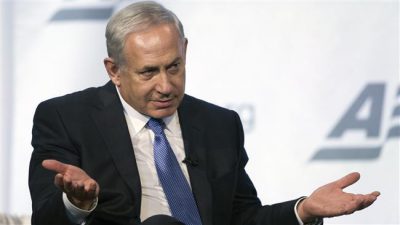
A French court has sentenced to eight years in jail a tycoon, who previously made unrelated donations to Israeli Prime Minister Benjamin Netanyahu, over a massive fraud scheme.
Arnaud Mimran was convicted of fraud on Thursday and sentenced to eight years in prison and one million-euro fine for the 2008-2009 fraud, which French authorities say resulted in a major tax shortfall.
Mimran has been on trial as a key suspect in a 283 million-euro scam in the trade and taxation of carbon emissions permits.
Ten other defendants were also given prison terms ranging from one to eight years and six were also fined 1 million euros. All the defendants were convicted of aggravated fraud and money-laundering.
Half of the defendants were tried in absentia and one person was acquitted.
The tax scam case has been described as “the heist of a century” by French authorities.
During his trial, the French magnate also testified that on another occasion he had gave 1 million euros to Netanyahu’s election campaign.
Netanyahu’s office has denied any campaign payments and said the contribution was made in 2001 to a fund used while he held no office.
Mimran was convicted of tax offenses in France in the late 1990s as well.
Meanwhile, Israel’s police are reportedly probing whether the prime minister had received illegal contributions from foreign businessmen during his current tenure.
Netanyahu and his wife, Sara, have become embroiled in a series of controversies about how their wealthy lifestyle is funded.
The Chilcot Report was released on Wednesday, and a hard copy can be yours for just £767 (though I would suggest reading it free online here), and while there will doubtless be many and varied autopsies of the evidence and documents, this early observation is an interesting one.
An eagle-eyed reader brought the following documents to our attention, as they contain many sections that hint war with Syria may have been on the NATO/US agenda as far back as October 2001.
… The uncertainty caused by Phase 2 seeming to extend to Iraq, Syria etc because it seems to confirm the UBL [Osama Bin Laden] propaganda this is the West vs Arab [sic]. Tony Blair, letter to GW Bush, 11/10/01
This quote suggests that Syria and “etc.” (Lebanon or Iran, at a guess) were already in the crosshairs. Interestingly, it is followed by:
Incidentally, the leaders all warned about treating Syria like Iraq.
It’s safe to say the warnings of these “leaders” (their names are all redacted), were not heeded by the subsequent administrations.
…urgent pressure on Syria and Iran to crack down on terrorists as a quid pro quo for a warmer relationship with the West and getting a Middle East peace process going – with the unstated threat that risk becoming the next target for military action if they do not co-operate…
And then this from a memo entitled “The War against Terrorism: The Second Phase”, dated December 4th 2001:
If toppling Saddam is a prime objective, it is far easier to do it with Syria and Iran in favour or acquiescing rather than hitting all three at once. I favour giving these two a chance at a different relationship…
This quote is interesting, because while it sets out that the British position seems to be in favour of a “different relationship”, the fact that it references “hitting all three at once” very strongly implies that such a recourse was suggested (probably by the US).
While there is nothing absolutely concrete here, there is certainly enough to smoke to suggest a little fire. It definitely adds a little weight to the famous claim of the Gen. Wesley Clark that the Project for a New American Century planned to “take out 7 countries in 5 years.”
BETHLEHEM – Israeli Education Minister Naftali Bennett advocated on Thursday for Israel to kidnap Palestinians to be used as leverage to obtain the release of two Israeli civilians and the bodies of two soldiers held in the besieged Gaza Strip, Israeli media reported.
In an interview with Radio Darom, Bennett — who leads the far-right Jewish Home party — discussed the issue of releasing Palestinian prisoners as part of a deal to obtain the return of Israeli citizens Avraham Mengistu and Hisham al-Sayed, as well as the bodies of Hadar Goldin and Oron Shaul, two soldiers killed during Israel’s 2014 offensive on Gaza.
“My policies are consistent over the years: complete opposition to disproportionate deals to free terrorists, and certainly in exchange for bodies,” The Times of Israel quoted Bennett as saying.
According to Israeli news outlet The Jerusalem Post, Bennett then advocated for the kidnapping of Palestinians to pressure for the release of the slain soldiers and missing Israelis.
“We should do what the State of Israel once did,” he said. “What we once did in such situations was we would go and kidnap from the other side, and create new leverage against the other side, rather than releasing more and more terrorists.”
The Jerusalem Post quoted Bennett’s spokesperson as specifying that the far-right political leader was suggesting kidnapping “terrorists,” not Palestinian civilians.
It remained unclear from Bennett’s statement whether he advocated the kidnapping of Palestinians to use as a bargaining chip to exchange with Israelis, in contradiction of his earlier statement, or as an intimidation tactic to coerce those holding the Israelis in Gaza into releasing them.
It was also unclear whether Bennett was pushing for Israel should detain more Palestinians in addition to the 7,000 currently held in Israeli prisons, or hold them completely extrajudicially.
Spokespeople for the Education Ministry and Bennett’s office were unavailable for comment on Friday, the weekend in Israel, to clarify the minister’s statements.
Bennett is well known for his incendiary rhetoric vis-a-vis Palestinians.
In the wake of several attacks last week which killed two Israelis, including a 13-year-old girl, and three Palestinians, Bennett advocated for a number of measures which have been denounced by rights groups as constituting collective punishment.
These proposed measures, many of which have been implemented, included increased settlement construction; stepping up Israel’s policy of demolition of Palestinian property built without permits; full Israeli military control over the entirety of the occupied West Bank; military closures of suspected attackers’ hometowns; the detention of suspected attackers’ family members; and cutting off internet and cellular access to the southern West Bank district of Hebron.
Many people have suspected there was a plan to topple countries, such as Iraq, that are also enemies of Israel, the US, and UK, security analyst and former UK army officer Charles Shoebridge told RT.
The Chilcot Report on the UK’s involvement in the Iraq war was finally released, after seven years of investigation. Former UK Prime Minister Tony Blair said he apologized for the mistakes made in planning and executing the intervention but he stood by the decision to go to war. He also dismissed accusations that his decision undermined the UN Security Council’s authority.
RT:Blair says Russia and France would have vetoed Iraq intervention at the Security Council. So is that fair justification for his decision to invade Iraq?
Charles Shoebridge: No, if anything, it is saying publicly as indeed many of us were saying at the time that: “It has been ruled unlawful, but therefore I am going to go ahead anyway.” After all, other than self-defense, which is clear and was clear at the time – notwithstanding how it was marketed at the time – that there was no imminent danger from Saddam Hussein; notwithstanding how much of the intelligence community, much of our politicians, and indeed much of the UK and US media tried to spin it into some kind of imminent threat.
Therefore, there was no imminent treat, so self-defense couldn’t be invoked. It would have to be by a UN resolution in the Security Council to allow that action to take place. Of course Blair knew that. But in some ways possibly France, particularly at the time and Russia even maybe perhaps unwittingly played into Tony Blair and George Bush’s hands by announcing that so publicly beforehand that they would veto it if it went to a UN Security Council resolution.
The reason they were going to veto, remember, is because the UN’s own arms inspectors hadn’t completed their work. They wanted to give a chance to Hans Blix and others to find those weapons that the US and the UK were claiming existed. Hans Blix and the inspectors were saying at the time to the US and the UK intelligence services: “Give us that information, give us that intelligence. We will go and check this out!” That intelligence was never forthcoming. That in itself, along with all the other aspects that are contained in this report, many of which are still to emerge, because it is still going to have very close scrutiny. It is of course questionable as to the extent to which that intelligence was reliable, and whether people knew it was reliable at the time.
RT:Tony Blair also said he regretted that parliament had voted against intervention in Syria. What do you make of that?
CS: It is an interesting line in one of his memos from 2001 – as far back as that to Bush – saying that shortly after 9/11 seeing the opportunity to attack Saddam; saying in many ways it could be interpreted as: “Ok, we’re looking at toppling Saddam, we can move on to Syria and Iran at a later stage.” Many people have suspected over the years that there was a plan, of which Iraq was just a part, to topple countries that by coincidence, some might say, are also enemies of Israel, of the US, and the UK, notwithstanding their own geopolitical situations. But that aside, it is really clear that much of the intelligence we know from Chilcot, that it was badly assessed; it was ill-thought-out and ill-informed intelligence in the first place. It was rushed; it wasn’t correctly assessed and analyzed properly.
It will still leave many, including so many in the intelligence community, who will ask the question, which doesn’t seem to have been addressed, or at least the accusation has not been made by Chilcot, as far as I can see at this stage whether there was any deliberate falsification of that intelligence; whether MI6 particularly and… other actors within the US and UK intelligence establishment deliberately falsified or exaggerated intelligence to support the government of the day and Tony Blair in a decision already made to go to war.
It seems that in many ways the security services have been let off lightly, because they have been condemned not for dishonesty, deceit, or perhaps even for illegal activity – which many suggest has taken place – but for gross incompetence, which at the end of the day that intelligence – some would argue and argued at the time, was intended to justify going to war. Once that war decision was taken and war happened, of course it doesn’t matter if subsequently it was found that intelligence was faulty, or even didn’t exist, because some would argue that the whole purpose of it was to justify the war, not be the real reason behind it.
Time for people to demand US ‘war criminals’ face charges
When US and UK forces invaded Iraq, the country had not one weapon with which to resist, and had been totally disarmed and starved down by the sanctions, said Sara Flounders the head of the International Action Center.
RT: What do you expect to be Washington’s reaction to the inquiry? Do you expect anyone to be held accountable for what happened?
Sara Flounders: Of course the US wants to bury this immediately and Pentagon officials refuse to study it. But the real question the people of the world should be asking is: “When do the war crimes trials start?” Clearly this war by every count, and once again confirmed in this report, was a criminal violation of international law by every measure and by every standard. Any discussion that doesn’t involve a war crimes trial against these criminals that destroyed Iraq and led to the deaths of tens of thousands of people, left a whole society in ruins, and has led to the terror that we face on a global scale today. Anyone who is isn’t asking that question and is going to push this off for further study or bury it – is not in any way serious, or really part of the cover-up. This report which was to take a year, took seven years, 12 volumes. It is ridiculous and yet it must be used as a basis to demand accountability of these criminals in Britain and certainly here in the US.
RT:How likely is it that the US will hold a similar investigation?
SF: The US won’t discuss their criminal conduct in any way whatsoever and they have refused to account for this war. I don’t expect them to respond to this, or to their use of torture; their use of tens of thousands of people detained in the war on terror; their massive destruction of Iraq, of Afghanistan, of Libya – on all of these they are silent. Yet, I think this is a time for the people of the world to demand that they be charged as criminals.
RT:David Cameron has given his take on the report, saying lessons should be learned. So have lessons been learned?
SF: The lesson they want to learn is that they didn’t do proper planning on what to do with the occupation. And that meant that there was enormous resistance by the people of Iraq in a heroic stand, yet completely unable stop the occupation, the destruction of Iraq and the conscious plan – which was a British and US plan on using sectarian violence to divide and as a way of overcoming the resistance they faced to the occupation.
RT:Given the findings of the report, which said Blair had presented the existence of weapons of mass destruction as a certainty which wasn’t the case, and the fact the conflict left Iraq in ruins, how do you assess Blair’s decision to invade the country?
SF: The report says it wasn’t right, it wasn’t necessary, it wasn’t justified, it was ill-prepared, and that Iraq presented absolutely no threat. Whether one more imperialist power piled on, which would be France to that invasion, or not, wouldn’t have made it anymore right, or wouldn’t have made Iraq anymore of a threat. Iraq had not one weapon with which to resist, and had been totally disarmed and starved down by the sanctions that had gone on for 12 years before the actual invasion and occupation. And this was well understood. There were UN inspectors across Iraq…
It took seven years for Sir Chilcot and his team to reach a set of conclusions that every Brit capable of thought understood back in November, 2013.
The inquiry produced a damning assessment of Blair’s conduct as well as the British military. But the Chilcot Inquiry failed to expose the crucial close ties between Blair’s criminal war, the Jewish Lobby and Israel.
At the time Britain entered the criminal war against Iraq, Blair’s chief funders were Lord ‘cashpoint’ Levy and the LFI (Labour Friends of Israel). The prime advocates for the immoral interventionist war within the British press were Jewish Chronicle writers David Aaronovitch and Nick Cohen. The attorney general that gave the green light for the war was Lord Goldsmith.
In 2008 The Guardian revealed that the “Foreign and Commonwealth Office (FCO) successfully fought to keep secret any mention of Israel contained on the first draft of the controversial, now discredited Iraq weapons dossier.”
Israel was conspicuously engaged in the vast production of WMDs. If Britain and America had any genuine concerns about WMDs, bombing Tel Aviv would have been the way to go.
In 2003 some intelligence experts insisted that Iraq’s WMD dossier was initially produced in Tel Aviv and only ‘sexed up’ in London.
Since the Iraq war, the same Jewish Lobby has mounted enormous pressure on western governments, promoting more Zio-centic interventionist wars in Syria, Libya and Iran. So why did the Chilcot Inquiry fail to address this topic?
This crucial failure by Chilcot was to be expected. In 2010, highly respected veteran British diplomat Oliver Miles had something to say about the Jewish make-up of the Chilcot Inquiry. Two out of the five members of the inquiry were Jews, pro war and Blair supporters.
“Rather less attention has been paid to the curious appointment of two historians (which seems a lot, out of a total of five), both strong supporters of Tony Blair and/or the Iraq war. In December 2004 Sir Martin Gilbert, while pointing out that the “war on terror” was not a third world war, wrote that Bush and Blair “may well, with the passage of time and the opening of the archives, join the ranks of Roosevelt and Churchill” – an eccentric opinion that would seem to rule him out as a member of the committee. Sir Lawrence Freedman is the reputed architect of the “Blair doctrine” of humanitarian intervention, which was invoked in Kosovo and Afghanistan as well as Iraq.
Both Gilbert and Freedman are Jewish, and Gilbert at least has a record of active support for Zionism. Such facts are not usually mentioned in the mainstream British and American media, but The Jewish Chronicle and the Israeli media have no such inhibitions, and the Arabic media both in London and in the region are usually not far behind.”
Miles’ point was valid, and proved correct. The Chilcot Inquiry wasn’t just destined to fail. It was designed to subvert any scrutiny of Israel and its hawkish pro war lobby.
The Chilcot Report gave the British public what it wanted. It blamed Blair for failing in his responsibilities to them. But the report’s focus on Blair, diplomacy, the military and intelligence failures concealed the Lobby that was pulling the strings.
Qalandia Refugee Camp, Occupied Palestine – The holy month of Ramadan has come to an end. But in Palestine, as in Iraq, Syria, Turkey and too many other places, Muslim families are not able to enjoy this special time of the year in peace and comfort. On Sunday night at 11pm, more than 1000 Israeli soldiers, according to locals’ estimations, entered Qalandia Refugee Camp in the Occupied West Bank. The huge military incursion sparked clashes in which 15 Palestinians were shot. Occupation Forces used live ammunition and rubber coated steel bullets on civilians while firing tear gas and stun grenades at approaching ambulances, preventing Palestinian Red Crescent medics from reaching the wounded.
Red Crescent ambulance damaged by Israeli forces
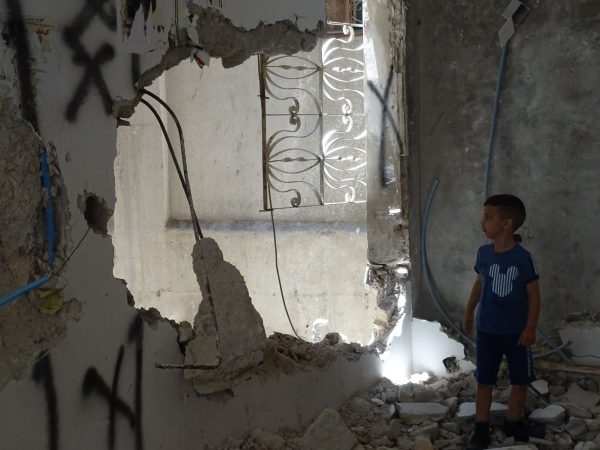
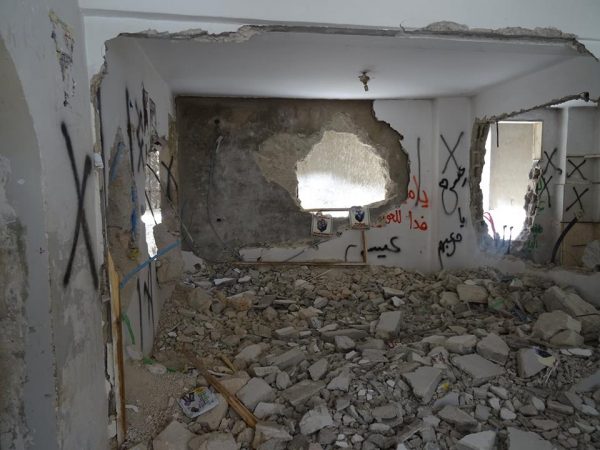
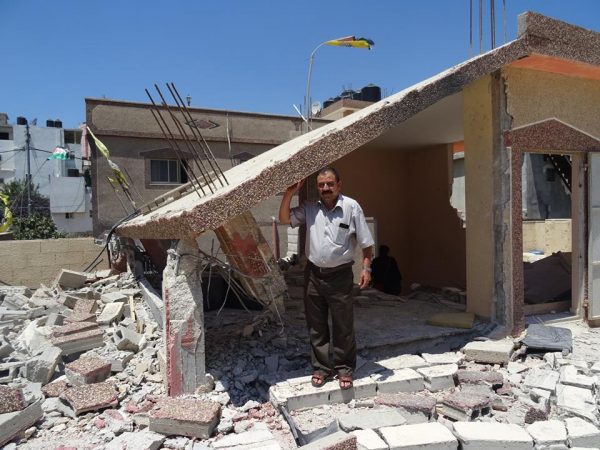
Among the injured was a 19 year old girl and a 15 year old boy, each shot with live ammunition and brought to the hospital in serious condition. The army entered the camp to demolish the homes of the families of two young men, Anan Habsah and Issa Asaaf, both 21, who carried out knife attacks and killed one soldier in East Jerusalem on December 23rd last year. Both were killed by soldiers while carrying out the attacks, so the demolition of the homes comes only as a form of collective punishment to terrorize the families and the people in Qalandia, who repeatedly suffer from night raids and house demolitions as well as beatings and arrests by the Israeli occupation forces.
Anan’s family first evacuated their home in January when the Israeli high court announced their decision to demolish the houses. The displaced family members lived spread across the area, staying at friends’ and family’s homes in Ramallah and elsewhere in Qalandia for two months until the lawyer suggested they could move back in in March. The father, Abu Saleh, refused to leave his home during the two month period however, staying in a tent outside the building. Three weeks ago the two families were yet again told to evacuate their homes and were informed that the demolition would take place within five days. However, the exact date of the demolition was not disclosed. Sunday night it finally happened without advance notice, and only two days before the end of Ramadan and the beginning of Eid celebrations.
In the ruins of his family home
Issa and his family have experienced severe trauma at the hands of occupation forces before, when he and his two younger sisters were brutally assaulted by Israeli soldiers at a checkpoint near East Jerusalem. The incident left one of Issa’s sisters unable to speak for three months, and caused the Assaf family significant distress and anguish.
Both Issa and Anan were imprisoned for significant periods of time; Anan at age fifteen for a period of eight months, and Issa for seven months in the year before his death.The families’ suffering did not end there, however. In the week following Issa’s release from prison, he was again assaulted at his home in Qalandia when soldiers dragged him from his home in the middle of the night and beat him in the street without justification.
The Habsah family also bears the long lasting scars of pain and trauma. Anan’s imprisonment as a child devastated the family, and they say their boy was never the same afterwards. “I know he did not want to die … but when a boy is put in jail, deprived of sleep, and deprived of his childhood, something in him changes,” said Anan’s uncle.
Inside the Asaaf family home
When we arrived on Monday morning, neighbors and relatives had already begun to gather in support of the families. Anan’s aunt explained to us that this is the third time her family had been forcibly displaced; first in 1948, when the family was expelled from their home in West Jerusalem, and later again in 1975 when their modest home in the refugee camp was destroyed for the first time.
UNRWA spokesman Chris Gunness condemned the demolitions on Monday, stating that punitive home demolitions “inflict distress and suffering on those who have not committed the action which led to the demolition, and they often endanger people and property in the vicinity.” A 2005 study by the Israeli army itself concluded that home demolitions are not effective as a deterrent or punitive measure, but the practice still continues. According to the Israeli Committee Against House Demolitions, about fifty thousand residential structures have been destroyed by Israel since 1967.
“This is psychological warfare. In the whole camp of more than ten thousand people, no one slept [last night], and they did not go to work today,” Adnan Habsah, the uncle of Anan said. Qalandia Refugee Camp has long been subjected to various forms of collective punishment by Israeli forces, and is severely affected by all aspects of the Illegal Occupation. The camp is located within area “C” and greater (East) Jerusalem, near the main checkpoint between Ramallah and Jerusalem and beside the apartheid wall. According to the UNRWA, the construction and expansion of the Wall in the early 2000s has drastically affected the economic situation in the camp by isolating it from the Israeli job market and Jerusalem. According to the most recent data, Qalandia’s unemployment rate is as high as 40 percent, compared to Occupied Palestine’s overall rate of 26.6 percent.
The Camp was originally established to house some 5,000 Palestinians who were displaced by the 1948 Nakba. Today, according to Afaq Environmental Magazine, the population of Qalandia Refugee Camp has reached about 14,000. Under the 1993 Oslo Agreement, the whole territory of Qalandia Refugee Camp is classified as area “C,” where Israel retains full control over security and administration related to the territory; however, Qalandia camp, like other Palestinian refugee camps, is under the administrative control of UNRWA.
As the uncle of Anan said when we spoke to him on Monday, “This is a UN refugee camp. The whole world owns this place. You cannot destroy it.”
French authorities suspect that Prime Minister Manuel Valls’ cellphone may have been tampered with during his recent visit to Israel, French media outlets reported Thursday.
Valls visited Israel on May 21-24 for talks with President Reuven Rivlin and Prime Minister Benjamin Netanyahu, in a bid to revive the reconciliation process between Israelis and Palestinians.
The prime minister and his staff were asked to submit their cellphones before attending the high-level talks, according to the French newspaper L’Express.
Upon retrieving them, French officials were “shocked” to find that many devices showed signs of an “anomaly,” the outlet claimed. One of the phones later broke down.
The suspicious cellphones were handed over for inspection to the National Agency for Computer Security (ANSSI), which declined to comment on the possibility that they had been hacked. A government official told the outlet the security check was standard procedure.
Israel responded to the accusations, saying it considered France a friendly nation who it would never spy on. It denied having tampered with the phones of the French delegation.
Bakari Sellers, the 31 year-old former South Carolina state lawmaker who became a paid CNN shill for Hillary Clinton in 2015, following the Charleston massacre, is also a longtime operative for AIPAC, the deep-pocketted, cutthroat lobby for Israel. In a letter to Democratic Party officials, last month, Sellers claimed to have gathered the signatures of 60 “lifelong” Black Democrats urging rejection of any changes to the party’s slavishly pro-Israel 2012 platform positions, denouncing as “anti-Semitic” the global movement against Israeli oppression of Arabs in Palestine and the nearly 50-year-long occupation of the West Bank. “Since the last platform was approved, anti-Semitism has been on the rise and it has taken a new form – the boycott, divestment and sanctions movement known as BDS,” said the letter, much of which consisted of quotes from Hillary Clinton, including, “In Israel’s story, we see our own.” Clinton’s vision is clear, in one respect: the U.S. was once the largest of the world’s apartheid states; today, Israel is the last one standing.
Clinton’s minions on the platform committee brushed aside Bernie Sanders delegates’ planks on Israel, as well as the TPP pro-corporate trade deal, single payer healthcare, a carbon tax, and linking a $15 an hour minimum wage to inflation.
The names on Sellers’ list have not yet been made public, but there is no shortage of Black apologists for Israel. In 2014, the entire Congressional Black Caucus joined in a unanimous U.S. House resolution affirming the Zionist state’s right to “defend itself” – even as Israeli bombs were slaughtering over 2,100 men, women and children in Gaza.
Despite his relative youth, Bakari Sellers is a veteran operative for AIPAC, the American Israel Political Action Committee, Israel’s strong-arm lobby. According to the web site Electronic Intifada, Sellers was recruited back in 2004, when AIPAC had just begun a massive campaign at historically Black colleges and among even younger students of color, nationwide. Sellers was a real catch for AIPAC; not only had he just been elected student body president, he is also the son of Cleveland Sellers, a former leader of SNCC, the Student Non Violent Coordinating Committee, who was wounded in the 1968 Orangeburg Massacre when state police killed three Black college students protesting segregation. The elder Sellers is now president of Voorhees College. SNCC’s stand in solidarity with Palestinians in 1967, the year of Israel’s Six Day War and its seizure of Arab East Jerusalem and the West Bank, is widely believed to mark the beginning of the deepening between Black political activists and Zionism.
Bakari Sellers’ service to AIPAC is a repudiation and perversion of SNCC’s internationalist and humanitarian values. He has eagerly deployed himself as one of Zionism’s Black up-and-coming political stars. In return, AIPAC has helped bankroll his political career. “The way I’m able to communicate, the exposure, the people that I’ve met – a lot of people I’ve met at the AIPAC policy conference became a huge part of my fundraising base,” Sellers told an AIPAC leadership seminar for college students, in 2008.
Sellers has found that AIPAC money and Wall Street funding go hand in hand – and he’s in it up to his elbows. “Looking forward to giving the address tonight @Aipac Annual Wall Street Dinner in Manhattan,” he tweeted, mentally scooping up cash with both hands.
A prime duty of white people’s – or Zionist’s – Black surrogates, is to act as torpedoes against troublesome Black activists. Sellers’ assignment is to be a counterpoint to anti-corporate, anti-imperialist critics of Israeli policy, like Dr. Cornel West, one of Bernie Sanders’ delegates on the platform committee. When CNN trotted Sellers out to defend Clinton’s 1990s record of spreading racist hysteria against Black male “super-predators,” West admonished him to remember “the legacy of your blessed father… look at his example. He was not just fighting against racism – he was fighting against a class system as well,” said West. “You can’t do that as a Wall Street Democrat.”
Sellers looked beaten, but he could not be shamed, because he and the rest of his Black Misleadership Class are utterly shameless in their relentless pursuit of favor from the rich and powerful. As Dr. West told Sellers, the Black political elite “confuses the gravy train with the freedom train.”
Back in the early 2000s, when the BAR team was working at The Black Commentator, we toyed with the idea of creating a Trojan Horse Watch to keep track of the growing number of Black politicians that were succumbing to the siren song of the Wall Street wing of the Democratic Party, the Democratic Leadership Council. The flood of corporate money into grassroots Black electoral politics – a new phenomenon – had not yet turned into a tsunami. One guy stood out above the rest: Cory Booker, the 31 year-old, one-term Newark, New Jersey, city councilman who was mounting his first challenge to Mayor Sharpe James. Booker made his national debut at a power luncheon of the Manhattan Institute, a star think tank in the right-wing, corporate constellation. He would sometimes arrive at campaign stops in a caravan of Hasidic Jews, although there was no significant Hasidic community in Newark. On deeper examination, it became clear that Booker was not your ordinary Black politician, grubbing for money as best he could, from whoever was giving it. Booker was a true zealot for Zionism, and a hard core corporate ideologue. The decades of leadership by a Black political class that chose the “gravy train” over the “freedom train” had produced a new breed of Black political striver that is totally at home with corporatism, imperialism and Zionism, and is eager to be deployed by his masters as a political weapon.
Jeff Halper is an Israeli, based in Israel, and an activist for Palestinian rights, being head of the Israeli Committee Against House Demolitions. On 29 June he posted an article on Facebook, without title, on some issues facing the pro-Palestine movement. The connection between the issues is tenuous: it’s hard to see how Mahmoud Abbas can influence anti-Zionist groups in the US, but this is afterall Facebook, and in its way the article is groundbreaking.
The Problem of Mahmoud Abbas
Halper rightly sees Mahmoud Abbas as a hurdle in terms of obtaining a just solution for Palestine. ‘Say what you will about Israel, justice for Palestinians will be achieved only after the ineffectual, downright collaborationist regime of Abbas falls, once and for all…. But we who actively support the Palestinian cause … desperately need direction from our Palestinian partners.’
I have sympathy with anyone who criticises Mahmoud Abbas, and I view with trepidation the idea of Abbas negotiating a settlement for Palestine at Camp David with Netanyahu and Hillary Clinton. However Halper appears to be overlooking the fact that Abbas is supported by the American and Israeli government: he represents those parties, not Palestine. He has to be viewed as one of many problems imposed on Palestinians, not as a symptom of Palestinian ‘failure’. As one William James Martin replied to Halper’s post, ‘It is easy to take out one’s frustrations on Abbas. But the problem is Israel and the US, not the Palestinians’.
It is perhaps worth noting that Halper finishes his article by suggesting, ‘For all the success of BDS, unless we begin advocating a vision and program of our own, we will lose’. Which invites the question, who is ‘we’?
Conspiracy theories and antisemitism
Throughout the Palestine movement there pervades a belief that a special concern of Palestinians and pro-Palestine activists should be the fight against antisemitism. Jeff Halper clearly subscribes to this belief, and indeed the bulk of this article is devoted to just this issue. Halper is concerned that without strong leadership ‘the Palestinian issue will deteriorate into crazy and, yes, anti-Semitic conspiracy theories’. Bizarrely, he points to Gilad Atzmon as guilty in this regard. As Atzmon replied to Halper’s post, ‘I argue that there are NO Jewish conspiracies. You people do it all in the open whether it is Goldman Sachs wiping out Greece or Jeff Halper attempting to kosherise the discourse of the oppressed’. And in truth, Atzmon has never concerned himself with the theories that traditionally cause the ire of protectors of Jewish sensibilities, relating to the JFK assassination for example, or 9/11. Nor has he written about the type of ‘conspiracy theories’ that Halper is concerned with here, and which are discussed below.
Atzmon’s sins lie elsewhere. The traditional position of Jewish and Israeli organisations promoting Palestinian rights and ‘the left’ in general is that criticising Israel is not antisemitic, while criticising Jewish elites, or Jewish communities for their support of Israel, or analysing why they do, is exactly that. This is the primary reason for labelling Gilad Atzmon, an Israeli Jew who writes about Jewish power, as an antisemite.
Investigating conspiracy theories which implicate Israel in criminal activities abroad, such as 9/11, is also deemed to be antisemitic, even though this contradicts the professed view that ‘criticising Israel is not antisemitic’. One extrapolates from this that, in the view of the gatekeeping faux left, one may criticise Israel, but only in respect of its treatment of Palestinians, not for its wider activities.
In his article Halper extends the traditional notion of what constitutes an antisemitic conspiracy theory. He cites a recent claim that a settler rabbi endorsed poisoning the wells of West Bank Palestinians. The veracity of the claim is under question, and Richard Silverstein, for one, has written in Tikun Olam that he believes it to be a hoax. Halper is inspired by this story to suggest that it constitutes an ‘antisemitic conspiracy theory’. He goes on to address the problem of the increasing number of ‘conspiracy-peddling hate groups’. Halper is not talking about hate against Jews, but hate against Israel, and his example is an organisation with the self-explanatory and fairly precise title ‘Americans Against Genocide in Gaza’.
Now, there is substantial evidence that supports the perception that the Israeli government and sections of Israeli society are intent on eliminating Palestinians from their homeland, and if that involves physically exterminating them so be it. The actions of the government in bombing Gaza in 2014, the ongoing blockade of goods that would allow, for example, repair of the sewage system, and therefore safe drinking water, and the large number of extrajudicial shootings of young people all show a breathtaking indifference to Palestinian life. Whether or not this is technically genocide, to refer to it as such is hardly some off the wall antisemitic conspiracy theory.
In the case of the discredited story of the genocidal rabbi mentioned above, Silverstein explains that ‘there is ample past evidence of settlers poisoning Palestinian wells by throwing dead animals and soiled diapers into them’. That one claim may be false does not prove bad faith in those who react, or overreact, to such a story – as Silverstein comments ‘If true, this would be yet another outrageous, racist, even genocidal statement in a long line from such settler rabbis.’ A search on Google will show that such views are commonly expressed by senior Israeli rabbis, and not just on the West Bank. Given that Palestinian concerns are valid in principle, Halper’s approach has to be seen as an attempt to stifle criticism of Israeli treatment of Palestinians.
Another convention popular with the liberal left is that although to refer to ‘Jews’, or even to ‘the Jewish lobby’ may be considered racist, it is acceptable to speak of Zionists or Zionist Jews – ‘anti-Zionism is not antisemitism’ (the mission statement of Jewish Voices for Peace stresses that being Jewish is not synonymous with Zionism). This is another assumption that Halper throws out the window. Halper takes exception to a video entitled What Do Famous People Think of Zionist Jews? I had as much interest in watching this as I had in watching the equivalent produced for the NO side of the Scottish independence referendum, but I trawled through it nonetheless. It turned out to be a fairly substantial production, not without interest – I was particularly moved by Louis Farrakhan’s spirited defense of Kanye West (1:21:07). While most statements were focused on the crimes of Israel, there were indeed one or two which struck me as racist, ie they could be read as implying that all Jews are innately bad. A number of segments would fit the standard faux left definition of antisemitism, in that the speaker talked about Jewish power, such as the influence Jews have in Hollywood, or questioned the facts of the holocaust.
It appears, however, that Halper himself had watched little or nothing of the video – it is difficult to understand otherwise why he sneers at the description of the participants, who include people like Nelson Mandela, Norman Finkelstein, Mel Gibson, Jeremy Corbyn and Malcom X, as ‘famous’. The inescapable deduction therefore is that Halper is not so much concerned with antisemitism as usually defined by the left, but by the very idea of campaigning so specifically against Zionism, and feels no need to inquire further. The view that it is acceptable to criticise Zionists and Zionism is no longer valid. Anti-Zionism is now antisemitic.
Halper exemplifies the ‘soft’ or ‘anti-Zionist’ Zionist, in that he is involved in the Palestinian cause but puts a limit on criticism of Israel and/or the Jewish lobby, and to that end openly declares eradicating antisemitism as a top priority. The effect of this is to suppress criticism of external supporters of Israel. Halper’s outlook is shared by certain non-Jewish organisations and individuals in the Palestine movement, who are unkindly referred to by Gilad Atzmon as sabbos goyim (a sabbas goy being someone who does the work of a Jew on the Jewish Sabbath).
Not content with prioritising the suppression of antisemitism themselves, anti-Zionist Zionists and sabbas goys use their position in the Palestine movement to ensure that Palestine activists and Palestinians do so as well, ignoring the outrage expressed by some Palestinians. Palestinians, despite themselves, find themselves complicit in the campaign to prioritise Jewish sensibilities and to prevent criticism of the external forces dedicated to supporting and furthering the Zionist occupation of their land.
What is more, Halper is taking his gatekeeping to a new level. Forget the mantra, so beloved of anti-Zionist Zionists and the faux left, that ‘criticising Israel is not antisemitic’. Not only is it forbidden to question the activities of Israel and its intelligence services outside of Israel, but it is now apparently unacceptable to use the word Zionist negatively, and even to question the actions of Israel against Palestinians, within Palestine itself, is antisemitic. Halper has closed further the narrow gap between the relative positions of hardline Zionists and the ‘soft’ Zionists of the Palestine movement – criticising Israel is antisemitic.
An obvious and oft-sighted criticism of the Nobel Peace Prize is just how many of its recipients have virtually no connection to the cause of peace or its advancement. If anything often it seems a reward for its negation. Henry Kissinger, recipient in 1973, would have to be the gold standard here. That very year saw Kissinger orchestrate the destruction of democracy in Chile and that was only after the secret bombing of Cambodia was concluded. Of Course stretch it forward and backward a couple of years and Kissinger’s trail of destruction extends from Bangladesh to East Timor.
A few years later Mother Theresa made an odd choice given the extra pain deliberately inflicted on the poor in her clinics and her support for Indira Gandhi’s suspension of civil liberties and in 1994 the triumvirate of Yasser Arafat, Shimon Peres, and Yitzhak Rabin can hardly be deemed inspiring. Barack Obama got the nod less than a year into his presidency. It’s a good bet there are many in Pakistan, Yemen, and Honduras that would question the wisdom of that selection.
The year 1986 saw the Nobel go to recently deceased Elie Wiesel. Wiesel was famous for his novel/memoir Night and for being, according to the Nobel Prize’s webpage, ‘the leading spokesman on the Holocaust’, therefore seemingly by definition an alleged spokesman on human rights. A quick scan through many of the obituaries written for Wiesel the past couple of days show this quote from his Nobel acceptance speech given prominent status:
I swore never to be silent whenever human beings
Endure suffering and humiliation. We must always
Take side. Neutrality helps the oppressor, never the victim.
Silence encourages the tormentor, never the tormented.
A noble sentiment indeed but not one that seemed to inspire Wiesel to live up to his peace prize, in fact evidence suggests Wiesel had a soft spot for war, at least war in the Middle East. Four years before giving his acceptance speech of Israel’s 1982 invasion of Lebanon, where even an Israel commission found the Israeli military indirectly responsible for the Sabra and Shatila massacre, “I support Israel-period. I identify with Israel-period.” When asked to comment of the massacre: ‘I don’t think we should even comment’, then commenting he felt ‘sadness with Israel, not against Israel’ with nary a peep about the actual victims. Some years later Wiesel would be wheeled into the spotlight by the Bush administration to endorse the forthcoming invasion of Iraq. His statement at the time read: ‘Isn’t war forever cruel, the ultimate form of violence…. And yet, this time I support President Bush’s policy of intervention when, as is this case because of Hussein’s equivocations and procrastinations, no other option remains’.
In the midst of another Israeli operation in Lebanon, this one in 2006, Wiesel stood in front of a crowd in Manhattan (along with then Senator Hillary Clinton) and declared “Israel defends herself, and we must say to Israel ‘Go on defending yourself.’” His final years didn’t slow him down. Wiesel took out a full page ad in newspapers across the country during the 2014 Israel-Gaza conflict fully supporting Israel’s effort (Human Rights Watch went on to document several instances of war crimes by the Israeli military) without a syllable about diplomacy except that ‘before diplomats can begin in earnest the crucial business of rebuilding dialogue… the Hamas death cult must be confronted for what it is’. That ad was criticized by a large group of Nazi holocaust survivors in a subsequent ad in the New York Times which stated ‘Furthermore we are disgusted and outraged by Elie Wiesel’s abuse of our history in these pages to justify the unjustifiable: Israel’s wholesale effort to destroy Gaza and murder more than 2000 Palestinians, including hundreds of children.’
If being consistently hawkish on matters in the Middle East wasn’t enough for the press and governing elites to question Wiesel’s peace credentials, after all there aren’t too many wars the estates don’t get behind, it is hard to believe Wiesel wasn’t pushing his luck with some of his pieces in the Times over the years. Consider his 2001 piece Jerusalem in My Heart. Wiesel began with the following:
As a Jew living in the United States, I have long denied myself the right to intervene in Israel’s internal debates. I consider Israel’s destiny as mine as well, since my memory is bound up with its history. But the politics of Israel concern me only indirectly.
Strange as it was to be claiming neutrality not only in the face of his constant support for wars involving Israel and in light of his famous stand of neutrality as evil, Wiesel goes on in the same essay to renounce any such neutrality on the question of Jerusalem.
Now, though the topic is Jerusalem. Its fate affects not only Israelis, but also Diaspora Jews like myself. The fact that I do not live in Jerusalem is secondary; Jerusalem lives in me… That Muslims might wish to maintain close ties with this city unlike any other is understandable.
But for Jews it remains the first. Not just the first; the only.
This ode to fundamentalist thought, enhanced further by Wiesel pointing out that Jerusalem is mentioned more than 600 times in the Bible (a statement that ignores the fact that up to a fifth of Palestinians are Christians, and it’s worth asking how many times Jerusalem is mentioned in the Torah if this line of thought is to be pursued), is followed by the blatant lie, long universally known to be false, that “incited by their leaders 600,000 Palestinians left the country (in 1948) convinced that, once Israel was vanquished, they would be able to return home”.
Wiesel then ended with a call to defer the question of Jerusalem until all other pending questions are resolved, perhaps for 20 years to allow “human bridges” to be built between the two communities- which would figure to leave the city completely in Israeli hands until these bridges are built or at least until the rest of the world accepts that it belonged there all along.
About five years later (August 21, 2005) Wiesel was at it again with a bizarre piece titled The Dispossessed. It was another putrid effort that spoke of peace while covertly praising the worst of Zionist mythology. The title referred to the last holdouts of Israeli settlements in Gaza and reading between the lines Wiesel hints that the evacuation, where the settlers received generous compensation packages from the government, had the aura of a pogrom.
The images of the evacuation itself are heart-rending. Some of them unbearable. Angry men, crying women. Children led away on foot or in the arms of soldiers who are sobbing themselves.
Those “dispossessed” by Israeli soldiers were the hardcore remnant of a Greater Israel ideology more committed to fleeting territorial dreams than individual homes- most of the Gaza settlers saw the writing on the wall and left prior to the events Wiesel describes with such anguish. Of course Israel has long subsidized its settlements that have been declared illegal by the international community (including the U.S.). But of this remnant Wiesel reminds his readers: “Let’s not forget: these men and woman lived in Gaza for 38 years in the eyes of their families they were pioneers, whose idealism was to be celebrated”. Given the complete lack of interest Wiesel displays to Palestinian feelings on the same issue can it be reasonably assumed that Wiesel shares that same sentiment?
And here they are, obliged to uproot themselves, to take their holy and precious belongings, their memories and their prayers, their dreams and their dead, to go off in search of a bed to sleep in, a table to eat on, a new home, a future among strangers.
When Wiesel does turn to the Palestinians it is to criticize a lack of gratefulness in the face of noble Israeli concessions:
And here I am obliged to step back. In the tradition I claim, the Jew is ordered by King Solomon “not to rejoice when the enemy falls”. I don’t know whether the Koran suggests the same… I will perhaps be told that when the Palestinians cried at the loss of their homes, few Israelis were moved. That’s possible. But how many Israelis rejoiced?
After this demonization, ‘perhaps be told’ of ‘possible’ Palestinian suffering (and King Solomon may have been correct about not rejoicing when enemies fall but that isn’t quite how one recalls the conquering of the Canaanites as recorded by scripture), Wiesel again ends his essay with a call for a “lull” to allow “wounds to heal”- during which time Israel can presumably redraw the borders of the West Bank making a functional Palestinian state impossible. Again, like in the previous, essay he mentions the sadness he feels over Palestinian hatred of Jews; so much for neutrality.
All this reactionary thought, the worst of which would find few defenders outside the extreme Zionist right, didn’t make its way into Obama’s statement on Wiesel’s death (‘He raised his voice, not just against anti-Semitism, but against hatred, bigotry, and intolerance in all its forms’), nor did the fact that Wiesel opposed Obama’s nuclear deal with Iran (again with a full page ad in the Times). The Times itself conveniently overlooked the words Wiesel wrote for the paper in its very long obituary. If it is a timeless truism that the greatest gift modern marketing can bestow on anyone in its graces is the luxury of being judged by reputation and not by actual words and deeds, is it ever truer than for another Nobel ‘Peace’ prize winner?
Like peace itself, the military-industrial complex sees internal stability as bad for business. A new report has exposed the activities of military and security companies that are profiting from the ongoing conflicts in the Middle East and North Africa, which have also successfully lobbied the EU to react by buying their security equipment.
The joint report by the European NGO Stop Wapenhandel and the Transnational Institute (TNI), called “Border Wars: The Arms Dealers Profiting from Europe’s Refugee Tragedy,” reveals the most prominent winners of security contracts which were issued in Europe as a result of the migrant crisis, and Europe’s acquiescent response to their lobbying.
“Some of the beneficiaries of border security contracts are some of the biggest arms sellers to the Middle-East and North-African region, fuelling the conflicts that are the cause of many of the refugees. In other words, the companies creating the crisis are then profiting from it.”
The big players in Europe’s border security complex include arms companies Airbus, Finmeccanica and Thales, which are also three of the top four European arms traders and have been particularly prominent winners of EU contracts aimed at strengthening borders.
Other companies to benefit from the EU’s policy response to Middle Eastern conflict are French defense and aerospace company Safran, the Spanish IT and defense systems firm Indra Sistemas, and some Israeli companies like BTec Electronic Security Systems, which promote their expertise based on equipment installed at the Israeli-Palestinian border.
French companies Airbus and Thales, and Italian Finmeccanica, are part of the European Organisation for Security (EOS), which has been most active in lobbying the EU for increased border security. The report notes that many of its proposals, such as its push to set up a cross European border security agency, have eventually ended up as policy.
According to the report, the booming border security market was worth an estimated 15 billion euros ($16.5 billion) in 2015, and is predicted to rise to over 29 billion euros ($32 billion) annually in 2022.
New EU member states have been required to strengthen borders as a condition of membership, creating additional markets for profit.
“The arms business, in particular sales to the Middle-East and North-Africa, where most of the refugees are fleeing from, is also booming. Global arms exports to the Middle-East actually increased by 61 per cent between 2006–10 and 2011–15. Between 2005 and 2014, EU member states granted arms exports licenses to the Middle East and North Africa worth over 82 billion euros ($91 billion).”
On Tuesday, the German newspaper Tagesspiegelnewspaper revealed that the arms industry could benefit even further from a new direction in the EU’s African policy.
According to the report, the EU Commission intends to direct some funds from its Instrument contributing to Stability and Peace towards equipping African militaries.
The fund was established in March 2014 and has a 2.3 billion euro ($2.5 billion) budget, to be disbursed between 2014 and 2020.
“Development without security and stability is not possible,” a source in the Commission told the newspaper.
“The Commission is therefore considering increasing its support for security actors,” and “in some very special cases,” this will include security forces.
The proposal to spend African development funds on security forces was criticized by the German Green Party MEP Reinhard Butikofer, who described it as “breaking a taboo.”
Die Linke MEP Sabine Losing called the idea “scandalous,” and criticized the “misuse of aid.”
She said the proposal is one of a series of “steps in the militarization of EU foreign policy.”
Dr. Anthony Fauci’s private diary reveals a “mind-numbing” contradiction between what the former top U.S. infectious disease official knew about COVID-19 and what he told the public, senior White House adviser Peter Navarro, Ph.D., said last week on “American Thought Leaders.”
“I show, actually, how a prosecution can and should happen … at the state level, most likely,” Navarro said. “He should wind up in prison, and we’ve got the receipts in this book to put him there.”
Navarro said Fauci repeatedly acknowledged important facts in private, then publicly pursued policies that contradicted those facts — with devastating consequences.
“What he says many times privately in his diary is so at odds with both his public behavior and public statements that it’s mind-numbing,” Navarro said.
Navarro examines the lasting damage caused by lockdowns and other pandemic policies, and the ongoing toll of long COVID.
His book also addresses questions about vaccine safety, including why healthy young people faced COVID-19 vaccination mandates despite concerns about myocarditis, and why women were not warned about miscarriage risks linked to the shots. … continue
This site is provided as a research and reference tool. Although we make every reasonable effort to ensure that the information and data provided at this site are useful, accurate, and current, we cannot guarantee that the information and data provided here will be error-free. By using this site, you assume all responsibility for and risk arising from your use of and reliance upon the contents of this site.
This site and the information available through it do not, and are not intended to constitute legal advice. Should you require legal advice, you should consult your own attorney.
Nothing within this site or linked to by this site constitutes investment advice or medical advice.
Materials accessible from or added to this site by third parties, such as comments posted, are strictly the responsibility of the third party who added such materials or made them accessible and we neither endorse nor undertake to control, monitor, edit or assume responsibility for any such third-party material.
The posting of stories, commentaries, reports, documents and links (embedded or otherwise) on this site does not in any way, shape or form, implied or otherwise, necessarily express or suggest endorsement or support of any of such posted material or parts therein.
The word “alleged” is deemed to occur before the word “fraud.” Since the rule of law still applies. To peasants, at least.
Fair Use
This site contains copyrighted material the use of which has not always been specifically authorized by the copyright owner. We are making such material available in our efforts to advance understanding of environmental, political, human rights, economic, democracy, scientific, and social justice issues, etc. We believe this constitutes a ‘fair use’ of any such copyrighted material as provided for in section 107 of the US Copyright Law. In accordance with Title 17 U.S.C. Section 107, the material on this site is distributed without profit to those who have expressed a prior interest in receiving the included information for research and educational purposes. For more info go to: http://www.law.cornell.edu/uscode/17/107.shtml. If you wish to use copyrighted material from this site for purposes of your own that go beyond ‘fair use’, you must obtain permission from the copyright owner.
DMCA Contact
This is information for anyone that wishes to challenge our “fair use” of copyrighted material.
If you are a legal copyright holder or a designated agent for such and you believe that content residing on or accessible through our website infringes a copyright and falls outside the boundaries of “Fair Use”, please send a notice of infringement by contacting atheonews@gmail.com.
We will respond and take necessary action immediately.
If notice is given of an alleged copyright violation we will act expeditiously to remove or disable access to the material(s) in question.
All 3rd party material posted on this website is copyright the respective owners / authors. Aletho News makes no claim of copyright on such material.