Russia refuses to blacklist Hamas as terrorist
“Occupation is in itself a form of terrorism”
Palestine Information Center – December 31, 2015
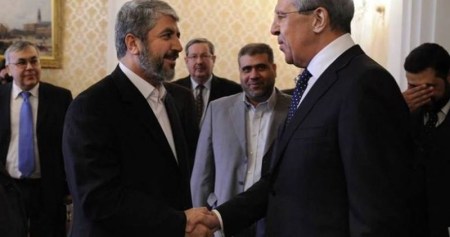
MOSCOW – Russia and the United States agree that Daesh, al-Qaeda and Jabhat al-Nusra are terrorist organizations but differ over blacklisting Hezbollah and Hamas, the Russian Foreign Ministry said.
Speaking to the Interfax news agency on Tuesday night, Russian Deputy Foreign Minister Gennady Gatilov said: “Our opinions coincide as regards to the main terrorist organizations. These are ISIS, al-Qaeda and Jabhat al-Nusra.”
But “we are not even discussing Hezbollah and Hamas with the Americans,” he added.
Moscow has routinely held senior-level contacts with Hamas officials and leaders.
Commenting on the Russian position, political analyst Abdul Sattar Qassem said: “Hamas cannot be compared to Daesh or al-Qaeda. It can only be viewed in terms of its resistance to the Israeli occupation.”
“The Israeli occupation and the USA are the real terrorists. They are fighting all those who stand in their way,” he added.
“Blacklisting Hamas as terrorist is unacceptable for Moscow. There is no evidence to corroborate the fact that Hamas is a terror group,” he said.
“Israel has been misleading the world into believing that Hamas is targeting Israeli civilians, which is not in fact the case,” the analyst stated.
“Hamas is a movement of national liberation that defends its people. It does not seek to wage wars for the sake of wars. It is engaged in a fight against an entity that colonized its motherland,” he explained.
However, “does Russia dare blacklist Israel as a terrorist entity for the crimes it has perpetrated against the Palestinians?” Qassem wondered. “It is not enough that Russia refuses to dub Hamas a terror group. It should dare include Israel on its terror list.”
“There is no colonizing power in the world but Israel. Occupation is in itself a form of terrorism,” the analyst further stated.
Coroner: Israel’s conditional release of bodies prevents autopsies
Ma’an – December 31, 2015
BETHLEHEM – A Palestinian coroner responsible for performing autopsies on the bodies of Palestinians killed by Israeli forces condemned on Thursday Israel’s conditional handover of bodies.
Head of Al-Quds University’s Institute for Forensic Medicine, Sabir al-Aloul, told Ma’an that the demand by Israeli authorities that Palestinian bodies be buried immediately after their return prevents autopsies from being carried out.
“Israel freezes the bodies of the Palestinian martyrs in mortuaries held at -35 degrees which prevents autopsy for 24 to 48 hours,” al-Aloul said.
The burial of the body of 38-year-old Baseem Salah — delivered on Tuesday — was reportedly delayed after coroners were unable to immediately autopsy his body, still frozen after the handover.
The Palestinian Ministry of Justice adopted a resolution to perform autopsies on the bodies of all Palestinians killed by Israeli forces in effort to document “Israeli crimes,” al-Aloul added.
Israeli authorities began holding the bodies of Palestinians killed while carrying out attacks on Israeli military or civilians in October. The practice has not been used with such frequency since the Second Intifada, according to rights group Hamoked.
Israeli Defense Minister Moshe Yaalon said on Nov. 5 that bodies would begin to be returned on a “case-by-case basis, where the main consideration is if there`ll be a massive funeral.”
Several bodies have been handed over since.
A number of Palestinian families on Wednesday refused in a letter the conditions proposed by Israel for the return of their relatives. One of several complaints issued by the signatories was that families should be allotted time to request an official autopsy on their dead.
Autopsy reports are used in official paperwork necessary to file cases against Israeli authorities at the International Criminal Court.
“The freezing prevents autopsy results that document the crime, which means a loss of important information for bringing Israel in front of the International Criminal Court,” al-Aloul told Ma’an.
A spokesperson for Israel’s Ministry of Defense was not immediately available for comment regarding the return of frozen bodies.
Al-Aloul said that Israeli conditions also prevented autopsies that would resolve accusations that Israel has been “stealing” organs from the bodies of Palestinians withheld by the state.
Palestinian delegate to the United Nations, Riyad Mansour, on Nov. 3 wrote a letter to the president of the UN Security council that included an accusation of organ harvesting by Israel.
The delegate referred to reports that the body of Muhannad Okbi — killed after reportedly killing an Israeli soldier in a Beersheba bus station — was returned to his family without corneas.
The allegations have yet to be confirmed.
According to autopsies al-Aloul had performed on Palestinians killed since Oct. 1 so far, the coroner said that those killed were “shot in the head and the chest many times from a very close distance.”
Some bodies also showed the use of expanding bullets — also known as “dum dum” bullets — the use of which is illegal under international law.
Israel has repeatedly denied claims that its forces use such bullets, though Palestinian medical examiners have on occasion documented their use.
The coroner also reported that a number of the bodies appeared to be returned in poor condition.
Israeli occupation authorities revoke ban on fanatic settler to enter al-Aqsa
Palestine Information Center – December 30, 2015
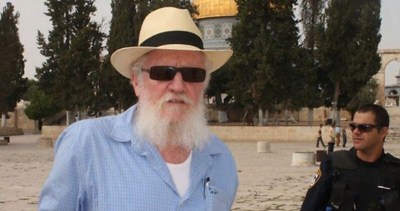 OCCUPIED JERUSALEM – Despite his dark past and his attempt oat bombing al-Aqsa Mosque in the 1980s, Israeli occupation authorities (IOA) allowed settler Yehuda Etzion to enter al-Aqsa Mosque after 30 years of prevention; he was also allowed to raise his hands as an aspect of worship while roaming the Mosque’s courtyards.
However, after the removal of the ban, Etzion breached the term of an agreement between Israel and Jordan with the sponsorship of the USA.
Etzion appealed the decision of denying him access into al-Aqsa Mosque for 15 days. The decision was issued by the Magistrate Court in Jerusalem, because he violated the “terms” of the recent Jordanian–Israeli agreement, which allows settlers to enter al-Aqsa Mosque but not to pray in it; however, Etzion raised his hands after entering the site as part of a religious ritual, prompting Israeli forces to remove him from the Mosque after Aqsa guards protested his act and insisted on him leaving the holy Islamic site.
In view of the serious unprecedented event after the Israeli judiciary allowed the settler to practice an act of worship violating the Jordanian-Israeli agreement, the Islamic Waqf management communicated with the Jordanian ambassador and Jordanian Ministry Of Awqaf and Islamic Affairs and informed them of the serious situation arising from storming the Mosque by such settlers who declare their intention to destroy the Mosque to build the alleged Temple in its place.
Escalation against al-Aqsa
The director of al-Aqsa Mosque, Sheikh Omar Kiswani told Qpress that the District Court’s decision is a serious escalation and a flagrant attack on al-Aqsa Mosque that would affect the region, stressing that the Israeli occupation must stop those settlers if it wants peace as it claims.
Lawyer and specialist of Jerusalem and Al-Aqsa affairs, Khalid Zabarqh, opined that the decision not to ban the settler Yehuda Etzion from al-Aqsa Mosque affects the legal rules that govern al-Aqsa Mosque, which acknowledge the entitlement of Muslims in the Al-Aqsa Mosque and praying there, and at the same time prevent others from doing that.
He charged that the Israeli judiciary has recently cohered with the Judaization schemes of the city of Jerusalem; as the judiciary began making decisions that help the settlement project, noting that, in conjunction with allowing Etzion to raise his hands as a signal of a prayer in al-Aqsa Mosque, the Israeli judiciary is looking into a decision to criminalize the chanting of Thakbir (Allah is the greatest) inside al-Aqsa Mosque.
Judaization dwarfs the Islamic right
Through his follow-up of the conduct of the Israeli courts, Zabarqh said that the occupation is trying through this device to widen the Judaization practice, in addition to dwarfing the Islamic right in al-Aqsa Mosque albeit in simple steps in order to endorse the occupation’s presence in it.
While the Israeli occupation allows the settlers to break into al-Aqsa Mosque knowing their plans and intentions to demolish al-Aqsa Mosque, it prevents many Palestinians from entering the Mosque, he pointed out.
Legitimize settlement
In this context, Sheikh Raed Salah, who has been barred from entering the city of Jerusalem and Al-Aqsa Mosque since 2007, confirmed that it is not permissible for any Israeli court to judge in any issue pertaining to the al-Aqsa Mosque; because it does not have sovereignty over it. Sheikh Salah believes that the Israeli court’s decision is null and void.
Sheikh Salah explained that the court is trying to legitimize through its decisions the incursions of settlers into al-Aqsa Mosque, in addition to legitimizing the construction of the alleged temple in place of the Mosque.
Regarding the renewal of his ban decision yesterday for an additional six months, Sheikh Salah said that the occupation which pretends that it respects the judiciary, issues an administrative military decision to prevent him from entering the city of Jerusalem, which he described as blatant injustice and racism.
The Israeli occupation forces prevented 12 Muslim deputies in the Israeli Knesset from entering the al-Aqsa Mosque, as well as banning 60 Palestinian women from praying in it.
Yehuda Etzion had tried to blow up the Dome of the Rock but al-Aqsa Mosque guards thwarted his attempt when a guard on one of its gates stopped him and searched the bag he was carrying and found it filled with explosives.
Etzion was a member of the Jewish secret movement that planned to assassinate the mayors of the West Bank. It adopted the bombing of the Nablus mayor Bassam Shaka’s car; the bombing resulted in the amputation of his legs.
MK Zoabi: Israelis are the real terrorists
Palestine Information Center – December 29, 2015
NAZARETH – The real terrorism is the one perpetrated by the Israeli occupation army and propped up by Israeli political institutions, Arab MK Hanin Zoabi said Monday.
 In a speech at a no-confidence motion in parliament against the Israeli government on Monday, MK Zoabi wondered: “Has any [Israeli] dared to accuse the criminals who burned [18-month-old] Ali to death and killed [his parents] Saad and Riham? Who has ever described them as psychopaths or terrorists?”
“Who has been killing and legitimizing the murder of Palestinian children? Aren’t they the ones who gave instructions for the execution of some 500 children in Gaza and the murder of 1,700 Palestinians in the latest Israeli offensive on Gaza?” Zoabi added.
“Who is the real terrorist? Who is more bloodthirsty? Who does rejoice at butchery?,” she said.
“Not only do Israelis kill and feign tears, shed blood and dance; they also kill and look for pretexts,” Zoabi further stated.
“The real terrorist is the Israeli army and the real terrorism is the one perpetrated by the Israeli occupation,” the MK concluded.
Israel threatens Brazil with cold diplomacy unless it accepts settler ambassador

Dani Dayan © Wikipedia
RT | December 28, 2015
Israel has warned Brazil that relations will deteriorate unless it accepts the former Israeli head of the West Bank settlement program as ambassador. The appointment was made four months ago and has still not been approved by Brazil’s government.
The country has continuously failed to give in to diplomatic pressure, leading Israel to up the stakes and issue threats.
Brazilian refusals have gone on since August, when the political appointment was made by Prime Minister Benjamin Netanyahu.
The main sticking point for Brazilian opposition to the appointment is the fact that Dani Dayan – the nominee – lives in the occupied West Bank, as well as being the former head of the Council of Jewish Communities of Judea and Samaria.
Like most [all] of the international community, Brazil’s leftist government believes the building of Israeli settlements on occupied Palestinian land to be illegal. But condemnation at all levels has not resulted in any action on the part of Israel.
Reda Mansour, Israel’s previous ambassador, left Brasilia last week, and now the Israelis are warning that if Dayan does not replace him, there will be consequences for bilateral relations.
“The State of Israel will leave the level of diplomatic relations with Brazil at the secondary level if the appointment of Dani Dayan is not confirmed,” Deputy Foreign Minister Tzipi Hotovely said in an interview to Israel’s Channel 10, according to Reuters. Israel has refused to nominate another candidate for the position.
Hotovely then said Israel would continue to press Brasilia through various means, including the Brazilian Jewish community, as well as direct appeals from Prime Minister Benjamin Netanyahu, who is one of the more outspoken defenders of Israel’s settlement-building in the West Bank.
According to Hotovely, as cited by the Jerusalem Post, this lobbying will take place with the aim of showing that Dayan is “a man who is respectable, worthy, and accepted across Israel’s political spectrum.”
Hotovely added that in the event of Brazil’s refusal, there will be “a crisis in relations between the two countries, and it is not worth going there.”
There has been no comment yet from President Dilma Roussef on whether Brasilia would cave to Israeli demands, but a senior source in the Foreign Ministry told Reuters they “do not see that happening.” And if Dayan is not, in fact, named the next ambassador, the only real alternative will be to have the next highest-ranking official acting in his stead.
Dayan for months remained silent, but on Saturday, in an interview to Channel 2, attributed Brazil’s refusal to “classic BDS” – or boycott, divestment and sanctions. He believes the entire situation owes itself to pressure from Israeli activists, Palestinians and select circles in Brazil.
Tensions between the two countries have been on the rise since the last administration, when Luiz Inacio Lula da Silva worked to warm Brazilian ties with Iran. They rose further last year when an Israeli Foreign Ministry spokesman labeled Brazil “a diplomatic dwarf.” This was after Brasilia recalled its ambassador from Israel as a show of protest over the continuing military offensive in Gaza.
Jewish Terrorists Burned An Israeli Church, Now Israel’s Government Is Screwing The Church Out Of The Money It Needs To Rebuild
Failed Messiah | December 25, 2015
 The Church of the Multiplication of Loaves and Fishes overlooking the Sea of Galilee in better times
National Geographic has a new article on Jewish extremist violence against Christians in Israel and the West Bank.
Much of it has already been long reported elsewhere, including here …
But one point made in the National Geographic report, which primarily focuses on the Church of Multiplication of Loaves and Fishes hate crime arson, hasn’t been made, and that point arguably shows how dishonest Israel’s government really is:
… Israeli Prime Minister Benjamin Netanyahu quickly designated the fire as a terrorist attack, making the church ineligible to draw on insurance but paving the way for government compensation. Two months later, the Israeli Tax Authority declared that the violent event did not qualify as terrorism, and therefore could not receive government funding.
When Israeli President Reuven Rivlin visited the church in early September, just before meeting Pope Francis in Rome, he promised to help reverse that decision. “He was shocked by the extent of damage,” said Father Matthias. “Since then there have been a lot of meetings with the government, but no compensation.”
In the meantime, a group of Israeli rabbis started a crowd-funding campaign that raised $13,000 so that the church can start work on a new reception area for pilgrims. Rabbi Alon Goshen-Gottstein, director of the Jerusalem-based Elijah Interfaith Institute, led the effort that included the head of the Knesset, Israel’s parliament.
“Israel still protects the rights of minorities, and events like this overshadow this fact,” said Rabbi Goshen-Gottstein, noting that Iraq and Syria are in the midst of ethnic cleansing. “These are disenfranchised youth with very few leaders who are messianic activists riding on waves of suspicion and ignorance.”
[These rabbis linked to Goshen-Gottstein are overwhelmingly non-Orthodox and make up only a small group. Despite public tittering against the hate crime by more mainstream non-Orthodox Jewish leaders, the US-based non-Orthodox movements and representative bodies like the UJA-Federation did not kick in to help this church (or, for that matter, any of the other vandalized churches and mosques) to be repaired.]
Some Israelis fear that the small group of violent extremists, made up mostly of young West Bank settlers, has been emboldened by the lack of prosecutions.…
Assaf Sharon, a philosophy professor at Tel Aviv University who has written about the history of Jewish terrorism, said the youth “are surrounded by institutions that condone, protect, and support them. And there is certainly authority behind them, including rabbis they look up to.”…
Follow the links posted below to read up on some of those rabbis the Jewish terrorists look up and follow.
As for the government, and especially Prime Minister Netanyahu (who is arguably the most dishonest man ever to hold high office in Israel), to use the Church of Multiplication of Loaves and Fishes hate crime arson for your own political ends and causing the church to lose its insurance money in the process, is truly vile. The Netanyahu needs to immediately pay to fully repair the church. If it doesn’t do so, no excuse – not even the standard (and often true) complaint about layers of Israeli government bureaucracy – should be accepted.
Related Posts:
Syria: Has Anyone Stepped Back from the Brink?
By Michael Jabara CARLEY | Strategic Culture Foundation | 26.12.2015
John Kerry, the US Secretary of State, recently visited Moscow to discuss the Syrian crisis with his colleague Sergei Lavrov and President Vladimir Putin. Journalists observed handshakes, smiles, even hearty laughter, between Kerry and his Russian counterparts. Syrian President Bashar al Assad does not have to resign immediately, Kerry declared, and the United States is not trying to isolate Russia. What good news, and what a surprise for the Russians. The Moscow show seemed a great success. Kerry strolled along Stariy Arbat Street, met smiling Russian pedestrians and bought souvenirs to take home. A few days later the UN Security Council passed a resolution, calling for a ceasefire and negotiations. Russian and western journalists alike now say there is some hope to avoid the worst in Syria. And as you may already know, if the United States wants a ceasefire, it’s because their «moderate» Jihadist allies are getting beaten up now by the Syrian Arab Army backed by Russian air support.
Is cautious optimism warranted about a Syrian peace? It is hard to see how. Kerry may say whatever he wants in Moscow, but when he gets back to Washington, he sings a different song, or his colleagues do. His boss, President Obama, said «Assad has to go» only a few days after Kerry returned home. And then there is the new phantasmagorical story published by Seymour B Hersh, the muckraking US journalist, who has revealed that not everyone inside the US government is brain dead. It’s a remarkable discovery when you think about US foreign policy. Some military officials, and no less than the former Chief of Staff, General Martin Dempsey, were actually indirectly, and very secretly, passing military intelligence to the Syrian government to help it fight Daesh, Al-Qaeda and allied Jihadist forces operating in Syria. At the same time, the CIA, with Obama’s support, was sending arms hither and thither in Syria to help the Jihadists overthrow the Assad government.
General Dempsey left office in September 2015 and was replaced by General Joseph Dunford, a true blue Russophobe, who says Russia is an «existential threat» to the United States. It is a classic Washington response: the US aggressor accuses its intended victim of aggression. Just the other day (22 December), the United States slapped on gratuitous new sanctions against Russia. It’s the same old pretext: Russian «aggression» in the Ukraine.
Yet another US provocation, you might think, as Russia searches for a peaceful settlement of the Syrian war. The Russian government is taking a sensible position, but in the present circumstances, is a negotiated peace a real possibility? If the war in Syria were simply a civil war, as is often repeated in the media, you could encourage the belligerents to put on suits and ties and sit down at a table to negotiate a settlement. Unfortunately, the war in Syria is not a civil war: it is rather a proxy war of aggression led by the United States, Britain, and France (until the Paris massacre in November), and pursued vigorously in the region by Turkey, Saudi Arabia, Qatar, Jordan, and Apartheid Israel.
Turkey is playing a dirty, evil role. It provides arms and supplies across its borders for Daesh in Syria. Oil taken from Syrian wells by Daesh travels in the opposite direction, sold at cut rate prices, to provide revenue to the Jihadists for their war against Assad. It is estimated that Daesh was obtaining $40 millions a month from exported oil (before Russian intervention), but this is a bagatelle in terms of the money necessary for the Jihadists to wage war against Syria. Hundreds of millions are required. Saudi Arabia and Qatar are important suppliers and financiers of the Salafi Jihadist movement. Jordan permits training of Jihadists on its territory and allows passage across its frontiers into Syria. Israel also provides support from the occupied Golan territory, even providing medical care to wounded Jihadists. A coalition of states, four of which are NATO members, is waging a war of aggression against Syria. Against this array of deadly enemies, the Syrian government and the Syrian Arab Army, in a remarkable feat of arms, has been able to hold out for more than four years. President Assad has proven his courage and tenacity as a leader by refusing US summons to resign and by staying in Damascus to share the personal danger which all Syrians must endure simply to live in their country. No wonder Obama wants to get rid of Assad before talk about Syrian elections for he would almost certainly win them.
Sputnik in Moscow has estimated that there are as many as 70,000 foreign Jihadists fighting in Syria.

These forces appear for the most part are well motivated, supplied largely with US weapons and deeply entrenched in various parts of Syria. Since the Russian intervention on the side of the Syrian government, progress has been made in rooting out Jihadist forces, but as long as supply routes remain open across Turkey, Iraq, Jordan, Israel, even Lebanon, the war in Syria is not going to end.
Turkey’s role is particularly dangerous. It is a NATO member and it uses this privileged position to commit acts of aggression against Iraq and Syria. It shot down a Russian warplane in a well-planned ambush, likely with US connivance, and then ran to hide in NATO’s skirts. Apparently, the Turkish government hoped to sabotage budding European cooperation with Russia against Daesh, or to provoke a NATO-Russian war, as insane as that might seem. Other NATO members, the United States, France, and Britain, have also been deeply involved in the proxy war against Syria. Indeed, after the destruction of Libya, it has been reported that NATO planes were secretly used to transport Jihadists and Libyan arms to other Middle Eastern fronts. NATO members are effectively allied with Daesh and its Al-Qaeda derivatives against the Syrian government.
To be sure, the United States and its European vassals have attempted to cover up their links to the Jihadist war in Syria by launching make-believe air attacks on Daesh targets, occasionally bombing a caterpillar tractor here or there and blowing up a lot of sand in people’s eyes. Russian intervention exposed the double game of the United States and changed the balance of military forces in Syria.
Even now however, the US air force sends warning messages to Jihadist truck drivers to get away from their vehicles before it attacks them. Or it refuses altogether to attack trucks carrying Daesh oil, claiming it’s private civilian property. How preposterous! Since World War II, when has the United States hesitated to attack civilian targets? It is understandable that Obama and the CIA, having been caught red-handed in Syria, are furious with Putin for exposing them. Nevertheless, the Russian government has offered the United States, a porte de sortie, pushing for an anti-Jihadist alliance and peace talks to settle the war.
Peace is a marvelous idea and the US escape route, a practical gesture, but how is Foreign Minister Lavrov going to get Saudi Arabia, Turkey, Qatar, Jordan, and Israel, not to mention the United States and Britain, to stop supporting the Jihadist movement in Syria and Iraq? Talk about an impossible alliance: it’s like taking a writhing nest of asps to your breast and hoping they won’t bite you. Are such hopes realistic? «Maybe not but that’s diplomacy,» Lavrov might respond: «we have to try nevertheless». These days it takes infinite patience and great theatrical skills to be a Russian diplomat. Russia is trying to finesse the United States into dropping its support of «moderate» Jihadists. In fact, such moderates do not exist.

Neither does the so-called Free Syrian Army (FSA). The Jihadists decapitate a few hapless victims, and FSA volunteers run away in horror leaving their arms for Daesh. Or, they laugh at the infidels’ stupidity and go over, arms in hand, to the Jihadist side.
Even if Russia could get real commitments from the United States, which is as yet quite uncertain, what is to be done about Turkey, Saudi Arabia and the Gulf states? And what is to be done with all the foreign Jihadists in Syria? Are these terrorists and war criminals going to be encouraged to return to the 40+ different countries whence they came to stir up violence there? And what is to be done about the Syrian Jihadists, though there is no open source information about their numbers? Will they be allowed to remain at large, or worse, will they be recognised as a legitimate Syrian opposition?
Even an anti-Jihadist coalition of willing members will have hard work rooting out Daesh and its allies. But the coalition of asps which Russia is trying to organise is composed of Daesh supporters. How is that going to work? One fears not at all well since the would-be alliance members, with the possible exception of France, have not abandoned their backing of Daesh, whatever one hears to the contrary notwithstanding. The United States remains the chief culprit continuing to pursue its two-faced, dangerous policies.

«The four core elements of Obama’s Syria policy remain intact today», Seymour Hersh says: «an insistence that Assad must go; that no anti-IS (Islamic State) coalition with Russia is possible; that Turkey is a steadfast ally in the war against terrorism; and that there really are significant moderate opposition forces for the US to support».
Policy based on false premises invariably leads to failure. Obama’s policy is no exception. Assad is a courageous leader of Syrian resistance against the Jihadist invasion. The only possible successful coalition against Daesh, Al-Qaeda and their affiliates is with Assad and with Russia. Turkey is a dangerous provocateur, playing with matches amongst open kegs of gunpowder, trying to drag NATO into a deeper de facto alliance with Daesh or even war with Russia. Finally, there are no «moderate» Jihadist forces in Syria. The Free Syrian Army barely exists at all, and the so-called moderates are no less murderous than their Daesh allies.
One cannot fault the Russians for trying to organise an anti-Jihadist alliance in Syria, but their potential allies, apart perhaps from the apparently repentant French, are all snakes in the grass. And Obama, the Nobel Peace Prize winner, is the biggest snake of all. «Do you realise what you have done?» Putin asked at the UN in September. Not yet apparently, reports to the contrary notwithstanding. But then, as we know, there are none so blind as those who will not see.
Israeli soldiers kill Palestinian woman in Silwad
IMEMC News – December 25, 2015
 Israeli soldiers killed, on Friday evening, a Palestinian woman while driving her car near the main entrance of Silwad town, northeast of the central West Bank city of Ramallah.
The slain Palestinian woman has been identified as Mahdiyya Mohammad Ibrahim Hammad, 38. She is a married mother of four children.
Although the Israeli army claimed “she attempted to ram soldiers with her car,” eyewitness confirmed she was at least 30 meters away from the military roadblock, when the soldiers opened fire on her.
They added that the woman was not even speeding when the soldiers opened fire on her car, and that the army fired many live rounds at her.
Following the shooting, the soldiers left the woman to bleed to death, and held her body for more than two hours before handing her to the Palestinian side, near the Beit El military roadblock.
The family said the funeral ceremony and procession will be held on Saturday, after the noon prayers in Silwad.
The Palestinian Health Ministry said Hammad was shot with two live rounds in her face, five rounds in the chest and two in the pelvis.
Also on Friday, the army killed a young Palestinian man, identified as Hani Rafeeq Wahdan, 22, east of Gaza City. Wahdan was shot with a live round in the head.
The Palestinian Health Ministry said 137 Palestinians, including 26 children and 7 women, have been killed by Israeli fire since October 1, while more than 15000 have been injured, including 4500 who were shot with live fire and rubber-coated metal bullets.
Amnesty International: Imperialist Tool

By Prof. Francis A. Boyle | thewallwillfall
July 31, 1998
Dear Amnesty Friends:
I am in receipt of the response by three members of the AIUSA Middle East Coordination Group to my message that was entitled “NGOs As Western Tools.” You will note that they never denied any of the basic facts set forth in my original message. When Israel invaded Lebanon in 1982 and murdered 20,000 Arabs/Muslims with the full support of the United States, both Amnesty International and AIUSA said absolutely nothing at all despite vigorous efforts by AIUSA Members to get them both to say and to do anything. When it became clear that AIUSA was not going to say or do anything about Israel’s wholesale slaughter of Arabs/Muslims in Lebanon because of the marked pro-Israel bias by the AIUSA Staff, Board, and Funders, I called the Irish Nobel Peace Prize Winner Sean MacBride at his home in Dublin and asked him to intervene with AI/London. What little AI/London said and did about 20,000 Arabs/Muslims in Lebanon murdered by Israel with the full support of the United States was due to Sean MacBride.
MacBride then convinced the then AI Secretary General to appoint me a Consultant to Amnesty International on the human rights situation in the Middle East. In that capacity, I attended the founding meeting of what would become the AIUSA Middle East Coordination Group. In other words, I was one of the founders of the AIUSA Mid-East Co-Group, some of whose members are now defending its work. At that founding meeting I said quite emphatically that Amnesty International and AIUSA would have absolutely no credibility whatsoever in the Middle East unless they dealt forthrightly and vigorously with violations of the human rights of Arabs and Muslims by Israel, and, in particular, Israeli atrocities against the People of Lebanon and the Palestinian People. Soon thereafter, I found out that the Members of the AIUSA Mid-East Co-Group had been instructed to have nothing more to do with me by a direct order coming from the AIUSA Board of Directors.
It is fair to say that Amnesty International has quite recently released some reports dealing with Israeli violations of human rights of the Palestinian People and the Lebanese People. But Israel has been consistently murdering, torturing and destroying the Palestinian People since at least the time when the occupation of their lands began in 1967–and with the full support of the United States Government. And only now has Amnesty International got around to condemning it. Almost a decade ago while on the AIUSA Board, I tried to get AI/London and AIUSA to act on the basis of the infamous Landau Report whereby the Israeli Government officially sanctioned torture against Palestinians. Over a decade ago while on the AIUSA Board, I pointed out that this made Israel the only state in the world to officially sanction torture. It is nice to see that a decade later Amnesty International has finally agreed with me and said something about it.
Likewise, Israel has been rampaging around Lebanon with the full support of the United States to the grave detriment of the Lebanese People and Palestinians living there since at least the time when Israel first invaded Lebanon in 1978. The primary reason why Amnesty International has put out these latest reports condemning Israeli human rights violations in Lebanon and against the Palestinian People after decades of silence is because there are now several other human rights organizations which have acted against Israel when AI/London and AIUSA refused to act because of their marked pro-Israel bias. When it comes to protecting the human rights of Palestinians, Lebanese, Arabs/Muslims from atrocities by Israel, the United States, and Britain, AI/London and AIUSA have always been too little, too late, and on purpose.
While on the AIUSA Board I once saw the itinerary drawn up by AIUSA for the visit to the United States by the then AI Secretary General coming from London. On the list was almost every major pro-Israel group in New York and Washington and about one Arab Group. Given their standard operating procedures, I am confident the pro-Israel groups threatened the AI Secretary General that they would have their members withhold or reduce their contributions to AI and AIUSA if AI/London did not reign in its pathetic, pitiful, and meager criticisms of Israel. While I was on the AIUSA Board, AIUSA paid about 20% of the budget for AI/London. He who pays the piper calls the tune.
You will also note that the three AIUSA Mid-East Co-Group members’ response to my original message said absolutely nothing at all about the scandalous Kuwaiti Dead Babies Report and Campaign that both Amnesty International and AIUSA used for the purpose of promoting war against Iraq. As a Member of the AIUSA Board, I received a pre-publication copy of the Dead Babies Report. I read it immediately and quite carefully. First, this report contained technical errors that should have precluded its publication. Second, even if all these sensational allegations had been true, it was clear that publication of this report at that critical moment in time (December 1990) would only be used by the United States and Britain to monger for war against Iraq. I expressed these opinions in the strongest terms possible and that this report should not be published because it was inaccurate; or that if for some reason it were to be published, it must be accompanied by an errata sheet. Amnesty International published the Dead Babies Report anyway despite my vigorous objections, and launched their Disinformation Campaign against Iraq. From this episode I could only conclude that AI/London deliberately intended the Dead-Babies Report and Campaign to be used in order to tip the balance in favor of war against Iraq.
This is exactly what happened. In January of 1991 the United States Senate voted in favor of war against Iraq by only five or six votes. Several Senators publicly stated that the AI/AIUSA Dead Babies Report and Campaign had influenced their votes in favor of war against Iraq. That genocidal war waged by the United States, the United Kingdom and France, inter alia, during the months of January and February 1991, killed at a minimum 200,000 Iraqis, half of whom were civilians. Amnesty International shall always have the blood of the Iraqi People on its hands!
Once it became clear that there never were any dead babies in Kuwait as alleged by Amnesty International, AI/London proceeded to engage in a massive coverup of the truth. For all I know, the same people at AI/London who waged this Dead-Babies Disinformation Campaign against Iraq are still at AI/London producing more disinformation against Arab/Muslim states in the Middle East in order to further the political and economic interests of the United States, Britain, and Israel. Because of its Dead-Babies Disinformation Campaign against Iraq and its ensuing coverup, Amnesty International will never have any credibility in the Middle East!
During the past eight years, about 1.5 million People in Iraq have died as a result of genocidal sanctions imposed upon them primarily at the behest of the United States and Britain, including in that number about 500,000 dead Iraqi children. While on the AIUSA Board of Directors, I tried to get them and AI/London to do something about this genocidal embargo against the People of Iraq, and especially against the Iraqi Children. Both AI/London and AIUSA adamantly refused to act despite the grievous harm that their Dead-Babies Disinformation Campaign had inflicted upon the People of Iraq. It was clear to me at the time that there was no way AI/London and AIUSA were going to take on Britain and the United States on behalf of the completely innocent People of Iraq.
Now we are told that there is something in the AI Mandate that precludes AI action against such genocidal economic embargoes. Of course this is nonsense. While I served on the AIUSA Board, one of our Board Chairs personally put me in charge of handling Mandate issues for the AIUSA Board. I know all about the Mandate. It was my responsibility.
Generally put, when AI/London and AIUSA want to take action on a matter because it will bring them publicity, money, members, and “influence,” they pay no attention whatsoever to their so-called Mandate. Likewise, when AI/London and AIUSA decide for political or economic reasons that they will not work on human rights problem, they trot out their so-called Mandate to justify non-action.
The same type of bogus argument was used by AI/London and AIUSA to prevent the organizations and their memberships from taking any effective action against the criminal apartheid regime in South Africa that had been oppressing millions of Black People for decades. To the best of my knowledge, Amnesty International is the only human rights organization in the entire world to have refused to condemn apartheid and work against it. The spurious argument made here was that Amnesty International could take no position on a type of government. But the truth of the matter was that Amnesty International is headquartered in London, and AIUSA is headquartered in New York and Washington. The biggest political supporters of the criminal apartheid regime in South Africa were the governments of Britain, the United States, and Israel. Likewise, the biggest sources of economic investments in the criminal apartheid regime in South Africa came from Britain and the United States. Once again, he who pays the piper calls the tune.
There was no way AI/London and AIUSA were ever going to work against the political and economic interests of Britain, the United States, and Israel operating together in support of the criminal apartheid regime in South Africa. So AI/London and AIUSA concocted this spurious rationale for non-action. The same is being done today by AI/London and AIUSA to justify their non-action in light of the genocidal economic embargo imposed now primarily by the United States and Britain against the People of Iraq. There is no way AI/London and AIUSA will ever act against the political and economic interests of the United States, Britain, and Israel in the Middle East, and certainly not on behalf of the People of Iraq, whose blood AI and AIUSA now have on their hands.
Notice too how this latest specious justification for AI non-action fits in quite neatly with the strategic objectives of the United States around the world. Right now the United States Government is primarily responsible for imposing genocidal economic sanctions against the People of Iraq, the People of Cuba, and the People of North Korea. Amnesty International will do nothing at all about it. In other words, by their deliberate non-action AI and AIUSA are supporting the genocidal policies of the United States, Britain and Israel against these Third World countries–just as AI and AIUSA supported the criminal apartheid regime in South Africa by their deliberate non-action. If you want to do effective human rights work in opposition to the imperial, colonial and genocidal policies of the United States, Britain, or Israel, there is no point working with Amnesty International or AIUSA. You will simply be wasting your time, your efforts, your resources, and your enthusiasm.
Permit me to further substantiate this assertion that Amnesty International and AIUSA are imperialist tools by reference to other areas of the world. It is well known that AI/London has done little effective work to help Irish Catholics in Northern Ireland. As Sean MacBride once said: Amnesty International will never treat Irish Catholics fairly so long as it is headquartered in London. The long and sordid history of AI/London non-action in the face of genocidal violations of the most fundamental human rights of Irish Catholics living in Northern Ireland by Britain is well known among Irish Americans and Irish People living in Ireland, Northern Ireland, and around the world. For example, a letter by a former AI Secretary-General sabotaged public support for the defense of Joe Doherty here in the United States. Just recently, it required a massive internet campaign to force AI/London to do anything at all to save the life of Loinnir McAliskey and to obtain the freedom of Roisin McAliskey.
Let me now move from the British colony in Northern Ireland to the American colony in Puerto Rico. While I was still on the AIUSA Board, a fellow Board Member asked me to draft a resolution for adoption by the Annual General Meeting (AGM) of AIUSA calling for a comprehensive AI Campaign against human rights violations by the United States in Puerto Rico. This resolution passed the AIUSA/AGM overwhelmingly, and without any dissent that I could detect. I was then invited by Amnesty International/Puerto Rico to give the Keynote Address at their Annual General Meeting in San Juan on the subject of the right of Puerto Rican political prisoners in American jails to be treated as prisoners of war. Immediately thereafter, AI/London and AIUSA applied massive pressure on AI/Puerto Rico to prevent this speech. AI/Puerto Rico refused to cave in.
I went down to Puerto Rico to attend their AGM, gave the Keynote Address, and also investigated U.S. human rights violations in Puerto Rico, including torture, summary executions and disappearances. Upon my return home, AIUSA attempted to stiff me out of my expenses despite the fact that I was attending the AI/Puerto Rico AGM in my official capacity as an invited AIUSA Board Member. Perhaps I missed it due to the press of other duties at the time, but I am not aware of any comprehensive Amnesty International Campaign against U.S. human rights abuses in Puerto Rico as overwhelmingly called for by the AIUSA/AGM.
Finally, let me say a few words about the deliberate non-action of AI/London and AIUSA on behalf of indigenous peoples living in the United States and its imperial ally, Canada. Back when I was on the AIUSA Board, AI/London decided to launch an international campaign on behalf of indigenous peoples. As usual, I received a pre-publication copy of the campaign material. On reading it, I immediately noticed that almost nothing was to be done to help the indigenous peoples living in the United States and Canada. I protested this to AI/London and AIUSA, and demanded that the indigenous peoples living in the United States and Canada be added as an integral part of this campaign. To the best of my knowledge, this was never done. I leave it to the indigenous peoples living in the United States and Canada to decide for themselves how helpful AI/London and AIUSA have been to them.
I will not belabor the obvious any longer in this brief Memorandum. But based upon my over sixteen years of experience having dealt with AI/London and AIUSA at the highest levels, it is clear to me that both organizations manifest a consistent pattern and practice of following the lines of the foreign policies of the United States, Britain, and Israel. You can certainly see this in all of AI’s non-work with respect to the Middle East, Northern Ireland, Puerto Rico, South Africa, indigenous peoples living in North America, etc. Effectively, Amnesty International and AIUSA function as tools for the imperialist, colonial and genocidal policies of the United States, Britain, and Israel.
There are many people of good will and good faith working at the grassroots level of Amnesty International and AIUSA who genuinely believe that they are doing meaningful and effective work to protect human rights around the world. But at the top of these two organizations you will find a self-perpetuating clique of co-opted Elites who deliberately shape and direct the work of AI and AIUSA so as to either affirmatively support, or else not seriously undercut, the imperial, colonial, and genocidal policies of the United States, Britain, and Israel. The Leadership Elites of AI/London and AIUSA have always considered themselves to be the so-called “loyal opposition” to the imperial, colonial, and genocidal policies of the United States, Britain and Israel. I would ask the people at the grassroots of AI and AIUSA whether you want to continue being part of the “loyal opposition” to imperialism, colonialism and genocide perpetrated by the United States, Britain and Israel? It is not for me to tell those people of good faith and good will currently working with AI/London and AIUSA what to do. But I have found other organizations to work with and support.
Francis A. Boyle, Professor of International Law, Board of Directors, Amnesty International USA (1988-92), Co-Founder AIUSA Middle East Coordination Group, Consultant to Amnesty International on the Middle East
Cover Image: Courtesy of WrongKindofGreen.
Bethlehem-area village sealed by Israeli military for weeks

Ma’an – December 23, 2015
BETHLEHEM – The movement of residents in Ras Al-Wad southwest of Bethlehem has been cut off for weeks by Israeli military forces, locals said Wednesday.
A resident told Ma’an that the forces closed off the main entrance to the small village with large mounds of dirt around three weeks ago, and the road has remained closed since.
The road was used by residents in Ras al-Wad to access a main highway nearby. While they have been able to find an alternate route — a one-way dirt road that connects to the nearby village of Beit Sahour — access to the highway is severely limited, locals said.
“They just don’t want Arabs accessing the highway,” a Ras al-Wad resident told Ma’an.
An Israeli army spokesperson did not have immediate information on the closure of Ras al-Wad, but in the past has told Ma’an that Palestinian towns and roads were sealed in accordance with “security measures” taken in the area.
The isolation faced by Ras al-Wad residents has taken place in Palestinian areas throughout the occupied West Bank and East Jerusalem that have been cut off in recent months.
Following attacks carried out by Palestinian individuals on Israeli military and civilians that began in October and have continued into December, the military has been sealing villages and cities in the area around the attack or hometown of attacker.
In the West Bank, where Palestinian movement is already placed under a myriad of Israeli restrictions, the recent closures have had wide-scale repercussions in what rights groups have termed collective punishment.
The military never contacted residents of Ras al-Wad with warning or reason of the closure, and locals told Ma’an they have no idea how long the dirt mounds will remain in place.
While Palestinians in other areas have removed dirt mounds shortly after their placement, locals told Ma’an that Ras al-Wad residents have yet to remove them.
Ras al-Wad is a relatively quiet village and locals told Ma’an that residents generally avoid confrontation with the military, locals said.
“They’re not confrontational and they’re not political,” a resident told Ma’an. “They would just rather try to live their lives than deal with any trouble.
“No one from the village has gone to move the dirt mounds, everyone here just turned their head and found alternate routes,” the resident continued.
Featured Video

Why the U.S. Should Pull Back From the First Island Chain
or go to
Aletho News Archives – Video-Images
From the Archives
Only 19.7% of Americans agree with US State Dept on Israeli settlements
… Most American adults of voting age don’t appear willing to reject the applicability of international law to Israel’s ongoing colonization of occupied territories in East Jerusalem, the West Bank and Golan Heights. … Full article
Blog Roll
 Aletho News
- British Government Employees Were Fact-Checking the News at the BBC. Nobody Told You.
- Albania on fire: who’s behind the riots?
- Egypt’s Civil Democratic Movement rejects involvement in regional war
- Egypt collaborates with Israel to build ‘Green Rafah’ project over erased Palestinian city
- Rising fuel prices and shortages have helped drive ongoing protests and rioting in France
- Tokyo protests demand Takaichi’s resignation over support for ‘Israel’
- Jennifer Kavanagh: Why the U.S. Should Pull Back From the First Island Chain
- Yemen denounces international community’s silence on Saudi aggression, siege
- UAE and Saudi Arabia move toward renewed coordination against Sanaa
- How Iran’s two-week retaliatory strikes exposed cracks in US military architecture in Persian Gulf
- If Americans Knew
- More on how Bari Weiss is using CBS on behalf of Israel
- What the UK Is Doing to Pro-Palestine Novelist Sally Rooney Is an Act of Orwellian Villainy
- ‘We will build palaces for Jews in Gaza’: Right-wing activists establish new outpost near border
- ‘You see us burning, you stay silent’: Family’s agony over mother and sons burned to death in Gaza tent
- Israel keeps Palestinian journalist Bushra al-Tawil in isolation for 46 days
- US-Israel integration plan puts US military tech in Israel’s hands
- Israeli Strike Burns Gaza Mother Alive in Front of Toddler, ‘Without Generating Any Headlines’
- ‘The Israel Experience with Mike Huckabee’: The Ambassador’s Family Sells Trips to Israel
- As Gazans carry out mass burial, food insecurity is getting worse – Daily Update
- Israeli rabbi permits occupiers to steal Palestinian olive harvest in West Bank
- No Tricks Zone
- Predictions Made By Renowned Climate Proifessor Over Past Decades Have Been Proven To Be Poor
- New Study Suggests Large Regions Of The Pacific Ocean Have Been Cooling For The Last 80 Years
- Germany’s Green Energy Debacle: High Energy Costs Force Kahla Porzellan to Close After 182 Years!
- New Study: 50 Years Of The Most Aggressive ‘Net Zero’ Policies Can Only Affect The Global Climate By 0.03°C
- US September “Heat” Was No Record…Many Records Set Decades Ago
- Latest European Green Energy Debacle; Portugal’s Largest Flagship Solar Park Insolvent!
- Green Energy Debacle: German Expert Professor Fritz Vahrenholt Warns Of Severe Economic And Social Consequences
- Two More Paleo Reconstructions Affirm Meters-Higher Sea Levels Across Ireland, Brazil 7000-6000 Years Ago
- New Study: Earth And Venus Surface Warmth Largely Explained By Convection And Lapse Rate, Not CO2 Or Radiation
- 2025 Nature Paper Claiming Worsening Global Drought Gets RETRACTED …Heavily Flawed

