Israeli forces kill Palestinian woman, 72, after alleged car attack
Ma’an – November 6, 2015
BETHLEHEM – Israeli forces shot and killed an elderly Palestinian woman after an alleged vehicle attack in Halhul, north of Hebron on Friday.
A spokesperson at the Shaare Zedek Medical Center in Jerusalem told Ma’an that the woman, aged 72, was dead upon arrival at the hospital.
Israeli media reported that the woman attempted to run over Israeli soldiers in Halhul and was shot and seriously wounded by Israeli forces.
The Jerusalem Post said that a “suspicious vehicle” drove at Israeli soldiers, with forces opening fire at the car.
No Israeli injuries were reported.
The victim was identified as Tharwat al-Sharawi, 72. Her husband, Fouad, was killed by Israeli forces during the 1st Intifada.
Two Palestinian youths who were standing at a gas station nearby were injured as Israeli gunfire shattered the car’s windows.
Both youths were taken to the al-Ahli hospital in Hebron to treat their injuries, which were described as moderate.
Al-Sharawi was the 74th Palestinian to be killed since the beginning of last month, the majority of whom were shot dead by Israeli forces during alleged, attempted, and actual attacks on Israeli military and civilians.
On Wednesday, Ibrahim Skafi, 22, was also shot dead by Israeli forces in Halhul after a vehicular attack that left a 20-year-old border policeman seriously injured.
The town of Halhul, north of Hebron city, was sealed by Israeli forces following the attack.
Recent attacks come as Israeli intelligence said earlier this week that a recent lull in violence was unlikely to be long-term, citing high levels of frustration among the Palestinian public.

Tharwat al-Sharawi, 72.
Who Will Blink in Syria? Russia? Or the US?
By Paul Larudee | Dissident Voice | November 5, 2015
The first to die will be US troops. Russians will be made to appear as the killers, but the agents will probably be ISIS, Al-Qaeda (aka al-Nusra), Turks, or the Americans themselves. I’m not ruling out that the Russians might actually do the job, especially if the Americans order their 50 soldiers to the most likely Russian bombing targets and then dare the Russians to hit them. But most likely, the US will do the job itself and not take a chance that the Russians might miss.
Those dead American soldiers are needed as bargaining chips so as to up the ante. Next, Russians have to die, with or without a mutual secret agreement to that effect.
The strategy is based upon the assumption that if the stakes become high enough, the other side will back down. It is called brinkmanship, and its best known example was the 1962 Cuban missile crisis. One or both sides may believe that they are bluffing, but if their bluff is called are they really going to back down? Or are they going to up the ante so much that they end up in a real war, where they are required to respond to the other’s actions with ever-escalating effect?
I do not think the Russians will blink. They have had enough of American encroachment. They will not stand for further NATO poaching of their erstwhile Warsaw Pact allies, and certainly not in Ukraine, which is to Russia roughly as Canada is to the US. Similarly, the port of Tartus in Syria is Russia’s only Mediterranean naval base, and Syria is currently its only ally in the Arab world. Russia has much more at stake than the US, and is therefore much less likely to back down. In fact, Russia has clearly made a major commitment to the preservation of Syria, and waited a long time before doing so, which is another sign that they will not shrink soon from their decision to stay the course.
On the American side, the stakes are much less well defined. Syria is part of the post-USSR assertion of US global dominance, as advocated mainly by the neoconservative strategic movement, closely allied with Israeli and Zionist interests, which benefits from the Israel Lobby clout in the US. From its base in the Congress and the National Security Agency, this movement has made inroads into the intelligence services, the State Department and the Department of Defense, mainly at the top echelons. (Elected and appointed positions are the most vulnerable to lobbyist penetration.)
Following the dissolution of the Soviet Union, the neocons argued that the US should use its military might to mold the world into US-controlled fiefdoms. Plans for such domination have been variously described in the “Clean Break” proposal, the “Project for a New American Century”, and the “New Middle East”. They begin with the destruction (aka “regime change”) of seven Middle Eastern countries, of which Iraq and Libya are considered successfully catastrophic outcomes, and a model for what is to be done to Syria.
Part of the purpose is to remove “bad examples” of nations that refuse to open their economies to U.S. exploitation and to accept US direction of their foreign policy, regardless of their own national interests. Iran and Syria are current examples of such countries, as were Libya and Iraq prior to their destruction. If these objectives happen to coincide with the Israeli policy of destroying the countries in its neighborhood, we may be forgiven for thinking that this is not mere coincidence.
Also on the American side, the stakes are ruled to a greater extent by domestic politics. Having championed the cause of regime change in Syria, Barack Obama and Hillary Clinton are loathe to appear weak or indecisive, and thus vulnerable to Republican criticism. In any case, they rely heavily on the Israel Lobby, which appears willing to sacrifice America’s fortune and youth on the altar of Israeli interests.
Despite these considerations, the American motives are not as strong as those of Russia. The problem is, neither is American leadership. There is a clear way out of this confrontation, with a face-saving agreement, if only the US will allow it to happen. It is for Russia and the US to cooperate in eliminating ISIS, al-Qaeda and their allies, cutting off US support for these terrorist organizations, forcing US allies Turkey, Saudi Arabia, Qatar, and others to do the same, and jointly convening a peace conference that brings indigenous Syrian groups together to negotiate an agreement that allows all sides to claim victory (even if it is something of a charade, as are most such agreements).
Brinkmanship is unnecessary. It is dangerous, and it is not a solution. Vladimir Putin is ready to achieve a negotiated outcome that protects Russia’s interests and ends US encroachment. Assad has never been an enemy of the US, and he is the current choice of the vast majority of the Syrian people, whether enthusiastically or reluctantly (as in most countries). The United States will be able to claim victory over its terrorist enemies as well as a compromise over the form of government in Syria, and a new positive working relationship with Russia. The Israelis will be upset that we have not done enough killing for them, but they will get over it, in the same way that they are reluctantly learning to live with the US-Iran settlement on nuclear development.
It shouldn’t be a question of who blinks first, but of having the option to continue blinking at all.
Paul Larudee is one of the founders of the Free Gaza and Free Palestine Movements and an organizer in the International Solidarity Movement.
Israel seeks 60 percent increase in US military aid: US officials
Press TV – November 5, 2015
Israel is seeking a large increase in annual military assistance from the United States and has held preliminary talks with the Obama administration on a 10-year financial package that would provide up to $50 billion, American congressional sources say.
During unofficial talks in recent weeks, Israel has asked the US to increase its annual military assistance by 60 percent to an average of $5 billion a year over the 2018-2028 period, the congressional aides said on Wednesday, according to Reuters.
Under the existing agreement that was signed in 2007 and expires in 2017, annual military aid to Israel grew to about $3 billion a year. That deal was negotiated during the George W. Bush administration.
Israel says that it wants more money to counter threats that will arise as a result of the recent Iran nuclear agreement, which the Zionist regime has fiercely opposed.
US officials said that negotiations on the new aid package deal were still in the early stages and the proposal has not yet been formally presented to Congress, which must approve the funding.
“First they have to negotiate with the White House,” one senior congressional aide said of the Israeli regime.
Israeli Prime Minister Benjamin Netanyahu will visit Washington next week and hold talks with President Barack Obama on the aid package. Netanyahu and Obama are expected to reach an agreement on the aid deal’s broad outlines.
President Barack Obama and Prime Minister Benjamin Netanyahu of Israel hold a bilateral meeting in the Oval Office, Sept. 30, 2013.
Obama had reportedly agreed in principle with Netanyahu in a previous meeting to increase the aid package to between $4.2 billion and $4.5 billion.
The money is separate from the nearly $500 million in annual US funding for Israel’s missile system programs in recent years. It is also on top of the US warfighting material held in Israel, which is valued at $1.2 billion.
US annual aid to Israel has held steady despite cuts to a wide range of domestic and military programs in the United States, including reducing the size of the US Army to its lowest level since before World War Two.
The US government is pressured to serve Israel’s interests due to the influence of the powerful Zionist lobby in the United States. The pro-Israel pressure groups actively work to steer US foreign policy in favor of Israel.
Israel steals slain Palestinians’ organs
Palestine Information Center – November 5, 2015
RAMALLAH – The Palestinian ambassador to the United Nations (UN) Riyad Mansour said that Israel is harvesting the organs of Palestinians killed during the ongoing Jerusalem Intifada.
Riyad Mansour said in a letter to UN Secretary General Ban Ki-moon on Wednesday that the bodies of the Palestinians killed by Israeli forces are “returned with missing corneas and other organs, further confirming past reports about organ harvesting by the occupying power.”
“A medical examination conducted on bodies of Palestinians returned after they were killed by the occupying power found that they were missing organs,” Mansour wrote in the letter.
The issue of organ theft by Israel was first brought to the fore in a report published by Sweden’s most highly-circulated daily Aftonbladet in 2009.
The New York Times has also reported in 2014 that “transplant brokers in Israel have pocketed enormous sums of money.” Based on the report “Israelis have played a ‘disproportionate role’ in organ trafficking since 2000.”
According to the latest figures by the Palestinian Health Ministry, at least 74 Palestinians were shot and killed at the hands of Israeli forces since the beginning of October.
The bodies of the Palestinian victims are most often held in Israeli custody for long periods of time before they are returned to relatives.
Israel orders aircraft carrier as part of US military aid package
MEMO | November 4, 2015
Israel has provided the United States with a list of weapons that it would like to have available as part of the US aid package, Israel’s Yedioth Ahronoth revealed yesterday.
According to the newspaper the list included a modern aircraft carrier and a squadron of F-15 aircrafts as well as material assistance to support Israel’s anti-ballistic missile system, Arrow 3.
According to the newspaper Israeli officials have asked for these weapons during closed-door meetings with US officials attended by Defence Minister Moshe Ya’alon and US Secretary of Defence Ashton Carter in Washington.
The list of arms exceeded the maximum assistance provided by the United States each year, amounting to nearly $3 billion, therefore it has been referred to US President Barack Obama before Israeli Prime Minister Benjamin Netanyahu’s visit to the White House scheduled for next week, the paper reported.
Israeli forces storm, shut down Hebron radio station
Ma’an – November 3, 2015
HEBRON – Israeli forces on Tuesday morning stormed the offices of a Palestinian radio station in Hebron, where they destroyed equipment and ordered the station’s closure, in the latest violation of press freedoms in the occupied Palestinian territory.
 Manbar al-Hurriyya (Freedom Tribune) radio station, which is reportedly affiliated with Fatah, wrote on its website that Israeli forces had destroyed equipment inside the offices and confiscated other equipment.
The soldiers then issued a military order notifying employees that the station was to be closed and its broadcast banned.
The Israeli army said in a statement that the station was shut down “as part of the ongoing battle against incitement.”
It continued: “Forces confiscated broadcasting equipment in order to prevent the incitement which has caused a flare of violence in the region over recent weeks.”
It accused the radio station of encouraging “stabbing attacks” and “violent riots,” and reporting “false and malicious claims of security forces executing and kidnapping Palestinians in order to provoke violence.”
The statement said that Israeli forces had shut down the station twice before, in 2002 and again in 2008.
The incident comes a day after a Palestinian press freedoms watchdog condemned more than 450 violations of media freedoms since the beginning of the year.
The Palestinian Center for Development and Media Freedoms, known as MADA, said in a statement that it “condemns the ongoing violence against Palestinian journalists by the Israeli Occupying Forces,” including more than 100 violations in October alone.
It said that “continued impunity with lack of accountability” encouraged Israeli forces “to commit more crimes and assaults.”
The watchdog said that while press violations had not reached last year’s proportions, when 17 Palestinian journalists were killed by Israeli forces in Gaza, violations had “witnessed an enormous escalation this year.”
The group called for accountability, but also for “preventing censorship and persecution of journalists and activists regarding their opinions and comments on social media.”
Israeli forces redouble brutal efforts to curtail and isolate Palestinians’ daily lives

International Solidarity Movement | November 2, 2015
Hebron, Occupied Palestine – On Sunday, 1st November 2015, Israeli forces prevented movement of Palestinians in various areas in al-Khalil (Hebron) that have previously been declared a ‘closed military zone’. Violence against school-children and teachers has seen a sharp increase. International observers documenting and reporting on the every-day restrictions and crimes of the Israeli forces are increasingly targeted by the Israeli forces trying to silence any reporting.
Salaymeh checkpoint
In the morning, students were allowed to pass through the checkpoint without any major problems. Just three days ago, Israeli forces extrajudicially executed a Palestinian youth who was lying on the ground after already being shot and seriously injured by Israeli forces, from a close distance, at this checkpoint. Three Palestinian adults were denied passage through the checkpoint by the Israeli forces, who refused to give any reason for turning them back. When international observers wanted to pass through the checkpoint after documenting the body-search of a Palestinian man, they were stopped by border police that denied them passage through the checkpoint. When asked for a reason, Israeli forces refused to give any reason, but forced them to move away from the checkpoint.
In the afternoon, when international activists walked towards the Salaymeh checkpoint to secure the pupils and teachers a safe journey home from school, the border police immediately told the internationals: “If you go through, you will never be able to come back”. When asked why, they just responded “those are the orders”. The internationals chose not to go through the check point but to monitor it from the inside, standing ten meters from the checkpoint as is the limit for how far authorities can require that observers stand. As the law requires that any orders regarding ‘closed military zones’ be displayed with dates and maps of affected areas, the activists asked to see this order. Immediately, the officer standing closest to them yelled to the other police in Hebrew to “bring pepper spray and handcuffs”, so the activists were made to move back to a place where the check point was still within sight. After around ten minutes a car with two male settlers stopped at the check point and talked with the soldiers. After that the soldiers approached the activists telling them to move further back out of sight of the checkpoint. The activists were forced to leave due to fear of violence from the police.
Queitun checkpoint
 At Queitun checkpoint this morning, approximately one hundred fifty children from several local schools remained outside after the start of school. Israeli Border police began shooting tear-gas grenades around 7:15 am, and very quickly shot thirteen rounds of tear-gas via grenades and canisters directly at dense clusters of pre-pubescent boys. Faces everywhere were red, swollen and tear-streaked.
Upon time to return home, four international human rights observers were denied passage through two checkpoints by Israeli forces first without explanation, and then on grounds that they had cameras in their possession, a restriction which is illegal by Israeli and international law.
In the afternoon, international observers were again denied their legal right to pass through the checkpoint without any reason.
Qurtuba school
This noon, children and teachers were prevented to return home by Shuada street by soldiers explaining the ‘closed military zone’ was ‘for security reasons’ and ‘a new measures against terrorism’. They stayed on the stairs, blocked by the army for nearly one hour. In the same time, four settlers including Anat Cohen and one who filmed with his phone convinced the soldiers to push the children back. Because of the children and teachers refusing to leave – as they were not allowed to proceed on the stairs – soldiers called the police. After a long talk with the four settlers who didn’t want to leave the stairs and insulted the director and the children, the soldiers and the police finally authorized the children to go home and walk through Shuada Street in small groups of children and teachers. Israeli forces at the checkpoint threatened the children to walk faster, pointing their loaded guns at them.
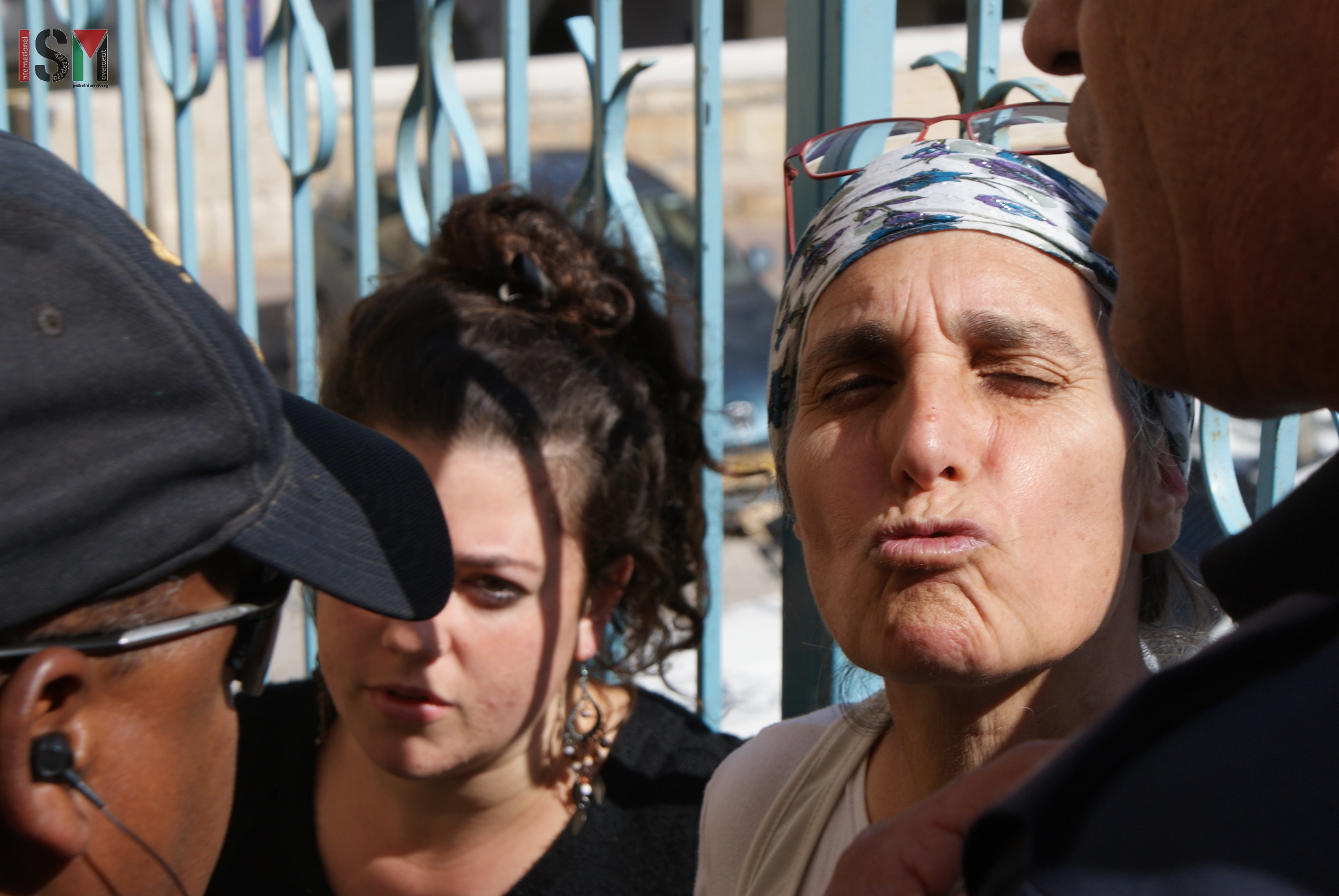
Settler Anat Cohen making fun of school-children denied passage on their way home

School-children blocked on the stairs by Israeli forces
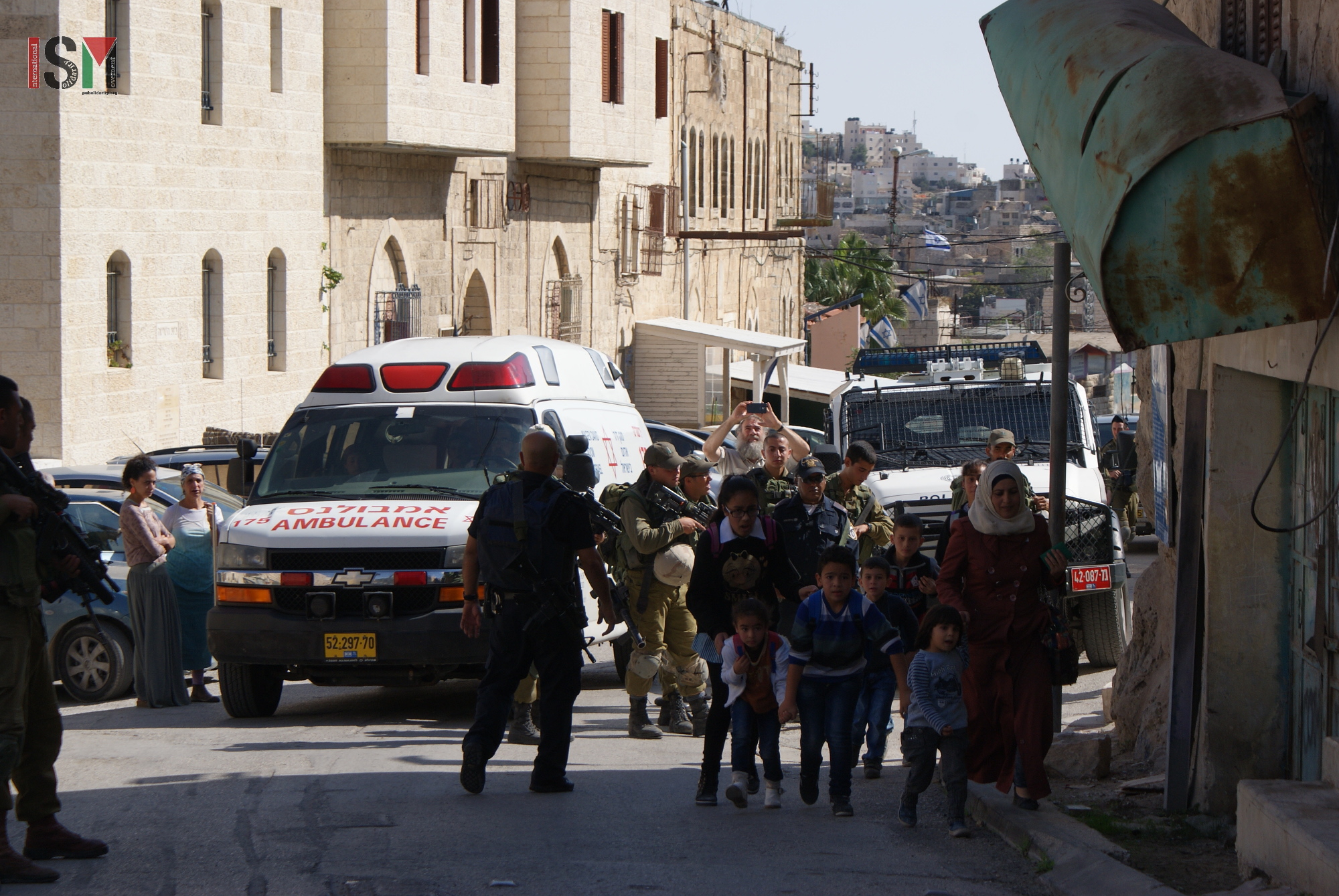
School-children finally allowed to go home after more than an hour of wait
Whereas in the morning, an actual order for a ‘closed military zone’ was still in place, the order was only valid from Saturday morning 8 am till Sunday morning 8am and thus not valid for the end of the school day.
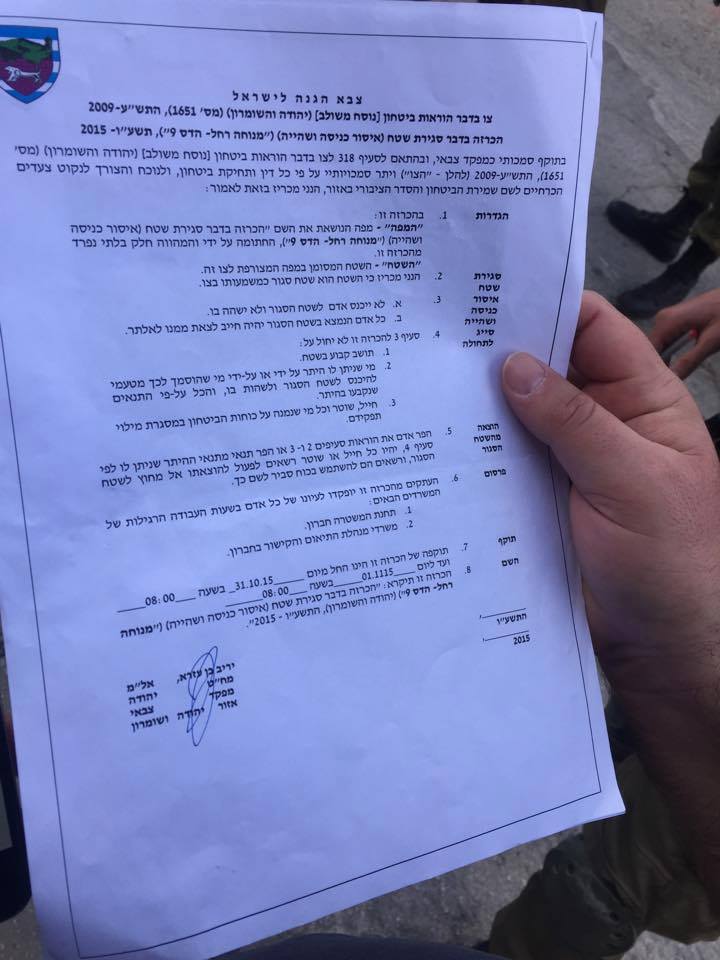
‘Closed military zone’ order Photo credit: Youth Against Settlements
The order for a closed military zone is a clear infringement on Palestinians freedom of movement and clearly only geared towards exactly this aim. Whereas Palestinians all over the areas declared ‘closed’ are forced to undergo constant body-searches, detentions, ID- and bag-searches and are randomly denied access on the soldiers whims, settlers from the illegal settlements within al-Khalil (Hebron) are allowed to freely roam the streets without being stopped at any time. International observers documenting and reporting are facing yet another instance in which Israeli authorities are making determined strides to completely rid Al-Khalil of any witnesses for the myriad and worsening ways in which they violate the basic rights of Palestinians on a daily basis.
All these measures clearly illustrate the real aim of the latest escalations in violence geared towards instilling fear in the Palestinian residents and ultimately force them to leave the area.
Rubio Follows the Big Money
By Jonathan Marshall | Consortium News | November 1, 2015
On the morning of Halloween, the New York Times broke the scary news that Republican presidential contender Marco Rubio had won a big jackpot: the endorsement of billionaire hedge fund investor Paul Singer. But aside from citing Singer’s praise for Rubio’s “message of optimism” and “work on the Senate Foreign Relations Committee,” the story offered little explanation of what could prove to be a decisive turning point in the GOP primary race.
On the policy front, Rubio clearly meets Singer’s requirement for a candidate who favors lower taxes on the rich and, even more important, a blank check for Israel’s right-wing government. With his hawkish stands on the Middle East, including fervent opposition to the Iran nuclear deal, Rubio had already won over another leading Republican “bundler,” New York attorney Phil Rosen, former chairman of American Friends of Likud and a believer that Israel’s conflict with the Palestinians “was, and will always be, a holy war.”
Rubio is a protégé of Florida billionaire Norman Braman, who has contributed at least six figures to support the expansion of Jewish settlements in the occupied territories. Rubio reportedly leads the all-important “Adelson primary,” the race to tap the virtually unlimited cash box of gambling billionaire Sheldon Adelson, the single most prominent U.S. supporter of Israeli Prime Minister Benjamin Netanyahu.
All that is music to Singer’s ears, but Rubio’s “work on the Senate Foreign Relations Committee” is about something else altogether: his political support for Singer’s efforts to drain more than $1.5 billion dollars from Argentina in payments on old bonds that lost most of their value after the country defaulted in 2001.
Singer’s Elliott Management bought that debt several years ago for less than $50 million, and then successfully sued in U.S. court to demand full recovery of the face amount — in the face of opposition from the Obama administration, most other bondholders, and, above all, Argentina’s government, led by President Cristina Fernandez de Kirchner.
Singer, who is famous for his bare-knuckles tactics against foreign governments, has gone after Kirchner’s government on all fronts. Most strategically, he supported the highly questionable claims by an Argentine prosecutor that the Kirchner government tried to cover up the involvement of the Iranian government in the 1994 bombing of the Jewish community center in Buenos Aires, which killed 85 people.
The issue was perfect for a smear campaign: targeting alleged Iranian terrorism and government anti-Semitism, Singer could undercut the legitimacy of the one entity standing between him and huge profits on his speculative bond purchases.
Singer’s Elliot Management is a major backer of American Task Force Argentina, which advocates for full repayment of the Argentine bonds and has spent millions of dollars lobbying Congress. It also spends big bucks to blacken Argentina’s reputation.
As Huffington Post reported in 2013, the group “has launched a broad attack on Argentina in its PR campaign. … Politico ad, paid for by ATFA, slammed the country as a safe haven for narcotics traffickers. Another ATFA ad accuses Argentine President Cristina Kirchner of making a ‘pact with the Devil,’ pointing to a legal memo between her country and Iran involving Argentina’s effort to prosecute Iranian defendants in a terrorism case.”
As one of its lobbyists told Huffington Post, “We do whatever we can to get our government and media’s attention focused on what a bad actor Argentina is.”
An investigation by Charles Davis for Inter Press Service showed that employees of Singer’s Elliott Management contributed more than $95,000 to Sen. Mark Kirk, R-Illinois, who wrote a letter denouncing President Kirchner’s agreement with Iran to investigate the 1994 bombing.
Rep. Michael Grimm, R-NY, who received $38,000 from Elliott Management employees, co-sponsored legislation demanding that Argentina’s bondholders receive full compensation, and called for an investigation of Argentina’s ties with Iran. Other recipients of Singer’s largesse — including AIPAC, The Israel Project and the American Enterprise Institute — also hammered the Kirchner government, virtually accusing it of anti-Semitism.
Last year, another member of Congress got in on the act: Sen. Marco Rubio. While grilling President Obama’s nominee as U.S. ambassador to Argentina, Rubio complained that Buenos Aires “doesn’t pay bondholders, doesn’t work with our security operations. . . . These aren’t the actions of an ally.”
Adding a dig at President Kirchner, he added, “We have this trend in Latin America of people who get elected but then don’t govern democratically. Argentina is an example of this.” His speech triggered an angry response from Kirchner’s Foreign Minister Hector Timerman — an Argentine Jew — calling Rubio an “extremist.”
This May, Rubio introduced a resolution in the Senate suggesting that Kirchner conspired to “cover up Iranian involvement in the 1994 terrorist bombing.” Rubio declared that the issues in the case “extend well beyond Argentina and involve the international community, and more importantly, U.S. national security.”
As Eli Clifton noted, “It turns out that Singer’s hedge fund, Elliott Management, was Rubio’s second largest source of campaign contributions between 2009 and 2014, providing the presidential hopeful with $122,620, according to the nonpartisan Center for Responsive Politics.”
When Kirchner herself had the temerity this spring to link Singer to various neoconservative attacks on her policies, citing a “global modus operandi” to coerce foreign states, the reliably neoconservative editorial page of the Washington Post published an editorial reply titled, “Argentina’s President Resorts to Anti-Semitic Conspiracy Theories.”
To which Jim Lobe and Charles Davis, citing a long list of Singer connections to Kirchner’s critics, replied, “follow the money.” That advice, made famous in the movie version of Watergate’s Deep Throat, remains the best guide to understanding billionaire funding of candidates in the 2016 election.
Palestinian Women from Occupied East Jerusalem Call for Protection
A Statement by the JERUSALEMITE WOMEN’S COALITION | Kafila | October 26, 2015
We women of occupied East Jerusalem call for immediate protection as we witness and suffer the widespread and serious violations of Palestinian human rights, including physical attacks and injuries, severe psychological threats, and persecution by the Israeli settler-colonial state and settler entities.
We urge the international community to act and defend the rights of Palestinian children, women, and men, including the right to a safe life amidst the constant attacks, excessive and indiscriminate use of force used by the Israeli oppressive apparatus, acts of violence and daily terror committed by Israeli Jewish civilians, including settlers. This brutality is intimidating our lives, provoking our youth, willfully causing death and bodily and psychological harm, and disabling and injuring of our community members.
We, a group of Palestinian women, mothers, sisters, daughters and youth—and in the name of the “Jerusalemite Women’s Coalition”—call upon the international community to protect our families, community, and children. We are calling for the protection of our bodily safety and security when in our homes, walking in our neighborhood, reaching schools, clinics, work places, and worships venues.
We are calling for protection, for we feel displaced even at home, as the Israeli soldiers, armed settlers, border patrol, and police invade our homes, attack our
families, strip-search our bodies, and terrorize us all.
We women of occupied East Jerusalem feel as if we are orphans, without any protection from the Palestinian Authority or the international community, as the Israeli state terrorizes our homes, educational institutions, and public spaces. The state’s imposition of collective punishment and sanctions invade not only our physical spaces and bodies, but also our psyches. We live in a state of fear and horror, not knowing how to face the omnipotent power of the highly technologized settler colonial entity, and militarized Israeli state that regularly executes Palestinians in the streets. Palestinians in occupied East Jerusalem have been abandoned, subject to the discriminatory policies of a violent state and its security and police apparatus.
The current political violence and the lack of any protection, as the Israeli security apparatus is protecting Jews only, jeopardizes women’s safety and her economic, social, psychological, and bodily rights, as well as children’s and men’s safety and security. We call for protection, and the implementation of Security Council Resolution 1325 on women, peace, and security, and urge human rights defenders to protect our community from the Israeli machinery of oppression. Our children must be allowed to reach their schools in peace, and our parents and elderly must be able to reach their work places, health institutions and welfare services with safety. We request that we are able to walk in the streets without fearing the attacks of the Israeli security apparatus and its armed settlers.
We are calling to protect women and girls, who are particularly vulnerable to various forms of state violence and mass atrocities. The economic strangulation of Palestinians by the Israeli settler-colonial powers, that have thus far resulted in the total dependency on the Israeli entity, further traps the lives of Palestinians. The feminization of poverty and the economic strangulation of Palestinians in occupied East Jerusalem enslave Palestinians. The feminization of slavery in the colony is apparent when watching Palestinian women turn into domestic workers humiliated, controlled, and oppressed in Israeli public and private entities.
We are aware that humanitarian law attempts to challenge the inherent inhumanity of wars and colonial criminality by requiring international actors to protect civilians. International humanitarian law suggests moral boundaries of the exercise of power in situations of mass violence. International humanitarian law’s main object is primarily to protect and aid victims of violence.
We, the women of occupied East Jerusalem, are politically orphaned. We are victims without protection, as the Palestinian Authority has no right to protect us in our city, and the Israeli state treats us as terrorists that should be humiliated, attacked, violated, and controlled. The guerrilla state style tactics used in occupied East Jerusalem, be it the attacks on Palestinians in the streets, the beating of the young and old, the attacks on children going to and from school, the invasion of violent settlers to our neighborhoods and homes, the control of our life, water, cell phones, internet, mobility, health, economy, and accessibility to other resources, have situated us in human cages—segregated, restrained by Israeli laws and security theology, unable to know what to anticipate and what will come next.
Having to endure all the above difficulties, which have been escalated by Israeli cabinet resolutions and otherwise ignored due to global amnesia, WE ARE CALLING FOR PROTECTION AND URGENT ACTIONS TO PREVENT FURTHER AGONIES, UPROOTING, DEMONIZATION, AND SUFFERING.
Signed by Jerusalemite Women ’s Coalition /Al-tajamo’ Al-nasawiy Almaqdasy.
The Coalition includes a group of Women NGOs and Jerusalemite feminists from all segments of society
Jerusalem 24.10.2015
Featured Video

Why the U.S. Should Pull Back From the First Island Chain
or go to
Aletho News Archives – Video-Images
From the Archives
Only 19.7% of Americans agree with US State Dept on Israeli settlements
… Most American adults of voting age don’t appear willing to reject the applicability of international law to Israel’s ongoing colonization of occupied territories in East Jerusalem, the West Bank and Golan Heights. … Full article
Blog Roll
 Aletho News
- British Government Employees Were Fact-Checking the News at the BBC. Nobody Told You.
- Albania on fire: who’s behind the riots?
- Egypt’s Civil Democratic Movement rejects involvement in regional war
- Egypt collaborates with Israel to build ‘Green Rafah’ project over erased Palestinian city
- Rising fuel prices and shortages have helped drive ongoing protests and rioting in France
- Tokyo protests demand Takaichi’s resignation over support for ‘Israel’
- Jennifer Kavanagh: Why the U.S. Should Pull Back From the First Island Chain
- Yemen denounces international community’s silence on Saudi aggression, siege
- UAE and Saudi Arabia move toward renewed coordination against Sanaa
- How Iran’s two-week retaliatory strikes exposed cracks in US military architecture in Persian Gulf
- If Americans Knew
- More on how Bari Weiss is using CBS on behalf of Israel
- What the UK Is Doing to Pro-Palestine Novelist Sally Rooney Is an Act of Orwellian Villainy
- ‘We will build palaces for Jews in Gaza’: Right-wing activists establish new outpost near border
- ‘You see us burning, you stay silent’: Family’s agony over mother and sons burned to death in Gaza tent
- Israel keeps Palestinian journalist Bushra al-Tawil in isolation for 46 days
- US-Israel integration plan puts US military tech in Israel’s hands
- Israeli Strike Burns Gaza Mother Alive in Front of Toddler, ‘Without Generating Any Headlines’
- ‘The Israel Experience with Mike Huckabee’: The Ambassador’s Family Sells Trips to Israel
- As Gazans carry out mass burial, food insecurity is getting worse – Daily Update
- Israeli rabbi permits occupiers to steal Palestinian olive harvest in West Bank
- No Tricks Zone
- Predictions Made By Renowned Climate Proifessor Over Past Decades Have Been Proven To Be Poor
- New Study Suggests Large Regions Of The Pacific Ocean Have Been Cooling For The Last 80 Years
- Germany’s Green Energy Debacle: High Energy Costs Force Kahla Porzellan to Close After 182 Years!
- New Study: 50 Years Of The Most Aggressive ‘Net Zero’ Policies Can Only Affect The Global Climate By 0.03°C
- US September “Heat” Was No Record…Many Records Set Decades Ago
- Latest European Green Energy Debacle; Portugal’s Largest Flagship Solar Park Insolvent!
- Green Energy Debacle: German Expert Professor Fritz Vahrenholt Warns Of Severe Economic And Social Consequences
- Two More Paleo Reconstructions Affirm Meters-Higher Sea Levels Across Ireland, Brazil 7000-6000 Years Ago
- New Study: Earth And Venus Surface Warmth Largely Explained By Convection And Lapse Rate, Not CO2 Or Radiation
- 2025 Nature Paper Claiming Worsening Global Drought Gets RETRACTED …Heavily Flawed

